

Presented by- Tridib Sharma & Mithisar Basumatary
CLOUD COMPUTING
IN
Cloud computing definition
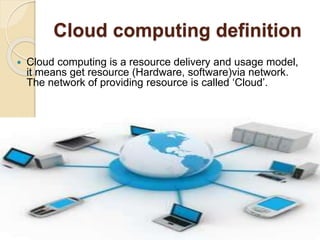
 Cloud computing is a resource delivery and usage model,
it means get resource (Hardware, software)via network.
The network of providing resource is called ‘Cloud’.
www.cloudcomputingchina.com
3
Cloud - Service & Deployment
Models
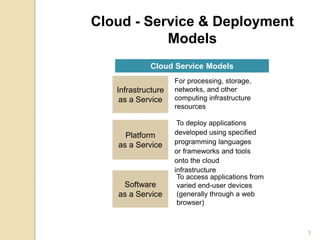
Cloud Service Models
Infrastructure
as a Service
For processing, storage,
networks, and other
computing infrastructure
resources
Platform
as a Service
To deploy applications
developed using specified
programming languages
or frameworks and tools
onto the cloud
infrastructure
Software
as a Service
To access applications from
varied end-user devices
(generally through a web
browser)
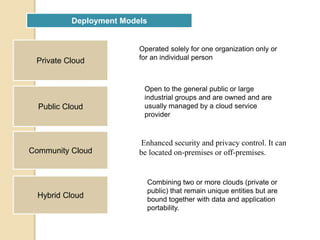
Private Cloud
Public Cloud
Community Cloud
Hybrid Cloud
Operated solely for one organization only or
for an individual person
Open to the general public or large
industrial groups and are owned and are
usually managed by a cloud service
provider
Combining two or more clouds (private or
public) that remain unique entities but are
bound together with data and application
portability.
Deployment Models
Enhanced security and privacy control. It can
be located on-premises or off-premises.
Advantages of Cloud
Computing
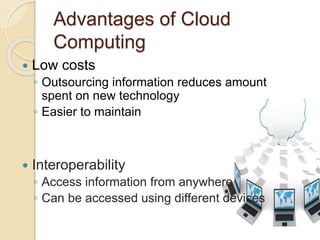
 Low costs
◦ Outsourcing information reduces amount
spent on new technology
◦ Easier to maintain
 Interoperability
◦ Access information from anywhere
◦ Can be accessed using different devices
Advantages of Cloud
Computing
 Increases the adoption of Electronic
medical records.
 Beneficial for small companies
 Easy to share information among
different organizations and doctors
Cloud Computing
Disadvantages
 Security is the main disadvantage of cloud
computing
 Consumers are worried about Insurance
companies getting a hold of there information and
discriminating based upon current medical
conditions they may have or medical conditions
that they could develop later in life.
 They are also worried about government agencies
getting a hold of there information and exploiting it
to third party vendors, or there place of work.
Disadvantages Cont.
 The cloud companies do not always handle all of
the security themselves and sometimes pass it off
to third party vendors
 Consumers need to make sure to thoroughly check
out these companies to see who else they are
involved with and check out there reputation to see
if you trust them to not share your information with
any other outside sources. If the third party vendor
looks trustworthy then you are probably safe to
send your medical records over the cloud safely.
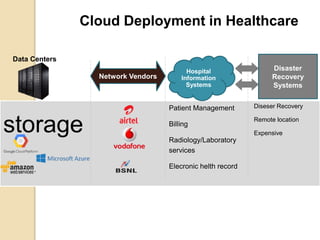
Cloud Deployment in Healthcare
Hospital
Information
Systems
Network Vendors
Disaster
Recovery
Systems
Data Centers
storage
Patient Management
Billing
Radiology/Laboratory
services
Elecronic helth record
Diseser Recovery
Remote location
Expensive
Identified Needs for Expansion of Cloud by
Health Care
• Cost Reduction
• The number one gain to be realized from the
cloud is cost reduction. With all aspects,
including infrastructure, software, and even
management paid for on a per-use-basis, cloud
greatly reduces the cost. No investment in any
physical resources coupled with paying only for
needed resources makes cloud an attractive
option financially
Identified Needs for Expansion of Cloud by
Health Care
• Disaster Recovery
The processes, policies and procedures to
prepare for recovery or continuation of the
organizations technology infrastructure after a
natural or man-made disaster
Identified Needs for Expansion of Cloud by
Health Care
• Storage Scalability
Maintaining storage and traffic load during the
peak traffic load for a customer, without adding
additional hardware or infrastructure without
interference to the customer workload
13
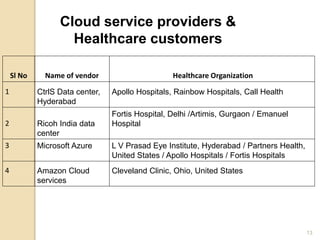
Sl No Name of vendor Healthcare Organization
1 CtrlS Data center,
Hyderabad
Apollo Hospitals, Rainbow Hospitals, Call Health
2 Ricoh India data
center
Fortis Hospital, Delhi /Artimis, Gurgaon / Emanuel
Hospital
3 Microsoft Azure L V Prasad Eye Institute, Hyderabad / Partners Health,
United States / Apollo Hospitals / Fortis Hospitals
4 Amazon Cloud
services
Cleveland Clinic, Ohio, United States
Cloud service providers &
Healthcare customers
Conclusion
 Right Information at right time saves
life.
 Economical and Efficient.
 Better management practice.
 Improve and solve several collaborative
information issues in healthcare
organizations.
Cloud computing in healthcare

Cloud computing in healthcare

  • 1.
    Presented by- TridibSharma & Mithisar Basumatary CLOUD COMPUTING IN
  • 2.
    Cloud computing definition Cloud computing is a resource delivery and usage model, it means get resource (Hardware, software)via network. The network of providing resource is called ‘Cloud’. www.cloudcomputingchina.com
  • 3.
    3 Cloud - Service& Deployment Models Cloud Service Models Infrastructure as a Service For processing, storage, networks, and other computing infrastructure resources Platform as a Service To deploy applications developed using specified programming languages or frameworks and tools onto the cloud infrastructure Software as a Service To access applications from varied end-user devices (generally through a web browser)
  • 4.
    Private Cloud Public Cloud CommunityCloud Hybrid Cloud Operated solely for one organization only or for an individual person Open to the general public or large industrial groups and are owned and are usually managed by a cloud service provider Combining two or more clouds (private or public) that remain unique entities but are bound together with data and application portability. Deployment Models Enhanced security and privacy control. It can be located on-premises or off-premises.
  • 5.
    Advantages of Cloud Computing Low costs ◦ Outsourcing information reduces amount spent on new technology ◦ Easier to maintain  Interoperability ◦ Access information from anywhere ◦ Can be accessed using different devices
  • 6.
    Advantages of Cloud Computing Increases the adoption of Electronic medical records.  Beneficial for small companies  Easy to share information among different organizations and doctors
  • 7.
    Cloud Computing Disadvantages  Securityis the main disadvantage of cloud computing  Consumers are worried about Insurance companies getting a hold of there information and discriminating based upon current medical conditions they may have or medical conditions that they could develop later in life.  They are also worried about government agencies getting a hold of there information and exploiting it to third party vendors, or there place of work.
  • 8.
    Disadvantages Cont.  Thecloud companies do not always handle all of the security themselves and sometimes pass it off to third party vendors  Consumers need to make sure to thoroughly check out these companies to see who else they are involved with and check out there reputation to see if you trust them to not share your information with any other outside sources. If the third party vendor looks trustworthy then you are probably safe to send your medical records over the cloud safely.
  • 9.
    Cloud Deployment inHealthcare Hospital Information Systems Network Vendors Disaster Recovery Systems Data Centers storage Patient Management Billing Radiology/Laboratory services Elecronic helth record Diseser Recovery Remote location Expensive
  • 10.
    Identified Needs forExpansion of Cloud by Health Care • Cost Reduction • The number one gain to be realized from the cloud is cost reduction. With all aspects, including infrastructure, software, and even management paid for on a per-use-basis, cloud greatly reduces the cost. No investment in any physical resources coupled with paying only for needed resources makes cloud an attractive option financially
  • 11.
    Identified Needs forExpansion of Cloud by Health Care • Disaster Recovery The processes, policies and procedures to prepare for recovery or continuation of the organizations technology infrastructure after a natural or man-made disaster
  • 12.
    Identified Needs forExpansion of Cloud by Health Care • Storage Scalability Maintaining storage and traffic load during the peak traffic load for a customer, without adding additional hardware or infrastructure without interference to the customer workload
  • 13.
    13 Sl No Nameof vendor Healthcare Organization 1 CtrlS Data center, Hyderabad Apollo Hospitals, Rainbow Hospitals, Call Health 2 Ricoh India data center Fortis Hospital, Delhi /Artimis, Gurgaon / Emanuel Hospital 3 Microsoft Azure L V Prasad Eye Institute, Hyderabad / Partners Health, United States / Apollo Hospitals / Fortis Hospitals 4 Amazon Cloud services Cleveland Clinic, Ohio, United States Cloud service providers & Healthcare customers
  • 14.
    Conclusion  Right Informationat right time saves life.  Economical and Efficient.  Better management practice.  Improve and solve several collaborative information issues in healthcare organizations.

Editor's Notes

  • #11 As mentioned here, the most prominent improvement to HIT by cloud is the low cost. Kuo (2011) shared examples of Amazon Elastic Compute Cloud (EC2) being only $0.1 per hour for 1.0-GHz and the Amazon Simple Storage Solution (S3) rates at $0.12 to $0.15 per gigabyte-month, all at 2011 rates, which are known to have been reducing continually due to the current cloud race (Kuo, 2011). Gaining a cost effective solution with no need to evaluate hardware or software, and no hiring and training of internal IT staff, allows organizations to concentrate on their core business (Kuo, 2011). The ability for health care organizations to operate this way in the cloud is invaluable to the expansion of HIT and to finally reduce costs and realize an ROI for organizations of any size. In addition to these considerations there are additional needs for health care to finally adopt and expand into the cloud.
  • #12 A number of factors including an aging population and the growing need for patient data to be ubiquitous anywhere at any time including on mobile devices has emphasized the need to have data easily recovered in a disaster. The requirement to have patient’s health information available at their fingertips, whether in Aruba or aging at home, isn’t going away, but rather growing every year. As the American public becomes more and more accustomed to having every type of information available on their mobile devices that level of expectation will migrate to health care quicker than can be imagined. The ever present need of having options to continue operations no matter the difficult situation is a key feature of cloud deployments. Cloud’s ease of replication and mirroring of data ensures seamless disaster recovery. The ability to have resources deployed in multiple locations allowing health care organizations to continue operations no matter the circumstances is invaluable. Avoidance of system failure and redundancy are key features common to cloud service providers. The increase in redundancy itself provides a certain level of disaster recovery. Additionally, the capability to reallocate security resources dynamically for areas such as filtering, traffic shaping, and encryption against such disasters as a distributed denial-of-service attack is a natural advantage for disaster recovery (Kuo, 2011). The current disaster recover options outside the cloud are expensive, cumbersome, and not always readily instantly available. Cloud disaster recovery platforms are an excellent match due to their pay-as-you-go pricing and rapid recovery after a disaster. Two other advantages to cloud disaster recovery are that cloud resources are easily added at the level needed without a large capital investment, and the cloud platform manages and maintains the disaster recovery servers and storage, reducing IT costs and the impact of failures at the disaster site. Cost reductions of up to 85% have been reported using the cloud disaster recovery model (Wood, Cecchet, Ramakrishnan, Shenoy, Van der Merwe, & Venkataramani, 2010).
  • #13 Data drives almost every venture in the 21st Century and the unimaginable growth of data has driven the need for storage solutions that are scalable both up and down as well as being cost effective. Cloud storage may be scaled to any size needed from storing minute pieces of research data and EHRs to storing large capacity Digital Imaging and Communications in Medicine (DICOM) images. Cloud providers such as EC2 are available that have the capacity to store and retrieve tremendous amounts of data (Cardenosa, Diez, Coronado, & Rodrigues, 2012). Storage scalability benefits health care organizations at every level. The burden of storage is shifted to the cloud provider for both a small organizations with a very small IT staff or large hospitals with a very large IT staff (Kuo, 2011). In an interview study and literature review by Bollineni et al. (2011), the storage scalability available in the cloud without interference to the work being performed was repeatedly cited as both a need and a benefit to health care (Bollineni et al., 2011). High capacity computing, which is used in the handling of large amounts of data, is currently being tested for scalability in the cloud and thus far the results have been very promising (Vilaplana, Solsona, Abella, Filgueira, & Rius, 2013).