Hybrid Cloud Implementation
Sai Mishra
What is Cloud Computing?
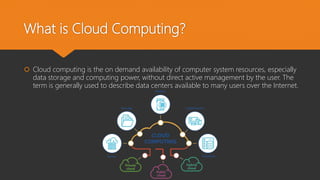
 Cloud computing is the on demand availability of computer system resources, especially
data storage and computing power, without direct active management by the user. The
term is generally used to describe data centers available to many users over the Internet.
What is Hybrid Cloud?
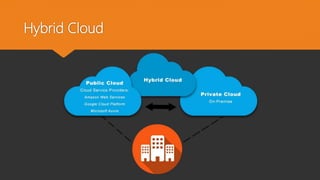
 Hybrid cloud is a mix of private cloud and third-party, public cloud services with
orchestration between the two platforms.
 By allowing workloads to move between private and public clouds as computing needs
and costs change.
 Hybrid cloud gives businesses greater flexibility and more data deployment options.
 According to the 2016 State of the Cloud report by RightScale, hybrid cloud adoption
from 58 to 71 percent year over year.
 Egenera PAN Cloud Director, RightScale Cloud Management and Cisco CloudCenter
help businesses handle workflow creation, service catalogs, billing and other tasks
related to hybrid cloud.
Hybrid Cloud
Hybrid cloud Architecture
The idea of the tiered
hybrid pattern is to focus first
on deploying existing
frontend applications to the
public cloud. In this pattern,
you reuse existing backend
applications that stay in their
private computing
environment. You migrate
frontend applications case by
case.
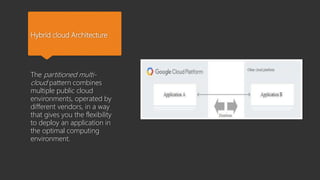
Hybrid cloud Architecture
The partitioned multi-
cloud pattern combines
multiple public cloud
environments, operated by
different vendors, in a way
that gives you the flexibility
to deploy an application in
the optimal computing
environment.
Key Considerations for Hybrid Cloud
 How to determine the placement of solution components ?
 How to integrate with existing enterprise systems ?
 How to handle an increase of management complexity ?
 How to ensure that security is considered in all aspects of the hybrid cloud ?
 How to deal with rapidly evolving and partially mature technologies ?
 How to implement common operational services such as backup and disaster recovery
in a hybrid cloud ?
 How to ensure adherence to regulatory and compliance requirements ?
Implementation of Hybrid Cloud
Depending on the maturity of the organization and the level of adoption of cloud
computing, the entry point will change for each new service being evaluated: -
 Determine cloud deployment model for applications and data.
 Integrate with existing enterprise services.
 Address connectivity requirements.
 Develop governance policies and service agreements.
 Assess and resolve security and privacy challenges.
 Manage the hybrid cloud environment.
 Consider a backup, archive and disaster recovery plan.
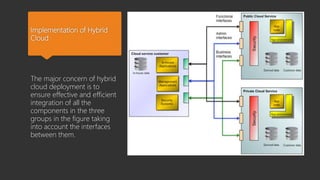
Implementation of Hybrid
Cloud
The major concern of hybrid
cloud deployment is to
ensure effective and efficient
integration of all the
components in the three
groups in the figure taking
into account the interfaces
between them.
1.Determine cloud deployment model for
applications and data.
 Determine the right resource model – on-premises private cloud, hosted private cloud,
or public cloud.
 Rationalize application and data environment.
 Apply decision criteria to define the right deployment model – flexibility, security, speed
& automation, cost, locality, service levels, and system interdependencies.
 IT architects consider options for application placement in the hybrid cloud.
2. Integrate with existing enterprise systems
 Put in place controlled interfaces by which components in cloud services can access
applications and/or data in on-premises systems – consider technologies such as API
Management.
 Consider the administration and business aspects of the integration as well as the
functional integration of the systems.
 Demand that the cloud service provider supports standards for the interfaces to their
cloud services
3. Address connectivity requirements
 Consider the requirements of each link between components that spans two or more
cloud services or on-premises system and ensure that appropriate connectivity is
available to support those requirements.
 Consider the use of network virtualization if available.
 Ensure that the connectivity capabilities can support resilience and disaster recovery
requirements.
4. Develop governance policies and service
agreements
 Assess existing compliance and governance frameworks, identify gaps and harmonize
processes.
 The need for thorough and efficient change management and communications
increases with the addition of multiple cloud service providers.
 Allow adequate time to educate and habituate changes across the organization.
 Identify gaps in measurement and management visibility.
5. Assess and resolve security and privacy
issues
 Understand the interfaces between components running in private cloud services, in
public cloud services and on-premises and apply appropriate and consistent security
controls to each of them.
 Evaluate the location of all datasets in the hybrid cloud deployment and ensure the
application of consistent access controls and encryption.
 When migrating application components between environments, be careful to check that
the security controls in place for the new environment meet or exceed those in place for
the old environment.
 Apply technologies across all the environments that are part of the hybrid cloud
deployment – for example, single IdAM system and Single-Sign-On.
6. Manage the cloud environment
 Enable management of the complete hybrid cloud system, spanning all the
environments used.
 Either adapt and integrate existing on-premises management tools or consider use of
new cloud based management services, based on cost and functionality.
 Look for APIs and integration points for management capabilities rather than fixed
function management applications.
7. Consider backup, archive and disaster
recovery plan
 Monitor the frequency of backup and archiving as this will drive cloud service provider costs.
 For public cloud workloads and components, make certain legal agreements are in place, as
necessary.
 The location of the backup and archive data will determine the Recovery Time Objective (RTO)
for restore and retrieval. The RTO will be lower if they are collocated with the primary data.
Restoring over the WAN will introduce latencies that will increase the RTO. The architectural
decision in this regard must be made to meet the SLAs.
 Determine what resiliency and backup capabilities are provided out-of-the-box for the cloud
services portion of the hybrid cloud deployment.
 For offsite backup and archiving of sensitive, proprietary or financial data, make certain the cloud
service providers’ physical location is permissible and acceptable given legal and regulatory
constraints.
Strategic Road map
BT recommends that
companies consider two
additional factors in choosing
the optimal cloud solution
for a specific application:
1) Data Sensitivity
2) Process Criticality
Thank You
The implications of the hybrid cloud for your IT organization may seem daunting and
encourage you to take a long-term approach. However, this should not stop you from
initiating the process and take on the cloud today. It is possible to start adopting the cloud,
even if the IT organization is not yet fully prepared for their services broker role.

Hybrid Cloud and Its Implementation

  • 1.
  • 2.
    What is CloudComputing?  Cloud computing is the on demand availability of computer system resources, especially data storage and computing power, without direct active management by the user. The term is generally used to describe data centers available to many users over the Internet.
  • 3.
    What is HybridCloud?  Hybrid cloud is a mix of private cloud and third-party, public cloud services with orchestration between the two platforms.  By allowing workloads to move between private and public clouds as computing needs and costs change.  Hybrid cloud gives businesses greater flexibility and more data deployment options.  According to the 2016 State of the Cloud report by RightScale, hybrid cloud adoption from 58 to 71 percent year over year.  Egenera PAN Cloud Director, RightScale Cloud Management and Cisco CloudCenter help businesses handle workflow creation, service catalogs, billing and other tasks related to hybrid cloud.
  • 4.
  • 5.
    Hybrid cloud Architecture Theidea of the tiered hybrid pattern is to focus first on deploying existing frontend applications to the public cloud. In this pattern, you reuse existing backend applications that stay in their private computing environment. You migrate frontend applications case by case.
  • 6.
    Hybrid cloud Architecture Thepartitioned multi- cloud pattern combines multiple public cloud environments, operated by different vendors, in a way that gives you the flexibility to deploy an application in the optimal computing environment.
  • 7.
    Key Considerations forHybrid Cloud  How to determine the placement of solution components ?  How to integrate with existing enterprise systems ?  How to handle an increase of management complexity ?  How to ensure that security is considered in all aspects of the hybrid cloud ?  How to deal with rapidly evolving and partially mature technologies ?  How to implement common operational services such as backup and disaster recovery in a hybrid cloud ?  How to ensure adherence to regulatory and compliance requirements ?
  • 8.
    Implementation of HybridCloud Depending on the maturity of the organization and the level of adoption of cloud computing, the entry point will change for each new service being evaluated: -  Determine cloud deployment model for applications and data.  Integrate with existing enterprise services.  Address connectivity requirements.  Develop governance policies and service agreements.  Assess and resolve security and privacy challenges.  Manage the hybrid cloud environment.  Consider a backup, archive and disaster recovery plan.
  • 9.
    Implementation of Hybrid Cloud Themajor concern of hybrid cloud deployment is to ensure effective and efficient integration of all the components in the three groups in the figure taking into account the interfaces between them.
  • 10.
    1.Determine cloud deploymentmodel for applications and data.  Determine the right resource model – on-premises private cloud, hosted private cloud, or public cloud.  Rationalize application and data environment.  Apply decision criteria to define the right deployment model – flexibility, security, speed & automation, cost, locality, service levels, and system interdependencies.  IT architects consider options for application placement in the hybrid cloud.
  • 11.
    2. Integrate withexisting enterprise systems  Put in place controlled interfaces by which components in cloud services can access applications and/or data in on-premises systems – consider technologies such as API Management.  Consider the administration and business aspects of the integration as well as the functional integration of the systems.  Demand that the cloud service provider supports standards for the interfaces to their cloud services
  • 12.
    3. Address connectivityrequirements  Consider the requirements of each link between components that spans two or more cloud services or on-premises system and ensure that appropriate connectivity is available to support those requirements.  Consider the use of network virtualization if available.  Ensure that the connectivity capabilities can support resilience and disaster recovery requirements.
  • 13.
    4. Develop governancepolicies and service agreements  Assess existing compliance and governance frameworks, identify gaps and harmonize processes.  The need for thorough and efficient change management and communications increases with the addition of multiple cloud service providers.  Allow adequate time to educate and habituate changes across the organization.  Identify gaps in measurement and management visibility.
  • 14.
    5. Assess andresolve security and privacy issues  Understand the interfaces between components running in private cloud services, in public cloud services and on-premises and apply appropriate and consistent security controls to each of them.  Evaluate the location of all datasets in the hybrid cloud deployment and ensure the application of consistent access controls and encryption.  When migrating application components between environments, be careful to check that the security controls in place for the new environment meet or exceed those in place for the old environment.  Apply technologies across all the environments that are part of the hybrid cloud deployment – for example, single IdAM system and Single-Sign-On.
  • 15.
    6. Manage thecloud environment  Enable management of the complete hybrid cloud system, spanning all the environments used.  Either adapt and integrate existing on-premises management tools or consider use of new cloud based management services, based on cost and functionality.  Look for APIs and integration points for management capabilities rather than fixed function management applications.
  • 16.
    7. Consider backup,archive and disaster recovery plan  Monitor the frequency of backup and archiving as this will drive cloud service provider costs.  For public cloud workloads and components, make certain legal agreements are in place, as necessary.  The location of the backup and archive data will determine the Recovery Time Objective (RTO) for restore and retrieval. The RTO will be lower if they are collocated with the primary data. Restoring over the WAN will introduce latencies that will increase the RTO. The architectural decision in this regard must be made to meet the SLAs.  Determine what resiliency and backup capabilities are provided out-of-the-box for the cloud services portion of the hybrid cloud deployment.  For offsite backup and archiving of sensitive, proprietary or financial data, make certain the cloud service providers’ physical location is permissible and acceptable given legal and regulatory constraints.
  • 17.
    Strategic Road map BTrecommends that companies consider two additional factors in choosing the optimal cloud solution for a specific application: 1) Data Sensitivity 2) Process Criticality
  • 18.
    Thank You The implicationsof the hybrid cloud for your IT organization may seem daunting and encourage you to take a long-term approach. However, this should not stop you from initiating the process and take on the cloud today. It is possible to start adopting the cloud, even if the IT organization is not yet fully prepared for their services broker role.