Topic 1
Foundations of Environmental
Systems and Societies
1.3 Energy and Equilibria
Ecosystems
• Most of the systems we will look at are
ecosystems (self contained communities of living
things and their surrounding environment)
• Very large ecosystems which span a fairly stable
climate are biomes
• Many biologists say the whole planet is a single
ecosystem (e.g. Gaia Theory). Some of them call
it a CLOSED ecosytem
Biomes and Biospheres
• Biome – An open ecosystem in a
geographically defined area with similar
climatic conditions throughout – eg, desert,
grassland (savannah), tropical rainforest
• Biosphere – A closed ecosytem – generally
made up of a range of biomes (i.e. the entire
Earth)
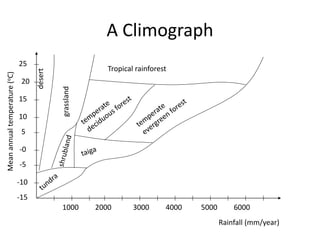
A Climograph
Meanannualtemperature(oC)
Rainfall (mm/year)
-15
-10
-5
-0
5
10
15
20
25
1000 2000 3000 4000 5000 6000
desert
grassland Tropical rainforest
The Laws of Thermodynamics
• 1st Law:
Energy can neither be created nor destroyed. It is
conserved and transformed from one form to another
• 2nd Law:
Entropy of a system always increases
i.e. energy always changes to a less concentrated, less
useful form, and therefore disorder increases
Equilibrium
• A system needs to be in equilibrium
• If not, entropy will increase so much the
system will destroy itself by becoming too
disordered
• There a 4 kinds of equilibrium:
– Static
– Steady State
– Stable
– unstable
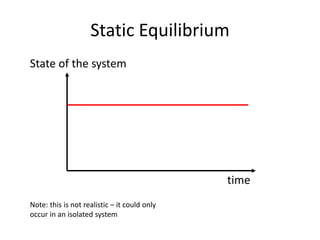
Static Equilibrium
time
State of the system
Note: this is not realistic – it could only
occur in an isolated system
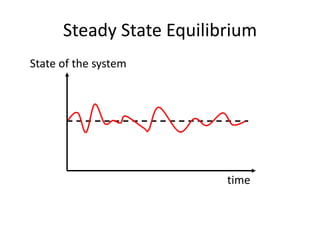
Steady State Equilibrium
time
State of the system
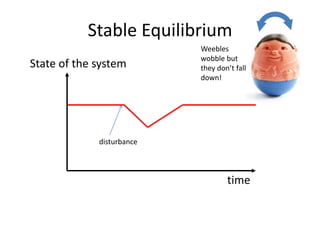
Stable Equilibrium
time
State of the system
disturbance
Weebles
wobble but
they don’t fall
down!
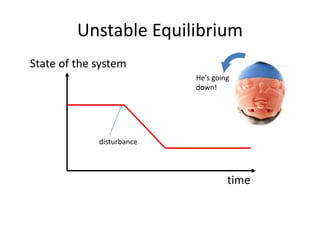
Unstable Equilibrium
time
State of the system
disturbance
He’s going
down!
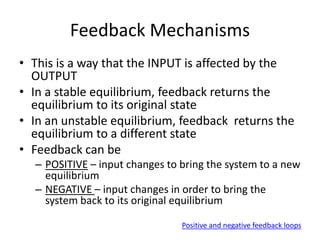
Feedback Mechanisms
• This is a way that the INPUT is affected by the
OUTPUT
• In a stable equilibrium, feedback returns the
equilibrium to its original state
• In an unstable equilibrium, feedback returns the
equilibrium to a different state
• Feedback can be
– POSITIVE – input changes to bring the system to a new
equilibrium
– NEGATIVE – input changes in order to bring the
system back to its original equilibrium
Positive and negative feedback loops
Negative Feedback
• Your (stable) equilibrium body temperature is
37oC
• Sensors in the skin detect your skin
temperature is rising (you are in Cancún)
• Show what happens in a system diagram
Positive Feedback
• Your (stable) equilibrium body temperature is
37oC
• Sensors in the skin detect your skin
temperature is decreasing (you are locked in a
freezer)
• Your body is unable to maintain its stable
equibilibrium and therefore you enter a state
of hypothermia
• Show what happens in a system diagram
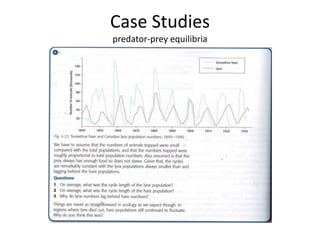
Case Studies
predator-prey equilibria

Summary of topic 1.3

  • 1.
    Topic 1 Foundations ofEnvironmental Systems and Societies 1.3 Energy and Equilibria
  • 2.
    Ecosystems • Most ofthe systems we will look at are ecosystems (self contained communities of living things and their surrounding environment) • Very large ecosystems which span a fairly stable climate are biomes • Many biologists say the whole planet is a single ecosystem (e.g. Gaia Theory). Some of them call it a CLOSED ecosytem
  • 3.
    Biomes and Biospheres •Biome – An open ecosystem in a geographically defined area with similar climatic conditions throughout – eg, desert, grassland (savannah), tropical rainforest • Biosphere – A closed ecosytem – generally made up of a range of biomes (i.e. the entire Earth)
  • 4.
    A Climograph Meanannualtemperature(oC) Rainfall (mm/year) -15 -10 -5 -0 5 10 15 20 25 10002000 3000 4000 5000 6000 desert grassland Tropical rainforest
  • 5.
    The Laws ofThermodynamics • 1st Law: Energy can neither be created nor destroyed. It is conserved and transformed from one form to another • 2nd Law: Entropy of a system always increases i.e. energy always changes to a less concentrated, less useful form, and therefore disorder increases
  • 6.
    Equilibrium • A systemneeds to be in equilibrium • If not, entropy will increase so much the system will destroy itself by becoming too disordered • There a 4 kinds of equilibrium: – Static – Steady State – Stable – unstable
  • 7.
    Static Equilibrium time State ofthe system Note: this is not realistic – it could only occur in an isolated system
  • 8.
  • 9.
    Stable Equilibrium time State ofthe system disturbance Weebles wobble but they don’t fall down!
  • 10.
    Unstable Equilibrium time State ofthe system disturbance He’s going down!
  • 11.
    Feedback Mechanisms • Thisis a way that the INPUT is affected by the OUTPUT • In a stable equilibrium, feedback returns the equilibrium to its original state • In an unstable equilibrium, feedback returns the equilibrium to a different state • Feedback can be – POSITIVE – input changes to bring the system to a new equilibrium – NEGATIVE – input changes in order to bring the system back to its original equilibrium Positive and negative feedback loops
  • 12.
    Negative Feedback • Your(stable) equilibrium body temperature is 37oC • Sensors in the skin detect your skin temperature is rising (you are in Cancún) • Show what happens in a system diagram
  • 13.
    Positive Feedback • Your(stable) equilibrium body temperature is 37oC • Sensors in the skin detect your skin temperature is decreasing (you are locked in a freezer) • Your body is unable to maintain its stable equibilibrium and therefore you enter a state of hypothermia • Show what happens in a system diagram
  • 14.