Presented by
MARIYA RAJU
•Thermophiles
•Mesophiles
•Halophiles
•Psychrophiles
What is an Extremophile?
• Extremophiles are organisms that live in ‘Extreme Environments’
• Under high Pressure and Temperature
• Unique enzymes used by these organisms - ‘Extremozymes’
• Enable the organisms to function in ‘Extreme Environments’
Extremophile, produce some of the bright colors of Grand Prismatic Spring,Yellowstone National Park
Classification of Extremophiles
Acidophile
• An organism with optimal growth at pH levels of 3 or below
Bacillus Clausii
Citrobacter freundi
Serratia marcesce
Alkaliphile
• An organism with optimal growth at pH levels of 9 or above
Thiohalospira alkaliphila Halorhodospira halochloris
Anaerobe
 Organism that does not require oxygen for growth
 Eg: Spinoloricus Cinzia
 Two sub-types exist:
 Facultative anaerobe & Obligate anaerobe
 Facultative anaerobe can tolerate anaerobic and aerobic conditions
 Obligate anaerobe would die in the presence of even trace levels of oxygen
Spinoloricus Cinzia Actinomyces
staphylococcus_haemolyticus Streptococcus anginosus Pleural Shewanella oneidensis
Clostridium difficile
Cryptoendolith
• Organism that lives in microscopic spaces within rocks
• These may also be called Endolith
• Term Endolith that also includes organisms populating fissures, aquifers,
and faults filled with groundwater in the deep sub surface
fluorescentendolith Cryptoendolith
• An organism that lives underneath rocks in cold deserts
Hypolith
Lithoautotroph
• Organism (usually bacteria) ,whose source of carbon is carbon dioxide
• Eg: Nitrosomonas europaea
• They are capable of deriving energy from reduced mineral compounds
like pyrites
• They are active in geochemical cycling and the weathering of parent
bedrock to form soil
Nitrosomonas europaea
Metallotolerant
• Organisms tolerating high levels of dissolved heavy metals in solution
• Such as copper, cadmium, arsenic, and zinc
• Eg; Ferroplasma sp., Cupriavidus metallidurans
Cupriavidus metallidurans.
Ferroplasma
• Organisms grow in environments with a high sugar concentration
Osmophile
Saccharomyces rouxii Zygosaccharomyces bailii Wallemia sebi
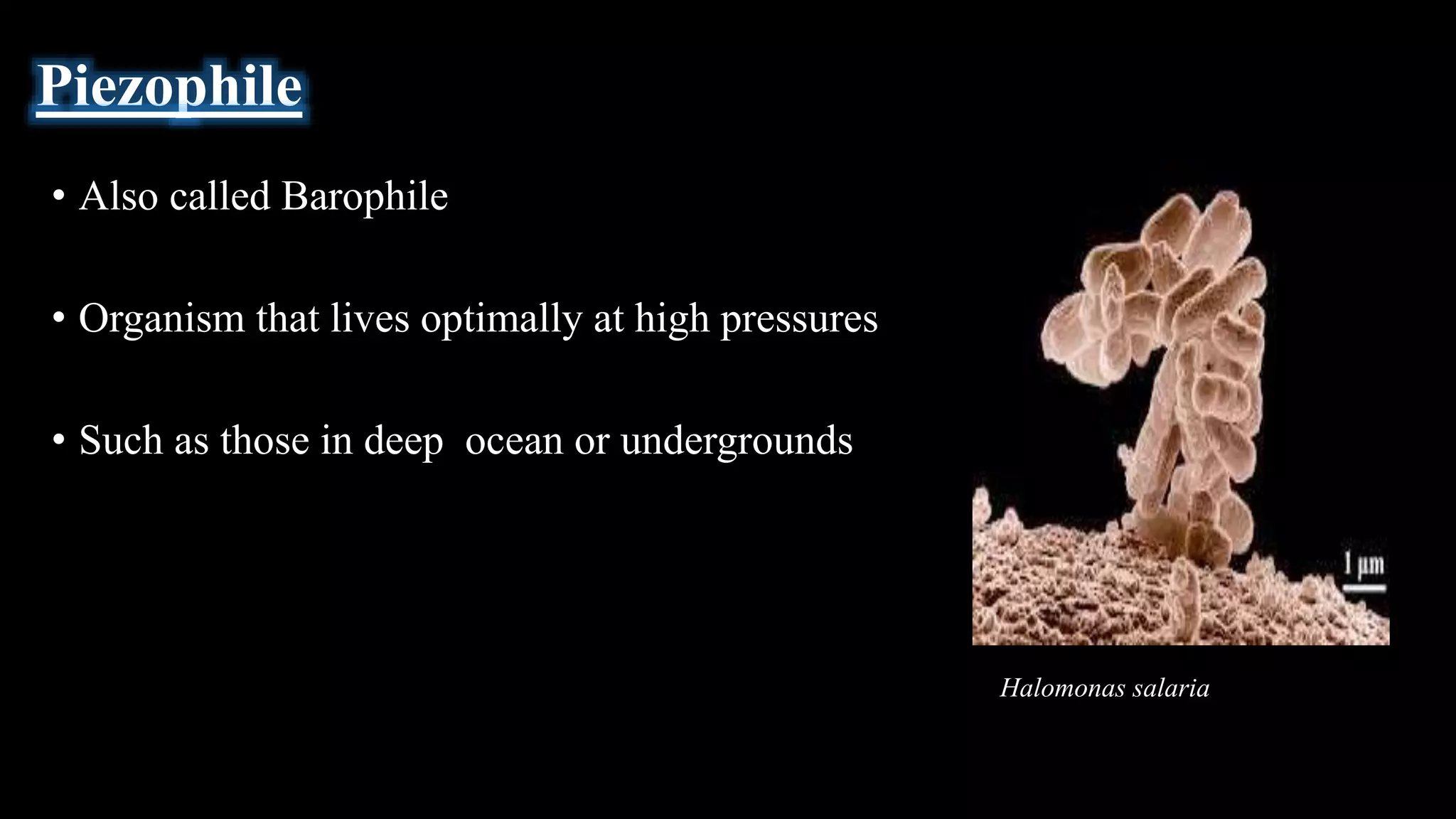
Piezophile
• Also called Barophile
• Organism that lives optimally at high pressures
• Such as those in deep ocean or undergrounds
Halomonas salaria
Radioresistant
• Organisms resistant to high levels of ionizing radiation
• Most commonly to ultraviolet radiation
• Also including organisms capable of resisting nuclear radiation
Thermococcus_gammatolerans Milnesium tardigradum
Xerophile
• Organism that can grow in extremely dry, desiccating conditions
• This type is mainly found in soil microbes of the Atacama Desert
Trichosporonoides nigrescens
Atacama Desert
Thermophiles
• Organisms that thrives at relatively high temperatures
• Between 41 and 122 °C (106 and 252 °F)
• Many thermophiles are archaea
• Thermophilic eubacteria are suggested to have been among the earliest
bacteria
Cont……
• Thermophiles are found in various geothermally heated regions of the
Earth
• Such as hot springs (Yellowstone National Park )
• Hydrothermal vents
• Deep sea
• Decaying plant matter, such as peat bogs and compost
Cont……
• Thermophiles contain enzymes that can function at high temperatures
• Some of these enzymes are used in molecular biology
• Eg: Heat-stable DNA polymerases for PCR, and in washing agents.
Thermophile Classification
• Classified into Obligate & Facultative thermophiles
• Obligate thermophiles - Extreme thermophiles
• Require high temperatures for growth
• Facultative thermophiles -Moderate thermophiles
• Thrive at high temperatures, but also at lower temperatures - below 50 °C
(122 °F)
Cont……
• Hyperthermophiles are particularly extreme thermophiles for which the optimal
temperatures are above 80 °C (176 °F)
• Bacteria within the Alicyclobacillus genus are acidophilic thermophiles, which
can cause contamination in fruit juice drinks
Cont……
• Hyperthermophiles membranes and proteins are unusually stable at
extreme high temperatures
• Thus, many important biotechnological processes use thermophilic
enzymes
• Many of the hyperthermophiles Archea require elemental sulfur for growth
• Some are anaerobes that use the sulfur instead of oxygen as an electron
acceptor during cellular respiration.
Cont……
• Some are lithotrophs that oxidize sulfur to sulfuric acid as an energy
source
• These organisms are inhabitants of hot, sulfur-rich environments usually
associated with volcanism, such as hot springs, geysers, and fumaroles
• They are colored, due to the presence of photosynthetic pigments
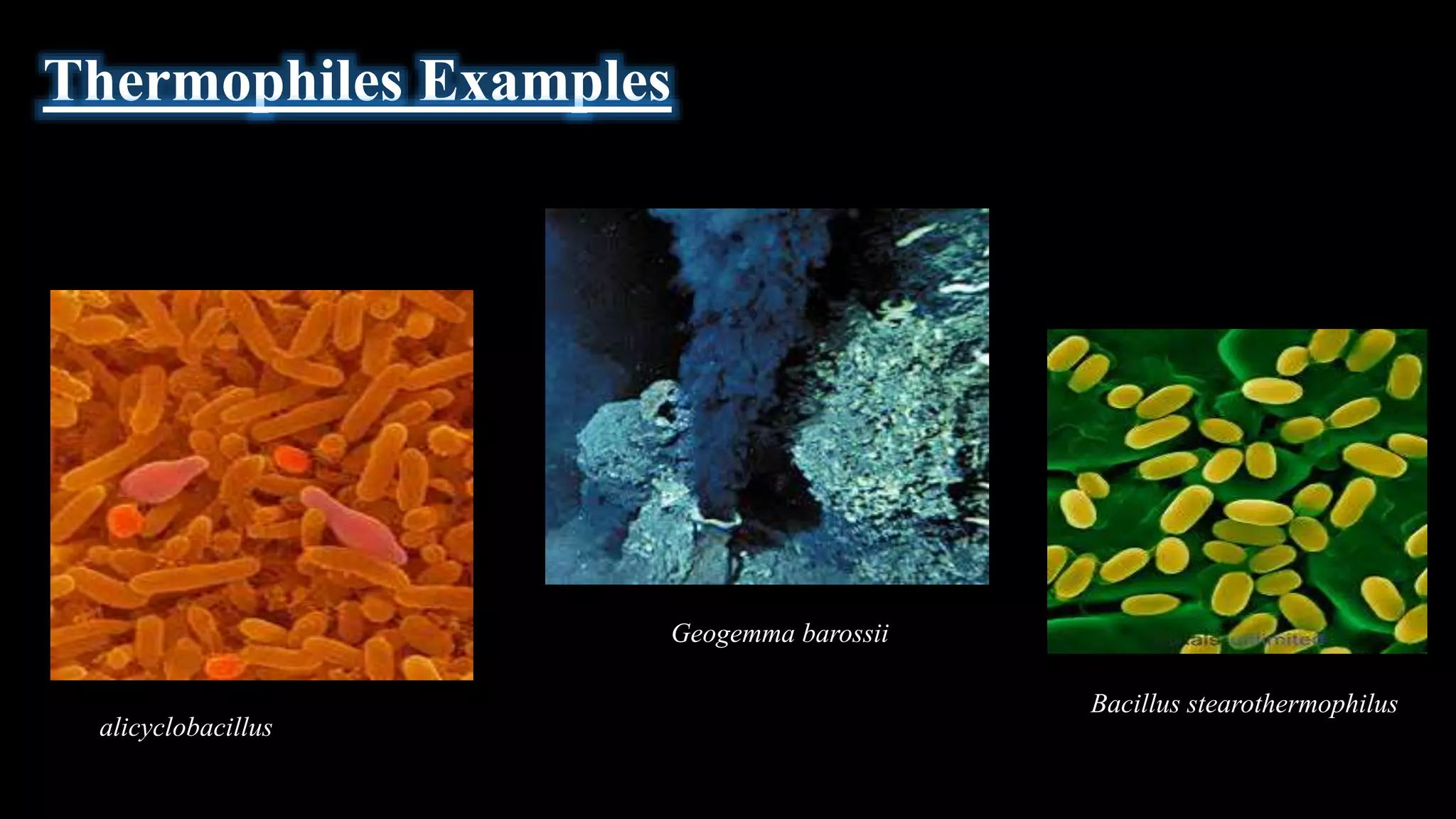
Thermophiles Examples
alicyclobacillus
Geogemma barossii
Bacillus stearothermophilus
Thermus aquaticus
Mesophiles
• Organism that grows best in moderate temperature
• Neither too hot nor too cold
• Typically between 20 and 45 °C (68 and 113 °F)
• The term is mainly applied to microorganisms
Cont……
• The habitats mesophiles include cheese, yogurt
• Mesophile are often included in the process of beer and wine making
• Since normal human body temperature is 37 °C, the majority of human
pathogens are mesophiles
Cont……
• Bacterial species involved in biodegradation
• Take part in the web of micro-organic activity that form the humus layer in
forests and other fertile soils, by decomposing both vegetable and animal
matter
• At the beginning of the decomposition process, another group of bacteria,
psychrophylic bacteria, start the process because they are active in lower
temperatures up to 55°F (from below zero up to 20°C), and generate heat
in the process
• When the temperature inside the decomposing layer reaches 50–100°F, it
attracts mesophilic bacteria to continue the biodegradation
Cont……
• Mesophilic bacteria are also involved in food contamination and degradation,
such as in bread, grains, dairies, and meats
• Bacterial infections in humans are mostly caused by mesophilic bacteria that
find their optimum growth temperature around 37°C (98.6°F), - normal human
body temperature
• Beneficial bacteria found in human intestinal flora are also mesophiles, such as
dietary Lactobacillus acidophilus
Examples of Mesophiles
Staphylococcus aureus
Listeria monocytogenes
• Pesudomonas maltophilia
• Thiobacillus novellus
• Staphylococcus aureus
• Streptococcus pneumonia
• Escherichia coli
• Clostridium kluyveri
• Lactobacillus acidophilus
Canadian-Salmonella
Avoiding Mesophilic Bacteria
• Consuming food that has been cooked at adequately high temperatures
•
• The food that has been preserved in a freezer or refrigerator
• These environments prohibit the ability of mesophiles to grow
• In the case of staphylococcus, prevent contraction or transmission by
upholding good hygiene standards, including regular hand and clothes
washing, avoiding contact with infectious materials, and not sharing
personal items
Halophiles
• Organisms that thrive in high salt concentrations
• The name comes from the Greek word for "salt-loving’’
• Most halophiles are classified into the Archaea domain
• Also bacterial halophiles and some eukaryotes were present
• Eg: alga- Dunaliella salina
• Fungus - Wallemia ichthyophaga
Cont……
• Some species give off a red color
• Because of carotenoid compounds
• Eg: bacteriorhodopsin
• Halophiles can be found anywhere with a concentration of salt five times
greater than the salt concentration of the ocean, such as the Great Salt Lake
• Mainly found in Owens Lake in California, Dead Sea, and in evaporation
ponds
Classification of Halophiles
• Classification based on the extent of their halotolerance
• Slight halophiles - 3.5% salt concentration
• Moderate halophiles - 4.7 to 20%
• Extreme halophiles - 20 to 30%
• Halophiles require sodium chloride (salt) for growth
Lifestyle
• Organisms expend energy to exclude salt from their cytoplasm to avoid
protein aggregation ('salting out')
• In order to survive the high salinities, halophiles employ two differing
strategies to prevent desiccation through osmotic movement of water out of
their cytoplasm
• Both strategies work by increasing the internal osmolarity of the cell
Cont……
• In the first organic compounds are accumulated in the cytoplasm
• Osmoprotectants - compatible solutes
• These can be either synthesised or accumulated from the environment
• Common compatible solutes are neutral or zwitterionic, and include
amino acids, sugars, polyols, betaines and ectoines, as well as
derivatives of some of these compounds.
Cont……
• The second, more radical, adaptation involves the selective influx of
potassium (K+) ions into the cytoplasm
• This adaptation is restricted to :
• Moderately halophilic bacterial order - Halanerobiales
• Extremely halophilic archaeal family - Halobacteriaceae and
Salinibacteriaceae
Cont……
• Halophiles may use a variety of energy sources
• They can be aerobic or anaerobic
• Anaerobic halophiles include phototrophic, fermentative, sulfate-reducing,
homoacetogenic and methanogenic species
Cont……
• Haloarchaea and family Halobacteriaceae, are members of the domain
Archaea
• Comprise the majority of the prokaryotic population in hypersaline
environments
• There are currently 15 recognised genera in the family
• The domain Bacteria (mainly Salinibacter ruber) can comprise up to 25%
of the prokaryotic community
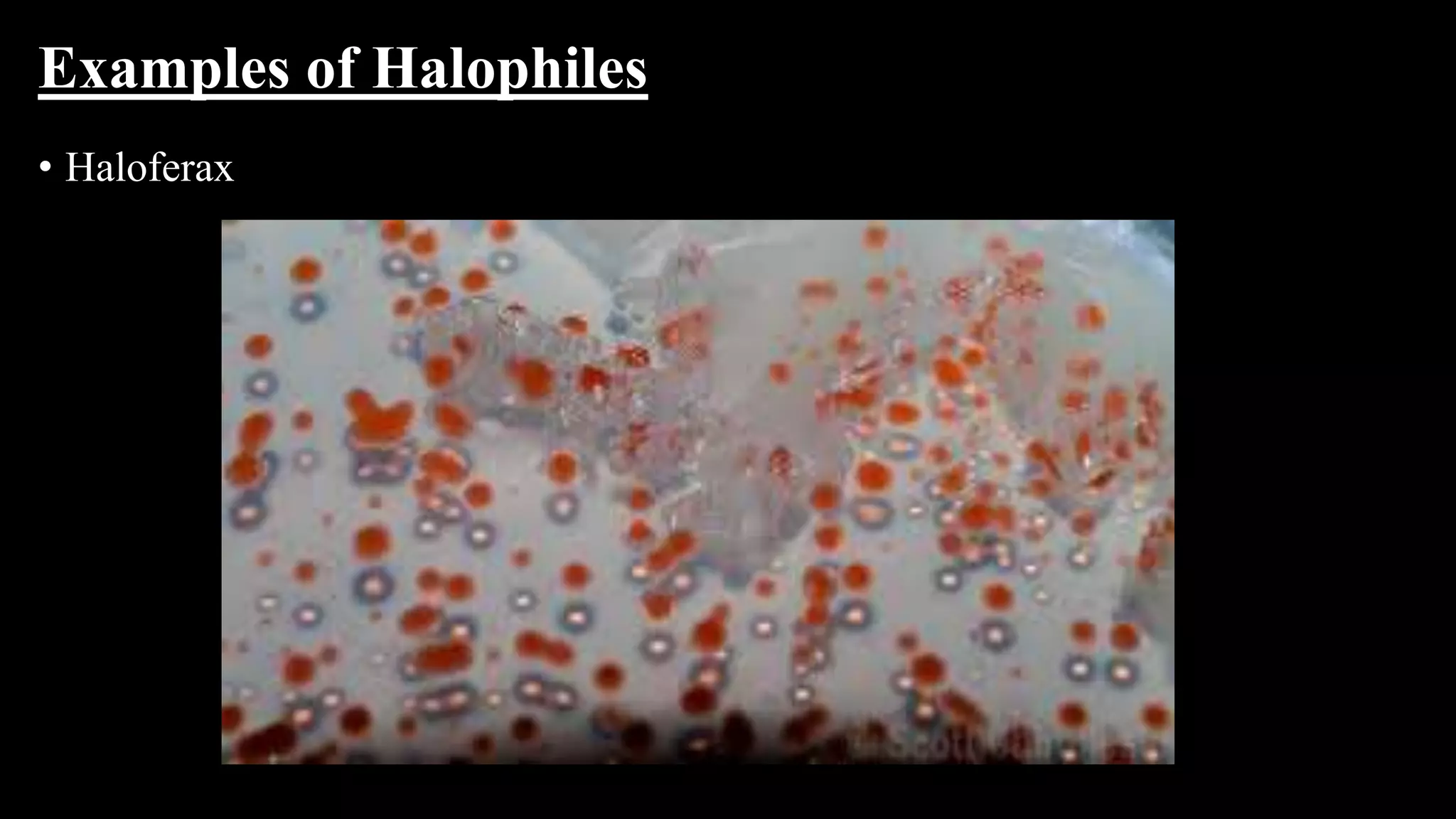
Examples of Halophiles
• Haloferax
Halogeometricum
Halococcus
Halorubrum
Haloarcula
Haloterrigena
Halobacterium
Psychrophiles
• Organisms that are capable of growth and reproduction in cold
temperatures
• Ranging from −20 °C to +10 °C
• Temperatures as low as −15 °C are found in pockets of very salty water
surrounded by sea ice
Cont……
• The environments they inhabit are ubiquitous on Earth
• Such as a large fraction of our planetary surface experiences temperatures
lower than 15 °C
• They are present in alpine and arctic soils
• high-latitude and deep ocean waters
• polar ice, glaciers, and snowfields
Cont……
• In experimental work at University of Alaska Fairbanks, a 1000-litre
biogas digester using psychrophiles harvested from "mud from a frozen
lake in Alaska" has produced 200–300 litres of methane per day, about 20–
30% of the output from digesters in warmer climates
Cont……
• Psychrophiles use a wide variety of metabolic pathways
• Photosynthesis, chemoautotrophy, and heterotrophy
• Form robust, diverse communities
• Most psychrophiles are bacteria or archaea
Cont……
• A further group of eukaryotic cold-adapted organisms are snow algae
• which can cause watermelon snow
• Psychrophiles have enzymes that are very useful in the research of proteins
• Psychrophiles are characterized by lipid cell membranes chemically resistant to
the stiffening caused by extreme cold
Cont……
• Often create protein 'antifreezes' to keep their internal space liquid and protect
their DNA even in temperatures below water's freezing point
• A commonly accepted hypothesis for this cold adaptation is the activity-
stability-flexibility relationship, suggesting that psychrophilic enzymes
increase the flexibility of their structure to compensate for the 'freezing effect'
of cold habitats
Psychrophiles Examples
Arthrobacter sp
Psychrobacter sp
Halomonas
Pseudomonas
Sphingomonas
Hyphomonas
Applications of Extremophiles
• Thermostable enzyme - Taq-polymerase
used in polymerase chain reactions (PCR) for amplification of DNA
• Methane Production
• Fermentation Industry
• Curd and Cheese making
Cont……
• Used in geochemical cycles - Forming soil from bedrocks
• Used for the production of washing agents
• Some are used in the Biofuel Production
Reference
Microbiology
Lansing M Presscott,John P Harley,Donald A Klein Fourth
Edition,1999,Pub-The McGraw-Hill Companies US
http://mentalfloss.com/article/54493/11-polar-sea-extremophiles
http://www.livescience.com/13377-extremophiles-world-
weirdest-life.html
http://www.realclearscience.com/2013/02/13/top_10_most_extre
me_extremophiles_251471.html
http://archive.bio.ed.ac.uk/jdeacon/microbes/thermo.htm
http://study.com/academy/lesson/thermophiles-definition-examples-
application.html
http://study.com/academy/lesson/thermus-aquaticus-and-other-
thermophiles-definition-examples.html
http://serc.carleton.edu/microbelife/extreme/extremeheat/index.html
http://www.encyclopedia.com/doc/1G2-3409800375.html
http://education.seattlepi.com/examples-mesophilic-bacteria-4292.html
http://www.ncbi.nlm.nih.gov/pmc/articles/PMC1456908
http://www.els.net/WileyCDA/ElsArticle/refId-
a0000402.html
https://www.boundless.com/microbiology/textbooks/boundl
ess-microbiology-textbook/microbial-evolution-phylogeny-
and-diversity-8/euryarchaeota-111/extremely-halophilic-
archaea-575-7678/
http://study.com/academy/lesson/halophiles-definition-
examples-classification.html
EXTREMOPHILES

EXTREMOPHILES