Tactile perception 
Mariacarla Memeo 
Robotics, Brain and Cognitive Science(RBCS) 
Multisensory mapping group 
Istituto Italiano di Tecnologia (IIT), Italy
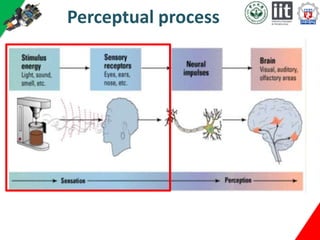
● Perceptual process 
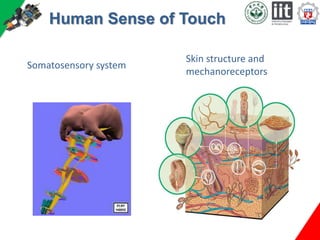
● Human sense of touch 
Outline 
1. Somatosensory system 
2. Mechanoreceptors 
3. Tactile acuity 
4. Receptive field 
● Electric metaphor of mechanoreceptors
Perceptual process
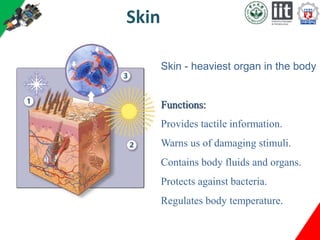
Skin 
Skin - heaviest organ in the body 
Functions: 
Provides tactile information. 
Warns us of damaging stimuli. 
Contains body fluids and organs. 
Protects against bacteria. 
Regulates body temperature.
Why touch is important? 
Haptic senses—or “touch”—is the most basic of senses; we learn this before 
vision and smell. 
Everyday Tasks: 
● Grasping objects; 
● Dialing a phone; 
● Playing a guitar or piano; 
● Finding a light switch; 
● Feeling your pulse. 
Touch is complex (e.g. tying a shoelace): bi-directional communication channel 
– both input & output
Human sense of Touch 
Touch helps us identify objects and provides unique 
information (e.g., texture, friction)
Human Sense of Touch 
Skin structure and 
mechanoreceptorsu 
Somatosensory system
Somatosensory system 
The 'somatosensory system' is a sensory that detects 
experiences labelled as touch or pressure, temperature(warm 
or cold), pain(including itch and tickle) and those that belong 
to proprioception(muscle movement and joint position).
Somatosensory Cortex 
Damage to somatosensory cortex destroys ability to 
recognize objects by touch.
Somatosensory Cortex 
The body is mapped topographically onto somatosensory cortex, but 
body parts are not represented equally.
Somatosensory Pathway 
ANTEROLATERAL SYSTEM 
This system is involved in 
the perception of touch, 
temperature, and sharp 
pain. Next instead is 
selectively involved in the 
perception of deep, chronic 
pain.
Mechanoreceptors 
These are the 
tissue “filter” 
between stimulus 
and nerve ending . 
Each type encodes 
a different aspect 
of deformation. 
(Stimulus) 
Mechanical 
filter 
Transducer 
(mechanical energy 
→ 
bioelectric signals) 
Merkel receptors 
Encoder 
Ruffini cylinder 
Pacini corpuscole 
Meissner 
corpuscole
Mechanoreceptors 
Two types located close to surface of the skin 
Merkel receptor fires continuously while stimulus 
is present. 
Responsible for sensing fine details 
Meissner corpuscle fires only when a stimulus is 
first applied and when it is removed. 
Responsible for controlling hand-grip
Mechanoreceptors
Mechanoreceptors 
Two types located deeper in the skin 
Ruffini cylinder fires continuously to stimulation 
Associated with perceiving stretching of 
the skin 
Pacinian corpuscle fires only when a stimulus is 
first applied and when it is removed. 
Associated with sensing rapid vibrations 
and fine texture
Mechanoreceptors
Mechanoreceptors – temporal features
Mechanoreceptors – spatial features
Tactile acuity 
Tactile acuity thresholds are determined by Merkel receptors 
(SA1). 
● Measuring tactile acuity 
● Two-point threshold - minimum separation needed between 
two points to perceive them as two units
Tactile acuity 
● Measuring tactile acuity 
● Grating acuity - placing a grooved stimulus on the skin and 
asking the participant to indicate the orientation of the 
grating
Tactile acuity 
Merkel receptors are densely packed on the fingertips - similar to cones 
in the fovea. 
Both two-point thresholds and grating acuity studies show these results
Receptive Field 
The receptive field of an 
individual sensory neuron is the 
particular part of the body 
surface in which a stimulus will 
trigger the firing of that neuron. 
The two-point threshold for any 
part of the body is determined by 
the size of the receptive fields 
and the extent of overlap.
Receptive Field 
Tactile acuity is determined by how close the mechanoreceptors are to 
each other and by the size of the receptive field 
Inhibitory region 
Excitatory 
region
Receptive Field 
Mechanoreceptors found in areas of the body with less tactile 
acuity tend to have larger receptive fields.
Electrical metaphor 
Ruffini cylinder 
Pacini corpuscole 
Merkel receptors 
Meissner 
corpuscole
Outline 
● Perceptual process (continue) 
● Meaning 
1. Psychophysics 
2. Absolute threshold 
3. Differential threshold (Just Noticeable Difference) 
● Tactile feedback 
● Tactile technologies 
● Simulate tactile perception (our robot)
Perceptual process
Psychophysics 
Science that focuses on how the physical environment is integrated into 
our personal, subjective world. 
● Ernst Weber & Gustav Fechner -- psychophysicists
Absolute threshold 
● Weber published “De tactu” describing the minimum amount of 
tactile stimulation needed to experience a sensation of touch – the 
absolute threshold. 
● Using weights he found that holding versus lifting them gave different results 
(due to muscles involved). 
● He used a tactile compass to study how two-point discrimination 
varied across the body. 
● On the fingertip .22 cm, on the lips .30 cm, 
on the back 4.06 cm. 
Aesthesiometric compass
Just Noticeable Difference 
(JND) 
● Weber studied how much a stimulus must change in order for a 
person to sense the change. 
● How much heavier must a weight be in order for a person to notice that it is 
heavier? 
● This amount is called the just noticeable difference JND
Just Noticeable Difference 
(JND) 
1)A stimulus is presented at a 
starting quantity Q. 
1)Once the subject is adapted to 
this stimulus, the attribute is 
increased … 
…each time the subject is asked… 
yes or no 
if there is a difference in the 
stimulus.
Just Noticeable Difference 
(JND) 
After repeated trials the 
increment T that produces a 
perceptible difference 
is identified: 
75% of right difference in 
threshold identified.
Just Noticeable Difference 
(JND) 
After repeated trials the 
increment T that produces a 
perceptible difference 
is identified. 
It is calculated when the 
75% of right difference in 
threshold identified.
Just Noticeable Difference 
(JND) 
When the starting quantity is the 
stimulus zero value (complete 
absence of the stimulus), then 
the first jnd value T is called 
… absolute threshold Q0… 
This is the minimum stimulus 
quantity necessary to produce 
any sensation.
Just Noticeable Difference 
(JND) 
● JND can be expressed as a ratio: 
where (Q + Q0) is stimulus magnitude and k is a constant and DQ means the 
change in R (D usually means change). 
or 
k 
T 
Q Q 
 
(  ) 0 
k 
Q 
D 
( Q Q 
) 0 
 
 
● Weber's law asserts that the ratio k is constant across a wide range of stimulus 
quantities, although the value of k is different for different sensory domains or 
types of stimulus.
Fechner Contribution 
● Fechner related the physical and 
psychological worlds using 
mathematics. 
● Fechner (1860) said: 
“Psychophysics, already related to 
physics by name must on one hand be 
based on psychology, and [on] the other 
hand promises to give psychology a 
mathematical foundation.” (pp. 9-10) 
● Fechner called Weber’s finding 
about the JND “Weber’s Law.”
Fechner Contribution 
● Fechner's Law allows the estimation of the sensory intensity (S) from 
the stimulus quantity: 
log( ) 0 S  k Q Q 
where S is sensation, k is Weber’s constant and R is the magnitude of a stimulus 
● The larger the stimulus magnitude, the greater the amount of 
difference needed to produce a JND.
Relationship of JND with 
Stimulus 
log( ) 0 S  k QQ
Fechner Contribution 
● His methods are still used in psychophysics. 
● Ideas from signal detection theory have been applied to a wide 
variety of other topics. 
● Threshold for criminal behavior, scenic beauty. 
● Scaling techniques, including rating scales, were placed on a sound 
scientific basis, especially by S.S. Stevens modified Fechner’s Log 
Law to a Power Function in the early 1950’s.
Tactile Feedback 
Goal is to stimulate the skin in a 
programmable manner to create 
a desired set of sensations. 
Tactile feedback is generated by a 
tactile device, sometimes called a 
tactile displays or tactile 
interfaces. 
Tactile feedback aims to create a 
metaphor to communicate 
specific information.
Tactile Technologies 
Pins or other mechanical vibrating elements, such as servo motors - either alone or 
in an array, as in devices for Braille display 
● typically used for fingertip stimulation 
Wagner & Howe 2002 
Kyung et al. 2006 
Brayda et al. 2010 
Cannella 2009
TActile MOuse (TAMO) 
Tactile device, able to deliver simple tactile maps of virtual objects by 
means of heights information.
Tactile Technologies 
Cushions of air can be inflated or deflated to vary pressure on skin 
Okamura et al. 2014 
Chih-Hung King 2008 
Siarhei Vishniakou et al. 2013
Tactile Technologies 
● Skin stretch to simulate moving stimuli. 
Provancher et al. 2013 Hayward et al. 2003-7 
● Electro-tactile devices. 
Kajimoto laboratory 2014

Tactile perception

  • 1.
    Tactile perception MariacarlaMemeo Robotics, Brain and Cognitive Science(RBCS) Multisensory mapping group Istituto Italiano di Tecnologia (IIT), Italy
  • 2.
    ● Perceptual process ● Human sense of touch Outline 1. Somatosensory system 2. Mechanoreceptors 3. Tactile acuity 4. Receptive field ● Electric metaphor of mechanoreceptors
  • 3.
  • 4.
    Skin Skin -heaviest organ in the body Functions: Provides tactile information. Warns us of damaging stimuli. Contains body fluids and organs. Protects against bacteria. Regulates body temperature.
  • 5.
    Why touch isimportant? Haptic senses—or “touch”—is the most basic of senses; we learn this before vision and smell. Everyday Tasks: ● Grasping objects; ● Dialing a phone; ● Playing a guitar or piano; ● Finding a light switch; ● Feeling your pulse. Touch is complex (e.g. tying a shoelace): bi-directional communication channel – both input & output
  • 6.
    Human sense ofTouch Touch helps us identify objects and provides unique information (e.g., texture, friction)
  • 7.
    Human Sense ofTouch Skin structure and mechanoreceptorsu Somatosensory system
  • 8.
    Somatosensory system The'somatosensory system' is a sensory that detects experiences labelled as touch or pressure, temperature(warm or cold), pain(including itch and tickle) and those that belong to proprioception(muscle movement and joint position).
  • 9.
    Somatosensory Cortex Damageto somatosensory cortex destroys ability to recognize objects by touch.
  • 10.
    Somatosensory Cortex Thebody is mapped topographically onto somatosensory cortex, but body parts are not represented equally.
  • 11.
    Somatosensory Pathway ANTEROLATERALSYSTEM This system is involved in the perception of touch, temperature, and sharp pain. Next instead is selectively involved in the perception of deep, chronic pain.
  • 12.
    Mechanoreceptors These arethe tissue “filter” between stimulus and nerve ending . Each type encodes a different aspect of deformation. (Stimulus) Mechanical filter Transducer (mechanical energy → bioelectric signals) Merkel receptors Encoder Ruffini cylinder Pacini corpuscole Meissner corpuscole
  • 13.
    Mechanoreceptors Two typeslocated close to surface of the skin Merkel receptor fires continuously while stimulus is present. Responsible for sensing fine details Meissner corpuscle fires only when a stimulus is first applied and when it is removed. Responsible for controlling hand-grip
  • 14.
  • 15.
    Mechanoreceptors Two typeslocated deeper in the skin Ruffini cylinder fires continuously to stimulation Associated with perceiving stretching of the skin Pacinian corpuscle fires only when a stimulus is first applied and when it is removed. Associated with sensing rapid vibrations and fine texture
  • 16.
  • 17.
  • 18.
  • 19.
    Tactile acuity Tactileacuity thresholds are determined by Merkel receptors (SA1). ● Measuring tactile acuity ● Two-point threshold - minimum separation needed between two points to perceive them as two units
  • 20.
    Tactile acuity ●Measuring tactile acuity ● Grating acuity - placing a grooved stimulus on the skin and asking the participant to indicate the orientation of the grating
  • 21.
    Tactile acuity Merkelreceptors are densely packed on the fingertips - similar to cones in the fovea. Both two-point thresholds and grating acuity studies show these results
  • 22.
    Receptive Field Thereceptive field of an individual sensory neuron is the particular part of the body surface in which a stimulus will trigger the firing of that neuron. The two-point threshold for any part of the body is determined by the size of the receptive fields and the extent of overlap.
  • 23.
    Receptive Field Tactileacuity is determined by how close the mechanoreceptors are to each other and by the size of the receptive field Inhibitory region Excitatory region
  • 24.
    Receptive Field Mechanoreceptorsfound in areas of the body with less tactile acuity tend to have larger receptive fields.
  • 25.
    Electrical metaphor Ruffinicylinder Pacini corpuscole Merkel receptors Meissner corpuscole
  • 27.
    Outline ● Perceptualprocess (continue) ● Meaning 1. Psychophysics 2. Absolute threshold 3. Differential threshold (Just Noticeable Difference) ● Tactile feedback ● Tactile technologies ● Simulate tactile perception (our robot)
  • 28.
  • 29.
    Psychophysics Science thatfocuses on how the physical environment is integrated into our personal, subjective world. ● Ernst Weber & Gustav Fechner -- psychophysicists
  • 30.
    Absolute threshold ●Weber published “De tactu” describing the minimum amount of tactile stimulation needed to experience a sensation of touch – the absolute threshold. ● Using weights he found that holding versus lifting them gave different results (due to muscles involved). ● He used a tactile compass to study how two-point discrimination varied across the body. ● On the fingertip .22 cm, on the lips .30 cm, on the back 4.06 cm. Aesthesiometric compass
  • 31.
    Just Noticeable Difference (JND) ● Weber studied how much a stimulus must change in order for a person to sense the change. ● How much heavier must a weight be in order for a person to notice that it is heavier? ● This amount is called the just noticeable difference JND
  • 32.
    Just Noticeable Difference (JND) 1)A stimulus is presented at a starting quantity Q. 1)Once the subject is adapted to this stimulus, the attribute is increased … …each time the subject is asked… yes or no if there is a difference in the stimulus.
  • 33.
    Just Noticeable Difference (JND) After repeated trials the increment T that produces a perceptible difference is identified: 75% of right difference in threshold identified.
  • 34.
    Just Noticeable Difference (JND) After repeated trials the increment T that produces a perceptible difference is identified. It is calculated when the 75% of right difference in threshold identified.
  • 35.
    Just Noticeable Difference (JND) When the starting quantity is the stimulus zero value (complete absence of the stimulus), then the first jnd value T is called … absolute threshold Q0… This is the minimum stimulus quantity necessary to produce any sensation.
  • 36.
    Just Noticeable Difference (JND) ● JND can be expressed as a ratio: where (Q + Q0) is stimulus magnitude and k is a constant and DQ means the change in R (D usually means change). or k T Q Q  (  ) 0 k Q D ( Q Q ) 0   ● Weber's law asserts that the ratio k is constant across a wide range of stimulus quantities, although the value of k is different for different sensory domains or types of stimulus.
  • 37.
    Fechner Contribution ●Fechner related the physical and psychological worlds using mathematics. ● Fechner (1860) said: “Psychophysics, already related to physics by name must on one hand be based on psychology, and [on] the other hand promises to give psychology a mathematical foundation.” (pp. 9-10) ● Fechner called Weber’s finding about the JND “Weber’s Law.”
  • 38.
    Fechner Contribution ●Fechner's Law allows the estimation of the sensory intensity (S) from the stimulus quantity: log( ) 0 S  k Q Q where S is sensation, k is Weber’s constant and R is the magnitude of a stimulus ● The larger the stimulus magnitude, the greater the amount of difference needed to produce a JND.
  • 39.
    Relationship of JNDwith Stimulus log( ) 0 S  k QQ
  • 40.
    Fechner Contribution ●His methods are still used in psychophysics. ● Ideas from signal detection theory have been applied to a wide variety of other topics. ● Threshold for criminal behavior, scenic beauty. ● Scaling techniques, including rating scales, were placed on a sound scientific basis, especially by S.S. Stevens modified Fechner’s Log Law to a Power Function in the early 1950’s.
  • 41.
    Tactile Feedback Goalis to stimulate the skin in a programmable manner to create a desired set of sensations. Tactile feedback is generated by a tactile device, sometimes called a tactile displays or tactile interfaces. Tactile feedback aims to create a metaphor to communicate specific information.
  • 42.
    Tactile Technologies Pinsor other mechanical vibrating elements, such as servo motors - either alone or in an array, as in devices for Braille display ● typically used for fingertip stimulation Wagner & Howe 2002 Kyung et al. 2006 Brayda et al. 2010 Cannella 2009
  • 43.
    TActile MOuse (TAMO) Tactile device, able to deliver simple tactile maps of virtual objects by means of heights information.
  • 44.
    Tactile Technologies Cushionsof air can be inflated or deflated to vary pressure on skin Okamura et al. 2014 Chih-Hung King 2008 Siarhei Vishniakou et al. 2013
  • 45.
    Tactile Technologies ●Skin stretch to simulate moving stimuli. Provancher et al. 2013 Hayward et al. 2003-7 ● Electro-tactile devices. Kajimoto laboratory 2014

Editor's Notes

  • #4 Sensation: processes by which our sense organs receive info from the environment Transduction: phisical energy is trasformend into neuronal impulses Perception: process by which people select organize and interpret sensation
  • #7 Planar, 3d, matematical functions texture
  • #11 Homunculus
  • #13 Mechanoreceptors are sensors
  • #20 Threshold?
  • #26 Switch with continuous different position for on and off; vibrating sensors; strain gage; switch on-off
  • #32 https://www.youtube.com/watch?v=qpLPyUDRLSM
  • #35 The differential threshold is the ability of a sensory system to detect changes of differences between two stimuli. The minimum difference we can detect between two is the just noticeable difference of j.n.d.
  • #36 The differential threshold is the ability of a sensory system to detect changes of differences between two stimuli. The minimum difference we can detect between two is the just noticeable difference of j.n.d.
  • #37 The Weber Fraction (ΔQ/Q). At each step the jnd is the smallest detectable increase T in the stimulus, given the starting value of the stimulus. It turns out that this increase is often a constant proportional increase (k) in the stimulus intensity, which is defined by the Weber fraction https://www.youtube.com/watch?v=qpLPyUDRLSM
  • #43 Wagner & Howe 2002: pins with servo motors