TOUCH, HAPTICS & PROPRIOCEPTION
Touch The oldest perceptual modality The most social sense The most closely linked to motion and action
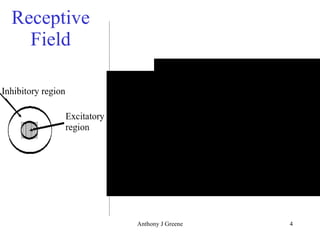
Receptive Field Mechanoreceptors  detect skin deformations Tactile acuity is determined by how close the mechanoreceptors are to each other and by the size of the receptive field
Receptive Field
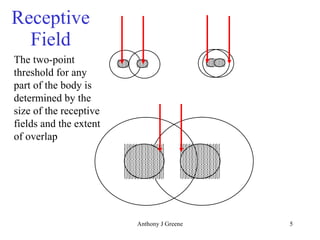
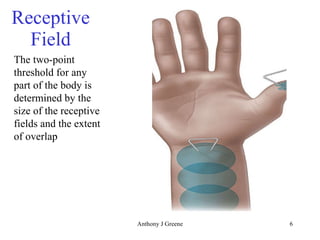
Receptive Field The two-point threshold for any part of the body is determined by the size of the receptive fields and the extent of overlap
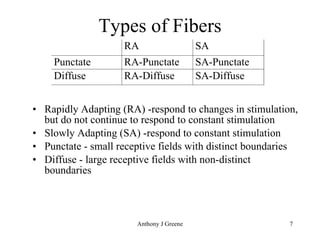
Types of Fibers Rapidly Adapting (RA) -respond to changes in stimulation, but do not continue to respond to constant stimulation Slowly Adapting (SA) -respond to constant stimulation Punctate - small receptive fields with distinct boundaries Diffuse - large receptive fields with non-distinct boundaries
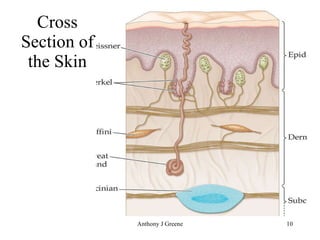
The nerve fibers enervate four receptor types Receptors Meissner Corpuscles (RA-punctate) responds best to active touch involved in object exploration Pacinian Corpuscles (RA-diffuse) extremely sensitive over a large receptive field -- blow gently on the palm of your hand Merkel Disks (SA-punctate) constant sources of stimulation over a small area, such as if you were carrying a pebble Ruffini Endings (SA-diffuse)constant stimulation over a larger area - also detects skin stretch Free nerve endings - pain fibers & thermal conductance fibers
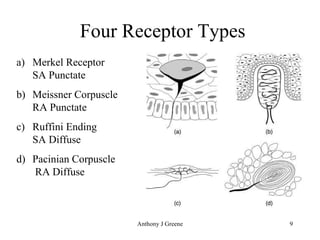
Four Receptor Types Merkel Receptor SA Punctate Meissner Corpuscle RA Punctate Ruffini Ending SA Diffuse Pacinian Corpuscle  RA Diffuse
Cross Section of the Skin
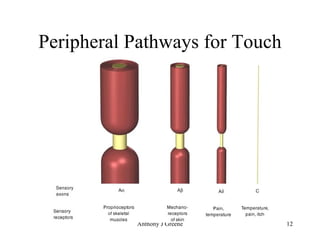
Peripheral Pathways of Touch Proprioceptors Mechanoreceptors Two pathways for pain (both of which are independent from other tactile or proprioceptive pathways) –  one fast pathway for sharp pain,  one slow pathway for dull pain
Peripheral Pathways for Touch
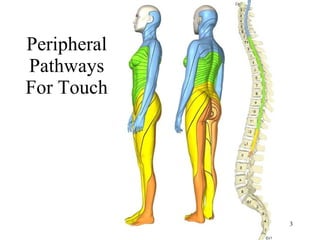
Peripheral Pathways For Touch
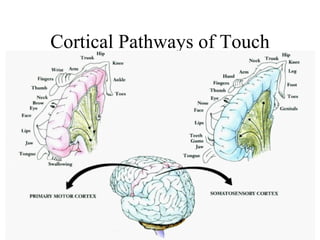
Cortical Pathways of Touch
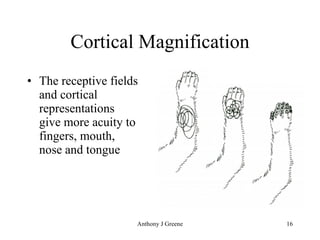
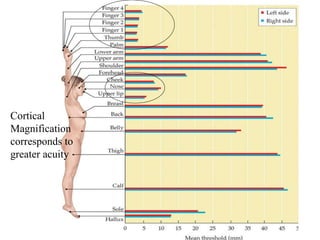
Sensation of Touch Adjacent portions of skin surface tend to be represented by adjacent portions of cortex Cortical magnification for lips, nose and fingers
Cortical Magnification The receptive fields and cortical representations give more acuity to fingers, mouth, nose and tongue
Cortical Magnification corresponds to greater acuity
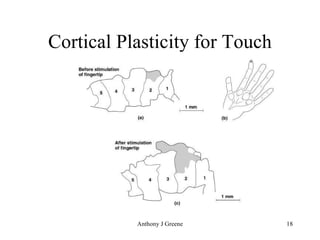
Cortical Plasticity for Touch
Faculties of Touch 1)  Object identification 2) Proprioception 3) Object localization 4)  Detection of tissue damage
Object Identification Haptics provide abstract, 3-D information about object form Spatial Frequency Analysis of Skin Deformations provides information about local form texture, density,  mass and torque Thermal conductance gives information about object material properties
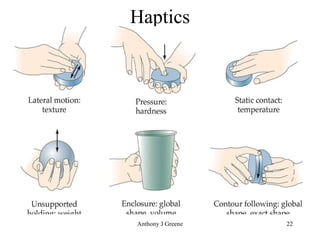
Haptics Active touch is a mode of perceptual explorarion (c.f., visual search) Haptics can detect gross features of objects form, mass, weight distribution, torque,
Haptics
Spatial Frequencies Spatial frequencies correspond to the rate of minute deformation which determine texture (i.e. coarse, smooth etc.) Larger deformations correspond to object features Active touch ( Haptics ) allows us to determine the position of tactile features on an object relative to each other These features corresponds to visual information about texture, shape and form and relative position Sensory Substitution --Braille
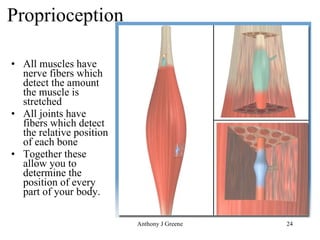
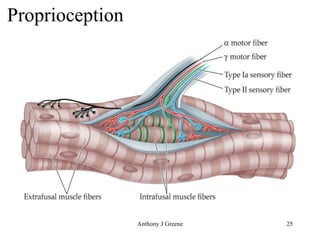
Proprioception All muscles have nerve fibers which detect the amount the muscle is stretched All joints have fibers which detect the relative position of each bone Together these allow you to determine the position of every part of your body.
Proprioception
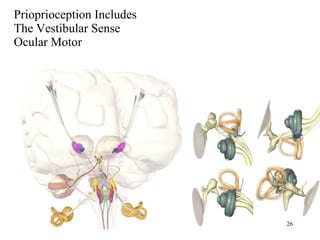
Prioprioception Includes  The Vestibular Sense Ocular Motor
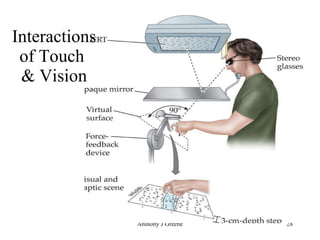
Haptics, Proprioception and Object Location Prioprioceptors allow you to determine the position of every part of your body. Haptic touch is the interaction of proprioceptive and mechanoreceptive information Object location is determined (within a narrow range) by the position of the object relative to the body
Interactions of Touch  & Vision
 
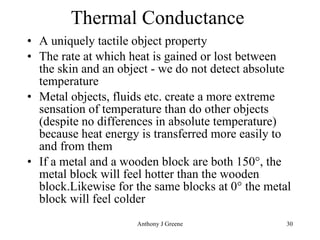
Thermal Conductance  A uniquely tactile object property  The rate at which heat is gained or lost between the skin and an object - we do not detect absolute temperature Metal objects, fluids etc. create a more extreme sensation of temperature than do other objects (despite no differences in absolute temperature) because heat energy is transferred more easily to and from them  If a metal and a wooden block are both 150°, the metal block will feel hotter than the wooden block.Likewise for the same blocks at 0° the metal block will feel colder
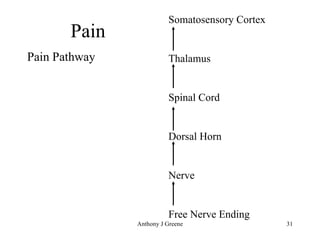
Pain Pain Pathway Somatosensory Cortex Thalamus Spinal Cord Dorsal Horn Nerve Free Nerve Ending
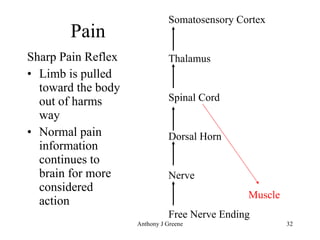
Pain Sharp Pain Reflex Limb is pulled toward the body out of harms way Normal pain information continues to brain for more considered action Somatosensory Cortex Thalamus Spinal Cord Dorsal Horn Nerve Muscle Free Nerve Ending
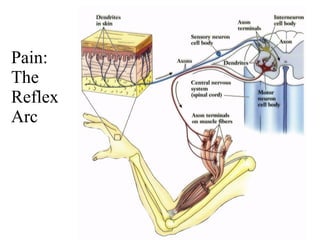
Pain: The Reflex Arc
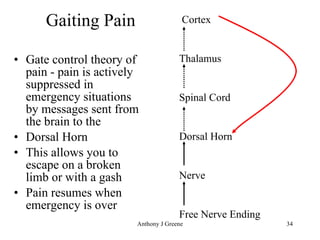
Gaiting Pain Gate control theory of pain - pain is actively suppressed in emergency situations by messages sent from the brain to the  Dorsal Horn This allows you to escape on a broken limb or with a gash Pain resumes when emergency is over Cortex Thalamus Spinal Cord Dorsal Horn Nerve Free Nerve Ending
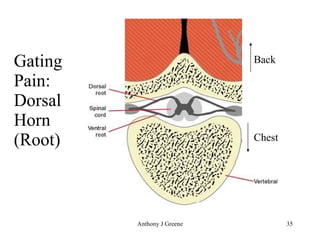
Gating Pain: Dorsal Horn (Root) Back Chest
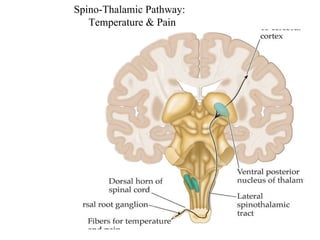
Spino-Thalamic Pathway:  Temperature & Pain
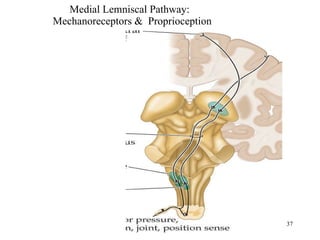
Medial Lemniscal Pathway:  Mechanoreceptors &  Proprioception
Phantom Pain After surgical removal of a limb, sensations resume in the limb In 90% of patients, the sensations are very painful In 60% the pain is excruciating:  described sometimes as an arm on fire, being torn or punctured, great pressure
Phantom Pain:  Strange Facts Stimulating certain areas of skin (e.g., face) may aggrevate phantom pain. Severing the nerve doesn’t help. Blocking the nerve doesn’t help.  Removing the portion of the thalamus that relays the information to the brain doesn’t help! Stimulating the nerve does help.  Electric or manual stimulation of the stump helps tremendously electric more so).
Phantom Pain:  A Theory Recall that the cortex is plastic and may reorganize. Normally this involves annexing juvenile or unused neurons (indicated by low activity level) In amputation the entire area of say an arm is no longer active in the brain Other areas attempt to annex these neurons Because the neurons already had a specialization (e.g., sharp pain) and are no being stimulated by adjacent areas of cortex, the subject feels pain.
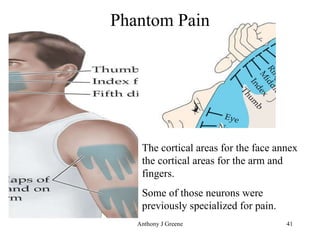
Phantom Pain The cortical areas for the face annex the cortical areas for the arm and fingers. Some of those neurons were previously specialized for pain.
Phantom Pain TENS  (transcutaneous electrical stimulation) uses tiny electrical pulses, delivered through the skin to nerve fibers, to directly stimulate nerves in the stump that formerly enervated the limb. Spinal cord stimulation  uses electrodes surgically inserted within the epidural space of the spinal cord.  Deep brain or intracerebral stimulation  is considered an extreme treatment and involves surgical stimulation of the brain. These treatments all create activity in the cortical region associated with the former limb, which prevents adjacent neurons from annexing

12 touch

  • 1.
    TOUCH, HAPTICS &PROPRIOCEPTION
  • 2.
    Touch The oldestperceptual modality The most social sense The most closely linked to motion and action
  • 3.
    Receptive Field Mechanoreceptors detect skin deformations Tactile acuity is determined by how close the mechanoreceptors are to each other and by the size of the receptive field
  • 4.
  • 5.
    Receptive Field Thetwo-point threshold for any part of the body is determined by the size of the receptive fields and the extent of overlap
  • 6.
    Receptive Field Thetwo-point threshold for any part of the body is determined by the size of the receptive fields and the extent of overlap
  • 7.
    Types of FibersRapidly Adapting (RA) -respond to changes in stimulation, but do not continue to respond to constant stimulation Slowly Adapting (SA) -respond to constant stimulation Punctate - small receptive fields with distinct boundaries Diffuse - large receptive fields with non-distinct boundaries
  • 8.
    The nerve fibersenervate four receptor types Receptors Meissner Corpuscles (RA-punctate) responds best to active touch involved in object exploration Pacinian Corpuscles (RA-diffuse) extremely sensitive over a large receptive field -- blow gently on the palm of your hand Merkel Disks (SA-punctate) constant sources of stimulation over a small area, such as if you were carrying a pebble Ruffini Endings (SA-diffuse)constant stimulation over a larger area - also detects skin stretch Free nerve endings - pain fibers & thermal conductance fibers
  • 9.
    Four Receptor TypesMerkel Receptor SA Punctate Meissner Corpuscle RA Punctate Ruffini Ending SA Diffuse Pacinian Corpuscle RA Diffuse
  • 10.
  • 11.
    Peripheral Pathways ofTouch Proprioceptors Mechanoreceptors Two pathways for pain (both of which are independent from other tactile or proprioceptive pathways) – one fast pathway for sharp pain, one slow pathway for dull pain
  • 12.
  • 13.
  • 14.
  • 15.
    Sensation of TouchAdjacent portions of skin surface tend to be represented by adjacent portions of cortex Cortical magnification for lips, nose and fingers
  • 16.
    Cortical Magnification Thereceptive fields and cortical representations give more acuity to fingers, mouth, nose and tongue
  • 17.
  • 18.
  • 19.
    Faculties of Touch1) Object identification 2) Proprioception 3) Object localization 4) Detection of tissue damage
  • 20.
    Object Identification Hapticsprovide abstract, 3-D information about object form Spatial Frequency Analysis of Skin Deformations provides information about local form texture, density, mass and torque Thermal conductance gives information about object material properties
  • 21.
    Haptics Active touchis a mode of perceptual explorarion (c.f., visual search) Haptics can detect gross features of objects form, mass, weight distribution, torque,
  • 22.
  • 23.
    Spatial Frequencies Spatialfrequencies correspond to the rate of minute deformation which determine texture (i.e. coarse, smooth etc.) Larger deformations correspond to object features Active touch ( Haptics ) allows us to determine the position of tactile features on an object relative to each other These features corresponds to visual information about texture, shape and form and relative position Sensory Substitution --Braille
  • 24.
    Proprioception All muscleshave nerve fibers which detect the amount the muscle is stretched All joints have fibers which detect the relative position of each bone Together these allow you to determine the position of every part of your body.
  • 25.
  • 26.
    Prioprioception Includes The Vestibular Sense Ocular Motor
  • 27.
    Haptics, Proprioception andObject Location Prioprioceptors allow you to determine the position of every part of your body. Haptic touch is the interaction of proprioceptive and mechanoreceptive information Object location is determined (within a narrow range) by the position of the object relative to the body
  • 28.
  • 29.
  • 30.
    Thermal Conductance A uniquely tactile object property The rate at which heat is gained or lost between the skin and an object - we do not detect absolute temperature Metal objects, fluids etc. create a more extreme sensation of temperature than do other objects (despite no differences in absolute temperature) because heat energy is transferred more easily to and from them If a metal and a wooden block are both 150°, the metal block will feel hotter than the wooden block.Likewise for the same blocks at 0° the metal block will feel colder
  • 31.
    Pain Pain PathwaySomatosensory Cortex Thalamus Spinal Cord Dorsal Horn Nerve Free Nerve Ending
  • 32.
    Pain Sharp PainReflex Limb is pulled toward the body out of harms way Normal pain information continues to brain for more considered action Somatosensory Cortex Thalamus Spinal Cord Dorsal Horn Nerve Muscle Free Nerve Ending
  • 33.
  • 34.
    Gaiting Pain Gatecontrol theory of pain - pain is actively suppressed in emergency situations by messages sent from the brain to the Dorsal Horn This allows you to escape on a broken limb or with a gash Pain resumes when emergency is over Cortex Thalamus Spinal Cord Dorsal Horn Nerve Free Nerve Ending
  • 35.
    Gating Pain: DorsalHorn (Root) Back Chest
  • 36.
    Spino-Thalamic Pathway: Temperature & Pain
  • 37.
    Medial Lemniscal Pathway: Mechanoreceptors & Proprioception
  • 38.
    Phantom Pain Aftersurgical removal of a limb, sensations resume in the limb In 90% of patients, the sensations are very painful In 60% the pain is excruciating: described sometimes as an arm on fire, being torn or punctured, great pressure
  • 39.
    Phantom Pain: Strange Facts Stimulating certain areas of skin (e.g., face) may aggrevate phantom pain. Severing the nerve doesn’t help. Blocking the nerve doesn’t help. Removing the portion of the thalamus that relays the information to the brain doesn’t help! Stimulating the nerve does help. Electric or manual stimulation of the stump helps tremendously electric more so).
  • 40.
    Phantom Pain: A Theory Recall that the cortex is plastic and may reorganize. Normally this involves annexing juvenile or unused neurons (indicated by low activity level) In amputation the entire area of say an arm is no longer active in the brain Other areas attempt to annex these neurons Because the neurons already had a specialization (e.g., sharp pain) and are no being stimulated by adjacent areas of cortex, the subject feels pain.
  • 41.
    Phantom Pain Thecortical areas for the face annex the cortical areas for the arm and fingers. Some of those neurons were previously specialized for pain.
  • 42.
    Phantom Pain TENS (transcutaneous electrical stimulation) uses tiny electrical pulses, delivered through the skin to nerve fibers, to directly stimulate nerves in the stump that formerly enervated the limb. Spinal cord stimulation uses electrodes surgically inserted within the epidural space of the spinal cord. Deep brain or intracerebral stimulation is considered an extreme treatment and involves surgical stimulation of the brain. These treatments all create activity in the cortical region associated with the former limb, which prevents adjacent neurons from annexing