Complexity and
Simplicity Unpacked
Who cares?
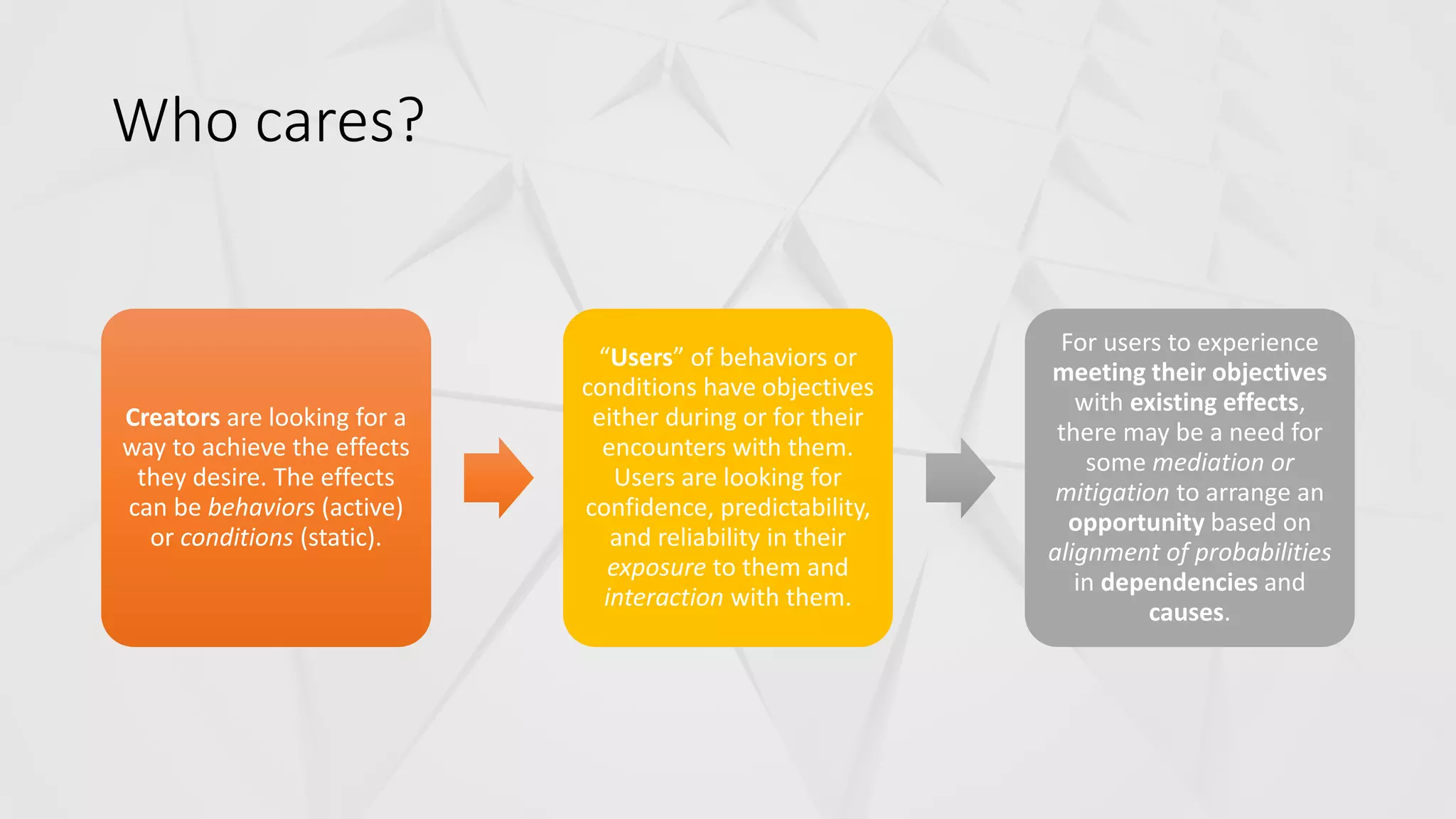
Creators are looking for a
way to achieve the effects
they desire. The effects
can be behaviors (active)
or conditions (static).
“Users” of behaviors or
conditions have objectives
either during or for their
encounters with them.
Users are looking for
confidence, predictability,
and reliability in their
exposure to them and
interaction with them.
For users to experience
meeting their objectives
with existing effects,
there may be a need for
some mediation or
mitigation to arrange an
opportunity based on
alignment of probabilities
in dependencies and
causes.
Simplicity and Complexity: truths
It is “popularly” said that simplicity is good for effectiveness and complexity is bad. But this is a
fallacy due to using the terms as substitutes for the real concerns at hand: ease and difficulty.
Simplicity is also not the opposite of complexity – except in cases where it is “known” beforehand
that the required outcome depends on one of the two being excluded.
Furthermore, some desired behaviors and conditions exist only through or in complexity.
This fact is regularly demonstrated in much of art, math, pro team sports, and personal health as
well as in balanced natural (environmental) ecosystems.
The key observation to make is that complexity can be the condition of the opportunity, and it can
be the condition of the effect.
Likewise, simplicity can characterize opportunity and characterize effect.
A characterization may be an accepted perception or a verified fact. Those two characterizations
may or may not agree in the given moment.
Descriptions and Perceptions
Simplicity and Complexity are different descriptions of the same thing: CONFIGURATION
• Configuration is the way that something CAME TO BE the way that something IS
• This includes, therefore, both Approaches and States
Ranges of perceived Simplicity:
• Simplicity of state can be (lower) RUDIMENTARY or (higher) MINIMAL
• Simplicity of approach can be CRUDE (lower) or ELEGANT (higher)
Ranges of perceived Complexity:
• Complexity of state can be CLUTTERED (lower) or ELABORATE (higher)
• Complexity of approach can be CONFUSED (lower) or TAILORED (higher)
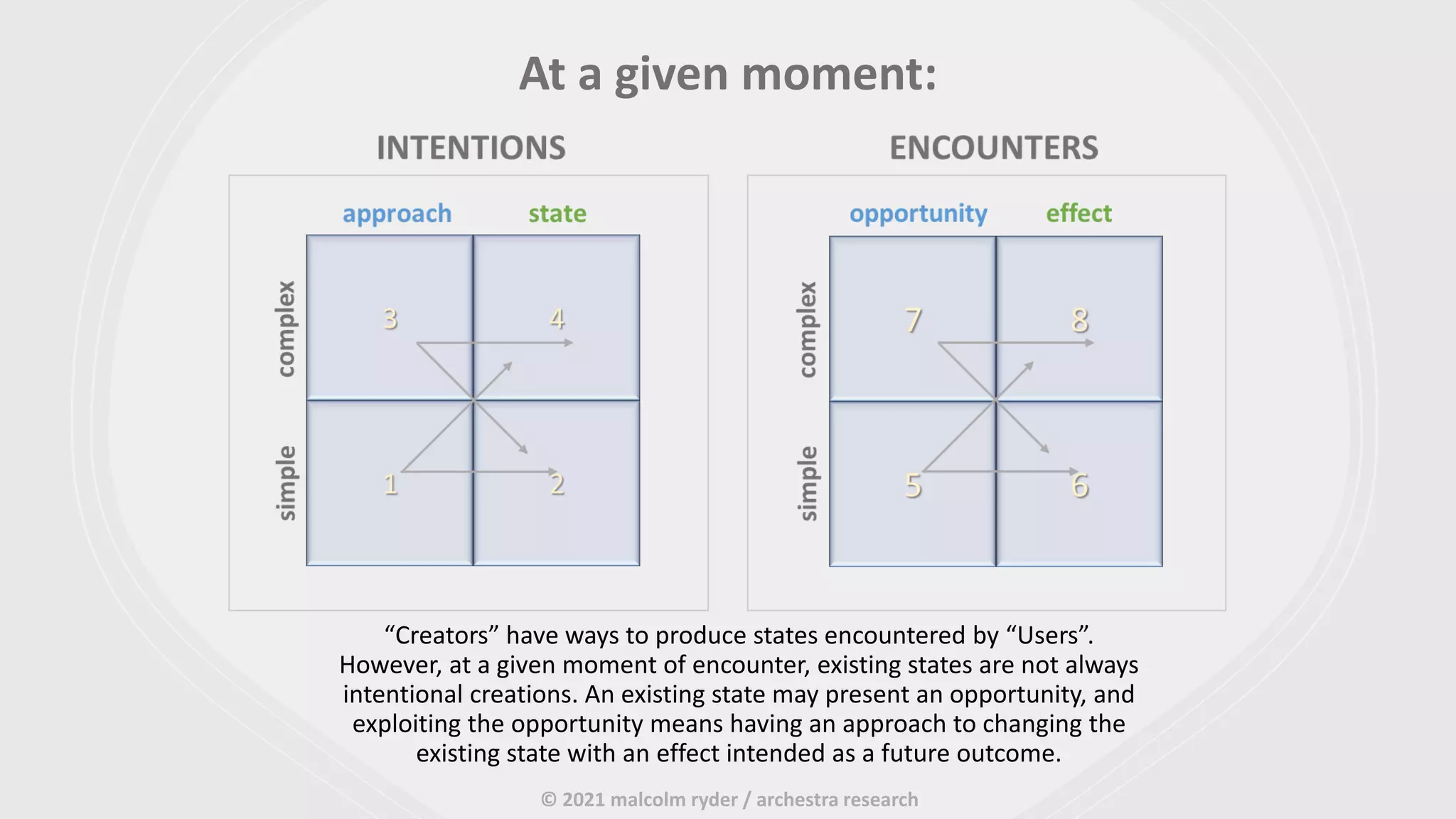
“Creators” have ways to produce states encountered by “Users”.
However, at a given moment of encounter, existing states are not always
intentional creations. An existing state may present an opportunity, and
exploiting the opportunity means having an approach to changing the
existing state with an effect intended as a future outcome.
At a given moment:
© 2021 malcolm ryder / archestra research
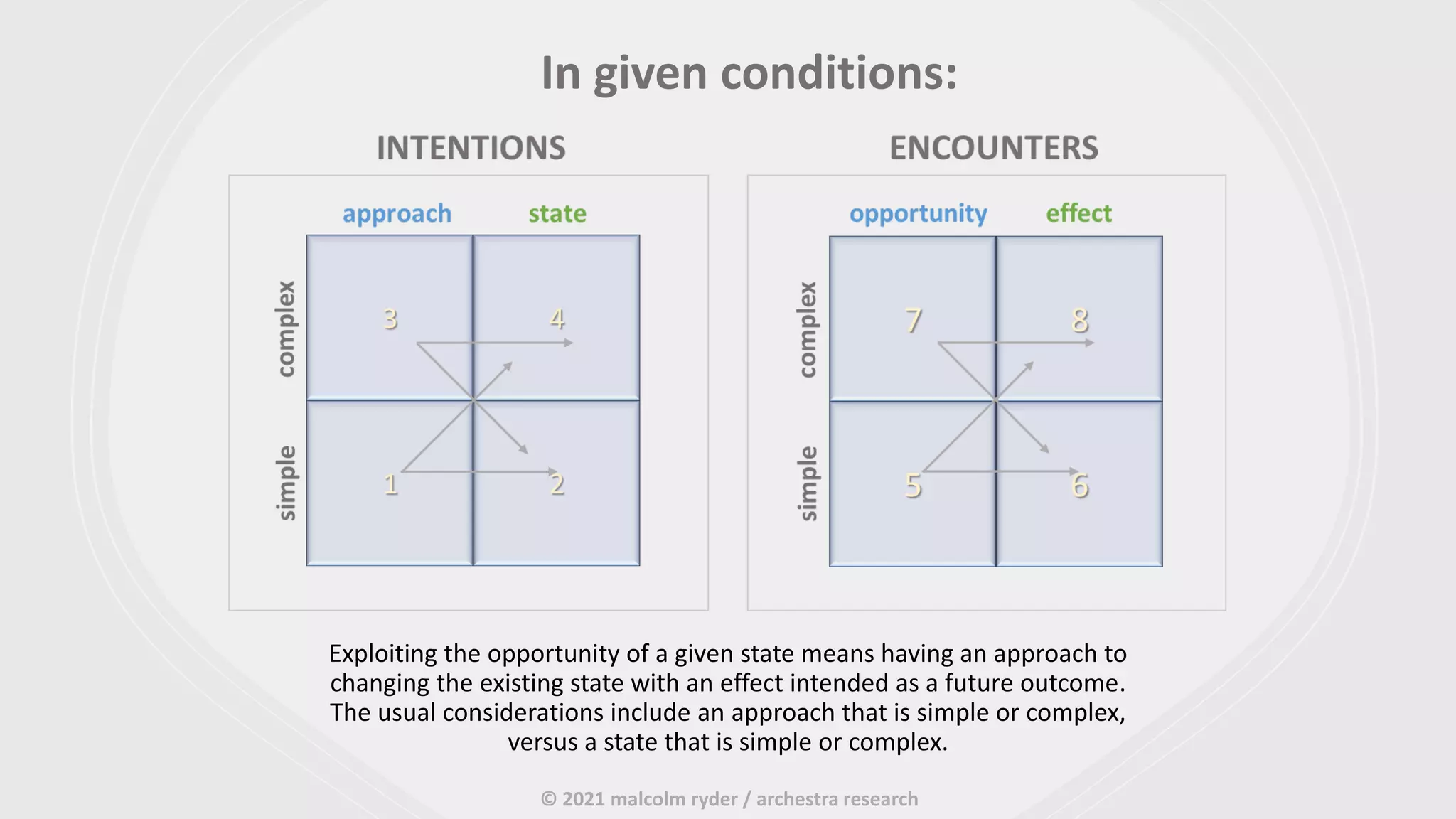
Exploiting the opportunity of a given state means having an approach to
changing the existing state with an effect intended as a future outcome.
The usual considerations include an approach that is simple or complex,
versus a state that is simple or complex.
In given conditions:
© 2021 malcolm ryder / archestra research
The Basics
Complexity and Simplicity are types of conditions, not types of problems
Each is a condition of a structure that is posited as a single entity
A structure is a persistent arrangement of certain given elements
The single entity is usually significant as either an environment or a mechanism
The single entity has an acknowledged typifying character
The intent of referring to simplicity or complexity is to characterize an environment or a mechanism
© 2021 malcolm ryder / archestra research
Goal-oriented structure, and more truths
State wants to have SUFFICIENCY without DEFICIENCY
• Simplicity of state can require complexity of approach (FORMULA)
• Complexity of state can require simplicity of approach (POWER)
Approach wants to have EFFICIENCY without DEFICIENCY
• Simplicity of approach can cause complexity of state (TENSION)
• Complexity of approach can cause simplicity of state (STABILITY)
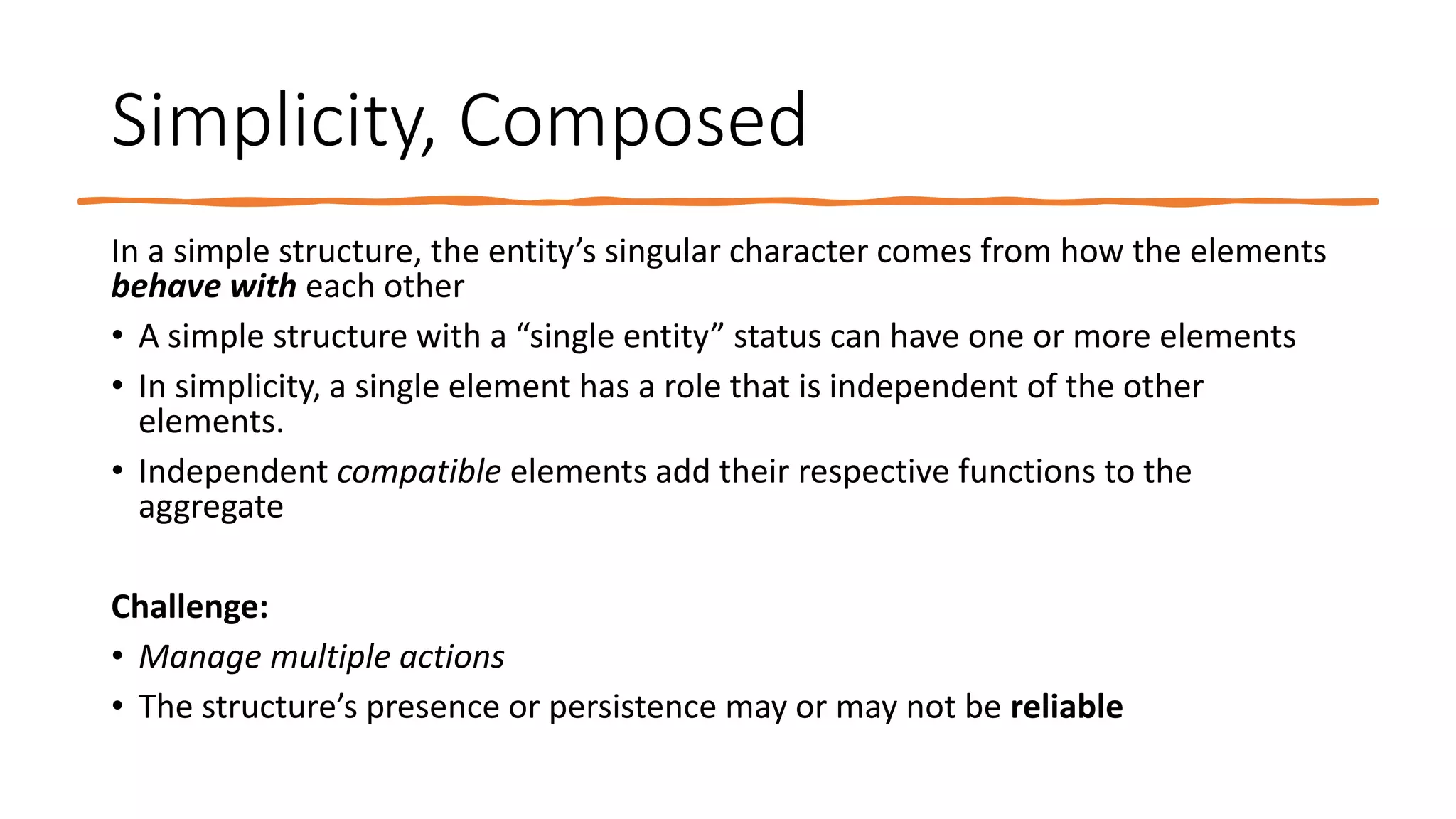
Simplicity, Composed
In a simple structure, the entity’s singular character comes from how the elements
behave with each other
• A simple structure with a “single entity” status can have one or more elements
• In simplicity, a single element has a role that is independent of the other
elements.
• Independent compatible elements add their respective functions to the
aggregate
Challenge:
• Manage multiple actions
• The structure’s presence or persistence may or may not be reliable
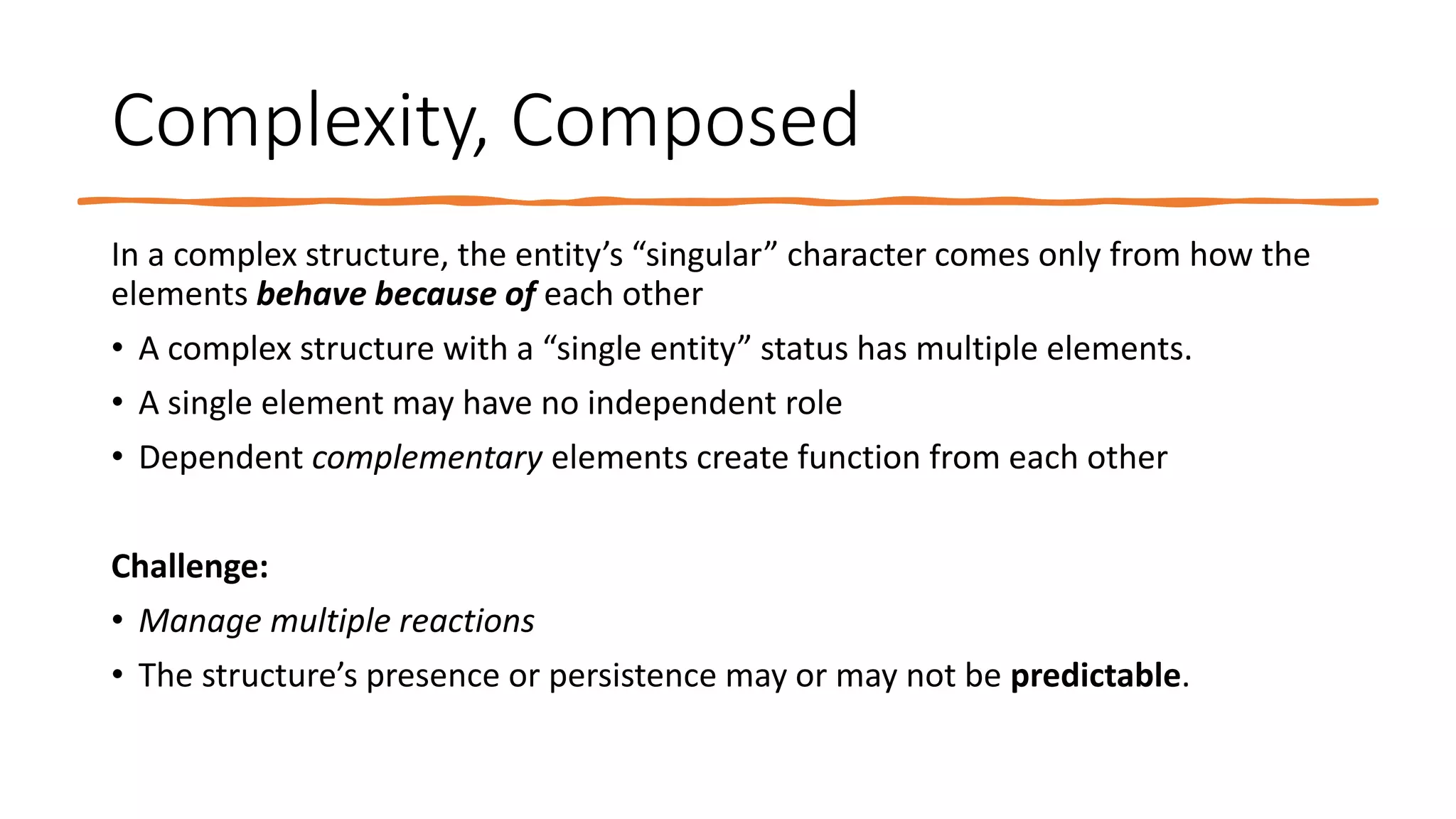
Complexity, Composed
In a complex structure, the entity’s “singular” character comes only from how the
elements behave because of each other
• A complex structure with a “single entity” status has multiple elements.
• A single element may have no independent role
• Dependent complementary elements create function from each other
Challenge:
• Manage multiple reactions
• The structure’s presence or persistence may or may not be predictable.
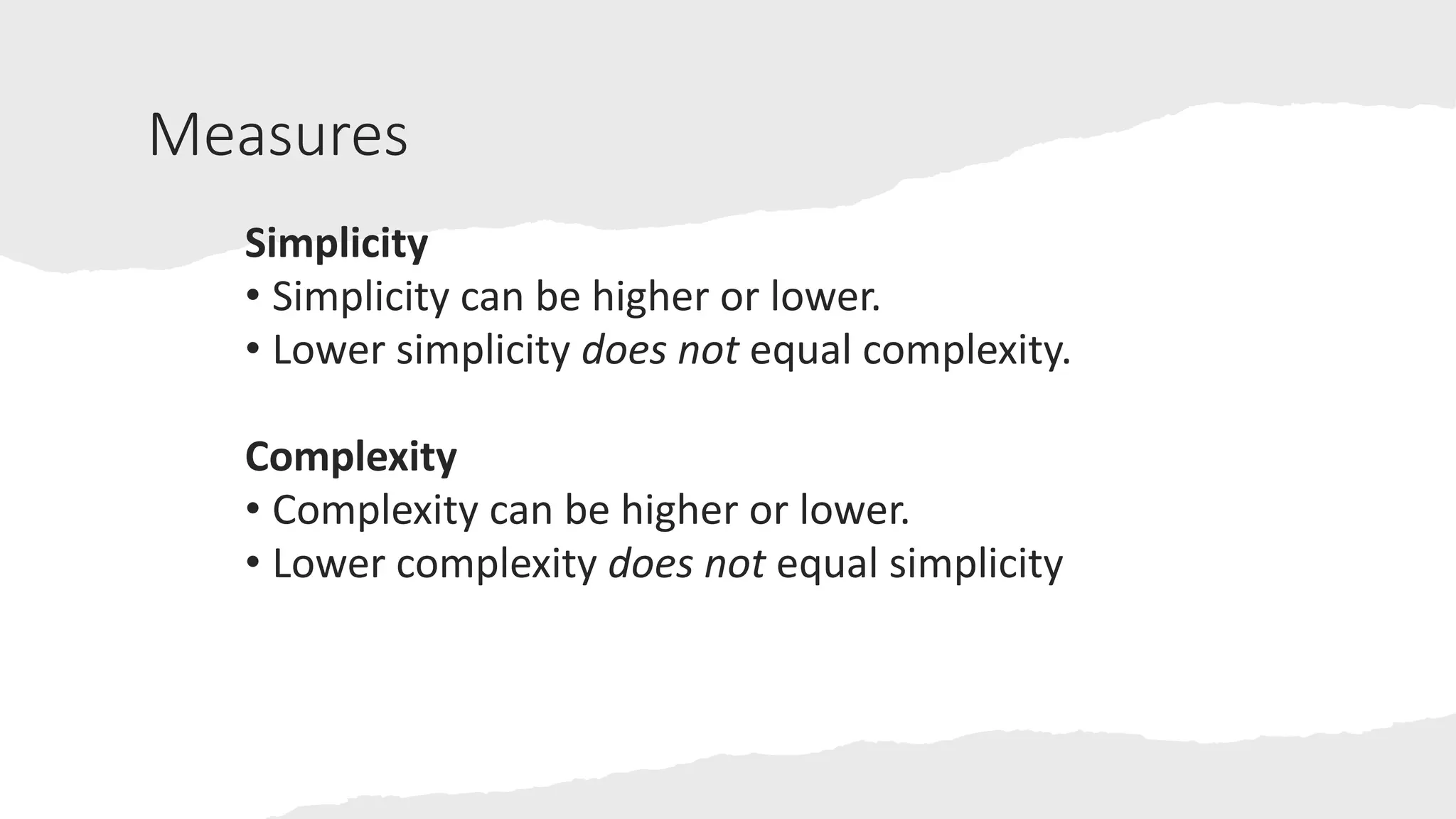
Measures
Simplicity
• Simplicity can be higher or lower.
• Lower simplicity does not equal complexity.
Complexity
• Complexity can be higher or lower.
• Lower complexity does not equal simplicity
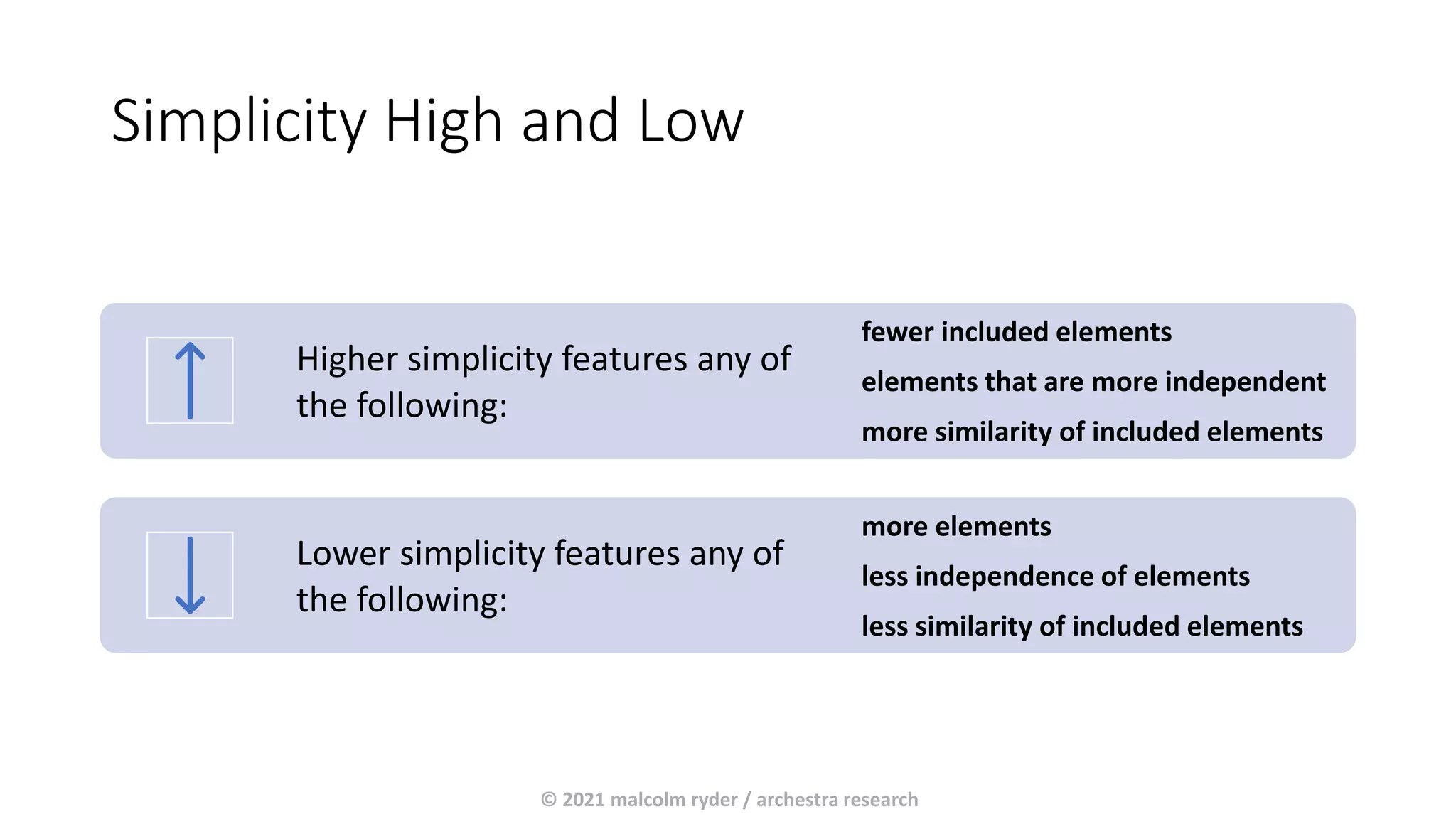
Simplicity High and Low
Higher simplicity features any of
the following:
fewer included elements
elements that are more independent
more similarity of included elements
Lower simplicity features any of
the following:
more elements
less independence of elements
less similarity of included elements
© 2021 malcolm ryder / archestra research
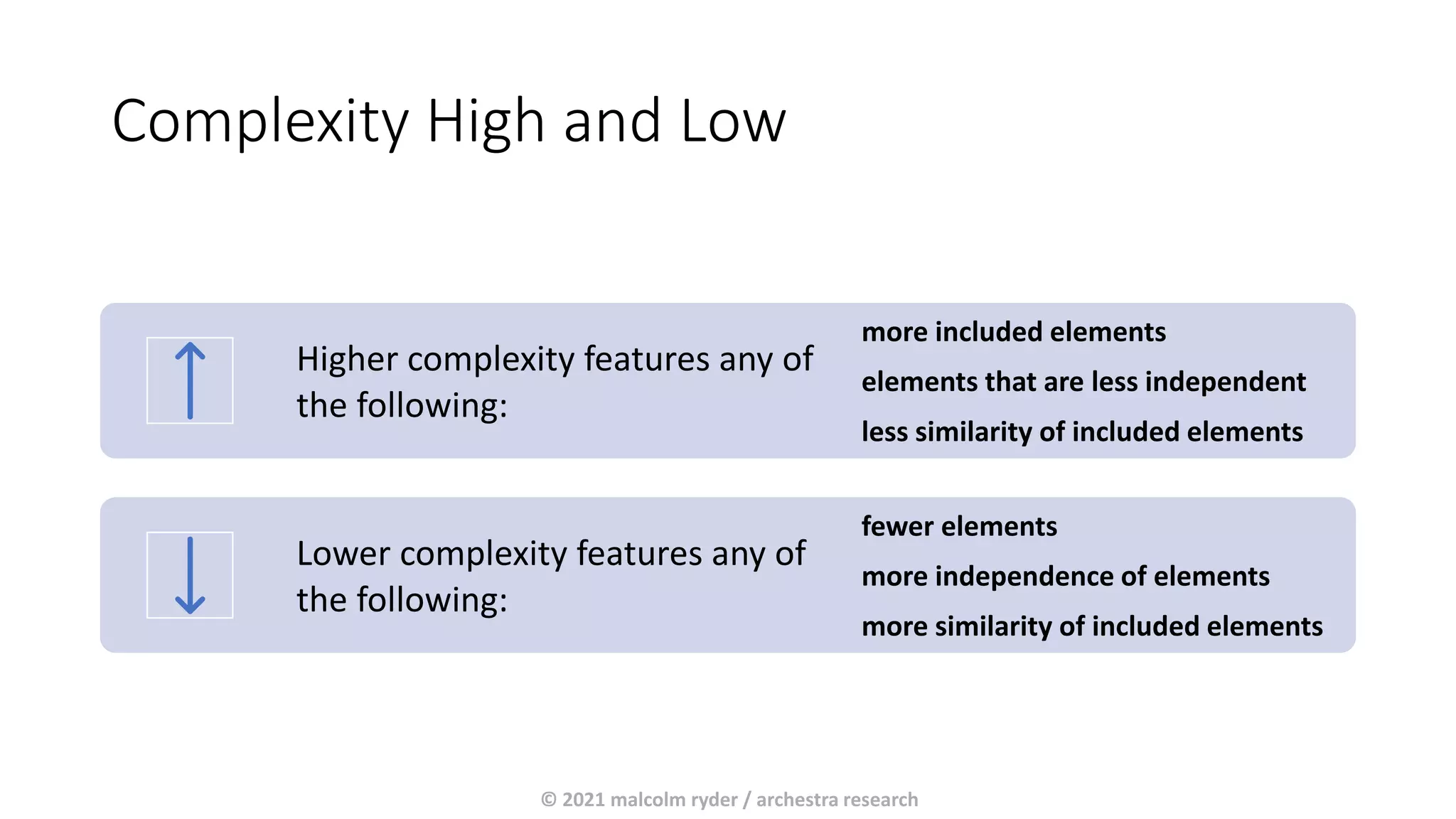
Complexity High and Low
Higher complexity features any of
the following:
more included elements
elements that are less independent
less similarity of included elements
Lower complexity features any of
the following:
fewer elements
more independence of elements
more similarity of included elements
© 2021 malcolm ryder / archestra research
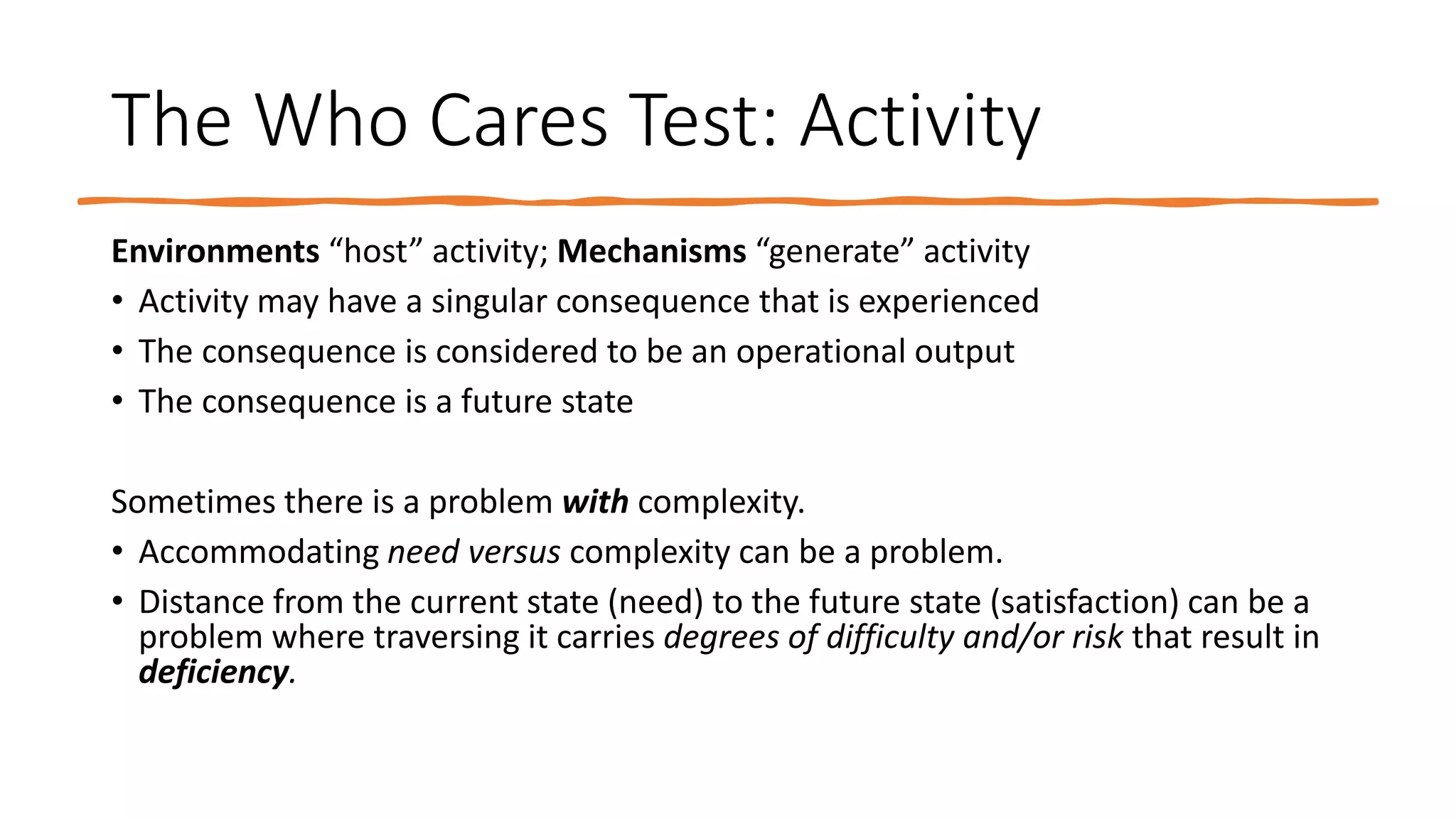
The Who Cares Test: Activity
Environments “host” activity; Mechanisms “generate” activity
• Activity may have a singular consequence that is experienced
• The consequence is considered to be an operational output
• The consequence is a future state
Sometimes there is a problem with complexity.
• Accommodating need versus complexity can be a problem.
• Distance from the current state (need) to the future state (satisfaction) can be a
problem where traversing it carries degrees of difficulty and/or risk that result in
deficiency.
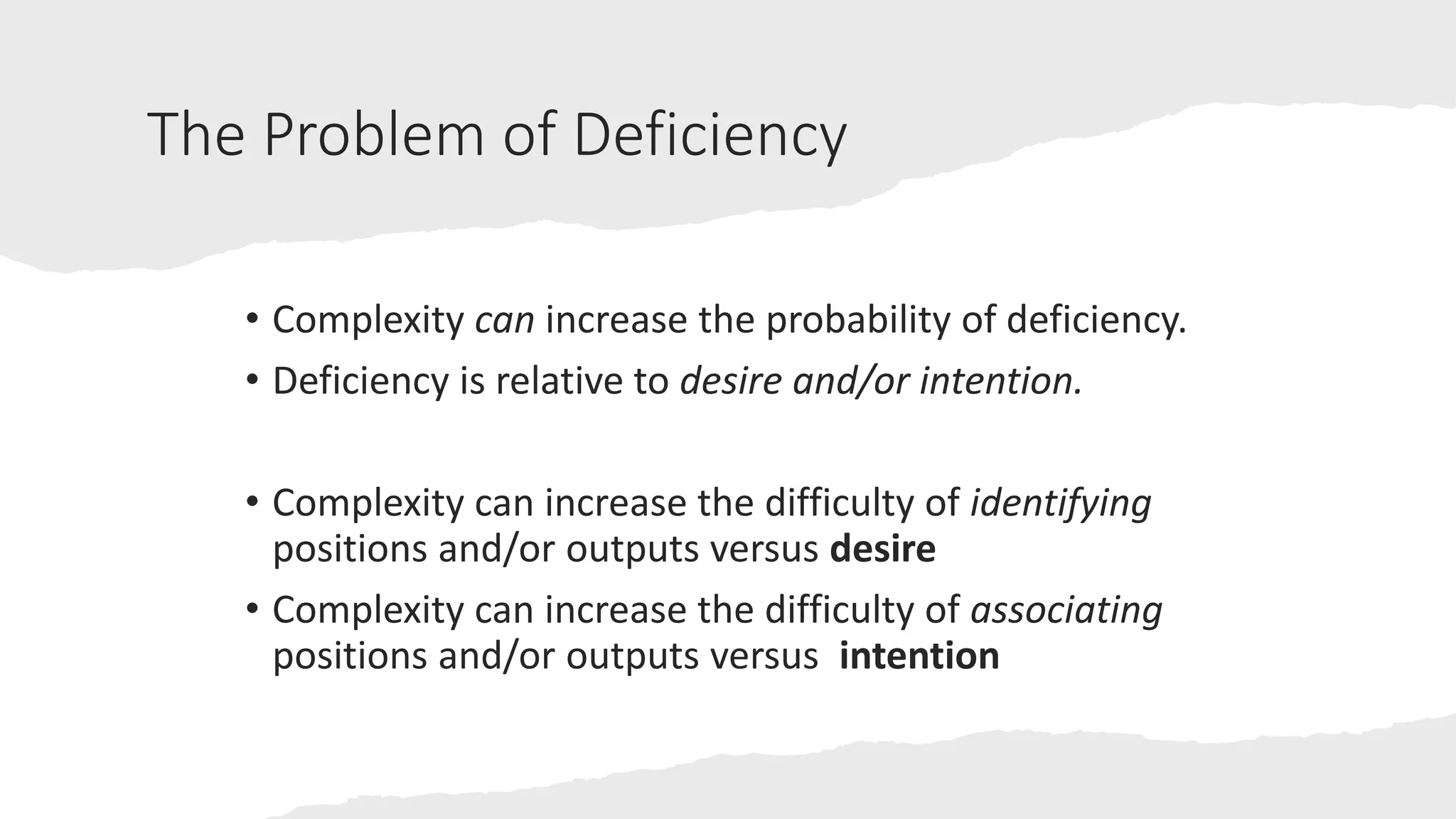
The Problem of Deficiency
• Complexity can increase the probability of deficiency.
• Deficiency is relative to desire and/or intention.
• Complexity can increase the difficulty of identifying
positions and/or outputs versus desire
• Complexity can increase the difficulty of associating
positions and/or outputs versus intention
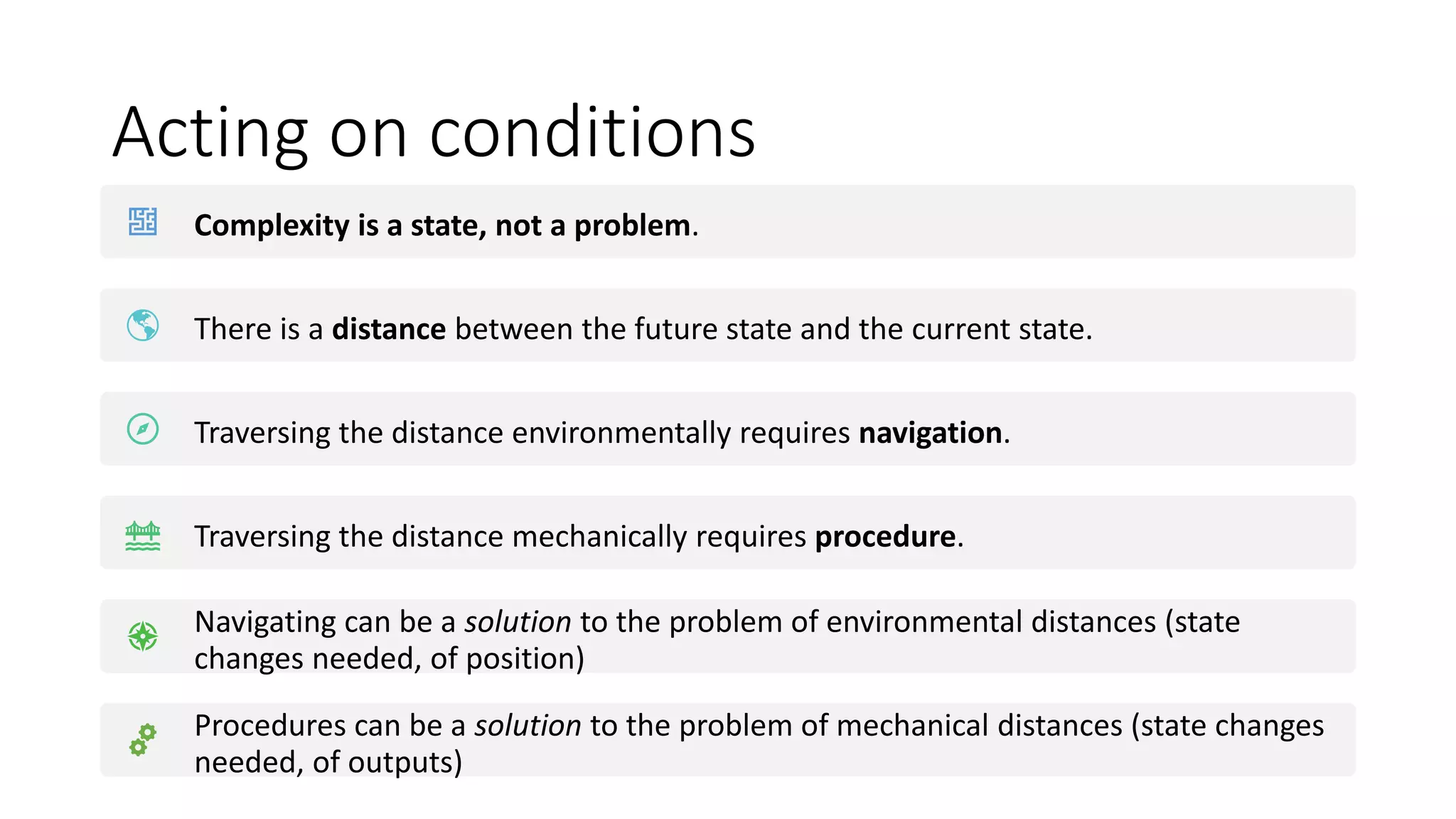
Acting on conditions
Complexity is a state, not a problem.
There is a distance between the future state and the current state.
Traversing the distance environmentally requires navigation.
Traversing the distance mechanically requires procedure.
Navigating can be a solution to the problem of environmental distances (state
changes needed, of position)
Procedures can be a solution to the problem of mechanical distances (state changes
needed, of outputs)
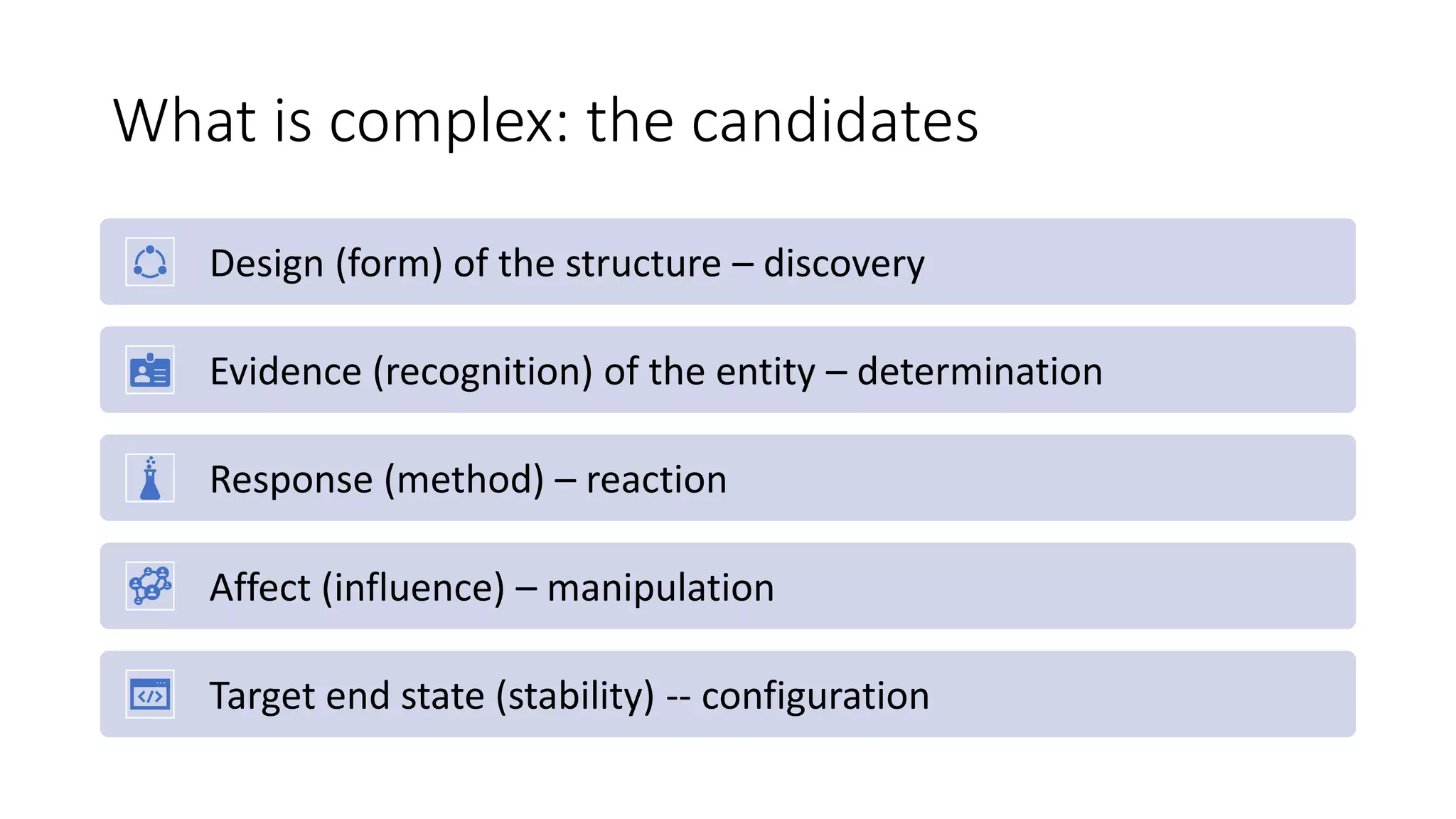
What is complex: the candidates
Design (form) of the structure – discovery
Evidence (recognition) of the entity – determination
Response (method) – reaction
Affect (influence) – manipulation
Target end state (stability) -- configuration
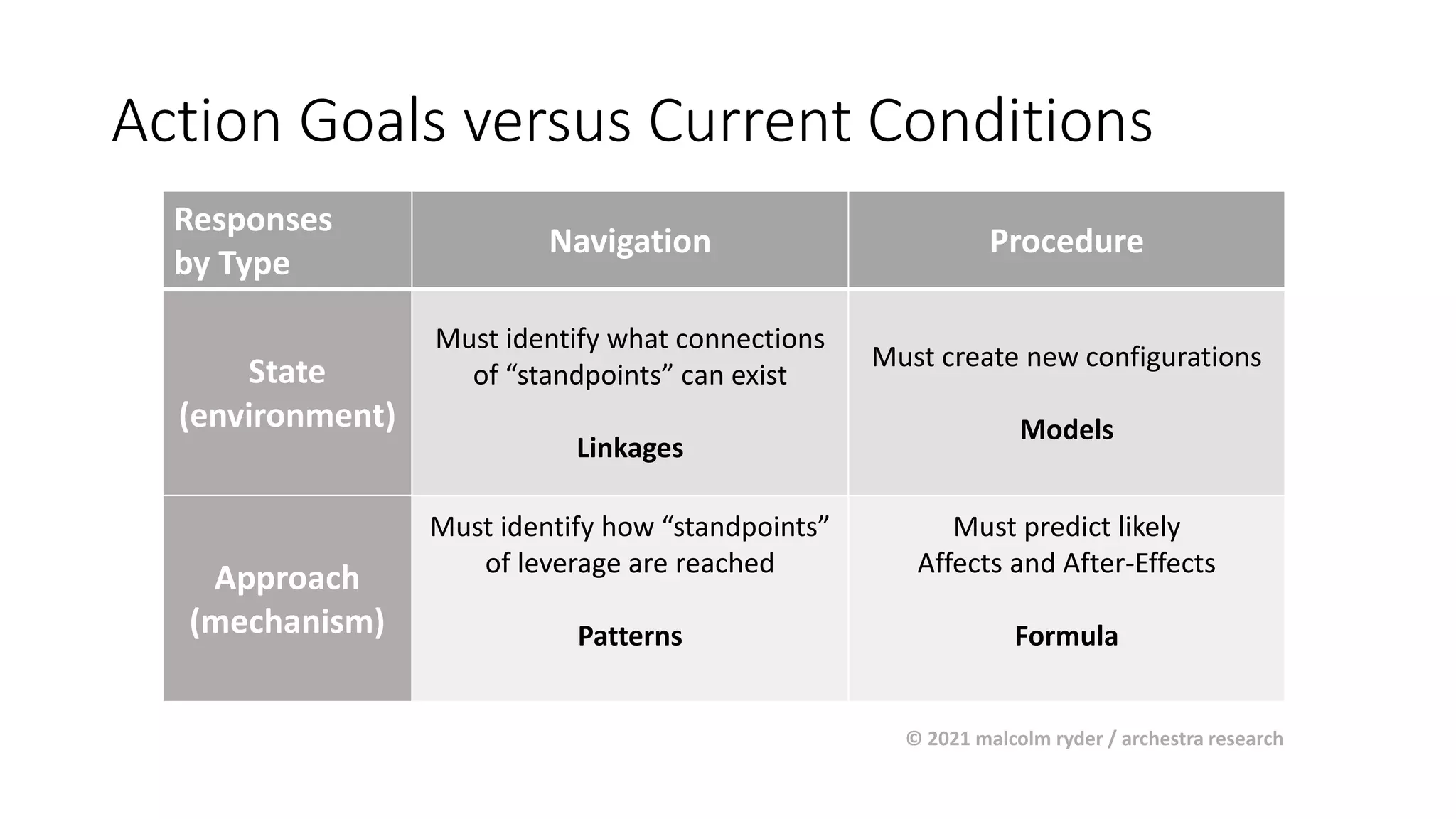
Action Goals versus Current Conditions
Responses
by Type
Navigation Procedure
State
(environment)
Must identify what connections
of “standpoints” can exist
Linkages
Must create new configurations
Models
Approach
(mechanism)
Must identify how “standpoints”
of leverage are reached
Patterns
Must predict likely
Affects and After-Effects
Formula
© 2021 malcolm ryder / archestra research
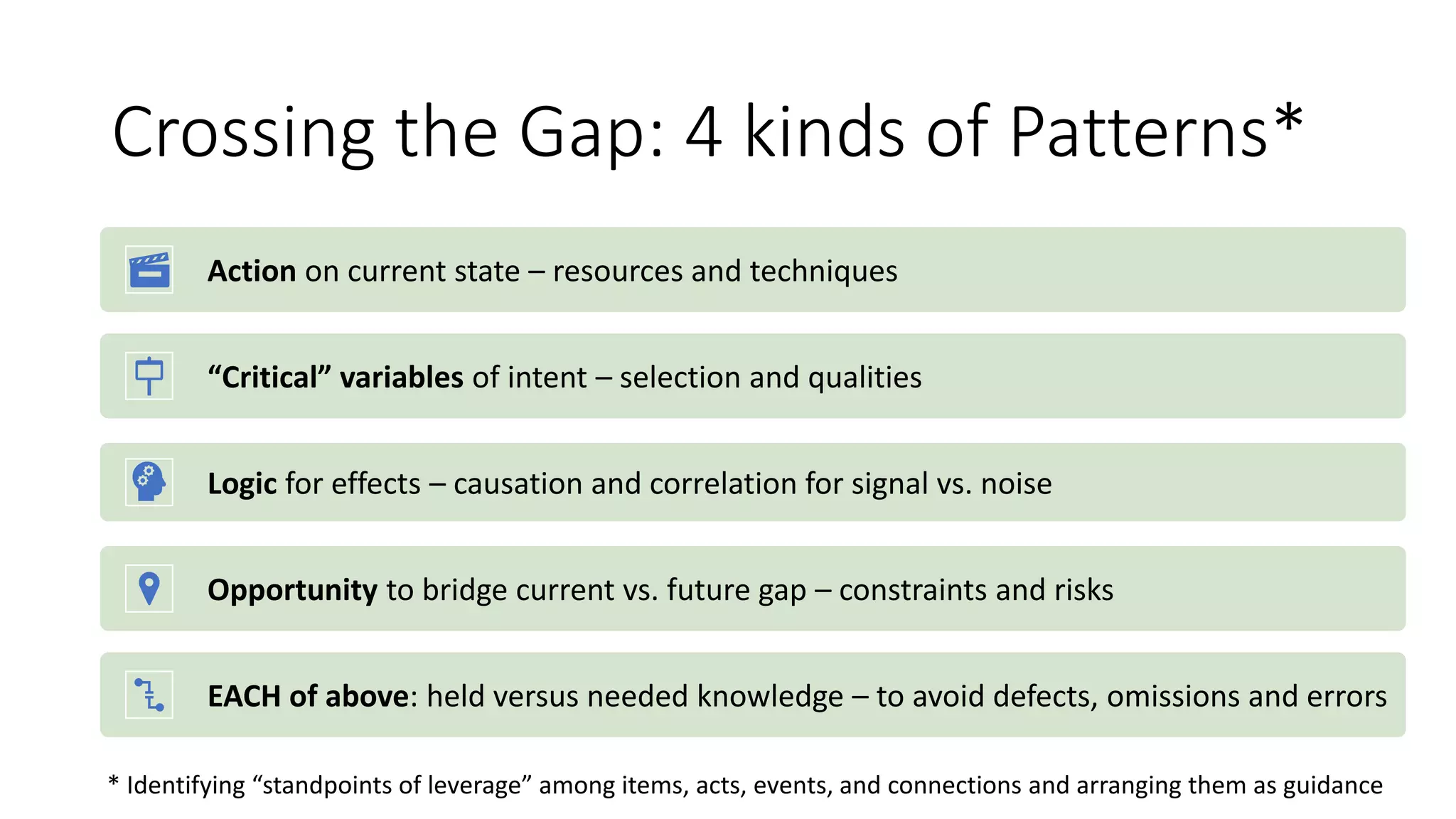
Crossing the Gap: 4 kinds of Patterns*
Action on current state – resources and techniques
“Critical” variables of intent – selection and qualities
Logic for effects – causation and correlation for signal vs. noise
Opportunity to bridge current vs. future gap – constraints and risks
EACH of above: held versus needed knowledge – to avoid defects, omissions and errors
* Identifying “standpoints of leverage” among items, acts, events, and connections and arranging them as guidance
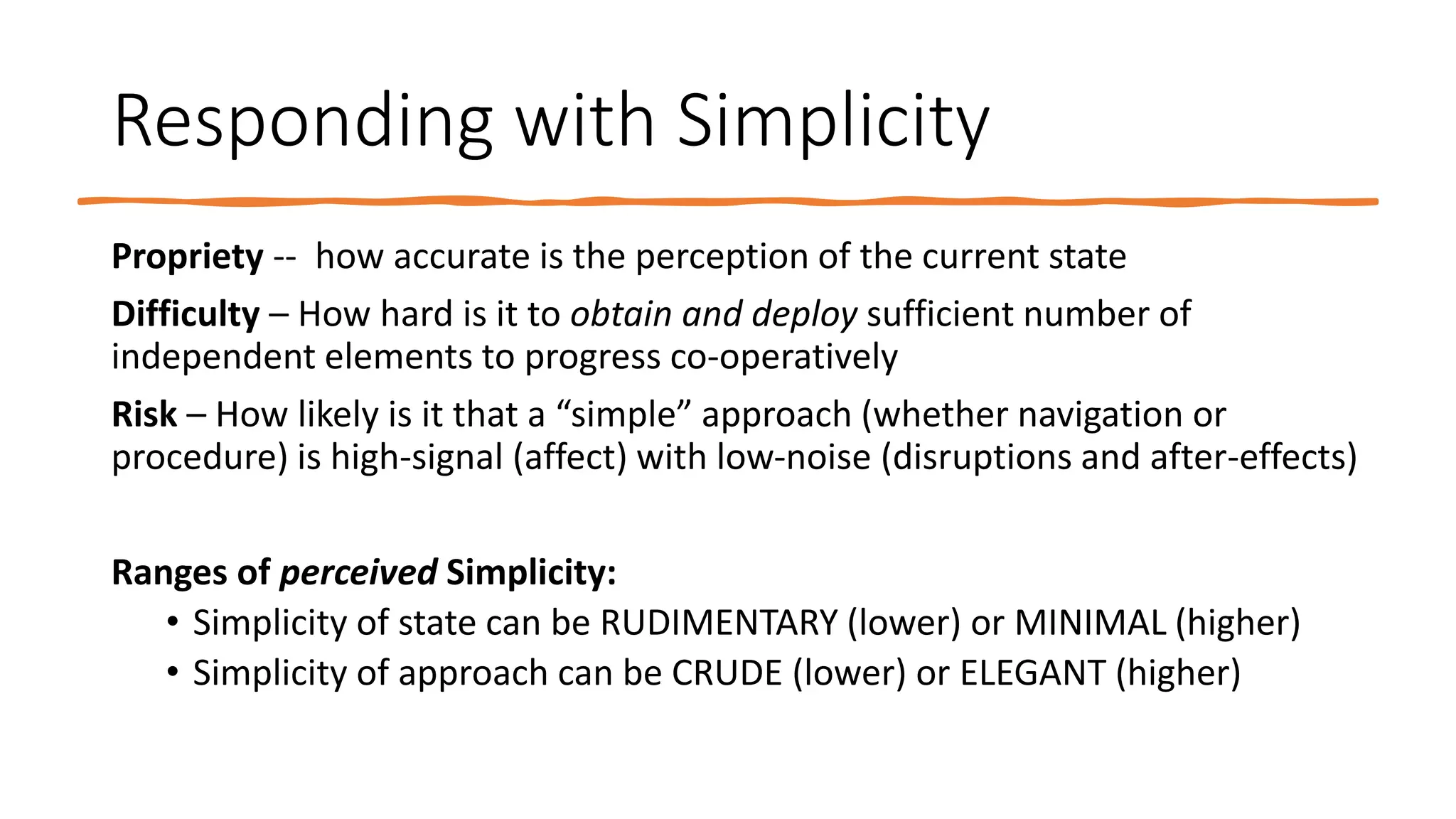
Responding with Simplicity
Propriety -- how accurate is the perception of the current state
Difficulty – How hard is it to obtain and deploy sufficient number of
independent elements to progress co-operatively
Risk – How likely is it that a “simple” approach (whether navigation or
procedure) is high-signal (affect) with low-noise (disruptions and after-effects)
Ranges of perceived Simplicity:
• Simplicity of state can be RUDIMENTARY (lower) or MINIMAL (higher)
• Simplicity of approach can be CRUDE (lower) or ELEGANT (higher)
Responding with Complexity
Propriety -- how accurate is the perception of the current state
Difficulty – How hard is it to obtain and deploy sufficient types of dependent
elements to progress synergistically
Risk – How likely is it that a “complex” approach (whether navigation or
procedure) is sustainable
Ranges of perceived Complexity:
• Complexity of state can be CLUTTERED (lower) or ELABORATE (higher)
• Complexity of approach can be CONFUSED (lower) or TAILORED (higher)
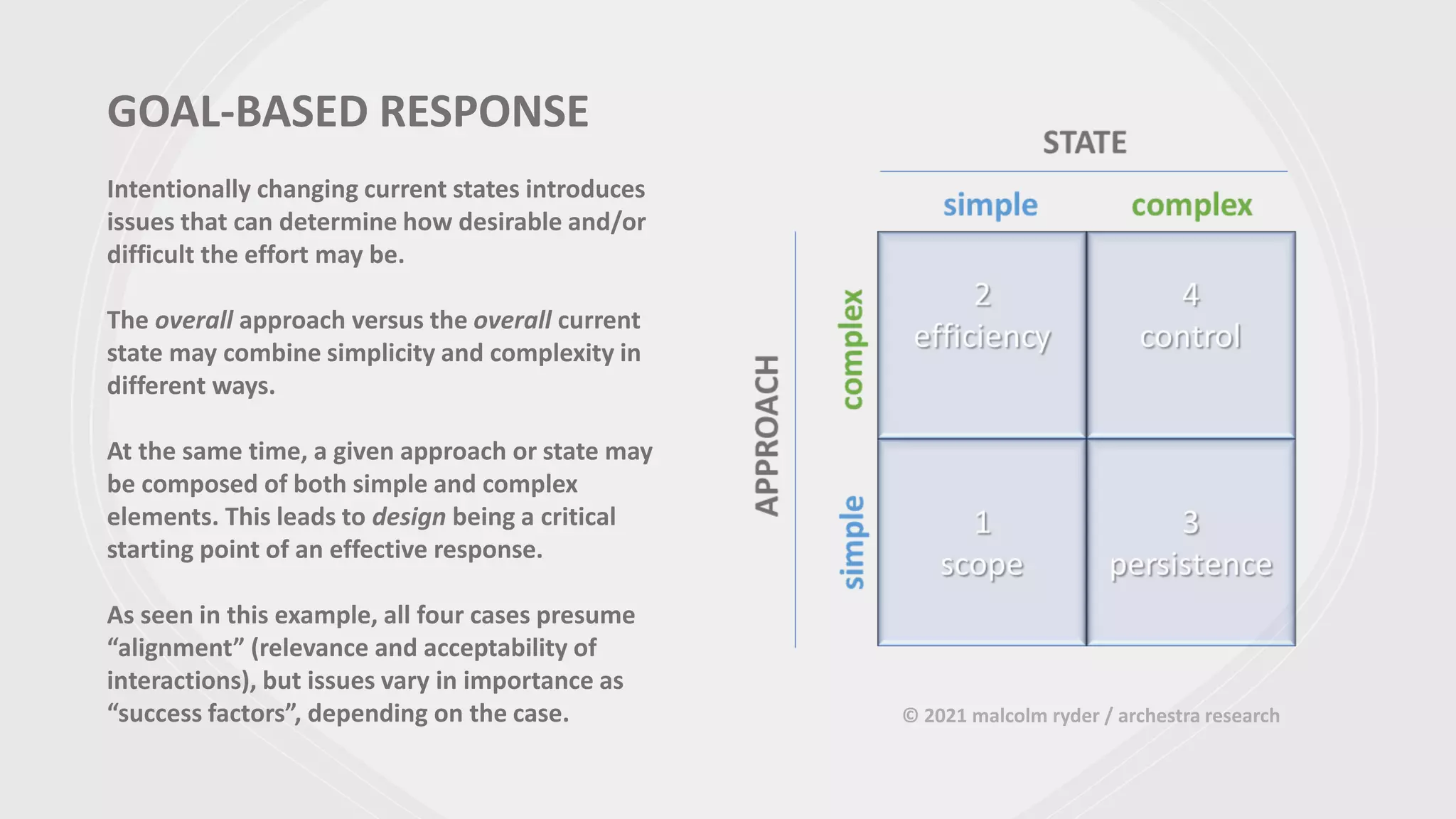
GOAL-BASED RESPONSE
Intentionally changing current states introduces
issues that can determine how desirable and/or
difficult the effort may be.
The overall approach versus the overall current
state may combine simplicity and complexity in
different ways.
At the same time, a given approach or state may
be composed of both simple and complex
elements. This leads to design being a critical
starting point of an effective response.
As seen in this example, all four cases presume
“alignment” (relevance and acceptability of
interactions), but issues vary in importance as
“success factors”, depending on the case. © 2021 malcolm ryder / archestra research
Complexity and Simplicity Unpacked

Complexity and Simplicity Unpacked

  • 1.
  • 2.
    Who cares? Creators arelooking for a way to achieve the effects they desire. The effects can be behaviors (active) or conditions (static). “Users” of behaviors or conditions have objectives either during or for their encounters with them. Users are looking for confidence, predictability, and reliability in their exposure to them and interaction with them. For users to experience meeting their objectives with existing effects, there may be a need for some mediation or mitigation to arrange an opportunity based on alignment of probabilities in dependencies and causes.
  • 3.
    Simplicity and Complexity:truths It is “popularly” said that simplicity is good for effectiveness and complexity is bad. But this is a fallacy due to using the terms as substitutes for the real concerns at hand: ease and difficulty. Simplicity is also not the opposite of complexity – except in cases where it is “known” beforehand that the required outcome depends on one of the two being excluded. Furthermore, some desired behaviors and conditions exist only through or in complexity. This fact is regularly demonstrated in much of art, math, pro team sports, and personal health as well as in balanced natural (environmental) ecosystems. The key observation to make is that complexity can be the condition of the opportunity, and it can be the condition of the effect. Likewise, simplicity can characterize opportunity and characterize effect. A characterization may be an accepted perception or a verified fact. Those two characterizations may or may not agree in the given moment.
  • 4.
    Descriptions and Perceptions Simplicityand Complexity are different descriptions of the same thing: CONFIGURATION • Configuration is the way that something CAME TO BE the way that something IS • This includes, therefore, both Approaches and States Ranges of perceived Simplicity: • Simplicity of state can be (lower) RUDIMENTARY or (higher) MINIMAL • Simplicity of approach can be CRUDE (lower) or ELEGANT (higher) Ranges of perceived Complexity: • Complexity of state can be CLUTTERED (lower) or ELABORATE (higher) • Complexity of approach can be CONFUSED (lower) or TAILORED (higher)
  • 5.
    “Creators” have waysto produce states encountered by “Users”. However, at a given moment of encounter, existing states are not always intentional creations. An existing state may present an opportunity, and exploiting the opportunity means having an approach to changing the existing state with an effect intended as a future outcome. At a given moment: © 2021 malcolm ryder / archestra research
  • 6.
    Exploiting the opportunityof a given state means having an approach to changing the existing state with an effect intended as a future outcome. The usual considerations include an approach that is simple or complex, versus a state that is simple or complex. In given conditions: © 2021 malcolm ryder / archestra research
  • 7.
    The Basics Complexity andSimplicity are types of conditions, not types of problems Each is a condition of a structure that is posited as a single entity A structure is a persistent arrangement of certain given elements The single entity is usually significant as either an environment or a mechanism The single entity has an acknowledged typifying character The intent of referring to simplicity or complexity is to characterize an environment or a mechanism © 2021 malcolm ryder / archestra research
  • 8.
    Goal-oriented structure, andmore truths State wants to have SUFFICIENCY without DEFICIENCY • Simplicity of state can require complexity of approach (FORMULA) • Complexity of state can require simplicity of approach (POWER) Approach wants to have EFFICIENCY without DEFICIENCY • Simplicity of approach can cause complexity of state (TENSION) • Complexity of approach can cause simplicity of state (STABILITY)
  • 9.
    Simplicity, Composed In asimple structure, the entity’s singular character comes from how the elements behave with each other • A simple structure with a “single entity” status can have one or more elements • In simplicity, a single element has a role that is independent of the other elements. • Independent compatible elements add their respective functions to the aggregate Challenge: • Manage multiple actions • The structure’s presence or persistence may or may not be reliable
  • 10.
    Complexity, Composed In acomplex structure, the entity’s “singular” character comes only from how the elements behave because of each other • A complex structure with a “single entity” status has multiple elements. • A single element may have no independent role • Dependent complementary elements create function from each other Challenge: • Manage multiple reactions • The structure’s presence or persistence may or may not be predictable.
  • 11.
    Measures Simplicity • Simplicity canbe higher or lower. • Lower simplicity does not equal complexity. Complexity • Complexity can be higher or lower. • Lower complexity does not equal simplicity
  • 12.
    Simplicity High andLow Higher simplicity features any of the following: fewer included elements elements that are more independent more similarity of included elements Lower simplicity features any of the following: more elements less independence of elements less similarity of included elements © 2021 malcolm ryder / archestra research
  • 13.
    Complexity High andLow Higher complexity features any of the following: more included elements elements that are less independent less similarity of included elements Lower complexity features any of the following: fewer elements more independence of elements more similarity of included elements © 2021 malcolm ryder / archestra research
  • 14.
    The Who CaresTest: Activity Environments “host” activity; Mechanisms “generate” activity • Activity may have a singular consequence that is experienced • The consequence is considered to be an operational output • The consequence is a future state Sometimes there is a problem with complexity. • Accommodating need versus complexity can be a problem. • Distance from the current state (need) to the future state (satisfaction) can be a problem where traversing it carries degrees of difficulty and/or risk that result in deficiency.
  • 15.
    The Problem ofDeficiency • Complexity can increase the probability of deficiency. • Deficiency is relative to desire and/or intention. • Complexity can increase the difficulty of identifying positions and/or outputs versus desire • Complexity can increase the difficulty of associating positions and/or outputs versus intention
  • 16.
    Acting on conditions Complexityis a state, not a problem. There is a distance between the future state and the current state. Traversing the distance environmentally requires navigation. Traversing the distance mechanically requires procedure. Navigating can be a solution to the problem of environmental distances (state changes needed, of position) Procedures can be a solution to the problem of mechanical distances (state changes needed, of outputs)
  • 17.
    What is complex:the candidates Design (form) of the structure – discovery Evidence (recognition) of the entity – determination Response (method) – reaction Affect (influence) – manipulation Target end state (stability) -- configuration
  • 18.
    Action Goals versusCurrent Conditions Responses by Type Navigation Procedure State (environment) Must identify what connections of “standpoints” can exist Linkages Must create new configurations Models Approach (mechanism) Must identify how “standpoints” of leverage are reached Patterns Must predict likely Affects and After-Effects Formula © 2021 malcolm ryder / archestra research
  • 19.
    Crossing the Gap:4 kinds of Patterns* Action on current state – resources and techniques “Critical” variables of intent – selection and qualities Logic for effects – causation and correlation for signal vs. noise Opportunity to bridge current vs. future gap – constraints and risks EACH of above: held versus needed knowledge – to avoid defects, omissions and errors * Identifying “standpoints of leverage” among items, acts, events, and connections and arranging them as guidance
  • 20.
    Responding with Simplicity Propriety-- how accurate is the perception of the current state Difficulty – How hard is it to obtain and deploy sufficient number of independent elements to progress co-operatively Risk – How likely is it that a “simple” approach (whether navigation or procedure) is high-signal (affect) with low-noise (disruptions and after-effects) Ranges of perceived Simplicity: • Simplicity of state can be RUDIMENTARY (lower) or MINIMAL (higher) • Simplicity of approach can be CRUDE (lower) or ELEGANT (higher)
  • 21.
    Responding with Complexity Propriety-- how accurate is the perception of the current state Difficulty – How hard is it to obtain and deploy sufficient types of dependent elements to progress synergistically Risk – How likely is it that a “complex” approach (whether navigation or procedure) is sustainable Ranges of perceived Complexity: • Complexity of state can be CLUTTERED (lower) or ELABORATE (higher) • Complexity of approach can be CONFUSED (lower) or TAILORED (higher)
  • 22.
    GOAL-BASED RESPONSE Intentionally changingcurrent states introduces issues that can determine how desirable and/or difficult the effort may be. The overall approach versus the overall current state may combine simplicity and complexity in different ways. At the same time, a given approach or state may be composed of both simple and complex elements. This leads to design being a critical starting point of an effective response. As seen in this example, all four cases presume “alignment” (relevance and acceptability of interactions), but issues vary in importance as “success factors”, depending on the case. © 2021 malcolm ryder / archestra research