Systemic Thinking Fundamentals For Understanding
Problems And Messes 2014th Edition Patrick T
Hester download
https://ebookbell.com/product/systemic-thinking-fundamentals-for-
understanding-problems-and-messes-2014th-edition-patrick-t-
hester-4916544
Explore and download more ebooks at ebookbell.com
Here are some recommended products that we believe you will be
interested in. You can click the link to download.
Systemic Thinking Fundamentals For Understanding Problems And Messes
Patrick T Hester Kevin Macg Adams
https://ebookbell.com/product/systemic-thinking-fundamentals-for-
understanding-problems-and-messes-patrick-t-hester-kevin-macg-
adams-10986674
The Fundamentals Of Systems Thinking Management Effective Leadership
Sawomir Wycilak
https://ebookbell.com/product/the-fundamentals-of-systems-thinking-
management-effective-leadership-sawomir-wycilak-58426752
Systemic Thinking For Public Managers Five Practices For Creating A
Vibrant Organization Sheila E Murphy Tracey A Regenold Philip A Reed
https://ebookbell.com/product/systemic-thinking-for-public-managers-
five-practices-for-creating-a-vibrant-organization-sheila-e-murphy-
tracey-a-regenold-philip-a-reed-55978134
Systemic Thinking For Policy Making William Hynes Martin Lees And Jan
Marco Mller
https://ebookbell.com/product/systemic-thinking-for-policy-making-
william-hynes-martin-lees-and-jan-marco-mller-22754478
Systemic Thinking Building Maps For Worlds Of Systems John Boardman
https://ebookbell.com/product/systemic-thinking-building-maps-for-
worlds-of-systems-john-boardman-4318196
Unity From Diversity Pluralist Systemic Thinking For Social And
Behavioural Research Ray W Cooksey
https://ebookbell.com/product/unity-from-diversity-pluralist-systemic-
thinking-for-social-and-behavioural-research-ray-w-cooksey-58535542
Nature In Mind Systemic Thinking And Imagination In Ecopsychology And
Mental Health Roger Duncan
https://ebookbell.com/product/nature-in-mind-systemic-thinking-and-
imagination-in-ecopsychology-and-mental-health-roger-duncan-33987708
New Approaches To Economic Challenges Systemic Thinking For Policy
Making The Potential Of Systems Analysis For Addressing Global Policy
Challenges In The 21st Century Oecd
https://ebookbell.com/product/new-approaches-to-economic-challenges-
systemic-thinking-for-policy-making-the-potential-of-systems-analysis-
for-addressing-global-policy-challenges-in-the-21st-century-
oecd-49476556
Culture And System In Family Therapy Systemic Thinking And Practice
1st Ingabritt Krause
https://ebookbell.com/product/culture-and-system-in-family-therapy-
systemic-thinking-and-practice-1st-ingabritt-krause-2521710
Topics in Safety, Risk, Reliability and Quality
PatrickT. Hester
Kevin MacG. Adams
Systemic
Thinking
Fundamentals for Understanding
Problems and Messes
For further volumes:
http://www.springer.com/series/6653
Topics in Safety, Risk, Reliability and Quality
Volume 26
Series editor
Adrian V. Gheorghe, Old Dominion University, Norfolk, VA, USA
Editorial Advisory Board
Hirokazu Tatano, Kyoto University, Kyoto, Japan
Enrico Zio, Ecole Centrale Paris, France and Politecnico di Milano, Milan, Italy
Andres Sousa-Poza, Old Dominion University, Norfolk, VA, USA
Patrick T. Hester · Kevin MacG. Adams
1 3
Systemic Thinking
Fundamentals for Understanding
Problems and Messes
Patrick T. Hester
Department of Engineering Management
and Systems Engineering
Old Dominion University
Norfolk, VA
USA
Library of Congress Control Number: 2014941919
© Springer International Publishing Switzerland 2014
This work is subject to copyright. All rights are reserved by the Publisher, whether the whole or part
of the material is concerned, specifically the rights of translation, reprinting, reuse of illustrations,
recitation, broadcasting, reproduction on microfilms or in any other physical way, and transmission or
information storage and retrieval, electronic adaptation, computer software, or by similar or dissimilar
methodology now known or hereafter developed. Exempted from this legal reservation are brief excerpts
in connection with reviews or scholarly analysis or material supplied specifically for the purpose of
being entered and executed on a computer system, for exclusive use by the purchaser of the work.
Duplication of this publication or parts thereof is permitted only under the provisions of the Copyright
Law of the Publisher’s location, in its current version, and permission for use must always be obtained
from Springer. Permissions for use may be obtained through RightsLink at the Copyright Clearance
Center. Violations are liable to prosecution under the respective Copyright Law.
The use of general descriptive names, registered names, trademarks, service marks, etc. in this publication
does not imply, even in the absence of a specific statement, that such names are exempt from the relevant
protective laws and regulations and therefore free for general use.
While the advice and information in this book are believed to be true and accurate at the date of
publication, neither the authors nor the editors nor the publisher can accept any legal responsibility for
any errors or omissions that may be made. The publisher makes no warranty, express or implied, with
respect to the material contained herein.
Printed on acid-free paper
Springer is part of Springer Science+Business Media (www.springer.com)
ISSN 1566-0443 ISSN 2215-0285 (electronic)
ISBN 978-3-319-07628-7 ISBN 978-3-319-07629-4 (eBook)
DOI 10.1007/978-3-319-07629-4
Springer Cham Heidelberg New York Dordrecht London
Kevin MacG. Adams
Department of Information Technology
and Computer Science
University of Maryland University College
Adelphi, MD
USA
To my wife for her encouragement, my
children for their comic relief, and my
parents for their support
Patrick T. Hester
To the men of the U.S. Navy’s submarine
force, who practice attention-to-detail every
minute of every day
Kevin MacG. Adams
vii
Preface
Quick, think about a problem that vexes you. Too easy, right? The only difficulty
you’d likely face is narrowing it down to a singular problem. Now think of another
one. But this time, dig deep into your brain. Think of a problem that keeps you up at
night, one that bothers you day in and day out, one that is seemingly intractable. Got
one? Good, now think about what it is that characterizes this problem. What makes
it hard? Why haven’t you solved it yet? Well, for starters, it probably includes many
of the items on the list below, identified by noted Psychologist Joachim Funke ([1]
pp. 186–187) as characterizing complex problem solving situations:
• Intransparency: Intransparency refers to the lack of availability of information
in our problem. An intransparent problem represents a situation in which all
variables cannot be directly observed. In this case, we may have to infer infor-
mation about the underlying state of the system, or too many variables exist,
leading to our selection of only a handful for observation and analysis.
• Polytely: From the Greek words poly and telos meaning many goals. This set
of goals can be thought of in many forms. We may have many individuals asso-
ciated with our problem, and each harbors their own needs and wants. These
interests are likely not to be directly aligned; thus, they compete for our atten-
tion, requiring trade-offs. Similarly, objectives within our problem are not
typically straightforward. Complex problems involve multiple, conflicting
objectives. Finally, our problem will likely require competition for resources.
We do not have unlimited resources; thus, we are limited in our ability to
address our problem in the most straightforward and effective manner.
• Complexity: This element concerns the number of variables, the connectivity
between these variables, and the nature of their relationship (i.e., linear vs. non-
linear). Funke [1] summarizes complexity as:
A complex problem-solving situation is not only characterized by a large number of vari-
ables that have to be considered, but also by their complex connectivity pattern, by the
possibilities to control the system, and by the dynamic aspects of the system. The growing
complexity of situational demands may conflict with the limited capacity of the problem
solver. (pp. 186–187)
Preface
viii
• Variable connectivity: A change in one variable is likely to affect the status of
many other variables. Given this high connectivity, consequences are difficult
to predict. That is, there is substantial unpredictability in the behavior of the
problem. Even the most tried-and-true of modeling techniques fail to capture
the behavior of modern problems—events such as Hurricanes Katrina or Sandy,
the housing market crash, and other so-called Black Swans. These unpredict-
able phenomena go beyond the bounds of our uncertainty analysis techniques
and require us to consider the robustness of our institutions, organizations, and
supporting systems. Considering these phenomena in concert with shrinking
resources, we have a quandary. More resources are required to plan for unpre-
dictability, yet we lack sufficient resources to address these concerns completely.
Thus, we must make compromises to account for this inherent contradiction.
• Dynamic developments: There is often considerable time pressure to address
problems before they worsen. Positive changes also occur, but these changes
could lead to further unpredictability. This is complicated by humans’ bias for
action. Most people are uncomfortable with situations that are unresolved. We
want an answer and we want it now. One must simply look at the increase in
information availability over the last decade to understand how the world has
transformed into an instant gratification generation. No longer are we content
to pull an encyclopedia off our bookshelf (that is, if we even own an encyclo-
pedia anymore) and look up the answer to a question. Instead, we pull out our
smart phone and Google it, expecting an instant answer, and grumbling when
our Internet connection hits a snag. This behavior is problematic when consider-
ing problems of substantial complexity. Choosing to act, to get an answer right
now, rather than to obtain additional information may lead to an inferior choice
based on insufficient information. We must carefully weigh the desire to obtain
more information with our potential for loss and what may have been. To put it
another way, we must choose between getting it right or getting it right now.
• Time-delayed effects: Effects often occur with a time delay. This requires patience
on the part of the individual concerned with the problem. This is in direct contrast
to the need for near-term action discussed in the previous element.
To this list we add two criteria:
• Significant uncertainty: Complex problems have substantial uncertainty. That
is, there are unknown elements which plague our problem. Some are so-called
known unknowns such as the fact that market demand for a new product is
unknown. These uncertainties come from the variables that are known to exist
in a problem (but that have some level of random behavior associated with them
that can be expressed by probability distributions). These types of uncertainties
are present in any real-world problem due to the inherent variability of the natu-
ral world. So we use probabilistic information to reason about and predict these
phenomena. More difficult to deal with are unknown unknowns such as the fact
that we don’t know what our competitors will do. This type of uncertainty comes
from lack of knowledge of the larger system of problems (which we will later
classify as a mess) of which our problem is a part. Will we be instantly outclassed
Preface ix
by our competitors the day our new product is introduced to the market (or worse,
before we even release our product)? To estimate these uncertainties, we typically
turn to experts for their insight. Both sources of uncertainty, known and unknown
unknowns, complicate our problem landscape but cannot be ignored.
• Humans-in-the-loop: Designing a mechanical system given a set of specifica-
tions may be straightforward, but designing the same system while incorporat-
ing human factors, including such elements as ergonomics, fatigue, and operator
error prevention, is substantially more complex. Once we insert humans into our
problem system, all bets are off, so to speak. In many ways, humans are the ulti-
mate trump card. They represent the one factor that seemingly ignores all the hard
work, all the calculations, all the effort, that has gone into the development of a
solution to our problem. They exploit the one weakness or vulnerability in our
problem system that no amount of simulations, trial runs, mock-ups, or counter-
factuals could have accounted for. They are intransparent, uncertain, competitive,
unpredictable, and have a bias for action, all factors that we’ve indicated make a
problem hard. To boot, they are not mechanistic; they have feelings and emotions
and difficult problems are often especially emotional issues. Think about some of
the most difficult problems facing our current society, e.g., health care or higher
education; they are highly emotional topics likely to elicit an emotionally charged
response from even the most level-headed of individuals. Thus, even when we
think we have it all figured out, humans enter the equation and blow it all apart.
So, what is one to do? Well, we could avoid all problems exhibiting one or all of
these factors. This leaves a very small, uninteresting subset of the world to deal with.
Alternatively, we suggest that all hope is not lost. We simply need a new way to rea-
son about these problems that goes beyond the traditional methods we employ. Full
disclosure—the authors of this book are engineers by education. But we’ve worked
in industry and the military for many years and we’ve come to understand that no
single discipline can solve truly complex problems. Problems of real interest, those
vexing ones that keep you up at night, require a discipline-agnostic approach. They
require us to get out of our comfort zone a little bit, to reach across the aisle, and
embrace those fundamental concepts of other disciplines that may be advantageous
to our effort. Simply, they require us to think systemically about our problem.
Fundamentally, we need a novel way to think about these problems, and more
specifically, to think systemically, hence the title of this book. It is the hope of the
authors that, after reading this book, readers will gain an appreciation for a novel
way of thinking and reasoning about complex problems that encourages increased
understanding. We intend to provide this in a manner that is not predicated on the
reader being either an engineer or a scientist. Indeed, most of the real, complex
problems vexing us are not engineering or scientific problems, at least in the strict-
est sense. So, you’ll see us draw from engineering and science to be sure, but we’ll
also draw from psychology, mathematics, sociology, management, and many other
fields in an effort to develop a robust approach to thinking about problems. To
support this approach, the book is divided into two major parts: (1) A Frame of
Reference for Systemic Thinking and (2) A Methodology for Systemic Thinking.
Preface
x
Part I focuses on the underlying theoretical basis necessary for thinking about
problems in a meaningful manner. Chapter 1 discusses why current approaches to
problem analysis lead to routine and predictable errors and why a new method for
thinking about problems is necessary. Chapter 2 discusses the difference between
problems (such as the mechanical design problem above) and messes (such as
the healthcare crisis), and it addresses how to formulate an initial problem for
investigation. Chapter 3 discusses the difference between traditional systematic
approaches for reasoning about problems and our proposed systemic approach,
introducing our methodology for systemic thinking. Chapter 4 completes Part I by
providing the discipline-agnostic, theoretical basis necessary for systemic think-
ing. Completion of Part I will provide the reader with all of the knowledge neces-
sary to understand a problem systemically from a theoretical basis. It will offer
little guidance, however, in the way of practical deployment of such an approach.
Such guidance is provided in Part II.
Part II provides a practical methodology for thinking systemically about any
situation. For reasons that will become apparent after reading Chap. 3, Part II is
divided into seven chapters, with the first six chapters answering the fundamental
questions of who, what, why, where, how, and when as they pertain to your prob-
lem of interest. Chapter 5 addresses the who question by discussing stakeholder
analysis and management. Chapter 6 addresses the what question by discussing
problem decomposition into relevant elements such as outputs and outcomes.
Chapter 7 answers the why question by addressing the motivational factors that
influence stakeholders involved in a problem. Chapter 8 is focused on the where
question, with emphasis placed on characterizing the context and boundaries of
our problem. Chapter 9 is the how chapter which discusses mechanisms we can
utilize in support of our problem analysis. Chapter 10 addresses the when ques-
tion, discussing the stability and maturity of our problems. Finally, Chapter 11
brings all of these six perspectives together, introducing a systemic perspective
which allows for a more holistic problem understanding. Once the reader has com-
pleted this book, it is the intent of the authors that he or she will possess a thor-
ough understanding of the theory underlying systemic thinking (Part I), as well as
how to actually utilize systemic thinking (Part II).
This book is intended for use by systems practitioners or in a graduate or
advanced undergraduate class. Given its discipline-agnostic nature, it is just
as appropriate for use in a business, sociology, or psychology course as it is
in an engineering or scientific course. Regarding its instruction, Part I should
be taught in order of appearance in the book to provide the proper theoretical
foundation. Chapters 5–10 in Part II can be taught in any order, although, lack-
ing any other preference, they can be taught in the order in which they appear.
Chapter 11 should follow their instruction as it builds on techniques developed
in Chaps. 5–10.
Preface xi
One final note before moving on. Before beginning the book in earnest, we
ask you to skip ahead to Appendix A and complete our Systemic Thinking Self-
Assessment. This brief questionnaire will enable you to self-assess your current
perspective on systemic thinking. When you have finished reading the book, we
ask you to return and complete it again, to compare your results and see if your
perspectives have changed.
Reference
1. Funke J (1991) Solving complex problems: exploration and control of complex systems.
In: Sternberg RJ, Frensch PA (eds) Complex problem solving: principles and mechanisms.
Lawrence Erlbaum Associates, NJ: Hillsdale pp. 185–222
xiii
Acknowledgments
I would like to thank the numerous organizations, and all the individuals, that
I have worked with over the years and that have shaped my perspectives on
life and work. Thanks to all my colleagues and classmates at Webb Institute,
National Steel and Shipbuilding Company, Vanderbilt University, Sandia National
Laboratories, and Old Dominion University. Each stop along my journey has led
to new insights and even more questions.
To my students over the years at Old Dominion University. You never lack the
courage to ask the tough questions that have filled up my white board with chaos
that boggles my mind and has helped me to lose what little hair I had left. Thanks
especially to those students that beta tested this book with me—James Asbury,
Alan Bell, Serkan Polat, and Pete Zohorsky. Your comments greatly improved this
text and the thinking behind it.
To my co-author Kevin, who is nothing if not 100 % emphatic about everything
he’s ever been a part of. Your enthusiasm is contagious. To my wife Kasey, who
is my partner and constant companion on this wild ride through life. To my kids,
Maryn and Gavin, who cheer me up even on the most dreary of days. To my par-
ents, Kevin and Peggy, for your unwavering support over the years.
I would like to thank the many real-world systems designers and maintain-
ers who have mentored me over the past 43 years. Special thanks to Art Colling,
Stan Handley, Butch Meier, George Yount, John Bowen, Vince Albano, Jim Dunn,
Joe Yurso, Bob Luby, Paul Bilodeau, and Bob Charette for guiding me through
numerous challenges. Praise for my colleagues Dave Herbein, Tim Arcano, Steve
Krahn, Mark Welsh, Bill Zuppinger, Jim Sullivan, Mike Daley, Tom Meyers, and
Joe Bradley who provided continuous counsel in keeping me from committing the
Type VII error.
To the many students I have been privileged to teach at both the University of
Maryland University College, the College of William and Mary, Virginia Wesleyan
College, and Old Dominion University. Your quest for knowledge has challenged
me to constantly renew and improve my own understanding as part of the learning
process.
Patrick T. Hester
Acknowledgments
xiv
To my co-author Patrick for making this journey not only informative, but
fun. To my parents, for providing me with the resources and basic skills required
to thrive as an engineer. To my children, for many hours of challenges, joy and
amazement. Finally, to my wife, for her constant support, companionship, and
love throughout the process of completing this book and our journey through life
together.
Kevin MacG. Adams
xv
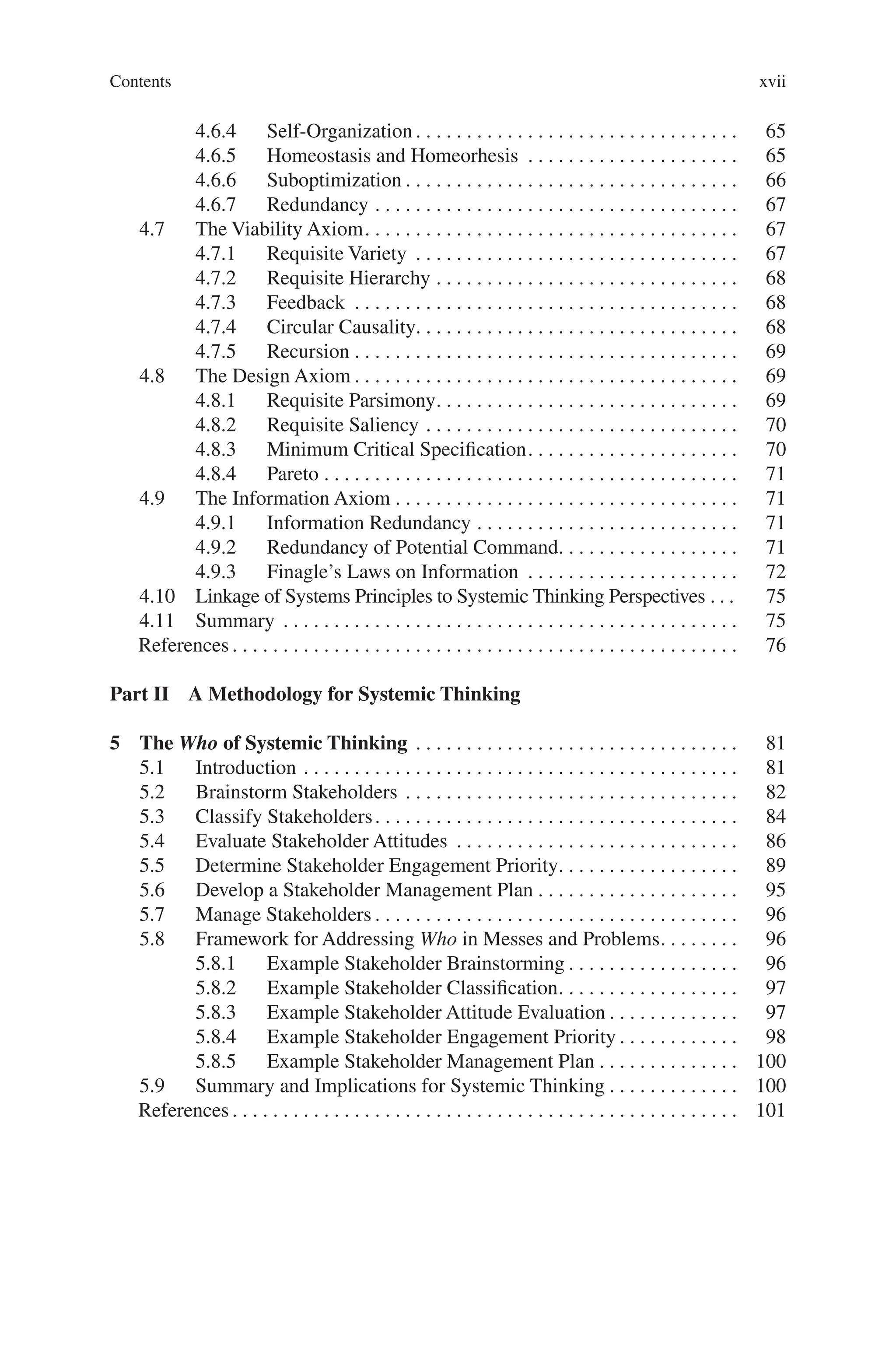
Contents
Part I A Frame of Reference for Systemic Thinking
1 Introduction. . . . . . . . . . . . . . . . . . . . . . . . . . . . . . . . . . . . . . . . . . . . . . . .  3
1.1 The TAO Approach . . . . . . . . . . . . . . . . . . . . . . . . . . . . . . . . . . . . .  3
1.2 Systems Errors. . . . . . . . . . . . . . . . . . . . . . . . . . . . . . . . . . . . . . . . .  3
1.2.1 Type III Error. . . . . . . . . . . . . . . . . . . . . . . . . . . . . . . . . . .  5
1.2.2 Type IV Error. . . . . . . . . . . . . . . . . . . . . . . . . . . . . . . . . . .  6
1.2.3 Type V Error. . . . . . . . . . . . . . . . . . . . . . . . . . . . . . . . . . . .  6
1.2.4 Type I and Type II Errors. . . . . . . . . . . . . . . . . . . . . . . . . .  7
1.2.5 Type VI Error. . . . . . . . . . . . . . . . . . . . . . . . . . . . . . . . . . .  8
1.2.6 Type VII Error. . . . . . . . . . . . . . . . . . . . . . . . . . . . . . . . . .  9
1.2.7 Analysis of Errors . . . . . . . . . . . . . . . . . . . . . . . . . . . . . . .  9
1.3 Observation . . . . . . . . . . . . . . . . . . . . . . . . . . . . . . . . . . . . . . . . . . .  12
1.3.1 Theory-Laden Observation . . . . . . . . . . . . . . . . . . . . . . . .  14
1.3.2 Dynamic Model of Situated Cognition . . . . . . . . . . . . . . .  15
1.3.3 Measurement. . . . . . . . . . . . . . . . . . . . . . . . . . . . . . . . . . .  15
1.3.4 Bias and Heuristics. . . . . . . . . . . . . . . . . . . . . . . . . . . . . . .  16
1.4 Summary . . . . . . . . . . . . . . . . . . . . . . . . . . . . . . . . . . . . . . . . . . . . .  19
References. . . . . . . . . . . . . . . . . . . . . . . . . . . . . . . . . . . . . . . . . . . . . . . . . .  19
2 Problems and Messes . . . . . . . . . . . . . . . . . . . . . . . . . . . . . . . . . . . . . . . .  23
2.1 Introduction to Complex Problems. . . . . . . . . . . . . . . . . . . . . . . . .  23
2.1.1 Historical Background for Complex Problems. . . . . . . . .  24
2.1.2 The Machine Age and the Systems Age. . . . . . . . . . . . . . .  25
2.2 Dealing with Systems Age Messes . . . . . . . . . . . . . . . . . . . . . . . . .  26
2.2.1 Perspectives in Complex Problems. . . . . . . . . . . . . . . . . .  26
2.3 Holistic Understanding. . . . . . . . . . . . . . . . . . . . . . . . . . . . . . . . . . . 28
2.4 Problem Formulation. . . . . . . . . . . . . . . . . . . . . . . . . . . . . . . . . . . .  29
2.5 Summary . . . . . . . . . . . . . . . . . . . . . . . . . . . . . . . . . . . . . . . . . . . . .  32
References. . . . . . . . . . . . . . . . . . . . . . . . . . . . . . . . . . . . . . . . . . . . . . . . . .  33
Contents
xvi
3 Systemic Thinking. . . . . . . . . . . . . . . . . . . . . . . . . . . . . . . . . . . . . . . . . . .  35
3.1 A Brief Background of Systems Approaches. . . . . . . . . . . . . . . . . . 35
3.2 What is Systemic Thinking? . . . . . . . . . . . . . . . . . . . . . . . . . . . . . .  38
3.2.1 Age. . . . . . . . . . . . . . . . . . . . . . . . . . . . . . . . . . . . . . . . . . .  38
3.2.2 Unit of Analysis. . . . . . . . . . . . . . . . . . . . . . . . . . . . . . . . .  39
3.2.3 Stopping Criteria. . . . . . . . . . . . . . . . . . . . . . . . . . . . . . . .  40
3.2.4 Goal. . . . . . . . . . . . . . . . . . . . . . . . . . . . . . . . . . . . . . . . . .  41
3.2.5 Underlying Philosophy. . . . . . . . . . . . . . . . . . . . . . . . . . . . 42
3.2.6 Epistemology. . . . . . . . . . . . . . . . . . . . . . . . . . . . . . . . . . .  43
3.2.7 Disciplinary Scope. . . . . . . . . . . . . . . . . . . . . . . . . . . . . . .  44
3.2.8 Approach. . . . . . . . . . . . . . . . . . . . . . . . . . . . . . . . . . . . . .  44
3.3 A Methodology for Systemic Thinking. . . . . . . . . . . . . . . . . . . . . .  45
3.4 Summary . . . . . . . . . . . . . . . . . . . . . . . . . . . . . . . . . . . . . . . . . . . . .  47
References. . . . . . . . . . . . . . . . . . . . . . . . . . . . . . . . . . . . . . . . . . . . . . . . . .  48
4 Systems Theory. . . . . . . . . . . . . . . . . . . . . . . . . . . . . . . . . . . . . . . . . . . . .  51
4.1 Historical Roots of Systems Theory . . . . . . . . . . . . . . . . . . . . . . . .  51
4.1.1 General Systems Theory . . . . . . . . . . . . . . . . . . . . . . . . . .  51
4.1.2 Living Systems Theory . . . . . . . . . . . . . . . . . . . . . . . . . . .  52
4.1.3 Mathematical Systems Theory. . . . . . . . . . . . . . . . . . . . . .  52
4.1.4 Cybernetics. . . . . . . . . . . . . . . . . . . . . . . . . . . . . . . . . . . . .  53
4.1.5 Social Systems Theory. . . . . . . . . . . . . . . . . . . . . . . . . . . .  53
4.1.6 Philosophical Systems Theory. . . . . . . . . . . . . . . . . . . . . .  53
4.1.7 Historical Roots of Systems Theory Summary. . . . . . . . .  54
4.2 Systems Theory. . . . . . . . . . . . . . . . . . . . . . . . . . . . . . . . . . . . . . . .  54
4.3 Centrality Axiom. . . . . . . . . . . . . . . . . . . . . . . . . . . . . . . . . . . . . . .  57
4.3.1 Emergence. . . . . . . . . . . . . . . . . . . . . . . . . . . . . . . . . . . . .  57
4.3.2 Hierarchy. . . . . . . . . . . . . . . . . . . . . . . . . . . . . . . . . . . . . .  57
4.3.3 Communication and Control. . . . . . . . . . . . . . . . . . . . . . .  58
4.4 The Contextual Axiom. . . . . . . . . . . . . . . . . . . . . . . . . . . . . . . . . . .  59
4.4.1 Holism. . . . . . . . . . . . . . . . . . . . . . . . . . . . . . . . . . . . . . . .  59
4.4.2 Darkness. . . . . . . . . . . . . . . . . . . . . . . . . . . . . . . . . . . . . . .  59
4.4.3 Complementarity. . . . . . . . . . . . . . . . . . . . . . . . . . . . . . . .  60
4.5 The Goal Axiom. . . . . . . . . . . . . . . . . . . . . . . . . . . . . . . . . . . . . . . .  60
4.5.1 Equifinality and Multifinality. . . . . . . . . . . . . . . . . . . . . . .  60
4.5.2 Purposive Behavior . . . . . . . . . . . . . . . . . . . . . . . . . . . . . .  61
4.5.3 Satisficing. . . . . . . . . . . . . . . . . . . . . . . . . . . . . . . . . . . . . .  62
4.5.4 Viability. . . . . . . . . . . . . . . . . . . . . . . . . . . . . . . . . . . . . . .  62
4.5.5 Finite Causality . . . . . . . . . . . . . . . . . . . . . . . . . . . . . . . . .  63
4.6 The Operational Axiom. . . . . . . . . . . . . . . . . . . . . . . . . . . . . . . . . .  63
4.6.1 Dynamic Equilibrium. . . . . . . . . . . . . . . . . . . . . . . . . . . . .  63
4.6.2 Relaxation Time. . . . . . . . . . . . . . . . . . . . . . . . . . . . . . . . .  63
4.6.3 Basins of Stability . . . . . . . . . . . . . . . . . . . . . . . . . . . . . . .  64
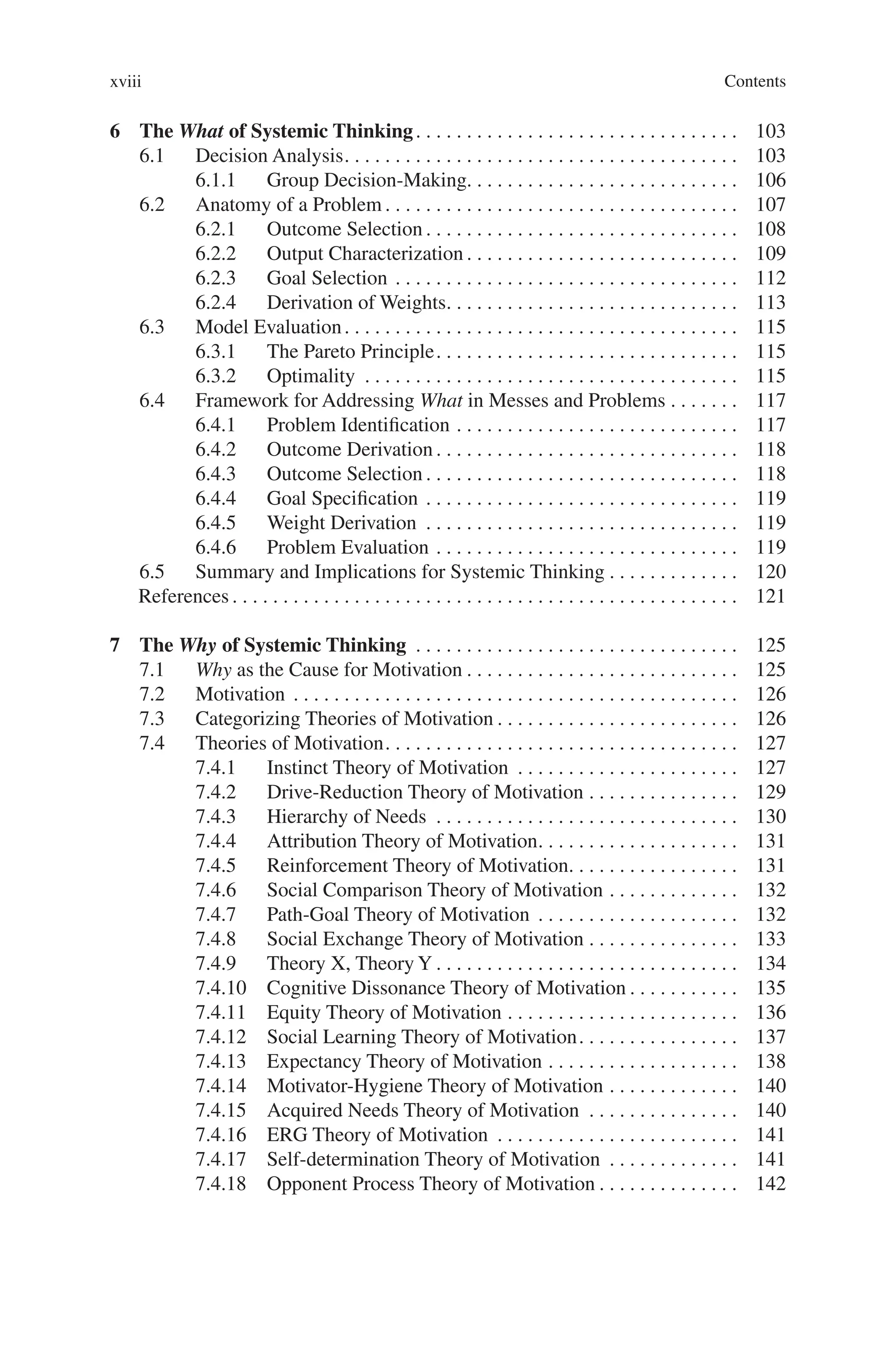
Contents xvii
4.6.4 Self-Organization. . . . . . . . . . . . . . . . . . . . . . . . . . . . . . . .  65
4.6.5 Homeostasis and Homeorhesis . . . . . . . . . . . . . . . . . . . . .  65
4.6.6 Suboptimization. . . . . . . . . . . . . . . . . . . . . . . . . . . . . . . . .  66
4.6.7 Redundancy. . . . . . . . . . . . . . . . . . . . . . . . . . . . . . . . . . . .  67
4.7 The Viability Axiom. . . . . . . . . . . . . . . . . . . . . . . . . . . . . . . . . . . . .  67
4.7.1 Requisite Variety . . . . . . . . . . . . . . . . . . . . . . . . . . . . . . . .  67
4.7.2 Requisite Hierarchy. . . . . . . . . . . . . . . . . . . . . . . . . . . . . .  68
4.7.3 Feedback . . . . . . . . . . . . . . . . . . . . . . . . . . . . . . . . . . . . . .  68
4.7.4 Circular Causality. . . . . . . . . . . . . . . . . . . . . . . . . . . . . . . . 68
4.7.5 Recursion. . . . . . . . . . . . . . . . . . . . . . . . . . . . . . . . . . . . . .  69
4.8 The Design Axiom. . . . . . . . . . . . . . . . . . . . . . . . . . . . . . . . . . . . . .  69
4.8.1 Requisite Parsimony. . . . . . . . . . . . . . . . . . . . . . . . . . . . . .  69
4.8.2 Requisite Saliency. . . . . . . . . . . . . . . . . . . . . . . . . . . . . . .  70
4.8.3 Minimum Critical Specification. . . . . . . . . . . . . . . . . . . . .  70
4.8.4 Pareto. . . . . . . . . . . . . . . . . . . . . . . . . . . . . . . . . . . . . . . . .  71
4.9 The Information Axiom. . . . . . . . . . . . . . . . . . . . . . . . . . . . . . . . . .  71
4.9.1 Information Redundancy. . . . . . . . . . . . . . . . . . . . . . . . . .  71
4.9.2 Redundancy of Potential Command. . . . . . . . . . . . . . . . . .  71
4.9.3 Finagle’s Laws on Information . . . . . . . . . . . . . . . . . . . . .  72
4.10 Linkage of Systems Principles to Systemic Thinking Perspectives. . .  75
4.11 Summary . . . . . . . . . . . . . . . . . . . . . . . . . . . . . . . . . . . . . . . . . . . . .  75
References. . . . . . . . . . . . . . . . . . . . . . . . . . . . . . . . . . . . . . . . . . . . . . . . . .  76
Part II A Methodology for Systemic Thinking
5 The Who of Systemic Thinking . . . . . . . . . . . . . . . . . . . . . . . . . . . . . . . .  81
5.1 Introduction. . . . . . . . . . . . . . . . . . . . . . . . . . . . . . . . . . . . . . . . . . .  81
5.2 Brainstorm Stakeholders. . . . . . . . . . . . . . . . . . . . . . . . . . . . . . . . .  82
5.3 Classify Stakeholders. . . . . . . . . . . . . . . . . . . . . . . . . . . . . . . . . . . .  84
5.4 Evaluate Stakeholder Attitudes . . . . . . . . . . . . . . . . . . . . . . . . . . . .  86
5.5 Determine Stakeholder Engagement Priority. . . . . . . . . . . . . . . . . .  89
5.6 Develop a Stakeholder Management Plan. . . . . . . . . . . . . . . . . . . .  95
5.7 Manage Stakeholders. . . . . . . . . . . . . . . . . . . . . . . . . . . . . . . . . . . .  96
5.8 Framework for Addressing Who in Messes and Problems. . . . . . . .  96
5.8.1 Example Stakeholder Brainstorming. . . . . . . . . . . . . . . . .  96
5.8.2 Example Stakeholder Classification. . . . . . . . . . . . . . . . . .  97
5.8.3 Example Stakeholder Attitude Evaluation. . . . . . . . . . . . .  97
5.8.4 Example Stakeholder Engagement Priority. . . . . . . . . . . .  98
5.8.5 Example Stakeholder Management Plan. . . . . . . . . . . . . .  100
5.9 Summary and Implications for Systemic Thinking. . . . . . . . . . . . .  100
References. . . . . . . . . . . . . . . . . . . . . . . . . . . . . . . . . . . . . . . . . . . . . . . . . .  101
Contents
xviii
6 The What of Systemic Thinking. . . . . . . . . . . . . . . . . . . . . . . . . . . . . . . .  103
6.1 Decision Analysis. . . . . . . . . . . . . . . . . . . . . . . . . . . . . . . . . . . . . . .  103
6.1.1 Group Decision-Making. . . . . . . . . . . . . . . . . . . . . . . . . . . 106
6.2 Anatomy of a Problem. . . . . . . . . . . . . . . . . . . . . . . . . . . . . . . . . . .  107
6.2.1 Outcome Selection. . . . . . . . . . . . . . . . . . . . . . . . . . . . . . .  108
6.2.2 Output Characterization. . . . . . . . . . . . . . . . . . . . . . . . . . .  109
6.2.3 Goal Selection. . . . . . . . . . . . . . . . . . . . . . . . . . . . . . . . . .  112
6.2.4 Derivation of Weights. . . . . . . . . . . . . . . . . . . . . . . . . . . . .  113
6.3 Model Evaluation. . . . . . . . . . . . . . . . . . . . . . . . . . . . . . . . . . . . . . .  115
6.3.1 The Pareto Principle. . . . . . . . . . . . . . . . . . . . . . . . . . . . . .  115
6.3.2 Optimality . . . . . . . . . . . . . . . . . . . . . . . . . . . . . . . . . . . . .  115
6.4 Framework for Addressing What in Messes and Problems. . . . . . .  117
6.4.1 Problem Identification. . . . . . . . . . . . . . . . . . . . . . . . . . . .  117
6.4.2 Outcome Derivation. . . . . . . . . . . . . . . . . . . . . . . . . . . . . .  118
6.4.3 Outcome Selection. . . . . . . . . . . . . . . . . . . . . . . . . . . . . . .  118
6.4.4 Goal Specification. . . . . . . . . . . . . . . . . . . . . . . . . . . . . . .  119
6.4.5 Weight Derivation . . . . . . . . . . . . . . . . . . . . . . . . . . . . . . .  119
6.4.6 Problem Evaluation. . . . . . . . . . . . . . . . . . . . . . . . . . . . . .  119
6.5 Summary and Implications for Systemic Thinking. . . . . . . . . . . . .  120
References. . . . . . . . . . . . . . . . . . . . . . . . . . . . . . . . . . . . . . . . . . . . . . . . . .  121
7 The Why of Systemic Thinking . . . . . . . . . . . . . . . . . . . . . . . . . . . . . . . .  125
7.1 Why as the Cause for Motivation. . . . . . . . . . . . . . . . . . . . . . . . . . .  125
7.2 Motivation . . . . . . . . . . . . . . . . . . . . . . . . . . . . . . . . . . . . . . . . . . . .  126
7.3 Categorizing Theories of Motivation. . . . . . . . . . . . . . . . . . . . . . . .  126
7.4 Theories of Motivation. . . . . . . . . . . . . . . . . . . . . . . . . . . . . . . . . . .  127
7.4.1 Instinct Theory of Motivation . . . . . . . . . . . . . . . . . . . . . .  127
7.4.2 Drive-Reduction Theory of Motivation. . . . . . . . . . . . . . .  129
7.4.3 Hierarchy of Needs . . . . . . . . . . . . . . . . . . . . . . . . . . . . . .  130
7.4.4 Attribution Theory of Motivation. . . . . . . . . . . . . . . . . . . .  131
7.4.5 Reinforcement Theory of Motivation. . . . . . . . . . . . . . . . .  131
7.4.6 Social Comparison Theory of Motivation. . . . . . . . . . . . .  132
7.4.7 Path-Goal Theory of Motivation . . . . . . . . . . . . . . . . . . . .  132
7.4.8 Social Exchange Theory of Motivation. . . . . . . . . . . . . . .  133
7.4.9 Theory X, Theory Y. . . . . . . . . . . . . . . . . . . . . . . . . . . . . .  134
7.4.10 Cognitive Dissonance Theory of Motivation. . . . . . . . . . .  135
7.4.11 Equity Theory of Motivation. . . . . . . . . . . . . . . . . . . . . . .  136
7.4.12 Social Learning Theory of Motivation. . . . . . . . . . . . . . . .  137
7.4.13 Expectancy Theory of Motivation. . . . . . . . . . . . . . . . . . .  138
7.4.14 Motivator-Hygiene Theory of Motivation. . . . . . . . . . . . .  140
7.4.15 Acquired Needs Theory of Motivation . . . . . . . . . . . . . . .  140
7.4.16 ERG Theory of Motivation . . . . . . . . . . . . . . . . . . . . . . . .  141
7.4.17 Self-determination Theory of Motivation . . . . . . . . . . . . .  141
7.4.18 Opponent Process Theory of Motivation. . . . . . . . . . . . . .  142
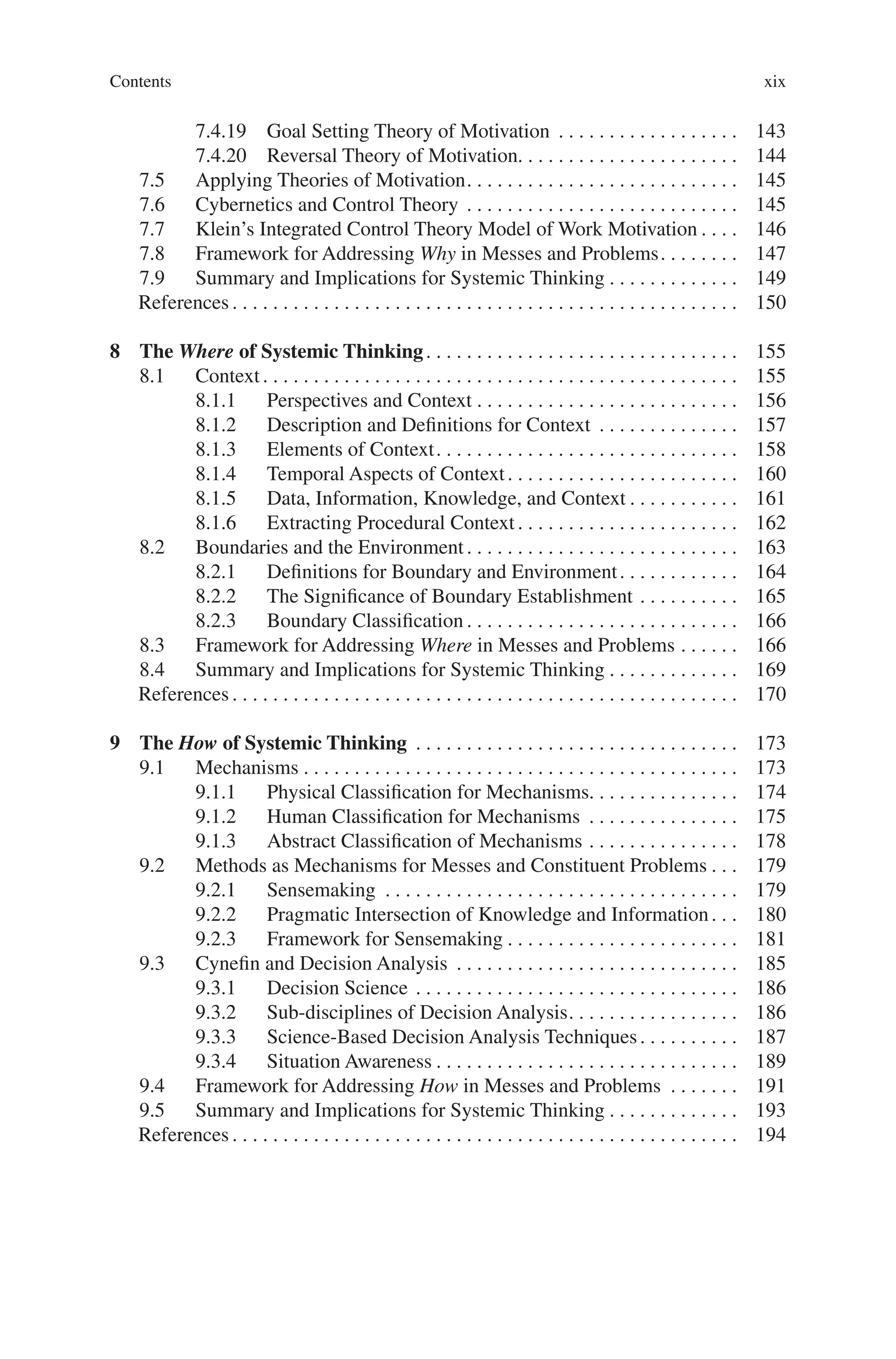
Contents xix
7.4.19 Goal Setting Theory of Motivation . . . . . . . . . . . . . . . . . .  143
7.4.20 Reversal Theory of Motivation. . . . . . . . . . . . . . . . . . . . . . 144
7.5 Applying Theories of Motivation. . . . . . . . . . . . . . . . . . . . . . . . . . .  145
7.6 Cybernetics and Control Theory . . . . . . . . . . . . . . . . . . . . . . . . . . .  145
7.7 Klein’s Integrated Control Theory Model of Work Motivation. . . .  146
7.8 Framework for Addressing Why in Messes and Problems. . . . . . . .  147
7.9 Summary and Implications for Systemic Thinking. . . . . . . . . . . . .  149
References. . . . . . . . . . . . . . . . . . . . . . . . . . . . . . . . . . . . . . . . . . . . . . . . . .  150
8 The Where of Systemic Thinking. . . . . . . . . . . . . . . . . . . . . . . . . . . . . . .  155
8.1 Context. . . . . . . . . . . . . . . . . . . . . . . . . . . . . . . . . . . . . . . . . . . . . . .  155
8.1.1 Perspectives and Context. . . . . . . . . . . . . . . . . . . . . . . . . .  156
8.1.2 Description and Definitions for Context . . . . . . . . . . . . . .  157
8.1.3 Elements of Context. . . . . . . . . . . . . . . . . . . . . . . . . . . . . .  158
8.1.4 Temporal Aspects of Context. . . . . . . . . . . . . . . . . . . . . . .  160
8.1.5 Data, Information, Knowledge, and Context. . . . . . . . . . .  161
8.1.6 Extracting Procedural Context. . . . . . . . . . . . . . . . . . . . . .  162
8.2 Boundaries and the Environment. . . . . . . . . . . . . . . . . . . . . . . . . . .  163
8.2.1 Definitions for Boundary and Environment. . . . . . . . . . . .  164
8.2.2 The Significance of Boundary Establishment. . . . . . . . . .  165
8.2.3 Boundary Classification. . . . . . . . . . . . . . . . . . . . . . . . . . .  166
8.3 Framework for Addressing Where in Messes and Problems. . . . . .  166
8.4 Summary and Implications for Systemic Thinking. . . . . . . . . . . . .  169
References. . . . . . . . . . . . . . . . . . . . . . . . . . . . . . . . . . . . . . . . . . . . . . . . . .  170
9 The How of Systemic Thinking . . . . . . . . . . . . . . . . . . . . . . . . . . . . . . . .  173
9.1 Mechanisms. . . . . . . . . . . . . . . . . . . . . . . . . . . . . . . . . . . . . . . . . . .  173
9.1.1 Physical Classification for Mechanisms. . . . . . . . . . . . . . .  174
9.1.2 Human Classification for Mechanisms . . . . . . . . . . . . . . .  175
9.1.3 Abstract Classification of Mechanisms. . . . . . . . . . . . . . .  178
9.2 Methods as Mechanisms for Messes and Constituent Problems. . .  179
9.2.1 Sensemaking . . . . . . . . . . . . . . . . . . . . . . . . . . . . . . . . . . .  179
9.2.2 Pragmatic Intersection of Knowledge and Information. . .  180
9.2.3 Framework for Sensemaking. . . . . . . . . . . . . . . . . . . . . . .  181
9.3 Cynefin and Decision Analysis . . . . . . . . . . . . . . . . . . . . . . . . . . . .  185
9.3.1 Decision Science. . . . . . . . . . . . . . . . . . . . . . . . . . . . . . . .  186
9.3.2 Sub-disciplines of Decision Analysis. . . . . . . . . . . . . . . . .  186
9.3.3 Science-Based Decision Analysis Techniques. . . . . . . . . .  187
9.3.4 Situation Awareness. . . . . . . . . . . . . . . . . . . . . . . . . . . . . .  189
9.4 Framework for Addressing How in Messes and Problems . . . . . . .  191
9.5 Summary and Implications for Systemic Thinking. . . . . . . . . . . . .  193
References. . . . . . . . . . . . . . . . . . . . . . . . . . . . . . . . . . . . . . . . . . . . . . . . . .  194
Contents
xx
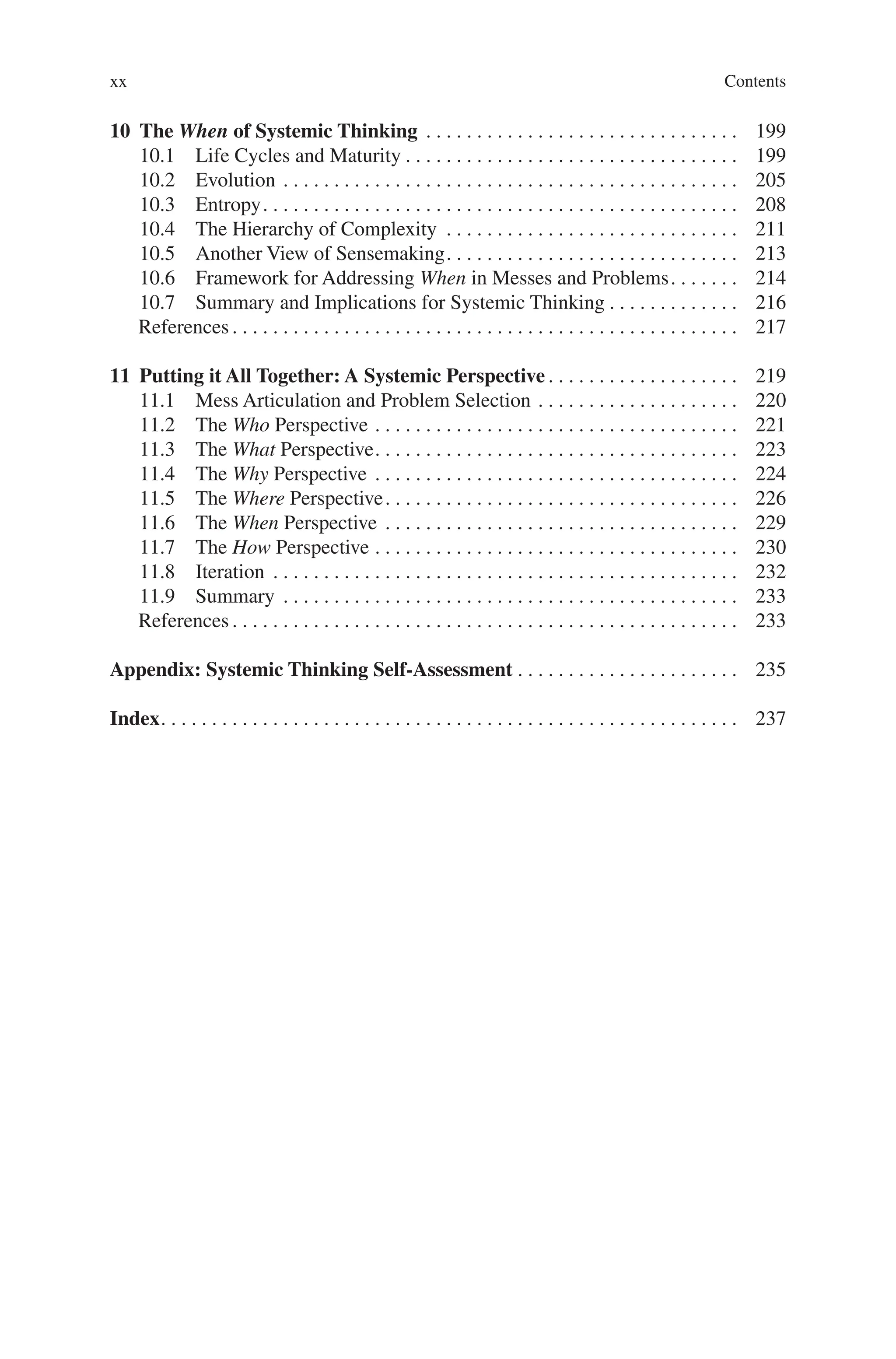
10 The When of Systemic Thinking . . . . . . . . . . . . . . . . . . . . . . . . . . . . . . .  199
10.1 Life Cycles and Maturity. . . . . . . . . . . . . . . . . . . . . . . . . . . . . . . . .  199
10.2 Evolution. . . . . . . . . . . . . . . . . . . . . . . . . . . . . . . . . . . . . . . . . . . . .  205
10.3 Entropy. . . . . . . . . . . . . . . . . . . . . . . . . . . . . . . . . . . . . . . . . . . . . . .  208
10.4 The Hierarchy of Complexity . . . . . . . . . . . . . . . . . . . . . . . . . . . . .  211
10.5 Another View of Sensemaking. . . . . . . . . . . . . . . . . . . . . . . . . . . . .  213
10.6 Framework for Addressing When in Messes and Problems. . . . . . .  214
10.7 Summary and Implications for Systemic Thinking. . . . . . . . . . . . .  216
References. . . . . . . . . . . . . . . . . . . . . . . . . . . . . . . . . . . . . . . . . . . . . . . . . .  217
11 Putting it All Together: A Systemic Perspective. . . . . . . . . . . . . . . . . . .  219
11.1 Mess Articulation and Problem Selection. . . . . . . . . . . . . . . . . . . .  220
11.2 The Who Perspective. . . . . . . . . . . . . . . . . . . . . . . . . . . . . . . . . . . .  221
11.3 The What Perspective. . . . . . . . . . . . . . . . . . . . . . . . . . . . . . . . . . . .  223
11.4 The Why Perspective. . . . . . . . . . . . . . . . . . . . . . . . . . . . . . . . . . . .  224
11.5 The Where Perspective. . . . . . . . . . . . . . . . . . . . . . . . . . . . . . . . . . .  226
11.6 The When Perspective. . . . . . . . . . . . . . . . . . . . . . . . . . . . . . . . . . .  229
11.7 The How Perspective. . . . . . . . . . . . . . . . . . . . . . . . . . . . . . . . . . . .  230
11.8 Iteration . . . . . . . . . . . . . . . . . . . . . . . . . . . . . . . . . . . . . . . . . . . . . .  232
11.9 Summary . . . . . . . . . . . . . . . . . . . . . . . . . . . . . . . . . . . . . . . . . . . . .  233
References. . . . . . . . . . . . . . . . . . . . . . . . . . . . . . . . . . . . . . . . . . . . . . . . . .  233
Appendix: Systemic Thinking Self-Assessment. . . . . . . . . . . . . . . . . . . . . .  235
Index. . . . . . . . . . . . . . . . . . . . . . . . . . . . . . . . . . . . . . . . . . . . . . . . . . . . . . . . .  237
Part I
A Frame of Reference for Systemic
Thinking
3
Abstract The first step to solving a problem is recognizing you have one. It
is with this notion in mind that the authors begin their discussion. This chapter
begins with the first tenet of systemic thinking which we term the TAO approach,
a general approach for increasing our understanding about problems. Then, a dis-
cussion of systems errors is presented. In order to mitigate these errors, we discuss
the importance of observation as it pertains to making conclusions about our prob-
lems. Issues associated with observation and the effects of bias are then discussed.
1.1 The TAO Approach
As we said before, we’ve all got problems. Some are big, some are small. Some are
fleeting, while some are nagging and persistent. All could benefit from a structured
way of reasoning about them. To that end, we provide an initial perspective for rea-
soning that we deem the TAO approach, for Think, Act, and Observe. The relation-
ship between these elements is pictured in Fig. 1.1. While there are many approaches
to undertaking each of these steps, this book concentrates in large part on discussing
the systemic thinking approach, a method for undertaking the Think step.
Knowing that we have problems and more importantly, knowing that we need
approaches to deal with these problems, requires us to first understand what sys-
tematic mistakes we make that may be avoided. To this end, we turn to a discus-
sion of systems errors.
1.2 Systems Errors
As we discussed in the preface, most difficult problems can be characterized
by (1) intransparency, (2) polytely, (3) complexity, (4) variable connectivity,
(5) dynamic developments, (6) time-delayed effects, (7) significant uncertainty, and
Chapter 1
Introduction
P. T. Hester and K. M. Adams, Systemic Thinking, Topics in Safety, Risk,
Reliability and Quality 26, DOI: 10.1007/978-3-319-07629-4_1,
© Springer International Publishing Switzerland 2014
4 1 Introduction
(8) humans-in-the-loop. Each of these has a substantial element of human percep-
tion and interpretation. The way in which a problem is thought about, acted on,
and observed is a major determinant of the degree of uncertainty, competition, and
unpredictability associated with the problem context. Reasoning about a complex
problem routinely employs the use of one of a number of systems-based approaches
[18–20]. Analytical and interpretational errors are common while thinking about,
acting on, and observing problems; however, none of these systems approaches
explicitly addresses these potential errors. Further, despite their prominence, there
is not an agreed-upon taxonomy for errors in problem solving approaches. Thus, the
authors have worked to establish an initial taxonomy for error classification [2, 3].
This taxonomy has drawn from research performed by researchers representing four
of the 42 fields of science [43], as depicted in Table 1.1.
Based on our review of the literature in Table 1.1, we were able to develop a
taxonomy of seven common errors that individuals are prone to encounter while
thinking about, acting on, and observing problems. For reasons that will become
clear once this discussion is complete, we will not discuss the errors in numerical
order; rather, we begin with discussion of the Type III error.
Fig. 1.1  TAO approach to
reasoning
Table 1.1  Science sector and field of science that have conducted inquiry on errors (adapted
from [3])
Science sector Field of science Reference
Social sciences Educational sciences Betz and Gabriel [6], Kaufman et al. [23],
Marascuilo and Levin [32, 33], Onwuegbuzie
and Daniel [44], Rosnow and Rosenthal [46, 47]
Psychology Games [13], Kaiser [22], Leventhal and Huynh
[28], Levin and Marascuilo [29, 30], Meyer [34],
Mitroff [36], Mitroff and Featheringham [37]
Economics and business Boal and Meckler [7], Umesh et al. [54]
Natural sciences Mathematics Kimball [24, 38,40–42], Tracz et al. [50]
5
1.2.1 
Type III Error
The extant literature on the Type III (γ) error originated in statistics. Frederick
Mosteller [1916–2006], one of the most eminent statisticians of the 20th century,
reported:
In other words it is possible for the null hypothesis to be false. It is also possible to reject
the null hypothesis because some sample Oi has too many observations which are greater
than all observations in the other samples. But the population from which some other
sample say Oj is drawn is in fact the right-most population. In this case we have commit-
ted an error of the third kind. (p. 61)
This is commonly referred to as “the error associated with solving the wrong prob-
lem precisely” [36, p. 15].
Type III errors normally occur during the formulation of problems, the phase in
which the actual details surrounding the reported problem are exposed, validated
and verified as part of the process of problem reformulation (reformulation is
where the initial reported problem statement is validated by relevant stakeholders).
We denote this revised problem statement the formulated problem, to differentiate
it from the reported problem. Failure to reformulate the reported problem is the
most common source for a Type III error.
Adams and Hester [2] devise a medical analogy to explain the Type III error:
The systems practitioner faced with a reported problem needs to act much like a physi-
cian. The physician listens to the symptoms reported by a patient, but does not accept
the diagnosis of the patient. The physician cannot rely solely on the patient’s story and
symptoms, but must gather empirical data by conducting tests, taking physiological meas-
urements, and conducting a physical examination. The systems practitioner is in a similar
professional relationship with the client that has a systems problem. Problem reformula-
tion ensures that the scope of the problem is properly abstracted from the real-world and
defined. The problem system must be adequately bounded, include empirical data of both
the quantitative and qualitative types, and include an understanding of both the environ-
ment and relevant stakeholders. (p. 28)
Mitroff and Featheringham [37] elaborate on the importance of proper problem
formulation.
The initial representation or conceptualization of a problem is so crucial to its subsequent
treatment that one is tempted to say that the most important as well as most difficult issue
underlying the subject of problem solving is precisely ‘the problem of how to represent
problems.’ (p. 383)
Failure to properly define the scope of the problem results in inadequate problem
statements and is commonly referred to as “the error committed by giving the right
answer to the wrong problem” [22]. Once we have appropriately formulated our
problem (i.e., thought about it), we must decide what to do about this problem
(i.e., act on it). In acting (or abstaining from action), we may encounter a number
of errors, to which we now turn.
1.2 Systems Errors
6 1 Introduction
1.2.2 
Type IV Error
A review of the extant literature on Type IV (δ) errors shows that this type of error
has been discussed principally in the psychology and the educational sciences. To
the authors’ knowledge, the first mention of the Type IV error in the literature was
by Marascuilo and Levin [32]. They define the Type IV (δ) error as:
A Type IV error is said to occur whenever a correct statistical test has been performed,
but is then followed by analyses and explanations that are not related to the statistical test
used to decide whether the hypothesis should or should not have been rejected [33].
The primary discussion related to Type IV errors has been associated with statistical
testing, most notably ANOVA models [23, 46, 47, 54]. We prefer, however, to endorse
the Type IV error as one concerned with a higher level of abstraction, most notably as
“the incorrect interpretation of a correctly rejected hypothesis” ([32], p. 398).
Boal and Meckler [7] elaborate on the problems caused by a Type IV error,
introducing the concept of solutions as iatrongenic:
Acting to solve a problem, be it the right problem or the wrong problem, can create other
difficulties. Sometimes solutions are ‘iatrogenic,’ meaning that they create more, or bigger
problems than they solve. Faced with such a possibility the decision maker should thor-
oughly examine all the potential system effects, and perhaps refrain from action. In the
case that it was an attempted solution to the right initial problem, one important problem
is now replaced by another, perhaps worse problem. (p. 333)
Thus, even though the problem has been correctly identified (i.e., thought about),
the action identified to resolve the problem is incorrect. Further, there is potential
in this situation for the identified actions to actually exacerbate the problem.
Adams and Hester [3] continue their medical analogy:
This type of error also has a medical analogy. This could be the case where the physi-
cian commits a Type IV (δ) error by correctly diagnosing the problem and prescribes the
right medication. However, the medication side-effects for a particular patient are worse
than the original symptoms. The systems practitioner is prone to committing this error.
The most typical instance is when the practitioner has properly reformulated and defined
the client’s problem and then applies an improper solution approach (i.e., methodology,
method, or technique) in an attempt to resolve this problem. Failure to match the solution
method to appropriate solution of a problem has been an important subject in the systems
literature [4, 17, 21]. (pp. 320–321)
1.2.3 Type V Error
The Type V error, like the Type IV error, concerns actions taken in support of
problem resolution. The field of cybernetics and the systems principles of homeo-
stasis [8] and homeorhesis [55] inform individuals that systems have the ability to
self-regulate to maintain a stable condition. Thus, some problems may solve them-
selves by simply allowing a natural order to restore itself. The converse of this
is that many problems require intervention in order to be addressed and simply
7
wishing for a problem to disappear on its own will not make it go away. There is
a substantial risk in not acting when action is called for. Boal and Meckler [7] dis-
cuss this sentiment as the Type V (ε) error:
Deciding to take no action, when no action is called for, is the correct solution. However,
falsely believing that the problem will either solve itself or simply go away is an error
of the 5th kind. Such errors allow the situation to linger, at best, or to fester and worsen
requiring greater resources to solve. (p. 334)
In the medical analogy of this error, the physician commits a Type V error when he or
she correctly diagnoses an ailment (i.e., thinks about the problem properly), yet fails
to take corrective action to resolve the problem. The reason for the failure to act in this
case may reside in the physician’s belief that the ailment will simply resolve itself.
Causes for the Type V error are many. Lack of stakeholder consensus (e.g., the
doctor, insurance company, and patient do not agree on treatment options) may
lead to inaction due to the lack of a singular prevailing option, or due to a predom-
inant stakeholder forcing an inaction strategy (e.g., the insurance company denies
a request for an MRI, leading to a wait-and-see approach). Further, there may be
a fundamental lack of understanding which permeates the analysis of the problem.
This may lead to the stakeholders being unable to generate a plausible scenario
for resolving the problem. Finally, stakeholders may fear worsening the problem
by interfering. While this is a valid concern, we must weigh the balance between
the Type IV and Type V errors, that is, between taking the wrong action and taking
no action. Once we have acted, we must now observe the effects of our actions. In
observation, there are also opportunities for committing errors.
1.2.4 
Type I and Type II Errors
The extant literature on the Type I and Type II errors is founded in the mathematics
(i.e., statistics) field of science, originating with Neyman and Pearson [40–42]. The
Type I and Type II errors have been explored extensively in the literature associated
with these fields. They are driven by discussions of statistical inference; specifi-
cally, they are motivated by the traditional two-sided hypothesis test. In such a test,
there are only two possible error conditions: (1) deciding that a difference exists
when, in fact, there is none (i.e., committing a Type I (α) error), and (2) deciding
there is no difference when, in fact, there is a difference (i.e., committing a Type II
(β) error) [22]. Table 1.2 contains a representation of and definitions for the Type I
and Type II errors framed in terms of the testing of a null hypothesis, H0.
To continue our medical analogy, there are two classic examples from the medi-
cal world of the Type I (α) and Type II (β) error, based on the premise of H0 being
the hypothesis that a person does not have a disease:
• Type I (α) error: A medical test indicates a person has a disease that they do not
actually have.
• Type II (β) error: A medical test indicates a person does not have a disease that
they do actually have.
1.2 Systems Errors
8 1 Introduction
Both of these errors typically occur after the problem has been thought about and
acted on (and after practitioners hopefully have avoided committing a Type III, IV,
or V error). Thus, this phase is considered to be the observation phase (observa-
tion, as we intend it, will be elaborated on later in this chapter). Another potential
error of observation is the Type VI error.
1.2.5 Type VI Error
Here we introduce a Type VI (θ) error as one that is well known yet not
­
characterized in error terms traditionally. This error is that of unsubstantiated
inference. Succinctly, Holland [16] states famously, “Correlation does not imply
causation…” (p. 945). Given two variables, A and B, we can measure the strength
of the relationship between these variables, known as their correlation. If we con-
tinue our medical analogy, denoting A as the number of tests taken to diagnose an
­illness and B as money spent on treatment, then we see what is termed a positive
correlation between these two variables, meaning that the more tests that are per-
formed, the more money that is spent. We can now change B to money remaining
in your bank account. As additional tests are ran, assuming they are being paid
for by you, your bank account balance decreases, indicating a negative correlation.
The correlation coefficient measures the strength of the relationship between these
two variables.
Causation is not as straightforward, however, and it is often erroneously taken
as a given when correlation is present. For example, if we have two additional
events, (1) a man receives a positive test for a given disease (A) and (2) his brother
receives a positive test for the same disease (B), we may be able to establish cor-
relation. However, inferring that A caused B or B caused A is faulty, unless we
have information (more specifically, observations) that corroborates this assump-
tion, e.g., the disease in question is a blood-borne disease and the brothers admit
to sharing needles during drug use. In this case, we might be able to establish cau-
sality. More often than not, however, our notion of causality is simply conjecture.
This behavior represents the Type VI error. In fact, there are four possible out-
comes for any two correlated variables, A and B:
1. A could cause B.
2. B could cause A.
Table 1.2  Type I and type
II errors
Actual condition
Test result H0 true H0 false
Reject H0 Type I Error (α)
False positive
Correct action
True positive
Fail to reject H0 Correct decision
True negative
Type II Error (β)
False negative
9
3. An additional third variable, C, could be contributing to the change in both A and B.
4. It may simply be a coincidence that the two events have a correlation.
We must be careful not to infer causality regarding A and B in an effort to explain
unknown phenomena. Establishing causality requires significant observation and
should not be done erroneously.
1.2.6 Type VII Error
A Type VII (ζ) error occurs when errors of Types I–VI compound to create a
larger, more complex problem than originally encountered. Boal and Meckler [7]
elaborate on the nature of Type VII errors:
…the resulting problem may no longer be recognizable in its original form. The problems
are not easily diagnosable, the resources and choices available become less sufficient or
desirable, the solution is not readily apparent, and the solution not so attainable. (p. 336)
Complex systems problems that are open to multiple errors may be referred to as
messes [1] and are in sharp contrast to those denoted as tame by Boal and Meckler
[7]. It is the Type VII error that we must truly be concerned about. Complex prob-
lems are further exacerbated by committing a Type VII error, a “system of errors”
([2], p. 30) to complement Ackoff’s characterization of messes as “systems of
problems” ([1], p. 100).
Adams and Hester [2] complete their medical analogy by discussing this error:
…a Type [VII] error can be conceived as one that first involves a physician diagnosing
an incorrect problem for a patient, perhaps due to incorrect information provided by the
patient (thus committing a Type III error). Let’s suppose for the sake of argument that
the patient is uninterested in receiving a true diagnosis of his symptoms as he fears grave
news from the physician, so he downplays his symptoms. Given this incorrect (and under-
emphasized) problem, the physician decides to take no action to a problem otherwise
requiring action (thereby committing a Type V error). His reasoning, based on the infor-
mation he’s received, is that the problem will go away on its own. The problem, untreated,
worsens, thereby resulting in an inoperable condition, such as the progression of a benign
cancer to a stage at which treatment is unavailable. Clearly, this system of errors has exac-
erbated the original in a form unimaginable by the original stakeholders (i.e., the patient
and physician). (p. 30)
1.2.7 
Analysis of Errors
We have discussed seven classifications of errors that may be experienced while
thinking about, acting on, or observing a problem. A taxonomy of the seven sys-
tems errors is presented in Table 1.3.
Recalling the TAO approach, we can see when individuals may be prone to
these errors. Thinking is prone to the Type III error, acting to the Type IV or V
1.2 Systems Errors
10 1 Introduction
error, and observation to the Type I, II, or VI errors. In order to correctly address a
problem, all of these errors must be avoided as follows:
1. The Type III error must be overcome; that is, the correct problem must be for-
mulated. This is, in large measure, the focus of this book. Thinking systemically
about a situation allows us to ensure we have formulated the correct problem
for action and observation.
2. Once we have thought systemically about our problem, we must now act (or
not). This offers the opportunity for three possible outcomes:
a) We act incorrectly, when action is warranted (committing a Type IV error).
b) We fail to act, when action is warranted (committing a Type V error).
c) We act correctly, when action is warranted (committing no error).
Thus, we must choose the appropriate course of action for a particular
problem, given that choosing not to act is also a feasible choice. This can
only be achieved if we first think systemically about our problem, ensur-
ing our ensuing actions appropriately address the problem we are dealing
with.
3. Finally, we must observe the effects of our actions (or lack thereof). This must
include consideration of avoiding the Type I and Type II errors by conducting
appropriate statistical analyses and making appropriate conclusions based on
these analyses. Further, we must avoid the Type VI error by ensuring our con-
clusions are supported by evidence and not by conjecture. More on this obser-
vation process is presented in the next section.
To illustrate the potential interaction of these errors with the TAO approach,
Table 1.4 illustrates the TAO approach applied to reasoning about a disease.
The timeline in Table 1.4 can continue, ad infinitum. That is, you may continue
to think, act, and observe with respect to your headache problem. This series of
steps is shown graphically in Fig. 1.2 in a manner adapted from Boal and Meckler
[7] and (Adams and Hester [2, 3]), but focused on the probabilities associated with
Table 1.3  Taxonomy of systems errors (adapted from [2])
Error Definition Issue
Type I (α) Rejecting the null-hypothesis when the null-hypothesis
is true
False positive
Type II (β) Failing to reject the null-hypothesis when the
­
null-hypothesis is false
False negative
Type III (γ) Solving the wrong problem precisely Wrong problem
Type IV (δ) Inappropriate action is taken to resolve a problem as
the result of a correct analysis
Wrong action
Type V (ε) Failure to act when the results of analysis indicate
action is required
Inaction
Type VI (θ) Inferring causation when only correlation exists Unsubstantiated inference
Type VII (ζ) An error that results from a combination of the other
six error types, often resulting in a more complex
problem than initially encountered
System of errors
11
particular paths available to an individual. It is worth noting that Type VII errors
are represented by the different error combinations presented in Fig. 1.2 (i.e., a
Type III error followed by a Type I error). Note that P(α), P(β), P(γ), P(δ), P(ε),
P(θ), and P(ζ) represent the probability of a Type I-VII error, respectively.
Note that the shaded boxes represent the only scenario in which no errors are com-
mitted. It is easy to see, qualitatively, how prone we are to errors based purely on the
number of opportunities for us to commit one (or more) errors. Combining these error
probabilities together, we can devise an equation for the calculation of the probability
of a correctly addressed problem. This can be computed as shown in (Eq. 1.1).
(1.1)
P(correctly addressed problem) = 1 − [[1 − P(γ )][1 − (P(δ) + P(ε))]
[1 − (P(α) + P(β) + P(θ))]]
Table 1.4  Example TAO timeline and potential errors
TAO stage Situation description Potential error(s)
Think Recurring headaches cause you to try to figure out their source.
Lacking an obvious environmental trigger, you decide to
make an appointment to see your primary care provider
Type III
Act You make an appointment with your doctor based on your
thinking
Types IV, V
Observe Your doctor observes you, asks you questions, and collects
information
Types I, II, VI
Think Based on the information provided and their own perspectives,
the doctor reasons about your condition
Type III
Act The doctor, with your consent, agrees to schedule you for
an MRI
Types IV, V
Observe Your insurance company collects the request from your doctor,
and considers it in concert with your medical history. Given
your lack of prior concerns and lack of current evidence, the
insurance company denies your claim
Types I, II, VI
Think Given the reduced options available, your doctor thinks about
your situation. Your doctor suggests you go home and start
an activity log to keep track of your food, sleep, and activity
habits to identify any underlying patterns
Type III
Act You maintain your activity log for two weeks Types IV, V
Observe You return to the doctor and the doctor observes your activity
log, making recommendations based on the results (to
include a second attempt at securing insurance approval for
an MRI)
Types I, II, VI
And so on… You can continue to think, act, and observe. Even though the
problem may seem resolved (i.e., your headaches go away),
there is likely to be an implicit recognition of the danger of
their recurrence. Thus, you may devote brain power to the
awareness of their presence, no matter how distant they are
in memory. The problem, as you see it may evolve from
“How can I make these headaches go away?” to “How can I
ensure these headaches do not return?”
Types I–VII
1.2 Systems Errors
12 1 Introduction
Correctly addressing a problem requires that we think about, act on, and observe
the situation appropriately, thus, we do not commit any Type I-VI (and, by defini-
tion, Type VII) errors. While we can calculate P(α) and P(β) in a very straight-
forward manner, the remaining quantities are more difficult, if not impossible,
to discern. It is more important to understand that errors are serial; thus, our
approach to understanding is only as strong as its weakest link, be it in our think-
ing, acting, or observation. Committing any error drastically reduces the likelihood
that we correctly addressed our problem. Thus, we must be diligent in addressing
each of these errors.
1.3 Observation
Here we elaborate on the notion of observation as it pertains to the TAO process
and to systemic thinking in general. Observation is the central source of knowl-
edge gained from exposure to the real world. This is true whether the knowledge is
being generated in a controlled laboratory or in a natural setting.
Observation is being understood in a very broad way here, to include all kinds of sensory
contact with the world, all kinds of perception [14, p. 156].
Observation is the operation where raw sensory inputs are filtered by the human
thought process. The physiological capacity for sensory perception in humans is
limited by the five senses: (1) hearing, (2) sight, (3) smell, (4) taste, and (5) touch.
Over time, raw perceptions are converted by the human thought process and begin
Problem to Solve
Type III Error (P(γ))
Type IV Error (P(δ))
Type I Error (P(α))
Type II Error (P(β))
Type VI Error (P(θ))
No Type I, Type II, or
Type VI Error
(1-[P(α)+P(β)+P(θ)])
Type V Error (P(ε))
Type I Error (P(α))
Type II Error (P(β))
Type VI Error (P(θ))
No Type I, Type II, or
Type VI Error
(1-[P(α)+P(β)+P(θ)])
No Type IV or Type V
Error
(1-[P(δ)+P(ε)])
Type I Error (P(α))
Type II Error (P(β))
Type VI Error (P(θ))
No Type I, Type II, or
Type VI Error
(1-[P(α)+P(β)+P(θ)])
No Type III Error
(1-P(γ))
Type IV Error (P(δ))
Type I Error (P(α))
Type II Error (P(β))
Type VI Error (P(θ))
No Type I, Type II, or
Type VI Error
(1-[P(α)+P(β)+P(θ)])
Type V Error (P(ε))
Type I Error (P(α))
Type II Error (P(β))
Type VI Error (P(θ))
No Type I, Type II, or
Type VI Error
(1-[P(α)+P(β)+P(θ)])
No Type IV or Type V
Error
(1-[P(δ)+P(ε)])
Type I Error (P(α))
Type II Error (P(β))
Type VI Error (P(θ))
No Type I, Type II, or
Type VI Error
(1-[P(α)+P(β)+P(θ)])
Thinking
Acting
Observing
Fig. 1.2  Tree depiction of systems errors
13
to form impressions, which are stored for future use. Stored impressions and their
relationships with one another are formed into constructs that permit the individual
to develop more complex implications and associations from the sensory inputs.
In a literature too vast to summarize here, theorists have argued that observa-
tion is already cognition and that we cannot describe a fact without implying more
than the fact. As a result, Clyde H. Coombs [1912–1988] proposed that the term
data be used for observations already interpreted in some way. The diagram in
Fig. 1.3 depicts the scope of Coombs’ [9] theory of data.
Figure 1.3 depicts how an observer’s interpretation of the universe of all pos-
sible observations can lead to logical inferences as a result of four distinct phases
conducted during the process of observation. The graphic has additional impor-
tance when considered with the following statement from Coombs [9] pertaining
to those phases after Phase 0:
The scientist enters each of these three phases in a creative way in the sense that alterna-
tives are open to him and his decisions will determine in a significant way the results that
will be obtained from the analysis. Each successive phase puts more limiting boundaries
on what the results might be. At the beginning, before phase 1, there are perhaps, no limits
on the potential conclusions; but each phase then constrains the universe of possible infer-
ences that can be ultimately drawn from the analysis. (p. 5)
It is important to note that the observer depicted in Fig. 1.3 directly influences the
data in many ways. Table 1.5 provides a glimpse of the how the observer influ-
ences the observations during the four phases and associated stages.
Recorded
Observations
Universe
of all
Possible
Observations
Inferential
Classifications
Phase 1 Phase 2 Phase 3
The inference phase in
which a detection of
relations,order, and
structure is a logical
consequence of the
data and the model
used for analysis
.
The interpretive
phase in which the
observer classifies
the observations in
terms of a relation
of some kind
.
The subjective
phase in which
the observer
selects some
things to record
.
The decision
as to what to
observe
The choice of
a model for
making
inferences
from the data
The mapping
of recorded
observations
into data
Universe
of all
Possible
Knowledge
Preparation
Data
Phase 0
The preparation
phase in which
the observer
selects an area
to investigate
.
Selection of an area
for investigating
new knowledge
OBSERVER
Fig. 1.3  Flow diagram of observable to inference
1.3 Observation
14 1 Introduction
Table 1.5 demonstrates that the potential to influence observations is problem-
atic and must be mitigated during the conduct of all research and problem solving
efforts. Thus, in terms of the stages of observation and their relation to our systems
errors, we must be careful to avoid the Type I and II errors in Phase 2 and the Type
VI error in Phase 3.
This leads the discussion to the notion that all observation is impacted by the
observer’s personal beliefs in what is termed theory-laden observation.
1.3.1 Theory-Laden Observation
Based upon the notion that observation has already been subjected to analysis, a
number of major scholars in the field of Philosophy of Science have argued that
observation is theory-laden [12, 26]. Specifically,
Observation cannot function as an unbiased way of testing theories (or larger units like
paradigms) because observational judgments are affected by the theoretical beliefs of the
observer [14, p. 156].
Paul K. Feyerabend [1924–1994] [12] cautions all observers of empirical data to
separate the observation from the consequent description:
We must carefully distinguish between the ‘causes’ of the production of a certain obser-
vational sentence, or the features of the process of production, on the one side, and the
‘meaning’ of the sentence produced in this manner on the other. More especially, a sen-
tient being must distinguish between the fact that he possesses certain sensation, or dis-
position to verbal behavior, and the interpretation of the sentence being uttered in the
presence of this sensation, or terminating this verbal behavior. (p. 94)
Many theories and models exist for further reading into awareness, observation,
and cognition. While this subject area is beyond the scope of this text, the reader is
referred to literature on situation awareness [11], the recognition-primed decision
(RPD) model [25], and gestalt psychology [10] for further guidance on the topic.
We turn to the Dynamic Model of Situated Cognition as one model for observation.
Table 1.5  How and where an observer exhibits influence during observation
Phase Stage Description
0—preparatory Knowledge area Selection of an area for investigating new knowledge
Preparation Preparatory reading in the area’s existing body of knowledge
1—subjective Selection Selection of things to observe
Method The sensors and methods used to record and measure the
observation
2—interpretive Analysis The observer interprets the data
Classification The observer classifies the observations
3—inferential Inference The observer makes an inference based on the order structure
and model used in analysis and classification
Publication The observer reports the interpretation of the new knowledge
15
1.3.2 
Dynamic Model of Situated Cognition
The theory-laden observation process must involve consideration of both
­
technological and human elements and can be thought of as residing within
a larger construct. A model to describe this observation process is the Dynamic
Model of Situated Cognition (DMSC), which captures both the human and tech-
nological components of systems in a single model that depicts how observation
is influenced by a variety of agents [35, 49]. Figure 1.4 is our depiction of the
DMSC, that aligns the terminology of Miller and Shattuck to be consistent with
Coombs and ours’; specifically, Coombs’ central thesis was that data are recorded
observations that have already been subjected to analysis.
The final output of the DMSC is used to make decisions, which are then meas-
ured with metrics and then used as feedback to the system. The key insight from
Fig. 1.4 is a graphical representation of the observation to decision process. In
translating observations to usable data, we intentionally (and unintentionally,
based on our own perceptions and technological limitations) remove observa-
tions from consideration, as all observation is theory-laden and influenced by our
human biases.
1.3.3 Measurement
Good science is based upon four generally accepted criteria that ensure quality:
(1) truth value, (2) applicability, (3) consistency, and (4) neutrality [31]. The third
criterion addresses the consistency in the generation of knowledge and establishes
guidelines for ensuring consistency and stability during generation (i.e., design
All
data
in
Environment
Data
detected
by
the
technological
system
Data
available
to
system
users
Data
Information
Knowledge
Technological System Cognitive System
Lens A
Lens B
Lens C
Decisions
Metrics and
Feedback
Perception
Comprehension
Projection
Fig. 1.4  The dynamic model of situation cognition
1.3 Observation
16 1 Introduction
and technique), of new knowledge. The ability to accurately repeat observations,
independent of the original observer, is an essential element. The requirement for
independent reproducibility ensures that observations by different observers are
comparable. Because the physiological capacity for input perception in humans
is subjective and qualitative (i.e., the five senses react differently from human to
human) this makes them difficult to record and hence, compare.
The concept for measurement evolved to permit different human observers to
record and compare observations made at different times and places. Measurement
consists of using observation to compare the real-world phenomena being meas-
ured to an established standard which can be reliably reproduced for use by mul-
tiple, independent observers. Measurement’s goal is to reduce an observation to a
discrete measure which can be recorded and used as the basis for comparison with
other measures.
Quality criterion such as reproducibility may be invoked through the use of
formal methods and measurement. However, the nagging issue and difficulties
generated by the presence of theory-laden observation must be addressed by an
understanding of how bias is introduced into the process. This leads the discussion
to the mitigation of bias as an element of personal beliefs during observation.
1.3.4 
Bias and Heuristics
Our ability to observe is affected, both negatively and positively, by our own
biases and heuristics. First, we discuss bias, defined as:
Any process at any stage of inference which tends to produce results or conclusions that
differ systematically from the truth [48, p. 60].
Bias may be introduced during each and every stage and phase depicted in
Fig. 1.3. As a result, the observer must ensure that the process depicted in Fig. 1.3
provides reasonable controls that mitigate bias.
The difficulties generated for scientific inquiry by unconscious bias and tacit value ori-
entations are rarely overcome by devout resolutions to eliminate bias. They are usually
overcome, often only gradually, through self-corrective mechanisms of science as a social
enterprise [39, p. 489].
Part of understanding how to mitigate human bias requires knowledge of the
source and major types of unconscious bias. Because all human beings have unin-
tentional cognitive biases that affect their decision making, knowledge of the types
of bias may help improve their detection and elimination. Cognitive biases include
behaviors that are labeled heuristics. Table 1.6 lists a variety of definitions for the
term heuristic.
The unintentional biases and heuristics that operate at the subconscious level
are the most difficult to prevent. The sections that follow will provide a short dis-
cussion of major heuristics and how to mitigate their effect.
17
1.3.4.1 Availability Heuristic
The availability heuristic refers to the practice of basing probabilistic evidence
on an available piece of information from one’s own set of experiences [51, 52].
That is to say, humans estimate the likelihood of an event based on a similar event
that they can remember, which is by definition, from a biased and unrepresenta-
tive sample in their memory. Further, since newer events provide greater saliency
in one’s mind, they influence an individual’s reasoning to a larger degree than do
older events. Additionally, events with unusual characteristics stand out in one’s
mind (i.e., you don’t remember the hundreds of times you went to a given restau-
rant, but you definitely remember the time you got food poisoning). Furthermore,
humans may be biased based on the retrieval mechanism that is utilized to obtain
the experience from their memory. Depending on who is asking the question, for
example, an individual may consciously or unconsciously block memories. In
order to mitigate this problem, observers should include mechanisms that account
for how their experiences bias the data they retrieve about a particular set of
observations.
1.3.4.2 Representativeness Heuristic
The representativeness heuristic refers to the phenomena when individuals assume
commonalities between objects and estimate probabilities accordingly [52]. The
determination of similarity between objects is typically performed by comparing
their known attributes. Individuals compute a running tally of matches versus mis-
matches and then estimate whether or not the item fits a category based on the
total. Once the item is categorized, automatic category-based judgments are made
about the member item. Using this type of analysis has its issues. To combat this
bias, individuals must use base rates (i.e., unconditional, or prior, probabilities) to
compare the underlying category probability versus the specific scenario. Then,
the base rate can be adjusted to accurately reflect the specific scenario’s character-
istics (i.e., its conditional factors).
It should be noted that availability and representativeness are often confused,
but they are not the same phenomenon. With availability, individual instances
are retrieved and a judgment concerning the frequency of the item is made
Table 1.6  Definitions for heuristic
Definition Source
A heuristic is a procedure for achieving a result which does not consist simply in
applying certain general rules which are guaranteed to lead to the result in question
[45, p. 165]
A rule or solution adopted to reduce the complexity of computational tasks,
thereby reducing demands on resources such as time, memory, and attention
[5, p. 379]
Heuristics are ‘rules of thumb’ that are used to find solutions to problems quickly [27, p. 242]
1.3 Observation
18 1 Introduction
based on the item’s saliency and ease of information retrieval. Alternatively,
­
representativeness involves retrieving information about generic concepts and then
a similarity match is made between the item in question and a proposed category.
The category association, along with goodness-of-match or degree of similarity,
produces confidence or a frequency estimate.
1.3.4.3 Conjunction Fallacy
Another bias that individuals may be prone to is the conjunction fallacy [53].
Tversky and Kahneman [53] introduce this phenomenon with the following exam-
ple: Linda is 31, single, outspoken and very bright. She majored in philosophy.
As a student, she was deeply concerned with issues of discrimination and social
justice and also participated in antinuclear demonstrations. Is she more likely to be
(a) a bank teller, or (b) a bank teller and active in the feminist movement?
The overwhelming majority of survey respondents answered b, despite the fact
that b is more restrictive (and therefore less probable) than a. People report the
more complicated scenario as being more real or that it made more sense. The
conjunction fallacy is counteracted by analyzing individual event probabilities and
then combining them.
1.3.4.4 
Anchoring and Adjustment Heuristic
Another bias is the anchoring and adjustment heuristic [51]. Humans establish
anchors as starting points for their judgments and base subsequent observations
on the initial value that was provided to them. In other words, early values will
be given higher weights than subsequent values and as such will serve as anchors
for future analysis. Anchors tend to bias future information that is sought and
included in one’s analysis. The status quo is a powerful anchor. It is often easier
for individuals to take an existing value and adjust it to their specifications. The
anchoring and adjustment effect can be either beneficial or detrimental and may be
combated by independently generating values prior to the observation of values in
the real-world.
1.3.4.5 Recognition Heuristic
The recognition heuristic refers to the heuristic by which an individual selects an
alternative that is the most familiar to them [15]. While it seems to be a funda-
mentally unsound approach to decision making, Goldstein and Gigerenzer [15]
discovered experimentally that this approach often outperforms more rigorous
approaches to decision making. It can be useful for on the fly decision making in
inconsequential scenarios such as deciding on a restaurant while on a road trip
based on restaurants you recognize (e.g., McDonald’s or Subway) or buying a pair
19
of shoes based on brands that you’ve worn in the past and know to be ­
reliable
(e.g., Nike or Adidas). However, this approach has both positive and negative
effects and should be avoided in conducting empirical observations.
1.4 Summary
Complex problems demand approaches that can account for their inherent
­
complexity, rather than ignore it and hope it goes away. That is the underlying
premise of this book. To that end, this chapter introduced the TAO approach to
thinking systemically about a problem. We then discussed a taxonomy for errors
that we are prone to when seeking increasing understanding. We continued with a
discussion of observation and its importance in mitigating errors. Finally, we dis-
cussed biases and heuristics and their effect on observation.
After reading this chapter, the reader should:
1. Understand the TAO approach;
2. Have an appreciation for errors and how to avoid them; and
3. Understand how to conduct bias-free observation.
References
1. Ackoff RL (1979) The future of operational research is past. J Oper Res Soc 30(2):93–104
2. Adams KM, Hester PT (2012) Errors in systems approaches. Int J Syst Syst Eng
3(3/4):233–242
3. Adams KM, Hester PT (2013) Accounting for errors when using systems approaches.
Procedia Comput Sci 20:318–324
4. Adams KM, Mun JH (2005) Towards a system of systems methodologies, once again. In:
Proceedings of the 26th national ASEM conference: organizational transformation: opportuni-
ties and challenges. American Society for Engineering Management, Rolla, MO (pp 502–510)
5. Audi R (ed) (1999) Cambridge dictionary of philosophy. Cambridge University Press, New
York
6. Betz MA, Gabriel KR (1978) Type IV errors and analysis of simple effects. J Educ Stat
3(2):121–143
7. Boal K, Meckler M (2010) Decision errors of the 4th, 5th and 6th kind. In: Nutt PC, Wilson
DC (eds) Handbook of decision making. Wiley, West Sussex, pp 327–348
8. Cannon W (1929) Organization for physiological homeostasis. Physiol Rev 9(3):399–431
9. Coombs CH (1964) A theory of data. Wiley, New York
10. Ellis WD (ed) (1997) A source book of gestalt psychology. The Gestalt Journal Press,
Gouldsboro
11. Endsley MR (1995) A taxonomy of situation awareness errors. In: Fuller R, Johnston N,
McDonald N (eds) Human factors in aviation operations. Avery Aviation Ashgate Publishing
Ltd, Aldershot, pp 287–292
12. Feyerabend PK (1962) Explanation, reduction, and empiricism. In: Feigl H, Maxwell G (eds)
Minnesota studies in philosophy of science , vol III—scientific explanation, space and time.
University of Minnesota Press, Minneapolis, pp 28–97
13. Games PA (1973) Type IV errors revisited. Psychol Bull 80(4):304–307
1.3 Observation
20 1 Introduction
14. Godfrey-Smith P (2003) An introduction to the philosophy of science: theory and reality.
University of Chicago Press, Chicago
15. Goldstein DG, Gigerenzer G (1999) The recognition heuristic: how ignorance makes
us smart. In: Gigerenzer G, Todd PM (eds) Simple heuristics that make us smart. Oxford
University Press, Oxford
16. Holland PW (1986) Statistics and causal inference. J Am Stat Assoc 81(396):945–960
17. Jackson MC (1984) Beyond a system of systems methodologies. J Oper Res Soc 41:657–668
18. Jackson MC (1991) Systems methodology for the management sciences. Plenum Press, New
York
19. Jackson MC (2000) Systems approaches to management. Kluwer Academic, New York
20. Jackson MC (2003) Systems thinking: creative holism for managers. Wiley, Chichester
21. Jackson MC, Keys P (1984) Towards a system of systems methodologies. J Oper Res Soc
35:473–486
22. Kaiser HF (1960) Directional statistical decisions. Psychol Rev 67(3):160–167
23. Kaufman NJ, Dudley-Marling C, Serlin RL (1986) An examination of statistical interactions
in the special education literature. J Spec Educ 20(1):31–42
24. Kimball AW (1957) Errors of the third kind in statistical consulting. J Am Stat Assoc
52(278):133–142
25. Klein GA, Calderwood R, Clinton-Cirocco A (1986) Rapid decision making on the fire-
ground. In: Proceedings of the human factors and ergonomics society 30th annual meeting.
Human Factors Society, Santa Monica, pp 576–580
26. Kuhn TS (1996) The structure of scientific revolutions. University of Chicago Press, Chicago
27. Kynn M (2008) The ‘heuristics and biases’ bias in expert elicitation. J Roy Stat Soc
171(1):239–264
28. Leventhal L, Huynh C-L (1996) Directional decisions for two-tailed tests: power, error rates,
and sample size. Psychol Methods 1(3):278–292
29. Levin JR, Marascuilo LA (1972) Type IV errors and interactions. Psychol Bull
78(5):368–374
30. Levin JR, Marascuilo LA (1973) Type IV errors and games. Psychol Bull 80(4):308–309
31. Lincoln YS, Guba EG (1985) Naturalistic inquiry. Sage Publications, Newbury Park
32. Marascuilo LA, Levin JR (1970) Appropriate post hoc comparisons for interaction and
nested hypotheses in analysis of variance designs: the elimination of type IV errors. Am
Educ Res 7(3):397–421
33. Marascuilo LA, Levin JR (1976) The simultaneous investigation of interaction and nested
hypotheses in two-factor analysis of variance designs. Am Educ Res J 13(1):61–65
34. Meyer DL (1991) Misinterpretation of interaction effects: a reply to Rosnow and Rosenthal.
Psychol Bull 110(3):571–573
35. Miller NL, Shattuck LG (2005) Applying a dynamic model of situated cognition to the inves-
tigation of mishaps. Paper presented at the proceedings of the human factors and ergonomics
conference society 49th annual meeting
36. Mitroff I (1998) Smart thinking for crazy times: the art of solving the right problems. Berrett-
Koehler Publishers, San Francisco
37. Mitroff I, Featheringham TR (1974) On systematic problem solving and the error of the third
kind. Behav Sci 19(6):383–393
38. Mosteller F (1948) A K-sample slippage test for an extreme population. Ann Math Stat
19(1):58–65
39. Nagel E (1961) The structure of science: problems in the logic of scientific explanation.
Harcourt, Brace  World, New York
40. Neyman J, Pearson ES (1928) On the use and interpretation of certain test criteria for pur-
poses of statistical inference: part I. Biometrika 20A(1/2):175–240
41. Neyman J, Pearson ES (1928) On the use and interpretation of certain test criteria for pur-
poses of statistical inference: part II. Biometrika 20A(3/4):263–294
42. Neyman J, Pearson ES (1933) The testing of statistical hypotheses in relation to probabilities
a priori. Math Proc Cambridge Philos Soc 29(4):492–510
21
43. OECD (2007) Revised field of science and technology (FOS) classification in the frascati
manual. Organization for Economic Cooperation and Development, Paris
44. Onwuegbuzie AJ, Daniel LG (2003) Typology of analytical and interpretational errors in
quantitative and qualitative educational research. Current Issues Educ 6(2)
45. Proudfoot M, Lacey AR (2010) The Routledge dictionary of philosophy, 4th edn. Routledge,
Abingdon
46. Rosnow RL, Rosenthal R (1989) Definition and interpretation of interaction effects. Psychol
Bull 105(1):143–146
47. Rosnow RL, Rosenthal R (1991) If you’re looking at the cell means, you’re not looking at
only the interaction (unless all main effects are zero). Psychol Bull 110(3):574–576
48. Sackett DL (1979) Bias in analytic research. J Chronic Dis 32(1–2):51–63
49. Shattuck LG, Miller NL (2006) Extending naturalistic decision making to complex organiza-
tions: a dynamic model of situated cognition. Organ Stud 27(7):989–1009
50. Tracz SM, Nelson LL, Newman I, Beltran A (2005) The misuse of ANCOVA: the academic
and political implications of type VI errors in studies of achievement and socioeconomic sta-
tus. Multiple Linear Regression Viewpoints 31(1):16–21
51. Tversky A, Kahneman D (1973) Availability: a heuristic for judging frequency and probabil-
ity. Cogn Psychol 5(2):207–232
52. Tversky A, Kahneman D (1974) Judgment under uncertainty: heuristics and biases. Science
185(4157):1124–1131
53. Tversky A, Kahneman D (1983) Extension versus intuitive reasoning: the conjunction fallacy
in probability judgment. Psychol Rev 90(4):293–315
54. Umesh UN, Peterson RA, McCann-Nelson M, Vaidyanathan R (1996) Type IV error in mar-
keting research: the investigation of ANOVA interactions. J Acad Mark Sci 24(1):17–26
55. Waddington CH (1957) The strategy of genes: a discussion of some aspects of theoretical
biology. George Allen  Unwin, London
References
23
Abstract As problems have evolved from simple systems to complex ­
systems, so
too must the methods we use to address them. However, machine age ­
problems,
consisting of simple systems, have traditionally been viewed from a largely
­
technical perspective. In systems age complex problems, a predominantly ­
technical
perspective continues to be used at the expense of other complementary perspec-
tives. Complex problems have been viewed, and hence, addressed, with a single
predominant lens which has often been unsuccessful in ­
solving many ill-structured,
wicked, or messy problems. The development of ­
multiple ­
perspectives requires
those faced with solving complex problems to include additional perspectives
in order to achieve understanding. This includes the integration of hard and soft
­
perspectives to ensure that, in addition to the technical ­
perspective, the equally
important organizational, political and human perspectives have been included. The
application of multiple perspectives offers a more inclusive ­
framework through
which complex problems may be viewed. The integration of ­
technical, organi-
zational, political and human perspectives widens the aperture through which
a problem is analyzed, which then increases the probability of correctly address-
ing ill-structured, wicked, and messy problems. Embracing these ­
complementary
­
perspectives, guidance is given on how to begin to decompose our mess into a
number of discrete problems for analysis.
2.1 
Introduction to Complex Problems
This section will give a brief historical background for the emergence of the ­
systems
age and how problems in the systems age are differentiated from those in the machine
age.
Chapter 2
Problems and Messes
P. T. Hester and K. M. Adams, Systemic Thinking, Topics in Safety, Risk,
Reliability and Quality 26, DOI: 10.1007/978-3-319-07629-4_2,
© Springer International Publishing Switzerland 2014
24 2 Problems and Messes
2.1.1 
Historical Background for Complex Problems1
The genesis for most approaches for handling ill-structured, wicked, or messy
problems has been attributed to the increase in the complexity of these problems.
Early pioneers in the systems field2 emphasized increasing system complexity as
the principal driver for new approaches, although they recognized that this was far
from a complete explanation [10, 11]. To explain this, some historical background
is warranted.
Problem solvers have been approaching complex problems using a predomi-
nantly technical perspective since the advent of large-scale systems in the fledg-
ling radio, television, and telephone industries in the United States during the
1930s. This was a result of the recognized need for an approach to deal with prob-
lems encountered during the development of modern telecommunications ser-
vices. The Radio Corporation of America (RCA) and its subsidiary, the National
Broadcasting Company (NBC), were interested in the expansion of their televi-
sion broadcast domain. At the same time, the Bell Telephone Company was inter-
ested in the expansion of their long-distance telephone network. Both companies
initiated technical studies aimed at increasing their markets through the use of new
broadband technologies that were beginning to emerge in the early 1940s. Most of
the exploratory studies and experimentation in the commercial sector were inter-
rupted by the Second World War.
During the Second World War, the American military used large numbers of
scientists and engineers to help solve complex logistical and strategic bombing
problems related to the war effort. Many of these efforts made significant con-
tributions to the philosophy and techniques of what was then called Operations
Research. At the same time, the need for many novel types of electronic gear
for airborne use gave rise to a wide variety of component devices, popularly
known as black boxes. “These were ingenious devices, but their application in
terms of the entire system of which they were merely parts was a matter of
improvisation” [10]. Inevitably, many of the engineers and scientists work-
ing on these black boxes were required, by necessity, to look ahead to the ulti-
mate goal—the system. When the war ended, a number of corporations (most
notably the RAND Corporation, the Bell Telephone Laboratories, and RCA)
hired much of this pool of talented scientists and engineers to provide ser-
vices to both the government and the telecommunications industry. These sea-
soned practitioners were able to capitalize upon the lessons from their war-time
experiences in the development and implementation of the modern telecom-
munications and electrical power systems. The telecommunications system
development efforts provided an impetus for much of the early literature on
systems approaches [11, 12].
1 Much of this information comes from a conference paper by Adams and Mun [5].
2 The early systems field included operations research, systems analysis, and systems engineering.
25
2.1.2 
The Machine Age and the Systems Age
Russell Ackoff [1919–2004, 1] used the terms machine age and systems age to
refer to eras that were concerned with two different types of systems problems.
The machine age was concerned with simple systems, and the systems age is con-
cerned with complex systems. Table 2.1 contrasts the most basic characteristics of
the machine and systems ages.
Ackoff [2] recognized that the technical perspective of the machine age was
inadequate for coping with what he termed the messy situations present in the
systems age, where human activity systems were predominant. Ackoff coined the
concept of a mess and messes in 1979 when he used the idea in two papers where
he was arguing that operational research was passé and that a more holistic treat-
ment of systems problems was required [2, 3]. He foresaw that a wide variety of
disciplines would be necessary to solve systems problems. Ackoff’s [2] definition
of a mess and messes is worthy of review:
Because messes are systems of problems, the sum of the optimal solutions to each com-
ponent problem taken separately is not an optimal solution to the mess. The behavior of
the mess depends more on how the solutions to its parts interact than on how they interact
independently of each other. But the unit in OR is a problem, not a mess. Managers do not
solve problems, they manage messes. (p. 100)
The bottom line is that complex problems in the real-world must include a definition
of human activity in the development of the contextual framework for the problem.
For Ackoff [2], context was the essential element that modern systems age problem
solvers would need to include in each problem formulation if complex systems were
to be understood and later resolved. He argued that the utility of operations research
had been diminished because most of the established machine age techniques were
unable to account for the complexity caused by humans that were present in almost
all systems age problems. Burrell  Morgan [8] support Ackoff’s contention, stating:
Mechanical models of social systems, therefore, tend to be characterized by a number of
theoretical considerations and are thus of very limited value as methods of analysis in sit-
uations where the environment of the subject is of any real significance. (p. 61)
In short, the methods and techniques of traditional operations research are “...
mathematically sophisticated but contextually naïve and value free” [14]. Ackoff’s
work established the need for a clear understanding of specific or relevant context
as fundamental to understanding and analyzing systems age problems.
Table 2.1  Ackoff’s machine age and systems age characteristics
Machine age Systems age
Description Simple system Complex system
Boundary Closed Open
Elements Passive parts Purposeful parts
Observable Fully Partially
Method of understanding Analysis and reductionism Synthesis and holism
2.1 Introduction to Complex Problems
26 2 Problems and Messes
Additional support for Ackoff’s notions was provided by Nobel laureate Herb
Simon [1916–2001] who addressed what he labeled the ill-structured problem.
Simon [23] states that “an ill-structured problem is usually defined as a problem
whose structure lacks definition in some respect” (p. 181). A systems age problem
is ill-structured when circumstances and conditions surrounding the problem are
potentially in dispute, not readily accessible, or lack sufficient consensus for initial
problem formulation and bounding. There may be multiple and possibly divergent
perspectives or worldviews, rapidly shifting and emergent conditions that render
stable solution methods innocuous, and difficulty in framing the problem domain
such that the path forward can be engaged with sufficient alignment of perspec-
tives to remain viable. Rittel and Webber [20] termed this a wicked problem,
where:
The information needed to understand the problem depends upon one’s idea for solving
it. That is to say: in order to describe a wicked-problem in sufficient detail, one has to
develop an exhaustive inventory of all conceivable solutions ahead of time. The reason is
that every question asking for additional information depends upon the understanding of
the problem—and its resolution—at that time. Problem understanding and problem res-
olution are concomitant to each other. Therefore, in order to anticipate all questions (in
order to anticipate all information required for resolution ahead of time), knowledge of all
conceivable solutions is required. (p. 161)
The immediate result of a wicked problem is the questionable ability of traditional
approaches based upon a single technical perspective to be successful.
2.2 
Dealing with Systems Age Messes
Most systems age messes include those factors we identified in the preface,
namely (1) intransparency, (2) polytely, (3) complexity, (4) variable connectiv-
ity, (5) dynamic developments, (6) time-delayed effects, (7) significant uncer-
tainty, and (8) humans-in-the-loop. From our point of view, it seems reasonable
to assume that the way in which a systems age mess is perceived by its solution
participants is a major determinant of the degree of these factors that each of the
solution participants is able to clearly identify as part of the problem analysis.
2.2.1 
Perspectives in Complex Problems
Because there is not a single true reality or correct perspective of any systems age
problem, the systems principle of complementarity [7] must be applied. The prin-
ciple simply states:
Two different perspectives or models about a system will reveal truths regarding the sys-
tem that are neither entirely independent nor entirely compatible.
27
If we think of a perspective as the state of one’s ideas or the known facts, then we
can represent the world-view of the observer as a function of the number (i) of
perspectives (Pi) utilized to represent the problem under study. Equation 2.1 [4] is
a mathematical representation of contextual understanding for a limited number of
perspectives (n).
Perfect understanding requires complete knowledge of the infinite number of per-
spectives, a fact that problem solvers struggle to control when bounding messy, ill-
structured, or wicked problems. Equation 2.2 [4] is a mathematical representation
of perfect understanding.
A depiction of these concepts is shown in Fig. 2.1. This figure shows that as both
time (t) and the number of perspectives increases, our understanding increases dra-
matically. Perfect understanding (i) is depicted as a plane that we attempt to attain
but cannot reach no matter how much time passes or how many perspectives we
consider.
Because, by definition, our scope of perspectives is limited, we can never have
perfect understanding, and thus, we must strive to increase the value of our contex-
tual understanding.
(2.1)
Contextual Understanding =
n

i=1
Pi
(2.2)
Perfect Understanding =
∞

i=1
Pi
Fig. 2.1  Depiction of
increased understanding as
a function of Time (t) and
Perspectives (i)
2.2 Dealing with Systems Age Messes
28 2 Problems and Messes
2.3 Holistic Understanding
Holistic understanding of systems age messes requires problem solvers to for-
mally account for elements contained in both hard and soft approaches to complex
problems. A hard system perspective includes notions such as objectivity, unitary
viewpoints, and quantitative assessment, while a soft systems perspective evokes
subjectivity, pluralistic perspectives, and qualitative assessments. The attributes of
the hard and soft systems approaches are depicted in Table 2.2.
The contrast between the views represented by the soft and hard systems
approaches leads to significantly different perspectives of the problems encoun-
tered by the problem solver or problem solving team. The soft perspective consid-
ers organizational, managerial, policy, political, and human factors, while the hard
perspective tends to deal with only technical elements, those that can be reduced
to objective measures. The hard perspective is more appropriate as a standalone
approach for dealing with machine age problems concerned primarily with tech-
nical solutions, whereas the soft perspective is more concerned with social sys-
tems, ones that are primarily devoid of technical considerations. Figure 2.2 shows
how both approaches contribute to the development of understanding for systems
age messes. Messes occur at the intersection of these two perspectives and thus,
require both a soft and hard perspective to be considered in order to achieve an
appropriate level of understanding.
The most fundamental, and therefore first, step in achieving a holistic under-
standing of a mess is to first formulate its constituent problems in a manner that is
conducive to further exploration.
Table 2.2  Attributes of hard and soft systems approaches [4, p. 167]
Attributes Hard systems view Soft systems view
World view A real world exists external to the
analyst
Perspectives of reality are dynamic 
shifting
Data Factual, truthful and unambiguous
data can be gathered, observed,
collected, and objectively
analyzed
Data is subjective in collection and
interpretation—analysis strives for
transparency
System The system in focus is unaffected by
either the analysis or the analyst
The system in focus is affected by both
the analysis as well as the analyst
Analysis results The results of analysis are replicable Results of analysis are ­
credible
and capable of compelling
reconstruction
Value The analysis can be conducted free of
value judgments
The analysis and interpretation of
analysis is value-laden
Boundaries The system in focus can be bounded
and the analysis can be con-
trolled—this is both possible and
desirable
Bounding of the system in focus is
problematic, control of the analysis
is questionable—emergence is
dominant
29
2.4 Problem Formulation
It’s one of the most fundamental questions we are routinely faced with and yet
one of the most vexing—what’s the problem? In order to begin a discussion of
problems, we first define what we intend when we use the term. A problem is “an
undesirable situation or unresolved matter that is significant to some individual or
group and that the individual or group is desirous of resolving” [22, p. 232]. Sage
[22] goes on to define four basic characteristics of problems:
1. There is a detectable gap between a present state and a desired state, and this creates a
concern.
2. It may be difficult to bring about concordance between these two states.
3. This situation is important to some individual or group.
4. The situation is regarded as resolvable by an individual or group, either directly or indi-
rectly. Solving a problem would constitute a direct resolution. Ameliorating or dissolving
a problem, by making it go away, is an indirect resolution of a problem. (p. 232)
Newell et al. [18], studying problem solving and formulation, define a problem
more succinctly as existing “whenever a problem solver desires some outcome
or state of affairs that he does not immediately know how to attain” (p. 1). This
perspective motivated their work in developing a General Problem Solver, their
attempt to generate a universal problem solving computer algorithm. This work
introduced the notion of means-ends analysis, whereby a goal is established (this
can be thought of as Sage’s notion of a desired state) for a situation. This desired
state is contrasted with a current state. Your problem represents your difference, or
delta, between the two. If your current state is equal to your desired state, then you
don’t have a problem. Newell et al. [18] provide a simple example which explains
means-ends analysis:
I want to take my son to nursery school. What’s the difference between I have and what
I want? One of distance. What changes distance? My automobile. My automobile won’t
work. What’s needed to make it work? A new battery. What has new batteries? An auto
repair shop. I want the repair shop to put in a new battery; but the shop doesn’t know I
need one. What is the difficulty? One of communication. What allows communication? A
telephone…And so on. (pp. 8–9)
Fig. 2.2  Messes as the
intersection between hard and
soft perspectives
Messes
Soft
Perspective
(organizational,
managerial,
policy, political,
and
human factors)
Hard
Perspective
(technical
factors)
2.4 Problem Formulation
30 2 Problems and Messes
The universe of acceptable decisions available to you to move from your current
state to desired state is your problem space. This problem space may include several
intermediate steps which each move the current state incrementally closer to your
desired end state. Identification of the delta between our current and desired states
is a useful and practical means for us to articulate our problem. Readers interested
in more on means-ends analysis, problem solving computer algorithms, and early
developments in artificial intelligence are referred to Newell and Simon [19].
Even knowing these basic characteristics doesn’t make problem formulation
any easier. It is not a straightforward endeavor, for many of the reasons we’ve
talked about so far, e.g., any time we have multiple divergent perspectives, the
complexity of our situation increases substantially. Vennix [24] agrees, stating of
messy problems:
One of the most pervasive characteristics of messy problems is that people hold entirely
different views on (a) whether there is a problem, and if they agree there is, and (b) what
the problem is. In that sense messy problems are quite intangible and as a result various
authors have suggested that there are no objective problems, only situations defined as
problems by people. (p. 13)
As such, problem identification is not trivial. Further, the question of problem
identification can have different levels of importance depending on the situa-
tion that we are facing—discerning that our stomach pains are really appendici-
tis likely is more important than choosing what we will have for dinner, and yet
both situations may be perceived to meet Sage’s four criteria. Indeed, problems are
omnipresent and, often times, overwhelming.
To assist individuals in dealing with their problems (or more appropriately,
their messes), we suggest modern approaches to reductionist problem solving are
insufficient, not because they suggest we decompose a problem, but because, after
analysis of this singular problem, they often ignore the reintegration of this prob-
lem into the context of which it is a part. Just like no man is an island, no problem
exists in isolation. Our appendicitis problem must also consider insurance, trans-
portation to the doctor, family history, alcohol and drug use, and diet, while our
dinner choice must consider our finances, social obligations, fellow diners, avail-
ability of cuisine, and time constraints.
After problem-centered analysis, all conclusions concerning problem under-
standing must be considered as part of a coherent whole in order to holistically
reason about our mess, as shown in Fig. 2.3. Thus, we suggest, during the thinking
stage of the TAO approach, first articulate a mess as best as possible by identifying
problems associated with it (there are five shown in Fig. 2.3, with two being grayed
out, suggesting either they weren’t identified or purposefully chosen to be ignored
for the purposes of the analysis). Each of the selected problems (P1–P3 in the case
of Fig. 2.3) is then analyzing using the methods detailed in Chaps. 5–10. These
perspectives are then reintegrated as detailed in Chap. 11, in order to ­
provide for
understanding at the mess level. This increased understanding acts as an input to
the act and observe stages of the TAO approach.
Thus, within the thinking step of the TAO approach, we begin by asking the
most fundamental initial question, namely, What problems are we trying to solve?
31
Each mess will contain many problems, and we must think systemically about
each in order to reason about our mess.
Hammond et al. (2002) discuss the importance of problem formulation: “The
way you state your problem frames your decision. It determines the alternatives
you consider and the way you evaluate them. Posing the right problem drives
­
everything else” (p. 15). Formulation of your problem must include an ­
appreciation
for characteristics of the systems they are associated with. Churchman and
Ackoff [9] noted a number of similarities in purpose-built objects (i.e., man-made
­
systems). Three of these similarities are important to our study of messes and to the
formulation of our problem:
1. Presence of Choice: “The basis of the concept of purpose is the awareness of
voluntary activity” ([21], p. 19). Choice is essential to identify purpose.
2. Inclusion of Time: “Purposive behavior can only be studied relative to a period
of time” [9, p. 35].
3. Production Requirement: “The purposive object or behavior is at least a poten-
tial producer of some end-result (end, objective, goal)” [9, p. 35].
Purposive behavior, a characteristic of all man-made systems, requires a system to
have choices (alternatives) and to produce some desired behavior over a period of
time. In order to identify and formulate our problem (or accompanying mess), one
must appreciate the underlying purpose of its associated system. Ignorance of pur-
pose will no doubt result in inappropriate analysis and a ­
propensity for ­
committing
Fig. 2.3  Illustration of mess decomposition and reconstruction
2.4 Problem Formulation
32 2 Problems and Messes
a Type III error [15–17]. It is in our best interest to ensure that this problem truly
reflects the concerns of relevant stakeholders in order to avoid this error. This is
sometimes easier said than done as we don’t always have complete latitude over
this exercise, however. In fact, our problem may be predefined by some authority
(such as a customer) or the organization in which we work. Hammond et al. [13]
agree, urging decision makers to consider the trigger, the initiating force, behind
their problems. They caution, “Most triggers come from others…or from circum-
stances beyond your control…Because they’re imposed on you from the outside,
you may not like the resulting decision problems” (pp. 18–19). In this case, at a
minimum, we should work with other stakeholders to refine the problem in a man-
ner conducive to gaining further understanding. If we can influence our problem
formulation, we need to consider what triggered the problem so that we can ensure
we’ve identified the root problem.
In all, problem formulation is neither trivial nor to be taken lightly. “Defining
the problem is sometimes the most difficult part of the process, particularly if one
is in a rush to ‘get going’” [6, p. 48]; recall our notion of humans having a bias
for action. Hammond et al. [13] warn of the pitfalls in taking problem formulation
lightly:
Too often, people give short shrift to problem definition…In their impatience to get on
with things, they plunge into the other elements of decision making without correctly for-
mulating the problem first. Though they may feel like they’re making progress in solving
their problem, to us they seem like travelers barreling along a highway, satisfied to be
going 60 miles an hour—without realizing they’re going the wrong way. (p. 26)
One final point on problem formulation. We should be careful to specify a
­
problem that is unique enough to be relevant to our concerns, yet not so specific
that it ­
predefines a solution. This is important because a true problem may have
­
predispositions towards a solution, but if we already have a solution, then we don’t
have a problem (i.e., we’ve got nothing to solve and we’ve violated the problem
criteria suggested by Sage [22]). Only once we’ve formulated our problems and
are satisfied they are representative of the concerns we wish to explore, can we
begin to change our way of thinking about the problems in question. At this point,
we are ready to think systemically.
2.5 Summary
Complex problems continue to be viewed from a largely technical perspective.
Adopting a single technical perspective has been unsuccessful in solving many
ill-structured, wicked, or messy systems problems. The application of multiple
perspectives offers a more inclusive framework through which complex problems
may be viewed.
The integration of technical, organizational, political and human perspectives
during the analysis of the problem widens the aperture and provides an increased
33
probability of correctly addressing systems age problems. Finally, it is worth ­
noting
that the range of variability of individual perspectives, objectives, and ­
perceived
interests may be so divergent that sufficient alignment necessary to move forward
may be unattainable. Many traditional approaches assume a unitary ­
perspective
where there is assumed agreement on the problem context. We have found that
most systems age problem domains have deeply rooted or philosophical ­
divergence
which add to the difficulty in developing a mutually agreeable problem ­
formulation.
Divergence may involve such issues as allocation of scarce resources, power distribu-
tion, control, personal preferences or interests, and other areas that may exist at a tacit
level. Assuming alignment in systems age problem domains may be problematic.
In order to move forward, we must decompose the messes we wish to further
understand into tractable problems about which we may reason, and then recon-
struct them in order to obtain systemic understanding of our mess. Simply decom-
posing them, as many methods do, is insufficient, as it fails to holistically consider
the context in which each problem operates.
After reading this chapter, the reader should:
1. Understand the difference between systems age problems and machine age
messes;
2. Appreciate the importance of considering multiple perspectives in a system’s
effort;
3. Understand the characteristics of hard and soft perspectives; and
4. Be able to formulate a mess and its constituent problems.
References
1. Ackoff RL (1974) The systems revolution. Long Range Plan 7(6):2–20
2. Ackoff RL (1979) The future of operational research is past. J Oper Res Soc 30(2):93–104
3. Ackoff RL (1979) Resurrecting the future of operational research. J Oper Res Soc
30(3):189–199
4. Adams KM, Meyers TJ (2011) Perspective 1 of the SoSE methodology: framing the system
under study. Int J Sys Sys Eng 2(2/3):163–192
5. Adams KM, Mun JH (2005) The application of systems thinking and systems theory to
systems engineering. In: Proceedings of the 26th national ASEM conference: organiza-
tional transformation: opportunities and challenges, American Society for Engineering
Management, Virginia Beach, VA, pp 493–500
6. Blanchard BS (2004) System engineering management, 3rd edn. Wiley, Hoboken, NJ
7. Bohr N (1928) The quantum postulate and the recent development of atomic theory. Nature
121(3050):580–590
8. Burrell G, Morgan G (1979) Sociological paradigms and organizational analysis: elements of
the sociology of corporate life. Heinemann, London
9. Churchman CW, Ackoff RL (1950) Purposive behavior and cybernetics. Soc Forces
29(1):32–39
10. Engstrom EW (1957) System engineering—a growing concept. Electr Eng 76(2):113–116
11. Goode HH, Machol RE (1957) Systems engineering: an introduction to the design of large-
scale systems. McGraw-Hill, New York
2.5 Summary
34 2 Problems and Messes
12. Hall AD (1962) A methodology for systems engineering. D. Van Nostrand Company,
Princeton, NJ
13. Hammond JS, Keeney RL, Raiffa H (2002) Smart choices: a practical guide to making better
life decisions. Broadway Books, New York
14. Hughes AC, Hughes TP (eds) (2000) Systems, experts, and computers: the systems approach
in management and engineering, World War II and after. MIT Press, Cambridge, MA
15. Mitroff I (1998) Smart thinking for crazy times: the art of solving the right problems. Berrett-
Koehler Publishers, San Francisco, CA
16. Mitroff I, Featheringham TR (1974) On systematic problem solving and the error of the third
kind. Behav Sci 19(6):383–393
17. Mosteller F (1948) A K-sample slippage test for an extreme population. Ann Math Stat
19(1):58–65
18. Newell A, Shaw JC, Simon, HA (1959) Report on a general problem-solving program
(Technical Report No. P-1584). Santa Monica, CA: RAND Corporation
19. Newell A, Simon HA (1972) Human problem solving. Prentice-Hall, Englewood Cliffs, NJ
20. Rittel HWJ, Webber MM (1973) Dilemmas in a general theory of planning. Policy Sci
4(1):155–169
21. Rosenblueth A, Wiener N, Bigelow J (1943) Behavior, purpose and teleology. Philos Sci
10(1):18–24
22. Sage AP (1992) Systems engineering. Wiley, New York
23. Simon HA (1973) The structure of Ill structured problems. Artif Intell 4(3/4):181–201
24. Vennix J (1996) Group model building: facilitating team learning using system dynamics.
Wiley, Chicester, UK
Another Random Document on
Scribd Without Any Related Topics
commented, first immediate impression was that possibly the John
Birch people would have had a grievance against him, possibly, and
we talked about that.
And Michael said he didn't know. He wouldn't expect that the
Communists would do it, yet at the same time he wouldn't expect
the John Birch people to do it and wouldn't know. Then the first
report came through that he had been fired at from Elm and
Houston Streets in that area, and at that time Michael commented
that, well, that is right close to the Texas School Book Depository.
I did remember prior to the assassination Michael telling me that
Oswald had finally gotten a job and he was working at the Texas
School Book Depository, and at that particular time right then, I said,
You don't think it could be Oswald? And he said, No, it couldn't be
him. At any rate, he had the same impression I had, that none of
us could really believe it was a person they had met. It was such a
big thing that a person doesn't imagine himself having met a person
that could do such an act.
Mr. Liebeler. Your first discussion with Michael on the question of
Oswald's possible involvement in the assassination came after you
had learned that the shots were fired in the vicinity of Elm and
Houston near the Texas School Book Depository?
Mr. Krystinik. Yes; he commented about Elm and Houston, and
he said that is where the Texas School Book Depository is, and the
next comment was I commented, Well isn't that where Oswald
works? And he says, That is where he works. And I said, Do you
think it could be him? And he said, No; he doesn't see any way in
the world it could have been him. But it wasn't but just a little
bit——
Mr. Liebeler. Let me interrupt you for a moment. You were the
first one to mention Oswald's name in connection with the
assassination between you and Michael Paine, is that correct?
Mr. Krystinik. Yes, sir; everyone was standing around.
Mr. Liebeler. Why did you think of Oswald's name in connection
with the assassination?
Mr. Krystinik. I guess mainly because the first time I had heard of
the Texas Book Depository was, Michael told me Oswald had gotten
a job there. And when he said Texas Book, that was perhaps the
second time I had ever heard the name. I don't know that I actually
knew they had one. And when he said Texas Book Depository, it
immediately rang right back. And I said, That's where Oswald
works.
And I didn't think of Oswald shooting the President at that time.
I just commented that was where he works. And then my next
comment, You don't think it could be him? And he said, No; of
course not, it wouldn't be him. And it wasn't but just a little while
later that we heard that Officer Tippit had been shot, and it wasn't
very long after that that it came through that the Oswald fellow had
been captured, had had a pistol with him, and Michael used some
expression, I have forgotten exactly what the expression was, and
then he said, The stupid, something, I have forgotten. It wasn't a
complimentary thing. He said, He is not even supposed to have a
gun.
And that I can quote, He is not even supposed to have a gun.
Or, Not even supposed to own a gun, I have forgotten.
We talked about it a little bit more, about how or why or what
would the reasons be behind, that he would have absolutely nothing
to gain, he could hurt himself and the nation, but couldn't gain
anything personal, and we discussed it.
That immediately ruled out the John Birch, but why would the
Communists want him dead, and Michael couldn't imagine whether it
was a plot or a rash action by the man himself. He didn't know which
it could be. He said he didn't know. And he called home then to
Ruth.
Mr. Liebeler. Before we get into that, you specifically remember
that Michael said that Oswald was not even supposed to have a
gun?
Mr. Krystinik. Yes, sir; I remember that.
Mr. Liebeler. Do you remember those exact words?
Mr. Krystinik. Yes. He could have said, Oswald doesn't own a
gun. That could be. That could be. The exact thing is cloudy a little
bit.
Mr. Liebeler. What is your best recollection on the point?
Mr. Krystinik. My best recollection is, He is not supposed to have
a gun, or something in that vicinity. That is the best I remember
right now.
Mr. Liebeler. Did you have the impression——
Mr. Krystinik. Now that you mentioned to me that he isn't
supposed to own that gun, it is possible that he did say that, but the
way I remember is that he said He is not supposed to have a gun.
Mr. Liebeler. Did you get the impression at that time that Michael
had any foreknowledge of Oswald's possible involvement?
Mr. Krystinik. None at all. I felt it hit him as a big shock.
Mr. Liebeler. Now you said that you were the first one to mention
Oswald's name?
Mr. Krystinik. Yes, sir.
Mr. Liebeler. The basic reason you mentioned it was because you
had associated his name with the Texas School Book Depository?
Mr. Krystinik. Yes, sir.
Mr. Liebeler. Is there any other reason why you thought of
Oswald in connection with the assassination?
Mr. Krystinik. Oh, it might possibly be; I can't really tell you, it
was all just everything was going that way, and it was a trying thing
of oppression and worry at that particular time.
It may be that he is the only Communist I have ever been
introduced to, that I knew was possibly a Communist or Marxist, or
whatever they are, and he was the only villain I could think of at the
time, possibly. And I didn't really feel that he was a villain. I didn't
really feel it was him, but he was the only person I knew connected
with the Communist Party, and if the Communist Party should be
associated with something, his was the name that came to my mind,
possibly.
I feel the correlation came through the fact that Michael had told
me about him getting a job at the Texas School Depository, and
when I heard the name again, I feel that was the correlation that
brought his name to my mind. A lot of these things, I don't know
where or how they come to mind.
Mr. Liebeler. After you heard that Oswald had been apprehended
in connection with the slaying of Officer Tippit, did you and Michael
Paine then associate Oswald with the assassination of the President?
Mr. Krystinik. I did, and I feel that Michael did also.
Mr. Liebeler. What did you and Michael say to each other just
very shortly after the word had come through?
Mr. Krystinik. I can't really remember. Michael said that he felt
that he should be going home, that Ruth and Marina are both going
to be muchly upset and there was going to be people at the house
asking questions, and he felt he should be there to answer them. He
did say, if I can answer, I feel I should be there.
Mr. Liebeler. He said that prior to the time that Oswald had been
publicly connected with the assassination, is that correct?
Mr. Krystinik. I just really don't know. Prior to Oswald's being
apprehended, there was a description of the man on the radio, if I
remember correctly, and the shot had been—it had been reported
that—can we go back just a little bit?
Mr. Liebeler. Sure.
Mr. Krystinik. More of this is coming back.
Mr. Liebeler. Surely.
Mr. Krystinik. At the time the radio had commented that the
shots had come from the vicinity of the Texas School Book
Depository, and they put out a description of a young man. After I
had asked Michael about the possibility of Oswald, well, he
commented that that is where Oswald works.
Then they put out the description of the young man, and I said
that fits him pretty good, to the best of my memory. You don't think
it could have been him? They did put out the description prior to his
arrest and prior to his having shot Officer Tippit.
Mr. Liebeler. The description seemed to fit Oswald?
Mr. Krystinik. The description seemed to fit Oswald, and they did
at that time, if I remember, comment on him being about 25 years
old. I think that was the age they gave, weighing about 160 pounds,
and being sandy head, and if I remember right, they said a fair
complexion. I don't remember that part of it. And shortly, just a little
while after that, they commented on Officer Tippit having been shot
and Oswald having been arrested in the Texas Theatre.
Mr. Liebeler. Did you discuss with Michael the possibility that the
description given fitted Oswald?
Mr. Krystinik. Yes; I did. I said it sounds like him. Do you think
we should call the FBI. And he said, Let's wait a little bit. And at
that particular time he said that he didn't see any way in the world it
could be Oswald at all. Besides, the man was in Oak Cliff, and
Oswald was—works in the School Book Depository.
They commented on the radio there was a man fitting this
description and having shot Officer Tippet in Oak Cliff, and being
shot. They commented on Tippit, and they were after him, and it
was after they arrested him in the Oak Cliff Theatre.
Mr. Liebeler. The description of this individual was given out after
Officer Tippit had been shot, is that correct?
Mr. Krystinik. It seems that someone had seen him shoot Officer
Tippit. I don't remember that for sure, the description was on the
radio.
Mr. Liebeler. What did Michael say when you suggested that he
call the FBI?
Mr. Krystinik. He said, If it is him, there is nothing they could do
right now. It seems they are right after him. He didn't see in any
way in the world it could be him. He didn't believe that it could be
him.
And then just a little bit after that, I can't remember time spans,
that was a pretty bad day—when I first heard about it having been
Oswald, to the best of my recollection, the thing he said was that,
He is not even supposed to have a gun. He may have been
meaning to the best of his knowledge, he didn't know that he owned
a gun. That would have been what he meant.
Mr. Liebeler. Did it seem strange to you at the time that Michael
didn't want to advise the FBI?
Mr. Krystinik. No; it didn't at all. We had talked about—Michael is
a little, I couldn't call him an odd duck, but he is very different. He
doesn't like to intrude on anyone's personal privacy at all, I mean,
the least little bit.
I can be making a telephone conversation to my wife or to the
company on business, and he is very careful not to come into the
office, and he will see me on the telephone and turn around and go
back. He is very careful to afford to other people all the privacy that
he can.
At the same time, we commented before when I had seen a
fellow taking movies of the Chance Vought FAU 3 Crusader from the
road above a railroad embankment just north of the naval air
station, of the 11735 and I was a little bit wrangled about it and
accosted the man did he—if he couldn't read signs, that that was an
—that was a United States Government reservation and no
photographs permitted, and he said he was recording the historical
information of the aircraft for the future.
It seems that no one is actually doing this and he was claiming
this date and time that the FAU 3 was a fairly new airplane. And I
don't know that taking that picture would hurt. There have been
pictures of it in Aviation Week. It still wrangled me that someone
would be taking pictures when there were signs up saying not to,
and I accosted him, and I got his name. And I felt that he was
probably lying to me, and I got his license number of his car, also.
The next day while they were discussing the situation at work,
and Michael said, regardless of the signs there, that he was standing
in a public right-of-way, and anything that could be photographed
from the public right-of-way he could technically, regardless of what
the signs said on the fence.
If it is something super secret, they should maintain a security
check and faithfully check it out.
I asked him if he thought I should go ahead and call the FBI or
the security officer at the naval air station. He said, I could do what I
wanted. He certainly wouldn't tell me not to. Yet at the same time it
was entirely possible that the guy was a nut and doing exactly what
he said he was doing, and we might cause him a lot of
inconvenience and a lot of unhappiness by hollering wolf when the
man had done nothing wrong. He said it would be better had I gone
ahead at the time and had him arrested on the spot.
Mr. Liebeler. You think that Michael's attitude toward calling the
FBI in connection with Oswald's involvement was similar to the
attitude that you explained in the situation you have just described?
Mr. Krystinik. Yes; and at the same time it still is his attitude. A
fellow ran into the back of his Citroen and damaged it. And I said,
Well, you got his name, serial, license number and so forth? And
he said, No, the man said that he would pay for it. I said, Did you
call the police in the event he sues you for a broken neck? He said,
No, I take a man at his word.
He exhibited that several times to assume him to be honest until
you have good reason or absolute proof positive. He would have to
see in his mind that the man had done it before he actually would
bring forth civilly, because he would feel that the man was actually
going to sue him before he would take measures to even protect
himself. As it worked out, I don't know whether the man ever paid
for fixing the back end of his car, because he drove it that way for a
long time.
Mr. Liebeler. Have you talked to Michael since he returned from
Washington?
Mr. Krystinik. Yes, sir.
Mr. Liebeler. Did you discuss the testimony that he gave the
Commission?
Mr. Krystinik. Only in that he said that he felt that he didn't give
them anything that was news to them, that he said he told them
about the same thing he told the FBI and other people that had
talked to him. He felt that he hadn't earned his plane ticket.
Mr. Liebeler. He didn't discuss any of the details of the testimony?
Mr. Krystinik. No, sir; none of the details.
At any rate, I did call the Security Officer and the naval air
station in Dallas, and as it worked out, the fellow had been working
for himself—seems he is out every Saturday and Sunday and that he
had been checked out and is apparently a nut, rather than a
Communist.
Mr. Liebeler. Can you think of anything else that you think the
Commission should know about in connection with the
assassination?
Mr. Krystinik. Nothing in connection with the assassination.
In connection with Michael, I would almost stake my reputation
on his apparent honesty. I feel he is as good, I think, in his heart as
he is on the surface.
Mr. Liebeler. You don't think he had anything to do with the
events leading up to the assassination?
Mr. Krystinik. I don't feel that he had anything to do with it. I
think if he had been of a more suspicious nature, he could possibly
have avoided the President being shot.
He told me after the President was killed and after it had come
out that the rifle had possibly been stored at his home, that he had
moved in his garage some sort of heavy object about this long
wrapped up in a blanket, and he had the impression when he moved
it this was some sort of camping equipment, and that it was
considerably heavier than camping equipment he had been dealing
with, and it never occurred to him it might be a gun or rifle that had
been broken down.
Mr. Liebeler. Would you indicate approximately how long the
package was?
Mr. Krystinik. He said something about like that [indicating].
Mr. Liebeler. How long would you say that was?
Mr. Krystinik. Looking at it, I would say 26 or 28 inches. Maybe
30 inches.
Mr. Liebeler. [Measuring]. The witness indicates a length of
approximately 27 inches.
Mr. Krystinik. Michael might have had his hands up 2 or 3 inches
different from that.
Mr. Liebeler. To the best of your recollection, Michael indicated
the length of about 27 inches?
Mr. Krystinik. Yes.
Mr. Liebeler. He told you that he did not suspect at any time prior
to the assassination that this package contained a rifle, is that
correct?
Mr. Krystinik. That's correct. Or a gun. He didn't state rifle in
reference to the weapon.
Michael had commented briefly that he had never had a gun or
would not have a gun in his house. He is opposed. I would assume
he is opposed to killing men. I know he is opposed to killing animals,
and he doesn't believe in violence at all.
Mr. Liebeler. Aside from this remark that you made about Michael
Paine, is there anything else that you can think of that you would
like to tell us in connection with either the assassination or Michael
Paine at this point?
Mr. Krystinik. Nothing I can think of now. I have taken enough of
your time. I can't really think of anything that is concrete from
beginning to end that I feel would help you. I don't know of
anything that is important.
Mr. Liebeler. How well do you know Ruth Paine?
Mr. Krystinik. We have been to her house once. We have been to
the Dallas Dollar Concert with he and Ruth one time. We have had
her at our house twice. Actually I can't say that I know her real well.
I feel that I know Michael fairly well.
Mr. Liebeler. You don't really know Ruth well? Well enough to
make any judgment about her character?
Mr. Krystinik. Only when I have talked to her, I had an impression
I have been talking to an extremely sincere and very warm person.
I felt that if she had done something, she is of such a type she
would say, I did it. That is the impression I have about her. I don't
know her well enough to make judgment upon her. I don't know
Michael well enough to judge him. All I know of him is the
association I had with him at work and the little bit I have had with
him in my home. I don't actually know what he does on his off time,
but in my association with him at work and what I know of him at
home, I have actually come to love him as much as I love my
brother.
Mr. Liebeler. Based upon your knowledge of both of the Paines,
you have no reason to suspect them of any involvement of any kind
in the assassination, do you?
Mr. Krystinik. Only as victims of a very cruel twist of fate, that is
all I can say, and that they are in that position because of their
charity. I think it is a vexatious, cruel reward for charity, to be
associated with the people, or to harbor the wife of the assassin—I
won't say harbor—I don't say she had anything to do with it. Michael
told me that Oswald visited the Paine residence on weekends.
Mr. Liebeler. I don't have any more questions at this time. Unless
you have something else you want to add we shall terminate the
questioning. Thank you, Mr. Krystinik.
Let me indicate that the witness is willing to waive signature of
the transcript, is that so?
Mr. Krystinik. Yes, sir.
Transcriber's Notes
Punctuation and spelling were made consistent when a
predominant preference was found in this book; otherwise they
were not changed.
Misspellings in quoted evidence not changed; misspellings
that could be due to mispronunciations were not changed.
Some simple typographical errors were corrected.
Inconsistent hyphenation of compound words retained.
Ambiguous end-of-line hyphens retained.
Occasional uses of Mr. for Mrs. and of Mrs. for Mr.
corrected.
Dubious repeated words, (e.g., What took place by way of
of conversation?) retained.
Several unbalanced quotation marks not remedied.
Occasional periods that should be question marks not
changed.
Occasional periods that should be commas, and commas
that should be periods, were changed only when they clearly
had been misprinted (at the end of a paragraph or following a
speaker's name in small-caps at the beginning of a line). Some
commas and semi-colons were printed so faintly that they
appear to be periods or colons: some were found and
corrected, but some almost certainly remain.
The Index and illustrated Exhibits volumes of this series
may not be available at Project Gutenberg.
Text uses Le Gon and LeGon, possibly deliberately; not
changed.
Text uses door jamb, doorjamb, doorjam, jamb, and
jam; none changed.
Exhibits Introduced lists Exhibit No. 364 on page 93, but it
is on page 447.
Page 1: The Commission to investigate was printed that
way.
Page 16: quite a field was misprinted as quiet; changed
here.
Page 23: De Mohrenschildt Exhibit No. 5 was misprinted
as Exhibt; changed here.
Page 25: Yours sincerly, was printed that way in quoted
material; not changed.
Page 28: And your last name is was misprinted as you;
changed here.
Page 43: Have you seen him at any time was misprinted
as see; changed here.
Page 52: who was at that stage a political probably should
be apolitical.
Page 56: banding about possibly should be bandying.
Page 61: we were kidnapped from the Germans was
misprinted as kidnaped; changed here.
Page 63: You joined your husband here was misprinted as
you; changed here.
Page 64: The husband would not take them to the
hospital was misprinted as huband; changed here.
Page 72: see if they're any corrections was printed that
way; not changed.
Page 74: assistant cameraman was misprinted as
camerman; changed here.
Page 85: seemed to be person of was printed that way;
not changed.
Page 89: I think they were located was misprinted as
thing; changed here.
Page 103: one of the other of us probably should be or;
not changed.
Page 103: And prior to 1952 was printed with that date.
Page 104: One or more lines after Mr. Mamantov. Or way of
government. appear to be missing from the Testimony.
Page 111: on that particular morning was misprinted as
partciular; changed here.
Page 116 and elsewhere: Mamantov occasionally was
misprinted as Manantov; all have been changed here.
Page 131: I lived until 1950 in Ventspils probably should
be 1915.
Page 148: always expressed what I would interpret was
misprinted as expresed; changed here.
Page 162: when I was 5 years old is an unlikely age in
this context.
Page 179: was eventually expropriated was misprinted as
eventally; changed here.
Page 195: ex-nephew was printed as exnephew;
changed here for consistency with other compound words
beginning with ex-.
Page 215: and a shotgun with us, And to be able was
punctuated and capitalized that way.
Page 248: Or the use of any weapons or his right to have
weapons when he was in Russia? is shown as dialog spoken by
Mr. De Mohrenschildt, but probably was spoken by Mr. Jenner.
Page 269: Zitkoff is spelled Jitkoff elsewhere in this text.
Page 291: Four little kinds probably should be kids; not
changed.
Page 320: Yoico should be Yaeko; not changed.
Page 311: so boldy probably should be boldly.
Page 320: little Japanese girl now, you now probably
should be you know.
Page 331: The Index referenced in Footnote 1 may not be
available at Project Gutenberg. The other volume referenced in
that footnote probably is Volume III, which is available at
Project Gutenberg.
Page 363: registered a false, positive was printed with the
comma in that position.
Page 420: comittee is misprint for committee; not
changed.
Page 433: a year. IN the early winter was printed that
way.
Page 438: that was too symmetrical was misprinted as
two; changed here.
Page 440: I though it was probably should be thought.
Page 441: Commission Exhibit 148 possibly should be
140.
Page 447: Yes; is seems to me probably should be it.
Page 449: it made by heart leap probably should be my.
Page 458: but I though it said probably should be
thought.
*** END OF THE PROJECT GUTENBERG EBOOK WARREN
COMMISSION (09 OF 26): HEARINGS VOL. IX (OF 15) ***
Updated editions will replace the previous one—the old editions
will be renamed.
Creating the works from print editions not protected by U.S.
copyright law means that no one owns a United States copyright
in these works, so the Foundation (and you!) can copy and
distribute it in the United States without permission and without
paying copyright royalties. Special rules, set forth in the General
Terms of Use part of this license, apply to copying and
distributing Project Gutenberg™ electronic works to protect the
PROJECT GUTENBERG™ concept and trademark. Project
Gutenberg is a registered trademark, and may not be used if you
charge for an eBook, except by following the terms of the
trademark license, including paying royalties for use of the
Project Gutenberg trademark. If you do not charge anything for
copies of this eBook, complying with the trademark license is
very easy. You may use this eBook for nearly any purpose such
as creation of derivative works, reports, performances and
research. Project Gutenberg eBooks may be modified and
printed and given away—you may do practically ANYTHING in
the United States with eBooks not protected by U.S. copyright
law. Redistribution is subject to the trademark license, especially
commercial redistribution.
START: FULL LICENSE
THE FULL PROJECT GUTENBERG LICENSE
PLEASE READ THIS BEFORE YOU DISTRIBUTE OR USE THIS WORK
To protect the Project Gutenberg™ mission of promoting the free
distribution of electronic works, by using or distributing this work
(or any other work associated in any way with the phrase
“Project Gutenberg”), you agree to comply with all the terms of
the Full Project Gutenberg™ License available with this file or
online at www.gutenberg.org/license.
Section 1. General Terms of Use and
Redistributing Project Gutenberg™
electronic works
1.A. By reading or using any part of this Project Gutenberg™
electronic work, you indicate that you have read, understand,
agree to and accept all the terms of this license and intellectual
property (trademark/copyright) agreement. If you do not agree
to abide by all the terms of this agreement, you must cease
using and return or destroy all copies of Project Gutenberg™
electronic works in your possession. If you paid a fee for
obtaining a copy of or access to a Project Gutenberg™ electronic
work and you do not agree to be bound by the terms of this
agreement, you may obtain a refund from the person or entity to
whom you paid the fee as set forth in paragraph 1.E.8.
1.B. “Project Gutenberg” is a registered trademark. It may only
be used on or associated in any way with an electronic work by
people who agree to be bound by the terms of this agreement.
There are a few things that you can do with most Project
Gutenberg™ electronic works even without complying with the
full terms of this agreement. See paragraph 1.C below. There are
a lot of things you can do with Project Gutenberg™ electronic
works if you follow the terms of this agreement and help
preserve free future access to Project Gutenberg™ electronic
works. See paragraph 1.E below.
1.C. The Project Gutenberg Literary Archive Foundation (“the
Foundation” or PGLAF), owns a compilation copyright in the
collection of Project Gutenberg™ electronic works. Nearly all the
individual works in the collection are in the public domain in the
United States. If an individual work is unprotected by copyright
law in the United States and you are located in the United
States, we do not claim a right to prevent you from copying,
distributing, performing, displaying or creating derivative works
based on the work as long as all references to Project Gutenberg
are removed. Of course, we hope that you will support the
Project Gutenberg™ mission of promoting free access to
electronic works by freely sharing Project Gutenberg™ works in
compliance with the terms of this agreement for keeping the
Project Gutenberg™ name associated with the work. You can
easily comply with the terms of this agreement by keeping this
work in the same format with its attached full Project
Gutenberg™ License when you share it without charge with
others.
1.D. The copyright laws of the place where you are located also
govern what you can do with this work. Copyright laws in most
countries are in a constant state of change. If you are outside
the United States, check the laws of your country in addition to
the terms of this agreement before downloading, copying,
displaying, performing, distributing or creating derivative works
based on this work or any other Project Gutenberg™ work. The
Foundation makes no representations concerning the copyright
status of any work in any country other than the United States.
1.E. Unless you have removed all references to Project
Gutenberg:
1.E.1. The following sentence, with active links to, or other
immediate access to, the full Project Gutenberg™ License must
appear prominently whenever any copy of a Project Gutenberg™
work (any work on which the phrase “Project Gutenberg”
appears, or with which the phrase “Project Gutenberg” is
associated) is accessed, displayed, performed, viewed, copied or
distributed:
This eBook is for the use of anyone anywhere in
the United States and most other parts of the
world at no cost and with almost no restrictions
whatsoever. You may copy it, give it away or re-
use it under the terms of the Project Gutenberg
License included with this eBook or online at
www.gutenberg.org. If you are not located in the
United States, you will have to check the laws of
the country where you are located before using
this eBook.
1.E.2. If an individual Project Gutenberg™ electronic work is
derived from texts not protected by U.S. copyright law (does not
contain a notice indicating that it is posted with permission of
the copyright holder), the work can be copied and distributed to
anyone in the United States without paying any fees or charges.
If you are redistributing or providing access to a work with the
phrase “Project Gutenberg” associated with or appearing on the
work, you must comply either with the requirements of
paragraphs 1.E.1 through 1.E.7 or obtain permission for the use
of the work and the Project Gutenberg™ trademark as set forth
in paragraphs 1.E.8 or 1.E.9.
1.E.3. If an individual Project Gutenberg™ electronic work is
posted with the permission of the copyright holder, your use and
distribution must comply with both paragraphs 1.E.1 through
1.E.7 and any additional terms imposed by the copyright holder.
Additional terms will be linked to the Project Gutenberg™
License for all works posted with the permission of the copyright
holder found at the beginning of this work.
Welcome to our website – the perfect destination for book lovers and
knowledge seekers. We believe that every book holds a new world,
offering opportunities for learning, discovery, and personal growth.
That’s why we are dedicated to bringing you a diverse collection of
books, ranging from classic literature and specialized publications to
self-development guides and children's books.
More than just a book-buying platform, we strive to be a bridge
connecting you with timeless cultural and intellectual values. With an
elegant, user-friendly interface and a smart search system, you can
quickly find the books that best suit your interests. Additionally,
our special promotions and home delivery services help you save time
and fully enjoy the joy of reading.
Join us on a journey of knowledge exploration, passion nurturing, and
personal growth every day!
ebookbell.com

Systemic Thinking Fundamentals For Understanding Problems And Messes 2014th Edition Patrick T Hester
  • 1.
    Systemic Thinking FundamentalsFor Understanding Problems And Messes 2014th Edition Patrick T Hester download https://ebookbell.com/product/systemic-thinking-fundamentals-for- understanding-problems-and-messes-2014th-edition-patrick-t- hester-4916544 Explore and download more ebooks at ebookbell.com
  • 2.
    Here are somerecommended products that we believe you will be interested in. You can click the link to download. Systemic Thinking Fundamentals For Understanding Problems And Messes Patrick T Hester Kevin Macg Adams https://ebookbell.com/product/systemic-thinking-fundamentals-for- understanding-problems-and-messes-patrick-t-hester-kevin-macg- adams-10986674 The Fundamentals Of Systems Thinking Management Effective Leadership Sawomir Wycilak https://ebookbell.com/product/the-fundamentals-of-systems-thinking- management-effective-leadership-sawomir-wycilak-58426752 Systemic Thinking For Public Managers Five Practices For Creating A Vibrant Organization Sheila E Murphy Tracey A Regenold Philip A Reed https://ebookbell.com/product/systemic-thinking-for-public-managers- five-practices-for-creating-a-vibrant-organization-sheila-e-murphy- tracey-a-regenold-philip-a-reed-55978134 Systemic Thinking For Policy Making William Hynes Martin Lees And Jan Marco Mller https://ebookbell.com/product/systemic-thinking-for-policy-making- william-hynes-martin-lees-and-jan-marco-mller-22754478
  • 3.
    Systemic Thinking BuildingMaps For Worlds Of Systems John Boardman https://ebookbell.com/product/systemic-thinking-building-maps-for- worlds-of-systems-john-boardman-4318196 Unity From Diversity Pluralist Systemic Thinking For Social And Behavioural Research Ray W Cooksey https://ebookbell.com/product/unity-from-diversity-pluralist-systemic- thinking-for-social-and-behavioural-research-ray-w-cooksey-58535542 Nature In Mind Systemic Thinking And Imagination In Ecopsychology And Mental Health Roger Duncan https://ebookbell.com/product/nature-in-mind-systemic-thinking-and- imagination-in-ecopsychology-and-mental-health-roger-duncan-33987708 New Approaches To Economic Challenges Systemic Thinking For Policy Making The Potential Of Systems Analysis For Addressing Global Policy Challenges In The 21st Century Oecd https://ebookbell.com/product/new-approaches-to-economic-challenges- systemic-thinking-for-policy-making-the-potential-of-systems-analysis- for-addressing-global-policy-challenges-in-the-21st-century- oecd-49476556 Culture And System In Family Therapy Systemic Thinking And Practice 1st Ingabritt Krause https://ebookbell.com/product/culture-and-system-in-family-therapy- systemic-thinking-and-practice-1st-ingabritt-krause-2521710
  • 5.
    Topics in Safety,Risk, Reliability and Quality PatrickT. Hester Kevin MacG. Adams Systemic Thinking Fundamentals for Understanding Problems and Messes
  • 6.
    For further volumes: http://www.springer.com/series/6653 Topicsin Safety, Risk, Reliability and Quality Volume 26 Series editor Adrian V. Gheorghe, Old Dominion University, Norfolk, VA, USA Editorial Advisory Board Hirokazu Tatano, Kyoto University, Kyoto, Japan Enrico Zio, Ecole Centrale Paris, France and Politecnico di Milano, Milan, Italy Andres Sousa-Poza, Old Dominion University, Norfolk, VA, USA
  • 7.
    Patrick T. Hester· Kevin MacG. Adams 1 3 Systemic Thinking Fundamentals for Understanding Problems and Messes
  • 8.
    Patrick T. Hester Departmentof Engineering Management and Systems Engineering Old Dominion University Norfolk, VA USA Library of Congress Control Number: 2014941919 © Springer International Publishing Switzerland 2014 This work is subject to copyright. All rights are reserved by the Publisher, whether the whole or part of the material is concerned, specifically the rights of translation, reprinting, reuse of illustrations, recitation, broadcasting, reproduction on microfilms or in any other physical way, and transmission or information storage and retrieval, electronic adaptation, computer software, or by similar or dissimilar methodology now known or hereafter developed. Exempted from this legal reservation are brief excerpts in connection with reviews or scholarly analysis or material supplied specifically for the purpose of being entered and executed on a computer system, for exclusive use by the purchaser of the work. Duplication of this publication or parts thereof is permitted only under the provisions of the Copyright Law of the Publisher’s location, in its current version, and permission for use must always be obtained from Springer. Permissions for use may be obtained through RightsLink at the Copyright Clearance Center. Violations are liable to prosecution under the respective Copyright Law. The use of general descriptive names, registered names, trademarks, service marks, etc. in this publication does not imply, even in the absence of a specific statement, that such names are exempt from the relevant protective laws and regulations and therefore free for general use. While the advice and information in this book are believed to be true and accurate at the date of publication, neither the authors nor the editors nor the publisher can accept any legal responsibility for any errors or omissions that may be made. The publisher makes no warranty, express or implied, with respect to the material contained herein. Printed on acid-free paper Springer is part of Springer Science+Business Media (www.springer.com) ISSN 1566-0443 ISSN 2215-0285 (electronic) ISBN 978-3-319-07628-7 ISBN 978-3-319-07629-4 (eBook) DOI 10.1007/978-3-319-07629-4 Springer Cham Heidelberg New York Dordrecht London Kevin MacG. Adams Department of Information Technology and Computer Science University of Maryland University College Adelphi, MD USA
  • 9.
    To my wifefor her encouragement, my children for their comic relief, and my parents for their support Patrick T. Hester To the men of the U.S. Navy’s submarine force, who practice attention-to-detail every minute of every day Kevin MacG. Adams
  • 10.
    vii Preface Quick, think abouta problem that vexes you. Too easy, right? The only difficulty you’d likely face is narrowing it down to a singular problem. Now think of another one. But this time, dig deep into your brain. Think of a problem that keeps you up at night, one that bothers you day in and day out, one that is seemingly intractable. Got one? Good, now think about what it is that characterizes this problem. What makes it hard? Why haven’t you solved it yet? Well, for starters, it probably includes many of the items on the list below, identified by noted Psychologist Joachim Funke ([1] pp. 186–187) as characterizing complex problem solving situations: • Intransparency: Intransparency refers to the lack of availability of information in our problem. An intransparent problem represents a situation in which all variables cannot be directly observed. In this case, we may have to infer infor- mation about the underlying state of the system, or too many variables exist, leading to our selection of only a handful for observation and analysis. • Polytely: From the Greek words poly and telos meaning many goals. This set of goals can be thought of in many forms. We may have many individuals asso- ciated with our problem, and each harbors their own needs and wants. These interests are likely not to be directly aligned; thus, they compete for our atten- tion, requiring trade-offs. Similarly, objectives within our problem are not typically straightforward. Complex problems involve multiple, conflicting objectives. Finally, our problem will likely require competition for resources. We do not have unlimited resources; thus, we are limited in our ability to address our problem in the most straightforward and effective manner. • Complexity: This element concerns the number of variables, the connectivity between these variables, and the nature of their relationship (i.e., linear vs. non- linear). Funke [1] summarizes complexity as: A complex problem-solving situation is not only characterized by a large number of vari- ables that have to be considered, but also by their complex connectivity pattern, by the possibilities to control the system, and by the dynamic aspects of the system. The growing complexity of situational demands may conflict with the limited capacity of the problem solver. (pp. 186–187)
  • 11.
    Preface viii • Variable connectivity:A change in one variable is likely to affect the status of many other variables. Given this high connectivity, consequences are difficult to predict. That is, there is substantial unpredictability in the behavior of the problem. Even the most tried-and-true of modeling techniques fail to capture the behavior of modern problems—events such as Hurricanes Katrina or Sandy, the housing market crash, and other so-called Black Swans. These unpredict- able phenomena go beyond the bounds of our uncertainty analysis techniques and require us to consider the robustness of our institutions, organizations, and supporting systems. Considering these phenomena in concert with shrinking resources, we have a quandary. More resources are required to plan for unpre- dictability, yet we lack sufficient resources to address these concerns completely. Thus, we must make compromises to account for this inherent contradiction. • Dynamic developments: There is often considerable time pressure to address problems before they worsen. Positive changes also occur, but these changes could lead to further unpredictability. This is complicated by humans’ bias for action. Most people are uncomfortable with situations that are unresolved. We want an answer and we want it now. One must simply look at the increase in information availability over the last decade to understand how the world has transformed into an instant gratification generation. No longer are we content to pull an encyclopedia off our bookshelf (that is, if we even own an encyclo- pedia anymore) and look up the answer to a question. Instead, we pull out our smart phone and Google it, expecting an instant answer, and grumbling when our Internet connection hits a snag. This behavior is problematic when consider- ing problems of substantial complexity. Choosing to act, to get an answer right now, rather than to obtain additional information may lead to an inferior choice based on insufficient information. We must carefully weigh the desire to obtain more information with our potential for loss and what may have been. To put it another way, we must choose between getting it right or getting it right now. • Time-delayed effects: Effects often occur with a time delay. This requires patience on the part of the individual concerned with the problem. This is in direct contrast to the need for near-term action discussed in the previous element. To this list we add two criteria: • Significant uncertainty: Complex problems have substantial uncertainty. That is, there are unknown elements which plague our problem. Some are so-called known unknowns such as the fact that market demand for a new product is unknown. These uncertainties come from the variables that are known to exist in a problem (but that have some level of random behavior associated with them that can be expressed by probability distributions). These types of uncertainties are present in any real-world problem due to the inherent variability of the natu- ral world. So we use probabilistic information to reason about and predict these phenomena. More difficult to deal with are unknown unknowns such as the fact that we don’t know what our competitors will do. This type of uncertainty comes from lack of knowledge of the larger system of problems (which we will later classify as a mess) of which our problem is a part. Will we be instantly outclassed
  • 12.
    Preface ix by ourcompetitors the day our new product is introduced to the market (or worse, before we even release our product)? To estimate these uncertainties, we typically turn to experts for their insight. Both sources of uncertainty, known and unknown unknowns, complicate our problem landscape but cannot be ignored. • Humans-in-the-loop: Designing a mechanical system given a set of specifica- tions may be straightforward, but designing the same system while incorporat- ing human factors, including such elements as ergonomics, fatigue, and operator error prevention, is substantially more complex. Once we insert humans into our problem system, all bets are off, so to speak. In many ways, humans are the ulti- mate trump card. They represent the one factor that seemingly ignores all the hard work, all the calculations, all the effort, that has gone into the development of a solution to our problem. They exploit the one weakness or vulnerability in our problem system that no amount of simulations, trial runs, mock-ups, or counter- factuals could have accounted for. They are intransparent, uncertain, competitive, unpredictable, and have a bias for action, all factors that we’ve indicated make a problem hard. To boot, they are not mechanistic; they have feelings and emotions and difficult problems are often especially emotional issues. Think about some of the most difficult problems facing our current society, e.g., health care or higher education; they are highly emotional topics likely to elicit an emotionally charged response from even the most level-headed of individuals. Thus, even when we think we have it all figured out, humans enter the equation and blow it all apart. So, what is one to do? Well, we could avoid all problems exhibiting one or all of these factors. This leaves a very small, uninteresting subset of the world to deal with. Alternatively, we suggest that all hope is not lost. We simply need a new way to rea- son about these problems that goes beyond the traditional methods we employ. Full disclosure—the authors of this book are engineers by education. But we’ve worked in industry and the military for many years and we’ve come to understand that no single discipline can solve truly complex problems. Problems of real interest, those vexing ones that keep you up at night, require a discipline-agnostic approach. They require us to get out of our comfort zone a little bit, to reach across the aisle, and embrace those fundamental concepts of other disciplines that may be advantageous to our effort. Simply, they require us to think systemically about our problem. Fundamentally, we need a novel way to think about these problems, and more specifically, to think systemically, hence the title of this book. It is the hope of the authors that, after reading this book, readers will gain an appreciation for a novel way of thinking and reasoning about complex problems that encourages increased understanding. We intend to provide this in a manner that is not predicated on the reader being either an engineer or a scientist. Indeed, most of the real, complex problems vexing us are not engineering or scientific problems, at least in the strict- est sense. So, you’ll see us draw from engineering and science to be sure, but we’ll also draw from psychology, mathematics, sociology, management, and many other fields in an effort to develop a robust approach to thinking about problems. To support this approach, the book is divided into two major parts: (1) A Frame of Reference for Systemic Thinking and (2) A Methodology for Systemic Thinking.
  • 13.
    Preface x Part I focuseson the underlying theoretical basis necessary for thinking about problems in a meaningful manner. Chapter 1 discusses why current approaches to problem analysis lead to routine and predictable errors and why a new method for thinking about problems is necessary. Chapter 2 discusses the difference between problems (such as the mechanical design problem above) and messes (such as the healthcare crisis), and it addresses how to formulate an initial problem for investigation. Chapter 3 discusses the difference between traditional systematic approaches for reasoning about problems and our proposed systemic approach, introducing our methodology for systemic thinking. Chapter 4 completes Part I by providing the discipline-agnostic, theoretical basis necessary for systemic think- ing. Completion of Part I will provide the reader with all of the knowledge neces- sary to understand a problem systemically from a theoretical basis. It will offer little guidance, however, in the way of practical deployment of such an approach. Such guidance is provided in Part II. Part II provides a practical methodology for thinking systemically about any situation. For reasons that will become apparent after reading Chap. 3, Part II is divided into seven chapters, with the first six chapters answering the fundamental questions of who, what, why, where, how, and when as they pertain to your prob- lem of interest. Chapter 5 addresses the who question by discussing stakeholder analysis and management. Chapter 6 addresses the what question by discussing problem decomposition into relevant elements such as outputs and outcomes. Chapter 7 answers the why question by addressing the motivational factors that influence stakeholders involved in a problem. Chapter 8 is focused on the where question, with emphasis placed on characterizing the context and boundaries of our problem. Chapter 9 is the how chapter which discusses mechanisms we can utilize in support of our problem analysis. Chapter 10 addresses the when ques- tion, discussing the stability and maturity of our problems. Finally, Chapter 11 brings all of these six perspectives together, introducing a systemic perspective which allows for a more holistic problem understanding. Once the reader has com- pleted this book, it is the intent of the authors that he or she will possess a thor- ough understanding of the theory underlying systemic thinking (Part I), as well as how to actually utilize systemic thinking (Part II). This book is intended for use by systems practitioners or in a graduate or advanced undergraduate class. Given its discipline-agnostic nature, it is just as appropriate for use in a business, sociology, or psychology course as it is in an engineering or scientific course. Regarding its instruction, Part I should be taught in order of appearance in the book to provide the proper theoretical foundation. Chapters 5–10 in Part II can be taught in any order, although, lack- ing any other preference, they can be taught in the order in which they appear. Chapter 11 should follow their instruction as it builds on techniques developed in Chaps. 5–10.
  • 14.
    Preface xi One finalnote before moving on. Before beginning the book in earnest, we ask you to skip ahead to Appendix A and complete our Systemic Thinking Self- Assessment. This brief questionnaire will enable you to self-assess your current perspective on systemic thinking. When you have finished reading the book, we ask you to return and complete it again, to compare your results and see if your perspectives have changed. Reference 1. Funke J (1991) Solving complex problems: exploration and control of complex systems. In: Sternberg RJ, Frensch PA (eds) Complex problem solving: principles and mechanisms. Lawrence Erlbaum Associates, NJ: Hillsdale pp. 185–222
  • 15.
    xiii Acknowledgments I would liketo thank the numerous organizations, and all the individuals, that I have worked with over the years and that have shaped my perspectives on life and work. Thanks to all my colleagues and classmates at Webb Institute, National Steel and Shipbuilding Company, Vanderbilt University, Sandia National Laboratories, and Old Dominion University. Each stop along my journey has led to new insights and even more questions. To my students over the years at Old Dominion University. You never lack the courage to ask the tough questions that have filled up my white board with chaos that boggles my mind and has helped me to lose what little hair I had left. Thanks especially to those students that beta tested this book with me—James Asbury, Alan Bell, Serkan Polat, and Pete Zohorsky. Your comments greatly improved this text and the thinking behind it. To my co-author Kevin, who is nothing if not 100 % emphatic about everything he’s ever been a part of. Your enthusiasm is contagious. To my wife Kasey, who is my partner and constant companion on this wild ride through life. To my kids, Maryn and Gavin, who cheer me up even on the most dreary of days. To my par- ents, Kevin and Peggy, for your unwavering support over the years. I would like to thank the many real-world systems designers and maintain- ers who have mentored me over the past 43 years. Special thanks to Art Colling, Stan Handley, Butch Meier, George Yount, John Bowen, Vince Albano, Jim Dunn, Joe Yurso, Bob Luby, Paul Bilodeau, and Bob Charette for guiding me through numerous challenges. Praise for my colleagues Dave Herbein, Tim Arcano, Steve Krahn, Mark Welsh, Bill Zuppinger, Jim Sullivan, Mike Daley, Tom Meyers, and Joe Bradley who provided continuous counsel in keeping me from committing the Type VII error. To the many students I have been privileged to teach at both the University of Maryland University College, the College of William and Mary, Virginia Wesleyan College, and Old Dominion University. Your quest for knowledge has challenged me to constantly renew and improve my own understanding as part of the learning process. Patrick T. Hester
  • 16.
    Acknowledgments xiv To my co-authorPatrick for making this journey not only informative, but fun. To my parents, for providing me with the resources and basic skills required to thrive as an engineer. To my children, for many hours of challenges, joy and amazement. Finally, to my wife, for her constant support, companionship, and love throughout the process of completing this book and our journey through life together. Kevin MacG. Adams
  • 17.
    xv Contents Part I AFrame of Reference for Systemic Thinking 1 Introduction. . . . . . . . . . . . . . . . . . . . . . . . . . . . . . . . . . . . . . . . . . . . . . . . 3 1.1 The TAO Approach . . . . . . . . . . . . . . . . . . . . . . . . . . . . . . . . . . . . . 3 1.2 Systems Errors. . . . . . . . . . . . . . . . . . . . . . . . . . . . . . . . . . . . . . . . . 3 1.2.1 Type III Error. . . . . . . . . . . . . . . . . . . . . . . . . . . . . . . . . . . 5 1.2.2 Type IV Error. . . . . . . . . . . . . . . . . . . . . . . . . . . . . . . . . . . 6 1.2.3 Type V Error. . . . . . . . . . . . . . . . . . . . . . . . . . . . . . . . . . . . 6 1.2.4 Type I and Type II Errors. . . . . . . . . . . . . . . . . . . . . . . . . . 7 1.2.5 Type VI Error. . . . . . . . . . . . . . . . . . . . . . . . . . . . . . . . . . . 8 1.2.6 Type VII Error. . . . . . . . . . . . . . . . . . . . . . . . . . . . . . . . . . 9 1.2.7 Analysis of Errors . . . . . . . . . . . . . . . . . . . . . . . . . . . . . . . 9 1.3 Observation . . . . . . . . . . . . . . . . . . . . . . . . . . . . . . . . . . . . . . . . . . . 12 1.3.1 Theory-Laden Observation . . . . . . . . . . . . . . . . . . . . . . . . 14 1.3.2 Dynamic Model of Situated Cognition . . . . . . . . . . . . . . . 15 1.3.3 Measurement. . . . . . . . . . . . . . . . . . . . . . . . . . . . . . . . . . . 15 1.3.4 Bias and Heuristics. . . . . . . . . . . . . . . . . . . . . . . . . . . . . . . 16 1.4 Summary . . . . . . . . . . . . . . . . . . . . . . . . . . . . . . . . . . . . . . . . . . . . . 19 References. . . . . . . . . . . . . . . . . . . . . . . . . . . . . . . . . . . . . . . . . . . . . . . . . . 19 2 Problems and Messes . . . . . . . . . . . . . . . . . . . . . . . . . . . . . . . . . . . . . . . . 23 2.1 Introduction to Complex Problems. . . . . . . . . . . . . . . . . . . . . . . . . 23 2.1.1 Historical Background for Complex Problems. . . . . . . . . 24 2.1.2 The Machine Age and the Systems Age. . . . . . . . . . . . . . . 25 2.2 Dealing with Systems Age Messes . . . . . . . . . . . . . . . . . . . . . . . . . 26 2.2.1 Perspectives in Complex Problems. . . . . . . . . . . . . . . . . . 26 2.3 Holistic Understanding. . . . . . . . . . . . . . . . . . . . . . . . . . . . . . . . . . . 28 2.4 Problem Formulation. . . . . . . . . . . . . . . . . . . . . . . . . . . . . . . . . . . . 29 2.5 Summary . . . . . . . . . . . . . . . . . . . . . . . . . . . . . . . . . . . . . . . . . . . . . 32 References. . . . . . . . . . . . . . . . . . . . . . . . . . . . . . . . . . . . . . . . . . . . . . . . . . 33
  • 18.
    Contents xvi 3 Systemic Thinking.. . . . . . . . . . . . . . . . . . . . . . . . . . . . . . . . . . . . . . . . . . 35 3.1 A Brief Background of Systems Approaches. . . . . . . . . . . . . . . . . . 35 3.2 What is Systemic Thinking? . . . . . . . . . . . . . . . . . . . . . . . . . . . . . . 38 3.2.1 Age. . . . . . . . . . . . . . . . . . . . . . . . . . . . . . . . . . . . . . . . . . . 38 3.2.2 Unit of Analysis. . . . . . . . . . . . . . . . . . . . . . . . . . . . . . . . . 39 3.2.3 Stopping Criteria. . . . . . . . . . . . . . . . . . . . . . . . . . . . . . . . 40 3.2.4 Goal. . . . . . . . . . . . . . . . . . . . . . . . . . . . . . . . . . . . . . . . . . 41 3.2.5 Underlying Philosophy. . . . . . . . . . . . . . . . . . . . . . . . . . . . 42 3.2.6 Epistemology. . . . . . . . . . . . . . . . . . . . . . . . . . . . . . . . . . . 43 3.2.7 Disciplinary Scope. . . . . . . . . . . . . . . . . . . . . . . . . . . . . . . 44 3.2.8 Approach. . . . . . . . . . . . . . . . . . . . . . . . . . . . . . . . . . . . . . 44 3.3 A Methodology for Systemic Thinking. . . . . . . . . . . . . . . . . . . . . . 45 3.4 Summary . . . . . . . . . . . . . . . . . . . . . . . . . . . . . . . . . . . . . . . . . . . . . 47 References. . . . . . . . . . . . . . . . . . . . . . . . . . . . . . . . . . . . . . . . . . . . . . . . . . 48 4 Systems Theory. . . . . . . . . . . . . . . . . . . . . . . . . . . . . . . . . . . . . . . . . . . . . 51 4.1 Historical Roots of Systems Theory . . . . . . . . . . . . . . . . . . . . . . . . 51 4.1.1 General Systems Theory . . . . . . . . . . . . . . . . . . . . . . . . . . 51 4.1.2 Living Systems Theory . . . . . . . . . . . . . . . . . . . . . . . . . . . 52 4.1.3 Mathematical Systems Theory. . . . . . . . . . . . . . . . . . . . . . 52 4.1.4 Cybernetics. . . . . . . . . . . . . . . . . . . . . . . . . . . . . . . . . . . . . 53 4.1.5 Social Systems Theory. . . . . . . . . . . . . . . . . . . . . . . . . . . . 53 4.1.6 Philosophical Systems Theory. . . . . . . . . . . . . . . . . . . . . . 53 4.1.7 Historical Roots of Systems Theory Summary. . . . . . . . . 54 4.2 Systems Theory. . . . . . . . . . . . . . . . . . . . . . . . . . . . . . . . . . . . . . . . 54 4.3 Centrality Axiom. . . . . . . . . . . . . . . . . . . . . . . . . . . . . . . . . . . . . . . 57 4.3.1 Emergence. . . . . . . . . . . . . . . . . . . . . . . . . . . . . . . . . . . . . 57 4.3.2 Hierarchy. . . . . . . . . . . . . . . . . . . . . . . . . . . . . . . . . . . . . . 57 4.3.3 Communication and Control. . . . . . . . . . . . . . . . . . . . . . . 58 4.4 The Contextual Axiom. . . . . . . . . . . . . . . . . . . . . . . . . . . . . . . . . . . 59 4.4.1 Holism. . . . . . . . . . . . . . . . . . . . . . . . . . . . . . . . . . . . . . . . 59 4.4.2 Darkness. . . . . . . . . . . . . . . . . . . . . . . . . . . . . . . . . . . . . . . 59 4.4.3 Complementarity. . . . . . . . . . . . . . . . . . . . . . . . . . . . . . . . 60 4.5 The Goal Axiom. . . . . . . . . . . . . . . . . . . . . . . . . . . . . . . . . . . . . . . . 60 4.5.1 Equifinality and Multifinality. . . . . . . . . . . . . . . . . . . . . . . 60 4.5.2 Purposive Behavior . . . . . . . . . . . . . . . . . . . . . . . . . . . . . . 61 4.5.3 Satisficing. . . . . . . . . . . . . . . . . . . . . . . . . . . . . . . . . . . . . . 62 4.5.4 Viability. . . . . . . . . . . . . . . . . . . . . . . . . . . . . . . . . . . . . . . 62 4.5.5 Finite Causality . . . . . . . . . . . . . . . . . . . . . . . . . . . . . . . . . 63 4.6 The Operational Axiom. . . . . . . . . . . . . . . . . . . . . . . . . . . . . . . . . . 63 4.6.1 Dynamic Equilibrium. . . . . . . . . . . . . . . . . . . . . . . . . . . . . 63 4.6.2 Relaxation Time. . . . . . . . . . . . . . . . . . . . . . . . . . . . . . . . . 63 4.6.3 Basins of Stability . . . . . . . . . . . . . . . . . . . . . . . . . . . . . . . 64
  • 19.
    Contents xvii 4.6.4 Self-Organization.. . . . . . . . . . . . . . . . . . . . . . . . . . . . . . . 65 4.6.5 Homeostasis and Homeorhesis . . . . . . . . . . . . . . . . . . . . . 65 4.6.6 Suboptimization. . . . . . . . . . . . . . . . . . . . . . . . . . . . . . . . . 66 4.6.7 Redundancy. . . . . . . . . . . . . . . . . . . . . . . . . . . . . . . . . . . . 67 4.7 The Viability Axiom. . . . . . . . . . . . . . . . . . . . . . . . . . . . . . . . . . . . . 67 4.7.1 Requisite Variety . . . . . . . . . . . . . . . . . . . . . . . . . . . . . . . . 67 4.7.2 Requisite Hierarchy. . . . . . . . . . . . . . . . . . . . . . . . . . . . . . 68 4.7.3 Feedback . . . . . . . . . . . . . . . . . . . . . . . . . . . . . . . . . . . . . . 68 4.7.4 Circular Causality. . . . . . . . . . . . . . . . . . . . . . . . . . . . . . . . 68 4.7.5 Recursion. . . . . . . . . . . . . . . . . . . . . . . . . . . . . . . . . . . . . . 69 4.8 The Design Axiom. . . . . . . . . . . . . . . . . . . . . . . . . . . . . . . . . . . . . . 69 4.8.1 Requisite Parsimony. . . . . . . . . . . . . . . . . . . . . . . . . . . . . . 69 4.8.2 Requisite Saliency. . . . . . . . . . . . . . . . . . . . . . . . . . . . . . . 70 4.8.3 Minimum Critical Specification. . . . . . . . . . . . . . . . . . . . . 70 4.8.4 Pareto. . . . . . . . . . . . . . . . . . . . . . . . . . . . . . . . . . . . . . . . . 71 4.9 The Information Axiom. . . . . . . . . . . . . . . . . . . . . . . . . . . . . . . . . . 71 4.9.1 Information Redundancy. . . . . . . . . . . . . . . . . . . . . . . . . . 71 4.9.2 Redundancy of Potential Command. . . . . . . . . . . . . . . . . . 71 4.9.3 Finagle’s Laws on Information . . . . . . . . . . . . . . . . . . . . . 72 4.10 Linkage of Systems Principles to Systemic Thinking Perspectives. . . 75 4.11 Summary . . . . . . . . . . . . . . . . . . . . . . . . . . . . . . . . . . . . . . . . . . . . . 75 References. . . . . . . . . . . . . . . . . . . . . . . . . . . . . . . . . . . . . . . . . . . . . . . . . . 76 Part II A Methodology for Systemic Thinking 5 The Who of Systemic Thinking . . . . . . . . . . . . . . . . . . . . . . . . . . . . . . . . 81 5.1 Introduction. . . . . . . . . . . . . . . . . . . . . . . . . . . . . . . . . . . . . . . . . . . 81 5.2 Brainstorm Stakeholders. . . . . . . . . . . . . . . . . . . . . . . . . . . . . . . . . 82 5.3 Classify Stakeholders. . . . . . . . . . . . . . . . . . . . . . . . . . . . . . . . . . . . 84 5.4 Evaluate Stakeholder Attitudes . . . . . . . . . . . . . . . . . . . . . . . . . . . . 86 5.5 Determine Stakeholder Engagement Priority. . . . . . . . . . . . . . . . . . 89 5.6 Develop a Stakeholder Management Plan. . . . . . . . . . . . . . . . . . . . 95 5.7 Manage Stakeholders. . . . . . . . . . . . . . . . . . . . . . . . . . . . . . . . . . . . 96 5.8 Framework for Addressing Who in Messes and Problems. . . . . . . . 96 5.8.1 Example Stakeholder Brainstorming. . . . . . . . . . . . . . . . . 96 5.8.2 Example Stakeholder Classification. . . . . . . . . . . . . . . . . . 97 5.8.3 Example Stakeholder Attitude Evaluation. . . . . . . . . . . . . 97 5.8.4 Example Stakeholder Engagement Priority. . . . . . . . . . . . 98 5.8.5 Example Stakeholder Management Plan. . . . . . . . . . . . . . 100 5.9 Summary and Implications for Systemic Thinking. . . . . . . . . . . . . 100 References. . . . . . . . . . . . . . . . . . . . . . . . . . . . . . . . . . . . . . . . . . . . . . . . . . 101
  • 20.
    Contents xviii 6 The Whatof Systemic Thinking. . . . . . . . . . . . . . . . . . . . . . . . . . . . . . . . 103 6.1 Decision Analysis. . . . . . . . . . . . . . . . . . . . . . . . . . . . . . . . . . . . . . . 103 6.1.1 Group Decision-Making. . . . . . . . . . . . . . . . . . . . . . . . . . . 106 6.2 Anatomy of a Problem. . . . . . . . . . . . . . . . . . . . . . . . . . . . . . . . . . . 107 6.2.1 Outcome Selection. . . . . . . . . . . . . . . . . . . . . . . . . . . . . . . 108 6.2.2 Output Characterization. . . . . . . . . . . . . . . . . . . . . . . . . . . 109 6.2.3 Goal Selection. . . . . . . . . . . . . . . . . . . . . . . . . . . . . . . . . . 112 6.2.4 Derivation of Weights. . . . . . . . . . . . . . . . . . . . . . . . . . . . . 113 6.3 Model Evaluation. . . . . . . . . . . . . . . . . . . . . . . . . . . . . . . . . . . . . . . 115 6.3.1 The Pareto Principle. . . . . . . . . . . . . . . . . . . . . . . . . . . . . . 115 6.3.2 Optimality . . . . . . . . . . . . . . . . . . . . . . . . . . . . . . . . . . . . . 115 6.4 Framework for Addressing What in Messes and Problems. . . . . . . 117 6.4.1 Problem Identification. . . . . . . . . . . . . . . . . . . . . . . . . . . . 117 6.4.2 Outcome Derivation. . . . . . . . . . . . . . . . . . . . . . . . . . . . . . 118 6.4.3 Outcome Selection. . . . . . . . . . . . . . . . . . . . . . . . . . . . . . . 118 6.4.4 Goal Specification. . . . . . . . . . . . . . . . . . . . . . . . . . . . . . . 119 6.4.5 Weight Derivation . . . . . . . . . . . . . . . . . . . . . . . . . . . . . . . 119 6.4.6 Problem Evaluation. . . . . . . . . . . . . . . . . . . . . . . . . . . . . . 119 6.5 Summary and Implications for Systemic Thinking. . . . . . . . . . . . . 120 References. . . . . . . . . . . . . . . . . . . . . . . . . . . . . . . . . . . . . . . . . . . . . . . . . . 121 7 The Why of Systemic Thinking . . . . . . . . . . . . . . . . . . . . . . . . . . . . . . . . 125 7.1 Why as the Cause for Motivation. . . . . . . . . . . . . . . . . . . . . . . . . . . 125 7.2 Motivation . . . . . . . . . . . . . . . . . . . . . . . . . . . . . . . . . . . . . . . . . . . . 126 7.3 Categorizing Theories of Motivation. . . . . . . . . . . . . . . . . . . . . . . . 126 7.4 Theories of Motivation. . . . . . . . . . . . . . . . . . . . . . . . . . . . . . . . . . . 127 7.4.1 Instinct Theory of Motivation . . . . . . . . . . . . . . . . . . . . . . 127 7.4.2 Drive-Reduction Theory of Motivation. . . . . . . . . . . . . . . 129 7.4.3 Hierarchy of Needs . . . . . . . . . . . . . . . . . . . . . . . . . . . . . . 130 7.4.4 Attribution Theory of Motivation. . . . . . . . . . . . . . . . . . . . 131 7.4.5 Reinforcement Theory of Motivation. . . . . . . . . . . . . . . . . 131 7.4.6 Social Comparison Theory of Motivation. . . . . . . . . . . . . 132 7.4.7 Path-Goal Theory of Motivation . . . . . . . . . . . . . . . . . . . . 132 7.4.8 Social Exchange Theory of Motivation. . . . . . . . . . . . . . . 133 7.4.9 Theory X, Theory Y. . . . . . . . . . . . . . . . . . . . . . . . . . . . . . 134 7.4.10 Cognitive Dissonance Theory of Motivation. . . . . . . . . . . 135 7.4.11 Equity Theory of Motivation. . . . . . . . . . . . . . . . . . . . . . . 136 7.4.12 Social Learning Theory of Motivation. . . . . . . . . . . . . . . . 137 7.4.13 Expectancy Theory of Motivation. . . . . . . . . . . . . . . . . . . 138 7.4.14 Motivator-Hygiene Theory of Motivation. . . . . . . . . . . . . 140 7.4.15 Acquired Needs Theory of Motivation . . . . . . . . . . . . . . . 140 7.4.16 ERG Theory of Motivation . . . . . . . . . . . . . . . . . . . . . . . . 141 7.4.17 Self-determination Theory of Motivation . . . . . . . . . . . . . 141 7.4.18 Opponent Process Theory of Motivation. . . . . . . . . . . . . . 142
  • 21.
    Contents xix 7.4.19 GoalSetting Theory of Motivation . . . . . . . . . . . . . . . . . . 143 7.4.20 Reversal Theory of Motivation. . . . . . . . . . . . . . . . . . . . . . 144 7.5 Applying Theories of Motivation. . . . . . . . . . . . . . . . . . . . . . . . . . . 145 7.6 Cybernetics and Control Theory . . . . . . . . . . . . . . . . . . . . . . . . . . . 145 7.7 Klein’s Integrated Control Theory Model of Work Motivation. . . . 146 7.8 Framework for Addressing Why in Messes and Problems. . . . . . . . 147 7.9 Summary and Implications for Systemic Thinking. . . . . . . . . . . . . 149 References. . . . . . . . . . . . . . . . . . . . . . . . . . . . . . . . . . . . . . . . . . . . . . . . . . 150 8 The Where of Systemic Thinking. . . . . . . . . . . . . . . . . . . . . . . . . . . . . . . 155 8.1 Context. . . . . . . . . . . . . . . . . . . . . . . . . . . . . . . . . . . . . . . . . . . . . . . 155 8.1.1 Perspectives and Context. . . . . . . . . . . . . . . . . . . . . . . . . . 156 8.1.2 Description and Definitions for Context . . . . . . . . . . . . . . 157 8.1.3 Elements of Context. . . . . . . . . . . . . . . . . . . . . . . . . . . . . . 158 8.1.4 Temporal Aspects of Context. . . . . . . . . . . . . . . . . . . . . . . 160 8.1.5 Data, Information, Knowledge, and Context. . . . . . . . . . . 161 8.1.6 Extracting Procedural Context. . . . . . . . . . . . . . . . . . . . . . 162 8.2 Boundaries and the Environment. . . . . . . . . . . . . . . . . . . . . . . . . . . 163 8.2.1 Definitions for Boundary and Environment. . . . . . . . . . . . 164 8.2.2 The Significance of Boundary Establishment. . . . . . . . . . 165 8.2.3 Boundary Classification. . . . . . . . . . . . . . . . . . . . . . . . . . . 166 8.3 Framework for Addressing Where in Messes and Problems. . . . . . 166 8.4 Summary and Implications for Systemic Thinking. . . . . . . . . . . . . 169 References. . . . . . . . . . . . . . . . . . . . . . . . . . . . . . . . . . . . . . . . . . . . . . . . . . 170 9 The How of Systemic Thinking . . . . . . . . . . . . . . . . . . . . . . . . . . . . . . . . 173 9.1 Mechanisms. . . . . . . . . . . . . . . . . . . . . . . . . . . . . . . . . . . . . . . . . . . 173 9.1.1 Physical Classification for Mechanisms. . . . . . . . . . . . . . . 174 9.1.2 Human Classification for Mechanisms . . . . . . . . . . . . . . . 175 9.1.3 Abstract Classification of Mechanisms. . . . . . . . . . . . . . . 178 9.2 Methods as Mechanisms for Messes and Constituent Problems. . . 179 9.2.1 Sensemaking . . . . . . . . . . . . . . . . . . . . . . . . . . . . . . . . . . . 179 9.2.2 Pragmatic Intersection of Knowledge and Information. . . 180 9.2.3 Framework for Sensemaking. . . . . . . . . . . . . . . . . . . . . . . 181 9.3 Cynefin and Decision Analysis . . . . . . . . . . . . . . . . . . . . . . . . . . . . 185 9.3.1 Decision Science. . . . . . . . . . . . . . . . . . . . . . . . . . . . . . . . 186 9.3.2 Sub-disciplines of Decision Analysis. . . . . . . . . . . . . . . . . 186 9.3.3 Science-Based Decision Analysis Techniques. . . . . . . . . . 187 9.3.4 Situation Awareness. . . . . . . . . . . . . . . . . . . . . . . . . . . . . . 189 9.4 Framework for Addressing How in Messes and Problems . . . . . . . 191 9.5 Summary and Implications for Systemic Thinking. . . . . . . . . . . . . 193 References. . . . . . . . . . . . . . . . . . . . . . . . . . . . . . . . . . . . . . . . . . . . . . . . . . 194
  • 22.
    Contents xx 10 The Whenof Systemic Thinking . . . . . . . . . . . . . . . . . . . . . . . . . . . . . . . 199 10.1 Life Cycles and Maturity. . . . . . . . . . . . . . . . . . . . . . . . . . . . . . . . . 199 10.2 Evolution. . . . . . . . . . . . . . . . . . . . . . . . . . . . . . . . . . . . . . . . . . . . . 205 10.3 Entropy. . . . . . . . . . . . . . . . . . . . . . . . . . . . . . . . . . . . . . . . . . . . . . . 208 10.4 The Hierarchy of Complexity . . . . . . . . . . . . . . . . . . . . . . . . . . . . . 211 10.5 Another View of Sensemaking. . . . . . . . . . . . . . . . . . . . . . . . . . . . . 213 10.6 Framework for Addressing When in Messes and Problems. . . . . . . 214 10.7 Summary and Implications for Systemic Thinking. . . . . . . . . . . . . 216 References. . . . . . . . . . . . . . . . . . . . . . . . . . . . . . . . . . . . . . . . . . . . . . . . . . 217 11 Putting it All Together: A Systemic Perspective. . . . . . . . . . . . . . . . . . . 219 11.1 Mess Articulation and Problem Selection. . . . . . . . . . . . . . . . . . . . 220 11.2 The Who Perspective. . . . . . . . . . . . . . . . . . . . . . . . . . . . . . . . . . . . 221 11.3 The What Perspective. . . . . . . . . . . . . . . . . . . . . . . . . . . . . . . . . . . . 223 11.4 The Why Perspective. . . . . . . . . . . . . . . . . . . . . . . . . . . . . . . . . . . . 224 11.5 The Where Perspective. . . . . . . . . . . . . . . . . . . . . . . . . . . . . . . . . . . 226 11.6 The When Perspective. . . . . . . . . . . . . . . . . . . . . . . . . . . . . . . . . . . 229 11.7 The How Perspective. . . . . . . . . . . . . . . . . . . . . . . . . . . . . . . . . . . . 230 11.8 Iteration . . . . . . . . . . . . . . . . . . . . . . . . . . . . . . . . . . . . . . . . . . . . . . 232 11.9 Summary . . . . . . . . . . . . . . . . . . . . . . . . . . . . . . . . . . . . . . . . . . . . . 233 References. . . . . . . . . . . . . . . . . . . . . . . . . . . . . . . . . . . . . . . . . . . . . . . . . . 233 Appendix: Systemic Thinking Self-Assessment. . . . . . . . . . . . . . . . . . . . . . 235 Index. . . . . . . . . . . . . . . . . . . . . . . . . . . . . . . . . . . . . . . . . . . . . . . . . . . . . . . . . 237
  • 23.
    Part I A Frameof Reference for Systemic Thinking
  • 24.
    3 Abstract The firststep to solving a problem is recognizing you have one. It is with this notion in mind that the authors begin their discussion. This chapter begins with the first tenet of systemic thinking which we term the TAO approach, a general approach for increasing our understanding about problems. Then, a dis- cussion of systems errors is presented. In order to mitigate these errors, we discuss the importance of observation as it pertains to making conclusions about our prob- lems. Issues associated with observation and the effects of bias are then discussed. 1.1 The TAO Approach As we said before, we’ve all got problems. Some are big, some are small. Some are fleeting, while some are nagging and persistent. All could benefit from a structured way of reasoning about them. To that end, we provide an initial perspective for rea- soning that we deem the TAO approach, for Think, Act, and Observe. The relation- ship between these elements is pictured in Fig. 1.1. While there are many approaches to undertaking each of these steps, this book concentrates in large part on discussing the systemic thinking approach, a method for undertaking the Think step. Knowing that we have problems and more importantly, knowing that we need approaches to deal with these problems, requires us to first understand what sys- tematic mistakes we make that may be avoided. To this end, we turn to a discus- sion of systems errors. 1.2 Systems Errors As we discussed in the preface, most difficult problems can be characterized by (1) intransparency, (2) polytely, (3) complexity, (4) variable connectivity, (5) dynamic developments, (6) time-delayed effects, (7) significant uncertainty, and Chapter 1 Introduction P. T. Hester and K. M. Adams, Systemic Thinking, Topics in Safety, Risk, Reliability and Quality 26, DOI: 10.1007/978-3-319-07629-4_1, © Springer International Publishing Switzerland 2014
  • 25.
    4 1 Introduction (8)humans-in-the-loop. Each of these has a substantial element of human percep- tion and interpretation. The way in which a problem is thought about, acted on, and observed is a major determinant of the degree of uncertainty, competition, and unpredictability associated with the problem context. Reasoning about a complex problem routinely employs the use of one of a number of systems-based approaches [18–20]. Analytical and interpretational errors are common while thinking about, acting on, and observing problems; however, none of these systems approaches explicitly addresses these potential errors. Further, despite their prominence, there is not an agreed-upon taxonomy for errors in problem solving approaches. Thus, the authors have worked to establish an initial taxonomy for error classification [2, 3]. This taxonomy has drawn from research performed by researchers representing four of the 42 fields of science [43], as depicted in Table 1.1. Based on our review of the literature in Table 1.1, we were able to develop a taxonomy of seven common errors that individuals are prone to encounter while thinking about, acting on, and observing problems. For reasons that will become clear once this discussion is complete, we will not discuss the errors in numerical order; rather, we begin with discussion of the Type III error. Fig. 1.1  TAO approach to reasoning Table 1.1  Science sector and field of science that have conducted inquiry on errors (adapted from [3]) Science sector Field of science Reference Social sciences Educational sciences Betz and Gabriel [6], Kaufman et al. [23], Marascuilo and Levin [32, 33], Onwuegbuzie and Daniel [44], Rosnow and Rosenthal [46, 47] Psychology Games [13], Kaiser [22], Leventhal and Huynh [28], Levin and Marascuilo [29, 30], Meyer [34], Mitroff [36], Mitroff and Featheringham [37] Economics and business Boal and Meckler [7], Umesh et al. [54] Natural sciences Mathematics Kimball [24, 38,40–42], Tracz et al. [50]
  • 26.
    5 1.2.1  Type III Error Theextant literature on the Type III (γ) error originated in statistics. Frederick Mosteller [1916–2006], one of the most eminent statisticians of the 20th century, reported: In other words it is possible for the null hypothesis to be false. It is also possible to reject the null hypothesis because some sample Oi has too many observations which are greater than all observations in the other samples. But the population from which some other sample say Oj is drawn is in fact the right-most population. In this case we have commit- ted an error of the third kind. (p. 61) This is commonly referred to as “the error associated with solving the wrong prob- lem precisely” [36, p. 15]. Type III errors normally occur during the formulation of problems, the phase in which the actual details surrounding the reported problem are exposed, validated and verified as part of the process of problem reformulation (reformulation is where the initial reported problem statement is validated by relevant stakeholders). We denote this revised problem statement the formulated problem, to differentiate it from the reported problem. Failure to reformulate the reported problem is the most common source for a Type III error. Adams and Hester [2] devise a medical analogy to explain the Type III error: The systems practitioner faced with a reported problem needs to act much like a physi- cian. The physician listens to the symptoms reported by a patient, but does not accept the diagnosis of the patient. The physician cannot rely solely on the patient’s story and symptoms, but must gather empirical data by conducting tests, taking physiological meas- urements, and conducting a physical examination. The systems practitioner is in a similar professional relationship with the client that has a systems problem. Problem reformula- tion ensures that the scope of the problem is properly abstracted from the real-world and defined. The problem system must be adequately bounded, include empirical data of both the quantitative and qualitative types, and include an understanding of both the environ- ment and relevant stakeholders. (p. 28) Mitroff and Featheringham [37] elaborate on the importance of proper problem formulation. The initial representation or conceptualization of a problem is so crucial to its subsequent treatment that one is tempted to say that the most important as well as most difficult issue underlying the subject of problem solving is precisely ‘the problem of how to represent problems.’ (p. 383) Failure to properly define the scope of the problem results in inadequate problem statements and is commonly referred to as “the error committed by giving the right answer to the wrong problem” [22]. Once we have appropriately formulated our problem (i.e., thought about it), we must decide what to do about this problem (i.e., act on it). In acting (or abstaining from action), we may encounter a number of errors, to which we now turn. 1.2 Systems Errors
  • 27.
    6 1 Introduction 1.2.2  TypeIV Error A review of the extant literature on Type IV (δ) errors shows that this type of error has been discussed principally in the psychology and the educational sciences. To the authors’ knowledge, the first mention of the Type IV error in the literature was by Marascuilo and Levin [32]. They define the Type IV (δ) error as: A Type IV error is said to occur whenever a correct statistical test has been performed, but is then followed by analyses and explanations that are not related to the statistical test used to decide whether the hypothesis should or should not have been rejected [33]. The primary discussion related to Type IV errors has been associated with statistical testing, most notably ANOVA models [23, 46, 47, 54]. We prefer, however, to endorse the Type IV error as one concerned with a higher level of abstraction, most notably as “the incorrect interpretation of a correctly rejected hypothesis” ([32], p. 398). Boal and Meckler [7] elaborate on the problems caused by a Type IV error, introducing the concept of solutions as iatrongenic: Acting to solve a problem, be it the right problem or the wrong problem, can create other difficulties. Sometimes solutions are ‘iatrogenic,’ meaning that they create more, or bigger problems than they solve. Faced with such a possibility the decision maker should thor- oughly examine all the potential system effects, and perhaps refrain from action. In the case that it was an attempted solution to the right initial problem, one important problem is now replaced by another, perhaps worse problem. (p. 333) Thus, even though the problem has been correctly identified (i.e., thought about), the action identified to resolve the problem is incorrect. Further, there is potential in this situation for the identified actions to actually exacerbate the problem. Adams and Hester [3] continue their medical analogy: This type of error also has a medical analogy. This could be the case where the physi- cian commits a Type IV (δ) error by correctly diagnosing the problem and prescribes the right medication. However, the medication side-effects for a particular patient are worse than the original symptoms. The systems practitioner is prone to committing this error. The most typical instance is when the practitioner has properly reformulated and defined the client’s problem and then applies an improper solution approach (i.e., methodology, method, or technique) in an attempt to resolve this problem. Failure to match the solution method to appropriate solution of a problem has been an important subject in the systems literature [4, 17, 21]. (pp. 320–321) 1.2.3 Type V Error The Type V error, like the Type IV error, concerns actions taken in support of problem resolution. The field of cybernetics and the systems principles of homeo- stasis [8] and homeorhesis [55] inform individuals that systems have the ability to self-regulate to maintain a stable condition. Thus, some problems may solve them- selves by simply allowing a natural order to restore itself. The converse of this is that many problems require intervention in order to be addressed and simply
  • 28.
    7 wishing for aproblem to disappear on its own will not make it go away. There is a substantial risk in not acting when action is called for. Boal and Meckler [7] dis- cuss this sentiment as the Type V (ε) error: Deciding to take no action, when no action is called for, is the correct solution. However, falsely believing that the problem will either solve itself or simply go away is an error of the 5th kind. Such errors allow the situation to linger, at best, or to fester and worsen requiring greater resources to solve. (p. 334) In the medical analogy of this error, the physician commits a Type V error when he or she correctly diagnoses an ailment (i.e., thinks about the problem properly), yet fails to take corrective action to resolve the problem. The reason for the failure to act in this case may reside in the physician’s belief that the ailment will simply resolve itself. Causes for the Type V error are many. Lack of stakeholder consensus (e.g., the doctor, insurance company, and patient do not agree on treatment options) may lead to inaction due to the lack of a singular prevailing option, or due to a predom- inant stakeholder forcing an inaction strategy (e.g., the insurance company denies a request for an MRI, leading to a wait-and-see approach). Further, there may be a fundamental lack of understanding which permeates the analysis of the problem. This may lead to the stakeholders being unable to generate a plausible scenario for resolving the problem. Finally, stakeholders may fear worsening the problem by interfering. While this is a valid concern, we must weigh the balance between the Type IV and Type V errors, that is, between taking the wrong action and taking no action. Once we have acted, we must now observe the effects of our actions. In observation, there are also opportunities for committing errors. 1.2.4  Type I and Type II Errors The extant literature on the Type I and Type II errors is founded in the mathematics (i.e., statistics) field of science, originating with Neyman and Pearson [40–42]. The Type I and Type II errors have been explored extensively in the literature associated with these fields. They are driven by discussions of statistical inference; specifi- cally, they are motivated by the traditional two-sided hypothesis test. In such a test, there are only two possible error conditions: (1) deciding that a difference exists when, in fact, there is none (i.e., committing a Type I (α) error), and (2) deciding there is no difference when, in fact, there is a difference (i.e., committing a Type II (β) error) [22]. Table 1.2 contains a representation of and definitions for the Type I and Type II errors framed in terms of the testing of a null hypothesis, H0. To continue our medical analogy, there are two classic examples from the medi- cal world of the Type I (α) and Type II (β) error, based on the premise of H0 being the hypothesis that a person does not have a disease: • Type I (α) error: A medical test indicates a person has a disease that they do not actually have. • Type II (β) error: A medical test indicates a person does not have a disease that they do actually have. 1.2 Systems Errors
  • 29.
    8 1 Introduction Bothof these errors typically occur after the problem has been thought about and acted on (and after practitioners hopefully have avoided committing a Type III, IV, or V error). Thus, this phase is considered to be the observation phase (observa- tion, as we intend it, will be elaborated on later in this chapter). Another potential error of observation is the Type VI error. 1.2.5 Type VI Error Here we introduce a Type VI (θ) error as one that is well known yet not ­ characterized in error terms traditionally. This error is that of unsubstantiated inference. Succinctly, Holland [16] states famously, “Correlation does not imply causation…” (p. 945). Given two variables, A and B, we can measure the strength of the relationship between these variables, known as their correlation. If we con- tinue our medical analogy, denoting A as the number of tests taken to diagnose an ­illness and B as money spent on treatment, then we see what is termed a positive correlation between these two variables, meaning that the more tests that are per- formed, the more money that is spent. We can now change B to money remaining in your bank account. As additional tests are ran, assuming they are being paid for by you, your bank account balance decreases, indicating a negative correlation. The correlation coefficient measures the strength of the relationship between these two variables. Causation is not as straightforward, however, and it is often erroneously taken as a given when correlation is present. For example, if we have two additional events, (1) a man receives a positive test for a given disease (A) and (2) his brother receives a positive test for the same disease (B), we may be able to establish cor- relation. However, inferring that A caused B or B caused A is faulty, unless we have information (more specifically, observations) that corroborates this assump- tion, e.g., the disease in question is a blood-borne disease and the brothers admit to sharing needles during drug use. In this case, we might be able to establish cau- sality. More often than not, however, our notion of causality is simply conjecture. This behavior represents the Type VI error. In fact, there are four possible out- comes for any two correlated variables, A and B: 1. A could cause B. 2. B could cause A. Table 1.2  Type I and type II errors Actual condition Test result H0 true H0 false Reject H0 Type I Error (α) False positive Correct action True positive Fail to reject H0 Correct decision True negative Type II Error (β) False negative
  • 30.
    9 3. An additionalthird variable, C, could be contributing to the change in both A and B. 4. It may simply be a coincidence that the two events have a correlation. We must be careful not to infer causality regarding A and B in an effort to explain unknown phenomena. Establishing causality requires significant observation and should not be done erroneously. 1.2.6 Type VII Error A Type VII (ζ) error occurs when errors of Types I–VI compound to create a larger, more complex problem than originally encountered. Boal and Meckler [7] elaborate on the nature of Type VII errors: …the resulting problem may no longer be recognizable in its original form. The problems are not easily diagnosable, the resources and choices available become less sufficient or desirable, the solution is not readily apparent, and the solution not so attainable. (p. 336) Complex systems problems that are open to multiple errors may be referred to as messes [1] and are in sharp contrast to those denoted as tame by Boal and Meckler [7]. It is the Type VII error that we must truly be concerned about. Complex prob- lems are further exacerbated by committing a Type VII error, a “system of errors” ([2], p. 30) to complement Ackoff’s characterization of messes as “systems of problems” ([1], p. 100). Adams and Hester [2] complete their medical analogy by discussing this error: …a Type [VII] error can be conceived as one that first involves a physician diagnosing an incorrect problem for a patient, perhaps due to incorrect information provided by the patient (thus committing a Type III error). Let’s suppose for the sake of argument that the patient is uninterested in receiving a true diagnosis of his symptoms as he fears grave news from the physician, so he downplays his symptoms. Given this incorrect (and under- emphasized) problem, the physician decides to take no action to a problem otherwise requiring action (thereby committing a Type V error). His reasoning, based on the infor- mation he’s received, is that the problem will go away on its own. The problem, untreated, worsens, thereby resulting in an inoperable condition, such as the progression of a benign cancer to a stage at which treatment is unavailable. Clearly, this system of errors has exac- erbated the original in a form unimaginable by the original stakeholders (i.e., the patient and physician). (p. 30) 1.2.7  Analysis of Errors We have discussed seven classifications of errors that may be experienced while thinking about, acting on, or observing a problem. A taxonomy of the seven sys- tems errors is presented in Table 1.3. Recalling the TAO approach, we can see when individuals may be prone to these errors. Thinking is prone to the Type III error, acting to the Type IV or V 1.2 Systems Errors
  • 31.
    10 1 Introduction error,and observation to the Type I, II, or VI errors. In order to correctly address a problem, all of these errors must be avoided as follows: 1. The Type III error must be overcome; that is, the correct problem must be for- mulated. This is, in large measure, the focus of this book. Thinking systemically about a situation allows us to ensure we have formulated the correct problem for action and observation. 2. Once we have thought systemically about our problem, we must now act (or not). This offers the opportunity for three possible outcomes: a) We act incorrectly, when action is warranted (committing a Type IV error). b) We fail to act, when action is warranted (committing a Type V error). c) We act correctly, when action is warranted (committing no error). Thus, we must choose the appropriate course of action for a particular problem, given that choosing not to act is also a feasible choice. This can only be achieved if we first think systemically about our problem, ensur- ing our ensuing actions appropriately address the problem we are dealing with. 3. Finally, we must observe the effects of our actions (or lack thereof). This must include consideration of avoiding the Type I and Type II errors by conducting appropriate statistical analyses and making appropriate conclusions based on these analyses. Further, we must avoid the Type VI error by ensuring our con- clusions are supported by evidence and not by conjecture. More on this obser- vation process is presented in the next section. To illustrate the potential interaction of these errors with the TAO approach, Table 1.4 illustrates the TAO approach applied to reasoning about a disease. The timeline in Table 1.4 can continue, ad infinitum. That is, you may continue to think, act, and observe with respect to your headache problem. This series of steps is shown graphically in Fig. 1.2 in a manner adapted from Boal and Meckler [7] and (Adams and Hester [2, 3]), but focused on the probabilities associated with Table 1.3  Taxonomy of systems errors (adapted from [2]) Error Definition Issue Type I (α) Rejecting the null-hypothesis when the null-hypothesis is true False positive Type II (β) Failing to reject the null-hypothesis when the ­ null-hypothesis is false False negative Type III (γ) Solving the wrong problem precisely Wrong problem Type IV (δ) Inappropriate action is taken to resolve a problem as the result of a correct analysis Wrong action Type V (ε) Failure to act when the results of analysis indicate action is required Inaction Type VI (θ) Inferring causation when only correlation exists Unsubstantiated inference Type VII (ζ) An error that results from a combination of the other six error types, often resulting in a more complex problem than initially encountered System of errors
  • 32.
    11 particular paths availableto an individual. It is worth noting that Type VII errors are represented by the different error combinations presented in Fig. 1.2 (i.e., a Type III error followed by a Type I error). Note that P(α), P(β), P(γ), P(δ), P(ε), P(θ), and P(ζ) represent the probability of a Type I-VII error, respectively. Note that the shaded boxes represent the only scenario in which no errors are com- mitted. It is easy to see, qualitatively, how prone we are to errors based purely on the number of opportunities for us to commit one (or more) errors. Combining these error probabilities together, we can devise an equation for the calculation of the probability of a correctly addressed problem. This can be computed as shown in (Eq. 1.1). (1.1) P(correctly addressed problem) = 1 − [[1 − P(γ )][1 − (P(δ) + P(ε))] [1 − (P(α) + P(β) + P(θ))]] Table 1.4  Example TAO timeline and potential errors TAO stage Situation description Potential error(s) Think Recurring headaches cause you to try to figure out their source. Lacking an obvious environmental trigger, you decide to make an appointment to see your primary care provider Type III Act You make an appointment with your doctor based on your thinking Types IV, V Observe Your doctor observes you, asks you questions, and collects information Types I, II, VI Think Based on the information provided and their own perspectives, the doctor reasons about your condition Type III Act The doctor, with your consent, agrees to schedule you for an MRI Types IV, V Observe Your insurance company collects the request from your doctor, and considers it in concert with your medical history. Given your lack of prior concerns and lack of current evidence, the insurance company denies your claim Types I, II, VI Think Given the reduced options available, your doctor thinks about your situation. Your doctor suggests you go home and start an activity log to keep track of your food, sleep, and activity habits to identify any underlying patterns Type III Act You maintain your activity log for two weeks Types IV, V Observe You return to the doctor and the doctor observes your activity log, making recommendations based on the results (to include a second attempt at securing insurance approval for an MRI) Types I, II, VI And so on… You can continue to think, act, and observe. Even though the problem may seem resolved (i.e., your headaches go away), there is likely to be an implicit recognition of the danger of their recurrence. Thus, you may devote brain power to the awareness of their presence, no matter how distant they are in memory. The problem, as you see it may evolve from “How can I make these headaches go away?” to “How can I ensure these headaches do not return?” Types I–VII 1.2 Systems Errors
  • 33.
    12 1 Introduction Correctlyaddressing a problem requires that we think about, act on, and observe the situation appropriately, thus, we do not commit any Type I-VI (and, by defini- tion, Type VII) errors. While we can calculate P(α) and P(β) in a very straight- forward manner, the remaining quantities are more difficult, if not impossible, to discern. It is more important to understand that errors are serial; thus, our approach to understanding is only as strong as its weakest link, be it in our think- ing, acting, or observation. Committing any error drastically reduces the likelihood that we correctly addressed our problem. Thus, we must be diligent in addressing each of these errors. 1.3 Observation Here we elaborate on the notion of observation as it pertains to the TAO process and to systemic thinking in general. Observation is the central source of knowl- edge gained from exposure to the real world. This is true whether the knowledge is being generated in a controlled laboratory or in a natural setting. Observation is being understood in a very broad way here, to include all kinds of sensory contact with the world, all kinds of perception [14, p. 156]. Observation is the operation where raw sensory inputs are filtered by the human thought process. The physiological capacity for sensory perception in humans is limited by the five senses: (1) hearing, (2) sight, (3) smell, (4) taste, and (5) touch. Over time, raw perceptions are converted by the human thought process and begin Problem to Solve Type III Error (P(γ)) Type IV Error (P(δ)) Type I Error (P(α)) Type II Error (P(β)) Type VI Error (P(θ)) No Type I, Type II, or Type VI Error (1-[P(α)+P(β)+P(θ)]) Type V Error (P(ε)) Type I Error (P(α)) Type II Error (P(β)) Type VI Error (P(θ)) No Type I, Type II, or Type VI Error (1-[P(α)+P(β)+P(θ)]) No Type IV or Type V Error (1-[P(δ)+P(ε)]) Type I Error (P(α)) Type II Error (P(β)) Type VI Error (P(θ)) No Type I, Type II, or Type VI Error (1-[P(α)+P(β)+P(θ)]) No Type III Error (1-P(γ)) Type IV Error (P(δ)) Type I Error (P(α)) Type II Error (P(β)) Type VI Error (P(θ)) No Type I, Type II, or Type VI Error (1-[P(α)+P(β)+P(θ)]) Type V Error (P(ε)) Type I Error (P(α)) Type II Error (P(β)) Type VI Error (P(θ)) No Type I, Type II, or Type VI Error (1-[P(α)+P(β)+P(θ)]) No Type IV or Type V Error (1-[P(δ)+P(ε)]) Type I Error (P(α)) Type II Error (P(β)) Type VI Error (P(θ)) No Type I, Type II, or Type VI Error (1-[P(α)+P(β)+P(θ)]) Thinking Acting Observing Fig. 1.2  Tree depiction of systems errors
  • 34.
    13 to form impressions,which are stored for future use. Stored impressions and their relationships with one another are formed into constructs that permit the individual to develop more complex implications and associations from the sensory inputs. In a literature too vast to summarize here, theorists have argued that observa- tion is already cognition and that we cannot describe a fact without implying more than the fact. As a result, Clyde H. Coombs [1912–1988] proposed that the term data be used for observations already interpreted in some way. The diagram in Fig. 1.3 depicts the scope of Coombs’ [9] theory of data. Figure 1.3 depicts how an observer’s interpretation of the universe of all pos- sible observations can lead to logical inferences as a result of four distinct phases conducted during the process of observation. The graphic has additional impor- tance when considered with the following statement from Coombs [9] pertaining to those phases after Phase 0: The scientist enters each of these three phases in a creative way in the sense that alterna- tives are open to him and his decisions will determine in a significant way the results that will be obtained from the analysis. Each successive phase puts more limiting boundaries on what the results might be. At the beginning, before phase 1, there are perhaps, no limits on the potential conclusions; but each phase then constrains the universe of possible infer- ences that can be ultimately drawn from the analysis. (p. 5) It is important to note that the observer depicted in Fig. 1.3 directly influences the data in many ways. Table 1.5 provides a glimpse of the how the observer influ- ences the observations during the four phases and associated stages. Recorded Observations Universe of all Possible Observations Inferential Classifications Phase 1 Phase 2 Phase 3 The inference phase in which a detection of relations,order, and structure is a logical consequence of the data and the model used for analysis . The interpretive phase in which the observer classifies the observations in terms of a relation of some kind . The subjective phase in which the observer selects some things to record . The decision as to what to observe The choice of a model for making inferences from the data The mapping of recorded observations into data Universe of all Possible Knowledge Preparation Data Phase 0 The preparation phase in which the observer selects an area to investigate . Selection of an area for investigating new knowledge OBSERVER Fig. 1.3  Flow diagram of observable to inference 1.3 Observation
  • 35.
    14 1 Introduction Table1.5 demonstrates that the potential to influence observations is problem- atic and must be mitigated during the conduct of all research and problem solving efforts. Thus, in terms of the stages of observation and their relation to our systems errors, we must be careful to avoid the Type I and II errors in Phase 2 and the Type VI error in Phase 3. This leads the discussion to the notion that all observation is impacted by the observer’s personal beliefs in what is termed theory-laden observation. 1.3.1 Theory-Laden Observation Based upon the notion that observation has already been subjected to analysis, a number of major scholars in the field of Philosophy of Science have argued that observation is theory-laden [12, 26]. Specifically, Observation cannot function as an unbiased way of testing theories (or larger units like paradigms) because observational judgments are affected by the theoretical beliefs of the observer [14, p. 156]. Paul K. Feyerabend [1924–1994] [12] cautions all observers of empirical data to separate the observation from the consequent description: We must carefully distinguish between the ‘causes’ of the production of a certain obser- vational sentence, or the features of the process of production, on the one side, and the ‘meaning’ of the sentence produced in this manner on the other. More especially, a sen- tient being must distinguish between the fact that he possesses certain sensation, or dis- position to verbal behavior, and the interpretation of the sentence being uttered in the presence of this sensation, or terminating this verbal behavior. (p. 94) Many theories and models exist for further reading into awareness, observation, and cognition. While this subject area is beyond the scope of this text, the reader is referred to literature on situation awareness [11], the recognition-primed decision (RPD) model [25], and gestalt psychology [10] for further guidance on the topic. We turn to the Dynamic Model of Situated Cognition as one model for observation. Table 1.5  How and where an observer exhibits influence during observation Phase Stage Description 0—preparatory Knowledge area Selection of an area for investigating new knowledge Preparation Preparatory reading in the area’s existing body of knowledge 1—subjective Selection Selection of things to observe Method The sensors and methods used to record and measure the observation 2—interpretive Analysis The observer interprets the data Classification The observer classifies the observations 3—inferential Inference The observer makes an inference based on the order structure and model used in analysis and classification Publication The observer reports the interpretation of the new knowledge
  • 36.
    15 1.3.2  Dynamic Model ofSituated Cognition The theory-laden observation process must involve consideration of both ­ technological and human elements and can be thought of as residing within a larger construct. A model to describe this observation process is the Dynamic Model of Situated Cognition (DMSC), which captures both the human and tech- nological components of systems in a single model that depicts how observation is influenced by a variety of agents [35, 49]. Figure 1.4 is our depiction of the DMSC, that aligns the terminology of Miller and Shattuck to be consistent with Coombs and ours’; specifically, Coombs’ central thesis was that data are recorded observations that have already been subjected to analysis. The final output of the DMSC is used to make decisions, which are then meas- ured with metrics and then used as feedback to the system. The key insight from Fig. 1.4 is a graphical representation of the observation to decision process. In translating observations to usable data, we intentionally (and unintentionally, based on our own perceptions and technological limitations) remove observa- tions from consideration, as all observation is theory-laden and influenced by our human biases. 1.3.3 Measurement Good science is based upon four generally accepted criteria that ensure quality: (1) truth value, (2) applicability, (3) consistency, and (4) neutrality [31]. The third criterion addresses the consistency in the generation of knowledge and establishes guidelines for ensuring consistency and stability during generation (i.e., design All data in Environment Data detected by the technological system Data available to system users Data Information Knowledge Technological System Cognitive System Lens A Lens B Lens C Decisions Metrics and Feedback Perception Comprehension Projection Fig. 1.4  The dynamic model of situation cognition 1.3 Observation
  • 37.
    16 1 Introduction andtechnique), of new knowledge. The ability to accurately repeat observations, independent of the original observer, is an essential element. The requirement for independent reproducibility ensures that observations by different observers are comparable. Because the physiological capacity for input perception in humans is subjective and qualitative (i.e., the five senses react differently from human to human) this makes them difficult to record and hence, compare. The concept for measurement evolved to permit different human observers to record and compare observations made at different times and places. Measurement consists of using observation to compare the real-world phenomena being meas- ured to an established standard which can be reliably reproduced for use by mul- tiple, independent observers. Measurement’s goal is to reduce an observation to a discrete measure which can be recorded and used as the basis for comparison with other measures. Quality criterion such as reproducibility may be invoked through the use of formal methods and measurement. However, the nagging issue and difficulties generated by the presence of theory-laden observation must be addressed by an understanding of how bias is introduced into the process. This leads the discussion to the mitigation of bias as an element of personal beliefs during observation. 1.3.4  Bias and Heuristics Our ability to observe is affected, both negatively and positively, by our own biases and heuristics. First, we discuss bias, defined as: Any process at any stage of inference which tends to produce results or conclusions that differ systematically from the truth [48, p. 60]. Bias may be introduced during each and every stage and phase depicted in Fig. 1.3. As a result, the observer must ensure that the process depicted in Fig. 1.3 provides reasonable controls that mitigate bias. The difficulties generated for scientific inquiry by unconscious bias and tacit value ori- entations are rarely overcome by devout resolutions to eliminate bias. They are usually overcome, often only gradually, through self-corrective mechanisms of science as a social enterprise [39, p. 489]. Part of understanding how to mitigate human bias requires knowledge of the source and major types of unconscious bias. Because all human beings have unin- tentional cognitive biases that affect their decision making, knowledge of the types of bias may help improve their detection and elimination. Cognitive biases include behaviors that are labeled heuristics. Table 1.6 lists a variety of definitions for the term heuristic. The unintentional biases and heuristics that operate at the subconscious level are the most difficult to prevent. The sections that follow will provide a short dis- cussion of major heuristics and how to mitigate their effect.
  • 38.
    17 1.3.4.1 Availability Heuristic The availabilityheuristic refers to the practice of basing probabilistic evidence on an available piece of information from one’s own set of experiences [51, 52]. That is to say, humans estimate the likelihood of an event based on a similar event that they can remember, which is by definition, from a biased and unrepresenta- tive sample in their memory. Further, since newer events provide greater saliency in one’s mind, they influence an individual’s reasoning to a larger degree than do older events. Additionally, events with unusual characteristics stand out in one’s mind (i.e., you don’t remember the hundreds of times you went to a given restau- rant, but you definitely remember the time you got food poisoning). Furthermore, humans may be biased based on the retrieval mechanism that is utilized to obtain the experience from their memory. Depending on who is asking the question, for example, an individual may consciously or unconsciously block memories. In order to mitigate this problem, observers should include mechanisms that account for how their experiences bias the data they retrieve about a particular set of observations. 1.3.4.2 Representativeness Heuristic The representativeness heuristic refers to the phenomena when individuals assume commonalities between objects and estimate probabilities accordingly [52]. The determination of similarity between objects is typically performed by comparing their known attributes. Individuals compute a running tally of matches versus mis- matches and then estimate whether or not the item fits a category based on the total. Once the item is categorized, automatic category-based judgments are made about the member item. Using this type of analysis has its issues. To combat this bias, individuals must use base rates (i.e., unconditional, or prior, probabilities) to compare the underlying category probability versus the specific scenario. Then, the base rate can be adjusted to accurately reflect the specific scenario’s character- istics (i.e., its conditional factors). It should be noted that availability and representativeness are often confused, but they are not the same phenomenon. With availability, individual instances are retrieved and a judgment concerning the frequency of the item is made Table 1.6  Definitions for heuristic Definition Source A heuristic is a procedure for achieving a result which does not consist simply in applying certain general rules which are guaranteed to lead to the result in question [45, p. 165] A rule or solution adopted to reduce the complexity of computational tasks, thereby reducing demands on resources such as time, memory, and attention [5, p. 379] Heuristics are ‘rules of thumb’ that are used to find solutions to problems quickly [27, p. 242] 1.3 Observation
  • 39.
    18 1 Introduction basedon the item’s saliency and ease of information retrieval. Alternatively, ­ representativeness involves retrieving information about generic concepts and then a similarity match is made between the item in question and a proposed category. The category association, along with goodness-of-match or degree of similarity, produces confidence or a frequency estimate. 1.3.4.3 Conjunction Fallacy Another bias that individuals may be prone to is the conjunction fallacy [53]. Tversky and Kahneman [53] introduce this phenomenon with the following exam- ple: Linda is 31, single, outspoken and very bright. She majored in philosophy. As a student, she was deeply concerned with issues of discrimination and social justice and also participated in antinuclear demonstrations. Is she more likely to be (a) a bank teller, or (b) a bank teller and active in the feminist movement? The overwhelming majority of survey respondents answered b, despite the fact that b is more restrictive (and therefore less probable) than a. People report the more complicated scenario as being more real or that it made more sense. The conjunction fallacy is counteracted by analyzing individual event probabilities and then combining them. 1.3.4.4  Anchoring and Adjustment Heuristic Another bias is the anchoring and adjustment heuristic [51]. Humans establish anchors as starting points for their judgments and base subsequent observations on the initial value that was provided to them. In other words, early values will be given higher weights than subsequent values and as such will serve as anchors for future analysis. Anchors tend to bias future information that is sought and included in one’s analysis. The status quo is a powerful anchor. It is often easier for individuals to take an existing value and adjust it to their specifications. The anchoring and adjustment effect can be either beneficial or detrimental and may be combated by independently generating values prior to the observation of values in the real-world. 1.3.4.5 Recognition Heuristic The recognition heuristic refers to the heuristic by which an individual selects an alternative that is the most familiar to them [15]. While it seems to be a funda- mentally unsound approach to decision making, Goldstein and Gigerenzer [15] discovered experimentally that this approach often outperforms more rigorous approaches to decision making. It can be useful for on the fly decision making in inconsequential scenarios such as deciding on a restaurant while on a road trip based on restaurants you recognize (e.g., McDonald’s or Subway) or buying a pair
  • 40.
    19 of shoes basedon brands that you’ve worn in the past and know to be ­ reliable (e.g., Nike or Adidas). However, this approach has both positive and negative effects and should be avoided in conducting empirical observations. 1.4 Summary Complex problems demand approaches that can account for their inherent ­ complexity, rather than ignore it and hope it goes away. That is the underlying premise of this book. To that end, this chapter introduced the TAO approach to thinking systemically about a problem. We then discussed a taxonomy for errors that we are prone to when seeking increasing understanding. We continued with a discussion of observation and its importance in mitigating errors. Finally, we dis- cussed biases and heuristics and their effect on observation. After reading this chapter, the reader should: 1. Understand the TAO approach; 2. Have an appreciation for errors and how to avoid them; and 3. Understand how to conduct bias-free observation. References 1. Ackoff RL (1979) The future of operational research is past. J Oper Res Soc 30(2):93–104 2. Adams KM, Hester PT (2012) Errors in systems approaches. Int J Syst Syst Eng 3(3/4):233–242 3. Adams KM, Hester PT (2013) Accounting for errors when using systems approaches. Procedia Comput Sci 20:318–324 4. Adams KM, Mun JH (2005) Towards a system of systems methodologies, once again. In: Proceedings of the 26th national ASEM conference: organizational transformation: opportuni- ties and challenges. American Society for Engineering Management, Rolla, MO (pp 502–510) 5. Audi R (ed) (1999) Cambridge dictionary of philosophy. Cambridge University Press, New York 6. Betz MA, Gabriel KR (1978) Type IV errors and analysis of simple effects. J Educ Stat 3(2):121–143 7. Boal K, Meckler M (2010) Decision errors of the 4th, 5th and 6th kind. In: Nutt PC, Wilson DC (eds) Handbook of decision making. Wiley, West Sussex, pp 327–348 8. Cannon W (1929) Organization for physiological homeostasis. Physiol Rev 9(3):399–431 9. Coombs CH (1964) A theory of data. Wiley, New York 10. Ellis WD (ed) (1997) A source book of gestalt psychology. The Gestalt Journal Press, Gouldsboro 11. Endsley MR (1995) A taxonomy of situation awareness errors. In: Fuller R, Johnston N, McDonald N (eds) Human factors in aviation operations. Avery Aviation Ashgate Publishing Ltd, Aldershot, pp 287–292 12. Feyerabend PK (1962) Explanation, reduction, and empiricism. In: Feigl H, Maxwell G (eds) Minnesota studies in philosophy of science , vol III—scientific explanation, space and time. University of Minnesota Press, Minneapolis, pp 28–97 13. Games PA (1973) Type IV errors revisited. Psychol Bull 80(4):304–307 1.3 Observation
  • 41.
    20 1 Introduction 14.Godfrey-Smith P (2003) An introduction to the philosophy of science: theory and reality. University of Chicago Press, Chicago 15. Goldstein DG, Gigerenzer G (1999) The recognition heuristic: how ignorance makes us smart. In: Gigerenzer G, Todd PM (eds) Simple heuristics that make us smart. Oxford University Press, Oxford 16. Holland PW (1986) Statistics and causal inference. J Am Stat Assoc 81(396):945–960 17. Jackson MC (1984) Beyond a system of systems methodologies. J Oper Res Soc 41:657–668 18. Jackson MC (1991) Systems methodology for the management sciences. Plenum Press, New York 19. Jackson MC (2000) Systems approaches to management. Kluwer Academic, New York 20. Jackson MC (2003) Systems thinking: creative holism for managers. Wiley, Chichester 21. Jackson MC, Keys P (1984) Towards a system of systems methodologies. J Oper Res Soc 35:473–486 22. Kaiser HF (1960) Directional statistical decisions. Psychol Rev 67(3):160–167 23. Kaufman NJ, Dudley-Marling C, Serlin RL (1986) An examination of statistical interactions in the special education literature. J Spec Educ 20(1):31–42 24. Kimball AW (1957) Errors of the third kind in statistical consulting. J Am Stat Assoc 52(278):133–142 25. Klein GA, Calderwood R, Clinton-Cirocco A (1986) Rapid decision making on the fire- ground. In: Proceedings of the human factors and ergonomics society 30th annual meeting. Human Factors Society, Santa Monica, pp 576–580 26. Kuhn TS (1996) The structure of scientific revolutions. University of Chicago Press, Chicago 27. Kynn M (2008) The ‘heuristics and biases’ bias in expert elicitation. J Roy Stat Soc 171(1):239–264 28. Leventhal L, Huynh C-L (1996) Directional decisions for two-tailed tests: power, error rates, and sample size. Psychol Methods 1(3):278–292 29. Levin JR, Marascuilo LA (1972) Type IV errors and interactions. Psychol Bull 78(5):368–374 30. Levin JR, Marascuilo LA (1973) Type IV errors and games. Psychol Bull 80(4):308–309 31. Lincoln YS, Guba EG (1985) Naturalistic inquiry. Sage Publications, Newbury Park 32. Marascuilo LA, Levin JR (1970) Appropriate post hoc comparisons for interaction and nested hypotheses in analysis of variance designs: the elimination of type IV errors. Am Educ Res 7(3):397–421 33. Marascuilo LA, Levin JR (1976) The simultaneous investigation of interaction and nested hypotheses in two-factor analysis of variance designs. Am Educ Res J 13(1):61–65 34. Meyer DL (1991) Misinterpretation of interaction effects: a reply to Rosnow and Rosenthal. Psychol Bull 110(3):571–573 35. Miller NL, Shattuck LG (2005) Applying a dynamic model of situated cognition to the inves- tigation of mishaps. Paper presented at the proceedings of the human factors and ergonomics conference society 49th annual meeting 36. Mitroff I (1998) Smart thinking for crazy times: the art of solving the right problems. Berrett- Koehler Publishers, San Francisco 37. Mitroff I, Featheringham TR (1974) On systematic problem solving and the error of the third kind. Behav Sci 19(6):383–393 38. Mosteller F (1948) A K-sample slippage test for an extreme population. Ann Math Stat 19(1):58–65 39. Nagel E (1961) The structure of science: problems in the logic of scientific explanation. Harcourt, Brace World, New York 40. Neyman J, Pearson ES (1928) On the use and interpretation of certain test criteria for pur- poses of statistical inference: part I. Biometrika 20A(1/2):175–240 41. Neyman J, Pearson ES (1928) On the use and interpretation of certain test criteria for pur- poses of statistical inference: part II. Biometrika 20A(3/4):263–294 42. Neyman J, Pearson ES (1933) The testing of statistical hypotheses in relation to probabilities a priori. Math Proc Cambridge Philos Soc 29(4):492–510
  • 42.
    21 43. OECD (2007)Revised field of science and technology (FOS) classification in the frascati manual. Organization for Economic Cooperation and Development, Paris 44. Onwuegbuzie AJ, Daniel LG (2003) Typology of analytical and interpretational errors in quantitative and qualitative educational research. Current Issues Educ 6(2) 45. Proudfoot M, Lacey AR (2010) The Routledge dictionary of philosophy, 4th edn. Routledge, Abingdon 46. Rosnow RL, Rosenthal R (1989) Definition and interpretation of interaction effects. Psychol Bull 105(1):143–146 47. Rosnow RL, Rosenthal R (1991) If you’re looking at the cell means, you’re not looking at only the interaction (unless all main effects are zero). Psychol Bull 110(3):574–576 48. Sackett DL (1979) Bias in analytic research. J Chronic Dis 32(1–2):51–63 49. Shattuck LG, Miller NL (2006) Extending naturalistic decision making to complex organiza- tions: a dynamic model of situated cognition. Organ Stud 27(7):989–1009 50. Tracz SM, Nelson LL, Newman I, Beltran A (2005) The misuse of ANCOVA: the academic and political implications of type VI errors in studies of achievement and socioeconomic sta- tus. Multiple Linear Regression Viewpoints 31(1):16–21 51. Tversky A, Kahneman D (1973) Availability: a heuristic for judging frequency and probabil- ity. Cogn Psychol 5(2):207–232 52. Tversky A, Kahneman D (1974) Judgment under uncertainty: heuristics and biases. Science 185(4157):1124–1131 53. Tversky A, Kahneman D (1983) Extension versus intuitive reasoning: the conjunction fallacy in probability judgment. Psychol Rev 90(4):293–315 54. Umesh UN, Peterson RA, McCann-Nelson M, Vaidyanathan R (1996) Type IV error in mar- keting research: the investigation of ANOVA interactions. J Acad Mark Sci 24(1):17–26 55. Waddington CH (1957) The strategy of genes: a discussion of some aspects of theoretical biology. George Allen Unwin, London References
  • 43.
    23 Abstract As problemshave evolved from simple systems to complex ­ systems, so too must the methods we use to address them. However, machine age ­ problems, consisting of simple systems, have traditionally been viewed from a largely ­ technical perspective. In systems age complex problems, a predominantly ­ technical perspective continues to be used at the expense of other complementary perspec- tives. Complex problems have been viewed, and hence, addressed, with a single predominant lens which has often been unsuccessful in ­ solving many ill-structured, wicked, or messy problems. The development of ­ multiple ­ perspectives requires those faced with solving complex problems to include additional perspectives in order to achieve understanding. This includes the integration of hard and soft ­ perspectives to ensure that, in addition to the technical ­ perspective, the equally important organizational, political and human perspectives have been included. The application of multiple perspectives offers a more inclusive ­ framework through which complex problems may be viewed. The integration of ­ technical, organi- zational, political and human perspectives widens the aperture through which a problem is analyzed, which then increases the probability of correctly address- ing ill-structured, wicked, and messy problems. Embracing these ­ complementary ­ perspectives, guidance is given on how to begin to decompose our mess into a number of discrete problems for analysis. 2.1  Introduction to Complex Problems This section will give a brief historical background for the emergence of the ­ systems age and how problems in the systems age are differentiated from those in the machine age. Chapter 2 Problems and Messes P. T. Hester and K. M. Adams, Systemic Thinking, Topics in Safety, Risk, Reliability and Quality 26, DOI: 10.1007/978-3-319-07629-4_2, © Springer International Publishing Switzerland 2014
  • 44.
    24 2 Problemsand Messes 2.1.1  Historical Background for Complex Problems1 The genesis for most approaches for handling ill-structured, wicked, or messy problems has been attributed to the increase in the complexity of these problems. Early pioneers in the systems field2 emphasized increasing system complexity as the principal driver for new approaches, although they recognized that this was far from a complete explanation [10, 11]. To explain this, some historical background is warranted. Problem solvers have been approaching complex problems using a predomi- nantly technical perspective since the advent of large-scale systems in the fledg- ling radio, television, and telephone industries in the United States during the 1930s. This was a result of the recognized need for an approach to deal with prob- lems encountered during the development of modern telecommunications ser- vices. The Radio Corporation of America (RCA) and its subsidiary, the National Broadcasting Company (NBC), were interested in the expansion of their televi- sion broadcast domain. At the same time, the Bell Telephone Company was inter- ested in the expansion of their long-distance telephone network. Both companies initiated technical studies aimed at increasing their markets through the use of new broadband technologies that were beginning to emerge in the early 1940s. Most of the exploratory studies and experimentation in the commercial sector were inter- rupted by the Second World War. During the Second World War, the American military used large numbers of scientists and engineers to help solve complex logistical and strategic bombing problems related to the war effort. Many of these efforts made significant con- tributions to the philosophy and techniques of what was then called Operations Research. At the same time, the need for many novel types of electronic gear for airborne use gave rise to a wide variety of component devices, popularly known as black boxes. “These were ingenious devices, but their application in terms of the entire system of which they were merely parts was a matter of improvisation” [10]. Inevitably, many of the engineers and scientists work- ing on these black boxes were required, by necessity, to look ahead to the ulti- mate goal—the system. When the war ended, a number of corporations (most notably the RAND Corporation, the Bell Telephone Laboratories, and RCA) hired much of this pool of talented scientists and engineers to provide ser- vices to both the government and the telecommunications industry. These sea- soned practitioners were able to capitalize upon the lessons from their war-time experiences in the development and implementation of the modern telecom- munications and electrical power systems. The telecommunications system development efforts provided an impetus for much of the early literature on systems approaches [11, 12]. 1 Much of this information comes from a conference paper by Adams and Mun [5]. 2 The early systems field included operations research, systems analysis, and systems engineering.
  • 45.
    25 2.1.2  The Machine Ageand the Systems Age Russell Ackoff [1919–2004, 1] used the terms machine age and systems age to refer to eras that were concerned with two different types of systems problems. The machine age was concerned with simple systems, and the systems age is con- cerned with complex systems. Table 2.1 contrasts the most basic characteristics of the machine and systems ages. Ackoff [2] recognized that the technical perspective of the machine age was inadequate for coping with what he termed the messy situations present in the systems age, where human activity systems were predominant. Ackoff coined the concept of a mess and messes in 1979 when he used the idea in two papers where he was arguing that operational research was passé and that a more holistic treat- ment of systems problems was required [2, 3]. He foresaw that a wide variety of disciplines would be necessary to solve systems problems. Ackoff’s [2] definition of a mess and messes is worthy of review: Because messes are systems of problems, the sum of the optimal solutions to each com- ponent problem taken separately is not an optimal solution to the mess. The behavior of the mess depends more on how the solutions to its parts interact than on how they interact independently of each other. But the unit in OR is a problem, not a mess. Managers do not solve problems, they manage messes. (p. 100) The bottom line is that complex problems in the real-world must include a definition of human activity in the development of the contextual framework for the problem. For Ackoff [2], context was the essential element that modern systems age problem solvers would need to include in each problem formulation if complex systems were to be understood and later resolved. He argued that the utility of operations research had been diminished because most of the established machine age techniques were unable to account for the complexity caused by humans that were present in almost all systems age problems. Burrell Morgan [8] support Ackoff’s contention, stating: Mechanical models of social systems, therefore, tend to be characterized by a number of theoretical considerations and are thus of very limited value as methods of analysis in sit- uations where the environment of the subject is of any real significance. (p. 61) In short, the methods and techniques of traditional operations research are “... mathematically sophisticated but contextually naïve and value free” [14]. Ackoff’s work established the need for a clear understanding of specific or relevant context as fundamental to understanding and analyzing systems age problems. Table 2.1  Ackoff’s machine age and systems age characteristics Machine age Systems age Description Simple system Complex system Boundary Closed Open Elements Passive parts Purposeful parts Observable Fully Partially Method of understanding Analysis and reductionism Synthesis and holism 2.1 Introduction to Complex Problems
  • 46.
    26 2 Problemsand Messes Additional support for Ackoff’s notions was provided by Nobel laureate Herb Simon [1916–2001] who addressed what he labeled the ill-structured problem. Simon [23] states that “an ill-structured problem is usually defined as a problem whose structure lacks definition in some respect” (p. 181). A systems age problem is ill-structured when circumstances and conditions surrounding the problem are potentially in dispute, not readily accessible, or lack sufficient consensus for initial problem formulation and bounding. There may be multiple and possibly divergent perspectives or worldviews, rapidly shifting and emergent conditions that render stable solution methods innocuous, and difficulty in framing the problem domain such that the path forward can be engaged with sufficient alignment of perspec- tives to remain viable. Rittel and Webber [20] termed this a wicked problem, where: The information needed to understand the problem depends upon one’s idea for solving it. That is to say: in order to describe a wicked-problem in sufficient detail, one has to develop an exhaustive inventory of all conceivable solutions ahead of time. The reason is that every question asking for additional information depends upon the understanding of the problem—and its resolution—at that time. Problem understanding and problem res- olution are concomitant to each other. Therefore, in order to anticipate all questions (in order to anticipate all information required for resolution ahead of time), knowledge of all conceivable solutions is required. (p. 161) The immediate result of a wicked problem is the questionable ability of traditional approaches based upon a single technical perspective to be successful. 2.2  Dealing with Systems Age Messes Most systems age messes include those factors we identified in the preface, namely (1) intransparency, (2) polytely, (3) complexity, (4) variable connectiv- ity, (5) dynamic developments, (6) time-delayed effects, (7) significant uncer- tainty, and (8) humans-in-the-loop. From our point of view, it seems reasonable to assume that the way in which a systems age mess is perceived by its solution participants is a major determinant of the degree of these factors that each of the solution participants is able to clearly identify as part of the problem analysis. 2.2.1  Perspectives in Complex Problems Because there is not a single true reality or correct perspective of any systems age problem, the systems principle of complementarity [7] must be applied. The prin- ciple simply states: Two different perspectives or models about a system will reveal truths regarding the sys- tem that are neither entirely independent nor entirely compatible.
  • 47.
    27 If we thinkof a perspective as the state of one’s ideas or the known facts, then we can represent the world-view of the observer as a function of the number (i) of perspectives (Pi) utilized to represent the problem under study. Equation 2.1 [4] is a mathematical representation of contextual understanding for a limited number of perspectives (n). Perfect understanding requires complete knowledge of the infinite number of per- spectives, a fact that problem solvers struggle to control when bounding messy, ill- structured, or wicked problems. Equation 2.2 [4] is a mathematical representation of perfect understanding. A depiction of these concepts is shown in Fig. 2.1. This figure shows that as both time (t) and the number of perspectives increases, our understanding increases dra- matically. Perfect understanding (i) is depicted as a plane that we attempt to attain but cannot reach no matter how much time passes or how many perspectives we consider. Because, by definition, our scope of perspectives is limited, we can never have perfect understanding, and thus, we must strive to increase the value of our contex- tual understanding. (2.1) Contextual Understanding = n i=1 Pi (2.2) Perfect Understanding = ∞ i=1 Pi Fig. 2.1  Depiction of increased understanding as a function of Time (t) and Perspectives (i) 2.2 Dealing with Systems Age Messes
  • 48.
    28 2 Problemsand Messes 2.3 Holistic Understanding Holistic understanding of systems age messes requires problem solvers to for- mally account for elements contained in both hard and soft approaches to complex problems. A hard system perspective includes notions such as objectivity, unitary viewpoints, and quantitative assessment, while a soft systems perspective evokes subjectivity, pluralistic perspectives, and qualitative assessments. The attributes of the hard and soft systems approaches are depicted in Table 2.2. The contrast between the views represented by the soft and hard systems approaches leads to significantly different perspectives of the problems encoun- tered by the problem solver or problem solving team. The soft perspective consid- ers organizational, managerial, policy, political, and human factors, while the hard perspective tends to deal with only technical elements, those that can be reduced to objective measures. The hard perspective is more appropriate as a standalone approach for dealing with machine age problems concerned primarily with tech- nical solutions, whereas the soft perspective is more concerned with social sys- tems, ones that are primarily devoid of technical considerations. Figure 2.2 shows how both approaches contribute to the development of understanding for systems age messes. Messes occur at the intersection of these two perspectives and thus, require both a soft and hard perspective to be considered in order to achieve an appropriate level of understanding. The most fundamental, and therefore first, step in achieving a holistic under- standing of a mess is to first formulate its constituent problems in a manner that is conducive to further exploration. Table 2.2  Attributes of hard and soft systems approaches [4, p. 167] Attributes Hard systems view Soft systems view World view A real world exists external to the analyst Perspectives of reality are dynamic shifting Data Factual, truthful and unambiguous data can be gathered, observed, collected, and objectively analyzed Data is subjective in collection and interpretation—analysis strives for transparency System The system in focus is unaffected by either the analysis or the analyst The system in focus is affected by both the analysis as well as the analyst Analysis results The results of analysis are replicable Results of analysis are ­ credible and capable of compelling reconstruction Value The analysis can be conducted free of value judgments The analysis and interpretation of analysis is value-laden Boundaries The system in focus can be bounded and the analysis can be con- trolled—this is both possible and desirable Bounding of the system in focus is problematic, control of the analysis is questionable—emergence is dominant
  • 49.
    29 2.4 Problem Formulation It’s oneof the most fundamental questions we are routinely faced with and yet one of the most vexing—what’s the problem? In order to begin a discussion of problems, we first define what we intend when we use the term. A problem is “an undesirable situation or unresolved matter that is significant to some individual or group and that the individual or group is desirous of resolving” [22, p. 232]. Sage [22] goes on to define four basic characteristics of problems: 1. There is a detectable gap between a present state and a desired state, and this creates a concern. 2. It may be difficult to bring about concordance between these two states. 3. This situation is important to some individual or group. 4. The situation is regarded as resolvable by an individual or group, either directly or indi- rectly. Solving a problem would constitute a direct resolution. Ameliorating or dissolving a problem, by making it go away, is an indirect resolution of a problem. (p. 232) Newell et al. [18], studying problem solving and formulation, define a problem more succinctly as existing “whenever a problem solver desires some outcome or state of affairs that he does not immediately know how to attain” (p. 1). This perspective motivated their work in developing a General Problem Solver, their attempt to generate a universal problem solving computer algorithm. This work introduced the notion of means-ends analysis, whereby a goal is established (this can be thought of as Sage’s notion of a desired state) for a situation. This desired state is contrasted with a current state. Your problem represents your difference, or delta, between the two. If your current state is equal to your desired state, then you don’t have a problem. Newell et al. [18] provide a simple example which explains means-ends analysis: I want to take my son to nursery school. What’s the difference between I have and what I want? One of distance. What changes distance? My automobile. My automobile won’t work. What’s needed to make it work? A new battery. What has new batteries? An auto repair shop. I want the repair shop to put in a new battery; but the shop doesn’t know I need one. What is the difficulty? One of communication. What allows communication? A telephone…And so on. (pp. 8–9) Fig. 2.2  Messes as the intersection between hard and soft perspectives Messes Soft Perspective (organizational, managerial, policy, political, and human factors) Hard Perspective (technical factors) 2.4 Problem Formulation
  • 50.
    30 2 Problemsand Messes The universe of acceptable decisions available to you to move from your current state to desired state is your problem space. This problem space may include several intermediate steps which each move the current state incrementally closer to your desired end state. Identification of the delta between our current and desired states is a useful and practical means for us to articulate our problem. Readers interested in more on means-ends analysis, problem solving computer algorithms, and early developments in artificial intelligence are referred to Newell and Simon [19]. Even knowing these basic characteristics doesn’t make problem formulation any easier. It is not a straightforward endeavor, for many of the reasons we’ve talked about so far, e.g., any time we have multiple divergent perspectives, the complexity of our situation increases substantially. Vennix [24] agrees, stating of messy problems: One of the most pervasive characteristics of messy problems is that people hold entirely different views on (a) whether there is a problem, and if they agree there is, and (b) what the problem is. In that sense messy problems are quite intangible and as a result various authors have suggested that there are no objective problems, only situations defined as problems by people. (p. 13) As such, problem identification is not trivial. Further, the question of problem identification can have different levels of importance depending on the situa- tion that we are facing—discerning that our stomach pains are really appendici- tis likely is more important than choosing what we will have for dinner, and yet both situations may be perceived to meet Sage’s four criteria. Indeed, problems are omnipresent and, often times, overwhelming. To assist individuals in dealing with their problems (or more appropriately, their messes), we suggest modern approaches to reductionist problem solving are insufficient, not because they suggest we decompose a problem, but because, after analysis of this singular problem, they often ignore the reintegration of this prob- lem into the context of which it is a part. Just like no man is an island, no problem exists in isolation. Our appendicitis problem must also consider insurance, trans- portation to the doctor, family history, alcohol and drug use, and diet, while our dinner choice must consider our finances, social obligations, fellow diners, avail- ability of cuisine, and time constraints. After problem-centered analysis, all conclusions concerning problem under- standing must be considered as part of a coherent whole in order to holistically reason about our mess, as shown in Fig. 2.3. Thus, we suggest, during the thinking stage of the TAO approach, first articulate a mess as best as possible by identifying problems associated with it (there are five shown in Fig. 2.3, with two being grayed out, suggesting either they weren’t identified or purposefully chosen to be ignored for the purposes of the analysis). Each of the selected problems (P1–P3 in the case of Fig. 2.3) is then analyzing using the methods detailed in Chaps. 5–10. These perspectives are then reintegrated as detailed in Chap. 11, in order to ­ provide for understanding at the mess level. This increased understanding acts as an input to the act and observe stages of the TAO approach. Thus, within the thinking step of the TAO approach, we begin by asking the most fundamental initial question, namely, What problems are we trying to solve?
  • 51.
    31 Each mess willcontain many problems, and we must think systemically about each in order to reason about our mess. Hammond et al. (2002) discuss the importance of problem formulation: “The way you state your problem frames your decision. It determines the alternatives you consider and the way you evaluate them. Posing the right problem drives ­ everything else” (p. 15). Formulation of your problem must include an ­ appreciation for characteristics of the systems they are associated with. Churchman and Ackoff [9] noted a number of similarities in purpose-built objects (i.e., man-made ­ systems). Three of these similarities are important to our study of messes and to the formulation of our problem: 1. Presence of Choice: “The basis of the concept of purpose is the awareness of voluntary activity” ([21], p. 19). Choice is essential to identify purpose. 2. Inclusion of Time: “Purposive behavior can only be studied relative to a period of time” [9, p. 35]. 3. Production Requirement: “The purposive object or behavior is at least a poten- tial producer of some end-result (end, objective, goal)” [9, p. 35]. Purposive behavior, a characteristic of all man-made systems, requires a system to have choices (alternatives) and to produce some desired behavior over a period of time. In order to identify and formulate our problem (or accompanying mess), one must appreciate the underlying purpose of its associated system. Ignorance of pur- pose will no doubt result in inappropriate analysis and a ­ propensity for ­ committing Fig. 2.3  Illustration of mess decomposition and reconstruction 2.4 Problem Formulation
  • 52.
    32 2 Problemsand Messes a Type III error [15–17]. It is in our best interest to ensure that this problem truly reflects the concerns of relevant stakeholders in order to avoid this error. This is sometimes easier said than done as we don’t always have complete latitude over this exercise, however. In fact, our problem may be predefined by some authority (such as a customer) or the organization in which we work. Hammond et al. [13] agree, urging decision makers to consider the trigger, the initiating force, behind their problems. They caution, “Most triggers come from others…or from circum- stances beyond your control…Because they’re imposed on you from the outside, you may not like the resulting decision problems” (pp. 18–19). In this case, at a minimum, we should work with other stakeholders to refine the problem in a man- ner conducive to gaining further understanding. If we can influence our problem formulation, we need to consider what triggered the problem so that we can ensure we’ve identified the root problem. In all, problem formulation is neither trivial nor to be taken lightly. “Defining the problem is sometimes the most difficult part of the process, particularly if one is in a rush to ‘get going’” [6, p. 48]; recall our notion of humans having a bias for action. Hammond et al. [13] warn of the pitfalls in taking problem formulation lightly: Too often, people give short shrift to problem definition…In their impatience to get on with things, they plunge into the other elements of decision making without correctly for- mulating the problem first. Though they may feel like they’re making progress in solving their problem, to us they seem like travelers barreling along a highway, satisfied to be going 60 miles an hour—without realizing they’re going the wrong way. (p. 26) One final point on problem formulation. We should be careful to specify a ­ problem that is unique enough to be relevant to our concerns, yet not so specific that it ­ predefines a solution. This is important because a true problem may have ­ predispositions towards a solution, but if we already have a solution, then we don’t have a problem (i.e., we’ve got nothing to solve and we’ve violated the problem criteria suggested by Sage [22]). Only once we’ve formulated our problems and are satisfied they are representative of the concerns we wish to explore, can we begin to change our way of thinking about the problems in question. At this point, we are ready to think systemically. 2.5 Summary Complex problems continue to be viewed from a largely technical perspective. Adopting a single technical perspective has been unsuccessful in solving many ill-structured, wicked, or messy systems problems. The application of multiple perspectives offers a more inclusive framework through which complex problems may be viewed. The integration of technical, organizational, political and human perspectives during the analysis of the problem widens the aperture and provides an increased
  • 53.
    33 probability of correctlyaddressing systems age problems. Finally, it is worth ­ noting that the range of variability of individual perspectives, objectives, and ­ perceived interests may be so divergent that sufficient alignment necessary to move forward may be unattainable. Many traditional approaches assume a unitary ­ perspective where there is assumed agreement on the problem context. We have found that most systems age problem domains have deeply rooted or philosophical ­ divergence which add to the difficulty in developing a mutually agreeable problem ­ formulation. Divergence may involve such issues as allocation of scarce resources, power distribu- tion, control, personal preferences or interests, and other areas that may exist at a tacit level. Assuming alignment in systems age problem domains may be problematic. In order to move forward, we must decompose the messes we wish to further understand into tractable problems about which we may reason, and then recon- struct them in order to obtain systemic understanding of our mess. Simply decom- posing them, as many methods do, is insufficient, as it fails to holistically consider the context in which each problem operates. After reading this chapter, the reader should: 1. Understand the difference between systems age problems and machine age messes; 2. Appreciate the importance of considering multiple perspectives in a system’s effort; 3. Understand the characteristics of hard and soft perspectives; and 4. Be able to formulate a mess and its constituent problems. References 1. Ackoff RL (1974) The systems revolution. Long Range Plan 7(6):2–20 2. Ackoff RL (1979) The future of operational research is past. J Oper Res Soc 30(2):93–104 3. Ackoff RL (1979) Resurrecting the future of operational research. J Oper Res Soc 30(3):189–199 4. Adams KM, Meyers TJ (2011) Perspective 1 of the SoSE methodology: framing the system under study. Int J Sys Sys Eng 2(2/3):163–192 5. Adams KM, Mun JH (2005) The application of systems thinking and systems theory to systems engineering. In: Proceedings of the 26th national ASEM conference: organiza- tional transformation: opportunities and challenges, American Society for Engineering Management, Virginia Beach, VA, pp 493–500 6. Blanchard BS (2004) System engineering management, 3rd edn. Wiley, Hoboken, NJ 7. Bohr N (1928) The quantum postulate and the recent development of atomic theory. Nature 121(3050):580–590 8. Burrell G, Morgan G (1979) Sociological paradigms and organizational analysis: elements of the sociology of corporate life. Heinemann, London 9. Churchman CW, Ackoff RL (1950) Purposive behavior and cybernetics. Soc Forces 29(1):32–39 10. Engstrom EW (1957) System engineering—a growing concept. Electr Eng 76(2):113–116 11. Goode HH, Machol RE (1957) Systems engineering: an introduction to the design of large- scale systems. McGraw-Hill, New York 2.5 Summary
  • 54.
    34 2 Problemsand Messes 12. Hall AD (1962) A methodology for systems engineering. D. Van Nostrand Company, Princeton, NJ 13. Hammond JS, Keeney RL, Raiffa H (2002) Smart choices: a practical guide to making better life decisions. Broadway Books, New York 14. Hughes AC, Hughes TP (eds) (2000) Systems, experts, and computers: the systems approach in management and engineering, World War II and after. MIT Press, Cambridge, MA 15. Mitroff I (1998) Smart thinking for crazy times: the art of solving the right problems. Berrett- Koehler Publishers, San Francisco, CA 16. Mitroff I, Featheringham TR (1974) On systematic problem solving and the error of the third kind. Behav Sci 19(6):383–393 17. Mosteller F (1948) A K-sample slippage test for an extreme population. Ann Math Stat 19(1):58–65 18. Newell A, Shaw JC, Simon, HA (1959) Report on a general problem-solving program (Technical Report No. P-1584). Santa Monica, CA: RAND Corporation 19. Newell A, Simon HA (1972) Human problem solving. Prentice-Hall, Englewood Cliffs, NJ 20. Rittel HWJ, Webber MM (1973) Dilemmas in a general theory of planning. Policy Sci 4(1):155–169 21. Rosenblueth A, Wiener N, Bigelow J (1943) Behavior, purpose and teleology. Philos Sci 10(1):18–24 22. Sage AP (1992) Systems engineering. Wiley, New York 23. Simon HA (1973) The structure of Ill structured problems. Artif Intell 4(3/4):181–201 24. Vennix J (1996) Group model building: facilitating team learning using system dynamics. Wiley, Chicester, UK
  • 55.
    Another Random Documenton Scribd Without Any Related Topics
  • 56.
    commented, first immediateimpression was that possibly the John Birch people would have had a grievance against him, possibly, and we talked about that. And Michael said he didn't know. He wouldn't expect that the Communists would do it, yet at the same time he wouldn't expect the John Birch people to do it and wouldn't know. Then the first report came through that he had been fired at from Elm and Houston Streets in that area, and at that time Michael commented that, well, that is right close to the Texas School Book Depository. I did remember prior to the assassination Michael telling me that Oswald had finally gotten a job and he was working at the Texas School Book Depository, and at that particular time right then, I said, You don't think it could be Oswald? And he said, No, it couldn't be him. At any rate, he had the same impression I had, that none of us could really believe it was a person they had met. It was such a big thing that a person doesn't imagine himself having met a person that could do such an act. Mr. Liebeler. Your first discussion with Michael on the question of Oswald's possible involvement in the assassination came after you had learned that the shots were fired in the vicinity of Elm and Houston near the Texas School Book Depository? Mr. Krystinik. Yes; he commented about Elm and Houston, and he said that is where the Texas School Book Depository is, and the next comment was I commented, Well isn't that where Oswald works? And he says, That is where he works. And I said, Do you think it could be him? And he said, No; he doesn't see any way in the world it could have been him. But it wasn't but just a little bit—— Mr. Liebeler. Let me interrupt you for a moment. You were the first one to mention Oswald's name in connection with the assassination between you and Michael Paine, is that correct? Mr. Krystinik. Yes, sir; everyone was standing around.
  • 57.
    Mr. Liebeler. Whydid you think of Oswald's name in connection with the assassination? Mr. Krystinik. I guess mainly because the first time I had heard of the Texas Book Depository was, Michael told me Oswald had gotten a job there. And when he said Texas Book, that was perhaps the second time I had ever heard the name. I don't know that I actually knew they had one. And when he said Texas Book Depository, it immediately rang right back. And I said, That's where Oswald works. And I didn't think of Oswald shooting the President at that time. I just commented that was where he works. And then my next comment, You don't think it could be him? And he said, No; of course not, it wouldn't be him. And it wasn't but just a little while later that we heard that Officer Tippit had been shot, and it wasn't very long after that that it came through that the Oswald fellow had been captured, had had a pistol with him, and Michael used some expression, I have forgotten exactly what the expression was, and then he said, The stupid, something, I have forgotten. It wasn't a complimentary thing. He said, He is not even supposed to have a gun. And that I can quote, He is not even supposed to have a gun. Or, Not even supposed to own a gun, I have forgotten. We talked about it a little bit more, about how or why or what would the reasons be behind, that he would have absolutely nothing to gain, he could hurt himself and the nation, but couldn't gain anything personal, and we discussed it. That immediately ruled out the John Birch, but why would the Communists want him dead, and Michael couldn't imagine whether it was a plot or a rash action by the man himself. He didn't know which it could be. He said he didn't know. And he called home then to Ruth. Mr. Liebeler. Before we get into that, you specifically remember that Michael said that Oswald was not even supposed to have a
  • 58.
    gun? Mr. Krystinik. Yes,sir; I remember that. Mr. Liebeler. Do you remember those exact words? Mr. Krystinik. Yes. He could have said, Oswald doesn't own a gun. That could be. That could be. The exact thing is cloudy a little bit. Mr. Liebeler. What is your best recollection on the point? Mr. Krystinik. My best recollection is, He is not supposed to have a gun, or something in that vicinity. That is the best I remember right now. Mr. Liebeler. Did you have the impression—— Mr. Krystinik. Now that you mentioned to me that he isn't supposed to own that gun, it is possible that he did say that, but the way I remember is that he said He is not supposed to have a gun. Mr. Liebeler. Did you get the impression at that time that Michael had any foreknowledge of Oswald's possible involvement? Mr. Krystinik. None at all. I felt it hit him as a big shock. Mr. Liebeler. Now you said that you were the first one to mention Oswald's name? Mr. Krystinik. Yes, sir. Mr. Liebeler. The basic reason you mentioned it was because you had associated his name with the Texas School Book Depository? Mr. Krystinik. Yes, sir. Mr. Liebeler. Is there any other reason why you thought of Oswald in connection with the assassination? Mr. Krystinik. Oh, it might possibly be; I can't really tell you, it was all just everything was going that way, and it was a trying thing of oppression and worry at that particular time.
  • 59.
    It may bethat he is the only Communist I have ever been introduced to, that I knew was possibly a Communist or Marxist, or whatever they are, and he was the only villain I could think of at the time, possibly. And I didn't really feel that he was a villain. I didn't really feel it was him, but he was the only person I knew connected with the Communist Party, and if the Communist Party should be associated with something, his was the name that came to my mind, possibly. I feel the correlation came through the fact that Michael had told me about him getting a job at the Texas School Depository, and when I heard the name again, I feel that was the correlation that brought his name to my mind. A lot of these things, I don't know where or how they come to mind. Mr. Liebeler. After you heard that Oswald had been apprehended in connection with the slaying of Officer Tippit, did you and Michael Paine then associate Oswald with the assassination of the President? Mr. Krystinik. I did, and I feel that Michael did also. Mr. Liebeler. What did you and Michael say to each other just very shortly after the word had come through? Mr. Krystinik. I can't really remember. Michael said that he felt that he should be going home, that Ruth and Marina are both going to be muchly upset and there was going to be people at the house asking questions, and he felt he should be there to answer them. He did say, if I can answer, I feel I should be there. Mr. Liebeler. He said that prior to the time that Oswald had been publicly connected with the assassination, is that correct? Mr. Krystinik. I just really don't know. Prior to Oswald's being apprehended, there was a description of the man on the radio, if I remember correctly, and the shot had been—it had been reported that—can we go back just a little bit? Mr. Liebeler. Sure. Mr. Krystinik. More of this is coming back.
  • 60.
    Mr. Liebeler. Surely. Mr.Krystinik. At the time the radio had commented that the shots had come from the vicinity of the Texas School Book Depository, and they put out a description of a young man. After I had asked Michael about the possibility of Oswald, well, he commented that that is where Oswald works. Then they put out the description of the young man, and I said that fits him pretty good, to the best of my memory. You don't think it could have been him? They did put out the description prior to his arrest and prior to his having shot Officer Tippit. Mr. Liebeler. The description seemed to fit Oswald? Mr. Krystinik. The description seemed to fit Oswald, and they did at that time, if I remember, comment on him being about 25 years old. I think that was the age they gave, weighing about 160 pounds, and being sandy head, and if I remember right, they said a fair complexion. I don't remember that part of it. And shortly, just a little while after that, they commented on Officer Tippit having been shot and Oswald having been arrested in the Texas Theatre. Mr. Liebeler. Did you discuss with Michael the possibility that the description given fitted Oswald? Mr. Krystinik. Yes; I did. I said it sounds like him. Do you think we should call the FBI. And he said, Let's wait a little bit. And at that particular time he said that he didn't see any way in the world it could be Oswald at all. Besides, the man was in Oak Cliff, and Oswald was—works in the School Book Depository. They commented on the radio there was a man fitting this description and having shot Officer Tippet in Oak Cliff, and being shot. They commented on Tippit, and they were after him, and it was after they arrested him in the Oak Cliff Theatre. Mr. Liebeler. The description of this individual was given out after Officer Tippit had been shot, is that correct?
  • 61.
    Mr. Krystinik. Itseems that someone had seen him shoot Officer Tippit. I don't remember that for sure, the description was on the radio. Mr. Liebeler. What did Michael say when you suggested that he call the FBI? Mr. Krystinik. He said, If it is him, there is nothing they could do right now. It seems they are right after him. He didn't see in any way in the world it could be him. He didn't believe that it could be him. And then just a little bit after that, I can't remember time spans, that was a pretty bad day—when I first heard about it having been Oswald, to the best of my recollection, the thing he said was that, He is not even supposed to have a gun. He may have been meaning to the best of his knowledge, he didn't know that he owned a gun. That would have been what he meant. Mr. Liebeler. Did it seem strange to you at the time that Michael didn't want to advise the FBI? Mr. Krystinik. No; it didn't at all. We had talked about—Michael is a little, I couldn't call him an odd duck, but he is very different. He doesn't like to intrude on anyone's personal privacy at all, I mean, the least little bit. I can be making a telephone conversation to my wife or to the company on business, and he is very careful not to come into the office, and he will see me on the telephone and turn around and go back. He is very careful to afford to other people all the privacy that he can. At the same time, we commented before when I had seen a fellow taking movies of the Chance Vought FAU 3 Crusader from the road above a railroad embankment just north of the naval air station, of the 11735 and I was a little bit wrangled about it and accosted the man did he—if he couldn't read signs, that that was an —that was a United States Government reservation and no
  • 62.
    photographs permitted, andhe said he was recording the historical information of the aircraft for the future. It seems that no one is actually doing this and he was claiming this date and time that the FAU 3 was a fairly new airplane. And I don't know that taking that picture would hurt. There have been pictures of it in Aviation Week. It still wrangled me that someone would be taking pictures when there were signs up saying not to, and I accosted him, and I got his name. And I felt that he was probably lying to me, and I got his license number of his car, also. The next day while they were discussing the situation at work, and Michael said, regardless of the signs there, that he was standing in a public right-of-way, and anything that could be photographed from the public right-of-way he could technically, regardless of what the signs said on the fence. If it is something super secret, they should maintain a security check and faithfully check it out. I asked him if he thought I should go ahead and call the FBI or the security officer at the naval air station. He said, I could do what I wanted. He certainly wouldn't tell me not to. Yet at the same time it was entirely possible that the guy was a nut and doing exactly what he said he was doing, and we might cause him a lot of inconvenience and a lot of unhappiness by hollering wolf when the man had done nothing wrong. He said it would be better had I gone ahead at the time and had him arrested on the spot. Mr. Liebeler. You think that Michael's attitude toward calling the FBI in connection with Oswald's involvement was similar to the attitude that you explained in the situation you have just described? Mr. Krystinik. Yes; and at the same time it still is his attitude. A fellow ran into the back of his Citroen and damaged it. And I said, Well, you got his name, serial, license number and so forth? And he said, No, the man said that he would pay for it. I said, Did you call the police in the event he sues you for a broken neck? He said, No, I take a man at his word.
  • 63.
    He exhibited thatseveral times to assume him to be honest until you have good reason or absolute proof positive. He would have to see in his mind that the man had done it before he actually would bring forth civilly, because he would feel that the man was actually going to sue him before he would take measures to even protect himself. As it worked out, I don't know whether the man ever paid for fixing the back end of his car, because he drove it that way for a long time. Mr. Liebeler. Have you talked to Michael since he returned from Washington? Mr. Krystinik. Yes, sir. Mr. Liebeler. Did you discuss the testimony that he gave the Commission? Mr. Krystinik. Only in that he said that he felt that he didn't give them anything that was news to them, that he said he told them about the same thing he told the FBI and other people that had talked to him. He felt that he hadn't earned his plane ticket. Mr. Liebeler. He didn't discuss any of the details of the testimony? Mr. Krystinik. No, sir; none of the details. At any rate, I did call the Security Officer and the naval air station in Dallas, and as it worked out, the fellow had been working for himself—seems he is out every Saturday and Sunday and that he had been checked out and is apparently a nut, rather than a Communist. Mr. Liebeler. Can you think of anything else that you think the Commission should know about in connection with the assassination? Mr. Krystinik. Nothing in connection with the assassination. In connection with Michael, I would almost stake my reputation on his apparent honesty. I feel he is as good, I think, in his heart as he is on the surface.
  • 64.
    Mr. Liebeler. Youdon't think he had anything to do with the events leading up to the assassination? Mr. Krystinik. I don't feel that he had anything to do with it. I think if he had been of a more suspicious nature, he could possibly have avoided the President being shot. He told me after the President was killed and after it had come out that the rifle had possibly been stored at his home, that he had moved in his garage some sort of heavy object about this long wrapped up in a blanket, and he had the impression when he moved it this was some sort of camping equipment, and that it was considerably heavier than camping equipment he had been dealing with, and it never occurred to him it might be a gun or rifle that had been broken down. Mr. Liebeler. Would you indicate approximately how long the package was? Mr. Krystinik. He said something about like that [indicating]. Mr. Liebeler. How long would you say that was? Mr. Krystinik. Looking at it, I would say 26 or 28 inches. Maybe 30 inches. Mr. Liebeler. [Measuring]. The witness indicates a length of approximately 27 inches. Mr. Krystinik. Michael might have had his hands up 2 or 3 inches different from that. Mr. Liebeler. To the best of your recollection, Michael indicated the length of about 27 inches? Mr. Krystinik. Yes. Mr. Liebeler. He told you that he did not suspect at any time prior to the assassination that this package contained a rifle, is that correct?
  • 65.
    Mr. Krystinik. That'scorrect. Or a gun. He didn't state rifle in reference to the weapon. Michael had commented briefly that he had never had a gun or would not have a gun in his house. He is opposed. I would assume he is opposed to killing men. I know he is opposed to killing animals, and he doesn't believe in violence at all. Mr. Liebeler. Aside from this remark that you made about Michael Paine, is there anything else that you can think of that you would like to tell us in connection with either the assassination or Michael Paine at this point? Mr. Krystinik. Nothing I can think of now. I have taken enough of your time. I can't really think of anything that is concrete from beginning to end that I feel would help you. I don't know of anything that is important. Mr. Liebeler. How well do you know Ruth Paine? Mr. Krystinik. We have been to her house once. We have been to the Dallas Dollar Concert with he and Ruth one time. We have had her at our house twice. Actually I can't say that I know her real well. I feel that I know Michael fairly well. Mr. Liebeler. You don't really know Ruth well? Well enough to make any judgment about her character? Mr. Krystinik. Only when I have talked to her, I had an impression I have been talking to an extremely sincere and very warm person. I felt that if she had done something, she is of such a type she would say, I did it. That is the impression I have about her. I don't know her well enough to make judgment upon her. I don't know Michael well enough to judge him. All I know of him is the association I had with him at work and the little bit I have had with him in my home. I don't actually know what he does on his off time, but in my association with him at work and what I know of him at home, I have actually come to love him as much as I love my brother.
  • 66.
    Mr. Liebeler. Basedupon your knowledge of both of the Paines, you have no reason to suspect them of any involvement of any kind in the assassination, do you? Mr. Krystinik. Only as victims of a very cruel twist of fate, that is all I can say, and that they are in that position because of their charity. I think it is a vexatious, cruel reward for charity, to be associated with the people, or to harbor the wife of the assassin—I won't say harbor—I don't say she had anything to do with it. Michael told me that Oswald visited the Paine residence on weekends. Mr. Liebeler. I don't have any more questions at this time. Unless you have something else you want to add we shall terminate the questioning. Thank you, Mr. Krystinik. Let me indicate that the witness is willing to waive signature of the transcript, is that so? Mr. Krystinik. Yes, sir.
  • 67.
    Transcriber's Notes Punctuation andspelling were made consistent when a predominant preference was found in this book; otherwise they were not changed. Misspellings in quoted evidence not changed; misspellings that could be due to mispronunciations were not changed. Some simple typographical errors were corrected. Inconsistent hyphenation of compound words retained. Ambiguous end-of-line hyphens retained. Occasional uses of Mr. for Mrs. and of Mrs. for Mr. corrected. Dubious repeated words, (e.g., What took place by way of of conversation?) retained. Several unbalanced quotation marks not remedied. Occasional periods that should be question marks not changed. Occasional periods that should be commas, and commas that should be periods, were changed only when they clearly had been misprinted (at the end of a paragraph or following a speaker's name in small-caps at the beginning of a line). Some commas and semi-colons were printed so faintly that they appear to be periods or colons: some were found and corrected, but some almost certainly remain.
  • 68.
    The Index andillustrated Exhibits volumes of this series may not be available at Project Gutenberg. Text uses Le Gon and LeGon, possibly deliberately; not changed. Text uses door jamb, doorjamb, doorjam, jamb, and jam; none changed. Exhibits Introduced lists Exhibit No. 364 on page 93, but it is on page 447. Page 1: The Commission to investigate was printed that way. Page 16: quite a field was misprinted as quiet; changed here. Page 23: De Mohrenschildt Exhibit No. 5 was misprinted as Exhibt; changed here. Page 25: Yours sincerly, was printed that way in quoted material; not changed. Page 28: And your last name is was misprinted as you; changed here. Page 43: Have you seen him at any time was misprinted as see; changed here. Page 52: who was at that stage a political probably should be apolitical. Page 56: banding about possibly should be bandying. Page 61: we were kidnapped from the Germans was misprinted as kidnaped; changed here. Page 63: You joined your husband here was misprinted as you; changed here. Page 64: The husband would not take them to the hospital was misprinted as huband; changed here.
  • 69.
    Page 72: seeif they're any corrections was printed that way; not changed. Page 74: assistant cameraman was misprinted as camerman; changed here. Page 85: seemed to be person of was printed that way; not changed. Page 89: I think they were located was misprinted as thing; changed here. Page 103: one of the other of us probably should be or; not changed. Page 103: And prior to 1952 was printed with that date. Page 104: One or more lines after Mr. Mamantov. Or way of government. appear to be missing from the Testimony. Page 111: on that particular morning was misprinted as partciular; changed here. Page 116 and elsewhere: Mamantov occasionally was misprinted as Manantov; all have been changed here. Page 131: I lived until 1950 in Ventspils probably should be 1915. Page 148: always expressed what I would interpret was misprinted as expresed; changed here. Page 162: when I was 5 years old is an unlikely age in this context. Page 179: was eventually expropriated was misprinted as eventally; changed here. Page 195: ex-nephew was printed as exnephew; changed here for consistency with other compound words beginning with ex-. Page 215: and a shotgun with us, And to be able was punctuated and capitalized that way.
  • 70.
    Page 248: Orthe use of any weapons or his right to have weapons when he was in Russia? is shown as dialog spoken by Mr. De Mohrenschildt, but probably was spoken by Mr. Jenner. Page 269: Zitkoff is spelled Jitkoff elsewhere in this text. Page 291: Four little kinds probably should be kids; not changed. Page 320: Yoico should be Yaeko; not changed. Page 311: so boldy probably should be boldly. Page 320: little Japanese girl now, you now probably should be you know. Page 331: The Index referenced in Footnote 1 may not be available at Project Gutenberg. The other volume referenced in that footnote probably is Volume III, which is available at Project Gutenberg. Page 363: registered a false, positive was printed with the comma in that position. Page 420: comittee is misprint for committee; not changed. Page 433: a year. IN the early winter was printed that way. Page 438: that was too symmetrical was misprinted as two; changed here. Page 440: I though it was probably should be thought. Page 441: Commission Exhibit 148 possibly should be 140. Page 447: Yes; is seems to me probably should be it. Page 449: it made by heart leap probably should be my.
  • 71.
    Page 458: butI though it said probably should be thought.
  • 72.
    *** END OFTHE PROJECT GUTENBERG EBOOK WARREN COMMISSION (09 OF 26): HEARINGS VOL. IX (OF 15) *** Updated editions will replace the previous one—the old editions will be renamed. Creating the works from print editions not protected by U.S. copyright law means that no one owns a United States copyright in these works, so the Foundation (and you!) can copy and distribute it in the United States without permission and without paying copyright royalties. Special rules, set forth in the General Terms of Use part of this license, apply to copying and distributing Project Gutenberg™ electronic works to protect the PROJECT GUTENBERG™ concept and trademark. Project Gutenberg is a registered trademark, and may not be used if you charge for an eBook, except by following the terms of the trademark license, including paying royalties for use of the Project Gutenberg trademark. If you do not charge anything for copies of this eBook, complying with the trademark license is very easy. You may use this eBook for nearly any purpose such as creation of derivative works, reports, performances and research. Project Gutenberg eBooks may be modified and printed and given away—you may do practically ANYTHING in the United States with eBooks not protected by U.S. copyright law. Redistribution is subject to the trademark license, especially commercial redistribution. START: FULL LICENSE
  • 73.
    THE FULL PROJECTGUTENBERG LICENSE
  • 74.
    PLEASE READ THISBEFORE YOU DISTRIBUTE OR USE THIS WORK To protect the Project Gutenberg™ mission of promoting the free distribution of electronic works, by using or distributing this work (or any other work associated in any way with the phrase “Project Gutenberg”), you agree to comply with all the terms of the Full Project Gutenberg™ License available with this file or online at www.gutenberg.org/license. Section 1. General Terms of Use and Redistributing Project Gutenberg™ electronic works 1.A. By reading or using any part of this Project Gutenberg™ electronic work, you indicate that you have read, understand, agree to and accept all the terms of this license and intellectual property (trademark/copyright) agreement. If you do not agree to abide by all the terms of this agreement, you must cease using and return or destroy all copies of Project Gutenberg™ electronic works in your possession. If you paid a fee for obtaining a copy of or access to a Project Gutenberg™ electronic work and you do not agree to be bound by the terms of this agreement, you may obtain a refund from the person or entity to whom you paid the fee as set forth in paragraph 1.E.8. 1.B. “Project Gutenberg” is a registered trademark. It may only be used on or associated in any way with an electronic work by people who agree to be bound by the terms of this agreement. There are a few things that you can do with most Project Gutenberg™ electronic works even without complying with the full terms of this agreement. See paragraph 1.C below. There are a lot of things you can do with Project Gutenberg™ electronic works if you follow the terms of this agreement and help preserve free future access to Project Gutenberg™ electronic works. See paragraph 1.E below.
  • 75.
    1.C. The ProjectGutenberg Literary Archive Foundation (“the Foundation” or PGLAF), owns a compilation copyright in the collection of Project Gutenberg™ electronic works. Nearly all the individual works in the collection are in the public domain in the United States. If an individual work is unprotected by copyright law in the United States and you are located in the United States, we do not claim a right to prevent you from copying, distributing, performing, displaying or creating derivative works based on the work as long as all references to Project Gutenberg are removed. Of course, we hope that you will support the Project Gutenberg™ mission of promoting free access to electronic works by freely sharing Project Gutenberg™ works in compliance with the terms of this agreement for keeping the Project Gutenberg™ name associated with the work. You can easily comply with the terms of this agreement by keeping this work in the same format with its attached full Project Gutenberg™ License when you share it without charge with others. 1.D. The copyright laws of the place where you are located also govern what you can do with this work. Copyright laws in most countries are in a constant state of change. If you are outside the United States, check the laws of your country in addition to the terms of this agreement before downloading, copying, displaying, performing, distributing or creating derivative works based on this work or any other Project Gutenberg™ work. The Foundation makes no representations concerning the copyright status of any work in any country other than the United States. 1.E. Unless you have removed all references to Project Gutenberg: 1.E.1. The following sentence, with active links to, or other immediate access to, the full Project Gutenberg™ License must appear prominently whenever any copy of a Project Gutenberg™ work (any work on which the phrase “Project Gutenberg”
  • 76.
    appears, or withwhich the phrase “Project Gutenberg” is associated) is accessed, displayed, performed, viewed, copied or distributed: This eBook is for the use of anyone anywhere in the United States and most other parts of the world at no cost and with almost no restrictions whatsoever. You may copy it, give it away or re- use it under the terms of the Project Gutenberg License included with this eBook or online at www.gutenberg.org. If you are not located in the United States, you will have to check the laws of the country where you are located before using this eBook. 1.E.2. If an individual Project Gutenberg™ electronic work is derived from texts not protected by U.S. copyright law (does not contain a notice indicating that it is posted with permission of the copyright holder), the work can be copied and distributed to anyone in the United States without paying any fees or charges. If you are redistributing or providing access to a work with the phrase “Project Gutenberg” associated with or appearing on the work, you must comply either with the requirements of paragraphs 1.E.1 through 1.E.7 or obtain permission for the use of the work and the Project Gutenberg™ trademark as set forth in paragraphs 1.E.8 or 1.E.9. 1.E.3. If an individual Project Gutenberg™ electronic work is posted with the permission of the copyright holder, your use and distribution must comply with both paragraphs 1.E.1 through 1.E.7 and any additional terms imposed by the copyright holder. Additional terms will be linked to the Project Gutenberg™ License for all works posted with the permission of the copyright holder found at the beginning of this work.
  • 77.
    Welcome to ourwebsite – the perfect destination for book lovers and knowledge seekers. We believe that every book holds a new world, offering opportunities for learning, discovery, and personal growth. That’s why we are dedicated to bringing you a diverse collection of books, ranging from classic literature and specialized publications to self-development guides and children's books. More than just a book-buying platform, we strive to be a bridge connecting you with timeless cultural and intellectual values. With an elegant, user-friendly interface and a smart search system, you can quickly find the books that best suit your interests. Additionally, our special promotions and home delivery services help you save time and fully enjoy the joy of reading. Join us on a journey of knowledge exploration, passion nurturing, and personal growth every day! ebookbell.com