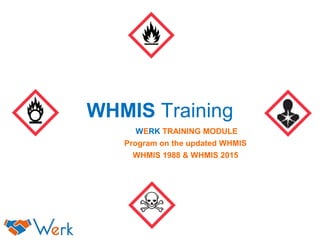
WHMIS Training
WERK TRAINING MODULE
Program on the updated WHMIS
WHMIS 1988 & WHMIS 2015
WHMIS OVERVIEW
What is WHMIS ?
Why was WHMIS created?
WHMIS Objective
• Identify Hazardous materials on the work site
• Improve the communication of health hazard information of
materials used on the work site
• Protect workers from exposure to hazardous materials through
safety equipment, training, and procedures
WHIMIS 2015
• WHIMIS 2015 is updated version of WHIMIS 1988.
• Canada has aligned the WHMIS with the Globally Harmonized System
of Classification and Labelling of Chemicals (GHS).
• Hazardous Products Regulation
• Aligned Internationally recognized system; GHS is a global system developed
by United Nation
• Comprehensive classification criteria
• Hazard severity
• Harmonized communication of chemical hazard information
• Reduce worker risks
• Mitigate hazard communication costs
• Promote international trade
WHMIS 1988 System Important ?
• Yes. Keep in mind that education and training on the 'old' WHMIS
1988 system will be necessary for as long as workplace products
have 'old' WHMIS style labels and MSDSs – for example, until the
product is re-labelled or existing stock is used up. This situation will
exist until the transition to WHMIS 2015 is complete by December
2018.
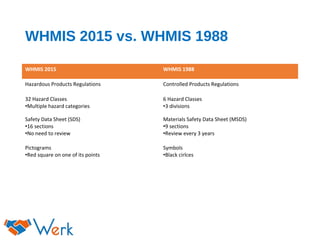
WHMIS 2015 vs. WHMIS 1988
WHMIS 2015 WHMIS 1988
Hazardous Products Regulations Controlled Products Regulations
32 Hazard Classes
•Multiple hazard categories
6 Hazard Classes
•3 divisions
Safety Data Sheet (SDS)
•16 sections
•No need to review
Materials Safety Data Sheet (MSDS)
•9 sections
•Review every 3 years
Pictograms
•Red square on one of its points
Symbols
•Black cirlces
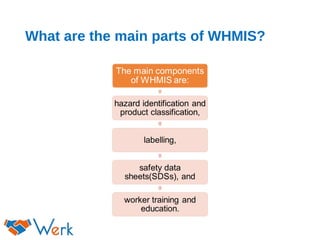
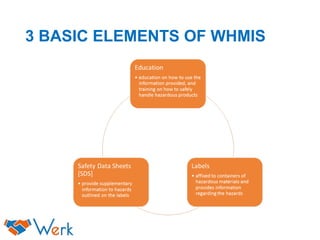
What are the main parts of WHMIS?
3 BASIC ELEMENTS OF WHMIS
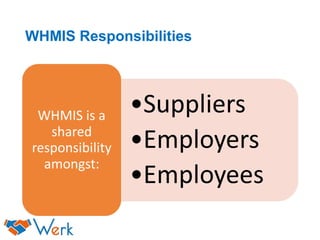
RIGHTS AND RESPONSIBILITIES
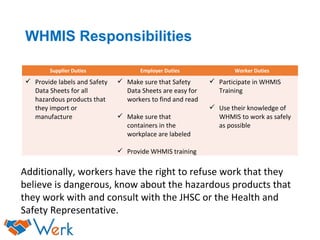
WHMIS Responsibilities
Supplier Duties Employer Duties Worker Duties
 Provide labels and Safety
Data Sheets for all
hazardous products that
they import or
manufacture
 Make sure that Safety
Data Sheets are easy for
workers to find and read
 Make sure that
containers in the
workplace are labeled
 Provide WHMIS training
 Participate in WHMIS
Training
 Use their knowledge of
WHMIS to work as safely
as possible
Additionally, workers have the right to refuse work that they
believe is dangerous, know about the hazardous products that
they work with and consult with the JHSC or the Health and
Safety Representative.
LEGISLATION
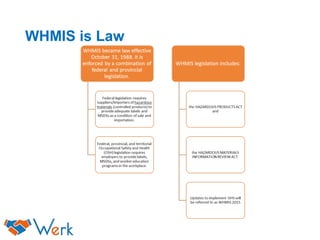
WHMIS is Law
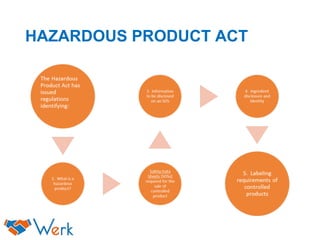
HAZARDOUS PRODUCT ACT
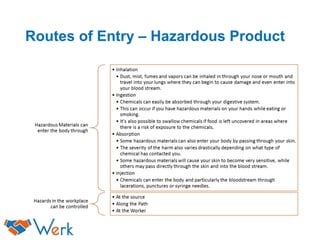
ROUTE TO ENTRY & SAFETY
PROCEDURES FOR WORKERS
Routes of Entry – Hazardous Product
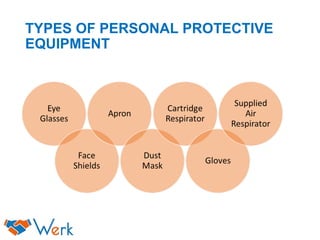
TYPES OF PERSONAL PROTECTIVE
EQUIPMENT
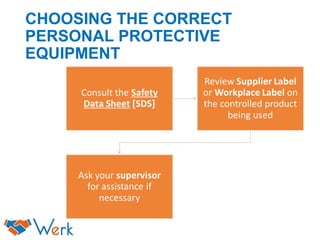
CHOOSING THE CORRECT
PERSONAL PROTECTIVE
EQUIPMENT
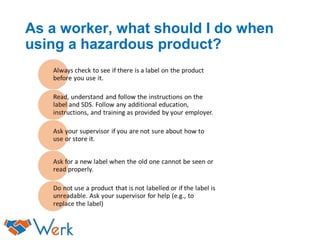
As a worker, what should I do when
using a hazardous product?
HAZARD CLASSIFICATIONS &
DESCRIPTION
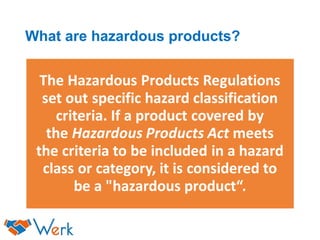
What are hazardous products?
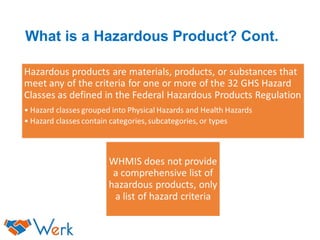
What is a Hazardous Product? Cont.
WHMIS/GHS Hazard Categories
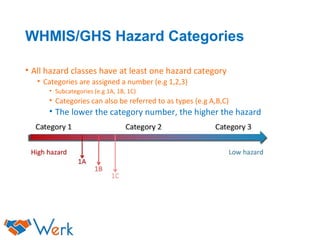
• All hazard classes have at least one hazard category
• Categories are assigned a number (e.g 1,2,3)
• Subcategories (e.g 1A, 1B, 1C)
• Categories can also be referred to as types (e.g A,B,C)
• The lower the category number, the higher the hazard
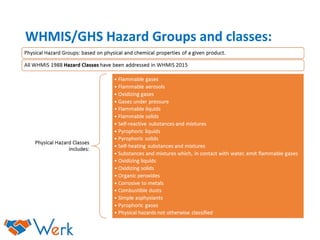
WHMIS/GHS Hazard Groups and classes:
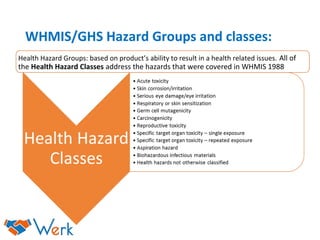
Health Hazard Groups: based on product’s ability to result in a health related issues. All of
the Health Hazard Classes address the hazards that were covered in WHMIS 1988
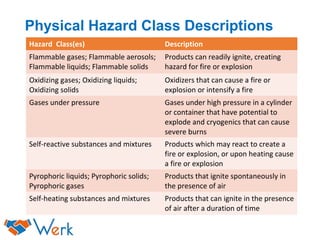
Physical Hazard Class Descriptions
Hazard Class(es) Description
Flammable gases; Flammable aerosols;
Flammable liquids; Flammable solids
Products can readily ignite, creating
hazard for fire or explosion
Oxidizing gases; Oxidizing liquids;
Oxidizing solids
Oxidizers that can cause a fire or
explosion or intensify a fire
Gases under pressure Gases under high pressure in a cylinder
or container that have potential to
explode and cryogenics that can cause
severe burns
Self-reactive substances and mixtures Products which may react to create a
fire or explosion, or upon heating cause
a fire or explosion
Pyrophoric liquids; Pyrophoric solids;
Pyrophoric gases
Products that ignite spontaneously in
the presence of air
Self-heating substances and mixtures Products that can ignite in the presence
of air after a duration of time
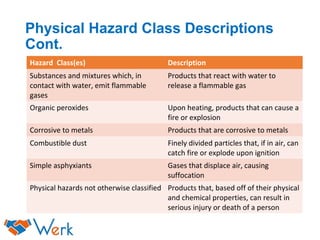
Physical Hazard Class Descriptions
Cont.
Hazard Class(es) Description
Substances and mixtures which, in
contact with water, emit flammable
gases
Products that react with water to
release a flammable gas
Organic peroxides Upon heating, products that can cause a
fire or explosion
Corrosive to metals Products that are corrosive to metals
Combustible dust Finely divided particles that, if in air, can
catch fire or explode upon ignition
Simple asphyxiants Gases that displace air, causing
suffocation
Physical hazards not otherwise classified Products that, based off of their physical
and chemical properties, can result in
serious injury or death of a person
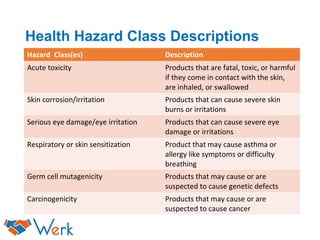
Health Hazard Class Descriptions
Hazard Class(es) Description
Acute toxicity Products that are fatal, toxic, or harmful
if they come in contact with the skin,
are inhaled, or swallowed
Skin corrosion/irritation Products that can cause severe skin
burns or irritations
Serious eye damage/eye irritation Products that can cause severe eye
damage or irritations
Respiratory or skin sensitization Product that may cause asthma or
allergy like symptoms or difficulty
breathing
Germ cell mutagenicity Products that may cause or are
suspected to cause genetic defects
Carcinogenicity Products that may cause or are
suspected to cause cancer
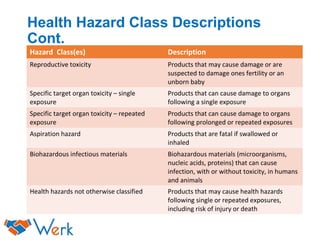
Health Hazard Class Descriptions
Cont.
Hazard Class(es) Description
Reproductive toxicity Products that may cause damage or are
suspected to damage ones fertility or an
unborn baby
Specific target organ toxicity – single
exposure
Products that can cause damage to organs
following a single exposure
Specific target organ toxicity – repeated
exposure
Products that can cause damage to organs
following prolonged or repeated exposures
Aspiration hazard Products that are fatal if swallowed or
inhaled
Biohazardous infectious materials Biohazardous materials (microorganisms,
nucleic acids, proteins) that can cause
infection, with or without toxicity, in humans
and animals
Health hazards not otherwise classified Products that may cause health hazards
following single or repeated exposures,
including risk of injury or death
HAZARD SYMBOLS AND
PICTOGRAM
Symbols and Pictogram
• Even if you are just entering into the workforce, it’s very likely that
you have already seen some of the images displayed within symbols
and pictograms.
• These images can sometimes be found on household products that
you buy often, and possibly use on a regular basis.
Symbols and Pictogram
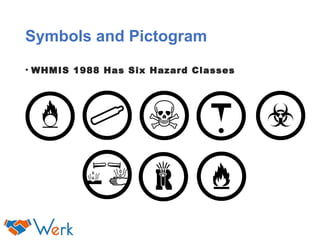
• WHMIS 1988 Has Six Hazard Classes
Pictogram
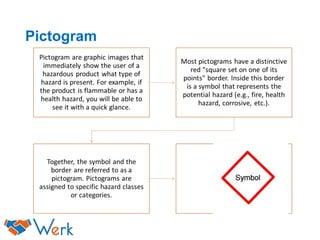
Pictogram
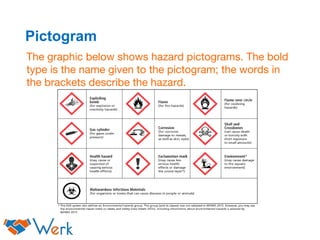
The graphic below shows hazard pictograms. The bold
type is the name given to the pictogram; the words in
the brackets describe the hazard.
1988 Symbols vs 2015 Pictograms
• WHMIS pictograms are denoted by symbols inside red “diamond”
shaped borders
• Some WHMIS 1988 symbols have been fully replaced and are non-
existent in the new system
• The red borders of WHMIS 2015 over the black images are more
prominent
• Pictograms are more specific
• WHMIS 2015 pictograms are universally accepted
LABELS
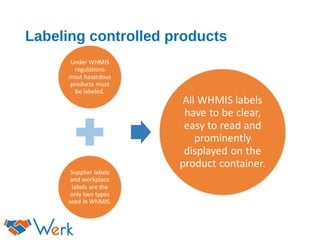
Labeling controlled products
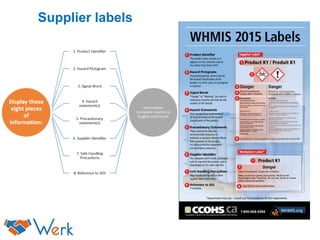
Supplier labels
Supplier Label – What is signal word?
• A signal word is a prompt that alerts you about the degree or level of
hazard of the product. There are only two signal words used:
"Danger" or "Warning". "Danger" is used for high risk hazards, while
"Warning" is used for less severe hazards.
• If a signal word is assigned to a hazard class and category, it must be
shown on the label, and listed in section 2 (Hazards Identification) of
the Safety Data Sheet (SDS).
• Some hazard classes or categories do not have a signal word assigned
to them.
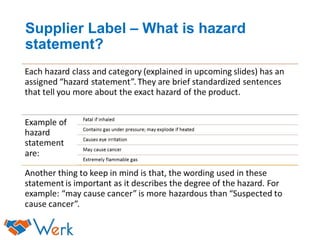
Supplier Label – What is hazard
statement?
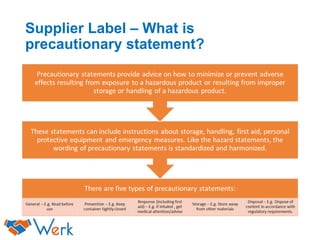
Supplier Label – What is
precautionary statement?
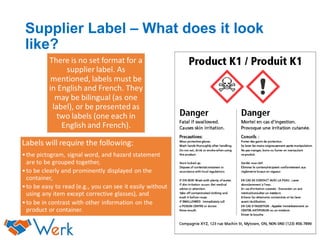
Supplier Label – What does it look
like?
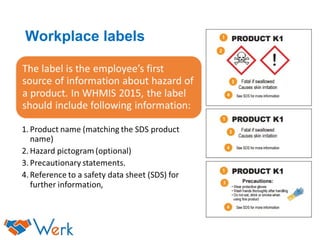
Workplace labels
SAFETY DATA SHEETS
Safety Data Sheets
(SDSs)
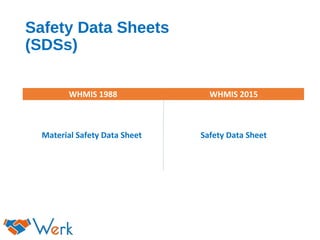
Material Safety Data Sheet Safety Data Sheet
WHMIS 1988 WHMIS 2015
Safety Data Sheets
(SDSs)
• All hazardous products must have a SDS
• It provides more detailed hazard information than labels
• Suppliers must supply a current SDS at the time of sale
• Suppliers must update the SDS when they become aware of any significant
new data
• SDS must be accessible to all workers
• Store in a readily accessible area known to everyone
• Referenced and understood before handling a hazardous product
Safety Data Sheets
(SDSs)
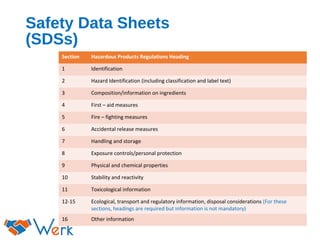
Section Hazardous Products Regulations Heading
1 Identification
2 Hazard Identification (including classification and label text)
3 Composition/information on ingredients
4 First – aid measures
5 Fire – fighting measures
6 Accidental release measures
7 Handling and storage
8 Exposure controls/personal protection
9 Physical and chemical properties
10 Stability and reactivity
11 Toxicological information
12-15 Ecological, transport and regulatory information, disposal considerations (For these
sections, headings are required but information is not mandatory)
16 Other information
SDS Section 1 & 2 Information
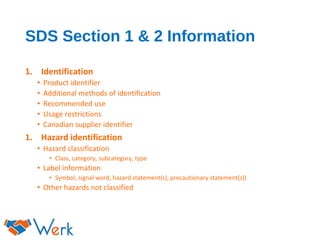
1. Identification
• Product identifier
• Additional methods of identification
• Recommended use
• Usage restrictions
• Canadian supplier identifier
1. Hazard identification
• Hazard classification
• Class, category, subcategory, type
• Label information
• Symbol, signal word, hazard statement(s), precautionary statement(s))
• Other hazards not classified
SDS Section 3 & 4 Information
3. Composition/information on ingredients
• For hazardous products that are a material or substance
• Chemical name, common name/synonyms, CAS number, other unique identifiers,
chemical names of impurities, stabilizers, or additives
• For materials or substances in a mixture that are classified as a health hazard
• Chemical name, common name/synonyms, CAS number, other unique identifiers,
concentration
4. First-aid measures
• Measures by exposure type
• Inhalation, skin contact, eye contact, ingestion
• Vital symptoms and effects
• If medical attention or treatment is required
SDS Section 5 & 6 Information
5. Fire-fighting measures
• Suitable and unsuitable extinguishing media
• Hazards associated with the hazardous product in fire conditions
• Personal protective equipment and precautions for fire-fighters
6. Accidental release measures
• Personal protective equipment, precautions, and emergency procedures
• Containment method, including required materials
• Prescribed clean-up
SDS Section 7 & 8 Information
7. Handling and storage
• Information on safe handling
• Prescribed storage methods
• Incompatible materials
8. Exposure controls/personal protection
• Occupational exposure information for chemical and biological exposures
and appropriate control mechanisms
• Engineering controls
• Personal protective equipment recommendations
SDS Section 9 Information
SDS Section 10 & 11 Information
10. Stability and reactivity
• Not all may be applicable
• Reactivity
• Stability
• Possible hazardous reactions
• Undesirable conditions that can impact material (ie. Shock, light)
• Incompatible materials
• Decomposition products
11. Toxicological information
• Description of toxic health effects and the data which verified these claims
• Routes of exposure
• Symptoms related to the toxic health effects
• Delayed, immediate, and chronic effects from short- and long-term exposures
• Values/measurements of toxicity
SDS Section 12 & 13 Information
12. Ecological information
• Information may not be on SDS
• Ecotoxicity
• Persistence and degradability
• Bioaccumulation potential
• Mobility in soil
• Other adverse effects
13. Disposal considerations
• Information may not be on SDS
• Safe handling for disposal
• Methods for disposal, including contaminated packaging
SDS Section 14,15 & 16
Information
14. Transport information
• Information may not be on SDS
• UN number
• UN proper shipping name
• Transport hazard class(es)
• Packing group
• Environmental hazards
• Transport in bulk
• Special precautions
15. Regulatory information
• Information may not be on SDS
• Safety, health, and environmental regulations pertaining to the product
16. Other information
• Date of the latest revision of the SDS
As a worker, when would I use an
SDS?
• Always be familiar with the hazards of a product before you start
using it. You should look at an SDS, match the name of the product
on the container to the one on the SDS, know the hazards,
understand safe handling and storage instructions, as well as
understand what to do in an emergency.
• You can think of the SDS as having four main purposes. It provides
information on:
A. Identification: for the product and supplier.
B. Hazards: physical (fire and reactivity) and health.
C. Prevention: steps you can take to work safely, reduce or prevent exposure,
or in an emergency.
D. Response: appropriate responses in various situations (e.g., first-aid, fire,
accidental release).
As a worker, when would I use an
SDS? Cont.
• For most people who work with hazardous products, you should
always:
• read the name of the chemical (Section 1),
• know the hazards (Section 2),
• understand safe handling and storage instructions (Section 7), and
• understand what to do in an emergency (Sections 4, 5 and 6).
• Ask your supervisor or a health and safety professional for advice if
the way you use the product does not match the SDS.
Additional Resources
On-line WHMIS Training
http://access.nscc.ns.ca/safety/whmis.htm
Where to find WHMIS symbols:
http://www.hc-sc.gc.ca/hecs-
sesc/whmis/whmis_symbols.htm
Where to find Hazardous Household Product Symbols:
http://www.region.peel.on.ca/pw/waste/resident/hhw.htm
Sources for this presentation
• This presentation has been assembled using following information
on:
• CCOHS Website
• http://www.ccohs.ca/oshanswers/chemicals/whmis_ghs/general.html
• Workplace labels and information
• http://www.worksafenb.ca/docs/WHMIS-Workplace-Labels.pdf
• WHIMIS Training PPT University of Manitoba
• https://umanitoba.ca/admin/vp_admin/risk_management/ehso/media/WH
MIS_2015_Training_Presentation-PDF.pdf
• http://www.iecpartnership.com/wp-content/uploads/WHMIS-2015-
Supplement-Test-ANSWERS.pdf

Werk WHMIS Training

  • 1.
    WHMIS Training WERK TRAININGMODULE Program on the updated WHMIS WHMIS 1988 & WHMIS 2015
  • 2.
  • 3.
  • 4.
    Why was WHMIScreated?
  • 5.
    WHMIS Objective • IdentifyHazardous materials on the work site • Improve the communication of health hazard information of materials used on the work site • Protect workers from exposure to hazardous materials through safety equipment, training, and procedures
  • 6.
    WHIMIS 2015 • WHIMIS2015 is updated version of WHIMIS 1988. • Canada has aligned the WHMIS with the Globally Harmonized System of Classification and Labelling of Chemicals (GHS). • Hazardous Products Regulation • Aligned Internationally recognized system; GHS is a global system developed by United Nation • Comprehensive classification criteria • Hazard severity • Harmonized communication of chemical hazard information • Reduce worker risks • Mitigate hazard communication costs • Promote international trade
  • 7.
    WHMIS 1988 SystemImportant ? • Yes. Keep in mind that education and training on the 'old' WHMIS 1988 system will be necessary for as long as workplace products have 'old' WHMIS style labels and MSDSs – for example, until the product is re-labelled or existing stock is used up. This situation will exist until the transition to WHMIS 2015 is complete by December 2018.
  • 8.
    WHMIS 2015 vs.WHMIS 1988 WHMIS 2015 WHMIS 1988 Hazardous Products Regulations Controlled Products Regulations 32 Hazard Classes •Multiple hazard categories 6 Hazard Classes •3 divisions Safety Data Sheet (SDS) •16 sections •No need to review Materials Safety Data Sheet (MSDS) •9 sections •Review every 3 years Pictograms •Red square on one of its points Symbols •Black cirlces
  • 9.
    What are themain parts of WHMIS?
  • 10.
  • 11.
  • 12.
  • 13.
    WHMIS Responsibilities Supplier DutiesEmployer Duties Worker Duties  Provide labels and Safety Data Sheets for all hazardous products that they import or manufacture  Make sure that Safety Data Sheets are easy for workers to find and read  Make sure that containers in the workplace are labeled  Provide WHMIS training  Participate in WHMIS Training  Use their knowledge of WHMIS to work as safely as possible Additionally, workers have the right to refuse work that they believe is dangerous, know about the hazardous products that they work with and consult with the JHSC or the Health and Safety Representative.
  • 14.
  • 15.
  • 16.
  • 17.
    ROUTE TO ENTRY& SAFETY PROCEDURES FOR WORKERS
  • 18.
    Routes of Entry– Hazardous Product
  • 19.
    TYPES OF PERSONALPROTECTIVE EQUIPMENT
  • 20.
    CHOOSING THE CORRECT PERSONALPROTECTIVE EQUIPMENT
  • 21.
    As a worker,what should I do when using a hazardous product?
  • 22.
  • 23.
  • 24.
    What is aHazardous Product? Cont.
  • 25.
    WHMIS/GHS Hazard Categories •All hazard classes have at least one hazard category • Categories are assigned a number (e.g 1,2,3) • Subcategories (e.g 1A, 1B, 1C) • Categories can also be referred to as types (e.g A,B,C) • The lower the category number, the higher the hazard
  • 26.
  • 27.
    WHMIS/GHS Hazard Groupsand classes: Health Hazard Groups: based on product’s ability to result in a health related issues. All of the Health Hazard Classes address the hazards that were covered in WHMIS 1988
  • 28.
    Physical Hazard ClassDescriptions Hazard Class(es) Description Flammable gases; Flammable aerosols; Flammable liquids; Flammable solids Products can readily ignite, creating hazard for fire or explosion Oxidizing gases; Oxidizing liquids; Oxidizing solids Oxidizers that can cause a fire or explosion or intensify a fire Gases under pressure Gases under high pressure in a cylinder or container that have potential to explode and cryogenics that can cause severe burns Self-reactive substances and mixtures Products which may react to create a fire or explosion, or upon heating cause a fire or explosion Pyrophoric liquids; Pyrophoric solids; Pyrophoric gases Products that ignite spontaneously in the presence of air Self-heating substances and mixtures Products that can ignite in the presence of air after a duration of time
  • 29.
    Physical Hazard ClassDescriptions Cont. Hazard Class(es) Description Substances and mixtures which, in contact with water, emit flammable gases Products that react with water to release a flammable gas Organic peroxides Upon heating, products that can cause a fire or explosion Corrosive to metals Products that are corrosive to metals Combustible dust Finely divided particles that, if in air, can catch fire or explode upon ignition Simple asphyxiants Gases that displace air, causing suffocation Physical hazards not otherwise classified Products that, based off of their physical and chemical properties, can result in serious injury or death of a person
  • 30.
    Health Hazard ClassDescriptions Hazard Class(es) Description Acute toxicity Products that are fatal, toxic, or harmful if they come in contact with the skin, are inhaled, or swallowed Skin corrosion/irritation Products that can cause severe skin burns or irritations Serious eye damage/eye irritation Products that can cause severe eye damage or irritations Respiratory or skin sensitization Product that may cause asthma or allergy like symptoms or difficulty breathing Germ cell mutagenicity Products that may cause or are suspected to cause genetic defects Carcinogenicity Products that may cause or are suspected to cause cancer
  • 31.
    Health Hazard ClassDescriptions Cont. Hazard Class(es) Description Reproductive toxicity Products that may cause damage or are suspected to damage ones fertility or an unborn baby Specific target organ toxicity – single exposure Products that can cause damage to organs following a single exposure Specific target organ toxicity – repeated exposure Products that can cause damage to organs following prolonged or repeated exposures Aspiration hazard Products that are fatal if swallowed or inhaled Biohazardous infectious materials Biohazardous materials (microorganisms, nucleic acids, proteins) that can cause infection, with or without toxicity, in humans and animals Health hazards not otherwise classified Products that may cause health hazards following single or repeated exposures, including risk of injury or death
  • 32.
  • 33.
    Symbols and Pictogram •Even if you are just entering into the workforce, it’s very likely that you have already seen some of the images displayed within symbols and pictograms. • These images can sometimes be found on household products that you buy often, and possibly use on a regular basis.
  • 34.
    Symbols and Pictogram •WHMIS 1988 Has Six Hazard Classes
  • 35.
  • 36.
    Pictogram The graphic belowshows hazard pictograms. The bold type is the name given to the pictogram; the words in the brackets describe the hazard.
  • 37.
    1988 Symbols vs2015 Pictograms • WHMIS pictograms are denoted by symbols inside red “diamond” shaped borders • Some WHMIS 1988 symbols have been fully replaced and are non- existent in the new system • The red borders of WHMIS 2015 over the black images are more prominent • Pictograms are more specific • WHMIS 2015 pictograms are universally accepted
  • 38.
  • 39.
  • 40.
  • 41.
    Supplier Label –What is signal word? • A signal word is a prompt that alerts you about the degree or level of hazard of the product. There are only two signal words used: "Danger" or "Warning". "Danger" is used for high risk hazards, while "Warning" is used for less severe hazards. • If a signal word is assigned to a hazard class and category, it must be shown on the label, and listed in section 2 (Hazards Identification) of the Safety Data Sheet (SDS). • Some hazard classes or categories do not have a signal word assigned to them.
  • 42.
    Supplier Label –What is hazard statement?
  • 43.
    Supplier Label –What is precautionary statement?
  • 44.
    Supplier Label –What does it look like?
  • 45.
  • 46.
  • 47.
    Safety Data Sheets (SDSs) MaterialSafety Data Sheet Safety Data Sheet WHMIS 1988 WHMIS 2015
  • 48.
    Safety Data Sheets (SDSs) •All hazardous products must have a SDS • It provides more detailed hazard information than labels • Suppliers must supply a current SDS at the time of sale • Suppliers must update the SDS when they become aware of any significant new data • SDS must be accessible to all workers • Store in a readily accessible area known to everyone • Referenced and understood before handling a hazardous product
  • 49.
    Safety Data Sheets (SDSs) SectionHazardous Products Regulations Heading 1 Identification 2 Hazard Identification (including classification and label text) 3 Composition/information on ingredients 4 First – aid measures 5 Fire – fighting measures 6 Accidental release measures 7 Handling and storage 8 Exposure controls/personal protection 9 Physical and chemical properties 10 Stability and reactivity 11 Toxicological information 12-15 Ecological, transport and regulatory information, disposal considerations (For these sections, headings are required but information is not mandatory) 16 Other information
  • 50.
    SDS Section 1& 2 Information 1. Identification • Product identifier • Additional methods of identification • Recommended use • Usage restrictions • Canadian supplier identifier 1. Hazard identification • Hazard classification • Class, category, subcategory, type • Label information • Symbol, signal word, hazard statement(s), precautionary statement(s)) • Other hazards not classified
  • 51.
    SDS Section 3& 4 Information 3. Composition/information on ingredients • For hazardous products that are a material or substance • Chemical name, common name/synonyms, CAS number, other unique identifiers, chemical names of impurities, stabilizers, or additives • For materials or substances in a mixture that are classified as a health hazard • Chemical name, common name/synonyms, CAS number, other unique identifiers, concentration 4. First-aid measures • Measures by exposure type • Inhalation, skin contact, eye contact, ingestion • Vital symptoms and effects • If medical attention or treatment is required
  • 52.
    SDS Section 5& 6 Information 5. Fire-fighting measures • Suitable and unsuitable extinguishing media • Hazards associated with the hazardous product in fire conditions • Personal protective equipment and precautions for fire-fighters 6. Accidental release measures • Personal protective equipment, precautions, and emergency procedures • Containment method, including required materials • Prescribed clean-up
  • 53.
    SDS Section 7& 8 Information 7. Handling and storage • Information on safe handling • Prescribed storage methods • Incompatible materials 8. Exposure controls/personal protection • Occupational exposure information for chemical and biological exposures and appropriate control mechanisms • Engineering controls • Personal protective equipment recommendations
  • 54.
    SDS Section 9Information
  • 55.
    SDS Section 10& 11 Information 10. Stability and reactivity • Not all may be applicable • Reactivity • Stability • Possible hazardous reactions • Undesirable conditions that can impact material (ie. Shock, light) • Incompatible materials • Decomposition products 11. Toxicological information • Description of toxic health effects and the data which verified these claims • Routes of exposure • Symptoms related to the toxic health effects • Delayed, immediate, and chronic effects from short- and long-term exposures • Values/measurements of toxicity
  • 56.
    SDS Section 12& 13 Information 12. Ecological information • Information may not be on SDS • Ecotoxicity • Persistence and degradability • Bioaccumulation potential • Mobility in soil • Other adverse effects 13. Disposal considerations • Information may not be on SDS • Safe handling for disposal • Methods for disposal, including contaminated packaging
  • 57.
    SDS Section 14,15& 16 Information 14. Transport information • Information may not be on SDS • UN number • UN proper shipping name • Transport hazard class(es) • Packing group • Environmental hazards • Transport in bulk • Special precautions 15. Regulatory information • Information may not be on SDS • Safety, health, and environmental regulations pertaining to the product 16. Other information • Date of the latest revision of the SDS
  • 58.
    As a worker,when would I use an SDS? • Always be familiar with the hazards of a product before you start using it. You should look at an SDS, match the name of the product on the container to the one on the SDS, know the hazards, understand safe handling and storage instructions, as well as understand what to do in an emergency. • You can think of the SDS as having four main purposes. It provides information on: A. Identification: for the product and supplier. B. Hazards: physical (fire and reactivity) and health. C. Prevention: steps you can take to work safely, reduce or prevent exposure, or in an emergency. D. Response: appropriate responses in various situations (e.g., first-aid, fire, accidental release).
  • 59.
    As a worker,when would I use an SDS? Cont. • For most people who work with hazardous products, you should always: • read the name of the chemical (Section 1), • know the hazards (Section 2), • understand safe handling and storage instructions (Section 7), and • understand what to do in an emergency (Sections 4, 5 and 6). • Ask your supervisor or a health and safety professional for advice if the way you use the product does not match the SDS.
  • 60.
    Additional Resources On-line WHMISTraining http://access.nscc.ns.ca/safety/whmis.htm Where to find WHMIS symbols: http://www.hc-sc.gc.ca/hecs- sesc/whmis/whmis_symbols.htm Where to find Hazardous Household Product Symbols: http://www.region.peel.on.ca/pw/waste/resident/hhw.htm
  • 61.
    Sources for thispresentation • This presentation has been assembled using following information on: • CCOHS Website • http://www.ccohs.ca/oshanswers/chemicals/whmis_ghs/general.html • Workplace labels and information • http://www.worksafenb.ca/docs/WHMIS-Workplace-Labels.pdf • WHIMIS Training PPT University of Manitoba • https://umanitoba.ca/admin/vp_admin/risk_management/ehso/media/WH MIS_2015_Training_Presentation-PDF.pdf • http://www.iecpartnership.com/wp-content/uploads/WHMIS-2015- Supplement-Test-ANSWERS.pdf

Editor's Notes