Porosity 
• Learning Outcomes 
Reservoir Rocks & Fluid Properties
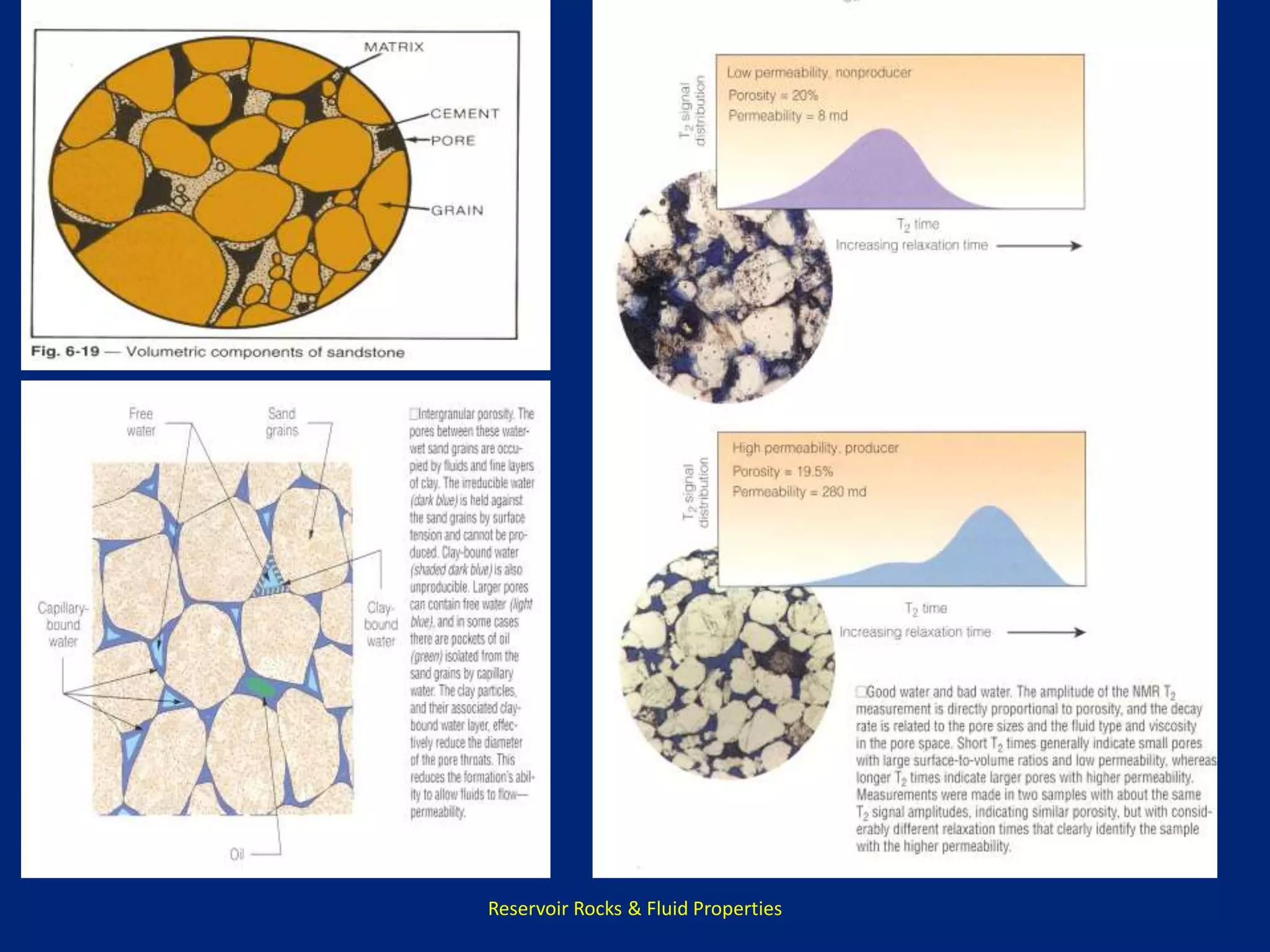
Porosity of Reservoir Rocks 
• Definition of Porosity 
• Classification of Porosity 
• Factors affecting Porosity 
• Applications of Porosity 
• Determination of Porosity 
Reservoir Rocks & Fluid Properties
Porosity 
Definition: Measure of 
pore space in porous 
media. 
Packing 
Sorting 
Grain Shape 
High Low
Reservoir Rocks & Fluid Properties
• Rock reservoir have pore that are connected and contain fluids 
(oil, gas, water) that can flow through the rock. 
• Reservoir rock looks solid to the naked eye, but a microscopic 
examination reveals the existence of tiny openings in the rock. 
• These spaces or tiny openings (typically up to 300 μm) in 
petroleum reservoir rocks are the one in which petroleum 
reservoir fluids are presents 
Reservoir Rocks & Fluid Properties 
1 
Porosity of Reservoir Rocks
Definition of Porosity 
• Porosity(φ) : the ratio of the pore volume in a 
rock to the bulk volume of that rock. Express in per 
cent. 
Mathematical form is: 
φ = Vp/Vb 
Reservoir Rocks & Fluid Properties
Porosity 
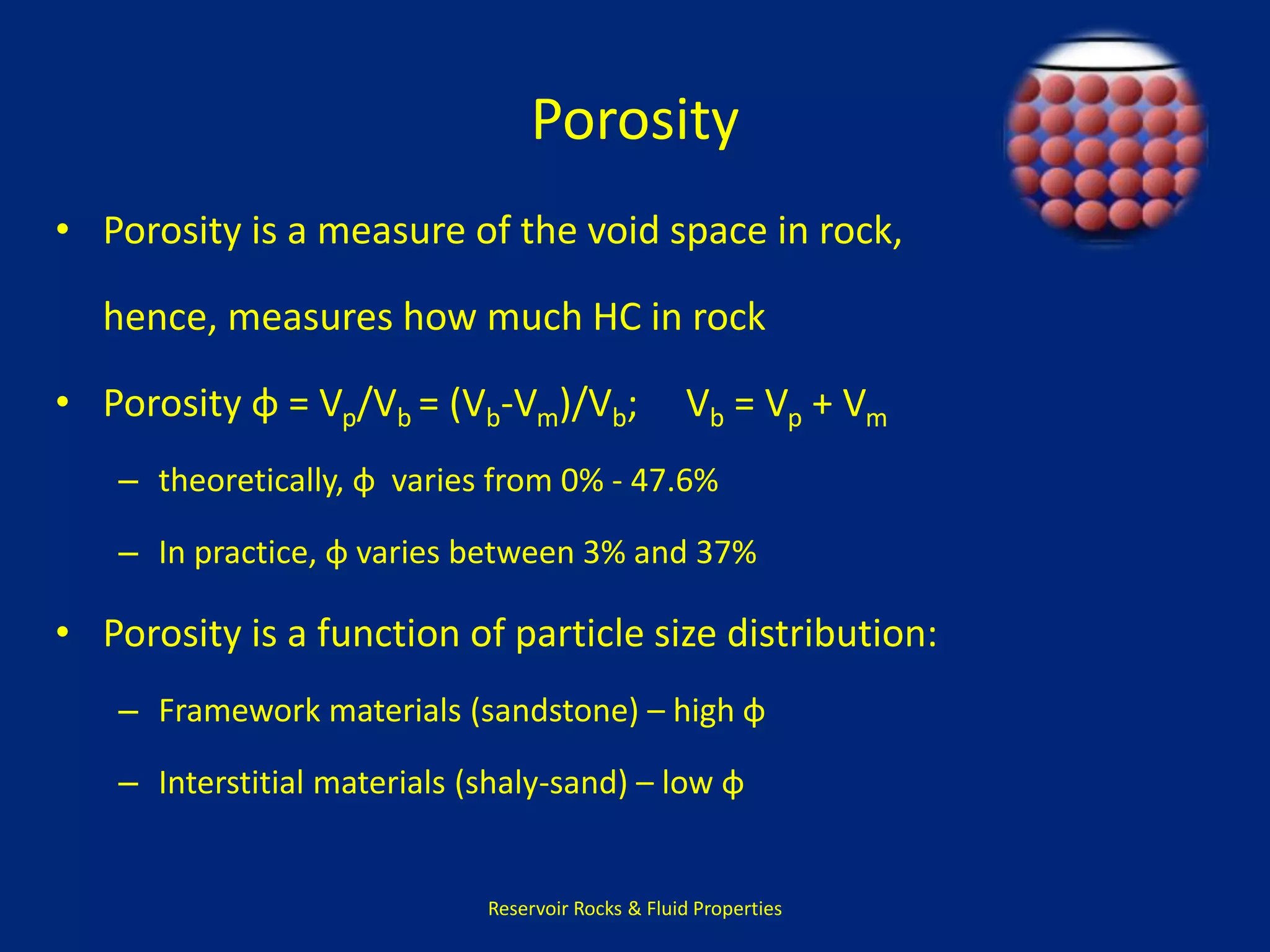
• Porosity is a measure of the void space in rock, 
hence, measures how much HC in rock 
• Porosity φ = Vp/Vb = (Vb-Vm)/Vb; Vb = Vp + Vm 
– theoretically, φ varies from 0% - 47.6% 
– In practice, φ varies between 3% and 37% 
• Porosity is a function of particle size distribution: 
– Framework materials (sandstone) – high φ 
– Interstitial materials (shaly-sand) – low φ 
Reservoir Rocks & Fluid Properties
Classification of Porosity 
Porosity can be classified into; 
1. Original porosity 
2. Induced porosity 
• Original porosity (primary) is formed during the deposition of rock 
materials, e.g. porosity between granular in sandstone, 
porosity among crystal and oolitic in limestone 
• Induced porosity (secondary) is developed by some geological 
process on the deposited rock material. 
E.g; Fractures, or vugs cavity usual occur in limestone 
(chemical reaction b/w CaCO3 and MgCl2) 
Reservoir Rocks & Fluid Properties
Porosity 
Sand grain 
Cement material 
Effective / connected 
porosity (25%) 
Ineffective Porosity 
(5%) 
Total Porosity (30%) 
Reservoir Rocks & Fluid Properties 
Deadend or cul-de- 
sac pore
Types of Porosity 
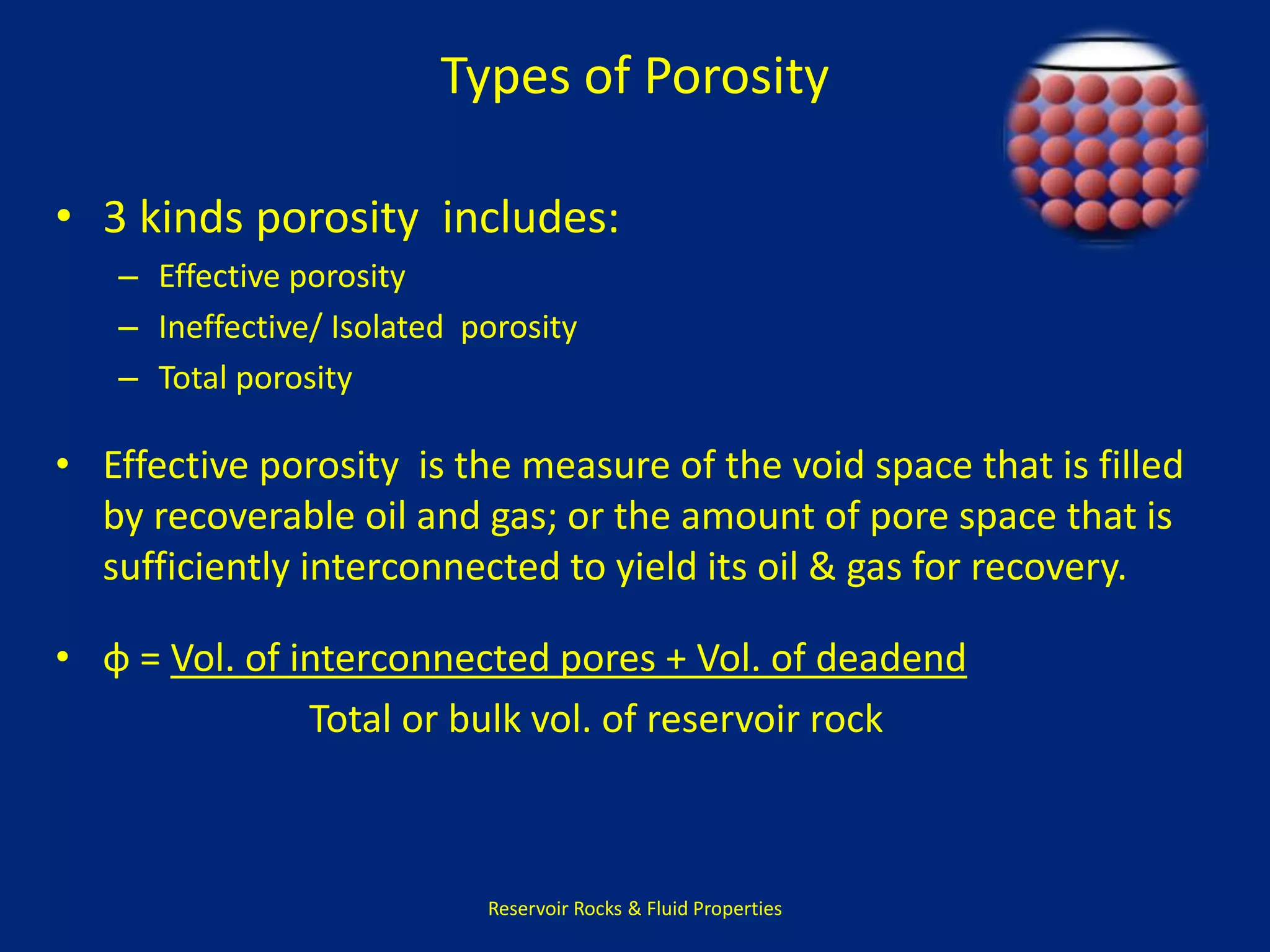
• 3 kinds porosity includes: 
– Effective porosity 
– Ineffective/ Isolated porosity 
– Total porosity 
• Effective porosity is the measure of the void space that is filled 
by recoverable oil and gas; or the amount of pore space that is 
sufficiently interconnected to yield its oil & gas for recovery. 
• φ = Vol. of interconnected pores + Vol. of deadend 
Total or bulk vol. of reservoir rock 
Reservoir Rocks & Fluid Properties
PORE-SPACE CLASSIFICATION 
• Total porosity, t = 
• Effective porosity, e = 
Total Pore Volume 
Bulk Volume 
Interconnected Pore Space 
Bulk Volume 
• Effective porosity – of great importance; 
contains the mobile fluid
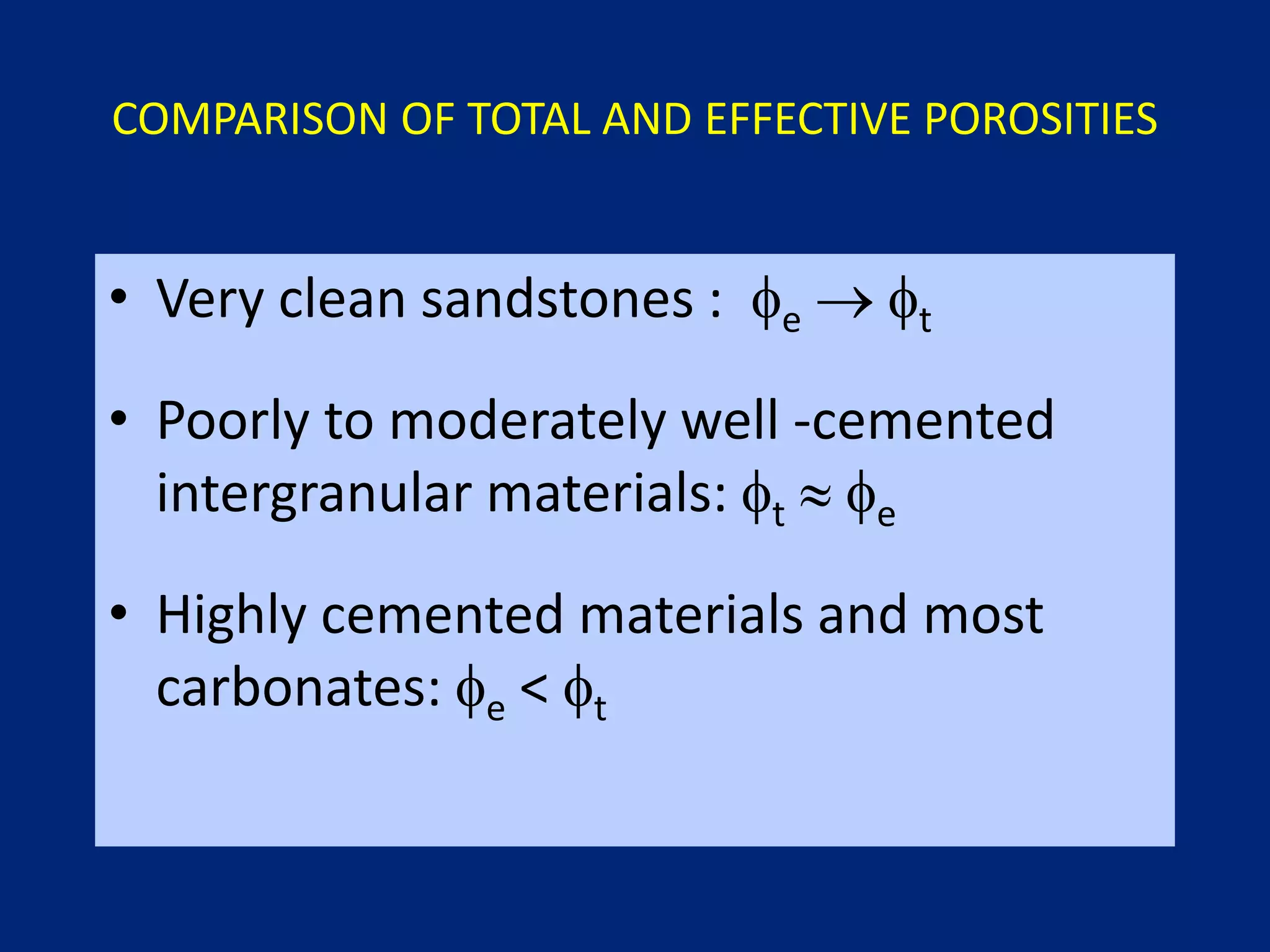
COMPARISON OF TOTAL AND EFFECTIVE POROSITIES 
• Very clean sandstones : e  t 
• Poorly to moderately well -cemented 
intergranular materials: t  e 
• Highly cemented materials and most 
carbonates: e < t
Types of Porosity 
• Ineffective porosity is the ratio of the volume of isolated or 
completely disconnected pores to the total or bulk volume 
• φ = Vol. of completely disconnected pores 
Total or bulk volume 
• Total or absolute porosity is the ratio of the entire void spaces 
in the reservoir rock to the bulk volume of the rock 
• φ = Vol. of interconnected + Vol. of deadend or cul-de-sac 
pores + Vol. of isolated pore 
Total or bilk volume 
Reservoir Rocks & Fluid Properties
Applications of Porosity 
• What is the significance Porosity in engineering reservoir? 
• From the reservoir engineering point of view, porosity is probably one of 
the most important reservoir rock properties and its quantitative value is 
used in all reservoir engineering calculations ‘cos it represents the pore 
spaces that’s occupied by mobile fluids. 
• For common reservoir rock types, under average operating conditions, porosity 
values ranges; 
Porosity % 25~20 20~15 15~10 10~5 5~0 
Reservoir Rocks & Fluid Properties 
Grade Very 
good 
good moderate poor no 
value 
Evaluating formation
Applications of Porosity 
Porosity data are used in these basic reservoir evaluations: 
1. Volumetric calculation of fluids in the reservoir 
2.Calculation of fluid saturations 
3.Geological characterization of the reservoir 
 Calculating hydrocarbon in a reservoir 
 HCPV = Area x Thickness x φ x (1 – Sw) 
 where: A = surface area of the reservoir 
 h = thickness of the formation 
 φ = porosity 
 Swi= the percent of the pore volume 
 occupied by the water 
Reservoir Rocks & Fluid Properties
Various packing of spheres: cubic & rhombohedral 
Reservoir Rocks & Fluid Properties 
cubic packing of 
spheres resulting in a 
least-compact 
arrangement with a 
porosity of 47.64% 
Rhombohedral 
packing of spheres 
resulting in a most-compact 
arrangement 
with a porosity of 
26% 
Spherical size variation influences 
type & volume of solid porosity 
Porosity 
36% 
Porosity 
20% 
Effect of cement material
FACTORS THAT AFFECT POROSITY 
PRIMARY 
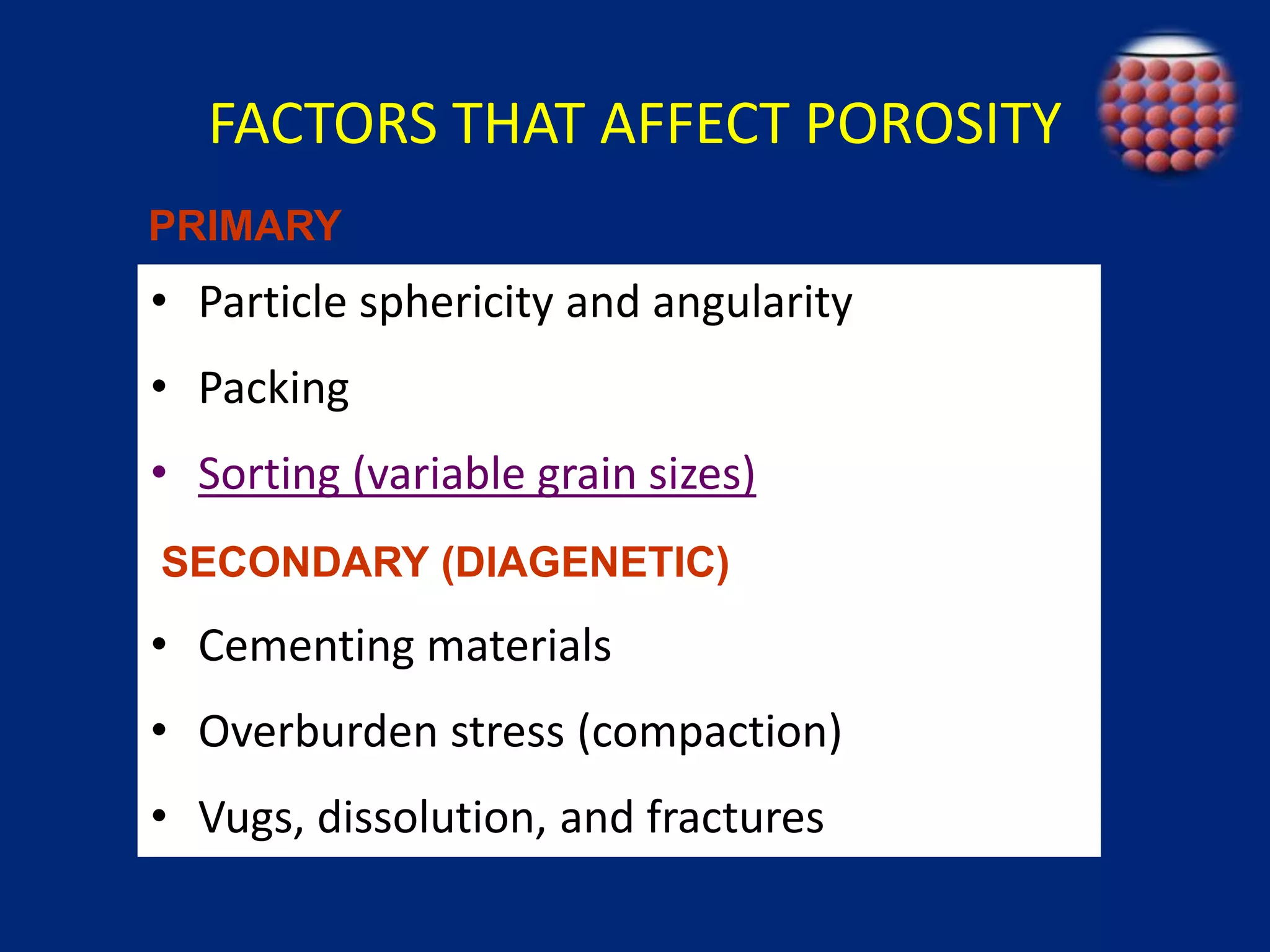
• Particle sphericity and angularity 
• Packing 
• Sorting (variable grain sizes) 
SECONDARY (DIAGENETIC) 
• Cementing materials 
• Overburden stress (compaction) 
• Vugs, dissolution, and fractures
Porosity Measurements 
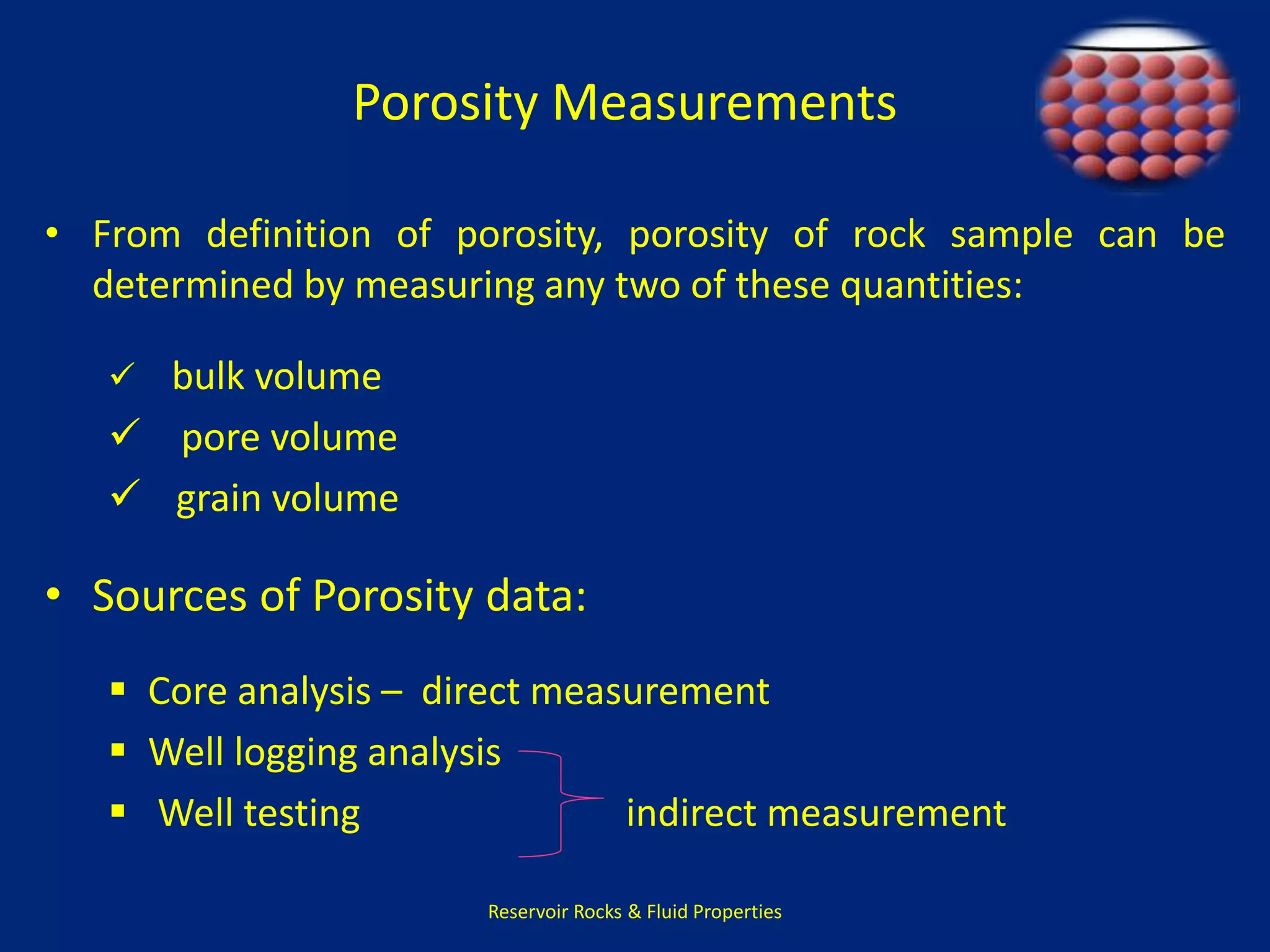
• From definition of porosity, porosity of rock sample can be 
determined by measuring any two of these quantities: 
 bulk volume 
 pore volume 
 grain volume 
• Sources of Porosity data: 
 Core analysis – direct measurement 
 Well logging analysis 
 Well testing indirect measurement 
Reservoir Rocks & Fluid Properties
Porosity 
• Porosity from loggings: 
 Sonic log 
t t  1   t   Dt = sonic travel time recorded by log 
m f Dtm = sonic travel time for the matrix 
mineral grains (w/o porosity), (55, 47 and 43 microsec/ft 
for quartz, limestone and dolomite, respectively) 
Dtf = sonic travel time for fluid in the 
pore space 
 = porosity, fraction 
Reservoir Rocks & Fluid Properties 
 Density log 
       b m f 1 b = bulk density recorded by log 
m = density of the matrix mineral grains (w/o porosity), 
(2.65, 2.71 and 2.87 gm/cc 
for quartz, limestone and dolomite, respectively) 
f = density of the fluid in the pore space
Determination of Porosity 
• Several methods: involves only the determination of two out of 3 
(Vp, Vm, & Vb) 
• Bulk volume by the following methods 
– Coated sample immersed in water, or 
– Water-saturated sample immersed in water, or 
– Dry sample immersed in Hg method (no more Hg in the labs) 
• Grain volume: by Melcher- Nutting method in which the sample is 
crushed and its volume measured with a pychnometer 
Reservoir Rocks & Fluid Properties
Laboratory Measurement of Porosity 
• Under laboratory the following are measured; 
• Vp, pore volume directly measured indirectly 
• Vb, bulk volume directly measured indirectly 
• Porosity measurement 
– Vb, bulk volume directly measured 
Reservoir Rocks & Fluid Properties 
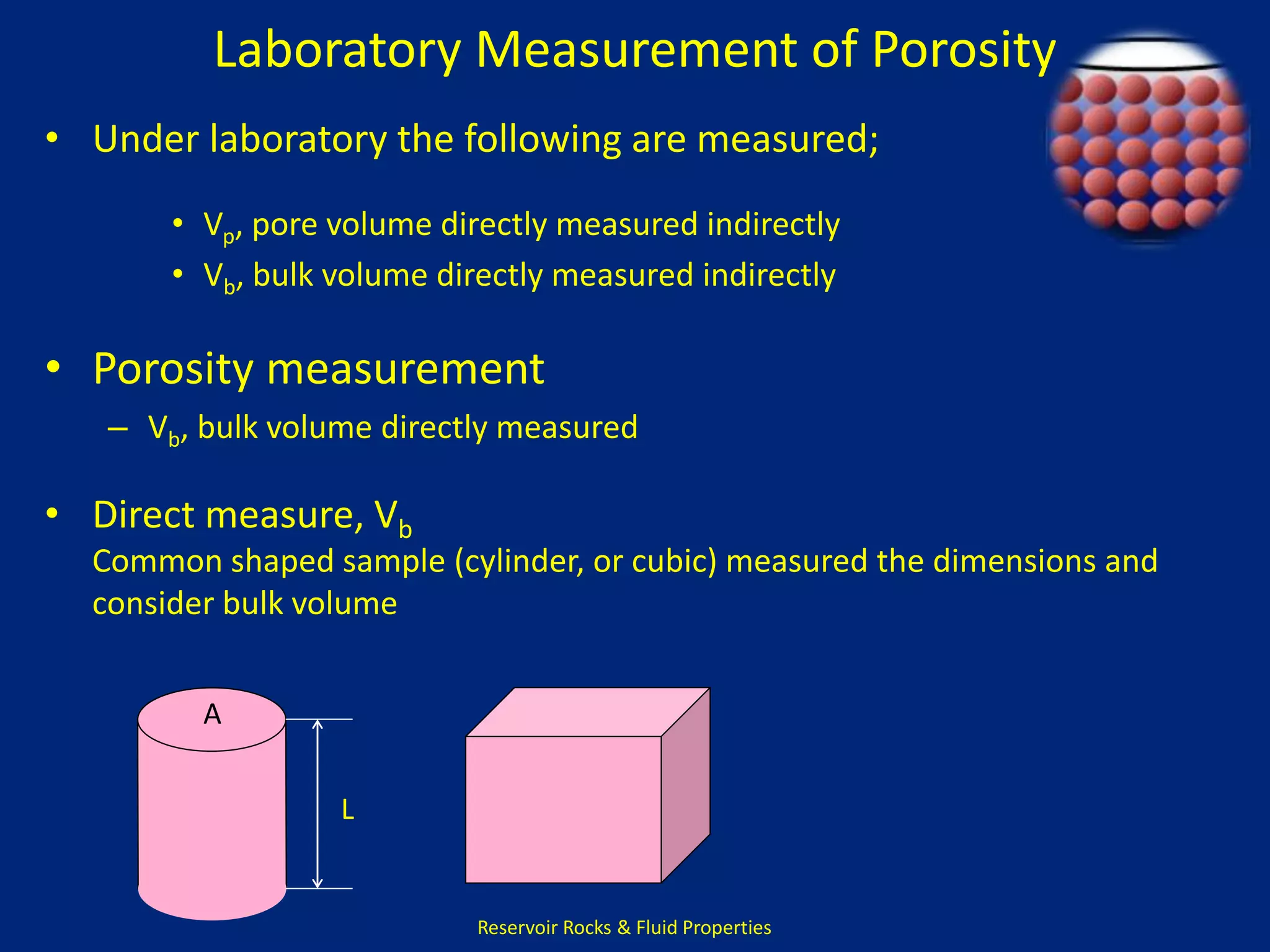
• Direct measure, Vb 
Common shaped sample (cylinder, or cubic) measured the dimensions and 
consider bulk volume 
A 
L
Porosity 
• Measurement of Vb, 
Irregular & regular sample shapes 
A 
L 
 Two means explained here; 
- volumes faulted (volumetrically) 
- methodologies gravity (gravimetrically) 
 To use above method must prevent fluid 
Reservoir Rocks & Fluid Properties 
penetration into the pore sample by: 
- coating with wax 
- saturating the core with same fluid 
- using mercury
Porosity 
• Measurement of Vb , 
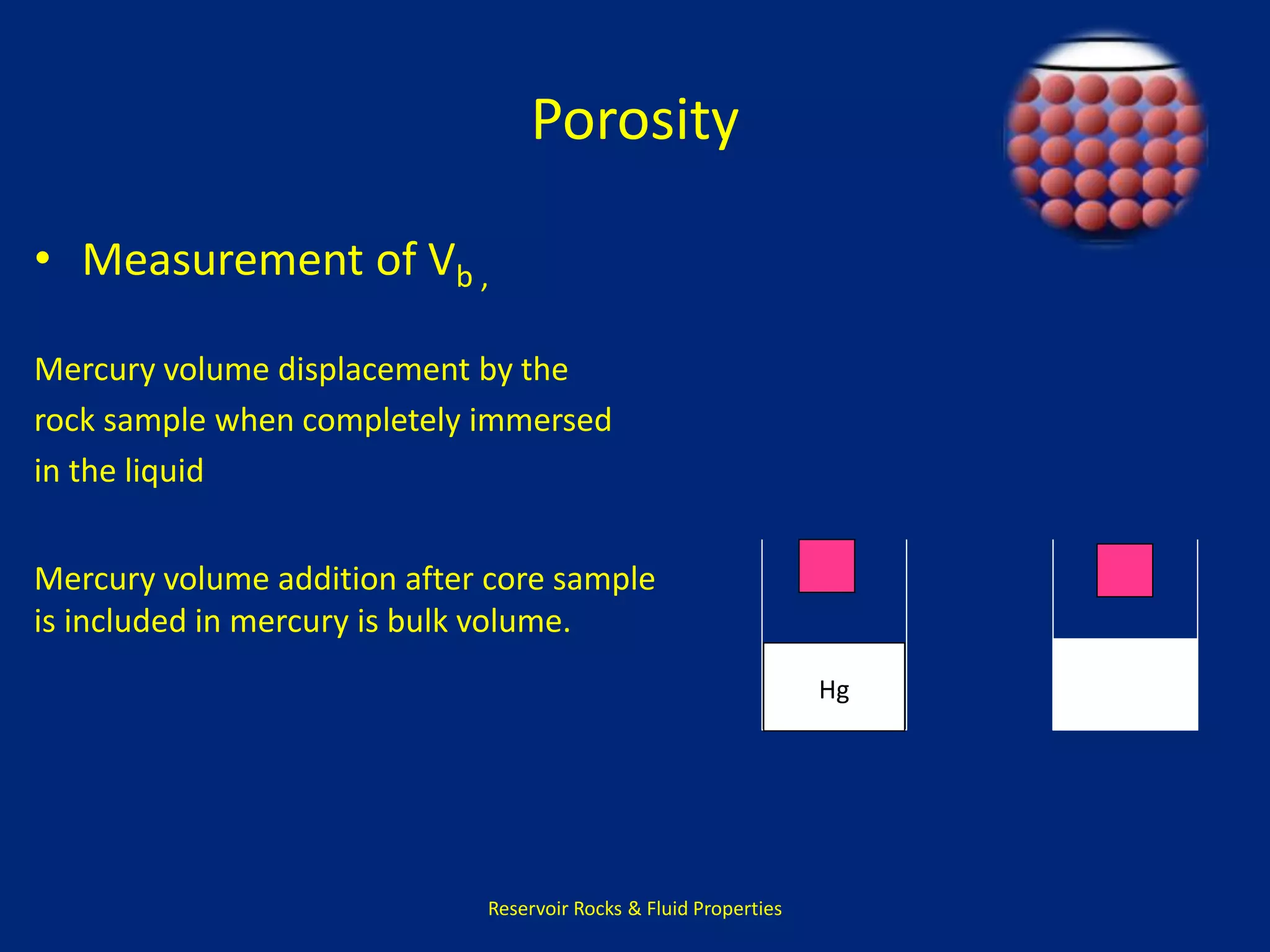
Mercury volume displacement by the 
rock sample when completely immersed 
in the liquid 
Reservoir Rocks & Fluid Properties 
Hg 
Mercury volume addition after core sample 
is included in mercury is bulk volume.
Porosity 
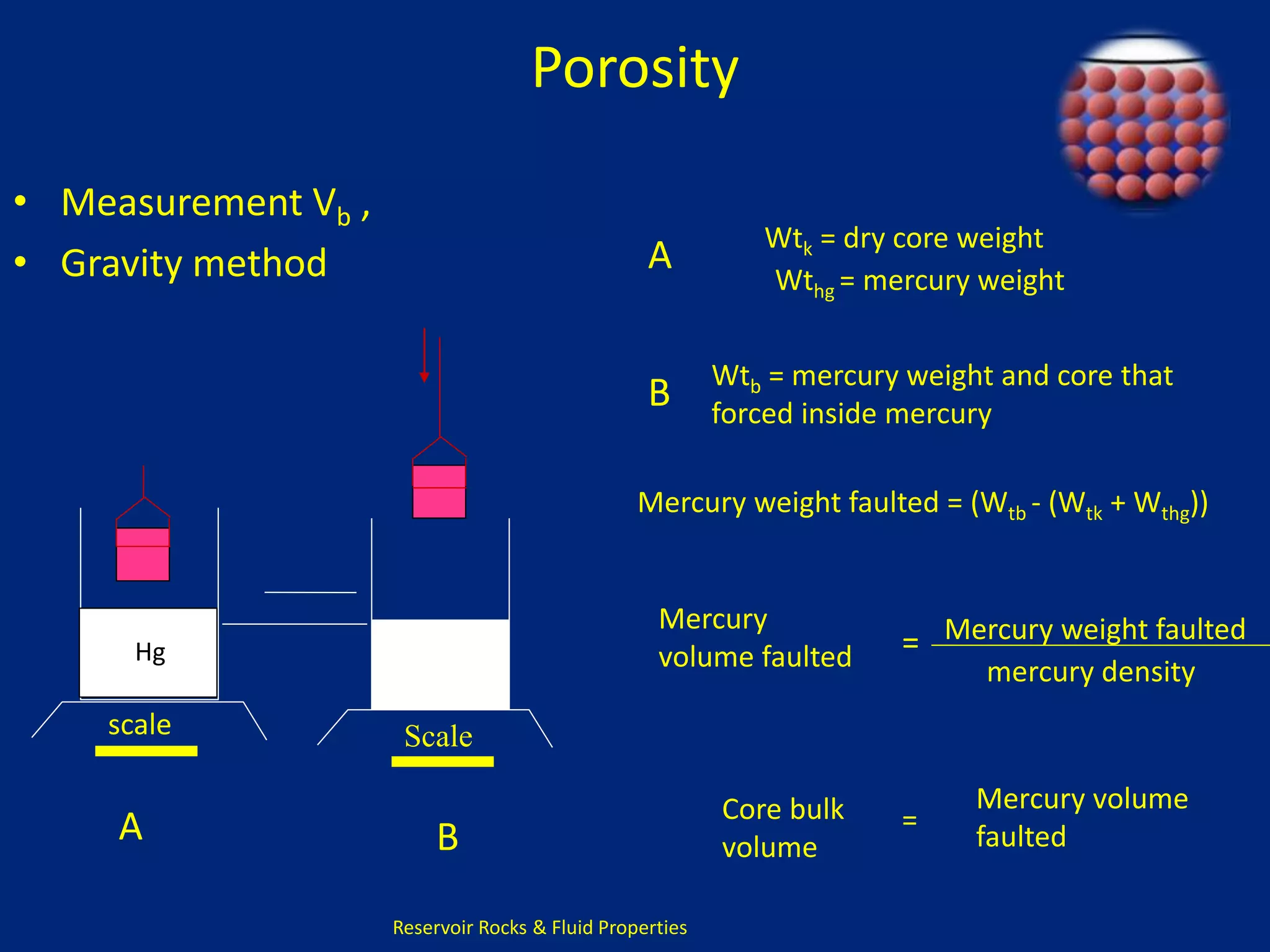
• Measurement Vb , 
• Gravity method 
Reservoir Rocks & Fluid Properties 
Hg 
scale Scale 
A B 
A Wtk = dry core weight 
Wthg = mercury weight 
B Wtb = mercury weight and core that 
forced inside mercury 
Mercury weight faulted = (Wtb - (Wtk + Wthg)) 
Mercury 
volume faulted = Mercury weight faulted 
mercury density 
Core bulk 
volume 
= 
Mercury volume 
faulted
Porosity 
 Porosity measurement 
• Vp, pore volume determination 
 Fluid saturation inside rock Wtk = dry sample weight 
Wtt = saturated sample weight fluid 
Wtf = fluid weight in pore 
Reservoir Rocks & Fluid Properties 
= Wtt - Wtk 
H Vp = (Wtt - Wtk)/f 2O
Porosity 
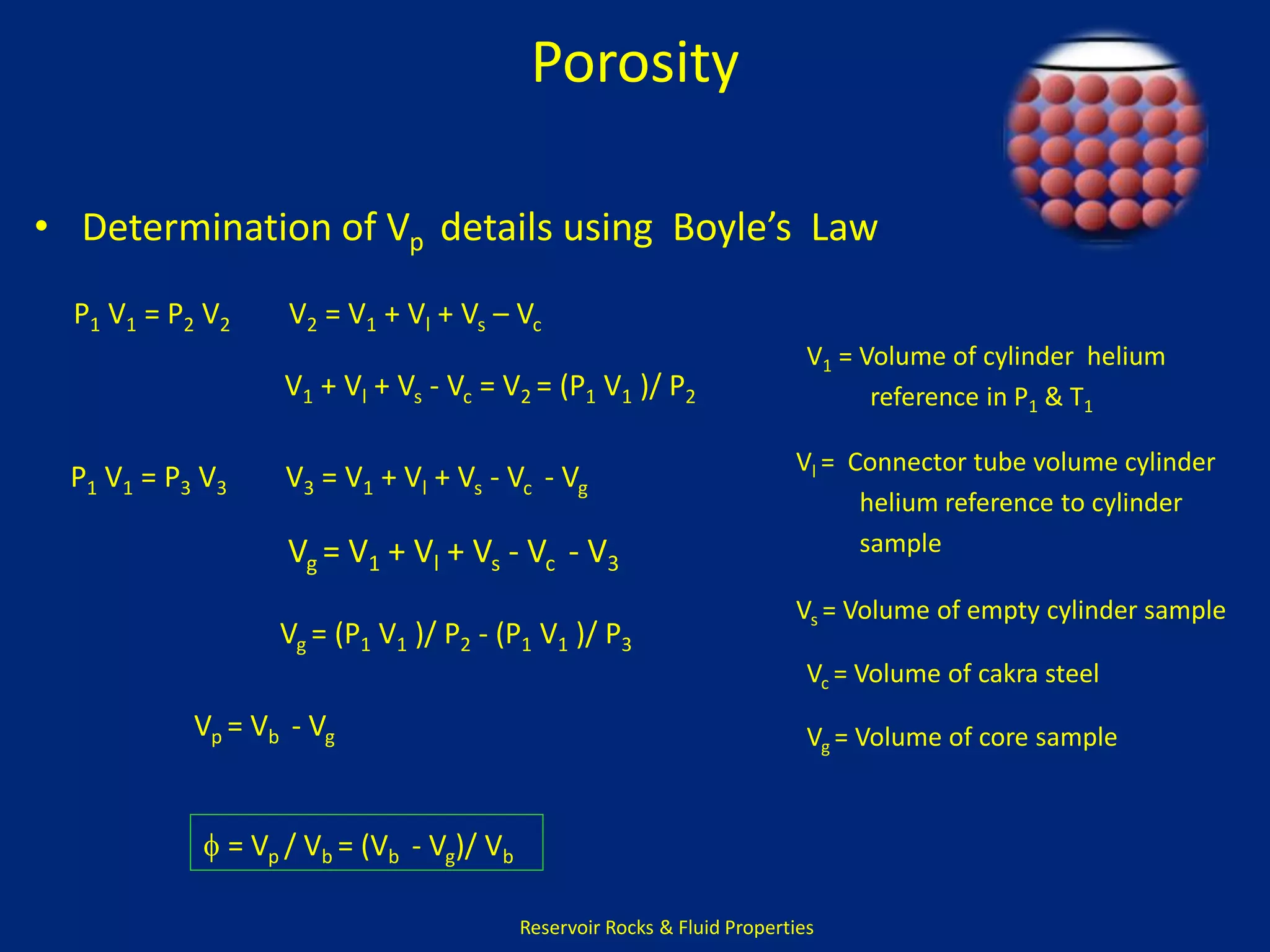
• Determination of Vp details using Boyle’s Law 
Reservoir Rocks & Fluid Properties 
Helium tank 
Cylinder 
sample 
steel 
line 
sample 
P3 V3 T1 
P1 V1 = P3 V3 
V3 = V1 + Vl + Vs -Vc - Vg 
P1 V1 T1
Porosity 
• Determination of Vp details using Boyle’s Law 
P1 V1 = P2 V2 V2 = V1 + Vl + Vs – Vc 
V1 + Vl + Vs - Vc = V2 = (P1 V1 )/ P2 
P1 V1 = P3 V3 V3 = V1 + Vl + Vs - Vc - Vg 
Vg = V1 + Vl + Vs - Vc - V3 
Vg = (P1 V1 )/ P2 - (P1 V1 )/ P3 
Vp = Vb - Vg 
Reservoir Rocks & Fluid Properties 
 = Vp / Vb = (Vb - Vg)/ Vb 
V1 = Volume of cylinder helium 
reference in P1 & T1 
Vl = Connector tube volume cylinder 
helium reference to cylinder 
sample 
Vs = Volume of empty cylinder sample 
Vc = Volume of cakra steel 
Vg = Volume of core sample
Uses of Porosity 
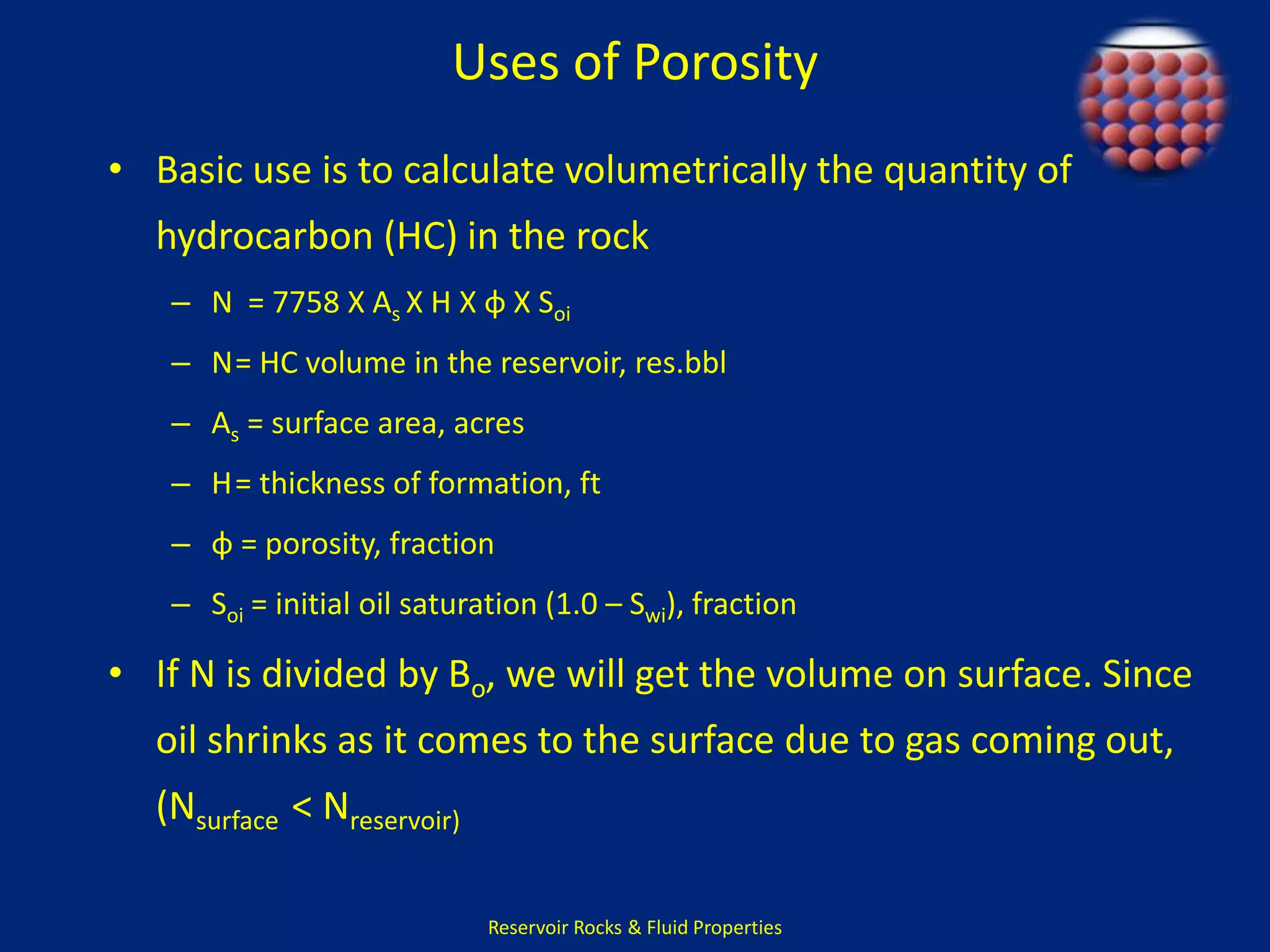
• Basic use is to calculate volumetrically the quantity of 
hydrocarbon (HC) in the rock 
– N = 7758 X As X H X φ X Soi 
– N= HC volume in the reservoir, res.bbl 
– As = surface area, acres 
– H= thickness of formation, ft 
– φ = porosity, fraction 
– Soi = initial oil saturation (1.0 – Swi), fraction 
• If N is divided by Bo, we will get the volume on surface. Since 
oil shrinks as it comes to the surface due to gas coming out, 
(Nsurface < Nreservoir) 
Reservoir Rocks & Fluid Properties
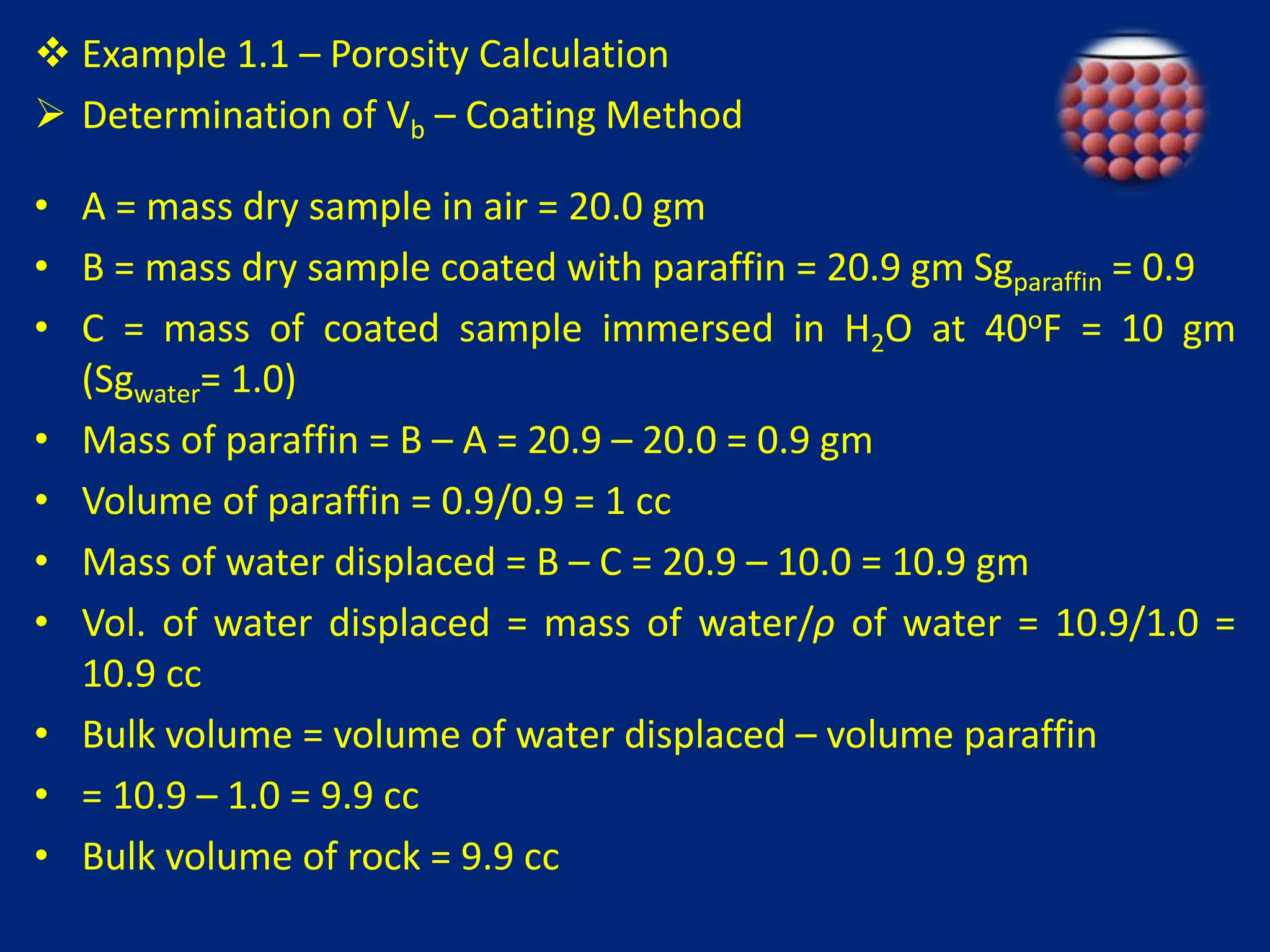
 Example 1.1 – Porosity Calculation 
 Determination of Vb – Coating Method 
• A = mass dry sample in air = 20.0 gm 
• B = mass dry sample coated with paraffin = 20.9 gm Sgparaffin = 0.9 
• C = mass of coated sample immersed in H2O at 40oF = 10 gm 
(Sgwater= 1.0) 
• Mass of paraffin = B – A = 20.9 – 20.0 = 0.9 gm 
• Volume of paraffin = 0.9/0.9 = 1 cc 
• Mass of water displaced = B – C = 20.9 – 10.0 = 10.9 gm 
• Vol. of water displaced = mass of water/ρ of water = 10.9/1.0 = 
10.9 cc 
• Bulk volume = volume of water displaced – volume paraffin 
• = 10.9 – 1.0 = 9.9 cc 
• Bulk volume of rock = 9.9 cc
 Example 1.2 – Porosity Calculation 
• From Example 1.1 
• Mass of dry sample in air = 20 gm 
• Bulk volume of sample = 9.9 cc 
• Grain volume of sample = (mass of dry sample in air)/ (sand-grain 
density) 
• = 20/2.67 = 7.5 cc 
• Total porosity = Øt = [(bulk vol. – grain vol.)/bulk volume] x 100 
• = [(9.9 – 7.5)/9.9] x 100 = 24.2 per cent
Example 3 
• A clean and dry core sample weighting 425g was 100% saturated 
with a 1.07 specific gravity brine. The new weight is 453g. The core 
sample is 12 cm long and 4 cm in diameter. Calculate the porosity of 
the rock sample. 
 SOLUTION: 
The bulk volume of the core sample is: 
Vb = π(r)2 (12) = 150.80 cm3 
The pore volume is: 
Vp = 1/џ (Vwet - Vdry) = 453 – 425 = 26.17 cm3 
1.07 
Reservoir Rocks & Fluid Properties
Cont… 
• Then; 
• Porosity of the core is: 
φ = Vp/Vb = 26.17 = 0.173 or 17.3% 
150.80 
Reservoir Rocks & Fluid Properties
Transform of lab porosity to formation porosity 
• φ =φ e−CPΔP 
• ΔP :effective overburden pressure change 
• P C :rock compressibility 
• φ:lab porosity 
Reservoir Rocks & Fluid Properties

Porosity

  • 1.
    Porosity • LearningOutcomes Reservoir Rocks & Fluid Properties
  • 2.
    Porosity of ReservoirRocks • Definition of Porosity • Classification of Porosity • Factors affecting Porosity • Applications of Porosity • Determination of Porosity Reservoir Rocks & Fluid Properties
  • 3.
    Porosity Definition: Measureof pore space in porous media. Packing Sorting Grain Shape High Low
  • 4.
    Reservoir Rocks &Fluid Properties
  • 5.
    • Rock reservoirhave pore that are connected and contain fluids (oil, gas, water) that can flow through the rock. • Reservoir rock looks solid to the naked eye, but a microscopic examination reveals the existence of tiny openings in the rock. • These spaces or tiny openings (typically up to 300 μm) in petroleum reservoir rocks are the one in which petroleum reservoir fluids are presents Reservoir Rocks & Fluid Properties 1 Porosity of Reservoir Rocks
  • 6.
    Definition of Porosity • Porosity(φ) : the ratio of the pore volume in a rock to the bulk volume of that rock. Express in per cent. Mathematical form is: φ = Vp/Vb Reservoir Rocks & Fluid Properties
  • 7.
    Porosity • Porosityis a measure of the void space in rock, hence, measures how much HC in rock • Porosity φ = Vp/Vb = (Vb-Vm)/Vb; Vb = Vp + Vm – theoretically, φ varies from 0% - 47.6% – In practice, φ varies between 3% and 37% • Porosity is a function of particle size distribution: – Framework materials (sandstone) – high φ – Interstitial materials (shaly-sand) – low φ Reservoir Rocks & Fluid Properties
  • 8.
    Classification of Porosity Porosity can be classified into; 1. Original porosity 2. Induced porosity • Original porosity (primary) is formed during the deposition of rock materials, e.g. porosity between granular in sandstone, porosity among crystal and oolitic in limestone • Induced porosity (secondary) is developed by some geological process on the deposited rock material. E.g; Fractures, or vugs cavity usual occur in limestone (chemical reaction b/w CaCO3 and MgCl2) Reservoir Rocks & Fluid Properties
  • 9.
    Porosity Sand grain Cement material Effective / connected porosity (25%) Ineffective Porosity (5%) Total Porosity (30%) Reservoir Rocks & Fluid Properties Deadend or cul-de- sac pore
  • 10.
    Types of Porosity • 3 kinds porosity includes: – Effective porosity – Ineffective/ Isolated porosity – Total porosity • Effective porosity is the measure of the void space that is filled by recoverable oil and gas; or the amount of pore space that is sufficiently interconnected to yield its oil & gas for recovery. • φ = Vol. of interconnected pores + Vol. of deadend Total or bulk vol. of reservoir rock Reservoir Rocks & Fluid Properties
  • 11.
    PORE-SPACE CLASSIFICATION •Total porosity, t = • Effective porosity, e = Total Pore Volume Bulk Volume Interconnected Pore Space Bulk Volume • Effective porosity – of great importance; contains the mobile fluid
  • 12.
    COMPARISON OF TOTALAND EFFECTIVE POROSITIES • Very clean sandstones : e  t • Poorly to moderately well -cemented intergranular materials: t  e • Highly cemented materials and most carbonates: e < t
  • 13.
    Types of Porosity • Ineffective porosity is the ratio of the volume of isolated or completely disconnected pores to the total or bulk volume • φ = Vol. of completely disconnected pores Total or bulk volume • Total or absolute porosity is the ratio of the entire void spaces in the reservoir rock to the bulk volume of the rock • φ = Vol. of interconnected + Vol. of deadend or cul-de-sac pores + Vol. of isolated pore Total or bilk volume Reservoir Rocks & Fluid Properties
  • 14.
    Applications of Porosity • What is the significance Porosity in engineering reservoir? • From the reservoir engineering point of view, porosity is probably one of the most important reservoir rock properties and its quantitative value is used in all reservoir engineering calculations ‘cos it represents the pore spaces that’s occupied by mobile fluids. • For common reservoir rock types, under average operating conditions, porosity values ranges; Porosity % 25~20 20~15 15~10 10~5 5~0 Reservoir Rocks & Fluid Properties Grade Very good good moderate poor no value Evaluating formation
  • 15.
    Applications of Porosity Porosity data are used in these basic reservoir evaluations: 1. Volumetric calculation of fluids in the reservoir 2.Calculation of fluid saturations 3.Geological characterization of the reservoir  Calculating hydrocarbon in a reservoir  HCPV = Area x Thickness x φ x (1 – Sw)  where: A = surface area of the reservoir  h = thickness of the formation  φ = porosity  Swi= the percent of the pore volume  occupied by the water Reservoir Rocks & Fluid Properties
  • 16.
    Various packing ofspheres: cubic & rhombohedral Reservoir Rocks & Fluid Properties cubic packing of spheres resulting in a least-compact arrangement with a porosity of 47.64% Rhombohedral packing of spheres resulting in a most-compact arrangement with a porosity of 26% Spherical size variation influences type & volume of solid porosity Porosity 36% Porosity 20% Effect of cement material
  • 17.
    FACTORS THAT AFFECTPOROSITY PRIMARY • Particle sphericity and angularity • Packing • Sorting (variable grain sizes) SECONDARY (DIAGENETIC) • Cementing materials • Overburden stress (compaction) • Vugs, dissolution, and fractures
  • 18.
    Porosity Measurements •From definition of porosity, porosity of rock sample can be determined by measuring any two of these quantities:  bulk volume  pore volume  grain volume • Sources of Porosity data:  Core analysis – direct measurement  Well logging analysis  Well testing indirect measurement Reservoir Rocks & Fluid Properties
  • 19.
    Porosity • Porosityfrom loggings:  Sonic log t t  1   t   Dt = sonic travel time recorded by log m f Dtm = sonic travel time for the matrix mineral grains (w/o porosity), (55, 47 and 43 microsec/ft for quartz, limestone and dolomite, respectively) Dtf = sonic travel time for fluid in the pore space  = porosity, fraction Reservoir Rocks & Fluid Properties  Density log        b m f 1 b = bulk density recorded by log m = density of the matrix mineral grains (w/o porosity), (2.65, 2.71 and 2.87 gm/cc for quartz, limestone and dolomite, respectively) f = density of the fluid in the pore space
  • 20.
    Determination of Porosity • Several methods: involves only the determination of two out of 3 (Vp, Vm, & Vb) • Bulk volume by the following methods – Coated sample immersed in water, or – Water-saturated sample immersed in water, or – Dry sample immersed in Hg method (no more Hg in the labs) • Grain volume: by Melcher- Nutting method in which the sample is crushed and its volume measured with a pychnometer Reservoir Rocks & Fluid Properties
  • 21.
    Laboratory Measurement ofPorosity • Under laboratory the following are measured; • Vp, pore volume directly measured indirectly • Vb, bulk volume directly measured indirectly • Porosity measurement – Vb, bulk volume directly measured Reservoir Rocks & Fluid Properties • Direct measure, Vb Common shaped sample (cylinder, or cubic) measured the dimensions and consider bulk volume A L
  • 22.
    Porosity • Measurementof Vb, Irregular & regular sample shapes A L  Two means explained here; - volumes faulted (volumetrically) - methodologies gravity (gravimetrically)  To use above method must prevent fluid Reservoir Rocks & Fluid Properties penetration into the pore sample by: - coating with wax - saturating the core with same fluid - using mercury
  • 23.
    Porosity • Measurementof Vb , Mercury volume displacement by the rock sample when completely immersed in the liquid Reservoir Rocks & Fluid Properties Hg Mercury volume addition after core sample is included in mercury is bulk volume.
  • 24.
    Porosity • MeasurementVb , • Gravity method Reservoir Rocks & Fluid Properties Hg scale Scale A B A Wtk = dry core weight Wthg = mercury weight B Wtb = mercury weight and core that forced inside mercury Mercury weight faulted = (Wtb - (Wtk + Wthg)) Mercury volume faulted = Mercury weight faulted mercury density Core bulk volume = Mercury volume faulted
  • 25.
    Porosity  Porositymeasurement • Vp, pore volume determination  Fluid saturation inside rock Wtk = dry sample weight Wtt = saturated sample weight fluid Wtf = fluid weight in pore Reservoir Rocks & Fluid Properties = Wtt - Wtk H Vp = (Wtt - Wtk)/f 2O
  • 26.
    Porosity • Determinationof Vp details using Boyle’s Law Reservoir Rocks & Fluid Properties Helium tank Cylinder sample steel line sample P3 V3 T1 P1 V1 = P3 V3 V3 = V1 + Vl + Vs -Vc - Vg P1 V1 T1
  • 27.
    Porosity • Determinationof Vp details using Boyle’s Law P1 V1 = P2 V2 V2 = V1 + Vl + Vs – Vc V1 + Vl + Vs - Vc = V2 = (P1 V1 )/ P2 P1 V1 = P3 V3 V3 = V1 + Vl + Vs - Vc - Vg Vg = V1 + Vl + Vs - Vc - V3 Vg = (P1 V1 )/ P2 - (P1 V1 )/ P3 Vp = Vb - Vg Reservoir Rocks & Fluid Properties  = Vp / Vb = (Vb - Vg)/ Vb V1 = Volume of cylinder helium reference in P1 & T1 Vl = Connector tube volume cylinder helium reference to cylinder sample Vs = Volume of empty cylinder sample Vc = Volume of cakra steel Vg = Volume of core sample
  • 28.
    Uses of Porosity • Basic use is to calculate volumetrically the quantity of hydrocarbon (HC) in the rock – N = 7758 X As X H X φ X Soi – N= HC volume in the reservoir, res.bbl – As = surface area, acres – H= thickness of formation, ft – φ = porosity, fraction – Soi = initial oil saturation (1.0 – Swi), fraction • If N is divided by Bo, we will get the volume on surface. Since oil shrinks as it comes to the surface due to gas coming out, (Nsurface < Nreservoir) Reservoir Rocks & Fluid Properties
  • 29.
     Example 1.1– Porosity Calculation  Determination of Vb – Coating Method • A = mass dry sample in air = 20.0 gm • B = mass dry sample coated with paraffin = 20.9 gm Sgparaffin = 0.9 • C = mass of coated sample immersed in H2O at 40oF = 10 gm (Sgwater= 1.0) • Mass of paraffin = B – A = 20.9 – 20.0 = 0.9 gm • Volume of paraffin = 0.9/0.9 = 1 cc • Mass of water displaced = B – C = 20.9 – 10.0 = 10.9 gm • Vol. of water displaced = mass of water/ρ of water = 10.9/1.0 = 10.9 cc • Bulk volume = volume of water displaced – volume paraffin • = 10.9 – 1.0 = 9.9 cc • Bulk volume of rock = 9.9 cc
  • 30.
     Example 1.2– Porosity Calculation • From Example 1.1 • Mass of dry sample in air = 20 gm • Bulk volume of sample = 9.9 cc • Grain volume of sample = (mass of dry sample in air)/ (sand-grain density) • = 20/2.67 = 7.5 cc • Total porosity = Øt = [(bulk vol. – grain vol.)/bulk volume] x 100 • = [(9.9 – 7.5)/9.9] x 100 = 24.2 per cent
  • 31.
    Example 3 •A clean and dry core sample weighting 425g was 100% saturated with a 1.07 specific gravity brine. The new weight is 453g. The core sample is 12 cm long and 4 cm in diameter. Calculate the porosity of the rock sample.  SOLUTION: The bulk volume of the core sample is: Vb = π(r)2 (12) = 150.80 cm3 The pore volume is: Vp = 1/џ (Vwet - Vdry) = 453 – 425 = 26.17 cm3 1.07 Reservoir Rocks & Fluid Properties
  • 32.
    Cont… • Then; • Porosity of the core is: φ = Vp/Vb = 26.17 = 0.173 or 17.3% 150.80 Reservoir Rocks & Fluid Properties
  • 33.
    Transform of labporosity to formation porosity • φ =φ e−CPΔP • ΔP :effective overburden pressure change • P C :rock compressibility • φ:lab porosity Reservoir Rocks & Fluid Properties