POROSITY
Ahmed Ibrahim Elaraby
CONTENT
• What is Porosity?
• How To Measure Porosity?
• Classification of Porosity
• Example
• Reference
2
What is Porosity?
• Porosity is one of rock important rock properties and it is a measure of pore space in a rock.
• Figure 1 shows the illustration of porosity and it can be seen that grain size and distribution can
affect porosity of rock
3
What is Porosity?
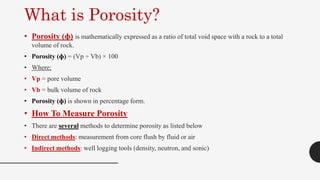
• Porosity (ɸ) is mathematically expressed as a ratio of total void space with a rock to a total
volume of rock.
• Porosity (ɸ) = (Vp ÷ Vb) × 100
• Where;
• Vp = pore volume
• Vb = bulk volume of rock
• Porosity (ɸ) is shown in percentage form.
• How To Measure Porosity
• There are several methods to determine porosity as listed below
• Direct methods: measurement from core flush by fluid or air
• Indirect methods: well logging tools (density, neutron, and sonic)
4
Classification of Porosity
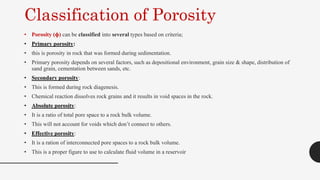
• Porosity (ɸ) can be classified into several types based on criteria;
• Primary porosity:
• this is porosity in rock that was formed during sedimentation.
• Primary porosity depends on several factors, such as depositional environment, grain size & shape, distribution of
sand grain, cementation between sands, etc.
• Secondary porosity:
• This is formed during rock diagenesis.
• Chemical reaction dissolves rock grains and it results in void spaces in the rock.
• Absolute porosity:
• It is a ratio of total pore space to a rock bulk volume.
• This will not account for voids which don’t connect to others.
• Effective porosity:
• It is a ration of interconnected pore spaces to a rock bulk volume.
• This is a proper figure to use to calculate fluid volume in a reservoir
5
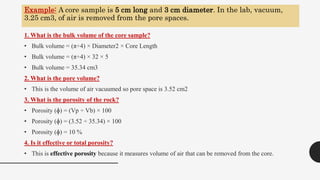
Example: A core sample is 5 cm long and 3 cm diameter. In the lab, vacuum,
3.25 cm3, of air is removed from the pore spaces.
1. What is the bulk volume of the core sample?
• Bulk volume = (π÷4) × Diameter2 × Core Length
• Bulk volume = (π÷4) × 32 × 5
• Bulk volume = 35.34 cm3
2. What is the pore volume?
• This is the volume of air vacuumed so pore space is 3.52 cm2
3. What is the porosity of the rock?
• Porosity (ɸ) = (Vp ÷ Vb) × 100
• Porosity (ɸ) = (3.52 ÷ 35.34) × 100
• Porosity (ɸ) = 10 %
4. Is it effective or total porosity?
• This is effective porosity because it measures volume of air that can be removed from the core.
6
References
• Abhijit Y. Dandekar, 2013. Petroleum Reservoir Rock and Fluid Properties, Second Edition. 2
Edition. CRC Press.
• L.P. Dake, 1983. Fundamentals of Reservoir Engineering, Volume 8 (Developments in Petroleum
Science). New impression Edition. Elsevier Science.
• Tarek Ahmed PhD PE, 2011. Advanced Reservoir Management and Engineering, Second Edition.
2 Edition. Gulf Professional Publishing.
7
8

Porosity

  • 1.
  • 2.
    CONTENT • What isPorosity? • How To Measure Porosity? • Classification of Porosity • Example • Reference 2
  • 3.
    What is Porosity? •Porosity is one of rock important rock properties and it is a measure of pore space in a rock. • Figure 1 shows the illustration of porosity and it can be seen that grain size and distribution can affect porosity of rock 3
  • 4.
    What is Porosity? •Porosity (ɸ) is mathematically expressed as a ratio of total void space with a rock to a total volume of rock. • Porosity (ɸ) = (Vp ÷ Vb) × 100 • Where; • Vp = pore volume • Vb = bulk volume of rock • Porosity (ɸ) is shown in percentage form. • How To Measure Porosity • There are several methods to determine porosity as listed below • Direct methods: measurement from core flush by fluid or air • Indirect methods: well logging tools (density, neutron, and sonic) 4
  • 5.
    Classification of Porosity •Porosity (ɸ) can be classified into several types based on criteria; • Primary porosity: • this is porosity in rock that was formed during sedimentation. • Primary porosity depends on several factors, such as depositional environment, grain size & shape, distribution of sand grain, cementation between sands, etc. • Secondary porosity: • This is formed during rock diagenesis. • Chemical reaction dissolves rock grains and it results in void spaces in the rock. • Absolute porosity: • It is a ratio of total pore space to a rock bulk volume. • This will not account for voids which don’t connect to others. • Effective porosity: • It is a ration of interconnected pore spaces to a rock bulk volume. • This is a proper figure to use to calculate fluid volume in a reservoir 5
  • 6.
    Example: A coresample is 5 cm long and 3 cm diameter. In the lab, vacuum, 3.25 cm3, of air is removed from the pore spaces. 1. What is the bulk volume of the core sample? • Bulk volume = (π÷4) × Diameter2 × Core Length • Bulk volume = (π÷4) × 32 × 5 • Bulk volume = 35.34 cm3 2. What is the pore volume? • This is the volume of air vacuumed so pore space is 3.52 cm2 3. What is the porosity of the rock? • Porosity (ɸ) = (Vp ÷ Vb) × 100 • Porosity (ɸ) = (3.52 ÷ 35.34) × 100 • Porosity (ɸ) = 10 % 4. Is it effective or total porosity? • This is effective porosity because it measures volume of air that can be removed from the core. 6
  • 7.
    References • Abhijit Y.Dandekar, 2013. Petroleum Reservoir Rock and Fluid Properties, Second Edition. 2 Edition. CRC Press. • L.P. Dake, 1983. Fundamentals of Reservoir Engineering, Volume 8 (Developments in Petroleum Science). New impression Edition. Elsevier Science. • Tarek Ahmed PhD PE, 2011. Advanced Reservoir Management and Engineering, Second Edition. 2 Edition. Gulf Professional Publishing. 7
  • 8.