CHARITY CAMPAIGNS
Audience
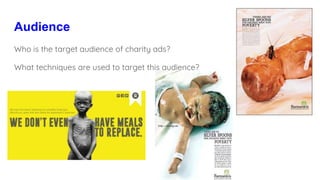
Who is the target audience of charity ads?
What techniques are used to target this audience?
Desensitisation
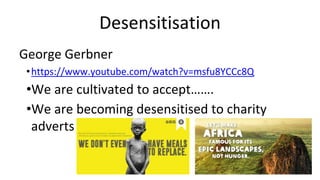
George Gerbner
•https://www.youtube.com/watch?v=msfu8YCCc8Q
•We are cultivated to accept…….
•We are becoming desensitised to charity
adverts
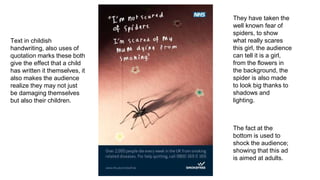
Text in childish
handwriting, also uses of
quotation marks these both
give the effect that a child
has written it themselves, it
also makes the audience
realize they may not just
be damaging themselves
but also their children.
The fact at the
bottom is used to
shock the audience;
showing that this ad
is aimed at adults.
They have taken the
well known fear of
spiders, to show
what really scares
this girl, the audience
can tell it is a girl,
from the flowers in
the background, the
spider is also made
to look big thanks to
shadows and
lighting.
Shelter
Shelter
●What does Shelter do?
https://www.youtube.com/watch?v=8kyb0dh
W5ss
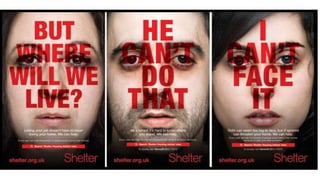
Context: Shelter’s 2011 campaign
Founded in 1966 in London. Ken Loach’s Cathy Come Home was pivotal in
establishment of the charity. https://www.youtube.com/watch?v=xky8ZqhNAlo
Aims to help people with homelessness and bad housing. Gives advice and lobbies
government to make changes to improve housing.
Campaign launched in 2011 to encourage people at risk of losing their home to
ask for advice earlier
Main focus of campaign is poster ads, but FB and mobile messaging also used
The poster campaign initially launched in four towns identified as hotspots for
housing problems, and ran from 21 August for six weeks.
Discuss
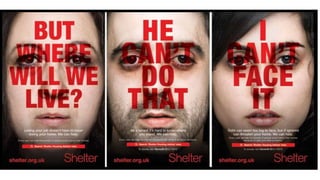
Shelter’s campaign was created by Amplify on a pro bono basis. Jonathan Emmins, founder of
Amplify said:
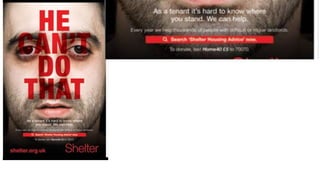
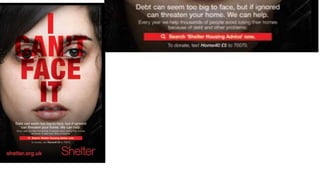
“It was crucial to us that the creative had the ability to shock and stand out but without resorting to
gimmicks. We wanted people to empathise, to never lose sight of the real people, the real faces
impacted by the current economic and housing situation.”
Purpose:
To campaign
To provide information
Aims:
The aims of this campaign is to raise awareness of homelessness arising in todays society, especially with the
recession and the current climate, which is relatable to many people in todays society because it coincides with the
issues of debt which people are faced with.
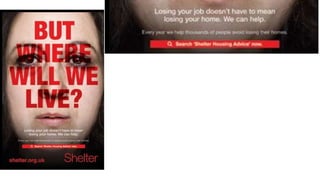
Some of slogans used to really catch to eye of the reader include; ‘but where will we live?’ this is a good clear
message which gets the information across in a direct manner as this could happen to anyone down to their job or
living accommodation.
Analyse the ad
●1. what is the aim of the ad?
●2. what messages are being communicated? (How is this communicated via
media language)
●3. what does Shelter value? (How is this communicated via media language)
●4. who is represented and how is this constructed? (age, race, class, issues)
Annotate analysing colour scheme, copy, font, tone, images
Social Context: Social Anxieties
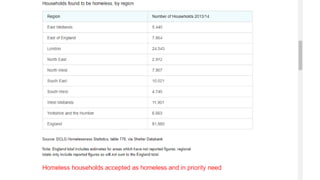
●How many households are homeless? (2013-2014)
●In the East Midlands?
●In London?
●In England?
●https://www.theguardian.com/society/2017/nov/08/one-in-every-200-
people-in-uk-are-homeless-according-to-shelter
Social Context
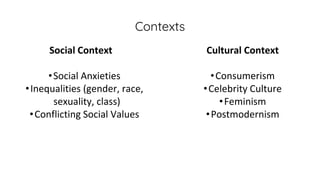
Contexts
Social Context
•Social Anxieties
•Inequalities (gender, race,
sexuality, class)
•Conflicting Social Values
Cultural Context
•Consumerism
•Celebrity Culture
•Feminism
•Postmodernism
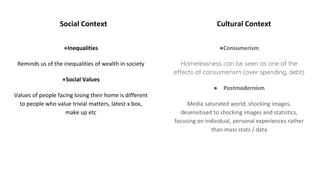
Social Context Cultural Context
●Inequalities
Reminds us of the inequalities of wealth in society
●Social Values
Values of people facing losing their home is different
to people who value trivial matters, latest x box,
make up etc
●Consumerism
Homelessness can be seen as one of the
effects of consumerism (over spending, debt)
● Postmodernism
Media saturated world, shocking images,
desensitised to shocking images and statistics,
focusing on individual, personal experiences rather
than mass stats / data
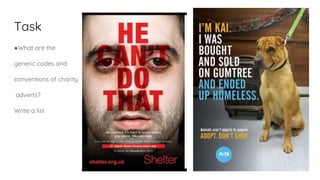
Task
●What are the
generic codes and
conventions of charity
adverts?
Write a list
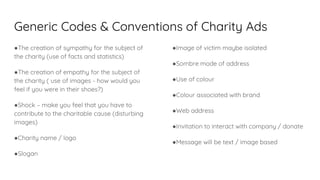
Generic Codes & Conventions of Charity Ads
●The creation of sympathy for the subject of
the charity (use of facts and statistics)
●The creation of empathy for the subject of
the charity ( use of images - how would you
feel if you were in their shoes?)
●Shock – make you feel that you have to
contribute to the charitable cause (disturbing
images)
●Charity name / logo
●Slogan
●Image of victim maybe isolated
●Sombre mode of address
●Use of colour
●Colour associated with brand
●Web address
●Invitation to interact with company / donate
●Message will be text / image based
TASK
Create your own Print Charity ad.

Shelter

  • 1.
  • 2.
    Audience Who is thetarget audience of charity ads? What techniques are used to target this audience?
  • 3.
    Desensitisation George Gerbner •https://www.youtube.com/watch?v=msfu8YCCc8Q •We arecultivated to accept……. •We are becoming desensitised to charity adverts
  • 4.
    Text in childish handwriting,also uses of quotation marks these both give the effect that a child has written it themselves, it also makes the audience realize they may not just be damaging themselves but also their children. The fact at the bottom is used to shock the audience; showing that this ad is aimed at adults. They have taken the well known fear of spiders, to show what really scares this girl, the audience can tell it is a girl, from the flowers in the background, the spider is also made to look big thanks to shadows and lighting.
  • 5.
  • 6.
    Shelter ●What does Shelterdo? https://www.youtube.com/watch?v=8kyb0dh W5ss
  • 7.
    Context: Shelter’s 2011campaign Founded in 1966 in London. Ken Loach’s Cathy Come Home was pivotal in establishment of the charity. https://www.youtube.com/watch?v=xky8ZqhNAlo Aims to help people with homelessness and bad housing. Gives advice and lobbies government to make changes to improve housing. Campaign launched in 2011 to encourage people at risk of losing their home to ask for advice earlier Main focus of campaign is poster ads, but FB and mobile messaging also used The poster campaign initially launched in four towns identified as hotspots for housing problems, and ran from 21 August for six weeks.
  • 8.
    Discuss Shelter’s campaign wascreated by Amplify on a pro bono basis. Jonathan Emmins, founder of Amplify said: “It was crucial to us that the creative had the ability to shock and stand out but without resorting to gimmicks. We wanted people to empathise, to never lose sight of the real people, the real faces impacted by the current economic and housing situation.” Purpose: To campaign To provide information Aims: The aims of this campaign is to raise awareness of homelessness arising in todays society, especially with the recession and the current climate, which is relatable to many people in todays society because it coincides with the issues of debt which people are faced with. Some of slogans used to really catch to eye of the reader include; ‘but where will we live?’ this is a good clear message which gets the information across in a direct manner as this could happen to anyone down to their job or living accommodation.
  • 13.
    Analyse the ad ●1.what is the aim of the ad? ●2. what messages are being communicated? (How is this communicated via media language) ●3. what does Shelter value? (How is this communicated via media language) ●4. who is represented and how is this constructed? (age, race, class, issues) Annotate analysing colour scheme, copy, font, tone, images
  • 15.
    Social Context: SocialAnxieties ●How many households are homeless? (2013-2014) ●In the East Midlands? ●In London? ●In England? ●https://www.theguardian.com/society/2017/nov/08/one-in-every-200- people-in-uk-are-homeless-according-to-shelter
  • 16.
  • 17.
    Contexts Social Context •Social Anxieties •Inequalities(gender, race, sexuality, class) •Conflicting Social Values Cultural Context •Consumerism •Celebrity Culture •Feminism •Postmodernism
  • 18.
    Social Context CulturalContext ●Inequalities Reminds us of the inequalities of wealth in society ●Social Values Values of people facing losing their home is different to people who value trivial matters, latest x box, make up etc ●Consumerism Homelessness can be seen as one of the effects of consumerism (over spending, debt) ● Postmodernism Media saturated world, shocking images, desensitised to shocking images and statistics, focusing on individual, personal experiences rather than mass stats / data
  • 19.
    Task ●What are the genericcodes and conventions of charity adverts? Write a list
  • 20.
    Generic Codes &Conventions of Charity Ads ●The creation of sympathy for the subject of the charity (use of facts and statistics) ●The creation of empathy for the subject of the charity ( use of images - how would you feel if you were in their shoes?) ●Shock – make you feel that you have to contribute to the charitable cause (disturbing images) ●Charity name / logo ●Slogan ●Image of victim maybe isolated ●Sombre mode of address ●Use of colour ●Colour associated with brand ●Web address ●Invitation to interact with company / donate ●Message will be text / image based
  • 21.
    TASK Create your ownPrint Charity ad.