Submitted to:
Dr. Golya naik sir
Dept. of Extension
College of sericulture,
Chintamani.
Submitted by:
jyothi P
ALC3021, III BSc(agri)
College of sericulture,
Chintamani.
Introduction
• A programme means a prospectus or a
statement issued to promote understanding and
interest in an enterprise.
• Planning is a process, which involves
studying the past, and present in order to
forecast the future and in the light of that
forecast determining the goals to be achieved
and what must be done to reach them.
• Extension Programme is a statement of
situation, objectives, problems and solutions.
• Programme Planning is a decision making
process involving critical analysis of the
existing situation and the problems, evaluation
of the various alternatives to solve these
problems and the selection of the relevant
ones, giving necessary priorities based upon
local needs and resources by the cooperative
efforts of the people both official and non-
official with a view to facilitate the individual
and community growth and development.
Definitions .
• Leagans (1961) says that an "extension
programme" is a set of clearly defined,
consciously conceived objectives or ends,
derived from an adequate analysis of the
situation, which are to be achieved through
extension teaching activity.
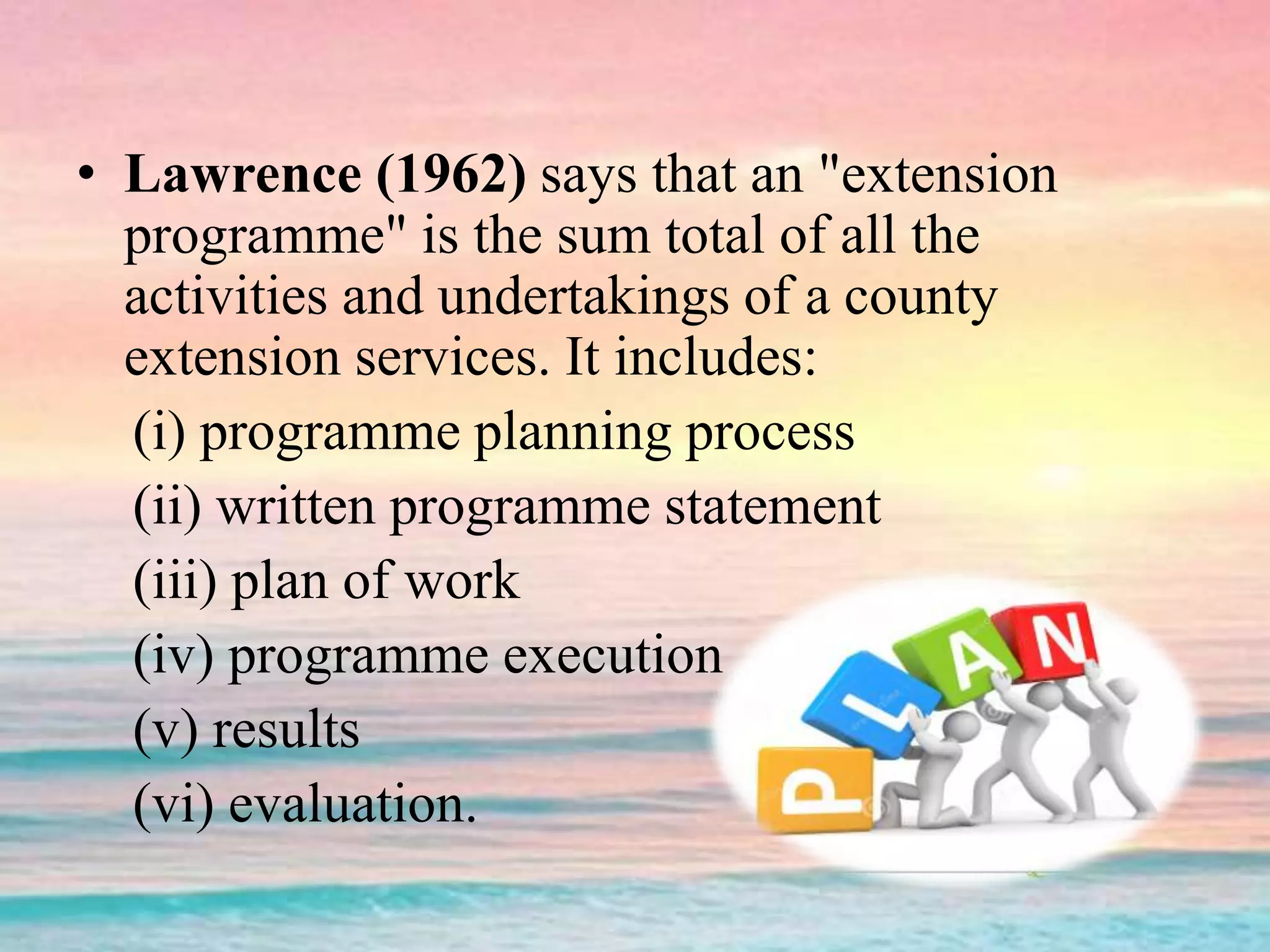
• Lawrence (1962) says that an "extension
programme" is the sum total of all the
activities and undertakings of a county
extension services. It includes:
(i) programme planning process
(ii) written programme statement
(iii) plan of work
(iv) programme execution
(v) results
(vi) evaluation.
Assumptions on Extension Planning
• The concept of extension planning is based on
a number of assumptions.
• Boyle (1965) has listed the following
assumptions in this regard.
i. Planning change is a necessary pre-requisite
to effective social progress for people and
communities.
ii. The most desirable change is pre-determined
and democratically achieved.
ii. Extension education programmes, if properly
planned and implemented, can make a
significant contribution to planned change.
iii. It is possible to select, organize and
administer a programme that will contribute
to the social and economic progress of
people.
iv. People and communities need the guidance,
leadership and help of extension educators to
solve their problems in a planned and
systematic way.
Pr
• Principles are the fundamental truths and
settled rules of action. There are some basic
principals which are generally applicable
before starting any extension programme.
These are as follows:
1. Programme should be based on felt needs of
people.
2. Objectives of the programme should have
clarity and meaning
3. Programmes should be based on an analysis of
the past experience, present situation and
future needs.
5. Has balance with emphasis.
6. Has definite plan of work.
7. Is a continuous process.
8. Is a teaching process
9. Is a co-ordinating process.
10. Provides for evaluation of results and
reconsideration of programmes.
11. All concerning people must be given a
summary of the programme in a written
format.
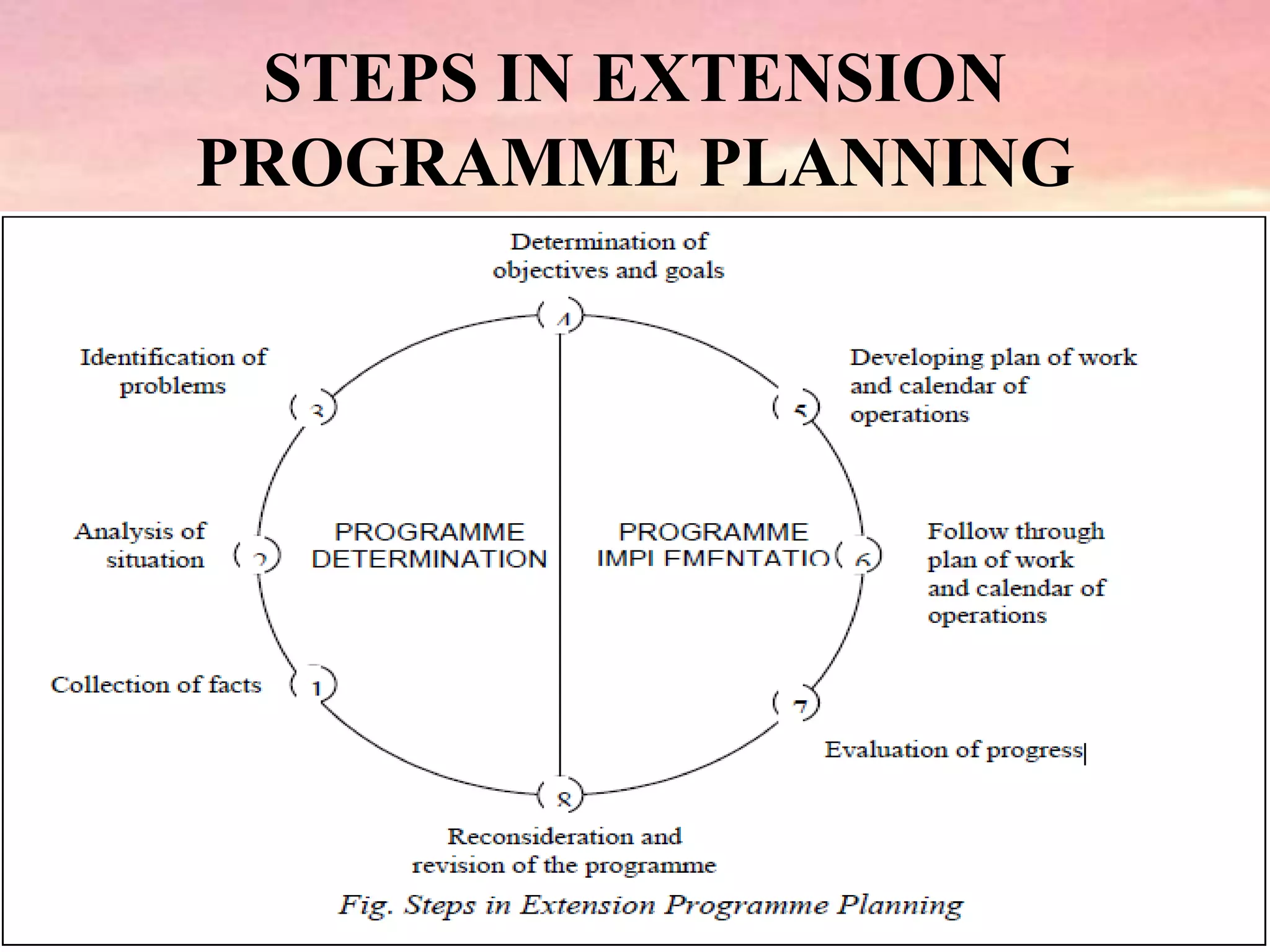
STEPS IN EXTENSION
PROGRAMME PLANNING
1. Collection of
facts
It is the starting point of programme planning
process. Pertinent data may be collected from
the available records and survey of the area.
Information relating to the people, their
enterprises, levels of technology, facilities and
constraints, values etc. may be collected.
Information may also be collected from
Panchayats, Cooperatives and other
organizations in the area.
2. Analysis of the situation
• The data and information collected are then
analyzed with the local people. This shall help
in understanding the situation in its proper
perspective.
3. Identification of the
problems
A proper analysis and interpretation of the data
shall help in correctly identifying the
problems.
There may be many problems, but only the
urgent and significant ones, which may be
solved with the available resources and within
the limits of time, should be selected.
Selections of a large number of problems,
which cannot be properly managed, lead to a
failure of the programme and generate
frustration among the people.
4. Determination of objectives and goals
The objectives are set forth on the basis of the
significant needs identified. The objectives
should be direct and stated in clear terms.
To make the objectives realistic and
actionable, there is need to state them in terms
of specific goals.
It is necessary to discuss with the local people
and local institutions, which shall also
legitimize the programme planning process.
5. Developing plan of work and calender
operations.
The plan of work should be in written form
and shall indicate who shall do what job.
The plan should have all the essential details
and no important point should be left out.
The calendar of operations shall be prepared
on the basis of the plan of work and shall
specify when a particular work shall be done,
preferably mentioning date and time
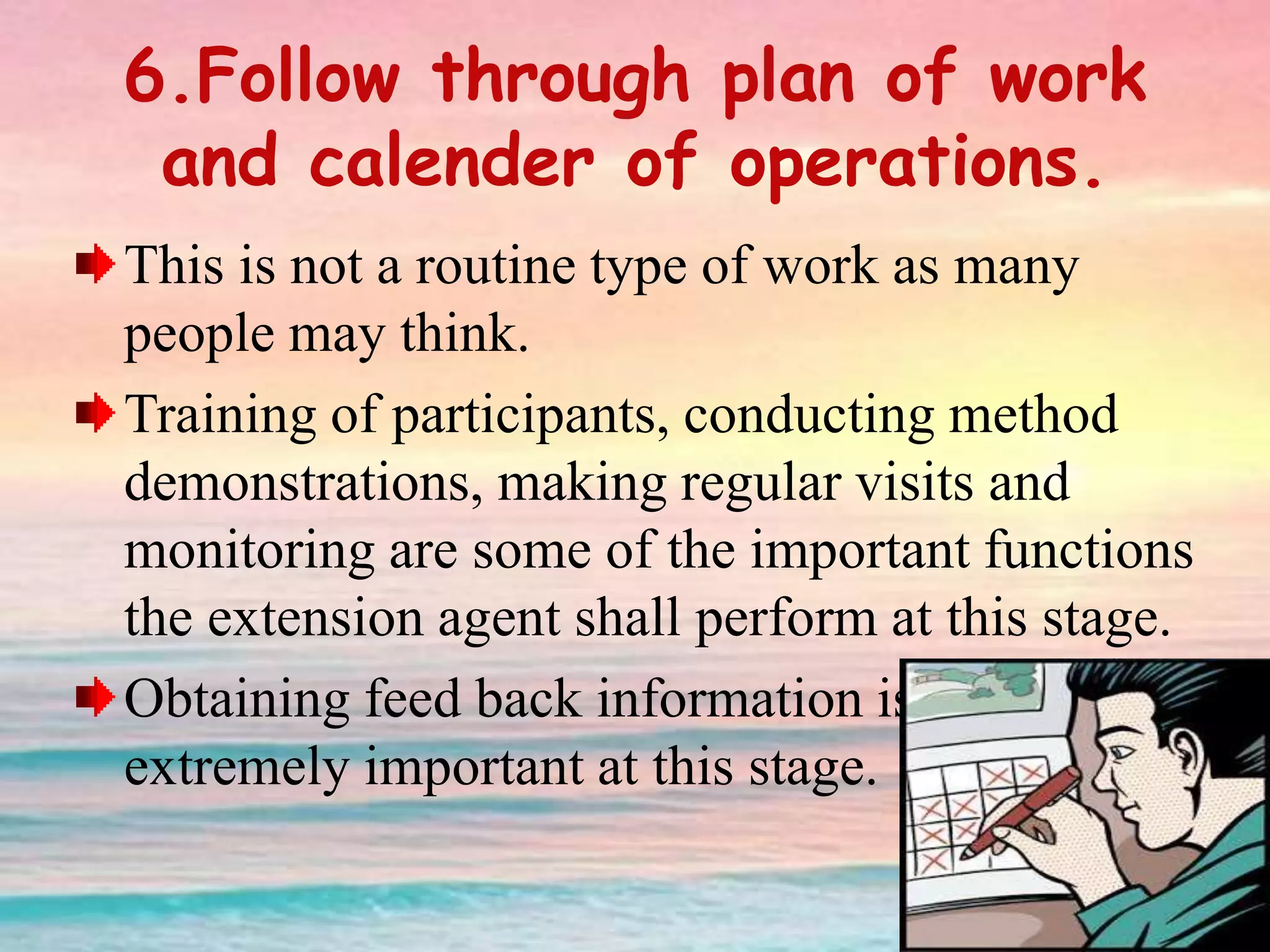
6.Follow through plan of work
and calender of operations.
This is not a routine type of work as many
people may think.
Training of participants, conducting method
demonstrations, making regular visits and
monitoring are some of the important functions
the extension agent shall perform at this stage.
Obtaining feed back information is
extremely important at this stage.
7.Evaluation of progress
Evaluation is the process of determining the
extent to which we have been able to attain our
objectives.
It should be a continuous process not only to
measure the end result but also to ensure that
all the steps are correctly followed.
Evaluation may be formal or informal,
depending on the importance of the
programme and also on the availability of
trained manpower, funds,
facilities and time.
8.Reconsideration &
revision of the programme.
On the basis of the results of evaluation, the
programme should be reconsidered and
revised, if needed.
This reconsideration should be done not only
with the participants; but also with the
scientists, administrators in extension
organization and local bodies like Panchayats,
etc.
Reconsideration shall help in making
necessary corrections and modifications in the
Extension programme planning

Extension programme planning

  • 2.
    Submitted to: Dr. Golyanaik sir Dept. of Extension College of sericulture, Chintamani. Submitted by: jyothi P ALC3021, III BSc(agri) College of sericulture, Chintamani.
  • 4.
    Introduction • A programmemeans a prospectus or a statement issued to promote understanding and interest in an enterprise. • Planning is a process, which involves studying the past, and present in order to forecast the future and in the light of that forecast determining the goals to be achieved and what must be done to reach them. • Extension Programme is a statement of situation, objectives, problems and solutions.
  • 5.
    • Programme Planningis a decision making process involving critical analysis of the existing situation and the problems, evaluation of the various alternatives to solve these problems and the selection of the relevant ones, giving necessary priorities based upon local needs and resources by the cooperative efforts of the people both official and non- official with a view to facilitate the individual and community growth and development.
  • 6.
    Definitions . • Leagans(1961) says that an "extension programme" is a set of clearly defined, consciously conceived objectives or ends, derived from an adequate analysis of the situation, which are to be achieved through extension teaching activity.
  • 7.
    • Lawrence (1962)says that an "extension programme" is the sum total of all the activities and undertakings of a county extension services. It includes: (i) programme planning process (ii) written programme statement (iii) plan of work (iv) programme execution (v) results (vi) evaluation.
  • 8.
    Assumptions on ExtensionPlanning • The concept of extension planning is based on a number of assumptions. • Boyle (1965) has listed the following assumptions in this regard. i. Planning change is a necessary pre-requisite to effective social progress for people and communities. ii. The most desirable change is pre-determined and democratically achieved.
  • 9.
    ii. Extension educationprogrammes, if properly planned and implemented, can make a significant contribution to planned change. iii. It is possible to select, organize and administer a programme that will contribute to the social and economic progress of people. iv. People and communities need the guidance, leadership and help of extension educators to solve their problems in a planned and systematic way.
  • 10.
    Pr • Principles arethe fundamental truths and settled rules of action. There are some basic principals which are generally applicable before starting any extension programme. These are as follows: 1. Programme should be based on felt needs of people. 2. Objectives of the programme should have clarity and meaning 3. Programmes should be based on an analysis of the past experience, present situation and future needs.
  • 11.
    5. Has balancewith emphasis. 6. Has definite plan of work. 7. Is a continuous process. 8. Is a teaching process 9. Is a co-ordinating process. 10. Provides for evaluation of results and reconsideration of programmes. 11. All concerning people must be given a summary of the programme in a written format.
  • 12.
  • 13.
    1. Collection of facts Itis the starting point of programme planning process. Pertinent data may be collected from the available records and survey of the area. Information relating to the people, their enterprises, levels of technology, facilities and constraints, values etc. may be collected. Information may also be collected from Panchayats, Cooperatives and other organizations in the area.
  • 14.
    2. Analysis ofthe situation • The data and information collected are then analyzed with the local people. This shall help in understanding the situation in its proper perspective.
  • 15.
    3. Identification ofthe problems A proper analysis and interpretation of the data shall help in correctly identifying the problems. There may be many problems, but only the urgent and significant ones, which may be solved with the available resources and within the limits of time, should be selected. Selections of a large number of problems, which cannot be properly managed, lead to a failure of the programme and generate frustration among the people.
  • 16.
    4. Determination ofobjectives and goals The objectives are set forth on the basis of the significant needs identified. The objectives should be direct and stated in clear terms. To make the objectives realistic and actionable, there is need to state them in terms of specific goals. It is necessary to discuss with the local people and local institutions, which shall also legitimize the programme planning process.
  • 17.
    5. Developing planof work and calender operations. The plan of work should be in written form and shall indicate who shall do what job. The plan should have all the essential details and no important point should be left out. The calendar of operations shall be prepared on the basis of the plan of work and shall specify when a particular work shall be done, preferably mentioning date and time
  • 18.
    6.Follow through planof work and calender of operations. This is not a routine type of work as many people may think. Training of participants, conducting method demonstrations, making regular visits and monitoring are some of the important functions the extension agent shall perform at this stage. Obtaining feed back information is extremely important at this stage.
  • 19.
    7.Evaluation of progress Evaluationis the process of determining the extent to which we have been able to attain our objectives. It should be a continuous process not only to measure the end result but also to ensure that all the steps are correctly followed. Evaluation may be formal or informal, depending on the importance of the programme and also on the availability of trained manpower, funds, facilities and time.
  • 20.
    8.Reconsideration & revision ofthe programme. On the basis of the results of evaluation, the programme should be reconsidered and revised, if needed. This reconsideration should be done not only with the participants; but also with the scientists, administrators in extension organization and local bodies like Panchayats, etc. Reconsideration shall help in making necessary corrections and modifications in the