Man made disaster
Abisha.S.J
MFT16085
A disastrous event caused directly and principally by
one or more identifiable deliberate or negligent human
actions.
Also called human-made disaster.
There are multiple factor that may relate to
manmade disasters
Ignorance
Unawareness
 Illiteracy
Carelessly handling danger
Chemical
 Weapons
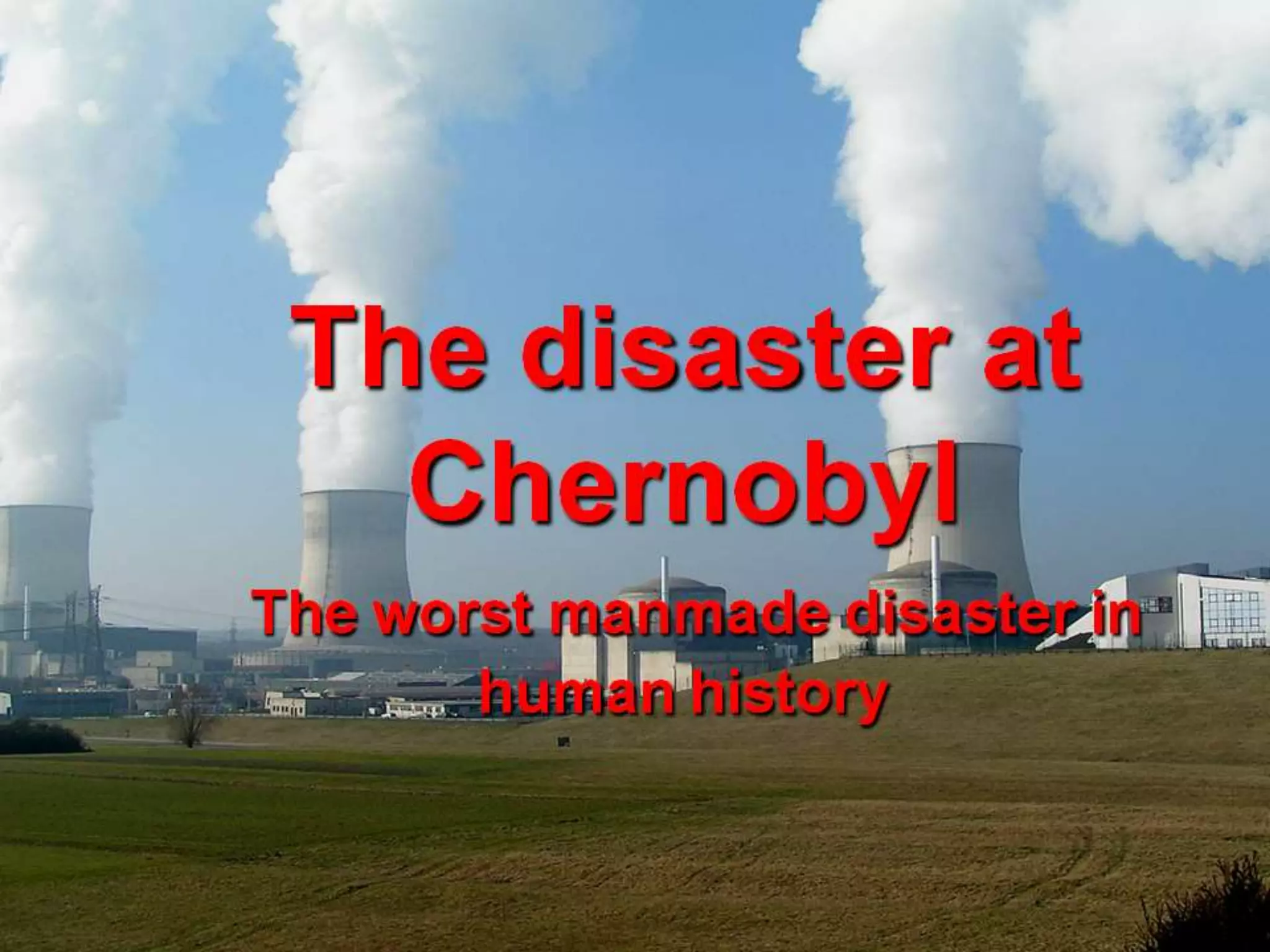
1986 Chernobyl nuclear power plant accident
According to the World Health Organization, exposed six million
people to dangerous levels of radiation and left a portion of
our planet nearly uninhabitable
Core of the
reactor 4
Arial view of the blast.
Most Common Man Made Disasters
Oil & Chemical Spill Economic Collapse
Terrorist Attack
Power Outage Biological Threat War
MAN-MADE DISASTERS
INDUSTRIAL ACCIDENTS
Fire
Explosions
C.B.R. ACCIDENTS
Chemical
Biological
Radiological
Fire
Causes Of Fire
The most common causes of fire are:
Electrical
Pantry Area
Smoking
Classes Of Fire
Let us also understand the classes of fires.
Class A
These are fires that involve some solid material like, clothers, paper,
junk-heap, wood etc.
Class B
These are fires that involve liquid materials like: petrol, gasoline,
diesel, oil etc.
Class C
These are fires that involve electrical elements
Class D
These are fires are those involve metals
MIGRANT CAMP BLAZE
Explosion
An explosion is a rapid increase in volume and release
of energy in an extreme manner, usually with the generation
of high temperatures and the release of gases.
Supersonic explosions created
by high explosives are known
as detonations and travel via
supersonic shock waves.
Subsonic explosions are created
by low explosives through a
slower burning process known
as deflagration.
Notable explosions
Chemical explosions
Nanaimo mine explosion 1887
Halifax Explosion 1917
Battle of Messines 1917
2015 Tianjin explosions 2015
Nuclear testing
Trinity test
Castle Bravo
Tsar Bomba
Atomic bombings of Hiroshima
and Nagasaki
Use in war
Artillery, mortars,
and cannons
Gunpowder and smokeless
powder as a propellant in
firearms and artillery
Bombs
Atomic bombings of
Hiroshima and Nagasaki
Land mines
Turkey is on edge after a number of bomb attacks
A chemical threat is
fear of a release of
poisonous
 vapors,
aerosols,
 liquids, and
solids being
dispensed into the
air or water ways
which would have a
toxic effect on
people, animals,
and/or plants
A chemical threat
Chemical agent or chemical poisons
are primarily used in war, terrorism
and riot control.
The impacts of chemical accidents can be deadly, for both human
being-environments.
Nerve Agents
Blister or Vesicant Agents
Choking Agents
Types of Chemical Warfare Agents
Depending upon the type of chemical, it can either have an
immediate effect (seconds to minutes) or a delayed effect (2-
48 hours).
Nuclear disaster
Nuclear power plants use the heat generated from nuclear fission
in a contained environment to convert water to steam, which powers
generators to produce electricity. It is the by-product of this activity
that creates the biggest hazard.
Accident categories
Nuclear meltdown
Criticality accidents
Decay heat
Equipment failure
Human error
Nuclear Disaster
This occurs, it is often as a result
of intent and the end results
are even more catastrophic
with a large percentage of
those involved losing their
lives.
Precautions for man made
disasters
1. One should not look at the
fire as it causes instant
blindness
2. Should close all doors and
windows as radioactivity
does not penetrate into
solid structures
3. Cover all food and water
Nuclear Accidents:
Chemical Agents
1. Use protective
equipment.
2. Give quick and correct
self-aid when
contaminated.
3. Avoid areas where
chemical agents exist.
4. Decontaminate your
equipment and body as
soon as possible.
Fire Accidents
1. The biggest main reason
might be poor wiring and
faulty electrical equipment,
leaking gas or carelessly
thrown cigarettes and
matches.
2. Wires should be properly
covered.
3. Inflammable things should
be kept safely.
4. Power points should not be
overloaded.
Historical Examples of man made disasters
1. London’s Killer Fog
2. The Al-Mishraq Fire
3. Dioxin Pollution
Worst Man-Made Disasters Of 2016
A pelican after Shell Oil Co spilled thousands of barrels of
crude oil into the Gulf of Mexico in May of this year
NUCLEAR POWER PLANT LEAKS – NY, WA, & FL, USA
Turkey Point Nuclear Facility
near Miami, Florida Credit – AP
PETROPERU’S FOUR OIL SPILLS – AMAZON RIVER
BASIN, PERU
Arguably the largest man-made environmental catastrophe of the
year were the four massive oil spills caused by Peru’s largest oil
company PetroPeru
AIR POLLUTION – ASIA
UNICEF announced earlier this year that air pollution is now the
cause of death for an estimated 600,000 children every year
A Chilean maritime officials surveys the millions of dead marine animals and
fish that lined Chiloé’s beaches during the record-breaking red tide algal
bloom in March
DEVASTATING RED TIDE OUTBREAKS – THE ISLAND OF
CHILOÉ, CHILE
Reference
 http://www.businessdictionary.com/definition/man-made-
disaster.html
www.disasterium.com/10-worst-man-made-disasters-of-all-time
www.disaster-survival-resources.com/man-made-disasters.html
restoreyoureconomy.org/disaster-overview/types-of-disasters
https://www.slideshare.net/AvasyuGupta/man-made-disasters
content.time.com/time/specials/2007/.../0,28804,1686204_16
86252_1690600,00.htm

Man made disaster

  • 1.
  • 2.
    A disastrous eventcaused directly and principally by one or more identifiable deliberate or negligent human actions. Also called human-made disaster.
  • 3.
    There are multiplefactor that may relate to manmade disasters Ignorance Unawareness  Illiteracy Carelessly handling danger Chemical  Weapons
  • 5.
    1986 Chernobyl nuclearpower plant accident According to the World Health Organization, exposed six million people to dangerous levels of radiation and left a portion of our planet nearly uninhabitable Core of the reactor 4 Arial view of the blast.
  • 6.
    Most Common ManMade Disasters Oil & Chemical Spill Economic Collapse Terrorist Attack Power Outage Biological Threat War
  • 7.
    MAN-MADE DISASTERS INDUSTRIAL ACCIDENTS Fire Explosions C.B.R.ACCIDENTS Chemical Biological Radiological
  • 8.
    Fire Causes Of Fire Themost common causes of fire are: Electrical Pantry Area Smoking
  • 9.
    Classes Of Fire Letus also understand the classes of fires. Class A These are fires that involve some solid material like, clothers, paper, junk-heap, wood etc. Class B These are fires that involve liquid materials like: petrol, gasoline, diesel, oil etc. Class C These are fires that involve electrical elements Class D These are fires are those involve metals
  • 11.
  • 12.
    Explosion An explosion isa rapid increase in volume and release of energy in an extreme manner, usually with the generation of high temperatures and the release of gases. Supersonic explosions created by high explosives are known as detonations and travel via supersonic shock waves. Subsonic explosions are created by low explosives through a slower burning process known as deflagration.
  • 13.
    Notable explosions Chemical explosions Nanaimomine explosion 1887 Halifax Explosion 1917 Battle of Messines 1917 2015 Tianjin explosions 2015 Nuclear testing Trinity test Castle Bravo Tsar Bomba Atomic bombings of Hiroshima and Nagasaki Use in war Artillery, mortars, and cannons Gunpowder and smokeless powder as a propellant in firearms and artillery Bombs Atomic bombings of Hiroshima and Nagasaki Land mines
  • 14.
    Turkey is onedge after a number of bomb attacks
  • 15.
    A chemical threatis fear of a release of poisonous  vapors, aerosols,  liquids, and solids being dispensed into the air or water ways which would have a toxic effect on people, animals, and/or plants A chemical threat Chemical agent or chemical poisons are primarily used in war, terrorism and riot control. The impacts of chemical accidents can be deadly, for both human being-environments.
  • 16.
    Nerve Agents Blister orVesicant Agents Choking Agents Types of Chemical Warfare Agents Depending upon the type of chemical, it can either have an immediate effect (seconds to minutes) or a delayed effect (2- 48 hours).
  • 17.
    Nuclear disaster Nuclear powerplants use the heat generated from nuclear fission in a contained environment to convert water to steam, which powers generators to produce electricity. It is the by-product of this activity that creates the biggest hazard. Accident categories Nuclear meltdown Criticality accidents Decay heat Equipment failure Human error
  • 18.
    Nuclear Disaster This occurs,it is often as a result of intent and the end results are even more catastrophic with a large percentage of those involved losing their lives.
  • 19.
    Precautions for manmade disasters
  • 20.
    1. One shouldnot look at the fire as it causes instant blindness 2. Should close all doors and windows as radioactivity does not penetrate into solid structures 3. Cover all food and water Nuclear Accidents:
  • 21.
    Chemical Agents 1. Useprotective equipment. 2. Give quick and correct self-aid when contaminated. 3. Avoid areas where chemical agents exist. 4. Decontaminate your equipment and body as soon as possible.
  • 22.
    Fire Accidents 1. Thebiggest main reason might be poor wiring and faulty electrical equipment, leaking gas or carelessly thrown cigarettes and matches. 2. Wires should be properly covered. 3. Inflammable things should be kept safely. 4. Power points should not be overloaded.
  • 23.
    Historical Examples ofman made disasters
  • 24.
  • 25.
  • 26.
  • 27.
    Worst Man-Made DisastersOf 2016 A pelican after Shell Oil Co spilled thousands of barrels of crude oil into the Gulf of Mexico in May of this year
  • 28.
    NUCLEAR POWER PLANTLEAKS – NY, WA, & FL, USA Turkey Point Nuclear Facility near Miami, Florida Credit – AP
  • 29.
    PETROPERU’S FOUR OILSPILLS – AMAZON RIVER BASIN, PERU Arguably the largest man-made environmental catastrophe of the year were the four massive oil spills caused by Peru’s largest oil company PetroPeru
  • 30.
    AIR POLLUTION –ASIA UNICEF announced earlier this year that air pollution is now the cause of death for an estimated 600,000 children every year
  • 31.
    A Chilean maritimeofficials surveys the millions of dead marine animals and fish that lined Chiloé’s beaches during the record-breaking red tide algal bloom in March DEVASTATING RED TIDE OUTBREAKS – THE ISLAND OF CHILOÉ, CHILE
  • 32.

Editor's Notes

  • #3 Man-made disasters are usually the result of things going wrong in our complex technological society. They include: blackouts, hazardous material spills, air pollution, house fires, radiation leaks, food or water contamination, and industrial chemical releases
  • #5 Chernobyl disaster is considered to be the worst catastrophic (Manmade disaster) in history. Chernobyl was a nuclear power plant that was located 80 miles north of Kiev, which is now the ‘Ukraine’. Chernobyl was a part of the city ‘Pripyat’.
  • #6 On 26th April 1986, at 1:23 P.M. blast occurred in the 4th reactor. The reactor 4 suffered power increase leading to explosion from core. The two engineers present in the 4th reactor were Alexander Akimov and Leonid Toptunov. Whereas Leonid was present at the time of blast as he was a young engineer with a 3 months experience. The obvious reason that can be stated is ‘Operator error’. Maybe the operator was not experienced enough to control the reactor. Another reason was that the, operator allowed to much water flow in the tank that caused the speed of the turbine to increase uncontrollably. Additionally normal safety rules were not followed. Example the regulation required at least 15 controlled rods but at the time of the explosion there were on 10 rods intact.
  • #9 Fire is a very good servant, but, a very bad master.  As long as fire is under our control, it serves a lot of useful purposes for us, but, once it goes out of our control, it can create a lot of destruction. 
  • #12  HUGE blaze has ripped through a French migrant camp reducing it to “a heap of ashes” with at least 10 people injured. 11th april UK
  • #13 When caused by a man-made device such as an exploding rocket or firework, the audible component of an explosion is referred to as its "report“ he action of heating a substance until it burns away rapidly. Detonation showing 16 tons of explosion
  • #15 The explosion is reported to have happened as a vehicle was being repaired, causing part of the building's roof to collapse. April 11 2017 the cause is being investigated, Mr Soylu suggested that the explosion was caused by repair work and was not the result of an attack.
  • #17 The nerve agents are a group of particularly toxic chemical warfare agents. They were developed just before and during World War II and are related chemically to the organophosphorus insecticides. Vesicants burn and blister the skin or any other part of the body they contact. They act on the eyes, mucous membranes, lungs, skin and blood-forming organs. They damage the respiratory tract when inhaled and cause vomiting and diarrhea when ingested. Blister or vesicant agents are likely to be used both to produce casualties and to force opposing troops to wear full protective equipment thus degrading fighting efficiency, rather than to kill, although exposure to such agents can be fatal. Chemical agents which attack lung tissue, primarily causing pulmonary edema, are classed as lung damaging agents.eg- chlorine
  • #18 A nuclear accident is still possible even though the construction and operation of nuclear power plants are closely monitored and regulated by the Nuclear Regulatory Commission (NRC). A nuclear meltdown is a severe nuclear reactor accident that results in reactor core damage from overheating. It has been defined as the accidental melting of the core of a nuclear reactor, and refers to the core's either complete or partial collapse.[107][108] A core melt accident occurs when the heat generated by a nuclear reactor exceeds the heat removed by the cooling systems to the point where at least one nuclear fuel element exceeds its melting point.  A criticality accident (also sometimes referred to as an "excursion" or "power excursion") occurs when a nuclear chain reaction is accidentally allowed to occur in fissile material, such as enriched uranium or plutonium Decay heat ccidents are where the heat generated by the radioactive decay causes harm. In a large nuclear reactor, a loss of coolant accident can damage the core: