


Jonathan E. Martin
  November 8, 2012
            ISACS
ď‚— Buck Institute of Education
ď‚— www.bie.org
ď‚— www.bie.org/diy


 Note: although I’ve had five days of training with BIE, I
  currently have no formal affiliation, and all materials
  herein from BIE are from their publicly available
  website materials.
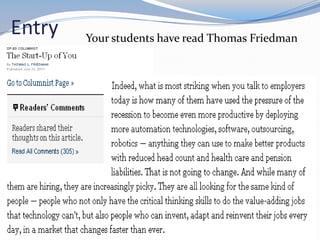
Entry   Your students have read Thomas Friedman
Now those students have come to a faculty meeting, and
                         ask:

 How are you the teachers going to redesign
our learning experiences to better prepare us
      for Friedman’s value adding jobs?
Your task: Answer their question
  and implement the solution.

ď‚—What do you need to know?
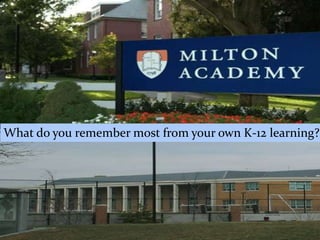
What do you remember most from your own K-12 learning?
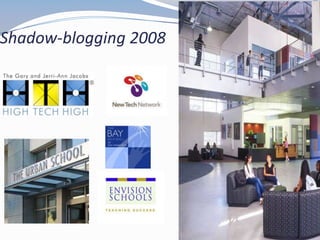
Shadow-blogging 2008
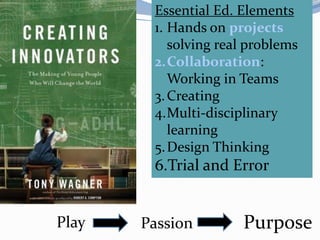
Essential Ed. Elements
        1. Hands on projects
           solving real problems
        2.Collaboration:
           Working in Teams
        3. Creating
        4.Multi-disciplinary
           learning
        5. Design Thinking
        6.Trial and Error


Play   Passion        Purpose
Project-based
learning is integral
to school’s program
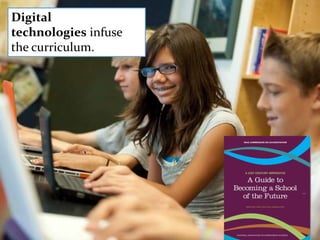
Digital
technologies infuse
the curriculum.
Students seeking social
time with friends and
sense of progress and
accomplishment.

PBL provides both.
ď‚— EUROLLE
ď‚— Ap govt
ď‚— Ms science
ď‚— St gregory logo
Pause:
Let’s talk about HQ 21st c. PBL: What is it not?

Discuss…

http://howtovideos.hightechhigh.org/video/265/What+
Project+Based+Learning+Isn't
Research evidence
Research has demonstrated that PBL can be more
effective than traditional instruction for long-term
retention, skill development and satisfaction of students
and teachers.
          Geier, R., Blumenfeld, P.C., Marx, R.W., Krajcik, J.S., Fishman, B., Soloway, E., &
Clay-Chambers, J. (2008). Standardized test outcomes for students engaged in inquiry-
based science curricula in the context of urban reform. Journal of Research in Science
Teaching, 45(8), 922-939.

           Strobel, J. & van Barneveld, A. (2008) "When is PBL More Effective? A Meta-
synthesis of Meta-analyses Comparing PBL to Conventional Classrooms," Interdisciplinary
Journal of Problem-based Learning, 3(1), 44-58. Retrieved from
http://docs.lib.purdue.edu/ijpbl/vol3/iss1/4.
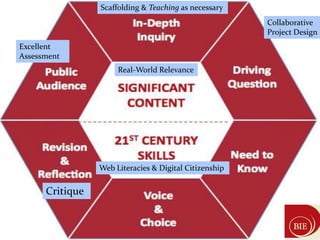
13 Essential Elements
Scaffolding & Teaching as necessary
                                                        Collaborative
                                                        Project Design
Excellent
Assessment
                      Real-World Relevance


                 Web Literacies & Digital Citizenship

      Critique
1. Significant Content
AL


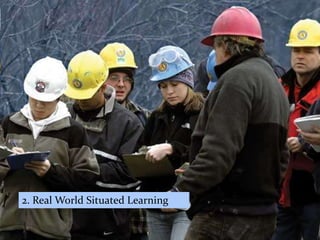
2. Real World Situated Learning
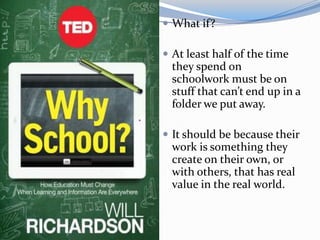
ď‚— What if?

ď‚— At least half of the time
  they spend on
  schoolwork must be on
  stuff that can’t end up in a
  folder we put away.

ď‚— It should be because their
  work is something they
  create on their own, or
  with others, that has real
  value in the real world.
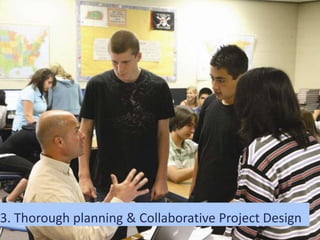
3. Thorough planning & Collaborative Project Design
4. A Driving Question
Video
ď‚— Draft the driving question


ď‚— https://www.youtube.com/watch?v=WftJ1rGsJi0
Designing a DQ
Characteristics of a Driving Question

ď‚— Provocative or challenging to students, because it is
 relevant, important, urgent or otherwise interesting.
Designing a DQ
Characteristics of a Driving Question

 Open-ended and/or complex; there is no single “right
 answer,” or at least no simple “yes” or “no” answer.

ď‚— It requires in-depth inquiry and higher-level thinking.
Designing a DQ
Characteristics of a Driving Question

ď‚— Linked to the core of what you want students to learn;


ď‚— to answer it well, students would need to gain the
 knowledge and skills you have targeted as goals for the
 project.
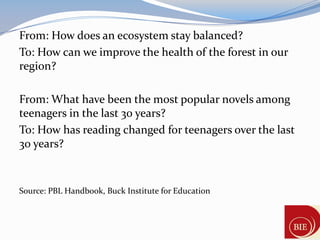
From: How does an ecosystem stay balanced?
To: How can we improve the health of the forest in our
region?

From: What have been the most popular novels among
teenagers in the last 30 years?
To: How has reading changed for teenagers over the last
30 years?


Source: PBL Handbook, Buck Institute for Education
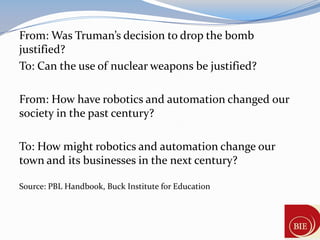
From: Was Truman’s decision to drop the bomb
justified?
To: Can the use of nuclear weapons be justified?

From: How have robotics and automation changed our
society in the past century?

To: How might robotics and automation change our
town and its businesses in the next century?

Source: PBL Handbook, Buck Institute for Education
5. Need to Know
6. VOICE AND CHOICE
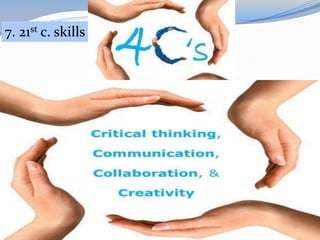
7. 21st c. skills
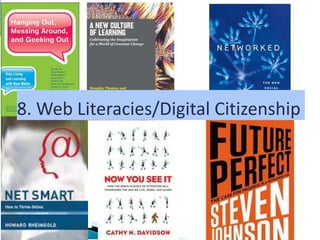
8. Web Literacies/Digital Citizenship
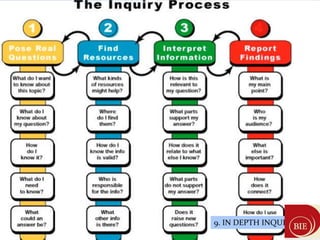
6. In-depth inquiry


                      9. IN DEPTH INQUIRY
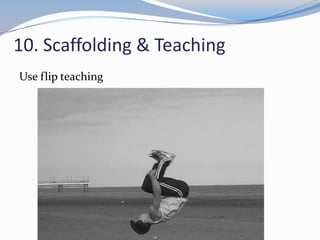
10. Scaffolding & Teaching
Use flip teaching
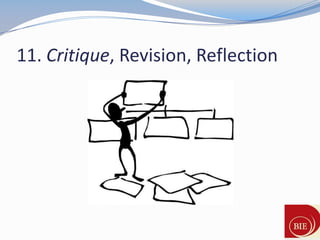
11. Critique, Revision, Reflection
Video: Ron Berger on Critique
ď‚— http://vimeo.com/21983058
12. Public Audience
The Culminating Product
ď‚— Video: Media Saves the Beach, High Tech High


ď‚— http://www.youtube.com/watch?v=cJ5Z53JAivE
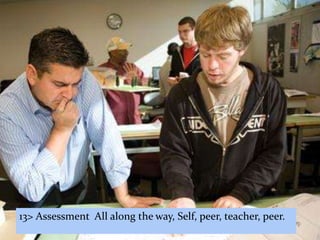
13> Assessment All along the way, Self, peer, teacher, peer.
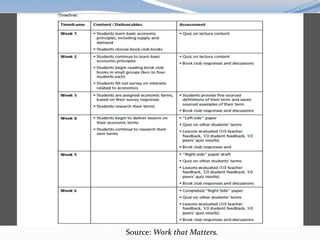
Source: Work that Matters.
Plan the assessment
ď‚— Video: Wings: Plan the Assessment
ď‚— https://www.youtube.com/watch?v=WftJ1rGsJi0
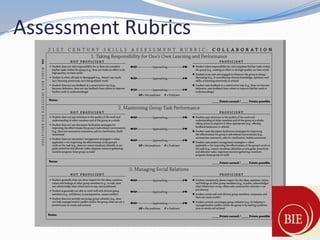
Assessment Rubrics
available for consulting, board training, parent ed. & faculty pd.

          21k12          jonathanemartin ed. services


                  www.21k12blog.net
        Twitter: @jonathanemartin
      jonathanemartin@gmail.com

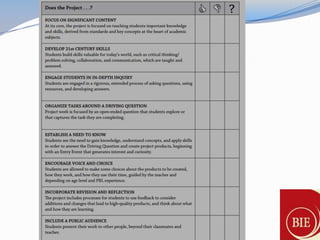
13 essential elements of high quality pbl

  • 1.
    Jonathan E. Martin November 8, 2012 ISACS
  • 2.
     Buck Instituteof Education  www.bie.org  www.bie.org/diy  Note: although I’ve had five days of training with BIE, I currently have no formal affiliation, and all materials herein from BIE are from their publicly available website materials.
  • 3.
    Entry Your students have read Thomas Friedman
  • 4.
    Now those studentshave come to a faculty meeting, and ask: How are you the teachers going to redesign our learning experiences to better prepare us for Friedman’s value adding jobs?
  • 5.
    Your task: Answertheir question and implement the solution. ď‚—What do you need to know?
  • 6.
    What do youremember most from your own K-12 learning?
  • 7.
  • 9.
    Essential Ed. Elements 1. Hands on projects solving real problems 2.Collaboration: Working in Teams 3. Creating 4.Multi-disciplinary learning 5. Design Thinking 6.Trial and Error Play Passion Purpose
  • 10.
  • 11.
  • 12.
    Students seeking social timewith friends and sense of progress and accomplishment. PBL provides both.
  • 15.
    ď‚— EUROLLE ď‚— Apgovt ď‚— Ms science ď‚— St gregory logo
  • 16.
    Pause: Let’s talk aboutHQ 21st c. PBL: What is it not? Discuss… http://howtovideos.hightechhigh.org/video/265/What+ Project+Based+Learning+Isn't
  • 18.
    Research evidence Research hasdemonstrated that PBL can be more effective than traditional instruction for long-term retention, skill development and satisfaction of students and teachers. Geier, R., Blumenfeld, P.C., Marx, R.W., Krajcik, J.S., Fishman, B., Soloway, E., & Clay-Chambers, J. (2008). Standardized test outcomes for students engaged in inquiry- based science curricula in the context of urban reform. Journal of Research in Science Teaching, 45(8), 922-939. Strobel, J. & van Barneveld, A. (2008) "When is PBL More Effective? A Meta- synthesis of Meta-analyses Comparing PBL to Conventional Classrooms," Interdisciplinary Journal of Problem-based Learning, 3(1), 44-58. Retrieved from http://docs.lib.purdue.edu/ijpbl/vol3/iss1/4.
  • 19.
  • 21.
    Scaffolding & Teachingas necessary Collaborative Project Design Excellent Assessment Real-World Relevance Web Literacies & Digital Citizenship Critique
  • 22.
  • 23.
    AL 2. Real WorldSituated Learning
  • 24.
     What if? At least half of the time they spend on schoolwork must be on stuff that can’t end up in a folder we put away.  It should be because their work is something they create on their own, or with others, that has real value in the real world.
  • 26.
    3. Thorough planning& Collaborative Project Design
  • 28.
    4. A DrivingQuestion
  • 29.
    Video ď‚— Draft thedriving question ď‚— https://www.youtube.com/watch?v=WftJ1rGsJi0
  • 30.
    Designing a DQ Characteristicsof a Driving Question ď‚— Provocative or challenging to students, because it is relevant, important, urgent or otherwise interesting.
  • 31.
    Designing a DQ Characteristicsof a Driving Question  Open-ended and/or complex; there is no single “right answer,” or at least no simple “yes” or “no” answer.  It requires in-depth inquiry and higher-level thinking.
  • 32.
    Designing a DQ Characteristicsof a Driving Question ď‚— Linked to the core of what you want students to learn; ď‚— to answer it well, students would need to gain the knowledge and skills you have targeted as goals for the project.
  • 33.
    From: How doesan ecosystem stay balanced? To: How can we improve the health of the forest in our region? From: What have been the most popular novels among teenagers in the last 30 years? To: How has reading changed for teenagers over the last 30 years? Source: PBL Handbook, Buck Institute for Education
  • 34.
    From: Was Truman’sdecision to drop the bomb justified? To: Can the use of nuclear weapons be justified? From: How have robotics and automation changed our society in the past century? To: How might robotics and automation change our town and its businesses in the next century? Source: PBL Handbook, Buck Institute for Education
  • 35.
  • 36.
  • 37.
    7. 21st c.skills
  • 38.
  • 40.
    6. In-depth inquiry 9. IN DEPTH INQUIRY
  • 41.
    10. Scaffolding &Teaching Use flip teaching
  • 42.
  • 43.
    Video: Ron Bergeron Critique ď‚— http://vimeo.com/21983058
  • 44.
  • 45.
    The Culminating Product ď‚—Video: Media Saves the Beach, High Tech High ď‚— http://www.youtube.com/watch?v=cJ5Z53JAivE
  • 46.
    13> Assessment Allalong the way, Self, peer, teacher, peer.
  • 47.
  • 48.
    Plan the assessment ď‚—Video: Wings: Plan the Assessment ď‚— https://www.youtube.com/watch?v=WftJ1rGsJi0
  • 49.
  • 51.
    available for consulting,board training, parent ed. & faculty pd. 21k12 jonathanemartin ed. services www.21k12blog.net Twitter: @jonathanemartin jonathanemartin@gmail.com

Editor's Notes

  • #7 Such a sharp difference in my remembering– and I LOVED my schools and feel very devoted, but what I remember learning were my elaborated projects. College too bored the hell out of me, so much so that I threw myself into projects on campus.
  • #8 My journey began in Summer 2008
  • #14 Tough book– developing perseverenceundermatching and grads taking easy route