Types and classif i
cation of Surgical Instruments
Presented by
Mr.JITENDRA BHARGAV
Assistant professor
E-mail: jitendrabardebarde98@gmail.com
Mobile 8349645598
Types and classif i
cation of surgical instruments
Objectives learning
1
2
3
1
2
History of surgical Instruments
Def i
nition of the Instruments
Manufacture of Surgical Instruments 4-
Grade of Surgical Instruments
Structure of the Instrument and its function
Types and Classif i
cation of surgical
instruments
History of surgical instruments





The history of surgical instruments began 10.000bc by
using
the stone knife to perform surgery
Then, the modern surgical instrumentation began with
the introduction of stainless steel
Surgical instruments represent a large portion of
healthcare facilities budget
Additional they are the tools that surgeons rely on to
help ensure a positive outcome of a surgical procedure
Each instrument is designed for a specif i
c purpose and
should never be used for any other purpose
History of surgical instruments



Surgical procedures cannot be effectively performed
without properly cleaned, packaged, and
sterile surgical instruments.
The manufacturer of surgical instruments must provide
processing instruction with each instrument manufactured.
Reprocessing of surgical instruments is the direct
responsibility of CSSD Technician
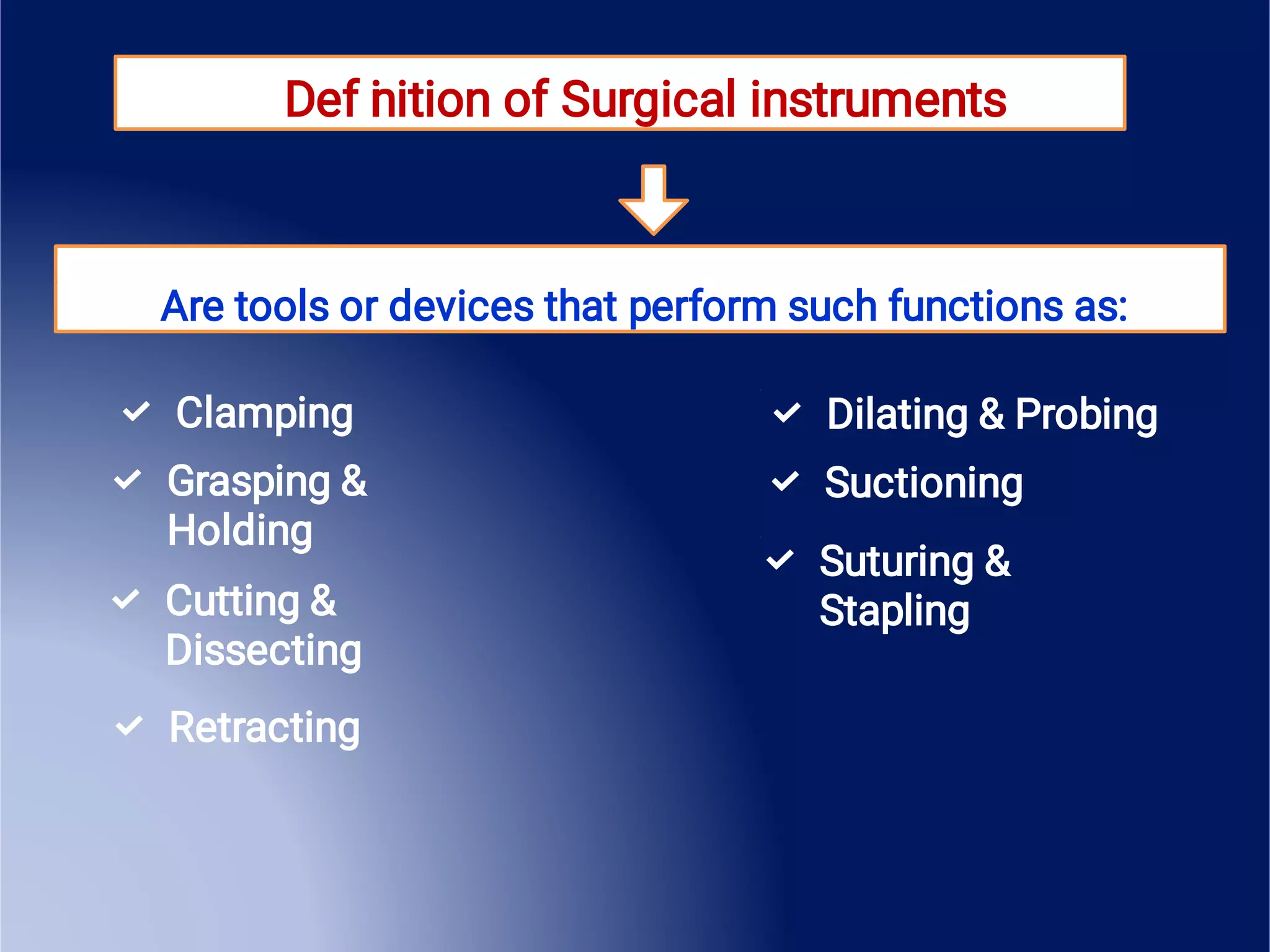
Def i
nition of Surgical instruments
Are tools or devices that perform such functions as:




Clamping
Grasping &
Holding
Cutting &
Dissecting
Retracting



Dilating & Probing
Suctioning
Suturing &
Stapling
Manufacture of Surgical
instruments
Most of surgical instruments are made from
Stainless Steel.
But there are other metals involved in the manufacture
of surgical instruments such as
Titaniu
m
chromiu
m
vanadiu
m
molybdenu
m
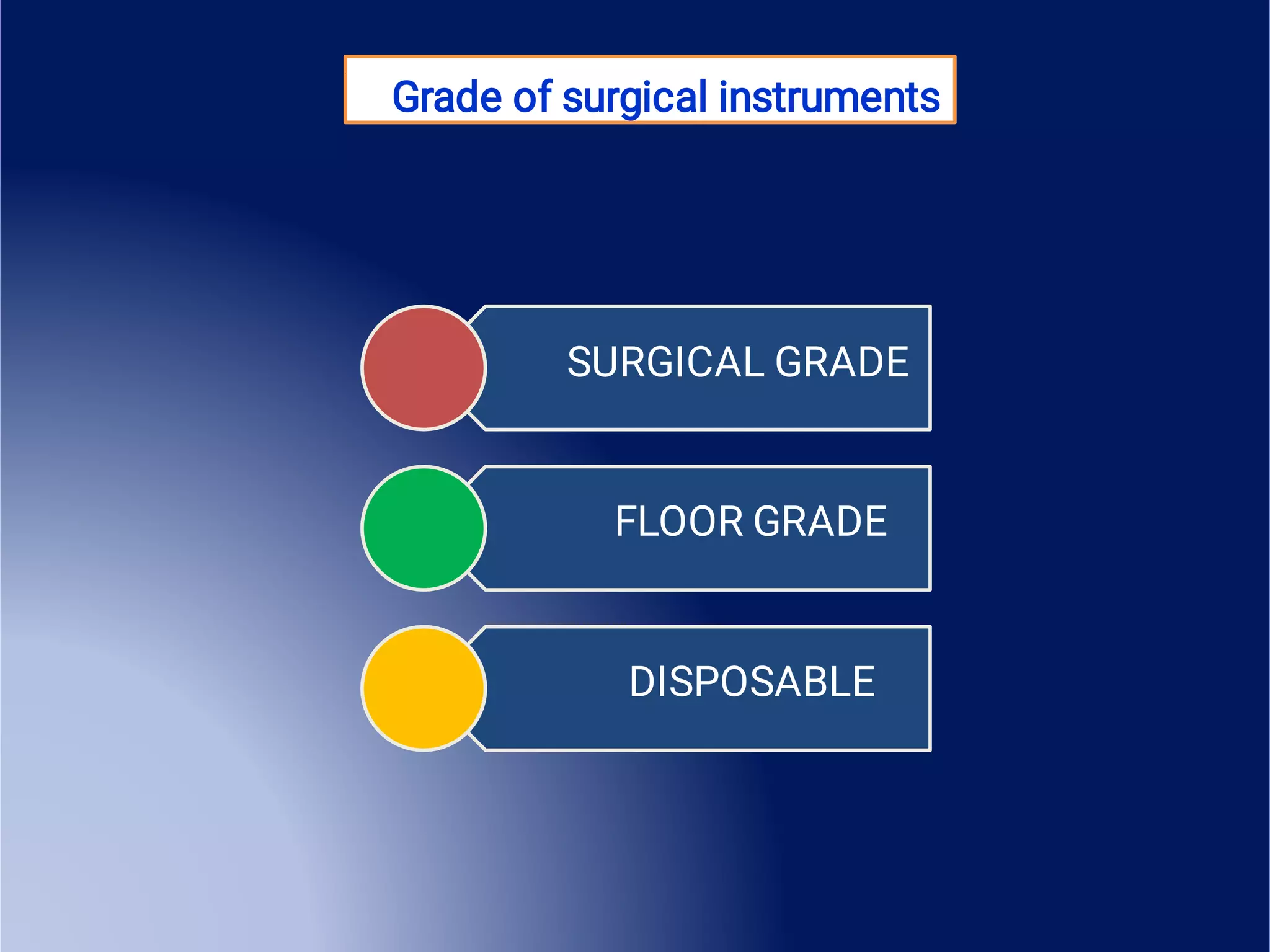
SURGICAL GRADE
FLOOR GRADE
DISPOSABLE
Grade of surgical instruments






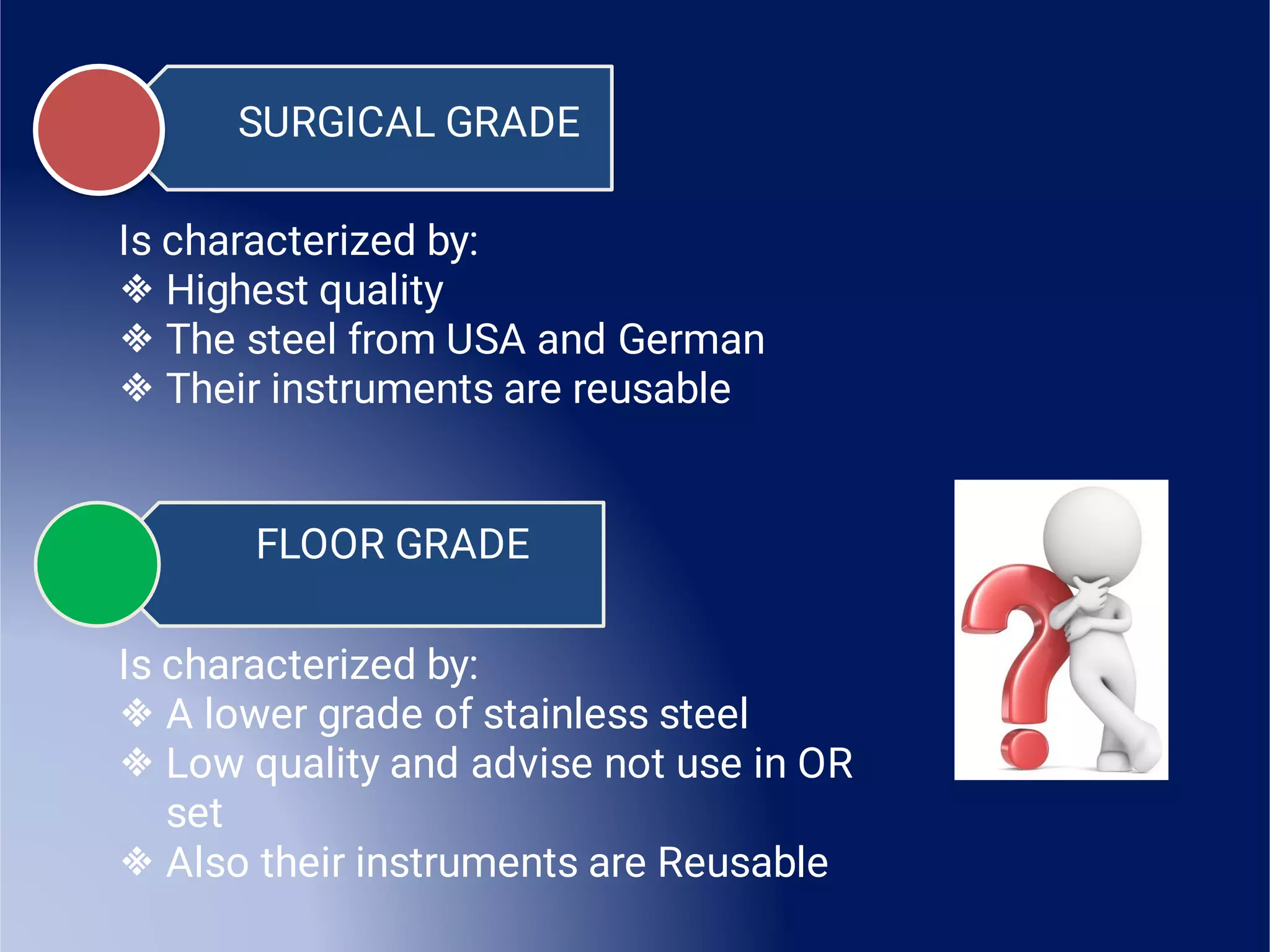
SURGICAL GRADE
Is characterized by:
Highest quality
The steel from USA and German
Their instruments are reusable
FLOOR GRADE
Is characterized by:
A lower grade of stainless steel
Low quality and advise not use in OR
set
Also their instruments are Reusable
DISPOSABLE


Is characterized by:
Single use
should never
reprocessing
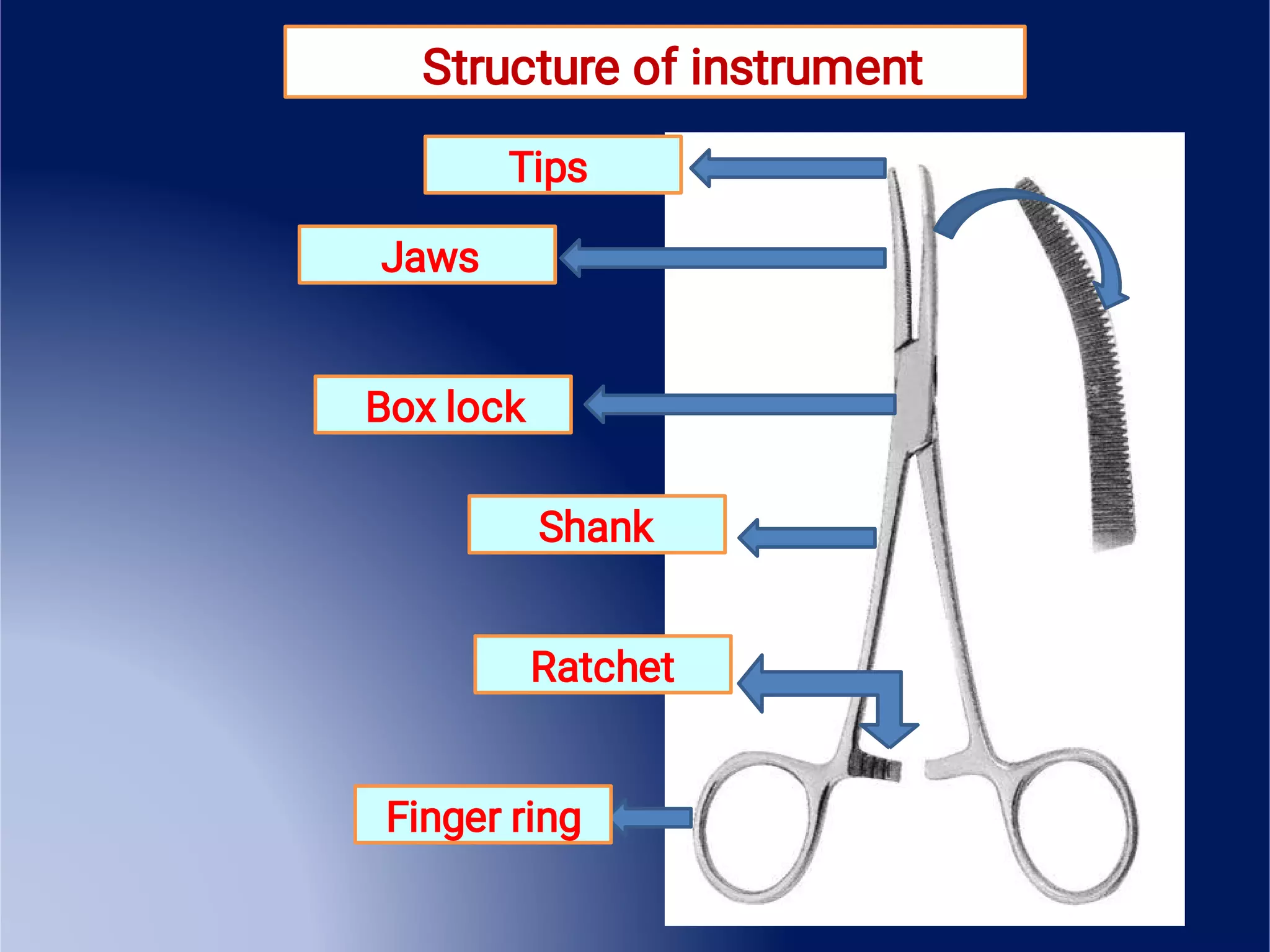
Tips
Jaws
Box lock
Shank
Ratchet
Finger ring
Structure of instrument
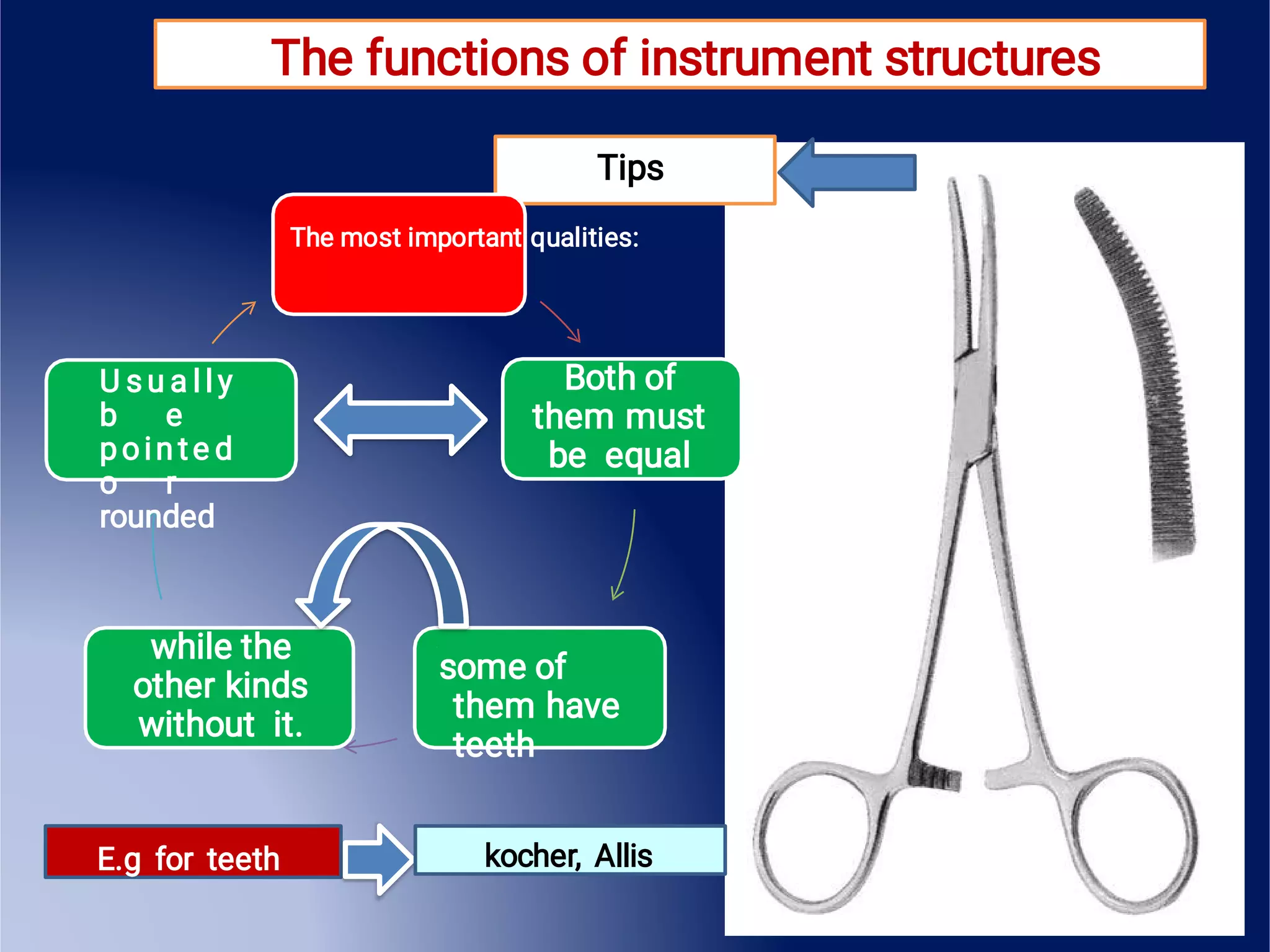
Tips
The most important qualities:
Both of
them must
be equal
some of
them have
teeth
while the
other kinds
without it.
U s u a lly
b e
pointe d
o r
rounded
E.g for teeth kocher, Allis
The functions of instrument structures
Smooth
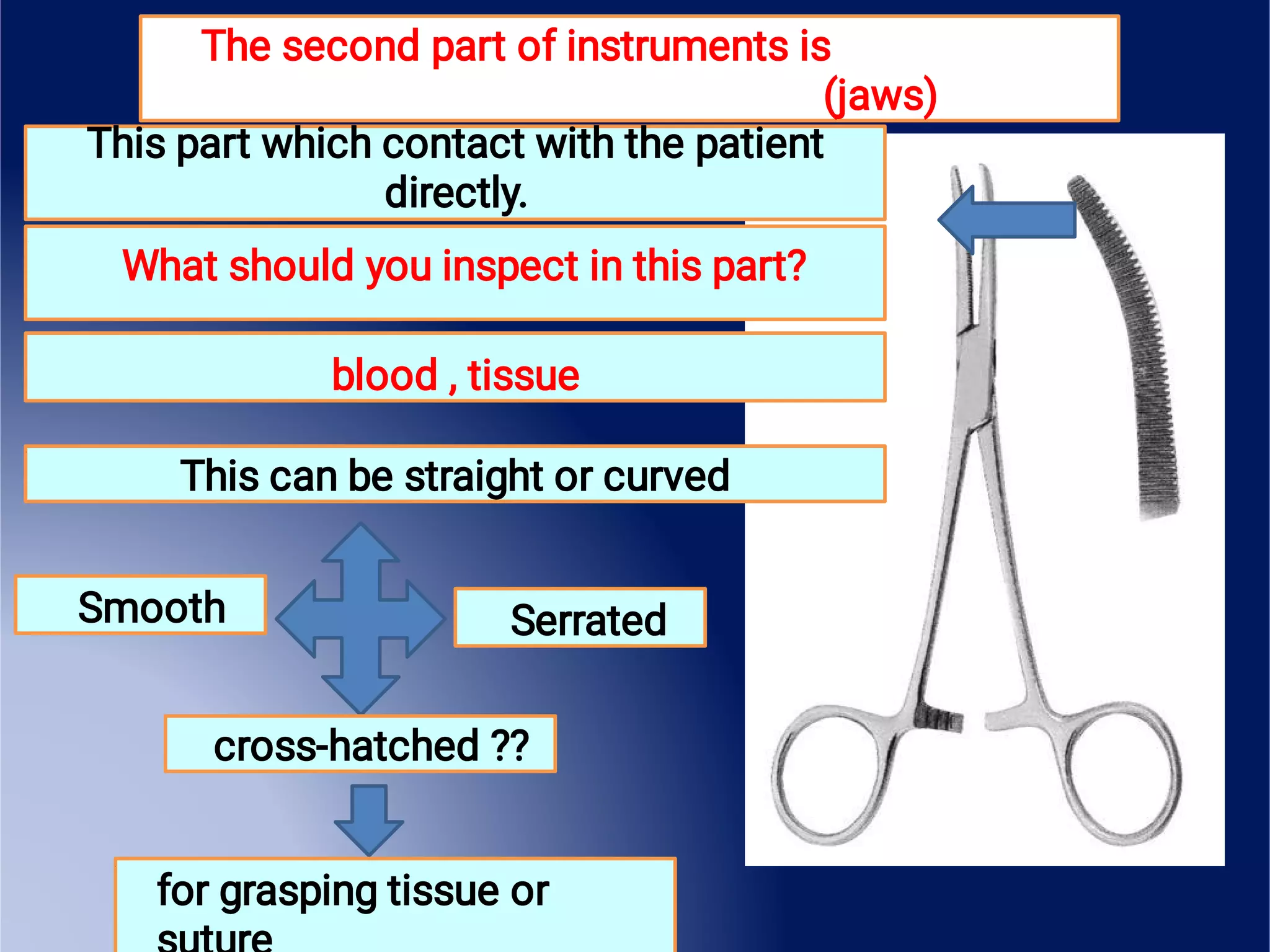
The second part of instruments is
(jaws)
This can be straight or curved
Serrated
cross-hatched ??
for grasping tissue or
This part which contact with the patient
directly.
What should you inspect in this part?
blood , tissue
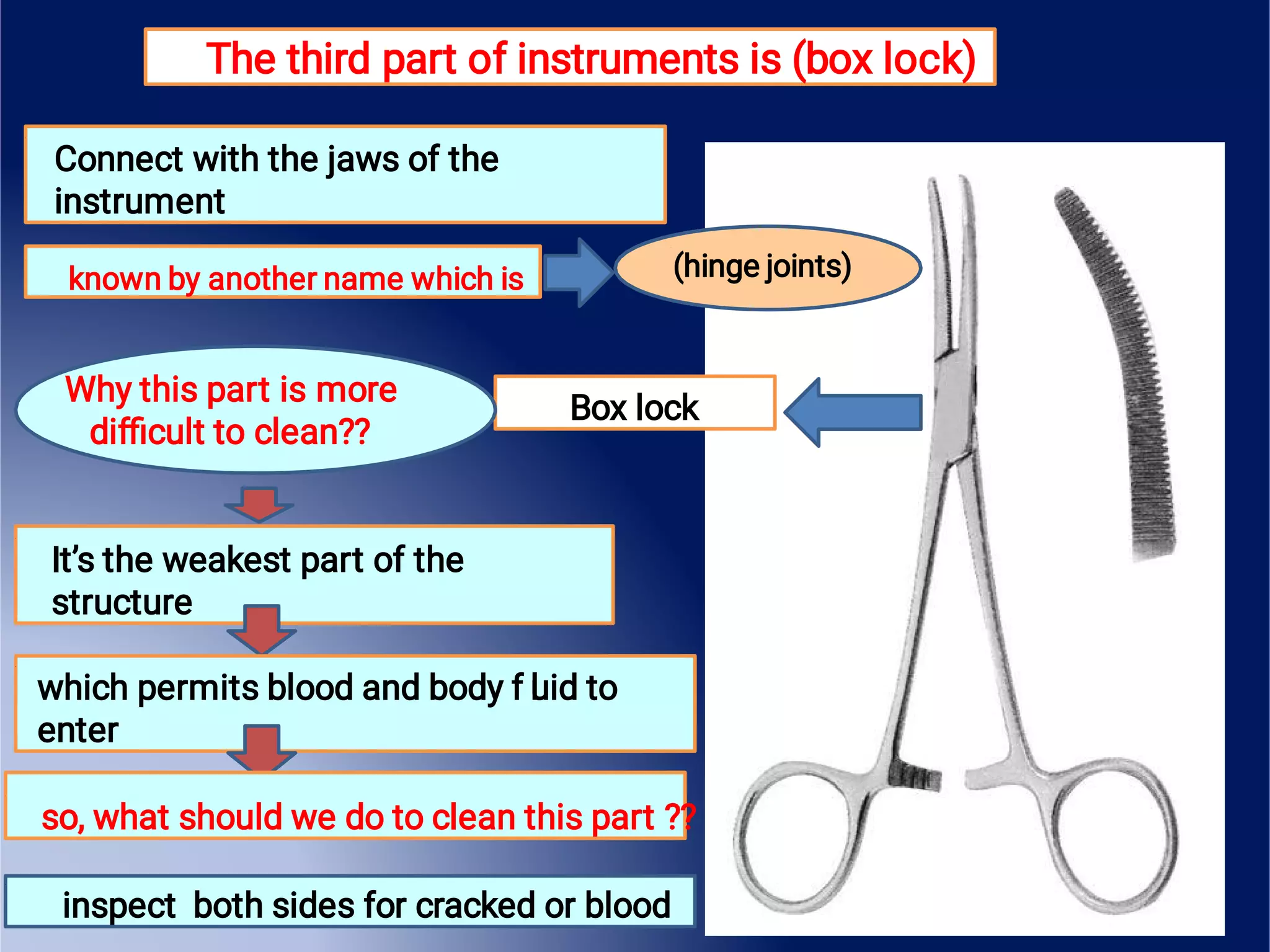
Box lock
The third part of instruments is (box lock)
known by another name which is
Connect with the jaws of the
instrument
Why this part is more
difficult to clean??
It’s the weakest part of the
structure
which permits blood and body f l
uid to
enter
so, what should we do to clean this part ??
(hinge joints)
inspect both sides for cracked or blood
Shank
The fourth part of instruments is (shank)
Which provide the closing force.
connect the box lock to the f i
nger
rings
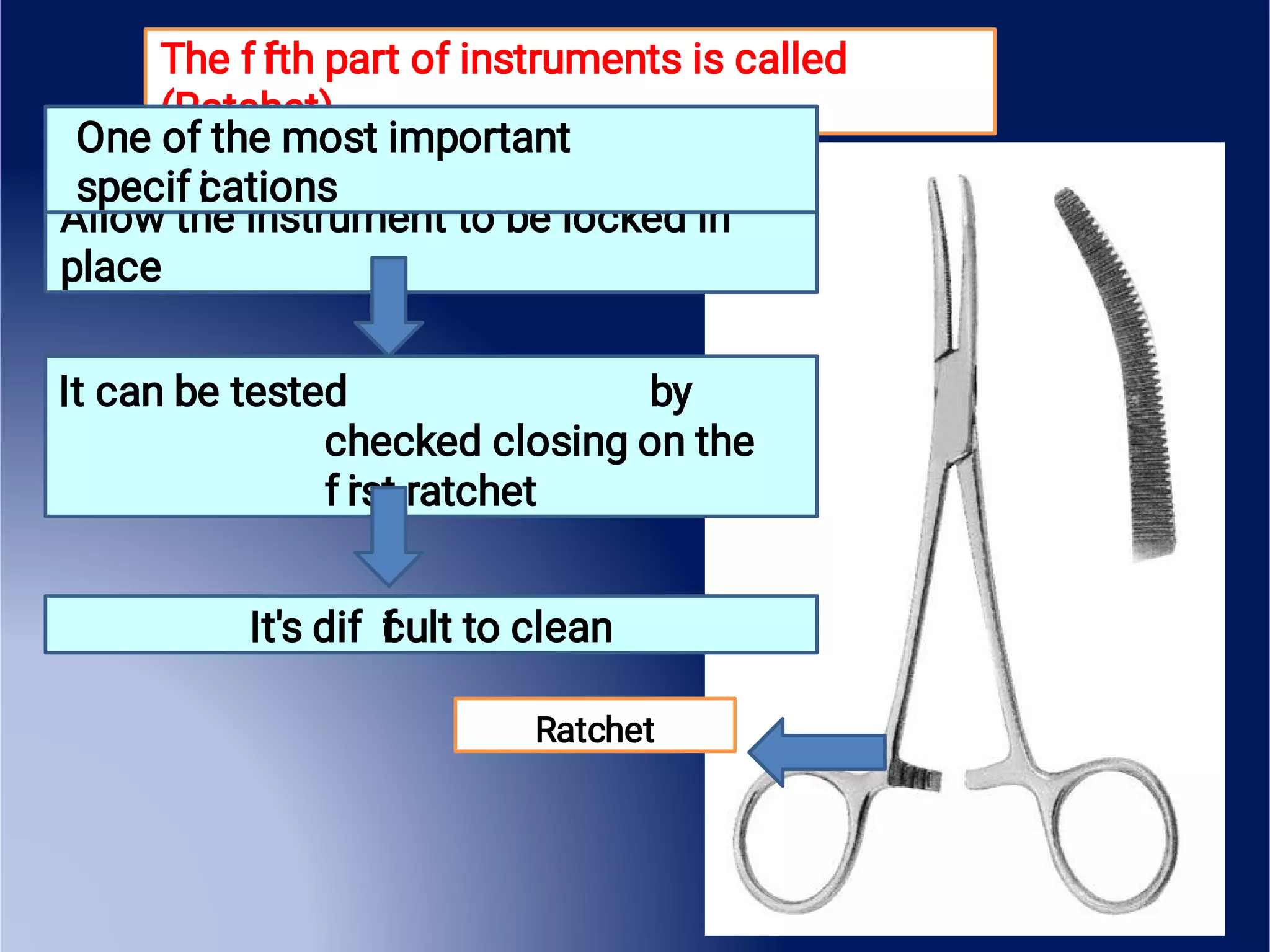
Ratchet
Allow the instrument to be locked in
place
It can be tested by
checked closing on the
f i
rst ratchet
It's dif f
i
cult to clean
The f i
fth part of instruments is called
(Ratchet)
One of the most important
specif i
cations
Ring f i
nger
Used to grip instruments
securely
The sixth part of instruments is (Ring Finger)
known by another name
which is ( Ring Handle )
It control the action of the jaw
which can open or close.
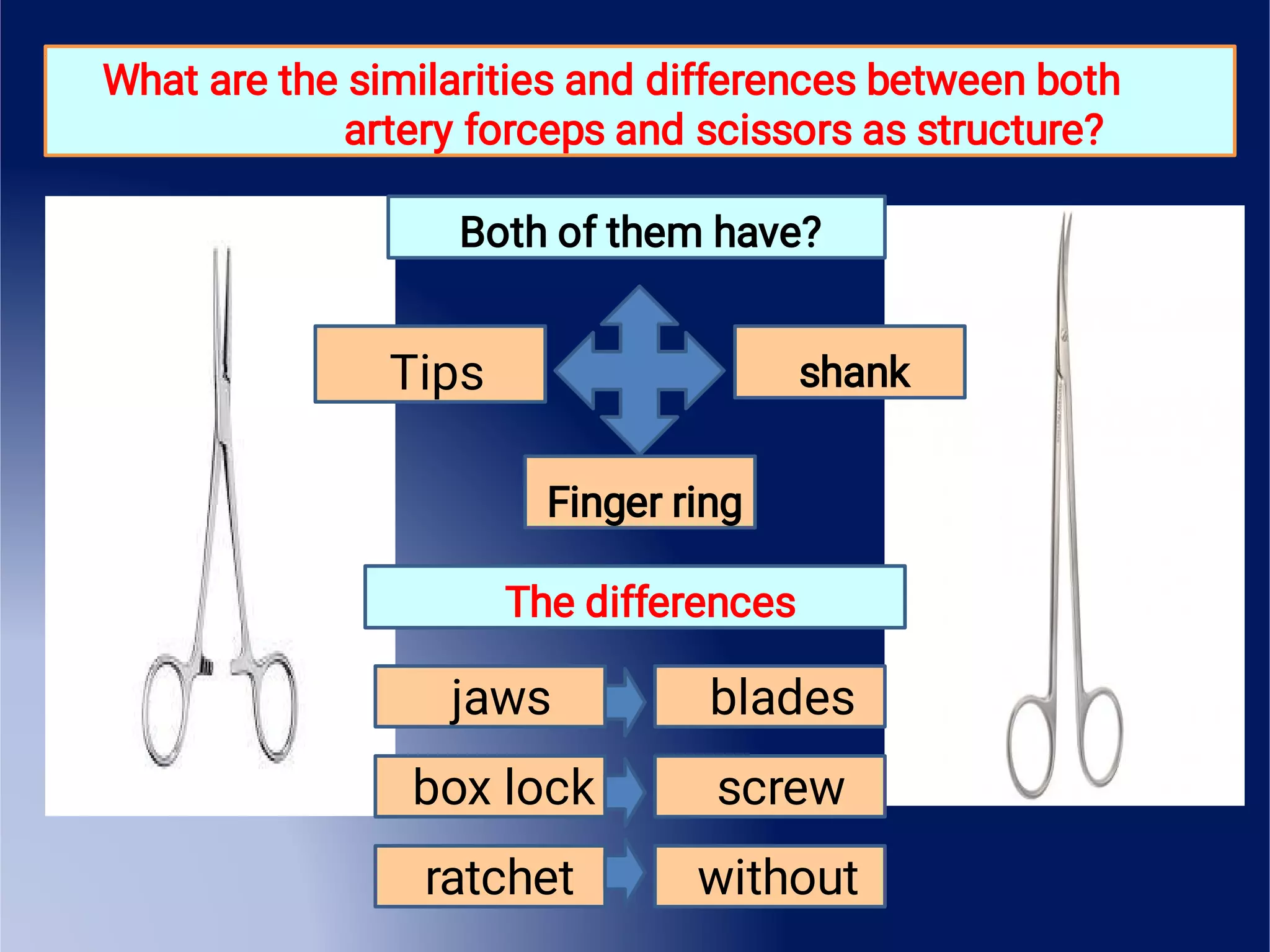
What are the similarities and differences between both
artery forceps and scissors as structure?
Both of them have?
Tips shank
Finger ring
The differences
jaws blades
box lock screw
ratchet without
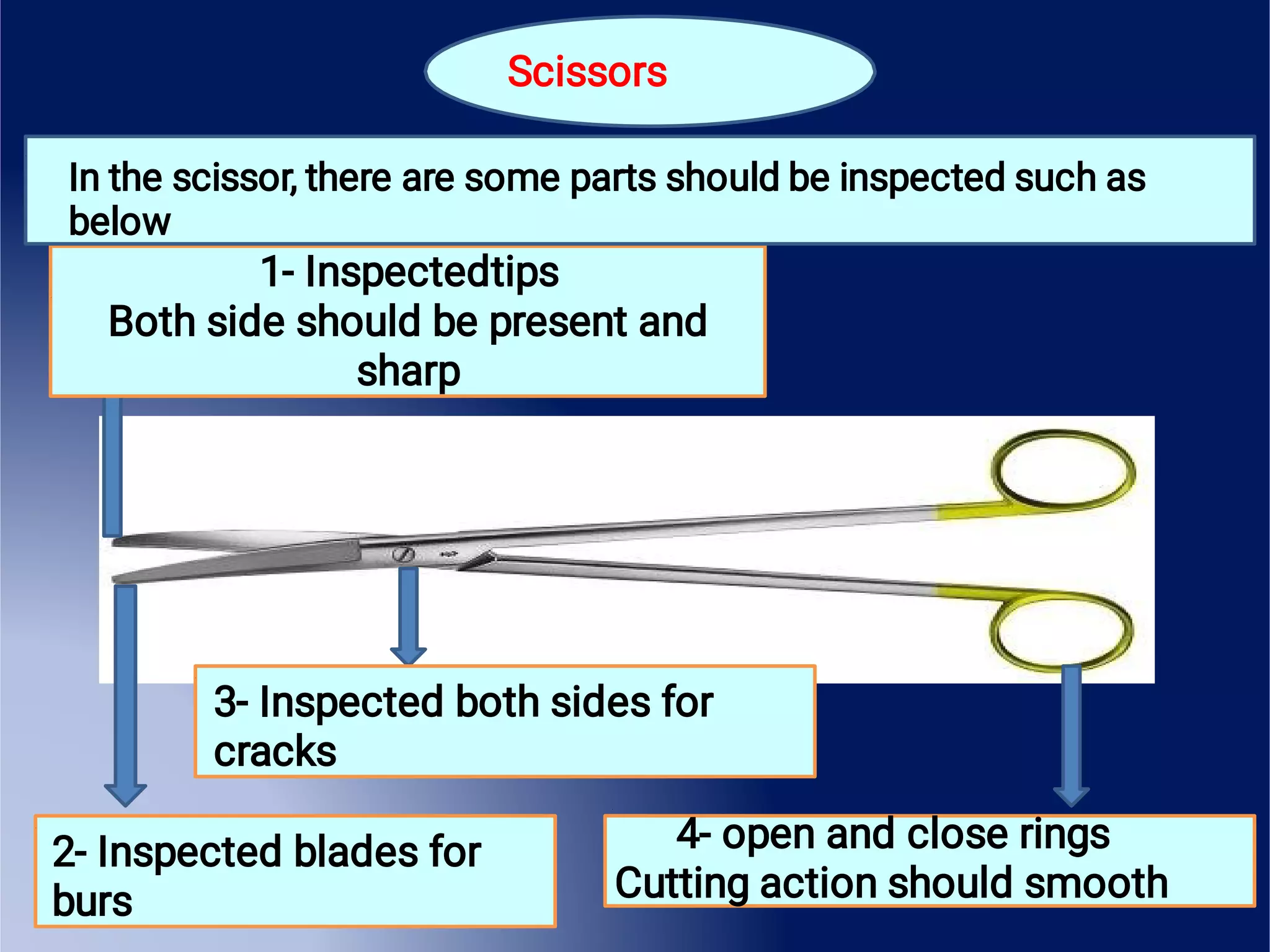
Scissors
1- Inspectedtips
Both side should be present and
sharp
2- Inspected blades for
burs
3- Inspected both sides for
cracks
4- open and close rings
Cutting action should smooth
In the scissor, there are some parts should be inspected such as
below
Tissue
forceps
In the tissue forceps you should inspect three parts of it as
below
Inspect teeth make sure all are present and
No tissue is present Inspect joint for cracks
Inspect handle serration for blood and
tissue
Join
t
Handle
grip
shan
k
Jaw
s
Ti
p
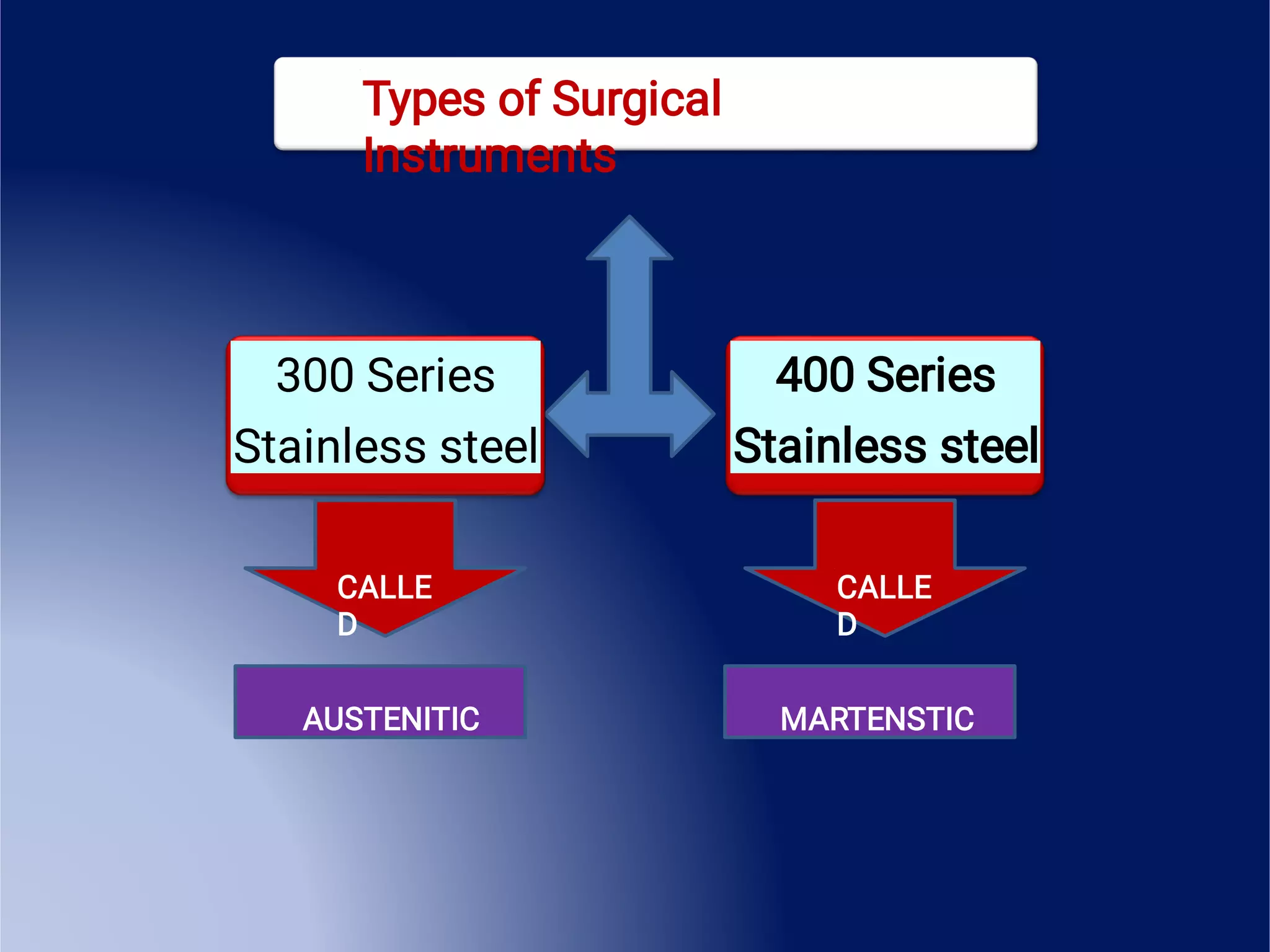
300 Series
Stainless steel
400 Series
Stainless steel
CALLE
D
CALLE
D
AUSTENITIC MARTENSTIC
Types of Surgical
Instruments
BASI
N
BOWEL
S
HOHMAAN
RET
DEAVER
RETRACTOR
BOWEL
KIDNEY
MALLABLE
RETRACTO
R
SCISSO
RS
FORCEP
S
NEDDLE
HOLDER
ALLIS
FORCEPS
OSTEOTOME
S
CHISE
LS
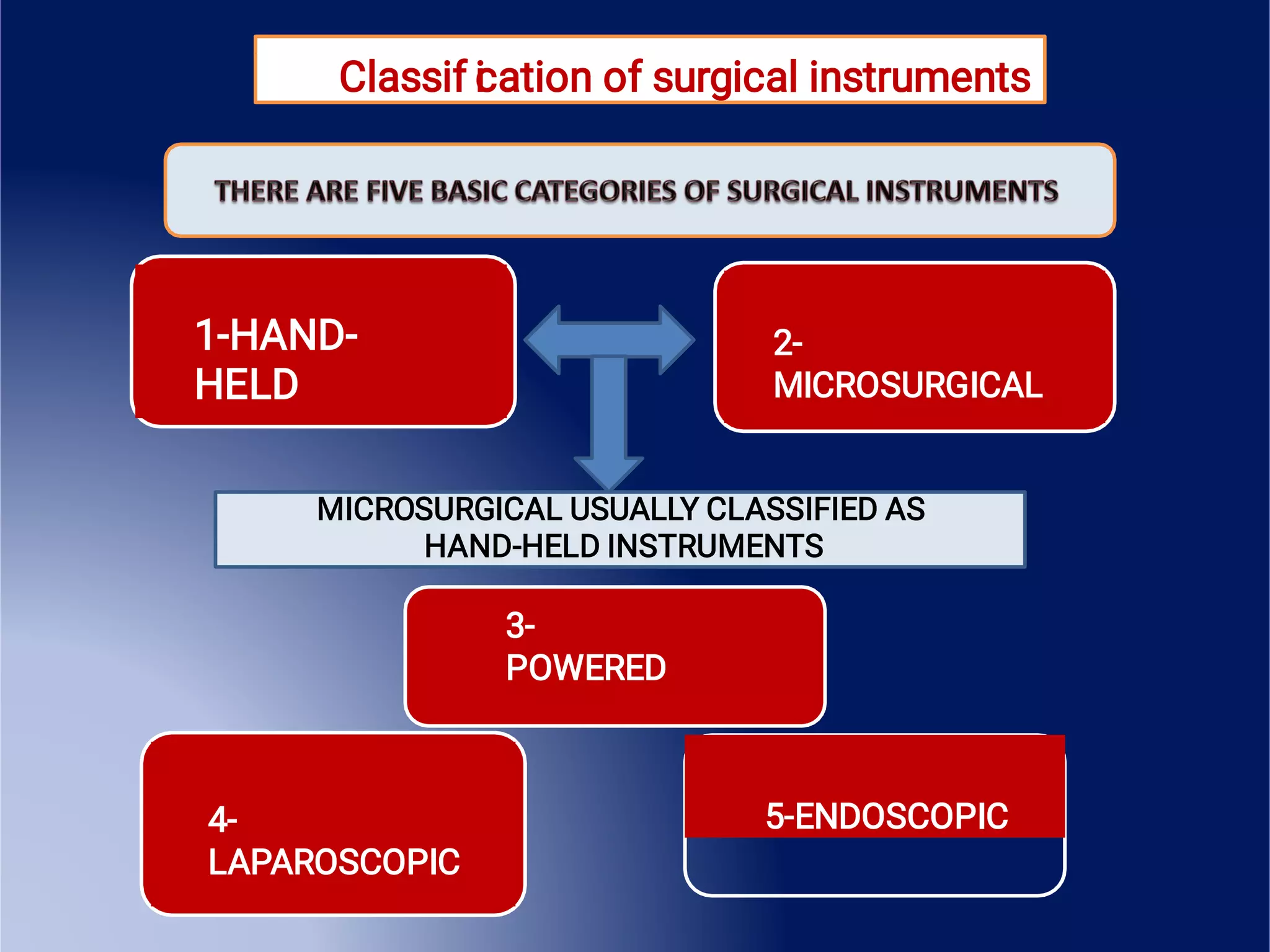
Classif i
cation of surgical instruments
1-HAND-
HELD
2-
MICROSURGICAL
3-
POWERED
4-
LAPAROSCOPIC
5-ENDOSCOPIC
MICROSURGICAL USUALLY CLASSIFIED AS
HAND-HELD INSTRUMENTS
HAND-HELD
INSTRUMENTS
HEMOSTATS Sharps/Dissectors / Cutting
NEEDLE HOLDER
FORCEPS
RERACTORS
LAPARSCOPIC
INSTRUMENTS
MISCELLANEOUS INSTRUMENTS
Inspections of hand-held
instruments
When should be inspected instruments?





Each and every time an instruments is handheld
when receive a new instruments in the department
Whenever they enter the decontamination area
when they are being assembled and packaged for
sterilization
before use, they should be inspected by the OR staff.
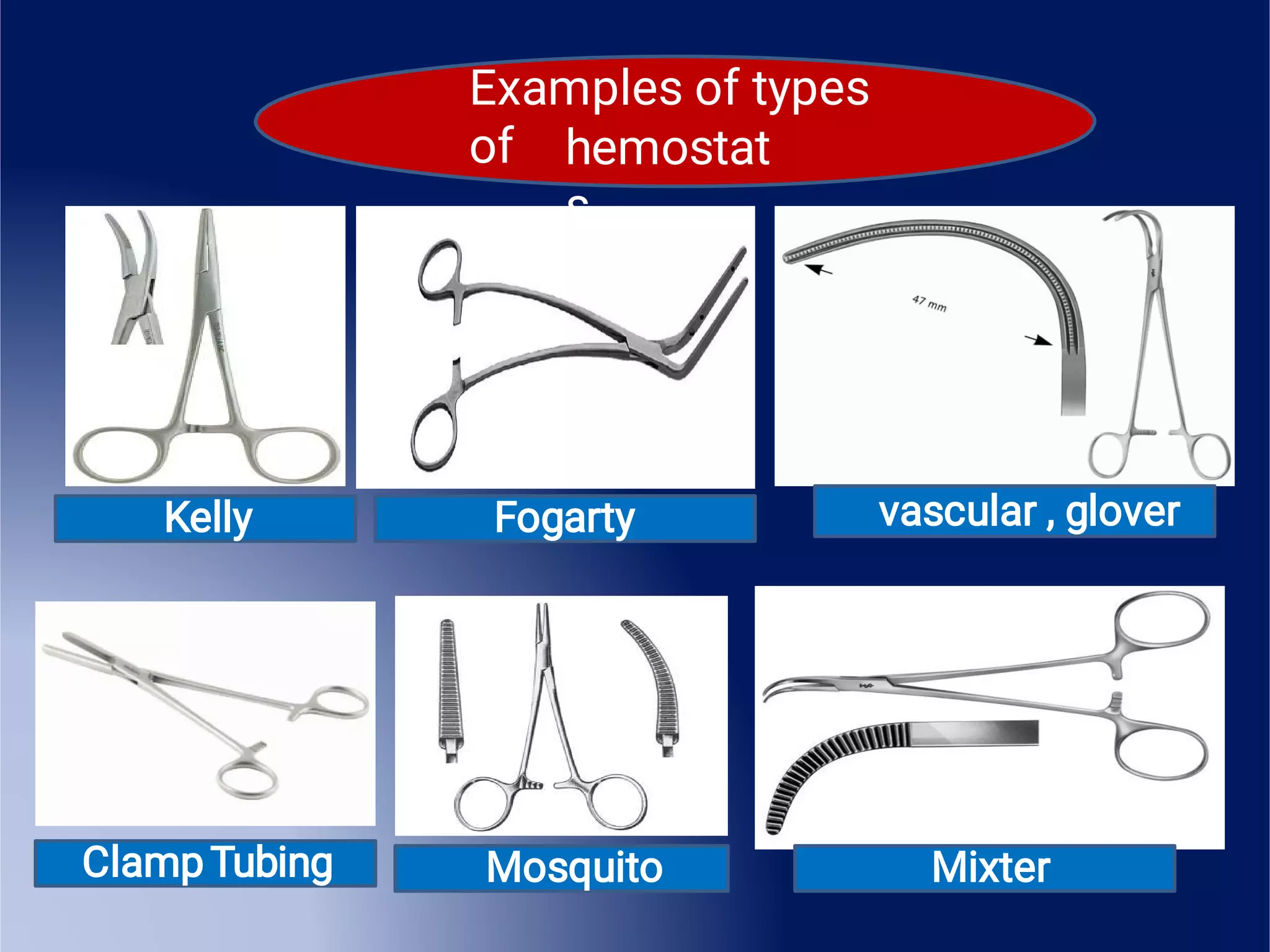
Examples of types
of hemostat
s
Kelly Fogarty vascular , glover
ClampTubing Mosquito Mixter
Examples of types of sharp / cutting
Curette which knows dissectors
Examples of types of
Needle Holder
Crile Wood needle holder Barraquer Needle Holder
Webster needle holder
Microsurgical
Castroviejo
Examples of types of forceps
Forceps / Adson Brown Adson forceps Forceps / Babcock
Forceps / Bayonet
Magill endotracheal forceps Forceps/ DeBakey
Retractors Classif i
ed into two types
Hand held Self retaining
Examples of types of retractor which include handheld
Bone Hook Deaver Volkman
Richardson Harrington Malleable (Ribbon)
Balfour Retractor bookwalter retractor
Examples of types of retractor which include self
retaining
Gelpi Retractor
Cerebellar Retractor Weitlaner Retractor
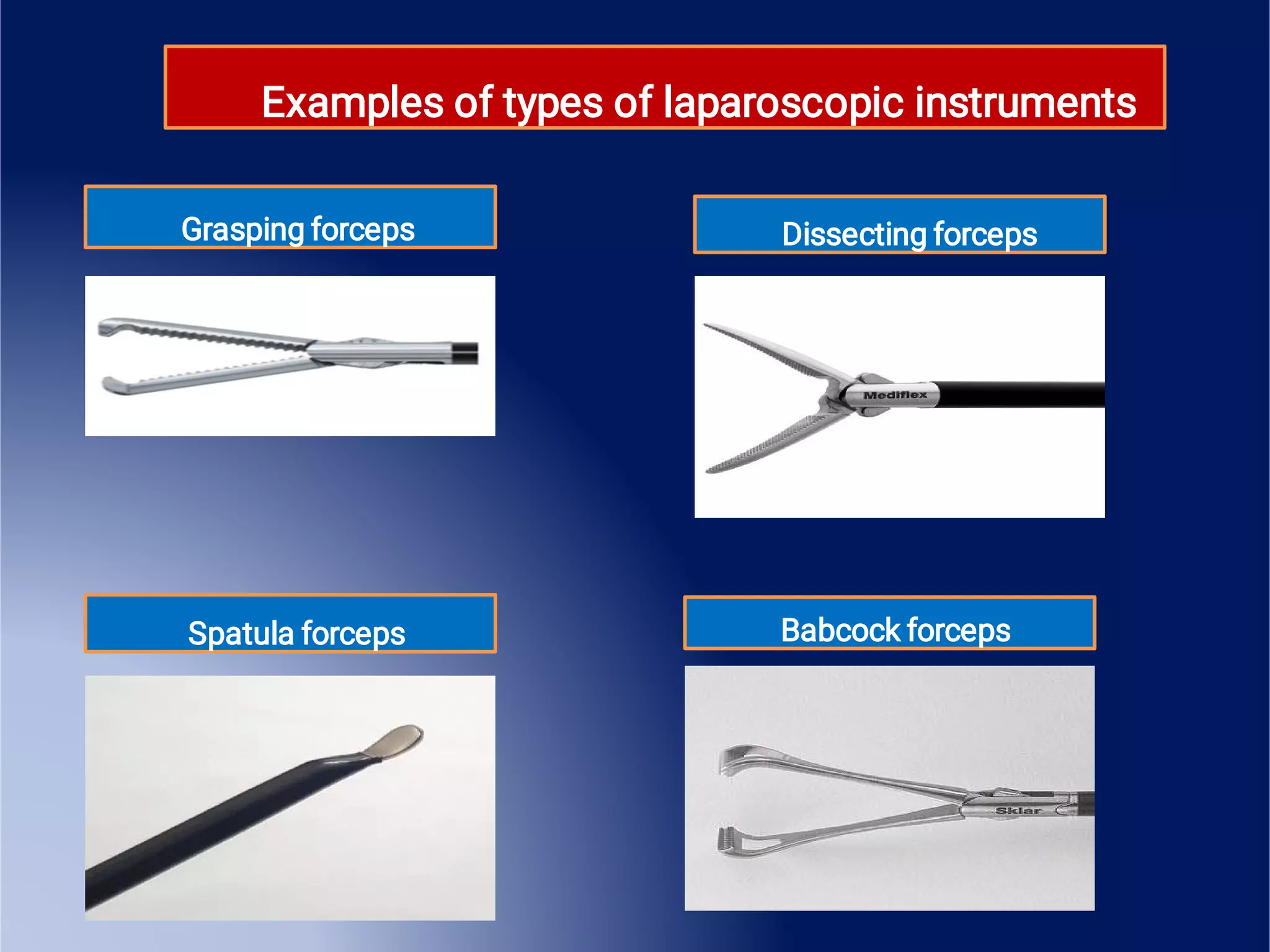
Examples of types of laparoscopic instruments
Grasping forceps Dissecting forceps
Spatula forceps Babcock forceps
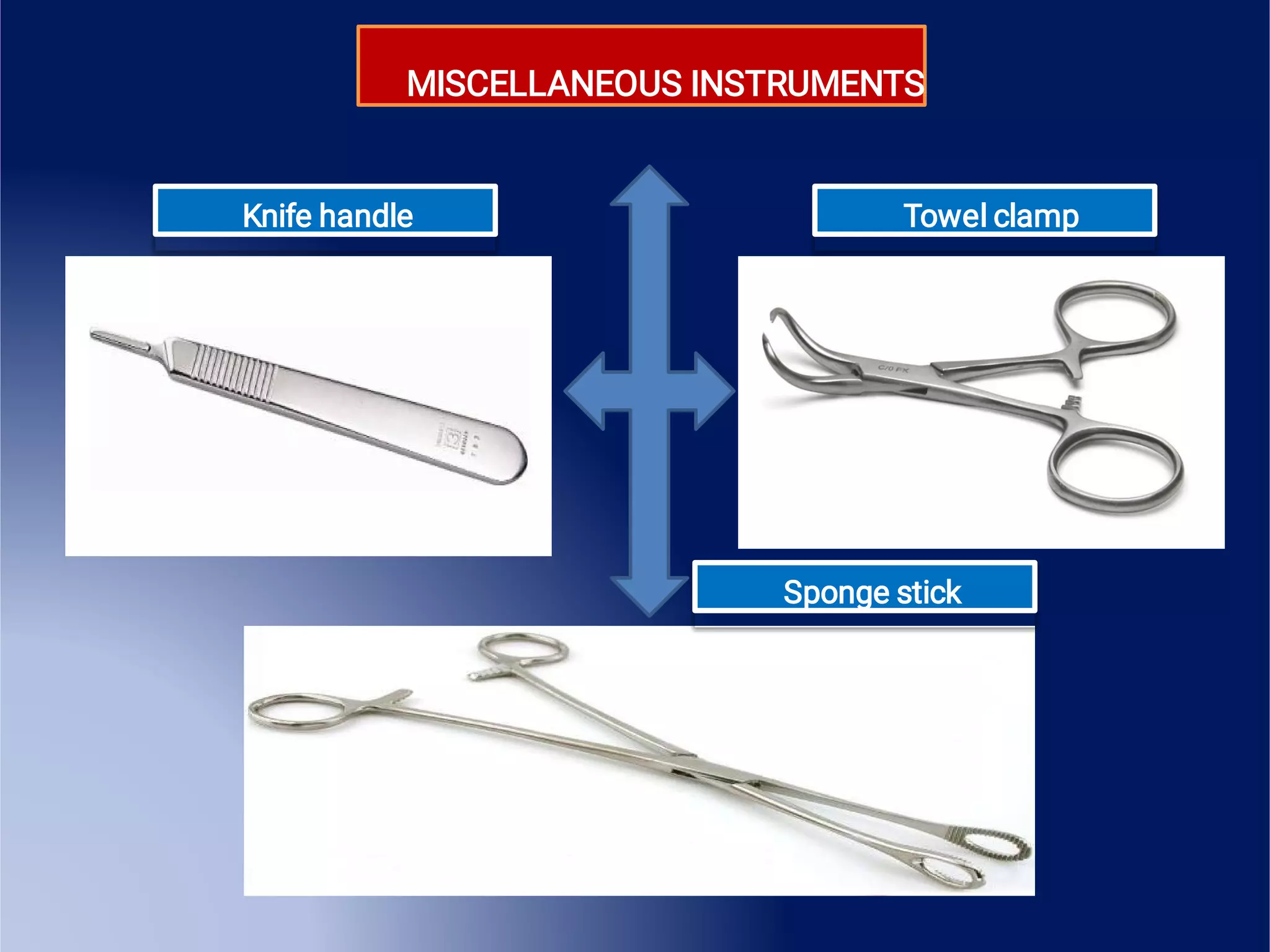
Knife handle Towel clamp
Sponge stick
MISCELLANEOUS INSTRUMENTS
REFERENCES
INSTRUMENTATION FOR THE OPERATING ROOM
NINTH RDITION … SHIRLEY .M.TIGHE
THE BASICS OF STERILE PROCESSING
FOURTH EDITION ( SPD )
CENTRAL SERVICE TECHNICAL MANUAL SEVEN
EDITION ( IAHCSMM )
THANKS
FOR
LISTENING
E-mail: jitendrabardebarde98@gmail.com
Mobile 8349645598

SURGICAL instruments types, classification and risks,.pdf

  • 1.
    Types and classifi cation of Surgical Instruments Presented by Mr.JITENDRA BHARGAV Assistant professor E-mail: jitendrabardebarde98@gmail.com Mobile 8349645598
  • 2.
    Types and classifi cation of surgical instruments
  • 3.
    Objectives learning 1 2 3 1 2 History ofsurgical Instruments Def i nition of the Instruments Manufacture of Surgical Instruments 4- Grade of Surgical Instruments Structure of the Instrument and its function Types and Classif i cation of surgical instruments
  • 4.
    History of surgicalinstruments      The history of surgical instruments began 10.000bc by using the stone knife to perform surgery Then, the modern surgical instrumentation began with the introduction of stainless steel Surgical instruments represent a large portion of healthcare facilities budget Additional they are the tools that surgeons rely on to help ensure a positive outcome of a surgical procedure Each instrument is designed for a specif i c purpose and should never be used for any other purpose
  • 5.
    History of surgicalinstruments    Surgical procedures cannot be effectively performed without properly cleaned, packaged, and sterile surgical instruments. The manufacturer of surgical instruments must provide processing instruction with each instrument manufactured. Reprocessing of surgical instruments is the direct responsibility of CSSD Technician
  • 6.
    Def i nition ofSurgical instruments Are tools or devices that perform such functions as:     Clamping Grasping & Holding Cutting & Dissecting Retracting    Dilating & Probing Suctioning Suturing & Stapling
  • 7.
    Manufacture of Surgical instruments Mostof surgical instruments are made from Stainless Steel. But there are other metals involved in the manufacture of surgical instruments such as Titaniu m chromiu m vanadiu m molybdenu m
  • 8.
  • 9.
          SURGICAL GRADE Is characterizedby: Highest quality The steel from USA and German Their instruments are reusable FLOOR GRADE Is characterized by: A lower grade of stainless steel Low quality and advise not use in OR set Also their instruments are Reusable
  • 10.
  • 11.
  • 12.
    Tips The most importantqualities: Both of them must be equal some of them have teeth while the other kinds without it. U s u a lly b e pointe d o r rounded E.g for teeth kocher, Allis The functions of instrument structures
  • 13.
    Smooth The second partof instruments is (jaws) This can be straight or curved Serrated cross-hatched ?? for grasping tissue or This part which contact with the patient directly. What should you inspect in this part? blood , tissue
  • 14.
    Box lock The thirdpart of instruments is (box lock) known by another name which is Connect with the jaws of the instrument Why this part is more difficult to clean?? It’s the weakest part of the structure which permits blood and body f l uid to enter so, what should we do to clean this part ?? (hinge joints) inspect both sides for cracked or blood
  • 15.
    Shank The fourth partof instruments is (shank) Which provide the closing force. connect the box lock to the f i nger rings
  • 16.
    Ratchet Allow the instrumentto be locked in place It can be tested by checked closing on the f i rst ratchet It's dif f i cult to clean The f i fth part of instruments is called (Ratchet) One of the most important specif i cations
  • 17.
    Ring f i nger Usedto grip instruments securely The sixth part of instruments is (Ring Finger) known by another name which is ( Ring Handle ) It control the action of the jaw which can open or close.
  • 18.
    What are thesimilarities and differences between both artery forceps and scissors as structure? Both of them have? Tips shank Finger ring The differences jaws blades box lock screw ratchet without
  • 19.
    Scissors 1- Inspectedtips Both sideshould be present and sharp 2- Inspected blades for burs 3- Inspected both sides for cracks 4- open and close rings Cutting action should smooth In the scissor, there are some parts should be inspected such as below
  • 20.
    Tissue forceps In the tissueforceps you should inspect three parts of it as below Inspect teeth make sure all are present and No tissue is present Inspect joint for cracks Inspect handle serration for blood and tissue Join t Handle grip shan k Jaw s Ti p
  • 21.
    300 Series Stainless steel 400Series Stainless steel CALLE D CALLE D AUSTENITIC MARTENSTIC Types of Surgical Instruments
  • 22.
  • 23.
  • 24.
    Classif i cation ofsurgical instruments 1-HAND- HELD 2- MICROSURGICAL 3- POWERED 4- LAPAROSCOPIC 5-ENDOSCOPIC MICROSURGICAL USUALLY CLASSIFIED AS HAND-HELD INSTRUMENTS
  • 25.
    HAND-HELD INSTRUMENTS HEMOSTATS Sharps/Dissectors /Cutting NEEDLE HOLDER FORCEPS RERACTORS LAPARSCOPIC INSTRUMENTS MISCELLANEOUS INSTRUMENTS
  • 26.
    Inspections of hand-held instruments Whenshould be inspected instruments?      Each and every time an instruments is handheld when receive a new instruments in the department Whenever they enter the decontamination area when they are being assembled and packaged for sterilization before use, they should be inspected by the OR staff.
  • 27.
    Examples of types ofhemostat s Kelly Fogarty vascular , glover ClampTubing Mosquito Mixter
  • 28.
    Examples of typesof sharp / cutting Curette which knows dissectors
  • 29.
    Examples of typesof Needle Holder Crile Wood needle holder Barraquer Needle Holder Webster needle holder Microsurgical Castroviejo
  • 30.
    Examples of typesof forceps Forceps / Adson Brown Adson forceps Forceps / Babcock Forceps / Bayonet Magill endotracheal forceps Forceps/ DeBakey
  • 31.
    Retractors Classif i edinto two types Hand held Self retaining
  • 32.
    Examples of typesof retractor which include handheld Bone Hook Deaver Volkman Richardson Harrington Malleable (Ribbon)
  • 33.
    Balfour Retractor bookwalterretractor Examples of types of retractor which include self retaining Gelpi Retractor Cerebellar Retractor Weitlaner Retractor
  • 34.
    Examples of typesof laparoscopic instruments Grasping forceps Dissecting forceps Spatula forceps Babcock forceps
  • 35.
    Knife handle Towelclamp Sponge stick MISCELLANEOUS INSTRUMENTS
  • 36.
    REFERENCES INSTRUMENTATION FOR THEOPERATING ROOM NINTH RDITION … SHIRLEY .M.TIGHE THE BASICS OF STERILE PROCESSING FOURTH EDITION ( SPD ) CENTRAL SERVICE TECHNICAL MANUAL SEVEN EDITION ( IAHCSMM ) THANKS FOR LISTENING E-mail: jitendrabardebarde98@gmail.com Mobile 8349645598