Ecological groups
ECOLOGICAL GROUPS
‘Groups of plants growing under
the same set of environmental
factors constitute ecological
groups’
In 1895 warming classified plants
into ecological groups
On the basis of ;
Type of substratum
Adaptic factors of the soil
Ecological groups of plants
Hydrophytes Xerophytes Epiphytes Halophytes
HYDROPHYTES
HYDROPHYTES
• Grow in water or in soil which is saturated
with water
• Water may be fresh or saline
• Lakes ,ponds,pools,rivers,etc. Constitute fresh
water bodies
• Phytoplanktons ;non vascular hydrophytes
• Vascular hydrophytes may arranged to 3
natural groups they are,
1. Rooted and Submerged plants
• Anchored (rooted) hydrophytes
• Completely submerged in water
• Restricted to shallow areas where
they get adequate supply of light
They are of two types
1.Plants with long stems
They bear small leaves at the nodes
hydrilla
ceratophyllum
potamogetoa
2.Plants with tuberous stem
They bear cauline leaves .the leaves are thin and
ribbon shaped.
Vallisneria nymphaea
2.FLOTING PLANTS
They are of two types
Free floating forms
• Not attached to the soil
• Floating
• Grow in large numbers
• Some forms have very large leaves and rise
above water eg.water hyacinth
•Some smaller forms are
Pistia salvinia
azolla
•Plants like utricularia normally remain just
below the surface of water and are rootless
Floating but rooted forms
• Rooted in mud
• Possess floating leaves
• Grow in shallow regions
Water lilly lotus(nelumsium)
Victoria regia
3.AMPHIBIOUS PLANTS
• Inhibits shallow water
• Form the marshy or shallow vegetation
• The basal part is submerged in water and
shoots extends well above the soil
typha sagittaria
hydrophylla
ADAPTATIONS OF
HYDROPHYTES
• Roots are reduced in size,unbranched and
without root hairs
• Stem is thin and delicate due to the lack of
mechanical tissues
• Leaves are reduced in size and are
thin,linear,or ribbon like to escape the effects
of strong water currents
1.SUBMERGED PLANTS
MORPHOLOGICAL ADAPTATIONS
Hydrilla with small leaves,small
roots,and tuberous stem
ANATOMICAL ADAPTATIONS
• They lack cuticle or suberin
• Conducting elements are very few and non
lignified
• Large number of air cavities for gas exchange
and storage
• Mesophyll is undifferentiated to palisade and
spongy tissue
• It is mostly of spongy type
• Chloroplasts are present in the epidermal cells
•Stomata is absent or non functional
•Absence of sclernchyma and collenchyma
2.FREE FLOATING PLANTS
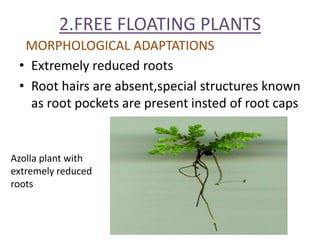
• Extremely reduced roots
• Root hairs are absent,special structures known
as root pockets are present insted of root caps
MORPHOLOGICAL ADAPTATIONS
Azolla plant with
extremely reduced
roots
• Roots are absent in
wolffia,utricularia,ceratophyllum etc.
• Stem is extremely reduced but leaves are
quite well developed
Water hycinth with small roots but well developed leaves
ANATOMICAL ADAPTATIONS
• Well developed air cavities are present in
stems ,leaves, and roots
• Collenchyma and sclerenchyma are
completely absent
• Vascular tissues are poorly developed
• Stomata are present at the upper surface of
leaves
• Palisade parenchyma is developed towards
the upper surface
FLOATING BUT ROOTED PLANTS
• Poorly developed roots
• Roots are produced from horizondal stems,
rootstocks or tubers
• Elongated and well developed petiole
MORPHOLOGICAL ADAPTATIONS
Well
developed
petioles
ANATOMICAL ADAPTATIONS
• Well developed air cavities are present in
petioles
• Leaves are covered with wax
• Stomata are present on the upper surfaces of
leaves
• Palisade parenchyma is developed but the
spongy parenchyma is in far excess. the later
enclose large air cavities
• Mechanical and vascular tissues are extremely
reduced
3.AMPHIBIOUS PLANTS
• Well developed root system
• Plants have rhizomes which lie in the mud and
may show hydric and xeric adaptations
• Heterophylly(presence of more than one type
of leaves) is exhibited, submerged leaves are
normally disected and the lobes are linear and
thin
MORPHOLOGICAL ADAPTATIONS
ANATOMICAL ADAPTATIONS
• Aerenchyma and storage parenchyma are
present
• Mechanical and conducting elements are
present
• Thick walled endodermis to check loss of
water
• Large air chambers are present. which are
separated by diaphragms
XEROPHYTES
XEROPHYTES
• Plants which grows in xeric habitat such as
* places like deserts, plain peaks, sand hills
* shortage of water
*high rate of transpiration
• they are modified to withstand unfavourable
conditions
Classification of xerophytes
• Depending upon the ability of xerophytes to
withstand unfavourable situation they are
classified as;
1.drought escaping
2.drought evading
3.drought enduring
4.drought resisting
1.Drought escaping (ephemerals)
• They are annuals
• Very short growing and flowering season
• Complete their life cycle in 4-6 weeks
• Found growing in semi arid region having
a brief rainy season
Arabidopis thaliana Alyassum alyssoides
2.Drought evading
• Very small in size
• Have restricted growth and require very
low amount of water for growth and
development
• They conserve whatever little amount if
light they get and evade drought
Ambrosia dumosa Encelia farinosa
(white bursage) (brittle bush)
3.Drought enduring(non-succulents)
• Slow growing shrubs
• They are small and have stunted growth
• They endure long dry periods when there is
acute shortage of water
• Extremely restricted growth
• Leaves wilt and fall down during unfavourable
season
• Resume growth in turn of favourable growth
Larrea tridentata (creosote bush)
4.Drought resisting(succulents)
• They have thick and fleshy stems or leaves
• They store large amount of water and resist
drought
• Have well extended root system for water
absorption
• With the help of stored water they continue
their growth, flowering and fruiting
Agave Aloe
Euphorbia opuntia
MORPHOLOGICAL ADAPTATIONS
• They are provided with
a very deep and
extensive root system
for water absorption. it
is almost 129 feet
below the soil
• The stem is stunted in
growth and form a
bushy appearance
• Presence of
underground stems to
tide over the dry season
eg.saccharum
• Presence of hard and
woody stems
eg.acacia,prosopis,zizyp
hus
• Capparis aphylla have
completely dispensed
with leaves to check
transpiration
Prosopis with woody
appearance
• Leaves are reduced to
small scaly or spiny
structures
eg.ruscus,asparagus,cas
aurina
• Microphyllus leaves are
present in many
xerophytes
• Plants like nerium have
shining surfaces to
reflect away light and
heat
Asparagus
• The leaves of many xerophytic plants
have a waxy coating on the upper
surface. they are also covered with a
dense mass of hairs
ANATOMICAL ADAPTATIONS
• Presence of thick cuticle on the upper and
lower surface of leaves
• Thick epidermal walls
• Presence of multiple epidermis on leaves
eg.nerium
• Stomata are greatly reduced in number and is
restricted to lower surface
• Stomata are situated in deep pits and those
• pits are filled with hairs eg.nerium
• Sclerenchymatous hypodermis eg.pinus
needle
• The spongy parenchyma cells are
comparatively fewer and have very small inter
cellular spaces
• Presence of small cells and small vacuoles to
maintain protoplasmic stability
• The protoplasam is not easily pulled away
from the cellwall and therefore the
plasmodesmata do not get ruptured
• Well developed xylem and phloem
Physiological adaptations
• Thick cell sap
HALOPHYTES
• Inhabit in saline soils
• Tolerant to a high concentration of soluble
inorganic salts
• The plants are affected by these dissolved
inorganic salts
• The effect may be partially osmotic and
partially chemical
• To maintain turgidity cell sap is much more
concentrated
SALIENT FEATURES OF
HALOPHYTES
• A vast number of halophytic flora are
succulents
• Leaves may be thin ,small leathery, and spiny
to minimise loss of water in transpiration
• They have evergreen leaves which have water
storage tissue, prominent palisade cells, and
thick cuticle
• They are provided with
negatively geotropic
pneumatophores for
gaseous exchange
eg.mangrooves
• Some halophytes
exhibit vivipary
ie,seeds germinate
before the fruits break
off the plants
• Salt glands are
presesnt
TYPES OF HALOPHYTES
• They grow on rocks near the rocks
1.LITHOPHILOUS
2.PSAMMOPHILOUS
•They grow on sandy region
3.PELOPHILOUS
They grow in places where the saaline soilloam
with a predominance of clay
4.SALT SWAMP AND SALT DESERT
• They grow in calm water and muddy spots
5.MANGROVES
• Mangroves or littoral swamp forest grow on
sea shores in tropical and sub tropical regions
MANGROOVES
• In tropical and subtropical regions halophytes
form a typical sea shore vegetation called
mangrooves
• Mangroves are present in suderbans,on the
coasts of Mumbai and Kerala,
• Their osmotic potential is maintained at a low
level to facilitate absorption of water from sea
MANGROOVES IN KERALA
• In Kerala mangroves are distributed in all the
districts except Idukki, Pathanamthitta,
Palakkad and Wayanad.
• Maximum extent is reported from Kannur
district.
• The total extent of mangrove forests in the
state is estimated to be less than 50km2
(Mohanan 1997) .
MAIN SPECIES
• Acanthus cillicifolius,
• Acrostichum aurem,
• Aegiceras corniculatum,
• Avicennia officinalis,
• Azima tetracantha,
• Bruguiera gymnorrhiza,
• B. cylindrica,
• B sexangula,
• Excoecaria agallocha,
• E indica,
• Kandelia candel,
• Rhizophora apiculate,
• R mucronata,
• Sonneratia caseolaris,
• Calophyllum etc.
ADAPTIC FEATURES OF
MANGROOVES
• STILT ROOTS
• PNEUMATOPHORES :special negatively
geotropical roots for absorbing atmospheric
oxygen
• VIVIPARY :seeds start germinating while fruit is
still attached to the mother plant
• SHRUBY AND WOODY NATUER
• SALT GLANDS; salt glands are present
EPIPHYTES
EPIPHYTES
• Plants which grow on other plants
• But will prepare their on food unlike parasites
• Grow in places where there is regular rainfall
and plenty of humidity in the atmosphere
• They bears three types of roots,clinging
roots,velamen roots,and areal roots
• They produce large amount of seeds
ADAPTATIONS TO CHEK
TRANSPIRATION
• Few leaves
• Thick leathery or
succulent leaves
• Thick cuticle
• Sunken stomata
Classification of epiphytes
• A number of species of family
Asclepiadaceae,Pepromia,and a few ferns
drive their nutrition from the host and
atmosphere
1.Proto epiphyte
2.Hemi epiphyte
•Their epyphytism is linked to their early
developmental stages which they complete on
certain hosts
•Later they grow on ground with their on roots
and behave as completely independent plants
•Eg.ficus,fig trees etc.
3.Nest epiphyte
Many orchids form net like structures to collect
large quantities of humus and water
4.Tank epiphyte
•The leaves are modified to pocket,funnel,or
spoon like structures to absorb humus and
mineral nutrients which accumulate in the bark
surface crevices of the host support.
• Peltate scaly hairs present on the base of the
leaves to absorb nutrients
•The root as are concerned only with the
anchorage of the epiphyte on the host
THANKYOU

Ecological groups

  • 1.
  • 2.
    ECOLOGICAL GROUPS ‘Groups ofplants growing under the same set of environmental factors constitute ecological groups’
  • 3.
    In 1895 warmingclassified plants into ecological groups On the basis of ; Type of substratum Adaptic factors of the soil Ecological groups of plants Hydrophytes Xerophytes Epiphytes Halophytes
  • 4.
  • 5.
    HYDROPHYTES • Grow inwater or in soil which is saturated with water • Water may be fresh or saline • Lakes ,ponds,pools,rivers,etc. Constitute fresh water bodies • Phytoplanktons ;non vascular hydrophytes • Vascular hydrophytes may arranged to 3 natural groups they are,
  • 6.
    1. Rooted andSubmerged plants • Anchored (rooted) hydrophytes • Completely submerged in water • Restricted to shallow areas where they get adequate supply of light
  • 7.
    They are oftwo types 1.Plants with long stems They bear small leaves at the nodes hydrilla ceratophyllum
  • 8.
  • 9.
    2.Plants with tuberousstem They bear cauline leaves .the leaves are thin and ribbon shaped. Vallisneria nymphaea
  • 10.
    2.FLOTING PLANTS They areof two types Free floating forms • Not attached to the soil • Floating • Grow in large numbers • Some forms have very large leaves and rise above water eg.water hyacinth
  • 11.
    •Some smaller formsare Pistia salvinia azolla
  • 12.
    •Plants like utricularianormally remain just below the surface of water and are rootless
  • 13.
    Floating but rootedforms • Rooted in mud • Possess floating leaves • Grow in shallow regions Water lilly lotus(nelumsium)
  • 14.
  • 15.
    3.AMPHIBIOUS PLANTS • Inhibitsshallow water • Form the marshy or shallow vegetation • The basal part is submerged in water and shoots extends well above the soil
  • 16.
  • 17.
    ADAPTATIONS OF HYDROPHYTES • Rootsare reduced in size,unbranched and without root hairs • Stem is thin and delicate due to the lack of mechanical tissues • Leaves are reduced in size and are thin,linear,or ribbon like to escape the effects of strong water currents 1.SUBMERGED PLANTS MORPHOLOGICAL ADAPTATIONS
  • 18.
    Hydrilla with smallleaves,small roots,and tuberous stem
  • 19.
    ANATOMICAL ADAPTATIONS • Theylack cuticle or suberin • Conducting elements are very few and non lignified • Large number of air cavities for gas exchange and storage • Mesophyll is undifferentiated to palisade and spongy tissue • It is mostly of spongy type • Chloroplasts are present in the epidermal cells
  • 20.
    •Stomata is absentor non functional •Absence of sclernchyma and collenchyma
  • 21.
    2.FREE FLOATING PLANTS •Extremely reduced roots • Root hairs are absent,special structures known as root pockets are present insted of root caps MORPHOLOGICAL ADAPTATIONS Azolla plant with extremely reduced roots
  • 22.
    • Roots areabsent in wolffia,utricularia,ceratophyllum etc. • Stem is extremely reduced but leaves are quite well developed Water hycinth with small roots but well developed leaves
  • 23.
    ANATOMICAL ADAPTATIONS • Welldeveloped air cavities are present in stems ,leaves, and roots • Collenchyma and sclerenchyma are completely absent • Vascular tissues are poorly developed • Stomata are present at the upper surface of leaves • Palisade parenchyma is developed towards the upper surface
  • 24.
    FLOATING BUT ROOTEDPLANTS • Poorly developed roots • Roots are produced from horizondal stems, rootstocks or tubers • Elongated and well developed petiole MORPHOLOGICAL ADAPTATIONS
  • 25.
  • 26.
    ANATOMICAL ADAPTATIONS • Welldeveloped air cavities are present in petioles • Leaves are covered with wax • Stomata are present on the upper surfaces of leaves • Palisade parenchyma is developed but the spongy parenchyma is in far excess. the later enclose large air cavities • Mechanical and vascular tissues are extremely reduced
  • 27.
    3.AMPHIBIOUS PLANTS • Welldeveloped root system • Plants have rhizomes which lie in the mud and may show hydric and xeric adaptations • Heterophylly(presence of more than one type of leaves) is exhibited, submerged leaves are normally disected and the lobes are linear and thin MORPHOLOGICAL ADAPTATIONS
  • 28.
    ANATOMICAL ADAPTATIONS • Aerenchymaand storage parenchyma are present • Mechanical and conducting elements are present • Thick walled endodermis to check loss of water • Large air chambers are present. which are separated by diaphragms
  • 29.
  • 30.
    XEROPHYTES • Plants whichgrows in xeric habitat such as * places like deserts, plain peaks, sand hills * shortage of water *high rate of transpiration • they are modified to withstand unfavourable conditions
  • 31.
    Classification of xerophytes •Depending upon the ability of xerophytes to withstand unfavourable situation they are classified as; 1.drought escaping 2.drought evading 3.drought enduring 4.drought resisting
  • 32.
    1.Drought escaping (ephemerals) •They are annuals • Very short growing and flowering season • Complete their life cycle in 4-6 weeks • Found growing in semi arid region having a brief rainy season
  • 33.
  • 34.
    2.Drought evading • Verysmall in size • Have restricted growth and require very low amount of water for growth and development • They conserve whatever little amount if light they get and evade drought
  • 35.
    Ambrosia dumosa Enceliafarinosa (white bursage) (brittle bush)
  • 36.
    3.Drought enduring(non-succulents) • Slowgrowing shrubs • They are small and have stunted growth • They endure long dry periods when there is acute shortage of water • Extremely restricted growth • Leaves wilt and fall down during unfavourable season • Resume growth in turn of favourable growth
  • 37.
  • 38.
    4.Drought resisting(succulents) • Theyhave thick and fleshy stems or leaves • They store large amount of water and resist drought • Have well extended root system for water absorption • With the help of stored water they continue their growth, flowering and fruiting
  • 39.
  • 40.
    MORPHOLOGICAL ADAPTATIONS • Theyare provided with a very deep and extensive root system for water absorption. it is almost 129 feet below the soil • The stem is stunted in growth and form a bushy appearance
  • 41.
    • Presence of undergroundstems to tide over the dry season eg.saccharum • Presence of hard and woody stems eg.acacia,prosopis,zizyp hus • Capparis aphylla have completely dispensed with leaves to check transpiration Prosopis with woody appearance
  • 42.
    • Leaves arereduced to small scaly or spiny structures eg.ruscus,asparagus,cas aurina • Microphyllus leaves are present in many xerophytes • Plants like nerium have shining surfaces to reflect away light and heat Asparagus
  • 43.
    • The leavesof many xerophytic plants have a waxy coating on the upper surface. they are also covered with a dense mass of hairs
  • 44.
    ANATOMICAL ADAPTATIONS • Presenceof thick cuticle on the upper and lower surface of leaves • Thick epidermal walls • Presence of multiple epidermis on leaves eg.nerium • Stomata are greatly reduced in number and is restricted to lower surface • Stomata are situated in deep pits and those • pits are filled with hairs eg.nerium
  • 46.
    • Sclerenchymatous hypodermiseg.pinus needle • The spongy parenchyma cells are comparatively fewer and have very small inter cellular spaces • Presence of small cells and small vacuoles to maintain protoplasmic stability • The protoplasam is not easily pulled away from the cellwall and therefore the plasmodesmata do not get ruptured • Well developed xylem and phloem
  • 47.
  • 48.
  • 49.
    • Inhabit insaline soils • Tolerant to a high concentration of soluble inorganic salts • The plants are affected by these dissolved inorganic salts • The effect may be partially osmotic and partially chemical • To maintain turgidity cell sap is much more concentrated
  • 50.
    SALIENT FEATURES OF HALOPHYTES •A vast number of halophytic flora are succulents • Leaves may be thin ,small leathery, and spiny to minimise loss of water in transpiration • They have evergreen leaves which have water storage tissue, prominent palisade cells, and thick cuticle
  • 51.
    • They areprovided with negatively geotropic pneumatophores for gaseous exchange eg.mangrooves • Some halophytes exhibit vivipary ie,seeds germinate before the fruits break off the plants • Salt glands are presesnt
  • 52.
    TYPES OF HALOPHYTES •They grow on rocks near the rocks 1.LITHOPHILOUS 2.PSAMMOPHILOUS •They grow on sandy region 3.PELOPHILOUS They grow in places where the saaline soilloam with a predominance of clay
  • 53.
    4.SALT SWAMP ANDSALT DESERT • They grow in calm water and muddy spots 5.MANGROVES • Mangroves or littoral swamp forest grow on sea shores in tropical and sub tropical regions
  • 54.
    MANGROOVES • In tropicaland subtropical regions halophytes form a typical sea shore vegetation called mangrooves • Mangroves are present in suderbans,on the coasts of Mumbai and Kerala, • Their osmotic potential is maintained at a low level to facilitate absorption of water from sea
  • 55.
    MANGROOVES IN KERALA •In Kerala mangroves are distributed in all the districts except Idukki, Pathanamthitta, Palakkad and Wayanad. • Maximum extent is reported from Kannur district. • The total extent of mangrove forests in the state is estimated to be less than 50km2 (Mohanan 1997) .
  • 56.
    MAIN SPECIES • Acanthuscillicifolius, • Acrostichum aurem, • Aegiceras corniculatum, • Avicennia officinalis, • Azima tetracantha, • Bruguiera gymnorrhiza, • B. cylindrica, • B sexangula, • Excoecaria agallocha, • E indica, • Kandelia candel, • Rhizophora apiculate, • R mucronata, • Sonneratia caseolaris, • Calophyllum etc.
  • 57.
    ADAPTIC FEATURES OF MANGROOVES •STILT ROOTS • PNEUMATOPHORES :special negatively geotropical roots for absorbing atmospheric oxygen • VIVIPARY :seeds start germinating while fruit is still attached to the mother plant • SHRUBY AND WOODY NATUER • SALT GLANDS; salt glands are present
  • 58.
  • 59.
    EPIPHYTES • Plants whichgrow on other plants • But will prepare their on food unlike parasites • Grow in places where there is regular rainfall and plenty of humidity in the atmosphere • They bears three types of roots,clinging roots,velamen roots,and areal roots • They produce large amount of seeds
  • 61.
    ADAPTATIONS TO CHEK TRANSPIRATION •Few leaves • Thick leathery or succulent leaves • Thick cuticle • Sunken stomata
  • 62.
    Classification of epiphytes •A number of species of family Asclepiadaceae,Pepromia,and a few ferns drive their nutrition from the host and atmosphere 1.Proto epiphyte 2.Hemi epiphyte •Their epyphytism is linked to their early developmental stages which they complete on certain hosts
  • 63.
    •Later they growon ground with their on roots and behave as completely independent plants •Eg.ficus,fig trees etc. 3.Nest epiphyte Many orchids form net like structures to collect large quantities of humus and water
  • 64.
    4.Tank epiphyte •The leavesare modified to pocket,funnel,or spoon like structures to absorb humus and mineral nutrients which accumulate in the bark surface crevices of the host support. • Peltate scaly hairs present on the base of the leaves to absorb nutrients •The root as are concerned only with the anchorage of the epiphyte on the host
  • 66.