9/8/2016
1
akhilab2016@outlook.com
OVERVIEW
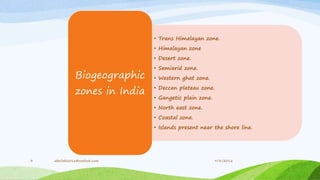
• Trans Himalayan zone.
• Himalayan zone
• Desert zone.
• Semiarid zone.
• Western ghat zone.
• Deccan plateau zone.
• Gangetic plain zone.
• North east zone.
• Coastal zone.
• Islands present near the shore line.
9/8/20162
• Trans Himalayan zone.
• Himalayan zone
• Desert zone.
• Semiarid zone.
• Western ghat zone.
• Deccan plateau zone.
• Gangetic plain zone.
• North east zone.
• Coastal zone.
• Islands present near the shore line.
Biogeographic
zones in India
9/8/2016akhilab2016@outlook.com3
9/8/2016akhilab2016@outlook.com4
9/8/2016akhilab2016@outlook.com5
FEATURES OF TRANS HIMALAYAS
 COLD AND ARID REGION.
 TEMPERATURE -35 to 3 degrees Celsius
 4500 mts. Above mean sea level
 sparse vegetation has the richest wild sheep and goat community in the
world
 Extensive area covered by BARE ROCKS and GLACIERS
 FAUNA:-
• wild sheep, wild goats, ibex, snow leopard, marbled cats, marmots,
black necked crane
9/8/2016akhilab2016@outlook.com6
9/8/2016akhilab2016@outlook.com7
Marco polo sheep - ratio of horn length to
body weight exceeds that of any animal in
the world
HIMALAYAS
• FEATURES:-
 Flora: 2,50,000 species
 Fauna: 45,000 species
 Tropical Rainforests- Eastern Himalaya
 Thick subtropical and Alpine forests – central Himalaya, western
Himalaya
 Rich endemic forests in north east
 Chief species include wild sheep, mountain goats, ibex, shrew, and
tapir. Panda and snow leopard are also found here.
9/8/2016akhilab2016@outlook.com8
Classification No. of species
Angiosperms 15,000
Gymnosperms 64
Pteridophytes 1,022
Bryophytes 2,584
Algae 2,500
Fungi 23,000
Bacteria 850
Lichens 1,600
Source: Rao, 1994: BSI, 1992
9/8/2016akhilab2016@outlook.com9
TOPOGRAPHY OF HIMALAYAS
• Young mountains
• Series of mountains running parallel to each other.
• Thick gravel and alluvium
• Source of major snow fed rivers of India.
• Snow covered peaks, glaciers and pristine rivers.
9/8/2016akhilab2016@outlook.com10
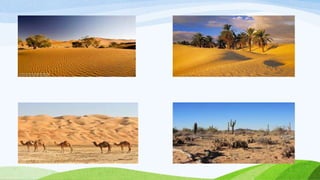
DESERT
1. Deserts in India include Thar desert and Kutch.
2. They receive around 25 cm of precipitation annually.
3. Temperature: 30 to 50 degrees
4. Fauna : Snakes, Owls , mice, armadillo lizards, foxes, bats,
vultures, rabbit, cats ,camel etc.
5. Flora: Cactus, prickly pear, octillo plant, boojum.
6. Hot and extreme climate.
7. Vegetation found in oasis.
8. Soil is composed of sand and hard rocks.
9. States covered: Rajasthan and Gujarat
9/8/2016
11
9/8/2016akhilab2016@outlook.com12
SEMI ARID REGIONS
1. States included: Parts of Punjab, Haryana, Gujarat, Maharashtra.
2. Transitional zone between desert and dense forests of western Ghats.
3. Natural vegetation is thorn forest.
4. Discontinuous vegetation, that is, vegetation in patches.
5. Open areas of bare and water deficit soil.
6. Flora: Thorny shrubs, grasses, cereals, some variety of bamboo, dry
forests.
7. Fauna: Birds, jackals, leopards, eagles, snakes, fox, buffalo. Gazelle, lions,
wolves, zebras, deer etc.
9/8/2016akhilab2016@outlook.com13
9/8/2016akhilab2016@outlook.com14
9/8/2016akhilab2016@outlook.com15
WESTERN GHATS
• Covers Malabar plains and Western Ghats.
• States included: Tamil Nadu, Maharashtra, Karnataka, Parts of
Kerala.
• Mountains along the west coast of India.
• Average altitude of mountains: 900-1500 mts. Above sea level.
• Diverse topography. Unique sets of flora and fauna.
• Rich evergreen forests, medicinal plants, ornamental plants.
• Included in the biodiversity hotspots of the world.
9/8/2016akhilab2016@outlook.com16
• Sparsely populated. Mainly tribal population lives there.
• Fertile land for rice cultivation, commercial crops, plantation etc.
• 14 endemic species of legless amphibians.
• Fauna: home to 325 globally threatened species, 16 species of endemic
mammals, tiger, lion tailed macaque, 288 freshwater species, 508
species of birbs,6000 species of insects, 344 species of butterflies,
9/8/2016akhilab2016@outlook.com17
9/8/2016akhilab2016@outlook.com18
DECCAN PLATEAU
• Semi arid regions lying in the rain shadow region of western Ghats.
• Central and eastern highlands provide many forest products.
• Composed of oldest crystalline rocks.
• Height varies from 300 to 900 mts above sea level.
• It is semi arid in the north and tropical in most parts.
• Rain falls in the monsoon and temperature can exceed up to 40 degrees
in summer.
9/8/2016akhilab2016@outlook.com19
• Types of forests: deciduous, thorn forests and scrublands.
• Consists mainly of black soil. Suitable for commercial crops, especially, cotton.
• Flora: teak, Sal.. Consists mainly of dry deciduous forests.
• Fauna: grazing animals, four horned rhinoceros, gaur, wild water buffalo, bear,
wild dog, Indian giant squirrel, tiger etc.
• Home to more than ninety species of animals and various other carnivores.
9/8/2016akhilab2016@outlook.com20
9/8/2016akhilab2016@outlook.com21
GANGETIC PLAINS
• Alluvial soil, fertile soil, drained by river ganga.
• Purely agro based area.
• Major trees in this area: teak, Sal, shisham, mahua, khair etc.
• Moist deciduous forests, densest human population.
• Fauna: Tiger, one horned rhinoceros, Asian elephant, gaur, swamp deer,
crocodile, gharial and a large number of other vertebrae.
• States covered: Parts of Haryana, Uttar Pradesh, Bihar, parts of west
Bengal.
9/8/2016akhilab2016@outlook.com22
• 25-35 cm of annual rainfall.
• Patches of grassland ecosystem.
• 79 known species of mammals.
• Lots of biodiversity conservation areas.
• 95% of the land converted into agricultural land
9/8/2016akhilab2016@outlook.com23
9/8/2016akhilab2016@outlook.com24
Coastal zone
• Includes west coast, east coast and Lakshadweep.
• India has coastline extending 5500 kms.
• Best preserved evergreen forests are found here, especially, in
Lakshadweep.
• Mangrove forests – a prominent feature.
• Coral reefs are found in Lakshadweep.
• Fertile land is found here. Most suitable for rice and coconut trees.
9/8/2016akhilab2016@outlook.com25
• Flora: railroads vines, coconut trees, beach grass etc.
• Fauna: large variety of birds, insects and marine animals. Seagulls,
pelican, penguin, terns, crabs, sea turtles, seals etc.
• States covered: Kerala, Tamil nadu, Karnataka, Andhra Pradesh,
Gujarat, goa, Maharashtra, Orissa, west Bengal.
9/8/2016akhilab2016@outlook.com26
9/8/2016akhilab2016@outlook.com27
NORTH EAST
• One of the richest areas of India in terms of biodiversity.
• Several species of orchids, bamboos, ferns, mango, bananas, citrus fruits,
pepper, medicinal plants etc.
• States included: Assam, Arrunachal Pradesh, Manipur, Meghalaya,
Mizoram, Nagaland, Sikkim, Tripura.
• One of the biodiversity hotspots of the world.
• Fauna: rich in rare species, red panda, slow Loris, marbled cat, leopard
cat, bats and rodents, sangai, wild elephant, blue sheep, yak, lots of
species of birds, python and other lower vertebrae, amphibians,
butterflies etc.
9/8/2016akhilab2016@outlook.com28
• 51 types of forest ecosystems are found in this area, broadly classified
into six categories:
• tropical moist deciduous forests
• tropical semi evergreen forests
• tropical wet evergreen forests
• subtropical forests
• temperate forests
• alpine forests.
9/8/2016akhilab2016@outlook.com29
9/8/2016akhilab2016@outlook.com30
ISLANDS
• It includes Andaman and Nicobar islands and Lakshadweep islands.
• Tropical climate, humid weather, no winter season.
• Maximum temperature: 28 degree Celsius.
• Flora: giant evergreen forests, wet bamboo brakes, semi evergreen forests,
mangrove forests, sub montane forests.
• Fauna: 50 varieties of forest mammals, wild boar, crocodile, sea cow,
leopard, butterflies and moths, shellfish
9/8/2016akhilab2016@outlook.com31
• over 600 species of marine fishes, 78 species of corals, 82 species
of seaweed, 52 species of crabs, 2 species of lobsters, 48 species
of gastropods, 12 species of bivalves, 101 species of birds.
• Sparsely populated, tribal population.
• Huge variety of marine species.
9/8/2016akhilab2016@outlook.com32
9/8/2016akhilab2016@outlook.com33
9/8/2016akhilab2016@outlook.com34

Biogeographical classification in india

  • 1.
  • 2.
    OVERVIEW • Trans Himalayanzone. • Himalayan zone • Desert zone. • Semiarid zone. • Western ghat zone. • Deccan plateau zone. • Gangetic plain zone. • North east zone. • Coastal zone. • Islands present near the shore line. 9/8/20162
  • 3.
    • Trans Himalayanzone. • Himalayan zone • Desert zone. • Semiarid zone. • Western ghat zone. • Deccan plateau zone. • Gangetic plain zone. • North east zone. • Coastal zone. • Islands present near the shore line. Biogeographic zones in India 9/8/2016akhilab2016@outlook.com3
  • 4.
  • 5.
  • 6.
    FEATURES OF TRANSHIMALAYAS  COLD AND ARID REGION.  TEMPERATURE -35 to 3 degrees Celsius  4500 mts. Above mean sea level  sparse vegetation has the richest wild sheep and goat community in the world  Extensive area covered by BARE ROCKS and GLACIERS  FAUNA:- • wild sheep, wild goats, ibex, snow leopard, marbled cats, marmots, black necked crane 9/8/2016akhilab2016@outlook.com6
  • 7.
    9/8/2016akhilab2016@outlook.com7 Marco polo sheep- ratio of horn length to body weight exceeds that of any animal in the world
  • 8.
    HIMALAYAS • FEATURES:-  Flora:2,50,000 species  Fauna: 45,000 species  Tropical Rainforests- Eastern Himalaya  Thick subtropical and Alpine forests – central Himalaya, western Himalaya  Rich endemic forests in north east  Chief species include wild sheep, mountain goats, ibex, shrew, and tapir. Panda and snow leopard are also found here. 9/8/2016akhilab2016@outlook.com8
  • 9.
    Classification No. ofspecies Angiosperms 15,000 Gymnosperms 64 Pteridophytes 1,022 Bryophytes 2,584 Algae 2,500 Fungi 23,000 Bacteria 850 Lichens 1,600 Source: Rao, 1994: BSI, 1992 9/8/2016akhilab2016@outlook.com9
  • 10.
    TOPOGRAPHY OF HIMALAYAS •Young mountains • Series of mountains running parallel to each other. • Thick gravel and alluvium • Source of major snow fed rivers of India. • Snow covered peaks, glaciers and pristine rivers. 9/8/2016akhilab2016@outlook.com10
  • 11.
    DESERT 1. Deserts inIndia include Thar desert and Kutch. 2. They receive around 25 cm of precipitation annually. 3. Temperature: 30 to 50 degrees 4. Fauna : Snakes, Owls , mice, armadillo lizards, foxes, bats, vultures, rabbit, cats ,camel etc. 5. Flora: Cactus, prickly pear, octillo plant, boojum. 6. Hot and extreme climate. 7. Vegetation found in oasis. 8. Soil is composed of sand and hard rocks. 9. States covered: Rajasthan and Gujarat 9/8/2016 11
  • 12.
  • 13.
    SEMI ARID REGIONS 1.States included: Parts of Punjab, Haryana, Gujarat, Maharashtra. 2. Transitional zone between desert and dense forests of western Ghats. 3. Natural vegetation is thorn forest. 4. Discontinuous vegetation, that is, vegetation in patches. 5. Open areas of bare and water deficit soil. 6. Flora: Thorny shrubs, grasses, cereals, some variety of bamboo, dry forests. 7. Fauna: Birds, jackals, leopards, eagles, snakes, fox, buffalo. Gazelle, lions, wolves, zebras, deer etc. 9/8/2016akhilab2016@outlook.com13
  • 14.
  • 15.
  • 16.
    WESTERN GHATS • CoversMalabar plains and Western Ghats. • States included: Tamil Nadu, Maharashtra, Karnataka, Parts of Kerala. • Mountains along the west coast of India. • Average altitude of mountains: 900-1500 mts. Above sea level. • Diverse topography. Unique sets of flora and fauna. • Rich evergreen forests, medicinal plants, ornamental plants. • Included in the biodiversity hotspots of the world. 9/8/2016akhilab2016@outlook.com16
  • 17.
    • Sparsely populated.Mainly tribal population lives there. • Fertile land for rice cultivation, commercial crops, plantation etc. • 14 endemic species of legless amphibians. • Fauna: home to 325 globally threatened species, 16 species of endemic mammals, tiger, lion tailed macaque, 288 freshwater species, 508 species of birbs,6000 species of insects, 344 species of butterflies, 9/8/2016akhilab2016@outlook.com17
  • 18.
  • 19.
    DECCAN PLATEAU • Semiarid regions lying in the rain shadow region of western Ghats. • Central and eastern highlands provide many forest products. • Composed of oldest crystalline rocks. • Height varies from 300 to 900 mts above sea level. • It is semi arid in the north and tropical in most parts. • Rain falls in the monsoon and temperature can exceed up to 40 degrees in summer. 9/8/2016akhilab2016@outlook.com19
  • 20.
    • Types offorests: deciduous, thorn forests and scrublands. • Consists mainly of black soil. Suitable for commercial crops, especially, cotton. • Flora: teak, Sal.. Consists mainly of dry deciduous forests. • Fauna: grazing animals, four horned rhinoceros, gaur, wild water buffalo, bear, wild dog, Indian giant squirrel, tiger etc. • Home to more than ninety species of animals and various other carnivores. 9/8/2016akhilab2016@outlook.com20
  • 21.
  • 22.
    GANGETIC PLAINS • Alluvialsoil, fertile soil, drained by river ganga. • Purely agro based area. • Major trees in this area: teak, Sal, shisham, mahua, khair etc. • Moist deciduous forests, densest human population. • Fauna: Tiger, one horned rhinoceros, Asian elephant, gaur, swamp deer, crocodile, gharial and a large number of other vertebrae. • States covered: Parts of Haryana, Uttar Pradesh, Bihar, parts of west Bengal. 9/8/2016akhilab2016@outlook.com22
  • 23.
    • 25-35 cmof annual rainfall. • Patches of grassland ecosystem. • 79 known species of mammals. • Lots of biodiversity conservation areas. • 95% of the land converted into agricultural land 9/8/2016akhilab2016@outlook.com23
  • 24.
  • 25.
    Coastal zone • Includeswest coast, east coast and Lakshadweep. • India has coastline extending 5500 kms. • Best preserved evergreen forests are found here, especially, in Lakshadweep. • Mangrove forests – a prominent feature. • Coral reefs are found in Lakshadweep. • Fertile land is found here. Most suitable for rice and coconut trees. 9/8/2016akhilab2016@outlook.com25
  • 26.
    • Flora: railroadsvines, coconut trees, beach grass etc. • Fauna: large variety of birds, insects and marine animals. Seagulls, pelican, penguin, terns, crabs, sea turtles, seals etc. • States covered: Kerala, Tamil nadu, Karnataka, Andhra Pradesh, Gujarat, goa, Maharashtra, Orissa, west Bengal. 9/8/2016akhilab2016@outlook.com26
  • 27.
  • 28.
    NORTH EAST • Oneof the richest areas of India in terms of biodiversity. • Several species of orchids, bamboos, ferns, mango, bananas, citrus fruits, pepper, medicinal plants etc. • States included: Assam, Arrunachal Pradesh, Manipur, Meghalaya, Mizoram, Nagaland, Sikkim, Tripura. • One of the biodiversity hotspots of the world. • Fauna: rich in rare species, red panda, slow Loris, marbled cat, leopard cat, bats and rodents, sangai, wild elephant, blue sheep, yak, lots of species of birds, python and other lower vertebrae, amphibians, butterflies etc. 9/8/2016akhilab2016@outlook.com28
  • 29.
    • 51 typesof forest ecosystems are found in this area, broadly classified into six categories: • tropical moist deciduous forests • tropical semi evergreen forests • tropical wet evergreen forests • subtropical forests • temperate forests • alpine forests. 9/8/2016akhilab2016@outlook.com29
  • 30.
  • 31.
    ISLANDS • It includesAndaman and Nicobar islands and Lakshadweep islands. • Tropical climate, humid weather, no winter season. • Maximum temperature: 28 degree Celsius. • Flora: giant evergreen forests, wet bamboo brakes, semi evergreen forests, mangrove forests, sub montane forests. • Fauna: 50 varieties of forest mammals, wild boar, crocodile, sea cow, leopard, butterflies and moths, shellfish 9/8/2016akhilab2016@outlook.com31
  • 32.
    • over 600species of marine fishes, 78 species of corals, 82 species of seaweed, 52 species of crabs, 2 species of lobsters, 48 species of gastropods, 12 species of bivalves, 101 species of birds. • Sparsely populated, tribal population. • Huge variety of marine species. 9/8/2016akhilab2016@outlook.com32
  • 33.
  • 34.