Elliptic Curve
Cryptography
Jacopo Maria Valtorta
https://github.com/jacopomv/ECC
Jacopo Maria Valtorta
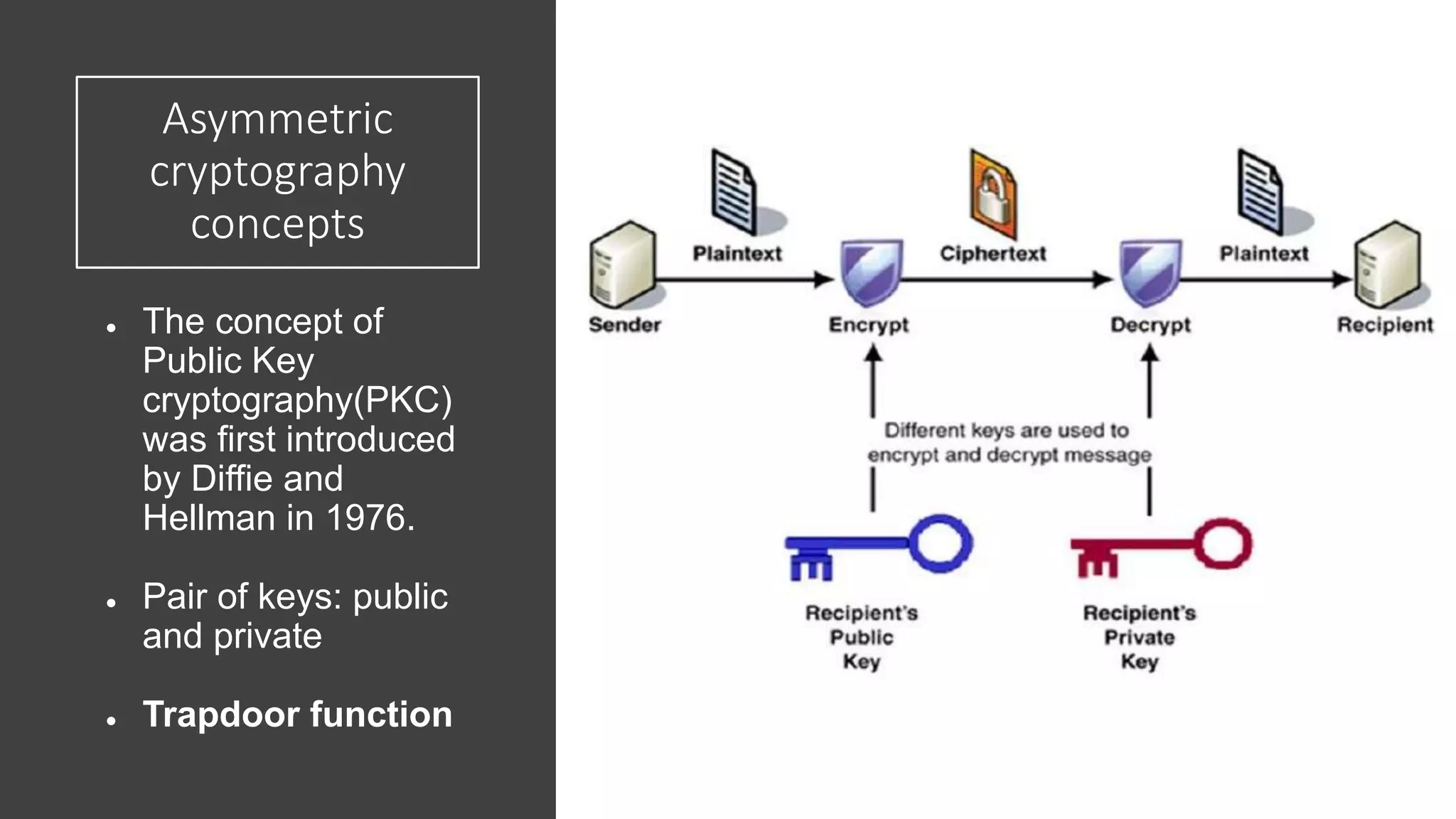
Asymmetric
cryptography
concepts
● The concept of
Public Key
cryptography(PKC)
was first introduced
by Diffie and
Hellman in 1976.
● Pair of keys: public
and private
● Trapdoor function
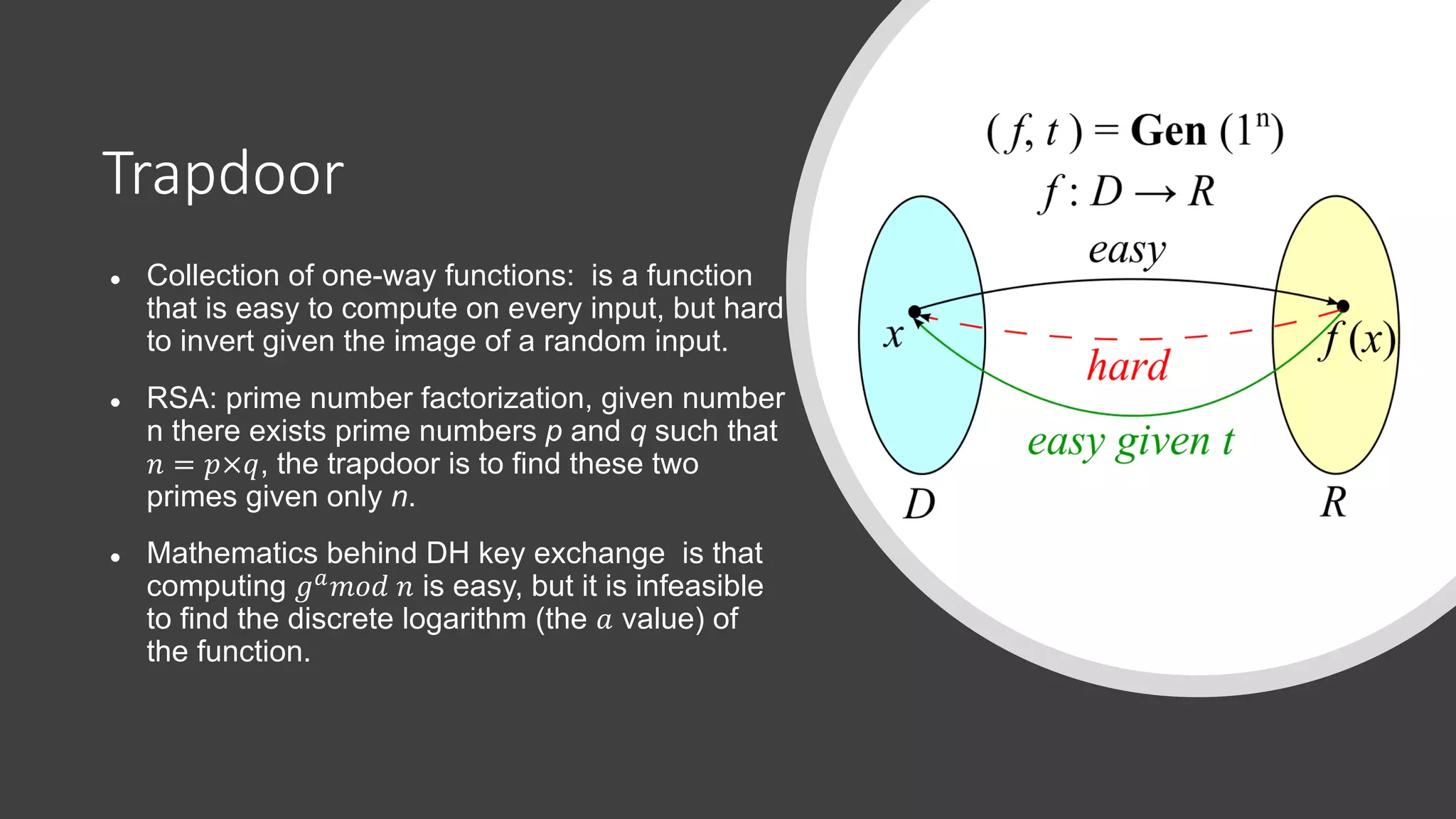
Trapdoor
● Collection of one-way functions: is a function
that is easy to compute on every input, but hard
to invert given the image of a random input.
● RSA: prime number factorization, given number
n there exists prime numbers p and q such that
! = #×%, the trapdoor is to find these two
primes given only n.
● Mathematics behind DH key exchange is that
computing &'()* ! is easy, but it is infeasible
to find the discrete logarithm (the + value) of
the function.
Elliptic Curve
Cryptography
• Elliptic Curve Cryptography is an
approach to public-key cryptography,
based on elliptic curves over finite
fields.
• The technique was first proposed
individually by Neal Koblitz and
Victor Miller in 1985.
• Based on the Elliptic Curve Discrete
Logarithm problem, which is a
known NP-Hard problem.
Elliptic Curve
Cryptography
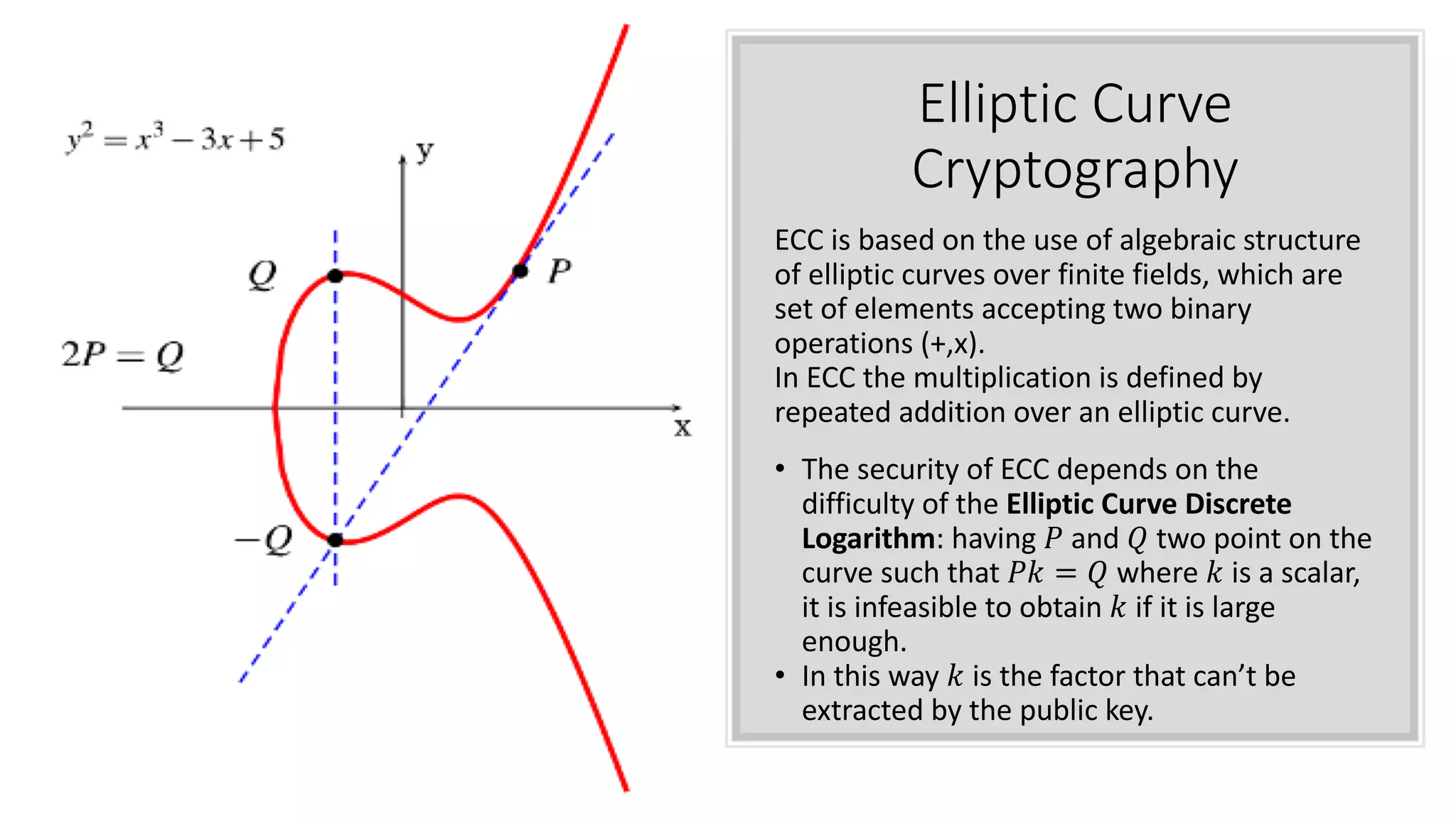
ECC is based on the use of algebraic structure
of elliptic curves over finite fields, which are
set of elements accepting two binary
operations (+,x).
In ECC the multiplication is defined by
repeated addition over an elliptic curve.
• The security of ECC depends on the
difficulty of the Elliptic Curve Discrete
Logarithm: having ! and " two point on the
curve such that !# = " where # is a scalar,
it is infeasible to obtain # if it is large
enough.
• In this way # is the factor that can’t be
extracted by the public key.
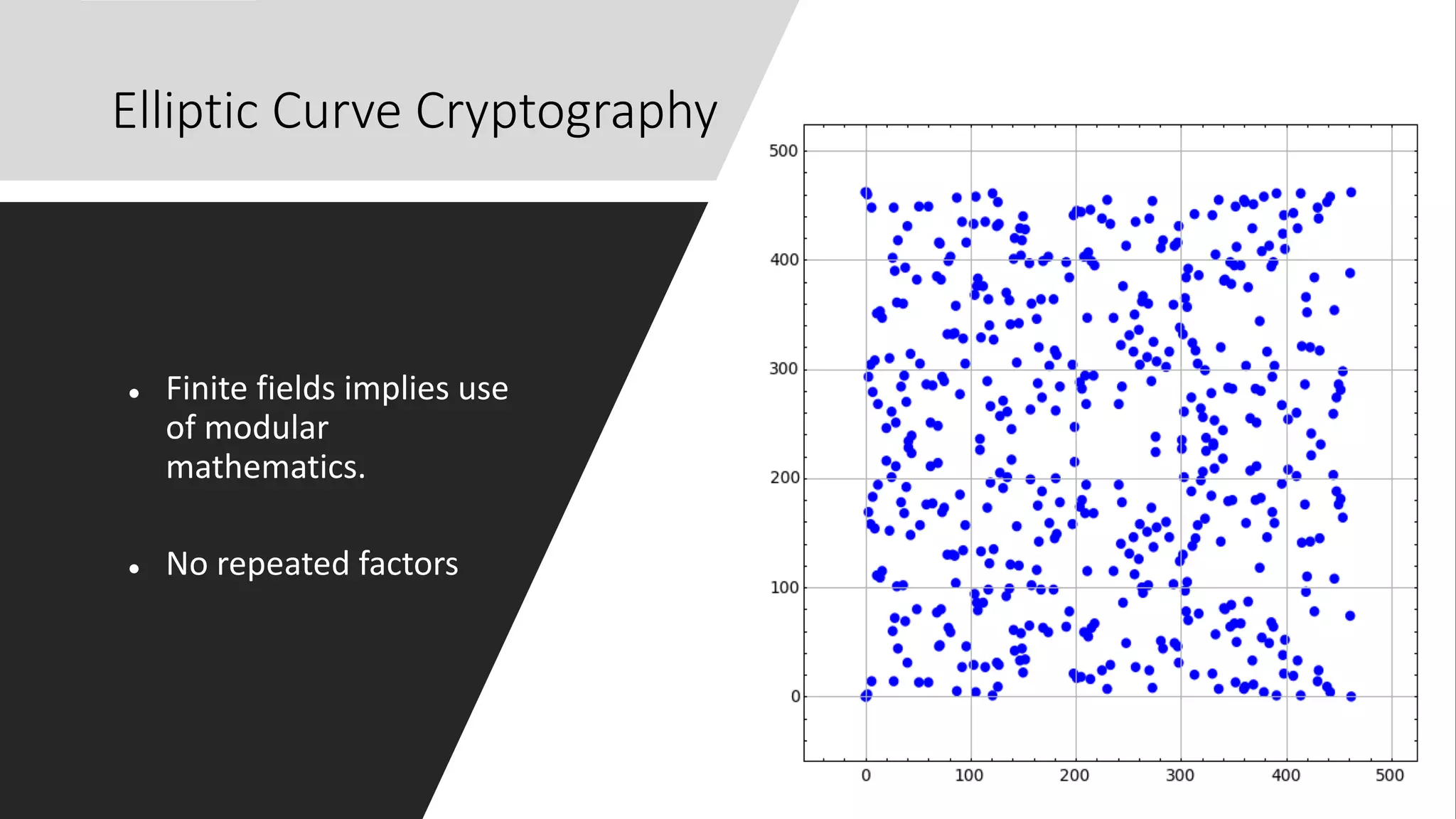
Elliptic Curve Cryptography
● Finite fields implies use
of modular
mathematics.
● No repeated factors
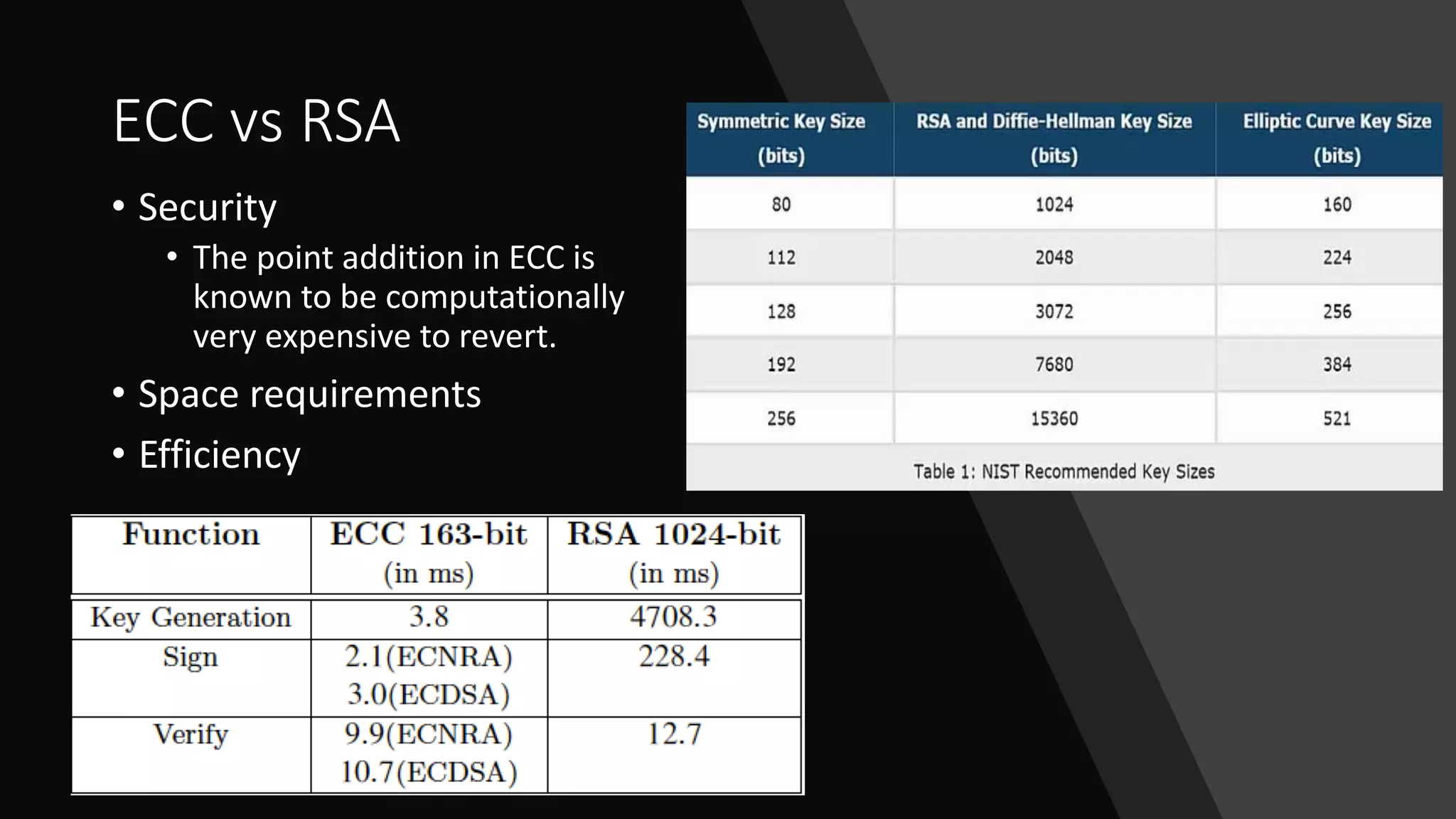
ECC vs RSA
• Security
• The point addition in ECC is
known to be computationally
very expensive to revert.
• Space requirements
• Efficiency
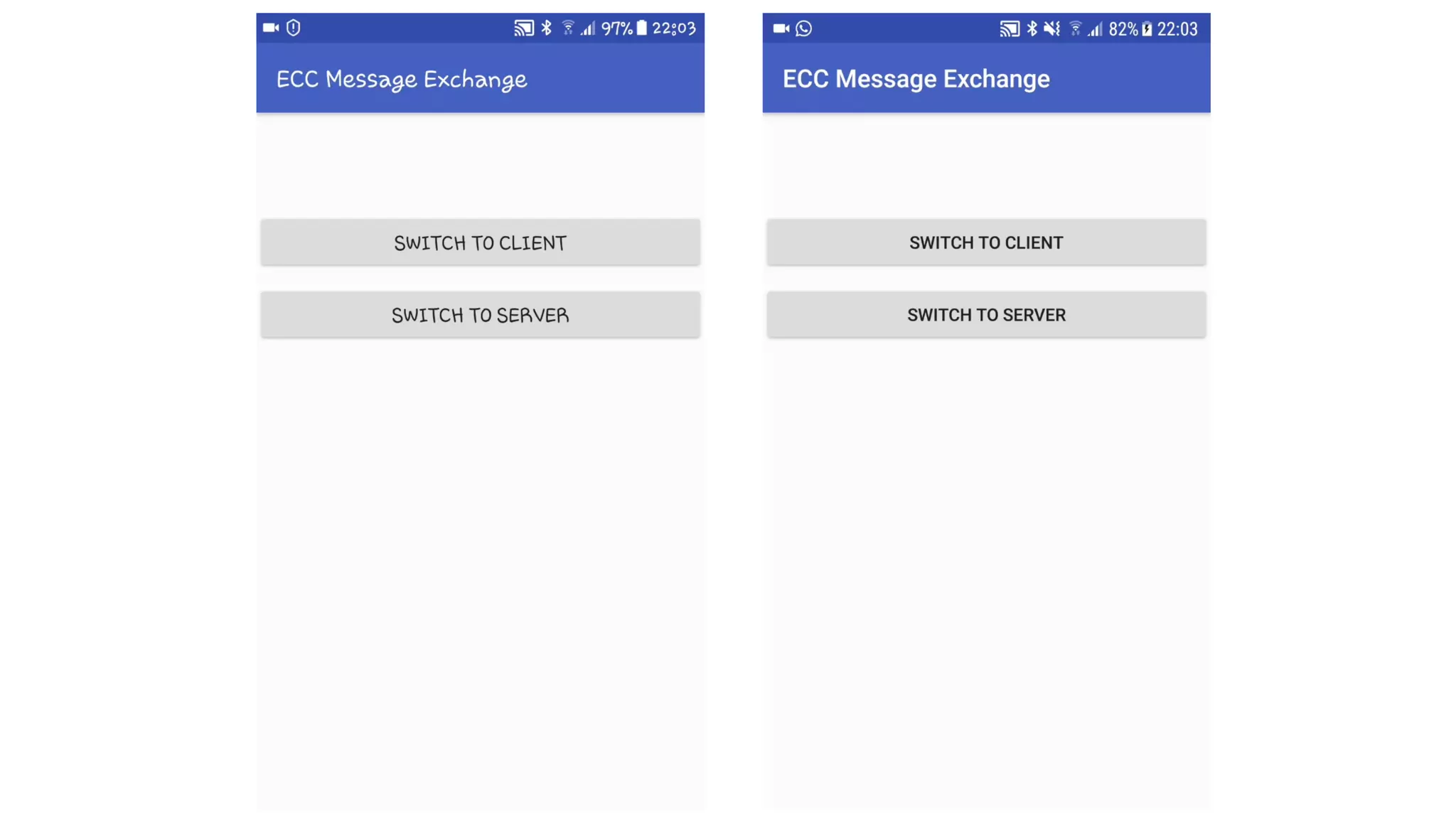
Hands on
Demo
ECDH-Curve25519-Mobile
Implements Diffie-Hellman
key exchange based on the
Elliptic Curve 25519 for
Android devices.
It is a native Android library
since NaCl is implemented in
C rather than Java. However,
it can be easily compiled for
all Android platforms like
ARM or x86, so this is not a
practical limitation compared
to a Java implementation.
// Create Alice's secret key from a big random number.
SecureRandom random = new SecureRandom();
byte[] alice_secret_key = ECDHCurve25519.generate_secret_key(random);
// Create Alice's public key.
byte[] alice_public_key =ECDHCurve25519.generate_public_key(alice_secret_key);
// Bob is also calculating a key pair.
byte[] bob_secret_key = ECDHCurve25519.generate_secret_key(random);
byte[] bob_public_key = ECDHCurve25519.generate_public_key(bob_secret_key);
// Assume that Alice and Bob have exchanged their public keys.
// Alice is calculating the shared secret.
byte[] alice_shared_secret = ECDHCurve25519.generate_shared_secret(
alice_secret_key, bob_public_key);
// Bob is also calculating the shared secret.
byte[] bob_shared_secret = ECDHCurve25519.generate_shared_secret (
bob_secret_key, alice_public_key);
https://github.com/duerrfk/ecdh-curve25519-mobile
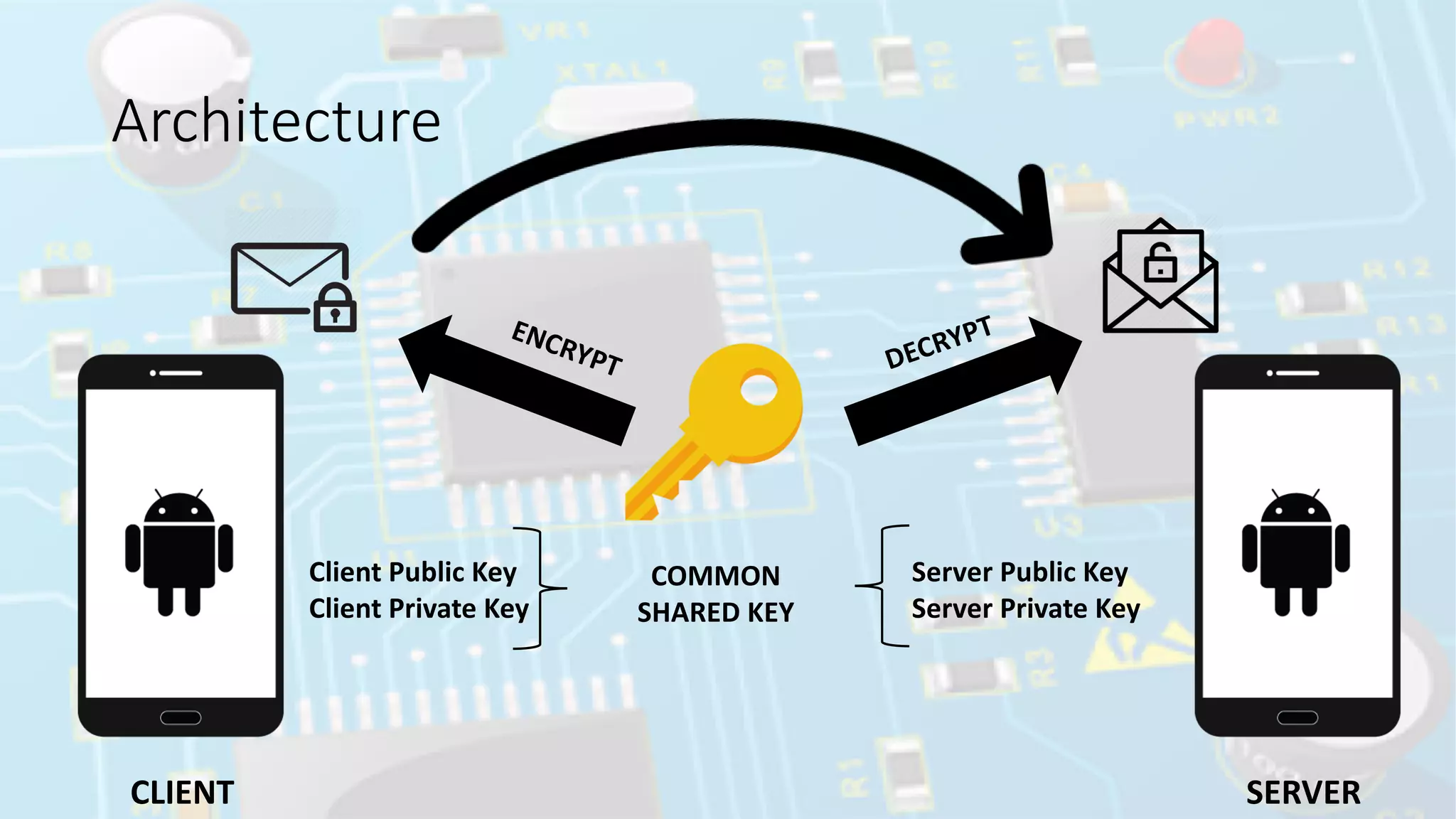
Architecture
CLIENT SERVER
Client Public Key
Client Private Key
Server Public Key
Server Private Key
COMMON
SHARED KEY
ENCRYPT DECRYPT
Magic, but why not
implemented yet?
• ECC’s cryptographic applications have been
noticed only recently.
• RSA has been well-researched and its
vulnerabilities have been studied a lot though
time.
• The cryptographic use for EC was only discovered
in the process of finding out new attacks on the
RSA system.
• Crypto community do not trust ECC enough to be
implemented, like RSA.
Thank you for
your
attention!

Elliptic Curve Cryptography Message Exchange

  • 1.
    Elliptic Curve Cryptography Jacopo MariaValtorta https://github.com/jacopomv/ECC Jacopo Maria Valtorta
  • 2.
    Asymmetric cryptography concepts ● The conceptof Public Key cryptography(PKC) was first introduced by Diffie and Hellman in 1976. ● Pair of keys: public and private ● Trapdoor function
  • 3.
    Trapdoor ● Collection ofone-way functions: is a function that is easy to compute on every input, but hard to invert given the image of a random input. ● RSA: prime number factorization, given number n there exists prime numbers p and q such that ! = #×%, the trapdoor is to find these two primes given only n. ● Mathematics behind DH key exchange is that computing &'()* ! is easy, but it is infeasible to find the discrete logarithm (the + value) of the function.
  • 4.
    Elliptic Curve Cryptography • EllipticCurve Cryptography is an approach to public-key cryptography, based on elliptic curves over finite fields. • The technique was first proposed individually by Neal Koblitz and Victor Miller in 1985. • Based on the Elliptic Curve Discrete Logarithm problem, which is a known NP-Hard problem.
  • 5.
    Elliptic Curve Cryptography ECC isbased on the use of algebraic structure of elliptic curves over finite fields, which are set of elements accepting two binary operations (+,x). In ECC the multiplication is defined by repeated addition over an elliptic curve. • The security of ECC depends on the difficulty of the Elliptic Curve Discrete Logarithm: having ! and " two point on the curve such that !# = " where # is a scalar, it is infeasible to obtain # if it is large enough. • In this way # is the factor that can’t be extracted by the public key.
  • 6.
    Elliptic Curve Cryptography ●Finite fields implies use of modular mathematics. ● No repeated factors
  • 7.
    ECC vs RSA •Security • The point addition in ECC is known to be computationally very expensive to revert. • Space requirements • Efficiency
  • 8.
  • 9.
    ECDH-Curve25519-Mobile Implements Diffie-Hellman key exchangebased on the Elliptic Curve 25519 for Android devices. It is a native Android library since NaCl is implemented in C rather than Java. However, it can be easily compiled for all Android platforms like ARM or x86, so this is not a practical limitation compared to a Java implementation. // Create Alice's secret key from a big random number. SecureRandom random = new SecureRandom(); byte[] alice_secret_key = ECDHCurve25519.generate_secret_key(random); // Create Alice's public key. byte[] alice_public_key =ECDHCurve25519.generate_public_key(alice_secret_key); // Bob is also calculating a key pair. byte[] bob_secret_key = ECDHCurve25519.generate_secret_key(random); byte[] bob_public_key = ECDHCurve25519.generate_public_key(bob_secret_key); // Assume that Alice and Bob have exchanged their public keys. // Alice is calculating the shared secret. byte[] alice_shared_secret = ECDHCurve25519.generate_shared_secret( alice_secret_key, bob_public_key); // Bob is also calculating the shared secret. byte[] bob_shared_secret = ECDHCurve25519.generate_shared_secret ( bob_secret_key, alice_public_key); https://github.com/duerrfk/ecdh-curve25519-mobile
  • 10.
    Architecture CLIENT SERVER Client PublicKey Client Private Key Server Public Key Server Private Key COMMON SHARED KEY ENCRYPT DECRYPT
  • 12.
    Magic, but whynot implemented yet? • ECC’s cryptographic applications have been noticed only recently. • RSA has been well-researched and its vulnerabilities have been studied a lot though time. • The cryptographic use for EC was only discovered in the process of finding out new attacks on the RSA system. • Crypto community do not trust ECC enough to be implemented, like RSA.
  • 13.