ELLIPTIC CURVE
CRYPTOGRAPHY
By
Manvi Molpariya
Sameena Khan
Introduction
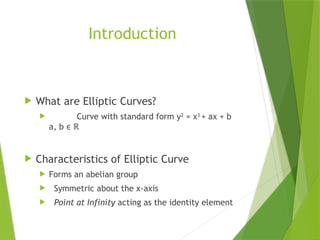
 What are Elliptic Curves?
 Curve with standard form y2
= x3
+ ax + b
a, b ϵ ℝ
 Characteristics of Elliptic Curve
 Forms an abelian group
 Symmetric about the x-axis
 Point at Infinity acting as the identity element
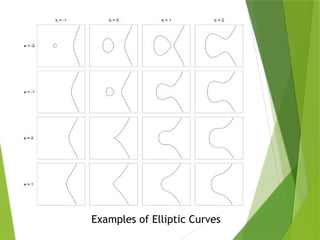
Examples of Elliptic Curves
Why Elliptic Curve
Cryptography?
 Shorter Key Length
 Lesser Computational Complexity
 Low Power Requirement
 More Secure
Key concept of elliptic curve
crytography
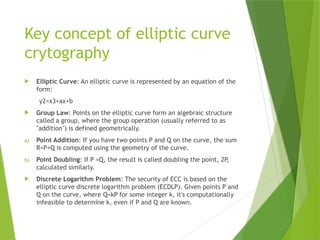
 Elliptic Curve: An elliptic curve is represented by an equation of the
form:
y2=x3+ax+b
 Group Law: Points on the elliptic curve form an algebraic structure
called a group, where the group operation (usually referred to as
"addition") is defined geometrically.
a) Point Addition: If you have two points P and Q on the curve, the sum
R=P+Q is computed using the geometry of the curve.
b) Point Doubling: If P =Q, the result is called doubling the point, 2P,
calculated similarly.
 Discrete Logarithm Problem: The security of ECC is based on the
elliptic curve discrete logarithm problem (ECDLP). Given points P and
Q on the curve, where Q=kP for some integer k, it's computationally
infeasible to determine k, even if P and Q are known.
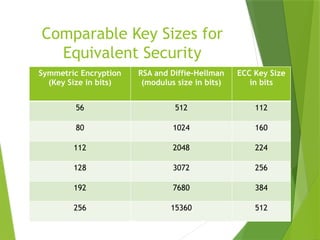
Comparable Key Sizes for
Equivalent Security
Symmetric Encryption
(Key Size in bits)
RSA and Diffie-Hellman
(modulus size in bits)
ECC Key Size
in bits
56 512 112
80 1024 160
112 2048 224
128 3072 256
192 7680 384
256 15360 512
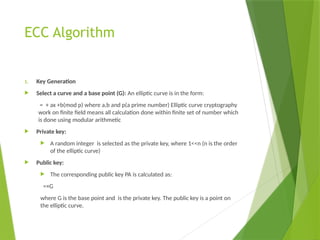
ECC Algorithm
1. Key Generation
 Select a curve and a base point (G): An elliptic curve is in the form:
= + ax +b(mod p) where a,b and p(a prime number) Elliptic curve cryptography
work on finite field means all calculation done within finite set of number which
is done using modular arithmetic
 Private key:
 A random integer is selected as the private key, where 1<<n (n is the order
of the elliptic curve)
 Public key:
 The corresponding public key PA​is calculated as:
=×G
where G is the base point and is the private key. The public key is a point on
the elliptic curve.
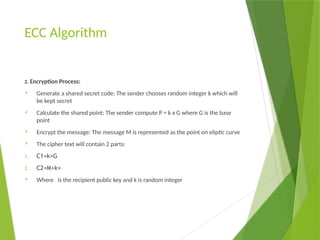
ECC Algorithm
2. Encryption Process:
 Generate a shared secret code: The sender chooses random integer k which will
be kept secret
 Calculate the shared point: The sender compute P = k x G where G is the base
point
 Encrypt the message: The message M is represented as the point on eliptic curve
 The cipher text will contain 2 parts:
1. C1​
=k×G
2. C2=M+k×
 Where is the recipient public key and k is random integer
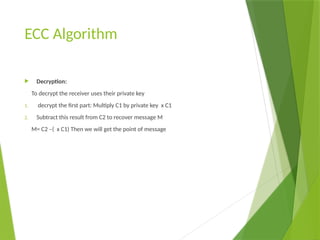
ECC Algorithm
 Decryption:
To decrypt the receiver uses their private key
1. decrypt the first part: Multiply C1 by private key x C1
2. Subtract this result from C2 to recover message M
M= C2 –( x C1) Then we will get the point of message
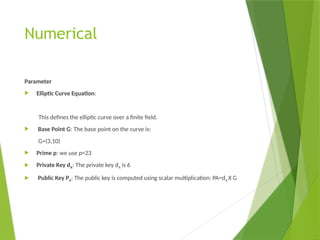
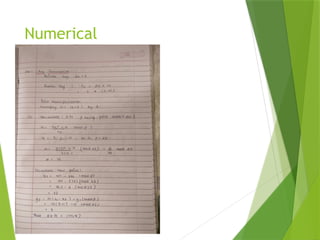
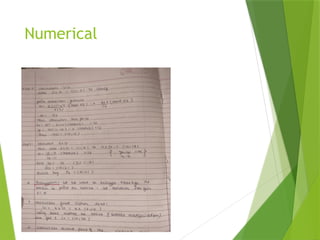
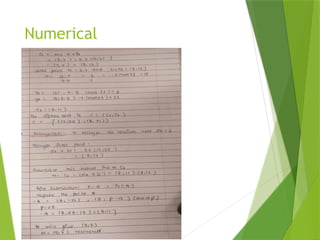
Numerical
Parameter
 Elliptic Curve Equation:
This defines the elliptic curve over a finite field.
 Base Point G: The base point on the curve is:
G=(3,10)
 Prime p: we use p=23
 Private Key dA: The private key dA​is 6
 Public Key PA​
: The public key is computed using scalar multiplication: PA=dA X G
Numerical
Numerical
Numerical
Pros and Cons
 Pros
 Shorter Key Length
 Same level of security as RSA achieved at a much shorter key
length
 Better Security
 Secure because of the ECDLP
 Higher security per key-bit than RSA
 Higher Performance
 Shorter key-length ensures lesser power requirement – suitable
in wireless sensor applications and low power devices
 More computation per bit but overall lesser computational
expense or complexity due to lesser number of key bits
Pros and Cons
 Cons
 Relatively newer field
 Idea prevails that all the aspects of the topic may not have
been explored yet – possibly unknown vulnerabilities
 Doesn’t have widespread usage
 Not perfect
 Attacks still exist that can solve ECC (112 bit key length has
been publicly broken)
 Well known attacks are the Pollard’s Rho attack
(complexity O(√n) ), Pohlig’s attack, Baby Step,Giant Step
etc

ECC.pptx Ecc cryptography for secure encrypted message and decryption using mathematics information with help of graph and formula

  • 1.
  • 2.
    Introduction  What areElliptic Curves?  Curve with standard form y2 = x3 + ax + b a, b ϵ ℝ  Characteristics of Elliptic Curve  Forms an abelian group  Symmetric about the x-axis  Point at Infinity acting as the identity element
  • 3.
  • 4.
    Why Elliptic Curve Cryptography? Shorter Key Length  Lesser Computational Complexity  Low Power Requirement  More Secure
  • 5.
    Key concept ofelliptic curve crytography  Elliptic Curve: An elliptic curve is represented by an equation of the form: y2=x3+ax+b  Group Law: Points on the elliptic curve form an algebraic structure called a group, where the group operation (usually referred to as "addition") is defined geometrically. a) Point Addition: If you have two points P and Q on the curve, the sum R=P+Q is computed using the geometry of the curve. b) Point Doubling: If P =Q, the result is called doubling the point, 2P, calculated similarly.  Discrete Logarithm Problem: The security of ECC is based on the elliptic curve discrete logarithm problem (ECDLP). Given points P and Q on the curve, where Q=kP for some integer k, it's computationally infeasible to determine k, even if P and Q are known.
  • 6.
    Comparable Key Sizesfor Equivalent Security Symmetric Encryption (Key Size in bits) RSA and Diffie-Hellman (modulus size in bits) ECC Key Size in bits 56 512 112 80 1024 160 112 2048 224 128 3072 256 192 7680 384 256 15360 512
  • 7.
    ECC Algorithm 1. KeyGeneration  Select a curve and a base point (G): An elliptic curve is in the form: = + ax +b(mod p) where a,b and p(a prime number) Elliptic curve cryptography work on finite field means all calculation done within finite set of number which is done using modular arithmetic  Private key:  A random integer is selected as the private key, where 1<<n (n is the order of the elliptic curve)  Public key:  The corresponding public key PA​is calculated as: =×G where G is the base point and is the private key. The public key is a point on the elliptic curve.
  • 8.
    ECC Algorithm 2. EncryptionProcess:  Generate a shared secret code: The sender chooses random integer k which will be kept secret  Calculate the shared point: The sender compute P = k x G where G is the base point  Encrypt the message: The message M is represented as the point on eliptic curve  The cipher text will contain 2 parts: 1. C1​ =k×G 2. C2=M+k×  Where is the recipient public key and k is random integer
  • 9.
    ECC Algorithm  Decryption: Todecrypt the receiver uses their private key 1. decrypt the first part: Multiply C1 by private key x C1 2. Subtract this result from C2 to recover message M M= C2 –( x C1) Then we will get the point of message
  • 10.
    Numerical Parameter  Elliptic CurveEquation: This defines the elliptic curve over a finite field.  Base Point G: The base point on the curve is: G=(3,10)  Prime p: we use p=23  Private Key dA: The private key dA​is 6  Public Key PA​ : The public key is computed using scalar multiplication: PA=dA X G
  • 11.
  • 12.
  • 13.
  • 14.
    Pros and Cons Pros  Shorter Key Length  Same level of security as RSA achieved at a much shorter key length  Better Security  Secure because of the ECDLP  Higher security per key-bit than RSA  Higher Performance  Shorter key-length ensures lesser power requirement – suitable in wireless sensor applications and low power devices  More computation per bit but overall lesser computational expense or complexity due to lesser number of key bits
  • 15.
    Pros and Cons Cons  Relatively newer field  Idea prevails that all the aspects of the topic may not have been explored yet – possibly unknown vulnerabilities  Doesn’t have widespread usage  Not perfect  Attacks still exist that can solve ECC (112 bit key length has been publicly broken)  Well known attacks are the Pollard’s Rho attack (complexity O(√n) ), Pohlig’s attack, Baby Step,Giant Step etc