Price Determination Under
Perfect Competition
JITHIN K THOMAS
Berchmans Institute of Management Studies
Perfect Competitive Market
• Perfectly Competitive Market is a situation
where large number of buyers and sellers are
engaged in the purchase and sale of
identically similar commodities, who are in
close contact with one another and who sell
freely among themselves.
Perfect Competitive Market
• Features
– Free and perfect competition
– Large number of sellers
– Large number of buyers
– Homogenous Product
– Free entry and exit
– Perfect Knowledge
– Perfect mobility of factors of production
– Lack of transport cost
– No selling cost
Pure Competition
• Large number of sellers
• Large number of buyers
• Homogenous Product
• Free entry and exit
• Independent decision making
Price Determination Under Perfect
Competition
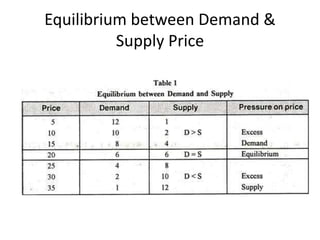
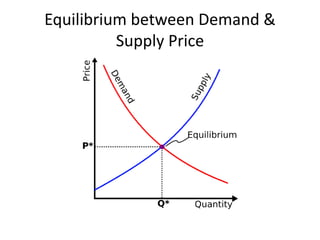
• Total Demand
– The amount which people are willing to buy at
various prices.
• Total Supply
– The amount which the producers are willing to
put on the market at various prices.
Equilibrium between Demand &
Supply Price
Equilibrium between Demand &
Supply Price
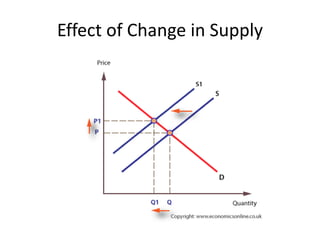
Change in Equilibrium
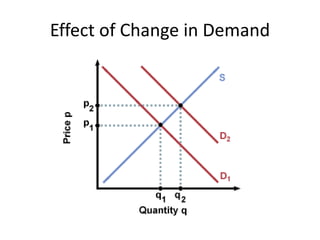
• The Equilibrium price and quantity changes
due to change in demand curve or supply
curve.
Effect of Change in Demand
Effect of Change in Supply
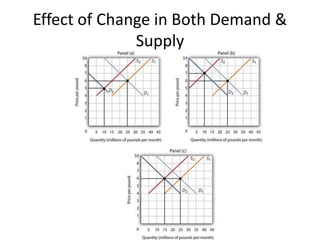
Effect of Change in Both Demand &
Supply
Time Element
• Market Period
– Refers to type of competitive market in which the
commodities are perishable and supply of such
commodities cannot be changed at all.
• Short Period
– Similar to Market period except that the
commodities in question are not perishable but
durable through of a short duration than capital.
Time Element
• Long Run
– All factors of production can be changed
• Secular Period
– Very long period
– All underlying economic factors like size of
population, general condition of capital supply
etc. can change.
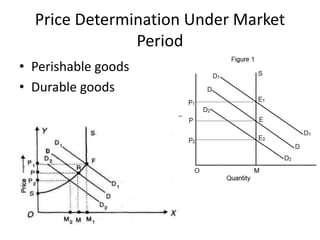
Price Determination Under Market
Period
• Perishable goods
• Durable goods
Reserve price
• Price in the future
• Liquidity Preference
• Future cost of production
• Storage expenses
• Durability of commodity
• Future demand
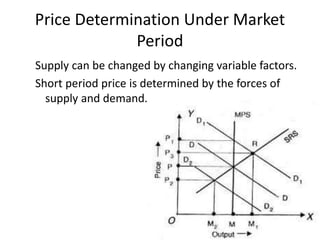
Price Determination Under Market
Period
Supply can be changed by changing variable factors.
Short period price is determined by the forces of
supply and demand.
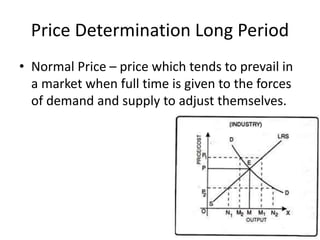
Price Determination Long Period
• Normal Price – price which tends to prevail in
a market when full time is given to the forces
of demand and supply to adjust themselves.
Normal Price and Laws of Return
• Normal price and Law of Increasing return
– Economies of scale
– AC & MC falls
• Normal price and Law of Constant return
– What ever the out put AC & MC remains constant
• Normal price and Law of Decreasing return
– Diseconomies of Scale
– AC & MC rises
Price determination under perfect competition

Price determination under perfect competition

  • 1.
    Price Determination Under PerfectCompetition JITHIN K THOMAS Berchmans Institute of Management Studies
  • 2.
    Perfect Competitive Market •Perfectly Competitive Market is a situation where large number of buyers and sellers are engaged in the purchase and sale of identically similar commodities, who are in close contact with one another and who sell freely among themselves.
  • 3.
    Perfect Competitive Market •Features – Free and perfect competition – Large number of sellers – Large number of buyers – Homogenous Product – Free entry and exit – Perfect Knowledge – Perfect mobility of factors of production – Lack of transport cost – No selling cost
  • 4.
    Pure Competition • Largenumber of sellers • Large number of buyers • Homogenous Product • Free entry and exit • Independent decision making
  • 5.
    Price Determination UnderPerfect Competition • Total Demand – The amount which people are willing to buy at various prices. • Total Supply – The amount which the producers are willing to put on the market at various prices.
  • 6.
  • 7.
  • 8.
    Change in Equilibrium •The Equilibrium price and quantity changes due to change in demand curve or supply curve.
  • 9.
  • 10.
  • 11.
    Effect of Changein Both Demand & Supply
  • 12.
    Time Element • MarketPeriod – Refers to type of competitive market in which the commodities are perishable and supply of such commodities cannot be changed at all. • Short Period – Similar to Market period except that the commodities in question are not perishable but durable through of a short duration than capital.
  • 13.
    Time Element • LongRun – All factors of production can be changed • Secular Period – Very long period – All underlying economic factors like size of population, general condition of capital supply etc. can change.
  • 14.
    Price Determination UnderMarket Period • Perishable goods • Durable goods
  • 15.
    Reserve price • Pricein the future • Liquidity Preference • Future cost of production • Storage expenses • Durability of commodity • Future demand
  • 16.
    Price Determination UnderMarket Period Supply can be changed by changing variable factors. Short period price is determined by the forces of supply and demand.
  • 17.
    Price Determination LongPeriod • Normal Price – price which tends to prevail in a market when full time is given to the forces of demand and supply to adjust themselves.
  • 18.
    Normal Price andLaws of Return • Normal price and Law of Increasing return – Economies of scale – AC & MC falls • Normal price and Law of Constant return – What ever the out put AC & MC remains constant • Normal price and Law of Decreasing return – Diseconomies of Scale – AC & MC rises