Prepared by
JISNA K JACOB
Roll no: 07
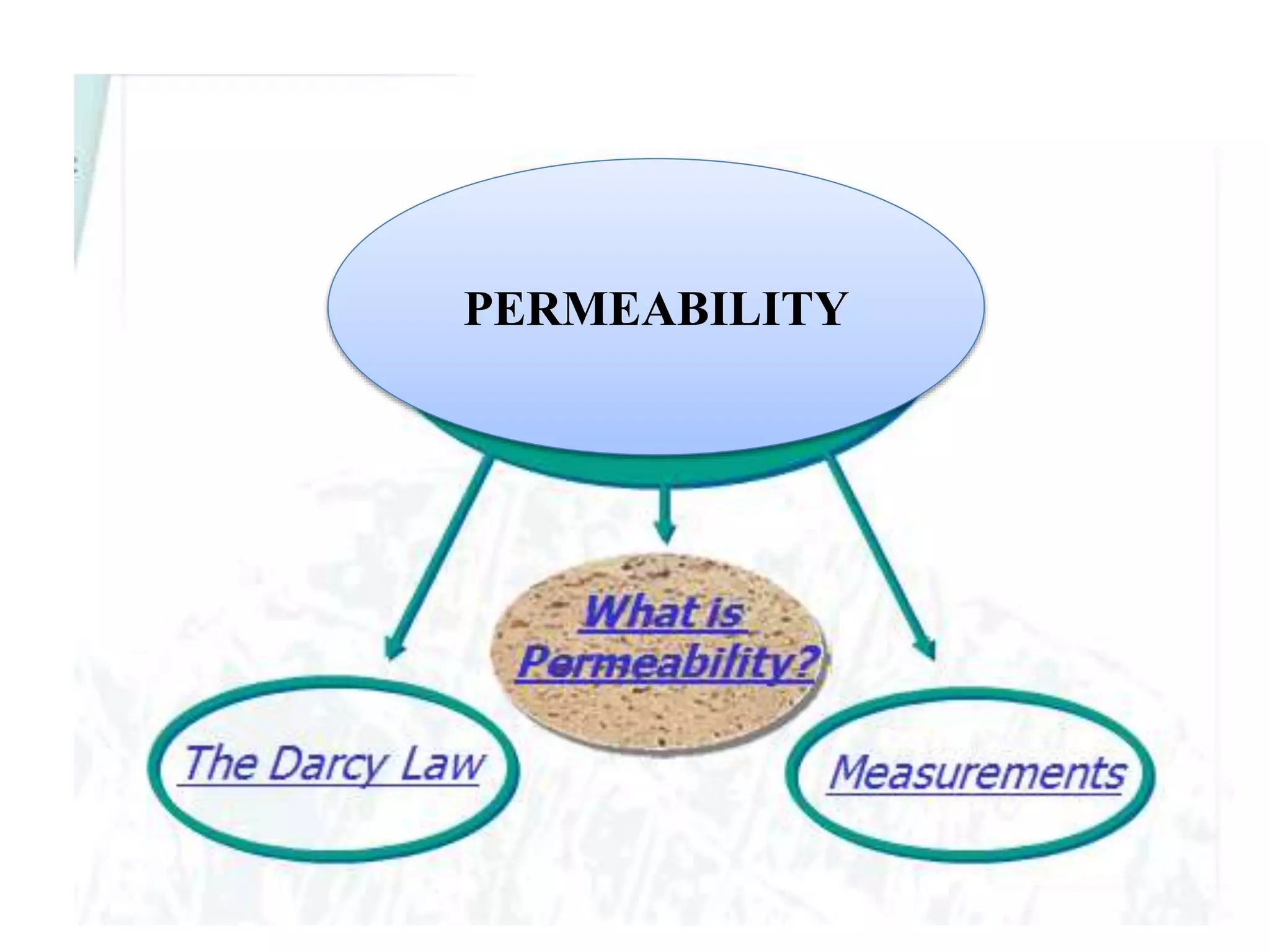
PERMEABILITY
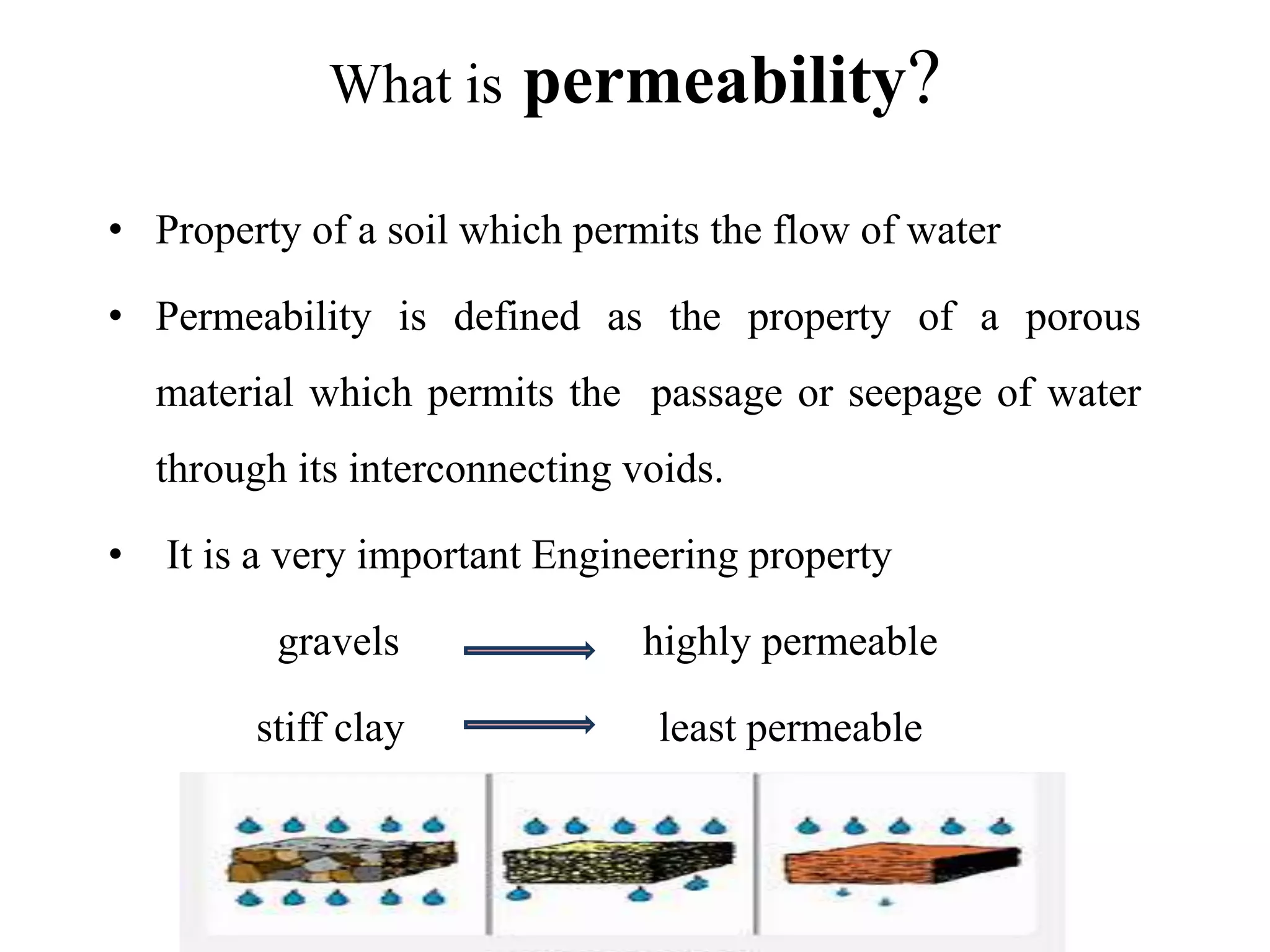
What is permeability?
• Property of a soil which permits the flow of water
• Permeability is defined as the property of a porous
material which permits the passage or seepage of water
through its interconnecting voids.
• It is a very important Engineering property
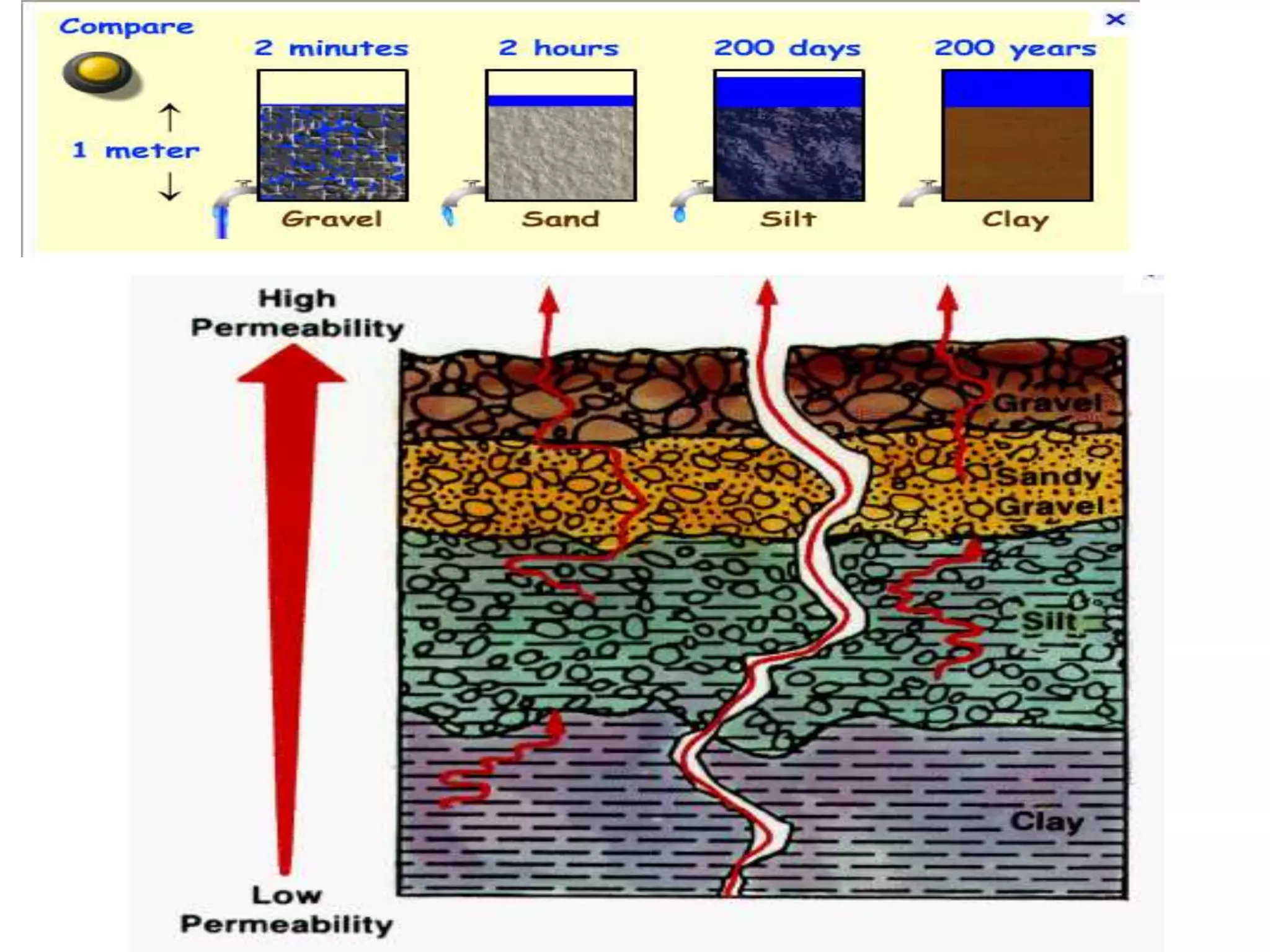
gravels highly permeable
stiff clay least permeable
• Calculation of uplift pressure under hydraulic structure and
their safety against piping
• Ground water flow towards wells and drainage of soil
• Calculation of seepage through the body of earth dams and
stability of slopes
• Determination of rate of settlement of a saturated
compressible soil layer
Permeability through soil is important for the
following engineering problems:
Flow of water through soils may either be a laminar
flow or a turbulent flow
Each fluid particle travel
along a definite path
which never crosses
the path of any other
particle
Paths are irregular and
twisting, crossing at
random
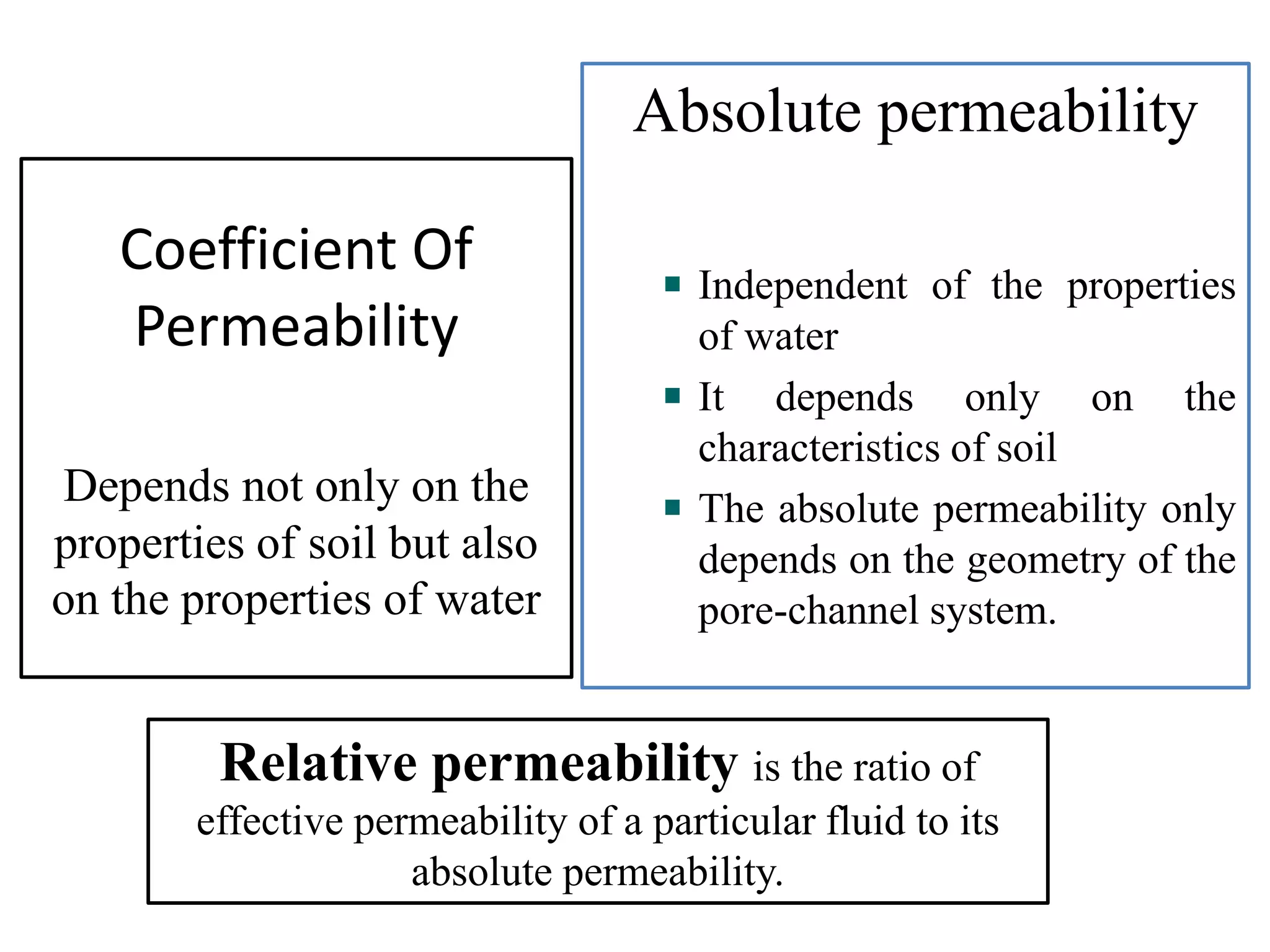
Coefficient Of
Permeability
Depends not only on the
properties of soil but also
on the properties of water
Absolute permeability
Independent of the properties
of water
It depends only on the
characteristics of soil
The absolute permeability only
depends on the geometry of the
pore-channel system.
Relative permeability is the ratio of
effective permeability of a particular fluid to its
absolute permeability.
Darcy’s Law
Henry Darcy (1803-1858), Hydraulic Engineer. His law is a
foundation stone for several fields of study
who demonstrated experimentally that for
laminar flow conditions in a saturated soil, the rate of flow
or the discharge per unit time is proportional to the hydraulic
gradient
vAq 
kiv 
kiAq 
Validity of darcy’s law - When flow is laminar
Bernouli’s Equation:
• Total Energy = Elevation Energy + Pressure Energy +
Velocity Energy
• Total Head = Elevation Head + Pressure Head +
Velocity Head
• Total head of water in soil engineering problems is equal to
the sum of the elevation head and the pressure head
g
p
g
zH v


2
2
Water In
)h =hA - hB
Head Loss or
Head Difference or
Energy Loss
hA
hB
i = Hydraulic Gradient
(q)
Water
out
ZA
Datum
ZB
q = v . A = k i A = k ADh
L
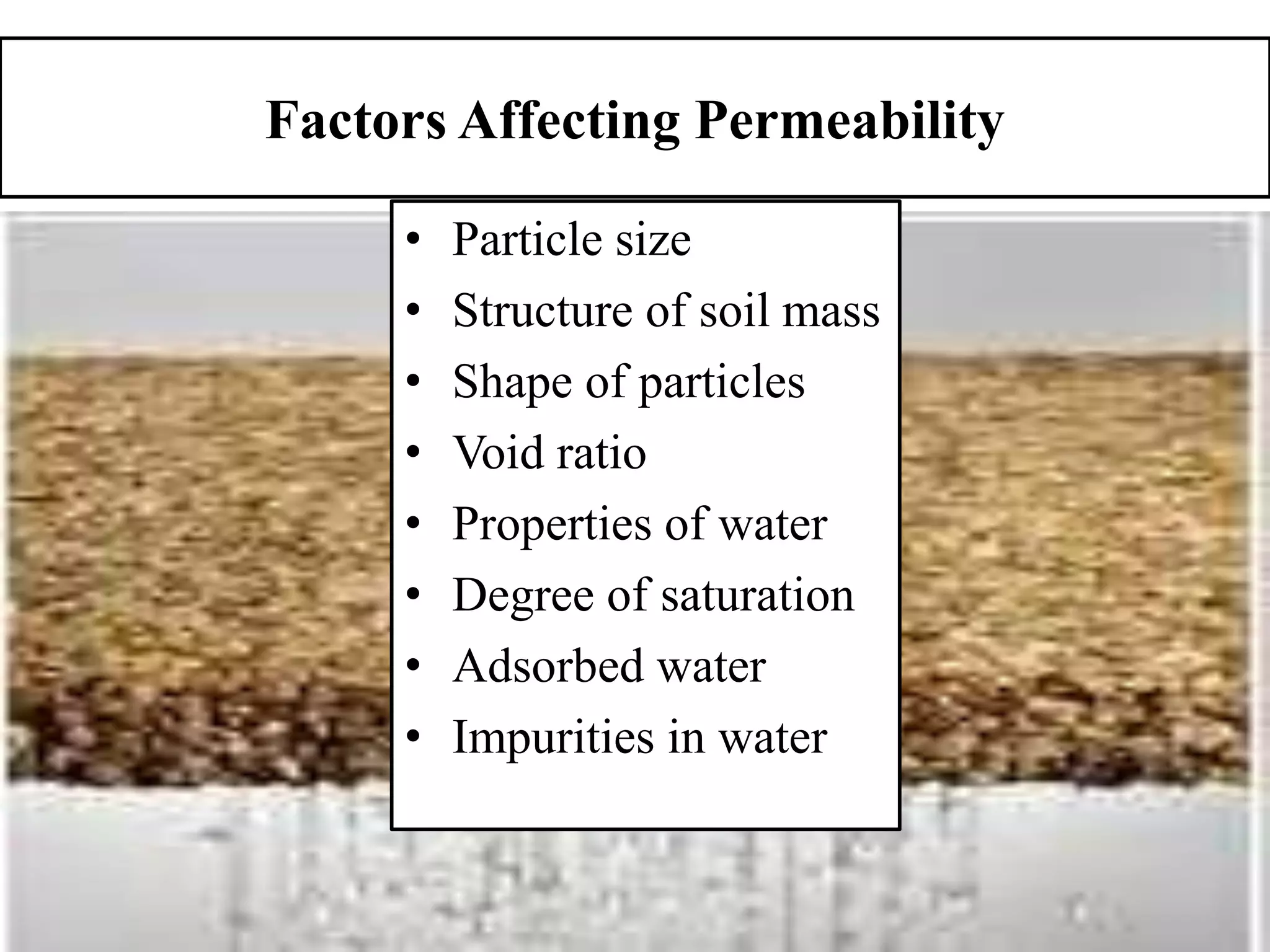
Factors Affecting Permeability
• Particle size
• Structure of soil mass
• Shape of particles
• Void ratio
• Properties of water
• Degree of saturation
• Adsorbed water
• Impurities in water
Determination Of Coefficient Of
Permeability
Laboratory
Methods Field Methods
Indirect Methods
Constant-head
Permeability Test
Variable-head
Permeability Test
Pumping-out Test
Pumping-in Test
Computation
From The Particle
Size
From Consolidation
Test Data
Capillarity-
permeability Test
Constant Head Permeability Test
• Quantity of water that flows under a given hydraulic gradient
through a soil sample of known length & cross sectional area in a
given time
• Water is allowed to flow through the cylindrical sample of soil
under a constant head
• For testing of pervious, coarse grained soils
K = Coefficient of permeability
Q = total quantity of water
t = time
L = Length of the coarse soil
Aht
QL
k 
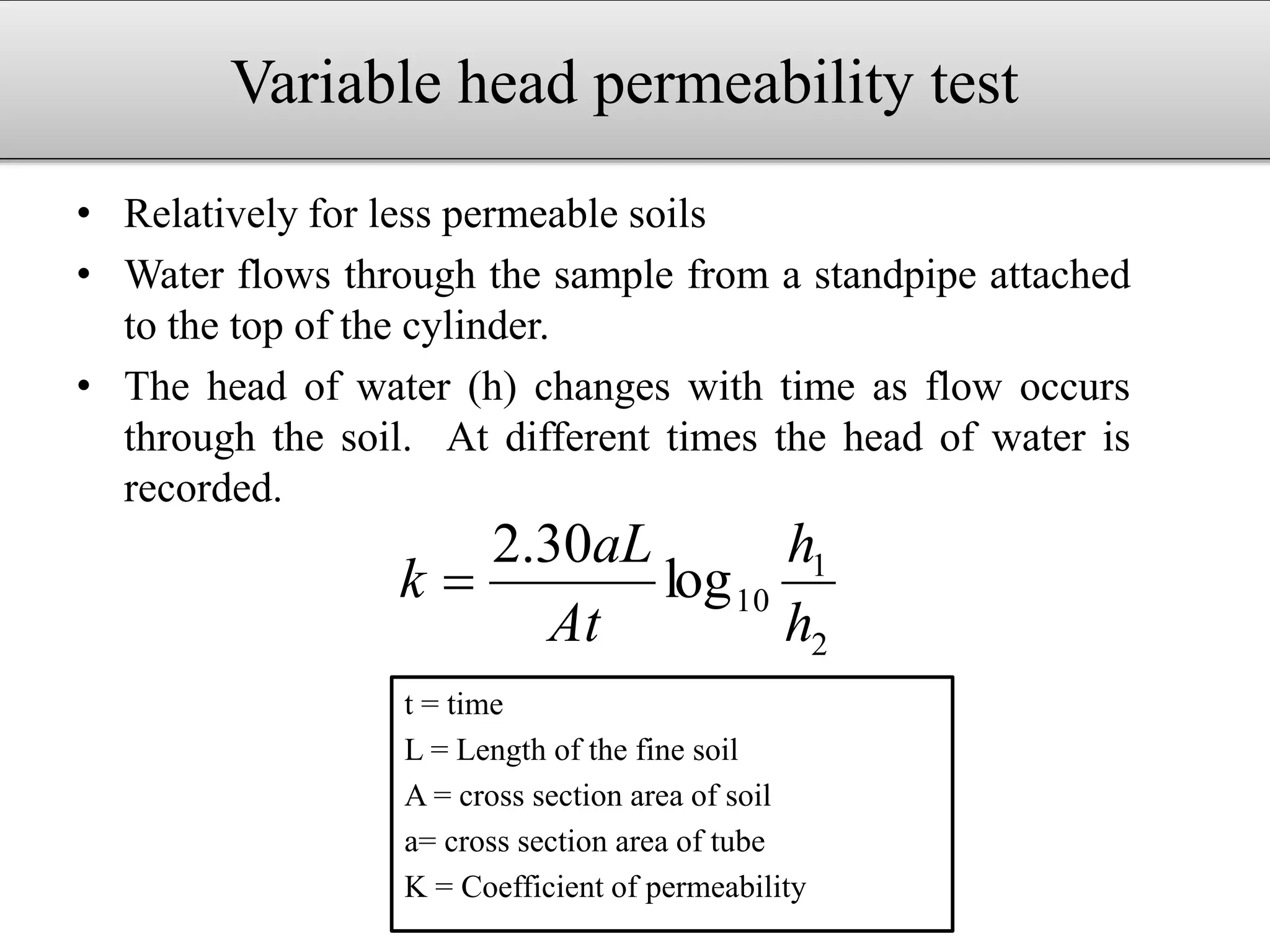
Variable head permeability test
• Relatively for less permeable soils
• Water flows through the sample from a standpipe attached
to the top of the cylinder.
• The head of water (h) changes with time as flow occurs
through the soil. At different times the head of water is
recorded.
t = time
L = Length of the fine soil
A = cross section area of soil
a= cross section area of tube
K = Coefficient of permeability
2
1
10log
30.2
h
h
At
aL
k 
By Indirect Method
Allen hazen’s formula
Kozeny carman equation
Loudon’s formula
Consolidation test data
2
10cDk 
e
e
TSC
g
k
s
w


1)(
3
22


bnakS )(log 2
10
vwv mCk 
constants.,a= 1.365
b=5.15
c=value b/w 100 & 150
T= Tortuosity
S = surface area
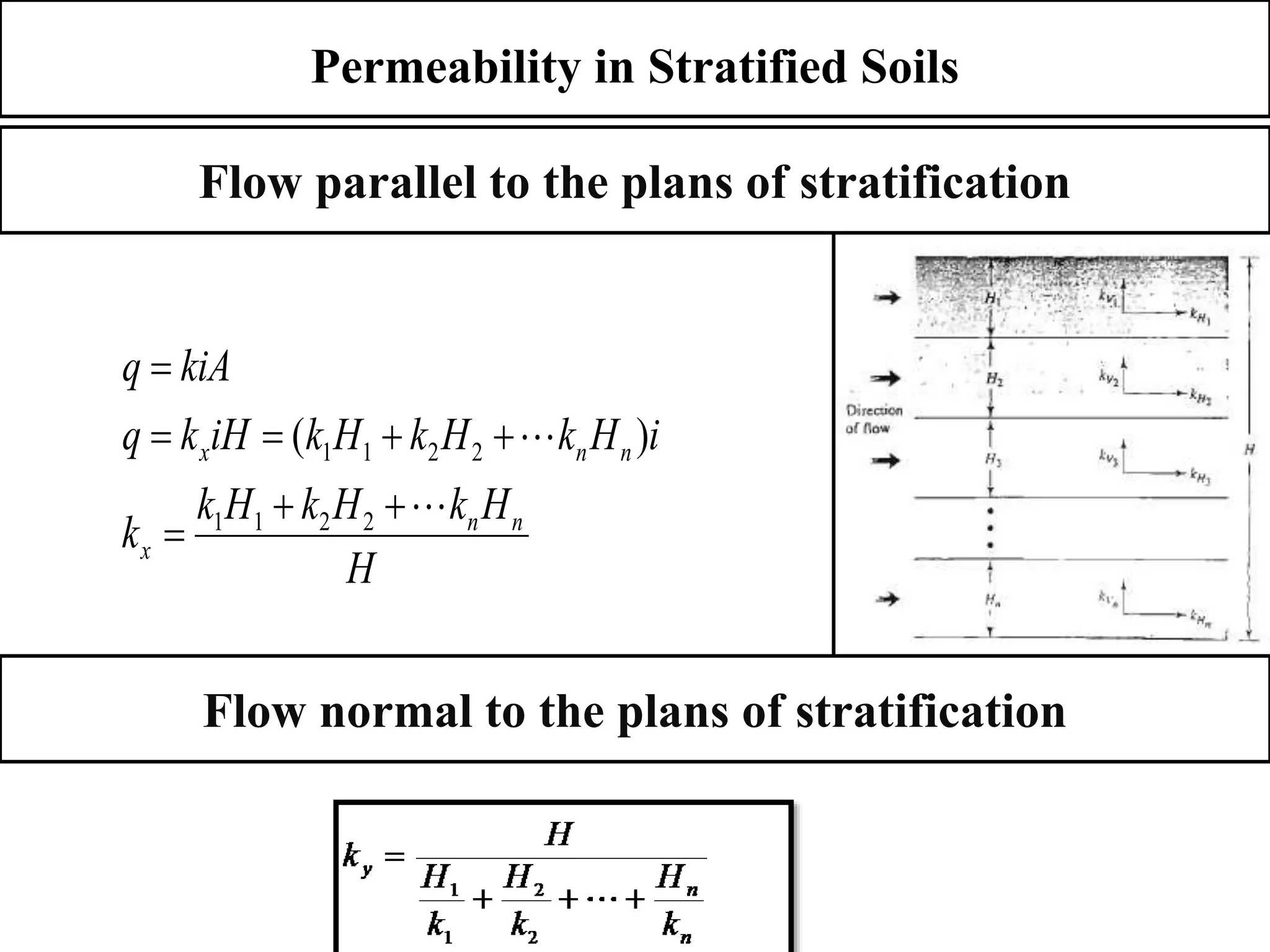
Permeability in Stratified Soils
H
HkHkHk
k
iHkHkHkiHkq
kiAq
nn
x
nnx






2211
2211 )(
Flow normal to the plans of stratification
Flow parallel to the plans of stratification
Soil Permeability Classes
Permeability is commonly measured
in terms of the rate of water flow
through the soil in a given period of
time.
REFERENCES
• K.R.Arora “Soil Mechanics & Foundation Engineering”
• Gopal Ranjan & A.S.R.Rao “Basic & Applied Soil Mechanics”
• B.C.Punmia “Soil Mechanics & Foundation”
• T.William Lambe(1969) “soil mechanics”
• Ernst and Sohn (2002) “Geotechnical Engineering Hand Book”
In this TOPIC you have learned:
About permeability, what it is, how it is defined
and measured !

SOIL PERMEABILITY PPT

  • 1.
    Prepared by JISNA KJACOB Roll no: 07
  • 2.
  • 3.
    What is permeability? •Property of a soil which permits the flow of water • Permeability is defined as the property of a porous material which permits the passage or seepage of water through its interconnecting voids. • It is a very important Engineering property gravels highly permeable stiff clay least permeable
  • 5.
    • Calculation ofuplift pressure under hydraulic structure and their safety against piping • Ground water flow towards wells and drainage of soil • Calculation of seepage through the body of earth dams and stability of slopes • Determination of rate of settlement of a saturated compressible soil layer Permeability through soil is important for the following engineering problems:
  • 6.
    Flow of waterthrough soils may either be a laminar flow or a turbulent flow Each fluid particle travel along a definite path which never crosses the path of any other particle Paths are irregular and twisting, crossing at random
  • 7.
    Coefficient Of Permeability Depends notonly on the properties of soil but also on the properties of water Absolute permeability Independent of the properties of water It depends only on the characteristics of soil The absolute permeability only depends on the geometry of the pore-channel system. Relative permeability is the ratio of effective permeability of a particular fluid to its absolute permeability.
  • 8.
    Darcy’s Law Henry Darcy(1803-1858), Hydraulic Engineer. His law is a foundation stone for several fields of study who demonstrated experimentally that for laminar flow conditions in a saturated soil, the rate of flow or the discharge per unit time is proportional to the hydraulic gradient vAq  kiv  kiAq  Validity of darcy’s law - When flow is laminar
  • 9.
    Bernouli’s Equation: • TotalEnergy = Elevation Energy + Pressure Energy + Velocity Energy • Total Head = Elevation Head + Pressure Head + Velocity Head • Total head of water in soil engineering problems is equal to the sum of the elevation head and the pressure head g p g zH v   2 2
  • 10.
    Water In )h =hA- hB Head Loss or Head Difference or Energy Loss hA hB i = Hydraulic Gradient (q) Water out ZA Datum ZB q = v . A = k i A = k ADh L
  • 11.
    Factors Affecting Permeability •Particle size • Structure of soil mass • Shape of particles • Void ratio • Properties of water • Degree of saturation • Adsorbed water • Impurities in water
  • 12.
    Determination Of CoefficientOf Permeability Laboratory Methods Field Methods Indirect Methods Constant-head Permeability Test Variable-head Permeability Test Pumping-out Test Pumping-in Test Computation From The Particle Size From Consolidation Test Data Capillarity- permeability Test
  • 13.
    Constant Head PermeabilityTest • Quantity of water that flows under a given hydraulic gradient through a soil sample of known length & cross sectional area in a given time • Water is allowed to flow through the cylindrical sample of soil under a constant head • For testing of pervious, coarse grained soils K = Coefficient of permeability Q = total quantity of water t = time L = Length of the coarse soil Aht QL k 
  • 14.
    Variable head permeabilitytest • Relatively for less permeable soils • Water flows through the sample from a standpipe attached to the top of the cylinder. • The head of water (h) changes with time as flow occurs through the soil. At different times the head of water is recorded. t = time L = Length of the fine soil A = cross section area of soil a= cross section area of tube K = Coefficient of permeability 2 1 10log 30.2 h h At aL k 
  • 15.
    By Indirect Method Allenhazen’s formula Kozeny carman equation Loudon’s formula Consolidation test data 2 10cDk  e e TSC g k s w   1)( 3 22   bnakS )(log 2 10 vwv mCk  constants.,a= 1.365 b=5.15 c=value b/w 100 & 150 T= Tortuosity S = surface area
  • 16.
    Permeability in StratifiedSoils H HkHkHk k iHkHkHkiHkq kiAq nn x nnx       2211 2211 )( Flow normal to the plans of stratification Flow parallel to the plans of stratification
  • 17.
    Soil Permeability Classes Permeabilityis commonly measured in terms of the rate of water flow through the soil in a given period of time.
  • 18.
    REFERENCES • K.R.Arora “SoilMechanics & Foundation Engineering” • Gopal Ranjan & A.S.R.Rao “Basic & Applied Soil Mechanics” • B.C.Punmia “Soil Mechanics & Foundation” • T.William Lambe(1969) “soil mechanics” • Ernst and Sohn (2002) “Geotechnical Engineering Hand Book”
  • 19.
    In this TOPICyou have learned: About permeability, what it is, how it is defined and measured !