T y p e s o f S a m p l i n g
M e t h o d s
S I M P L E R A N D O M
S A M P L I N G
It is a fully random method of
selecting subjects. All you need
to do is ensure that all the
subjects of a population are on
the list and then randomly
select the desired number of
subjects.
http://intellspot.com/
S Y S T E M A T I C
S A M P L I N G
It is appropriate if we have a list
of subjects arranged in a
systematic order such as
geographical order. The process
includes first selecting a starting
point in the population and then
performing subsequent
observations by using a constant
interval between samples taken.
J U D G M E N T
S A M P L I N G
It is a sampling methodology
where the researcher selects
the units of the sample based
on their knowledge. The
selection includes nothing but
purposely hand picking units
from the population based on
the researcher’s knowledge.
S N O W B A L L
S A M P L I N G
It is a method where researcher
recruits other individuals for the
study. This method is used only
when the population is very hard-
to-reach. For example, these
include populations such as
working prostitutes and current
heroin users. 
Q U O T A S A M P L I N G
It aims to create a sample where
the groups (e.g. males vs. females
workers) are proportional to the
population.The population is
divided into groups and the
samples are gathered from each
group to meet a quota.
Non-
probability
Sampling
Probability
Sampling
S T R A T I F I E D R A N D O M
S A M P L I N G
Involves the division of a population
into smaller groups, called ‘strata’.
Then the researcher randomly
selects the final items proportionally
from the different strata.
C L U S T E R R A N D O M
S A M P L I N G
It randomly selects members
from a list that is too large. Cluster
sampling design is used when
natural groups occur in a
population. The entire population
is subdivided into clusters
(groups) and random samples are
then gathered from each group.
C O N V E N I E N C E
S A M P L I N G
As the name suggests, this
method involves collecting units
that are the easiest to access:
your local school, the mall, your
nearest church and etc. It forms
an accidental sample. 
Probability sampling utilizes random sampling
techniques to create a sample. This group of
sampling methods give all the members of a
population equal chances of being selected.
Types of Probability
Sampling:
Types of Non-probability
Sampling:
It is a group of sampling techniques where the
samples are collected in a way that does not
give all the units in the population equal
chances of being selected. Probability sampling
does not involve random selection at all.

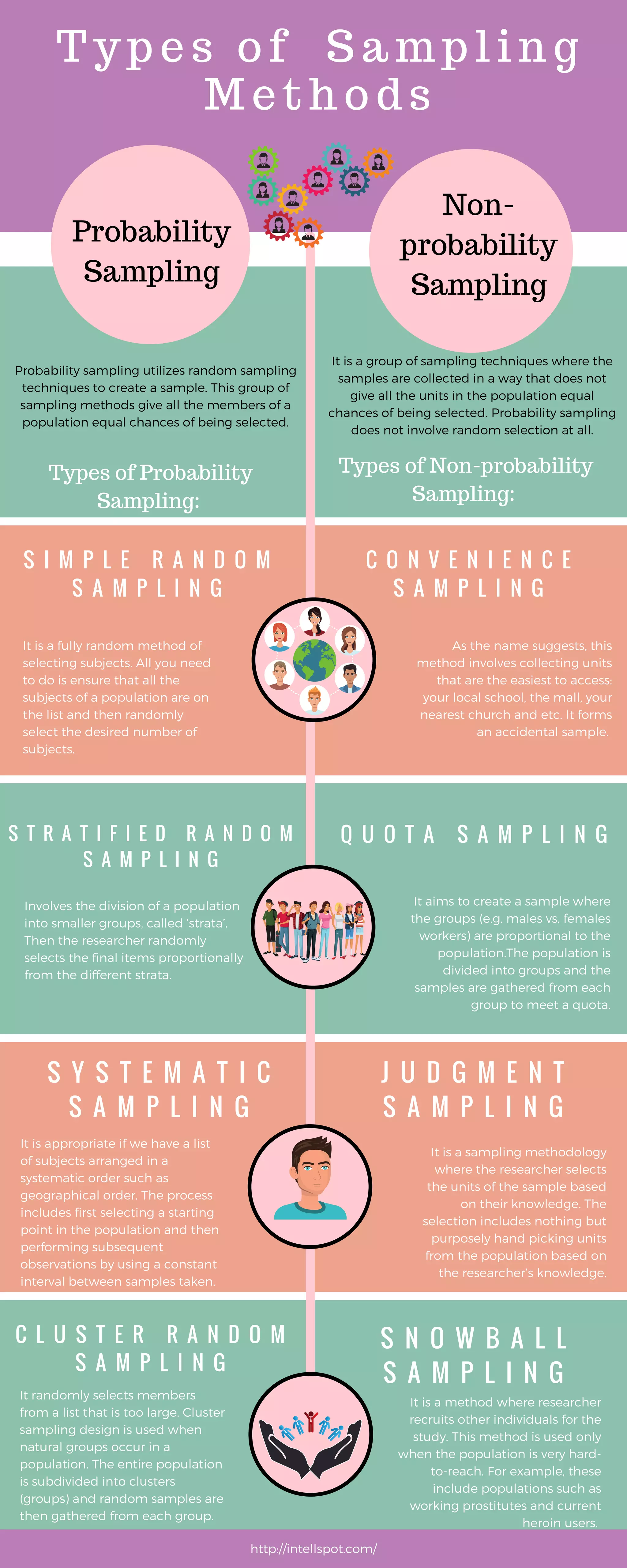
Types of sampling methods - infographic

  • 1.
    T y pe s o f S a m p l i n g M e t h o d s S I M P L E R A N D O M S A M P L I N G It is a fully random method of selecting subjects. All you need to do is ensure that all the subjects of a population are on the list and then randomly select the desired number of subjects. http://intellspot.com/ S Y S T E M A T I C S A M P L I N G It is appropriate if we have a list of subjects arranged in a systematic order such as geographical order. The process includes first selecting a starting point in the population and then performing subsequent observations by using a constant interval between samples taken. J U D G M E N T S A M P L I N G It is a sampling methodology where the researcher selects the units of the sample based on their knowledge. The selection includes nothing but purposely hand picking units from the population based on the researcher’s knowledge. S N O W B A L L S A M P L I N G It is a method where researcher recruits other individuals for the study. This method is used only when the population is very hard- to-reach. For example, these include populations such as working prostitutes and current heroin users.  Q U O T A S A M P L I N G It aims to create a sample where the groups (e.g. males vs. females workers) are proportional to the population.The population is divided into groups and the samples are gathered from each group to meet a quota. Non- probability Sampling Probability Sampling S T R A T I F I E D R A N D O M S A M P L I N G Involves the division of a population into smaller groups, called ‘strata’. Then the researcher randomly selects the final items proportionally from the different strata. C L U S T E R R A N D O M S A M P L I N G It randomly selects members from a list that is too large. Cluster sampling design is used when natural groups occur in a population. The entire population is subdivided into clusters (groups) and random samples are then gathered from each group. C O N V E N I E N C E S A M P L I N G As the name suggests, this method involves collecting units that are the easiest to access: your local school, the mall, your nearest church and etc. It forms an accidental sample.  Probability sampling utilizes random sampling techniques to create a sample. This group of sampling methods give all the members of a population equal chances of being selected. Types of Probability Sampling: Types of Non-probability Sampling: It is a group of sampling techniques where the samples are collected in a way that does not give all the units in the population equal chances of being selected. Probability sampling does not involve random selection at all.