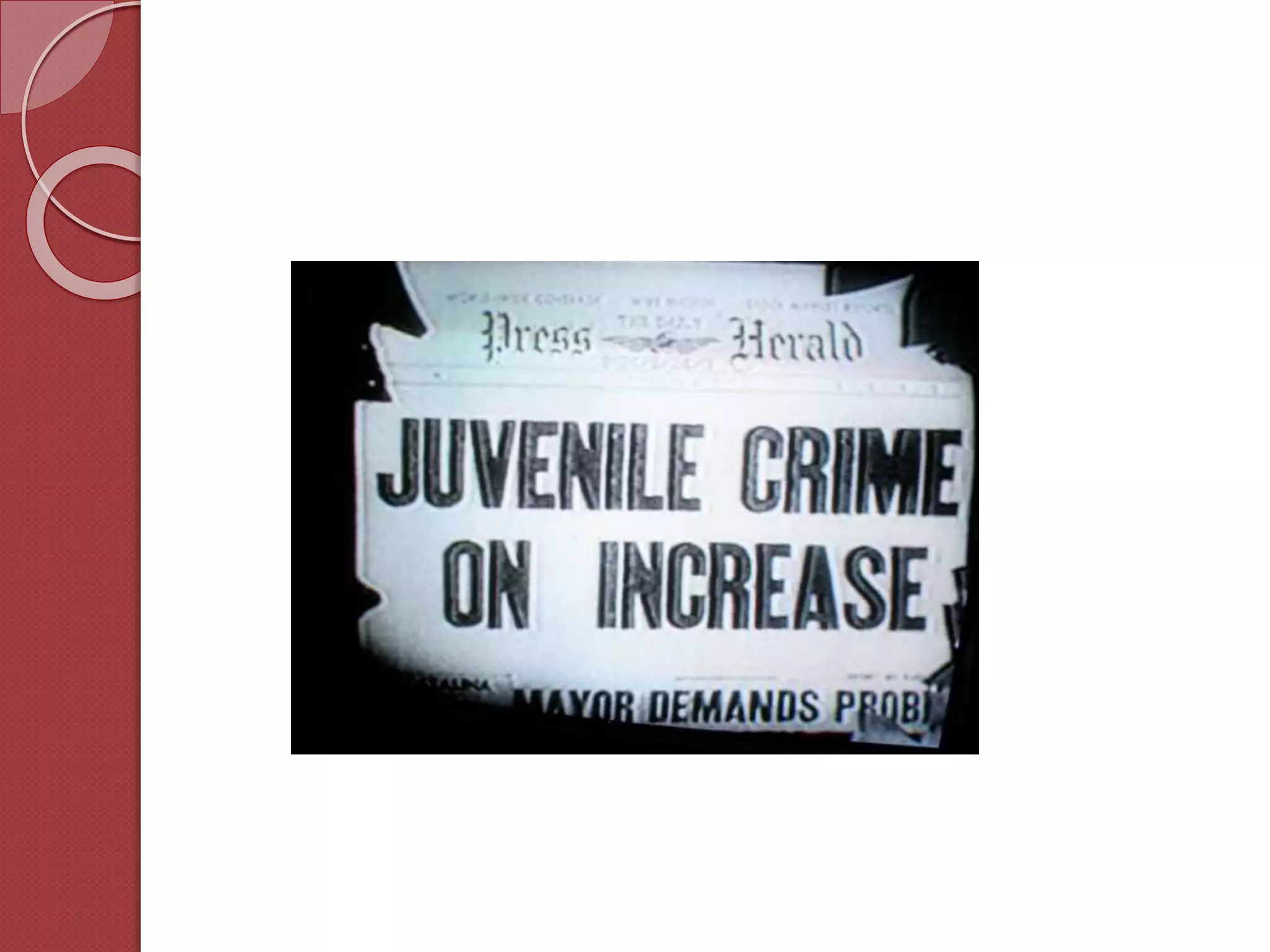
Let’s start with the news!
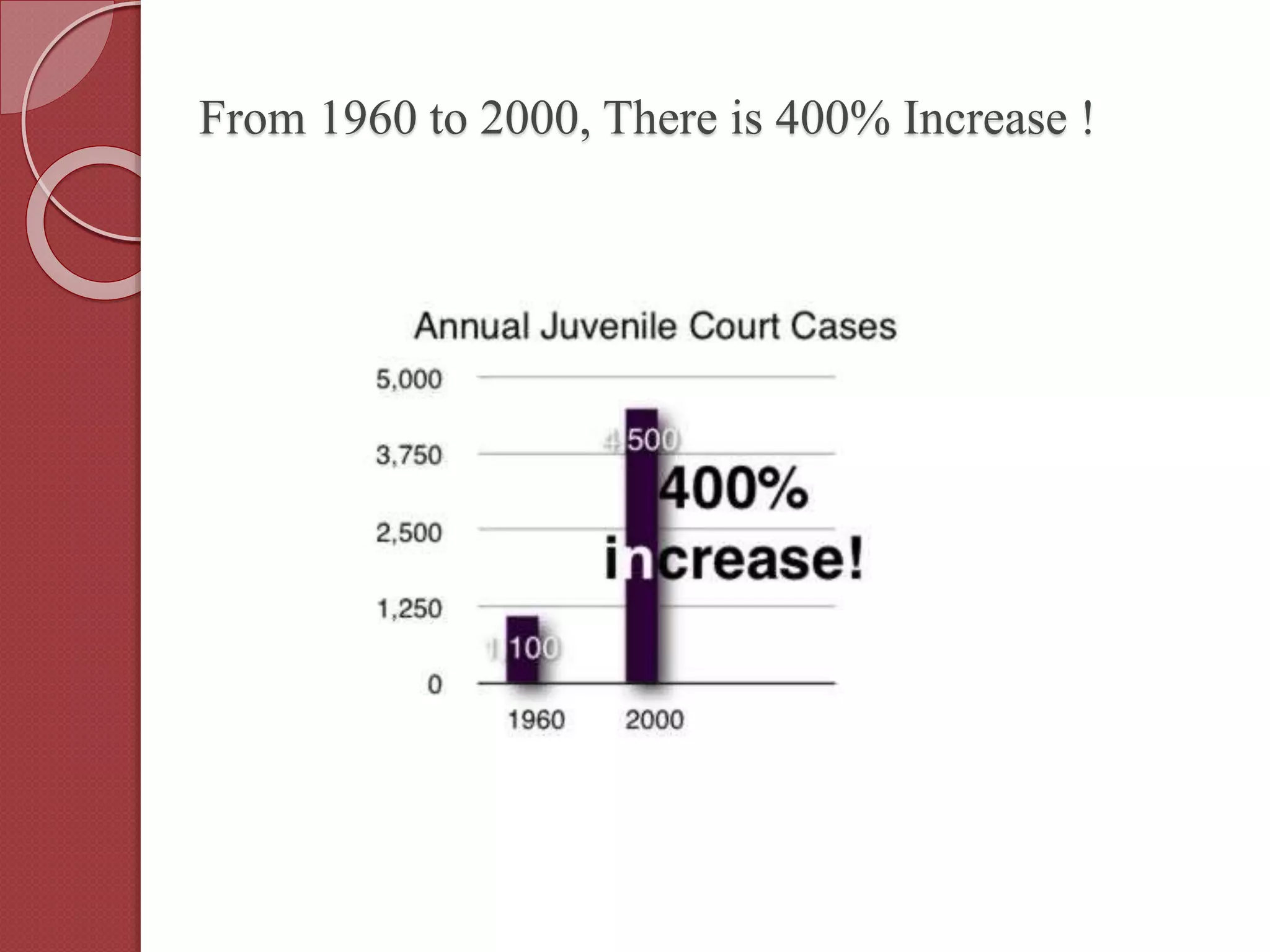
From 1960 to 2000, There is 400% Increase !
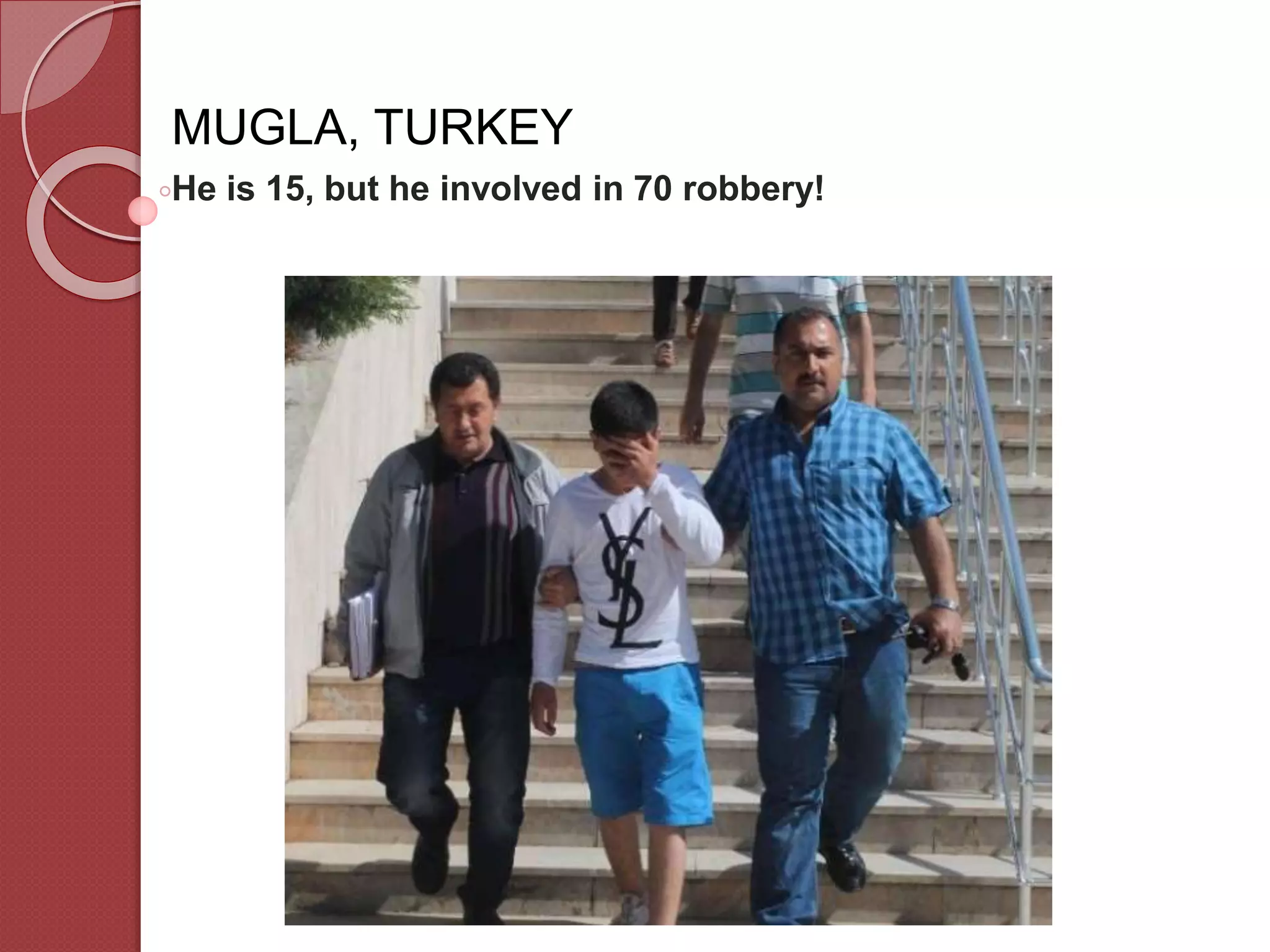
MUGLA, TURKEY
He is 15, but he involved in 70 robbery!
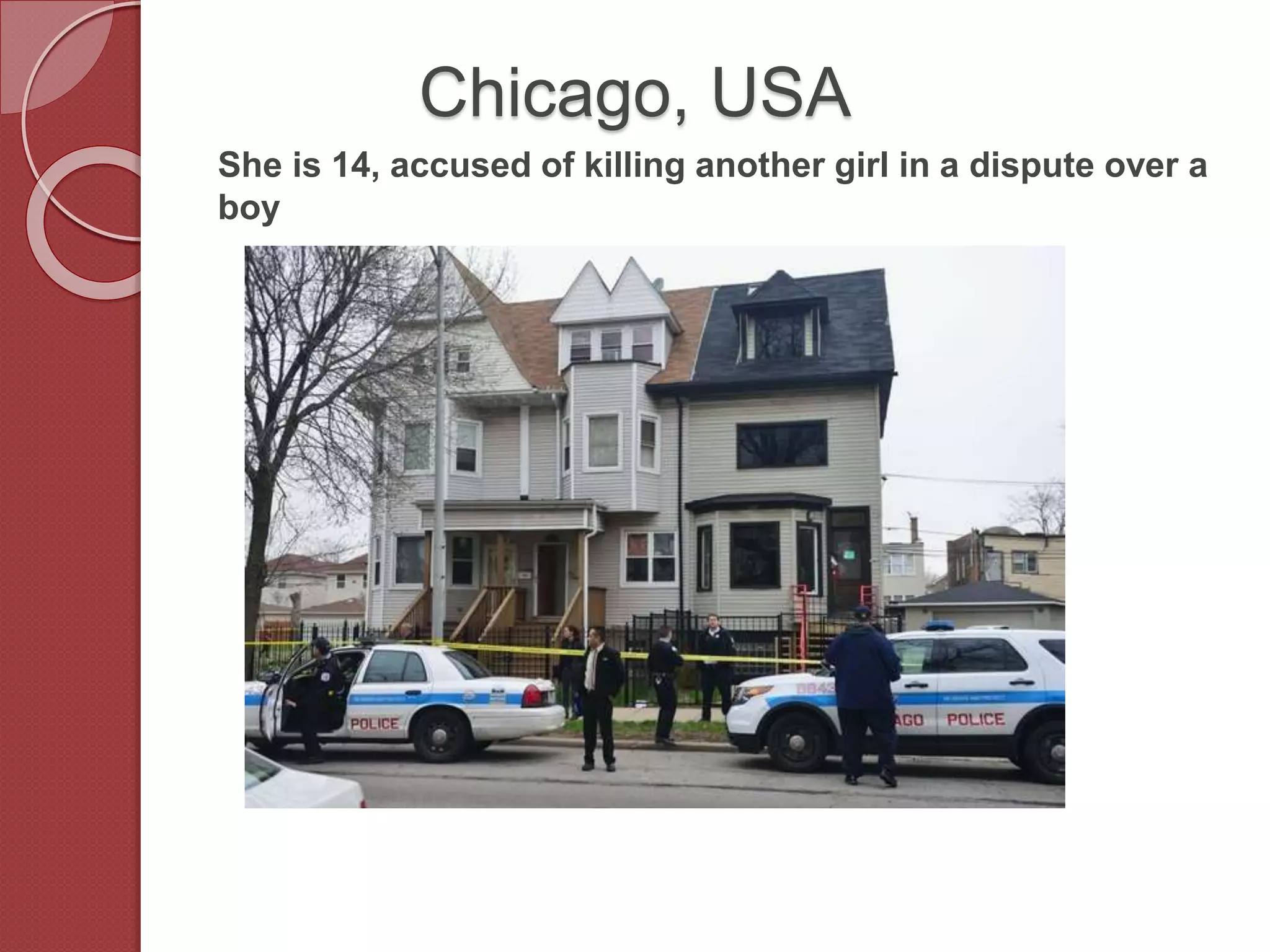
Chicago, USA
She is 14, accused of killing another girl in a dispute over a
boy
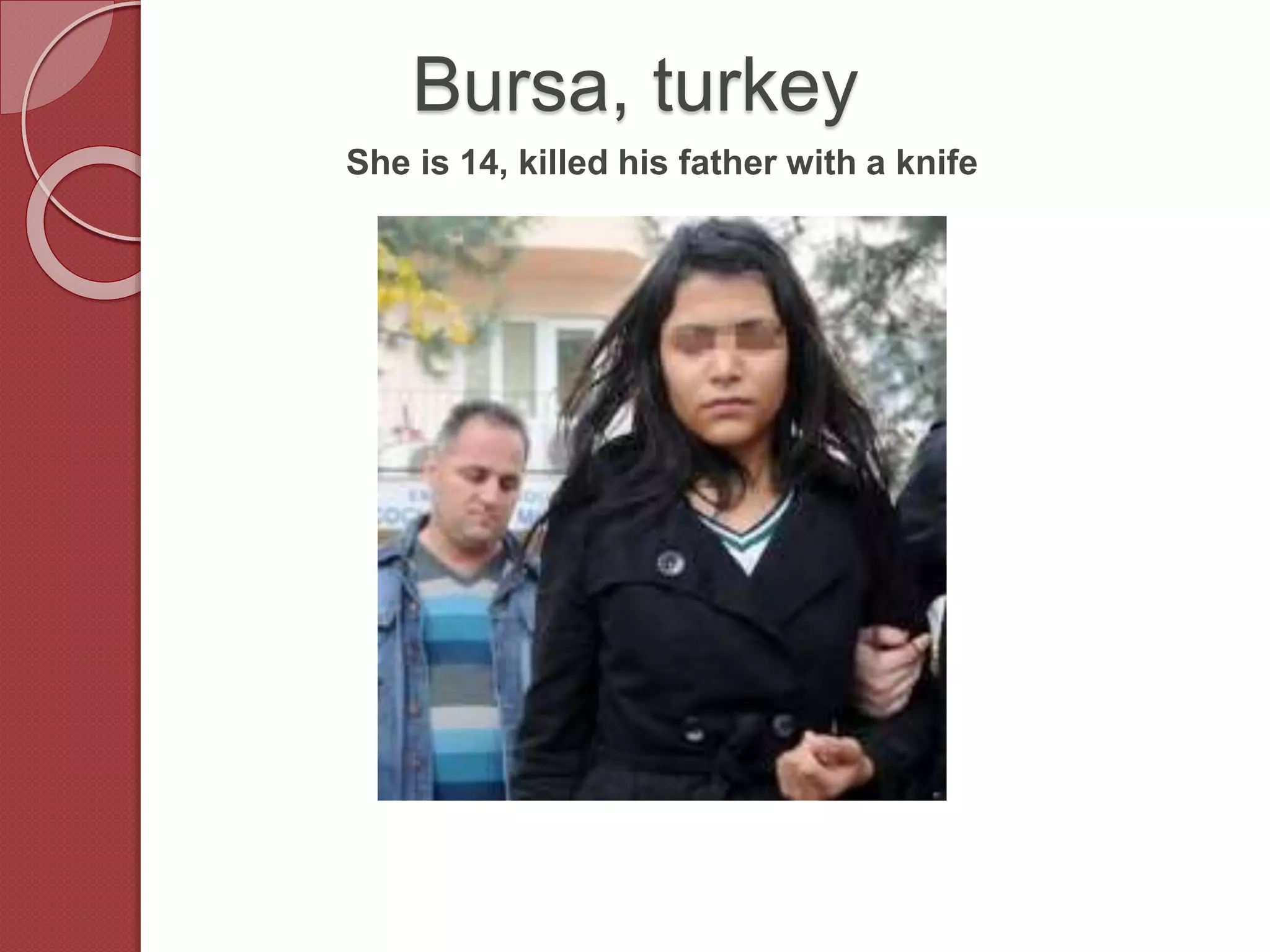
Bursa, turkey
She is 14, killed his father with a knife
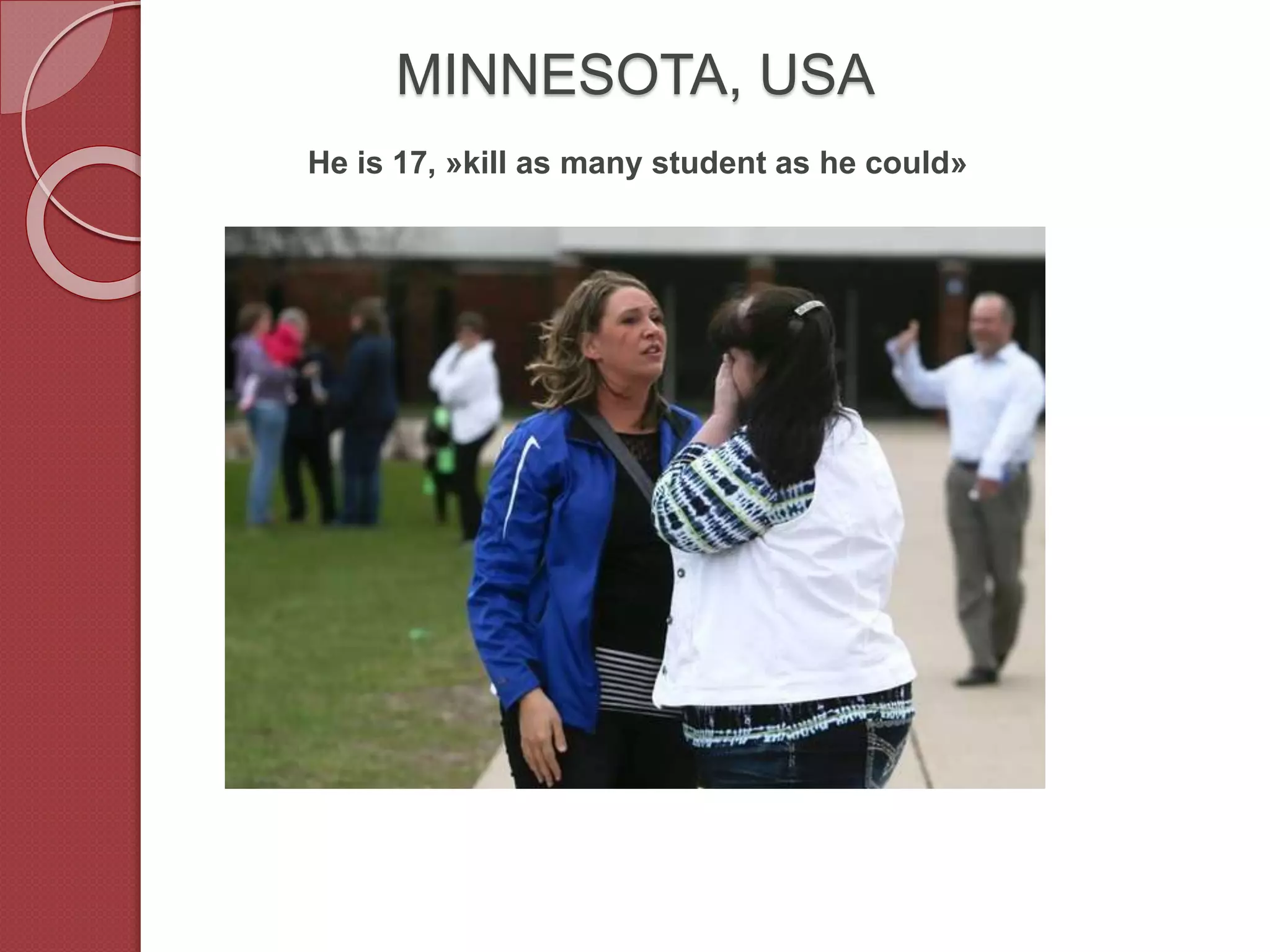
MINNESOTA, USA
He is 17, »kill as many student as he could»
As you understand, our topic is
about JUVENILE
DELINQUENCY
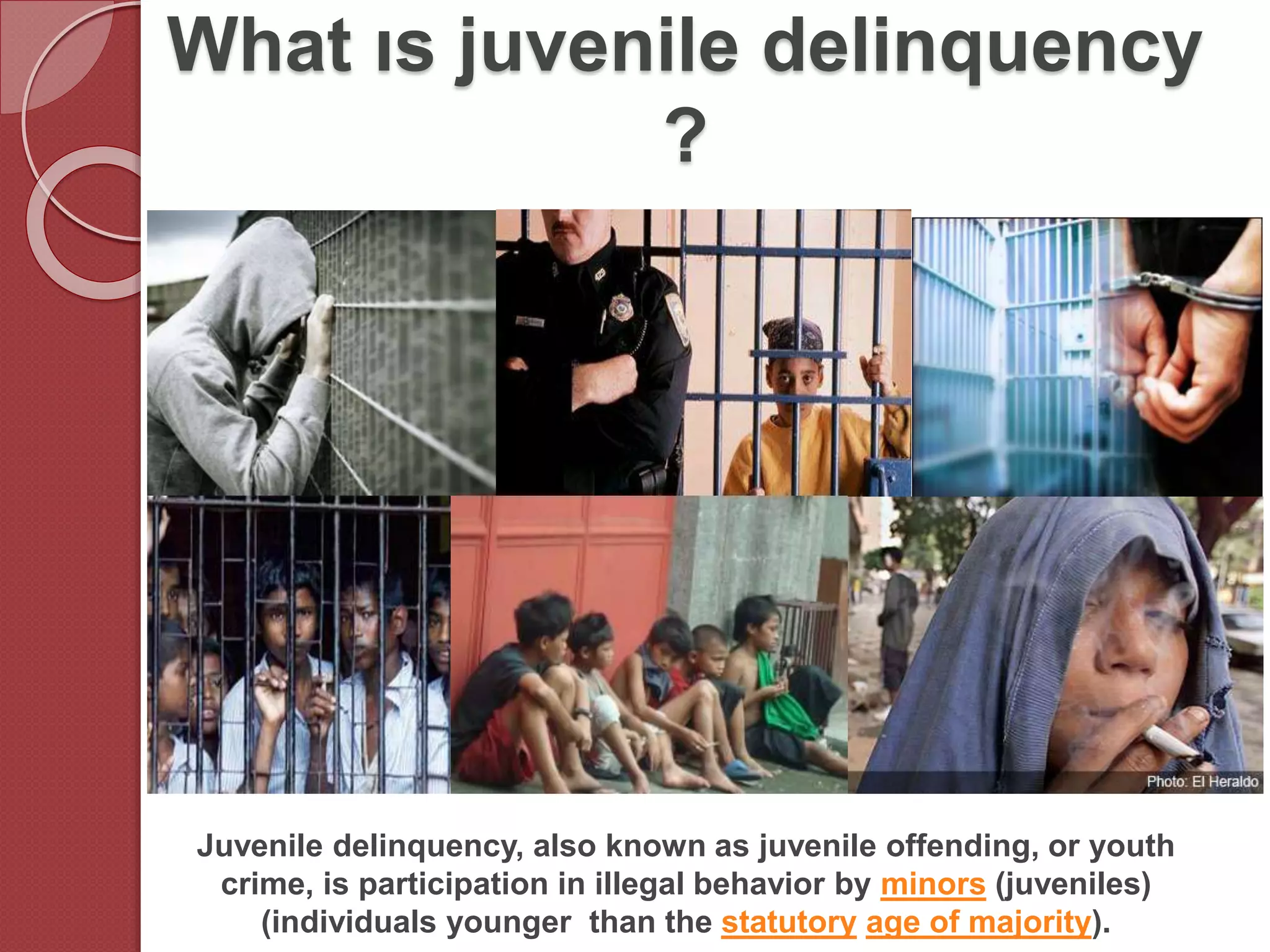
What ıs juvenile delinquency
?
Juvenile delinquency, also known as juvenile offending, or youth
crime, is participation in illegal behavior by minors (juveniles)
(individuals younger than the statutory age of majority).
Tıme to meet !
Juvenile
Delinquency
ED 313
Conflict Resolution
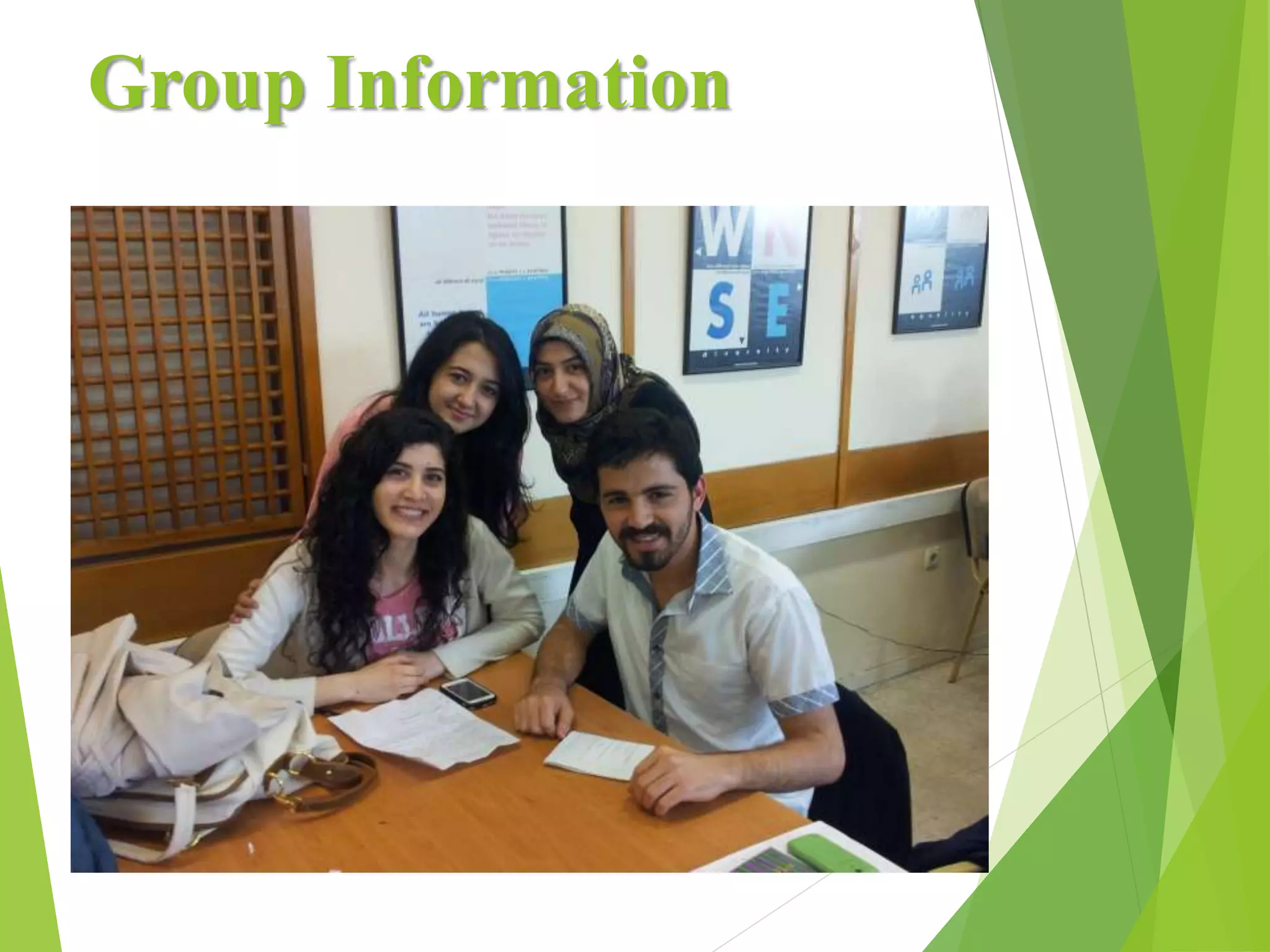
Group Information
 Group Name: Advocates of children
 Group Slogan: Children see, Children do.
 Group Leader: Ferhat Özel
 Group Members: Büşra Ertuğrul
Büşra Kabak
Sümeyra Tayfur
Group Information
Group Information
 Group Average Age: 20,8
 Group Meeting Time: Every Tuesday
and Wednesday at 5 p.m.
 Group Logo:
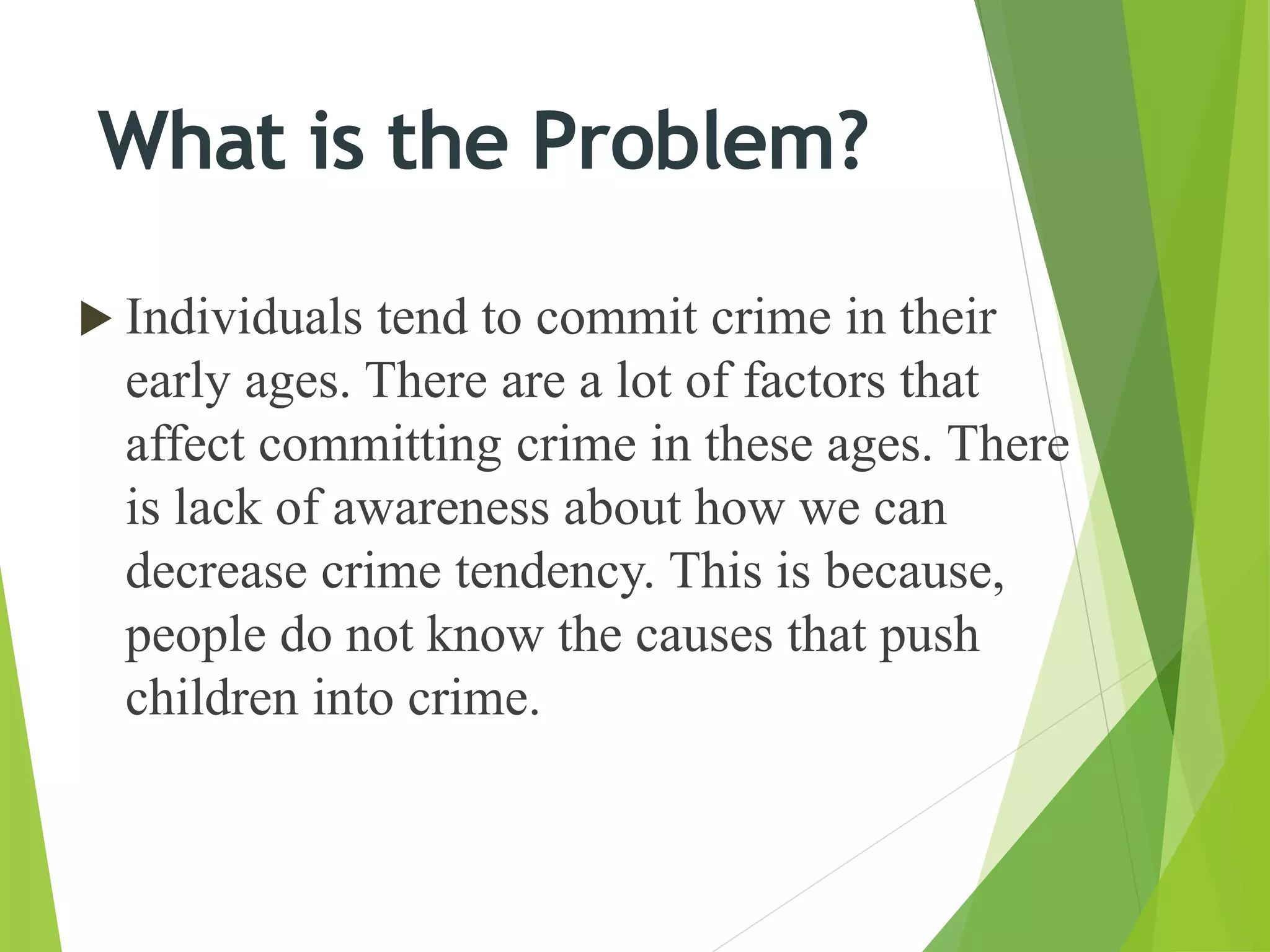
 Individuals tend to commit crime in their
early ages. There are a lot of factors that
affect committing crime in these ages. There
is lack of awareness about how we can
decrease crime tendency. This is because,
people do not know the causes that push
children into crime.
What is the Problem?
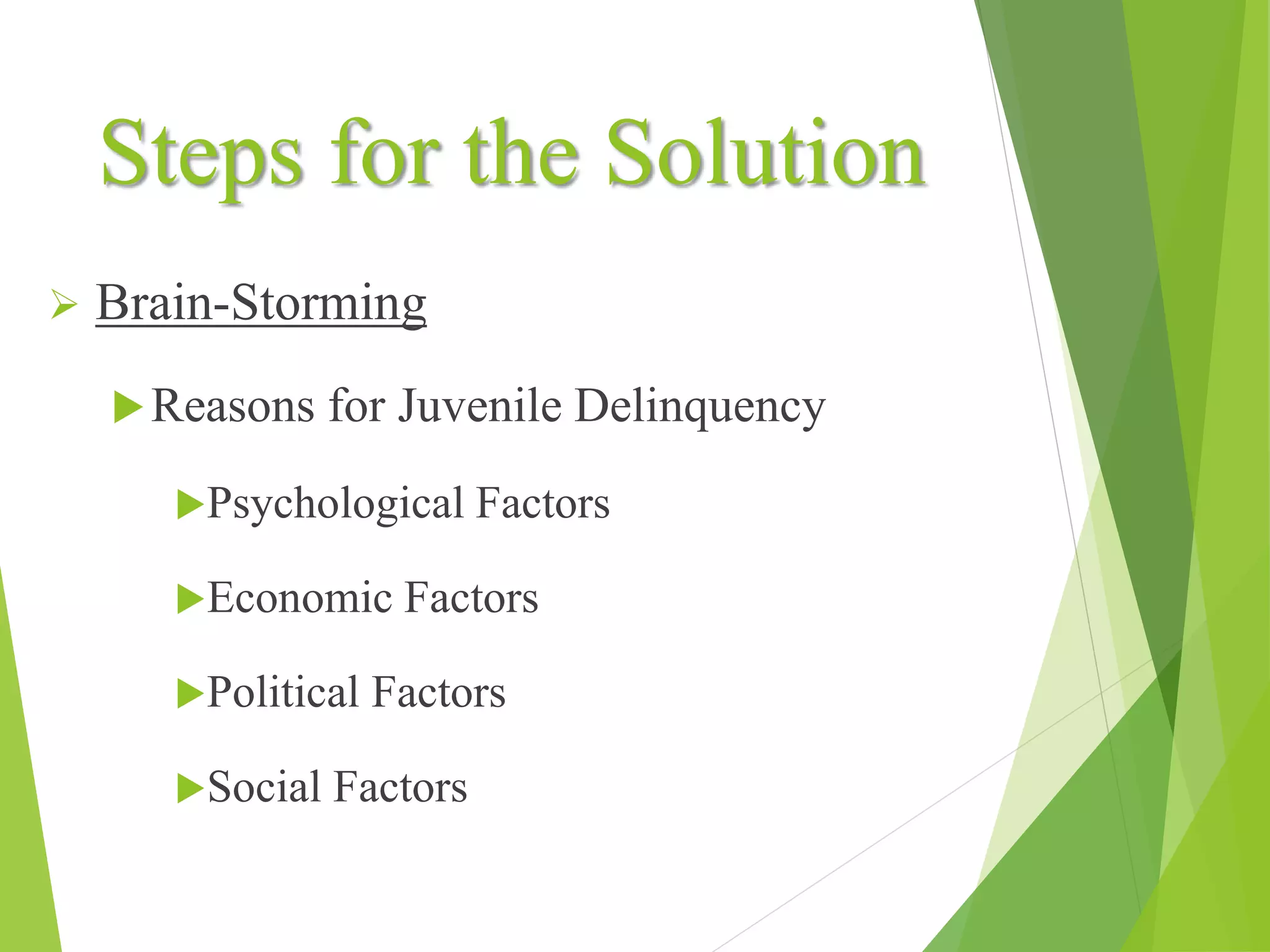
Steps for the Solution
 Brain-Storming
Reasons for Juvenile Delinquency
Psychological Factors
Economic Factors
Political Factors
Social Factors
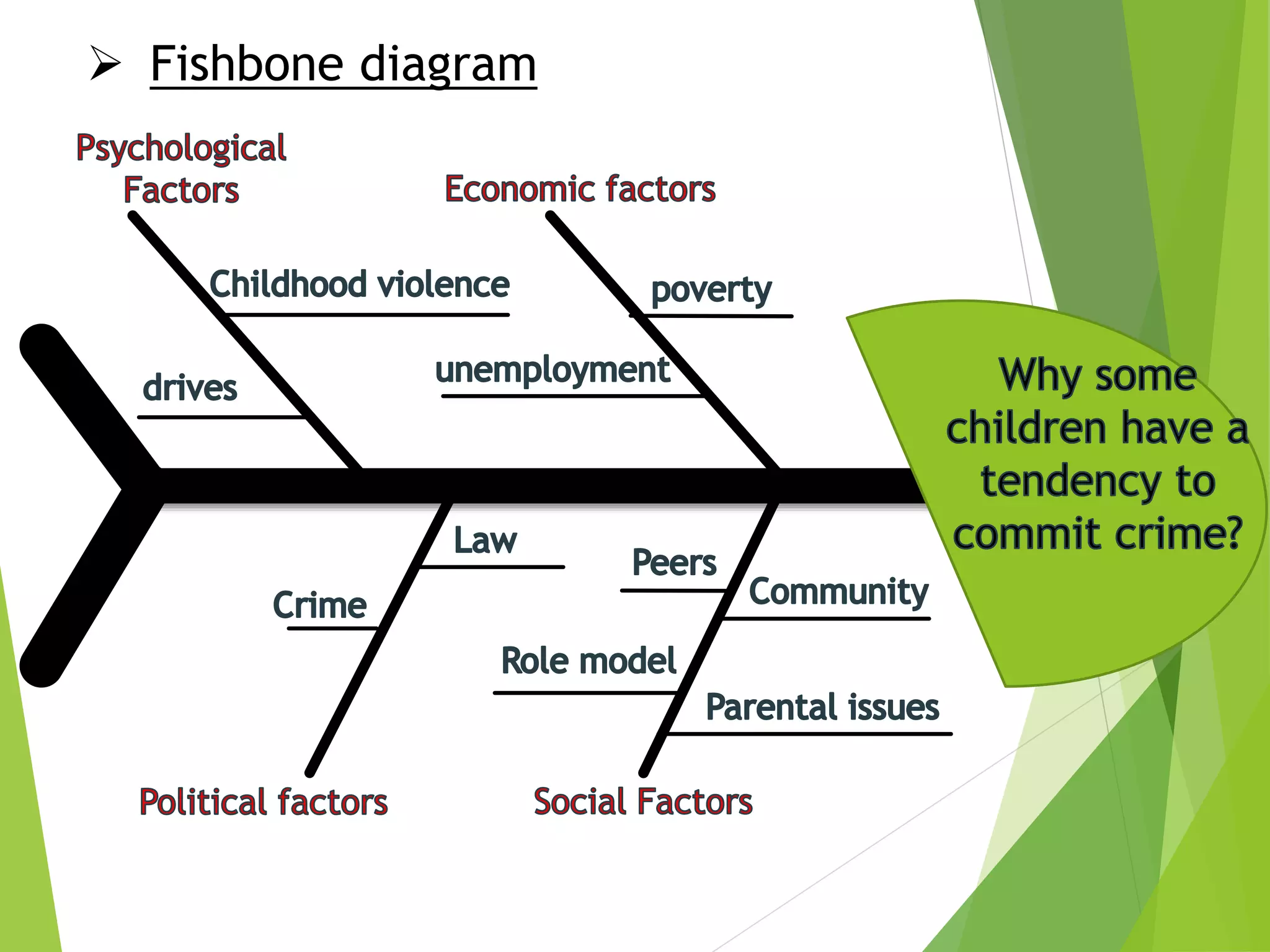
 Fishbone diagram
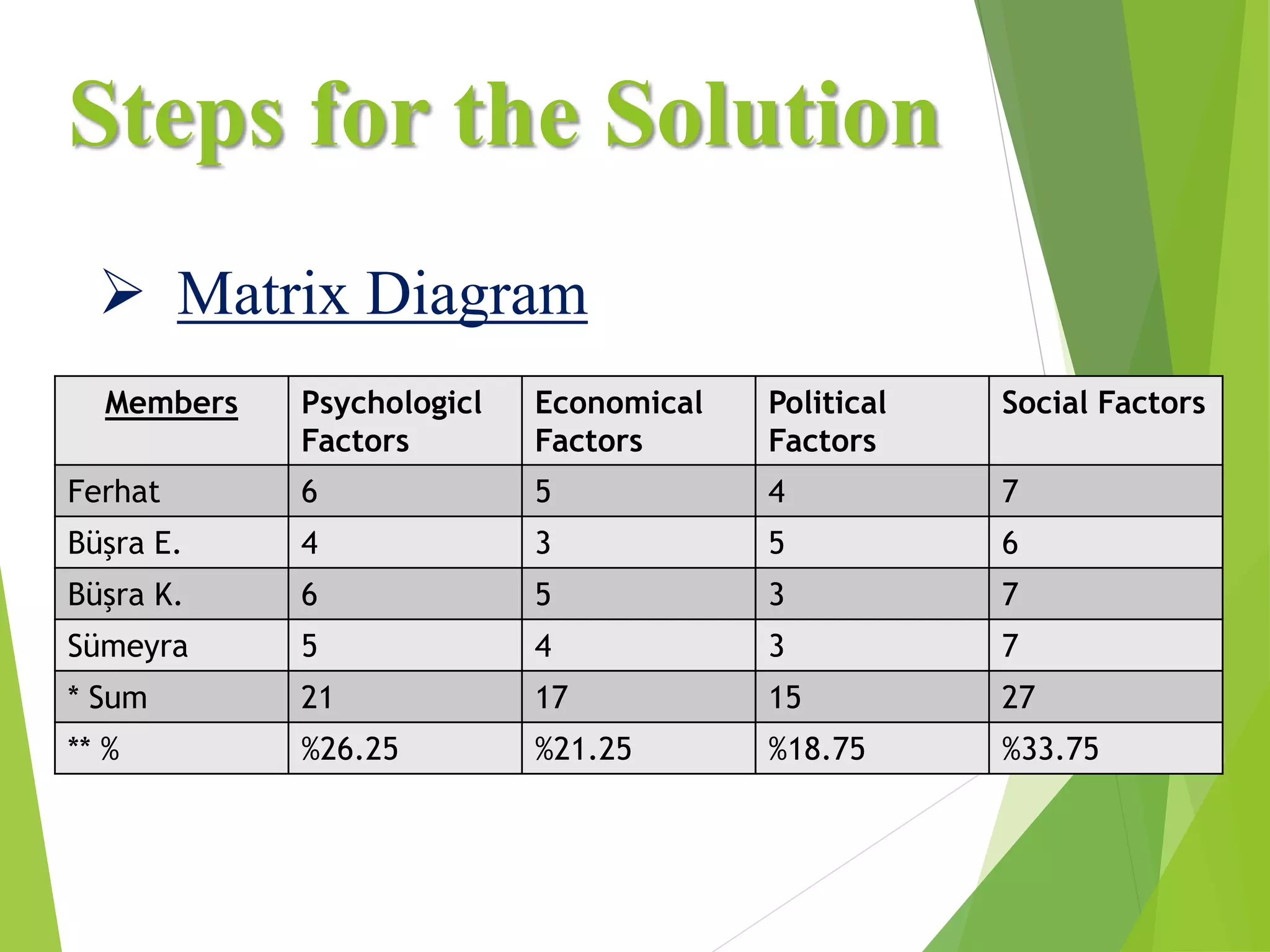
Steps for the Solution
Members Psychologicl
Factors
Economical
Factors
Political
Factors
Social Factors
Ferhat 6 5 4 7
Büşra E. 4 3 5 6
Büşra K. 6 5 3 7
Sümeyra 5 4 3 7
* Sum 21 17 15 27
** % %26.25 %21.25 %18.75 %33.75
 Matrix Diagram
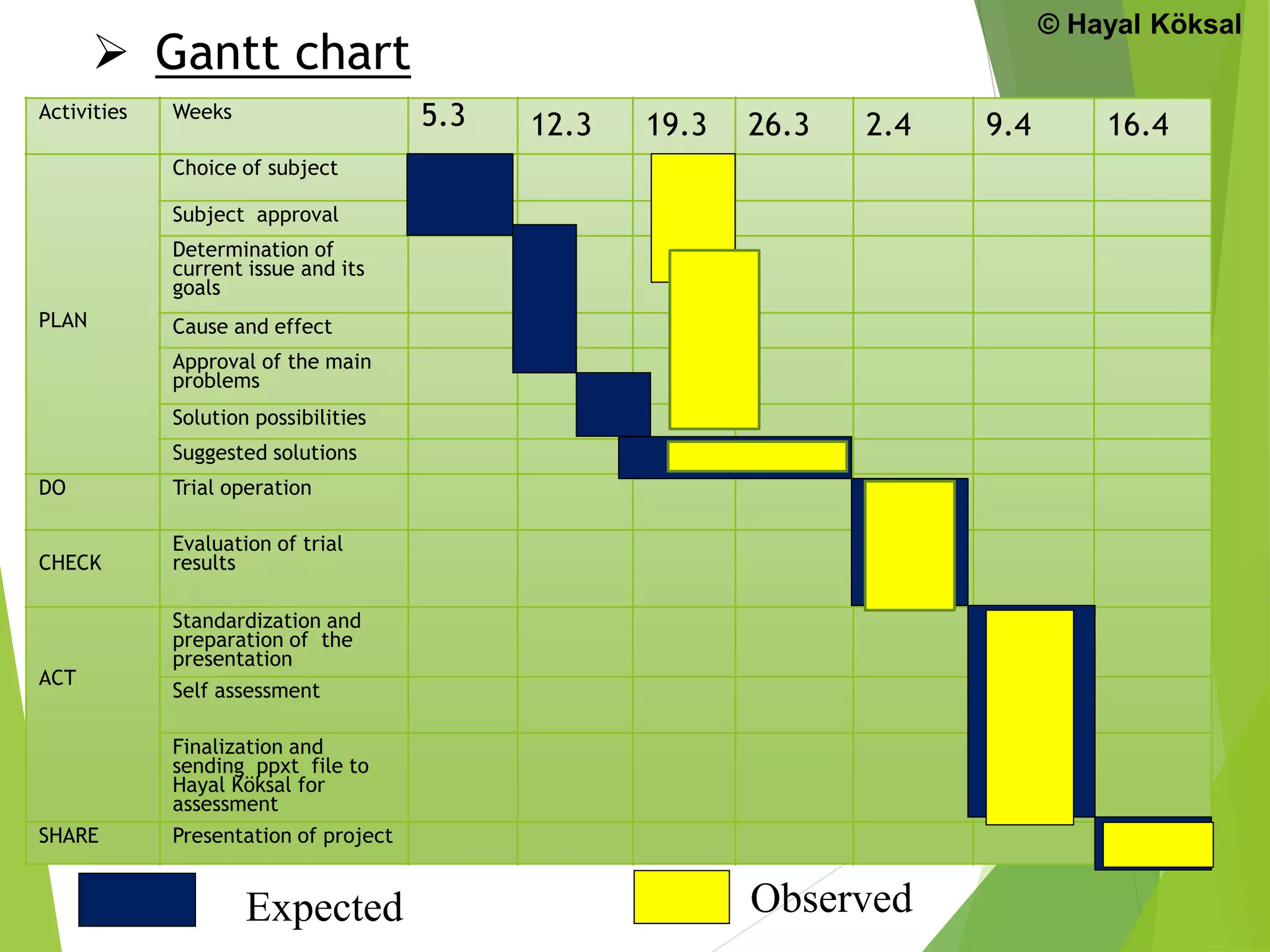
Activities Weeks 5.3 12.3 19.3 26.3 2.4 9.4 16.4
PLAN
Choice of subject
Subject approval
Determination of
current issue and its
goals
Cause and effect
Approval of the main
problems
Solution possibilities
Suggested solutions
DO Trial operation
CHECK
Evaluation of trial
results
ACT
Standardization and
preparation of the
presentation
Self assessment
Finalization and
sending ppxt file to
Hayal Köksal for
assessment
SHARE Presentation of project
© Hayal Köksal
Expected Observed
 Gantt chart
Steps For the Solution
Data Collection
Literature Review
Survey
Literature Review
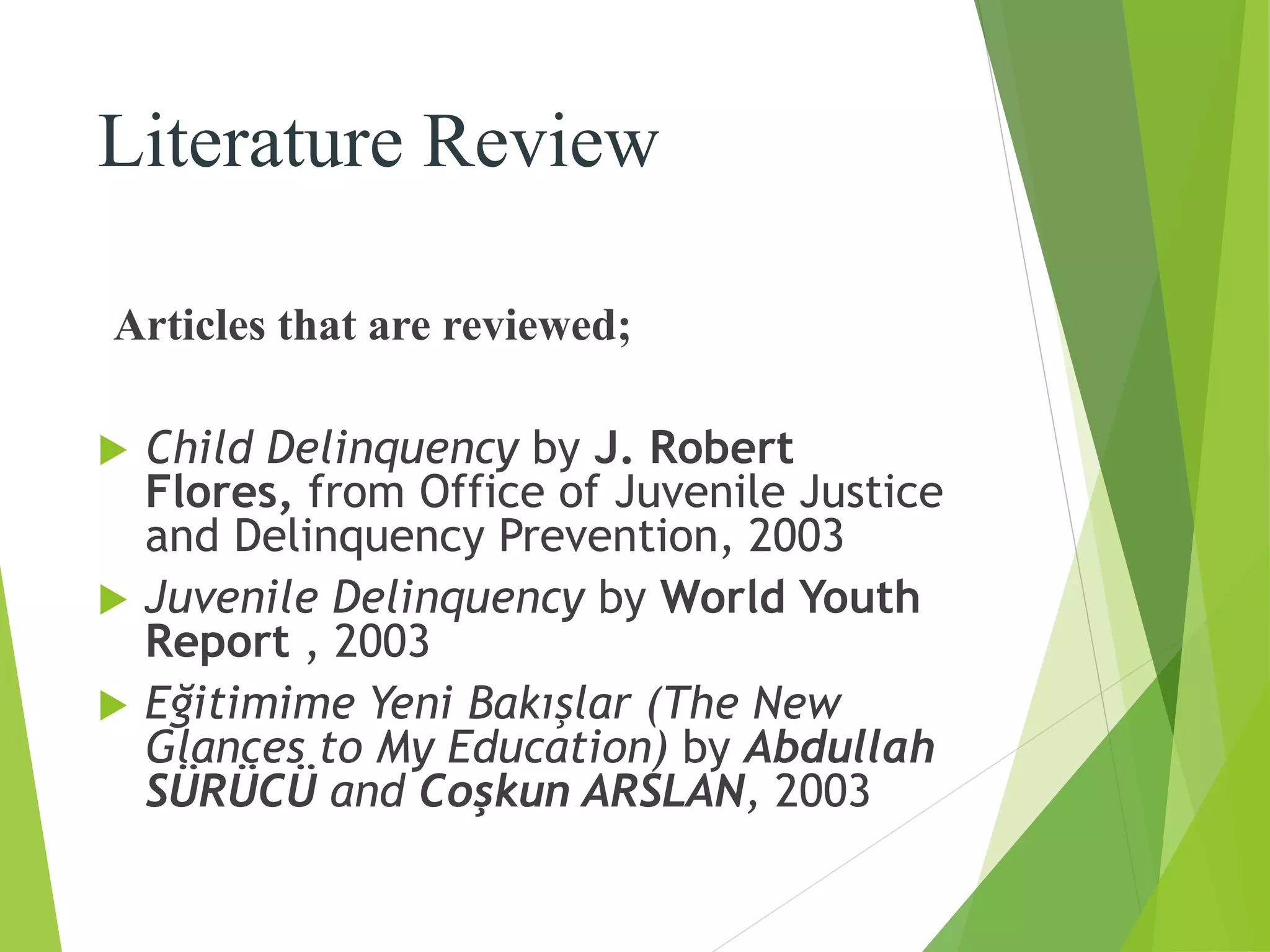
Articles that are reviewed;
 Child Delinquency by J. Robert
Flores, from Office of Juvenile Justice
and Delinquency Prevention, 2003
 Juvenile Delinquency by World Youth
Report , 2003
 Eğitimime Yeni Bakışlar (The New
Glances to My Education) by Abdullah
SÜRÜCÜ and Coşkun ARSLAN, 2003
Literature Review
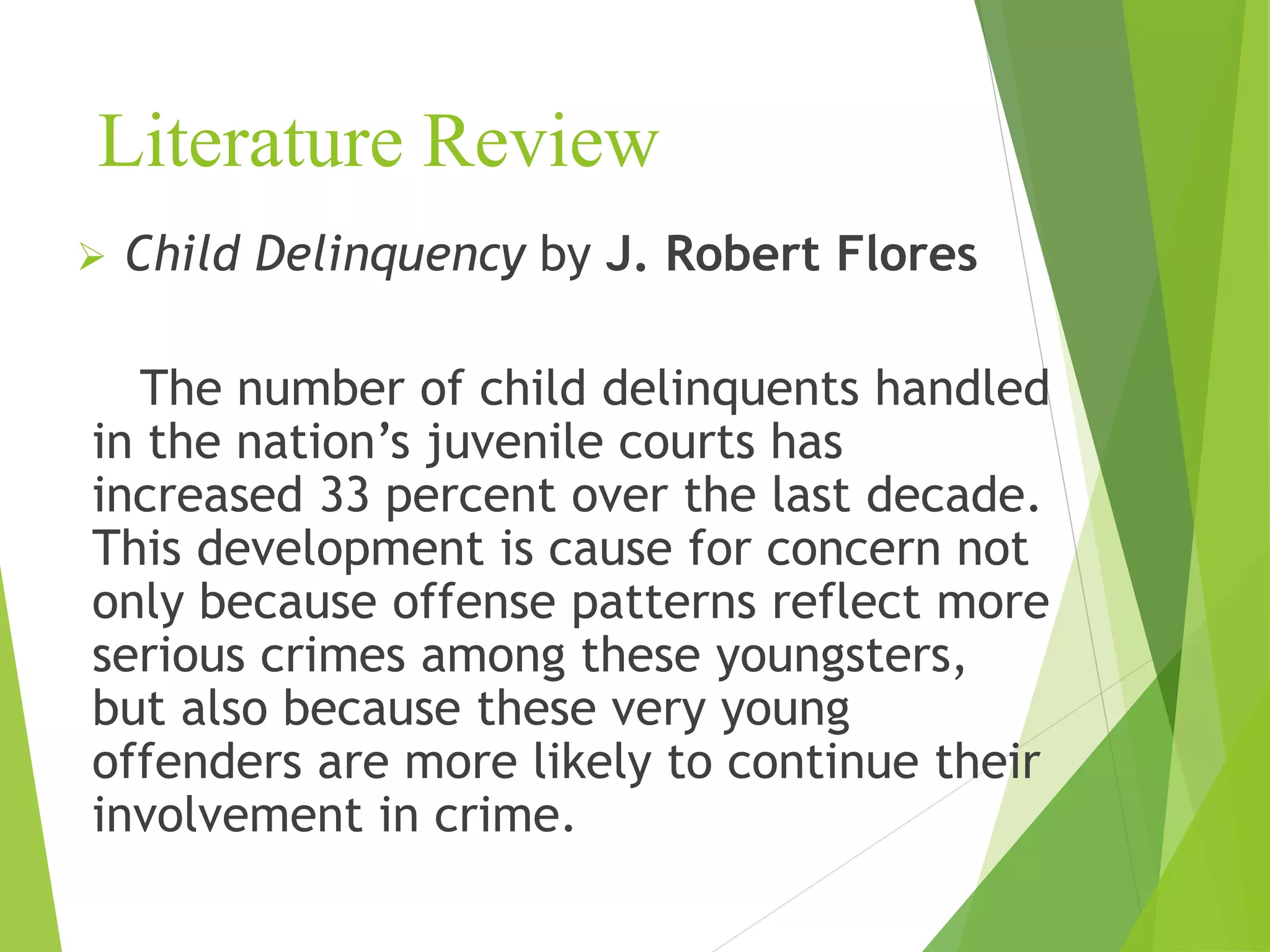
 Child Delinquency by J. Robert Flores
The number of child delinquents handled
in the nation’s juvenile courts has
increased 33 percent over the last decade.
This development is cause for concern not
only because offense patterns reflect more
serious crimes among these youngsters,
but also because these very young
offenders are more likely to continue their
involvement in crime.
Literature Review
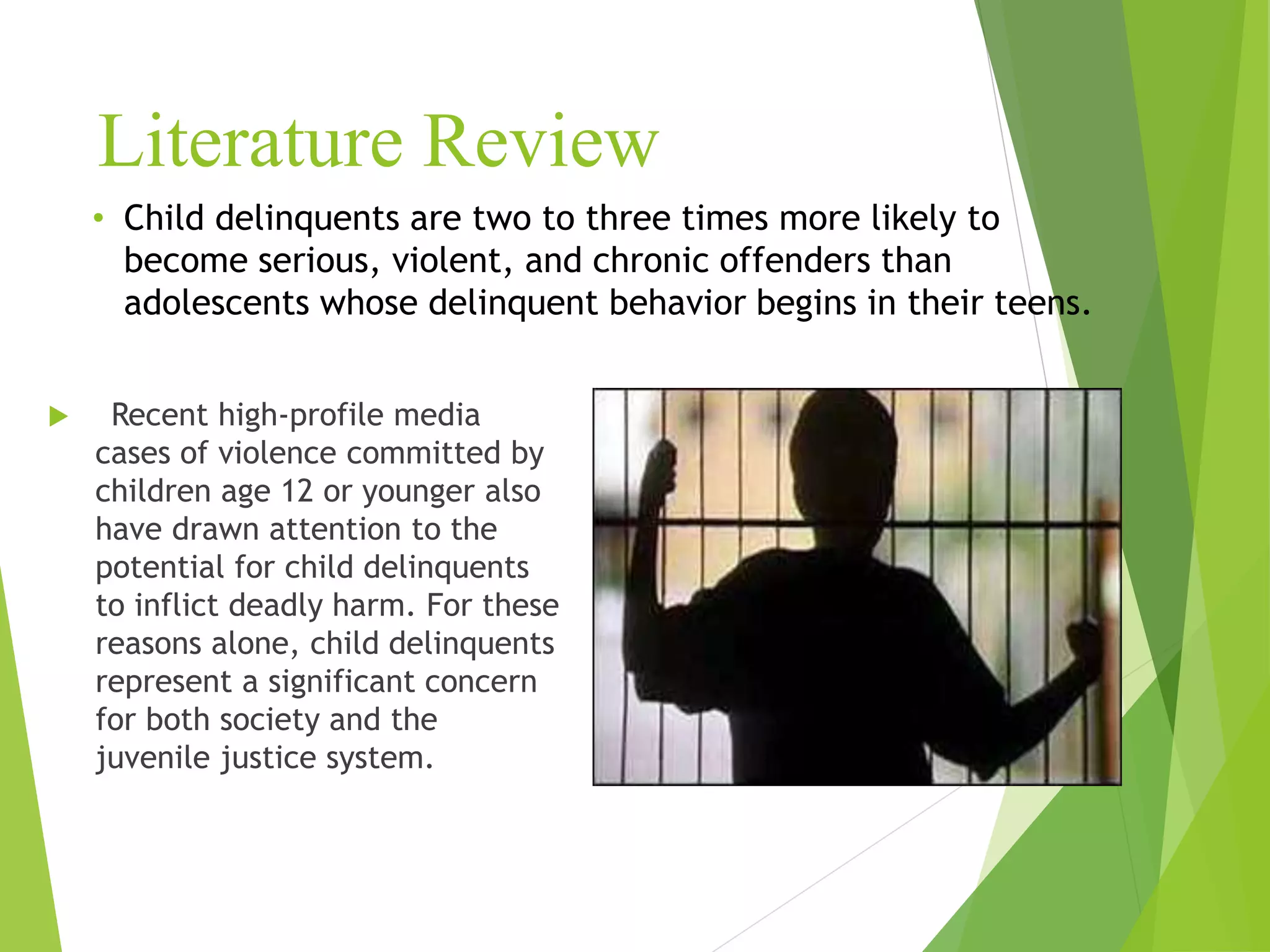
 Recent high-profile media
cases of violence committed by
children age 12 or younger also
have drawn attention to the
potential for child delinquents
to inflict deadly harm. For these
reasons alone, child delinquents
represent a significant concern
for both society and the
juvenile justice system.
• Child delinquents are two to three times more likely to
become serious, violent, and chronic offenders than
adolescents whose delinquent behavior begins in their teens.
Literature Review
 Juvenile Delinquency by World Youth
Report
The problem of juvenile delinquency is becoming
more complicated and universal, and crime
prevention programs are either unequipped to deal
with the present realities or do not exist. Many
developing countries have done little or nothing to
deal with these problems, and international
programs are obviously insufficient. Developed
countries are engaged in activities aimed at juvenile
crime prevention, but the overall effect of these
programs is rather weak because the mechanisms in
place are often inadequate to address the existing
situation.
Literature Review
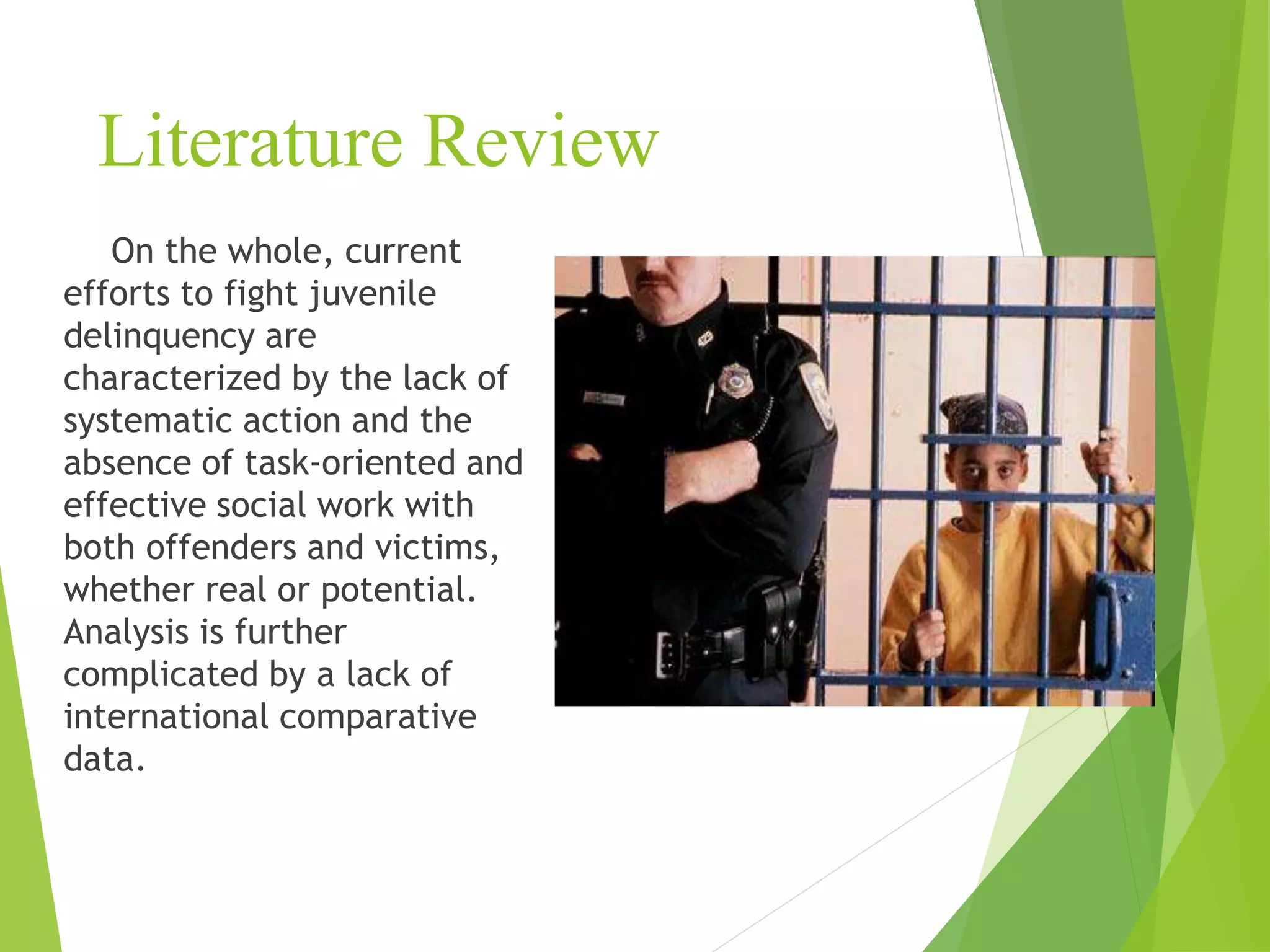
On the whole, current
efforts to fight juvenile
delinquency are
characterized by the lack of
systematic action and the
absence of task-oriented and
effective social work with
both offenders and victims,
whether real or potential.
Analysis is further
complicated by a lack of
international comparative
data.
Literature Review
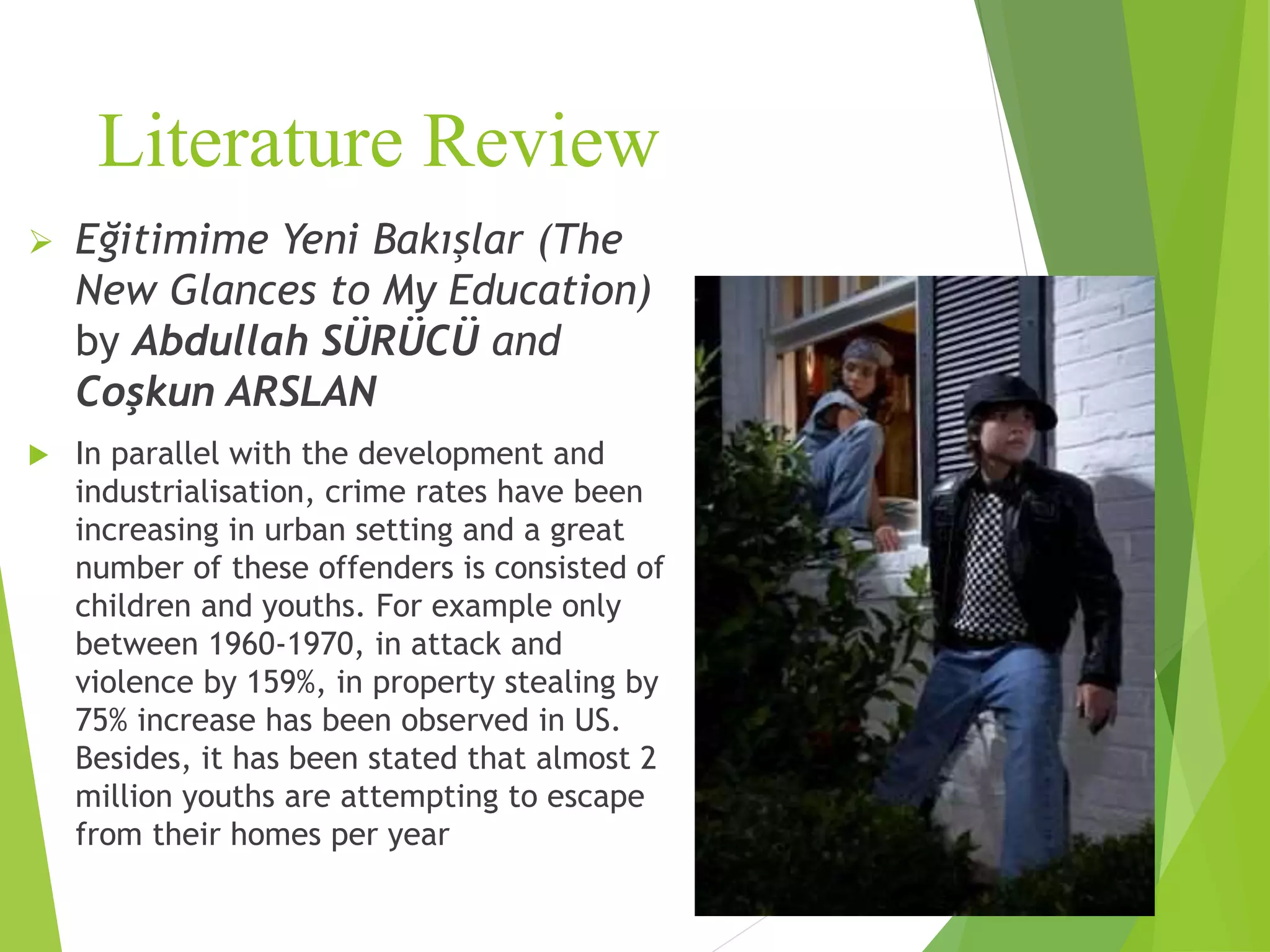
 Eğitimime Yeni Bakışlar (The
New Glances to My Education)
by Abdullah SÜRÜCÜ and
Coşkun ARSLAN
 In parallel with the development and
industrialisation, crime rates have been
increasing in urban setting and a great
number of these offenders is consisted of
children and youths. For example only
between 1960-1970, in attack and
violence by 159%, in property stealing by
75% increase has been observed in US.
Besides, it has been stated that almost 2
million youths are attempting to escape
from their homes per year
SOCIAL FACTORS
 Parental issues/ Family Environment
 Peer and Community / Antisocial Behavior or
Exclusion
 Role Modeling
1- PARENTAL ISSUES
 No parents / Divorced parents
 Parenting styles (Authoritarian or
negligent parents)
 Violence in the family sphere
BAUMRIND’S PARENTING
STYLES
 Authoritarian
 Authoritative
 Indulgent
 Neglectful
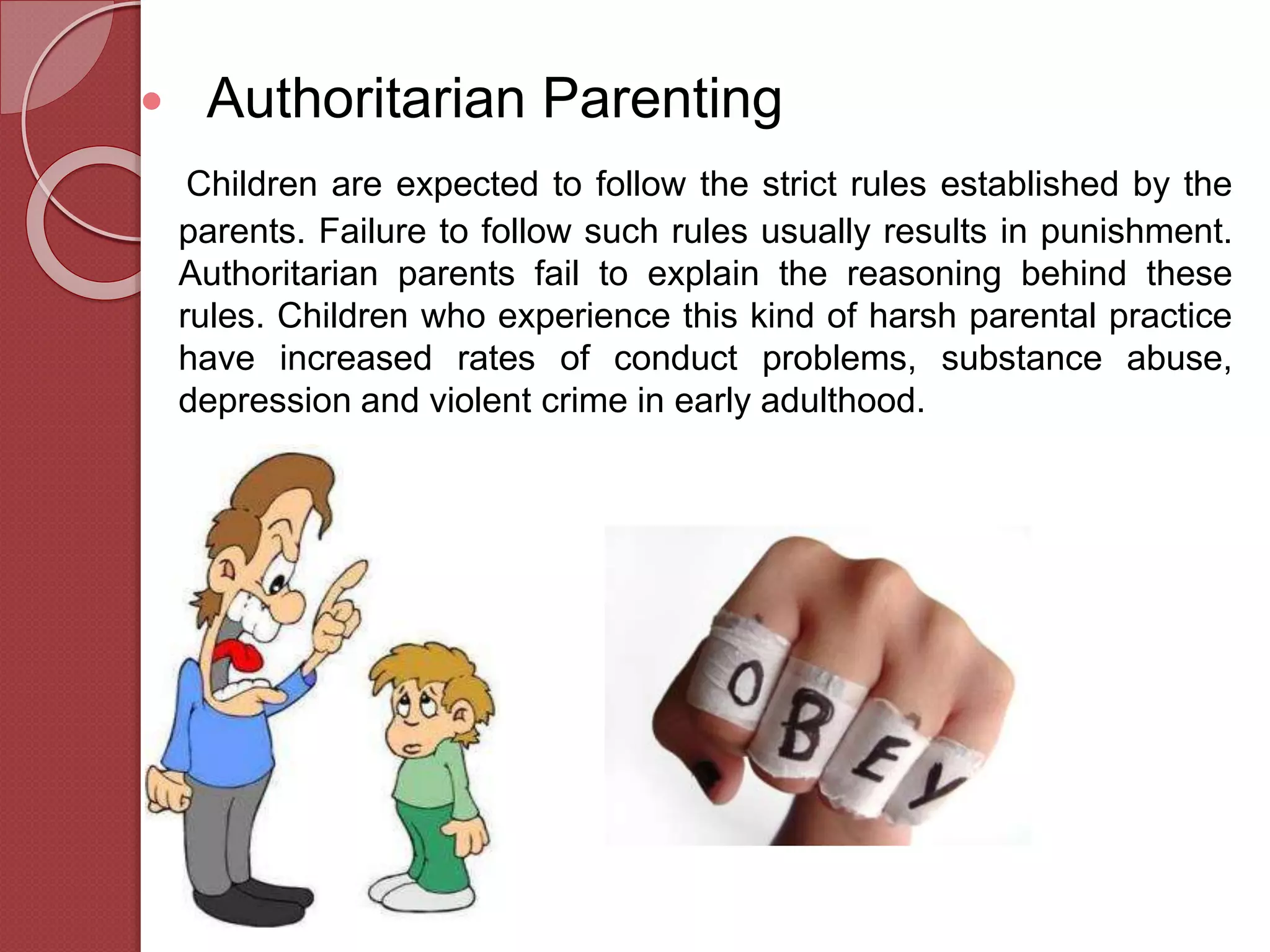
 Authoritarian Parenting
Children are expected to follow the strict rules established by the
parents. Failure to follow such rules usually results in punishment.
Authoritarian parents fail to explain the reasoning behind these
rules. Children who experience this kind of harsh parental practice
have increased rates of conduct problems, substance abuse,
depression and violent crime in early adulthood.
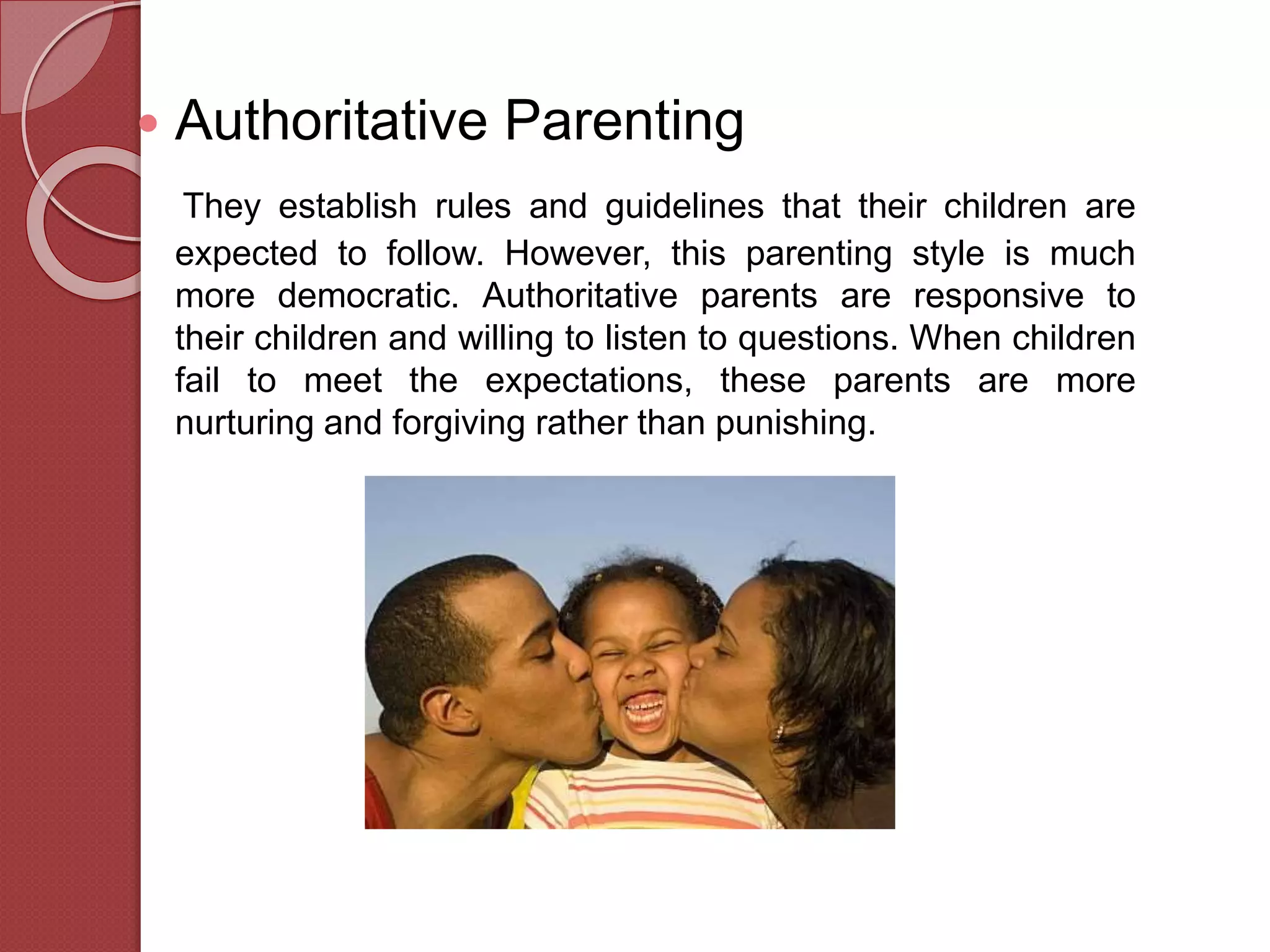
 Authoritative Parenting
They establish rules and guidelines that their children are
expected to follow. However, this parenting style is much
more democratic. Authoritative parents are responsive to
their children and willing to listen to questions. When children
fail to meet the expectations, these parents are more
nurturing and forgiving rather than punishing.
 Indulgent (Permissive) Parenting
They have very few demands to make of their children.
These parents rarely discipline their children because they
have relatively low expectations of maturity and self-
control. Permissive parents are generally nurturing and
communicative with their children, often taking on the status
of a friend more than that of a parent.
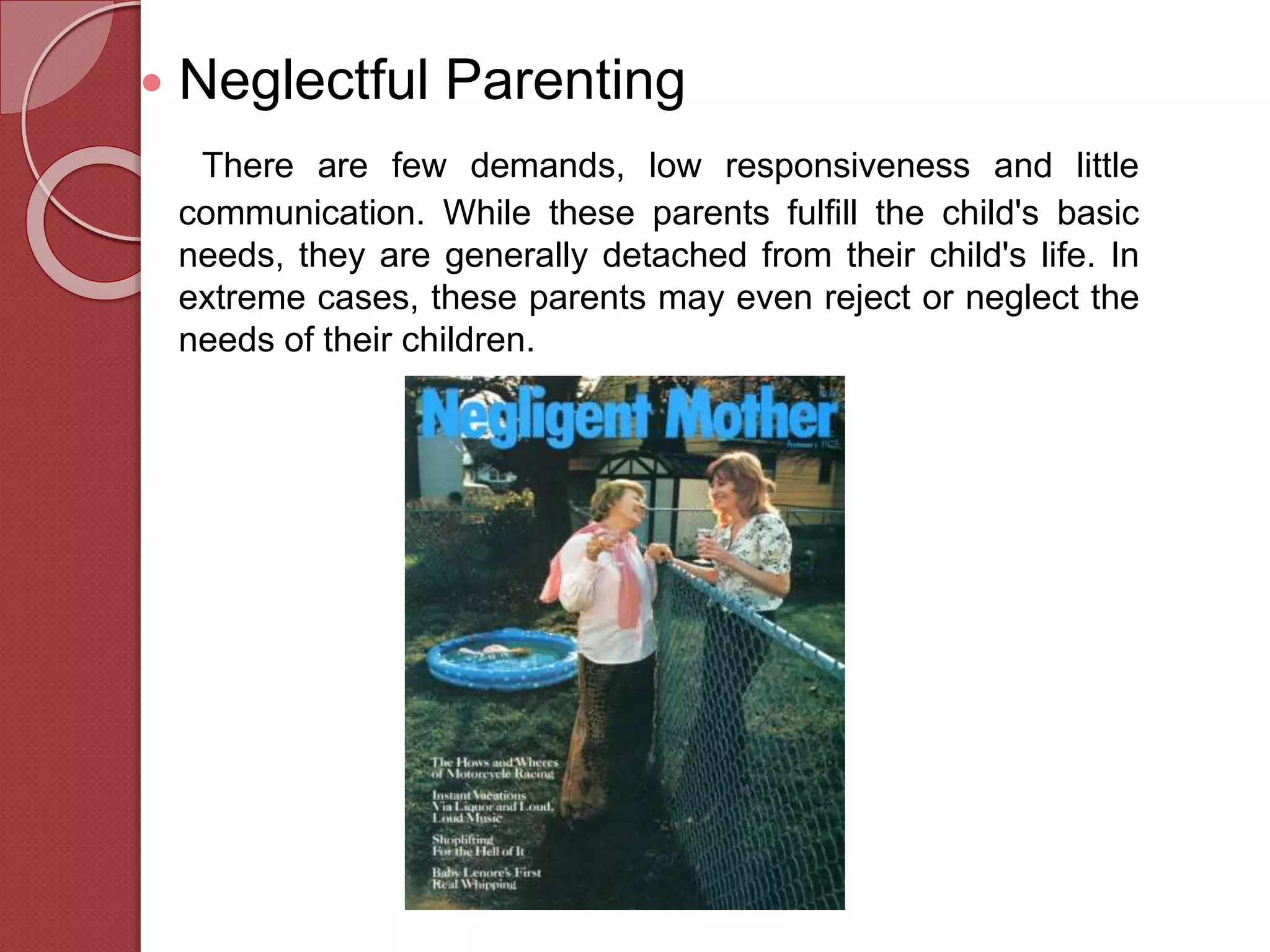
 Neglectful Parenting
There are few demands, low responsiveness and little
communication. While these parents fulfill the child's basic
needs, they are generally detached from their child's life. In
extreme cases, these parents may even reject or neglect the
needs of their children.
Domestıc Vıolence
Violence in the family environment is a crucial problem
because it has huge impacts on the child. Children who have
witnessed abuse often suffer low self-esteem, depression,
stress disorders, poor impulse control and feelings of
powerlessness. They are at high risk for alcohol and drug
use, sexual acting out, running away, suicide and crime
tendency.http://www.youtube.com/watch?v=hHHdovKHDNU
PEER AND
COMMUNITY
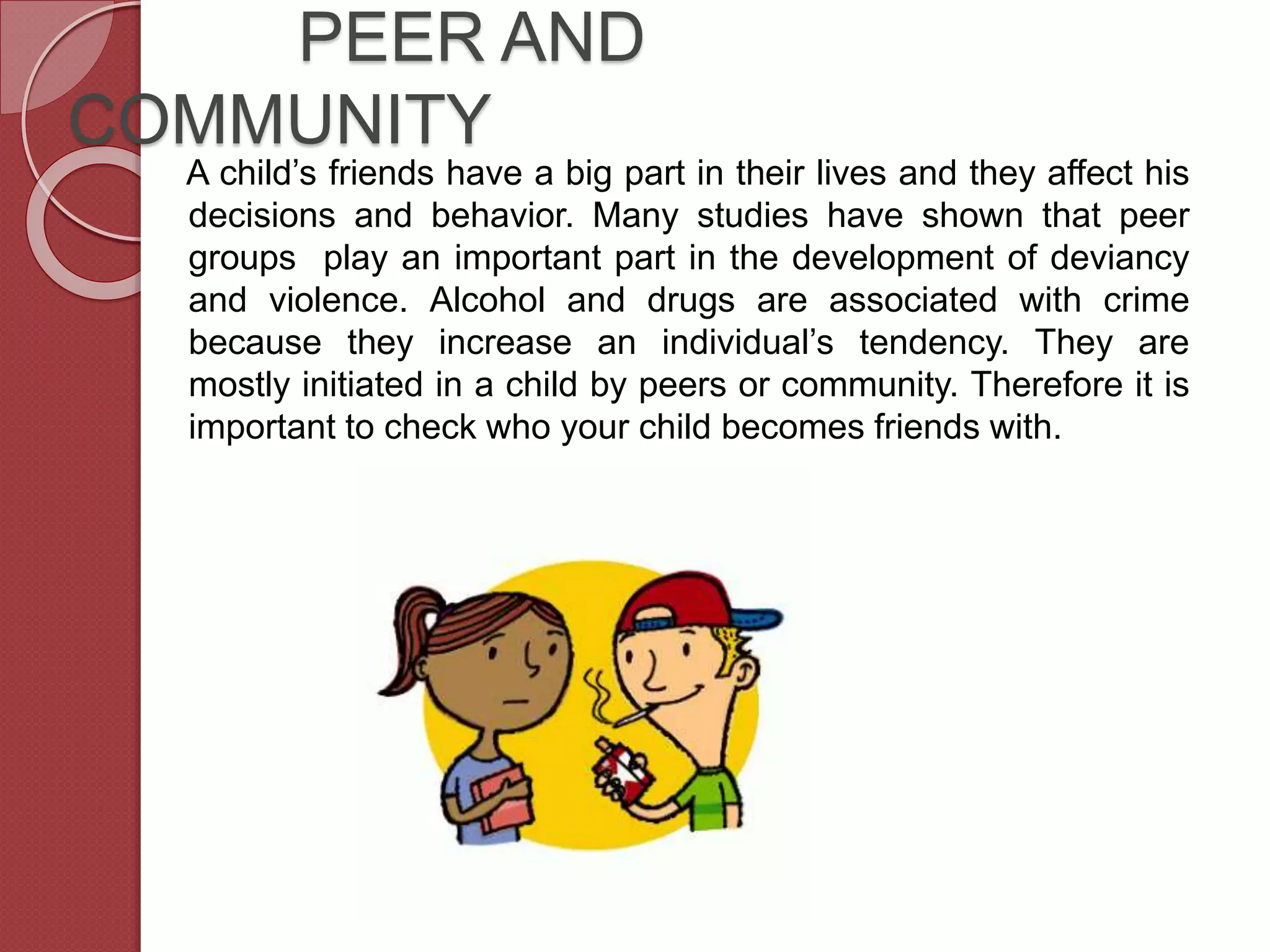
A child’s friends have a big part in their lives and they affect his
decisions and behavior. Many studies have shown that peer
groups play an important part in the development of deviancy
and violence. Alcohol and drugs are associated with crime
because they increase an individual’s tendency. They are
mostly initiated in a child by peers or community. Therefore it is
important to check who your child becomes friends with.
ANTISOCIAL BEHAVIOR OR
EXCLUSION
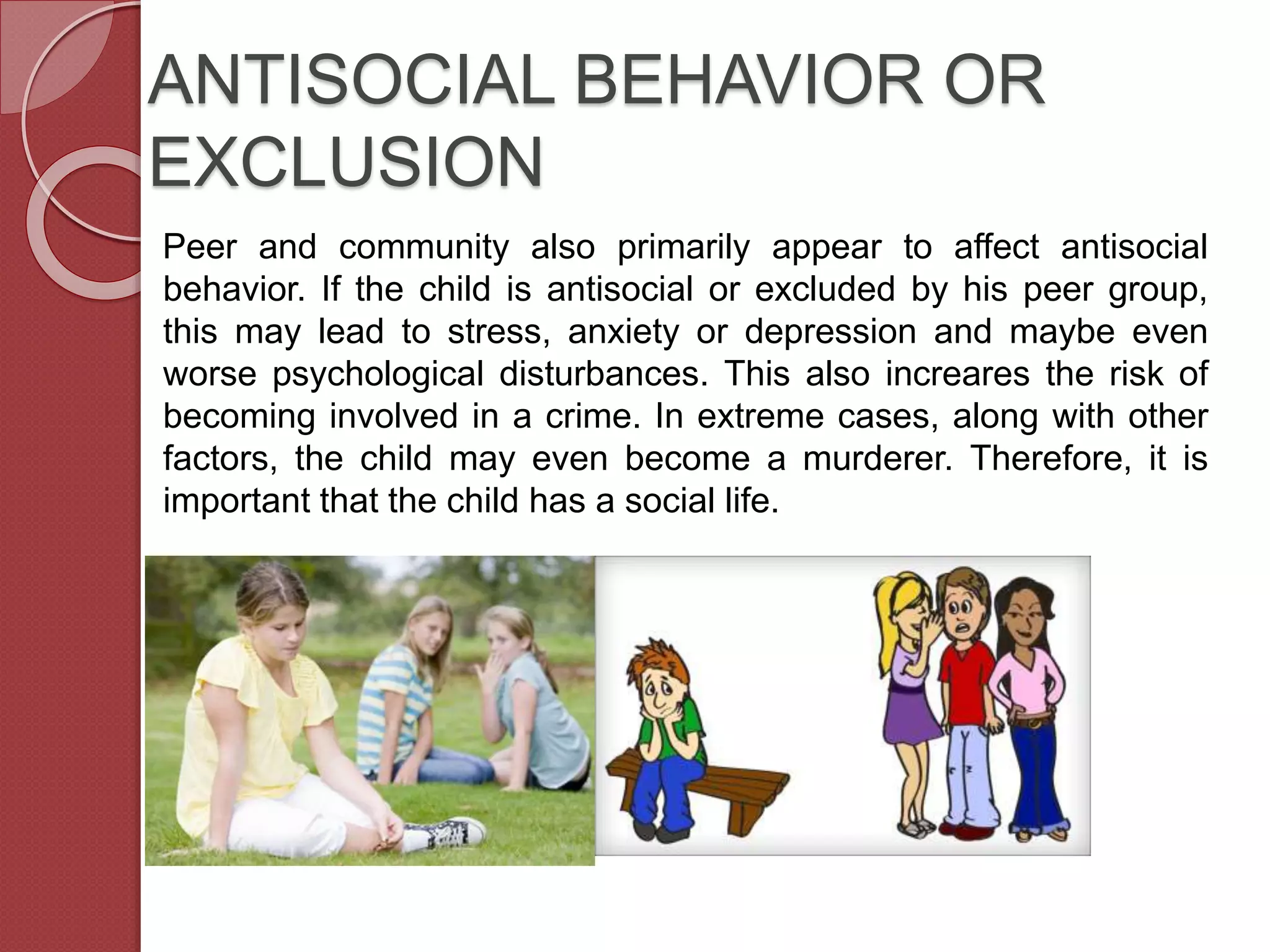
Peer and community also primarily appear to affect antisocial
behavior. If the child is antisocial or excluded by his peer group,
this may lead to stress, anxiety or depression and maybe even
worse psychological disturbances. This also increares the risk of
becoming involved in a crime. In extreme cases, along with other
factors, the child may even become a murderer. Therefore, it is
important that the child has a social life.
ROLE Model
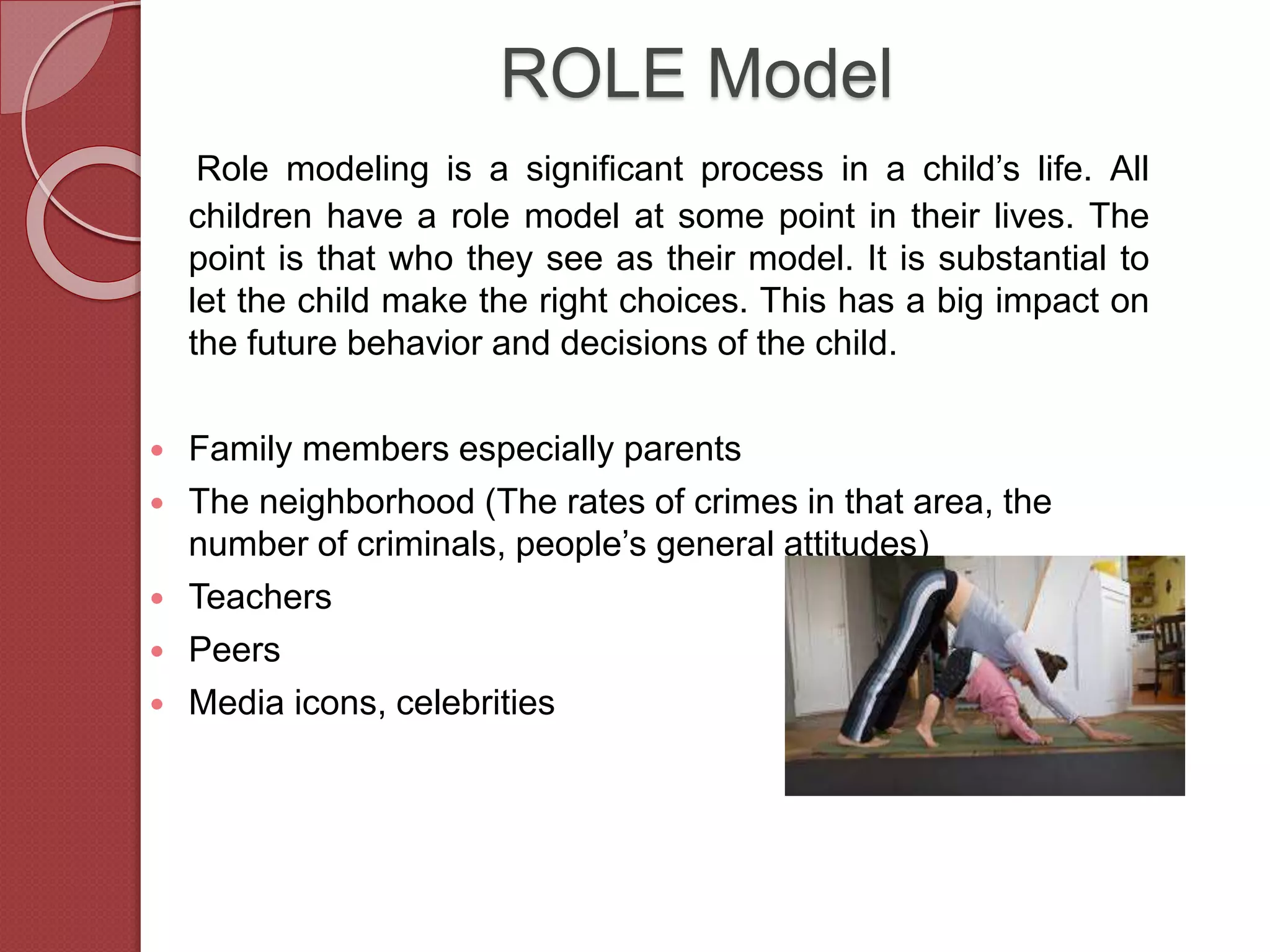
Role modeling is a significant process in a child’s life. All
children have a role model at some point in their lives. The
point is that who they see as their model. It is substantial to
let the child make the right choices. This has a big impact on
the future behavior and decisions of the child.
 Family members especially parents
 The neighborhood (The rates of crimes in that area, the
number of criminals, people’s general attitudes)
 Teachers
 Peers
 Media icons, celebrities
Survey
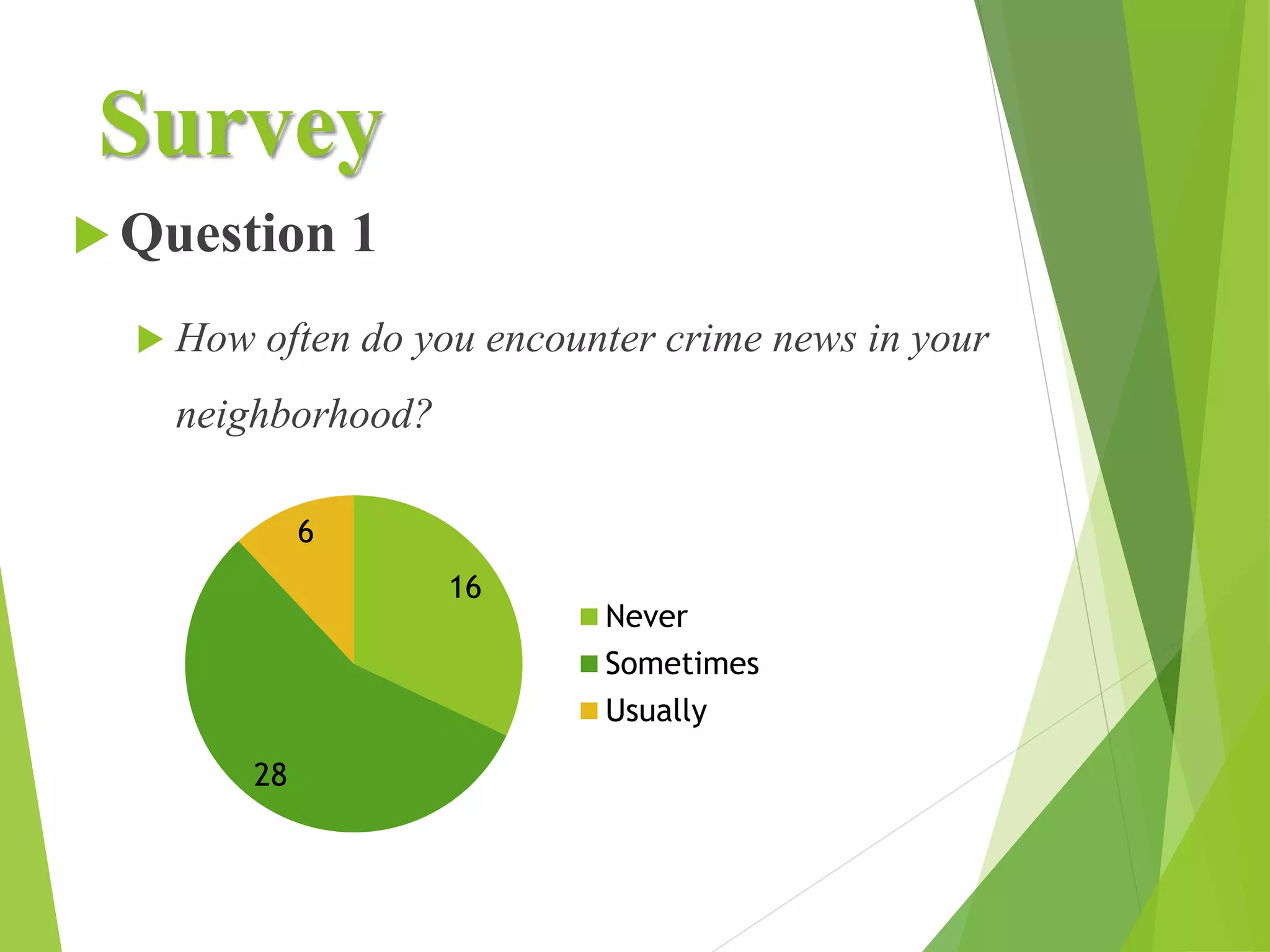
 Question 1
 How often do you encounter crime news in your
neighborhood?
16
28
6
Never
Sometimes
Usually
Survey
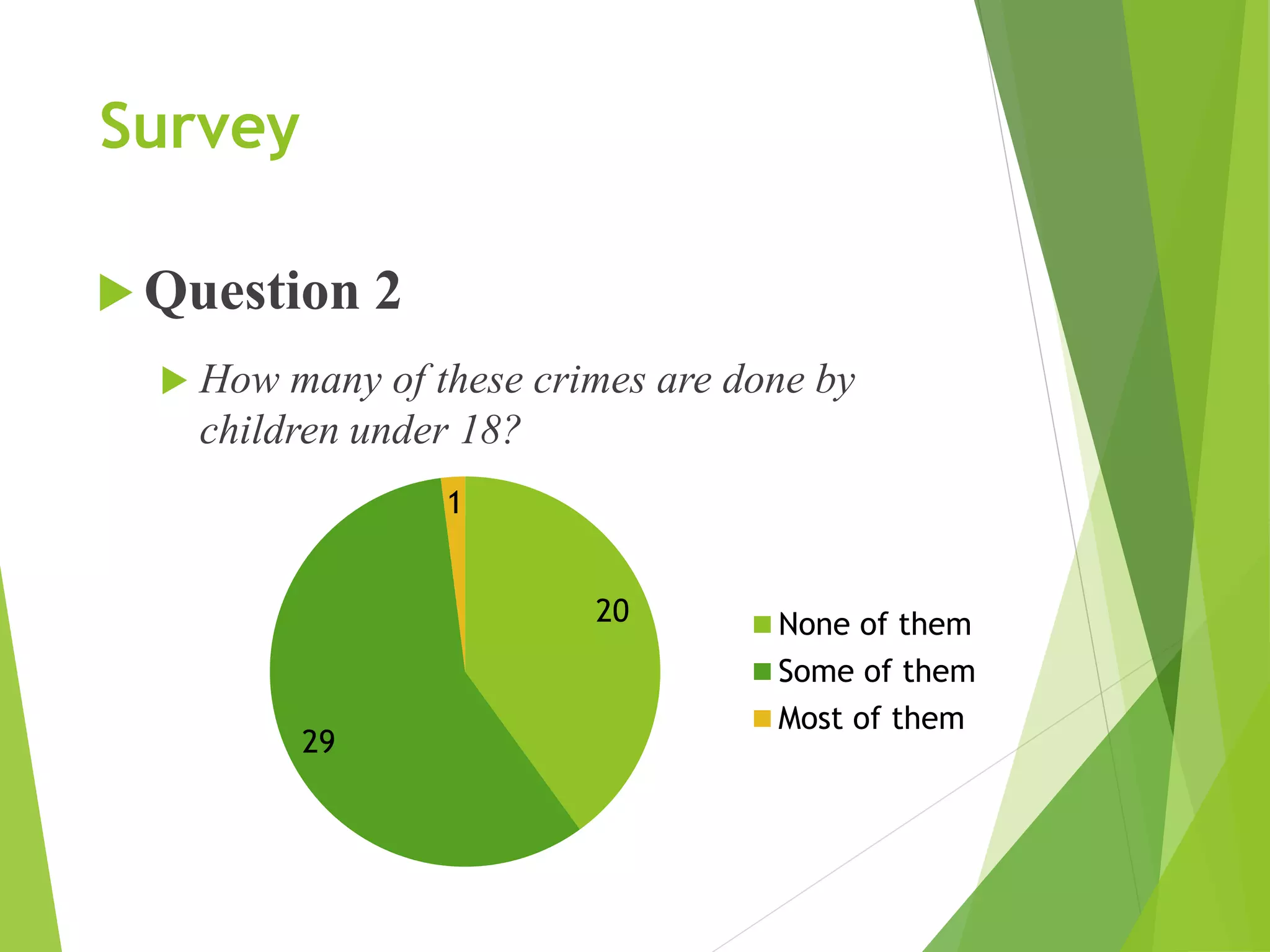
 Question 2
 How many of these crimes are done by
children under 18?
20
29
1
None of them
Some of them
Most of them
Survey
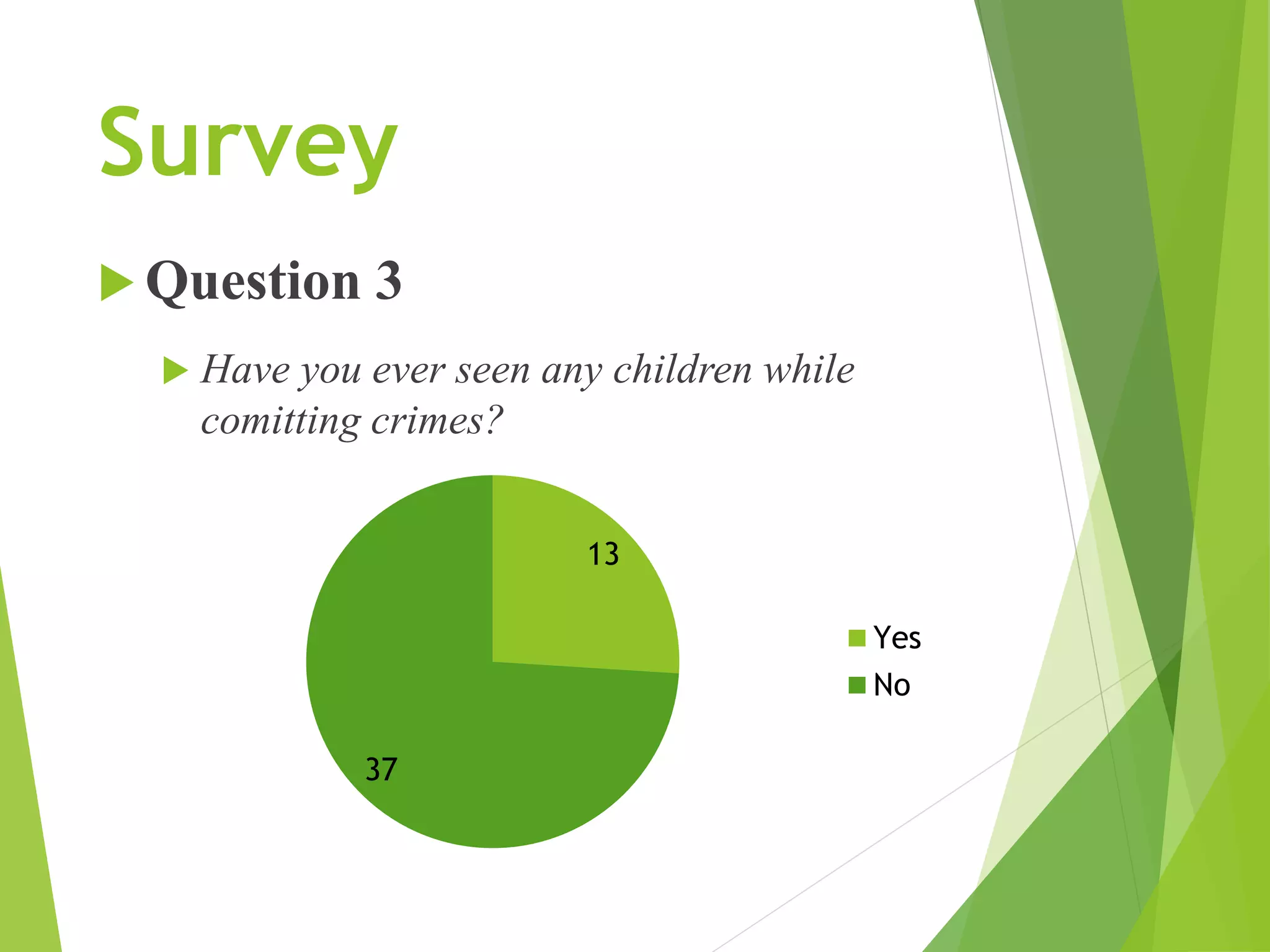
 Question 3
 Have you ever seen any children while
comitting crimes?
13
37
Yes
No
Survey
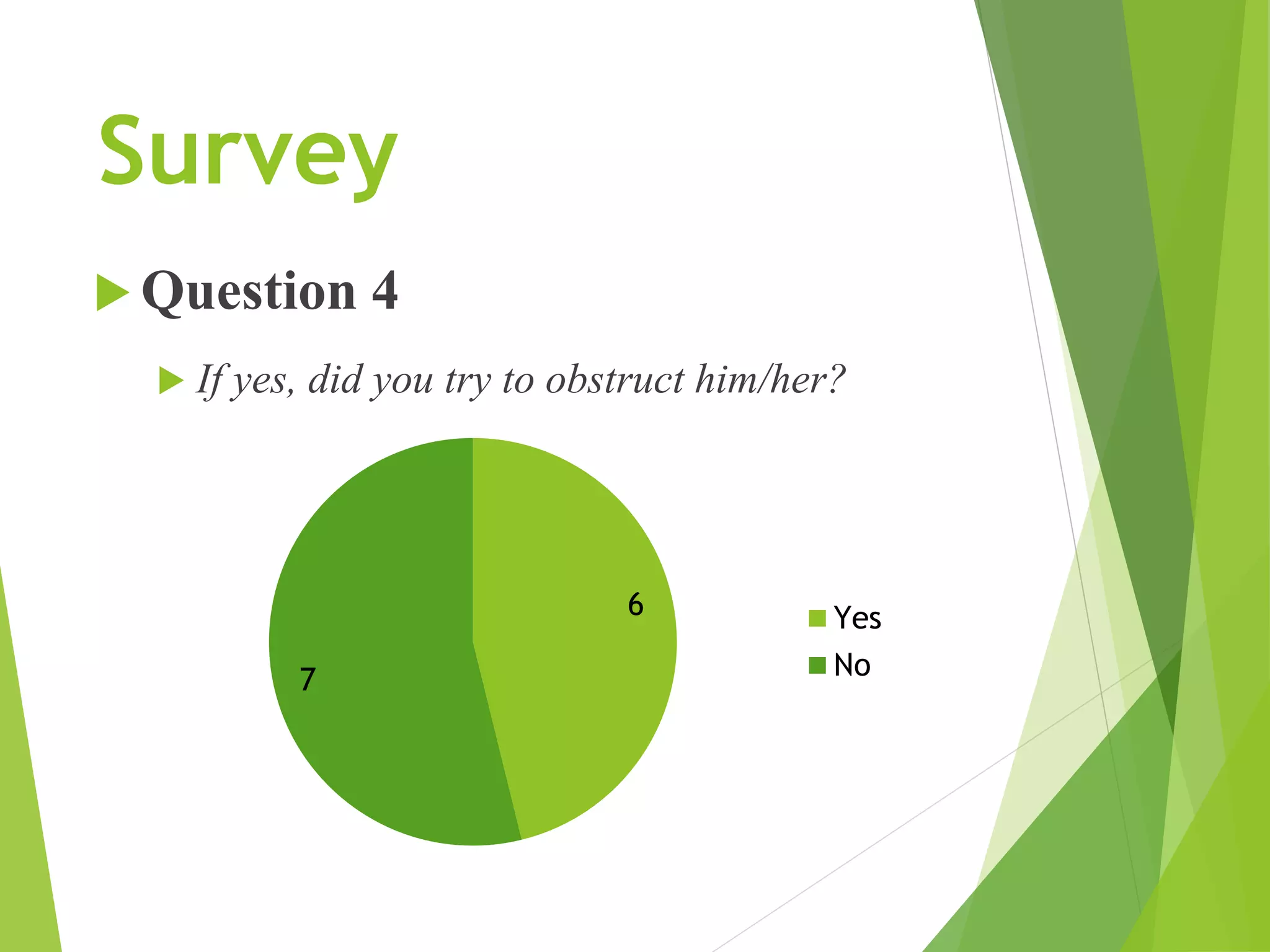
 Question 4
 If yes, did you try to obstruct him/her?
6
7
Yes
No
Survey
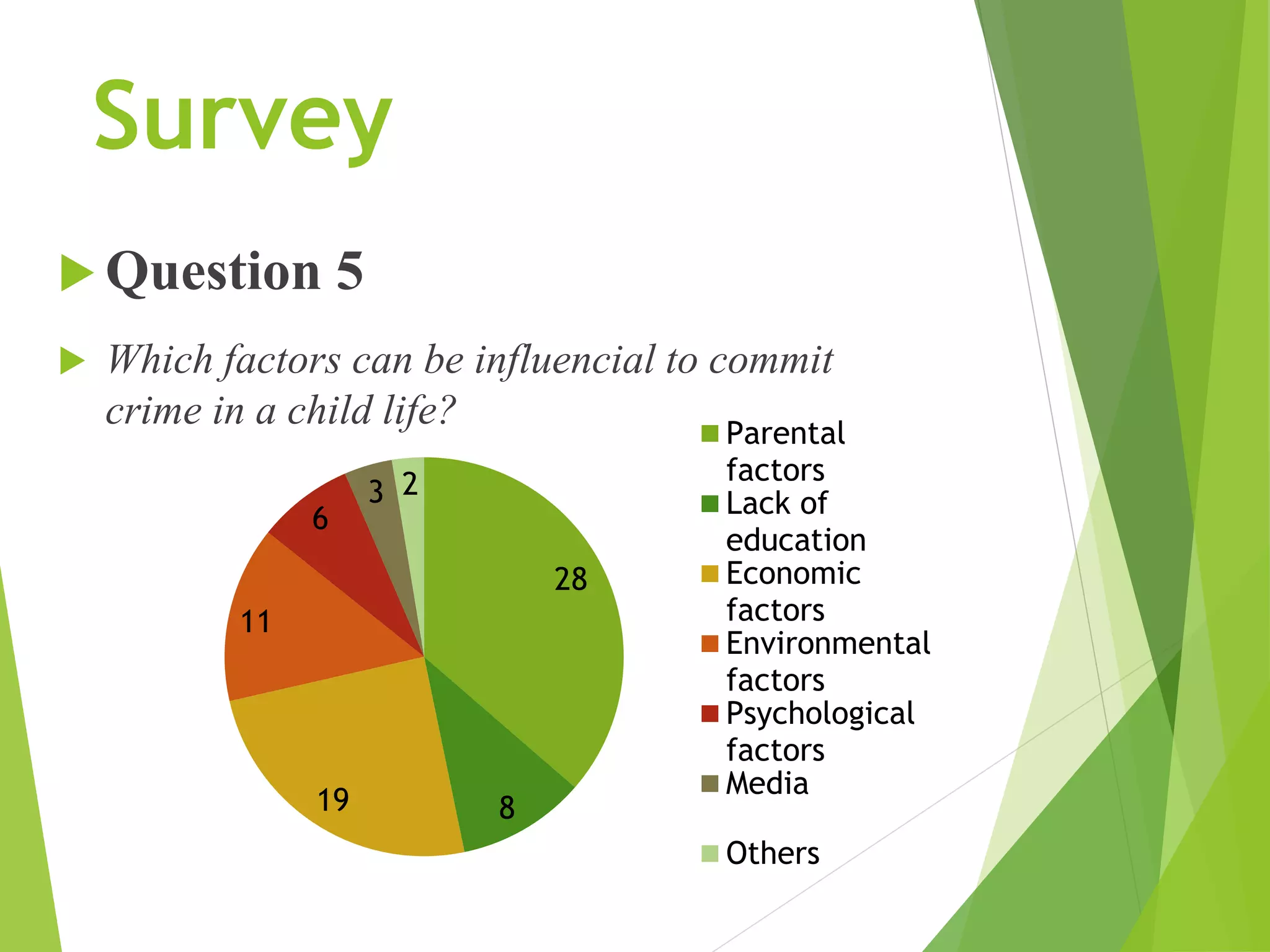
 Question 5
 Which factors can be influencial to commit
crime in a child life?
28
819
11
6
3 2
Parental
factors
Lack of
education
Economic
factors
Environmental
factors
Psychological
factors
Media
Others
Survey
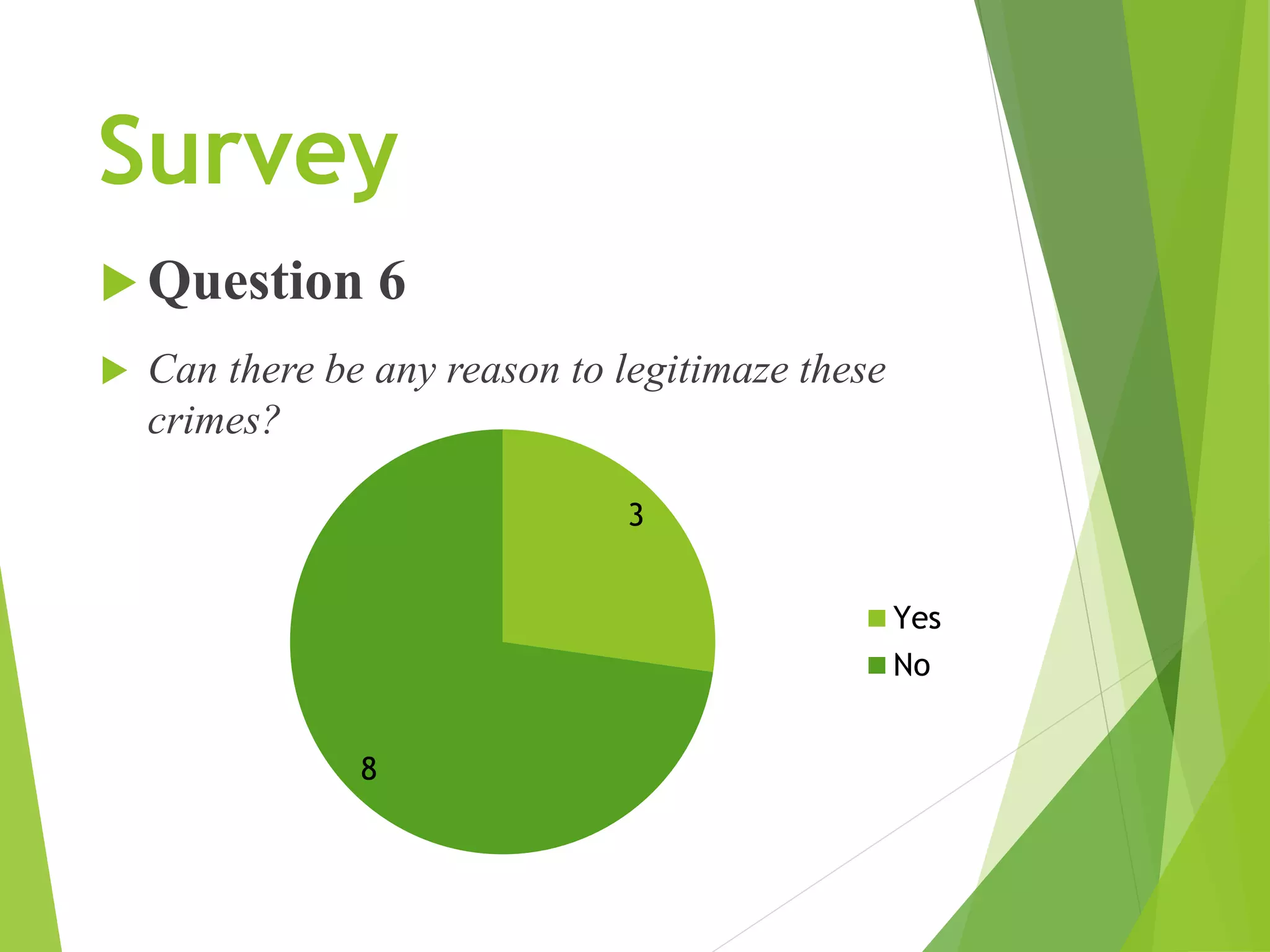
 Question 6
 Can there be any reason to legitimaze these
crimes?
3
8
Yes
No
Survey
 Question 7
 Can we make them adaptable individuals in the
society?
48
2
Yes
No
Survey
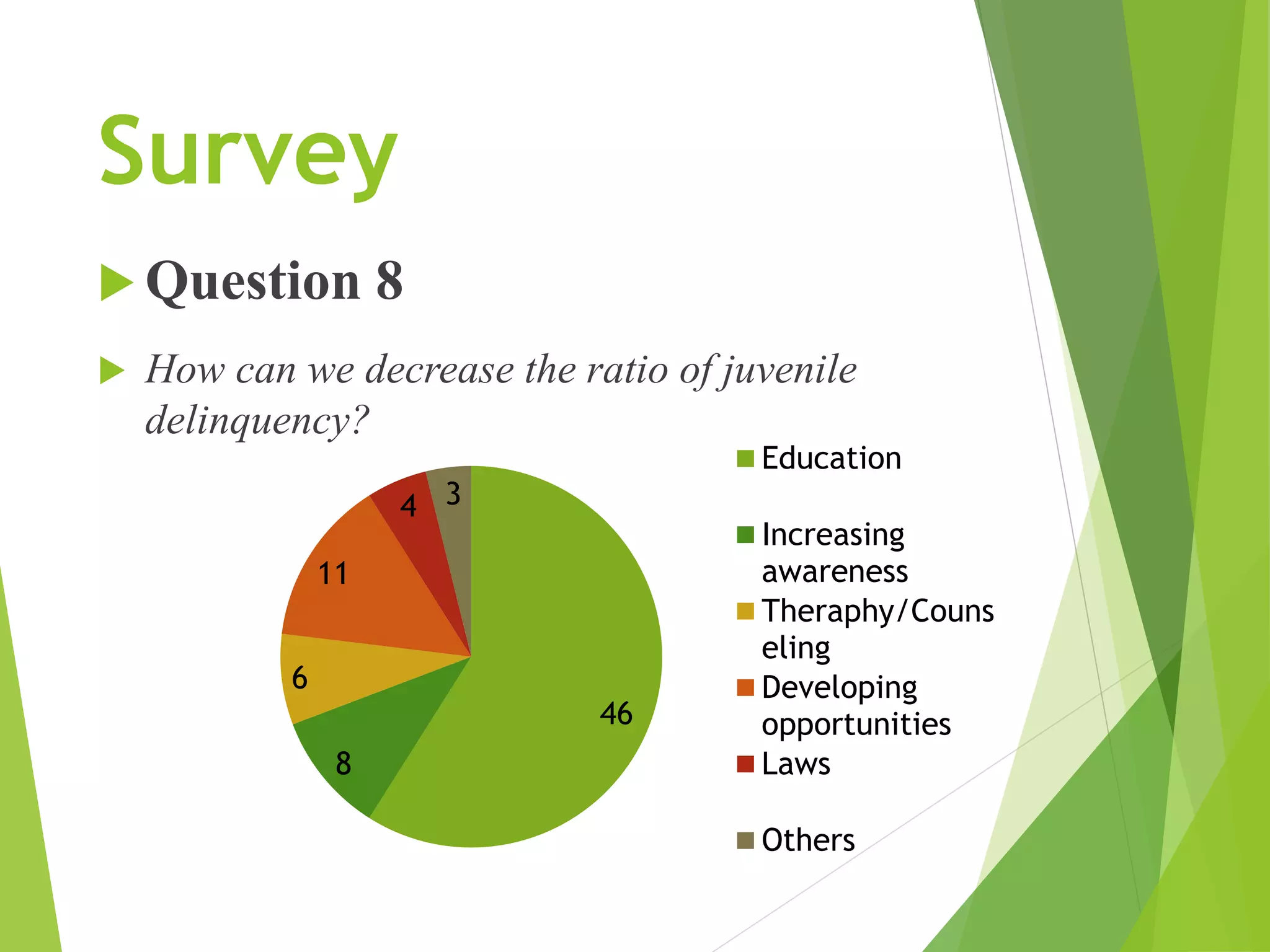
 Question 8
 How can we decrease the ratio of juvenile
delinquency?
46
8
6
11
4 3
Education
Increasing
awareness
Theraphy/Couns
eling
Developing
opportunities
Laws
Others
Survey Results
 The survey indicates that, people sometimes encounter
crime news and some of them are done by children.
 Lots of people believe that parental and economic
factors have a great impact on juvenile delinquency.
 Most of the people believe that we can make these
children adaptable individuals in the society.
 Education is the best way of dealing with juvenile
delinquency.
FOR A BETTER FUTURE
According to United Nations Guidelines
for the Prevention of Juvenile Delinquency
(The Riyadh Guidelines):
«The prevention of juvenile delinquency is an essential part of crime
prevention in society. By engaging in lawful, socially useful activities
and adopting a humanistic orientation towards society and outlook on
life, young persons can develop non-criminogenic attitudes.»
for the Prevention of Juvenile Delinquenc
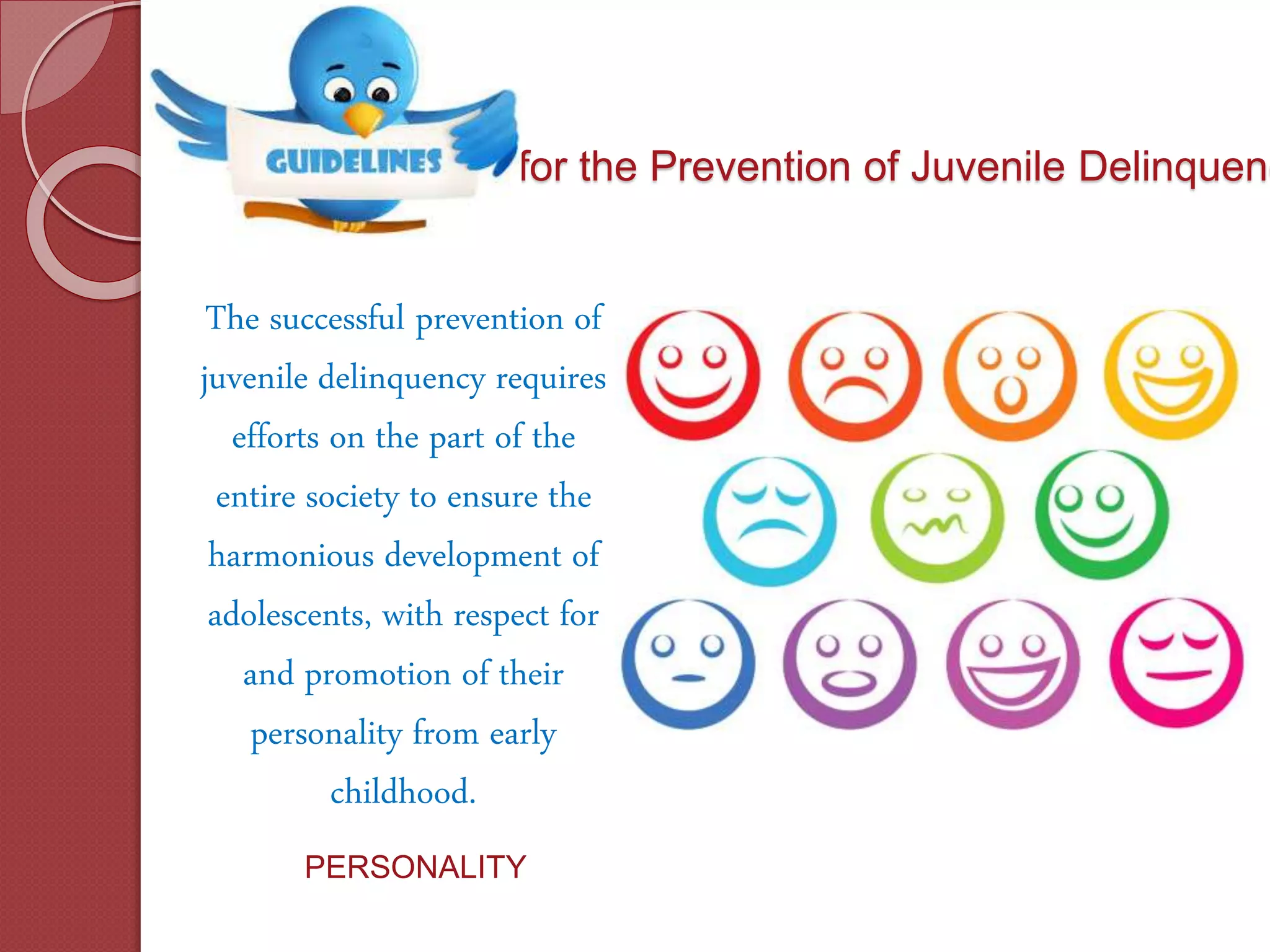
The successful prevention of
juvenile delinquency requires
efforts on the part of the
entire society to ensure the
harmonious development of
adolescents, with respect for
and promotion of their
personality from early
childhood.
PERSONALITY
for the Prevention of Juvenile Delinquen
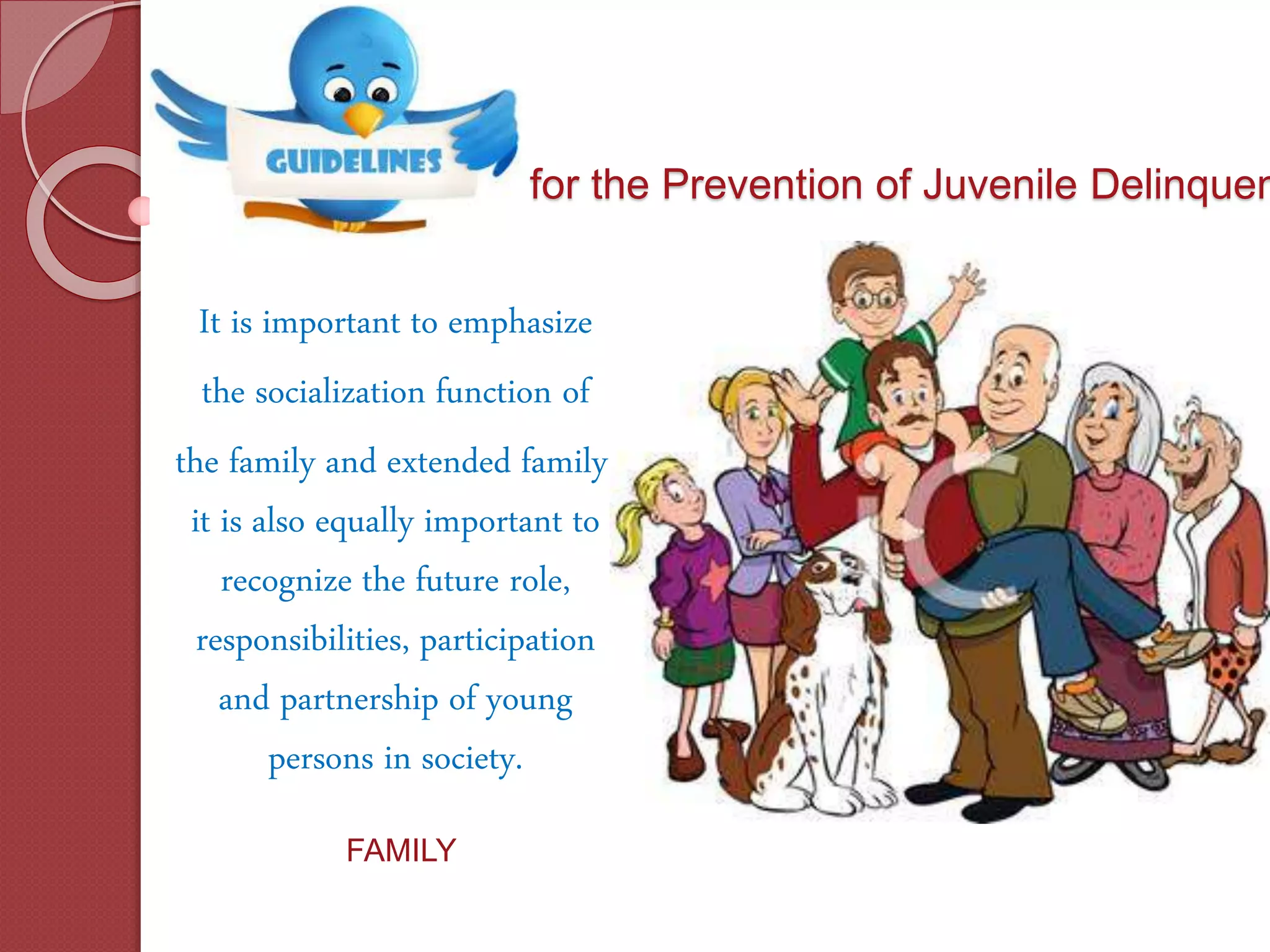
It is important to emphasize
the socialization function of
the family and extended family.
it is also equally important to
recognize the future role,
responsibilities, participation
and partnership of young
persons in society.
FAMILY
for the Prevention of Juvenile Delinquenc
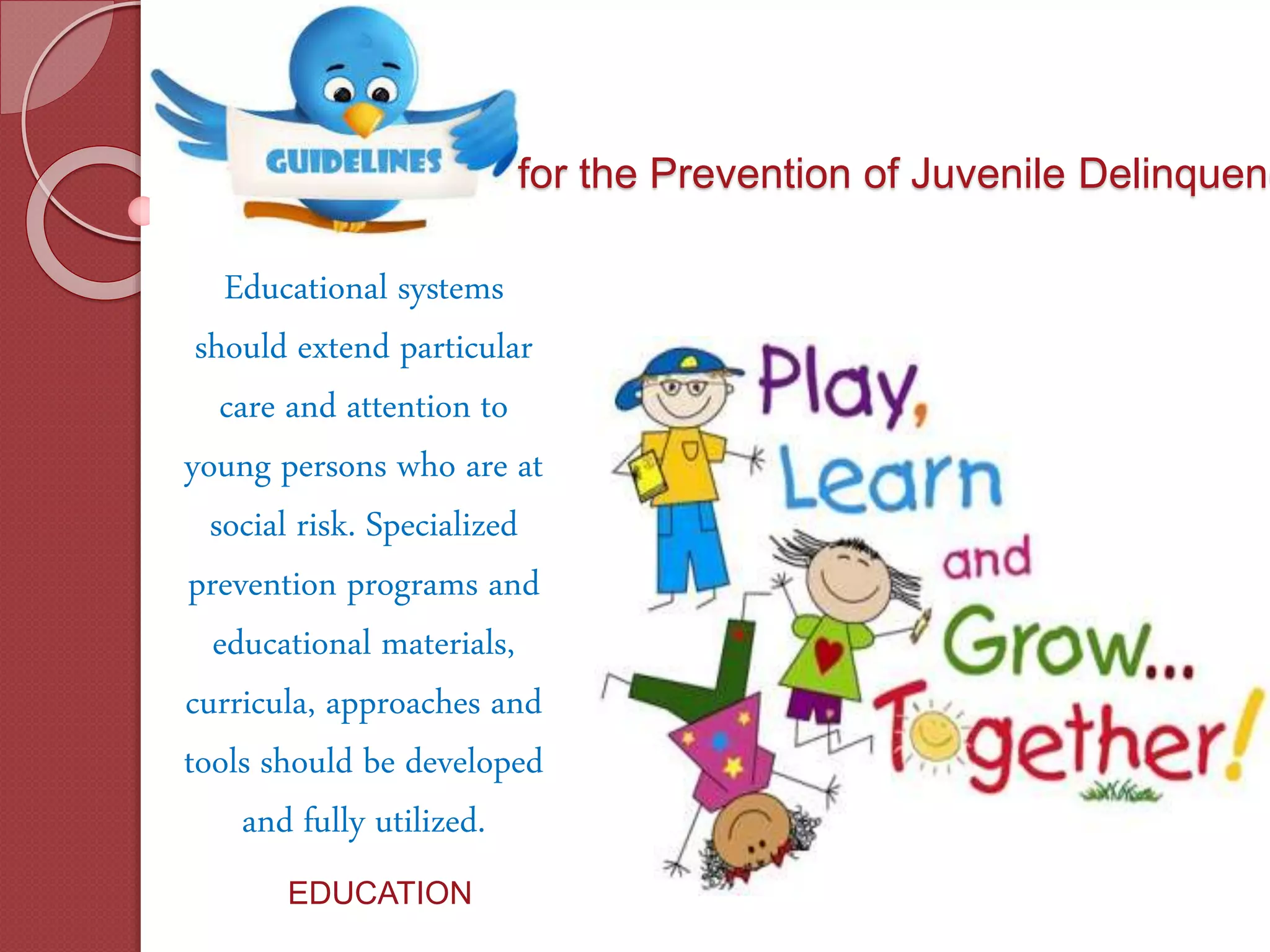
Educational systems
should extend particular
care and attention to
young persons who are at
social risk. Specialized
prevention programs and
educational materials,
curricula, approaches and
tools should be developed
and fully utilized.
EDUCATION
for the Prevention of Juvenile Delinquenc
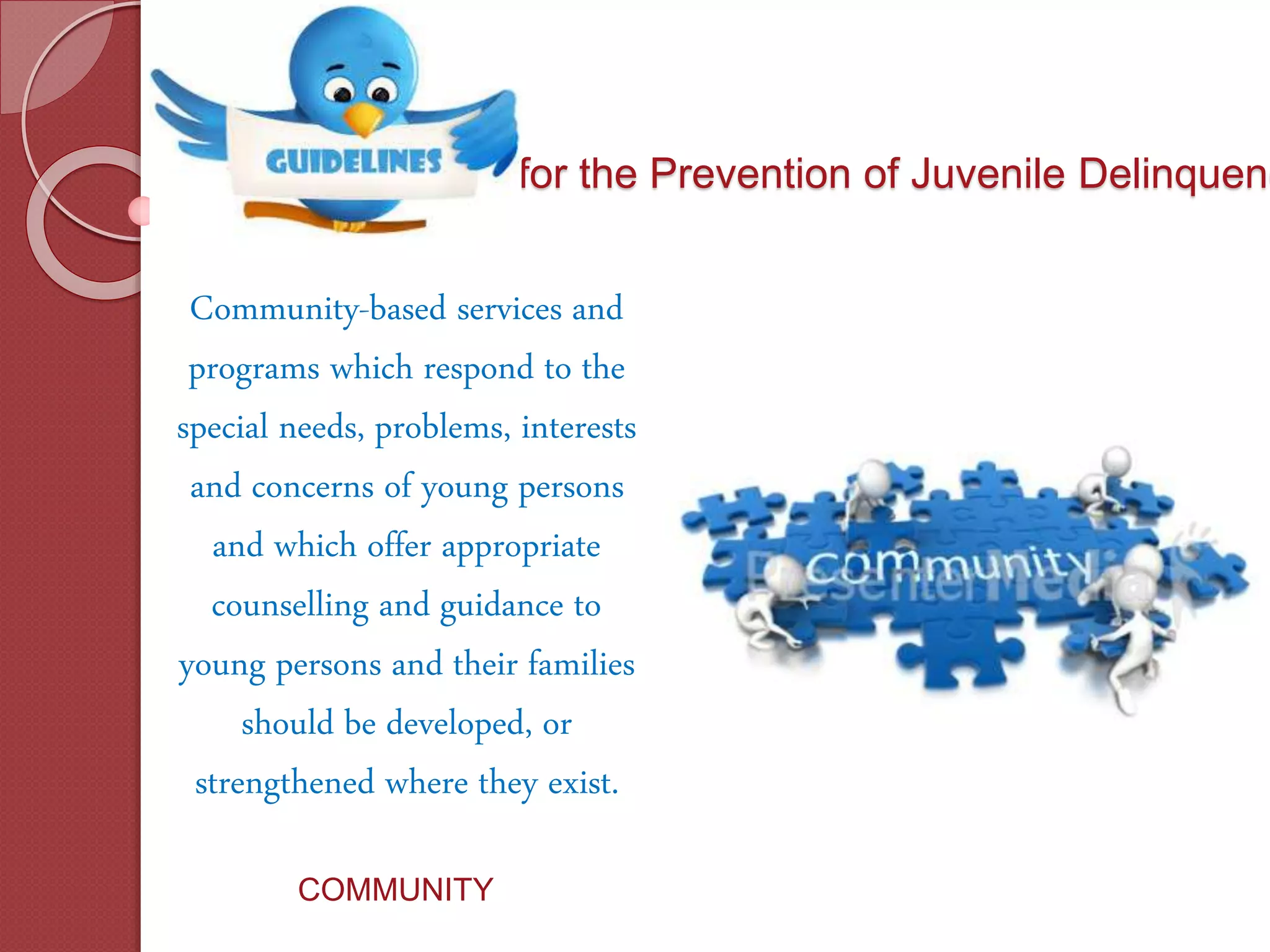
Community-based services and
programs which respond to the
special needs, problems, interests
and concerns of young persons
and which offer appropriate
counselling and guidance to
young persons and their families
should be developed, or
strengthened where they exist.
COMMUNITY
for the Prevention of Juvenile Delinquen
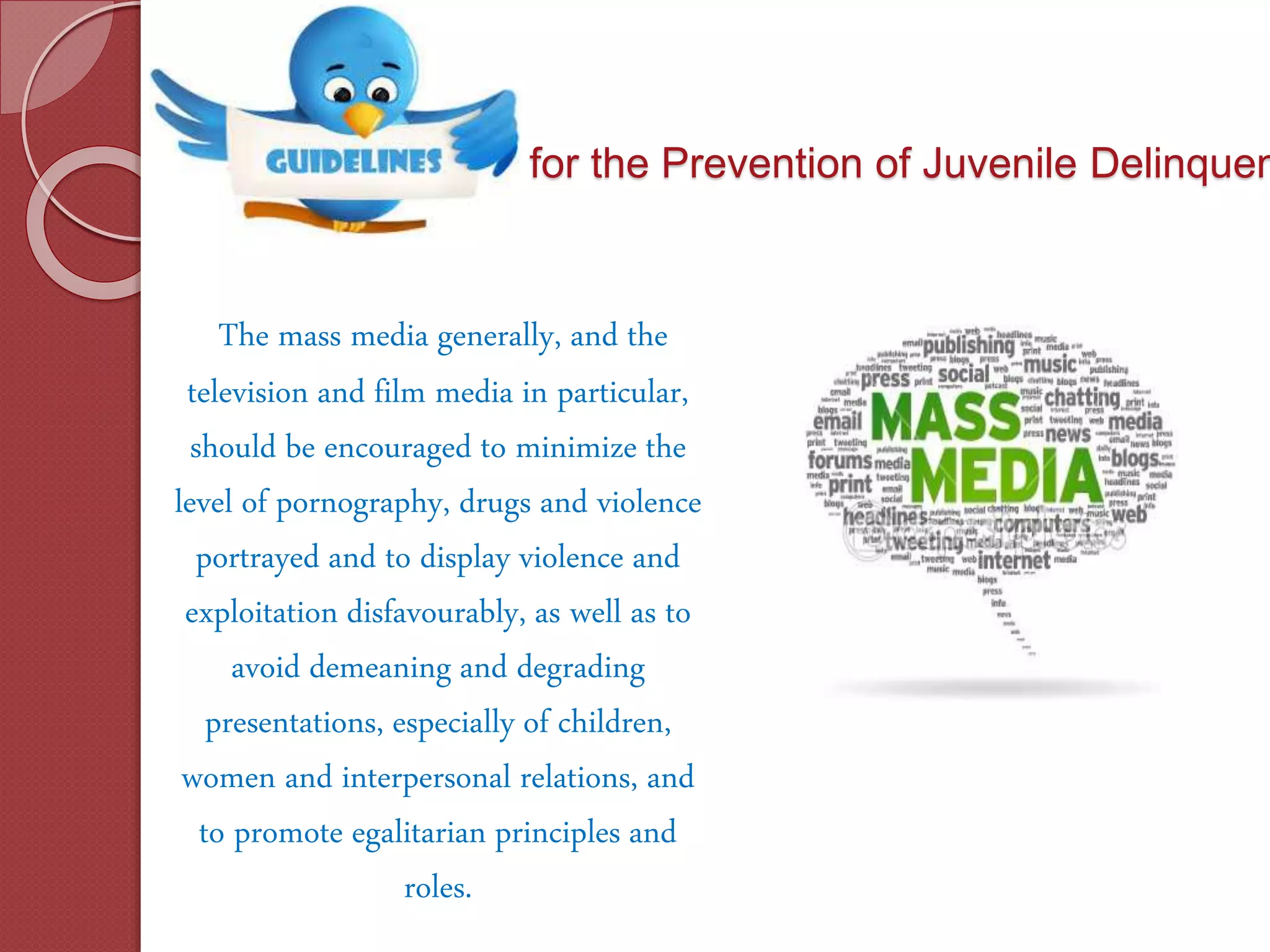
The mass media generally, and the
television and film media in particular,
should be encouraged to minimize the
level of pornography, drugs and violence
portrayed and to display violence and
exploitation disfavourably, as well as to
avoid demeaning and degrading
presentations, especially of children,
women and interpersonal relations, and
to promote egalitarian principles and
roles.
for the Prevention of Juvenile Delinquen
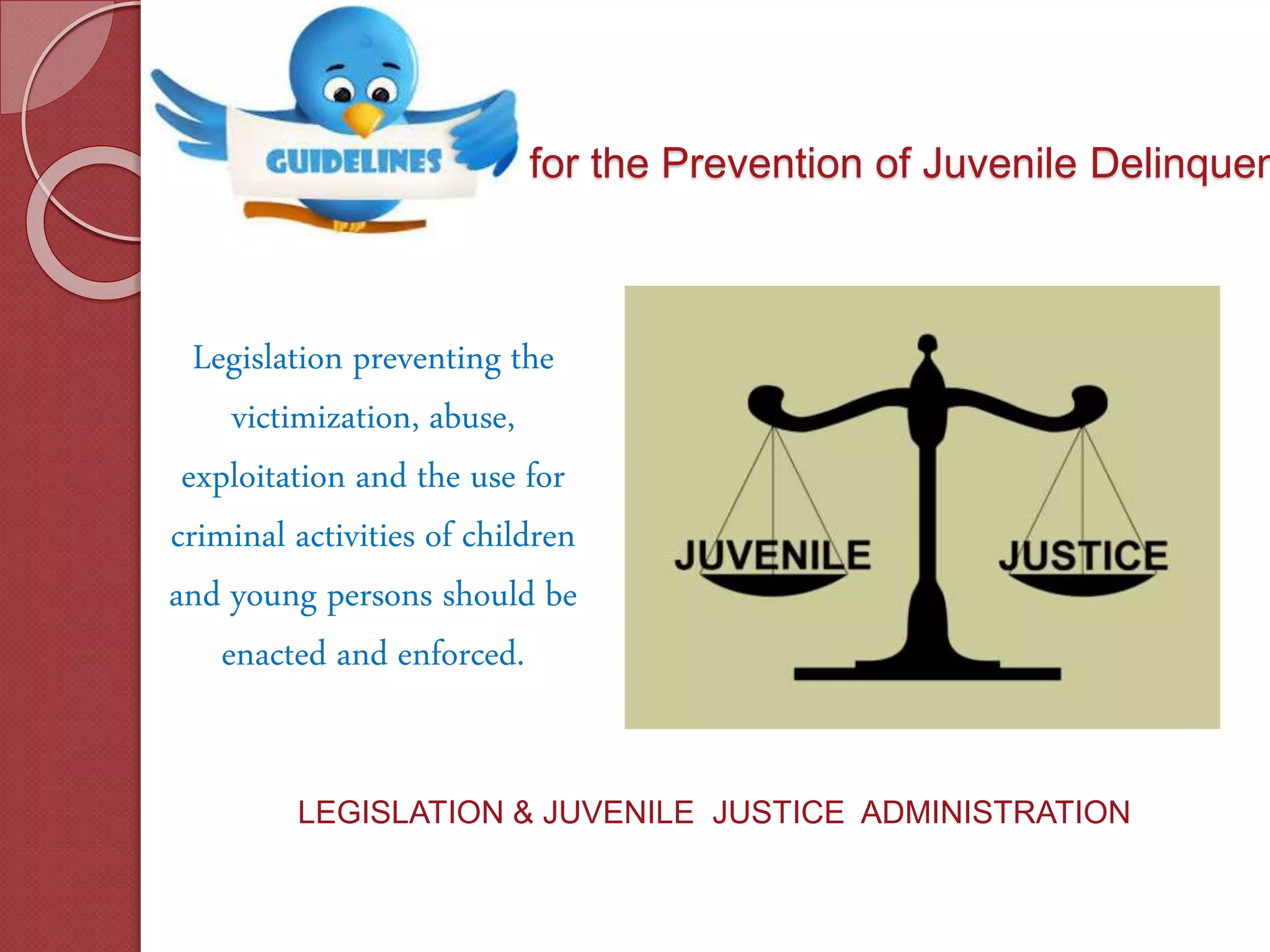
Legislation preventing the
victimization, abuse,
exploitation and the use for
criminal activities of children
and young persons should be
enacted and enforced.
LEGISLATION & JUVENILE JUSTICE ADMINISTRATION
for the Prevention of Juvenile Delinquen
The exchange of information, experience and expertise gained through
projects, programs, practices and initiatives relating to youth crime,
delinquency prevention and juvenile justice should be intensified at the
national, regional and international levels.
SOME PROJECTS
Governorship of Manisa
has prepared and
applied a project called
“Umutlar Çiçek Açsın” to
combat with the violence,
drug use and juvenile
delinquency in 2012.
SOME PROJECTS
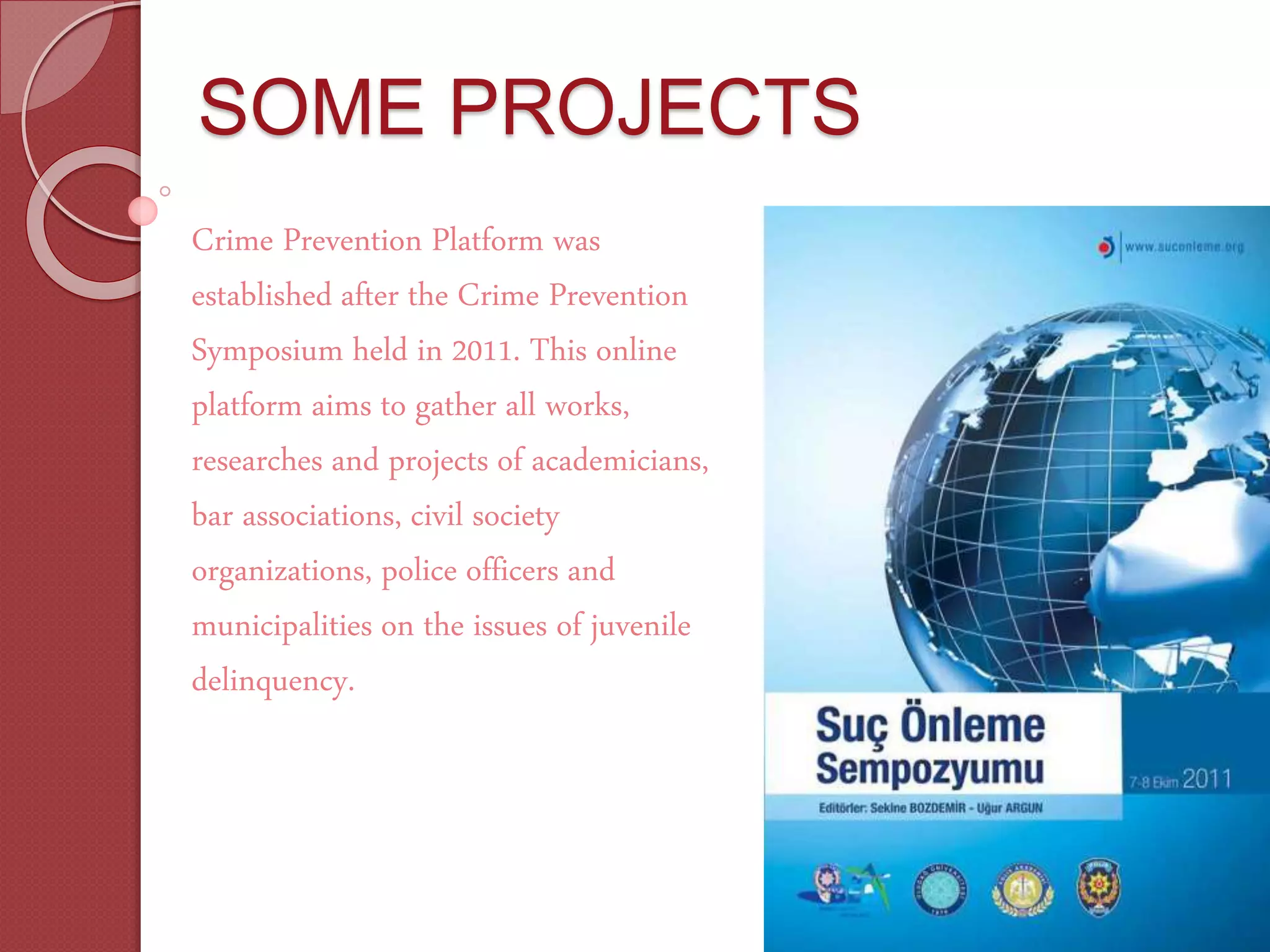
Crime Prevention Platform was
established after the Crime Prevention
Symposium held in 2011. This online
platform aims to gather all works,
researches and projects of academicians,
bar associations, civil society
organizations, police officers and
municipalities on the issues of juvenile
delinquency.
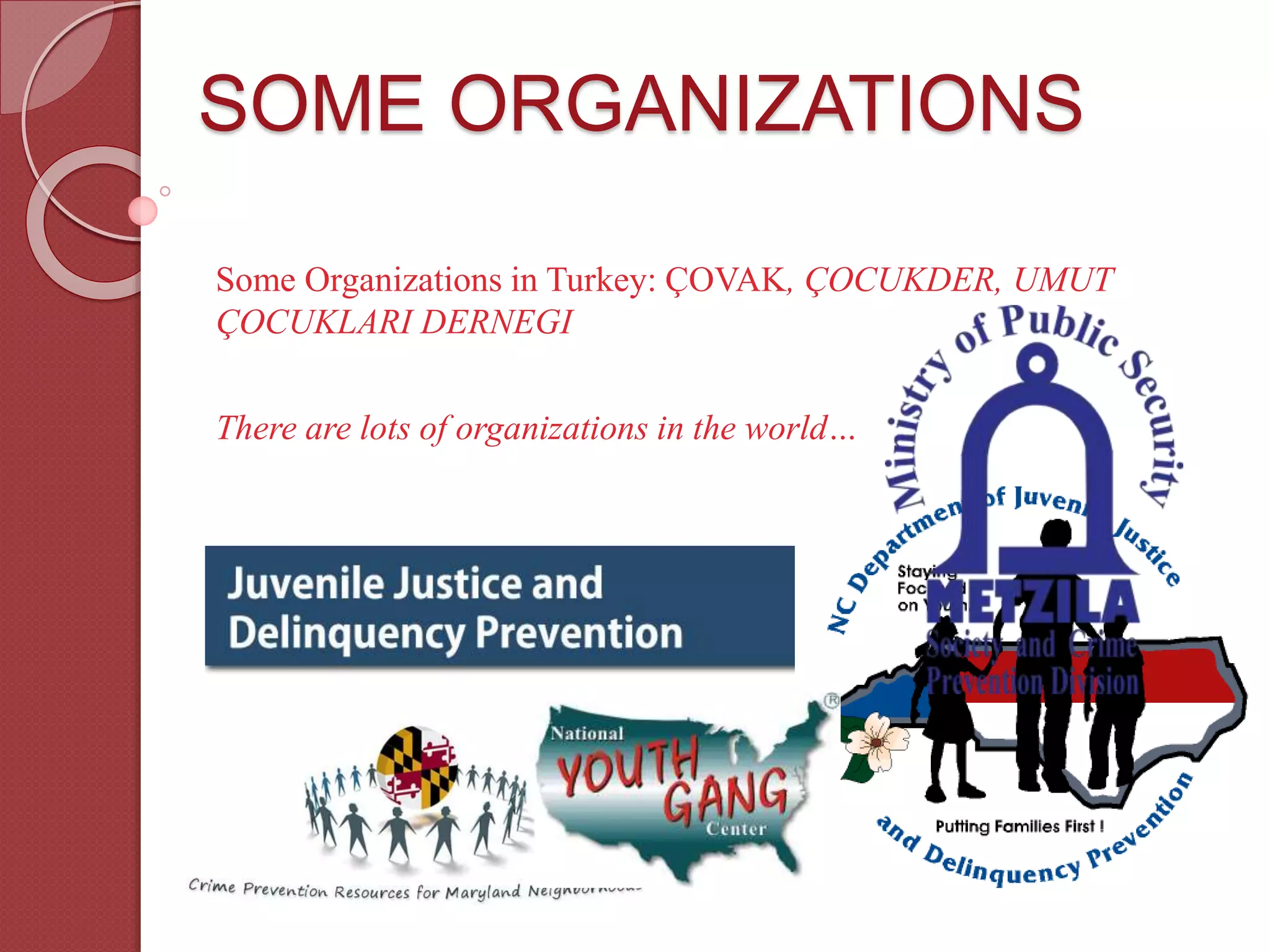
SOME ORGANIZATIONS
Some Organizations in Turkey: ÇOVAK, ÇOCUKDER, UMUT
ÇOCUKLARI DERNEGI
There are lots of organizations in the world…
OUR SUGGESTIONS
- All of the violent TV shows should
- be removed because they make
- children more inclined to commit crime.
- Families and preschool educational institutions
should be checked frequently so that children at
risk can be identified earlier.
- Conflict resolution class should be added to
elementary education as an
optional/complementary class.
AND…
CHILDREN SEE, CHILDREN DO
References
 Child Delinquency, U.S. Department of Justice, J. Robert
Flores, Administrator of Bulletin Series Office of Juvenile
Justice and Delinquency Prevention, May 2003
 World Youth Report Juvenile Delinquency, 2003
 Eğitimime Yeni Bakışlar 2, Mikro Yayınları, Ankara, 2003
 http://www.ohchr.org/EN/ProfessionalInterest/
Pages/PreventionOfJuvenileDelinquency.asp
x
 http://www.manisaumutlarcicekacsin.com/
 http://suconleme.org/
 http://www.cocukder.org.tr/
 http://www.covak.org/
 http://www.teachertube.com/viewVideo.php?v
ideo_id=14825
References
 http://www.murray.k12.ia.us/web-
content/Elementary/Preschool/preschool.html
 http://www.centrofis.ro/programele-universitatii-din-
londra/facultati-in-perspectiva/limba-literatura-engleza-
si-mass-media/
 http://bokardo.com/archives/comic-is-it-useful/
 http://www.penmai.com/forums/forwarded-
messages/51350-give-time-our-family.html
 http://www.gspscp.ca/en/citizens/citizens.asp
 http://www.adeca.alabama.gov/Divisions/lets/Pages/Juv
enileJustice.aspx
 http://thebullbustercafe.com/personality-based-
marketing/
 http://makingcoachingwork.wikispaces.com/Action+Res
earch+Project
References
 http://mysite.verizon.net/karenran/site
buildercontent/sitebuilderpictures/logo-
web2.jpg
 İmece Circles by @Hayal Koksal
Thanks
Thanks all of you for your
attention
Special Thanks to
Hayal Köksal
Juvenile delinquency

Juvenile delinquency

  • 1.
  • 3.
    From 1960 to2000, There is 400% Increase !
  • 4.
    MUGLA, TURKEY He is15, but he involved in 70 robbery!
  • 5.
    Chicago, USA She is14, accused of killing another girl in a dispute over a boy
  • 6.
    Bursa, turkey She is14, killed his father with a knife
  • 7.
    MINNESOTA, USA He is17, »kill as many student as he could»
  • 9.
    As you understand,our topic is about JUVENILE DELINQUENCY
  • 10.
    What ıs juveniledelinquency ? Juvenile delinquency, also known as juvenile offending, or youth crime, is participation in illegal behavior by minors (juveniles) (individuals younger than the statutory age of majority).
  • 11.
  • 12.
  • 13.
    Group Information  GroupName: Advocates of children  Group Slogan: Children see, Children do.  Group Leader: Ferhat Özel  Group Members: Büşra Ertuğrul Büşra Kabak Sümeyra Tayfur
  • 14.
  • 15.
    Group Information  GroupAverage Age: 20,8  Group Meeting Time: Every Tuesday and Wednesday at 5 p.m.  Group Logo:
  • 16.
     Individuals tendto commit crime in their early ages. There are a lot of factors that affect committing crime in these ages. There is lack of awareness about how we can decrease crime tendency. This is because, people do not know the causes that push children into crime. What is the Problem?
  • 17.
    Steps for theSolution  Brain-Storming Reasons for Juvenile Delinquency Psychological Factors Economic Factors Political Factors Social Factors
  • 18.
  • 19.
    Steps for theSolution Members Psychologicl Factors Economical Factors Political Factors Social Factors Ferhat 6 5 4 7 Büşra E. 4 3 5 6 Büşra K. 6 5 3 7 Sümeyra 5 4 3 7 * Sum 21 17 15 27 ** % %26.25 %21.25 %18.75 %33.75  Matrix Diagram
  • 20.
    Activities Weeks 5.312.3 19.3 26.3 2.4 9.4 16.4 PLAN Choice of subject Subject approval Determination of current issue and its goals Cause and effect Approval of the main problems Solution possibilities Suggested solutions DO Trial operation CHECK Evaluation of trial results ACT Standardization and preparation of the presentation Self assessment Finalization and sending ppxt file to Hayal Köksal for assessment SHARE Presentation of project © Hayal Köksal Expected Observed  Gantt chart
  • 21.
    Steps For theSolution Data Collection Literature Review Survey
  • 22.
    Literature Review Articles thatare reviewed;  Child Delinquency by J. Robert Flores, from Office of Juvenile Justice and Delinquency Prevention, 2003  Juvenile Delinquency by World Youth Report , 2003  Eğitimime Yeni Bakışlar (The New Glances to My Education) by Abdullah SÜRÜCÜ and Coşkun ARSLAN, 2003
  • 23.
    Literature Review  ChildDelinquency by J. Robert Flores The number of child delinquents handled in the nation’s juvenile courts has increased 33 percent over the last decade. This development is cause for concern not only because offense patterns reflect more serious crimes among these youngsters, but also because these very young offenders are more likely to continue their involvement in crime.
  • 24.
    Literature Review  Recenthigh-profile media cases of violence committed by children age 12 or younger also have drawn attention to the potential for child delinquents to inflict deadly harm. For these reasons alone, child delinquents represent a significant concern for both society and the juvenile justice system. • Child delinquents are two to three times more likely to become serious, violent, and chronic offenders than adolescents whose delinquent behavior begins in their teens.
  • 25.
    Literature Review  JuvenileDelinquency by World Youth Report The problem of juvenile delinquency is becoming more complicated and universal, and crime prevention programs are either unequipped to deal with the present realities or do not exist. Many developing countries have done little or nothing to deal with these problems, and international programs are obviously insufficient. Developed countries are engaged in activities aimed at juvenile crime prevention, but the overall effect of these programs is rather weak because the mechanisms in place are often inadequate to address the existing situation.
  • 26.
    Literature Review On thewhole, current efforts to fight juvenile delinquency are characterized by the lack of systematic action and the absence of task-oriented and effective social work with both offenders and victims, whether real or potential. Analysis is further complicated by a lack of international comparative data.
  • 27.
    Literature Review  EğitimimeYeni Bakışlar (The New Glances to My Education) by Abdullah SÜRÜCÜ and Coşkun ARSLAN  In parallel with the development and industrialisation, crime rates have been increasing in urban setting and a great number of these offenders is consisted of children and youths. For example only between 1960-1970, in attack and violence by 159%, in property stealing by 75% increase has been observed in US. Besides, it has been stated that almost 2 million youths are attempting to escape from their homes per year
  • 28.
  • 29.
     Parental issues/Family Environment  Peer and Community / Antisocial Behavior or Exclusion  Role Modeling
  • 30.
    1- PARENTAL ISSUES No parents / Divorced parents  Parenting styles (Authoritarian or negligent parents)  Violence in the family sphere
  • 31.
    BAUMRIND’S PARENTING STYLES  Authoritarian Authoritative  Indulgent  Neglectful
  • 32.
     Authoritarian Parenting Childrenare expected to follow the strict rules established by the parents. Failure to follow such rules usually results in punishment. Authoritarian parents fail to explain the reasoning behind these rules. Children who experience this kind of harsh parental practice have increased rates of conduct problems, substance abuse, depression and violent crime in early adulthood.
  • 33.
     Authoritative Parenting Theyestablish rules and guidelines that their children are expected to follow. However, this parenting style is much more democratic. Authoritative parents are responsive to their children and willing to listen to questions. When children fail to meet the expectations, these parents are more nurturing and forgiving rather than punishing.
  • 34.
     Indulgent (Permissive)Parenting They have very few demands to make of their children. These parents rarely discipline their children because they have relatively low expectations of maturity and self- control. Permissive parents are generally nurturing and communicative with their children, often taking on the status of a friend more than that of a parent.
  • 35.
     Neglectful Parenting Thereare few demands, low responsiveness and little communication. While these parents fulfill the child's basic needs, they are generally detached from their child's life. In extreme cases, these parents may even reject or neglect the needs of their children.
  • 36.
    Domestıc Vıolence Violence inthe family environment is a crucial problem because it has huge impacts on the child. Children who have witnessed abuse often suffer low self-esteem, depression, stress disorders, poor impulse control and feelings of powerlessness. They are at high risk for alcohol and drug use, sexual acting out, running away, suicide and crime tendency.http://www.youtube.com/watch?v=hHHdovKHDNU
  • 37.
    PEER AND COMMUNITY A child’sfriends have a big part in their lives and they affect his decisions and behavior. Many studies have shown that peer groups play an important part in the development of deviancy and violence. Alcohol and drugs are associated with crime because they increase an individual’s tendency. They are mostly initiated in a child by peers or community. Therefore it is important to check who your child becomes friends with.
  • 38.
    ANTISOCIAL BEHAVIOR OR EXCLUSION Peerand community also primarily appear to affect antisocial behavior. If the child is antisocial or excluded by his peer group, this may lead to stress, anxiety or depression and maybe even worse psychological disturbances. This also increares the risk of becoming involved in a crime. In extreme cases, along with other factors, the child may even become a murderer. Therefore, it is important that the child has a social life.
  • 39.
    ROLE Model Role modelingis a significant process in a child’s life. All children have a role model at some point in their lives. The point is that who they see as their model. It is substantial to let the child make the right choices. This has a big impact on the future behavior and decisions of the child.  Family members especially parents  The neighborhood (The rates of crimes in that area, the number of criminals, people’s general attitudes)  Teachers  Peers  Media icons, celebrities
  • 40.
    Survey  Question 1 How often do you encounter crime news in your neighborhood? 16 28 6 Never Sometimes Usually
  • 41.
    Survey  Question 2 How many of these crimes are done by children under 18? 20 29 1 None of them Some of them Most of them
  • 42.
    Survey  Question 3 Have you ever seen any children while comitting crimes? 13 37 Yes No
  • 43.
    Survey  Question 4 If yes, did you try to obstruct him/her? 6 7 Yes No
  • 44.
    Survey  Question 5 Which factors can be influencial to commit crime in a child life? 28 819 11 6 3 2 Parental factors Lack of education Economic factors Environmental factors Psychological factors Media Others
  • 45.
    Survey  Question 6 Can there be any reason to legitimaze these crimes? 3 8 Yes No
  • 46.
    Survey  Question 7 Can we make them adaptable individuals in the society? 48 2 Yes No
  • 47.
    Survey  Question 8 How can we decrease the ratio of juvenile delinquency? 46 8 6 11 4 3 Education Increasing awareness Theraphy/Couns eling Developing opportunities Laws Others
  • 48.
    Survey Results  Thesurvey indicates that, people sometimes encounter crime news and some of them are done by children.  Lots of people believe that parental and economic factors have a great impact on juvenile delinquency.  Most of the people believe that we can make these children adaptable individuals in the society.  Education is the best way of dealing with juvenile delinquency.
  • 49.
  • 50.
    According to UnitedNations Guidelines for the Prevention of Juvenile Delinquency (The Riyadh Guidelines): «The prevention of juvenile delinquency is an essential part of crime prevention in society. By engaging in lawful, socially useful activities and adopting a humanistic orientation towards society and outlook on life, young persons can develop non-criminogenic attitudes.»
  • 51.
    for the Preventionof Juvenile Delinquenc The successful prevention of juvenile delinquency requires efforts on the part of the entire society to ensure the harmonious development of adolescents, with respect for and promotion of their personality from early childhood. PERSONALITY
  • 52.
    for the Preventionof Juvenile Delinquen It is important to emphasize the socialization function of the family and extended family. it is also equally important to recognize the future role, responsibilities, participation and partnership of young persons in society. FAMILY
  • 53.
    for the Preventionof Juvenile Delinquenc Educational systems should extend particular care and attention to young persons who are at social risk. Specialized prevention programs and educational materials, curricula, approaches and tools should be developed and fully utilized. EDUCATION
  • 54.
    for the Preventionof Juvenile Delinquenc Community-based services and programs which respond to the special needs, problems, interests and concerns of young persons and which offer appropriate counselling and guidance to young persons and their families should be developed, or strengthened where they exist. COMMUNITY
  • 55.
    for the Preventionof Juvenile Delinquen The mass media generally, and the television and film media in particular, should be encouraged to minimize the level of pornography, drugs and violence portrayed and to display violence and exploitation disfavourably, as well as to avoid demeaning and degrading presentations, especially of children, women and interpersonal relations, and to promote egalitarian principles and roles.
  • 56.
    for the Preventionof Juvenile Delinquen Legislation preventing the victimization, abuse, exploitation and the use for criminal activities of children and young persons should be enacted and enforced. LEGISLATION & JUVENILE JUSTICE ADMINISTRATION
  • 57.
    for the Preventionof Juvenile Delinquen The exchange of information, experience and expertise gained through projects, programs, practices and initiatives relating to youth crime, delinquency prevention and juvenile justice should be intensified at the national, regional and international levels.
  • 58.
    SOME PROJECTS Governorship ofManisa has prepared and applied a project called “Umutlar Çiçek Açsın” to combat with the violence, drug use and juvenile delinquency in 2012.
  • 59.
    SOME PROJECTS Crime PreventionPlatform was established after the Crime Prevention Symposium held in 2011. This online platform aims to gather all works, researches and projects of academicians, bar associations, civil society organizations, police officers and municipalities on the issues of juvenile delinquency.
  • 60.
    SOME ORGANIZATIONS Some Organizationsin Turkey: ÇOVAK, ÇOCUKDER, UMUT ÇOCUKLARI DERNEGI There are lots of organizations in the world…
  • 61.
    OUR SUGGESTIONS - Allof the violent TV shows should - be removed because they make - children more inclined to commit crime. - Families and preschool educational institutions should be checked frequently so that children at risk can be identified earlier. - Conflict resolution class should be added to elementary education as an optional/complementary class.
  • 62.
  • 64.
    References  Child Delinquency,U.S. Department of Justice, J. Robert Flores, Administrator of Bulletin Series Office of Juvenile Justice and Delinquency Prevention, May 2003  World Youth Report Juvenile Delinquency, 2003  Eğitimime Yeni Bakışlar 2, Mikro Yayınları, Ankara, 2003  http://www.ohchr.org/EN/ProfessionalInterest/ Pages/PreventionOfJuvenileDelinquency.asp x  http://www.manisaumutlarcicekacsin.com/  http://suconleme.org/  http://www.cocukder.org.tr/  http://www.covak.org/  http://www.teachertube.com/viewVideo.php?v ideo_id=14825
  • 65.
    References  http://www.murray.k12.ia.us/web- content/Elementary/Preschool/preschool.html  http://www.centrofis.ro/programele-universitatii-din- londra/facultati-in-perspectiva/limba-literatura-engleza- si-mass-media/ http://bokardo.com/archives/comic-is-it-useful/  http://www.penmai.com/forums/forwarded- messages/51350-give-time-our-family.html  http://www.gspscp.ca/en/citizens/citizens.asp  http://www.adeca.alabama.gov/Divisions/lets/Pages/Juv enileJustice.aspx  http://thebullbustercafe.com/personality-based- marketing/  http://makingcoachingwork.wikispaces.com/Action+Res earch+Project
  • 66.
  • 67.
    Thanks Thanks all ofyou for your attention
  • 68.