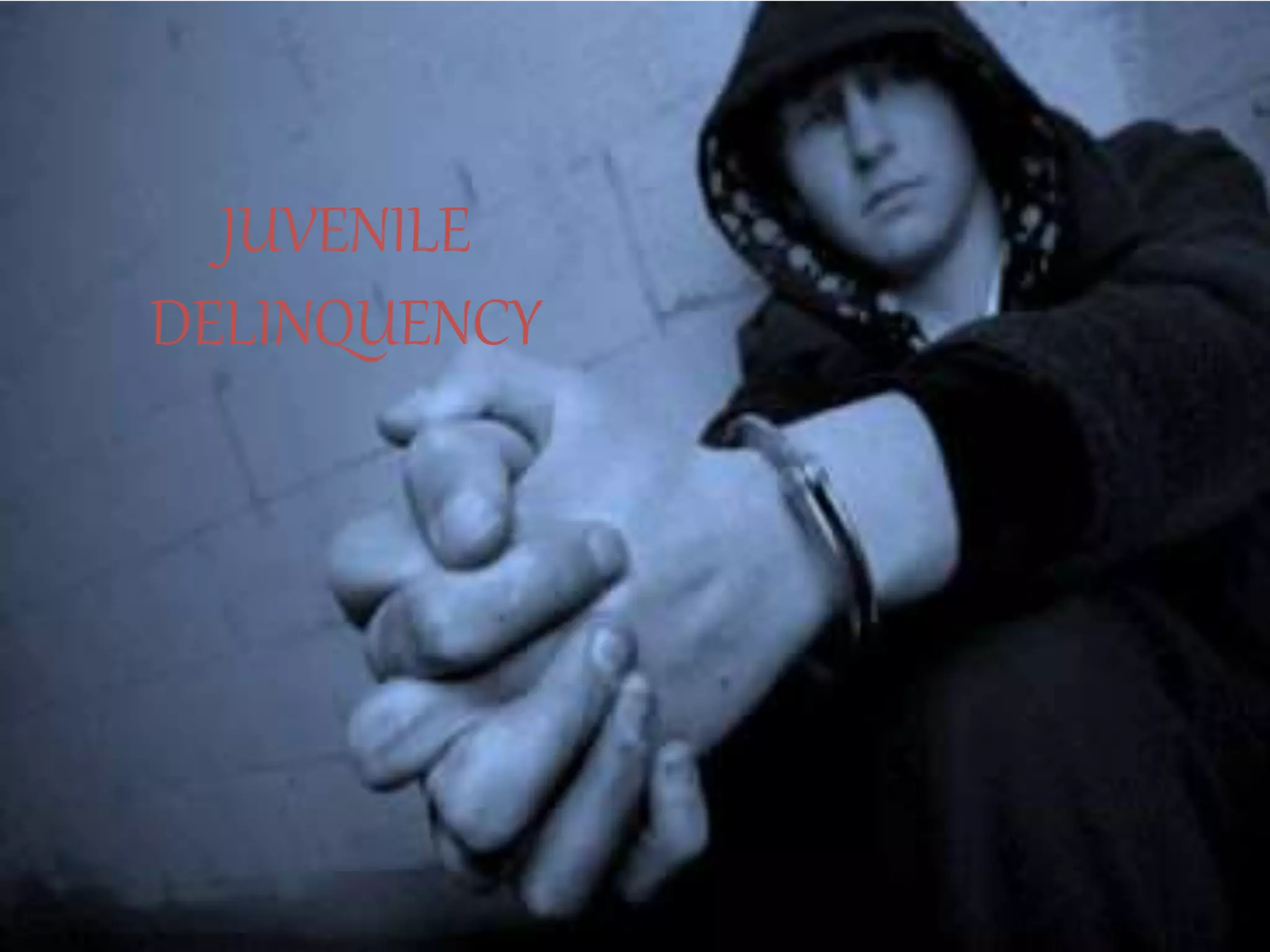
JUVENILE
DELINQUENCY
INTRODUCTION
• Delinquency problems began to receive public
attention particularly since the establishment of
juvenile delinquents(Juvenile court) in 1899 in Illinois,
USA.
• Juvenile Delinquent-
a person who is under the age of 18 commits an act
that otherwise would have been charged as a crime if
they were an adult.
• Juvenile delinquency is also known as
“juvenile offending,” and each state has a separate
legal system in place to deal with juveniles who break
the law.
• Crime is an act harmful not only to an individual, but
also to the community or the state. Such acts are
forbidden and punishable by law.
• Juvenile Delinquency also known as youth crime.
What is juvenile crime?
• Juvenile crime is one of the nation's serious
problems. Concern about it is widely shared by
federal, state, and local government officials
and by the public.
• A juvenile is person detention who is typically
under the age of 18 and commits an act that
otherwise would have been charged as
a crime if they were adult.
• Juvenile crime usually is the participation of
the minors of the age between 10-17 years, in
illegal behavior or activities.
JUVENILE CRIME IN INDIA
• Juvenile Justice (Care and Protection of Children)
Act, 2015 has been passed by Parliament of India
amidst intense controversy, debate and protest on
many of its provisions by Child Rights fraternity.
• It replaced the Indian juvenile
delinquency law, Juvenile Justice (Care and Protection
of Children) Act, 2000, and allows for juveniles in
conflict with Law in the age group of 16–18, involved
in Heinous Offences, to be tried as adults. The Act
came into force from 15 January 2016.
• It was passed on 7 May 2015 by the Lok Sabha amid
intense protest by several Members of Parliament. It
was passed on 22 December 2015 by the Rajya Sabha.
CAUSES OF JUVENILE CRIME
1. SOCIAL FACTORS
Teens who have not given any social or moral training often
lead to juvenile delinquency. It is the parent’s duty to teach
moral and ethical values to their children. They should teach
them the difference between right and wrong behavior. Lack
of social and moral values can lead children to poor
interaction with others and make them less confident. They
may become selfish and arrogant. They would not know how
to respect the laws of the state.
Parents often neglect their children and pay more focus on
working hard to earn money for them. However, while doing
so, they forget the importance of spending quality time with
their children. In their absence, children tend to spend time
with someone who pays attention to them. They may also fall
into wrong hands or get involved in a bad company while
seeking attention from someone other than their parents.
2. Peer Pressure
• Similar to neighborhood pressures, peer pressure
from direct acquaintances can have an effect on
how a juvenile reacts to bad situations. If all of
their friends are committing delinquent acts, the
child may feel pressured to do the same to be
accepted.
• The best way to avoid this type of situation is to
be actively involved with who your child is hanging
out with on a regular basis. Know their friends.
Know about their friends’ parents. This not only
instills confidence in your child to do the right
thing, but it can also help parents keep their
children away from bad influences.
3. Electronic Media
• Social Trends are influencing youth activities. People who are
addicted to social media may
experience negative side effects such as eye strain, social
withdrawal or lack of sleep. Stress. If you spend your time
researching problems or arguing with people, you may
experience stress, which can have a negative impact on your
health.
• Facebook depression. ...
• Cyberbullying. ...
• Sleep deprivation. ...
• Lower self-esteem. ...
• Social isolation. ...
• Poor concentration. ...
• Decreased activity. ...
• Internet addiction.
4. School Problems
• School problem is one of the causes of juvenile
delinquency. There are a variety of reasons
related to schooling that can lead a minor to
criminal activity. Truancy is one of the main
reasons. When a child misses a lot of schools they
do not reap the benefits of education or learn
the discipline of attending school each day.
• When a minor struggle to learn or has a parent
that is simply not interested in making sure that
the child attends school regularly, that child can
eventually end up in situations that lead to
criminal activity. These issues can be approached
and corrected and the child can move on to
leading a life crime-free.
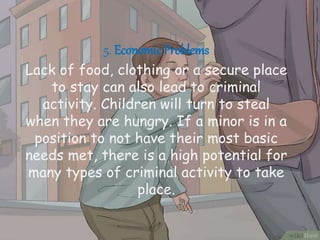
5. EconomicProblems
Lack of food, clothing or a secure place
to stay can also lead to criminal
activity. Children will turn to steal
when they are hungry. If a minor is in a
position to not have their most basic
needs met, there is a high potential for
many types of criminal activity to take
place.
Using School Related Programs to
Prevent Juvenile Delinquency
1. Bullying-RelatedSchoolPrevention
The main goals of Bullying Prevention program is to
“reduce existing bullying problems among students at
school, prevent the development of new bullying
problems, and generally, achieve better peer relations
at school”. This program is based off of four key
principles. The first principle is that the adults at
school should show warmth and positive interest and
must be involved in every student’s lives. The second
principle is that there must be set limits on what is
unacceptable behavior and the third principle is that
schools must always use nonphysical, non-hostile
negative consequences when rules are broken. The
final principle is that the schools must function as
authorities and positive role models.
2.Drug-Related School Prevention
The Life skills training program is a primary
prevention program, which means the ultimate of
goal of this program is to target the younger
populations and attempt to reduce the prevalence
of drug use and abuse among the youths as they
age. The Life Skills training program was created to
influence factors at the individual level through the
development of three components: “(1) to
influence alcohol, tobacco, and other drug (ATOD)
related knowledge, attitudes, and norms; (2) to
teach skills for resisting social influences to use
ATODS; and (3) to promote the development of
personal self-management and social skills”
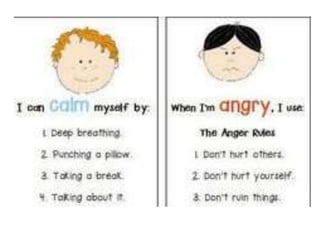
3.Anger Coping-Related School Prevention
This prevention program deals with preventing
anger is the Problem Solving Skills Training
(PSST) Program. The Problem Solving Skills
Training program was created for school-age
children who are taught to apply five problem-
solving steps through verbal self-
prompts which end up encouraging them to
engage in appropriate problem-solving
thoughts and action The five steps include:
“(1) what am I supposed to do? (2) I have to
look at all my possibilities, (3) I’d better
concentrate and focus in, (4) I need to make a
choice, (5) I did a good job or Oh, I made a
mistake” (Ibid, p. 162). In addition, role-
playing is utilized in this program to let the
Effectiveness of School-Related Programs
• Many school-related prevention programs have actually been
proven to be effective in preventing “drug use, delinquency,
anti-social behavior, and early drop out. Programs such as the
Bullying Prevention program, Life Skills Training Program,
Project Status, the School Transitional Environmental
program, the Anger Coping program and the Problem Solving
Skills Training program have shown to have some forms of
success when it comes to preventing certain delinquency.
Even the Gang Resistance Education and Training program has
achieved modest positive results. The Gang resistance
Education and Training program was shown to be able to
“successfully change several risk factors associated with
delinquency and gang membership”. The Bullying Prevention
Program has been effective in improving the school climate
and reducing both bullying and other forms of delinquency.
The Life Skills Training programs have proven to be effective
in reducing the use of cigarettes, marijuana and alcohol and
the reductions in these drugs are sustained throughout the
entire school period
THANK YOU

School administration juvenile ppt

  • 1.
  • 2.
    INTRODUCTION • Delinquency problemsbegan to receive public attention particularly since the establishment of juvenile delinquents(Juvenile court) in 1899 in Illinois, USA. • Juvenile Delinquent- a person who is under the age of 18 commits an act that otherwise would have been charged as a crime if they were an adult. • Juvenile delinquency is also known as “juvenile offending,” and each state has a separate legal system in place to deal with juveniles who break the law. • Crime is an act harmful not only to an individual, but also to the community or the state. Such acts are forbidden and punishable by law. • Juvenile Delinquency also known as youth crime.
  • 3.
    What is juvenilecrime? • Juvenile crime is one of the nation's serious problems. Concern about it is widely shared by federal, state, and local government officials and by the public. • A juvenile is person detention who is typically under the age of 18 and commits an act that otherwise would have been charged as a crime if they were adult. • Juvenile crime usually is the participation of the minors of the age between 10-17 years, in illegal behavior or activities.
  • 4.
    JUVENILE CRIME ININDIA • Juvenile Justice (Care and Protection of Children) Act, 2015 has been passed by Parliament of India amidst intense controversy, debate and protest on many of its provisions by Child Rights fraternity. • It replaced the Indian juvenile delinquency law, Juvenile Justice (Care and Protection of Children) Act, 2000, and allows for juveniles in conflict with Law in the age group of 16–18, involved in Heinous Offences, to be tried as adults. The Act came into force from 15 January 2016. • It was passed on 7 May 2015 by the Lok Sabha amid intense protest by several Members of Parliament. It was passed on 22 December 2015 by the Rajya Sabha.
  • 5.
    CAUSES OF JUVENILECRIME 1. SOCIAL FACTORS Teens who have not given any social or moral training often lead to juvenile delinquency. It is the parent’s duty to teach moral and ethical values to their children. They should teach them the difference between right and wrong behavior. Lack of social and moral values can lead children to poor interaction with others and make them less confident. They may become selfish and arrogant. They would not know how to respect the laws of the state. Parents often neglect their children and pay more focus on working hard to earn money for them. However, while doing so, they forget the importance of spending quality time with their children. In their absence, children tend to spend time with someone who pays attention to them. They may also fall into wrong hands or get involved in a bad company while seeking attention from someone other than their parents.
  • 6.
    2. Peer Pressure •Similar to neighborhood pressures, peer pressure from direct acquaintances can have an effect on how a juvenile reacts to bad situations. If all of their friends are committing delinquent acts, the child may feel pressured to do the same to be accepted. • The best way to avoid this type of situation is to be actively involved with who your child is hanging out with on a regular basis. Know their friends. Know about their friends’ parents. This not only instills confidence in your child to do the right thing, but it can also help parents keep their children away from bad influences.
  • 7.
    3. Electronic Media •Social Trends are influencing youth activities. People who are addicted to social media may experience negative side effects such as eye strain, social withdrawal or lack of sleep. Stress. If you spend your time researching problems or arguing with people, you may experience stress, which can have a negative impact on your health. • Facebook depression. ... • Cyberbullying. ... • Sleep deprivation. ... • Lower self-esteem. ... • Social isolation. ... • Poor concentration. ... • Decreased activity. ... • Internet addiction.
  • 8.
    4. School Problems •School problem is one of the causes of juvenile delinquency. There are a variety of reasons related to schooling that can lead a minor to criminal activity. Truancy is one of the main reasons. When a child misses a lot of schools they do not reap the benefits of education or learn the discipline of attending school each day. • When a minor struggle to learn or has a parent that is simply not interested in making sure that the child attends school regularly, that child can eventually end up in situations that lead to criminal activity. These issues can be approached and corrected and the child can move on to leading a life crime-free.
  • 9.
    5. EconomicProblems Lack offood, clothing or a secure place to stay can also lead to criminal activity. Children will turn to steal when they are hungry. If a minor is in a position to not have their most basic needs met, there is a high potential for many types of criminal activity to take place.
  • 10.
    Using School RelatedPrograms to Prevent Juvenile Delinquency 1. Bullying-RelatedSchoolPrevention The main goals of Bullying Prevention program is to “reduce existing bullying problems among students at school, prevent the development of new bullying problems, and generally, achieve better peer relations at school”. This program is based off of four key principles. The first principle is that the adults at school should show warmth and positive interest and must be involved in every student’s lives. The second principle is that there must be set limits on what is unacceptable behavior and the third principle is that schools must always use nonphysical, non-hostile negative consequences when rules are broken. The final principle is that the schools must function as authorities and positive role models.
  • 11.
    2.Drug-Related School Prevention TheLife skills training program is a primary prevention program, which means the ultimate of goal of this program is to target the younger populations and attempt to reduce the prevalence of drug use and abuse among the youths as they age. The Life Skills training program was created to influence factors at the individual level through the development of three components: “(1) to influence alcohol, tobacco, and other drug (ATOD) related knowledge, attitudes, and norms; (2) to teach skills for resisting social influences to use ATODS; and (3) to promote the development of personal self-management and social skills”
  • 12.
    3.Anger Coping-Related SchoolPrevention This prevention program deals with preventing anger is the Problem Solving Skills Training (PSST) Program. The Problem Solving Skills Training program was created for school-age children who are taught to apply five problem- solving steps through verbal self- prompts which end up encouraging them to engage in appropriate problem-solving thoughts and action The five steps include: “(1) what am I supposed to do? (2) I have to look at all my possibilities, (3) I’d better concentrate and focus in, (4) I need to make a choice, (5) I did a good job or Oh, I made a mistake” (Ibid, p. 162). In addition, role- playing is utilized in this program to let the
  • 14.
    Effectiveness of School-RelatedPrograms • Many school-related prevention programs have actually been proven to be effective in preventing “drug use, delinquency, anti-social behavior, and early drop out. Programs such as the Bullying Prevention program, Life Skills Training Program, Project Status, the School Transitional Environmental program, the Anger Coping program and the Problem Solving Skills Training program have shown to have some forms of success when it comes to preventing certain delinquency. Even the Gang Resistance Education and Training program has achieved modest positive results. The Gang resistance Education and Training program was shown to be able to “successfully change several risk factors associated with delinquency and gang membership”. The Bullying Prevention Program has been effective in improving the school climate and reducing both bullying and other forms of delinquency. The Life Skills Training programs have proven to be effective in reducing the use of cigarettes, marijuana and alcohol and the reductions in these drugs are sustained throughout the entire school period
  • 15.