RULES OF INFERENCE (CONCLUSION)
1. Rule of conjunctive simplification

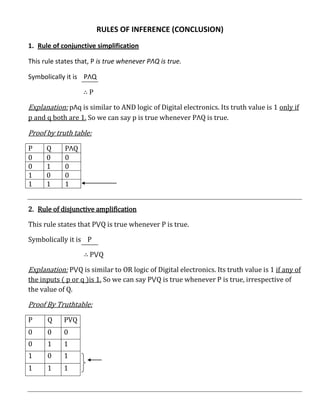
This rule states that, P is true whenever PΛQ is true.

Symbolically it is PΛQ

                   ∴P

Explanation: pΛq is similar to AND logic of Digital electronics. Its truth value is 1 only if
p and q both are 1. So we can say p is true whenever PΛQ is true.

Proof by truth table:
P     Q     PΛQ
0     0     0
0     1     0
1     0     0
1     1     1


2. Rule of disjunctive amplification

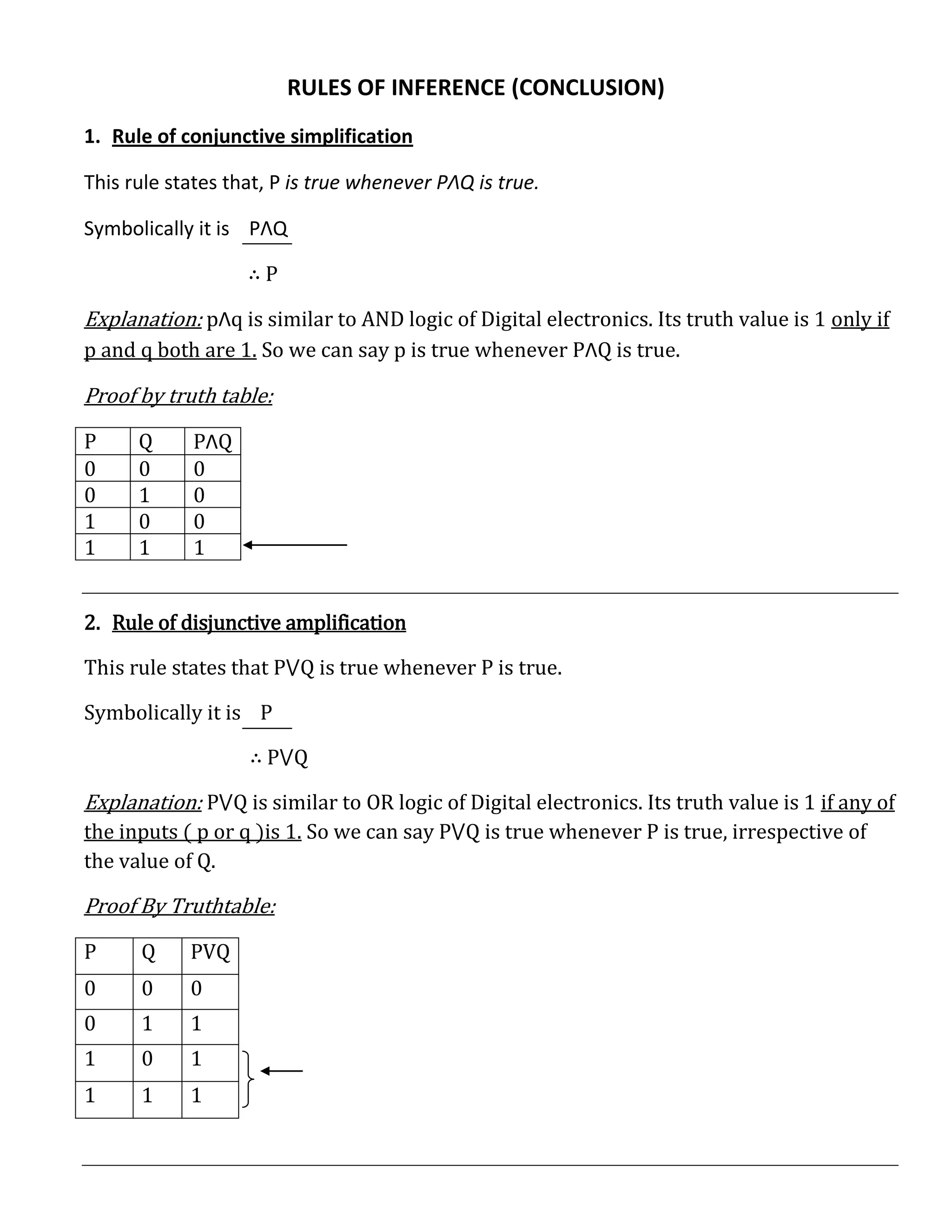
This rule states that P⋁Q is true whenever P is true.

Symbolically it is P

                   ∴ P⋁Q

Explanation: P⋁Q is similar to OR logic of Digital electronics. Its truth value is 1 if any of
the inputs ( p or q )is 1. So we can say P⋁Q is true whenever P is true, irrespective of
the value of Q.

Proof By Truthtable:
P     Q     PVQ
0     0     0
0     1     1
1     0     1
1     1     1
3. Rule of Hypothetical syllogism:

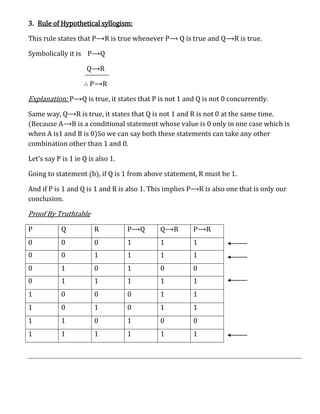
This rule states that P⟶R is true whenever P⟶ Q is true and Q⟶R is true.

Symbolically it is P⟶Q

                     Q⟶R

                    ∴ P⟶R

Explanation: P⟶Q is true, it states that P is not 1 and Q is not 0 concurrently.
Same way, Q⟶R is true, it states that Q is not 1 and R is not 0 at the same time.
(Because A⟶B is a conditional statement whose value is 0 only in one case which is
when A is1 and B is 0)So we can say both these statements can take any other
combination other than 1 and 0.

Let’s say P is 1 ie Q is also 1.

Going to statement (b), if Q is 1 from above statement, R must be 1.

And if P is 1 and Q is 1 and R is also 1. This implies P⟶R is also one that is only our
conclusion.

Proof By Truthtable
P           Q           R          P⟶Q      Q⟶R        P⟶R
0           0           0          1        1          1
0           0           1          1        1          1
0           1           0          1        0          0
0           1           1          1        1          1
1           0           0          0        1          1
1           0           1          0        1          1
1           1           0          1        0          0
1           1           1          1        1          1
4. Rule of Disjunctive syllogism

This rule states that Q is true whenever P⋁Q is true and P is true.

Symbolically it is P⋁Q      (a)

                       P    (b)

                    ∴Q

Explanation: P⋁Q behaves the same way as OR gate in digital electronics ie, if any of the
two inputs is 1 the output is 1. So if we know that PVQ is 1(from (a)) and P is 1 that
means P is 0. So to support (a), Q has to be one only then the output of PVQ will be 1.
This implies Q is 1 and that is our conclusion.

Proof By Truthtable
P         Q         P⋁Q        P
0         0         0         1
0         1         1         1
1         0         1         0
1         1         1         0


5. Rule of Modus Pones( Rule of detachment)

This rule states that Q is true whenever P is true and P⟶Q is true.

Symbolically it is P                     (a)

                   P⟶Q                   (b)

                   ∴Q

Explanation: P⟶Q is a conditional statement in discrete mathematics, which is false
only in one case that is when p is true and q is false (or P is 1 and Q is 0 then p⟶q is 0
and in all other cases it is true.)

Here we know that p is true, from (a)

And P⟶Q is true (from (b)) ie Q must be true that is the conclution.
Proof By Truthtable
P      Q             P⟶Q
0      0             1
0      1             1
1      0             0
1      1             1


6. Rule of Modus Tollens

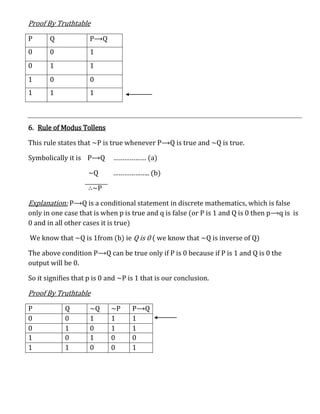
This rule states that ~P is true whenever P⟶Q is true and ~Q is true.

Symbolically it is P⟶Q       ……………… (a)

                    ~Q       ……………….. (b)

                    ∴~P

Explanation: P⟶Q is a conditional statement in discrete mathematics, which is false
only in one case that is when p is true and q is false (or P is 1 and Q is 0 then p⟶q is is
0 and in all other cases it is true)

We know that ~Q is 1from (b) ie Q is 0 ( we know that ~Q is inverse of Q)

The above condition P⟶Q can be true only if P is 0 because if P is 1 and Q is 0 the
output will be 0.

So it signifies that p is 0 and ~P is 1 that is our conclusion.

Proof By Truthtable
P           Q        ~Q     ~P      P⟶Q
0           0        1      1       1
0           1        0      1       1
1           0        1      0       0
1           1        0      0       1

Rules of inference

  • 1.
    RULES OF INFERENCE(CONCLUSION) 1. Rule of conjunctive simplification This rule states that, P is true whenever PΛQ is true. Symbolically it is PΛQ ∴P Explanation: pΛq is similar to AND logic of Digital electronics. Its truth value is 1 only if p and q both are 1. So we can say p is true whenever PΛQ is true. Proof by truth table: P Q PΛQ 0 0 0 0 1 0 1 0 0 1 1 1 2. Rule of disjunctive amplification This rule states that P⋁Q is true whenever P is true. Symbolically it is P ∴ P⋁Q Explanation: P⋁Q is similar to OR logic of Digital electronics. Its truth value is 1 if any of the inputs ( p or q )is 1. So we can say P⋁Q is true whenever P is true, irrespective of the value of Q. Proof By Truthtable: P Q PVQ 0 0 0 0 1 1 1 0 1 1 1 1
  • 2.
    3. Rule ofHypothetical syllogism: This rule states that P⟶R is true whenever P⟶ Q is true and Q⟶R is true. Symbolically it is P⟶Q Q⟶R ∴ P⟶R Explanation: P⟶Q is true, it states that P is not 1 and Q is not 0 concurrently. Same way, Q⟶R is true, it states that Q is not 1 and R is not 0 at the same time. (Because A⟶B is a conditional statement whose value is 0 only in one case which is when A is1 and B is 0)So we can say both these statements can take any other combination other than 1 and 0. Let’s say P is 1 ie Q is also 1. Going to statement (b), if Q is 1 from above statement, R must be 1. And if P is 1 and Q is 1 and R is also 1. This implies P⟶R is also one that is only our conclusion. Proof By Truthtable P Q R P⟶Q Q⟶R P⟶R 0 0 0 1 1 1 0 0 1 1 1 1 0 1 0 1 0 0 0 1 1 1 1 1 1 0 0 0 1 1 1 0 1 0 1 1 1 1 0 1 0 0 1 1 1 1 1 1
  • 3.
    4. Rule ofDisjunctive syllogism This rule states that Q is true whenever P⋁Q is true and P is true. Symbolically it is P⋁Q (a) P (b) ∴Q Explanation: P⋁Q behaves the same way as OR gate in digital electronics ie, if any of the two inputs is 1 the output is 1. So if we know that PVQ is 1(from (a)) and P is 1 that means P is 0. So to support (a), Q has to be one only then the output of PVQ will be 1. This implies Q is 1 and that is our conclusion. Proof By Truthtable P Q P⋁Q P 0 0 0 1 0 1 1 1 1 0 1 0 1 1 1 0 5. Rule of Modus Pones( Rule of detachment) This rule states that Q is true whenever P is true and P⟶Q is true. Symbolically it is P (a) P⟶Q (b) ∴Q Explanation: P⟶Q is a conditional statement in discrete mathematics, which is false only in one case that is when p is true and q is false (or P is 1 and Q is 0 then p⟶q is 0 and in all other cases it is true.) Here we know that p is true, from (a) And P⟶Q is true (from (b)) ie Q must be true that is the conclution.
  • 4.
    Proof By Truthtable P Q P⟶Q 0 0 1 0 1 1 1 0 0 1 1 1 6. Rule of Modus Tollens This rule states that ~P is true whenever P⟶Q is true and ~Q is true. Symbolically it is P⟶Q ……………… (a) ~Q ……………….. (b) ∴~P Explanation: P⟶Q is a conditional statement in discrete mathematics, which is false only in one case that is when p is true and q is false (or P is 1 and Q is 0 then p⟶q is is 0 and in all other cases it is true) We know that ~Q is 1from (b) ie Q is 0 ( we know that ~Q is inverse of Q) The above condition P⟶Q can be true only if P is 0 because if P is 1 and Q is 0 the output will be 0. So it signifies that p is 0 and ~P is 1 that is our conclusion. Proof By Truthtable P Q ~Q ~P P⟶Q 0 0 1 1 1 0 1 0 1 1 1 0 1 0 0 1 1 0 0 1