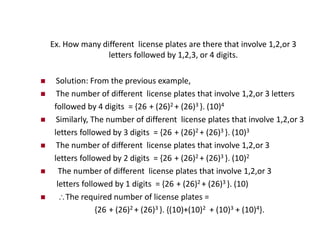
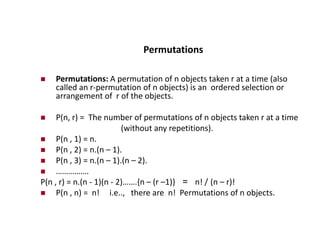
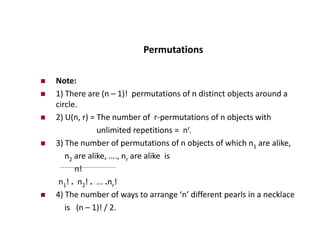
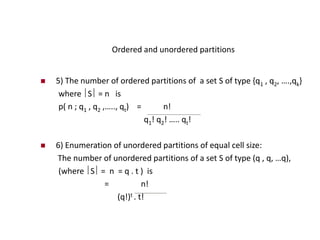
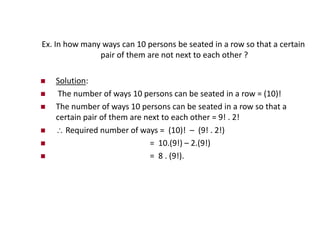
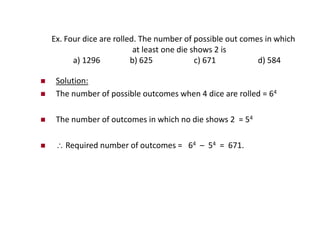
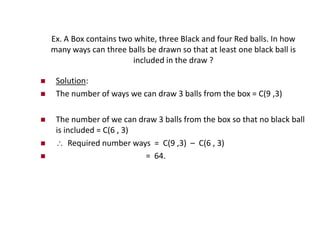
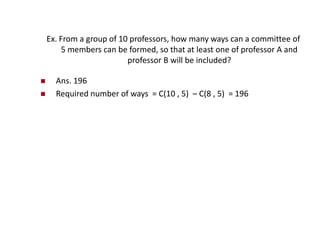
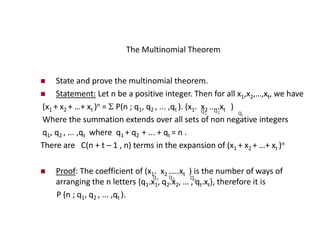
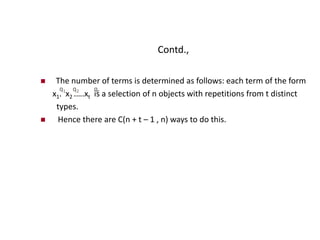
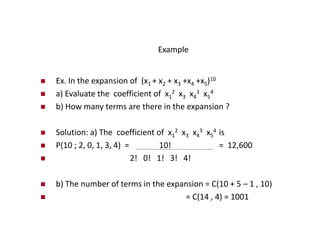
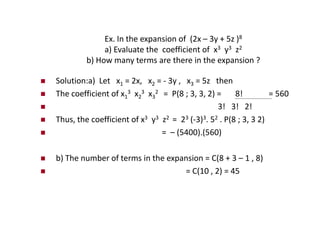
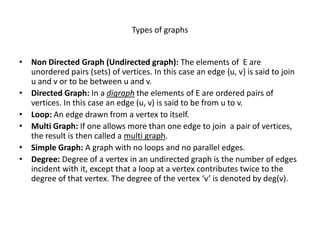
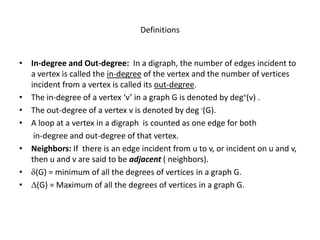
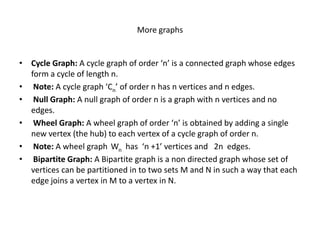
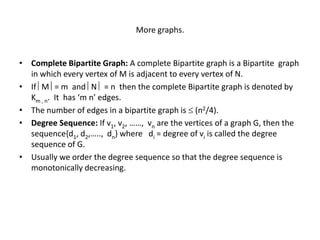
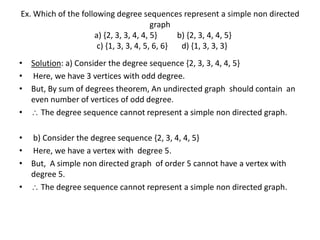
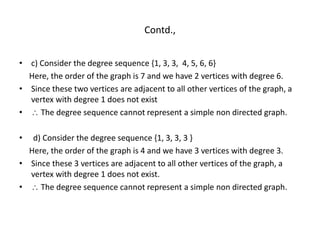
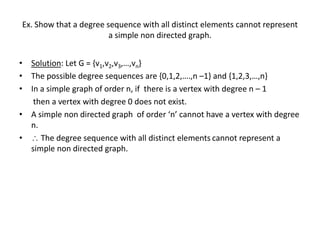
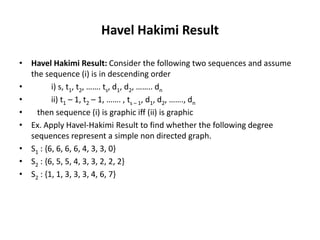
Mathematical Foundation of
Computer Science
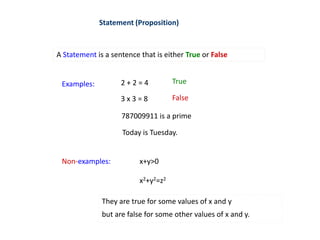
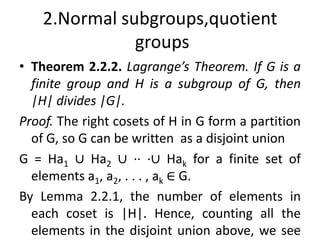
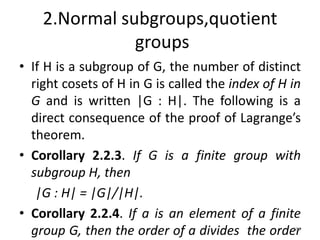
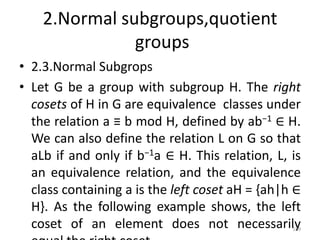
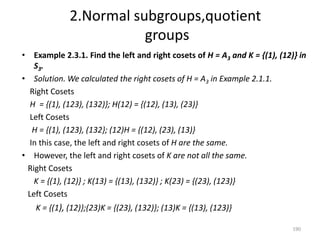
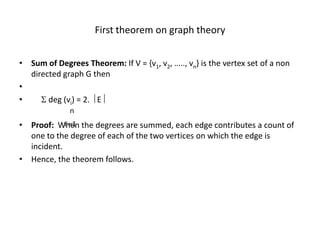
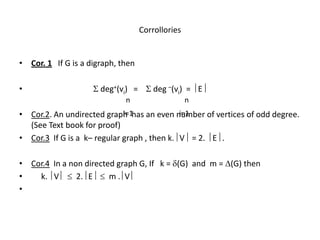
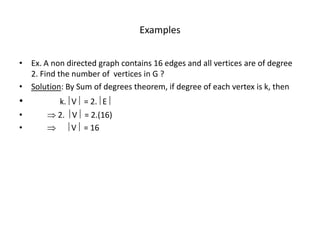
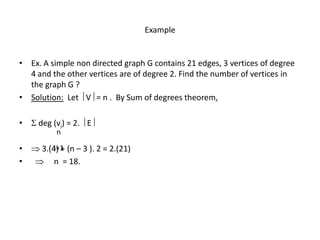
Statement (Proposition)
A Statement is a sentence that is either True or False
Examples:
Non-examples: x+y>0
x2+y2=z2
True
False
2 + 2 = 4
3 x 3 = 8
787009911 is a prime
They are true for some values of x and y
but are false for some other values of x and y.
Today is Tuesday.
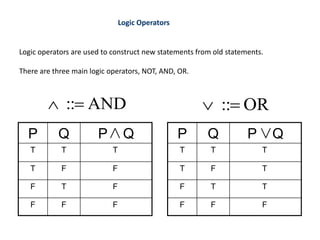
Logic Operators
F
F
F
T
P Q
F
F
T
F
F
T
T
T
Q
P
AND
::

F
T
T
T
P Q
F
F
T
F
F
T
T
T
Q
P
OR
::

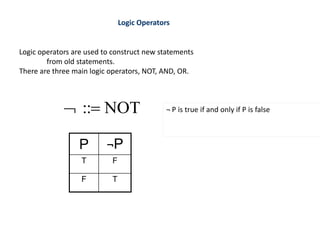
Logic operators are used to construct new statements from old statements.
There are three main logic operators, NOT, AND, OR.
Logic Operators
NOT
::
 ¬ P is true if and only if P is false
Logic operators are used to construct new statements
from old statements.
There are three main logic operators, NOT, AND, OR.
T
F
F
T
¬P
P
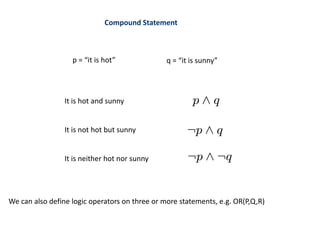
Compound Statement
p = “it is hot” q = “it is sunny”
It is hot and sunny
It is not hot but sunny
It is neither hot nor sunny
We can also define logic operators on three or more statements, e.g. OR(P,Q,R)
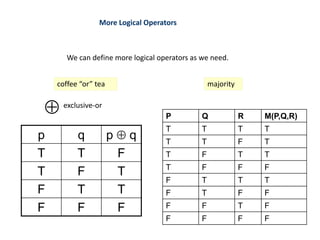
More Logical Operators
coffee “or” tea
 exclusive-or
p q p  q
T T F
T F T
F T T
F F F
We can define more logical operators as we need.
P Q R M(P,Q,R)
T T T T
T T F T
T F T T
T F F F
F T T T
F T F F
F F T F
F F F F
majority
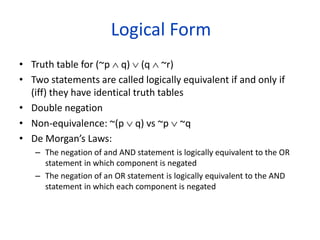
Logical Form
• Truth table for (~p  q)  (q  ~r)
• Two statements are called logically equivalent if and only if
(iff) they have identical truth tables
• Double negation
• Non-equivalence: ~(p  q) vs ~p  ~q
• De Morgan’s Laws:
– The negation of and AND statement is logically equivalent to the OR
statement in which component is negated
– The negation of an OR statement is logically equivalent to the AND
statement in which each component is negated
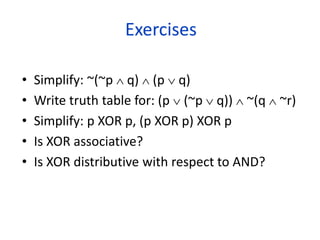
Exercises
• Simplify: ~(~p  q)  (p  q)
• Write truth table for: (p  (~p  q))  ~(q  ~r)
• Simplify: p XOR p, (p XOR p) XOR p
• Is XOR associative?
• Is XOR distributive with respect to AND?
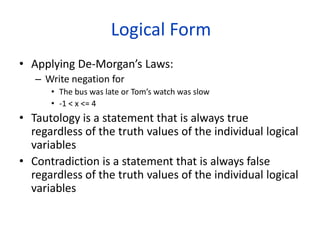
Logical Form
• Applying De-Morgan’s Laws:
– Write negation for
• The bus was late or Tom’s watch was slow
• -1 < x <= 4
• Tautology is a statement that is always true
regardless of the truth values of the individual logical
variables
• Contradiction is a statement that is always false
regardless of the truth values of the individual logical
variables
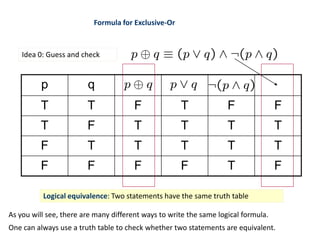
Formula for Exclusive-Or
p q
T T F T F F
T F T T T T
F T T T T T
F F F F T F
Logical equivalence: Two statements have the same truth table
Idea 0: Guess and check
As you will see, there are many different ways to write the same logical formula.
One can always use a truth table to check whether two statements are equivalent.
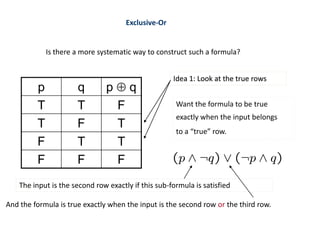
Exclusive-Or
Is there a more systematic way to construct such a formula?
p q p  q
T T F
T F T
F T T
F F F
Idea 1: Look at the true rows
Want the formula to be true
exactly when the input belongs
to a “true” row.
The input is the second row exactly if this sub-formula is satisfied
And the formula is true exactly when the input is the second row or the third row.
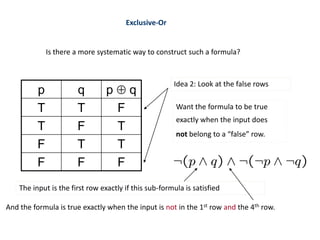
Exclusive-Or
p q p  q
T T F
T F T
F T T
F F F
Idea 2: Look at the false rows
Want the formula to be true
exactly when the input does
not belong to a “false” row.
The input is the first row exactly if this sub-formula is satisfied
And the formula is true exactly when the input is not in the 1st row and the 4th row.
Is there a more systematic way to construct such a formula?
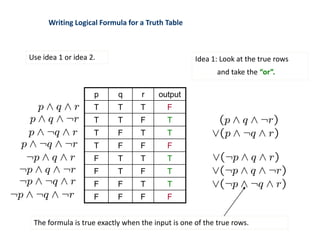
Writing Logical Formula for a Truth Table
p q r output
T T T F
T T F T
T F T T
T F F F
F T T T
F T F T
F F T T
F F F F
Use idea 1 or idea 2. Idea 1: Look at the true rows
and take the “or”.
The formula is true exactly when the input is one of the true rows.
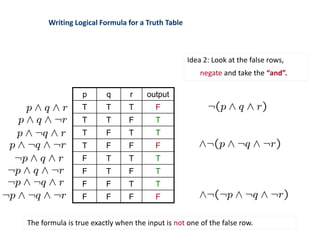
Writing Logical Formula for a Truth Table
Idea 2: Look at the false rows,
negate and take the “and”.
The formula is true exactly when the input is not one of the false row.
p q r output
T T T F
T T F T
T F T T
T F F F
F T T T
F T F T
F F T T
F F F F
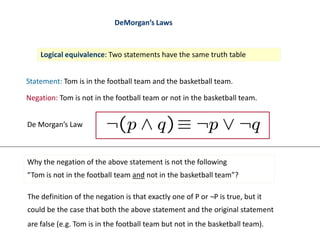
DeMorgan’s Laws
Logical equivalence: Two statements have the same truth table
Statement: Tom is in the football team and the basketball team.
Negation: Tom is not in the football team or not in the basketball team.
De Morgan’s Law
Why the negation of the above statement is not the following
“Tom is not in the football team and not in the basketball team”?
The definition of the negation is that exactly one of P or ¬P is true, but it
could be the case that both the above statement and the original statement
are false (e.g. Tom is in the football team but not in the basketball team).
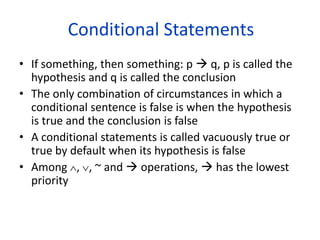
Conditional Statements
• If something, then something: p  q, p is called the
hypothesis and q is called the conclusion
• The only combination of circumstances in which a
conditional sentence is false is when the hypothesis
is true and the conclusion is false
• A conditional statements is called vacuously true or
true by default when its hypothesis is false
• Among , , ~ and  operations,  has the lowest
priority
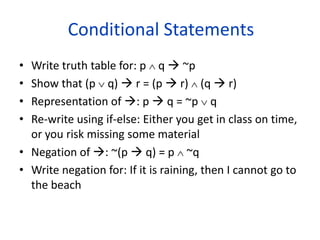
Conditional Statements
• Write truth table for: p  q  ~p
• Show that (p  q)  r = (p  r)  (q  r)
• Representation of : p  q = ~p  q
• Re-write using if-else: Either you get in class on time,
or you risk missing some material
• Negation of : ~(p  q) = p  ~q
• Write negation for: If it is raining, then I cannot go to
the beach
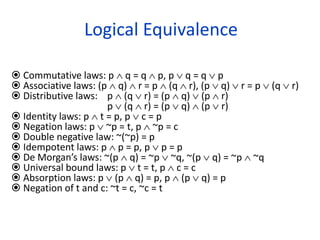
Logical Equivalence
 Commutative laws: p  q = q  p, p  q = q  p
 Associative laws: (p  q)  r = p  (q  r), (p  q)  r = p  (q  r)
 Distributive laws: p  (q  r) = (p  q)  (p  r)
p  (q  r) = (p  q)  (p  r)
 Identity laws: p  t = p, p  c = p
 Negation laws: p  ~p = t, p  ~p = c
 Double negative law: ~(~p) = p
 Idempotent laws: p  p = p, p  p = p
 De Morgan’s laws: ~(p  q) = ~p  ~q, ~(p  q) = ~p  ~q
 Universal bound laws: p  t = t, p  c = c
 Absorption laws: p  (p  q) = p, p  (p  q) = p
 Negation of t and c: ~t = c, ~c = t
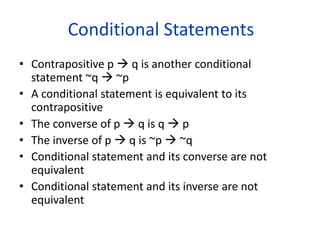
Conditional Statements
• Contrapositive p  q is another conditional
statement ~q  ~p
• A conditional statement is equivalent to its
contrapositive
• The converse of p  q is q  p
• The inverse of p  q is ~p  ~q
• Conditional statement and its converse are not
equivalent
• Conditional statement and its inverse are not
equivalent
Conditional Statements
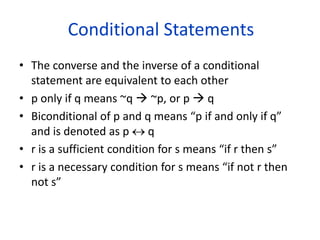
• The converse and the inverse of a conditional
statement are equivalent to each other
• p only if q means ~q  ~p, or p  q
• Biconditional of p and q means “p if and only if q”
and is denoted as p  q
• r is a sufficient condition for s means “if r then s”
• r is a necessary condition for s means “if not r then
not s”
Exercises
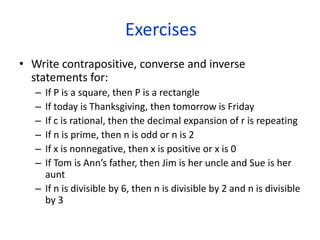
• Write contrapositive, converse and inverse
statements for:
– If P is a square, then P is a rectangle
– If today is Thanksgiving, then tomorrow is Friday
– If c is rational, then the decimal expansion of r is repeating
– If n is prime, then n is odd or n is 2
– If x is nonnegative, then x is positive or x is 0
– If Tom is Ann’s father, then Jim is her uncle and Sue is her
aunt
– If n is divisible by 6, then n is divisible by 2 and n is divisible
by 3
Arguments
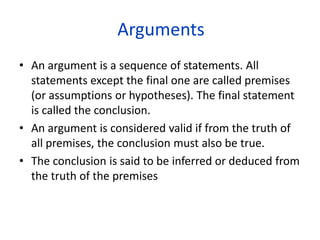
• An argument is a sequence of statements. All
statements except the final one are called premises
(or assumptions or hypotheses). The final statement
is called the conclusion.
• An argument is considered valid if from the truth of
all premises, the conclusion must also be true.
• The conclusion is said to be inferred or deduced from
the truth of the premises
Contradiction
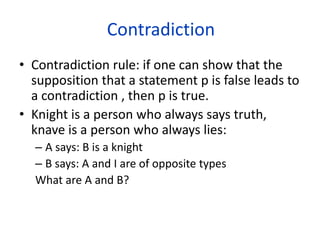
• Contradiction rule: if one can show that the
supposition that a statement p is false leads to
a contradiction , then p is true.
• Knight is a person who always says truth,
knave is a person who always lies:
– A says: B is a knight
– B says: A and I are of opposite types
What are A and B?
DeMorgan’s Laws
Logical equivalence: Two statements have the same truth table
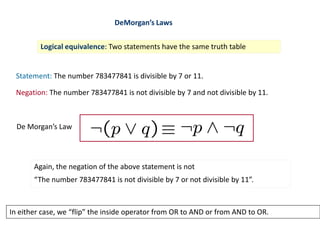
Statement: The number 783477841 is divisible by 7 or 11.
Negation: The number 783477841 is not divisible by 7 and not divisible by 11.
De Morgan’s Law
Again, the negation of the above statement is not
“The number 783477841 is not divisible by 7 or not divisible by 11”.
In either case, we “flip” the inside operator from OR to AND or from AND to OR.
DeMorgan’s Laws
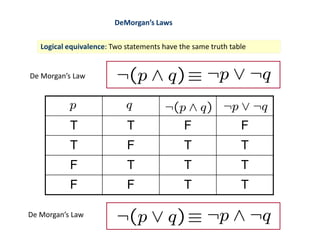
Logical equivalence: Two statements have the same truth table
T T F F
T F T T
F T T T
F F T T
De Morgan’s Law
De Morgan’s Law
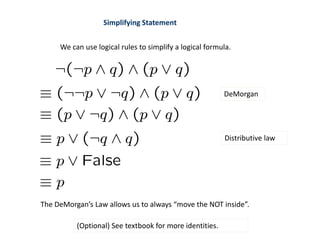
Simplifying Statement
(Optional) See textbook for more identities.
DeMorgan
Distributive law
The DeMorgan’s Law allows us to always “move the NOT inside”.
We can use logical rules to simplify a logical formula.
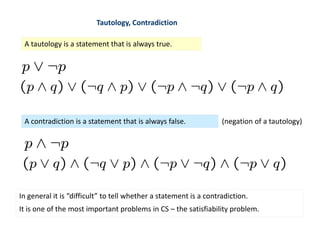
Tautology, Contradiction
A tautology is a statement that is always true.
A contradiction is a statement that is always false. (negation of a tautology)
In general it is “difficult” to tell whether a statement is a contradiction.
It is one of the most important problems in CS – the satisfiability problem.
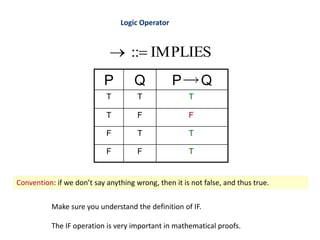
IMPLIES
::

Logic Operator
T
T
F
T
P Q
F
F
T
F
F
T
T
T
Q
P
Convention: if we don’t say anything wrong, then it is not false, and thus true.
Make sure you understand the definition of IF.
The IF operation is very important in mathematical proofs.
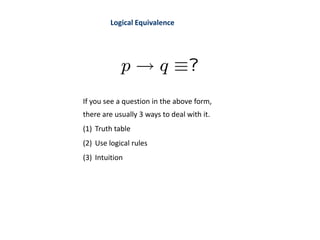
Logical Equivalence
If you see a question in the above form,
there are usually 3 ways to deal with it.
(1) Truth table
(2) Use logical rules
(3) Intuition
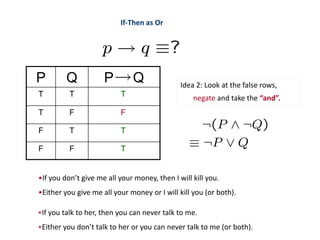
If-Then as Or
T
T
F
T
P Q
F
F
T
F
F
T
T
T
Q
P Idea 2: Look at the false rows,
negate and take the “and”.
•If you don’t give me all your money, then I will kill you.
•Either you give me all your money or I will kill you (or both).
•If you talk to her, then you can never talk to me.
•Either you don’t talk to her or you can never talk to me (or both).
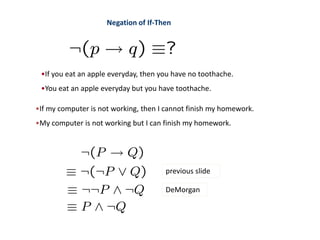
Negation of If-Then
•If you eat an apple everyday, then you have no toothache.
•You eat an apple everyday but you have toothache.
•If my computer is not working, then I cannot finish my homework.
•My computer is not working but I can finish my homework.
previous slide
DeMorgan
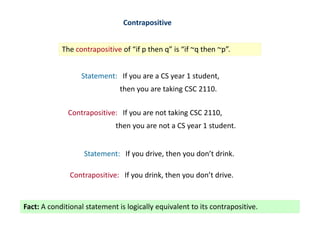
Contrapositive
The contrapositive of “if p then q” is “if ~q then ~p”.
Statement: If you drive, then you don’t drink.
Statement: If you are a CS year 1 student,
then you are taking CSC 2110.
Contrapositive: If you drink, then you don’t drive.
Contrapositive: If you are not taking CSC 2110,
then you are not a CS year 1 student.
Fact: A conditional statement is logically equivalent to its contrapositive.
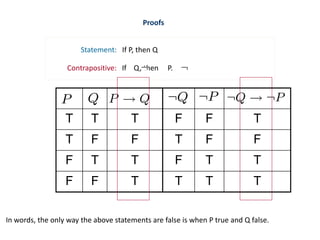
Proofs
Statement: If P, then Q
Contrapositive: If Q, then P.
F F T
T F F
F T T
T T T
T T T
T F F
F T T
F F T
In words, the only way the above statements are false is when P true and Q false.
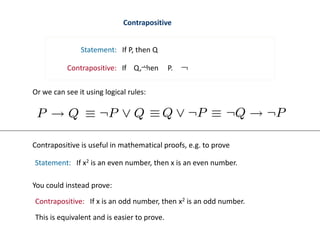
Contrapositive
Statement: If P, then Q
Contrapositive: If Q, then P.
Or we can see it using logical rules:
Contrapositive is useful in mathematical proofs, e.g. to prove
Statement: If x2 is an even number, then x is an even number.
Contrapositive: If x is an odd number, then x2 is an odd number.
You could instead prove:
This is equivalent and is easier to prove.
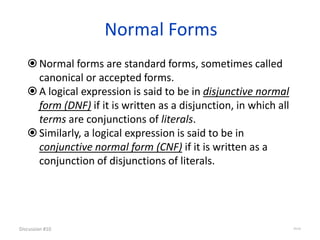
Normal Forms
Normal forms are standard forms, sometimes called
canonical or accepted forms.
A logical expression is said to be in disjunctive normal
form (DNF) if it is written as a disjunction, in which all
terms are conjunctions of literals.
Similarly, a logical expression is said to be in
conjunctive normal form (CNF) if it is written as a
conjunction of disjunctions of literals.
Discussion #10 35/16
( ), ( ), ( )
P Q Q R R P
P Q R
  
 
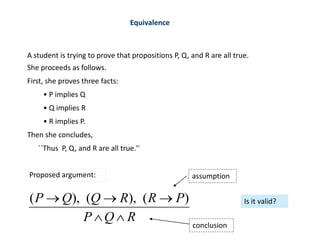
Equivalence
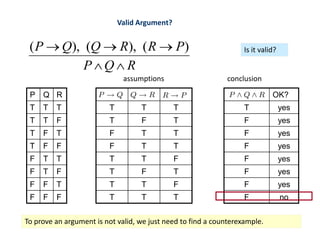
A student is trying to prove that propositions P, Q, and R are all true.
She proceeds as follows.
First, she proves three facts:
• P implies Q
• Q implies R
• R implies P.
Then she concludes,
``Thus P, Q, and R are all true.''
Proposed argument:
Is it valid?
assumption
conclusion
Valid Argument?
assumptions conclusion
P Q R
T T T
T T F
T F T
T F F
F T T
F T F
F F T
F F F
T T T
T F T
F T T
F T T
T T F
T F T
T T F
T T T
OK?
T yes
F yes
F yes
F yes
F yes
F yes
F yes
F no
To prove an argument is not valid, we just need to find a counterexample.
( ), ( ), ( )
P Q Q R R P
P Q R
  
 
Is it valid?
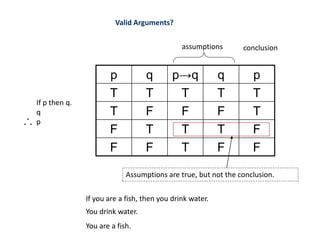
Valid Arguments?
If p then q.
q
p
If you are a fish, then you drink water.
You drink water.
You are a fish.
p q p→q q p
T T T T T
T F F F T
F T T T F
F F T F F
assumptions conclusion
Assumptions are true, but not the conclusion.
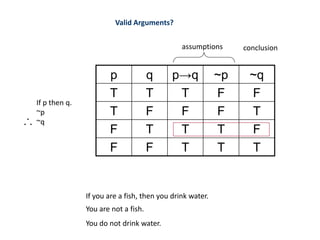
Valid Arguments?
If p then q.
~p
~q
If you are a fish, then you drink water.
You are not a fish.
You do not drink water.
p q p→q ~p ~q
T T T F F
T F F F T
F T T T F
F F T T T
assumptions conclusion
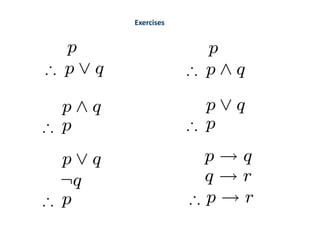
Exercises
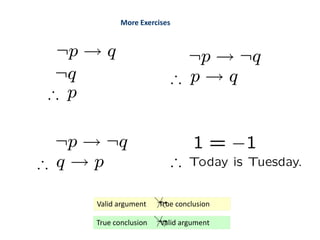
More Exercises
Valid argument True conclusion
True conclusion Valid argument
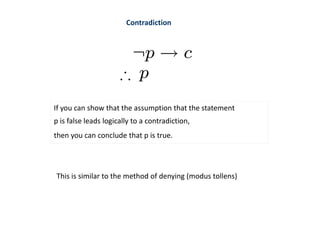
Contradiction
If you can show that the assumption that the statement
p is false leads logically to a contradiction,
then you can conclude that p is true.
This is similar to the method of denying (modus tollens)
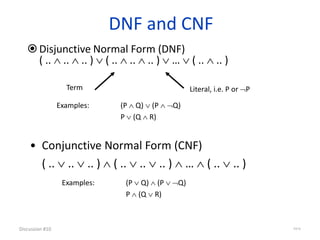
DNF and CNF
Disjunctive Normal Form (DNF)
( ..  ..  .. )  ( ..  ..  .. )  …  ( ..  .. )
Discussion #10 43/16
Term Literal, i.e. P or P
• Conjunctive Normal Form (CNF)
( ..  ..  .. )  ( ..  ..  .. )  …  ( ..  .. )
Examples: (P  Q)  (P  Q)
P  (Q  R)
Examples: (P  Q)  (P  Q)
P  (Q  R)
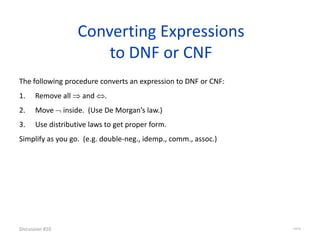
Converting Expressions
to DNF or CNF
Discussion #10 44/16
The following procedure converts an expression to DNF or CNF:
1. Remove all  and .
2. Move  inside. (Use De Morgan’s law.)
3. Use distributive laws to get proper form.
Simplify as you go. (e.g. double-neg., idemp., comm., assoc.)
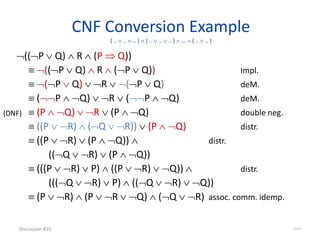
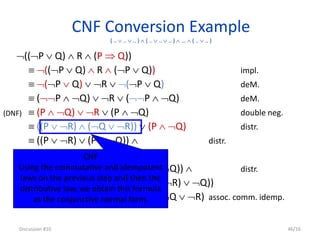
CNF Conversion Example
( ..  ..  .. )  ( ..  ..  .. )  …  ( ..  .. )
((P  Q)  R  (P  Q))
 ((P  Q)  R  (P  Q)) impl.
 (P  Q)  R  (P  Q) deM.
 (P  Q)  R  (P  Q) deM.
 (P  Q)  R  (P  Q) double neg.
 ((P  R)  (Q  R))  (P  Q) distr.
 ((P  R)  (P  Q))  distr.
((Q  R)  (P  Q))
 (((P  R)  P)  ((P  R)  Q))  distr.
(((Q  R)  P)  ((Q  R)  Q))
 (P  R)  (P  R  Q)  (Q  R) assoc. comm. idemp.
Discussion #10 45/16
(DNF)
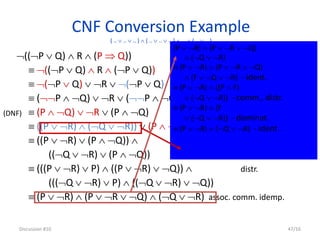
CNF Conversion Example
( ..  ..  .. )  ( ..  ..  .. )  …  ( ..  .. )
((P  Q)  R  (P  Q))
 ((P  Q)  R  (P  Q)) impl.
 (P  Q)  R  (P  Q) deM.
 (P  Q)  R  (P  Q) deM.
 (P  Q)  R  (P  Q) double neg.
 ((P  R)  (Q  R))  (P  Q) distr.
 ((P  R)  (P  Q))  distr.
((Q  R)  (P  Q))
 (((P  R)  P)  ((P  R)  Q))  distr.
(((Q  R)  P)  ((Q  R)  Q))
 (P  R)  (P  R  Q)  (Q  R) assoc. comm. idemp.
Discussion #10 46/16
(DNF)
CNF
Using the commutative and idempotent
laws on the previous step and then the
distributive law, we obtain this formula
as the conjunctive normal form.
CNF Conversion Example
( ..  ..  .. )  ( ..  ..  .. )  …  ( ..  .. )
((P  Q)  R  (P  Q))
 ((P  Q)  R  (P  Q)) impl.
 (P  Q)  R  (P  Q) deM.
 (P  Q)  R  (P  Q) deM.
 (P  Q)  R  (P  Q) double neg.
 ((P  R)  (Q  R))  (P  Q) distr.
 ((P  R)  (P  Q))  distr.
((Q  R)  (P  Q))
 (((P  R)  P)  ((P  R)  Q))  distr.
(((Q  R)  P)  ((Q  R)  Q))
 (P  R)  (P  R  Q)  (Q  R) assoc. comm. idemp.
Discussion #10 47/16
(DNF)
(P  R)  (P  R  Q)
 (Q  R)
 (P  R)  (P  R  Q)
 (F  Q  R) - ident.
 (P  R)  ((P  F)
 (Q  R)) - comm., distr.
 (P  R)  (F
 (Q  R)) - dominat.
 (P  R)  (Q  R) - ident.
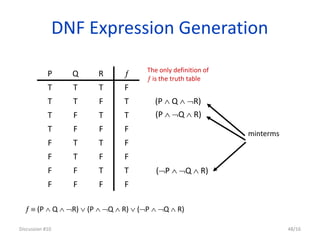
DNF Expression Generation
Discussion #10 48/16
F
T
F
F
F
T
T
F
F
F
F
T
F
F
F
T
F
T
T
F
F
F
T
T
F
T
F
T
T
T
T
T

R
Q
P
(P  Q  R)
(P  Q  R)
(P  Q  R)
  (P  Q  R)  (P  Q  R)  (P  Q  R)
minterms
The only definition of
 is the truth table
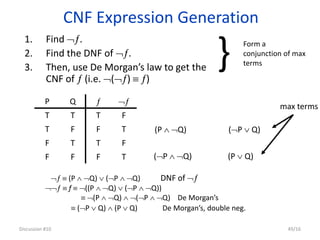
CNF Expression Generation
1. Find .
2. Find the DNF of .
3. Then, use De Morgan’s law to get the
CNF of  (i.e. ()  )
Discussion #10 49/16
T
F
T
F

F
F
F
T
T
F
F
F
T
T
T
T

Q
P
(P  Q) (P  Q)
(P  Q) (P  Q)
  (P  Q)  (P  Q) DNF of 
  f  ((P  Q)  (P  Q))
 (P  Q)  (P  Q) De Morgan’s
 (P  Q)  (P  Q) De Morgan’s, double neg.
max terms
} Form a
conjunction of max
terms
: Predicates
Predicate logic
Free and bound variables
Rules of Inference
Consistency
Proof of Contradiction
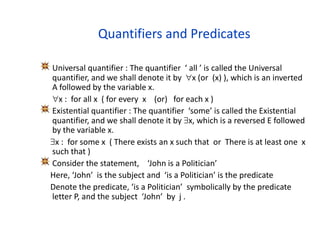
Quantifiers and Predicates
Universal quantifier : The quantifier ‘ all ’ is called the Universal
quantifier, and we shall denote it by x (or (x) ), which is an inverted
A followed by the variable x.
x : for all x ( for every x (or) for each x )
Existential quantifier : The quantifier ‘some’ is called the Existential
quantifier, and we shall denote it by x, which is a reversed E followed
by the variable x.
x : for some x ( There exists an x such that or There is at least one x
such that )
Consider the statement, ‘John is a Politician’
Here, ‘John’ is the subject and ‘is a Politician’ is the predicate
Denote the predicate, ‘is a Politician’ symbolically by the predicate
letter P, and the subject ‘John’ by j .
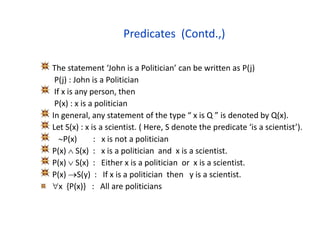
Predicates (Contd.,)
The statement ‘John is a Politician’ can be written as P(j)
P(j) : John is a Politician
If x is any person, then
P(x) : x is a politician
In general, any statement of the type “ x is Q ” is denoted by Q(x).
Let S(x) : x is a scientist. ( Here, S denote the predicate ‘is a scientist’).
P(x) : x is not a politician
P(x)  S(x) : x is a politician and x is a scientist.
P(x)  S(x) : Either x is a politician or x is a scientist.
P(x) S(y) : If x is a politician then y is a scientist.
x {P(x)} : All are politicians
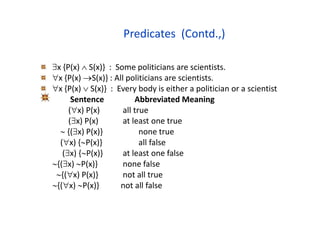
Predicates (Contd.,)
x {P(x)  S(x)} : Some politicians are scientists.
x {P(x) S(x)} : All politicians are scientists.
x {P(x)  S(x)} : Every body is either a politician or a scientist
Sentence Abbreviated Meaning
(x) P(x) all true
(x) P(x) at least one true
 {(x) P(x)} none true
(x) {P(x)} all false
(x) {P(x)} at least one false
{(x) P(x)} none false
{(x) P(x)} not all true
{(x) P(x)} not all false
Some Equivalences and Negations
(x) P(x)  {(x) P(x)}
(x) {P(x)}   {( x) P(x)}
 {(x) P(x)}  {(x)P(x)}
 {(x) ~P(x)}  (x) P(x)
Statement Negation
(x) P(x) (x) [P(x)]
(x) [~P(x)] (x) P(x)
(x) [P(x)] (x) P(x)
(x) P(x) (x) [P(x)]
To form the negation of a statement involving one quantifier,we need
only change the quantifier from universal to existential, or from
existential to Universal, and negate the statement it quantifies.
Sentences with Multiple quantifiers
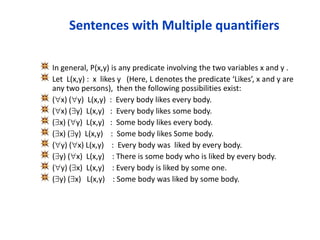
In general, P(x,y) is any predicate involving the two variables x and y .
Let L(x,y) : x likes y (Here, L denotes the predicate ‘Likes’, x and y are
any two persons), then the following possibilities exist:
(x) (y) L(x,y) : Every body likes every body.
(x) (y) L(x,y) : Every body likes some body.
(x) (y) L(x,y) : Some body likes every body.
(x) (y) L(x,y) : Some body likes Some body.
(y) (x) L(x,y) : Every body was liked by every body.
(y) (x) L(x,y) : There is some body who is liked by every body.
(y) (x) L(x,y) : Every body is liked by some one.
(y) (x) L(x,y) : Some body was liked by some body.
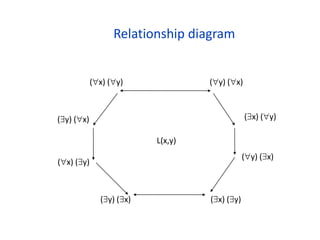
Relationship diagram
(x) (y) (y) (x)
(y) (x) (x) (y)
(x) (y)
(y) (x)
(x) (y)
(y) (x)
L(x,y)
Rules of Inference for Quantified Propositions
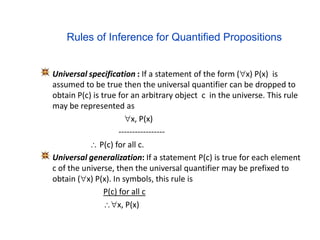
Universal specification : If a statement of the form (x) P(x) is
assumed to be true then the universal quantifier can be dropped to
obtain P(c) is true for an arbitrary object c in the universe. This rule
may be represented as
x, P(x)
-----------------
 P(c) for all c.
Universal generalization: If a statement P(c) is true for each element
c of the universe, then the universal quantifier may be prefixed to
obtain (x) P(x). In symbols, this rule is
P(c) for all c
x, P(x)
Rules of Inference for Quantified Propositions (Contd.,)
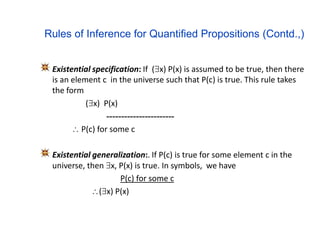
Existential specification: If (x) P(x) is assumed to be true, then there
is an element c in the universe such that P(c) is true. This rule takes
the form
(x) P(x)
-----------------------
 P(c) for some c
Existential generalization:. If P(c) is true for some element c in the
universe, then x, P(x) is true. In symbols, we have
P(c) for some c
(x) P(x)
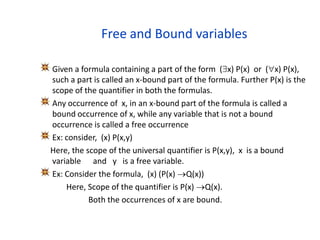
Free and Bound variables
Given a formula containing a part of the form (x) P(x) or (x) P(x),
such a part is called an x-bound part of the formula. Further P(x) is the
scope of the quantifier in both the formulas.
Any occurrence of x, in an x-bound part of the formula is called a
bound occurrence of x, while any variable that is not a bound
occurrence is called a free occurrence
Ex: consider, (x) P(x,y)
Here, the scope of the universal quantifier is P(x,y), x is a bound
variable and y is a free variable.
Ex: Consider the formula, (x) (P(x) Q(x))
Here, Scope of the quantifier is P(x) Q(x).
Both the occurrences of x are bound.
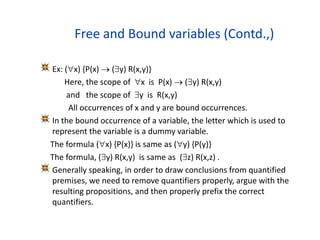
Free and Bound variables (Contd.,)
Ex: (x) {P(x)  (y) R(x,y)}
Here, the scope of x is P(x)  (y) R(x,y)
and the scope of y is R(x,y)
All occurrences of x and y are bound occurrences.
In the bound occurrence of a variable, the letter which is used to
represent the variable is a dummy variable.
The formula (x) {P(x)} is same as (y) {P(y)}
The formula, (y) R(x,y) is same as (z) R(x,z) .
Generally speaking, in order to draw conclusions from quantified
premises, we need to remove quantifiers properly, argue with the
resulting propositions, and then properly prefix the correct
quantifiers.
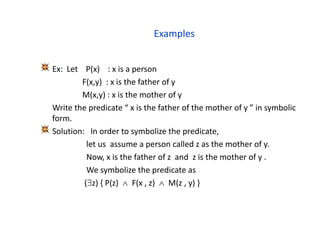
Examples
Ex: Let P(x) : x is a person
F(x,y) : x is the father of y
M(x,y) : x is the mother of y
Write the predicate “ x is the father of the mother of y ” in symbolic
form.
Solution: In order to symbolize the predicate,
let us assume a person called z as the mother of y.
Now, x is the father of z and z is the mother of y .
We symbolize the predicate as
(z) { P(z)  F(x , z)  M(z , y) }
Ex: Symbolize the expression “All the world loves a lover”
Solution: First, let us note that the quotation really means that every
body loves a lover.
Now let P(x) : x is a person
L(x) : x is a lover
Q(x , y) : x loves y
The required expression is
(x) [P(x)  (y){P(y)  L(y) Q(x , y)}]
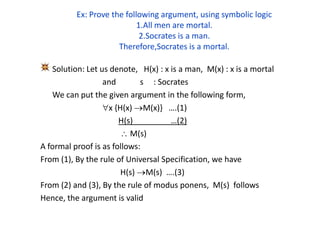
Ex: Prove the following argument, using symbolic logic
1.All men are mortal.
2.Socrates is a man.
Therefore,Socrates is a mortal.
Solution: Let us denote, H(x) : x is a man, M(x) : x is a mortal
and s : Socrates
We can put the given argument in the following form,
x {H(x) M(x)} ….(1)
H(s) …(2)
 M(s)
A formal proof is as follows:
From (1), By the rule of Universal Specification, we have
H(s) M(s) ….(3)
From (2) and (3), By the rule of modus ponens, M(s) follows
Hence, the argument is valid
Ex: Prove the following argument, using symbolic logic.
All men are fallible.
All kings are men.
Therefore, all kings are fallible.
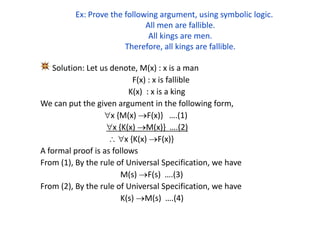
Solution: Let us denote, M(x) : x is a man
F(x) : x is fallible
K(x) : x is a king
We can put the given argument in the following form,
x {M(x) F(x)} ….(1)
x {K(x) M(x)} ….(2)
 x {K(x) F(x)}
A formal proof is as follows
From (1), By the rule of Universal Specification, we have
M(s) F(s) ….(3)
From (2), By the rule of Universal Specification, we have
K(s) M(s) ….(4)
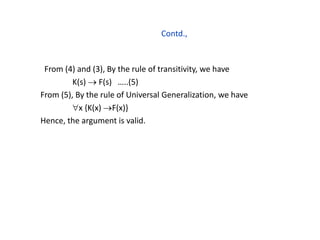
Contd.,
From (4) and (3), By the rule of transitivity, we have
K(s)  F(s) …..(5)
From (5), By the rule of Universal Generalization, we have
x {K(x) F(x)}
Hence, the argument is valid.
Ex: Symbolize the following argument and check for its validity:
All lions are dangerous animals
There are lions
Therefore, there are dangerous animals.
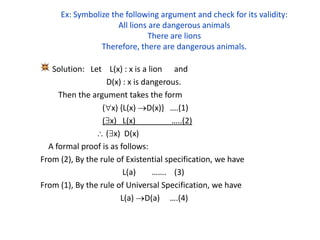
Solution: Let L(x) : x is a lion and
D(x) : x is dangerous.
Then the argument takes the form
(x) {L(x) D(x)} ….(1)
(x) L(x) …..(2)
 (x) D(x)
A formal proof is as follows:
From (2), By the rule of Existential specification, we have
L(a) ……. (3)
From (1), By the rule of Universal Specification, we have
L(a) D(a) ….(4)
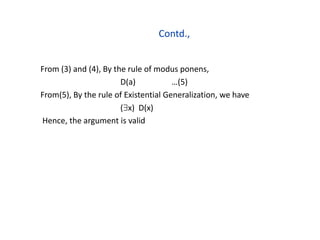
Contd.,
From (3) and (4), By the rule of modus ponens,
D(a) …(5)
From(5), By the rule of Existential Generalization, we have
(x) D(x)
Hence, the argument is valid
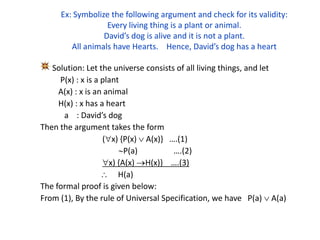
Ex: Symbolize the following argument and check for its validity:
Every living thing is a plant or animal.
David’s dog is alive and it is not a plant.
All animals have Hearts. Hence, David’s dog has a heart
Solution: Let the universe consists of all living things, and let
P(x) : x is a plant
A(x) : x is an animal
H(x) : x has a heart
a : David’s dog
Then the argument takes the form
(x) {P(x)  A(x)} ….(1)
P(a) ….(2)
x) {A(x) H(x)} ….(3)
 H(a)
The formal proof is given below:
From (1), By the rule of Universal Specification, we have P(a)  A(a)
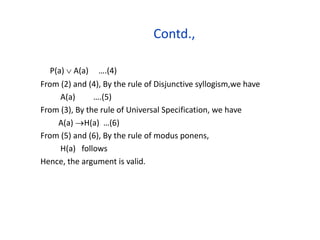
Contd.,
P(a)  A(a) ….(4)
From (2) and (4), By the rule of Disjunctive syllogism,we have
A(a) ….(5)
From (3), By the rule of Universal Specification, we have
A(a) H(a) …(6)
From (5) and (6), By the rule of modus ponens,
H(a) follows
Hence, the argument is valid.
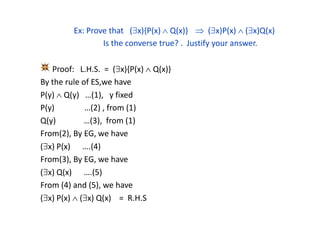
Ex: Prove that (x){P(x)  Q(x)}  (x)P(x)  (x)Q(x)
Is the converse true? . Justify your answer.
Proof: L.H.S. = (x){P(x)  Q(x)}
By the rule of ES,we have
P(y)  Q(y) …(1), y fixed
P(y) …(2) , from (1)
Q(y) …(3), from (1)
From(2), By EG, we have
(x) P(x) ….(4)
From(3), By EG, we have
(x) Q(x) ….(5)
From (4) and (5), we have
(x) P(x)  (x) Q(x) = R.H.S
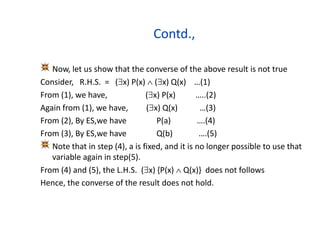
Contd.,
Now, let us show that the converse of the above result is not true
Consider, R.H.S. = (x) P(x)  (x) Q(x) …(1)
From (1), we have, (x) P(x) …..(2)
Again from (1), we have, (x) Q(x) …(3)
From (2), By ES,we have P(a) ….(4)
From (3), By ES,we have Q(b) ….(5)
Note that in step (4), a is fixed, and it is no longer possible to use that
variable again in step(5).
From (4) and (5), the L.H.S. (x) {P(x)  Q(x)} does not follows
Hence, the converse of the result does not hold.
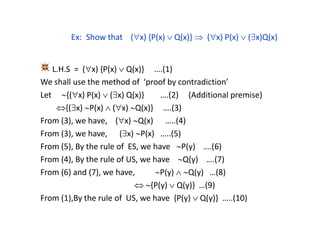
Ex: Show that (x) {P(x)  Q(x)}  (x) P(x)  (x)Q(x)
L.H.S = (x) {P(x)  Q(x)} ….(1)
We shall use the method of ‘proof by contradiction’
Let {(x) P(x)  (x) Q(x)} ….(2) (Additional premise)
{(x) P(x)  (x) Q(x)} ….(3)
From (3), we have, (x) Q(x) …..(4)
From (3), we have, (x) P(x) …..(5)
From (5), By the rule of ES, we have P(y) ….(6)
From (4), By the rule of US, we have Q(y) ….(7)
From (6) and (7), we have, P(y)  Q(y) …(8)
 {P(y)  Q(y)} …(9)
From (1),By the rule of US, we have {P(y)  Q(y)} …..(10)
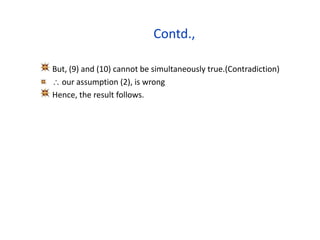
Contd.,
But, (9) and (10) cannot be simultaneously true.(Contradiction)
 our assumption (2), is wrong
Hence, the result follows.
Ex: Show that from
(a) (x) {F(x) S(x)}  (y){M(y)  W(y)}
(b) (y) {M(y )  W(y)}
the conclusion, (x) {F(x)  S(x)} follows
Proof: Given premises are
(x) {F(x) S(x)}  (y){M(y)  W(y)} ……(1)
(y) {M(y )  W(y)} …..(2)
(2)  [(y) {M(y )  W(y)}] …(3)
 [(y) {M(y ) W(y)}] …(4)
From (1) and (4), By Modus tollens, we have
[(x) {F(x)  S(x)}] ….(5)
 [(x) {F(x) )  S(x)}] ….(6)
 [(x) {F(x))  S(x)}] ….(7)
The conclusion logically follows from the premises.
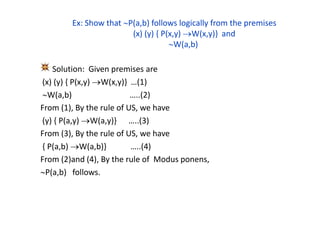
Ex: Show that P(a,b) follows logically from the premises
(x) (y) { P(x,y) W(x,y)} and
W(a,b)
Solution: Given premises are
(x) (y) { P(x,y) W(x,y)} …(1)
W(a,b) …..(2)
From (1), By the rule of US, we have
(y) { P(a,y) W(a,y)} …..(3)
From (3), By the rule of US, we have
{ P(a,b) W(a,b)} …..(4)
From (2)and (4), By the rule of Modus ponens,
P(a,b) follows.
Ex: Consider the statement ‘Given any positive integer, there is a greater positive
integer’. Symbolize the statement with and without using the set of positive
integers as the universe of discourse.
Case1: Let x and y are are restricted to set of positive integers.
The above statement can be written as
‘For all x, there exists a ‘y’ such that y is greater than x’
If G(x,y) is ‘x greater than y’
Then the given statement in symbolic form is (x) (y) G(y,x)
Case 2: If we do not impose the restriction on the universe of discourse
and if we write I(x) : x is an integer,
then we can symbolize the given statement as
(x) [ I(x) (y) { I(y)  G(y , x)} ]
Ex: prove the following argument
(1) (x) {P(x)  Q(x)}
(2) (x) [{P(x)  Q(x)}R(x)]
 (x) {R(x) P(x)}
Proof: From (1), By the rule of US, we have
P(c)  Q(c) ….(3)
From (2), By the rule of US, we have
{P(c)  Q(c)}  R(c) ..…(4)
From (4), By contra positive equivalence, we have
R(c)  {P(c)  Q(c)} ……(5)
Let R(c) ……………(6) (Additional premise)
From (5) and (6), By the rule of modus ponens, we have
P(c)  Q(c) ……………(7)
From (3) and (7), we have
{P(c)  Q( c )}  {P(c)  Q(c)}
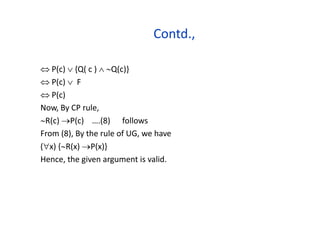
Contd.,
 P(c)  {Q( c )  Q(c)}
 P(c)  F
 P(c)
Now, By CP rule,
R(c) P(c) ….(8) follows
From (8), By the rule of UG, we have
(x) {R(x) P(x)}
Hence, the given argument is valid.
Example:
Ex: Let L(x,y) denote the statement ‘x likes y’, where the
universe of discourse for both x and y is the set of all
people in the world.
Consider the statement
“ There is somebody whom no one likes”
Write the Statement in symbolic form.
Solution:
(y) (x) [ ~L(x , y)} ]
Ex: Show that the negation of the sentence
(x) [{C(x)  B(x)}  A(x)}] is
(x) {C(x)  B(x)  A(x)}
Consider, {(x) [{C(x)  B(x)}  A(x)}] }
 {(x) [{C(x)  B(x)}  A(x)}] }
( Since P Q  P Q)
 {(x) [C(x)   B(x)  A(x)] }
(By demorgan’s law)
 (x) {C(x)  B(x)  A(x)}
(By demorgan’s law)
Ex: Show that the negation of the sentence
(x) (y) [{F(x,y)  G(x,y)}  H(x,y)]
is (x) (y) { F(x,y)  G(x,y)  H(x,y)}
Consider {(x) (y) [{F(x,y)  G(x,y)}  H(x,y)] }
 {(x) (y) [{F(x,y)  G(x,y)}  H(x,y)] }
( Since, P Q  P Q )
 (x) (y) {F(x,y)  G(x,y)  H(x,y)}
(By demorgan’s law)
Ex: Show that
(x) {B(x)  I(x)}  [(x){B(x)  I(x)}]
Proof: L.H.S.  [(x) {B(x)  I(x)}]
(Since, P  P)
 [(x) {B(x)  I(x)}]
( Since, P Q  P Q )
 [(x){B(x)  I(x)}]
(By demorgan’s law)
Ex: Show that
(x) {N(x)  R(x)}  [(x) {N(x)  R(x)}]
Proof: L.H.S.   [(x) {N(x)  R(x)} ]
(Since, P  P)
  [(x) {N(x)  R(x)}]
(By demorgan’s law)
  [(x) {N(x)  R(x)}]
( Since, P Q  P Q )
Some more Equivalences & Implications
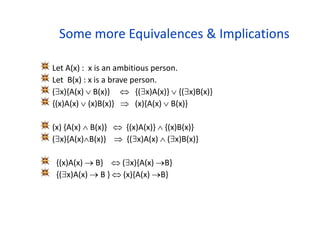
Let A(x) : x is an ambitious person.
Let B(x) : x is a brave person.
(x){A(x)  B(x)}  {(x)A(x)}  {(x)B(x)}
{(x)A(x)  (x)B(x)}  (x){A(x)  B(x)}
(x) {A(x)  B(x)}  {(x)A(x)}  {(x)B(x)}
(x){A(x)B(x)}  {(x)A(x)  (x)B(x)}
{(x)A(x)  B}  (x){A(x) B}
{(x)A(x)  B }  (x){A(x) B}
Automatic Theorem proving
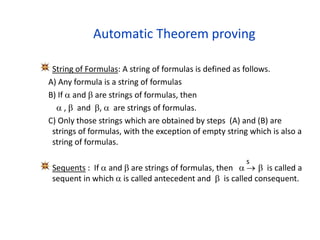
String of Formulas: A string of formulas is defined as follows.
A) Any formula is a string of formulas
B) If  and  are strings of formulas, then
 ,  and ,  are strings of formulas.
C) Only those strings which are obtained by steps (A) and (B) are
strings of formulas, with the exception of empty string which is also a
string of formulas.
Sequents : If  and  are strings of formulas, then    is called a
sequent in which  is called antecedent and  is called consequent.
s
Sequents (Contd.,)
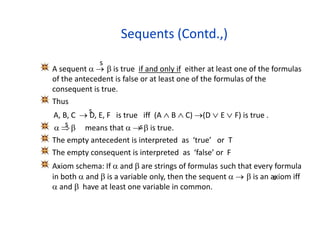
A sequent    is true if and only if either at least one of the formulas
of the antecedent is false or at least one of the formulas of the
consequent is true.
Thus
A, B, C  D, E, F is true iff (A  B  C) (D  E  F) is true .
   means that    is true.
The empty antecedent is interpreted as ‘true’ or T
The empty consequent is interpreted as ‘false’ or F
Axiom schema: If  and  are strings of formulas such that every formula
in both  and  is a variable only, then the sequent    is an axiom iff
 and  have at least one variable in common.
s
s
s s
s
Axioms –theorems -Rules
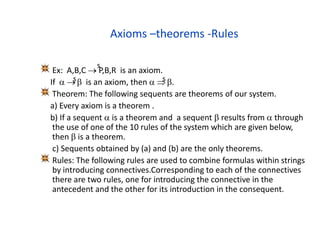
Ex: A,B,C  P,B,R is an axiom.
If   is an axiom, then   .
Theorem: The following sequents are theorems of our system.
a) Every axiom is a theorem .
b) If a sequent  is a theorem and a sequent  results from  through
the use of one of the 10 rules of the system which are given below,
then  is a theorem.
c) Sequents obtained by (a) and (b) are the only theorems.
Rules: The following rules are used to combine formulas within strings
by introducing connectives.Corresponding to each of the connectives
there are two rules, one for introducing the connective in the
antecedent and the other for its introduction in the consequent.
s s
s
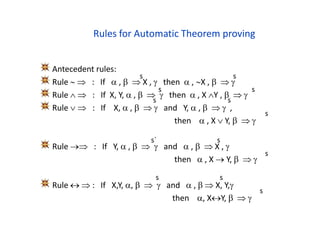
Rules for Automatic Theorem proving
Antecedent rules:
Rule   : If  ,   X ,  then  , X ,   
Rule   : If X, Y,  ,    then  , X Y ,   
Rule   : If X,  ,    and Y,  ,    ,
then  , X  Y,   
Rule  : If Y,  ,    and  ,   X , 
then  , X  Y,   
Rule   : If X,Y, ,    and  ,   X, Y,
then , XY,   
s s
s s
s s
s
s` s
s
s s
s
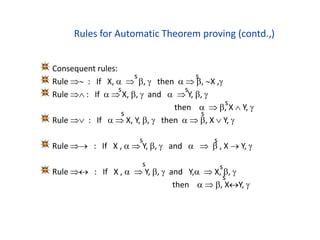
Rules for Automatic Theorem proving (contd.,)
Consequent rules:
Rule  : If X,   ,  then   , X ,
Rule  : If   X, ,  and   Y, , 
then   , X  Y, 
Rule  : If   X, Y, ,  then   , X  Y, 
Rule  : If X ,   Y, ,  and    , X  Y, 
Rule  : If X ,   Y, ,  and Y,  X, , 
then   , XY, 
s s
s s
s s
s
s s
s s
s
Examples
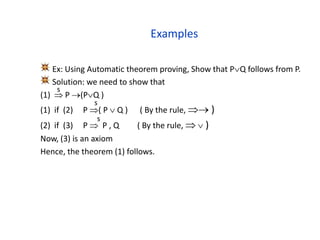
Ex: Using Automatic theorem proving, Show that PQ follows from P.
Solution: we need to show that
(1)  P (PQ )
(1) if (2) P ( P  Q ) ( By the rule,  )
(2) if (3) P  P , Q ( By the rule,   )
Now, (3) is an axiom
Hence, the theorem (1) follows.
s
s
s
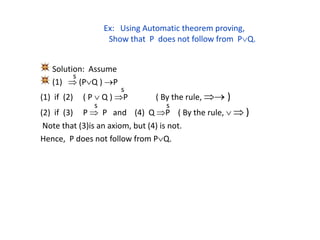
Ex: Using Automatic theorem proving,
Show that P does not follow from PQ.
Solution: Assume
(1)  (PQ ) P
(1) if (2) ( P  Q ) P ( By the rule,  )
(2) if (3) P  P and (4) Q P ( By the rule,   )
Note that (3)is an axiom, but (4) is not.
Hence, P does not follow from PQ.
s
s
s s
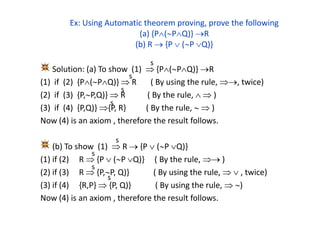
Ex: Using Automatic theorem proving, prove the following
(a) {P(PQ)} R
(b) R  {P  (P Q)}
Solution: (a) To show (1)  {P(PQ)} R
(1) if (2) {P(PQ)}  R ( By using the rule, , twice)
(2) if (3) {P,P,Q)}  R ( By the rule,   )
(3) if (4) {P,Q)} {P, R} ( By the rule,   )
Now (4) is an axiom , therefore the result follows.
(b) To show (1)  R  {P  (P Q)}
(1) if (2) R  {P  (P Q)} ( By the rule,  )
(2) if (3) R  {P,P, Q)} ( By using the rule,   , twice)
(3) if (4) {R,P}  {P, Q)} ( By using the rule,  )
Now (4) is an axiom , therefore the result follows.
s
s
s
s
s
s
s
s
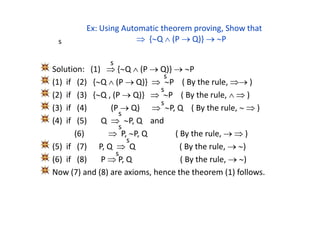
Ex: Using Automatic theorem proving, Show that
 {Q  (P  Q)}  P
Solution: (1)  {Q  (P  Q)}  P
(1) if (2) {Q  (P  Q)}  P ( By the rule,  )
(2) if (3) {Q , (P  Q)}  P ( By the rule,   )
(3) if (4) (P  Q)  P, Q ( By the rule,   )
(4) if (5) Q  P, Q and
(6)  P, P, Q ( By the rule,   )
(5) if (7) P, Q  Q ( By the rule,  )
(6) if (8) P  P, Q ( By the rule,  )
Now (7) and (8) are axioms, hence the theorem (1) follows.
s
s
s
s
s
s
s
s
s
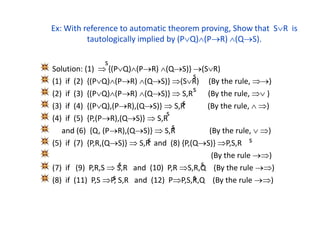
Ex: With reference to automatic theorem proving, Show that SR is
tautologically implied by (PQ)(PR) (QS).
Solution: (1)  {(PQ)(PR) (QS)} (SR)
(1) if (2) {(PQ)(PR) (QS)} (SR) (By the rule, )
(2) if (3) {(PQ)(PR) (QS)}  S,R (By the rule,  )
(3) if (4) {(PQ),(PR),(QS)}  S,R (By the rule,  )
(4) if (5) {P,(PR),(QS)}  S,R
and (6) {Q, (PR),(QS)}  S,R (By the rule,  )
(5) if (7) {P,R,(QS)}  S,R and (8) {P,(QS)} P,S,R
(By the rule )
(7) if (9) P,R,S  S,R and (10) P,R S,R,Q (By the rule )
(8) if (11) P,S P, S,R and (12) PP,S,R,Q (By the rule )
s
s
s
s
s
s
s s
s
s
s s
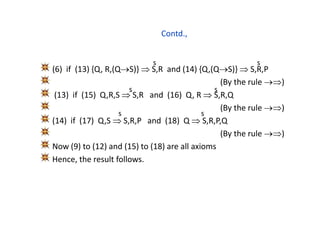
Contd.,
(6) if (13) {Q, R,(QS)}  S,R and (14) {Q,(QS)}  S,R,P
(By the rule )
(13) if (15) Q,R,S  S,R and (16) Q, R  S,R,Q
(By the rule )
(14) if (17) Q,S  S,R,P and (18) Q  S,R,P,Q
(By the rule )
Now (9) to (12) and (15) to (18) are all axioms
Hence, the result follows.
s s
s s
s s
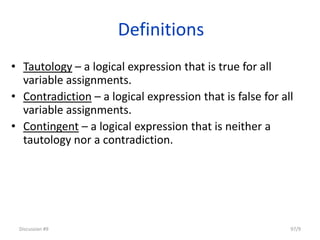
Definitions
• Tautology – a logical expression that is true for all
variable assignments.
• Contradiction – a logical expression that is false for all
variable assignments.
• Contingent – a logical expression that is neither a
tautology nor a contradiction.
Discussion #9 97/9
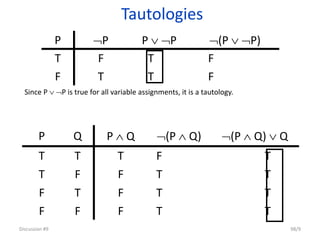
Tautologies
Discussion #9 98/9
F
F
T
T
T
F
F
T
(P  P)
P  P
P
P
T
T
T
T
T
T
T
F
F
F
F
T
F
F
T
F
F
T
T
T
(P  Q)  Q
(P  Q)
P  Q
Q
P
Since P  P is true for all variable assignments, it is a tautology.
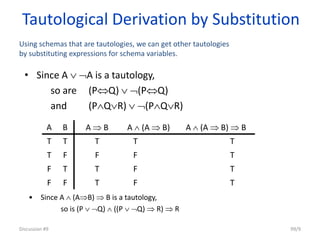
Tautological Derivation by Substitution
• Since A  A is a tautology,
so are (PQ)  (PQ)
and (PQR)  (PQR)
Discussion #9 99/9
T
T
T
T
F
F
F
T
T
T
F
T
F
F
T
F
F
T
T
T
A  (A  B)  B
A  (A  B)
A  B
B
A
• Since A  (AB)  B is a tautology,
so is (P  Q)  ((P  Q)  R)  R
Using schemas that are tautologies, we can get other tautologies
by substituting expressions for schema variables.
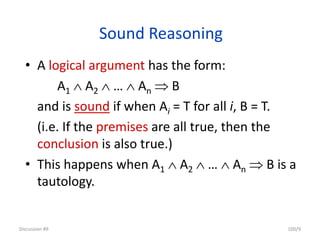
Sound Reasoning
• A logical argument has the form:
A1  A2  …  An  B
and is sound if when Ai = T for all i, B = T.
(i.e. If the premises are all true, then the
conclusion is also true.)
• This happens when A1  A2  …  An  B is a
tautology.
Discussion #9 100/9
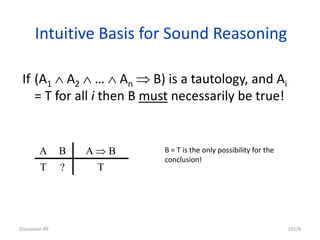
Intuitive Basis for Sound Reasoning
If (A1  A2  …  An  B) is a tautology, and Ai
= T for all i then B must necessarily be true!
Discussion #9 101/9
A B A  B
T ? T
B = T is the only possibility for the
conclusion!
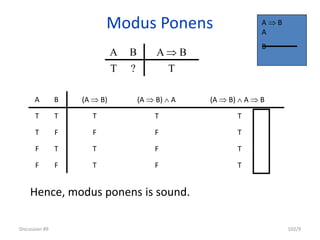
Modus Ponens
Discussion #9 102/9
T
T
T
T
F
F
F
T
T
T
F
T
F
F
T
F
F
T
T
T
(A  B)  A  B
(A  B)  A
(A  B)
B
A
A B A  B
T ? T
Hence, modus ponens is sound.
A  B
A
B
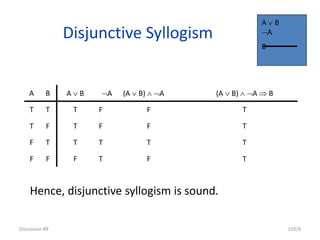
Disjunctive Syllogism
Discussion #9 103/9
T
T
F
F
T
T
T
T
F
T
F
F
F
T
T
T
A
F
F
T
F
F
T
T
T
(A  B)  A  B
(A  B)  A
A  B
B
A
Hence, disjunctive syllogism is sound.
A  B
A
B
Fall 2002 CMSC 203 - Discrete Structures 105
You Never Escape Your…
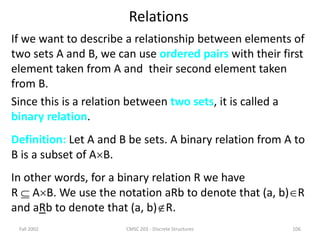
Relations
Fall 2002 CMSC 203 - Discrete Structures 106
Relations
If we want to describe a relationship between elements of
two sets A and B, we can use ordered pairs with their first
element taken from A and their second element taken
from B.
Since this is a relation between two sets, it is called a
binary relation.
Definition: Let A and B be sets. A binary relation from A to
B is a subset of AB.
In other words, for a binary relation R we have
R  AB. We use the notation aRb to denote that (a, b)R
and aRb to denote that (a, b)R.
Fall 2002 CMSC 203 - Discrete Structures 107
Relations
When (a, b) belongs to R, a is said to be related to b by R.
Example: Let P be a set of people, C be a set of cars, and D
be the relation describing which person drives which car(s).
P = {Carl, Suzanne, Peter, Carla},
C = {Mercedes, BMW, tricycle}
D = {(Carl, Mercedes), (Suzanne, Mercedes),
(Suzanne, BMW), (Peter, tricycle)}
This means that Carl drives a Mercedes, Suzanne drives a
Mercedes and a BMW, Peter drives a tricycle, and Carla
does not drive any of these vehicles.
Fall 2002 CMSC 203 - Discrete Structures 108
Functions as Relations
You might remember that a function f from a set A to a set
B assigns a unique element of B to each element of A.
The graph of f is the set of ordered pairs (a, b) such that b =
f(a).
Since the graph of f is a subset of AB, it is a relation from
A to B.
Moreover, for each element a of A, there is exactly one
ordered pair in the graph that has a as its first element.
Fall 2002 CMSC 203 - Discrete Structures 109
Functions as Relations
Conversely, if R is a relation from A to B such that every
element in A is the first element of exactly one ordered
pair of R, then a function can be defined with R as its
graph.
This is done by assigning to an element aA the unique
element bB such that (a, b)R.
Fall 2002 CMSC 203 - Discrete Structures 110
Relations on a Set
Definition: A relation on the set A is a relation from A to A.
In other words, a relation on the set A is a subset of AA.
Example: Let A = {1, 2, 3, 4}. Which ordered pairs are in the
relation R = {(a, b) | a < b} ?
Fall 2002 CMSC 203 - Discrete Structures 111
Relations on a Set
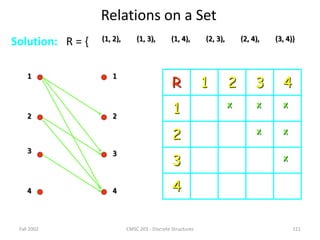
Solution: R = { (1, 2), (1, 3), (1, 4), (2, 3), (2, 4), (3, 4)}
R 1 2 3 4
1
2
3
4
1 1
2
3
4
2
3
4
X X X
X X
X
Fall 2002 CMSC 203 - Discrete Structures 112
Relations on a Set
How many different relations can we define on a set A
with n elements?
A relation on a set A is a subset of AA.
How many elements are in AA ?
There are n2 elements in AA, so how many subsets (=
relations on A) does AA have?
The number of subsets that we can form out of a set with
m elements is 2m. Therefore, 2n2
subsets can be formed
out of AA.
Answer: We can define 2n2
different relations
on A.
Fall 2002 CMSC 203 - Discrete Structures 113
Properties of Relations
We will now look at some useful ways to classify relations.
Definition: A relation R on a set A is called reflexive if (a,
a)R for every element aA.
Are the following relations on {1, 2, 3, 4} reflexive?
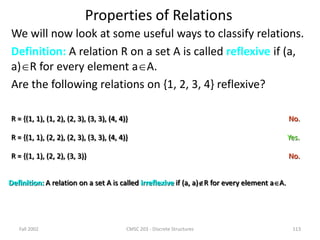
R = {(1, 1), (1, 2), (2, 3), (3, 3), (4, 4)} No.
R = {(1, 1), (2, 2), (2, 3), (3, 3), (4, 4)} Yes.
R = {(1, 1), (2, 2), (3, 3)} No.
Definition: A relation on a set A is called irreflexive if (a, a)R for every element aA.
Fall 2002 CMSC 203 - Discrete Structures 114
Properties of Relations
Definitions:
A relation R on a set A is called symmetric if (b, a)R
whenever (a, b)R for all a, bA.
A relation R on a set A is called antisymmetric if
a = b whenever (a, b)R and (b, a)R.
A relation R on a set A is called asymmetric if
(a, b)R implies that (b, a)R for all a, bA.
Fall 2002 CMSC 203 - Discrete Structures 115
Properties of Relations
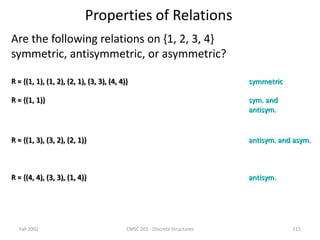
Are the following relations on {1, 2, 3, 4}
symmetric, antisymmetric, or asymmetric?
R = {(1, 1), (1, 2), (2, 1), (3, 3), (4, 4)} symmetric
R = {(1, 1)} sym. and
antisym.
R = {(1, 3), (3, 2), (2, 1)} antisym. and asym.
R = {(4, 4), (3, 3), (1, 4)} antisym.
Fall 2002 CMSC 203 - Discrete Structures 116
Properties of Relations
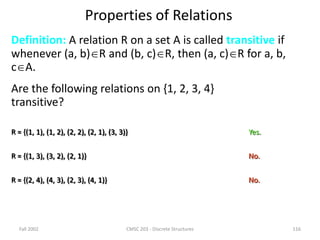
Definition: A relation R on a set A is called transitive if
whenever (a, b)R and (b, c)R, then (a, c)R for a, b,
cA.
Are the following relations on {1, 2, 3, 4}
transitive?
R = {(1, 1), (1, 2), (2, 2), (2, 1), (3, 3)} Yes.
R = {(1, 3), (3, 2), (2, 1)} No.
R = {(2, 4), (4, 3), (2, 3), (4, 1)} No.
Fall 2002 CMSC 203 - Discrete Structures 117
Counting Relations
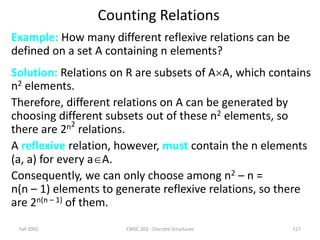
Example: How many different reflexive relations can be
defined on a set A containing n elements?
Solution: Relations on R are subsets of AA, which contains
n2 elements.
Therefore, different relations on A can be generated by
choosing different subsets out of these n2 elements, so
there are 2n2
relations.
A reflexive relation, however, must contain the n elements
(a, a) for every aA.
Consequently, we can only choose among n2 – n =
n(n – 1) elements to generate reflexive relations, so there
are 2n(n – 1) of them.
Fall 2002 CMSC 203 - Discrete Structures 118
Combining Relations
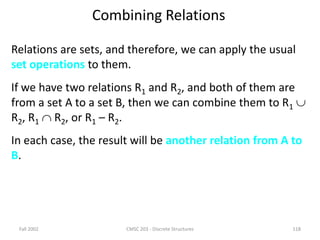
Relations are sets, and therefore, we can apply the usual
set operations to them.
If we have two relations R1 and R2, and both of them are
from a set A to a set B, then we can combine them to R1 
R2, R1  R2, or R1 – R2.
In each case, the result will be another relation from A to
B.
Fall 2002 CMSC 203 - Discrete Structures 119
Combining Relations
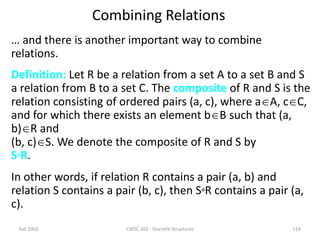
… and there is another important way to combine
relations.
Definition: Let R be a relation from a set A to a set B and S
a relation from B to a set C. The composite of R and S is the
relation consisting of ordered pairs (a, c), where aA, cC,
and for which there exists an element bB such that (a,
b)R and
(b, c)S. We denote the composite of R and S by
SR.
In other words, if relation R contains a pair (a, b) and
relation S contains a pair (b, c), then SR contains a pair (a,
c).
Fall 2002 CMSC 203 - Discrete Structures 120
Combining Relations
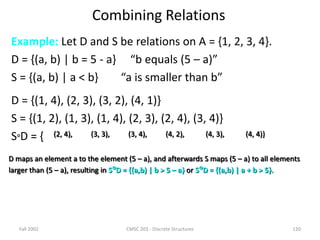
Example: Let D and S be relations on A = {1, 2, 3, 4}.
D = {(a, b) | b = 5 - a} “b equals (5 – a)”
S = {(a, b) | a < b} “a is smaller than b”
D = {(1, 4), (2, 3), (3, 2), (4, 1)}
S = {(1, 2), (1, 3), (1, 4), (2, 3), (2, 4), (3, 4)}
SD = { (2, 4), (3, 3), (3, 4), (4, 2), (4, 3),
D maps an element a to the element (5 – a), and afterwards S maps (5 – a) to all elements
larger than (5 – a), resulting in SD = {(a,b) | b > 5 – a} or SD = {(a,b) | a + b > 5}.
(4, 4)}
Fall 2002 CMSC 203 - Discrete Structures 121
Combining Relations
We already know that functions are just special cases of
relations (namely those that map each element in the
domain onto exactly one element in the codomain).
If we formally convert two functions into relations, that is,
write them down as sets of ordered pairs, the composite of
these relations will be exactly the same as the composite of
the functions (as defined earlier).
Fall 2002 CMSC 203 - Discrete Structures 122
Combining Relations
Definition: Let R be a relation on the set A. The powers Rn,
n = 1, 2, 3, …, are defined inductively by
R1 = R
Rn+1 = RnR
In other words:
Rn = RR … R (n times the letter R)
Fall 2002 CMSC 203 - Discrete Structures 123
Combining Relations
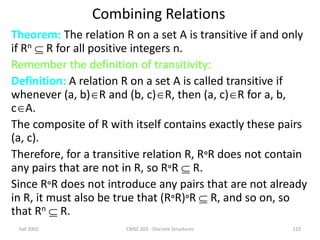
Theorem: The relation R on a set A is transitive if and only
if Rn  R for all positive integers n.
Remember the definition of transitivity:
Definition: A relation R on a set A is called transitive if
whenever (a, b)R and (b, c)R, then (a, c)R for a, b,
cA.
The composite of R with itself contains exactly these pairs
(a, c).
Therefore, for a transitive relation R, RR does not contain
any pairs that are not in R, so RR  R.
Since RR does not introduce any pairs that are not already
in R, it must also be true that (RR)R  R, and so on, so
that Rn  R.
Fall 2002 CMSC 203 - Discrete Structures 124
n-ary Relations
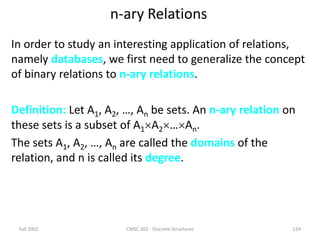
In order to study an interesting application of relations,
namely databases, we first need to generalize the concept
of binary relations to n-ary relations.
Definition: Let A1, A2, …, An be sets. An n-ary relation on
these sets is a subset of A1A2…An.
The sets A1, A2, …, An are called the domains of the
relation, and n is called its degree.
Fall 2002 CMSC 203 - Discrete Structures 125
n-ary Relations
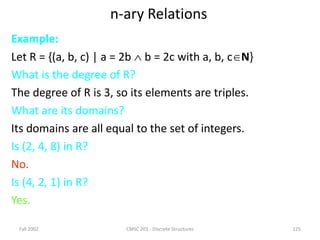
Example:
Let R = {(a, b, c) | a = 2b  b = 2c with a, b, cN}
What is the degree of R?
The degree of R is 3, so its elements are triples.
What are its domains?
Its domains are all equal to the set of integers.
Is (2, 4, 8) in R?
No.
Is (4, 2, 1) in R?
Yes.
Fall 2002 CMSC 203 - Discrete Structures 126
Representing Relations
We already know different ways of representing relations.
We will now take a closer look at two ways of
representation: Zero-one matrices and directed graphs.
If R is a relation from A = {a1, a2, …, am} to B =
{b1, b2, …, bn}, then R can be represented by the zero-one
matrix MR = [mij] with
mij = 1, if (ai, bj)R, and
mij = 0, if (ai, bj)R.
Note that for creating this matrix we first need to list the
elements in A and B in a particular, but arbitrary order.
Fall 2002 CMSC 203 - Discrete Structures 127
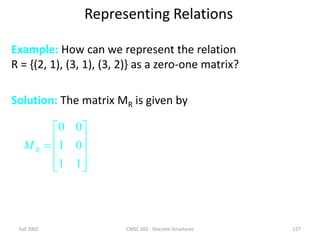
Representing Relations
Example: How can we represent the relation
R = {(2, 1), (3, 1), (3, 2)} as a zero-one matrix?
Solution: The matrix MR is given by











1
1
0
1
0
0
R
M
Fall 2002 CMSC 203 - Discrete Structures 128
Representing Relations
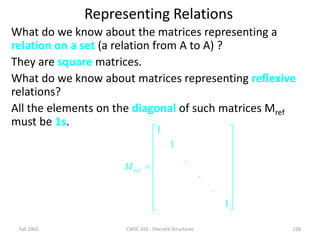
What do we know about the matrices representing a
relation on a set (a relation from A to A) ?
They are square matrices.
What do we know about matrices representing reflexive
relations?
All the elements on the diagonal of such matrices Mref
must be 1s.





















1
.
.
.
1
1
ref
M
Fall 2002 CMSC 203 - Discrete Structures 129
Representing Relations
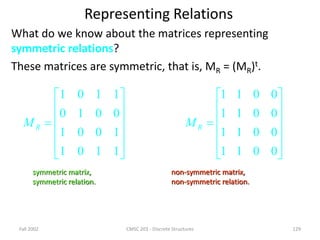
What do we know about the matrices representing
symmetric relations?
These matrices are symmetric, that is, MR = (MR)t.













1
1
0
1
1
0
0
1
0
0
1
0
1
1
0
1
R
M
symmetric matrix,
symmetric relation.













0
0
1
1
0
0
1
1
0
0
1
1
0
0
1
1
R
M
non-symmetric matrix,
non-symmetric relation.
Fall 2002 CMSC 203 - Discrete Structures 130
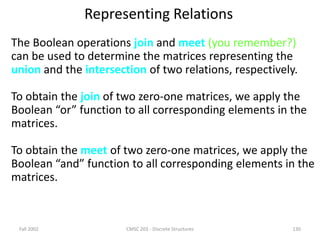
Representing Relations
The Boolean operations join and meet (you remember?)
can be used to determine the matrices representing the
union and the intersection of two relations, respectively.
To obtain the join of two zero-one matrices, we apply the
Boolean “or” function to all corresponding elements in the
matrices.
To obtain the meet of two zero-one matrices, we apply the
Boolean “and” function to all corresponding elements in the
matrices.
Fall 2002 CMSC 203 - Discrete Structures 131
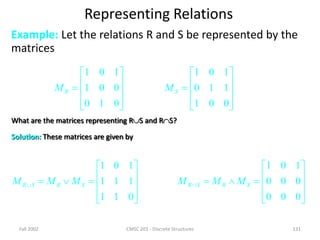
Representing Relations
Example: Let the relations R and S be represented by the
matrices














0
1
1
1
1
1
1
0
1
S
R
S
R M
M
M











0
0
1
1
1
0
1
0
1
S
M
What are the matrices representing RS and RS?
Solution: These matrices are given by














0
0
0
0
0
0
1
0
1
S
R
S
R M
M
M











0
1
0
0
0
1
1
0
1
R
M
Fall 2002 CMSC 203 - Discrete Structures 132
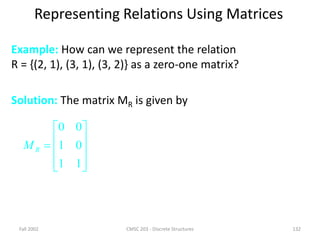
Representing Relations Using Matrices
Example: How can we represent the relation
R = {(2, 1), (3, 1), (3, 2)} as a zero-one matrix?
Solution: The matrix MR is given by











1
1
0
1
0
0
R
M
Fall 2002 CMSC 203 - Discrete Structures 133
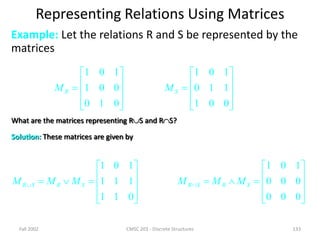
Representing Relations Using Matrices
Example: Let the relations R and S be represented by the
matrices














0
1
1
1
1
1
1
0
1
S
R
S
R M
M
M











0
0
1
1
1
0
1
0
1
S
M
What are the matrices representing RS and RS?
Solution: These matrices are given by














0
0
0
0
0
0
1
0
1
S
R
S
R M
M
M











0
1
0
0
0
1
1
0
1
R
M
Fall 2002 CMSC 203 - Discrete Structures 134
Representing Relations Using Matrices
Do you remember the Boolean product of two zero-one matrices?
Let A = [aij] be an mk zero-one matrix and
B = [bij] be a kn zero-one matrix.
Then the Boolean product of A and B, denoted by AB, is the mn matrix with (i, j)th entry
[cij], where
cij = (ai1  b1j)  (ai2  b2i)  …  (aik  bkj).
cij = 1 if and only if at least one of the terms
(ain  bnj) = 1 for some n; otherwise cij = 0.
Fall 2002 CMSC 203 - Discrete Structures 135
Representing Relations Using Matrices
Let us now assume that the zero-one matrices
MA = [aij], MB = [bij] and MC = [cij] represent relations A, B, and C, respectively.
Remember: For MC = MAMB we have:
cij = 1 if and only if at least one of the terms
(ain  bnj) = 1 for some n; otherwise cij = 0.
In terms of the relations, this means that C contains a pair (xi, zj) if and only if there is an
element yn such that (xi, yn) is in relation A and
(yn, zj) is in relation B.
Therefore, C = BA (composite of A and B).
Fall 2002 CMSC 203 - Discrete Structures 136
Representing Relations Using Matrices
This gives us the following rule:
MBA = MAMB
In other words, the matrix representing the composite of relations A and B is the Boolean
product of the matrices representing A and B.
Analogously, we can find matrices representing the powers of relations:
MRn = MR
[n] (n-th Boolean power).
Fall 2002 CMSC 203 - Discrete Structures 137
Representing Relations Using Matrices
Example: Find the matrix representing R2, where the
matrix representing R is given by











0
0
1
1
1
0
0
1
0
R
M
Solution: The matrix for R2 is given by












0
1
0
1
1
1
1
1
0
]
2
[
2 R
R
M
M
Fall 2002 CMSC 203 - Discrete Structures 138
Representing Relations Using Digraphs
Definition: A directed graph, or digraph, consists of a set V
of vertices (or nodes) together with a set E of ordered pairs
of elements of V called edges (or arcs).
The vertex a is called the initial vertex of the edge (a, b),
and the vertex b is called the terminal vertex of this edge.
We can use arrows to display graphs.
Fall 2002 CMSC 203 - Discrete Structures 139
Representing Relations Using Digraphs
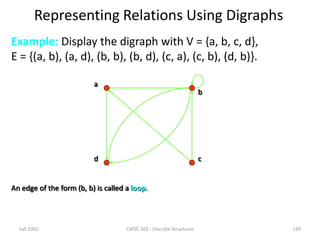
Example: Display the digraph with V = {a, b, c, d},
E = {(a, b), (a, d), (b, b), (b, d), (c, a), (c, b), (d, b)}.
a
b
c
d
An edge of the form (b, b) is called a loop.
Fall 2002 CMSC 203 - Discrete Structures 140
Representing Relations Using Digraphs
Obviously, we can represent any relation R on a set A by
the digraph with A as its vertices and all pairs (a, b)R as
its edges.
Vice versa, any digraph with vertices V and edges E can be
represented by a relation on V containing all the pairs in E.
This one-to-one correspondence between relations and
digraphs means that any statement about relations also
applies to digraphs, and vice versa.
Fall 2002 CMSC 203 - Discrete Structures 141
Equivalence Relations
Equivalence relations are used to relate objects that are
similar in some way.
Definition: A relation on a set A is called an equivalence
relation if it is reflexive, symmetric, and transitive.
Two elements that are related by an equivalence relation R
are called equivalent.
Fall 2002 CMSC 203 - Discrete Structures 142
Equivalence Relations
Since R is symmetric, a is equivalent to b whenever b is
equivalent to a.
Since R is reflexive, every element is equivalent to itself.
Since R is transitive, if a and b are equivalent and b and c
are equivalent, then a and c are equivalent.
Obviously, these three properties are necessary for a
reasonable definition of equivalence.
Fall 2002 CMSC 203 - Discrete Structures 143
Equivalence Relations
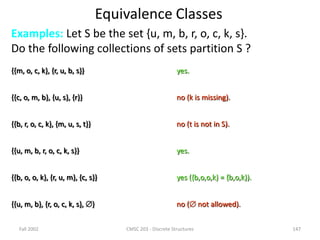
Example: Suppose that R is the relation on the set of
strings that consist of English letters such that aRb if and
only if l(a) = l(b), where l(x) is the length of the string x. Is R
an equivalence relation?
Solution:
• R is reflexive, because l(a) = l(a) and therefore
aRa for any string a.
• R is symmetric, because if l(a) = l(b) then l(b) =
l(a), so if aRb then bRa.
• R is transitive, because if l(a) = l(b) and l(b) = l(c),
then l(a) = l(c), so aRb and bRc implies aRc.
R is an equivalence relation.
Fall 2002 CMSC 203 - Discrete Structures 144
Equivalence Classes
Definition: Let R be an equivalence relation on a set A. The
set of all elements that are related to an element a of A is
called the equivalence class
of a.
The equivalence class of a with respect to R is denoted by
[a]R.
When only one relation is under consideration, we will
delete the subscript R and write [a] for this equivalence
class.
If b[a]R, b is called a representative of this equivalence
class.
Fall 2002 CMSC 203 - Discrete Structures 145
Equivalence Classes
Example: In the previous example (strings of identical
length), what is the equivalence class of the word mouse,
denoted by [mouse] ?
Solution: [mouse] is the set of all English words containing
five letters.
For example, ‘horse’ would be a representative of this
equivalence class.
Fall 2002 CMSC 203 - Discrete Structures 146
Equivalence Classes
Theorem: Let R be an equivalence relation on a set A. The
following statements are equivalent:
• aRb
• [a] = [b]
• [a]  [b]  
Definition: A partition of a set S is a collection of disjoint
nonempty subsets of S that have S as their union. In other
words, the collection of subsets Ai,
iI, forms a partition of S if and only if
(i) Ai   for iI
• Ai  Aj = , if i  j
• iI Ai = S
Fall 2002 CMSC 203 - Discrete Structures 147
Equivalence Classes
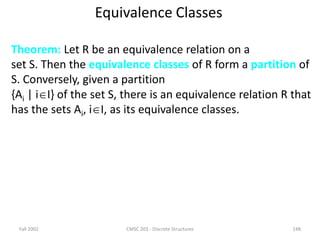
Examples: Let S be the set {u, m, b, r, o, c, k, s}.
Do the following collections of sets partition S ?
{{m, o, c, k}, {r, u, b, s}} yes.
{{c, o, m, b}, {u, s}, {r}} no (k is missing).
{{b, r, o, c, k}, {m, u, s, t}} no (t is not in S).
{{u, m, b, r, o, c, k, s}} yes.
{{b, o, o, k}, {r, u, m}, {c, s}} yes ({b,o,o,k} = {b,o,k}).
{{u, m, b}, {r, o, c, k, s}, } no ( not allowed).
Fall 2002 CMSC 203 - Discrete Structures 148
Equivalence Classes
Theorem: Let R be an equivalence relation on a
set S. Then the equivalence classes of R form a partition of
S. Conversely, given a partition
{Ai | iI} of the set S, there is an equivalence relation R that
has the sets Ai, iI, as its equivalence classes.
Fall 2002 CMSC 203 - Discrete Structures 149
Equivalence Classes
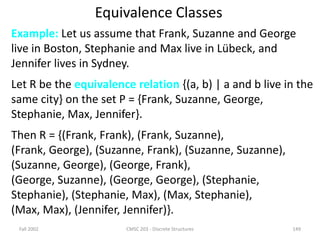
Example: Let us assume that Frank, Suzanne and George
live in Boston, Stephanie and Max live in Lübeck, and
Jennifer lives in Sydney.
Let R be the equivalence relation {(a, b) | a and b live in the
same city} on the set P = {Frank, Suzanne, George,
Stephanie, Max, Jennifer}.
Then R = {(Frank, Frank), (Frank, Suzanne),
(Frank, George), (Suzanne, Frank), (Suzanne, Suzanne),
(Suzanne, George), (George, Frank),
(George, Suzanne), (George, George), (Stephanie,
Stephanie), (Stephanie, Max), (Max, Stephanie),
(Max, Max), (Jennifer, Jennifer)}.
Fall 2002 CMSC 203 - Discrete Structures 150
Equivalence Classes
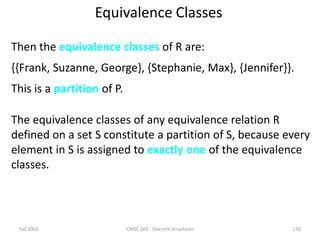
Then the equivalence classes of R are:
{{Frank, Suzanne, George}, {Stephanie, Max}, {Jennifer}}.
This is a partition of P.
The equivalence classes of any equivalence relation R
defined on a set S constitute a partition of S, because every
element in S is assigned to exactly one of the equivalence
classes.
Fall 2002 CMSC 203 - Discrete Structures 151
Equivalence Classes
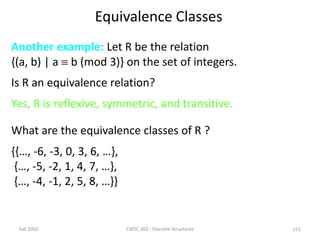
Another example: Let R be the relation
{(a, b) | a  b (mod 3)} on the set of integers.
Is R an equivalence relation?
Yes, R is reflexive, symmetric, and transitive.
What are the equivalence classes of R ?
{{…, -6, -3, 0, 3, 6, …},
{…, -5, -2, 1, 4, 7, …},
{…, -4, -1, 2, 5, 8, …}}
Discussion #28 152/13
Discussion #28
Partial Orders
Discussion #28 153/13
Topics
Weak and strict partially ordered sets (posets)
Total orderings
Hasse diagrams
Bounded and well-founded posets
Discussion #28 154/13
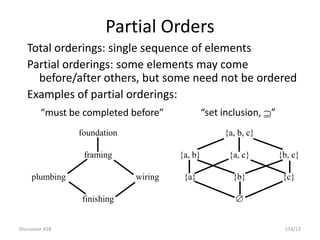
Partial Orders
Total orderings: single sequence of elements
Partial orderings: some elements may come
before/after others, but some need not be ordered
Examples of partial orderings:
foundation
framing
plumbing wiring
finishing
{a, b, c}
{a, b} {a, c} {b, c}
{a} {b} {c}

“must be completed before” “set inclusion, ”
Discussion #28 155/13
Partial Order Definitions
(Poset Definitions)
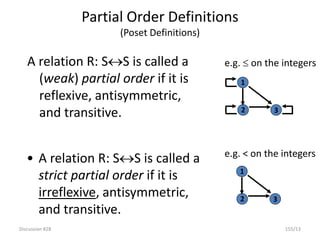
A relation R: SS is called a
(weak) partial order if it is
reflexive, antisymmetric,
and transitive.
1
2 3
• A relation R: SS is called a
strict partial order if it is
irreflexive, antisymmetric,
and transitive.
1
2 3
e.g.  on the integers
e.g. < on the integers
Discussion #28 156/13
Total Order
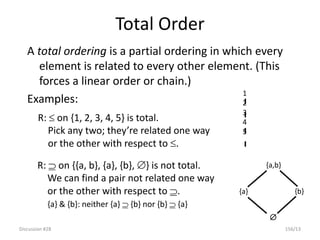
A total ordering is a partial ordering in which every
element is related to every other element. (This
forces a linear order or chain.)
Examples:
R:  on {1, 2, 3, 4, 5} is total.
Pick any two; they’re related one way
or the other with respect to .
{a,b}
{a} {b}

R:  on {{a, b}, {a}, {b}, } is not total.
We can find a pair not related one way
or the other with respect to .
{a} & {b}: neither {a}  {b} nor {b}  {a}
1
2
3
4
5
Discussion #28 157/13
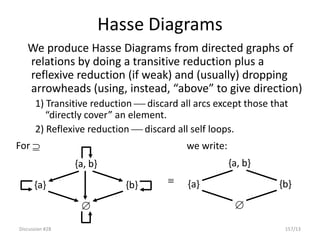
Hasse Diagrams
We produce Hasse Diagrams from directed graphs of
relations by doing a transitive reduction plus a
reflexive reduction (if weak) and (usually) dropping
arrowheads (using, instead, “above” to give direction)
1) Transitive reduction  discard all arcs except those that
“directly cover” an element.
2) Reflexive reduction  discard all self loops.

{b}
{a}
{a, b}

{b}
{a}
{a, b}

For  we write:
Discussion #28 158/13
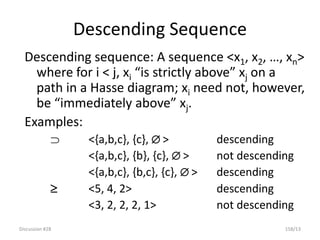
Descending Sequence
Descending sequence: A sequence <x1, x2, …, xn>
where for i < j, xi “is strictly above” xj on a
path in a Hasse diagram; xi need not, however,
be “immediately above” xj.
Examples:
 <{a,b,c}, {c},  > descending
<{a,b,c}, {b}, {c},  > not descending
<{a,b,c}, {b,c}, {c},  > descending
 <5, 4, 2> descending
<3, 2, 2, 2, 1> not descending
Discussion #28 159/13
Well Founded Poset
A poset is well founded if it has no infinite descending
sequence.
Examples:
> on the integers?
<3, 2, 1, 0, -1, …> not well founded
 on finite sets?
<{a, b, c}, {c}, > well founded
All finite strict posets are well founded.
 on finite sets?
<{a}, {a}, {a}, …> not a descending sequence
All finite (weak) posets are well founded.
> natural numbers?
<…, 3, 2, 1, 0> infinite, but well founded
Discussion #28 160/13
Application of Well Founded
Posets
Has anyone ever gotten into an infinite loop in
a program?
We use well founded sets to prove that loops
terminate.
e.g. The following clearly terminates.
for i=1 to n do …
ni for i=1, …, n is a descending sequence on a
well founded set (the natural numbers): <n1,
n2, …, nn = 0>.
Discussion #28 161/13
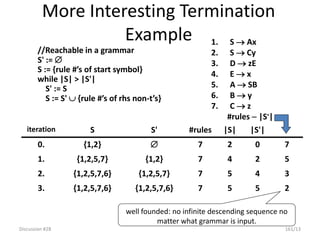
More Interesting Termination
Example 1. S  Ax
2. S  Cy
3. D  zE
4. E  x
5. A  SB
6. B  y
7. C  z
2
5
5
7
{1,2,5,7,6}
{1,2,5,7,6}
3.
3
4
5
7
{1,2,5,7}
{1,2,5,7,6}
2.
5
2
4
7
{1,2}
{1,2,5,7}
1.
7
0
2
7

{1,2}
0.
|S'|
|S|
#rules
S'
S
iteration
//Reachable in a grammar
S' := 
S := {rule #’s of start symbol}
while |S| > |S'|
S' := S
S := S'  {rule #’s of rhs non-t’s}
well founded: no infinite descending sequence no
matter what grammar is input.
#rules  |S'|
Discussion #28 162/13
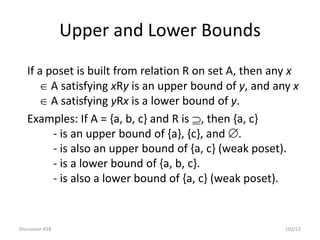
Upper and Lower Bounds
If a poset is built from relation R on set A, then any x
 A satisfying xRy is an upper bound of y, and any x
 A satisfying yRx is a lower bound of y.
Examples: If A = {a, b, c} and R is , then {a, c}
- is an upper bound of {a}, {c}, and .
- is also an upper bound of {a, c} (weak poset).
- is a lower bound of {a, b, c}.
- is also a lower bound of {a, c} (weak poset).
Discussion #28 163/13
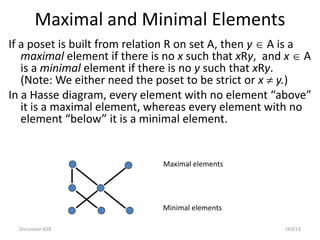
Maximal and Minimal Elements
If a poset is built from relation R on set A, then y  A is a
maximal element if there is no x such that xRy, and x  A
is a minimal element if there is no y such that xRy.
(Note: We either need the poset to be strict or x  y.)
In a Hasse diagram, every element with no element “above”
it is a maximal element, whereas every element with no
element “below” it is a minimal element.
Maximal elements
Minimal elements
Discussion #28
164/13
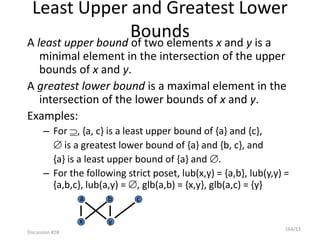
Least Upper and Greatest Lower
Bounds
A least upper bound of two elements x and y is a
minimal element in the intersection of the upper
bounds of x and y.
A greatest lower bound is a maximal element in the
intersection of the lower bounds of x and y.
Examples:
– For , {a, c} is a least upper bound of {a} and {c},
 is a greatest lower bound of {a} and {b, c}, and
{a} is a least upper bound of {a} and .
– For the following strict poset, lub(x,y) = {a,b}, lub(y,y) =
{a,b,c}, lub(a,y) = , glb(a,b) = {x,y}, glb(a,c) = {y}
a b
x y
c
Groups
165
• 1. Introduction
• 2.Normal subgroups, quotien groups.
• 3. Homomorphism.
1.Introduction
166
• 1.1. Binary Operations
• 1.2.Definition of Groups
• 1.3.Examples of Groups
• 1.4.Subgroups
1.Introduction
167
• 1.1. Binary Operations
• 1.2.Definition of Groups
• 1.3.Examples of Groups
• 1.4.Subgroups
1.Introduction
1.1.Binary Operations
A binary operation on a set is a rule for
combining two elements of the set. More
precisely, if S iz a nonemty set, a binary
operation on S iz a mapping f : S  S  S. Thus
f associates with each ordered pair (x,y) of
element of S an element f(x,y) of S. It is better
notation to write x y for f(x,y), refering to
as the binary operation.
168
1.Introduction
1.2.Definition of Groups
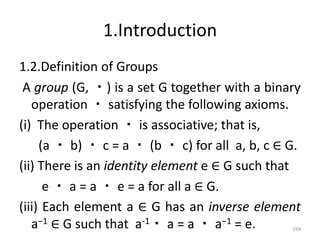
A group (G, ・) is a set G together with a binary
operation ・ satisfying the following axioms.
(i) The operation ・ is associative; that is,
(a ・ b) ・ c = a ・ (b ・ c) for all a, b, c ∈ G.
(ii) There is an identity element e ∈ G such that
e ・ a = a ・ e = a for all a ∈ G.
(iii) Each element a ∈ G has an inverse element
a−1 ∈ G such that a-1・ a = a ・ a−1 = e. 169
1.Introduction
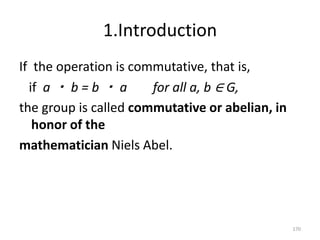
If the operation is commutative, that is,
if a ・ b = b ・ a for all a, b ∈ G,
the group is called commutative or abelian, in
honor of the
mathematician Niels Abel.
170
1.Introduction
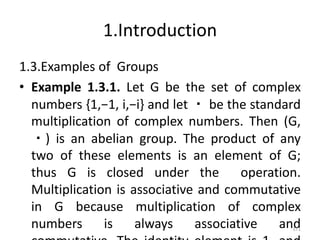
1.3.Examples of Groups
• Example 1.3.1. Let G be the set of complex
numbers {1,−1, i,−i} and let ・ be the standard
multiplication of complex numbers. Then (G,
・) is an abelian group. The product of any
two of these elements is an element of G;
thus G is closed under the operation.
Multiplication is associative and commutative
in G because multiplication of complex
numbers is always associative and
171
1.Introduction
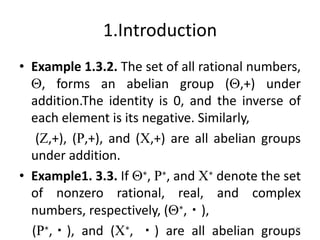
• Example 1.3.2. The set of all rational numbers,
Q, forms an abelian group (Q,+) under
addition.The identity is 0, and the inverse of
each element is its negative. Similarly,
(Z,+), (R,+), and (C,+) are all abelian groups
under addition.
• Example1. 3.3. If Q∗, R∗, and C∗ denote the set
of nonzero rational, real, and complex
numbers, respectively, (Q∗,・),
(R∗,・), and (C∗, ・) are all abelian groups
172
1.Introduction
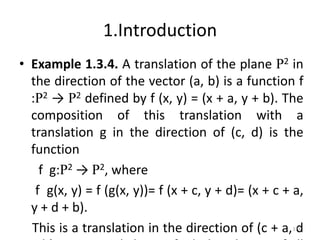
• Example 1.3.4. A translation of the plane R2 in
the direction of the vector (a, b) is a function f
:R2 → R2 defined by f (x, y) = (x + a, y + b). The
composition of this translation with a
translation g in the direction of (c, d) is the
function
f g:R2 → R2, where
f g(x, y) = f (g(x, y))= f (x + c, y + d)= (x + c + a,
y + d + b).
This is a translation in the direction of (c + a, d
173
1.Introduction
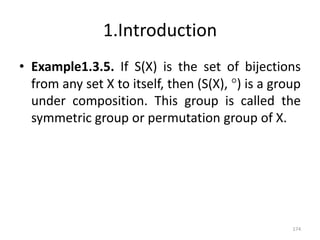
• Example1.3.5. If S(X) is the set of bijections
from any set X to itself, then (S(X), ) is a group
under composition. This group is called the
symmetric group or permutation group of X.
174
1.Introduction
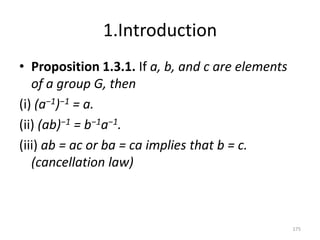
• Proposition 1.3.1. If a, b, and c are elements
of a group G, then
(i) (a−1)−1 = a.
(ii) (ab)−1 = b−1a−1.
(iii) ab = ac or ba = ca implies that b = c.
(cancellation law)
175
1.Introduction
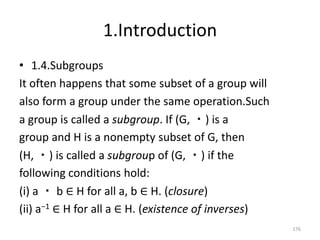
• 1.4.Subgroups
It often happens that some subset of a group will
also form a group under the same operation.Such
a group is called a subgroup. If (G, ・) is a
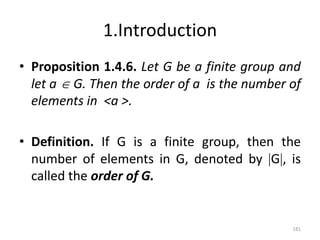
group and H is a nonempty subset of G, then
(H, ・) is called a subgroup of (G, ・) if the
following conditions hold:
(i) a ・ b ∈ H for all a, b ∈ H. (closure)
(ii) a−1 ∈ H for all a ∈ H. (existence of inverses)
176
1.Introduction
• Conditions (i) and (ii) are equivalent to the
single condition:
(iii) a ・ b−1 ∈ H for all a, b ∈ H.
Proposition 1.4.2. If H is a nonempty finite
subset of a group G and ab ∈ H for all a, b ∈ H,
then H is a subgroup of G.
Example 1.4.1 In the group ({1,−1, i,−i}, ・), the177
1.Introduction
• Example 1.4.2 .The group Z is a subgroup of
Q,Q is a subgroup of R, and R is a subgroup of
C. (Remember that addition is the operation
in all these groups.)
• However, the set N = {0, 1, 2, . . .} of
nonnegative integers is a subset of Z but not a
subgroup, because the inverse of 1, namely,
−1, is not in N. This example shows that
Proposition 1.4.2 is false if we drop the
condition that H be finite. 178
1.Introduction
• Definition. Let G be a group and let a  G. If ak
= 1 for some k  1, then the smallest such
exponent k  1 is called the order of a; if no
such power exists, then one says that a has
infinite order.
• Proposition 1.4.3 . Let G be a group and
assume that a G has finite order k. If an = 1,
then k | n. In fact, {n Z : an = 1} is the set of
179
1.Introduction
• Definition. If G is a group and a  G, write
<a > = {an : n Z} = {all powers of a } .
It is easy to see that <a > is a subgroup of G .
< a > is called the cyclic subgroup of G
generated by a. A group G is called cyclic if
there is some a  G with G = < a >; in this case
a is called a generator of G.
• Proposition 1.4.4. If G= <a > is a cyclic group
of order n, then ak is a generator of G if and
only if gcd(k; n)= 1.
180
1.Introduction
• Proposition 1.4.6. Let G be a finite group and
let a  G. Then the order of a is the number of
elements in <a >.
• Definition. If G is a finite group, then the
number of elements in G, denoted by G, is
called the order of G.
181
2.Normal subgroups,quotient
groups
• 2.1.Cosets
• 2.2.Theorem of Lagrange
• 2.3.Normal Subgrops
• 2.4.Quotient Groups
182
2.Normal subgroups,quotient
groups
• 2.1.Cosets
• Let (G, ·) be a group with subgroup H. For a, b
∈ G, we say that a is congruent to b modulo H,
and write a ≡ b mod H if and only if ab−1 ∈ H.
• Proposition 2.1. 1.The relation a ≡ b mod H is
an equivalence relation on G. The equivalence
class containing a can be written in the form
Ha = {ha|h ∈ H}, and it is called a right coset
of H in G. The element a is called a
representative of 183
2.Normal subgroups,quotient
groups
• Example 2.1.1. Find the right cosets of A3 in
S3.
Solution. One coset is the subgroup itself A3 =
{(1), (123), (132)}. Take any element not in the
subgroup, say (12). Then another coset is
A3(12) = {(12), (123) (12), (132) (12)} = {(12),
(13), (23)}.Since the right cosets form a
partition of S3 and the two cosets above
contain all the elements of S3, it follows that
these are the only two cosets. 184
2.Normal subgroups,quotient
groups
• Example 2.1.2. Find the right cosets of H = {e,
g4, g8} in C12 = {e, g, g2, . . . , g11}.
• Solution. H itself is one coset. Another is Hg =
{g, g5, g9}. These two cosets have not
exhausted all the elements of C12, so pick an
element, say g2, which is not in H or Hg. A
third coset is Hg2 = {g2, g6, g10} and a fourth is
Hg3 ={g3, g7, g11}.
Since C12 = H ∪ Hg ∪ Hg2 ∪ Hg3, these are all
the cosets 185
2.Normal subgroups,quotient
groups
• 2.2.Theorem of Lagrange
• As the examples above suggest, every coset
contains the same number of elements. We
use this result to prove the famous theorem of
Joseph Lagrange (1736–1813).
• Lemma 2.2.1. There is a bijection between any
two right cosets of H in G.
Proof. Let Ha be a right coset of H in G. We
produce a bijection between Ha and H, from
which it follows that there is a bijection
186
2.Normal subgroups,quotient
groups
• Theorem 2.2.2. Lagrange’s Theorem. If G is a
finite group and H is a subgroup of G, then
|H| divides |G|.
Proof. The right cosets of H in G form a partition
of G, so G can be written as a disjoint union
G = Ha1 ∪ Ha2 ∪ ·· ·∪ Hak for a finite set of
elements a1, a2, . . . , ak ∈ G.
By Lemma 2.2.1, the number of elements in
each coset is |H|. Hence, counting all the
elements in the disjoint union above, we see
187
2.Normal subgroups,quotient
groups
• If H is a subgroup of G, the number of distinct
right cosets of H in G is called the index of H in
G and is written |G : H|. The following is a
direct consequence of the proof of Lagrange’s
theorem.
• Corollary 2.2.3. If G is a finite group with
subgroup H, then
|G : H| = |G|/|H|.
• Corollary 2.2.4. If a is an element of a finite
group G, then the order of a divides the order
188
2.Normal subgroups,quotient
groups
• 2.3.Normal Subgrops
• Let G be a group with subgroup H. The right
cosets of H in G are equivalence classes under
the relation a ≡ b mod H, defined by ab−1 ∈ H.
We can also define the relation L on G so that
aLb if and only if b−1a ∈ H. This relation, L, is
an equivalence relation, and the equivalence
class containing a is the left coset aH = {ah|h ∈
H}. As the following example shows, the left
coset of an element does not necessarily
189
2.Normal subgroups,quotient
groups
• Example 2.3.1. Find the left and right cosets of H = A3 and K = {(1), (12)} in
S3.
• Solution. We calculated the right cosets of H = A3 in Example 2.1.1.
Right Cosets
H = {(1), (123), (132)}; H(12) = {(12), (13), (23)}
Left Cosets
H = {(1), (123), (132}; (12)H = {(12), (23), (13)}
In this case, the left and right cosets of H are the same.
• However, the left and right cosets of K are not all the same.
Right Cosets
K = {(1), (12)} ; K(13) = {(13), (132)} ; K(23) = {(23), (123)}
Left Cosets
K = {(1), (12)};(23)K = {(23), (132)}; (13)K = {(13), (123)}
190
2.Normal subgroups,quotient
groups
Definition: A subgroup H of a group G is called a
normal subgroup of G if g−1hg ∈ H for all g ∈ G
and h ∈ H.
Proposition 2.3.1. Hg = gH, for all g ∈ G, if and
only if H is a normal subgroup of G.
Proof. Suppose that Hg = gH. Then, for any
element h ∈ H, hg ∈ Hg = gH. Hence hg = gh1
for some h1 ∈ H and g−1hg = g−1gh1 = h1 ∈ H.
Therefore,H is a normal subgroup.
Conversely, if H is normal, let hg ∈ Hg and
191
2.Normal subgroups,quotient
groups
• If N is a normal subgroup of a group G, the left
cosets of N in G are the same as the right
cosets of N in G, so there will be no ambiguity
in just talking about the cosets of N in G.
• Theorem 2.3.2. If N is a normal subgroup of
(G, ·), the set of cosets G/N = {Ng|g ∈ G} forms
a group (G/N, ·), where the operation is
defined by (Ng1) · (Ng2) = N(g1 · g2). This group
is called the quotient group or factor group of
192
2.Normal subgroups,quotient
groups
• Proof. The operation of multiplying two cosets,
Ng1 and Ng2, is defined in terms of particular
elements, g1 and g2, of the cosets. For this
operation to make sense, we have to verify
that, if we choose different elements, h1 and
h2, in the same cosets, the product coset N(h1
· h2) is the same as N(g1 · g2). In other words,
we have to show that multiplication of cosets
is well defined. Since h1 is in the same coset as
g1, we have h1 ≡ g1 mod N. Similarly, h2 ≡ g2
193
2.Normal subgroups,quotient
groups
• The operation is associative because (Ng1 ·
Ng2) · Ng3 = N(g1g2) · Ng3 = N(g1g2)g3 and also
Ng1 · (Ng2 · Ng3) = Ng1 · N(g2g3) = Ng1(g2g3) =
N(g1g2)g3.
• Since Ng · Ne = Nge = Ng and Ne · Ng = Ng, the
identity is Ne = N.
• The inverse of Ng is Ng−1 because Ng · Ng−1 =
N(g · g−1) = Ne = N and also Ng−1 · Ng = N.
• Hence (G/N, ·) is a group.
194
2.Normal subgroups,quotient
groups
• Example 2.3.1. (Zn, +) is the quotient group of
(Z,+) by the subgroup nZ = {nz|z ∈ Z}.
• Solution. Since (Z,+) is abelian, every subgroup
is normal. The set nZ can be verified to be a
subgroup, and the relationship a ≡ b mod nZ
is equivalent to a − b ∈ nZ and to n|a − b.
Hence a ≡ b mod nZ is the same relation as a ≡
b mod n. Therefore, Zn is the quotient group
Z/nZ, where the operation on congruence
classes is defined by [a] + [b] = [a + b]. 195
3.Homorphisms.
• 3.1.Definition of Homomorphisms
• 3.2.Examples of Homomorphisms
• 3.3.Theorem on Homomorphisms
196
3.Homorphisms
• 3.1.Definition of Homomorphisms
• If (G, ・) and (H,  ) are two groups, the
function f :G → H is called a group
homomorphism if
f (a ・ b) = f (a)  f (b) for all a, b ∈ G.
• We often use the notation f : (G, ・) → (H, )
for such a homorphism. Many authors use
morphism instead of homomorphism.
• A group isomorphism is a bijective group
homomorphism. If there is an isomorphism
197
3.Homorphisms
• 3.2.Examples of Homomorphisms
- The function f : Z → Zn , defined by f (x) = [x]
iz the group homomorphism.
- Let be R the group of all real numbers with
operation addition, and let R+ be the group of
all positive real numbers with operation
multiplication. The function f : R → R+ ,
defined by f (x) = ex , is a homomorphism, for
if x, y  R, then
f(x + y) = ex+y = ex ey = f (x) f (y). Now f is an
198
3.Homorphisms
• 3.3.Theorem on Homomorphisms
• Proposition 3.3.1. Let f :G → H be a group morphism,
and let eG and eH be the identities of G and H,
respectively. Then
(i) f (eG) = eH .
(ii) f (a−1) = f (a)−1 for all a ∈ G.
• Proof. (i) Since f is a morphism, f (eG)f (eG) = f (eG eG) = f
(eG) = f (eG)eH . Hence (i) follows by cancellation in H
(ii) f (a) f (a−1) = f (a a−1) = f (eG) = eH by (i). Hence f (a−1) is
the unique inverse of f (a); that is f (a−1) = f (a)−1
199
3.Homorphisms
• If f :G → H is a group morphism, the kernel of f ,
denoted by Kerf, is defined to be the set of
elements of G that are mapped by f to the
identity of H. That is, Kerf ={g ∈ G|f (g) = eH }
• Proposition 3.3.2. Let f :G → H be a group
morphism. Then:
(i) Kerf is a normal subgroup of G.
(ii) f is injective if and only if Kerf = {eG}.
• Proposition 3.3.3. For any group morphism f :G
→ H, the image of f , Imf ={f (g)|g ∈ G}, is a
subgroup of H (although not necessarily normal).
200
3.Homorphisms
• Theorem 3.3.4. Morphism Theorem for Groups. Let K
be the kernel of the group morphism f :G → H. Then
G/K is isomorphic to the image of f, and the
isomorphism
ψ: G/K → Imf is defined by ψ(Kg) = f (g).
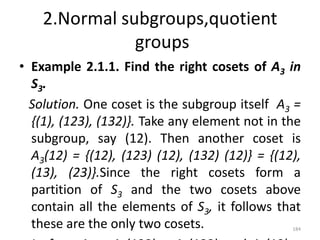
• This result is also known as the first isomorphism
theorem.
• Proof. The function ψ is defined on a coset by using
one particular element in the coset, so we have to
check that ψ is well defined; that is, it does not matter
which element we use. If Kg , = Kg, then g’ ≡ g mod K so
g ,g−1 = k ∈ K = Kerf . Hence g , = kg and so
f (g ,) = f (kg) = f (k)f(g) = eHf (g) = f (g).
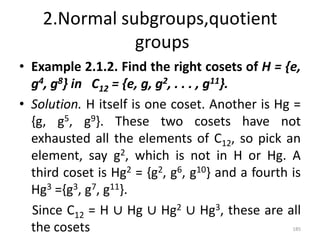
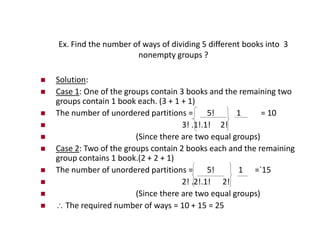
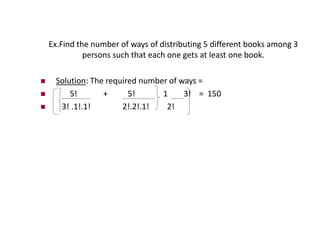
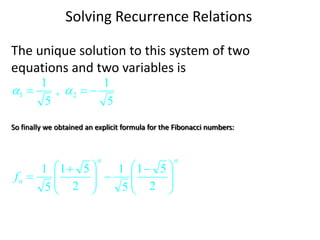
Thus ψ is well defined on cosets. 201
3.Homorphisms
• The function ψ is a morphism because
ψ(Kg1Kg2) = ψ(Kg1g2) = f (g1g2) = f (g1)f (g2) =
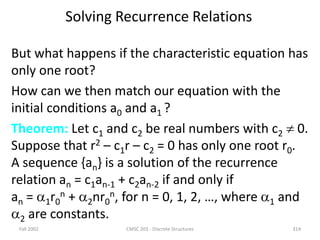
ψ(Kg1)ψ(Kg2).
• If ψ(Kg) = eH, then f (g) = eH and g ∈ K. Hence
the only element in the kernel of ψ is the
identity coset K, and ψ is injective. Finally,
Imψ = Imf ,by the definition of ψ. Therefore, ψ
is the required isomorphism between G/K and
Imf
202
3.Homorphisms
• Example 3.3.1. Show that the quotient group R/Z is
isomorphic to the circle group W = {eiθ ∈ C | θ ∈ R }.
Solution. The set W consists of points on the circle of complex
numbers of unit modulus, and forms a group under
multiplication. Define the function
f :R → W by f (x) = e2πix. This is a morphism from (R,+) to
(W, ·) because
f (x + y) = e2πi(x+y) = e2πix · e2πiy = f (x) · f (y).
The morphism f is clearly surjective, and its kernel is
{x ∈ R|e2πix = 1} = Z.
Therefore, the morphism theorem implies that R/Z  W.
203
Unit –IV Combinatorics
 Basics of counting
 Permutations and Combinations
 Combinations with Repetitions
 Binomial coefficients
 Principles of inclusion and exclusion
 Pigeon hole principle and its application
Basics of counting
 Sum Rule: If E1, E2, ………, En are mutually exclusive events, and
E1 can happen in e1 ways, E2 can happen in e2 ways, …….. ,
En can happen in en ways, then
(E1 or E2 or….or En ) can happen in (e1 + e2 + ….. + en ) ways.
 Ex. A man can spend his evening in one of the following ways.
He can do shopping or he can go to a Cinema hall or he can go to a
restaurant.
If there are 6 shopping complexes, 8 cinema halls and 9 restaurants
then, how many different ways he can spend his evening?.
 Solution: By Sum rule, he can spend his evening in 6 + 8 + 9 = 23
different ways.
Ex.: If two distinguishable dice are rolled, then
a) How many ways can we get a sum of 4 or of 8
b) How many ways we get an even sum?
 Solution: a) There are 3 ways to get a sum of 4
i.e., {(1 , 3), (2 , 2), (3 , 1)}
Likewise, There are 5 ways to get a sum of 8.
i.e., { (2 , 6),(3 , 5),(4 ,4), (5 ,3), (6 ,2)}.
The number of ways to get a sum of 4 or 8 = 3 + 5 = 8
 b) The number of ways we get an even sum =
The number of ways to get a sum of 2 or 4 or 6 or 8 or 10 or 12 =
1 + 3 + 5 + 5 + 3 + 1 = 18 ways .
Ex. If two indistinguishable dice are rolled, then
a) How many ways can we get a sum of 4 or of 8 .
b) How many ways we get an even sum?.
 Solution: a) If the dice are identical, the outcomes (a,b) and (b,a)
cannot be differentiated.
Now, there are only 2 ways to get a sum of 4
i.e., {(1 , 3), (2 , 2) }
Likewise, There are only 3 ways to get a sum of 8.
i.e., { (2 , 6),(3 , 5),(4 ,4)}.
The number of ways to get a sum of 4 or 8 = 2 +3 = 5
 b) Likewise, The number of ways we get an even sum =
The number of ways to get a sum of 2 or 4 or 6 or 8 or 10 or 12 =
1 + 2 + 3 + 3 + 2 + 1 = 12ways .
Basics of counting.
 Product Rule: If events E1, E2, ………, En can happen in
e1, e2, …, en ways respectively, then the sequence of events
( E1 first, followed by E2, ……, followed by En ) can happen
(e1 . e2 . …. en) ways.
 Ex. a) If 2 distinguishable dice are rolled, in how many ways
Can they fall ?
b) If 5 distinguishable dice are rolled, how many possible
outcomes are there?.
 Solution: a) The first die can fall in 6 ways and the second can fall in
6 ways.
 By product rule, the number of possible outcomes = 6 . 6 = 36.
Contd.,
 b) Similarly, the number of possible outcomes when 5
distinguishable dice are rolled = 6.6.6.6.6 = 65
 Ex. A man wants to spend his evening in the following way.
First, He would like to do some shopping ,
then he would like to go to a Cinema hall and
finally he would like to go to a restaurant.
If there are 6 shopping complexes, 8 cinema halls and 9 restaurants
then, how many different ways he can spend his evening?.
 Ans. 6. 8. 9 = 432 ways.
Ex. a) How many 3-digit numbers can be formed using the digits
1,3,4,5,6,8 and 9?
b) How many 3-digit numbers can be formed if no digit can be repeated?
 Solution: a) Here, each of the 3 digits can be filled in 7 ways .
 By product rule,The required number of 3-digit
numbers that can be formed = 7.7.7 = 343.
 b) If the repetitions are not allowed,
The required number of 3-digit numbers that can be formed =
7.6.5 = 210.
Ex. How many three digit even numbers are there which are even and
have no repeated digits? (Here we are using all digits 0 through 9)
 Solution: An even number must end with 0,2,4,6,or 8.
 Case1 x x 0
9 8 -
The number of 3- digit even numbers ending with 0 = 9 . 8 = 72
 Case2 x x x
8 8 4
The number of 3-digit even numbers not ending with 0 = 8. 8. 4 = 256.
Since, these two cases are mutually exclusive, By sum rule
The required number of 3-digit even numbers = 72 + 256 = 328.
 Ex. How many 4 digit even numbers have all 4 digits distinct ?
 Ans. 2296
Ex. How many different license plates are there that involve 1,2,or 3
letters followed by 4 digits.
 Solution: By product rule, we have
The number of plates with 1 letter followed by 4 digits = 26. (10)4
The number of plates with 2 letters followed by 4 digits = (26)2. (10)4
The number of plates with 3 letters followed by 4 digits = (26)3. (10)4
Since, these 3 cases are mutually exclusive, By sum rule, we have
 The required number of license plates =
26. (10)4 + (26)2. (10)4 + (26)3. (10)4
= {26 + (26)2 + (26)3 }.(10)4
Ex. How many different license plates are there that involve 1,2,or 3
letters followed by 1,2,3, or 4 digits.
 Solution: From the previous example,
 The number of different license plates that involve 1,2,or 3 letters
followed by 4 digits = {26 + (26)2 + (26)3 }. (10)4
 Similarly, The number of different license plates that involve 1,2,or 3
letters followed by 3 digits = {26 + (26)2 + (26)3 }. (10)3
 The number of different license plates that involve 1,2,or 3
letters followed by 2 digits = {26 + (26)2 + (26)3 }. (10)2
 The number of different license plates that involve 1,2,or 3
letters followed by 1 digits = {26 + (26)2 + (26)3 }. (10)
 The required number of license plates =
{26 + (26)2 + (26)3 }. {(10)+(10)2 + (10)3 + (10)4}.
Permutations
 Permutations: A permutation of n objects taken r at a time (also
called an r-permutation of n objects) is an ordered selection or
arrangement of r of the objects.
 P(n, r) = The number of permutations of n objects taken r at a time
(without any repetitions).
 P(n , 1) = n.
 P(n , 2) = n.(n – 1).
 P(n , 3) = n.(n – 1).(n – 2).
 …………….
P(n , r) = n.(n - 1)(n - 2)…….{n – (r –1)} = n! / (n – r)!
 P(n , n) = n! i.e.., there are n! Permutations of n objects.
Permutations
 Note:
 1) There are (n – 1)! permutations of n distinct objects around a
circle.
 2) U(n, r) = The number of r-permutations of n objects with
unlimited repetitions = nr.
 3) The number of permutations of n objects of which n1 are alike,
n2 are alike, …., nr are alike is
n!
n1! . n2! . ... .nr!
 4) The number of ways to arrange ‘n’ different pearls in a necklace
is (n – 1)! / 2.
Ordered and unordered partitions
 5) The number of ordered partitions of a set S of type {q1 , q2, ….,qk}
where S = n is
p( n ; q1 , q2 ,….., qt) = n!
q1! q2! ….. qt!
 6) Enumeration of unordered partitions of equal cell size:
The number of unordered partitions of a set S of type (q , q, …q),
(where S = n = q . t ) is
= n!
(q!)t . t!
Combinations
 Combinations:
 A combination of n-objects taken r at a time (called an r-combination
of n objects) is an unordered selection of n objects.
 C(n, r) = The number of combinations of n-objects taken r at time
 (without repetitions)
 = n!
 r! . (n-r)!
 Note: 1) P(n, r) = r! . C(n, r)
 2) C(n, 0) = 1
 3) C(n, 1) = n
Combinations
 4) C(n, 2) = n.(n –1)
1.2
 5) C(n, 3) = n.(n –1).(n –2 )
1.2.3
 6) C(n , n) = 1
 7) C(n , r) = C( n , n – r )
Combinations with repetitions
 V(n, r) = The number of combinations of n distinct objects taken r at
a time with unlimited repetitions.
 V(n ,r) = C(n –1 + r, r)
= C(n –1 + r, n - 1)
 V(n, r) = The number of ways distributing ‘r’ similar balls into ‘n’
numbered boxes.
 V(n, r) = The number of non negative integral solutions to the
equation x1 + x2 + ……..+ xn = r
 V(n ,r) = The number of binary sequences with ‘n – 1’ ones
and ‘r’ zeros.
Examples
 Ex. How many ways are there to distributive 10 different books
among 15 people, if no person is to receive more than one book?
a) P(15, 10) b) C(15, 10) c) 1015 d) 1510
 Ans. a
 Ex. How many binary sequences are there of length 15?
a) 215 b) 15! c) P(15, 2) d) C(15, 2)
 Ans. a
 Ex. How many binary sequences are there of length 15 with exactly
6 ones and 9 zeros?
a) P(15, 6) b) C(15, 6) c) 26 d) P(15, 6). C(15, 9)
 Ans. b
Example
 Ex. A multiple choice test has 15questions and 4 choices for each
answer.
a) How many ways can the 15 questions be answered?
b) How many ways the 15 questions be answered so that exactly 3
answers are correct?
c) How many ways the 15 questions be answered so that at least 3
answers are correct?
 Solution:
 a) Since, each question can be answered in 4 ways, By product rule,
the 15 questions can be answered in 415 ways.
Contd.,
 b) The 3 correct answers can be chosen in C(15 , 3) ways. Each of the
remaining questions can be wrongly answered in 3 ways.
 The required number of ways = C(15 , 3) . 312.
 c) The 15 questions can be answered in 415 ways.
Number of ways in which at most 2 answers are correct =
315 + C(15 , 1).314 + C(15 , 2).313
The number of ways the 15 questions be answered so that at least 3
answers are correct = 415 – {315 + C(15 , 1).314 + C(15 , 2).313 }
Ex. How many ways can 10 similar balls be placed in six numbered
boxes?.
 Solution: The number of ways distributing ‘r’ similar balls into ‘n’
numbered boxes = V(n , r) = C(n –1 + r , r ).
Here, n = 6 and r = 10
 The required number of ways = V(6 , 10)
= C(15 , 10)
= C(15 , 5)
= 3003.
Ex. How many non negative integral solutions are there to the equation
x1 + x2 + x3 + x4 + x5 = 50 .
 Solution: The number of non negative integral solutions to the
equation {x1 + x2 + x3 +… + xn = r} =
V(n , r) = C(n –1 + r , r ).
Here, n = 5 and r = 50
 The required number of solutions = V(5 , 50)
= C(54 , 50)
= C(54 , 4) = 3,16,251.
Ex.How many binary sequences are possible with ten one’s and five
zeros.
 Solution: The number of binary sequences with ‘n – 1’ ones
and ‘r’ zeros = V(n ,r)
Here, n – 1 = 10 and r = 5.
 Required number of binary sequences = V ( 11, 5)
= C (15 , 5) = 3003 .
Ex. In how many ways can 5 similar books be placed on 3 different
shelves so that each shelf contains at least one book ?
 Solution: First, let us place one book in each of the shelves to ensure
that each shelf contains at least one of the books.
 Now, let us count the number of ways of distributing the remaining
two books in 3 shelves.
  Required number of ways = V ( 3, 2)
= C (4 , 2) = 10.
Ex. A professor wishes to conduct a test with 10 questions. In how many
ways can the test be given a total of 30 marks if each question is to be
worth 2 or more marks?
 Solution: Since each question has to carry at least 2 marks, First he
has to allot 2 marks for each question.
 Now let us count the number of ways of distributing the remaining
10 marks to 10 questions.
  Required number of ways = V ( 10, 10)
= C (19 , 10).
Ex. How many non negative integral solutions are there to
x1 + x2 + x3 + x4 + x5 = 20
where x1  3, x2  2, x3  4, x4  6 and x5  0 ?
 Solution: This problem is similar to, placing 20 similar balls in 5
numbered boxes so that, first box contains at least 3 balls, second
box contains at least 2balls, third box contains at least 4 balls and
fourth box contains at least 6 balls.
 First, let us place 3 balls in the first box, 2 balls in the second, 4 balls
in the third and 6 balls in the fourth box.
 Now, let us count the number of ways of distributing the remaining 5
balls in boxes.
  Required number of solutions = V ( 5, 5)
= C (9 , 5) = C (9 , 4) = 126.
Ex. How many non negative integral solutions are there to the inequality
x1 + x2 + x3 + x4 + x5  19 ?.
 Solution: If k is some integer between 0 and 19, then for every
distribution of k balls into 5 boxes, one could distribute the
remaining 19 – k balls into a sixth box.
 Hence, the number of non negative integral solutions of x1 + x2 + x3
+ x4 + x5  19 is the same as the number of negative integral
solutions of x1 + x2 + x3 + x4 + x5 +x6 = 19 .
  Required number of solutions = V ( 6, 19)
= C (24 , 19) = C (24 , 5).
Ex. Find the number of ways in which 16 apples can be distributed among
four persons so that each of them gets at least one apple ?
Ans. 455 (Home work)
Ex. How many 5 letter words can be formed from the word ‘DADDY’ ?
a) 20 b)120 c) 15 d) 80
 Solution: Required number of words = 5! = 20.
3!
 Ans. a
Ex. How many 10-permutations are there of {a,a,a, b,b,b,b, c,c, d} ?
a) 12, 600 b) 16, 200 c) 14, 620 d) 8, 400
 Solution:
 Required number of permutations = 10! = 12,600.
3! . 4! . 2!
 Ans. a
Ex. How many 11-permutations can be formed from the word
‘TALLAHASSEE’.
How many of these permutations begin with T and end with E .
 Solution: Required number of 11-permutations = 11!
3! . 2! . 2!.2!
 The number of permutations which begin with T and end with E =
9!
3! . 2! .2!
Ex. How many different 8-digit numbers can be formed by arranging the
digits 1,1,1,1,2,3,3,3.?
Solution: Required number of 8-digit numbers = 8! = 280
4! . 3!
Ordered and unordered partitions
 Ex. In how many ways can 14 men be partitioned into 6 teams where
the first team has 3 members,the second team has 2 members, the
third team has 3members, the fourth,fifth and sixth teams each have
2 members.
 Solution: The required number of ordered partitions =
 P(14: 3,2,3,2,2,2)
 = 14!
 3!.2!.3!.2!.2!.2!
Ex. In how many ways can 12 of the 14 men be partitioned into 3 teams
where the first team has 3 members, the second team has 5 members
and the third team has 4 members.
 Solution:
 The number of ways 12 men can be chosen out of 14 = C(14 , 12).
 The number of ordered partitions = P(12; 3,5,4) = 12!
 3! .5! .4!
  Required number of ways = C(14 , 2) . 12!
 3! .5! .4!
Ex. In how many ways can 12 of the 14 men be partitioned into 3 teams
of
4 each?
 Solution:
 The number of ways 12 men can be chosen out of 14 = C(14 , 12).
 The number of unordered partitions = P(12; 4,4,4) = 12!
 (4!)3. 3!
  Required number of ways = C(14 , 2) . 12!
 (4!)3. 3!
Ex. In how many ways can 14 men be partitioned into 6 teams where two
teams have 3 each and four teams have 2 each?
 Solution:
 Required number of unordered partitions = 14!
 (3!)2.2! . (2!)4.4!
Ex. Find the number of ways of dividing 5 different books into 3
nonempty groups ?
 Solution:
 Case 1: One of the groups contain 3 books and the remaining two
groups contain 1 book each. (3 + 1 + 1)
 The number of unordered partitions = 5! 1 = 10
 3! .1!.1! 2!
 (Since there are two equal groups)
 Case 2: Two of the groups contain 2 books each and the remaining
group contains 1 book.(2 + 2 + 1)
 The number of unordered partitions = 5! 1 =`15
 2! .2!.1! 2!
 (Since there are two equal groups)
  The required number of ways = 10 + 15 = 25
Ex.Find the number of ways of distributing 5 different books among 3
persons such that each one gets at least one book.
 Solution: The required number of ways =
 5! + 5! 1 3! = 150
 3! .1!.1! 2!.2!.1! 2!
Indirect counting
 Ex. Suppose that there are 101 players entered in a single elimination
tennis tournament. How many matches must be conducted to
declare the winner ?
 a) 101 b) 100 c) 99 d) 51
 Solution: Since each mach eliminates one player,
 we have a one-to one correspondence between the the number of
losers and the number of matches to be conducted.
  The required number of matches to be conducted to declare the
winner = 100.
 Ans. b
Ex. In how many ways can 10 persons be seated in a row so that a certain
pair of them are not next to each other ?
 Solution:
 The number of ways 10 persons can be seated in a row = (10)!
 The number of ways 10 persons can be seated in a row so that a
certain pair of them are next to each other = 9! . 2!
  Required number of ways = (10)! – (9! . 2!)
 = 10.(9!) – 2.(9!)
 = 8 . (9!).
Ex. Four dice are rolled. The number of possible out comes in which
at least one die shows 2 is
a) 1296 b) 625 c) 671 d) 584
 Solution:
 The number of possible outcomes when 4 dice are rolled = 64
 The number of outcomes in which no die shows 2 = 54
  Required number of outcomes = 64 – 54 = 671.
Ex. A Box contains two white, three Black and four Red balls. In how
many ways can three balls be drawn so that at least one black ball is
included in the draw ?
 Solution:
 The number of ways we can draw 3 balls from the box = C(9 ,3)
 The number of we can draw 3 balls from the box so that no black ball
is included = C(6 , 3)
  Required number ways = C(9 ,3) – C(6 , 3)
 = 64.
Ex. From a group of 10 professors, how many ways can a committee of
5 members can be formed, so that at least one of professor A and
professor B will be included?
 Ans. 196
 Required number of ways = C(10 , 5) – C(8 , 5) = 196
Binomial Coefficients
 Notation:
 C(n , 0) = C0 = 1,
 C(n , 1) = C1 = n,
 C(n , 2) = C2 = {n.(n – 1)} / {1.2},
 ……….,
 C(n, r) = Cr = {n.(n – 1).(n - 2). .. .(n – r +1)} / {1.2.3. …r} ,
 …………..
 C(n, n) = Cn = 1
 C(n, r) = The number of combinations of n-objects taken r at time
 (without repetitions).
 = n!
 r! . (n-r)!
Combinatorial Identities.
 1. Give a combinatorial proof for the following.
a) C(n, r) . C(r, k) = C(n, k) .C(n – k, r – k) for integers n  r  k  0 .
(Newton’s identity).
b) C(n, r) . r = n . C(n – 1, r – 1) .
 Proof: a) The L.H.S. counts the number of ways of selecting two sets:
first a set of r objects and then from A, a set of k objects.
 For example,we may be counting the number of ways to select a
committee of r people and then to select a subset of k leaders from
this committee.
 On the other hand, the R.H.S. counts the the number of ways we
select a group of k leaders from the n people first, and then select
remaining r – k people from the remaining n – k people.
Contd.,
  L.H.S. = R.H.S.
 b) putting k = 1 in the Newton’s Identity, we have
C(n, r) . C(r, 1) = C(n, 1) .C(n – 1, r – 1).
  C(n, r) . r = n .C(n – 1, r – 1).
2) Give a combinatorial proof for the following.
a) P(n, r) = n. P(n – 1 , r – 1 )
b) P(n, r) = P(n , r – 1 ) .(n – r + 1)
 a) This identity holds because in arranging n objects we can fill the
first position n ways and then arrange the remaining n –1 objects in
r – 1 positions.
 P(n, r) = n. P(n – 1 , r – 1 )
 b) The first r – 1 positions can be filled in P(n, r – 1 ) ways while the
r th position can be filled in n – r +1 ways. Thus,
P(n, r) = P(n , r – 1 ) .(n – r + 1).
3) Prove that
C(n, r) = C(n-1, r) + C(n-1, r-1) ( Give combinatorial proof)
( Pascal’s identity)
 Proof: Let S be a set of n objects.
 Distinguish one of the objects, say x  S.
 The r – combinations of S can be divided into two classes:
 (a) those selections that include x and
 (b) those selections that do not include x .
 In (a), we need merely to choose r – 1 objects from the remaining
n – 1 objects in C(n – 1 , r – 1 ) ways.
 In (b), we choose r objects from the remaining n – 1
objects(excluding x) in C(n – 1 , r) ways.
 Since these two classes are disjoint, By sum rule, we have
C(n, r) = C(n-1, r) + C(n-1, r-1).
4) Prove (Give combinatorial proof) that
C(n , 0) + C(n , 1) + C(n , 2) + … + C(n , r) + …+ C(n , n) = 2n
(Row Summation)
 Proof: This just means that there is a total of 2n subsets of a set S
with n elements(R.H.S) and
 this number is also the sum of the number of all the subsets with
0 elements, 1 element, 2 elements, …, r elements, … ,
and n elements (L.H.S).
5) Diagonal Summation
Prove (Give combinatorial proof) that
C(n, 0) + C(n + 1, 1) + C(n + 2, 2) + …..+ C(n +r, r) = C(n + r + 1, r)
 R.H.S. = C(n + r + 1, r) = C(n + 2 + r – 1, r) = V(n + 2, r) =
The number of ways to distribute r similar balls into n+2 numbered
boxes.
 But the balls may also be distributed as follows: For each 0  k  r,
distribute k of the balls in the first n+1 boxes, and then the
remainder in the last box.
 This can be done in k=0 C(n + k, k) ways (= L.H.S).
r
6) Prove (Give combinatorial proof) that
C(m, 0).C(n , 0) + C(m, 1).C(n , 1) + …+ C(m, n).C(n, n) = C(m +n , n)
for integers m  n  0
 Here we suppose that we have a set S including a subset A of m men
and a subset B of n women.
 We can choose n people from this set in C(m+n , n) ways (R.H.S.).
 Also, Any n-combination of S is a union of an r-combination of A and an
(n – r)-combination of B for r = 0,1,…,n.
 Thus for any given r, there are C(m , r) r-combinations of A and
C(n , n – r ) = C(n , r) (n – r )-combinations of B.
 Thus, for each r, there are C(m ,r).C(n ,r) n-combinations of S which are
the union of an r- combination of A and an (n – r )-combination
of B. By sum rule as r = 0,1,2,…,n , we have
C(m, 0).C(n , 0) + C(m, 1).C(n , 1) + …+ C(m, n).C(n, n) = C(m +n , n).
7) Prove that C0
2 + C1
2 + C2
2 + …….. + Cn
2 = C(2n, n)
 Here we suppose that we have a set S including a subset A of n men
and a subset B of n women.
 We can choose n people from this set in C(2n , n) ways (R.H.S.).
 Also, Any n-combination of S is a union of an r-combination of A and
an (n – r)-combination of B for r = 0,1,…,n.
 Thus for any given r, there are C(n , r) r-combinations of A and
C(n , n – r ) = C(n , r) (n – r )-combinations of B.
 Thus, for each r, there are C(n ,r).C(n ,r) n-combinations of S which
are the union of an r- combination of A and an (n – r )-combination
of B. By sum rule as r = 0,1,2,…,n , we have
C(n, 0).C(n , 0) + C(n, 1).C(n , 1) + …+ C(n, n).C(n, n) = C(2n , n).
The Binomial Theorem
 Let n be a positive integer. Then for all x and y
 (x + y)n = C(n , 0).xn + C(n , 1).xn – 1 .y + C(n , 2).xn – 2 .y2 + …
 + C(n , r).xn – r .yr + ..… + C(n , n).yn .

 =  C(n , r) xn – r .yr .
 (x + 1)n =  C(n , r) x r.
 (1 - x)n =  C(n , r) (-1) r . xr.
n
r=0
r=0
n
r=0
n
Some more Identities
 8) C0 – C1 + C2 – C3 + …….. + (-1)n Cn = 0

 9) (C0 + C2 + C4 + ……..) = (C1 + C3 + C5 + …….. ) = 2n –1
 10) C1 + 2C2 + 3C3 + …….. + n Cn = n 2n-1
 10) C1 – 2 C2 + 3 C3 - ……. + ( -1)n-1 n.Cn = 0
 11) Prove that  C(n, r) 2r = 3n
 We know that,
 (x + 1)n =  C(n , r) xr. Putting x = 2, we have
 3n =  C(n, r) 2r
n
r=0
r=0
n
r=0
n
Ex. C(2n, 0) + C(2n, 1) + …….+ C(2n, 2n) =
a) 2n b) 22n c) 2n +2 d)n 2n
 Ans. B
 Vandermonde’s Identity :
 Prove that C(n+m, r) = C(n, 0).C(m, r) + C(n, 1) . C(m , r – 1) + …..
 + C(n,r). C(m,0). (for integers m  n  0)
 Proof: (Give combinatorial proof)
 Hint: Let S be the union set of m men and n women.
Ex. Prove that {C(n , 0) + C(n , 1) +… + C(n , r) + …+ C(n , n)}2 =
C(2n, 0) + C(2n, 1) + …….+ C(2n, 2n)
 Consider (1+x)2n = C(2n, 0) + C(2n, 1).x + …….+ C(2n, 2n)x2n …(1)
 Again, (1+x)2n = [(1+x)n]2 = {C(n , 0) + C(n , 1).x +… + C(n , r).xr +
…. + C(n , n).xn}2 ….(2)
From(1) and (2), we have
{C(n , 0) + C(n , 1).x +…. C(n , n).xn}2 = C(2n, 0) + C(2n, 1).x +
…….+ C(2n, 2n)x2n …..(3)
Putting x = 1 in (3), we have
 {C(n , 0) + C(n , 1) +… + C(n , r) + …+ C(n , n)}2 =
C(2n, 0) + C(2n, 1) + …….+ C(2n, 2n)
 Hence, the result follows.
The Multinomial Theorem
 State and prove the multinomial theorem.
 Statement: Let n be a positive integer. Then for all x1,x2,…,xt, we have
(x1 + x2 + …+ xt )n =  P(n ; q1, q2 , ... ,qt ). (x1. x2 .….xt )
Where the summation extends over all sets of non negative integers
q1, q2 , ... ,qt where q1 + q2 + ... + qt = n .
There are C(n + t – 1 , n) terms in the expansion of (x1 + x2 + …+ xt )n
 Proof: The coefficient of (x1. x2 .….xt ) is the number of ways of
arranging the n letters {q1.x1, q2.x2, … , qt.xt}, therefore it is
P (n ; q1, q2 , ... ,qt ).
q1
q2 qt
q1 q2 qt
Contd.,
 The number of terms is determined as follows: each term of the form
x1. x2 .….xt is a selection of n objects with repetitions from t distinct
types.
 Hence there are C(n + t – 1 , n) ways to do this.
q1 q2 qt
Example
 Ex. In the expansion of (x1 + x2 + x3 +x4 +x5)10
 a) Evaluate the coefficient of x1
2 x3 x4
3 x5
4
 b) How many terms are there in the expansion ?
 Solution: a) The coefficient of x1
2 x3 x4
3 x5
4 is
 P(10 ; 2, 0, 1, 3, 4) = 10! = 12,600
 2! 0! 1! 3! 4!
 b) The number of terms in the expansion = C(10 + 5 – 1 , 10)
 = C(14 , 4) = 1001
Ex. In the expansion of (2x – 3y + 5z )8
a) Evaluate the coefficient of x3 y3 z2
b) How many terms are there in the expansion ?
 Solution:a) Let x1 = 2x, x2 = - 3y , x3 = 5z then
 The coefficient of x1
3 x2
3 x3
2 = P(8 ; 3, 3, 2) = 8! = 560
 3! 3! 2!
 Thus, the coefficient of x3 y3 z2 = 23 (-3)3. 52 . P(8 ; 3, 3 2)
 = – (5400).(560)
 b) The number of terms in the expansion = C(8 + 3 – 1 , 8)
 = C(10 , 2) = 45
Ex. Use the multinomial theorem to expand (x – 2y + z)3
 (x – 2y + z)3 = P(3; 3,0,0) x3 + P(3; 0,3,0) (- 2y)3 + P(3; 0,0,3) z3 +
 P(3; 2,1,0) x2 (- 2y) + P(3; 1,2,0) x (- 2y)2 +
 P(3; 2,0,1) x2 z + P(3; 1,0,2) x z2 +
 P(3; 0,2,1) (- 2y)2 z + P(3; 0,1,2) (- 2y) z2 +
 P(3; 1,1,1) x(-2y) z .
 = x3 – 8y3 + z3– 6x2y + 12xy2 + 3x2z + 3xz2 + 12y2z – 6yz2 – 12xyz
Ex. What is the coefficient of x3 y7 in
a) (x + y)10
b) (2x – 9y)10
 Solution: a) The coefficient of x3 y7 = 10! = 120
 3! 7!
 b) The coefficient of x3 y7 = 23. (-9)7 . 10!
 3! 7!
The Principle of Inclusion-Exclusion:
 Theorem: If A and B are subsets of some universe set U, then
A  B = A + B – A  B .
 = A  Bc+ B  Ac+ A  B .
 Theorem: If A, B and C are finite sets, then
A  B  C  = A + B + C – A  B– B  C– C  A
+ A  B  C .
 U
A B
Ac  Bc
A Bc AB BAc
1)A  B  C 2) A  B  C 3) A  B  C 4) A  B  C 5) A 
B  C 6) A  B  C 7) A  B  C 8) A  B  C

 U
A
B
C 8
5 2
4
1 6
1
7
Ex. Suppose that 200 faculty members can speak French and 50 can
speak Russian, while only 20 can speak both French and Russian. How
many faculty members can speak either French or Russian ?
 Solution: Let F = Set of faculty who can speak French.
 R = Set of faculty who can speak Russian.
 F  R = Set of faculty who can speak French and Russian.
  Required number of faculty members = F  R
 F  R = F + R – F  R .
 = 200 + 50 – 20
 = 230.
Example
 Ex. If there are 200 faculty members that speak French, 50 that speak
Russian, 100 that speak Spanish, 20 that speak French and Russian ,
60 that speak French and Spanish, 35 that speak Russian and
Spanish, while only 10 speak French, Russian and Spanish. How many
speak
either French or Russian or Spanish ?
 Solution: Let F = Set of faculty who can speak French.
 R = Set of faculty who can speak Russian.
 S = Set of faculty who can speak Spanish.
  Required number of faculty members = F  R  S
= F + R + S – F  R– R  S– S  F
+ F  R  S.
= 200 + 50 + 100 – 20 – 60 – 35 + 10 = 245.
Ex. A certain computer center employs 100 computer programmers. Of
these 47 can program in FORTRAN , 35 in Pascal and 23 can program in
both languages. How many can program in neither of these 2 languages?
 Solution:
 100
 The number of programmers who can program in at least one of the
2 languages = 24 + 23 + 12 = 59.
 The number of programmers who can program in neither of these 2
languages = 100 – 59 = 41.
41
F P
24 23 12
Aliter
 Let F = {Programmers who can program in FORTRAN}
 P = {Programmers who can program in Pascal }
 F  P = {Programmers who can program in FORTRAN and Pascal}
 The number of programmers who can program in at least one of the
2 languages = F  P
 = F + P – F  P
 = 47 + 35 – 23 = 59.
  The number of programmers who can program in neither of these
2 languages = Fc  Pc = (F  P)c = U – F  P
 = 100 – 59 = 41.
Ex. In the previous example,
a) How many can program in only one of the 2 languages?
b) How many can program in Pascal but not in FORTRAN.
c) How many can program in FORTRAN but not in Pascal.
 Solution: From the Venn diagram, we have
 a) The number of programmers who can program in only one of the
2
languages = 24 + 12 = 36.
 b) The number of programmers who can program in Pascal but not in
FORTRAN = 12.
 c) The number of programmers who can program in FORTRAN but
not in Pascal = 24.
Ex. In a survey of students at a college the following information was
obtained:
 260 were taking a Statistics course,
 208 were taking a Mathematics course,
 160 were taking a Computer programming course,
 76 were taking statistics and Mathematics,
 48 were taking statistics and Computer programming,
 62 were taking Mathematics and Computer programming,
 30 were taking all three courses,
 and 150 were taking none of the 3 courses.
 a) How many students were taking at least one of the 3 courses.
 b) How many students were surveyed?
 c) How many students were taking at least 2 of the 3 courses.
Contd.,
 d) How many students were taking only one of the 3 courses ?.
 e) How many students were taking a Statistics and a Computer
programming course but not a Mathematics course ?.
 f) How many students were taking a Statistics course but not taking a
course in Computer programming or in Mathematics ?.
 Solution: let S = { Students taking a Statistics Course}
 M = { Students taking a Mathematics Course}
 C = { Students taking a Computer programming Course}
a) The number of students who are taking at least one of the 3 courses =S
 M  C
= S + M + C – S  M– S  C– M  C
+ S  M  C
= 260 + 208 + 160 – 76 – 48 – 62 + 30 = 472
Contd.,
 b)The total number of students surveyed =S  M  C+S M  C 
 = 472 + 150 = 622.
 From Venn diagram, we have,
 c) The number of students who were taking at least 2 of the 3 courses
= 46 + 18 + 32 = 96.
 d) The number of students who are taking only one of the 3 courses
= 166 + 100 + 80 = 346.
 e) S  M  C = 18.
 f) S  M  C = 166.
Contd.,
 Venn diagram
 622
S M
C 150
46
166 30
18
100
32
80
Ex. How many integers in the set {1,2,3, …1000} are not divisible by
2 or 3 or 5 ?.
 Solution:
Let n(2) = number of integers in the set that are divisible by 2.
n(3) = number of integers in the set that are divisible by 3.
n(5) = number of integers in the set that are divisible by 5.
n(2  3  5)
= n(2) + n(3)+ n(5) – n(2  3) – n(3  5)– n(2  5) + n(2  3  5) .
n(2) =  1000/2  = 500.
n(3) =  1000/3  = 333.
n(5) =  1000/5  = 200.
n(2  3) =  1000/6  = 166.
n(3  5) =  1000/15  = 66.
Contd.,
• n(2  5) =  1000/10  = 100.
• n(2  3  5) =  1000/30  = 33.
• n(2  3  5) = 500 + 333 + 200 – 166 – 66 – 100 + 33 = 734
•  Required number of integers = 1000 – 734 = 266.
Euler’s -function
 Euler’s  - function:
 If n is a positive integer, then
 (n) = The number of integers ‘x’ such that 1  x  n and such that
n and x are relatively prime.
 (n) = n [{1 – (1/p1)}.{(1 – (1/p2)}. ……. .{(1 – (1/pk)}]
where p1, p2,…. , pk are distinct prime divisors of n.
 Ex. Find the number of positive integers less than or equals to 91 and
relatively prime to 91.
 Solution: The prime divisors of 91 are 7 and 13.
 (91) = 91.{1 – (1/7)}.{(1 – (1/13)}.
 = 72.
Ex. Find the number of positive integers less than or equals to 100 and
relatively prime to 100.
 Solution: The prime divisors of 2 and 5.
 (100) = 100.{1 – (1/2)}.{(1 – (1/5)}.
 = 40.

Derangements
 Derangements:
 Among the permutations of {1, 2, …., n} there are some, called
derangements, in which none of the n integers appears in its natural
place.
 Dn = The number of derangements of n elements

 1 1 1 1 (-1)n
 2! 3! 4! 5! n!
+ + +
…
n!
=
Ex. Five balls marked with B1,B2,B3,B4,B5 are to be kept in 5 cells marked
with C1,C2,C3,C4,C5. How many ways this can be done so that ball Bi is not
kept in cell Ci (i = 1,2,…,5).
 Solution: Required number of ways = D5
 = 1 1 1 1
 2! 3! 4! 5!
 = 60 – 20 + 5 – 1 = 44.
+
5!
Ex. Four students take a quiz. Then for the purpose of grading, the
teacher ask the students to exchange papers, so that no one is grading
his own paper. How many ways this can be done?.
 Solution: Required number of ways = D4
 = 1 1 1
 2! 3! 4!
 = 12 – 4 + 1 = 9.
4! – +
Example
 Ex. Let 5 different books be distributed to 5 students. Suppose the
books are returned and distributed to the students again later on . In
how many ways the books be distributed so that no student will get
the same book twice ?
 Solution: The number of ways 5 different books be distributed to 5
students = 5! = 120.
 Second time, the number of ways the books be distributed so that no
student will get the same book twice = D5 = 44.
  The required number of distributions = (120) . (44)
 = 5280 .
The pigeonhole principle
 Suppose a flock of pigeons fly into a set of
pigeonholes to roost
 If there are more pigeons than pigeonholes, then
there must be at least 1 pigeonhole that has more
than one pigeon in it
 If k+1 or more objects are placed into k boxes, then
there is at least one box containing two or more of
the objects
This is Theorem 1
281
Pigeonhole principle examples
• In a group of 367 people, there must be two
people with the same birthday
– As there are 366 possible birthdays
• In a group of 27 English words, at least two
words must start with the same letter
– As there are only 26 letters
282
Generalized pigeonhole principle
• If N objects are placed into k boxes, then there
is at least one box containing N/k objects
– This is Theorem 2
283
Generalized pigeonhole principle examples
• Among 100 people, there are at least
100/12 = 9 born on the same month
• How many students in a class must there be to
ensure that 6 students get the same grade
(one of A, B, C, D, or F)?
– The “boxes” are the grades. Thus, k = 5
– Thus, we set N/5 = 6
– Lowest possible value for N is 26
284
Examples
• A bowl contains 10 red and 10 yellow balls
a) How many balls must be selected to ensure 3 balls of the
same color?
– One solution: consider the “worst” case
• Consider 2 balls of each color
• You can’t take another ball without hitting 3
• Thus, the answer is 5
– Via generalized pigeonhole principle
• How many balls are required if there are 2 colors, and one color must
have 3 balls?
• How many pigeons are required if there are 2 pigeon holes, and one
must have 3 pigeons?
• number of boxes: k = 2
• We want N/k = 3
• What is the minimum N?
• N = 5 285
Examples
• A bowl contains 10 red and 10 yellow balls
b) How many balls must be selected to ensure
3 yellow balls?
– Consider the “worst” case
• Consider 10 red balls and 2 yellow balls
• You can’t take another ball without hitting 3 yellow
balls
• Thus, the answer is 13
286
Examples
• 6 computers on a network are connected to at least 1 other
computer
• Show there are at least two computers that are have the
same number of connections
• The number of boxes, k, is the number of computer
connections
– This can be 1, 2, 3, 4, or 5
• The number of pigeons, N, is the number of computers
– That’s 6
• By the generalized pigeonhole principle, at least one box
must have N/k objects
– 6/5 = 2
– In other words, at least two computers must have the same number
of connections
287
Examples
• Consider 5 distinct points (xi, yi) with integer values, where i = 1, 2, 3, 4,
5
• Show that the midpoint of at least one pair of these five points also has
integer coordinates
• Thus, we are looking for the midpoint of a segment from (a,b) to (c,d)
– The midpoint is ( (a+c)/2, (b+d)/2 )
• Note that the midpoint will be integers if a and c have the same parity:
are either both even or both odd
– Same for b and d
• There are four parity possibilities
– (even, even), (even, odd), (odd, even), (odd, odd)
• Since we have 5 points, by the pigeonhole principle, there must be two
points that have the same parity possibility
– Thus, the midpoint of those two points will have integer coordinates
288
Now it’s Time for…
Recurrence
Relations
Recurrence Relations
A recurrence relation for the sequence {an} is an
equation that expresses an is terms of one or more
of the previous terms of the sequence, namely, a0,
a1, …, an-1, for all integers n with
n  n0, where n0 is a nonnegative integer.
A sequence is called a solution of a recurrence
relation if it terms satisfy the recurrence relation.
Recurrence Relations
In other words, a recurrence relation is like a
recursively defined sequence, but without
specifying any initial values (initial conditions).
Therefore, the same recurrence relation can have
(and usually has) multiple solutions.
If both the initial conditions and the recurrence
relation are specified, then the sequence is
uniquely determined.
Recurrence Relations
Example:
Consider the recurrence relation
an = 2an-1 – an-2 for n = 2, 3, 4, …
Is the sequence {an} with an=3n a solution of this
recurrence relation?
For n  2 we see that
2an-1 – an-2 = 2(3(n – 1)) – 3(n – 2) = 3n = an.
Therefore, {an} with an=3n is a solution of the
recurrence relation.
Recurrence Relations
Is the sequence {an} with an=5 a solution of the
same recurrence relation?
For n  2 we see that
2an-1 – an-2 = 25 - 5 = 5 = an.
Therefore, {an} with an=5 is also a solution of the
recurrence relation.
Modeling with Recurrence Relations
Example:
Someone deposits $10,000 in a savings account at
a bank yielding 5% per year with interest
compounded annually. How much money will be
in the account after 30 years?
Solution:
Let Pn denote the amount in the account after n
years.
How can we determine Pn on the basis of Pn-1?
Modeling with Recurrence Relations
We can derive the following recurrence relation:
Pn = Pn-1 + 0.05Pn-1 = 1.05Pn-1.
The initial condition is P0 = 10,000.
Then we have:
P1 = 1.05P0
P2 = 1.05P1 = (1.05)2P0
P3 = 1.05P2 = (1.05)3P0
…
Pn = 1.05Pn-1 = (1.05)nP0
We now have a formula to calculate Pn for any
natural number n and can avoid the iteration.
Modeling with Recurrence Relations
Let us use this formula to find P30 under the
initial condition P0 = 10,000:
P30 = (1.05)3010,000 = 43,219.42
After 30 years, the account contains $43,219.42.
Modeling with Recurrence Relations
Another example:
Let an denote the number of bit strings of length n
that do not have two consecutive 0s (“valid
strings”). Find a recurrence relation and give initial
conditions for the sequence {an}.
Solution:
Idea: The number of valid strings equals the
number of valid strings ending with a 0 plus the
number of valid strings ending with a 1.
Modeling with Recurrence Relations
Let us assume that n  3, so that the string
contains at least 3 bits.
Let us further assume that we know the number
an-1 of valid strings of length (n – 1).
Then how many valid strings of length n are there,
if the string ends with a 1?
There are an-1 such strings, namely the set of valid
strings of length (n – 1) with a 1 appended to
them.
Note: Whenever we append a 1 to a valid string,
that string remains valid.
Modeling with Recurrence Relations
Now we need to know: How many valid strings of
length n are there, if the string ends with a 0?
Valid strings of length n ending with a 0 must have
a 1 as their (n – 1)st bit (otherwise they would
end with 00 and would not be valid).
And what is the number of valid strings of length
(n – 1) that end with a 1?
We already know that there are an-1 strings of
length n that end with a 1.
Therefore, there are an-2 strings of length (n – 1)
that end with a 1.
Modeling with Recurrence Relations
So there are an-2 valid strings of length n that end
with a 0 (all valid strings of length (n – 2) with 10
appended to them).
As we said before, the number of valid strings is
the number of valid strings ending with a 0 plus
the number of valid strings ending with a 1.
That gives us the following recurrence relation:
an = an-1 + an-2
Modeling with Recurrence Relations
What are the initial conditions?
a1 = 2 (0 and 1)
a2 = 3 (01, 10, and 11)
a3 = a2 + a1 = 3 + 2 = 5
a4 = a3 + a2 = 5 + 3 = 8
a5 = a4 + a3 = 8 + 5 = 13
…
This sequence satisfies the same recurrence
relation as the Fibonacci sequence.
Since a1 = f3 and a2 = f4, we have an = fn+2.
Solving Recurrence Relations
In general, we would prefer to have an explicit
formula to compute the value of an rather than
conducting n iterations.
For one class of recurrence relations, we can
obtain such formulas in a systematic way.
Those are the recurrence relations that express
the terms of a sequence as linear combinations of
previous terms.
Solving Recurrence Relations
Definition: A linear homogeneous recurrence
relation of degree k with constant coefficients is a
recurrence relation of the form:
an = c1an-1 + c2an-2 + … + ckan-k,
Where c1, c2, …, ck are real numbers, and ck  0.
A sequence satisfying such a recurrence relation is
uniquely determined by the recurrence relation
and the k initial conditions
a0 = C0, a1 = C1, a2 = C2, …, ak-1 = Ck-1.
Solving Recurrence Relations
Examples:
The recurrence relation Pn = (1.05)Pn-1
is a linear homogeneous recurrence relation of
degree one.
The recurrence relation fn = fn-1 + fn-2
is a linear homogeneous recurrence relation of
degree two.
The recurrence relation an = an-5
is a linear homogeneous recurrence relation of
degree five.
Solving Recurrence Relations
Basically, when solving such recurrence relations,
we try to find solutions of the form an = rn, where
r is a constant.
an = rn is a solution of the recurrence relation
an = c1an-1 + c2an-2 + … + ckan-k if and only if
rn = c1rn-1 + c2rn-2 + … + ckrn-k.
Divide this equation by rn-k and subtract the right-
hand side from the left:
rk - c1rk-1 - c2rk-2 - … - ck-1r - ck = 0
This is called the characteristic equation of the
recurrence relation.
Solving Recurrence Relations
The solutions of this equation are called the
characteristic roots of the recurrence relation.
Let us consider linear homogeneous recurrence
relations of degree two.
Theorem: Let c1 and c2 be real numbers. Suppose
that r2 – c1r – c2 = 0 has two distinct roots r1 and r2.
Then the sequence {an} is a solution of the
recurrence relation an = c1an-1 + c2an-2 if and only if an
= 1r1
n + 2r2
n for n = 0, 1, 2, …, where 1 and 2 are
constants.
See pp. 321 and 322 for the proof.
Solving Recurrence Relations
Example: What is the solution of the recurrence
relation an = an-1 + 2an-2 with a0 = 2 and a1 = 7 ?
Solution: The characteristic equation of the
recurrence relation is r2 – r – 2 = 0.
Its roots are r = 2 and r = -1.
Hence, the sequence {an} is a solution to the
recurrence relation if and only if:
an = 12n + 2(-1)n for some constants 1 and 2.
Solving Recurrence Relations
Given the equation an = 12n + 2(-1)n and the
initial conditions a0 = 2 and a1 = 7, it follows that
a0 = 2 = 1 + 2
a1 = 7 = 12 + 2 (-1)
Solving these two equations gives us
1 = 3 and 2 = -1.
Therefore, the solution to the recurrence relation
and initial conditions is the sequence {an} with
an = 32n – (-1)n.
Solving Recurrence Relations
an = rn is a solution of the linear homogeneous
recurrence relation
an = c1an-1 + c2an-2 + … + ckan-k
if and only if
rn = c1rn-1 + c2rn-2 + … + ckrn-k.
Divide this equation by rn-k and subtract the right-
hand side from the left:
rk - c1rk-1 - c2rk-2 - … - ck-1r - ck = 0
This is called the characteristic equation of the
recurrence relation.
Solving Recurrence Relations
The solutions of this equation are called the
characteristic roots of the recurrence relation.
Let us consider linear homogeneous recurrence
relations of degree two.
Theorem: Let c1 and c2 be real numbers. Suppose
that r2 – c1r – c2 = 0 has two distinct roots r1 and r2.
Then the sequence {an} is a solution of the
recurrence relation an = c1an-1 + c2an-2 if and only if an
= 1r1
n + 2r2
n for n = 0, 1, 2, …, where 1 and 2 are
constants.
See pp. 321 and 322 for the proof.
Solving Recurrence Relations
Example: Give an explicit formula for the Fibonacci
numbers.
Solution: The Fibonacci numbers satisfy the
recurrence relation fn = fn-1 + fn-2 with initial
conditions f0 = 0 and f1 = 1.
The characteristic equation is r2 – r – 1 = 0.
Its roots are
2
5
1
,
2
5
1
2
1



 r
r
Solving Recurrence Relations
Therefore, the Fibonacci numbers are given by
n
n
n
f 






 








 

2
5
1
2
5
1
2
1 

for some constants 1 and 2.
We can determine values for these constants so that the sequence meets the conditions
f0 = 0 and f1 = 1:
0
2
1
0 

 

f
1
2
5
1
2
5
1
2
1
1 







 








 
 

f
Solving Recurrence Relations
The unique solution to this system of two
equations and two variables is
5
1
,
5
1
2
1 

 

So finally we obtained an explicit formula for the Fibonacci numbers:
n
n
n
f 






 








 

2
5
1
5
1
2
5
1
5
1
Solving Recurrence Relations
But what happens if the characteristic equation has
only one root?
How can we then match our equation with the
initial conditions a0 and a1 ?
Theorem: Let c1 and c2 be real numbers with c2  0.
Suppose that r2 – c1r – c2 = 0 has only one root r0.
A sequence {an} is a solution of the recurrence
relation an = c1an-1 + c2an-2 if and only if
an = 1r0
n + 2nr0
n, for n = 0, 1, 2, …, where 1 and
2 are constants.
Fall 2002 CMSC 203 - Discrete Structures 314
Solving Recurrence Relations
Example: What is the solution of the recurrence
relation an = 6an-1 – 9an-2 with a0 = 1 and a1 = 6?
Solution: The only root of r2 – 6r + 9 = 0 is r0 = 3.
Hence, the solution to the recurrence relation is
an = 13n + 2n3n for some constants 1 and 2.
To match the initial condition, we need
a0 = 1 = 1
a1 = 6 = 13 + 23
Solving these equations yields 1 = 1 and 2 = 1.
Consequently, the overall solution is given by
a = 3n + n3n.
Fall 2002 CMSC 203 - Discrete Structures 315
Recurrence Relations
Generating Functions of Sequences
Sequences
A = {ar}, r = 0 .. .
Examples:
1. A = {ar}, r = 0 .. , where ar = 2r.
= {1, 2, 4, 8, 16, …, 2r, …}
2. B = {br}, r = 0 .. , where
br = 0, if 0  r  4
= 2, if 5  r  9
= 3, if r = 10
= 4, if 11  r
= {0, 0, 0, 0, 0, 2, 2, 2, 2, 2, 3, 4, 4, …}
3. C = {cr}, r = 0 .. , where cr = r + 1.
= {1, 2, 3, 4, 5, …}
4. D = {dr}, r = 0 .. , where dr = r2.
= {0, 1, 4, 9, 16, 25, …}
Generating function for the sequence A = {ar}, r = 0 .. .
A(X) = a0 + a1X + a2 X2 + … + anXn + …
=  ar Xr, r = 0 .. .
Examples:
1. Generating function for the sequence A = {ar}, r = 0 .. ,
where ar = 2r.
A(X) = 1 + 2X + 4X2 + … + 2n Xn + …
=  2r Xr, r = 0 .. .
2. Generating function for the sequence B = {br}, r = 0 .. ,
where
br = 0, if 0  r  4
= 2, if 5  r  9
= 3, if r = 10
= 4, if 11  r
B(X) = 2X5 + 2X6 + 2X7 + 2X8 + 2X9 + 3X10 + 4X11 +
4X12 + … + 4Xn + …
3. Generating function for the sequence C = {cr}, r = 0 .. ,
where cr = r + 1.
C(X) = 1 + 2X + 3X2 + … + (n+1)Xn + …
=  (r+1)Xr, r = 0 .. .
4. Generating function for the sequence D = {dr}, r = 0 .. ,
where dr = r2.
D(X) = X + 4X2 + 9X3+ 16X4 + 25X5 + … + n2 Xn + …
=  r2 Xr, r = 0 .. .
Definitions
Let the Generating Functions / Formal Power Series be
A(X) =  ar Xr, r = 0 .. .
and B(X) =  bs Xs, s = 0 .. .
1. Equality
A(X) = B(X), iff an = bn for each n  0.
2. Multiplication by a scalar number C
C A(X) =  (C ar) Xr, r = 0 .. .
3. Sum
A(X) + B(X) =  (an + bn) Xr, r = 0 .. .
4. Product
A(X) B(X) =  Pn Xn, n = 0 .. ,
where Pn = j+k-n aj bk.
Exercises:
1. Find a Generating function for the sequence
A = {ar}, r = 0 .. , where
ar = 1, if 0  r  2
= 3, if 3  r  5
= 0, if r 
A(X) = 1 + X + X2 + 3X3 + 3X4 + 3X5
2. Build a generating function for ar = no. of integral solutions to the
equation e1 + e2 + e3 = r, if 0  ei  3 for each i.
A(X) = (1 + X + X2 + X3)3
3. Write a generating function for ar = no. of ways of selecting r balls from 3
red balls, 5 blue balls, and 7 white balls.
A(X) = (1 + X + X2 + X3) (1 + X + X2 + X3 + X4+ X5)
(1 + X + X2 + X3 + X4 + X5 + X6 + X7)
4. Find the coefficient of X23 in (1 + X5 + X9)10.
e1 + e2 + … + e10 = 23 where ei = 0, 5, 9.
1 x 5 + 2 x 9 + 7 x 0 = 23
Coefficient of X23 = 10! / (1! 2! 7!)
= 10 . 9 . 8 / (2)
= 10. 9 . 4
= 360
5. Find the coefficient of X32 in (1 + X5 + X9)10.
e1 + e2 + … + e10 = 32 where ei = 0, 5, 9.
1 x 5 + 3 x 9 + 6 x 0 = 32
Coefficient of X32 = 10! / (1! 3! 6!)
= 10 . 9 . 8 . 7/ (3 . 2)
= 10. 3 . 4 . 7
= 840
6. Find a Generating function for the no. of r-combinations of {3.a, 5.b, 2.c}.
A(X) = (1 + X + X2 + X3) (1 + X + X2 + X3 + X4+ X5 )
(1 + X + X2)
Calculating Coefficient of generating function
If A(X) =  ar Xr, r = 0 .. , then A(X) is said to have a multiplicative inverse
if there is B(X) =  bk Xk, k = 0 .. 
such that A(X) B(X) = 1.
a0 b0 = 1
a1 b0 + a0 b1 = 0
a0 b2 + a1 b1 + a2 b0 = 0
a0 b3 + a1 b2 + a2 b1 + a3 b0 = 0
…
a0 b2 + a0 b2 + … + a0 b2 = 0
…
b0 = 1 / a0
b1 = –a1 b0 / a0
b2 = –a1 b1 – a2 b0 / a0
…
Geometric Series
A(X) = 1 – X
a0 = 1, a1 = –1.
b0 = 1 / a0 = 1
b1 = –a1 b0 / a0 = –(–1) (1) / (1) = 1
b2 = –a1 b1 – a2 b0 / a0 = –(–1) (1) – (0) (1) / (1) = 1
…
bi = 1
1 / (1 – X) =  Xr, r = 0 .. .
Replace X by aX, where a is a real no.
1 / (1 – aX) =  ar Xr, r = 0 .. .
Let a = –1
1 / (1 + X) =  (–1)r Xr, r = 0 .. .
1 / (1 + aX) =  (–1)r ar Xr, r = 0 .. .
1 / (1 – X)n = ( Xk) n, k = 0 .. .
=  C(n – 1 + r, r) Xr, r = 0 .. .
1 / (1 + X)n = ( (–1)r Xk) n, k = 0 .. .
=  C(n – 1 + r, r) (–1)r Xr, r = 0 .. .
1 / (1 – aX)n = ( ar Xk ) n, k = 0 .. .
=  C(n – 1 + r, r) ar Xr, r = 0 .. .
1 / (1 – Xk) =  Xkr, k = 0 .. .
1 / (1 + Xk) =  (–1)r Xkr, k = 0 .. .
1 / (a – X) = (1 / a)  Xr / ar, r = 0 .. .
1 / (X – a) = (–1 / a)  Xr / ar, r = 0 .. .
1 / (X + a) = (1 / a)  Xr / ((–1)r ar), r = 0 .. .
1 + X + X2 + … + Xn = (1 – Xn+1 ) / (1 – x)
Special Cases of Binomial Theorem
(1 + X)n = 1 + C(n, 1) X + C(n, 2) X2 + … + C(n, n) Xn
(1 + Xk) n = 1 + C(n, 1) Xk + C(n, 2) X2k + … + C(n, n) Xnk
(1 – X) = 1 – C(n, 1) X + C(n, 2) X2 + … + (–1)n C(n, n) Xn
(1 – Xk) n = 1 – C(n, 1) Xk + C(n, 2) X2k + … + (–1)n C(n, n) Xnk
Examples:
1. Calculate A(X) =  ar Xr, r = 0 ..  = 1 / (X2 – 5X + 6).
(X2 – 5X + 6) = (X – 3) (X – 2)
1 / (X2 – 5X + 6) = A / (X – 3) + B / (X – 2)
 A(X – 2) + B(X – 3) = 1
Let X = 2, Then B = –1
Let X = 3, Then A = 1
1 / (X2 – 5X + 6)
= 1 / (X – 3) – 1 / (X – 2)
= (–1 / 3)  Xr / 3r – (–1 / 2)  Xr / 2r, r = 0 .. .
= (–1 / 3)  Xr / 3r + (1 / 2)  Xr / 2r, r = 0 .. .
2. Compute the coefficients of A(X) =  ar Xr, r = 0 .. 
= (X2 – 5X + 3) / (X4 – 5X2 + 4).
(X4 – 5X2 + 4) = (X2 – 1) (X2 – 4)
= (X – 1) (X + 1) (X – 2) (X + 2)
(X2 – 5X + 3) / (X4 – 5 X2 + 4)
= A / (X – 1) + B / (X + 1) + C / (X – 2) + D / (X + 2)
(X2 – 5X + 3) = A (X + 1) (X – 2) (X + 2)
+ B (X – 1) (X – 2) (X + 2)
+ C (X – 1) (X + 1) (X + 2)
+ D (X – 1) (X + 1) (X – 2)
For X = 1, A = 1 / 6
For X = –1, B = 3 / 2
For X = 2, C = –1 / 4
For X = –2, D = –17 / 12
(X2 – 5X + 3) / (X4 – 5 X2 + 4)
= 1/(6(X – 1)) + 3/(2(X + 1)) – 1/(4(X – 2)) – 17/(12(X + 2))
= (–1/6)Xr + 3/2(–1) r Xr – 1/4(–1/2) Xr /2r
17/12(1/2) Xr /((–1)r 2r), r = 0 .. 
=  [(–1/6) + 3/2(–1)r + 1/8(1/ 2r) – 17/24(–1)r / 2r)] Xr, r = 0 .. 
3. Find the coefficient of X20 in (X3 + X4 + X5 + …)5.
(X3 + X4 + X5 + …)5
= [X3 (1 + X + X2 + …)]5
= X15 (Xr)5, r = 0 .. 
= X15 C(5 – 1 + r, r) Xr, r = 0 .. 
= X15 C(4 + r, r) Xr, r = 0 .. 
Coefficient of X20 in (X3 + X4 + X5 + …)5
= Coefficient of X5 in C(4 + r, r) Xr, r = 0 .. 
 r = 5
C(4 + r, r)
= C(9, 5)
= 9! / (5! 4!)
= 9 . 8 . 7 . 6 / (4 . 3 . 2)
= 9 . 7 . 2
= 126
Recurrence relations
Recurrence relation
Formula that relates for any integer n ≥ 1, the nth term of a sequence A =
{ar}, r = 0 ..  to one or more of the terms a0, a1, …, an-1.
Examples
an + 5an-1 + 6an-2 = 0.
an + 5an-1 + 6an-2 = 3n2 – 2n + 1.
Linear recurrence relation
A recurrence relation of the form
c0(n) + c1(n)an + … + ck(n) an-k = f(n) for n ≥ k,
where c0(n), c1(n), …, ck(n), and f(n) are functions of n.
Example
an – (n – 1)an-1 – (n – 1)an-2 = 5n.
Linear recurrence relation of degree k
c0(n) and ck(n) are not identically zero.
Example
an + 5an-1 + 6an-2 = 0.
Linear recurrence relation with constant coefficients
c0(n), c1(n), …, ck(n) are constants.
Example
an + 5an-1 + 6an-2 = 0.
Homogeneous recurrence relation
f(n) is identically zero.
Example
an + 5an-1 + 6an-2 = 0.
Inhomogeneous recurrence relation
f(n) is not identically zero.
Example
an + 5an-1 + 6an-2 = 5n.
Solving recurrence relation by substitution and Generating functions
Solving recurrence relation by substitution / Backtracking
Technique for finding an explicit formula for the sequence defined
by a recurrence relation.
Backtrack the value of an by substituting the definition of an-1, an-2,
… until a pattern is clear.
Examples
1. Use the technique of backtracking, to find an explicit formula for the sequence
defined by the recurrence relation and initial condition for
an = an-1+ 3, a1=2.
an = an-1 + 3 or an = an-1+ 1.3
= (an-2 + 3) + 3 = an-2+ 2.3
= ((an-3 + 3) + 3) + 3 = an-3+ 3.3
… …
= an-(n-1) + (n–1).3
= a1+ (n–1).3
= 2 + (n–1).3
 The explicit formula for the sequence is
an = 2 + (n-1).3
2. Use the technique of backtracking, to find an explicit formula for the
sequence defined by the recurrence relation and initial condition for an =
2.5an-1, a1 = 4.
an = 2.5an-1
= 2.5(2.5an-2)
= (2.5)2an-2
= (2.5)3an-3
…
= (2.5)n-1an-(n-1)
= (2.5)n-1a1
= 4(2.5)n-1
 Explicit formula is an = 4(2.5)n-1
3. Use the technique of backtracking, to find an explicit formula for the sequence
defined by the recurrence relation and initial condition for
an= 5an-1+ 3, a1= 3.
an = 5an-1 + 3
= 5(5an-2+ 3) + 3
= 52an-2 + (5 + 1)3
= 52 (5an-3+ 3) + (5 + 1)3
= 53an-3 + (52 + 5 + 1)3
…
= 5n-1an-(n-1)+ (5n-2+ … + 52 + 5 + 1)3
=5n-1 a1 + (5n-2+ … + 52+ 5 + 1)3
= 5n-13 + (5n-2+ … + 52 + 5 + 1)3
= (5n-1+ 5n-2+ … + 52 + 5 + 1)3
= 3(5n– 1) / 4
 Explicit formula is an = 3(5n– 1) / 4
4. Use the technique of backtracking, to find an explicit formula for the sequence
defined by the recurrence relation and initial condition for
an = a n-1+ n, a1 = 4.
an = a n-1 + n
= an-2 + (n–1) + n
= an-3 + (n–2) + (n–1) + n
…
= an-(n-1)+ [n– (n–1) + 1] + … + (n–1) + n
= a1 + 2 + … + (n–1) + n
= a1 – 1 + [1 + 2 + … + (n-1) + n]
= 4 – 1 + n(n+1)/2
= 3 + n(n+1)/2
 Explicit formula is an = 3 + n(n+1)/2
Solving recurrence relations by Generating functions
Shifting properties of generating functions
Xk A(X) = Xk  anXn, n = 0 .. 
=  an Xn+k, n = 0 .. 
Replacing n+k by r, we get
 ar-k Xr, r = k .. 
Equivalent expressions for generating functions
If A(X) =  anXn, n = 0 .. , then
 anXn, n = k ..  = A(X) – a0 – a1X – … – ak-1Xk-1.
 an-1Xn, n = k ..  = X(A(X) – a0– a1X – … – ak-2Xk-2).
 an-2 Xn, n = k ..  = X2(A(X) – a0 – a1X – … – ak-3Xk-3).
 an-3 Xn, n = k ..  = X3(A(X) – a0 – a1X – … – ak-4Xk-4).
…
 an-k Xn, n = k ..  = Xk(A(X)).
Examples
 1. Solve the recurrence relation an – 7 an-1 + 10 an-2 = 0, n ≥ 0,
a0 = 10, a1 = 41, using generating functions.
1. Let A(X) =  an Xn, n = 0 .. .
2. Multiply each term in the recurrence relation by Xn and sum from
2 to ∞.
 an Xn – 7 an-1 Xn + 10 an-2 Xn = 0, n = 2 .. .
3. Replace each infinite sum by an equivalent expression.
[A(X) – a0 – a1X] – 7X[A(X) – a0] + 10X2[A(X)] = 0.
4. Simplify.
A(X)(1 – 7X +10X2) = a0 + a1X – 7 a0 X.
A(X) = [a0 + (a1 – 7 a0)X] / (1 – 7X +10X2)
= [a0 + (a1 – 7 a0)X] / [(1 – 2X) (1 – 5X)]
5. Decompose A(X) as a sum of partial fractions.
A(X) = C1 / (1 – 2X) + C2 / (1 – 5X)
6. Express A(X) as a sum of familiar series.
A(X) = C1  2n Xn + C2  5n Xn , n = 0 .. .
= (C1 2n + C2 5n) Xn , n = 0 .. .
7. Express an as the coefficient of Xn in A(X) and in the sum of the other
series.
an = C1 2n + C2 5n.
8. Determine the values of C1 and C2 .
For n = 0, a0 = C1 + C2 = 10 … (1)
For n = 1, a1 = 2 C1 + 5 C2 = 41 … (2)
Solving (1) and (2), we get
C1 = 3
C2 = 7
 an = (3) 2n + (7) 5n.
 2. Solve the recurrence relation an – 9 an-1 + 26 an-2 – 24 an-3 = 0,
n ≥ 3, a0 = 0, a1 = 1, and a2 = 10 using generating functions.
1. Let A(X) =  an Xn, n = 0 .. .
2. Multiply each term in the recurrence relation by Xn and sum from 3
to ∞.
 an Xn – 9  an-1 Xn + 26  an-2 Xn – 24  an-3 Xn = 0,
n = 3 .. .
3. Replace each infinite sum by an equivalent expression.
[A(X) – a0 – a1 X – a2 X2] – 9X [A(X) –a0 – a1X] –
26X2 [A(X) – a0] –24X3[A(X)] = 0.
4. Simplify.
A(X)(1 – 9X + 26X2 – 24X3)
= a0 + a1 X + a2 X2 – 9 a0 X – 9 a1 X2 + 26 a0 X2.
A(X) = [a0 + ( a1 – 9 a0 ) X + ( a2 – 9 a1+ 26 a0 ) X2] /
(1– 9X + 26X2 – 24X3)
= [a0 + (a1 – 9 a0) X + (a2 – 9 a1 + 26 a0) X2] /
[(1 – 2X) (1 – 3X) (1 – 4X)]
5. Decompose A(X) as a sum of partial fractions.
A(X) = C1 / (1 – 2X) + C2/ (1 – 3X) + C3/ (1 – 4X)
6. Express A(X) as a sum of familiar series.
A(X) = C1  2n Xn + C2  3n Xn + C3  4n Xn, n = 0 .. .
= (C12n + C2 3n + C2 3n + C3 4n) Xn, n = 0 .. .
7. Express an as the coefficient of Xn in A(X) and in the sum of the other
series.
an = C1 2n + C2 3n + C3 4n.
8. Determine the values of C1, C2 and C3.
Substituting a0 = 0, a1 = 1, and a2 = 10 in step 4, we get
A(X) = [X + X2] / [(1 – 2X) (1 – 3X) (1 – 4X)]
= C1 / (1 – 2X) + C2 / (1 – 3X) + C3 / (1 – 4X)
i.e., C1(1 – 3X) (1 – 4X) + C2 (1 – 2X) (1 – 4X)
+ C3(1 – 2X) (1 – 3X) = X + X2
for X = 1/2, C1 = 3/2
for X = 1/3, C2 = –4
for X = 1/4, C3 = 5/2
 an = (3/2) 2n – (4) 3n + (5/2) 4n .
Exercises
1. Solve the recurrence relation an – an-1 – 9 an-2+ 9 an-3= 0, n ≥ 3,
a0 = 0, a1 = 1, and a2 = 2 using generating functions.
2. Solve the recurrence relation an– 3 an-2 + 2 an-3= 0, n ≥ 3, a0 = 1,
a1 = 0, and a2 = 0 using generating functions
Method of Characteristics roots
Characteristic equation for a linear homogeneous recurrence relation of
degree k, an = r1an-1+ … + rkan-k is
xk = r1xk-1+ r2xk-2+ … + rk.
1. Characteristic equation x2 – r1x – r2 = 0 of the recurrence relation
an = r1an-1+ r2an-2, having two distinct roots s1 and s2.
Explicit formula for the sequence is an = us1
n + vs2
n and u and v
depend on the initial conditions.
2. Characteristic equation x2 – r1x – r2 = 0 of the recurrence relation
an = r1an-1+ r2an-2 having a single root s.
Explicit formula for the sequence is an = usn + vnsn and u and v
depend on the initial conditions.
Examples
1. Solve the recurrence relation an = 4an-1 + 5an-2, a1 = 2, a2 = 6.
The associated equation is x2 – 4x – 5 = 0
i.e. (x – 5)(x + 1) = 0
 The different roots are s1 = 5 and s2 = –1.
Explicit formula is an = us1
n + vs2
n
a1 = u(5) + v(–1) = 5u – v
Given a1 = 2
 5u – v = 2 (1)
a2 = u(5)2 + v(–1)2 = 25u + v
Given a2 = 6
 25u + v = 6 (2)
Solving the equations (1) and (2), we get
u = 4/15 and v = –2/3
 Explicit formula is an = us1
n + vs2
n
= 4/15(5)n –2/3(–1)n
2. Solve the recurrence relation an = -6an-1 – 9an-2,
a1 = 2.5, a2 = 4.7.
The associated equation is x2 + 6x + 9 = 0
i.e. (x + 3)2 = 0
 The multiple root is s = –3.
Explicit formula is an = usn + vsn
a1 = u(–3) + vn(–3) = –3u + 3v
Given a1 = 2.5
 –3u + 3v = 2.5 (1)
a2 = u(–3)2 + vn(–3)2 = 9u + 18v
Given a2 = 4.7
 9u + 18v = 4.7 (2)
Solving the equations (1) and (2), we get
u = –19.7/9 and v = 12.2/9
 Explicit formula is an = usn + vnsn
= (–19.7/9)(–3)n + (12.2/9)n(–3)n
3. Solve the recurrence relation an = 2an-2 , a1 = 2, a2 = 6.
The associated equation is x2 – 2 = 0
i.e. (x – 2)(x + 2) = 0
 The different roots are s1 = 2 and s2 = –2.
Explicit formula is an = us1
n + vs2
n
a1 = u(2) + v(–2) = 2u – 2v
Given a1 = 2
 2u – 2v = 2
u – v = 1 (1)
a2 = u(2)2 + v(–2)2 = 2u + 2v
Given a2 = 6
 2u + 2v = 6
u + v = 3 (2)
Solving the equations (1) and (2), we get
u = 2 and v = 1
 Explicit formula is an = us1
n + vs2
n
= 2(2)n + (–2)n
Examples:
1. Consider the argument.
All men are fallible.
All kings are men.
 All kings are fallible.
Let M(x) denote the assertion “x is a man”
K(x) denote the assertion “x is a king”
F(x) denote the assertion “x is fallible”
The above argument is symbolised as
x, [M(x)F(x)]
x, [K(x)M(x)]
 x, [K(x)F(x)]
Proof:
1) x, [M(x)F(x)] Premise 1
2) M(c)F(c) Step 1) and Rule 5
3) x, [K(x)M(x)] Premise 2
4) K(c)M(c) by 3) and Rule 5
5) K(c)F(c) by 2) & 4) and Rule 2
6) x, [K(x)F(x)] by 5) and Rule 6
2. Symbolize the following argument and check for its validity:
Lions are dangerous animals.
There are lions.
There are dangerous animals.
Let L(x) denotes ‘x is a lion’
D(x) denotes ‘x is dangerous’
Symbolically
x,[L(x)D(x)]
x, L(x)
 x, D(x)
Proof:
1. X, [L(x)D(x)] Premise 1
2. L(c)D(c) by 1) and Rule 5
3. X, L(x). Premise 2
4. L(c) by 3) and Rule 7
5. D(c) by 2) & 4) and Rule 1
6. X, D(x) by 5) and Rule 8
Fallacies:
There are three forms of faulty inferences.
1. The fallacy of affirming the consequent
(or affirming the converse)
(p  q)
q
--------
 p Fallacy
[(p  q)  q]  p is not a tautology
2. The fallacy of denying the antecedent
(or assuming the opposite)
p  q
~p
------
 ~q Fallacy
[(p  q)  ~p]  ~q is not a tautology
3. The non sequitar fallacy
(means “it does not follow”)
p
--
 q
Graph Theory and Applications
• Basic concepts
• Representation of Graphs
• Isomorphism and Sub graphs
• Multi graphs and Euler Circuits
• Hamiltonian graphs
• Spanning trees
• Planar graphs
• Chromatic number
Basic concepts and notations.
• A Graph G is a pair of sets (V, E)
• where V = A set of vertices (nodes) and
• E = A set of edges (lines)
• V(G) = Set of vertices in G.
• E(G) = Set of edges in G.
• V(G)  = Number of vertices in graph G = Order of G.
• E(G)  = Number of edges in graph G = Size of G .
• a b
• c d
* *
* *
Types of graphs
• Non Directed Graph (Undirected graph): The elements of E are
unordered pairs (sets) of vertices. In this case an edge {u, v} is said to join
u and v or to be between u and v.
• Directed Graph: In a digraph the elements of E are ordered pairs of
vertices. In this case an edge (u, v) is said to be from u to v.
• Loop: An edge drawn from a vertex to itself.
• Multi Graph: If one allows more than one edge to join a pair of vertices,
the result is then called a multi graph.
• Simple Graph: A graph with no loops and no parallel edges.
• Degree: Degree of a vertex in an undirected graph is the number of edges
incident with it, except that a loop at a vertex contributes twice to the
degree of that vertex. The degree of the vertex ‘v’ is denoted by deg(v).
Definitions
• In-degree and Out-degree: In a digraph, the number of edges incident to
a vertex is called the in-degree of the vertex and the number of vertices
incident from a vertex is called its out-degree.
• The in-degree of a vertex ‘v’ in a graph G is denoted by deg+(v) .
• The out-degree of a vertex v is denoted by deg -(G).
• A loop at a vertex in a digraph is counted as one edge for both
in-degree and out-degree of that vertex.
• Neighbors: If there is an edge incident from u to v, or incident on u and v,
then u and v are said to be adjacent ( neighbors).
• (G) = minimum of all the degrees of vertices in a graph G.
• (G) = Maximum of all the degrees of vertices in a graph G.
Regular graph
• Regular Graph: In a graph G, if (G) = (G) = k
i.e., if each vertex of G has degree k, then G is said to be a regular graph
of degree k (k-regular).
• Ex: Polygon is a 2-regular graph .
• Ex: A 3-regular graph is a cubic graph.
• Complete Graph: A simple non directed graph with ‘n’ mutually adjacent
vertices is called a complete graph on ‘n’ vertices and may be represented
by Kn.
• Note: A complete graph on ‘n’ vertices has [{n(n – 1)}/ 2]edges, and each
of its vertices has degree ‘n-1’.
• Every complete graph is a regular graph.
• The converse of the above statement need not be true.
More graphs
• Cycle Graph: A cycle graph of order ‘n’ is a connected graph whose edges
form a cycle of length n.
• Note: A cycle graph ‘Cn’ of order n has n vertices and n edges.
• Null Graph: A null graph of order n is a graph with n vertices and no
edges.
• Wheel Graph: A wheel graph of order ‘n’ is obtained by adding a single
new vertex (the hub) to each vertex of a cycle graph of order n.
• Note: A wheel graph Wn has ‘n +1’ vertices and 2n edges.
• Bipartite Graph: A Bipartite graph is a non directed graph whose set of
vertices can be partitioned in to two sets M and N in such a way that each
edge joins a vertex in M to a vertex in N.
More graphs.
• Complete Bipartite Graph: A complete Bipartite graph is a Bipartite graph
in which every vertex of M is adjacent to every vertex of N.
• If M = m and N  = n then the complete Bipartite graph is denoted by
Km , n. It has ‘m n’ edges.
• The number of edges in a bipartite graph is  (n2/4).
• Degree Sequence: If v1, v2, ……, vn are the vertices of a graph G, then the
sequence{d1, d2,….., dn} where di = degree of vi is called the degree
sequence of G.
• Usually we order the degree sequence so that the degree sequence is
monotonically decreasing.
First theorem on graph theory
• Sum of Degrees Theorem: If V = {v1, v2, ….., vn} is the vertex set of a non
directed graph G then
•
•  deg (vi) = 2.  E
• Proof: When the degrees are summed, each edge contributes a count of
one to the degree of each of the two vertices on which the edge is
incident.
• Hence, the theorem follows.
i =1
n
Corrollories
• Cor. 1 If G is a digraph, then
•  deg+(vi) =  deg –(vi) =  E
• Cor.2. An undirected graph has an even number of vertices of odd degree.
(See Text book for proof)
• Cor.3 If G is a k– regular graph , then k. V = 2.  E .
• Cor.4 In a non directed graph G, If k = (G) and m = (G) then
• k. V  2. E  m .V
•
i=1 i=1
n n
Examples
• Ex. A non directed graph contains 16 edges and all vertices are of degree
2. Find the number of vertices in G ?
• Solution: By Sum of degrees theorem, if degree of each vertex is k, then
• k. V = 2. E
•  2.  V = 2.(16)
•   V = 16
Example
• Ex. A simple non directed graph G contains 21 edges, 3 vertices of degree
4 and the other vertices are of degree 2. Find the number of vertices in
the graph G ?
• Solution: Let  V = n . By Sum of degrees theorem,
•  deg (vi) = 2.  E
•  3.(4) + (n – 3 ). 2 = 2.(21)
•  n = 18.
i=1
n
Ex.What is the number of vertices in an undirected connected graph with 27
edges, 6 vertices of degree 2, 3 vertices of degree 4 and remaining vertices of
degree 3?
• Solution: Let  V = n . By Sum of degrees theorem,
•  deg (vi) = 2.  E
•  6.(2) + 3.(4) + (n – 9 ). 3 = 2.(27)
•  n = 19.
Ex. If a simple non directed graph G contains 24 edges and all vertices are of
same degree then find the number of vertices in G?
• Solution: By Sum of degrees theorem, if degree of each vertex is k, then
• k. V = 2. E
•  k.  V = 2.(24)
•   V = 48/k ( k = 1,2,3,4,6,8,…)
•  V(G) = 48, 24, 16, …
Ex. What is the largest possible number of vertices in a graph G, with 35
edges and all vertices are of degree at least 3 ?.
• Solution: By Sum of degrees theorem, if degree of each vertex is  k, then
• k. V  2. E
•  3. V  2.(35)
•   V  (70/3 = 23.33..)
•   V  23
•  The largest possible number of vertices = 23
Example
• Ex. Let G be a simple graph with n vertices. Then show that the number of
edges in G is less than or equal to {n.(n – 1)} / 2.
• Solution: In a simple graph, each edge correspond to a distinct pair of
vertices.
• The number of ways to choose a pair of vertices, out of n vertices =
• C(n , 2) = n. (n – 1 )
• 2
• The maximum number of edges possible in G = {n.(n – 1)} / 2.
•  The number of edges in G is less than or equal to {n.(n – 1)} / 2.
Ex. Which of the following degree sequences represent a simple non directed
graph
a) {2, 3, 3, 4, 4, 5} b) {2, 3, 4, 4, 5}
c) {1, 3, 3, 4, 5, 6, 6} d) {1, 3, 3, 3}
• Solution: a) Consider the degree sequence {2, 3, 3, 4, 4, 5}
• Here, we have 3 vertices with odd degree.
• But, By sum of degrees theorem, An undirected graph should contain an
even number of vertices of odd degree.
•  The degree sequence cannot represent a simple non directed graph.
• b) Consider the degree sequence {2, 3, 4, 4, 5}
• Here, we have a vertex with degree 5.
• But, A simple non directed graph of order 5 cannot have a vertex with
degree 5.
•  The degree sequence cannot represent a simple non directed graph.
Contd.,
• c) Consider the degree sequence {1, 3, 3, 4, 5, 6, 6}
Here, the order of the graph is 7 and we have 2 vertices with degree 6.
• Since these two vertices are adjacent to all other vertices of the graph, a
vertex with degree 1 does not exist
•  The degree sequence cannot represent a simple non directed graph.
• d) Consider the degree sequence {1, 3, 3, 3 }
Here, the order of the graph is 4 and we have 3 vertices with degree 3.
• Since these 3 vertices are adjacent to all other vertices of the graph, a
vertex with degree 1 does not exist.
•  The degree sequence cannot represent a simple non directed graph.
Ex. Show that a degree sequence with all distinct elements cannot represent
a simple non directed graph.
• Solution: Let G = {v1,v2,v3,…,vn}
• The possible degree sequences are {0,1,2,….,n –1} and {1,2,3,…,n}
• In a simple graph of order n, if there is a vertex with degree n – 1
then a vertex with degree 0 does not exist.
• A simple non directed graph of order ‘n’ cannot have a vertex with degree
n.
•  The degree sequence with all distinct elements cannot represent a
simple non directed graph.
Havel Hakimi Result
• Havel Hakimi Result: Consider the following two sequences and assume
the sequence (i) is in descending order
• i) s, t1, t2, ……. ts, d1, d2, …….. dn
• ii) t1 – 1, t2 – 1, ……. , ts – 1, d1, d2, ……., dn
• then sequence (i) is graphic iff (ii) is graphic
• Ex. Apply Havel-Hakimi Result to find whether the following degree
sequences represent a simple non directed graph.
• S1 : {6, 6, 6, 6, 4, 3, 3, 0}
• S2 : {6, 5, 5, 4, 3, 3, 2, 2, 2}
• S2 : {1, 1, 3, 3, 3, 4, 6, 7}
Representation of Graphs
• Adjacency list: One way to represent a graph with no multiple edges is to
use adjacency lists, which specify the vertices that are adjacent to each
vertex of the graph.
• Ex.
Isomorphism
• Isomorphic Graphs: Two graphs G and G1 are isomorphic if there is a
function f : V(G)  V(G1) such that
• (i) f is a bijection and
• (ii) for each pair of vertices u and v of G,
• {u, v}  E(G)  {f(u), f(v)}  E(G)
• i.e.. the function preserves adjacency.
• Note: If G is isomorphic to G1 then
• a)  V(G) =  V(G1)
• b)  E(G) =  E(G1)
• c) The degree sequences of G and G1 are same.
• d) If {v, v} is a cycle in G, then {f(v), f(v)} is a loop in G1, and more generally,
if v0 – v1 – v2 – …. – vk – v0 is a cycle of length k in G, then f(v0)– f(v1)– f(v2)
– … – f(vk) – f(v0) is a cycle of length k in G1.
Isomorphism
• Suppose G and G1 are two graphs and that f : V(G)  V(G1) is a bijection.
• Let A be the adjacency matrix for the vertex ordering v1, v2, ……,vn of the
vertices of G.
• Let A1 be the adjacency matrix for the vertex ordering
• f(v1), f(v2), ….. , f(vn) of the vertices of G1.
• Then f is an isomorphism from V(G) to V(G1) iff the adjacency matrices A
and A1 are equal.
• Note: If A  A1, then it may still be the case that graphs G and G1 are
isomorphic under some other function.
Isomorphism
• Complement of a graph: The complement of a graph G is the graph G with
the same vertices as G. An edge exists in G iff it does not exist in G.
• Theorem: Two simple graphs are isomorphic iff their complements are
isomorphic.
• If two graphs are isomorphic, then their corresponding sub graphs are
isomorphic.
• Induced Subgraph: If W is a subset of V(G), then the sub graph induced by
W is the sub graph H of G obtained by taking V(H) = W and E(H) to be
those edges of G that join pairs of vertices in W.
• If G is isomorphic to G then G is said to be self complementary.
Isomorphism
• Ex. If G is self complementary graph with n vertices, then show that
• G has {n(n – 1)}/4 edges.
• Ex. If G is self complementary then prove that G has 4k or 4k + 1 vertices
where k is some positive integer.
• Ex. How many non isomorphic graphs are there of order 4 and size 2?
• Ex. How many non isomorphic graphs are there of order 8, size 8 and
degree sequence {2,2,2,2,2,2,2,2}.
• Ex. How many non isomorphic graphs are there of order 6, size 6 and
degree sequence {2, 2, 2, 2, 2, 2}.
• Ex. Let Cn be a cycle graph on n vertices. if Cn is isomorphic to Cn then
show that n = 5.
•
Euler Path and Circuit
• Euler Path: An Euler path in a multi graph is a path that includes each
edge of the multi graph exactly once and intersects each vertex of the
multi graph at least once.
• An Euler circuit is an Euler path whose end points are identical.
• A multi graph is traversable if it has Euler path.
• A non directed multi graph has an Euler path iff it is connected and has
zero or exactly two vertices of odd degree.
• Any finite connected graph with exactly two odd vertices is
traversable(Euler path exists). A traversable trail may begin at either odd
vertex and will end at other odd vertex.
• A connected multi graph has an Euler circuit if and only if all of its vertices
are of even degree.
Hamiltonian Graph
• Hamiltonian Graph: A Hamiltonian Graph is a graph with a closed path
that includes every vertex exactly once. Such a path is a cycle and is called
a Hamiltonian cycle.
• An Eulerian circuit uses every edge exactly once but may repeat vertices ,
while a Hamiltonian cycle uses each vertex exactly once (except for the
first and last) but may skip edges.
Spanning Trees
• Tree: A connected graph with no cycles is called a tree.
• A tree with ‘n’ vertices has (n – 1) edges.
• A tree with n vertices (n>1) has at least two vertices of degree 1.
• A sub graph H of a graph G is called a spanning tree of G if
i) H is a tree and
ii) H contains all vertices of G
• Note: In general, if G is a connected graph with n vertices and m edges, a
spanning tree of G must have (n – 1) edges. Therefore, the number of
edges that must be removed before a spanning tee is obtained must be m
– (n – 1). This number is called circuit rank of G.
• A non directed graph G is connected iff G contains a spanning tree.
• The complete graph Kn has nn – 2 different spanning trees.
(Caley’s formula)
BFS
• Breadth first search : (Algorithm for finding a spanning tree of a connected
graph)
• The idea of BFS is to visit all vertices sequentially on a given level before
going to next level.
• Input: A connected graph G.
• Output: A spanning tree for G.
• Method: …..
• ( Refer Text book by Mott, Kandell and Baker)
DFS
• Depth first search : (Algorithm for finding a spanning tree of a connected
graph)
• The idea of DFS is proceeding to higher levels successively in the first
opportunity. Later we backtrack and add the vertices which are not
visited.
• Input: A connected graph G.
• Output: A spanning tree for G.
• Method: …..
• ( Refer Text book by Mott, Kandell and Baker)
Minimal Spanning Tree: Let G be a connected graph where each edge of G is
labeled with a non negative cost. A spanning tree T where the total cost C(T)
is minimum is called a minimal spanning tree.
• Kruskal’s Algorithm: (For finding minimal spanning tree of a connected
weighted graph)
• Input: A connected graph G with non negative values assigned to each
edge.
• Output: A minimal spanning tree for G.
• Method: 1) Select any edge of minimal value that is not a loop. This is the
first edge of T(if there is more than one edge of minimal value, arbitrary
choose one of these edges)
• 2) Select any remaining edge of G of having minimal value that does not
form a circuit with the edges already included in T.
• 3) Continue step 2 until T contain (n – 1) edges when n = |V(G)|
Prim’s algorithm.
• Prim’s Algorithm: (For finding a minimal spanning tree)
• 1) Let G be a connected graph with non negative values assigned to each
edge. First let T be the tree consisting of any vertex V1 of G.
• 2) Among all the edges not in T, that are incident on a vertex in T and do
not form a circuit when added to T, Select one of minimal cost and add it
to T.
• 3) The process terminates after we have added (n – 1) edges
• where n = |V(G)|.
•
Planar Graphs
• A graph or a multi graph that can be drawn in a plane or on a sphere so
that its edges do not cross is called a planer graph.
• Ex : A complete graph on 4 vertices K4 is a planar graph.
• Ex : Tree is a planar graph.
• Map, Connected map : A particular planar representation of a finite planer
multi graph is called a map. We say that the map is connected if the under
lying multi graph is connected.
• Region : A given map (planar graph) divide the plane into connected areas
called regions
• Degree of a region : The boundary of each region of a map consists of a
sequence of edges forming a closed path. The degree of region ‘r’ denoted
by deg (r) is the length of the closed path bordering r .
Sum of degrees of regions theorem
• If G is a planar graph with k regions, then the sum of the degrees of the
regions of G is equal to twice the number of edges in G.
i.e.,  deg (ri) = 2. E .
• Cor.1 In a planar graph G, if the degree of each region is k then
k.R  = 2 .E
• Cor.2 In a planar graph G, if the degree of each region is  k , then
k.R   2 .E
• In particular, If G is a simple connected planar graph ( A planar graph with
no loops and no parallel edges, and degree of each region is  3), then
3. R   2 . E 
i=1
k
Euler’s formula
• Question: State and prove Euler’s formula for planar graphs.
• Statement: If G is a connected planar graph, then
•  V –  E + R  = 2.
• Proof: …..
• Theorem: If G is a simple connected planar graph with  E > 1 then,
(a)  E  {3. V – 6}.
(b) There exists at least one vertex v of G such that deg(v)  5
Proof: ……
• Theorem: If G is a simple connected planar graph with  v > 3 then,
 R  {2. V – 4}.
Proof:
Polyhedral graph
• Polyhedral Graph: A connected plane graph is said to be polyhedral if
degree of each region is  3 and deg(v)  3 for all v  G.
i.e., 3. R   2 . E  and 3. V   2 . E .
• For any polyhedral graph
• a) V   (2 + R  )
• 2
• b) R   (2 + V  )
• 2
• c) (3. R - 6)  E 
Kurtowski Theorem
• A graph G is not planar iff G contains a sub graph homeomorphic to K3, 3 or
K5 .
• Ex. A planar graph contains 25 vertices and 60 edges then find the number
of regions in the graph .
• Ex. What is the maximum number of edges possible in a planar graph with
eight vertices ?.
• Ex. What is the minimum number of vertices necessary for a graph with
11 edges to be a simple planar graph?.
• Ex. Suppose that a connected planar graph has 20 vertices, each of
degree 3. In to how many regions does a representation of this planar
graph split the plane ?
Examples
• Ex. Let G is a connected planar graph with 35 regions and degree of each
region is 6. Find the number of vertices in G ?.
• Ex. Suppose G is a polyhedral graph with 12 vertices and 30 edges prove
that degree of each region is 3.
• Ex. Show that there does not exist a polyhedral graph with exactly seven
edges.
• Ex. Show that there does not exist a polyhedral graph with exactly 30
edges and 11 regions.
• Theorem: Prove that a complete graph Kn is planar iff n  4.
• Theorem: Prove that a complete Bipartite graph Km, n is planar
• iff m  2 or n  2.
Chromatic number
• Vertex coloring: A coloring of a simple graph is the assignment of color to
each vertex of the graph so that no two adjacent vertices are assigned the
same color.
• Chromatic Number: The minimum number of colors needed to paint a
graph G is called the chromatic number of G , denoted by (G)
• Adjacent Regions: In a planar graph two regions are adjacent if they share
a common vertex.
• Map coloring: An assignment of colors to the regions of a map such that
adjacent regions have different colors.
• A map ‘M’ is n – colorable if there exists a coloring of M which uses n
colors.
• A planar graph is 5 – colorable
Four color Theorem
• Four color Theorem: If the regions of a planar graph are colored so that
adjacent regions have different colors, then no more than 4 colors are
required.
i.e., (G)  4.
• Ex. Prove that the chromatic number of a complete graph Kn is n.
• Ex. Prove that the chromatic number of a complete Bipartite graph Km, n is
2.
• Ex. Prove that the chromatic number of cyclic graph Cn is 2 if n is even and
3 if n is odd.
• Ex. If every cycle of G has even length then show that its chromatic
number is 2.
• Ex. Prove that the chromatic number of a tree on n vertices is 2.

MFCS PPT.pdf

  • 1.
  • 2.
    Statement (Proposition) A Statementis a sentence that is either True or False Examples: Non-examples: x+y>0 x2+y2=z2 True False 2 + 2 = 4 3 x 3 = 8 787009911 is a prime They are true for some values of x and y but are false for some other values of x and y. Today is Tuesday.
  • 3.
    Logic Operators F F F T P Q F F T F F T T T Q P AND ::  F T T T PQ F F T F F T T T Q P OR ::  Logic operators are used to construct new statements from old statements. There are three main logic operators, NOT, AND, OR.
  • 4.
    Logic Operators NOT ::  ¬P is true if and only if P is false Logic operators are used to construct new statements from old statements. There are three main logic operators, NOT, AND, OR. T F F T ¬P P
  • 5.
    Compound Statement p =“it is hot” q = “it is sunny” It is hot and sunny It is not hot but sunny It is neither hot nor sunny We can also define logic operators on three or more statements, e.g. OR(P,Q,R)
  • 6.
    More Logical Operators coffee“or” tea  exclusive-or p q p  q T T F T F T F T T F F F We can define more logical operators as we need. P Q R M(P,Q,R) T T T T T T F T T F T T T F F F F T T T F T F F F F T F F F F F majority
  • 7.
    Logical Form • Truthtable for (~p  q)  (q  ~r) • Two statements are called logically equivalent if and only if (iff) they have identical truth tables • Double negation • Non-equivalence: ~(p  q) vs ~p  ~q • De Morgan’s Laws: – The negation of and AND statement is logically equivalent to the OR statement in which component is negated – The negation of an OR statement is logically equivalent to the AND statement in which each component is negated
  • 8.
    Exercises • Simplify: ~(~p q)  (p  q) • Write truth table for: (p  (~p  q))  ~(q  ~r) • Simplify: p XOR p, (p XOR p) XOR p • Is XOR associative? • Is XOR distributive with respect to AND?
  • 9.
    Logical Form • ApplyingDe-Morgan’s Laws: – Write negation for • The bus was late or Tom’s watch was slow • -1 < x <= 4 • Tautology is a statement that is always true regardless of the truth values of the individual logical variables • Contradiction is a statement that is always false regardless of the truth values of the individual logical variables
  • 10.
    Formula for Exclusive-Or pq T T F T F F T F T T T T F T T T T T F F F F T F Logical equivalence: Two statements have the same truth table Idea 0: Guess and check As you will see, there are many different ways to write the same logical formula. One can always use a truth table to check whether two statements are equivalent.
  • 11.
    Exclusive-Or Is there amore systematic way to construct such a formula? p q p  q T T F T F T F T T F F F Idea 1: Look at the true rows Idea 1: Look at the true rows Idea 1: Look at the true rows Want the formula to be true exactly when the input belongs to a “true” row. The input is the second row exactly if this sub-formula is satisfied And the formula is true exactly when the input is the second row or the third row.
  • 12.
    Exclusive-Or p q p q T T F T F T F T T F F F Idea 2: Look at the false rows Want the formula to be true exactly when the input does not belong to a “false” row. The input is the first row exactly if this sub-formula is satisfied And the formula is true exactly when the input is not in the 1st row and the 4th row. Is there a more systematic way to construct such a formula?
  • 13.
    Writing Logical Formulafor a Truth Table p q r output T T T F T T F T T F T T T F F F F T T T F T F T F F T T F F F F Use idea 1 or idea 2. Idea 1: Look at the true rows and take the “or”. The formula is true exactly when the input is one of the true rows.
  • 14.
    Writing Logical Formulafor a Truth Table Idea 2: Look at the false rows, negate and take the “and”. The formula is true exactly when the input is not one of the false row. p q r output T T T F T T F T T F T T T F F F F T T T F T F T F F T T F F F F
  • 15.
    DeMorgan’s Laws Logical equivalence:Two statements have the same truth table Statement: Tom is in the football team and the basketball team. Negation: Tom is not in the football team or not in the basketball team. De Morgan’s Law Why the negation of the above statement is not the following “Tom is not in the football team and not in the basketball team”? The definition of the negation is that exactly one of P or ¬P is true, but it could be the case that both the above statement and the original statement are false (e.g. Tom is in the football team but not in the basketball team).
  • 16.
    Conditional Statements • Ifsomething, then something: p  q, p is called the hypothesis and q is called the conclusion • The only combination of circumstances in which a conditional sentence is false is when the hypothesis is true and the conclusion is false • A conditional statements is called vacuously true or true by default when its hypothesis is false • Among , , ~ and  operations,  has the lowest priority
  • 17.
    Conditional Statements • Writetruth table for: p  q  ~p • Show that (p  q)  r = (p  r)  (q  r) • Representation of : p  q = ~p  q • Re-write using if-else: Either you get in class on time, or you risk missing some material • Negation of : ~(p  q) = p  ~q • Write negation for: If it is raining, then I cannot go to the beach
  • 18.
    Logical Equivalence  Commutativelaws: p  q = q  p, p  q = q  p  Associative laws: (p  q)  r = p  (q  r), (p  q)  r = p  (q  r)  Distributive laws: p  (q  r) = (p  q)  (p  r) p  (q  r) = (p  q)  (p  r)  Identity laws: p  t = p, p  c = p  Negation laws: p  ~p = t, p  ~p = c  Double negative law: ~(~p) = p  Idempotent laws: p  p = p, p  p = p  De Morgan’s laws: ~(p  q) = ~p  ~q, ~(p  q) = ~p  ~q  Universal bound laws: p  t = t, p  c = c  Absorption laws: p  (p  q) = p, p  (p  q) = p  Negation of t and c: ~t = c, ~c = t
  • 19.
    Conditional Statements • Contrapositivep  q is another conditional statement ~q  ~p • A conditional statement is equivalent to its contrapositive • The converse of p  q is q  p • The inverse of p  q is ~p  ~q • Conditional statement and its converse are not equivalent • Conditional statement and its inverse are not equivalent
  • 20.
    Conditional Statements • Theconverse and the inverse of a conditional statement are equivalent to each other • p only if q means ~q  ~p, or p  q • Biconditional of p and q means “p if and only if q” and is denoted as p  q • r is a sufficient condition for s means “if r then s” • r is a necessary condition for s means “if not r then not s”
  • 21.
    Exercises • Write contrapositive,converse and inverse statements for: – If P is a square, then P is a rectangle – If today is Thanksgiving, then tomorrow is Friday – If c is rational, then the decimal expansion of r is repeating – If n is prime, then n is odd or n is 2 – If x is nonnegative, then x is positive or x is 0 – If Tom is Ann’s father, then Jim is her uncle and Sue is her aunt – If n is divisible by 6, then n is divisible by 2 and n is divisible by 3
  • 22.
    Arguments • An argumentis a sequence of statements. All statements except the final one are called premises (or assumptions or hypotheses). The final statement is called the conclusion. • An argument is considered valid if from the truth of all premises, the conclusion must also be true. • The conclusion is said to be inferred or deduced from the truth of the premises
  • 23.
    Contradiction • Contradiction rule:if one can show that the supposition that a statement p is false leads to a contradiction , then p is true. • Knight is a person who always says truth, knave is a person who always lies: – A says: B is a knight – B says: A and I are of opposite types What are A and B?
  • 24.
    DeMorgan’s Laws Logical equivalence:Two statements have the same truth table Statement: The number 783477841 is divisible by 7 or 11. Negation: The number 783477841 is not divisible by 7 and not divisible by 11. De Morgan’s Law Again, the negation of the above statement is not “The number 783477841 is not divisible by 7 or not divisible by 11”. In either case, we “flip” the inside operator from OR to AND or from AND to OR.
  • 25.
    DeMorgan’s Laws Logical equivalence:Two statements have the same truth table T T F F T F T T F T T T F F T T De Morgan’s Law De Morgan’s Law
  • 26.
    Simplifying Statement (Optional) Seetextbook for more identities. DeMorgan Distributive law The DeMorgan’s Law allows us to always “move the NOT inside”. We can use logical rules to simplify a logical formula.
  • 27.
    Tautology, Contradiction A tautologyis a statement that is always true. A contradiction is a statement that is always false. (negation of a tautology) In general it is “difficult” to tell whether a statement is a contradiction. It is one of the most important problems in CS – the satisfiability problem.
  • 28.
    IMPLIES ::  Logic Operator T T F T P Q F F T F F T T T Q P Convention:if we don’t say anything wrong, then it is not false, and thus true. Make sure you understand the definition of IF. The IF operation is very important in mathematical proofs.
  • 29.
    Logical Equivalence If yousee a question in the above form, there are usually 3 ways to deal with it. (1) Truth table (2) Use logical rules (3) Intuition
  • 30.
    If-Then as Or T T F T PQ F F T F F T T T Q P Idea 2: Look at the false rows, negate and take the “and”. •If you don’t give me all your money, then I will kill you. •Either you give me all your money or I will kill you (or both). •If you talk to her, then you can never talk to me. •Either you don’t talk to her or you can never talk to me (or both).
  • 31.
    Negation of If-Then •Ifyou eat an apple everyday, then you have no toothache. •You eat an apple everyday but you have toothache. •If my computer is not working, then I cannot finish my homework. •My computer is not working but I can finish my homework. previous slide DeMorgan
  • 32.
    Contrapositive The contrapositive of“if p then q” is “if ~q then ~p”. Statement: If you drive, then you don’t drink. Statement: If you are a CS year 1 student, then you are taking CSC 2110. Contrapositive: If you drink, then you don’t drive. Contrapositive: If you are not taking CSC 2110, then you are not a CS year 1 student. Fact: A conditional statement is logically equivalent to its contrapositive.
  • 33.
    Proofs Statement: If P,then Q Contrapositive: If Q, then P. F F T T F F F T T T T T T T T T F F F T T F F T In words, the only way the above statements are false is when P true and Q false.
  • 34.
    Contrapositive Statement: If P,then Q Contrapositive: If Q, then P. Or we can see it using logical rules: Contrapositive is useful in mathematical proofs, e.g. to prove Statement: If x2 is an even number, then x is an even number. Contrapositive: If x is an odd number, then x2 is an odd number. You could instead prove: This is equivalent and is easier to prove.
  • 35.
    Normal Forms Normal formsare standard forms, sometimes called canonical or accepted forms. A logical expression is said to be in disjunctive normal form (DNF) if it is written as a disjunction, in which all terms are conjunctions of literals. Similarly, a logical expression is said to be in conjunctive normal form (CNF) if it is written as a conjunction of disjunctions of literals. Discussion #10 35/16
  • 36.
    ( ), (), ( ) P Q Q R R P P Q R      Equivalence A student is trying to prove that propositions P, Q, and R are all true. She proceeds as follows. First, she proves three facts: • P implies Q • Q implies R • R implies P. Then she concludes, ``Thus P, Q, and R are all true.'' Proposed argument: Is it valid? assumption conclusion
  • 37.
    Valid Argument? assumptions conclusion PQ R T T T T T F T F T T F F F T T F T F F F T F F F T T T T F T F T T F T T T T F T F T T T F T T T OK? T yes F yes F yes F yes F yes F yes F yes F no To prove an argument is not valid, we just need to find a counterexample. ( ), ( ), ( ) P Q Q R R P P Q R      Is it valid?
  • 38.
    Valid Arguments? If pthen q. q p If you are a fish, then you drink water. You drink water. You are a fish. p q p→q q p T T T T T T F F F T F T T T F F F T F F assumptions conclusion Assumptions are true, but not the conclusion.
  • 39.
    Valid Arguments? If pthen q. ~p ~q If you are a fish, then you drink water. You are not a fish. You do not drink water. p q p→q ~p ~q T T T F F T F F F T F T T T F F F T T T assumptions conclusion
  • 40.
  • 41.
    More Exercises Valid argumentTrue conclusion True conclusion Valid argument
  • 42.
    Contradiction If you canshow that the assumption that the statement p is false leads logically to a contradiction, then you can conclude that p is true. This is similar to the method of denying (modus tollens)
  • 43.
    DNF and CNF DisjunctiveNormal Form (DNF) ( ..  ..  .. )  ( ..  ..  .. )  …  ( ..  .. ) Discussion #10 43/16 Term Literal, i.e. P or P • Conjunctive Normal Form (CNF) ( ..  ..  .. )  ( ..  ..  .. )  …  ( ..  .. ) Examples: (P  Q)  (P  Q) P  (Q  R) Examples: (P  Q)  (P  Q) P  (Q  R)
  • 44.
    Converting Expressions to DNFor CNF Discussion #10 44/16 The following procedure converts an expression to DNF or CNF: 1. Remove all  and . 2. Move  inside. (Use De Morgan’s law.) 3. Use distributive laws to get proper form. Simplify as you go. (e.g. double-neg., idemp., comm., assoc.)
  • 45.
    CNF Conversion Example (..  ..  .. )  ( ..  ..  .. )  …  ( ..  .. ) ((P  Q)  R  (P  Q))  ((P  Q)  R  (P  Q)) impl.  (P  Q)  R  (P  Q) deM.  (P  Q)  R  (P  Q) deM.  (P  Q)  R  (P  Q) double neg.  ((P  R)  (Q  R))  (P  Q) distr.  ((P  R)  (P  Q))  distr. ((Q  R)  (P  Q))  (((P  R)  P)  ((P  R)  Q))  distr. (((Q  R)  P)  ((Q  R)  Q))  (P  R)  (P  R  Q)  (Q  R) assoc. comm. idemp. Discussion #10 45/16 (DNF)
  • 46.
    CNF Conversion Example (..  ..  .. )  ( ..  ..  .. )  …  ( ..  .. ) ((P  Q)  R  (P  Q))  ((P  Q)  R  (P  Q)) impl.  (P  Q)  R  (P  Q) deM.  (P  Q)  R  (P  Q) deM.  (P  Q)  R  (P  Q) double neg.  ((P  R)  (Q  R))  (P  Q) distr.  ((P  R)  (P  Q))  distr. ((Q  R)  (P  Q))  (((P  R)  P)  ((P  R)  Q))  distr. (((Q  R)  P)  ((Q  R)  Q))  (P  R)  (P  R  Q)  (Q  R) assoc. comm. idemp. Discussion #10 46/16 (DNF) CNF Using the commutative and idempotent laws on the previous step and then the distributive law, we obtain this formula as the conjunctive normal form.
  • 47.
    CNF Conversion Example (..  ..  .. )  ( ..  ..  .. )  …  ( ..  .. ) ((P  Q)  R  (P  Q))  ((P  Q)  R  (P  Q)) impl.  (P  Q)  R  (P  Q) deM.  (P  Q)  R  (P  Q) deM.  (P  Q)  R  (P  Q) double neg.  ((P  R)  (Q  R))  (P  Q) distr.  ((P  R)  (P  Q))  distr. ((Q  R)  (P  Q))  (((P  R)  P)  ((P  R)  Q))  distr. (((Q  R)  P)  ((Q  R)  Q))  (P  R)  (P  R  Q)  (Q  R) assoc. comm. idemp. Discussion #10 47/16 (DNF) (P  R)  (P  R  Q)  (Q  R)  (P  R)  (P  R  Q)  (F  Q  R) - ident.  (P  R)  ((P  F)  (Q  R)) - comm., distr.  (P  R)  (F  (Q  R)) - dominat.  (P  R)  (Q  R) - ident.
  • 48.
    DNF Expression Generation Discussion#10 48/16 F T F F F T T F F F F T F F F T F T T F F F T T F T F T T T T T  R Q P (P  Q  R) (P  Q  R) (P  Q  R)   (P  Q  R)  (P  Q  R)  (P  Q  R) minterms The only definition of  is the truth table
  • 49.
    CNF Expression Generation 1.Find . 2. Find the DNF of . 3. Then, use De Morgan’s law to get the CNF of  (i.e. ()  ) Discussion #10 49/16 T F T F  F F F T T F F F T T T T  Q P (P  Q) (P  Q) (P  Q) (P  Q)   (P  Q)  (P  Q) DNF of    f  ((P  Q)  (P  Q))  (P  Q)  (P  Q) De Morgan’s  (P  Q)  (P  Q) De Morgan’s, double neg. max terms } Form a conjunction of max terms
  • 50.
    : Predicates Predicate logic Freeand bound variables Rules of Inference Consistency Proof of Contradiction
  • 51.
    Quantifiers and Predicates Universalquantifier : The quantifier ‘ all ’ is called the Universal quantifier, and we shall denote it by x (or (x) ), which is an inverted A followed by the variable x. x : for all x ( for every x (or) for each x ) Existential quantifier : The quantifier ‘some’ is called the Existential quantifier, and we shall denote it by x, which is a reversed E followed by the variable x. x : for some x ( There exists an x such that or There is at least one x such that ) Consider the statement, ‘John is a Politician’ Here, ‘John’ is the subject and ‘is a Politician’ is the predicate Denote the predicate, ‘is a Politician’ symbolically by the predicate letter P, and the subject ‘John’ by j .
  • 52.
    Predicates (Contd.,) The statement‘John is a Politician’ can be written as P(j) P(j) : John is a Politician If x is any person, then P(x) : x is a politician In general, any statement of the type “ x is Q ” is denoted by Q(x). Let S(x) : x is a scientist. ( Here, S denote the predicate ‘is a scientist’). P(x) : x is not a politician P(x)  S(x) : x is a politician and x is a scientist. P(x)  S(x) : Either x is a politician or x is a scientist. P(x) S(y) : If x is a politician then y is a scientist. x {P(x)} : All are politicians
  • 53.
    Predicates (Contd.,) x {P(x) S(x)} : Some politicians are scientists. x {P(x) S(x)} : All politicians are scientists. x {P(x)  S(x)} : Every body is either a politician or a scientist Sentence Abbreviated Meaning (x) P(x) all true (x) P(x) at least one true  {(x) P(x)} none true (x) {P(x)} all false (x) {P(x)} at least one false {(x) P(x)} none false {(x) P(x)} not all true {(x) P(x)} not all false
  • 54.
    Some Equivalences andNegations (x) P(x)  {(x) P(x)} (x) {P(x)}   {( x) P(x)}  {(x) P(x)}  {(x)P(x)}  {(x) ~P(x)}  (x) P(x) Statement Negation (x) P(x) (x) [P(x)] (x) [~P(x)] (x) P(x) (x) [P(x)] (x) P(x) (x) P(x) (x) [P(x)] To form the negation of a statement involving one quantifier,we need only change the quantifier from universal to existential, or from existential to Universal, and negate the statement it quantifies.
  • 55.
    Sentences with Multiplequantifiers In general, P(x,y) is any predicate involving the two variables x and y . Let L(x,y) : x likes y (Here, L denotes the predicate ‘Likes’, x and y are any two persons), then the following possibilities exist: (x) (y) L(x,y) : Every body likes every body. (x) (y) L(x,y) : Every body likes some body. (x) (y) L(x,y) : Some body likes every body. (x) (y) L(x,y) : Some body likes Some body. (y) (x) L(x,y) : Every body was liked by every body. (y) (x) L(x,y) : There is some body who is liked by every body. (y) (x) L(x,y) : Every body is liked by some one. (y) (x) L(x,y) : Some body was liked by some body.
  • 56.
    Relationship diagram (x) (y)(y) (x) (y) (x) (x) (y) (x) (y) (y) (x) (x) (y) (y) (x) L(x,y)
  • 57.
    Rules of Inferencefor Quantified Propositions Universal specification : If a statement of the form (x) P(x) is assumed to be true then the universal quantifier can be dropped to obtain P(c) is true for an arbitrary object c in the universe. This rule may be represented as x, P(x) -----------------  P(c) for all c. Universal generalization: If a statement P(c) is true for each element c of the universe, then the universal quantifier may be prefixed to obtain (x) P(x). In symbols, this rule is P(c) for all c x, P(x)
  • 58.
    Rules of Inferencefor Quantified Propositions (Contd.,) Existential specification: If (x) P(x) is assumed to be true, then there is an element c in the universe such that P(c) is true. This rule takes the form (x) P(x) -----------------------  P(c) for some c Existential generalization:. If P(c) is true for some element c in the universe, then x, P(x) is true. In symbols, we have P(c) for some c (x) P(x)
  • 59.
    Free and Boundvariables Given a formula containing a part of the form (x) P(x) or (x) P(x), such a part is called an x-bound part of the formula. Further P(x) is the scope of the quantifier in both the formulas. Any occurrence of x, in an x-bound part of the formula is called a bound occurrence of x, while any variable that is not a bound occurrence is called a free occurrence Ex: consider, (x) P(x,y) Here, the scope of the universal quantifier is P(x,y), x is a bound variable and y is a free variable. Ex: Consider the formula, (x) (P(x) Q(x)) Here, Scope of the quantifier is P(x) Q(x). Both the occurrences of x are bound.
  • 60.
    Free and Boundvariables (Contd.,) Ex: (x) {P(x)  (y) R(x,y)} Here, the scope of x is P(x)  (y) R(x,y) and the scope of y is R(x,y) All occurrences of x and y are bound occurrences. In the bound occurrence of a variable, the letter which is used to represent the variable is a dummy variable. The formula (x) {P(x)} is same as (y) {P(y)} The formula, (y) R(x,y) is same as (z) R(x,z) . Generally speaking, in order to draw conclusions from quantified premises, we need to remove quantifiers properly, argue with the resulting propositions, and then properly prefix the correct quantifiers.
  • 61.
    Examples Ex: Let P(x): x is a person F(x,y) : x is the father of y M(x,y) : x is the mother of y Write the predicate “ x is the father of the mother of y ” in symbolic form. Solution: In order to symbolize the predicate, let us assume a person called z as the mother of y. Now, x is the father of z and z is the mother of y . We symbolize the predicate as (z) { P(z)  F(x , z)  M(z , y) }
  • 62.
    Ex: Symbolize theexpression “All the world loves a lover” Solution: First, let us note that the quotation really means that every body loves a lover. Now let P(x) : x is a person L(x) : x is a lover Q(x , y) : x loves y The required expression is (x) [P(x)  (y){P(y)  L(y) Q(x , y)}]
  • 63.
    Ex: Prove thefollowing argument, using symbolic logic 1.All men are mortal. 2.Socrates is a man. Therefore,Socrates is a mortal. Solution: Let us denote, H(x) : x is a man, M(x) : x is a mortal and s : Socrates We can put the given argument in the following form, x {H(x) M(x)} ….(1) H(s) …(2)  M(s) A formal proof is as follows: From (1), By the rule of Universal Specification, we have H(s) M(s) ….(3) From (2) and (3), By the rule of modus ponens, M(s) follows Hence, the argument is valid
  • 64.
    Ex: Prove thefollowing argument, using symbolic logic. All men are fallible. All kings are men. Therefore, all kings are fallible. Solution: Let us denote, M(x) : x is a man F(x) : x is fallible K(x) : x is a king We can put the given argument in the following form, x {M(x) F(x)} ….(1) x {K(x) M(x)} ….(2)  x {K(x) F(x)} A formal proof is as follows From (1), By the rule of Universal Specification, we have M(s) F(s) ….(3) From (2), By the rule of Universal Specification, we have K(s) M(s) ….(4)
  • 65.
    Contd., From (4) and(3), By the rule of transitivity, we have K(s)  F(s) …..(5) From (5), By the rule of Universal Generalization, we have x {K(x) F(x)} Hence, the argument is valid.
  • 66.
    Ex: Symbolize thefollowing argument and check for its validity: All lions are dangerous animals There are lions Therefore, there are dangerous animals. Solution: Let L(x) : x is a lion and D(x) : x is dangerous. Then the argument takes the form (x) {L(x) D(x)} ….(1) (x) L(x) …..(2)  (x) D(x) A formal proof is as follows: From (2), By the rule of Existential specification, we have L(a) ……. (3) From (1), By the rule of Universal Specification, we have L(a) D(a) ….(4)
  • 67.
    Contd., From (3) and(4), By the rule of modus ponens, D(a) …(5) From(5), By the rule of Existential Generalization, we have (x) D(x) Hence, the argument is valid
  • 68.
    Ex: Symbolize thefollowing argument and check for its validity: Every living thing is a plant or animal. David’s dog is alive and it is not a plant. All animals have Hearts. Hence, David’s dog has a heart Solution: Let the universe consists of all living things, and let P(x) : x is a plant A(x) : x is an animal H(x) : x has a heart a : David’s dog Then the argument takes the form (x) {P(x)  A(x)} ….(1) P(a) ….(2) x) {A(x) H(x)} ….(3)  H(a) The formal proof is given below: From (1), By the rule of Universal Specification, we have P(a)  A(a)
  • 69.
    Contd., P(a)  A(a)….(4) From (2) and (4), By the rule of Disjunctive syllogism,we have A(a) ….(5) From (3), By the rule of Universal Specification, we have A(a) H(a) …(6) From (5) and (6), By the rule of modus ponens, H(a) follows Hence, the argument is valid.
  • 70.
    Ex: Prove that(x){P(x)  Q(x)}  (x)P(x)  (x)Q(x) Is the converse true? . Justify your answer. Proof: L.H.S. = (x){P(x)  Q(x)} By the rule of ES,we have P(y)  Q(y) …(1), y fixed P(y) …(2) , from (1) Q(y) …(3), from (1) From(2), By EG, we have (x) P(x) ….(4) From(3), By EG, we have (x) Q(x) ….(5) From (4) and (5), we have (x) P(x)  (x) Q(x) = R.H.S
  • 71.
    Contd., Now, let usshow that the converse of the above result is not true Consider, R.H.S. = (x) P(x)  (x) Q(x) …(1) From (1), we have, (x) P(x) …..(2) Again from (1), we have, (x) Q(x) …(3) From (2), By ES,we have P(a) ….(4) From (3), By ES,we have Q(b) ….(5) Note that in step (4), a is fixed, and it is no longer possible to use that variable again in step(5). From (4) and (5), the L.H.S. (x) {P(x)  Q(x)} does not follows Hence, the converse of the result does not hold.
  • 72.
    Ex: Show that(x) {P(x)  Q(x)}  (x) P(x)  (x)Q(x) L.H.S = (x) {P(x)  Q(x)} ….(1) We shall use the method of ‘proof by contradiction’ Let {(x) P(x)  (x) Q(x)} ….(2) (Additional premise) {(x) P(x)  (x) Q(x)} ….(3) From (3), we have, (x) Q(x) …..(4) From (3), we have, (x) P(x) …..(5) From (5), By the rule of ES, we have P(y) ….(6) From (4), By the rule of US, we have Q(y) ….(7) From (6) and (7), we have, P(y)  Q(y) …(8)  {P(y)  Q(y)} …(9) From (1),By the rule of US, we have {P(y)  Q(y)} …..(10)
  • 73.
    Contd., But, (9) and(10) cannot be simultaneously true.(Contradiction)  our assumption (2), is wrong Hence, the result follows.
  • 74.
    Ex: Show thatfrom (a) (x) {F(x) S(x)}  (y){M(y)  W(y)} (b) (y) {M(y )  W(y)} the conclusion, (x) {F(x)  S(x)} follows Proof: Given premises are (x) {F(x) S(x)}  (y){M(y)  W(y)} ……(1) (y) {M(y )  W(y)} …..(2) (2)  [(y) {M(y )  W(y)}] …(3)  [(y) {M(y ) W(y)}] …(4) From (1) and (4), By Modus tollens, we have [(x) {F(x)  S(x)}] ….(5)  [(x) {F(x) )  S(x)}] ….(6)  [(x) {F(x))  S(x)}] ….(7) The conclusion logically follows from the premises.
  • 75.
    Ex: Show thatP(a,b) follows logically from the premises (x) (y) { P(x,y) W(x,y)} and W(a,b) Solution: Given premises are (x) (y) { P(x,y) W(x,y)} …(1) W(a,b) …..(2) From (1), By the rule of US, we have (y) { P(a,y) W(a,y)} …..(3) From (3), By the rule of US, we have { P(a,b) W(a,b)} …..(4) From (2)and (4), By the rule of Modus ponens, P(a,b) follows.
  • 76.
    Ex: Consider thestatement ‘Given any positive integer, there is a greater positive integer’. Symbolize the statement with and without using the set of positive integers as the universe of discourse. Case1: Let x and y are are restricted to set of positive integers. The above statement can be written as ‘For all x, there exists a ‘y’ such that y is greater than x’ If G(x,y) is ‘x greater than y’ Then the given statement in symbolic form is (x) (y) G(y,x) Case 2: If we do not impose the restriction on the universe of discourse and if we write I(x) : x is an integer, then we can symbolize the given statement as (x) [ I(x) (y) { I(y)  G(y , x)} ]
  • 77.
    Ex: prove thefollowing argument (1) (x) {P(x)  Q(x)} (2) (x) [{P(x)  Q(x)}R(x)]  (x) {R(x) P(x)} Proof: From (1), By the rule of US, we have P(c)  Q(c) ….(3) From (2), By the rule of US, we have {P(c)  Q(c)}  R(c) ..…(4) From (4), By contra positive equivalence, we have R(c)  {P(c)  Q(c)} ……(5) Let R(c) ……………(6) (Additional premise) From (5) and (6), By the rule of modus ponens, we have P(c)  Q(c) ……………(7) From (3) and (7), we have {P(c)  Q( c )}  {P(c)  Q(c)}
  • 78.
    Contd.,  P(c) {Q( c )  Q(c)}  P(c)  F  P(c) Now, By CP rule, R(c) P(c) ….(8) follows From (8), By the rule of UG, we have (x) {R(x) P(x)} Hence, the given argument is valid.
  • 79.
    Example: Ex: Let L(x,y)denote the statement ‘x likes y’, where the universe of discourse for both x and y is the set of all people in the world. Consider the statement “ There is somebody whom no one likes” Write the Statement in symbolic form. Solution: (y) (x) [ ~L(x , y)} ]
  • 80.
    Ex: Show thatthe negation of the sentence (x) [{C(x)  B(x)}  A(x)}] is (x) {C(x)  B(x)  A(x)} Consider, {(x) [{C(x)  B(x)}  A(x)}] }  {(x) [{C(x)  B(x)}  A(x)}] } ( Since P Q  P Q)  {(x) [C(x)   B(x)  A(x)] } (By demorgan’s law)  (x) {C(x)  B(x)  A(x)} (By demorgan’s law)
  • 81.
    Ex: Show thatthe negation of the sentence (x) (y) [{F(x,y)  G(x,y)}  H(x,y)] is (x) (y) { F(x,y)  G(x,y)  H(x,y)} Consider {(x) (y) [{F(x,y)  G(x,y)}  H(x,y)] }  {(x) (y) [{F(x,y)  G(x,y)}  H(x,y)] } ( Since, P Q  P Q )  (x) (y) {F(x,y)  G(x,y)  H(x,y)} (By demorgan’s law)
  • 82.
    Ex: Show that (x){B(x)  I(x)}  [(x){B(x)  I(x)}] Proof: L.H.S.  [(x) {B(x)  I(x)}] (Since, P  P)  [(x) {B(x)  I(x)}] ( Since, P Q  P Q )  [(x){B(x)  I(x)}] (By demorgan’s law)
  • 83.
    Ex: Show that (x){N(x)  R(x)}  [(x) {N(x)  R(x)}] Proof: L.H.S.   [(x) {N(x)  R(x)} ] (Since, P  P)   [(x) {N(x)  R(x)}] (By demorgan’s law)   [(x) {N(x)  R(x)}] ( Since, P Q  P Q )
  • 84.
    Some more Equivalences& Implications Let A(x) : x is an ambitious person. Let B(x) : x is a brave person. (x){A(x)  B(x)}  {(x)A(x)}  {(x)B(x)} {(x)A(x)  (x)B(x)}  (x){A(x)  B(x)} (x) {A(x)  B(x)}  {(x)A(x)}  {(x)B(x)} (x){A(x)B(x)}  {(x)A(x)  (x)B(x)} {(x)A(x)  B}  (x){A(x) B} {(x)A(x)  B }  (x){A(x) B}
  • 85.
    Automatic Theorem proving Stringof Formulas: A string of formulas is defined as follows. A) Any formula is a string of formulas B) If  and  are strings of formulas, then  ,  and ,  are strings of formulas. C) Only those strings which are obtained by steps (A) and (B) are strings of formulas, with the exception of empty string which is also a string of formulas. Sequents : If  and  are strings of formulas, then    is called a sequent in which  is called antecedent and  is called consequent. s
  • 86.
    Sequents (Contd.,) A sequent   is true if and only if either at least one of the formulas of the antecedent is false or at least one of the formulas of the consequent is true. Thus A, B, C  D, E, F is true iff (A  B  C) (D  E  F) is true .    means that    is true. The empty antecedent is interpreted as ‘true’ or T The empty consequent is interpreted as ‘false’ or F Axiom schema: If  and  are strings of formulas such that every formula in both  and  is a variable only, then the sequent    is an axiom iff  and  have at least one variable in common. s s s s s
  • 87.
    Axioms –theorems -Rules Ex:A,B,C  P,B,R is an axiom. If   is an axiom, then   . Theorem: The following sequents are theorems of our system. a) Every axiom is a theorem . b) If a sequent  is a theorem and a sequent  results from  through the use of one of the 10 rules of the system which are given below, then  is a theorem. c) Sequents obtained by (a) and (b) are the only theorems. Rules: The following rules are used to combine formulas within strings by introducing connectives.Corresponding to each of the connectives there are two rules, one for introducing the connective in the antecedent and the other for its introduction in the consequent. s s s
  • 88.
    Rules for AutomaticTheorem proving Antecedent rules: Rule   : If  ,   X ,  then  , X ,    Rule   : If X, Y,  ,    then  , X Y ,    Rule   : If X,  ,    and Y,  ,    , then  , X  Y,    Rule  : If Y,  ,    and  ,   X ,  then  , X  Y,    Rule   : If X,Y, ,    and  ,   X, Y, then , XY,    s s s s s s s s` s s s s s
  • 89.
    Rules for AutomaticTheorem proving (contd.,) Consequent rules: Rule  : If X,   ,  then   , X , Rule  : If   X, ,  and   Y, ,  then   , X  Y,  Rule  : If   X, Y, ,  then   , X  Y,  Rule  : If X ,   Y, ,  and    , X  Y,  Rule  : If X ,   Y, ,  and Y,  X, ,  then   , XY,  s s s s s s s s s s s s
  • 90.
    Examples Ex: Using Automatictheorem proving, Show that PQ follows from P. Solution: we need to show that (1)  P (PQ ) (1) if (2) P ( P  Q ) ( By the rule,  ) (2) if (3) P  P , Q ( By the rule,   ) Now, (3) is an axiom Hence, the theorem (1) follows. s s s
  • 91.
    Ex: Using Automatictheorem proving, Show that P does not follow from PQ. Solution: Assume (1)  (PQ ) P (1) if (2) ( P  Q ) P ( By the rule,  ) (2) if (3) P  P and (4) Q P ( By the rule,   ) Note that (3)is an axiom, but (4) is not. Hence, P does not follow from PQ. s s s s
  • 92.
    Ex: Using Automatictheorem proving, prove the following (a) {P(PQ)} R (b) R  {P  (P Q)} Solution: (a) To show (1)  {P(PQ)} R (1) if (2) {P(PQ)}  R ( By using the rule, , twice) (2) if (3) {P,P,Q)}  R ( By the rule,   ) (3) if (4) {P,Q)} {P, R} ( By the rule,   ) Now (4) is an axiom , therefore the result follows. (b) To show (1)  R  {P  (P Q)} (1) if (2) R  {P  (P Q)} ( By the rule,  ) (2) if (3) R  {P,P, Q)} ( By using the rule,   , twice) (3) if (4) {R,P}  {P, Q)} ( By using the rule,  ) Now (4) is an axiom , therefore the result follows. s s s s s s s s
  • 93.
    Ex: Using Automatictheorem proving, Show that  {Q  (P  Q)}  P Solution: (1)  {Q  (P  Q)}  P (1) if (2) {Q  (P  Q)}  P ( By the rule,  ) (2) if (3) {Q , (P  Q)}  P ( By the rule,   ) (3) if (4) (P  Q)  P, Q ( By the rule,   ) (4) if (5) Q  P, Q and (6)  P, P, Q ( By the rule,   ) (5) if (7) P, Q  Q ( By the rule,  ) (6) if (8) P  P, Q ( By the rule,  ) Now (7) and (8) are axioms, hence the theorem (1) follows. s s s s s s s s s
  • 94.
    Ex: With referenceto automatic theorem proving, Show that SR is tautologically implied by (PQ)(PR) (QS). Solution: (1)  {(PQ)(PR) (QS)} (SR) (1) if (2) {(PQ)(PR) (QS)} (SR) (By the rule, ) (2) if (3) {(PQ)(PR) (QS)}  S,R (By the rule,  ) (3) if (4) {(PQ),(PR),(QS)}  S,R (By the rule,  ) (4) if (5) {P,(PR),(QS)}  S,R and (6) {Q, (PR),(QS)}  S,R (By the rule,  ) (5) if (7) {P,R,(QS)}  S,R and (8) {P,(QS)} P,S,R (By the rule ) (7) if (9) P,R,S  S,R and (10) P,R S,R,Q (By the rule ) (8) if (11) P,S P, S,R and (12) PP,S,R,Q (By the rule ) s s s s s s s s s s s s
  • 95.
    Contd., (6) if (13){Q, R,(QS)}  S,R and (14) {Q,(QS)}  S,R,P (By the rule ) (13) if (15) Q,R,S  S,R and (16) Q, R  S,R,Q (By the rule ) (14) if (17) Q,S  S,R,P and (18) Q  S,R,P,Q (By the rule ) Now (9) to (12) and (15) to (18) are all axioms Hence, the result follows. s s s s s s
  • 97.
    Definitions • Tautology –a logical expression that is true for all variable assignments. • Contradiction – a logical expression that is false for all variable assignments. • Contingent – a logical expression that is neither a tautology nor a contradiction. Discussion #9 97/9
  • 98.
    Tautologies Discussion #9 98/9 F F T T T F F T (P P) P  P P P T T T T T T T F F F F T F F T F F T T T (P  Q)  Q (P  Q) P  Q Q P Since P  P is true for all variable assignments, it is a tautology.
  • 99.
    Tautological Derivation bySubstitution • Since A  A is a tautology, so are (PQ)  (PQ) and (PQR)  (PQR) Discussion #9 99/9 T T T T F F F T T T F T F F T F F T T T A  (A  B)  B A  (A  B) A  B B A • Since A  (AB)  B is a tautology, so is (P  Q)  ((P  Q)  R)  R Using schemas that are tautologies, we can get other tautologies by substituting expressions for schema variables.
  • 100.
    Sound Reasoning • Alogical argument has the form: A1  A2  …  An  B and is sound if when Ai = T for all i, B = T. (i.e. If the premises are all true, then the conclusion is also true.) • This happens when A1  A2  …  An  B is a tautology. Discussion #9 100/9
  • 101.
    Intuitive Basis forSound Reasoning If (A1  A2  …  An  B) is a tautology, and Ai = T for all i then B must necessarily be true! Discussion #9 101/9 A B A  B T ? T B = T is the only possibility for the conclusion!
  • 102.
    Modus Ponens Discussion #9102/9 T T T T F F F T T T F T F F T F F T T T (A  B)  A  B (A  B)  A (A  B) B A A B A  B T ? T Hence, modus ponens is sound. A  B A B
  • 103.
    Disjunctive Syllogism Discussion #9103/9 T T F F T T T T F T F F F T T T A F F T F F T T T (A  B)  A  B (A  B)  A A  B B A Hence, disjunctive syllogism is sound. A  B A B
  • 105.
    Fall 2002 CMSC203 - Discrete Structures 105 You Never Escape Your… Relations
  • 106.
    Fall 2002 CMSC203 - Discrete Structures 106 Relations If we want to describe a relationship between elements of two sets A and B, we can use ordered pairs with their first element taken from A and their second element taken from B. Since this is a relation between two sets, it is called a binary relation. Definition: Let A and B be sets. A binary relation from A to B is a subset of AB. In other words, for a binary relation R we have R  AB. We use the notation aRb to denote that (a, b)R and aRb to denote that (a, b)R.
  • 107.
    Fall 2002 CMSC203 - Discrete Structures 107 Relations When (a, b) belongs to R, a is said to be related to b by R. Example: Let P be a set of people, C be a set of cars, and D be the relation describing which person drives which car(s). P = {Carl, Suzanne, Peter, Carla}, C = {Mercedes, BMW, tricycle} D = {(Carl, Mercedes), (Suzanne, Mercedes), (Suzanne, BMW), (Peter, tricycle)} This means that Carl drives a Mercedes, Suzanne drives a Mercedes and a BMW, Peter drives a tricycle, and Carla does not drive any of these vehicles.
  • 108.
    Fall 2002 CMSC203 - Discrete Structures 108 Functions as Relations You might remember that a function f from a set A to a set B assigns a unique element of B to each element of A. The graph of f is the set of ordered pairs (a, b) such that b = f(a). Since the graph of f is a subset of AB, it is a relation from A to B. Moreover, for each element a of A, there is exactly one ordered pair in the graph that has a as its first element.
  • 109.
    Fall 2002 CMSC203 - Discrete Structures 109 Functions as Relations Conversely, if R is a relation from A to B such that every element in A is the first element of exactly one ordered pair of R, then a function can be defined with R as its graph. This is done by assigning to an element aA the unique element bB such that (a, b)R.
  • 110.
    Fall 2002 CMSC203 - Discrete Structures 110 Relations on a Set Definition: A relation on the set A is a relation from A to A. In other words, a relation on the set A is a subset of AA. Example: Let A = {1, 2, 3, 4}. Which ordered pairs are in the relation R = {(a, b) | a < b} ?
  • 111.
    Fall 2002 CMSC203 - Discrete Structures 111 Relations on a Set Solution: R = { (1, 2), (1, 3), (1, 4), (2, 3), (2, 4), (3, 4)} R 1 2 3 4 1 2 3 4 1 1 2 3 4 2 3 4 X X X X X X
  • 112.
    Fall 2002 CMSC203 - Discrete Structures 112 Relations on a Set How many different relations can we define on a set A with n elements? A relation on a set A is a subset of AA. How many elements are in AA ? There are n2 elements in AA, so how many subsets (= relations on A) does AA have? The number of subsets that we can form out of a set with m elements is 2m. Therefore, 2n2 subsets can be formed out of AA. Answer: We can define 2n2 different relations on A.
  • 113.
    Fall 2002 CMSC203 - Discrete Structures 113 Properties of Relations We will now look at some useful ways to classify relations. Definition: A relation R on a set A is called reflexive if (a, a)R for every element aA. Are the following relations on {1, 2, 3, 4} reflexive? R = {(1, 1), (1, 2), (2, 3), (3, 3), (4, 4)} No. R = {(1, 1), (2, 2), (2, 3), (3, 3), (4, 4)} Yes. R = {(1, 1), (2, 2), (3, 3)} No. Definition: A relation on a set A is called irreflexive if (a, a)R for every element aA.
  • 114.
    Fall 2002 CMSC203 - Discrete Structures 114 Properties of Relations Definitions: A relation R on a set A is called symmetric if (b, a)R whenever (a, b)R for all a, bA. A relation R on a set A is called antisymmetric if a = b whenever (a, b)R and (b, a)R. A relation R on a set A is called asymmetric if (a, b)R implies that (b, a)R for all a, bA.
  • 115.
    Fall 2002 CMSC203 - Discrete Structures 115 Properties of Relations Are the following relations on {1, 2, 3, 4} symmetric, antisymmetric, or asymmetric? R = {(1, 1), (1, 2), (2, 1), (3, 3), (4, 4)} symmetric R = {(1, 1)} sym. and antisym. R = {(1, 3), (3, 2), (2, 1)} antisym. and asym. R = {(4, 4), (3, 3), (1, 4)} antisym.
  • 116.
    Fall 2002 CMSC203 - Discrete Structures 116 Properties of Relations Definition: A relation R on a set A is called transitive if whenever (a, b)R and (b, c)R, then (a, c)R for a, b, cA. Are the following relations on {1, 2, 3, 4} transitive? R = {(1, 1), (1, 2), (2, 2), (2, 1), (3, 3)} Yes. R = {(1, 3), (3, 2), (2, 1)} No. R = {(2, 4), (4, 3), (2, 3), (4, 1)} No.
  • 117.
    Fall 2002 CMSC203 - Discrete Structures 117 Counting Relations Example: How many different reflexive relations can be defined on a set A containing n elements? Solution: Relations on R are subsets of AA, which contains n2 elements. Therefore, different relations on A can be generated by choosing different subsets out of these n2 elements, so there are 2n2 relations. A reflexive relation, however, must contain the n elements (a, a) for every aA. Consequently, we can only choose among n2 – n = n(n – 1) elements to generate reflexive relations, so there are 2n(n – 1) of them.
  • 118.
    Fall 2002 CMSC203 - Discrete Structures 118 Combining Relations Relations are sets, and therefore, we can apply the usual set operations to them. If we have two relations R1 and R2, and both of them are from a set A to a set B, then we can combine them to R1  R2, R1  R2, or R1 – R2. In each case, the result will be another relation from A to B.
  • 119.
    Fall 2002 CMSC203 - Discrete Structures 119 Combining Relations … and there is another important way to combine relations. Definition: Let R be a relation from a set A to a set B and S a relation from B to a set C. The composite of R and S is the relation consisting of ordered pairs (a, c), where aA, cC, and for which there exists an element bB such that (a, b)R and (b, c)S. We denote the composite of R and S by SR. In other words, if relation R contains a pair (a, b) and relation S contains a pair (b, c), then SR contains a pair (a, c).
  • 120.
    Fall 2002 CMSC203 - Discrete Structures 120 Combining Relations Example: Let D and S be relations on A = {1, 2, 3, 4}. D = {(a, b) | b = 5 - a} “b equals (5 – a)” S = {(a, b) | a < b} “a is smaller than b” D = {(1, 4), (2, 3), (3, 2), (4, 1)} S = {(1, 2), (1, 3), (1, 4), (2, 3), (2, 4), (3, 4)} SD = { (2, 4), (3, 3), (3, 4), (4, 2), (4, 3), D maps an element a to the element (5 – a), and afterwards S maps (5 – a) to all elements larger than (5 – a), resulting in SD = {(a,b) | b > 5 – a} or SD = {(a,b) | a + b > 5}. (4, 4)}
  • 121.
    Fall 2002 CMSC203 - Discrete Structures 121 Combining Relations We already know that functions are just special cases of relations (namely those that map each element in the domain onto exactly one element in the codomain). If we formally convert two functions into relations, that is, write them down as sets of ordered pairs, the composite of these relations will be exactly the same as the composite of the functions (as defined earlier).
  • 122.
    Fall 2002 CMSC203 - Discrete Structures 122 Combining Relations Definition: Let R be a relation on the set A. The powers Rn, n = 1, 2, 3, …, are defined inductively by R1 = R Rn+1 = RnR In other words: Rn = RR … R (n times the letter R)
  • 123.
    Fall 2002 CMSC203 - Discrete Structures 123 Combining Relations Theorem: The relation R on a set A is transitive if and only if Rn  R for all positive integers n. Remember the definition of transitivity: Definition: A relation R on a set A is called transitive if whenever (a, b)R and (b, c)R, then (a, c)R for a, b, cA. The composite of R with itself contains exactly these pairs (a, c). Therefore, for a transitive relation R, RR does not contain any pairs that are not in R, so RR  R. Since RR does not introduce any pairs that are not already in R, it must also be true that (RR)R  R, and so on, so that Rn  R.
  • 124.
    Fall 2002 CMSC203 - Discrete Structures 124 n-ary Relations In order to study an interesting application of relations, namely databases, we first need to generalize the concept of binary relations to n-ary relations. Definition: Let A1, A2, …, An be sets. An n-ary relation on these sets is a subset of A1A2…An. The sets A1, A2, …, An are called the domains of the relation, and n is called its degree.
  • 125.
    Fall 2002 CMSC203 - Discrete Structures 125 n-ary Relations Example: Let R = {(a, b, c) | a = 2b  b = 2c with a, b, cN} What is the degree of R? The degree of R is 3, so its elements are triples. What are its domains? Its domains are all equal to the set of integers. Is (2, 4, 8) in R? No. Is (4, 2, 1) in R? Yes.
  • 126.
    Fall 2002 CMSC203 - Discrete Structures 126 Representing Relations We already know different ways of representing relations. We will now take a closer look at two ways of representation: Zero-one matrices and directed graphs. If R is a relation from A = {a1, a2, …, am} to B = {b1, b2, …, bn}, then R can be represented by the zero-one matrix MR = [mij] with mij = 1, if (ai, bj)R, and mij = 0, if (ai, bj)R. Note that for creating this matrix we first need to list the elements in A and B in a particular, but arbitrary order.
  • 127.
    Fall 2002 CMSC203 - Discrete Structures 127 Representing Relations Example: How can we represent the relation R = {(2, 1), (3, 1), (3, 2)} as a zero-one matrix? Solution: The matrix MR is given by            1 1 0 1 0 0 R M
  • 128.
    Fall 2002 CMSC203 - Discrete Structures 128 Representing Relations What do we know about the matrices representing a relation on a set (a relation from A to A) ? They are square matrices. What do we know about matrices representing reflexive relations? All the elements on the diagonal of such matrices Mref must be 1s.                      1 . . . 1 1 ref M
  • 129.
    Fall 2002 CMSC203 - Discrete Structures 129 Representing Relations What do we know about the matrices representing symmetric relations? These matrices are symmetric, that is, MR = (MR)t.              1 1 0 1 1 0 0 1 0 0 1 0 1 1 0 1 R M symmetric matrix, symmetric relation.              0 0 1 1 0 0 1 1 0 0 1 1 0 0 1 1 R M non-symmetric matrix, non-symmetric relation.
  • 130.
    Fall 2002 CMSC203 - Discrete Structures 130 Representing Relations The Boolean operations join and meet (you remember?) can be used to determine the matrices representing the union and the intersection of two relations, respectively. To obtain the join of two zero-one matrices, we apply the Boolean “or” function to all corresponding elements in the matrices. To obtain the meet of two zero-one matrices, we apply the Boolean “and” function to all corresponding elements in the matrices.
  • 131.
    Fall 2002 CMSC203 - Discrete Structures 131 Representing Relations Example: Let the relations R and S be represented by the matrices               0 1 1 1 1 1 1 0 1 S R S R M M M            0 0 1 1 1 0 1 0 1 S M What are the matrices representing RS and RS? Solution: These matrices are given by               0 0 0 0 0 0 1 0 1 S R S R M M M            0 1 0 0 0 1 1 0 1 R M
  • 132.
    Fall 2002 CMSC203 - Discrete Structures 132 Representing Relations Using Matrices Example: How can we represent the relation R = {(2, 1), (3, 1), (3, 2)} as a zero-one matrix? Solution: The matrix MR is given by            1 1 0 1 0 0 R M
  • 133.
    Fall 2002 CMSC203 - Discrete Structures 133 Representing Relations Using Matrices Example: Let the relations R and S be represented by the matrices               0 1 1 1 1 1 1 0 1 S R S R M M M            0 0 1 1 1 0 1 0 1 S M What are the matrices representing RS and RS? Solution: These matrices are given by               0 0 0 0 0 0 1 0 1 S R S R M M M            0 1 0 0 0 1 1 0 1 R M
  • 134.
    Fall 2002 CMSC203 - Discrete Structures 134 Representing Relations Using Matrices Do you remember the Boolean product of two zero-one matrices? Let A = [aij] be an mk zero-one matrix and B = [bij] be a kn zero-one matrix. Then the Boolean product of A and B, denoted by AB, is the mn matrix with (i, j)th entry [cij], where cij = (ai1  b1j)  (ai2  b2i)  …  (aik  bkj). cij = 1 if and only if at least one of the terms (ain  bnj) = 1 for some n; otherwise cij = 0.
  • 135.
    Fall 2002 CMSC203 - Discrete Structures 135 Representing Relations Using Matrices Let us now assume that the zero-one matrices MA = [aij], MB = [bij] and MC = [cij] represent relations A, B, and C, respectively. Remember: For MC = MAMB we have: cij = 1 if and only if at least one of the terms (ain  bnj) = 1 for some n; otherwise cij = 0. In terms of the relations, this means that C contains a pair (xi, zj) if and only if there is an element yn such that (xi, yn) is in relation A and (yn, zj) is in relation B. Therefore, C = BA (composite of A and B).
  • 136.
    Fall 2002 CMSC203 - Discrete Structures 136 Representing Relations Using Matrices This gives us the following rule: MBA = MAMB In other words, the matrix representing the composite of relations A and B is the Boolean product of the matrices representing A and B. Analogously, we can find matrices representing the powers of relations: MRn = MR [n] (n-th Boolean power).
  • 137.
    Fall 2002 CMSC203 - Discrete Structures 137 Representing Relations Using Matrices Example: Find the matrix representing R2, where the matrix representing R is given by            0 0 1 1 1 0 0 1 0 R M Solution: The matrix for R2 is given by             0 1 0 1 1 1 1 1 0 ] 2 [ 2 R R M M
  • 138.
    Fall 2002 CMSC203 - Discrete Structures 138 Representing Relations Using Digraphs Definition: A directed graph, or digraph, consists of a set V of vertices (or nodes) together with a set E of ordered pairs of elements of V called edges (or arcs). The vertex a is called the initial vertex of the edge (a, b), and the vertex b is called the terminal vertex of this edge. We can use arrows to display graphs.
  • 139.
    Fall 2002 CMSC203 - Discrete Structures 139 Representing Relations Using Digraphs Example: Display the digraph with V = {a, b, c, d}, E = {(a, b), (a, d), (b, b), (b, d), (c, a), (c, b), (d, b)}. a b c d An edge of the form (b, b) is called a loop.
  • 140.
    Fall 2002 CMSC203 - Discrete Structures 140 Representing Relations Using Digraphs Obviously, we can represent any relation R on a set A by the digraph with A as its vertices and all pairs (a, b)R as its edges. Vice versa, any digraph with vertices V and edges E can be represented by a relation on V containing all the pairs in E. This one-to-one correspondence between relations and digraphs means that any statement about relations also applies to digraphs, and vice versa.
  • 141.
    Fall 2002 CMSC203 - Discrete Structures 141 Equivalence Relations Equivalence relations are used to relate objects that are similar in some way. Definition: A relation on a set A is called an equivalence relation if it is reflexive, symmetric, and transitive. Two elements that are related by an equivalence relation R are called equivalent.
  • 142.
    Fall 2002 CMSC203 - Discrete Structures 142 Equivalence Relations Since R is symmetric, a is equivalent to b whenever b is equivalent to a. Since R is reflexive, every element is equivalent to itself. Since R is transitive, if a and b are equivalent and b and c are equivalent, then a and c are equivalent. Obviously, these three properties are necessary for a reasonable definition of equivalence.
  • 143.
    Fall 2002 CMSC203 - Discrete Structures 143 Equivalence Relations Example: Suppose that R is the relation on the set of strings that consist of English letters such that aRb if and only if l(a) = l(b), where l(x) is the length of the string x. Is R an equivalence relation? Solution: • R is reflexive, because l(a) = l(a) and therefore aRa for any string a. • R is symmetric, because if l(a) = l(b) then l(b) = l(a), so if aRb then bRa. • R is transitive, because if l(a) = l(b) and l(b) = l(c), then l(a) = l(c), so aRb and bRc implies aRc. R is an equivalence relation.
  • 144.
    Fall 2002 CMSC203 - Discrete Structures 144 Equivalence Classes Definition: Let R be an equivalence relation on a set A. The set of all elements that are related to an element a of A is called the equivalence class of a. The equivalence class of a with respect to R is denoted by [a]R. When only one relation is under consideration, we will delete the subscript R and write [a] for this equivalence class. If b[a]R, b is called a representative of this equivalence class.
  • 145.
    Fall 2002 CMSC203 - Discrete Structures 145 Equivalence Classes Example: In the previous example (strings of identical length), what is the equivalence class of the word mouse, denoted by [mouse] ? Solution: [mouse] is the set of all English words containing five letters. For example, ‘horse’ would be a representative of this equivalence class.
  • 146.
    Fall 2002 CMSC203 - Discrete Structures 146 Equivalence Classes Theorem: Let R be an equivalence relation on a set A. The following statements are equivalent: • aRb • [a] = [b] • [a]  [b]   Definition: A partition of a set S is a collection of disjoint nonempty subsets of S that have S as their union. In other words, the collection of subsets Ai, iI, forms a partition of S if and only if (i) Ai   for iI • Ai  Aj = , if i  j • iI Ai = S
  • 147.
    Fall 2002 CMSC203 - Discrete Structures 147 Equivalence Classes Examples: Let S be the set {u, m, b, r, o, c, k, s}. Do the following collections of sets partition S ? {{m, o, c, k}, {r, u, b, s}} yes. {{c, o, m, b}, {u, s}, {r}} no (k is missing). {{b, r, o, c, k}, {m, u, s, t}} no (t is not in S). {{u, m, b, r, o, c, k, s}} yes. {{b, o, o, k}, {r, u, m}, {c, s}} yes ({b,o,o,k} = {b,o,k}). {{u, m, b}, {r, o, c, k, s}, } no ( not allowed).
  • 148.
    Fall 2002 CMSC203 - Discrete Structures 148 Equivalence Classes Theorem: Let R be an equivalence relation on a set S. Then the equivalence classes of R form a partition of S. Conversely, given a partition {Ai | iI} of the set S, there is an equivalence relation R that has the sets Ai, iI, as its equivalence classes.
  • 149.
    Fall 2002 CMSC203 - Discrete Structures 149 Equivalence Classes Example: Let us assume that Frank, Suzanne and George live in Boston, Stephanie and Max live in Lübeck, and Jennifer lives in Sydney. Let R be the equivalence relation {(a, b) | a and b live in the same city} on the set P = {Frank, Suzanne, George, Stephanie, Max, Jennifer}. Then R = {(Frank, Frank), (Frank, Suzanne), (Frank, George), (Suzanne, Frank), (Suzanne, Suzanne), (Suzanne, George), (George, Frank), (George, Suzanne), (George, George), (Stephanie, Stephanie), (Stephanie, Max), (Max, Stephanie), (Max, Max), (Jennifer, Jennifer)}.
  • 150.
    Fall 2002 CMSC203 - Discrete Structures 150 Equivalence Classes Then the equivalence classes of R are: {{Frank, Suzanne, George}, {Stephanie, Max}, {Jennifer}}. This is a partition of P. The equivalence classes of any equivalence relation R defined on a set S constitute a partition of S, because every element in S is assigned to exactly one of the equivalence classes.
  • 151.
    Fall 2002 CMSC203 - Discrete Structures 151 Equivalence Classes Another example: Let R be the relation {(a, b) | a  b (mod 3)} on the set of integers. Is R an equivalence relation? Yes, R is reflexive, symmetric, and transitive. What are the equivalence classes of R ? {{…, -6, -3, 0, 3, 6, …}, {…, -5, -2, 1, 4, 7, …}, {…, -4, -1, 2, 5, 8, …}}
  • 152.
  • 153.
    Discussion #28 153/13 Topics Weakand strict partially ordered sets (posets) Total orderings Hasse diagrams Bounded and well-founded posets
  • 154.
    Discussion #28 154/13 PartialOrders Total orderings: single sequence of elements Partial orderings: some elements may come before/after others, but some need not be ordered Examples of partial orderings: foundation framing plumbing wiring finishing {a, b, c} {a, b} {a, c} {b, c} {a} {b} {c}  “must be completed before” “set inclusion, ”
  • 155.
    Discussion #28 155/13 PartialOrder Definitions (Poset Definitions) A relation R: SS is called a (weak) partial order if it is reflexive, antisymmetric, and transitive. 1 2 3 • A relation R: SS is called a strict partial order if it is irreflexive, antisymmetric, and transitive. 1 2 3 e.g.  on the integers e.g. < on the integers
  • 156.
    Discussion #28 156/13 TotalOrder A total ordering is a partial ordering in which every element is related to every other element. (This forces a linear order or chain.) Examples: R:  on {1, 2, 3, 4, 5} is total. Pick any two; they’re related one way or the other with respect to . {a,b} {a} {b}  R:  on {{a, b}, {a}, {b}, } is not total. We can find a pair not related one way or the other with respect to . {a} & {b}: neither {a}  {b} nor {b}  {a} 1 2 3 4 5
  • 157.
    Discussion #28 157/13 HasseDiagrams We produce Hasse Diagrams from directed graphs of relations by doing a transitive reduction plus a reflexive reduction (if weak) and (usually) dropping arrowheads (using, instead, “above” to give direction) 1) Transitive reduction  discard all arcs except those that “directly cover” an element. 2) Reflexive reduction  discard all self loops.  {b} {a} {a, b}  {b} {a} {a, b}  For  we write:
  • 158.
    Discussion #28 158/13 DescendingSequence Descending sequence: A sequence <x1, x2, …, xn> where for i < j, xi “is strictly above” xj on a path in a Hasse diagram; xi need not, however, be “immediately above” xj. Examples:  <{a,b,c}, {c},  > descending <{a,b,c}, {b}, {c},  > not descending <{a,b,c}, {b,c}, {c},  > descending  <5, 4, 2> descending <3, 2, 2, 2, 1> not descending
  • 159.
    Discussion #28 159/13 WellFounded Poset A poset is well founded if it has no infinite descending sequence. Examples: > on the integers? <3, 2, 1, 0, -1, …> not well founded  on finite sets? <{a, b, c}, {c}, > well founded All finite strict posets are well founded.  on finite sets? <{a}, {a}, {a}, …> not a descending sequence All finite (weak) posets are well founded. > natural numbers? <…, 3, 2, 1, 0> infinite, but well founded
  • 160.
    Discussion #28 160/13 Applicationof Well Founded Posets Has anyone ever gotten into an infinite loop in a program? We use well founded sets to prove that loops terminate. e.g. The following clearly terminates. for i=1 to n do … ni for i=1, …, n is a descending sequence on a well founded set (the natural numbers): <n1, n2, …, nn = 0>.
  • 161.
    Discussion #28 161/13 MoreInteresting Termination Example 1. S  Ax 2. S  Cy 3. D  zE 4. E  x 5. A  SB 6. B  y 7. C  z 2 5 5 7 {1,2,5,7,6} {1,2,5,7,6} 3. 3 4 5 7 {1,2,5,7} {1,2,5,7,6} 2. 5 2 4 7 {1,2} {1,2,5,7} 1. 7 0 2 7  {1,2} 0. |S'| |S| #rules S' S iteration //Reachable in a grammar S' :=  S := {rule #’s of start symbol} while |S| > |S'| S' := S S := S'  {rule #’s of rhs non-t’s} well founded: no infinite descending sequence no matter what grammar is input. #rules  |S'|
  • 162.
    Discussion #28 162/13 Upperand Lower Bounds If a poset is built from relation R on set A, then any x  A satisfying xRy is an upper bound of y, and any x  A satisfying yRx is a lower bound of y. Examples: If A = {a, b, c} and R is , then {a, c} - is an upper bound of {a}, {c}, and . - is also an upper bound of {a, c} (weak poset). - is a lower bound of {a, b, c}. - is also a lower bound of {a, c} (weak poset).
  • 163.
    Discussion #28 163/13 Maximaland Minimal Elements If a poset is built from relation R on set A, then y  A is a maximal element if there is no x such that xRy, and x  A is a minimal element if there is no y such that xRy. (Note: We either need the poset to be strict or x  y.) In a Hasse diagram, every element with no element “above” it is a maximal element, whereas every element with no element “below” it is a minimal element. Maximal elements Minimal elements
  • 164.
    Discussion #28 164/13 Least Upperand Greatest Lower Bounds A least upper bound of two elements x and y is a minimal element in the intersection of the upper bounds of x and y. A greatest lower bound is a maximal element in the intersection of the lower bounds of x and y. Examples: – For , {a, c} is a least upper bound of {a} and {c},  is a greatest lower bound of {a} and {b, c}, and {a} is a least upper bound of {a} and . – For the following strict poset, lub(x,y) = {a,b}, lub(y,y) = {a,b,c}, lub(a,y) = , glb(a,b) = {x,y}, glb(a,c) = {y} a b x y c
  • 165.
    Groups 165 • 1. Introduction •2.Normal subgroups, quotien groups. • 3. Homomorphism.
  • 166.
    1.Introduction 166 • 1.1. BinaryOperations • 1.2.Definition of Groups • 1.3.Examples of Groups • 1.4.Subgroups
  • 167.
    1.Introduction 167 • 1.1. BinaryOperations • 1.2.Definition of Groups • 1.3.Examples of Groups • 1.4.Subgroups
  • 168.
    1.Introduction 1.1.Binary Operations A binaryoperation on a set is a rule for combining two elements of the set. More precisely, if S iz a nonemty set, a binary operation on S iz a mapping f : S  S  S. Thus f associates with each ordered pair (x,y) of element of S an element f(x,y) of S. It is better notation to write x y for f(x,y), refering to as the binary operation. 168
  • 169.
    1.Introduction 1.2.Definition of Groups Agroup (G, ・) is a set G together with a binary operation ・ satisfying the following axioms. (i) The operation ・ is associative; that is, (a ・ b) ・ c = a ・ (b ・ c) for all a, b, c ∈ G. (ii) There is an identity element e ∈ G such that e ・ a = a ・ e = a for all a ∈ G. (iii) Each element a ∈ G has an inverse element a−1 ∈ G such that a-1・ a = a ・ a−1 = e. 169
  • 170.
    1.Introduction If the operationis commutative, that is, if a ・ b = b ・ a for all a, b ∈ G, the group is called commutative or abelian, in honor of the mathematician Niels Abel. 170
  • 171.
    1.Introduction 1.3.Examples of Groups •Example 1.3.1. Let G be the set of complex numbers {1,−1, i,−i} and let ・ be the standard multiplication of complex numbers. Then (G, ・) is an abelian group. The product of any two of these elements is an element of G; thus G is closed under the operation. Multiplication is associative and commutative in G because multiplication of complex numbers is always associative and 171
  • 172.
    1.Introduction • Example 1.3.2.The set of all rational numbers, Q, forms an abelian group (Q,+) under addition.The identity is 0, and the inverse of each element is its negative. Similarly, (Z,+), (R,+), and (C,+) are all abelian groups under addition. • Example1. 3.3. If Q∗, R∗, and C∗ denote the set of nonzero rational, real, and complex numbers, respectively, (Q∗,・), (R∗,・), and (C∗, ・) are all abelian groups 172
  • 173.
    1.Introduction • Example 1.3.4.A translation of the plane R2 in the direction of the vector (a, b) is a function f :R2 → R2 defined by f (x, y) = (x + a, y + b). The composition of this translation with a translation g in the direction of (c, d) is the function f g:R2 → R2, where f g(x, y) = f (g(x, y))= f (x + c, y + d)= (x + c + a, y + d + b). This is a translation in the direction of (c + a, d 173
  • 174.
    1.Introduction • Example1.3.5. IfS(X) is the set of bijections from any set X to itself, then (S(X), ) is a group under composition. This group is called the symmetric group or permutation group of X. 174
  • 175.
    1.Introduction • Proposition 1.3.1.If a, b, and c are elements of a group G, then (i) (a−1)−1 = a. (ii) (ab)−1 = b−1a−1. (iii) ab = ac or ba = ca implies that b = c. (cancellation law) 175
  • 176.
    1.Introduction • 1.4.Subgroups It oftenhappens that some subset of a group will also form a group under the same operation.Such a group is called a subgroup. If (G, ・) is a group and H is a nonempty subset of G, then (H, ・) is called a subgroup of (G, ・) if the following conditions hold: (i) a ・ b ∈ H for all a, b ∈ H. (closure) (ii) a−1 ∈ H for all a ∈ H. (existence of inverses) 176
  • 177.
    1.Introduction • Conditions (i)and (ii) are equivalent to the single condition: (iii) a ・ b−1 ∈ H for all a, b ∈ H. Proposition 1.4.2. If H is a nonempty finite subset of a group G and ab ∈ H for all a, b ∈ H, then H is a subgroup of G. Example 1.4.1 In the group ({1,−1, i,−i}, ・), the177
  • 178.
    1.Introduction • Example 1.4.2.The group Z is a subgroup of Q,Q is a subgroup of R, and R is a subgroup of C. (Remember that addition is the operation in all these groups.) • However, the set N = {0, 1, 2, . . .} of nonnegative integers is a subset of Z but not a subgroup, because the inverse of 1, namely, −1, is not in N. This example shows that Proposition 1.4.2 is false if we drop the condition that H be finite. 178
  • 179.
    1.Introduction • Definition. LetG be a group and let a  G. If ak = 1 for some k  1, then the smallest such exponent k  1 is called the order of a; if no such power exists, then one says that a has infinite order. • Proposition 1.4.3 . Let G be a group and assume that a G has finite order k. If an = 1, then k | n. In fact, {n Z : an = 1} is the set of 179
  • 180.
    1.Introduction • Definition. IfG is a group and a  G, write <a > = {an : n Z} = {all powers of a } . It is easy to see that <a > is a subgroup of G . < a > is called the cyclic subgroup of G generated by a. A group G is called cyclic if there is some a  G with G = < a >; in this case a is called a generator of G. • Proposition 1.4.4. If G= <a > is a cyclic group of order n, then ak is a generator of G if and only if gcd(k; n)= 1. 180
  • 181.
    1.Introduction • Proposition 1.4.6.Let G be a finite group and let a  G. Then the order of a is the number of elements in <a >. • Definition. If G is a finite group, then the number of elements in G, denoted by G, is called the order of G. 181
  • 182.
    2.Normal subgroups,quotient groups • 2.1.Cosets •2.2.Theorem of Lagrange • 2.3.Normal Subgrops • 2.4.Quotient Groups 182
  • 183.
    2.Normal subgroups,quotient groups • 2.1.Cosets •Let (G, ·) be a group with subgroup H. For a, b ∈ G, we say that a is congruent to b modulo H, and write a ≡ b mod H if and only if ab−1 ∈ H. • Proposition 2.1. 1.The relation a ≡ b mod H is an equivalence relation on G. The equivalence class containing a can be written in the form Ha = {ha|h ∈ H}, and it is called a right coset of H in G. The element a is called a representative of 183
  • 184.
    2.Normal subgroups,quotient groups • Example2.1.1. Find the right cosets of A3 in S3. Solution. One coset is the subgroup itself A3 = {(1), (123), (132)}. Take any element not in the subgroup, say (12). Then another coset is A3(12) = {(12), (123) (12), (132) (12)} = {(12), (13), (23)}.Since the right cosets form a partition of S3 and the two cosets above contain all the elements of S3, it follows that these are the only two cosets. 184
  • 185.
    2.Normal subgroups,quotient groups • Example2.1.2. Find the right cosets of H = {e, g4, g8} in C12 = {e, g, g2, . . . , g11}. • Solution. H itself is one coset. Another is Hg = {g, g5, g9}. These two cosets have not exhausted all the elements of C12, so pick an element, say g2, which is not in H or Hg. A third coset is Hg2 = {g2, g6, g10} and a fourth is Hg3 ={g3, g7, g11}. Since C12 = H ∪ Hg ∪ Hg2 ∪ Hg3, these are all the cosets 185
  • 186.
    2.Normal subgroups,quotient groups • 2.2.Theoremof Lagrange • As the examples above suggest, every coset contains the same number of elements. We use this result to prove the famous theorem of Joseph Lagrange (1736–1813). • Lemma 2.2.1. There is a bijection between any two right cosets of H in G. Proof. Let Ha be a right coset of H in G. We produce a bijection between Ha and H, from which it follows that there is a bijection 186
  • 187.
    2.Normal subgroups,quotient groups • Theorem2.2.2. Lagrange’s Theorem. If G is a finite group and H is a subgroup of G, then |H| divides |G|. Proof. The right cosets of H in G form a partition of G, so G can be written as a disjoint union G = Ha1 ∪ Ha2 ∪ ·· ·∪ Hak for a finite set of elements a1, a2, . . . , ak ∈ G. By Lemma 2.2.1, the number of elements in each coset is |H|. Hence, counting all the elements in the disjoint union above, we see 187
  • 188.
    2.Normal subgroups,quotient groups • IfH is a subgroup of G, the number of distinct right cosets of H in G is called the index of H in G and is written |G : H|. The following is a direct consequence of the proof of Lagrange’s theorem. • Corollary 2.2.3. If G is a finite group with subgroup H, then |G : H| = |G|/|H|. • Corollary 2.2.4. If a is an element of a finite group G, then the order of a divides the order 188
  • 189.
    2.Normal subgroups,quotient groups • 2.3.NormalSubgrops • Let G be a group with subgroup H. The right cosets of H in G are equivalence classes under the relation a ≡ b mod H, defined by ab−1 ∈ H. We can also define the relation L on G so that aLb if and only if b−1a ∈ H. This relation, L, is an equivalence relation, and the equivalence class containing a is the left coset aH = {ah|h ∈ H}. As the following example shows, the left coset of an element does not necessarily 189
  • 190.
    2.Normal subgroups,quotient groups • Example2.3.1. Find the left and right cosets of H = A3 and K = {(1), (12)} in S3. • Solution. We calculated the right cosets of H = A3 in Example 2.1.1. Right Cosets H = {(1), (123), (132)}; H(12) = {(12), (13), (23)} Left Cosets H = {(1), (123), (132}; (12)H = {(12), (23), (13)} In this case, the left and right cosets of H are the same. • However, the left and right cosets of K are not all the same. Right Cosets K = {(1), (12)} ; K(13) = {(13), (132)} ; K(23) = {(23), (123)} Left Cosets K = {(1), (12)};(23)K = {(23), (132)}; (13)K = {(13), (123)} 190
  • 191.
    2.Normal subgroups,quotient groups Definition: Asubgroup H of a group G is called a normal subgroup of G if g−1hg ∈ H for all g ∈ G and h ∈ H. Proposition 2.3.1. Hg = gH, for all g ∈ G, if and only if H is a normal subgroup of G. Proof. Suppose that Hg = gH. Then, for any element h ∈ H, hg ∈ Hg = gH. Hence hg = gh1 for some h1 ∈ H and g−1hg = g−1gh1 = h1 ∈ H. Therefore,H is a normal subgroup. Conversely, if H is normal, let hg ∈ Hg and 191
  • 192.
    2.Normal subgroups,quotient groups • IfN is a normal subgroup of a group G, the left cosets of N in G are the same as the right cosets of N in G, so there will be no ambiguity in just talking about the cosets of N in G. • Theorem 2.3.2. If N is a normal subgroup of (G, ·), the set of cosets G/N = {Ng|g ∈ G} forms a group (G/N, ·), where the operation is defined by (Ng1) · (Ng2) = N(g1 · g2). This group is called the quotient group or factor group of 192
  • 193.
    2.Normal subgroups,quotient groups • Proof.The operation of multiplying two cosets, Ng1 and Ng2, is defined in terms of particular elements, g1 and g2, of the cosets. For this operation to make sense, we have to verify that, if we choose different elements, h1 and h2, in the same cosets, the product coset N(h1 · h2) is the same as N(g1 · g2). In other words, we have to show that multiplication of cosets is well defined. Since h1 is in the same coset as g1, we have h1 ≡ g1 mod N. Similarly, h2 ≡ g2 193
  • 194.
    2.Normal subgroups,quotient groups • Theoperation is associative because (Ng1 · Ng2) · Ng3 = N(g1g2) · Ng3 = N(g1g2)g3 and also Ng1 · (Ng2 · Ng3) = Ng1 · N(g2g3) = Ng1(g2g3) = N(g1g2)g3. • Since Ng · Ne = Nge = Ng and Ne · Ng = Ng, the identity is Ne = N. • The inverse of Ng is Ng−1 because Ng · Ng−1 = N(g · g−1) = Ne = N and also Ng−1 · Ng = N. • Hence (G/N, ·) is a group. 194
  • 195.
    2.Normal subgroups,quotient groups • Example2.3.1. (Zn, +) is the quotient group of (Z,+) by the subgroup nZ = {nz|z ∈ Z}. • Solution. Since (Z,+) is abelian, every subgroup is normal. The set nZ can be verified to be a subgroup, and the relationship a ≡ b mod nZ is equivalent to a − b ∈ nZ and to n|a − b. Hence a ≡ b mod nZ is the same relation as a ≡ b mod n. Therefore, Zn is the quotient group Z/nZ, where the operation on congruence classes is defined by [a] + [b] = [a + b]. 195
  • 196.
    3.Homorphisms. • 3.1.Definition ofHomomorphisms • 3.2.Examples of Homomorphisms • 3.3.Theorem on Homomorphisms 196
  • 197.
    3.Homorphisms • 3.1.Definition ofHomomorphisms • If (G, ・) and (H,  ) are two groups, the function f :G → H is called a group homomorphism if f (a ・ b) = f (a)  f (b) for all a, b ∈ G. • We often use the notation f : (G, ・) → (H, ) for such a homorphism. Many authors use morphism instead of homomorphism. • A group isomorphism is a bijective group homomorphism. If there is an isomorphism 197
  • 198.
    3.Homorphisms • 3.2.Examples ofHomomorphisms - The function f : Z → Zn , defined by f (x) = [x] iz the group homomorphism. - Let be R the group of all real numbers with operation addition, and let R+ be the group of all positive real numbers with operation multiplication. The function f : R → R+ , defined by f (x) = ex , is a homomorphism, for if x, y  R, then f(x + y) = ex+y = ex ey = f (x) f (y). Now f is an 198
  • 199.
    3.Homorphisms • 3.3.Theorem onHomomorphisms • Proposition 3.3.1. Let f :G → H be a group morphism, and let eG and eH be the identities of G and H, respectively. Then (i) f (eG) = eH . (ii) f (a−1) = f (a)−1 for all a ∈ G. • Proof. (i) Since f is a morphism, f (eG)f (eG) = f (eG eG) = f (eG) = f (eG)eH . Hence (i) follows by cancellation in H (ii) f (a) f (a−1) = f (a a−1) = f (eG) = eH by (i). Hence f (a−1) is the unique inverse of f (a); that is f (a−1) = f (a)−1 199
  • 200.
    3.Homorphisms • If f:G → H is a group morphism, the kernel of f , denoted by Kerf, is defined to be the set of elements of G that are mapped by f to the identity of H. That is, Kerf ={g ∈ G|f (g) = eH } • Proposition 3.3.2. Let f :G → H be a group morphism. Then: (i) Kerf is a normal subgroup of G. (ii) f is injective if and only if Kerf = {eG}. • Proposition 3.3.3. For any group morphism f :G → H, the image of f , Imf ={f (g)|g ∈ G}, is a subgroup of H (although not necessarily normal). 200
  • 201.
    3.Homorphisms • Theorem 3.3.4.Morphism Theorem for Groups. Let K be the kernel of the group morphism f :G → H. Then G/K is isomorphic to the image of f, and the isomorphism ψ: G/K → Imf is defined by ψ(Kg) = f (g). • This result is also known as the first isomorphism theorem. • Proof. The function ψ is defined on a coset by using one particular element in the coset, so we have to check that ψ is well defined; that is, it does not matter which element we use. If Kg , = Kg, then g’ ≡ g mod K so g ,g−1 = k ∈ K = Kerf . Hence g , = kg and so f (g ,) = f (kg) = f (k)f(g) = eHf (g) = f (g). Thus ψ is well defined on cosets. 201
  • 202.
    3.Homorphisms • The functionψ is a morphism because ψ(Kg1Kg2) = ψ(Kg1g2) = f (g1g2) = f (g1)f (g2) = ψ(Kg1)ψ(Kg2). • If ψ(Kg) = eH, then f (g) = eH and g ∈ K. Hence the only element in the kernel of ψ is the identity coset K, and ψ is injective. Finally, Imψ = Imf ,by the definition of ψ. Therefore, ψ is the required isomorphism between G/K and Imf 202
  • 203.
    3.Homorphisms • Example 3.3.1.Show that the quotient group R/Z is isomorphic to the circle group W = {eiθ ∈ C | θ ∈ R }. Solution. The set W consists of points on the circle of complex numbers of unit modulus, and forms a group under multiplication. Define the function f :R → W by f (x) = e2πix. This is a morphism from (R,+) to (W, ·) because f (x + y) = e2πi(x+y) = e2πix · e2πiy = f (x) · f (y). The morphism f is clearly surjective, and its kernel is {x ∈ R|e2πix = 1} = Z. Therefore, the morphism theorem implies that R/Z  W. 203
  • 204.
    Unit –IV Combinatorics Basics of counting  Permutations and Combinations  Combinations with Repetitions  Binomial coefficients  Principles of inclusion and exclusion  Pigeon hole principle and its application
  • 205.
    Basics of counting Sum Rule: If E1, E2, ………, En are mutually exclusive events, and E1 can happen in e1 ways, E2 can happen in e2 ways, …….. , En can happen in en ways, then (E1 or E2 or….or En ) can happen in (e1 + e2 + ….. + en ) ways.  Ex. A man can spend his evening in one of the following ways. He can do shopping or he can go to a Cinema hall or he can go to a restaurant. If there are 6 shopping complexes, 8 cinema halls and 9 restaurants then, how many different ways he can spend his evening?.  Solution: By Sum rule, he can spend his evening in 6 + 8 + 9 = 23 different ways.
  • 206.
    Ex.: If twodistinguishable dice are rolled, then a) How many ways can we get a sum of 4 or of 8 b) How many ways we get an even sum?  Solution: a) There are 3 ways to get a sum of 4 i.e., {(1 , 3), (2 , 2), (3 , 1)} Likewise, There are 5 ways to get a sum of 8. i.e., { (2 , 6),(3 , 5),(4 ,4), (5 ,3), (6 ,2)}. The number of ways to get a sum of 4 or 8 = 3 + 5 = 8  b) The number of ways we get an even sum = The number of ways to get a sum of 2 or 4 or 6 or 8 or 10 or 12 = 1 + 3 + 5 + 5 + 3 + 1 = 18 ways .
  • 207.
    Ex. If twoindistinguishable dice are rolled, then a) How many ways can we get a sum of 4 or of 8 . b) How many ways we get an even sum?.  Solution: a) If the dice are identical, the outcomes (a,b) and (b,a) cannot be differentiated. Now, there are only 2 ways to get a sum of 4 i.e., {(1 , 3), (2 , 2) } Likewise, There are only 3 ways to get a sum of 8. i.e., { (2 , 6),(3 , 5),(4 ,4)}. The number of ways to get a sum of 4 or 8 = 2 +3 = 5  b) Likewise, The number of ways we get an even sum = The number of ways to get a sum of 2 or 4 or 6 or 8 or 10 or 12 = 1 + 2 + 3 + 3 + 2 + 1 = 12ways .
  • 208.
    Basics of counting. Product Rule: If events E1, E2, ………, En can happen in e1, e2, …, en ways respectively, then the sequence of events ( E1 first, followed by E2, ……, followed by En ) can happen (e1 . e2 . …. en) ways.  Ex. a) If 2 distinguishable dice are rolled, in how many ways Can they fall ? b) If 5 distinguishable dice are rolled, how many possible outcomes are there?.  Solution: a) The first die can fall in 6 ways and the second can fall in 6 ways.  By product rule, the number of possible outcomes = 6 . 6 = 36.
  • 209.
    Contd.,  b) Similarly,the number of possible outcomes when 5 distinguishable dice are rolled = 6.6.6.6.6 = 65  Ex. A man wants to spend his evening in the following way. First, He would like to do some shopping , then he would like to go to a Cinema hall and finally he would like to go to a restaurant. If there are 6 shopping complexes, 8 cinema halls and 9 restaurants then, how many different ways he can spend his evening?.  Ans. 6. 8. 9 = 432 ways.
  • 210.
    Ex. a) Howmany 3-digit numbers can be formed using the digits 1,3,4,5,6,8 and 9? b) How many 3-digit numbers can be formed if no digit can be repeated?  Solution: a) Here, each of the 3 digits can be filled in 7 ways .  By product rule,The required number of 3-digit numbers that can be formed = 7.7.7 = 343.  b) If the repetitions are not allowed, The required number of 3-digit numbers that can be formed = 7.6.5 = 210.
  • 211.
    Ex. How manythree digit even numbers are there which are even and have no repeated digits? (Here we are using all digits 0 through 9)  Solution: An even number must end with 0,2,4,6,or 8.  Case1 x x 0 9 8 - The number of 3- digit even numbers ending with 0 = 9 . 8 = 72  Case2 x x x 8 8 4 The number of 3-digit even numbers not ending with 0 = 8. 8. 4 = 256. Since, these two cases are mutually exclusive, By sum rule The required number of 3-digit even numbers = 72 + 256 = 328.  Ex. How many 4 digit even numbers have all 4 digits distinct ?  Ans. 2296
  • 212.
    Ex. How manydifferent license plates are there that involve 1,2,or 3 letters followed by 4 digits.  Solution: By product rule, we have The number of plates with 1 letter followed by 4 digits = 26. (10)4 The number of plates with 2 letters followed by 4 digits = (26)2. (10)4 The number of plates with 3 letters followed by 4 digits = (26)3. (10)4 Since, these 3 cases are mutually exclusive, By sum rule, we have  The required number of license plates = 26. (10)4 + (26)2. (10)4 + (26)3. (10)4 = {26 + (26)2 + (26)3 }.(10)4
  • 213.
    Ex. How manydifferent license plates are there that involve 1,2,or 3 letters followed by 1,2,3, or 4 digits.  Solution: From the previous example,  The number of different license plates that involve 1,2,or 3 letters followed by 4 digits = {26 + (26)2 + (26)3 }. (10)4  Similarly, The number of different license plates that involve 1,2,or 3 letters followed by 3 digits = {26 + (26)2 + (26)3 }. (10)3  The number of different license plates that involve 1,2,or 3 letters followed by 2 digits = {26 + (26)2 + (26)3 }. (10)2  The number of different license plates that involve 1,2,or 3 letters followed by 1 digits = {26 + (26)2 + (26)3 }. (10)  The required number of license plates = {26 + (26)2 + (26)3 }. {(10)+(10)2 + (10)3 + (10)4}.
  • 214.
    Permutations  Permutations: Apermutation of n objects taken r at a time (also called an r-permutation of n objects) is an ordered selection or arrangement of r of the objects.  P(n, r) = The number of permutations of n objects taken r at a time (without any repetitions).  P(n , 1) = n.  P(n , 2) = n.(n – 1).  P(n , 3) = n.(n – 1).(n – 2).  ……………. P(n , r) = n.(n - 1)(n - 2)…….{n – (r –1)} = n! / (n – r)!  P(n , n) = n! i.e.., there are n! Permutations of n objects.
  • 215.
    Permutations  Note:  1)There are (n – 1)! permutations of n distinct objects around a circle.  2) U(n, r) = The number of r-permutations of n objects with unlimited repetitions = nr.  3) The number of permutations of n objects of which n1 are alike, n2 are alike, …., nr are alike is n! n1! . n2! . ... .nr!  4) The number of ways to arrange ‘n’ different pearls in a necklace is (n – 1)! / 2.
  • 216.
    Ordered and unorderedpartitions  5) The number of ordered partitions of a set S of type {q1 , q2, ….,qk} where S = n is p( n ; q1 , q2 ,….., qt) = n! q1! q2! ….. qt!  6) Enumeration of unordered partitions of equal cell size: The number of unordered partitions of a set S of type (q , q, …q), (where S = n = q . t ) is = n! (q!)t . t!
  • 217.
    Combinations  Combinations:  Acombination of n-objects taken r at a time (called an r-combination of n objects) is an unordered selection of n objects.  C(n, r) = The number of combinations of n-objects taken r at time  (without repetitions)  = n!  r! . (n-r)!  Note: 1) P(n, r) = r! . C(n, r)  2) C(n, 0) = 1  3) C(n, 1) = n
  • 218.
    Combinations  4) C(n,2) = n.(n –1) 1.2  5) C(n, 3) = n.(n –1).(n –2 ) 1.2.3  6) C(n , n) = 1  7) C(n , r) = C( n , n – r )
  • 219.
    Combinations with repetitions V(n, r) = The number of combinations of n distinct objects taken r at a time with unlimited repetitions.  V(n ,r) = C(n –1 + r, r) = C(n –1 + r, n - 1)  V(n, r) = The number of ways distributing ‘r’ similar balls into ‘n’ numbered boxes.  V(n, r) = The number of non negative integral solutions to the equation x1 + x2 + ……..+ xn = r  V(n ,r) = The number of binary sequences with ‘n – 1’ ones and ‘r’ zeros.
  • 220.
    Examples  Ex. Howmany ways are there to distributive 10 different books among 15 people, if no person is to receive more than one book? a) P(15, 10) b) C(15, 10) c) 1015 d) 1510  Ans. a  Ex. How many binary sequences are there of length 15? a) 215 b) 15! c) P(15, 2) d) C(15, 2)  Ans. a  Ex. How many binary sequences are there of length 15 with exactly 6 ones and 9 zeros? a) P(15, 6) b) C(15, 6) c) 26 d) P(15, 6). C(15, 9)  Ans. b
  • 221.
    Example  Ex. Amultiple choice test has 15questions and 4 choices for each answer. a) How many ways can the 15 questions be answered? b) How many ways the 15 questions be answered so that exactly 3 answers are correct? c) How many ways the 15 questions be answered so that at least 3 answers are correct?  Solution:  a) Since, each question can be answered in 4 ways, By product rule, the 15 questions can be answered in 415 ways.
  • 222.
    Contd.,  b) The3 correct answers can be chosen in C(15 , 3) ways. Each of the remaining questions can be wrongly answered in 3 ways.  The required number of ways = C(15 , 3) . 312.  c) The 15 questions can be answered in 415 ways. Number of ways in which at most 2 answers are correct = 315 + C(15 , 1).314 + C(15 , 2).313 The number of ways the 15 questions be answered so that at least 3 answers are correct = 415 – {315 + C(15 , 1).314 + C(15 , 2).313 }
  • 223.
    Ex. How manyways can 10 similar balls be placed in six numbered boxes?.  Solution: The number of ways distributing ‘r’ similar balls into ‘n’ numbered boxes = V(n , r) = C(n –1 + r , r ). Here, n = 6 and r = 10  The required number of ways = V(6 , 10) = C(15 , 10) = C(15 , 5) = 3003.
  • 224.
    Ex. How manynon negative integral solutions are there to the equation x1 + x2 + x3 + x4 + x5 = 50 .  Solution: The number of non negative integral solutions to the equation {x1 + x2 + x3 +… + xn = r} = V(n , r) = C(n –1 + r , r ). Here, n = 5 and r = 50  The required number of solutions = V(5 , 50) = C(54 , 50) = C(54 , 4) = 3,16,251.
  • 225.
    Ex.How many binarysequences are possible with ten one’s and five zeros.  Solution: The number of binary sequences with ‘n – 1’ ones and ‘r’ zeros = V(n ,r) Here, n – 1 = 10 and r = 5.  Required number of binary sequences = V ( 11, 5) = C (15 , 5) = 3003 .
  • 226.
    Ex. In howmany ways can 5 similar books be placed on 3 different shelves so that each shelf contains at least one book ?  Solution: First, let us place one book in each of the shelves to ensure that each shelf contains at least one of the books.  Now, let us count the number of ways of distributing the remaining two books in 3 shelves.   Required number of ways = V ( 3, 2) = C (4 , 2) = 10.
  • 227.
    Ex. A professorwishes to conduct a test with 10 questions. In how many ways can the test be given a total of 30 marks if each question is to be worth 2 or more marks?  Solution: Since each question has to carry at least 2 marks, First he has to allot 2 marks for each question.  Now let us count the number of ways of distributing the remaining 10 marks to 10 questions.   Required number of ways = V ( 10, 10) = C (19 , 10).
  • 228.
    Ex. How manynon negative integral solutions are there to x1 + x2 + x3 + x4 + x5 = 20 where x1  3, x2  2, x3  4, x4  6 and x5  0 ?  Solution: This problem is similar to, placing 20 similar balls in 5 numbered boxes so that, first box contains at least 3 balls, second box contains at least 2balls, third box contains at least 4 balls and fourth box contains at least 6 balls.  First, let us place 3 balls in the first box, 2 balls in the second, 4 balls in the third and 6 balls in the fourth box.  Now, let us count the number of ways of distributing the remaining 5 balls in boxes.   Required number of solutions = V ( 5, 5) = C (9 , 5) = C (9 , 4) = 126.
  • 229.
    Ex. How manynon negative integral solutions are there to the inequality x1 + x2 + x3 + x4 + x5  19 ?.  Solution: If k is some integer between 0 and 19, then for every distribution of k balls into 5 boxes, one could distribute the remaining 19 – k balls into a sixth box.  Hence, the number of non negative integral solutions of x1 + x2 + x3 + x4 + x5  19 is the same as the number of negative integral solutions of x1 + x2 + x3 + x4 + x5 +x6 = 19 .   Required number of solutions = V ( 6, 19) = C (24 , 19) = C (24 , 5). Ex. Find the number of ways in which 16 apples can be distributed among four persons so that each of them gets at least one apple ? Ans. 455 (Home work)
  • 230.
    Ex. How many5 letter words can be formed from the word ‘DADDY’ ? a) 20 b)120 c) 15 d) 80  Solution: Required number of words = 5! = 20. 3!  Ans. a Ex. How many 10-permutations are there of {a,a,a, b,b,b,b, c,c, d} ? a) 12, 600 b) 16, 200 c) 14, 620 d) 8, 400  Solution:  Required number of permutations = 10! = 12,600. 3! . 4! . 2!  Ans. a
  • 231.
    Ex. How many11-permutations can be formed from the word ‘TALLAHASSEE’. How many of these permutations begin with T and end with E .  Solution: Required number of 11-permutations = 11! 3! . 2! . 2!.2!  The number of permutations which begin with T and end with E = 9! 3! . 2! .2! Ex. How many different 8-digit numbers can be formed by arranging the digits 1,1,1,1,2,3,3,3.? Solution: Required number of 8-digit numbers = 8! = 280 4! . 3!
  • 232.
    Ordered and unorderedpartitions  Ex. In how many ways can 14 men be partitioned into 6 teams where the first team has 3 members,the second team has 2 members, the third team has 3members, the fourth,fifth and sixth teams each have 2 members.  Solution: The required number of ordered partitions =  P(14: 3,2,3,2,2,2)  = 14!  3!.2!.3!.2!.2!.2!
  • 233.
    Ex. In howmany ways can 12 of the 14 men be partitioned into 3 teams where the first team has 3 members, the second team has 5 members and the third team has 4 members.  Solution:  The number of ways 12 men can be chosen out of 14 = C(14 , 12).  The number of ordered partitions = P(12; 3,5,4) = 12!  3! .5! .4!   Required number of ways = C(14 , 2) . 12!  3! .5! .4!
  • 234.
    Ex. In howmany ways can 12 of the 14 men be partitioned into 3 teams of 4 each?  Solution:  The number of ways 12 men can be chosen out of 14 = C(14 , 12).  The number of unordered partitions = P(12; 4,4,4) = 12!  (4!)3. 3!   Required number of ways = C(14 , 2) . 12!  (4!)3. 3!
  • 235.
    Ex. In howmany ways can 14 men be partitioned into 6 teams where two teams have 3 each and four teams have 2 each?  Solution:  Required number of unordered partitions = 14!  (3!)2.2! . (2!)4.4!
  • 236.
    Ex. Find thenumber of ways of dividing 5 different books into 3 nonempty groups ?  Solution:  Case 1: One of the groups contain 3 books and the remaining two groups contain 1 book each. (3 + 1 + 1)  The number of unordered partitions = 5! 1 = 10  3! .1!.1! 2!  (Since there are two equal groups)  Case 2: Two of the groups contain 2 books each and the remaining group contains 1 book.(2 + 2 + 1)  The number of unordered partitions = 5! 1 =`15  2! .2!.1! 2!  (Since there are two equal groups)   The required number of ways = 10 + 15 = 25
  • 237.
    Ex.Find the numberof ways of distributing 5 different books among 3 persons such that each one gets at least one book.  Solution: The required number of ways =  5! + 5! 1 3! = 150  3! .1!.1! 2!.2!.1! 2!
  • 238.
    Indirect counting  Ex.Suppose that there are 101 players entered in a single elimination tennis tournament. How many matches must be conducted to declare the winner ?  a) 101 b) 100 c) 99 d) 51  Solution: Since each mach eliminates one player,  we have a one-to one correspondence between the the number of losers and the number of matches to be conducted.   The required number of matches to be conducted to declare the winner = 100.  Ans. b
  • 239.
    Ex. In howmany ways can 10 persons be seated in a row so that a certain pair of them are not next to each other ?  Solution:  The number of ways 10 persons can be seated in a row = (10)!  The number of ways 10 persons can be seated in a row so that a certain pair of them are next to each other = 9! . 2!   Required number of ways = (10)! – (9! . 2!)  = 10.(9!) – 2.(9!)  = 8 . (9!).
  • 240.
    Ex. Four diceare rolled. The number of possible out comes in which at least one die shows 2 is a) 1296 b) 625 c) 671 d) 584  Solution:  The number of possible outcomes when 4 dice are rolled = 64  The number of outcomes in which no die shows 2 = 54   Required number of outcomes = 64 – 54 = 671.
  • 241.
    Ex. A Boxcontains two white, three Black and four Red balls. In how many ways can three balls be drawn so that at least one black ball is included in the draw ?  Solution:  The number of ways we can draw 3 balls from the box = C(9 ,3)  The number of we can draw 3 balls from the box so that no black ball is included = C(6 , 3)   Required number ways = C(9 ,3) – C(6 , 3)  = 64.
  • 242.
    Ex. From agroup of 10 professors, how many ways can a committee of 5 members can be formed, so that at least one of professor A and professor B will be included?  Ans. 196  Required number of ways = C(10 , 5) – C(8 , 5) = 196
  • 243.
    Binomial Coefficients  Notation: C(n , 0) = C0 = 1,  C(n , 1) = C1 = n,  C(n , 2) = C2 = {n.(n – 1)} / {1.2},  ……….,  C(n, r) = Cr = {n.(n – 1).(n - 2). .. .(n – r +1)} / {1.2.3. …r} ,  …………..  C(n, n) = Cn = 1  C(n, r) = The number of combinations of n-objects taken r at time  (without repetitions).  = n!  r! . (n-r)!
  • 244.
    Combinatorial Identities.  1.Give a combinatorial proof for the following. a) C(n, r) . C(r, k) = C(n, k) .C(n – k, r – k) for integers n  r  k  0 . (Newton’s identity). b) C(n, r) . r = n . C(n – 1, r – 1) .  Proof: a) The L.H.S. counts the number of ways of selecting two sets: first a set of r objects and then from A, a set of k objects.  For example,we may be counting the number of ways to select a committee of r people and then to select a subset of k leaders from this committee.  On the other hand, the R.H.S. counts the the number of ways we select a group of k leaders from the n people first, and then select remaining r – k people from the remaining n – k people.
  • 245.
    Contd.,   L.H.S.= R.H.S.  b) putting k = 1 in the Newton’s Identity, we have C(n, r) . C(r, 1) = C(n, 1) .C(n – 1, r – 1).   C(n, r) . r = n .C(n – 1, r – 1).
  • 246.
    2) Give acombinatorial proof for the following. a) P(n, r) = n. P(n – 1 , r – 1 ) b) P(n, r) = P(n , r – 1 ) .(n – r + 1)  a) This identity holds because in arranging n objects we can fill the first position n ways and then arrange the remaining n –1 objects in r – 1 positions.  P(n, r) = n. P(n – 1 , r – 1 )  b) The first r – 1 positions can be filled in P(n, r – 1 ) ways while the r th position can be filled in n – r +1 ways. Thus, P(n, r) = P(n , r – 1 ) .(n – r + 1).
  • 247.
    3) Prove that C(n,r) = C(n-1, r) + C(n-1, r-1) ( Give combinatorial proof) ( Pascal’s identity)  Proof: Let S be a set of n objects.  Distinguish one of the objects, say x  S.  The r – combinations of S can be divided into two classes:  (a) those selections that include x and  (b) those selections that do not include x .  In (a), we need merely to choose r – 1 objects from the remaining n – 1 objects in C(n – 1 , r – 1 ) ways.  In (b), we choose r objects from the remaining n – 1 objects(excluding x) in C(n – 1 , r) ways.  Since these two classes are disjoint, By sum rule, we have C(n, r) = C(n-1, r) + C(n-1, r-1).
  • 248.
    4) Prove (Givecombinatorial proof) that C(n , 0) + C(n , 1) + C(n , 2) + … + C(n , r) + …+ C(n , n) = 2n (Row Summation)  Proof: This just means that there is a total of 2n subsets of a set S with n elements(R.H.S) and  this number is also the sum of the number of all the subsets with 0 elements, 1 element, 2 elements, …, r elements, … , and n elements (L.H.S).
  • 249.
    5) Diagonal Summation Prove(Give combinatorial proof) that C(n, 0) + C(n + 1, 1) + C(n + 2, 2) + …..+ C(n +r, r) = C(n + r + 1, r)  R.H.S. = C(n + r + 1, r) = C(n + 2 + r – 1, r) = V(n + 2, r) = The number of ways to distribute r similar balls into n+2 numbered boxes.  But the balls may also be distributed as follows: For each 0  k  r, distribute k of the balls in the first n+1 boxes, and then the remainder in the last box.  This can be done in k=0 C(n + k, k) ways (= L.H.S). r
  • 250.
    6) Prove (Givecombinatorial proof) that C(m, 0).C(n , 0) + C(m, 1).C(n , 1) + …+ C(m, n).C(n, n) = C(m +n , n) for integers m  n  0  Here we suppose that we have a set S including a subset A of m men and a subset B of n women.  We can choose n people from this set in C(m+n , n) ways (R.H.S.).  Also, Any n-combination of S is a union of an r-combination of A and an (n – r)-combination of B for r = 0,1,…,n.  Thus for any given r, there are C(m , r) r-combinations of A and C(n , n – r ) = C(n , r) (n – r )-combinations of B.  Thus, for each r, there are C(m ,r).C(n ,r) n-combinations of S which are the union of an r- combination of A and an (n – r )-combination of B. By sum rule as r = 0,1,2,…,n , we have C(m, 0).C(n , 0) + C(m, 1).C(n , 1) + …+ C(m, n).C(n, n) = C(m +n , n).
  • 251.
    7) Prove thatC0 2 + C1 2 + C2 2 + …….. + Cn 2 = C(2n, n)  Here we suppose that we have a set S including a subset A of n men and a subset B of n women.  We can choose n people from this set in C(2n , n) ways (R.H.S.).  Also, Any n-combination of S is a union of an r-combination of A and an (n – r)-combination of B for r = 0,1,…,n.  Thus for any given r, there are C(n , r) r-combinations of A and C(n , n – r ) = C(n , r) (n – r )-combinations of B.  Thus, for each r, there are C(n ,r).C(n ,r) n-combinations of S which are the union of an r- combination of A and an (n – r )-combination of B. By sum rule as r = 0,1,2,…,n , we have C(n, 0).C(n , 0) + C(n, 1).C(n , 1) + …+ C(n, n).C(n, n) = C(2n , n).
  • 252.
    The Binomial Theorem Let n be a positive integer. Then for all x and y  (x + y)n = C(n , 0).xn + C(n , 1).xn – 1 .y + C(n , 2).xn – 2 .y2 + …  + C(n , r).xn – r .yr + ..… + C(n , n).yn .   =  C(n , r) xn – r .yr .  (x + 1)n =  C(n , r) x r.  (1 - x)n =  C(n , r) (-1) r . xr. n r=0 r=0 n r=0 n
  • 253.
    Some more Identities 8) C0 – C1 + C2 – C3 + …….. + (-1)n Cn = 0   9) (C0 + C2 + C4 + ……..) = (C1 + C3 + C5 + …….. ) = 2n –1  10) C1 + 2C2 + 3C3 + …….. + n Cn = n 2n-1  10) C1 – 2 C2 + 3 C3 - ……. + ( -1)n-1 n.Cn = 0  11) Prove that  C(n, r) 2r = 3n  We know that,  (x + 1)n =  C(n , r) xr. Putting x = 2, we have  3n =  C(n, r) 2r n r=0 r=0 n r=0 n
  • 254.
    Ex. C(2n, 0)+ C(2n, 1) + …….+ C(2n, 2n) = a) 2n b) 22n c) 2n +2 d)n 2n  Ans. B  Vandermonde’s Identity :  Prove that C(n+m, r) = C(n, 0).C(m, r) + C(n, 1) . C(m , r – 1) + …..  + C(n,r). C(m,0). (for integers m  n  0)  Proof: (Give combinatorial proof)  Hint: Let S be the union set of m men and n women.
  • 255.
    Ex. Prove that{C(n , 0) + C(n , 1) +… + C(n , r) + …+ C(n , n)}2 = C(2n, 0) + C(2n, 1) + …….+ C(2n, 2n)  Consider (1+x)2n = C(2n, 0) + C(2n, 1).x + …….+ C(2n, 2n)x2n …(1)  Again, (1+x)2n = [(1+x)n]2 = {C(n , 0) + C(n , 1).x +… + C(n , r).xr + …. + C(n , n).xn}2 ….(2) From(1) and (2), we have {C(n , 0) + C(n , 1).x +…. C(n , n).xn}2 = C(2n, 0) + C(2n, 1).x + …….+ C(2n, 2n)x2n …..(3) Putting x = 1 in (3), we have  {C(n , 0) + C(n , 1) +… + C(n , r) + …+ C(n , n)}2 = C(2n, 0) + C(2n, 1) + …….+ C(2n, 2n)  Hence, the result follows.
  • 256.
    The Multinomial Theorem State and prove the multinomial theorem.  Statement: Let n be a positive integer. Then for all x1,x2,…,xt, we have (x1 + x2 + …+ xt )n =  P(n ; q1, q2 , ... ,qt ). (x1. x2 .….xt ) Where the summation extends over all sets of non negative integers q1, q2 , ... ,qt where q1 + q2 + ... + qt = n . There are C(n + t – 1 , n) terms in the expansion of (x1 + x2 + …+ xt )n  Proof: The coefficient of (x1. x2 .….xt ) is the number of ways of arranging the n letters {q1.x1, q2.x2, … , qt.xt}, therefore it is P (n ; q1, q2 , ... ,qt ). q1 q2 qt q1 q2 qt
  • 257.
    Contd.,  The numberof terms is determined as follows: each term of the form x1. x2 .….xt is a selection of n objects with repetitions from t distinct types.  Hence there are C(n + t – 1 , n) ways to do this. q1 q2 qt
  • 258.
    Example  Ex. Inthe expansion of (x1 + x2 + x3 +x4 +x5)10  a) Evaluate the coefficient of x1 2 x3 x4 3 x5 4  b) How many terms are there in the expansion ?  Solution: a) The coefficient of x1 2 x3 x4 3 x5 4 is  P(10 ; 2, 0, 1, 3, 4) = 10! = 12,600  2! 0! 1! 3! 4!  b) The number of terms in the expansion = C(10 + 5 – 1 , 10)  = C(14 , 4) = 1001
  • 259.
    Ex. In theexpansion of (2x – 3y + 5z )8 a) Evaluate the coefficient of x3 y3 z2 b) How many terms are there in the expansion ?  Solution:a) Let x1 = 2x, x2 = - 3y , x3 = 5z then  The coefficient of x1 3 x2 3 x3 2 = P(8 ; 3, 3, 2) = 8! = 560  3! 3! 2!  Thus, the coefficient of x3 y3 z2 = 23 (-3)3. 52 . P(8 ; 3, 3 2)  = – (5400).(560)  b) The number of terms in the expansion = C(8 + 3 – 1 , 8)  = C(10 , 2) = 45
  • 260.
    Ex. Use themultinomial theorem to expand (x – 2y + z)3  (x – 2y + z)3 = P(3; 3,0,0) x3 + P(3; 0,3,0) (- 2y)3 + P(3; 0,0,3) z3 +  P(3; 2,1,0) x2 (- 2y) + P(3; 1,2,0) x (- 2y)2 +  P(3; 2,0,1) x2 z + P(3; 1,0,2) x z2 +  P(3; 0,2,1) (- 2y)2 z + P(3; 0,1,2) (- 2y) z2 +  P(3; 1,1,1) x(-2y) z .  = x3 – 8y3 + z3– 6x2y + 12xy2 + 3x2z + 3xz2 + 12y2z – 6yz2 – 12xyz
  • 261.
    Ex. What isthe coefficient of x3 y7 in a) (x + y)10 b) (2x – 9y)10  Solution: a) The coefficient of x3 y7 = 10! = 120  3! 7!  b) The coefficient of x3 y7 = 23. (-9)7 . 10!  3! 7!
  • 262.
    The Principle ofInclusion-Exclusion:  Theorem: If A and B are subsets of some universe set U, then A  B = A + B – A  B .  = A  Bc+ B  Ac+ A  B .  Theorem: If A, B and C are finite sets, then A  B  C  = A + B + C – A  B– B  C– C  A + A  B  C .  U A B Ac  Bc A Bc AB BAc
  • 263.
    1)A  B C 2) A  B  C 3) A  B  C 4) A  B  C 5) A  B  C 6) A  B  C 7) A  B  C 8) A  B  C   U A B C 8 5 2 4 1 6 1 7
  • 264.
    Ex. Suppose that200 faculty members can speak French and 50 can speak Russian, while only 20 can speak both French and Russian. How many faculty members can speak either French or Russian ?  Solution: Let F = Set of faculty who can speak French.  R = Set of faculty who can speak Russian.  F  R = Set of faculty who can speak French and Russian.   Required number of faculty members = F  R  F  R = F + R – F  R .  = 200 + 50 – 20  = 230.
  • 265.
    Example  Ex. Ifthere are 200 faculty members that speak French, 50 that speak Russian, 100 that speak Spanish, 20 that speak French and Russian , 60 that speak French and Spanish, 35 that speak Russian and Spanish, while only 10 speak French, Russian and Spanish. How many speak either French or Russian or Spanish ?  Solution: Let F = Set of faculty who can speak French.  R = Set of faculty who can speak Russian.  S = Set of faculty who can speak Spanish.   Required number of faculty members = F  R  S = F + R + S – F  R– R  S– S  F + F  R  S. = 200 + 50 + 100 – 20 – 60 – 35 + 10 = 245.
  • 266.
    Ex. A certaincomputer center employs 100 computer programmers. Of these 47 can program in FORTRAN , 35 in Pascal and 23 can program in both languages. How many can program in neither of these 2 languages?  Solution:  100  The number of programmers who can program in at least one of the 2 languages = 24 + 23 + 12 = 59.  The number of programmers who can program in neither of these 2 languages = 100 – 59 = 41. 41 F P 24 23 12
  • 267.
    Aliter  Let F= {Programmers who can program in FORTRAN}  P = {Programmers who can program in Pascal }  F  P = {Programmers who can program in FORTRAN and Pascal}  The number of programmers who can program in at least one of the 2 languages = F  P  = F + P – F  P  = 47 + 35 – 23 = 59.   The number of programmers who can program in neither of these 2 languages = Fc  Pc = (F  P)c = U – F  P  = 100 – 59 = 41.
  • 268.
    Ex. In theprevious example, a) How many can program in only one of the 2 languages? b) How many can program in Pascal but not in FORTRAN. c) How many can program in FORTRAN but not in Pascal.  Solution: From the Venn diagram, we have  a) The number of programmers who can program in only one of the 2 languages = 24 + 12 = 36.  b) The number of programmers who can program in Pascal but not in FORTRAN = 12.  c) The number of programmers who can program in FORTRAN but not in Pascal = 24.
  • 269.
    Ex. In asurvey of students at a college the following information was obtained:  260 were taking a Statistics course,  208 were taking a Mathematics course,  160 were taking a Computer programming course,  76 were taking statistics and Mathematics,  48 were taking statistics and Computer programming,  62 were taking Mathematics and Computer programming,  30 were taking all three courses,  and 150 were taking none of the 3 courses.  a) How many students were taking at least one of the 3 courses.  b) How many students were surveyed?  c) How many students were taking at least 2 of the 3 courses.
  • 270.
    Contd.,  d) Howmany students were taking only one of the 3 courses ?.  e) How many students were taking a Statistics and a Computer programming course but not a Mathematics course ?.  f) How many students were taking a Statistics course but not taking a course in Computer programming or in Mathematics ?.  Solution: let S = { Students taking a Statistics Course}  M = { Students taking a Mathematics Course}  C = { Students taking a Computer programming Course} a) The number of students who are taking at least one of the 3 courses =S  M  C = S + M + C – S  M– S  C– M  C + S  M  C = 260 + 208 + 160 – 76 – 48 – 62 + 30 = 472
  • 271.
    Contd.,  b)The totalnumber of students surveyed =S  M  C+S M  C   = 472 + 150 = 622.  From Venn diagram, we have,  c) The number of students who were taking at least 2 of the 3 courses = 46 + 18 + 32 = 96.  d) The number of students who are taking only one of the 3 courses = 166 + 100 + 80 = 346.  e) S  M  C = 18.  f) S  M  C = 166.
  • 272.
    Contd.,  Venn diagram 622 S M C 150 46 166 30 18 100 32 80
  • 273.
    Ex. How manyintegers in the set {1,2,3, …1000} are not divisible by 2 or 3 or 5 ?.  Solution: Let n(2) = number of integers in the set that are divisible by 2. n(3) = number of integers in the set that are divisible by 3. n(5) = number of integers in the set that are divisible by 5. n(2  3  5) = n(2) + n(3)+ n(5) – n(2  3) – n(3  5)– n(2  5) + n(2  3  5) . n(2) =  1000/2  = 500. n(3) =  1000/3  = 333. n(5) =  1000/5  = 200. n(2  3) =  1000/6  = 166. n(3  5) =  1000/15  = 66.
  • 274.
    Contd., • n(2 5) =  1000/10  = 100. • n(2  3  5) =  1000/30  = 33. • n(2  3  5) = 500 + 333 + 200 – 166 – 66 – 100 + 33 = 734 •  Required number of integers = 1000 – 734 = 266.
  • 275.
    Euler’s -function  Euler’s - function:  If n is a positive integer, then  (n) = The number of integers ‘x’ such that 1  x  n and such that n and x are relatively prime.  (n) = n [{1 – (1/p1)}.{(1 – (1/p2)}. ……. .{(1 – (1/pk)}] where p1, p2,…. , pk are distinct prime divisors of n.  Ex. Find the number of positive integers less than or equals to 91 and relatively prime to 91.  Solution: The prime divisors of 91 are 7 and 13.  (91) = 91.{1 – (1/7)}.{(1 – (1/13)}.  = 72.
  • 276.
    Ex. Find thenumber of positive integers less than or equals to 100 and relatively prime to 100.  Solution: The prime divisors of 2 and 5.  (100) = 100.{1 – (1/2)}.{(1 – (1/5)}.  = 40. 
  • 277.
    Derangements  Derangements:  Amongthe permutations of {1, 2, …., n} there are some, called derangements, in which none of the n integers appears in its natural place.  Dn = The number of derangements of n elements   1 1 1 1 (-1)n  2! 3! 4! 5! n! + + + … n! =
  • 278.
    Ex. Five ballsmarked with B1,B2,B3,B4,B5 are to be kept in 5 cells marked with C1,C2,C3,C4,C5. How many ways this can be done so that ball Bi is not kept in cell Ci (i = 1,2,…,5).  Solution: Required number of ways = D5  = 1 1 1 1  2! 3! 4! 5!  = 60 – 20 + 5 – 1 = 44. + 5!
  • 279.
    Ex. Four studentstake a quiz. Then for the purpose of grading, the teacher ask the students to exchange papers, so that no one is grading his own paper. How many ways this can be done?.  Solution: Required number of ways = D4  = 1 1 1  2! 3! 4!  = 12 – 4 + 1 = 9. 4! – +
  • 280.
    Example  Ex. Let5 different books be distributed to 5 students. Suppose the books are returned and distributed to the students again later on . In how many ways the books be distributed so that no student will get the same book twice ?  Solution: The number of ways 5 different books be distributed to 5 students = 5! = 120.  Second time, the number of ways the books be distributed so that no student will get the same book twice = D5 = 44.   The required number of distributions = (120) . (44)  = 5280 .
  • 281.
    The pigeonhole principle Suppose a flock of pigeons fly into a set of pigeonholes to roost  If there are more pigeons than pigeonholes, then there must be at least 1 pigeonhole that has more than one pigeon in it  If k+1 or more objects are placed into k boxes, then there is at least one box containing two or more of the objects This is Theorem 1 281
  • 282.
    Pigeonhole principle examples •In a group of 367 people, there must be two people with the same birthday – As there are 366 possible birthdays • In a group of 27 English words, at least two words must start with the same letter – As there are only 26 letters 282
  • 283.
    Generalized pigeonhole principle •If N objects are placed into k boxes, then there is at least one box containing N/k objects – This is Theorem 2 283
  • 284.
    Generalized pigeonhole principleexamples • Among 100 people, there are at least 100/12 = 9 born on the same month • How many students in a class must there be to ensure that 6 students get the same grade (one of A, B, C, D, or F)? – The “boxes” are the grades. Thus, k = 5 – Thus, we set N/5 = 6 – Lowest possible value for N is 26 284
  • 285.
    Examples • A bowlcontains 10 red and 10 yellow balls a) How many balls must be selected to ensure 3 balls of the same color? – One solution: consider the “worst” case • Consider 2 balls of each color • You can’t take another ball without hitting 3 • Thus, the answer is 5 – Via generalized pigeonhole principle • How many balls are required if there are 2 colors, and one color must have 3 balls? • How many pigeons are required if there are 2 pigeon holes, and one must have 3 pigeons? • number of boxes: k = 2 • We want N/k = 3 • What is the minimum N? • N = 5 285
  • 286.
    Examples • A bowlcontains 10 red and 10 yellow balls b) How many balls must be selected to ensure 3 yellow balls? – Consider the “worst” case • Consider 10 red balls and 2 yellow balls • You can’t take another ball without hitting 3 yellow balls • Thus, the answer is 13 286
  • 287.
    Examples • 6 computerson a network are connected to at least 1 other computer • Show there are at least two computers that are have the same number of connections • The number of boxes, k, is the number of computer connections – This can be 1, 2, 3, 4, or 5 • The number of pigeons, N, is the number of computers – That’s 6 • By the generalized pigeonhole principle, at least one box must have N/k objects – 6/5 = 2 – In other words, at least two computers must have the same number of connections 287
  • 288.
    Examples • Consider 5distinct points (xi, yi) with integer values, where i = 1, 2, 3, 4, 5 • Show that the midpoint of at least one pair of these five points also has integer coordinates • Thus, we are looking for the midpoint of a segment from (a,b) to (c,d) – The midpoint is ( (a+c)/2, (b+d)/2 ) • Note that the midpoint will be integers if a and c have the same parity: are either both even or both odd – Same for b and d • There are four parity possibilities – (even, even), (even, odd), (odd, even), (odd, odd) • Since we have 5 points, by the pigeonhole principle, there must be two points that have the same parity possibility – Thus, the midpoint of those two points will have integer coordinates 288
  • 289.
    Now it’s Timefor… Recurrence Relations
  • 290.
    Recurrence Relations A recurrencerelation for the sequence {an} is an equation that expresses an is terms of one or more of the previous terms of the sequence, namely, a0, a1, …, an-1, for all integers n with n  n0, where n0 is a nonnegative integer. A sequence is called a solution of a recurrence relation if it terms satisfy the recurrence relation.
  • 291.
    Recurrence Relations In otherwords, a recurrence relation is like a recursively defined sequence, but without specifying any initial values (initial conditions). Therefore, the same recurrence relation can have (and usually has) multiple solutions. If both the initial conditions and the recurrence relation are specified, then the sequence is uniquely determined.
  • 292.
    Recurrence Relations Example: Consider therecurrence relation an = 2an-1 – an-2 for n = 2, 3, 4, … Is the sequence {an} with an=3n a solution of this recurrence relation? For n  2 we see that 2an-1 – an-2 = 2(3(n – 1)) – 3(n – 2) = 3n = an. Therefore, {an} with an=3n is a solution of the recurrence relation.
  • 293.
    Recurrence Relations Is thesequence {an} with an=5 a solution of the same recurrence relation? For n  2 we see that 2an-1 – an-2 = 25 - 5 = 5 = an. Therefore, {an} with an=5 is also a solution of the recurrence relation.
  • 294.
    Modeling with RecurrenceRelations Example: Someone deposits $10,000 in a savings account at a bank yielding 5% per year with interest compounded annually. How much money will be in the account after 30 years? Solution: Let Pn denote the amount in the account after n years. How can we determine Pn on the basis of Pn-1?
  • 295.
    Modeling with RecurrenceRelations We can derive the following recurrence relation: Pn = Pn-1 + 0.05Pn-1 = 1.05Pn-1. The initial condition is P0 = 10,000. Then we have: P1 = 1.05P0 P2 = 1.05P1 = (1.05)2P0 P3 = 1.05P2 = (1.05)3P0 … Pn = 1.05Pn-1 = (1.05)nP0 We now have a formula to calculate Pn for any natural number n and can avoid the iteration.
  • 296.
    Modeling with RecurrenceRelations Let us use this formula to find P30 under the initial condition P0 = 10,000: P30 = (1.05)3010,000 = 43,219.42 After 30 years, the account contains $43,219.42.
  • 297.
    Modeling with RecurrenceRelations Another example: Let an denote the number of bit strings of length n that do not have two consecutive 0s (“valid strings”). Find a recurrence relation and give initial conditions for the sequence {an}. Solution: Idea: The number of valid strings equals the number of valid strings ending with a 0 plus the number of valid strings ending with a 1.
  • 298.
    Modeling with RecurrenceRelations Let us assume that n  3, so that the string contains at least 3 bits. Let us further assume that we know the number an-1 of valid strings of length (n – 1). Then how many valid strings of length n are there, if the string ends with a 1? There are an-1 such strings, namely the set of valid strings of length (n – 1) with a 1 appended to them. Note: Whenever we append a 1 to a valid string, that string remains valid.
  • 299.
    Modeling with RecurrenceRelations Now we need to know: How many valid strings of length n are there, if the string ends with a 0? Valid strings of length n ending with a 0 must have a 1 as their (n – 1)st bit (otherwise they would end with 00 and would not be valid). And what is the number of valid strings of length (n – 1) that end with a 1? We already know that there are an-1 strings of length n that end with a 1. Therefore, there are an-2 strings of length (n – 1) that end with a 1.
  • 300.
    Modeling with RecurrenceRelations So there are an-2 valid strings of length n that end with a 0 (all valid strings of length (n – 2) with 10 appended to them). As we said before, the number of valid strings is the number of valid strings ending with a 0 plus the number of valid strings ending with a 1. That gives us the following recurrence relation: an = an-1 + an-2
  • 301.
    Modeling with RecurrenceRelations What are the initial conditions? a1 = 2 (0 and 1) a2 = 3 (01, 10, and 11) a3 = a2 + a1 = 3 + 2 = 5 a4 = a3 + a2 = 5 + 3 = 8 a5 = a4 + a3 = 8 + 5 = 13 … This sequence satisfies the same recurrence relation as the Fibonacci sequence. Since a1 = f3 and a2 = f4, we have an = fn+2.
  • 302.
    Solving Recurrence Relations Ingeneral, we would prefer to have an explicit formula to compute the value of an rather than conducting n iterations. For one class of recurrence relations, we can obtain such formulas in a systematic way. Those are the recurrence relations that express the terms of a sequence as linear combinations of previous terms.
  • 303.
    Solving Recurrence Relations Definition:A linear homogeneous recurrence relation of degree k with constant coefficients is a recurrence relation of the form: an = c1an-1 + c2an-2 + … + ckan-k, Where c1, c2, …, ck are real numbers, and ck  0. A sequence satisfying such a recurrence relation is uniquely determined by the recurrence relation and the k initial conditions a0 = C0, a1 = C1, a2 = C2, …, ak-1 = Ck-1.
  • 304.
    Solving Recurrence Relations Examples: Therecurrence relation Pn = (1.05)Pn-1 is a linear homogeneous recurrence relation of degree one. The recurrence relation fn = fn-1 + fn-2 is a linear homogeneous recurrence relation of degree two. The recurrence relation an = an-5 is a linear homogeneous recurrence relation of degree five.
  • 305.
    Solving Recurrence Relations Basically,when solving such recurrence relations, we try to find solutions of the form an = rn, where r is a constant. an = rn is a solution of the recurrence relation an = c1an-1 + c2an-2 + … + ckan-k if and only if rn = c1rn-1 + c2rn-2 + … + ckrn-k. Divide this equation by rn-k and subtract the right- hand side from the left: rk - c1rk-1 - c2rk-2 - … - ck-1r - ck = 0 This is called the characteristic equation of the recurrence relation.
  • 306.
    Solving Recurrence Relations Thesolutions of this equation are called the characteristic roots of the recurrence relation. Let us consider linear homogeneous recurrence relations of degree two. Theorem: Let c1 and c2 be real numbers. Suppose that r2 – c1r – c2 = 0 has two distinct roots r1 and r2. Then the sequence {an} is a solution of the recurrence relation an = c1an-1 + c2an-2 if and only if an = 1r1 n + 2r2 n for n = 0, 1, 2, …, where 1 and 2 are constants. See pp. 321 and 322 for the proof.
  • 307.
    Solving Recurrence Relations Example:What is the solution of the recurrence relation an = an-1 + 2an-2 with a0 = 2 and a1 = 7 ? Solution: The characteristic equation of the recurrence relation is r2 – r – 2 = 0. Its roots are r = 2 and r = -1. Hence, the sequence {an} is a solution to the recurrence relation if and only if: an = 12n + 2(-1)n for some constants 1 and 2.
  • 308.
    Solving Recurrence Relations Giventhe equation an = 12n + 2(-1)n and the initial conditions a0 = 2 and a1 = 7, it follows that a0 = 2 = 1 + 2 a1 = 7 = 12 + 2 (-1) Solving these two equations gives us 1 = 3 and 2 = -1. Therefore, the solution to the recurrence relation and initial conditions is the sequence {an} with an = 32n – (-1)n.
  • 309.
    Solving Recurrence Relations an= rn is a solution of the linear homogeneous recurrence relation an = c1an-1 + c2an-2 + … + ckan-k if and only if rn = c1rn-1 + c2rn-2 + … + ckrn-k. Divide this equation by rn-k and subtract the right- hand side from the left: rk - c1rk-1 - c2rk-2 - … - ck-1r - ck = 0 This is called the characteristic equation of the recurrence relation.
  • 310.
    Solving Recurrence Relations Thesolutions of this equation are called the characteristic roots of the recurrence relation. Let us consider linear homogeneous recurrence relations of degree two. Theorem: Let c1 and c2 be real numbers. Suppose that r2 – c1r – c2 = 0 has two distinct roots r1 and r2. Then the sequence {an} is a solution of the recurrence relation an = c1an-1 + c2an-2 if and only if an = 1r1 n + 2r2 n for n = 0, 1, 2, …, where 1 and 2 are constants. See pp. 321 and 322 for the proof.
  • 311.
    Solving Recurrence Relations Example:Give an explicit formula for the Fibonacci numbers. Solution: The Fibonacci numbers satisfy the recurrence relation fn = fn-1 + fn-2 with initial conditions f0 = 0 and f1 = 1. The characteristic equation is r2 – r – 1 = 0. Its roots are 2 5 1 , 2 5 1 2 1     r r
  • 312.
    Solving Recurrence Relations Therefore,the Fibonacci numbers are given by n n n f                     2 5 1 2 5 1 2 1   for some constants 1 and 2. We can determine values for these constants so that the sequence meets the conditions f0 = 0 and f1 = 1: 0 2 1 0      f 1 2 5 1 2 5 1 2 1 1                        f
  • 313.
    Solving Recurrence Relations Theunique solution to this system of two equations and two variables is 5 1 , 5 1 2 1      So finally we obtained an explicit formula for the Fibonacci numbers: n n n f                     2 5 1 5 1 2 5 1 5 1
  • 314.
    Solving Recurrence Relations Butwhat happens if the characteristic equation has only one root? How can we then match our equation with the initial conditions a0 and a1 ? Theorem: Let c1 and c2 be real numbers with c2  0. Suppose that r2 – c1r – c2 = 0 has only one root r0. A sequence {an} is a solution of the recurrence relation an = c1an-1 + c2an-2 if and only if an = 1r0 n + 2nr0 n, for n = 0, 1, 2, …, where 1 and 2 are constants. Fall 2002 CMSC 203 - Discrete Structures 314
  • 315.
    Solving Recurrence Relations Example:What is the solution of the recurrence relation an = 6an-1 – 9an-2 with a0 = 1 and a1 = 6? Solution: The only root of r2 – 6r + 9 = 0 is r0 = 3. Hence, the solution to the recurrence relation is an = 13n + 2n3n for some constants 1 and 2. To match the initial condition, we need a0 = 1 = 1 a1 = 6 = 13 + 23 Solving these equations yields 1 = 1 and 2 = 1. Consequently, the overall solution is given by a = 3n + n3n. Fall 2002 CMSC 203 - Discrete Structures 315
  • 316.
    Recurrence Relations Generating Functionsof Sequences Sequences A = {ar}, r = 0 .. . Examples: 1. A = {ar}, r = 0 .. , where ar = 2r. = {1, 2, 4, 8, 16, …, 2r, …} 2. B = {br}, r = 0 .. , where br = 0, if 0  r  4 = 2, if 5  r  9 = 3, if r = 10 = 4, if 11  r = {0, 0, 0, 0, 0, 2, 2, 2, 2, 2, 3, 4, 4, …}
  • 317.
    3. C ={cr}, r = 0 .. , where cr = r + 1. = {1, 2, 3, 4, 5, …} 4. D = {dr}, r = 0 .. , where dr = r2. = {0, 1, 4, 9, 16, 25, …}
  • 318.
    Generating function forthe sequence A = {ar}, r = 0 .. . A(X) = a0 + a1X + a2 X2 + … + anXn + … =  ar Xr, r = 0 .. . Examples: 1. Generating function for the sequence A = {ar}, r = 0 .. , where ar = 2r. A(X) = 1 + 2X + 4X2 + … + 2n Xn + … =  2r Xr, r = 0 .. .
  • 319.
    2. Generating functionfor the sequence B = {br}, r = 0 .. , where br = 0, if 0  r  4 = 2, if 5  r  9 = 3, if r = 10 = 4, if 11  r B(X) = 2X5 + 2X6 + 2X7 + 2X8 + 2X9 + 3X10 + 4X11 + 4X12 + … + 4Xn + … 3. Generating function for the sequence C = {cr}, r = 0 .. , where cr = r + 1. C(X) = 1 + 2X + 3X2 + … + (n+1)Xn + … =  (r+1)Xr, r = 0 .. . 4. Generating function for the sequence D = {dr}, r = 0 .. , where dr = r2. D(X) = X + 4X2 + 9X3+ 16X4 + 25X5 + … + n2 Xn + … =  r2 Xr, r = 0 .. .
  • 320.
    Definitions Let the GeneratingFunctions / Formal Power Series be A(X) =  ar Xr, r = 0 .. . and B(X) =  bs Xs, s = 0 .. . 1. Equality A(X) = B(X), iff an = bn for each n  0. 2. Multiplication by a scalar number C C A(X) =  (C ar) Xr, r = 0 .. . 3. Sum A(X) + B(X) =  (an + bn) Xr, r = 0 .. . 4. Product A(X) B(X) =  Pn Xn, n = 0 .. , where Pn = j+k-n aj bk.
  • 321.
    Exercises: 1. Find aGenerating function for the sequence A = {ar}, r = 0 .. , where ar = 1, if 0  r  2 = 3, if 3  r  5 = 0, if r  A(X) = 1 + X + X2 + 3X3 + 3X4 + 3X5 2. Build a generating function for ar = no. of integral solutions to the equation e1 + e2 + e3 = r, if 0  ei  3 for each i. A(X) = (1 + X + X2 + X3)3
  • 322.
    3. Write agenerating function for ar = no. of ways of selecting r balls from 3 red balls, 5 blue balls, and 7 white balls. A(X) = (1 + X + X2 + X3) (1 + X + X2 + X3 + X4+ X5) (1 + X + X2 + X3 + X4 + X5 + X6 + X7) 4. Find the coefficient of X23 in (1 + X5 + X9)10. e1 + e2 + … + e10 = 23 where ei = 0, 5, 9. 1 x 5 + 2 x 9 + 7 x 0 = 23 Coefficient of X23 = 10! / (1! 2! 7!) = 10 . 9 . 8 / (2) = 10. 9 . 4 = 360 5. Find the coefficient of X32 in (1 + X5 + X9)10. e1 + e2 + … + e10 = 32 where ei = 0, 5, 9. 1 x 5 + 3 x 9 + 6 x 0 = 32 Coefficient of X32 = 10! / (1! 3! 6!) = 10 . 9 . 8 . 7/ (3 . 2) = 10. 3 . 4 . 7 = 840 6. Find a Generating function for the no. of r-combinations of {3.a, 5.b, 2.c}. A(X) = (1 + X + X2 + X3) (1 + X + X2 + X3 + X4+ X5 ) (1 + X + X2)
  • 323.
    Calculating Coefficient ofgenerating function If A(X) =  ar Xr, r = 0 .. , then A(X) is said to have a multiplicative inverse if there is B(X) =  bk Xk, k = 0 ..  such that A(X) B(X) = 1. a0 b0 = 1 a1 b0 + a0 b1 = 0 a0 b2 + a1 b1 + a2 b0 = 0 a0 b3 + a1 b2 + a2 b1 + a3 b0 = 0 … a0 b2 + a0 b2 + … + a0 b2 = 0 … b0 = 1 / a0 b1 = –a1 b0 / a0 b2 = –a1 b1 – a2 b0 / a0 …
  • 324.
    Geometric Series A(X) =1 – X a0 = 1, a1 = –1. b0 = 1 / a0 = 1 b1 = –a1 b0 / a0 = –(–1) (1) / (1) = 1 b2 = –a1 b1 – a2 b0 / a0 = –(–1) (1) – (0) (1) / (1) = 1 … bi = 1 1 / (1 – X) =  Xr, r = 0 .. .
  • 325.
    Replace X byaX, where a is a real no. 1 / (1 – aX) =  ar Xr, r = 0 .. . Let a = –1 1 / (1 + X) =  (–1)r Xr, r = 0 .. . 1 / (1 + aX) =  (–1)r ar Xr, r = 0 .. . 1 / (1 – X)n = ( Xk) n, k = 0 .. . =  C(n – 1 + r, r) Xr, r = 0 .. .
  • 326.
    1 / (1+ X)n = ( (–1)r Xk) n, k = 0 .. . =  C(n – 1 + r, r) (–1)r Xr, r = 0 .. . 1 / (1 – aX)n = ( ar Xk ) n, k = 0 .. . =  C(n – 1 + r, r) ar Xr, r = 0 .. . 1 / (1 – Xk) =  Xkr, k = 0 .. . 1 / (1 + Xk) =  (–1)r Xkr, k = 0 .. . 1 / (a – X) = (1 / a)  Xr / ar, r = 0 .. . 1 / (X – a) = (–1 / a)  Xr / ar, r = 0 .. . 1 / (X + a) = (1 / a)  Xr / ((–1)r ar), r = 0 .. . 1 + X + X2 + … + Xn = (1 – Xn+1 ) / (1 – x)
  • 327.
    Special Cases ofBinomial Theorem (1 + X)n = 1 + C(n, 1) X + C(n, 2) X2 + … + C(n, n) Xn (1 + Xk) n = 1 + C(n, 1) Xk + C(n, 2) X2k + … + C(n, n) Xnk (1 – X) = 1 – C(n, 1) X + C(n, 2) X2 + … + (–1)n C(n, n) Xn (1 – Xk) n = 1 – C(n, 1) Xk + C(n, 2) X2k + … + (–1)n C(n, n) Xnk
  • 328.
    Examples: 1. Calculate A(X)=  ar Xr, r = 0 ..  = 1 / (X2 – 5X + 6). (X2 – 5X + 6) = (X – 3) (X – 2) 1 / (X2 – 5X + 6) = A / (X – 3) + B / (X – 2)  A(X – 2) + B(X – 3) = 1 Let X = 2, Then B = –1 Let X = 3, Then A = 1 1 / (X2 – 5X + 6) = 1 / (X – 3) – 1 / (X – 2) = (–1 / 3)  Xr / 3r – (–1 / 2)  Xr / 2r, r = 0 .. . = (–1 / 3)  Xr / 3r + (1 / 2)  Xr / 2r, r = 0 .. .
  • 329.
    2. Compute thecoefficients of A(X) =  ar Xr, r = 0 ..  = (X2 – 5X + 3) / (X4 – 5X2 + 4). (X4 – 5X2 + 4) = (X2 – 1) (X2 – 4) = (X – 1) (X + 1) (X – 2) (X + 2) (X2 – 5X + 3) / (X4 – 5 X2 + 4) = A / (X – 1) + B / (X + 1) + C / (X – 2) + D / (X + 2) (X2 – 5X + 3) = A (X + 1) (X – 2) (X + 2) + B (X – 1) (X – 2) (X + 2) + C (X – 1) (X + 1) (X + 2) + D (X – 1) (X + 1) (X – 2)
  • 330.
    For X =1, A = 1 / 6 For X = –1, B = 3 / 2 For X = 2, C = –1 / 4 For X = –2, D = –17 / 12 (X2 – 5X + 3) / (X4 – 5 X2 + 4) = 1/(6(X – 1)) + 3/(2(X + 1)) – 1/(4(X – 2)) – 17/(12(X + 2)) = (–1/6)Xr + 3/2(–1) r Xr – 1/4(–1/2) Xr /2r 17/12(1/2) Xr /((–1)r 2r), r = 0 ..  =  [(–1/6) + 3/2(–1)r + 1/8(1/ 2r) – 17/24(–1)r / 2r)] Xr, r = 0 .. 
  • 331.
    3. Find thecoefficient of X20 in (X3 + X4 + X5 + …)5. (X3 + X4 + X5 + …)5 = [X3 (1 + X + X2 + …)]5 = X15 (Xr)5, r = 0 ..  = X15 C(5 – 1 + r, r) Xr, r = 0 ..  = X15 C(4 + r, r) Xr, r = 0 ..  Coefficient of X20 in (X3 + X4 + X5 + …)5 = Coefficient of X5 in C(4 + r, r) Xr, r = 0 ..   r = 5 C(4 + r, r) = C(9, 5) = 9! / (5! 4!) = 9 . 8 . 7 . 6 / (4 . 3 . 2) = 9 . 7 . 2 = 126
  • 332.
    Recurrence relations Recurrence relation Formulathat relates for any integer n ≥ 1, the nth term of a sequence A = {ar}, r = 0 ..  to one or more of the terms a0, a1, …, an-1. Examples an + 5an-1 + 6an-2 = 0. an + 5an-1 + 6an-2 = 3n2 – 2n + 1.
  • 333.
    Linear recurrence relation Arecurrence relation of the form c0(n) + c1(n)an + … + ck(n) an-k = f(n) for n ≥ k, where c0(n), c1(n), …, ck(n), and f(n) are functions of n. Example an – (n – 1)an-1 – (n – 1)an-2 = 5n. Linear recurrence relation of degree k c0(n) and ck(n) are not identically zero. Example an + 5an-1 + 6an-2 = 0.
  • 334.
    Linear recurrence relationwith constant coefficients c0(n), c1(n), …, ck(n) are constants. Example an + 5an-1 + 6an-2 = 0. Homogeneous recurrence relation f(n) is identically zero. Example an + 5an-1 + 6an-2 = 0. Inhomogeneous recurrence relation f(n) is not identically zero. Example an + 5an-1 + 6an-2 = 5n.
  • 335.
    Solving recurrence relationby substitution and Generating functions Solving recurrence relation by substitution / Backtracking Technique for finding an explicit formula for the sequence defined by a recurrence relation. Backtrack the value of an by substituting the definition of an-1, an-2, … until a pattern is clear.
  • 336.
    Examples 1. Use thetechnique of backtracking, to find an explicit formula for the sequence defined by the recurrence relation and initial condition for an = an-1+ 3, a1=2. an = an-1 + 3 or an = an-1+ 1.3 = (an-2 + 3) + 3 = an-2+ 2.3 = ((an-3 + 3) + 3) + 3 = an-3+ 3.3 … … = an-(n-1) + (n–1).3 = a1+ (n–1).3 = 2 + (n–1).3  The explicit formula for the sequence is an = 2 + (n-1).3
  • 337.
    2. Use thetechnique of backtracking, to find an explicit formula for the sequence defined by the recurrence relation and initial condition for an = 2.5an-1, a1 = 4. an = 2.5an-1 = 2.5(2.5an-2) = (2.5)2an-2 = (2.5)3an-3 … = (2.5)n-1an-(n-1) = (2.5)n-1a1 = 4(2.5)n-1  Explicit formula is an = 4(2.5)n-1
  • 338.
    3. Use thetechnique of backtracking, to find an explicit formula for the sequence defined by the recurrence relation and initial condition for an= 5an-1+ 3, a1= 3. an = 5an-1 + 3 = 5(5an-2+ 3) + 3 = 52an-2 + (5 + 1)3 = 52 (5an-3+ 3) + (5 + 1)3 = 53an-3 + (52 + 5 + 1)3 … = 5n-1an-(n-1)+ (5n-2+ … + 52 + 5 + 1)3 =5n-1 a1 + (5n-2+ … + 52+ 5 + 1)3 = 5n-13 + (5n-2+ … + 52 + 5 + 1)3 = (5n-1+ 5n-2+ … + 52 + 5 + 1)3 = 3(5n– 1) / 4  Explicit formula is an = 3(5n– 1) / 4
  • 339.
    4. Use thetechnique of backtracking, to find an explicit formula for the sequence defined by the recurrence relation and initial condition for an = a n-1+ n, a1 = 4. an = a n-1 + n = an-2 + (n–1) + n = an-3 + (n–2) + (n–1) + n … = an-(n-1)+ [n– (n–1) + 1] + … + (n–1) + n = a1 + 2 + … + (n–1) + n = a1 – 1 + [1 + 2 + … + (n-1) + n] = 4 – 1 + n(n+1)/2 = 3 + n(n+1)/2  Explicit formula is an = 3 + n(n+1)/2
  • 340.
    Solving recurrence relationsby Generating functions Shifting properties of generating functions Xk A(X) = Xk  anXn, n = 0 ..  =  an Xn+k, n = 0 ..  Replacing n+k by r, we get  ar-k Xr, r = k .. 
  • 341.
    Equivalent expressions forgenerating functions If A(X) =  anXn, n = 0 .. , then  anXn, n = k ..  = A(X) – a0 – a1X – … – ak-1Xk-1.  an-1Xn, n = k ..  = X(A(X) – a0– a1X – … – ak-2Xk-2).  an-2 Xn, n = k ..  = X2(A(X) – a0 – a1X – … – ak-3Xk-3).  an-3 Xn, n = k ..  = X3(A(X) – a0 – a1X – … – ak-4Xk-4). …  an-k Xn, n = k ..  = Xk(A(X)).
  • 342.
    Examples  1. Solvethe recurrence relation an – 7 an-1 + 10 an-2 = 0, n ≥ 0, a0 = 10, a1 = 41, using generating functions. 1. Let A(X) =  an Xn, n = 0 .. . 2. Multiply each term in the recurrence relation by Xn and sum from 2 to ∞.  an Xn – 7 an-1 Xn + 10 an-2 Xn = 0, n = 2 .. . 3. Replace each infinite sum by an equivalent expression. [A(X) – a0 – a1X] – 7X[A(X) – a0] + 10X2[A(X)] = 0. 4. Simplify. A(X)(1 – 7X +10X2) = a0 + a1X – 7 a0 X. A(X) = [a0 + (a1 – 7 a0)X] / (1 – 7X +10X2) = [a0 + (a1 – 7 a0)X] / [(1 – 2X) (1 – 5X)]
  • 343.
    5. Decompose A(X)as a sum of partial fractions. A(X) = C1 / (1 – 2X) + C2 / (1 – 5X) 6. Express A(X) as a sum of familiar series. A(X) = C1  2n Xn + C2  5n Xn , n = 0 .. . = (C1 2n + C2 5n) Xn , n = 0 .. . 7. Express an as the coefficient of Xn in A(X) and in the sum of the other series. an = C1 2n + C2 5n. 8. Determine the values of C1 and C2 . For n = 0, a0 = C1 + C2 = 10 … (1) For n = 1, a1 = 2 C1 + 5 C2 = 41 … (2) Solving (1) and (2), we get C1 = 3 C2 = 7  an = (3) 2n + (7) 5n.
  • 344.
     2. Solvethe recurrence relation an – 9 an-1 + 26 an-2 – 24 an-3 = 0, n ≥ 3, a0 = 0, a1 = 1, and a2 = 10 using generating functions. 1. Let A(X) =  an Xn, n = 0 .. . 2. Multiply each term in the recurrence relation by Xn and sum from 3 to ∞.  an Xn – 9  an-1 Xn + 26  an-2 Xn – 24  an-3 Xn = 0, n = 3 .. . 3. Replace each infinite sum by an equivalent expression. [A(X) – a0 – a1 X – a2 X2] – 9X [A(X) –a0 – a1X] – 26X2 [A(X) – a0] –24X3[A(X)] = 0.
  • 345.
    4. Simplify. A(X)(1 –9X + 26X2 – 24X3) = a0 + a1 X + a2 X2 – 9 a0 X – 9 a1 X2 + 26 a0 X2. A(X) = [a0 + ( a1 – 9 a0 ) X + ( a2 – 9 a1+ 26 a0 ) X2] / (1– 9X + 26X2 – 24X3) = [a0 + (a1 – 9 a0) X + (a2 – 9 a1 + 26 a0) X2] / [(1 – 2X) (1 – 3X) (1 – 4X)] 5. Decompose A(X) as a sum of partial fractions. A(X) = C1 / (1 – 2X) + C2/ (1 – 3X) + C3/ (1 – 4X) 6. Express A(X) as a sum of familiar series. A(X) = C1  2n Xn + C2  3n Xn + C3  4n Xn, n = 0 .. . = (C12n + C2 3n + C2 3n + C3 4n) Xn, n = 0 .. .
  • 346.
    7. Express anas the coefficient of Xn in A(X) and in the sum of the other series. an = C1 2n + C2 3n + C3 4n. 8. Determine the values of C1, C2 and C3. Substituting a0 = 0, a1 = 1, and a2 = 10 in step 4, we get A(X) = [X + X2] / [(1 – 2X) (1 – 3X) (1 – 4X)] = C1 / (1 – 2X) + C2 / (1 – 3X) + C3 / (1 – 4X) i.e., C1(1 – 3X) (1 – 4X) + C2 (1 – 2X) (1 – 4X) + C3(1 – 2X) (1 – 3X) = X + X2 for X = 1/2, C1 = 3/2 for X = 1/3, C2 = –4 for X = 1/4, C3 = 5/2  an = (3/2) 2n – (4) 3n + (5/2) 4n .
  • 347.
    Exercises 1. Solve therecurrence relation an – an-1 – 9 an-2+ 9 an-3= 0, n ≥ 3, a0 = 0, a1 = 1, and a2 = 2 using generating functions. 2. Solve the recurrence relation an– 3 an-2 + 2 an-3= 0, n ≥ 3, a0 = 1, a1 = 0, and a2 = 0 using generating functions
  • 348.
    Method of Characteristicsroots Characteristic equation for a linear homogeneous recurrence relation of degree k, an = r1an-1+ … + rkan-k is xk = r1xk-1+ r2xk-2+ … + rk. 1. Characteristic equation x2 – r1x – r2 = 0 of the recurrence relation an = r1an-1+ r2an-2, having two distinct roots s1 and s2. Explicit formula for the sequence is an = us1 n + vs2 n and u and v depend on the initial conditions. 2. Characteristic equation x2 – r1x – r2 = 0 of the recurrence relation an = r1an-1+ r2an-2 having a single root s. Explicit formula for the sequence is an = usn + vnsn and u and v depend on the initial conditions.
  • 349.
    Examples 1. Solve therecurrence relation an = 4an-1 + 5an-2, a1 = 2, a2 = 6. The associated equation is x2 – 4x – 5 = 0 i.e. (x – 5)(x + 1) = 0  The different roots are s1 = 5 and s2 = –1. Explicit formula is an = us1 n + vs2 n a1 = u(5) + v(–1) = 5u – v Given a1 = 2  5u – v = 2 (1) a2 = u(5)2 + v(–1)2 = 25u + v Given a2 = 6  25u + v = 6 (2) Solving the equations (1) and (2), we get u = 4/15 and v = –2/3  Explicit formula is an = us1 n + vs2 n = 4/15(5)n –2/3(–1)n
  • 350.
    2. Solve therecurrence relation an = -6an-1 – 9an-2, a1 = 2.5, a2 = 4.7. The associated equation is x2 + 6x + 9 = 0 i.e. (x + 3)2 = 0  The multiple root is s = –3. Explicit formula is an = usn + vsn a1 = u(–3) + vn(–3) = –3u + 3v Given a1 = 2.5  –3u + 3v = 2.5 (1) a2 = u(–3)2 + vn(–3)2 = 9u + 18v Given a2 = 4.7  9u + 18v = 4.7 (2) Solving the equations (1) and (2), we get u = –19.7/9 and v = 12.2/9  Explicit formula is an = usn + vnsn = (–19.7/9)(–3)n + (12.2/9)n(–3)n
  • 351.
    3. Solve therecurrence relation an = 2an-2 , a1 = 2, a2 = 6. The associated equation is x2 – 2 = 0 i.e. (x – 2)(x + 2) = 0  The different roots are s1 = 2 and s2 = –2. Explicit formula is an = us1 n + vs2 n a1 = u(2) + v(–2) = 2u – 2v Given a1 = 2  2u – 2v = 2 u – v = 1 (1) a2 = u(2)2 + v(–2)2 = 2u + 2v Given a2 = 6  2u + 2v = 6 u + v = 3 (2) Solving the equations (1) and (2), we get u = 2 and v = 1  Explicit formula is an = us1 n + vs2 n = 2(2)n + (–2)n
  • 352.
    Examples: 1. Consider theargument. All men are fallible. All kings are men.  All kings are fallible. Let M(x) denote the assertion “x is a man” K(x) denote the assertion “x is a king” F(x) denote the assertion “x is fallible” The above argument is symbolised as x, [M(x)F(x)] x, [K(x)M(x)]  x, [K(x)F(x)] Proof: 1) x, [M(x)F(x)] Premise 1 2) M(c)F(c) Step 1) and Rule 5 3) x, [K(x)M(x)] Premise 2 4) K(c)M(c) by 3) and Rule 5 5) K(c)F(c) by 2) & 4) and Rule 2 6) x, [K(x)F(x)] by 5) and Rule 6
  • 353.
    2. Symbolize thefollowing argument and check for its validity: Lions are dangerous animals. There are lions. There are dangerous animals. Let L(x) denotes ‘x is a lion’ D(x) denotes ‘x is dangerous’ Symbolically x,[L(x)D(x)] x, L(x)  x, D(x)
  • 354.
    Proof: 1. X, [L(x)D(x)]Premise 1 2. L(c)D(c) by 1) and Rule 5 3. X, L(x). Premise 2 4. L(c) by 3) and Rule 7 5. D(c) by 2) & 4) and Rule 1 6. X, D(x) by 5) and Rule 8
  • 355.
    Fallacies: There are threeforms of faulty inferences. 1. The fallacy of affirming the consequent (or affirming the converse) (p  q) q --------  p Fallacy [(p  q)  q]  p is not a tautology 2. The fallacy of denying the antecedent (or assuming the opposite) p  q ~p ------  ~q Fallacy [(p  q)  ~p]  ~q is not a tautology 3. The non sequitar fallacy (means “it does not follow”) p --  q
  • 356.
    Graph Theory andApplications • Basic concepts • Representation of Graphs • Isomorphism and Sub graphs • Multi graphs and Euler Circuits • Hamiltonian graphs • Spanning trees • Planar graphs • Chromatic number
  • 357.
    Basic concepts andnotations. • A Graph G is a pair of sets (V, E) • where V = A set of vertices (nodes) and • E = A set of edges (lines) • V(G) = Set of vertices in G. • E(G) = Set of edges in G. • V(G)  = Number of vertices in graph G = Order of G. • E(G)  = Number of edges in graph G = Size of G . • a b • c d * * * *
  • 358.
    Types of graphs •Non Directed Graph (Undirected graph): The elements of E are unordered pairs (sets) of vertices. In this case an edge {u, v} is said to join u and v or to be between u and v. • Directed Graph: In a digraph the elements of E are ordered pairs of vertices. In this case an edge (u, v) is said to be from u to v. • Loop: An edge drawn from a vertex to itself. • Multi Graph: If one allows more than one edge to join a pair of vertices, the result is then called a multi graph. • Simple Graph: A graph with no loops and no parallel edges. • Degree: Degree of a vertex in an undirected graph is the number of edges incident with it, except that a loop at a vertex contributes twice to the degree of that vertex. The degree of the vertex ‘v’ is denoted by deg(v).
  • 359.
    Definitions • In-degree andOut-degree: In a digraph, the number of edges incident to a vertex is called the in-degree of the vertex and the number of vertices incident from a vertex is called its out-degree. • The in-degree of a vertex ‘v’ in a graph G is denoted by deg+(v) . • The out-degree of a vertex v is denoted by deg -(G). • A loop at a vertex in a digraph is counted as one edge for both in-degree and out-degree of that vertex. • Neighbors: If there is an edge incident from u to v, or incident on u and v, then u and v are said to be adjacent ( neighbors). • (G) = minimum of all the degrees of vertices in a graph G. • (G) = Maximum of all the degrees of vertices in a graph G.
  • 360.
    Regular graph • RegularGraph: In a graph G, if (G) = (G) = k i.e., if each vertex of G has degree k, then G is said to be a regular graph of degree k (k-regular). • Ex: Polygon is a 2-regular graph . • Ex: A 3-regular graph is a cubic graph. • Complete Graph: A simple non directed graph with ‘n’ mutually adjacent vertices is called a complete graph on ‘n’ vertices and may be represented by Kn. • Note: A complete graph on ‘n’ vertices has [{n(n – 1)}/ 2]edges, and each of its vertices has degree ‘n-1’. • Every complete graph is a regular graph. • The converse of the above statement need not be true.
  • 361.
    More graphs • CycleGraph: A cycle graph of order ‘n’ is a connected graph whose edges form a cycle of length n. • Note: A cycle graph ‘Cn’ of order n has n vertices and n edges. • Null Graph: A null graph of order n is a graph with n vertices and no edges. • Wheel Graph: A wheel graph of order ‘n’ is obtained by adding a single new vertex (the hub) to each vertex of a cycle graph of order n. • Note: A wheel graph Wn has ‘n +1’ vertices and 2n edges. • Bipartite Graph: A Bipartite graph is a non directed graph whose set of vertices can be partitioned in to two sets M and N in such a way that each edge joins a vertex in M to a vertex in N.
  • 362.
    More graphs. • CompleteBipartite Graph: A complete Bipartite graph is a Bipartite graph in which every vertex of M is adjacent to every vertex of N. • If M = m and N  = n then the complete Bipartite graph is denoted by Km , n. It has ‘m n’ edges. • The number of edges in a bipartite graph is  (n2/4). • Degree Sequence: If v1, v2, ……, vn are the vertices of a graph G, then the sequence{d1, d2,….., dn} where di = degree of vi is called the degree sequence of G. • Usually we order the degree sequence so that the degree sequence is monotonically decreasing.
  • 363.
    First theorem ongraph theory • Sum of Degrees Theorem: If V = {v1, v2, ….., vn} is the vertex set of a non directed graph G then • •  deg (vi) = 2.  E • Proof: When the degrees are summed, each edge contributes a count of one to the degree of each of the two vertices on which the edge is incident. • Hence, the theorem follows. i =1 n
  • 364.
    Corrollories • Cor. 1If G is a digraph, then •  deg+(vi) =  deg –(vi) =  E • Cor.2. An undirected graph has an even number of vertices of odd degree. (See Text book for proof) • Cor.3 If G is a k– regular graph , then k. V = 2.  E . • Cor.4 In a non directed graph G, If k = (G) and m = (G) then • k. V  2. E  m .V • i=1 i=1 n n
  • 365.
    Examples • Ex. Anon directed graph contains 16 edges and all vertices are of degree 2. Find the number of vertices in G ? • Solution: By Sum of degrees theorem, if degree of each vertex is k, then • k. V = 2. E •  2.  V = 2.(16) •   V = 16
  • 366.
    Example • Ex. Asimple non directed graph G contains 21 edges, 3 vertices of degree 4 and the other vertices are of degree 2. Find the number of vertices in the graph G ? • Solution: Let  V = n . By Sum of degrees theorem, •  deg (vi) = 2.  E •  3.(4) + (n – 3 ). 2 = 2.(21) •  n = 18. i=1 n
  • 367.
    Ex.What is thenumber of vertices in an undirected connected graph with 27 edges, 6 vertices of degree 2, 3 vertices of degree 4 and remaining vertices of degree 3? • Solution: Let  V = n . By Sum of degrees theorem, •  deg (vi) = 2.  E •  6.(2) + 3.(4) + (n – 9 ). 3 = 2.(27) •  n = 19.
  • 368.
    Ex. If asimple non directed graph G contains 24 edges and all vertices are of same degree then find the number of vertices in G? • Solution: By Sum of degrees theorem, if degree of each vertex is k, then • k. V = 2. E •  k.  V = 2.(24) •   V = 48/k ( k = 1,2,3,4,6,8,…) •  V(G) = 48, 24, 16, …
  • 369.
    Ex. What isthe largest possible number of vertices in a graph G, with 35 edges and all vertices are of degree at least 3 ?. • Solution: By Sum of degrees theorem, if degree of each vertex is  k, then • k. V  2. E •  3. V  2.(35) •   V  (70/3 = 23.33..) •   V  23 •  The largest possible number of vertices = 23
  • 370.
    Example • Ex. LetG be a simple graph with n vertices. Then show that the number of edges in G is less than or equal to {n.(n – 1)} / 2. • Solution: In a simple graph, each edge correspond to a distinct pair of vertices. • The number of ways to choose a pair of vertices, out of n vertices = • C(n , 2) = n. (n – 1 ) • 2 • The maximum number of edges possible in G = {n.(n – 1)} / 2. •  The number of edges in G is less than or equal to {n.(n – 1)} / 2.
  • 371.
    Ex. Which ofthe following degree sequences represent a simple non directed graph a) {2, 3, 3, 4, 4, 5} b) {2, 3, 4, 4, 5} c) {1, 3, 3, 4, 5, 6, 6} d) {1, 3, 3, 3} • Solution: a) Consider the degree sequence {2, 3, 3, 4, 4, 5} • Here, we have 3 vertices with odd degree. • But, By sum of degrees theorem, An undirected graph should contain an even number of vertices of odd degree. •  The degree sequence cannot represent a simple non directed graph. • b) Consider the degree sequence {2, 3, 4, 4, 5} • Here, we have a vertex with degree 5. • But, A simple non directed graph of order 5 cannot have a vertex with degree 5. •  The degree sequence cannot represent a simple non directed graph.
  • 372.
    Contd., • c) Considerthe degree sequence {1, 3, 3, 4, 5, 6, 6} Here, the order of the graph is 7 and we have 2 vertices with degree 6. • Since these two vertices are adjacent to all other vertices of the graph, a vertex with degree 1 does not exist •  The degree sequence cannot represent a simple non directed graph. • d) Consider the degree sequence {1, 3, 3, 3 } Here, the order of the graph is 4 and we have 3 vertices with degree 3. • Since these 3 vertices are adjacent to all other vertices of the graph, a vertex with degree 1 does not exist. •  The degree sequence cannot represent a simple non directed graph.
  • 373.
    Ex. Show thata degree sequence with all distinct elements cannot represent a simple non directed graph. • Solution: Let G = {v1,v2,v3,…,vn} • The possible degree sequences are {0,1,2,….,n –1} and {1,2,3,…,n} • In a simple graph of order n, if there is a vertex with degree n – 1 then a vertex with degree 0 does not exist. • A simple non directed graph of order ‘n’ cannot have a vertex with degree n. •  The degree sequence with all distinct elements cannot represent a simple non directed graph.
  • 374.
    Havel Hakimi Result •Havel Hakimi Result: Consider the following two sequences and assume the sequence (i) is in descending order • i) s, t1, t2, ……. ts, d1, d2, …….. dn • ii) t1 – 1, t2 – 1, ……. , ts – 1, d1, d2, ……., dn • then sequence (i) is graphic iff (ii) is graphic • Ex. Apply Havel-Hakimi Result to find whether the following degree sequences represent a simple non directed graph. • S1 : {6, 6, 6, 6, 4, 3, 3, 0} • S2 : {6, 5, 5, 4, 3, 3, 2, 2, 2} • S2 : {1, 1, 3, 3, 3, 4, 6, 7}
  • 375.
    Representation of Graphs •Adjacency list: One way to represent a graph with no multiple edges is to use adjacency lists, which specify the vertices that are adjacent to each vertex of the graph. • Ex.
  • 376.
    Isomorphism • Isomorphic Graphs:Two graphs G and G1 are isomorphic if there is a function f : V(G)  V(G1) such that • (i) f is a bijection and • (ii) for each pair of vertices u and v of G, • {u, v}  E(G)  {f(u), f(v)}  E(G) • i.e.. the function preserves adjacency. • Note: If G is isomorphic to G1 then • a)  V(G) =  V(G1) • b)  E(G) =  E(G1) • c) The degree sequences of G and G1 are same. • d) If {v, v} is a cycle in G, then {f(v), f(v)} is a loop in G1, and more generally, if v0 – v1 – v2 – …. – vk – v0 is a cycle of length k in G, then f(v0)– f(v1)– f(v2) – … – f(vk) – f(v0) is a cycle of length k in G1.
  • 377.
    Isomorphism • Suppose Gand G1 are two graphs and that f : V(G)  V(G1) is a bijection. • Let A be the adjacency matrix for the vertex ordering v1, v2, ……,vn of the vertices of G. • Let A1 be the adjacency matrix for the vertex ordering • f(v1), f(v2), ….. , f(vn) of the vertices of G1. • Then f is an isomorphism from V(G) to V(G1) iff the adjacency matrices A and A1 are equal. • Note: If A  A1, then it may still be the case that graphs G and G1 are isomorphic under some other function.
  • 378.
    Isomorphism • Complement ofa graph: The complement of a graph G is the graph G with the same vertices as G. An edge exists in G iff it does not exist in G. • Theorem: Two simple graphs are isomorphic iff their complements are isomorphic. • If two graphs are isomorphic, then their corresponding sub graphs are isomorphic. • Induced Subgraph: If W is a subset of V(G), then the sub graph induced by W is the sub graph H of G obtained by taking V(H) = W and E(H) to be those edges of G that join pairs of vertices in W. • If G is isomorphic to G then G is said to be self complementary.
  • 379.
    Isomorphism • Ex. IfG is self complementary graph with n vertices, then show that • G has {n(n – 1)}/4 edges. • Ex. If G is self complementary then prove that G has 4k or 4k + 1 vertices where k is some positive integer. • Ex. How many non isomorphic graphs are there of order 4 and size 2? • Ex. How many non isomorphic graphs are there of order 8, size 8 and degree sequence {2,2,2,2,2,2,2,2}. • Ex. How many non isomorphic graphs are there of order 6, size 6 and degree sequence {2, 2, 2, 2, 2, 2}. • Ex. Let Cn be a cycle graph on n vertices. if Cn is isomorphic to Cn then show that n = 5. •
  • 380.
    Euler Path andCircuit • Euler Path: An Euler path in a multi graph is a path that includes each edge of the multi graph exactly once and intersects each vertex of the multi graph at least once. • An Euler circuit is an Euler path whose end points are identical. • A multi graph is traversable if it has Euler path. • A non directed multi graph has an Euler path iff it is connected and has zero or exactly two vertices of odd degree. • Any finite connected graph with exactly two odd vertices is traversable(Euler path exists). A traversable trail may begin at either odd vertex and will end at other odd vertex. • A connected multi graph has an Euler circuit if and only if all of its vertices are of even degree.
  • 381.
    Hamiltonian Graph • HamiltonianGraph: A Hamiltonian Graph is a graph with a closed path that includes every vertex exactly once. Such a path is a cycle and is called a Hamiltonian cycle. • An Eulerian circuit uses every edge exactly once but may repeat vertices , while a Hamiltonian cycle uses each vertex exactly once (except for the first and last) but may skip edges.
  • 382.
    Spanning Trees • Tree:A connected graph with no cycles is called a tree. • A tree with ‘n’ vertices has (n – 1) edges. • A tree with n vertices (n>1) has at least two vertices of degree 1. • A sub graph H of a graph G is called a spanning tree of G if i) H is a tree and ii) H contains all vertices of G • Note: In general, if G is a connected graph with n vertices and m edges, a spanning tree of G must have (n – 1) edges. Therefore, the number of edges that must be removed before a spanning tee is obtained must be m – (n – 1). This number is called circuit rank of G. • A non directed graph G is connected iff G contains a spanning tree. • The complete graph Kn has nn – 2 different spanning trees. (Caley’s formula)
  • 383.
    BFS • Breadth firstsearch : (Algorithm for finding a spanning tree of a connected graph) • The idea of BFS is to visit all vertices sequentially on a given level before going to next level. • Input: A connected graph G. • Output: A spanning tree for G. • Method: ….. • ( Refer Text book by Mott, Kandell and Baker)
  • 384.
    DFS • Depth firstsearch : (Algorithm for finding a spanning tree of a connected graph) • The idea of DFS is proceeding to higher levels successively in the first opportunity. Later we backtrack and add the vertices which are not visited. • Input: A connected graph G. • Output: A spanning tree for G. • Method: ….. • ( Refer Text book by Mott, Kandell and Baker)
  • 385.
    Minimal Spanning Tree:Let G be a connected graph where each edge of G is labeled with a non negative cost. A spanning tree T where the total cost C(T) is minimum is called a minimal spanning tree. • Kruskal’s Algorithm: (For finding minimal spanning tree of a connected weighted graph) • Input: A connected graph G with non negative values assigned to each edge. • Output: A minimal spanning tree for G. • Method: 1) Select any edge of minimal value that is not a loop. This is the first edge of T(if there is more than one edge of minimal value, arbitrary choose one of these edges) • 2) Select any remaining edge of G of having minimal value that does not form a circuit with the edges already included in T. • 3) Continue step 2 until T contain (n – 1) edges when n = |V(G)|
  • 386.
    Prim’s algorithm. • Prim’sAlgorithm: (For finding a minimal spanning tree) • 1) Let G be a connected graph with non negative values assigned to each edge. First let T be the tree consisting of any vertex V1 of G. • 2) Among all the edges not in T, that are incident on a vertex in T and do not form a circuit when added to T, Select one of minimal cost and add it to T. • 3) The process terminates after we have added (n – 1) edges • where n = |V(G)|. •
  • 387.
    Planar Graphs • Agraph or a multi graph that can be drawn in a plane or on a sphere so that its edges do not cross is called a planer graph. • Ex : A complete graph on 4 vertices K4 is a planar graph. • Ex : Tree is a planar graph. • Map, Connected map : A particular planar representation of a finite planer multi graph is called a map. We say that the map is connected if the under lying multi graph is connected. • Region : A given map (planar graph) divide the plane into connected areas called regions • Degree of a region : The boundary of each region of a map consists of a sequence of edges forming a closed path. The degree of region ‘r’ denoted by deg (r) is the length of the closed path bordering r .
  • 388.
    Sum of degreesof regions theorem • If G is a planar graph with k regions, then the sum of the degrees of the regions of G is equal to twice the number of edges in G. i.e.,  deg (ri) = 2. E . • Cor.1 In a planar graph G, if the degree of each region is k then k.R  = 2 .E • Cor.2 In a planar graph G, if the degree of each region is  k , then k.R   2 .E • In particular, If G is a simple connected planar graph ( A planar graph with no loops and no parallel edges, and degree of each region is  3), then 3. R   2 . E  i=1 k
  • 389.
    Euler’s formula • Question:State and prove Euler’s formula for planar graphs. • Statement: If G is a connected planar graph, then •  V –  E + R  = 2. • Proof: ….. • Theorem: If G is a simple connected planar graph with  E > 1 then, (a)  E  {3. V – 6}. (b) There exists at least one vertex v of G such that deg(v)  5 Proof: …… • Theorem: If G is a simple connected planar graph with  v > 3 then,  R  {2. V – 4}. Proof:
  • 390.
    Polyhedral graph • PolyhedralGraph: A connected plane graph is said to be polyhedral if degree of each region is  3 and deg(v)  3 for all v  G. i.e., 3. R   2 . E  and 3. V   2 . E . • For any polyhedral graph • a) V   (2 + R  ) • 2 • b) R   (2 + V  ) • 2 • c) (3. R - 6)  E 
  • 391.
    Kurtowski Theorem • Agraph G is not planar iff G contains a sub graph homeomorphic to K3, 3 or K5 . • Ex. A planar graph contains 25 vertices and 60 edges then find the number of regions in the graph . • Ex. What is the maximum number of edges possible in a planar graph with eight vertices ?. • Ex. What is the minimum number of vertices necessary for a graph with 11 edges to be a simple planar graph?. • Ex. Suppose that a connected planar graph has 20 vertices, each of degree 3. In to how many regions does a representation of this planar graph split the plane ?
  • 392.
    Examples • Ex. LetG is a connected planar graph with 35 regions and degree of each region is 6. Find the number of vertices in G ?. • Ex. Suppose G is a polyhedral graph with 12 vertices and 30 edges prove that degree of each region is 3. • Ex. Show that there does not exist a polyhedral graph with exactly seven edges. • Ex. Show that there does not exist a polyhedral graph with exactly 30 edges and 11 regions. • Theorem: Prove that a complete graph Kn is planar iff n  4. • Theorem: Prove that a complete Bipartite graph Km, n is planar • iff m  2 or n  2.
  • 393.
    Chromatic number • Vertexcoloring: A coloring of a simple graph is the assignment of color to each vertex of the graph so that no two adjacent vertices are assigned the same color. • Chromatic Number: The minimum number of colors needed to paint a graph G is called the chromatic number of G , denoted by (G) • Adjacent Regions: In a planar graph two regions are adjacent if they share a common vertex. • Map coloring: An assignment of colors to the regions of a map such that adjacent regions have different colors. • A map ‘M’ is n – colorable if there exists a coloring of M which uses n colors. • A planar graph is 5 – colorable
  • 394.
    Four color Theorem •Four color Theorem: If the regions of a planar graph are colored so that adjacent regions have different colors, then no more than 4 colors are required. i.e., (G)  4. • Ex. Prove that the chromatic number of a complete graph Kn is n. • Ex. Prove that the chromatic number of a complete Bipartite graph Km, n is 2. • Ex. Prove that the chromatic number of cyclic graph Cn is 2 if n is even and 3 if n is odd. • Ex. If every cycle of G has even length then show that its chromatic number is 2. • Ex. Prove that the chromatic number of a tree on n vertices is 2.