RANI LAKSHMI BAI CENTRAL AGRICULTURAL UNIVERSITY
COLLEGE OF AGRICULTURE, JHANSI UP
COURSE: Plant Bacteriology APP 503 (2+1)
TOPIC: Identification of bacteria using biolog
INTRODUCTION
Identification of bacteria is essential for
nomenclature, to know about its effectiveness,
pathogenicity and it's management.
 A large number of automated, semi-automated and
manual systems are practiced for identification of
pathogenic bacteria.
 Most of these systems relay on bacterial
growth and subsequent pH, directed colour
change to estimate and identification.
 And they are not good at identifying some
important genera like Acinetobacter,
moraxella, haemophilus etc
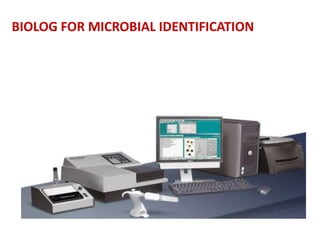
BIOLOG FOR MICROBIAL IDENTIFICATION
BIOLOG IDENTIFICATION SYSTEM
It is a new instrument that establishes an
identification of bacteria based on the exchange of
electron produced during an organisms respiration,
leading to a subsequent tetrazolium based colour change.
This system tests the ability of a microorganisms to
oxidize a panel of 95 different carbon source
 Biolog panel contain 95 tests and the manufacturer has
been abel to compile a data base that includes 434
species or group of bacteria.
 Using biolog database,. over 2650 species of bacteria,
yeast and filamentous fungi can be identified by just
preparing a cell suspension and inoculate the
appropriate microplate.
PRINCIPLE OF WORKING:
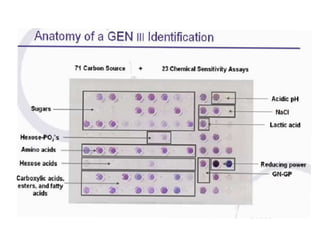
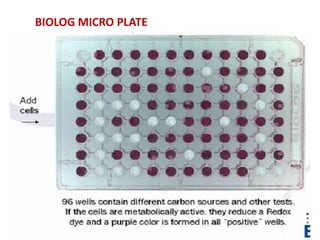
 Biolog's microplate use redox chemistry to
colorimetrically indicate respiration of live cell
suspension.
 All wells are initially colourless, when a chemical in a
well is oxidised there is a burst of respiration and the
reduce a tetrazolium dye, forming a purple colour
 And a reference well contain no carbon source
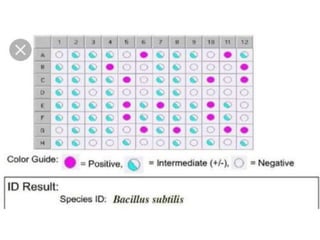
 The test yield a pattern of purple well which consists
a metabolic fingerprint of each organisms
BIOLOG MICRO PLATE
PROCEDURE:
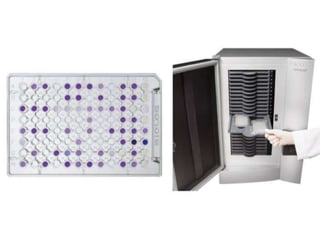
 The biolog system consists of a microplate containing
95 different carbon source, a contol well, a
turbidimeter, a computer driven automatic plate
reader.
 Culture to be tested were removed from storage,
subculture twice on trupticase soy agar containing 5
% sheep blood, and incubate overnight at 35°c.
 The inoculum to be used for testing was
prepared from second subculture.
 The inoculum was prepared by rolling a cotton
swab over the agar plate and preparing
suspension in 18-20 ml of 0.85% saline to
establish the appropriate inoculum density
relative to that of the milk of magnesia, standard
specified by manufacturer.
 The resulting suspension was poured into a
multi-channel pipette reservoir, precisely 150
micro liter of the suspension was dispensed in
to each well of microplate.he microplate was
incubated at 35°c for 4 hours.
 Then the plate was placed in the reader and
read automatically.
 The plates then returned to the incubator for an
additional 14-20 hours of incubation, and then
the second and final reading was made.
 The plates then returned to the incubator for an
additional 14-20 hours of incubation, and then the
second and final reading was made.
 The phenotypic fingerprint of purple well is
compared to bilog's extensives species library. If a
match is found, a species level identification of the
isolate is made.
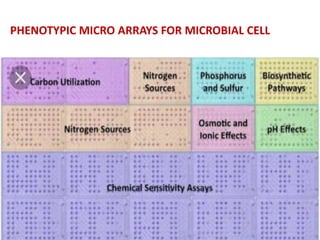
PHENOTYPIC MICRO ARRAYS FOR MICROBIAL CELL
1. The simplest and easiest bacterial ID system.
2. No Gram stain needed.
3. No pretest or follow on tests needed.
4.
4. Requires very few cells OD=0.01.
5.
5. One minute setup.
6. ID both GN and GP bacteria is a single,
universal panel.
7. 96 tests selected after evaluating 1,920 tests
FEATURES:
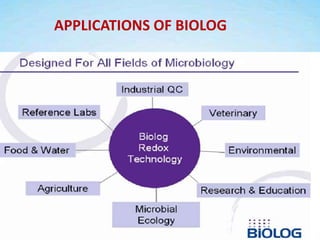
APPLICATIONS OF BIOLOG
Thank you
Submitted to,
Dr. Prashant. P. Jambhulkar,
Department of plant pathology,
RLBCAU, Jhansi.
Thank you
Submitted to,
Dr. Prashant.P. Jambhulkar,
Associate professor,
Department of plant pathology,
RLBCAU, Jhansi
Submitted by,
Sanjay H B- Ag/Pg/0017/19
M SC Ag GPB
RLBCAU, Jhansi

Bacteriology ppt

  • 1.
    RANI LAKSHMI BAICENTRAL AGRICULTURAL UNIVERSITY COLLEGE OF AGRICULTURE, JHANSI UP COURSE: Plant Bacteriology APP 503 (2+1) TOPIC: Identification of bacteria using biolog
  • 2.
    INTRODUCTION Identification of bacteriais essential for nomenclature, to know about its effectiveness, pathogenicity and it's management.  A large number of automated, semi-automated and manual systems are practiced for identification of pathogenic bacteria.
  • 3.
     Most ofthese systems relay on bacterial growth and subsequent pH, directed colour change to estimate and identification.  And they are not good at identifying some important genera like Acinetobacter, moraxella, haemophilus etc
  • 4.
    BIOLOG FOR MICROBIALIDENTIFICATION
  • 5.
    BIOLOG IDENTIFICATION SYSTEM Itis a new instrument that establishes an identification of bacteria based on the exchange of electron produced during an organisms respiration, leading to a subsequent tetrazolium based colour change. This system tests the ability of a microorganisms to oxidize a panel of 95 different carbon source
  • 7.
     Biolog panelcontain 95 tests and the manufacturer has been abel to compile a data base that includes 434 species or group of bacteria.  Using biolog database,. over 2650 species of bacteria, yeast and filamentous fungi can be identified by just preparing a cell suspension and inoculate the appropriate microplate.
  • 8.
    PRINCIPLE OF WORKING: Biolog's microplate use redox chemistry to colorimetrically indicate respiration of live cell suspension.  All wells are initially colourless, when a chemical in a well is oxidised there is a burst of respiration and the reduce a tetrazolium dye, forming a purple colour  And a reference well contain no carbon source  The test yield a pattern of purple well which consists a metabolic fingerprint of each organisms
  • 9.
  • 10.
    PROCEDURE:  The biologsystem consists of a microplate containing 95 different carbon source, a contol well, a turbidimeter, a computer driven automatic plate reader.  Culture to be tested were removed from storage, subculture twice on trupticase soy agar containing 5 % sheep blood, and incubate overnight at 35°c.
  • 12.
     The inoculumto be used for testing was prepared from second subculture.  The inoculum was prepared by rolling a cotton swab over the agar plate and preparing suspension in 18-20 ml of 0.85% saline to establish the appropriate inoculum density relative to that of the milk of magnesia, standard specified by manufacturer.
  • 13.
     The resultingsuspension was poured into a multi-channel pipette reservoir, precisely 150 micro liter of the suspension was dispensed in to each well of microplate.he microplate was incubated at 35°c for 4 hours.  Then the plate was placed in the reader and read automatically.  The plates then returned to the incubator for an additional 14-20 hours of incubation, and then the second and final reading was made.
  • 14.
     The platesthen returned to the incubator for an additional 14-20 hours of incubation, and then the second and final reading was made.  The phenotypic fingerprint of purple well is compared to bilog's extensives species library. If a match is found, a species level identification of the isolate is made.
  • 15.
    PHENOTYPIC MICRO ARRAYSFOR MICROBIAL CELL
  • 17.
    1. The simplestand easiest bacterial ID system. 2. No Gram stain needed. 3. No pretest or follow on tests needed. 4. 4. Requires very few cells OD=0.01. 5. 5. One minute setup. 6. ID both GN and GP bacteria is a single, universal panel. 7. 96 tests selected after evaluating 1,920 tests FEATURES:
  • 18.
  • 19.
    Thank you Submitted to, Dr.Prashant. P. Jambhulkar, Department of plant pathology, RLBCAU, Jhansi. Thank you Submitted to, Dr. Prashant.P. Jambhulkar, Associate professor, Department of plant pathology, RLBCAU, Jhansi Submitted by, Sanjay H B- Ag/Pg/0017/19 M SC Ag GPB RLBCAU, Jhansi