DR. GEETHA JANET VITUS
PROFESSOR,HEAD&
HON. DIRECTOR, CLDD,
DEPT.OF.EDUCATION
UNIVERSITY OF KERALA.
UNDERSTANDING OUR
LEARNERS
AN OUTLINE
 Discuss the importance of understanding our learners
 List various factors that need be known about learners
 Explain how adults learn
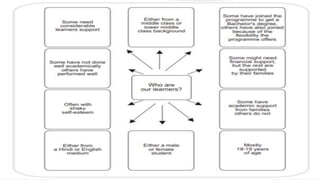
 Prepare a generic picture of the target learners.
WHY IS IT IMPORTANT TO KNOW OUR
LEARNERS
Effective pedagogy begins with knowing the student well.
It is important to know our learners so that we understand their:
 educational and social background; present knowledge level
 learning needs and their learning styles
 values, attitudes, and their cultural background
 motivation and desire for learning.
WHAT DO WE NEED TO KNOW ABOUT OUR
LEARNERS?
 Demographic factors
 Cognitive and metacognitive factors
 Motivational and Affective factors
 Learning factors
 Individual differences factors
 Subject background
 Resource factors
DEFINING “LEARNER-CENTERED”
 “Learner-centered” is the perspective that couples a focus on
individual learners— their heredity, experiences, perspectives,
backgrounds, talents, interests, capacities, and needs with a focus
on learning
 Learner-centered education is a reflection in practice of the Learner-
Centered Psychological Principles—the programs, practices,
policies, and people that support learning for all.
 Learner-centered is also related to the beliefs, characteristics,
dispositions, and practices of teachers—practices primarily created
by the teacher.
 “Learner-centeredness” is in “the eye of the beholder”: it varies as a
function of learner perceptions, which in turn are the result of
learners’ prior experiences, self-beliefs, and attitudes about schools
and learning as well as their current interests, values, and goals.
THE LEARNER- CENTERED PSYCHOLOGICAL PRINCIPLES
 Principle 1: Nature of the learning process
 Principle 2: Goals of the learning process
 Principle 3: Construction of knowledge
 Principle 4: Strategic thinking
 Principle 5: Thinking about thinking
 Principle 6: Context of learning
 Principle 7: Motivational and emotional influences on learning
THE LEARNER- CENTERED PSYCHOLOGICAL
PRINCIPLES
 Principle 8: Intrinsic motivation to learn
 Principle 9: Effects of motivation on effort
 Principle 10: Developmental influence on learning As individual
 Principle 11: Social influences on learning
 Principle 12: Individual differences in learning
 Principle 13: Learning and diversity
 Principle 14: Standards and assessment
DIMENSIONS OF LEARNING
 Attitudes and perceptions
 Acquire and integrate knowledge
 Extend and refine knowledge
 Use Knowledge meaningfully
 Habits of mind
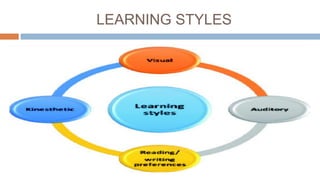
LEARNING STYLES
MODES OF LEARNING
 Learning by Observation
 Learning by Imitation
 Learning by trail and error
 Learning by Insight
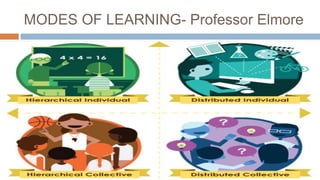
MODES OF LEARNING- Professor Elmore
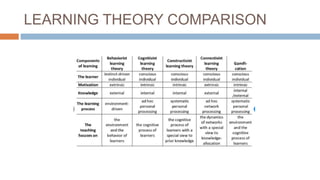
LEARNING THEORY COMPARISON
HOW WILL WE COLLECT
INFORMATION?
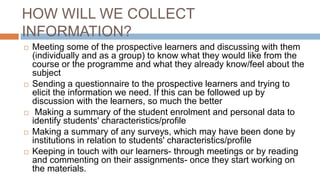
 Meeting some of the prospective learners and discussing with them
(individually and as a group) to know what they would like from the
course or the programme and what they already know/feel about the
subject
 Sending a questionnaire to the prospective learners and trying to
elicit the information we need. If this can be followed up by
discussion with the learners, so much the better
 Making a summary of the student enrolment and personal data to
identify students' characteristics/profile
 Making a summary of any surveys, which may have been done by
institutions in relation to students' characteristics/profile
 Keeping in touch with our learners- through meetings or by reading
and commenting on their assignments- once they start working on
the materials.
HOW DO ADULTS LEARN?
 Self-directed learning
 Prior experience
 Problem-centred learning
 Learning by doing
 Preference for democratic style of learning
 Experiencing a sense of progression, a sense of achievement
IMPLICATIONS OF UNDERSTANDING LEARNERS'
CHARACTERISTICS
 Understand the language level that would be easily understood by the learners in
comprehending concepts, new information, theory, etc.
 Understand the entry level of the learners with regard to knowledge and skills so
as to build on what the learners already know or possess
 Include examples that are based on learners' experiences
 Include references and further readings that the learners are able to access within
their learning environment
 Present information in a manner that would minimise their learning difficulties
 develop materials that would ensure interaction between the learner and the text
 Evolve a Learner Support System that is sensitive to the learners' needs
 Develop a system that ensures regular feedback on the quality of materials that are
issued as well as students' perceptions on the efficacy of the Learner Support
System
“ACTIVE LEARNING”- WHY IS IT
IMPORTANT?
Active learning, according to Charles Bonwell, is any strategy
“that involves learners in doing things and thinking about the
things they are doing.” “Active learning” helps us learn better
because it is based on experience and reflection
Why do you think it’s important to actively think about
what you are doing?
ACTIVE LEARNING EXAMPLES
Individual and group project-based assignments Pairing activities
such as “think, pair, share” Involving learners in research Job
shadowing (learners accompany an employee/worker at the
workplace, observing and learning about various tasks
associated with an occupation). Involving learners in well-
structured questions and answer sessions
ACTIVE LEARNING STRTATEGIES
 Role Play: a method of acting out an imaginary but real life
situation Debate/discussion panel: offers opportunity to verbal
presentations of views and arguments
 Brainstorming: learners are invited to quickly and freely
generate ideas/responses to issues/problems/topics Buzz
session: learners are divided into small groups to discuss a
particular issue/problem
ACTIVE LEARNING STRTATEGIES
 Concept Mapping: allows learners to visually represent
connections and relationships between concepts/ideas and
information.
 Demonstration: a practical presentation of a process or
procedure or skill which is designed to illustrate theoretical
principles, concepts or ideas.
 Jigsaw Method: each learner works on just one part of a project
or problem, then learners combine their work to complete the
whole task.
 Dialogue Journals: A formal repository for personal learners
writing that can be used to promote reflection, synthesis of
ACTIVE LEARNING STRTATEGIES
 Carousel Brainstorming Exercise: learners working in
cooperative groups write their responses to a question, moving
from poster to poster at set time intervals.
 Case Studies: learners take one issue or event (e.g. Martial
Law during the Marcos Era), and try to investigate, analyze,
synthesize, and evaluate various viewpoints on the issue.
 Think-pair-share: learners individually think for a moment about
a question posed in class, before pairing up with another
learner to discuss their thoughts. Pairs are then asked to share
with the entire group.
ACTIVE LEARNING STRTATEGIES
 Micro-teaching: learners are asked to give a lesson, speech, or
presentation on a topic to their classmates.
 Project-Based Learning: learners investigate a problem in-
depth and create a project (such as a poster or booklet) to
present to their classmates, or display in the classroom.
COLLABORATIVE LEARNING
 Many ‘active learning strategies’ are collaborative.
Collaborative learning encompasses a variety of approaches to
learning including small group or team-based activities. A way
for learners to develop the ability to work as part of a team A
way for learners to acquire and improve essential interpersonal
life skills A way for learners to take turns with different roles,
such as facilitator, recorder, reporter, etc.
Q. How do you think ‘collaborative learning’ might help
improve a learners’ understanding of your lesson?
ACTIVE LEARNING PHILOSOPHY
What I hear, I forget What I hear, and see, I remember a little.
What I hear, see and ask questions or discuss, I begin to
understand. When I hear, see, discuss and do, I acquire
knowledge and skill. What I teach to another, I master.
Learning ppt

Learning ppt

  • 1.
    DR. GEETHA JANETVITUS PROFESSOR,HEAD& HON. DIRECTOR, CLDD, DEPT.OF.EDUCATION UNIVERSITY OF KERALA.
  • 2.
  • 3.
    AN OUTLINE  Discussthe importance of understanding our learners  List various factors that need be known about learners  Explain how adults learn  Prepare a generic picture of the target learners.
  • 4.
    WHY IS ITIMPORTANT TO KNOW OUR LEARNERS Effective pedagogy begins with knowing the student well. It is important to know our learners so that we understand their:  educational and social background; present knowledge level  learning needs and their learning styles  values, attitudes, and their cultural background  motivation and desire for learning.
  • 5.
    WHAT DO WENEED TO KNOW ABOUT OUR LEARNERS?  Demographic factors  Cognitive and metacognitive factors  Motivational and Affective factors  Learning factors  Individual differences factors  Subject background  Resource factors
  • 6.
    DEFINING “LEARNER-CENTERED”  “Learner-centered”is the perspective that couples a focus on individual learners— their heredity, experiences, perspectives, backgrounds, talents, interests, capacities, and needs with a focus on learning  Learner-centered education is a reflection in practice of the Learner- Centered Psychological Principles—the programs, practices, policies, and people that support learning for all.  Learner-centered is also related to the beliefs, characteristics, dispositions, and practices of teachers—practices primarily created by the teacher.  “Learner-centeredness” is in “the eye of the beholder”: it varies as a function of learner perceptions, which in turn are the result of learners’ prior experiences, self-beliefs, and attitudes about schools and learning as well as their current interests, values, and goals.
  • 7.
    THE LEARNER- CENTEREDPSYCHOLOGICAL PRINCIPLES  Principle 1: Nature of the learning process  Principle 2: Goals of the learning process  Principle 3: Construction of knowledge  Principle 4: Strategic thinking  Principle 5: Thinking about thinking  Principle 6: Context of learning  Principle 7: Motivational and emotional influences on learning
  • 8.
    THE LEARNER- CENTEREDPSYCHOLOGICAL PRINCIPLES  Principle 8: Intrinsic motivation to learn  Principle 9: Effects of motivation on effort  Principle 10: Developmental influence on learning As individual  Principle 11: Social influences on learning  Principle 12: Individual differences in learning  Principle 13: Learning and diversity  Principle 14: Standards and assessment
  • 9.
    DIMENSIONS OF LEARNING Attitudes and perceptions  Acquire and integrate knowledge  Extend and refine knowledge  Use Knowledge meaningfully  Habits of mind
  • 10.
  • 11.
    MODES OF LEARNING Learning by Observation  Learning by Imitation  Learning by trail and error  Learning by Insight
  • 12.
    MODES OF LEARNING-Professor Elmore
  • 13.
  • 14.
    HOW WILL WECOLLECT INFORMATION?  Meeting some of the prospective learners and discussing with them (individually and as a group) to know what they would like from the course or the programme and what they already know/feel about the subject  Sending a questionnaire to the prospective learners and trying to elicit the information we need. If this can be followed up by discussion with the learners, so much the better  Making a summary of the student enrolment and personal data to identify students' characteristics/profile  Making a summary of any surveys, which may have been done by institutions in relation to students' characteristics/profile  Keeping in touch with our learners- through meetings or by reading and commenting on their assignments- once they start working on the materials.
  • 15.
    HOW DO ADULTSLEARN?  Self-directed learning  Prior experience  Problem-centred learning  Learning by doing  Preference for democratic style of learning  Experiencing a sense of progression, a sense of achievement
  • 17.
    IMPLICATIONS OF UNDERSTANDINGLEARNERS' CHARACTERISTICS  Understand the language level that would be easily understood by the learners in comprehending concepts, new information, theory, etc.  Understand the entry level of the learners with regard to knowledge and skills so as to build on what the learners already know or possess  Include examples that are based on learners' experiences  Include references and further readings that the learners are able to access within their learning environment  Present information in a manner that would minimise their learning difficulties  develop materials that would ensure interaction between the learner and the text  Evolve a Learner Support System that is sensitive to the learners' needs  Develop a system that ensures regular feedback on the quality of materials that are issued as well as students' perceptions on the efficacy of the Learner Support System
  • 18.
    “ACTIVE LEARNING”- WHYIS IT IMPORTANT? Active learning, according to Charles Bonwell, is any strategy “that involves learners in doing things and thinking about the things they are doing.” “Active learning” helps us learn better because it is based on experience and reflection Why do you think it’s important to actively think about what you are doing?
  • 19.
    ACTIVE LEARNING EXAMPLES Individualand group project-based assignments Pairing activities such as “think, pair, share” Involving learners in research Job shadowing (learners accompany an employee/worker at the workplace, observing and learning about various tasks associated with an occupation). Involving learners in well- structured questions and answer sessions
  • 20.
    ACTIVE LEARNING STRTATEGIES Role Play: a method of acting out an imaginary but real life situation Debate/discussion panel: offers opportunity to verbal presentations of views and arguments  Brainstorming: learners are invited to quickly and freely generate ideas/responses to issues/problems/topics Buzz session: learners are divided into small groups to discuss a particular issue/problem
  • 21.
    ACTIVE LEARNING STRTATEGIES Concept Mapping: allows learners to visually represent connections and relationships between concepts/ideas and information.  Demonstration: a practical presentation of a process or procedure or skill which is designed to illustrate theoretical principles, concepts or ideas.  Jigsaw Method: each learner works on just one part of a project or problem, then learners combine their work to complete the whole task.  Dialogue Journals: A formal repository for personal learners writing that can be used to promote reflection, synthesis of
  • 22.
    ACTIVE LEARNING STRTATEGIES Carousel Brainstorming Exercise: learners working in cooperative groups write their responses to a question, moving from poster to poster at set time intervals.  Case Studies: learners take one issue or event (e.g. Martial Law during the Marcos Era), and try to investigate, analyze, synthesize, and evaluate various viewpoints on the issue.  Think-pair-share: learners individually think for a moment about a question posed in class, before pairing up with another learner to discuss their thoughts. Pairs are then asked to share with the entire group.
  • 23.
    ACTIVE LEARNING STRTATEGIES Micro-teaching: learners are asked to give a lesson, speech, or presentation on a topic to their classmates.  Project-Based Learning: learners investigate a problem in- depth and create a project (such as a poster or booklet) to present to their classmates, or display in the classroom.
  • 24.
    COLLABORATIVE LEARNING  Many‘active learning strategies’ are collaborative. Collaborative learning encompasses a variety of approaches to learning including small group or team-based activities. A way for learners to develop the ability to work as part of a team A way for learners to acquire and improve essential interpersonal life skills A way for learners to take turns with different roles, such as facilitator, recorder, reporter, etc. Q. How do you think ‘collaborative learning’ might help improve a learners’ understanding of your lesson?
  • 25.
    ACTIVE LEARNING PHILOSOPHY WhatI hear, I forget What I hear, and see, I remember a little. What I hear, see and ask questions or discuss, I begin to understand. When I hear, see, discuss and do, I acquire knowledge and skill. What I teach to another, I master.