Customer and Supplier 
Interaction – The Industrial 
Marketing and Purchasing 
IMP Model 
Mr. Gan Chun Chet 
MSc (UMIST) (UK), BSc (Hon) (UK)
The IMP Model 
 The Industrial Marketing and Purchasing IMP 
Interaction Model 
 By the Industrial Marketing and Purchasing 
Group, Published in 1982 
 Model developed after analysing 1300 
relationships in Europe
The IMP Model 
 Assumed long term relationship 
 The IMP Model consists of: 
1) Interaction Process 
2) Interaction Parties 
3) Interaction Environment 
4) Atmosphere
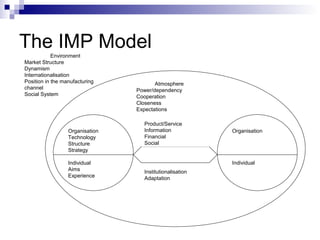
The IMP Model 
Organisation 
Technology 
Structure 
Strategy 
Individual 
Aims 
Experience 
Organisation 
Individual 
Atmosphere 
Power/dependency 
Cooperation 
Closeness 
Expectations 
Product/Service 
Information 
Financial 
Social 
Institutionalisation 
Adaptation 
Environment 
Market Structure 
Dynamism 
Internationalisation 
Position in the manufacturing 
channel 
Social System
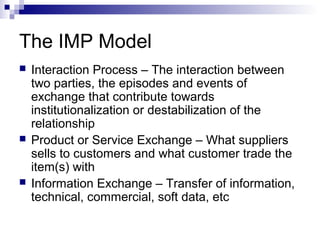
The IMP Model 
 Interaction Process – The interaction between 
two parties, the episodes and events of 
exchange that contribute towards 
institutionalization or destabilization of the 
relationship 
 Product or Service Exchange – What suppliers 
sells to customers and what customer trade the 
item(s) with 
 Information Exchange – Transfer of information, 
technical, commercial, soft data, etc
The IMP Model 
 Financial Exchange – Currency exchange and 
uncertainty involved over time 
 Social Exchange – Communication, experience, 
culture, etc.
The IMP Model 
 Interaction Parties – The characteristic of the 
parties, the participants 
 Technology – Capability of manufacturing plant 
 Organization Size, Structure and Strategy – Size 
often relate to power. Strategy relates to 
emphasis and priorities of an organization 
 Organization Experience – The number of 
exchanges 
 Individuals – The person involved during the 
interaction, salesperson
The IMP Model 
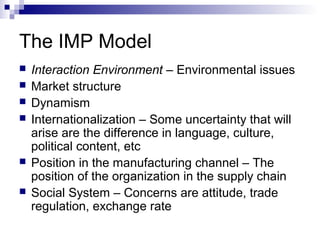
 Interaction Environment – Environmental issues 
 Market structure 
 Dynamism 
 Internationalization – Some uncertainty that will 
arise are the difference in language, culture, 
political content, etc 
 Position in the manufacturing channel – The 
position of the organization in the supply chain 
 Social System – Concerns are attitude, trade 
regulation, exchange rate
The IMP Model 
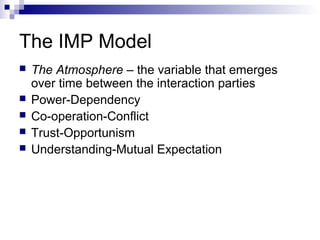
 The Atmosphere – the variable that emerges 
over time between the interaction parties 
 Power-Dependency 
 Co-operation-Conflict 
 Trust-Opportunism 
 Understanding-Mutual Expectation
Reference 
 Hakansson, H., “An Interaction Approach”, 
International Marketing and Purchasing of 
Industrial Goods, John Wiley, New York, 1982, 
pp. 10-27.

The Industrial Marketing and Purchasing IMP Model

  • 1.
    Customer and Supplier Interaction – The Industrial Marketing and Purchasing IMP Model Mr. Gan Chun Chet MSc (UMIST) (UK), BSc (Hon) (UK)
  • 2.
    The IMP Model  The Industrial Marketing and Purchasing IMP Interaction Model  By the Industrial Marketing and Purchasing Group, Published in 1982  Model developed after analysing 1300 relationships in Europe
  • 3.
    The IMP Model  Assumed long term relationship  The IMP Model consists of: 1) Interaction Process 2) Interaction Parties 3) Interaction Environment 4) Atmosphere
  • 4.
    The IMP Model Organisation Technology Structure Strategy Individual Aims Experience Organisation Individual Atmosphere Power/dependency Cooperation Closeness Expectations Product/Service Information Financial Social Institutionalisation Adaptation Environment Market Structure Dynamism Internationalisation Position in the manufacturing channel Social System
  • 5.
    The IMP Model  Interaction Process – The interaction between two parties, the episodes and events of exchange that contribute towards institutionalization or destabilization of the relationship  Product or Service Exchange – What suppliers sells to customers and what customer trade the item(s) with  Information Exchange – Transfer of information, technical, commercial, soft data, etc
  • 6.
    The IMP Model  Financial Exchange – Currency exchange and uncertainty involved over time  Social Exchange – Communication, experience, culture, etc.
  • 7.
    The IMP Model  Interaction Parties – The characteristic of the parties, the participants  Technology – Capability of manufacturing plant  Organization Size, Structure and Strategy – Size often relate to power. Strategy relates to emphasis and priorities of an organization  Organization Experience – The number of exchanges  Individuals – The person involved during the interaction, salesperson
  • 8.
    The IMP Model  Interaction Environment – Environmental issues  Market structure  Dynamism  Internationalization – Some uncertainty that will arise are the difference in language, culture, political content, etc  Position in the manufacturing channel – The position of the organization in the supply chain  Social System – Concerns are attitude, trade regulation, exchange rate
  • 9.
    The IMP Model  The Atmosphere – the variable that emerges over time between the interaction parties  Power-Dependency  Co-operation-Conflict  Trust-Opportunism  Understanding-Mutual Expectation
  • 10.
    Reference  Hakansson,H., “An Interaction Approach”, International Marketing and Purchasing of Industrial Goods, John Wiley, New York, 1982, pp. 10-27.