Blink’s Improvements to
Flink SQL &Table API
FlinkForward 2017.4Shaoxuan Wang,
Xiaowei Jiang
{xiaowei.jxw,shaoxuan.wang}
@alibaba-inc.com
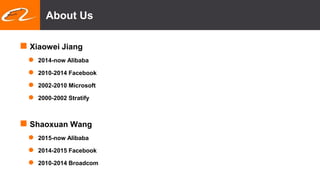
About Us
 Xiaowei Jiang
 2014-now Alibaba
 2010-2014 Facebook
 2002-2010 Microsoft
 2000-2002 Stratify
 Shaoxuan Wang
 2015-now Alibaba
 2014-2015 Facebook
 2010-2014 Broadcom
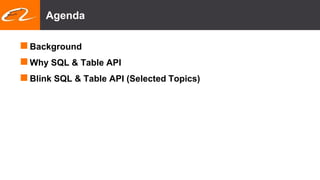
Agenda
Background
Why SQL & Table API
Blink SQL & Table API (Selected Topics)
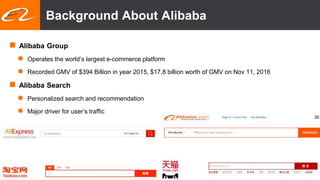
Background About Alibaba
 Alibaba Group
 Operates the world’s largest e-commerce platform
 Recorded GMV of $394 Billion in year 2015, $17.8 billion worth of GMV on Nov 11, 2016
 Alibaba Search
 Personalized search and recommendation
 Major driver for user’s traffic
What is Blink?
Blink – A project to make Flink work well for large scale
production at Alibaba
 Run on Thousands of Nodes In Production
 Support Key Production Scenarios, such as Search and
Recommendation
 Compatible with Flink API and Ecosystem
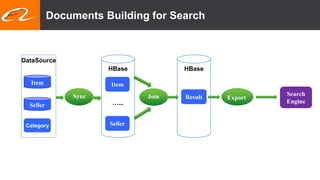
Documents Building for Search
Filter
Item
Filter
Category Seller
Join Search
Engine
HBase
Result
UIC
DataSource
Item
Seller
HBase
ExportSync
…...
Why Flink SQL & Table API
 Unify batch and streaming
 Flink currently offers DataSet API for batch and DataStream API for streaming
 We want a single API that can run in both batch and streaming mode
 Simplify user code
 Users only describe the semantics of their data processing
 Leave hard optimization problems to the system
 SQL is proven to be good at describing data processing
 Table API makes multi-statement data processing easy to write
 Table API also makes it possible/easy to extend standard SQL when necessary
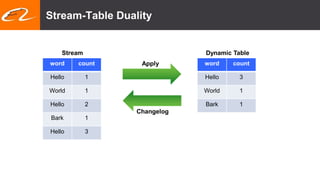
Stream-Table Duality
word count
Hello 3
World 1
Bark 1
word count
Hello 1
World 1
Hello 2
Bark 1
Hello 3
Stream Dynamic Table
Apply
Changelog
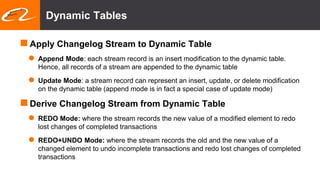
Dynamic Tables
Apply Changelog Stream to Dynamic Table
 Append Mode: each stream record is an insert modification to the dynamic table.
Hence, all records of a stream are appended to the dynamic table
 Update Mode: a stream record can represent an insert, update, or delete modification
on the dynamic table (append mode is in fact a special case of update mode)
Derive Changelog Stream from Dynamic Table
 REDO Mode: where the stream records the new value of a modified element to redo
lost changes of completed transactions
 REDO+UNDO Mode: where the stream records the old and the new value of a
changed element to undo incomplete transactions and redo lost changes of completed
transactions
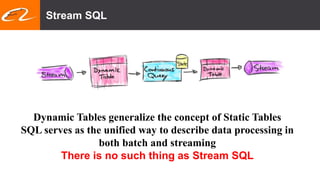
Stream SQL
Dynamic Tables generalize the concept of Static Tables
SQL serves as the unified way to describe data processing in
both batch and streaming
There is no such thing as Stream SQL
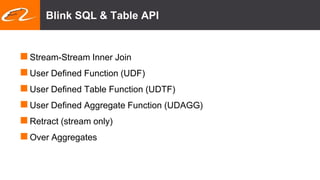
Blink SQL & Table API
Stream-Stream Inner Join
User Defined Function (UDF)
User Defined Table Function (UDTF)
User Defined Aggregate Function (UDAGG)
Retract (stream only)
Over Aggregates
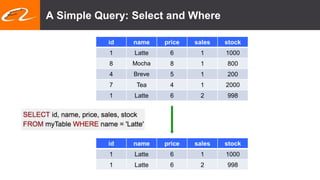
A Simple Query: Select and Where
id name price sales stock
1 Latte 6 1 1000
8 Mocha 8 1 800
4 Breve 5 1 200
7 Tea 4 1 2000
1 Latte 6 2 998
id name price sales stock
1 Latte 6 1 1000
1 Latte 6 2 998
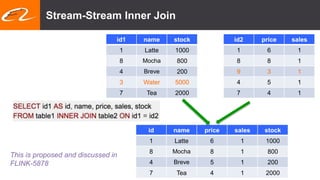
Stream-Stream Inner Join
id1 name stock
1 Latte 1000
8 Mocha 800
4 Breve 200
3 Water 5000
7 Tea 2000
id2 price sales
1 6 1
8 8 1
9 3 1
4 5 1
7 4 1
id name price sales stock
1 Latte 6 1 1000
8 Mocha 8 1 800
4 Breve 5 1 200
7 Tea 4 1 2000
This is proposed and discussed in
FLINK-5878
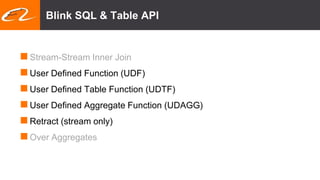
Blink SQL & Table API
Stream-Stream Inner Join
User Defined Function (UDF)
User Defined Table Function (UDTF)
User Defined Aggregate Function (UDAGG)
Retract (stream only)
Over Aggregates
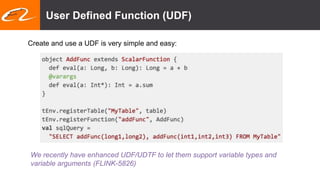
User Defined Function (UDF)
Create and use a UDF is very simple and easy:
We recently have enhanced UDF/UDTF to let them support variable types and
variable arguments (FLINK-5826)
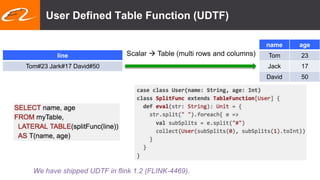
User Defined Table Function (UDTF)
We have shipped UDTF in flink 1.2 (FLINK-4469).
name age
Tom 23
Jack 17
David 50
line
Tom#23 Jark#17 David#50
Scalar  Table (multi rows and columns)
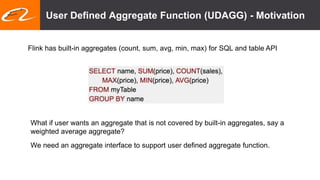
User Defined Aggregate Function (UDAGG) - Motivation
Flink has built-in aggregates (count, sum, avg, min, max) for SQL and table API
What if user wants an aggregate that is not covered by built-in aggregates, say a
weighted average aggregate?
We need an aggregate interface to support user defined aggregate function.
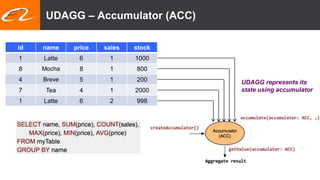
UDAGG – Accumulator (ACC)
id name price sales stock
1 Latte 6 1 1000
8 Mocha 8 1 800
4 Breve 5 1 200
7 Tea 4 1 2000
1 Latte 6 2 998
UDAGG represents its
state using accumulator
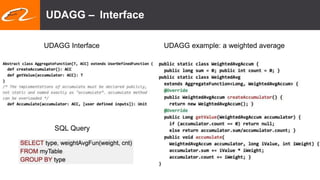
UDAGG – Interface
UDAGG example: a weighted average
SQL Query
UDAGG Interface
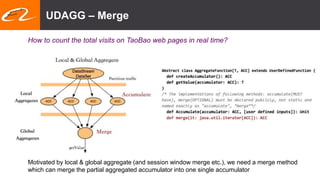
UDAGG – Merge
Motivated by local & global aggregate (and session window merge etc.), we need a merge method
which can merge the partial aggregated accumulator into one single accumulator
How to count the total visits on TaoBao web pages in real time?
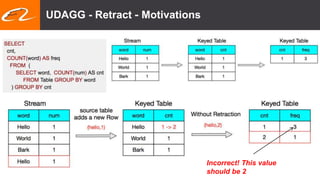
UDAGG - Retract - Motivations
Incorrect! This value
should be 2
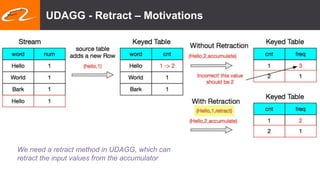
UDAGG - Retract – Motivations
We need a retract method in UDAGG, which can
retract the input values from the accumulator
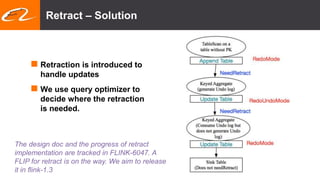
Retract – Solution
The design doc and the progress of retract
implementation are tracked in FLINK-6047. A
FLIP for retract is on the way. We aim to release
it in flink-1.3
 Retraction is introduced to
handle updates
 We use query optimizer to
decide where the retraction
is needed.
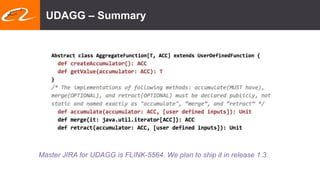
UDAGG – Summary
Master JIRA for UDAGG is FLINK-5564. We plan to ship it in release 1.3.
Blink SQL & Table API
Stream-Stream Inner Join
User Defined Function (UDF)
User Defined Table Function (UDTF)
User Defined Aggregate Function (UDAGG)
Retract (stream only)
Over Aggregates
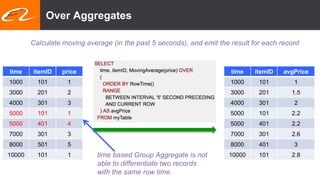
Over Aggregates
time itemID avgPrice
1000 101 1
3000 201 1.5
4000 301 2
5000 101 2.2
5000 401 2.2
7000 301 2.6
8000 401 3
10000 101 2.8
time itemID price
1000 101 1
3000 201 2
4000 301 3
5000 101 1
5000 401 4
7000 301 3
8000 501 5
10000 101 1 time based Group Aggregate is not
able to differentiate two records
with the same row time.
Calculate moving average (in the past 5 seconds), and emit the result for each record
Group/Over Aggregates
Grouping methods: Groupby / Over
Window types:
 Time/Count + TUMBLE/SESSION/SLIDE window;
 OVER Range/Rows window
Time types: Event time; Process time (only for stream)
We have been working closely with team dataArtisans, from the design to the
implementation on FLIP11 (FLINK-4557). Upon now, except the unbounded group
aggregate, all other group/over aggregates are fully supported via SQL query. We are
working on the support for table API.
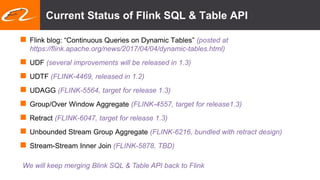
Current Status of Flink SQL & Table API
 Flink blog: “Continuous Queries on Dynamic Tables” (posted at
https://flink.apache.org/news/2017/04/04/dynamic-tables.html)
 UDF (several improvements will be released in 1.3)
 UDTF (FLINK-4469, released in 1.2)
 UDAGG (FLINK-5564, target for release 1.3)
 Group/Over Window Aggregate (FLINK-4557, target for release1.3)
 Retract (FLINK-6047, target for release 1.3)
 Unbounded Stream Group Aggregate (FLINK-6216, bundled with retract design)
 Stream-Stream Inner Join (FLINK-5878, TBD)
We will keep merging Blink SQL & Table API back to Flink
Q & A
Thank You!

Flink Forward SF 2017: Shaoxuan Wang_Xiaowei Jiang - Blinks Improvements to Flink SQL And TableAPI

  • 1.
    Blink’s Improvements to FlinkSQL &Table API FlinkForward 2017.4Shaoxuan Wang, Xiaowei Jiang {xiaowei.jxw,shaoxuan.wang} @alibaba-inc.com
  • 2.
    About Us  XiaoweiJiang  2014-now Alibaba  2010-2014 Facebook  2002-2010 Microsoft  2000-2002 Stratify  Shaoxuan Wang  2015-now Alibaba  2014-2015 Facebook  2010-2014 Broadcom
  • 3.
    Agenda Background Why SQL &Table API Blink SQL & Table API (Selected Topics)
  • 4.
    Background About Alibaba Alibaba Group  Operates the world’s largest e-commerce platform  Recorded GMV of $394 Billion in year 2015, $17.8 billion worth of GMV on Nov 11, 2016  Alibaba Search  Personalized search and recommendation  Major driver for user’s traffic
  • 5.
    What is Blink? Blink– A project to make Flink work well for large scale production at Alibaba  Run on Thousands of Nodes In Production  Support Key Production Scenarios, such as Search and Recommendation  Compatible with Flink API and Ecosystem
  • 6.
    Documents Building forSearch Filter Item Filter Category Seller Join Search Engine HBase Result UIC DataSource Item Seller HBase ExportSync …...
  • 7.
    Why Flink SQL& Table API  Unify batch and streaming  Flink currently offers DataSet API for batch and DataStream API for streaming  We want a single API that can run in both batch and streaming mode  Simplify user code  Users only describe the semantics of their data processing  Leave hard optimization problems to the system  SQL is proven to be good at describing data processing  Table API makes multi-statement data processing easy to write  Table API also makes it possible/easy to extend standard SQL when necessary
  • 8.
    Stream-Table Duality word count Hello3 World 1 Bark 1 word count Hello 1 World 1 Hello 2 Bark 1 Hello 3 Stream Dynamic Table Apply Changelog
  • 9.
    Dynamic Tables Apply ChangelogStream to Dynamic Table  Append Mode: each stream record is an insert modification to the dynamic table. Hence, all records of a stream are appended to the dynamic table  Update Mode: a stream record can represent an insert, update, or delete modification on the dynamic table (append mode is in fact a special case of update mode) Derive Changelog Stream from Dynamic Table  REDO Mode: where the stream records the new value of a modified element to redo lost changes of completed transactions  REDO+UNDO Mode: where the stream records the old and the new value of a changed element to undo incomplete transactions and redo lost changes of completed transactions
  • 10.
    Stream SQL Dynamic Tablesgeneralize the concept of Static Tables SQL serves as the unified way to describe data processing in both batch and streaming There is no such thing as Stream SQL
  • 11.
    Blink SQL &Table API Stream-Stream Inner Join User Defined Function (UDF) User Defined Table Function (UDTF) User Defined Aggregate Function (UDAGG) Retract (stream only) Over Aggregates
  • 12.
    A Simple Query:Select and Where id name price sales stock 1 Latte 6 1 1000 8 Mocha 8 1 800 4 Breve 5 1 200 7 Tea 4 1 2000 1 Latte 6 2 998 id name price sales stock 1 Latte 6 1 1000 1 Latte 6 2 998
  • 13.
    Stream-Stream Inner Join id1name stock 1 Latte 1000 8 Mocha 800 4 Breve 200 3 Water 5000 7 Tea 2000 id2 price sales 1 6 1 8 8 1 9 3 1 4 5 1 7 4 1 id name price sales stock 1 Latte 6 1 1000 8 Mocha 8 1 800 4 Breve 5 1 200 7 Tea 4 1 2000 This is proposed and discussed in FLINK-5878
  • 14.
    Blink SQL &Table API Stream-Stream Inner Join User Defined Function (UDF) User Defined Table Function (UDTF) User Defined Aggregate Function (UDAGG) Retract (stream only) Over Aggregates
  • 15.
    User Defined Function(UDF) Create and use a UDF is very simple and easy: We recently have enhanced UDF/UDTF to let them support variable types and variable arguments (FLINK-5826)
  • 16.
    User Defined TableFunction (UDTF) We have shipped UDTF in flink 1.2 (FLINK-4469). name age Tom 23 Jack 17 David 50 line Tom#23 Jark#17 David#50 Scalar  Table (multi rows and columns)
  • 17.
    User Defined AggregateFunction (UDAGG) - Motivation Flink has built-in aggregates (count, sum, avg, min, max) for SQL and table API What if user wants an aggregate that is not covered by built-in aggregates, say a weighted average aggregate? We need an aggregate interface to support user defined aggregate function.
  • 18.
    UDAGG – Accumulator(ACC) id name price sales stock 1 Latte 6 1 1000 8 Mocha 8 1 800 4 Breve 5 1 200 7 Tea 4 1 2000 1 Latte 6 2 998 UDAGG represents its state using accumulator
  • 19.
    UDAGG – Interface UDAGGexample: a weighted average SQL Query UDAGG Interface
  • 20.
    UDAGG – Merge Motivatedby local & global aggregate (and session window merge etc.), we need a merge method which can merge the partial aggregated accumulator into one single accumulator How to count the total visits on TaoBao web pages in real time?
  • 21.
    UDAGG - Retract- Motivations Incorrect! This value should be 2
  • 22.
    UDAGG - Retract– Motivations We need a retract method in UDAGG, which can retract the input values from the accumulator
  • 23.
    Retract – Solution Thedesign doc and the progress of retract implementation are tracked in FLINK-6047. A FLIP for retract is on the way. We aim to release it in flink-1.3  Retraction is introduced to handle updates  We use query optimizer to decide where the retraction is needed.
  • 24.
    UDAGG – Summary MasterJIRA for UDAGG is FLINK-5564. We plan to ship it in release 1.3.
  • 25.
    Blink SQL &Table API Stream-Stream Inner Join User Defined Function (UDF) User Defined Table Function (UDTF) User Defined Aggregate Function (UDAGG) Retract (stream only) Over Aggregates
  • 26.
    Over Aggregates time itemIDavgPrice 1000 101 1 3000 201 1.5 4000 301 2 5000 101 2.2 5000 401 2.2 7000 301 2.6 8000 401 3 10000 101 2.8 time itemID price 1000 101 1 3000 201 2 4000 301 3 5000 101 1 5000 401 4 7000 301 3 8000 501 5 10000 101 1 time based Group Aggregate is not able to differentiate two records with the same row time. Calculate moving average (in the past 5 seconds), and emit the result for each record
  • 27.
    Group/Over Aggregates Grouping methods:Groupby / Over Window types:  Time/Count + TUMBLE/SESSION/SLIDE window;  OVER Range/Rows window Time types: Event time; Process time (only for stream) We have been working closely with team dataArtisans, from the design to the implementation on FLIP11 (FLINK-4557). Upon now, except the unbounded group aggregate, all other group/over aggregates are fully supported via SQL query. We are working on the support for table API.
  • 28.
    Current Status ofFlink SQL & Table API  Flink blog: “Continuous Queries on Dynamic Tables” (posted at https://flink.apache.org/news/2017/04/04/dynamic-tables.html)  UDF (several improvements will be released in 1.3)  UDTF (FLINK-4469, released in 1.2)  UDAGG (FLINK-5564, target for release 1.3)  Group/Over Window Aggregate (FLINK-4557, target for release1.3)  Retract (FLINK-6047, target for release 1.3)  Unbounded Stream Group Aggregate (FLINK-6216, bundled with retract design)  Stream-Stream Inner Join (FLINK-5878, TBD) We will keep merging Blink SQL & Table API back to Flink
  • 29.