- FABIAN HUESKE, SOFTWARE ENGINEER
APACHE FLINK® SQL IN Action
© 2019 dA Platform2
ABOUT ME
• Apache Flink PMC member & ASF member
‒Contributing since day 1 at TU Berlin
‒Focusing on Flink’s relational APIs since ~3.5 years
• Co-author of “Stream Processing with Apache Flink”
‒Expected release: April 2019
© 2019 dA Platform3
WHAT IS APACHE FLINK?
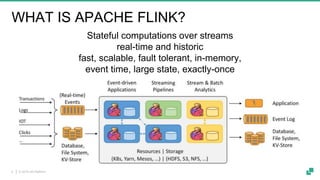
Stateful computations over streams
real-time and historic
fast, scalable, fault tolerant, in-memory,
event time, large state, exactly-once
© 2019 dA Platform4
HARDENED AT SCALE
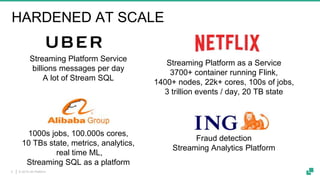
Streaming Platform Service
billions messages per day
A lot of Stream SQL
Streaming Platform as a Service
3700+ container running Flink,
1400+ nodes, 22k+ cores, 100s of jobs,
3 trillion events / day, 20 TB state
Fraud detection
Streaming Analytics Platform
1000s jobs, 100.000s cores,
10 TBs state, metrics, analytics,
real time ML,
Streaming SQL as a platform
© 2019 dA Platform5
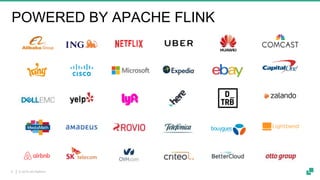
POWERED BY APACHE FLINK
© 2019 dA Platform6
FLINK’S POWERFUL ABSTRACTIONS
Process Function (events, state, time)
DataStream API (streams, windows)
SQL / Table API (dynamic tables)
Stream- & Batch
Data Processing
High-level
Analytics API
Stateful Event-
Driven Applications
val stats = stream
.keyBy("sensor")
.timeWindow(Time.seconds(5))
.sum((a, b) -> a.add(b))
def processElement(event: MyEvent, ctx: Context, out: Collector[Result]) = {
// work with event and state
(event, state.value) match { … }
out.collect(…) // emit events
state.update(…) // modify state
// schedule a timer callback
ctx.timerService.registerEventTimeTimer(event.timestamp + 500)
}
Layered abstractions to
navigate simple to complex use cases
© 2019 dA Platform7
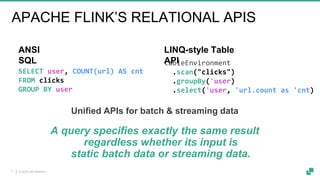
APACHE FLINK’S RELATIONAL APIS
Unified APIs for batch & streaming data
A query specifies exactly the same result
regardless whether its input is
static batch data or streaming data.
tableEnvironment
.scan("clicks")
.groupBy('user)
.select('user, 'url.count as 'cnt)
SELECT user, COUNT(url) AS cnt
FROM clicks
GROUP BY user
LINQ-style Table
API
ANSI
SQL
© 2019 dA Platform8
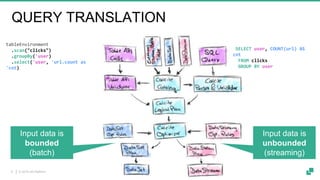
QUERY TRANSLATION
tableEnvironment
.scan("clicks")
.groupBy('user)
.select('user, 'url.count as
'cnt)
SELECT user, COUNT(url) AS
cnt
FROM clicks
GROUP BY user
Input data is
bounded
(batch)
Input data is
unbounded
(streaming)
© 2019 dA Platform9
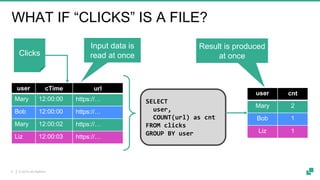
WHAT IF “CLICKS” IS A FILE?
Clicks
user cTime url
Mary 12:00:00 https://…
Bob 12:00:00 https://…
Mary 12:00:02 https://…
Liz 12:00:03 https://…
user cnt
Mary 2
Bob 1
Liz 1
SELECT
user,
COUNT(url) as cnt
FROM clicks
GROUP BY user
Input data is
read at once
Result is produced
at once
© 2019 dA Platform10
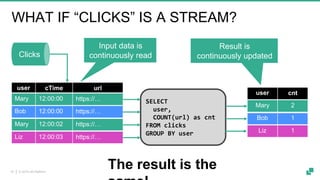
WHAT IF “CLICKS” IS A STREAM?
user cTime url
user cnt
SELECT
user,
COUNT(url) as cnt
FROM clicks
GROUP BY user
Clicks
Mary 12:00:00 https://…
Bob 12:00:00 https://…
Mary 12:00:02 https://…
Liz 12:00:03 https://…
Bob 1
Liz 1
Mary 1Mary 2
Input data is
continuously read
Result is
continuously updated
The result is the
© 2019 dA Platform11
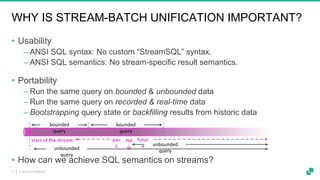
WHY IS STREAM-BATCH UNIFICATION IMPORTANT?
• Usability
‒ ANSI SQL syntax: No custom “StreamSQL” syntax.
‒ ANSI SQL semantics: No stream-specific result semantics.
• Portability
‒ Run the same query on bounded & unbounded data
‒ Run the same query on recorded & real-time data
‒ Bootstrapping query state or backfilling results from historic data
• How can we achieve SQL semantics on streams?
no
w
bounded
query
unbounded
query
pas
t
futur
e
bounded
query
start of the stream
unbounded
query
© 2019 dA Platform12
DATABASE SYSTEMS RUN QUERIES ON STREAMS
• Materialized views (MV) are similar to regular views,
but persisted to disk or memory
‒Used to speed-up analytical queries
‒MVs need to be updated when the base tables change
• MV maintenance is very similar to SQL on streams
‒Base table updates are a stream of DML statements
‒MV definition query is evaluated on that stream
‒MV is query result and continuously updated
© 2019 dA Platform13
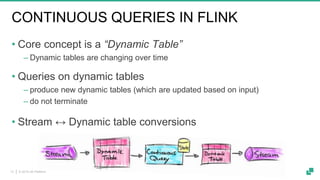
CONTINUOUS QUERIES IN FLINK
• Core concept is a “Dynamic Table”
‒ Dynamic tables are changing over time
• Queries on dynamic tables
‒ produce new dynamic tables (which are updated based on input)
‒ do not terminate
• Stream ↔ Dynamic table conversions
13
© 2019 dA Platform14
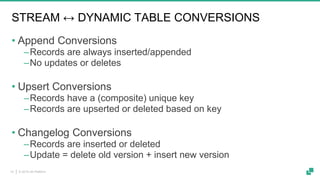
STREAM ↔ DYNAMIC TABLE CONVERSIONS
• Append Conversions
‒Records are always inserted/appended
‒No updates or deletes
• Upsert Conversions
‒Records have a (composite) unique key
‒Records are upserted or deleted based on key
• Changelog Conversions
‒Records are inserted or deleted
‒Update = delete old version + insert new version
© 2019 dA Platform15
SQL Feature Set in Flink 1.7.0
STREAMING ONLY
• OVER / WINDOW
‒ UNBOUNDED / BOUNDED PRECEDING
• INNER JOIN with time-versioned
• MATCH_RECOGNIZE
‒ Pattern Matching/CEP (SQL:2016)
BATCH ONLY
• UNION / INTERSECT / EXCEPT
• ORDER BY
STREAMING & BATCH
• SELECT FROM WHERE
• GROUP BY [HAVING]
‒ Non-windowed
‒ TUMBLE, HOP, SESSION windows
• JOIN
‒ Time-Windowed INNER + OUTER JOIN
‒ Non-windowed INNER + OUTER JOIN
• User-Defined Functions
‒ Scalar
‒ Aggregation
‒ Table-valued
© 2019 dA Platform16
WHAT CAN I BUILD WITH THIS?
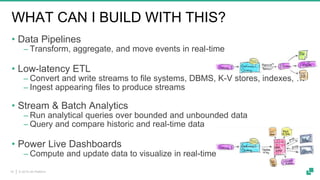
• Data Pipelines
‒ Transform, aggregate, and move events in real-time
• Low-latency ETL
‒ Convert and write streams to file systems, DBMS, K-V stores, indexes, …
‒ Ingest appearing files to produce streams
• Stream & Batch Analytics
‒ Run analytical queries over bounded and unbounded data
‒ Query and compare historic and real-time data
• Power Live Dashboards
‒ Compute and update data to visualize in real-time
© 2019 dA Platform17
SOUNDS GREAT! HOW CAN I USE IT?
• Embed SQL queries in regular (Java/Scala) Flink applications
‒ Tight integration with DataStream and DataSet APIs
‒ Mix and match with other libraries (CEP, ProcessFunction, Gelly)
‒ Package and operate queries like any other Flink application
• Run SQL queries via Flink’s SQL CLI Client
‒ Interactive mode: Submit query and inspect results
‒ Detached mode: Submit query and write results to sink systemc
© 2019 dA Platform18
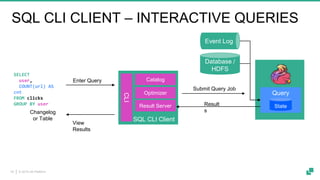
SQL CLI CLIENT – INTERACTIVE QUERIES
View
Results
Enter Query
SELECT
user,
COUNT(url) AS
cnt
FROM clicks
GROUP BY user
Database /
HDFS
Event Log
Query
StateResult
sChangelog
or Table SQL CLI Client
Catalog
Optimizer
CLI
Result Server
Submit Query Job
© 2019 dA Platform19
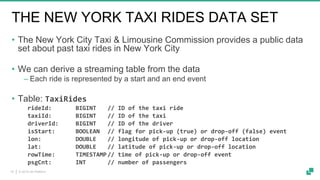
THE NEW YORK TAXI RIDES DATA SET
• The New York City Taxi & Limousine Commission provides a public data
set about past taxi rides in New York City
• We can derive a streaming table from the data
‒ Each ride is represented by a start and an end event
• Table: TaxiRides
rideId: BIGINT // ID of the taxi ride
taxiId: BIGINT // ID of the taxi
driverId: BIGINT // ID of the driver
isStart: BOOLEAN // flag for pick-up (true) or drop-off (false) event
lon: DOUBLE // longitude of pick-up or drop-off location
lat: DOUBLE // latitude of pick-up or drop-off location
rowTime: TIMESTAMP // time of pick-up or drop-off event
psgCnt: INT // number of passengers
© 2019 dA Platform20
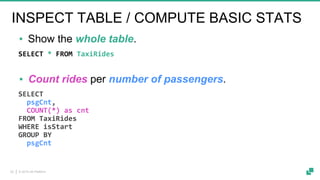
SELECT
psgCnt,
COUNT(*) as cnt
FROM TaxiRides
WHERE isStart
GROUP BY
psgCnt
▪ Count rides per number of passengers.
INSPECT TABLE / COMPUTE BASIC STATS
SELECT * FROM TaxiRides
▪ Show the whole table.
© 2019 dA Platform21
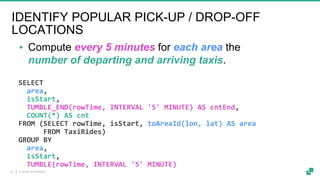
SELECT
area,
isStart,
TUMBLE_END(rowTime, INTERVAL '5' MINUTE) AS cntEnd,
COUNT(*) AS cnt
FROM (SELECT rowTime, isStart, toAreaId(lon, lat) AS area
FROM TaxiRides)
GROUP BY
area,
isStart,
TUMBLE(rowTime, INTERVAL '5' MINUTE)
▪ Compute every 5 minutes for each area the
number of departing and arriving taxis.
IDENTIFY POPULAR PICK-UP / DROP-OFF
LOCATIONS
© 2019 dA Platform22
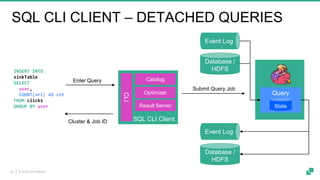
SQL CLI CLIENT – DETACHED QUERIES
SQL CLI Client
Catalog
Optimizer
Database /
HDFS
Event Log
Query
Submit Query Job
State
CLI
Result Server
Database /
HDFS
Event Log
Enter Query
INSERT INTO
sinkTable
SELECT
user,
COUNT(url) AS cnt
FROM clicks
GROUP BY user
Cluster & Job ID
© 2019 dA Platform23
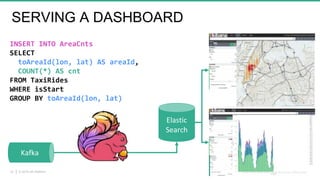
SERVING A DASHBOARD
Elastic
Search
Kafka
INSERT INTO AreaCnts
SELECT
toAreaId(lon, lat) AS areaId,
COUNT(*) AS cnt
FROM TaxiRides
WHERE isStart
GROUP BY toAreaId(lon, lat)
© 2019 dA Platform24
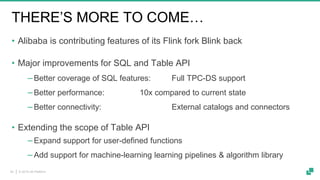
THERE’S MORE TO COME…
• Alibaba is contributing features of its Flink fork Blink back
• Major improvements for SQL and Table API
‒Better coverage of SQL features: Full TPC-DS support
‒Better performance: 10x compared to current state
‒Better connectivity: External catalogs and connectors
• Extending the scope of Table API
‒Expand support for user-defined functions
‒Add support for machine-learning learning pipelines & algorithm library
© 2019 dA Platform25
SUMMARY
• Unification of stream and batch is important.
• Flink’s SQL solves many streaming and batch use cases.
• In production at Alibaba, Huawei, Lyft, Uber, and others.
• Query deployment as application or via CLI
• Get involved, discuss, and contribute!
THANK YOU!
Available on O’Reilly Early Release!
THANK YOU!
@fhueske
@platform_da
@ApacheFlink
WE ARE HIRING
da-platform.com/careers
© 2019 dA Platform28
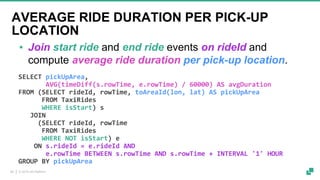
SELECT pickUpArea,
AVG(timeDiff(s.rowTime, e.rowTime) / 60000) AS avgDuration
FROM (SELECT rideId, rowTime, toAreaId(lon, lat) AS pickUpArea
FROM TaxiRides
WHERE isStart) s
JOIN
(SELECT rideId, rowTime
FROM TaxiRides
WHERE NOT isStart) e
ON s.rideId = e.rideId AND
e.rowTime BETWEEN s.rowTime AND s.rowTime + INTERVAL '1' HOUR
GROUP BY pickUpArea
▪ Join start ride and end ride events on rideId and
compute average ride duration per pick-up location.
AVERAGE RIDE DURATION PER PICK-UP
LOCATION

Webinar: Flink SQL in Action - Fabian Hueske

  • 1.
    - FABIAN HUESKE,SOFTWARE ENGINEER APACHE FLINK® SQL IN Action
  • 2.
    © 2019 dAPlatform2 ABOUT ME • Apache Flink PMC member & ASF member ‒Contributing since day 1 at TU Berlin ‒Focusing on Flink’s relational APIs since ~3.5 years • Co-author of “Stream Processing with Apache Flink” ‒Expected release: April 2019
  • 3.
    © 2019 dAPlatform3 WHAT IS APACHE FLINK? Stateful computations over streams real-time and historic fast, scalable, fault tolerant, in-memory, event time, large state, exactly-once
  • 4.
    © 2019 dAPlatform4 HARDENED AT SCALE Streaming Platform Service billions messages per day A lot of Stream SQL Streaming Platform as a Service 3700+ container running Flink, 1400+ nodes, 22k+ cores, 100s of jobs, 3 trillion events / day, 20 TB state Fraud detection Streaming Analytics Platform 1000s jobs, 100.000s cores, 10 TBs state, metrics, analytics, real time ML, Streaming SQL as a platform
  • 5.
    © 2019 dAPlatform5 POWERED BY APACHE FLINK
  • 6.
    © 2019 dAPlatform6 FLINK’S POWERFUL ABSTRACTIONS Process Function (events, state, time) DataStream API (streams, windows) SQL / Table API (dynamic tables) Stream- & Batch Data Processing High-level Analytics API Stateful Event- Driven Applications val stats = stream .keyBy("sensor") .timeWindow(Time.seconds(5)) .sum((a, b) -> a.add(b)) def processElement(event: MyEvent, ctx: Context, out: Collector[Result]) = { // work with event and state (event, state.value) match { … } out.collect(…) // emit events state.update(…) // modify state // schedule a timer callback ctx.timerService.registerEventTimeTimer(event.timestamp + 500) } Layered abstractions to navigate simple to complex use cases
  • 7.
    © 2019 dAPlatform7 APACHE FLINK’S RELATIONAL APIS Unified APIs for batch & streaming data A query specifies exactly the same result regardless whether its input is static batch data or streaming data. tableEnvironment .scan("clicks") .groupBy('user) .select('user, 'url.count as 'cnt) SELECT user, COUNT(url) AS cnt FROM clicks GROUP BY user LINQ-style Table API ANSI SQL
  • 8.
    © 2019 dAPlatform8 QUERY TRANSLATION tableEnvironment .scan("clicks") .groupBy('user) .select('user, 'url.count as 'cnt) SELECT user, COUNT(url) AS cnt FROM clicks GROUP BY user Input data is bounded (batch) Input data is unbounded (streaming)
  • 9.
    © 2019 dAPlatform9 WHAT IF “CLICKS” IS A FILE? Clicks user cTime url Mary 12:00:00 https://… Bob 12:00:00 https://… Mary 12:00:02 https://… Liz 12:00:03 https://… user cnt Mary 2 Bob 1 Liz 1 SELECT user, COUNT(url) as cnt FROM clicks GROUP BY user Input data is read at once Result is produced at once
  • 10.
    © 2019 dAPlatform10 WHAT IF “CLICKS” IS A STREAM? user cTime url user cnt SELECT user, COUNT(url) as cnt FROM clicks GROUP BY user Clicks Mary 12:00:00 https://… Bob 12:00:00 https://… Mary 12:00:02 https://… Liz 12:00:03 https://… Bob 1 Liz 1 Mary 1Mary 2 Input data is continuously read Result is continuously updated The result is the
  • 11.
    © 2019 dAPlatform11 WHY IS STREAM-BATCH UNIFICATION IMPORTANT? • Usability ‒ ANSI SQL syntax: No custom “StreamSQL” syntax. ‒ ANSI SQL semantics: No stream-specific result semantics. • Portability ‒ Run the same query on bounded & unbounded data ‒ Run the same query on recorded & real-time data ‒ Bootstrapping query state or backfilling results from historic data • How can we achieve SQL semantics on streams? no w bounded query unbounded query pas t futur e bounded query start of the stream unbounded query
  • 12.
    © 2019 dAPlatform12 DATABASE SYSTEMS RUN QUERIES ON STREAMS • Materialized views (MV) are similar to regular views, but persisted to disk or memory ‒Used to speed-up analytical queries ‒MVs need to be updated when the base tables change • MV maintenance is very similar to SQL on streams ‒Base table updates are a stream of DML statements ‒MV definition query is evaluated on that stream ‒MV is query result and continuously updated
  • 13.
    © 2019 dAPlatform13 CONTINUOUS QUERIES IN FLINK • Core concept is a “Dynamic Table” ‒ Dynamic tables are changing over time • Queries on dynamic tables ‒ produce new dynamic tables (which are updated based on input) ‒ do not terminate • Stream ↔ Dynamic table conversions 13
  • 14.
    © 2019 dAPlatform14 STREAM ↔ DYNAMIC TABLE CONVERSIONS • Append Conversions ‒Records are always inserted/appended ‒No updates or deletes • Upsert Conversions ‒Records have a (composite) unique key ‒Records are upserted or deleted based on key • Changelog Conversions ‒Records are inserted or deleted ‒Update = delete old version + insert new version
  • 15.
    © 2019 dAPlatform15 SQL Feature Set in Flink 1.7.0 STREAMING ONLY • OVER / WINDOW ‒ UNBOUNDED / BOUNDED PRECEDING • INNER JOIN with time-versioned • MATCH_RECOGNIZE ‒ Pattern Matching/CEP (SQL:2016) BATCH ONLY • UNION / INTERSECT / EXCEPT • ORDER BY STREAMING & BATCH • SELECT FROM WHERE • GROUP BY [HAVING] ‒ Non-windowed ‒ TUMBLE, HOP, SESSION windows • JOIN ‒ Time-Windowed INNER + OUTER JOIN ‒ Non-windowed INNER + OUTER JOIN • User-Defined Functions ‒ Scalar ‒ Aggregation ‒ Table-valued
  • 16.
    © 2019 dAPlatform16 WHAT CAN I BUILD WITH THIS? • Data Pipelines ‒ Transform, aggregate, and move events in real-time • Low-latency ETL ‒ Convert and write streams to file systems, DBMS, K-V stores, indexes, … ‒ Ingest appearing files to produce streams • Stream & Batch Analytics ‒ Run analytical queries over bounded and unbounded data ‒ Query and compare historic and real-time data • Power Live Dashboards ‒ Compute and update data to visualize in real-time
  • 17.
    © 2019 dAPlatform17 SOUNDS GREAT! HOW CAN I USE IT? • Embed SQL queries in regular (Java/Scala) Flink applications ‒ Tight integration with DataStream and DataSet APIs ‒ Mix and match with other libraries (CEP, ProcessFunction, Gelly) ‒ Package and operate queries like any other Flink application • Run SQL queries via Flink’s SQL CLI Client ‒ Interactive mode: Submit query and inspect results ‒ Detached mode: Submit query and write results to sink systemc
  • 18.
    © 2019 dAPlatform18 SQL CLI CLIENT – INTERACTIVE QUERIES View Results Enter Query SELECT user, COUNT(url) AS cnt FROM clicks GROUP BY user Database / HDFS Event Log Query StateResult sChangelog or Table SQL CLI Client Catalog Optimizer CLI Result Server Submit Query Job
  • 19.
    © 2019 dAPlatform19 THE NEW YORK TAXI RIDES DATA SET • The New York City Taxi & Limousine Commission provides a public data set about past taxi rides in New York City • We can derive a streaming table from the data ‒ Each ride is represented by a start and an end event • Table: TaxiRides rideId: BIGINT // ID of the taxi ride taxiId: BIGINT // ID of the taxi driverId: BIGINT // ID of the driver isStart: BOOLEAN // flag for pick-up (true) or drop-off (false) event lon: DOUBLE // longitude of pick-up or drop-off location lat: DOUBLE // latitude of pick-up or drop-off location rowTime: TIMESTAMP // time of pick-up or drop-off event psgCnt: INT // number of passengers
  • 20.
    © 2019 dAPlatform20 SELECT psgCnt, COUNT(*) as cnt FROM TaxiRides WHERE isStart GROUP BY psgCnt ▪ Count rides per number of passengers. INSPECT TABLE / COMPUTE BASIC STATS SELECT * FROM TaxiRides ▪ Show the whole table.
  • 21.
    © 2019 dAPlatform21 SELECT area, isStart, TUMBLE_END(rowTime, INTERVAL '5' MINUTE) AS cntEnd, COUNT(*) AS cnt FROM (SELECT rowTime, isStart, toAreaId(lon, lat) AS area FROM TaxiRides) GROUP BY area, isStart, TUMBLE(rowTime, INTERVAL '5' MINUTE) ▪ Compute every 5 minutes for each area the number of departing and arriving taxis. IDENTIFY POPULAR PICK-UP / DROP-OFF LOCATIONS
  • 22.
    © 2019 dAPlatform22 SQL CLI CLIENT – DETACHED QUERIES SQL CLI Client Catalog Optimizer Database / HDFS Event Log Query Submit Query Job State CLI Result Server Database / HDFS Event Log Enter Query INSERT INTO sinkTable SELECT user, COUNT(url) AS cnt FROM clicks GROUP BY user Cluster & Job ID
  • 23.
    © 2019 dAPlatform23 SERVING A DASHBOARD Elastic Search Kafka INSERT INTO AreaCnts SELECT toAreaId(lon, lat) AS areaId, COUNT(*) AS cnt FROM TaxiRides WHERE isStart GROUP BY toAreaId(lon, lat)
  • 24.
    © 2019 dAPlatform24 THERE’S MORE TO COME… • Alibaba is contributing features of its Flink fork Blink back • Major improvements for SQL and Table API ‒Better coverage of SQL features: Full TPC-DS support ‒Better performance: 10x compared to current state ‒Better connectivity: External catalogs and connectors • Extending the scope of Table API ‒Expand support for user-defined functions ‒Add support for machine-learning learning pipelines & algorithm library
  • 25.
    © 2019 dAPlatform25 SUMMARY • Unification of stream and batch is important. • Flink’s SQL solves many streaming and batch use cases. • In production at Alibaba, Huawei, Lyft, Uber, and others. • Query deployment as application or via CLI • Get involved, discuss, and contribute!
  • 26.
    THANK YOU! Available onO’Reilly Early Release!
  • 27.
  • 28.
    © 2019 dAPlatform28 SELECT pickUpArea, AVG(timeDiff(s.rowTime, e.rowTime) / 60000) AS avgDuration FROM (SELECT rideId, rowTime, toAreaId(lon, lat) AS pickUpArea FROM TaxiRides WHERE isStart) s JOIN (SELECT rideId, rowTime FROM TaxiRides WHERE NOT isStart) e ON s.rideId = e.rideId AND e.rowTime BETWEEN s.rowTime AND s.rowTime + INTERVAL '1' HOUR GROUP BY pickUpArea ▪ Join start ride and end ride events on rideId and compute average ride duration per pick-up location. AVERAGE RIDE DURATION PER PICK-UP LOCATION