Introduction to
Arduino
By: Karim El-Rayes
By: Karim El-Rayes, 2015
What about computers !
We all know that we can use computers to do anything like
process control or data ciphering, but to have a computer we need
a CPU, a main memory unit represented in a RAM module, a
secondary storage element represented in Hard Disk Drive
(HDD), some input devices to give instructions/orders like
keyboard and a mouse, and some other output devices like a
monitor and printer to check the system state, and maybe some
communication devices to communicate with external world like
Ethernet card, USB ports and wireless interface cards (Wi-Fi).
By: Karim El-Rayes, 2015
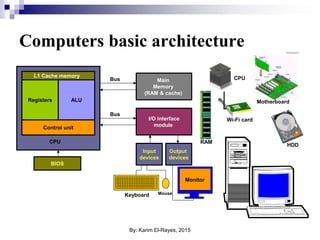
Main
Memory
(RAM & cache)
I/O interface
module
CPU
Control unit
ALURegisters
Input
devices
Output
devices
Bus
Bus
BIOS
L1 Cache memory
Computers basic architecture
Keyboard Mouse
Monitor
RAM
HDD
Motherboard
CPU
Wi-Fi card
By: Karim El-Rayes, 2015
Is it good enough?
Previously described system is very good and will be
very efficient, featuring a very high computing
capabilities BUT:
1. Big in size, you need a space for such system.
2. Very power hungry system, you can run on small
batteries or solar cell in a rural place.
3. Expensive, let’s try to calculate the prices of Intel
Core2Due processor, 1GB RAM slot, 80GB HDD, a
monitor, a keyboard and finally a mouse !!!
By: Karim El-Rayes, 2015
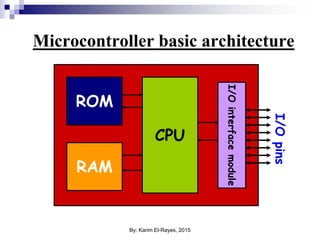
Microcontroller basic architecture
ROM
RAM
CPU
I/Ointerfacemodule
I/Opins
By: Karim El-Rayes, 2015
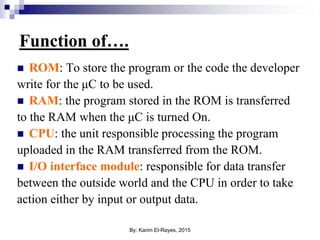
Function of….
 ROM: To store the program or the code the developer
write for the μC to be used.
 RAM: the program stored in the ROM is transferred
to the RAM when the μC is turned On.
 CPU: the unit responsible processing the program
uploaded in the RAM transferred from the ROM.
 I/O interface module: responsible for data transfer
between the outside world and the CPU in order to take
action either by input or output data.
By: Karim El-Rayes, 2015
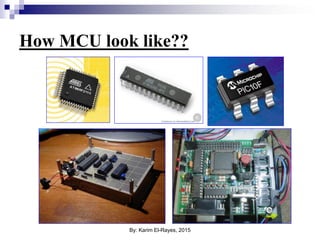
How MCU look like??
By: Karim El-Rayes, 2015
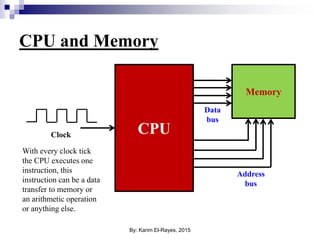
CPU and Memory
CPU
Memory
Address
bus
Data
bus
Clock
With every clock tick
the CPU executes one
instruction, this
instruction can be a data
transfer to memory or
an arithmetic operation
or anything else.
By: Karim El-Rayes, 2015
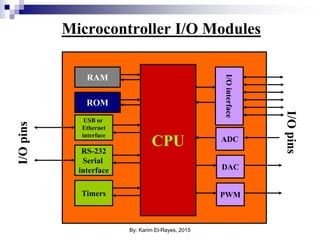
Microcontroller I/O Modules
ROM
RAM
CPU
I/Opins
ADC
DAC
Timers
RS-232
Serial
interface
PWM
USB or
Ethernet
interface
I/Opins
I/Ointerface
By: Karim El-Rayes, 2015
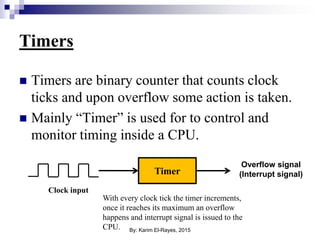
Timers
 Timers are binary counter that counts clock
ticks and upon overflow some action is taken.
 Mainly “Timer” is used for to control and
monitor timing inside a CPU.
Timer
Clock input
With every clock tick the timer increments,
once it reaches its maximum an overflow
happens and interrupt signal is issued to the
CPU.
Overflow signal
(Interrupt signal)
By: Karim El-Rayes, 2015
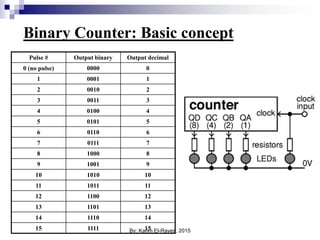
Binary Counter: Basic concept
Pulse # Output binary Output decimal
0 (no pulse) 0000 0
1 0001 1
2 0010 2
3 0011 3
4 0100 4
5 0101 5
6 0110 6
7 0111 7
8 1000 8
9 1001 9
10 1010 10
11 1011 11
12 1100 12
13 1101 13
14 1110 14
15 1111 15By: Karim El-Rayes, 2015
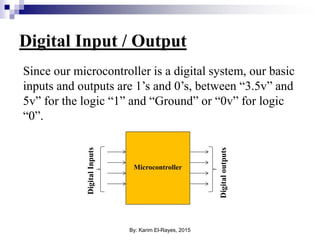
Digital Input / Output
Since our microcontroller is a digital system, our basic
inputs and outputs are 1’s and 0’s, between “3.5v” and
5v” for the logic “1” and “Ground” or “0v” for logic
“0”.
Microcontroller
DigitalInputs
Digitaloutputs
By: Karim El-Rayes, 2015
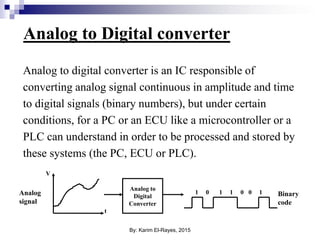
Analog to Digital converter
Analog to digital converter is an IC responsible of
converting analog signal continuous in amplitude and time
to digital signals (binary numbers), but under certain
conditions, for a PC or an ECU like a microcontroller or a
PLC can understand in order to be processed and stored by
these systems (the PC, ECU or PLC).
Analog to
Digital
Converter
1 1 1 10 0 0
V
t
Analog
signal
Binary
code
By: Karim El-Rayes, 2015
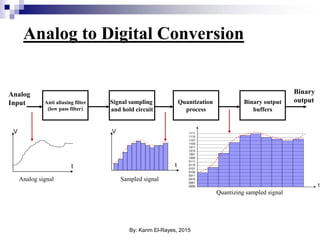
Analog to Digital Conversion
Anti aliasing filter
(low pass filter)
Signal sampling
and hold circuit
Quantization
process
Binary output
buffers
Analog
Input
Binary
output
0000
0001
0010
0011
0100
0101
0110
0111
1000
1001
1010
1011
1100
1101
1110
1111
t
V
t
V
t
Analog signal Sampled signal
Quantizing sampled signal
By: Karim El-Rayes, 2015
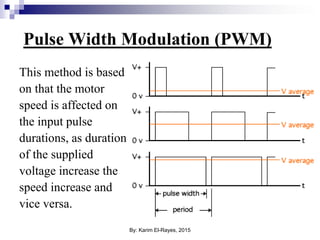
Pulse Width Modulation (PWM)
This method is based
on that the motor
speed is affected on
the input pulse
durations, as duration
of the supplied
voltage increase the
speed increase and
vice versa.
By: Karim El-Rayes, 2015
PWM (cont.)
 The speed of the motor using PWM system is determined
using a simple Methodology: which is the pulse duration
percentage ratio to the whole duration is equivalent to the
same ratio of the supplied voltage to the motor to the main
voltage supply.
 Example: if a motor is supplied with 10 volts and
the PWM circuit has an output pulse duration 10% from the
whole pulse period then the output voltage is 10% the main
supply voltage = 10% x 10 volts = 1 volt.
This mean that the motor is actually supplied with only 1 volt.
 PWM is a relation between the average voltage that will be
supplied to the motor and the pulse duration.
By: Karim El-Rayes, 2015
Serial vs. parallel transmission
0
0
0
1
1
1 1 1 10 0 0
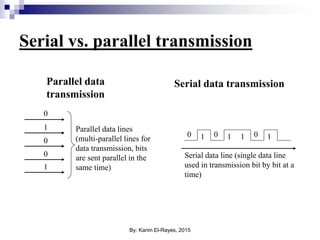
Parallel data lines
(multi-parallel lines for
data transmission, bits
are sent parallel in the
same time)
Serial data line (single data line
used in transmission bit by bit at a
time)
Parallel data
transmission
Serial data transmission
By: Karim El-Rayes, 2015
Serial Communications Interface RS-232
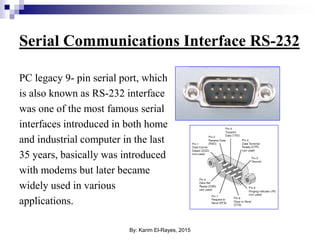
PC legacy 9- pin serial port, which
is also known as RS-232 interface
was one of the most famous serial
interfaces introduced in both home
and industrial computer in the last
35 years, basically was introduced
with modems but later became
widely used in various
applications.
By: Karim El-Rayes, 2015
Transmission Scheme
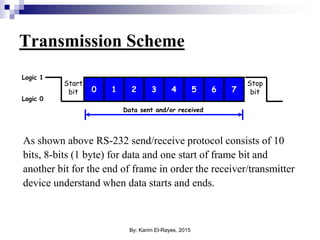
As shown above RS-232 send/receive protocol consists of 10
bits, 8-bits (1 byte) for data and one start of frame bit and
another bit for the end of frame in order the receiver/transmitter
device understand when data starts and ends.
0 1 2 3 4 5 6 7
Start
bit
Stop
bit
Logic 1
Logic 0
Data sent and/or received
By: Karim El-Rayes, 2015
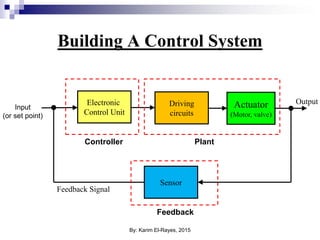
Building A Control System
Electronic
Control Unit
Actuator
(Motor, valve)
Sensor
Driving
circuits
Feedback Signal
Input
(or set point)
Controller Plant
Feedback
Output
By: Karim El-Rayes, 2015
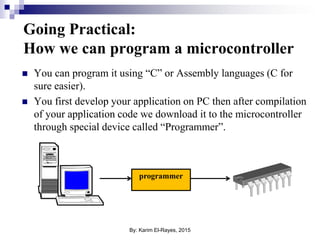
Going Practical:
How we can program a microcontroller
 You can program it using “C” or Assembly languages (C for
sure easier).
 You first develop your application on PC then after compilation
of your application code we download it to the microcontroller
through special device called “Programmer”.
programmer
By: Karim El-Rayes, 2015
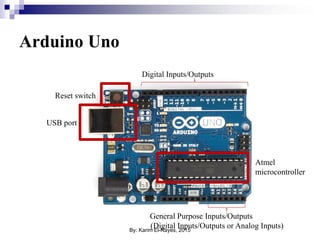
Arduino Uno
Reset switch
USB port
Atmel
microcontroller
General Purpose Inputs/Outputs
(Digital Inputs/Outputs or Analog Inputs)
Digital Inputs/Outputs
By: Karim El-Rayes, 2015
Notes on Arduino Uno Board
• General Purpose Inputs/Outputs are the input & output
interface pins between the Arduino board and outside world.
• Any pin can be configured as either digital input or digital
output.
• The output of digital pins is either 1 (+5v) or 0 (0v).
• Some pins can be configured to be “Analog Inputs”, i.e. you
can input analog signals on these pins.
• Analog signal: they can take any value between 0v and +5v,
the Arduino board converts this analog voltage value to a
number, such pins are commonly used with sensors.
By: Karim El-Rayes, 2015
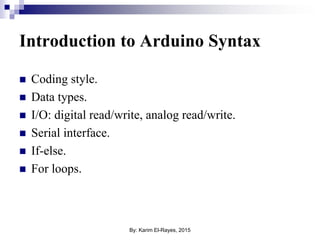
Introduction to Arduino Syntax
 Coding style.
 Data types.
 I/O: digital read/write, analog read/write.
 Serial interface.
 If-else.
 For loops.
By: Karim El-Rayes, 2015
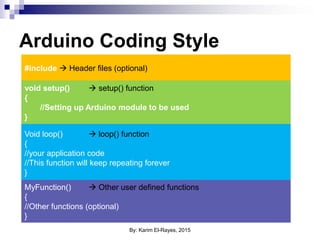
Arduino Coding Style
#include  Header files (optional)
void setup()  setup() function
{
//Setting up Arduino module to be used
}
Void loop()  loop() function
{
//your application code
//This function will keep repeating forever
}
MyFunction()  Other user defined functions
{
//Other functions (optional)
}
By: Karim El-Rayes, 2015
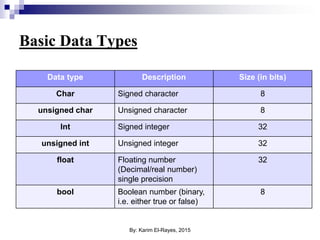
Basic Data Types
Data type Description Size (in bits)
Char Signed character 8
unsigned char Unsigned character 8
Int Signed integer 32
unsigned int Unsigned integer 32
float Floating number
(Decimal/real number)
single precision
32
bool Boolean number (binary,
i.e. either true or false)
8
By: Karim El-Rayes, 2015
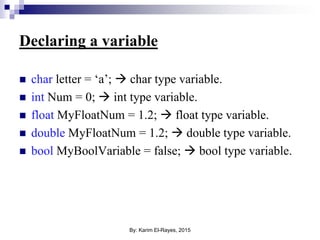
Declaring a variable
 char letter = ‘a’;  char type variable.
 int Num = 0;  int type variable.
 float MyFloatNum = 1.2;  float type variable.
 double MyFloatNum = 1.2;  double type variable.
 bool MyBoolVariable = false;  bool type variable.
By: Karim El-Rayes, 2015
Arrays
Array is a list of variables of the same type, instead of
declaring every variable separately they are declared in the
form list or “Array”.
Example:
int Numbers[10];  Array of 10 integers.
char MyArray[20];  Array of 20 character
Note: a string in C is just an array of characters.
By: Karim El-Rayes, 2015
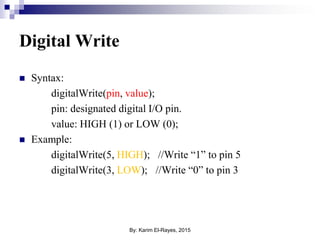
Digital Write
 Syntax:
digitalWrite(pin, value);
pin: designated digital I/O pin.
value: HIGH (1) or LOW (0);
 Example:
digitalWrite(5, HIGH); //Write “1” to pin 5
digitalWrite(3, LOW); //Write “0” to pin 3
By: Karim El-Rayes, 2015
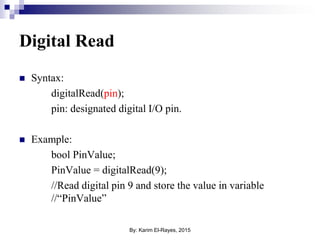
Digital Read
 Syntax:
digitalRead(pin);
pin: designated digital I/O pin.
 Example:
bool PinValue;
PinValue = digitalRead(9);
//Read digital pin 9 and store the value in variable
//“PinValue”
By: Karim El-Rayes, 2015
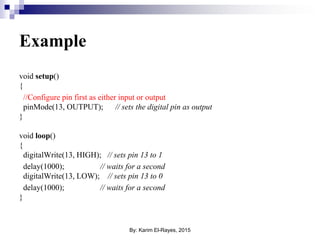
Example
void setup()
{
//Configure pin first as either input or output
pinMode(13, OUTPUT); // sets the digital pin as output
}
void loop()
{
digitalWrite(13, HIGH); // sets pin 13 to 1
delay(1000); // waits for a second
digitalWrite(13, LOW); // sets pin 13 to 0
delay(1000); // waits for a second
}
By: Karim El-Rayes, 2015
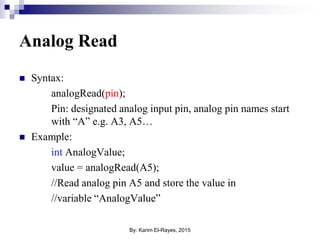
Analog Read
 Syntax:
analogRead(pin);
Pin: designated analog input pin, analog pin names start
with “A” e.g. A3, A5…
 Example:
int AnalogValue;
value = analogRead(A5);
//Read analog pin A5 and store the value in
//variable “AnalogValue”
By: Karim El-Rayes, 2015
Analog Write (PWM)
 Syntax:
analogWrite(pin, value);
pin: PWM designated pin.
Value: PWM duty cycle value, has to be between 0-255.
 Example:
analogWrite(7, 125);
By: Karim El-Rayes, 2015
Serial Output
void setup()
{
// Configure serial first: open the serial port at 9600 bps:
Serial.begin(9600);
}
void loop()
{
// read the analog input on pin 0:
analogValue = analogRead(0);
// print it out in many formats:
Serial.println(analogValue); // print as an ASCII-encoded decimal
delay(1000); //delay for 1 second
}
By: Karim El-Rayes, 2015
“if – else” statement
“if-else” is a conditional statement to check if a condition is true or not:
if(i == 1)
{
//do something
}
else if(i == 2)
{
//do something else
}
else
{
//do something else if the previous conditions aren’t true
}
By: Karim El-Rayes, 2015
Loops: “for” Loop
To repeat some action(s) several times:
for (initial condition; stop condition; increment/decrement)
{ //start
//do something here
} //end
Example:
for(i = 0;i<10;i++)
{
//Your code here
}
“trying for loop” will be printed on screen 10 times
By: Karim El-Rayes, 2015
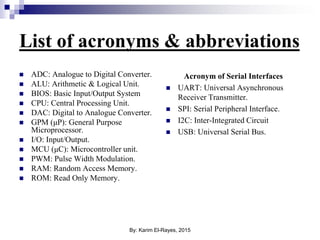
List of acronyms & abbreviations
 ADC: Analogue to Digital Converter.
 ALU: Arithmetic & Logical Unit.
 BIOS: Basic Input/Output System
 CPU: Central Processing Unit.
 DAC: Digital to Analogue Converter.
 GPM (μP): General Purpose
Microprocessor.
 I/O: Input/Output.
 MCU (μC): Microcontroller unit.
 PWM: Pulse Width Modulation.
 RAM: Random Access Memory.
 ROM: Read Only Memory.
Acronym of Serial Interfaces
 UART: Universal Asynchronous
Receiver Transmitter.
 SPI: Serial Peripheral Interface.
 I2C: Inter-Integrated Circuit
 USB: Universal Serial Bus.
By: Karim El-Rayes, 2015

Introduction to Arduino

  • 1.
    Introduction to Arduino By: KarimEl-Rayes By: Karim El-Rayes, 2015
  • 2.
    What about computers! We all know that we can use computers to do anything like process control or data ciphering, but to have a computer we need a CPU, a main memory unit represented in a RAM module, a secondary storage element represented in Hard Disk Drive (HDD), some input devices to give instructions/orders like keyboard and a mouse, and some other output devices like a monitor and printer to check the system state, and maybe some communication devices to communicate with external world like Ethernet card, USB ports and wireless interface cards (Wi-Fi). By: Karim El-Rayes, 2015
  • 3.
    Main Memory (RAM & cache) I/Ointerface module CPU Control unit ALURegisters Input devices Output devices Bus Bus BIOS L1 Cache memory Computers basic architecture Keyboard Mouse Monitor RAM HDD Motherboard CPU Wi-Fi card By: Karim El-Rayes, 2015
  • 4.
    Is it goodenough? Previously described system is very good and will be very efficient, featuring a very high computing capabilities BUT: 1. Big in size, you need a space for such system. 2. Very power hungry system, you can run on small batteries or solar cell in a rural place. 3. Expensive, let’s try to calculate the prices of Intel Core2Due processor, 1GB RAM slot, 80GB HDD, a monitor, a keyboard and finally a mouse !!! By: Karim El-Rayes, 2015
  • 5.
  • 6.
    Function of….  ROM:To store the program or the code the developer write for the μC to be used.  RAM: the program stored in the ROM is transferred to the RAM when the μC is turned On.  CPU: the unit responsible processing the program uploaded in the RAM transferred from the ROM.  I/O interface module: responsible for data transfer between the outside world and the CPU in order to take action either by input or output data. By: Karim El-Rayes, 2015
  • 7.
    How MCU looklike?? By: Karim El-Rayes, 2015
  • 8.
    CPU and Memory CPU Memory Address bus Data bus Clock Withevery clock tick the CPU executes one instruction, this instruction can be a data transfer to memory or an arithmetic operation or anything else. By: Karim El-Rayes, 2015
  • 9.
    Microcontroller I/O Modules ROM RAM CPU I/Opins ADC DAC Timers RS-232 Serial interface PWM USBor Ethernet interface I/Opins I/Ointerface By: Karim El-Rayes, 2015
  • 10.
    Timers  Timers arebinary counter that counts clock ticks and upon overflow some action is taken.  Mainly “Timer” is used for to control and monitor timing inside a CPU. Timer Clock input With every clock tick the timer increments, once it reaches its maximum an overflow happens and interrupt signal is issued to the CPU. Overflow signal (Interrupt signal) By: Karim El-Rayes, 2015
  • 11.
    Binary Counter: Basicconcept Pulse # Output binary Output decimal 0 (no pulse) 0000 0 1 0001 1 2 0010 2 3 0011 3 4 0100 4 5 0101 5 6 0110 6 7 0111 7 8 1000 8 9 1001 9 10 1010 10 11 1011 11 12 1100 12 13 1101 13 14 1110 14 15 1111 15By: Karim El-Rayes, 2015
  • 12.
    Digital Input /Output Since our microcontroller is a digital system, our basic inputs and outputs are 1’s and 0’s, between “3.5v” and 5v” for the logic “1” and “Ground” or “0v” for logic “0”. Microcontroller DigitalInputs Digitaloutputs By: Karim El-Rayes, 2015
  • 13.
    Analog to Digitalconverter Analog to digital converter is an IC responsible of converting analog signal continuous in amplitude and time to digital signals (binary numbers), but under certain conditions, for a PC or an ECU like a microcontroller or a PLC can understand in order to be processed and stored by these systems (the PC, ECU or PLC). Analog to Digital Converter 1 1 1 10 0 0 V t Analog signal Binary code By: Karim El-Rayes, 2015
  • 14.
    Analog to DigitalConversion Anti aliasing filter (low pass filter) Signal sampling and hold circuit Quantization process Binary output buffers Analog Input Binary output 0000 0001 0010 0011 0100 0101 0110 0111 1000 1001 1010 1011 1100 1101 1110 1111 t V t V t Analog signal Sampled signal Quantizing sampled signal By: Karim El-Rayes, 2015
  • 15.
    Pulse Width Modulation(PWM) This method is based on that the motor speed is affected on the input pulse durations, as duration of the supplied voltage increase the speed increase and vice versa. By: Karim El-Rayes, 2015
  • 16.
    PWM (cont.)  Thespeed of the motor using PWM system is determined using a simple Methodology: which is the pulse duration percentage ratio to the whole duration is equivalent to the same ratio of the supplied voltage to the motor to the main voltage supply.  Example: if a motor is supplied with 10 volts and the PWM circuit has an output pulse duration 10% from the whole pulse period then the output voltage is 10% the main supply voltage = 10% x 10 volts = 1 volt. This mean that the motor is actually supplied with only 1 volt.  PWM is a relation between the average voltage that will be supplied to the motor and the pulse duration. By: Karim El-Rayes, 2015
  • 17.
    Serial vs. paralleltransmission 0 0 0 1 1 1 1 1 10 0 0 Parallel data lines (multi-parallel lines for data transmission, bits are sent parallel in the same time) Serial data line (single data line used in transmission bit by bit at a time) Parallel data transmission Serial data transmission By: Karim El-Rayes, 2015
  • 18.
    Serial Communications InterfaceRS-232 PC legacy 9- pin serial port, which is also known as RS-232 interface was one of the most famous serial interfaces introduced in both home and industrial computer in the last 35 years, basically was introduced with modems but later became widely used in various applications. By: Karim El-Rayes, 2015
  • 19.
    Transmission Scheme As shownabove RS-232 send/receive protocol consists of 10 bits, 8-bits (1 byte) for data and one start of frame bit and another bit for the end of frame in order the receiver/transmitter device understand when data starts and ends. 0 1 2 3 4 5 6 7 Start bit Stop bit Logic 1 Logic 0 Data sent and/or received By: Karim El-Rayes, 2015
  • 20.
    Building A ControlSystem Electronic Control Unit Actuator (Motor, valve) Sensor Driving circuits Feedback Signal Input (or set point) Controller Plant Feedback Output By: Karim El-Rayes, 2015
  • 21.
    Going Practical: How wecan program a microcontroller  You can program it using “C” or Assembly languages (C for sure easier).  You first develop your application on PC then after compilation of your application code we download it to the microcontroller through special device called “Programmer”. programmer By: Karim El-Rayes, 2015
  • 22.
    Arduino Uno Reset switch USBport Atmel microcontroller General Purpose Inputs/Outputs (Digital Inputs/Outputs or Analog Inputs) Digital Inputs/Outputs By: Karim El-Rayes, 2015
  • 23.
    Notes on ArduinoUno Board • General Purpose Inputs/Outputs are the input & output interface pins between the Arduino board and outside world. • Any pin can be configured as either digital input or digital output. • The output of digital pins is either 1 (+5v) or 0 (0v). • Some pins can be configured to be “Analog Inputs”, i.e. you can input analog signals on these pins. • Analog signal: they can take any value between 0v and +5v, the Arduino board converts this analog voltage value to a number, such pins are commonly used with sensors. By: Karim El-Rayes, 2015
  • 24.
    Introduction to ArduinoSyntax  Coding style.  Data types.  I/O: digital read/write, analog read/write.  Serial interface.  If-else.  For loops. By: Karim El-Rayes, 2015
  • 25.
    Arduino Coding Style #include Header files (optional) void setup()  setup() function { //Setting up Arduino module to be used } Void loop()  loop() function { //your application code //This function will keep repeating forever } MyFunction()  Other user defined functions { //Other functions (optional) } By: Karim El-Rayes, 2015
  • 26.
    Basic Data Types Datatype Description Size (in bits) Char Signed character 8 unsigned char Unsigned character 8 Int Signed integer 32 unsigned int Unsigned integer 32 float Floating number (Decimal/real number) single precision 32 bool Boolean number (binary, i.e. either true or false) 8 By: Karim El-Rayes, 2015
  • 27.
    Declaring a variable char letter = ‘a’;  char type variable.  int Num = 0;  int type variable.  float MyFloatNum = 1.2;  float type variable.  double MyFloatNum = 1.2;  double type variable.  bool MyBoolVariable = false;  bool type variable. By: Karim El-Rayes, 2015
  • 28.
    Arrays Array is alist of variables of the same type, instead of declaring every variable separately they are declared in the form list or “Array”. Example: int Numbers[10];  Array of 10 integers. char MyArray[20];  Array of 20 character Note: a string in C is just an array of characters. By: Karim El-Rayes, 2015
  • 29.
    Digital Write  Syntax: digitalWrite(pin,value); pin: designated digital I/O pin. value: HIGH (1) or LOW (0);  Example: digitalWrite(5, HIGH); //Write “1” to pin 5 digitalWrite(3, LOW); //Write “0” to pin 3 By: Karim El-Rayes, 2015
  • 30.
    Digital Read  Syntax: digitalRead(pin); pin:designated digital I/O pin.  Example: bool PinValue; PinValue = digitalRead(9); //Read digital pin 9 and store the value in variable //“PinValue” By: Karim El-Rayes, 2015
  • 31.
    Example void setup() { //Configure pinfirst as either input or output pinMode(13, OUTPUT); // sets the digital pin as output } void loop() { digitalWrite(13, HIGH); // sets pin 13 to 1 delay(1000); // waits for a second digitalWrite(13, LOW); // sets pin 13 to 0 delay(1000); // waits for a second } By: Karim El-Rayes, 2015
  • 32.
    Analog Read  Syntax: analogRead(pin); Pin:designated analog input pin, analog pin names start with “A” e.g. A3, A5…  Example: int AnalogValue; value = analogRead(A5); //Read analog pin A5 and store the value in //variable “AnalogValue” By: Karim El-Rayes, 2015
  • 33.
    Analog Write (PWM) Syntax: analogWrite(pin, value); pin: PWM designated pin. Value: PWM duty cycle value, has to be between 0-255.  Example: analogWrite(7, 125); By: Karim El-Rayes, 2015
  • 34.
    Serial Output void setup() { //Configure serial first: open the serial port at 9600 bps: Serial.begin(9600); } void loop() { // read the analog input on pin 0: analogValue = analogRead(0); // print it out in many formats: Serial.println(analogValue); // print as an ASCII-encoded decimal delay(1000); //delay for 1 second } By: Karim El-Rayes, 2015
  • 35.
    “if – else”statement “if-else” is a conditional statement to check if a condition is true or not: if(i == 1) { //do something } else if(i == 2) { //do something else } else { //do something else if the previous conditions aren’t true } By: Karim El-Rayes, 2015
  • 36.
    Loops: “for” Loop Torepeat some action(s) several times: for (initial condition; stop condition; increment/decrement) { //start //do something here } //end Example: for(i = 0;i<10;i++) { //Your code here } “trying for loop” will be printed on screen 10 times By: Karim El-Rayes, 2015
  • 37.
    List of acronyms& abbreviations  ADC: Analogue to Digital Converter.  ALU: Arithmetic & Logical Unit.  BIOS: Basic Input/Output System  CPU: Central Processing Unit.  DAC: Digital to Analogue Converter.  GPM (μP): General Purpose Microprocessor.  I/O: Input/Output.  MCU (μC): Microcontroller unit.  PWM: Pulse Width Modulation.  RAM: Random Access Memory.  ROM: Read Only Memory. Acronym of Serial Interfaces  UART: Universal Asynchronous Receiver Transmitter.  SPI: Serial Peripheral Interface.  I2C: Inter-Integrated Circuit  USB: Universal Serial Bus. By: Karim El-Rayes, 2015