FLOCCULATION
&
SEDIMENTATION
ERIN DAVIS
SEM 7 BT
INTRODUCTION
• Processes are used to separate the suspended
solids portion from the water.
• The suspended particles vary considerably in
 source
 composition charge
 particle size
 shape
 density
30-08-2015 2B.TECH BIOTECHNOLOGY
30-08-2015 3B.TECH BIOTECHNOLOGY
FLOCCULATION
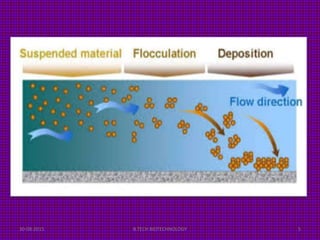
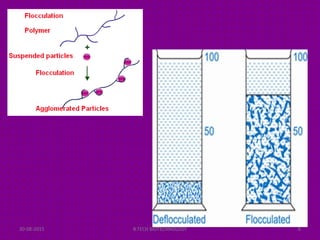
• Process where colloids come out of suspension in the
form of floc or flake
• Due to :
1.the addition of a clarifying agent
2.spontaneously
• Occur in successive steps
intended to overcome the
forces
• Stabilizes the suspended
particles, allowing particle
collision and growth of floc.
30-08-2015 4B.TECH BIOTECHNOLOGY
30-08-2015 5B.TECH BIOTECHNOLOGY
30-08-2015 6B.TECH BIOTECHNOLOGY
FLOCCULATION PROCESS
• A gentle mixing stage, increases the particle size from
submicroscopic microfloc to visible suspended particles.
• slow mixing
The microflocs are brought into contact with each other.
• Collisions
microfloc particles cause them to bond to produce larger,
visible flocs called pinflocs.
• The floc size continues to build through additional
collisions30-08-2015 7B.TECH BIOTECHNOLOGY
• Interactions occur with inorganic polymers formed by the
coagulant or with organic polymers added.
• Macroflocs are formed.
• High molecular weight polymers, called coagulant aids
added
o It helps to
 bridge
 bind
 Strengthens the floc
 add weight
 increase settling rate.
• Floc has reaches it optimum size and strength.30-08-2015 8B.TECH BIOTECHNOLOGY
Operational Considerations
Flocculation requires careful attention
• mixing velocity and amount of mix energy.
• prevent the floc from tearing apart or shearing, the
mixing velocity and energy input are usually
tapered off as the size of the floc increases.
• Once flocs are torn apart, it is difficult to get them
to reform to their optimum size and strength.
• The amount of operator control available in
flocculation is highly dependent
 type and design of the equipment.
30-08-2015 9B.TECH BIOTECHNOLOGY
Flocculants
(flocculating agents)
- Also known as flocking agents
- Chemicals that promote flocculation
by causing colloids and other suspended
particles in liquids to aggregate,
forming a floc.
• Flocculants are used in water treatment processes to
improve the sedimentation or filterability of small
particles.
30-08-2015 10B.TECH BIOTECHNOLOGY
• Selection of flocculant depends upon the
1. nature of the suspended solid to be removed
2. the raw water conditions
3. the facility design
4. the cost of production
• Considerations must be given
1. to required effluent quality,
2. effect upon down stream treatment process
performance,
3. method and cost of sludge handling and disposal
4. net overall cost at the dose required for effective
treatment.
30-08-2015 11B.TECH BIOTECHNOLOGY
SEDIMENTATION
• Sedimentation is the tendency for particles in suspension to
settle out of the fluid in which they are entrained and come
to rest against a barrier.
• It may be due to gravity , centrifugal acceleration or
electromagnetism.
• Sedimentation may take place in a pre-sedimentation
device such as a reservoir, grit basin, debris dam, or sand
trap
• Take place in a rectangular sedimentation basin, a double-
deck rectangular basin, a clarifier, or a solids-contact
clarifier.30-08-2015 12B.TECH BIOTECHNOLOGY
30-08-2015 13B.TECH BIOTECHNOLOGY
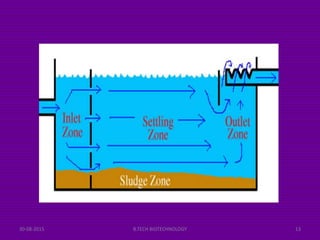
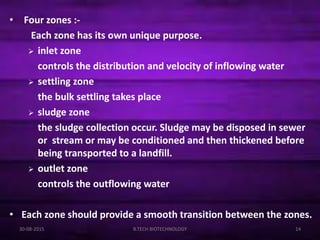
• Four zones :-
Each zone has its own unique purpose.
 inlet zone
controls the distribution and velocity of inflowing water
 settling zone
the bulk settling takes place
 sludge zone
the sludge collection occur. Sludge may be disposed in sewer
or stream or may be conditioned and then thickened before
being transported to a landfill.
 outlet zone
controls the outflowing water
• Each zone should provide a smooth transition between the zones.
30-08-2015 14B.TECH BIOTECHNOLOGY
CLASSIFICATION OF SEDIMENTATION
• Type 1 sedimentation
 Characterized by particles that settle discretely at a constant settling
velocity.
 They settle as individual particles and do not flocculate or stick to other
during settling.
 Example: sand and grit material
• Type 2 sedimentation
 Characterized by particles that flocculate during sedimentation
 Due to their constantly changing size their settling velocity changes.
 Example: alum or iron coagulation30-08-2015 15B.TECH BIOTECHNOLOGY
• Type 3 sedimentation ( zone sedimentation)
 Particles are at a high concentration (greater than 1000 mg/L)
such that the particles tend to settle as a mass .
 a distinct clear zone and sludge zone are present.
 Example: lime-softening, sedimentation, active sludge
sedimentation and sludge thickeners.
30-08-2015 16B.TECH BIOTECHNOLOGY
30-08-2015 17B.TECH BIOTECHNOLOGY

Flocculation & Sedimentation

  • 1.
  • 2.
    INTRODUCTION • Processes areused to separate the suspended solids portion from the water. • The suspended particles vary considerably in  source  composition charge  particle size  shape  density 30-08-2015 2B.TECH BIOTECHNOLOGY
  • 3.
  • 4.
    FLOCCULATION • Process wherecolloids come out of suspension in the form of floc or flake • Due to : 1.the addition of a clarifying agent 2.spontaneously • Occur in successive steps intended to overcome the forces • Stabilizes the suspended particles, allowing particle collision and growth of floc. 30-08-2015 4B.TECH BIOTECHNOLOGY
  • 5.
  • 6.
  • 7.
    FLOCCULATION PROCESS • Agentle mixing stage, increases the particle size from submicroscopic microfloc to visible suspended particles. • slow mixing The microflocs are brought into contact with each other. • Collisions microfloc particles cause them to bond to produce larger, visible flocs called pinflocs. • The floc size continues to build through additional collisions30-08-2015 7B.TECH BIOTECHNOLOGY
  • 8.
    • Interactions occurwith inorganic polymers formed by the coagulant or with organic polymers added. • Macroflocs are formed. • High molecular weight polymers, called coagulant aids added o It helps to  bridge  bind  Strengthens the floc  add weight  increase settling rate. • Floc has reaches it optimum size and strength.30-08-2015 8B.TECH BIOTECHNOLOGY
  • 9.
    Operational Considerations Flocculation requirescareful attention • mixing velocity and amount of mix energy. • prevent the floc from tearing apart or shearing, the mixing velocity and energy input are usually tapered off as the size of the floc increases. • Once flocs are torn apart, it is difficult to get them to reform to their optimum size and strength. • The amount of operator control available in flocculation is highly dependent  type and design of the equipment. 30-08-2015 9B.TECH BIOTECHNOLOGY
  • 10.
    Flocculants (flocculating agents) - Alsoknown as flocking agents - Chemicals that promote flocculation by causing colloids and other suspended particles in liquids to aggregate, forming a floc. • Flocculants are used in water treatment processes to improve the sedimentation or filterability of small particles. 30-08-2015 10B.TECH BIOTECHNOLOGY
  • 11.
    • Selection offlocculant depends upon the 1. nature of the suspended solid to be removed 2. the raw water conditions 3. the facility design 4. the cost of production • Considerations must be given 1. to required effluent quality, 2. effect upon down stream treatment process performance, 3. method and cost of sludge handling and disposal 4. net overall cost at the dose required for effective treatment. 30-08-2015 11B.TECH BIOTECHNOLOGY
  • 12.
    SEDIMENTATION • Sedimentation isthe tendency for particles in suspension to settle out of the fluid in which they are entrained and come to rest against a barrier. • It may be due to gravity , centrifugal acceleration or electromagnetism. • Sedimentation may take place in a pre-sedimentation device such as a reservoir, grit basin, debris dam, or sand trap • Take place in a rectangular sedimentation basin, a double- deck rectangular basin, a clarifier, or a solids-contact clarifier.30-08-2015 12B.TECH BIOTECHNOLOGY
  • 13.
  • 14.
    • Four zones:- Each zone has its own unique purpose.  inlet zone controls the distribution and velocity of inflowing water  settling zone the bulk settling takes place  sludge zone the sludge collection occur. Sludge may be disposed in sewer or stream or may be conditioned and then thickened before being transported to a landfill.  outlet zone controls the outflowing water • Each zone should provide a smooth transition between the zones. 30-08-2015 14B.TECH BIOTECHNOLOGY
  • 15.
    CLASSIFICATION OF SEDIMENTATION •Type 1 sedimentation  Characterized by particles that settle discretely at a constant settling velocity.  They settle as individual particles and do not flocculate or stick to other during settling.  Example: sand and grit material • Type 2 sedimentation  Characterized by particles that flocculate during sedimentation  Due to their constantly changing size their settling velocity changes.  Example: alum or iron coagulation30-08-2015 15B.TECH BIOTECHNOLOGY
  • 16.
    • Type 3sedimentation ( zone sedimentation)  Particles are at a high concentration (greater than 1000 mg/L) such that the particles tend to settle as a mass .  a distinct clear zone and sludge zone are present.  Example: lime-softening, sedimentation, active sludge sedimentation and sludge thickeners. 30-08-2015 16B.TECH BIOTECHNOLOGY
  • 17.