Cities Safer by Design:
Guidelines for safe road design for cities
Bhubaneswar
19th September 2016
Nikhil Chaudhary
Senior Project Associate – Urban Transport & Road Safety
WRI India
Reported Traffic Fatality Rates in Selected Global Cities
Reported Traffic Fatality rate per 100,000 population
2. Chennai
4. Jaipur
16. Indore
23. Kolkata
24. Delhi
25. Bangalore
34. Pune
35. Surat
36. Ahmedabad
Source: EMBARQ technical note (Welle and Li 2015)
Identify the vulnerable users
Cities Safer by Design
15
1
5
20
0
Children (<14 yrs) are killed every
day in road accidents in India
People are killed
every
hour in road
accidents
in India
Million people were seriously
Injured or disabled
in road accidents
in India in the past decade
Million
people died in road
accidents in India in
the past decade
3%
Annual GDP loss to India
due to road accidents
Statutes to protect children on the road
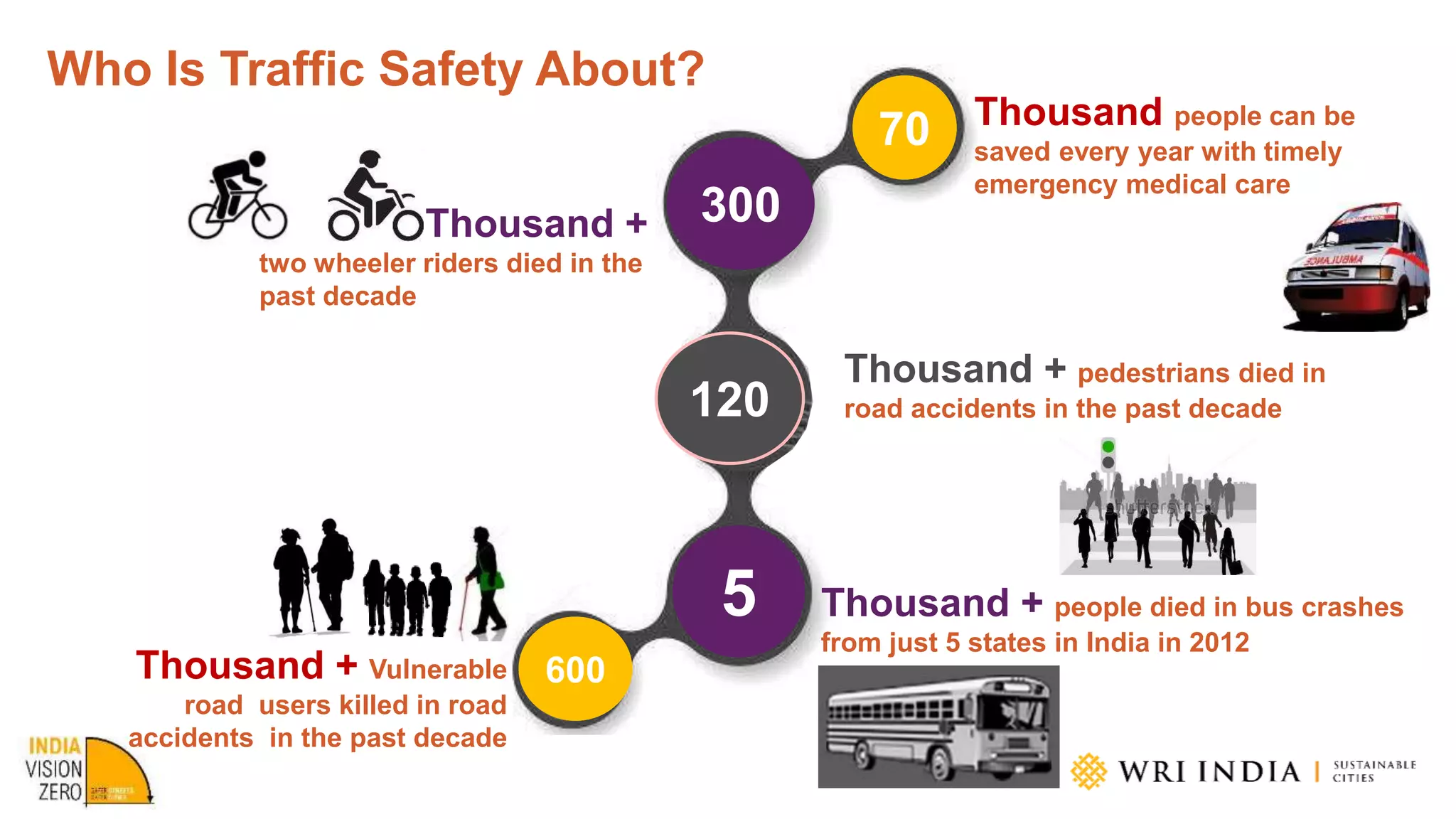
Who Is Traffic Safety About?
70
300
120
5
600
Thousand +
two wheeler riders died in the
past decade
Thousand people can be
saved every year with timely
emergency medical care
Thousand + Vulnerable
road users killed in road
accidents in the past decade
Thousand + people died in bus crashes
from just 5 states in India in 2012
Thousand + pedestrians died in
road accidents in the past decade
Who Is Traffic Safety About?
Traffic Safety for People First
Traffic Safety Across the Sections of the Society
Youth:
In India, 15-34 years accounted for
53.8% of the total road accident fatalities
(NCRB)
The poor:
People from lower socioeconomic
backgrounds more likely to be involved in
traffic crashes; Often live in areas with low-
quality infrastructure (WHO 2003)
Elderly and the disabled:
Age group of 35-64 years accounts for a
share of 35.7% of road accident fatalities
(NCRB)
Commuters and workers: Most workers
spend anywhere from 30 to 60 minutes or
more traveling to and from work
Customers: Research has shown that
pedestrian and other crashes are associated
with the location of retail land uses
Reducing Risk and Exposure: Creating a Safe System for All
Source: Rosen and Sander (2009).
Identify measures and
contextualise them
Cities Safer by Design
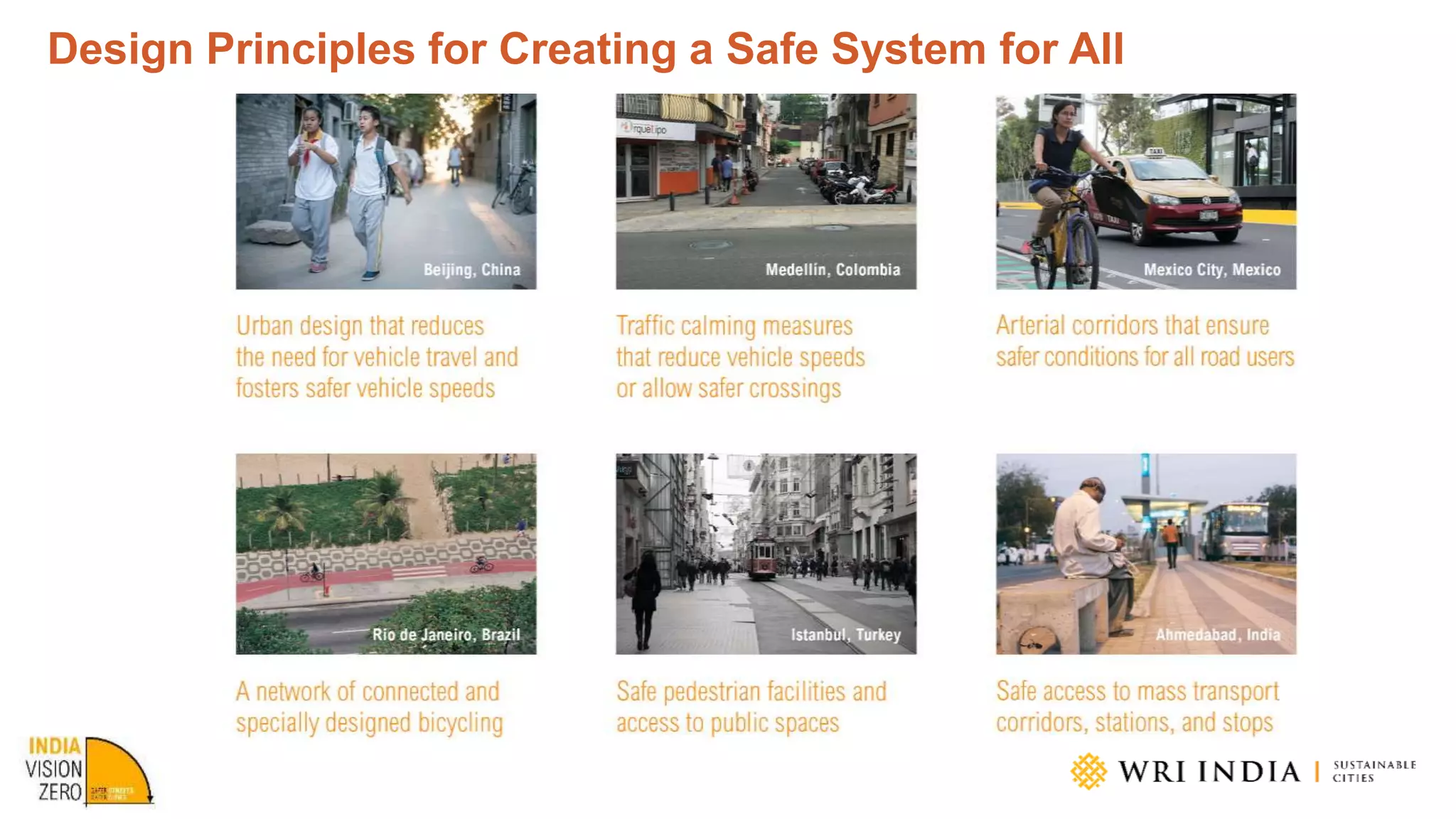
Design Principles for Creating a Safe System for All
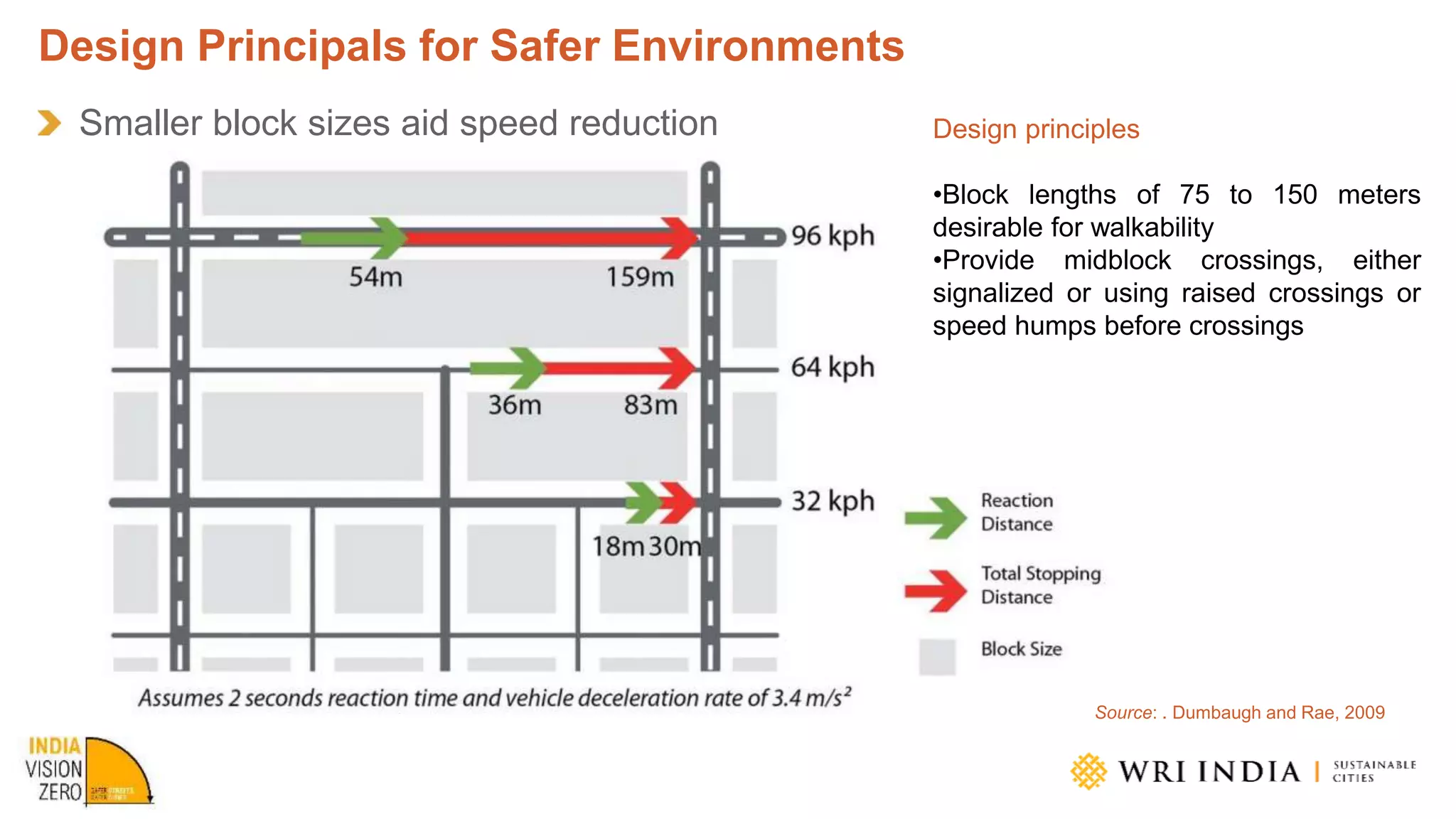
Design Principals for Safer Environments
Source: . Dumbaugh and Rae, 2009
Design principles
•Block lengths of 75 to 150 meters
desirable for walkability
•Provide midblock crossings, either
signalized or using raised crossings or
speed humps before crossings
Smaller block sizes aid speed reduction
Greater population densities can help
support mass transit and nearby uses
Design Principals for Safer Environments
Complementing population and Density
Compact & connected Urban Design
Design principles
•Density can be used with other
community design elements to
increase walking and cycling and
reduce motorized travel.
.
•Areas around mass transport
stations and corridors can be
targeted, especially those within a
half-kilometer catchment area of
stations.
Design Principals for Safer Environments
At commercial locations, transit points should be so located so as to set down and pick up
passengers as close as possible to main destinations.
Design Principals for Safer Environments
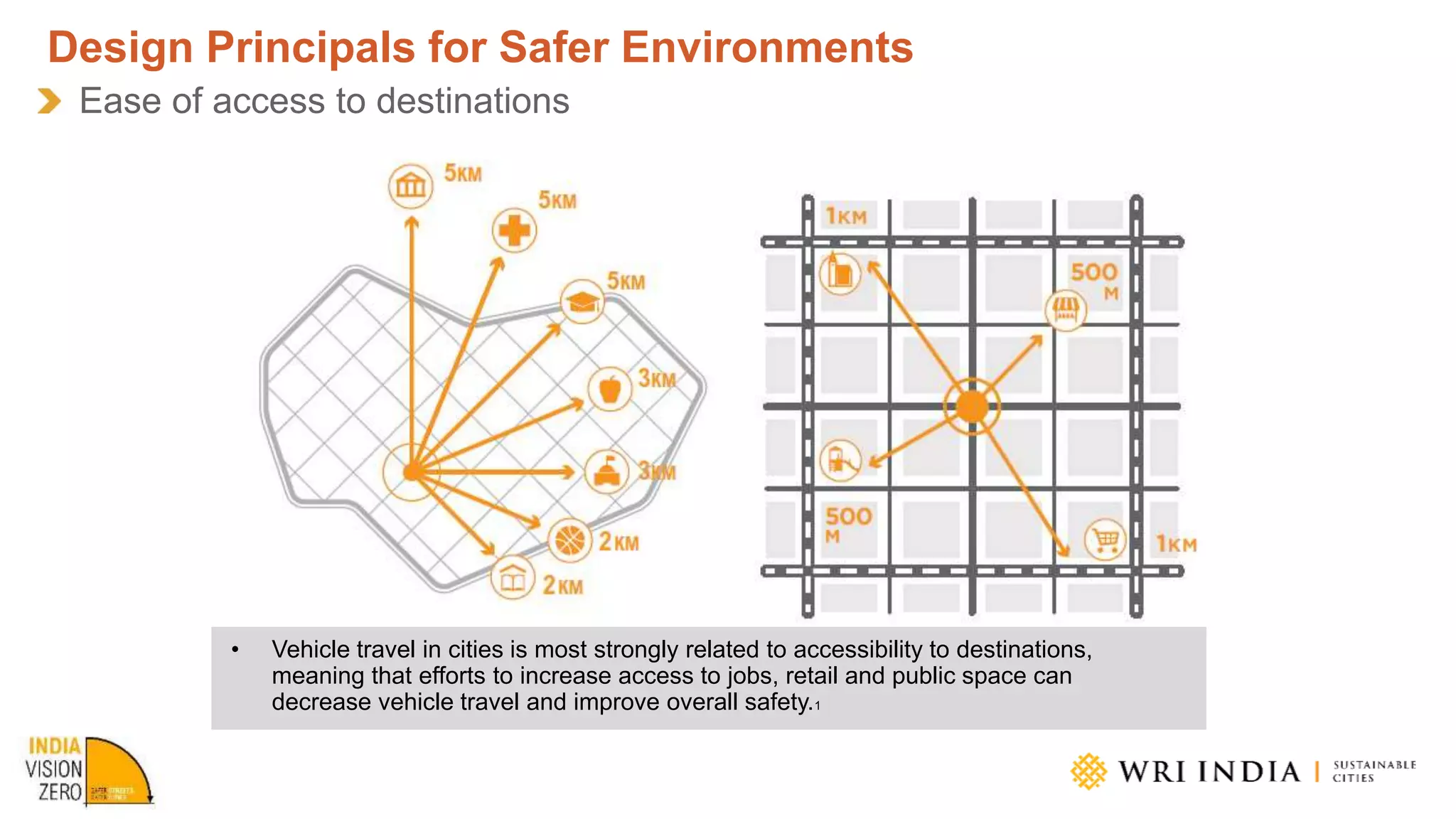
• Vehicle travel in cities is most strongly related to accessibility to destinations,
meaning that efforts to increase access to jobs, retail and public space can
decrease vehicle travel and improve overall safety.1
Ease of access to destinations
Design Principals for Safer Environments
Source: OECD (2009)
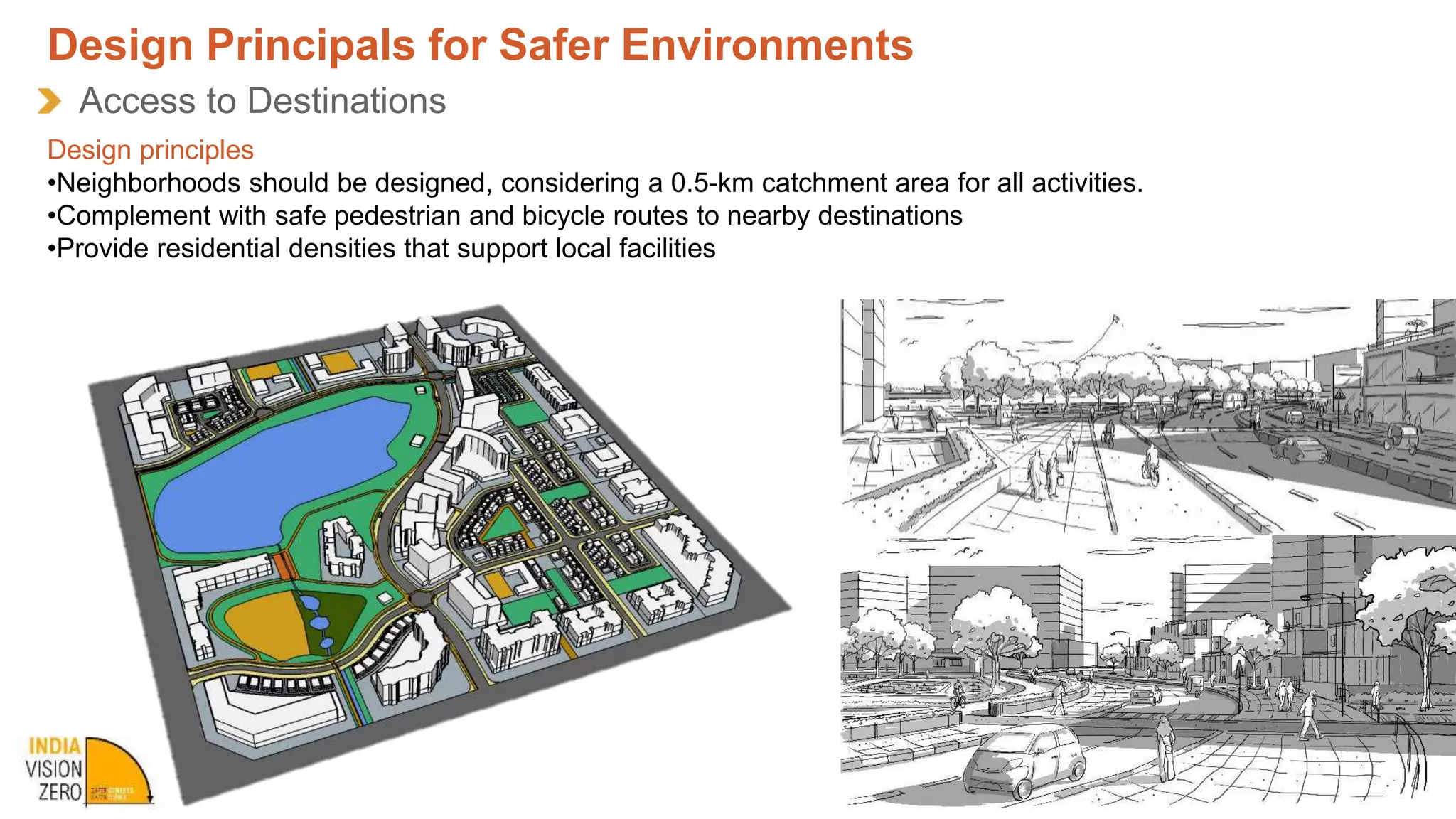
Access to Destinations
Design principles
•Neighborhoods should be designed, considering a 0.5-km catchment area for all activities.
•Complement with safe pedestrian and bicycle routes to nearby destinations
•Provide residential densities that support local facilities
Measures to improve Road Safety
Indian urban roads are unique in their challenges
Each design element must function in coordination with others
Measures to improve Road Safety: Road diet
Lesser lane widths for speed-calming and better capacity
Designing outside-in vs. inside-out
Measures to improve Road Safety: Road diet
Lesser lane widths for speed-calming and better capacity
Designing outside-in vs. inside-out
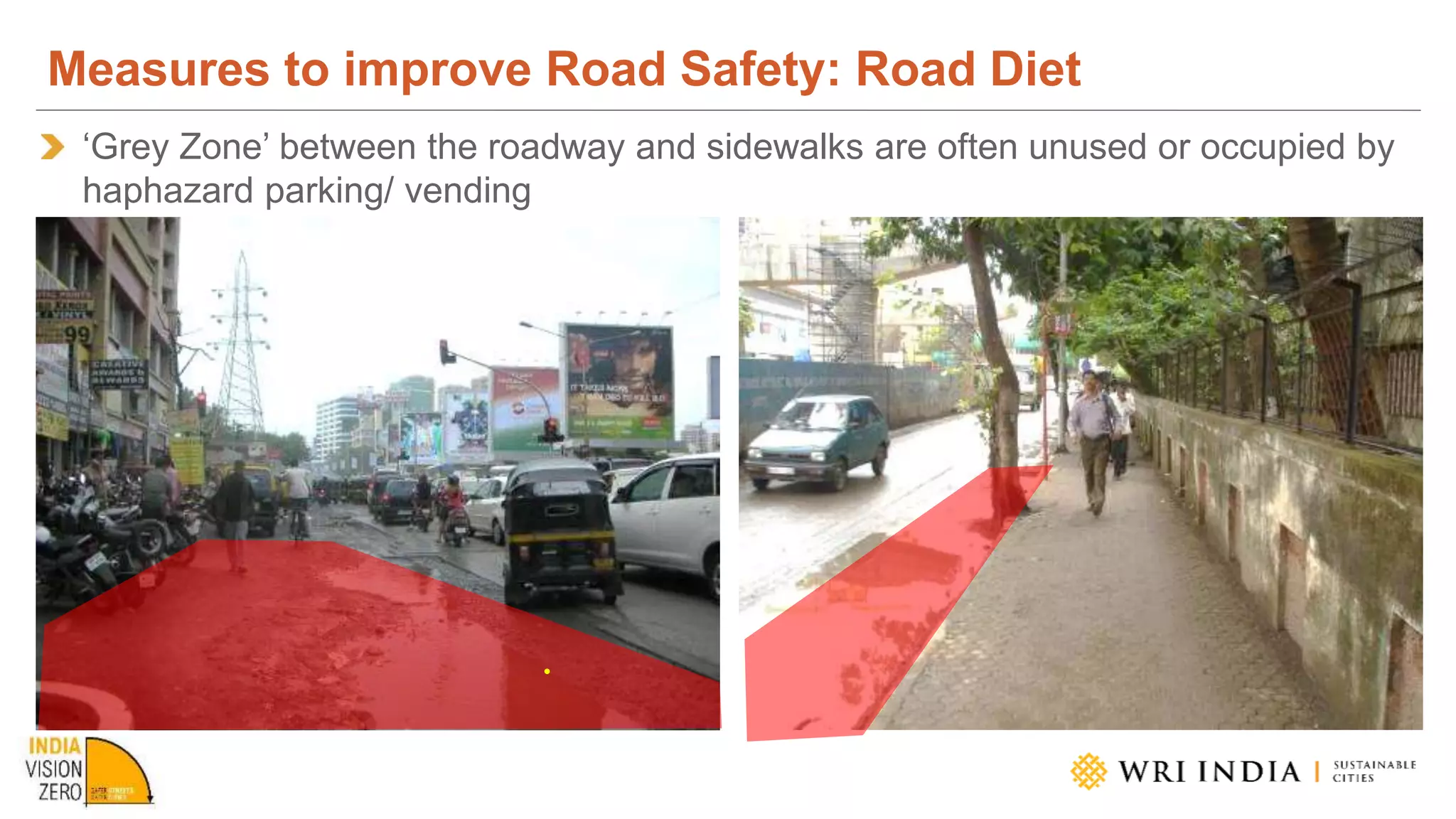
Measures to improve Road Safety: Road Diet
‘Grey Zone’ between the roadway and sidewalks are often unused or occupied by
haphazard parking/ vending
Retain existing
median
Retain existing CC
lanes
Proposed bus-stop/ taxi-auto stand/ trees/
utilities + Uninterrupted walkway 1.8m
Measures to improve Road Safety
‘Grey Zone’ between the roadway and sidewalks are often unused or occupied by
haphazard parking/ vending
Measures to improve Road Safety
2m
Footpath
2.5m
MUZ
10 m
Carriageway
1.5m
M
10 m
Carriageway
2.5m MUZ 2m
Footpath
Speed humps can
reduce accidents by
up to 50%,
Ped. crashes
increase by 6% for
every extra 1 meter
of crossing distance
Lesser lane-widths
and MUZ allows for
continuous clear
walkways
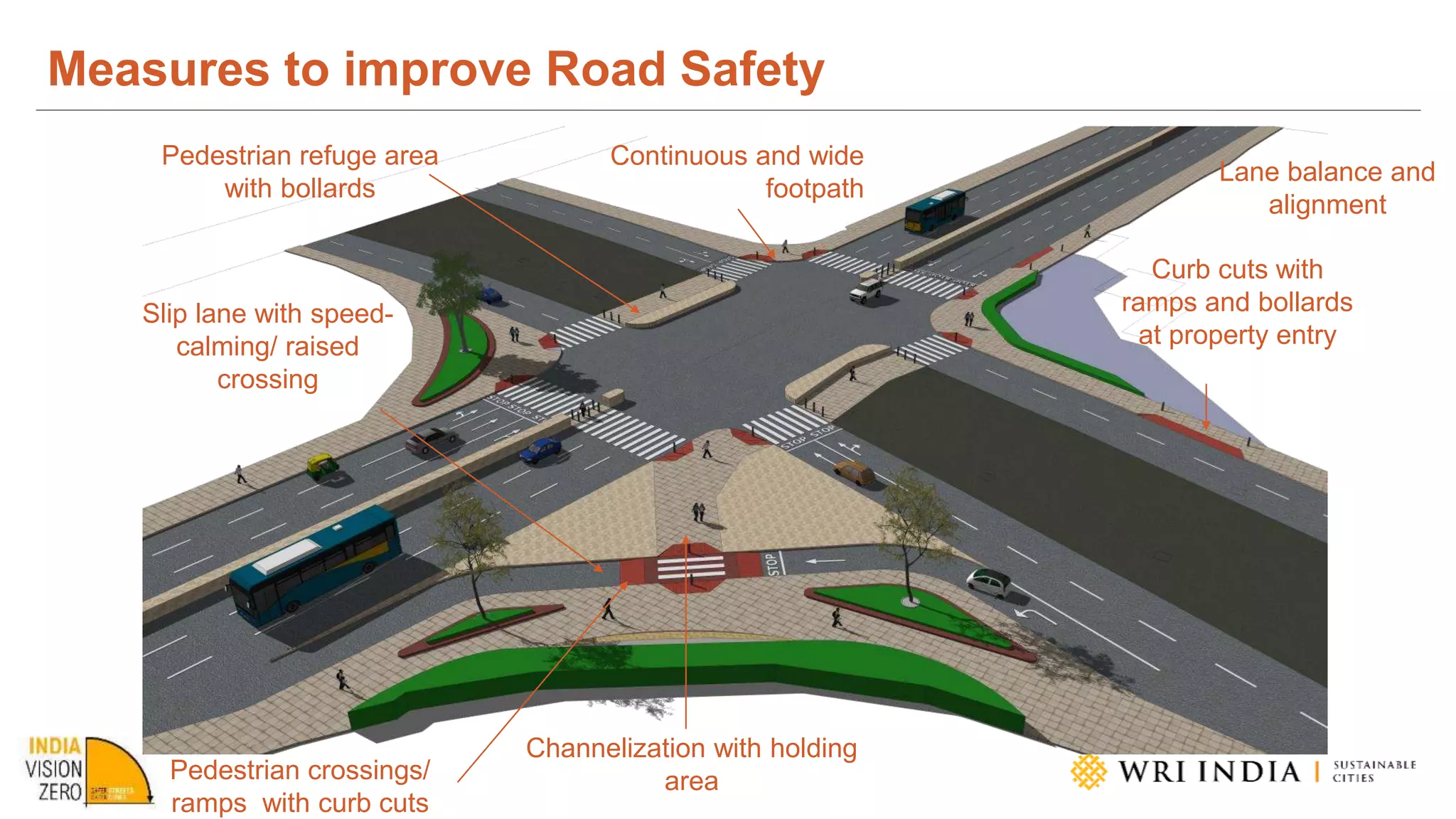
Measures to improve Road Safety
Pedestrian refuge area
with bollards
Pedestrian crossings/
ramps with curb cuts
Channelization with holding
area
Slip lane with speed-
calming/ raised
crossing
Continuous and wide
footpath
Lane balance and
alignment
Curb cuts with
ramps and bollards
at property entry
Safe access to Public Transit
Median division for
waiting area with
protected refuge
island
Corner kerbs
Minimum turning
radii with well
oriented ramps
Optimised signal
phasing with protected
phase for pedestrians
Wide refuge area with
tapered carriageway
Shared streets to create speed-calmed zones
•Enhanced paving, alternating pavers, and street furnishings within the street can be used
with maximum speeds at most around 15 km/h.
Scale-up through a
collaborative process
Cities Safer by Design
Aligning priorities with stakeholders
1 fatal accident
2 fatal accidents
>2 fatal accidents
Junction Locations No.
CST Bridge Junction 4
Kalpana Cinema 1
Sheetal Cinema 1
Kamini Signal 1
Ghatkopar Police Station 1
Opp. Water dept. 1
Sarvodaya Hospital 1
Godrej Gate 2 1
Godrej Gate 1 1
Gandhi nagar Junction 2
Cine Vista Film Studio 1
Kanjurmarg Station Jn. 3
Total 18
Mid-block Locations No.
Old Agra Road Bus stop 1
Naaz Hotel 1
Mukund company 1
Opp. Toyota Showroom 1
Sainik Petrolpump 1
Ghatkopar Police Station 1
Roa Hotel 1
Gopal Bhawan 2
Sai baba mandir 1
Vijay sales 1
Kalpataru 1
Mahajan Compound 1
Vikhroli Bus Stop 1
Hindustan Kohinoor Complex 1
Hometown 2
HCC Bus Stop 1
Total 18
Equal number of fatalities at both
intersection and midblock black-spots
Kanjurmarg Station Jn.
Gandhi Nagar Jn
Hometown
Gopal Bhawan
CST Bridge Junction
Guru Nanak Nagar
Engaging with the city authorities
Engaging with ward-level personnel
Engaging with the city authorities
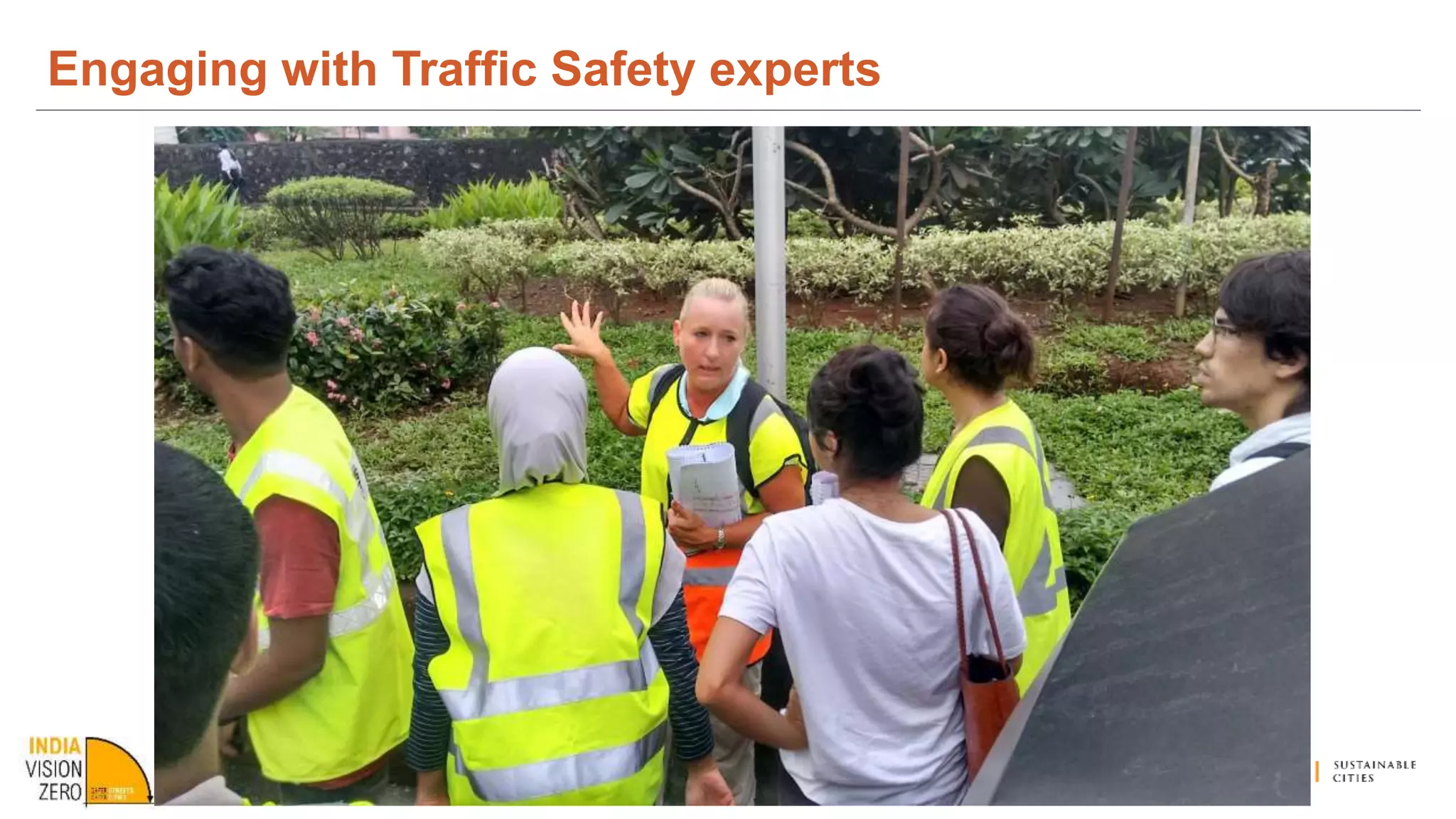
Engaging with Traffic Safety experts
Engaging with the community & users
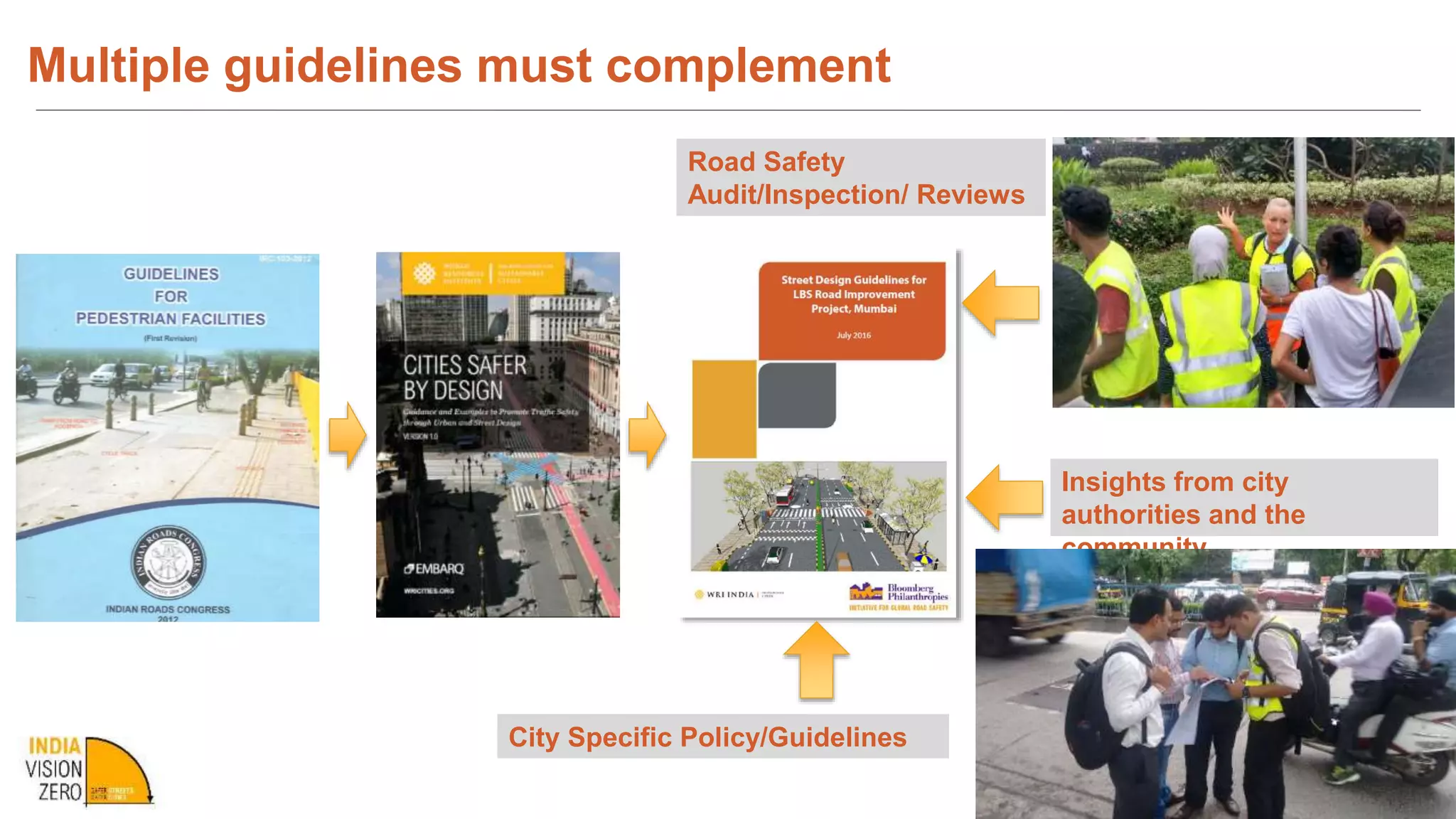
Multiple guidelines must complement
Road Safety
Audit/Inspection/ Reviews
City Specific Policy/Guidelines
Insights from city
authorities and the
community
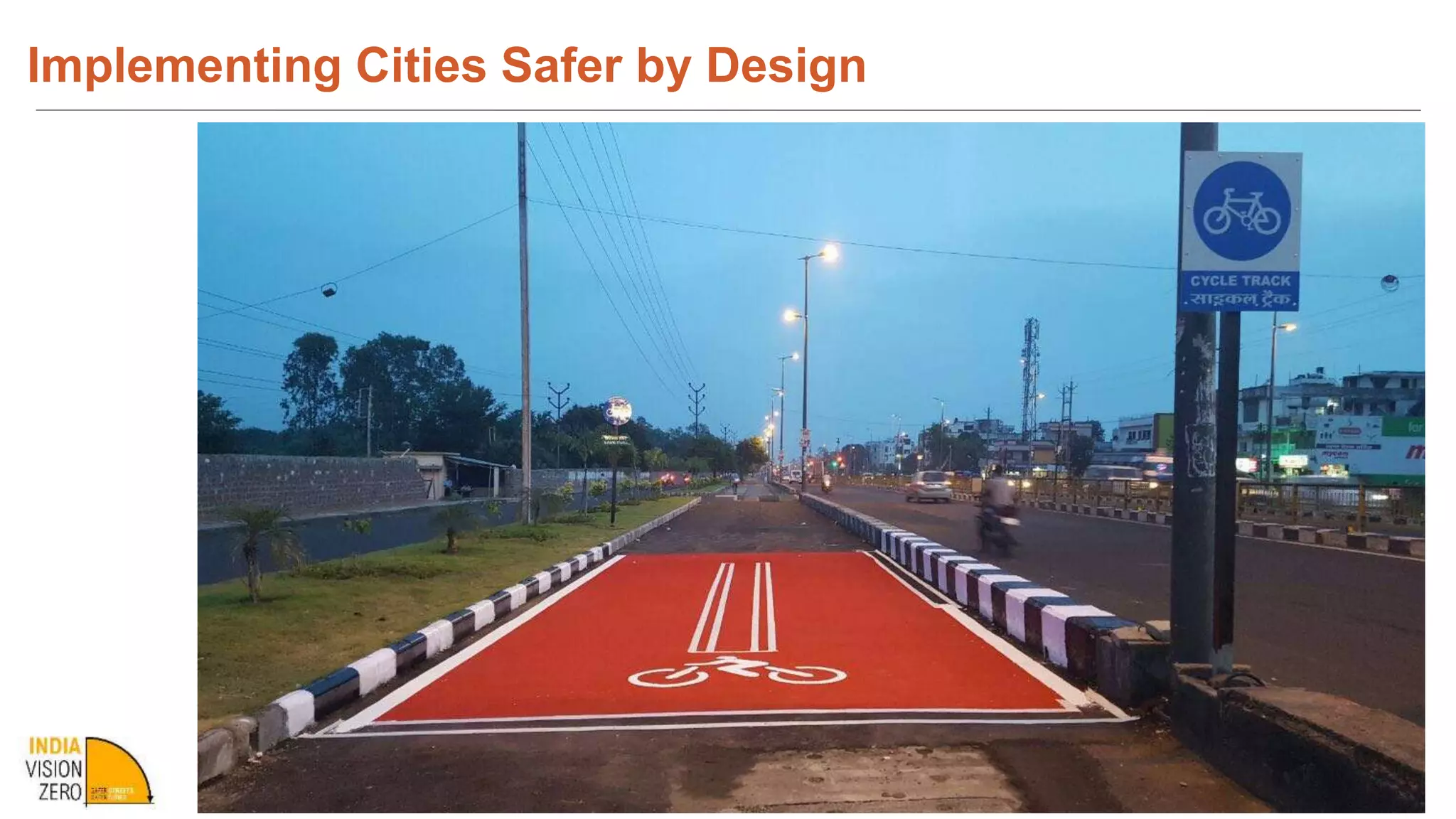
Implementing Cities Safer by Design
Thank you!
DOWNLOAD THE REPORTAT:
www.wri.org/cities-safer-design
#citiessaferbydesign

Cities Safer by Design - Guidelines For Safe Road Design for Cities

  • 1.
    Cities Safer byDesign: Guidelines for safe road design for cities Bhubaneswar 19th September 2016 Nikhil Chaudhary Senior Project Associate – Urban Transport & Road Safety WRI India
  • 2.
    Reported Traffic FatalityRates in Selected Global Cities Reported Traffic Fatality rate per 100,000 population 2. Chennai 4. Jaipur 16. Indore 23. Kolkata 24. Delhi 25. Bangalore 34. Pune 35. Surat 36. Ahmedabad Source: EMBARQ technical note (Welle and Li 2015)
  • 3.
    Identify the vulnerableusers Cities Safer by Design
  • 4.
    15 1 5 20 0 Children (<14 yrs)are killed every day in road accidents in India People are killed every hour in road accidents in India Million people were seriously Injured or disabled in road accidents in India in the past decade Million people died in road accidents in India in the past decade 3% Annual GDP loss to India due to road accidents Statutes to protect children on the road Who Is Traffic Safety About?
  • 5.
    70 300 120 5 600 Thousand + two wheelerriders died in the past decade Thousand people can be saved every year with timely emergency medical care Thousand + Vulnerable road users killed in road accidents in the past decade Thousand + people died in bus crashes from just 5 states in India in 2012 Thousand + pedestrians died in road accidents in the past decade Who Is Traffic Safety About?
  • 6.
    Traffic Safety forPeople First Traffic Safety Across the Sections of the Society Youth: In India, 15-34 years accounted for 53.8% of the total road accident fatalities (NCRB) The poor: People from lower socioeconomic backgrounds more likely to be involved in traffic crashes; Often live in areas with low- quality infrastructure (WHO 2003) Elderly and the disabled: Age group of 35-64 years accounts for a share of 35.7% of road accident fatalities (NCRB) Commuters and workers: Most workers spend anywhere from 30 to 60 minutes or more traveling to and from work Customers: Research has shown that pedestrian and other crashes are associated with the location of retail land uses
  • 7.
    Reducing Risk andExposure: Creating a Safe System for All Source: Rosen and Sander (2009).
  • 8.
    Identify measures and contextualisethem Cities Safer by Design
  • 9.
    Design Principles forCreating a Safe System for All
  • 10.
    Design Principals forSafer Environments Source: . Dumbaugh and Rae, 2009 Design principles •Block lengths of 75 to 150 meters desirable for walkability •Provide midblock crossings, either signalized or using raised crossings or speed humps before crossings Smaller block sizes aid speed reduction
  • 11.
    Greater population densitiescan help support mass transit and nearby uses Design Principals for Safer Environments Complementing population and Density Compact & connected Urban Design Design principles •Density can be used with other community design elements to increase walking and cycling and reduce motorized travel. . •Areas around mass transport stations and corridors can be targeted, especially those within a half-kilometer catchment area of stations.
  • 12.
    Design Principals forSafer Environments At commercial locations, transit points should be so located so as to set down and pick up passengers as close as possible to main destinations.
  • 13.
    Design Principals forSafer Environments • Vehicle travel in cities is most strongly related to accessibility to destinations, meaning that efforts to increase access to jobs, retail and public space can decrease vehicle travel and improve overall safety.1 Ease of access to destinations
  • 14.
    Design Principals forSafer Environments Source: OECD (2009) Access to Destinations Design principles •Neighborhoods should be designed, considering a 0.5-km catchment area for all activities. •Complement with safe pedestrian and bicycle routes to nearby destinations •Provide residential densities that support local facilities
  • 15.
    Measures to improveRoad Safety Indian urban roads are unique in their challenges Each design element must function in coordination with others
  • 16.
    Measures to improveRoad Safety: Road diet Lesser lane widths for speed-calming and better capacity Designing outside-in vs. inside-out
  • 17.
    Measures to improveRoad Safety: Road diet Lesser lane widths for speed-calming and better capacity Designing outside-in vs. inside-out
  • 18.
    Measures to improveRoad Safety: Road Diet ‘Grey Zone’ between the roadway and sidewalks are often unused or occupied by haphazard parking/ vending
  • 19.
    Retain existing median Retain existingCC lanes Proposed bus-stop/ taxi-auto stand/ trees/ utilities + Uninterrupted walkway 1.8m Measures to improve Road Safety ‘Grey Zone’ between the roadway and sidewalks are often unused or occupied by haphazard parking/ vending
  • 20.
    Measures to improveRoad Safety 2m Footpath 2.5m MUZ 10 m Carriageway 1.5m M 10 m Carriageway 2.5m MUZ 2m Footpath Speed humps can reduce accidents by up to 50%, Ped. crashes increase by 6% for every extra 1 meter of crossing distance Lesser lane-widths and MUZ allows for continuous clear walkways
  • 21.
    Measures to improveRoad Safety Pedestrian refuge area with bollards Pedestrian crossings/ ramps with curb cuts Channelization with holding area Slip lane with speed- calming/ raised crossing Continuous and wide footpath Lane balance and alignment Curb cuts with ramps and bollards at property entry
  • 22.
    Safe access toPublic Transit Median division for waiting area with protected refuge island Corner kerbs Minimum turning radii with well oriented ramps Optimised signal phasing with protected phase for pedestrians Wide refuge area with tapered carriageway
  • 23.
    Shared streets tocreate speed-calmed zones •Enhanced paving, alternating pavers, and street furnishings within the street can be used with maximum speeds at most around 15 km/h.
  • 24.
    Scale-up through a collaborativeprocess Cities Safer by Design
  • 25.
    Aligning priorities withstakeholders 1 fatal accident 2 fatal accidents >2 fatal accidents Junction Locations No. CST Bridge Junction 4 Kalpana Cinema 1 Sheetal Cinema 1 Kamini Signal 1 Ghatkopar Police Station 1 Opp. Water dept. 1 Sarvodaya Hospital 1 Godrej Gate 2 1 Godrej Gate 1 1 Gandhi nagar Junction 2 Cine Vista Film Studio 1 Kanjurmarg Station Jn. 3 Total 18 Mid-block Locations No. Old Agra Road Bus stop 1 Naaz Hotel 1 Mukund company 1 Opp. Toyota Showroom 1 Sainik Petrolpump 1 Ghatkopar Police Station 1 Roa Hotel 1 Gopal Bhawan 2 Sai baba mandir 1 Vijay sales 1 Kalpataru 1 Mahajan Compound 1 Vikhroli Bus Stop 1 Hindustan Kohinoor Complex 1 Hometown 2 HCC Bus Stop 1 Total 18 Equal number of fatalities at both intersection and midblock black-spots Kanjurmarg Station Jn. Gandhi Nagar Jn Hometown Gopal Bhawan CST Bridge Junction Guru Nanak Nagar
  • 26.
    Engaging with thecity authorities
  • 27.
    Engaging with thecity authorities
  • 28.
  • 29.
    Engaging with thecity authorities
  • 30.
    Engaging with thecity authorities
  • 31.
    Engaging with thecity authorities
  • 32.
    Engaging with TrafficSafety experts
  • 33.
    Engaging with thecommunity & users
  • 34.
    Engaging with thecommunity & users
  • 35.
    Engaging with thecommunity & users
  • 36.
  • 37.
  • 38.
    Multiple guidelines mustcomplement Road Safety Audit/Inspection/ Reviews City Specific Policy/Guidelines Insights from city authorities and the community
  • 39.
  • 40.
  • 41.
  • 42.
    Thank you! DOWNLOAD THEREPORTAT: www.wri.org/cities-safer-design #citiessaferbydesign