THE EMERGING INFORMATION AND COMMUNICATION
TECHNOLOGY (ICT) APPLICATIONS IN HIGHER EDUCATION IN
THE 21ST CENTURY
1. A.DURGAPRASAD*
M.Li.Sc., UGC-NET, SETPGDCA,(Ph.D)
Lecturer in Library Science, LIBRARIAN
GDC, SIDDIPET, MEDAK (Dt.)
TELANGANA
INFORMATION AND COMMUNICATION TECHNOLOGIES (ICT)
 Information and Communication Technologies (ICTs) are
referred to as the varied collection of technological gear and
resources which are made use of to communicate. They are
also made use of to generate, distribute, collect and
administer information. ICT is a force that has changed many
aspects of the way we live.
 ICT’s consist of the hardware, software, networks, and media
for collection, storage, processing, transmission and
presentation of information (voice, data, text, images), as well
as related services. ICTs can be divided into two components,
Information and Communication Infrastructure (ICI) which
refers to physical telecommunications systems and networks
(cellular, broadcast, cable, satellite, postal) and the services
that utilize those (Internet, voice, mail, radio, and television),
and Information Technology (IT) that refers to the hardware
and software of information collection, storage, processing,
and presentation.
INFORMATION COMMUNICATION THROUGH TECHNOLOGY
 Technological developments lead to changes in work and
changes in the organization of work, and required
competencies are therefore changing. Gaining in
importance are the following competencies:
 • critical thinking,
 • generalist (broad) competencies,
 • ICT competencies enabling expert work,
 • decision-making,• handling of dynamic situations,
 • working as a member of a team, and
 • communicating effectively.
ICT APPLICATION IN HIGHER EDUCATION
 •The availability of internet,socialnet working website,smartphones and
soon has equipped students to carry and transmit any information within
few seconds.
 •Modernstudentisnotonlywellversedwiththetechnologybutalsolikesittobei
mplementedineducation.
 •Themodesofeducationarechangingdaybyday.Institutionsarenowfeelingth
erequirementofmoderndaystoolstoimparteducation.
 •Thesmartworldoftechnologicaladvancementhasitsownadvantages.Itsave
stimeanderrors.
 •Video lectures are very useful which can be accessed any time
 •One can getthe benefit virtual classrooms and video conferencing.
THE VARIOUS TOOLS OF ICT FOR EDUCATION
 The various tools of ICT for education
 Institution’s Interactive Website
 Centralization of Evaluation System through ERP
Implementation
 Social Media: Facebook, Orkut, Twitter etc.
 Communication through SMS from centralized
System
 Teachers Websites and Blog writing
 CDs and Other Electronic Devices
 Virtual Classrooms / Video Conferencing
CHALLENGES IN IMPLEMENTATION OF ICT IN HIGHER EDUCATION
CHALLENGES IN IMPLEMENTATION OF ICT
 Top Management’s Attitude
 Lack of Sound Technology
 Cooperation from Faculty Members
 Acceptability from Students Side
 Lackofsupportingfactorssuchaselectricity,componentsetc.
ICT IN RESEARCH
 The combination of communications and digital libraries is
equalizing access to academic resources, greatly
enriching research possibilities for smaller institutions and
those outside the big cities. Taking full advantage of these
trends to create new dynamics in research requires
national policies for ICTs in higher education and the
establishment of joint information systems linking all higher
education institutions.
 The application of ICTs in academic research has grown
steadily in the past 10 to 15 years in both developing and
developed countries, although there are wide variations in
usage both withinand between countries and regions.
ICT IN TEACHING
 Academics have taken to the use of computer in teaching
much more readily than they adopted earlier audio-visual
media. This is because the strength of computers is their
power to manipulate words and symbols - which is at the heart
of the academic endeavor. There is a trend to
 introduce eLearning or online learning both in courses taught
on campus and in distance learning. Distance education and
eLearning are not necessarily the same thing and can have
very different cost structures. Whether eLearning improves
quality or reduce cost depends on the particular
circumstances. ICTs in general and eLearning in particular
have reduced the barriers to entry to the higher education
business. Countries and those aspiring to create new HEIs
can learn from the failures of a number of virtual universities.
They reveal that ICTs should be introduced in a systematic
manner that brings clarity to the business model through cost-
benefit analyses.
ICT FOR LIBRARY AUTOMATION
 Library House keeping operations
 Automatic acquisition,catalouging,classification
 Automatic circulation ,Serial control(periodicals
mgmt),
 Electronic Library management
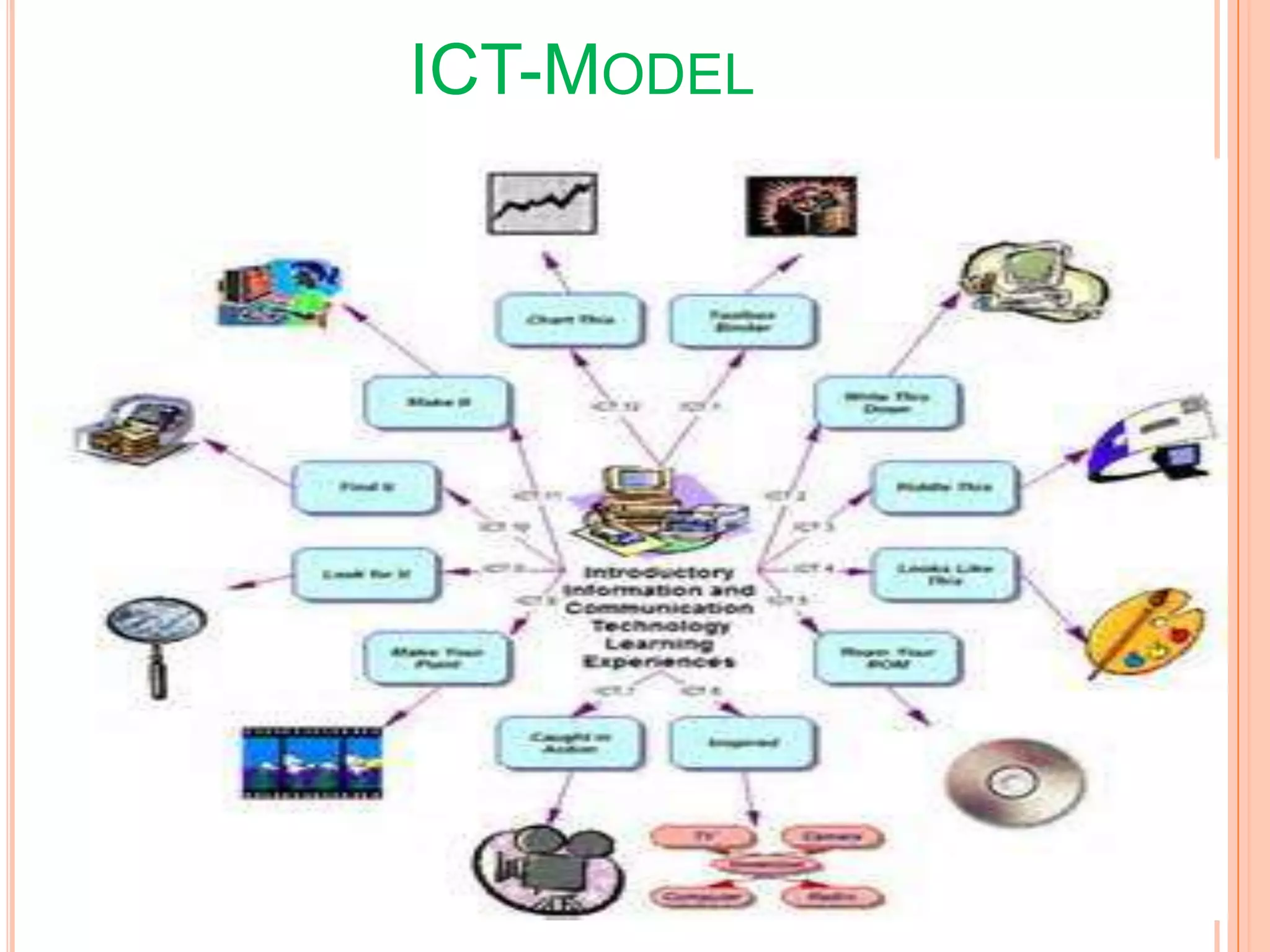
ICT-MODEL
RFID TECHNOLOGY FOR LIBRARIES
 RFID (Radio Frequency Identification) is the latest technology being used
in modern library’s theft detection system. Unlike EM (Electro
Mechanical) and RF (Radio Frequency) systems which have been used
in libraries for decades, RFID – based systems moved beyond security to
become tracking system that combines security with more efficient
tracking of materials throughout the easier and faster charge and
discharge, inventorying and material handling. RFID is a combination of
radio frequency based technology and microchip
 technology. The information contained on microchips in the tag affixed to
library materials is read using radio frequency technology regardless of
item orientation or alignment and distant from the item is not a critical
factor except in the case of extra wide exit gates. The corridors at the
building exits can be as wide as four feet because the tag can be read at
a distance of upto two feet by each of two parallel
 exit sensors. The target used in RFID systems can replace both EM or
RF theft detection targets and barcodes. RFID is necessary requirement
for modernization of college and University Libraries
JAWS SOFTWARE
 JAWS Software Blind persons-Job Access with
Speech-Disabled persons JAWS will read aloud
information on the screen which can be used the
windows desktop
 Index Braille-converts documents to Braille. This
printer imported from Sweden and Braille
documents can also be produced on request
CONCLUSION
 •ICT tool shave a significant potential in modernization of higher
education. In India there is a huge lack of participation for
development of ICT infrastructure particularly for educational
institutions.
 The teachers’ role become more critical when the yare not
helped by their top management.
 The teachers have to play not only the role of a subject expert
but the person who will is responsible for the successful
implementation of information and communication
technology tools in the higher education
THANKS TO TECHNOLOGY AN PATIENT LISTENERS

Emerging ict applications in higher education in 21 st century

  • 1.
    THE EMERGING INFORMATIONAND COMMUNICATION TECHNOLOGY (ICT) APPLICATIONS IN HIGHER EDUCATION IN THE 21ST CENTURY 1. A.DURGAPRASAD* M.Li.Sc., UGC-NET, SETPGDCA,(Ph.D) Lecturer in Library Science, LIBRARIAN GDC, SIDDIPET, MEDAK (Dt.) TELANGANA
  • 2.
    INFORMATION AND COMMUNICATIONTECHNOLOGIES (ICT)  Information and Communication Technologies (ICTs) are referred to as the varied collection of technological gear and resources which are made use of to communicate. They are also made use of to generate, distribute, collect and administer information. ICT is a force that has changed many aspects of the way we live.  ICT’s consist of the hardware, software, networks, and media for collection, storage, processing, transmission and presentation of information (voice, data, text, images), as well as related services. ICTs can be divided into two components, Information and Communication Infrastructure (ICI) which refers to physical telecommunications systems and networks (cellular, broadcast, cable, satellite, postal) and the services that utilize those (Internet, voice, mail, radio, and television), and Information Technology (IT) that refers to the hardware and software of information collection, storage, processing, and presentation.
  • 3.
    INFORMATION COMMUNICATION THROUGHTECHNOLOGY  Technological developments lead to changes in work and changes in the organization of work, and required competencies are therefore changing. Gaining in importance are the following competencies:  • critical thinking,  • generalist (broad) competencies,  • ICT competencies enabling expert work,  • decision-making,• handling of dynamic situations,  • working as a member of a team, and  • communicating effectively.
  • 4.
    ICT APPLICATION INHIGHER EDUCATION  •The availability of internet,socialnet working website,smartphones and soon has equipped students to carry and transmit any information within few seconds.  •Modernstudentisnotonlywellversedwiththetechnologybutalsolikesittobei mplementedineducation.  •Themodesofeducationarechangingdaybyday.Institutionsarenowfeelingth erequirementofmoderndaystoolstoimparteducation.  •Thesmartworldoftechnologicaladvancementhasitsownadvantages.Itsave stimeanderrors.  •Video lectures are very useful which can be accessed any time  •One can getthe benefit virtual classrooms and video conferencing.
  • 5.
    THE VARIOUS TOOLSOF ICT FOR EDUCATION  The various tools of ICT for education  Institution’s Interactive Website  Centralization of Evaluation System through ERP Implementation  Social Media: Facebook, Orkut, Twitter etc.  Communication through SMS from centralized System  Teachers Websites and Blog writing  CDs and Other Electronic Devices  Virtual Classrooms / Video Conferencing
  • 6.
    CHALLENGES IN IMPLEMENTATIONOF ICT IN HIGHER EDUCATION CHALLENGES IN IMPLEMENTATION OF ICT  Top Management’s Attitude  Lack of Sound Technology  Cooperation from Faculty Members  Acceptability from Students Side  Lackofsupportingfactorssuchaselectricity,componentsetc.
  • 7.
    ICT IN RESEARCH The combination of communications and digital libraries is equalizing access to academic resources, greatly enriching research possibilities for smaller institutions and those outside the big cities. Taking full advantage of these trends to create new dynamics in research requires national policies for ICTs in higher education and the establishment of joint information systems linking all higher education institutions.  The application of ICTs in academic research has grown steadily in the past 10 to 15 years in both developing and developed countries, although there are wide variations in usage both withinand between countries and regions.
  • 8.
    ICT IN TEACHING Academics have taken to the use of computer in teaching much more readily than they adopted earlier audio-visual media. This is because the strength of computers is their power to manipulate words and symbols - which is at the heart of the academic endeavor. There is a trend to  introduce eLearning or online learning both in courses taught on campus and in distance learning. Distance education and eLearning are not necessarily the same thing and can have very different cost structures. Whether eLearning improves quality or reduce cost depends on the particular circumstances. ICTs in general and eLearning in particular have reduced the barriers to entry to the higher education business. Countries and those aspiring to create new HEIs can learn from the failures of a number of virtual universities. They reveal that ICTs should be introduced in a systematic manner that brings clarity to the business model through cost- benefit analyses.
  • 9.
    ICT FOR LIBRARYAUTOMATION  Library House keeping operations  Automatic acquisition,catalouging,classification  Automatic circulation ,Serial control(periodicals mgmt),  Electronic Library management
  • 10.
  • 11.
    RFID TECHNOLOGY FORLIBRARIES  RFID (Radio Frequency Identification) is the latest technology being used in modern library’s theft detection system. Unlike EM (Electro Mechanical) and RF (Radio Frequency) systems which have been used in libraries for decades, RFID – based systems moved beyond security to become tracking system that combines security with more efficient tracking of materials throughout the easier and faster charge and discharge, inventorying and material handling. RFID is a combination of radio frequency based technology and microchip  technology. The information contained on microchips in the tag affixed to library materials is read using radio frequency technology regardless of item orientation or alignment and distant from the item is not a critical factor except in the case of extra wide exit gates. The corridors at the building exits can be as wide as four feet because the tag can be read at a distance of upto two feet by each of two parallel  exit sensors. The target used in RFID systems can replace both EM or RF theft detection targets and barcodes. RFID is necessary requirement for modernization of college and University Libraries
  • 12.
    JAWS SOFTWARE  JAWSSoftware Blind persons-Job Access with Speech-Disabled persons JAWS will read aloud information on the screen which can be used the windows desktop  Index Braille-converts documents to Braille. This printer imported from Sweden and Braille documents can also be produced on request
  • 13.
    CONCLUSION  •ICT toolshave a significant potential in modernization of higher education. In India there is a huge lack of participation for development of ICT infrastructure particularly for educational institutions.  The teachers’ role become more critical when the yare not helped by their top management.  The teachers have to play not only the role of a subject expert but the person who will is responsible for the successful implementation of information and communication technology tools in the higher education
  • 14.
    THANKS TO TECHNOLOGYAN PATIENT LISTENERS