ICT IN EDUCATION DEVELOPMENT
IN LAO PDR
Associate Professor Dr. Somkiat PHASY, Director General
ICT Center, Ministry of Education and Sports, Lao PDR
ASEAN Workshop “ ICT in Education”
15 – 16 October 2015
Phuket, Thailand
CONTENTS OF PRESENTATION
 Introduction
 ICT in Education Conceptual Framework
 ICT in Education Development Strategy
 ICT Project Phase I(E-Education Project)
 ICT Project Phase I Results
 Some Statistics
 Challenges
 Supports Needed
 Conclusion
 Thanks for Attentions & Thanks and Appreciation
for Questions and Recommendations
INTRODUCTION
 International Cooperation with Globalization
 ASEAN Integration
 ICT - Powerful tools for educational change and
Reforms
 National Policy and Goals(2006):
 2020, Reduce Poverty & Bring Country out of LD Status
 MDG and EFA
 Building primary foundations for the future
industrialization and modernization of the country
 Human Resource Development is an important factor
INTRODUCTION (CONTINUE)
 National ICT Policy
 Increasing general access to ICT infrastructure and its
software with the provision of modern telecommunications
infrastructure, computer networks, application software
 Digital educational resources
 National ICT Development Framework
 Government Enterprise and Private Telecommunication
Development
 Government Telecommunication Project Agency: Lao E-
Government Backbone Transmission Network
INTRODUCTION (CONTINUE)
 National Education System Reform(NESR): 2006 -
2015
 Pillar (1): Expand Equitable Access
 Pillar (2): Improve Quality of Education
 Pillar (3): Strengthen Planning and Management
 Results of Development and Implementation
Framework of NESR
 Promoting Private Education, Extension of Infrastructure,
Implementation of New Curriculum and others
 ICT in Education Framework Development
INTRODUCTION (CONTINUE)
 National ICT Development
 Government Enterprise and Private Telecommunication
Development
 Government Telecommunication Project Agency: Lao E-
Government Backbone Transmission Network
 Status of ICT in Education of Lao PDR(2009-2010):
 Ms Office and Internet Explorer, PMIS and running curriculum
program at Bachelor levels: Computer Science, Computer
Engineering;
 Laos (Cambodia, Myanmar, and Timor Leste) in the Third Group of
SEAMEO Member Countries at emerging stage of ICT in Education
INTRODUCTION(CONTINUE)
 Evaluation of NESR Implied to ICT in Education
Conceptual Development (2009)
 General: Improvement of Quality of Education Services and
Equitable Access to Education
 Specifics:
(1) Limitation of Number of Teachers in Remote Areas
(2) Qualification, Skills and Experiences of Teachers in Remotes Areas in
compare with Cities
(3) Capacities of Teachers in Implementing the New Curriculum
(4) Capacities of Administrative Staff in Carrying out their Duties and
Responsibilities in 21 st Century
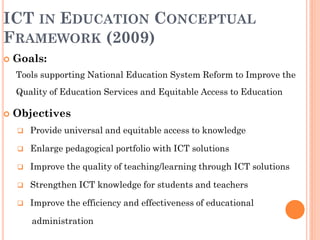
ICT IN EDUCATION CONCEPTUAL
FRAMEWORK (2009)
 Goals:
Tools supporting National Education System Reform to Improve the
Quality of Education Services and Equitable Access to Education
 Objectives
 Provide universal and equitable access to knowledge
 Enlarge pedagogical portfolio with ICT solutions
 Improve the quality of teaching/learning through ICT solutions
 Strengthen ICT knowledge for students and teachers
 Improve the efficiency and effectiveness of educational
administration
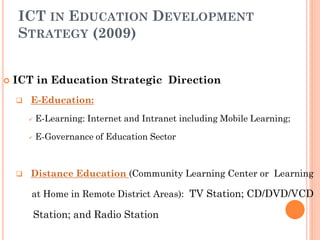
ICT IN EDUCATION DEVELOPMENT
STRATEGY (2009)
 ICT in Education Strategic Direction
 E-Education:
 E-Learning: Internet and Intranet including Mobile Learning;
 E-Governance of Education Sector
 Distance Education (Community Learning Center or Learning
at Home in Remote District Areas): TV Station; CD/DVD/VCD
Station; and Radio Station
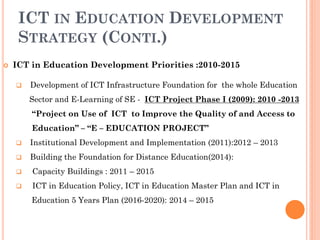
ICT IN EDUCATION DEVELOPMENT
STRATEGY (CONTI.)
 ICT in Education Development Priorities :2010-2015
 Development of ICT Infrastructure Foundation for the whole Education
Sector and E-Learning of SE - ICT Project Phase I (2009): 2010 -2013
“Project on Use of ICT to Improve the Quality of and Access to
Education” – “E – EDUCATION PROJECT”
 Institutional Development and Implementation (2011):2012 – 2013
 Building the Foundation for Distance Education(2014):
 Capacity Buildings : 2011 – 2015
 ICT in Education Policy, ICT in Education Master Plan and ICT in
Education 5 Years Plan (2016-2020): 2014 – 2015
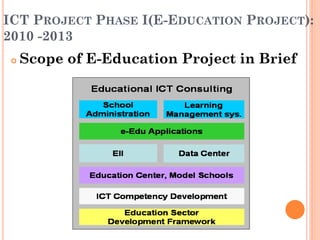
ICT PROJECT PHASE I(E-EDUCATION PROJECT):
2010 -2013
 Scope of E-Education Project in Brief
ICT PROJECT PHASE I(E-EDUCATION PROJECT):
2010 -2013
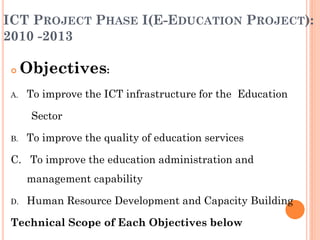
 Objectives:
A. To improve the ICT infrastructure for the Education
Sector
B. To improve the quality of education services
C. To improve the education administration and
management capability
D. Human Resource Development and Capacity Building
Technical Scope of Each Objectives below
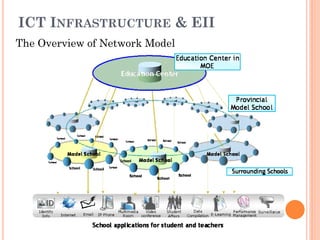
ICT INFRASTRUCTURE & EII
The Overview of Network Model
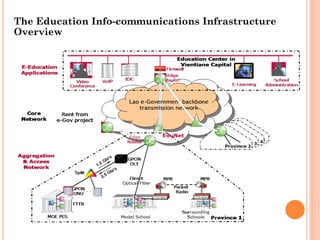
The Education Info-communications Infrastructure
Overview
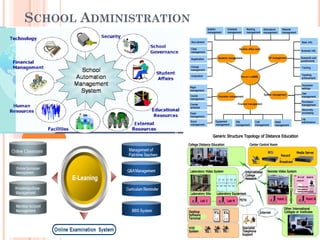
SCHOOL ADMINISTRATION
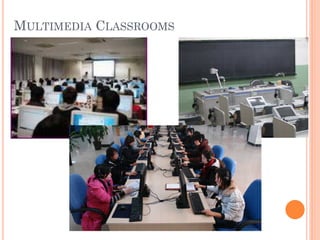
MULTIMEDIA CLASSROOMS
ICT PROJECT PHASE I (CONTINUE)
Scope of the Project for Each Objective (Continue)
C. Human Resource Development and Capability
Building:
 Allocating and Recruiting the Staff in each Center and
the priority departments concerned
 Training:
 Overseas: Mother of Chicken
 In-Country Training
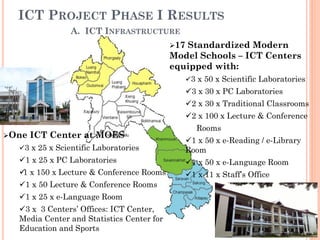
ICT PROJECT PHASE I RESULTS
17 Standardized Modern
Model Schools – ICT Centers
equipped with:
3 x 50 x Scientific Laboratories
3 x 30 x PC Laboratories
2 x 30 x Traditional Classrooms
2 x 100 x Lecture & Conference
Rooms
1 x 50 x e-Reading / e-Library
Room
1 x 50 x e-Language Room
1 x 11 x Staff’s Office
One ICT Center at MOES
3 x 25 x Scientific Laboratories
1 x 25 x PC Laboratories
1 x 150 x Lecture & Conference Rooms
1 x 50 Lecture & Conference Rooms
1 x 25 x e-Language Room
3 x 3 Centers’ Offices: ICT Center,
Media Center and Statistics Center for
Education and Sports
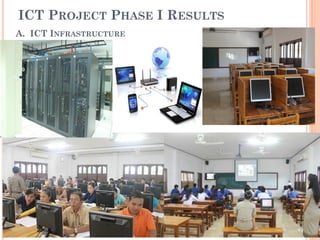
A. ICT INFRASTRUCTURE
ICT PROJECT PHASE I RESULTS
A. ICT INFRASTRUCTURE
ICT PROJECT PHASE I RESULTS (CONTI.)
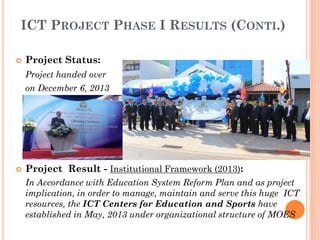
 Project Status:
Project handed over
on December 6, 2013
 Project Result - Institutional Framework (2013):
In Accordance with Education System Reform Plan and as project
implication, in order to manage, maintain and serve this huge ICT
resources, the ICT Centers for Education and Sports have
established in May, 2013 under organizational structure of MOES
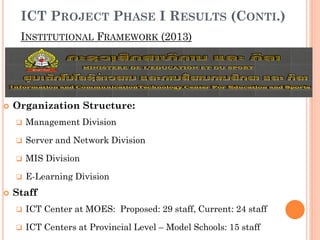
INSTITUTIONAL FRAMEWORK (2013)
 Organization Structure:
 Management Division
 Server and Network Division
 MIS Division
 E-Learning Division
 Staff
 ICT Center at MOES: Proposed: 29 staff, Current: 24 staff
 ICT Centers at Provincial Level – Model Schools: 15 staff
ICT PROJECT PHASE I RESULTS (CONTI.)
INSTITUTIONAL FRAMEWORK (2013)
ICT PROJECT PHASE I RESULTS (CONTI.)
 Function:
The ICT Center which is under direct supervision of Minister is the key
enabler to support all ICT facilities and systems for Lao Education
and is responsible for formulating policies and strategic planning in
the management and monitoring of all ICT resources
 To Provide and Support all ICT Equipments and ICT System for
Education Sector
 Data Centers: MIS for Educational Administration and Management
 E-Learning Centers: Learning Management Systems(LMS) and
Multimedia devices and equipments for education delivery and
Services
 ICT Policy and ICT Master Plan and Related Policies and Regulations
ICT PROJECT PHASE I RESULTS (CONTI.)
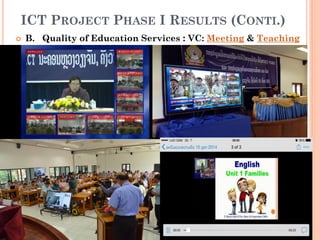
 B. Quality of Education Services : VC: Meeting & Teaching
•
ICT PROJECT PHASE I RESULTS (CONTI.)
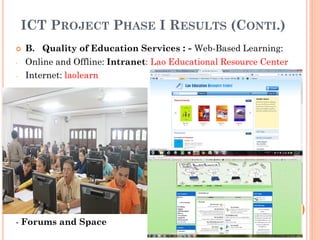
 B. Quality of Education Services : - Web-Based Learning:
- Online and Offline: Intranet: Lao Educational Resource Center
- Internet: laolearn
- Forums and Space
ICT PROJECT PHASE I RESULTS (CONTI.)
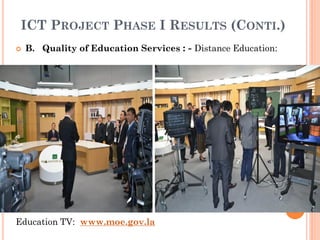
 B. Quality of Education Services : - Distance Education:
Education TV: www.moe.gov.la
ICT PROJECT PHASE I RESULTS (CONTI.)
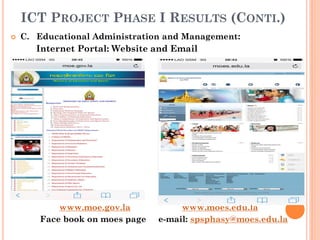
 C. Educational Administration and Management:
Internet Portal: Website and Email
www.moe.gov.la www.moes.edu.la
Face book on moes page e-mail: spsphasy@moes.edu.la
ICT PROJECT PHASE I RESULTS (CONTI.)
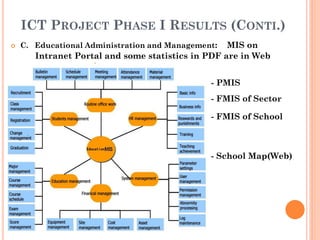
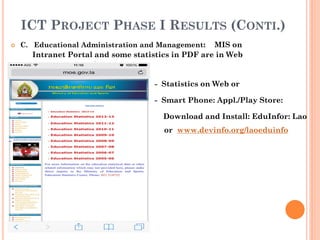
 C. Educational Administration and Management: MIS on
Intranet Portal and some statistics in PDF are in Web
•
 - PMIS
 - FMIS of Sector
 - FMIS of School
 - School Map(Web)
•


ICT PROJECT PHASE I RESULTS (CONTI.)
 C. Educational Administration and Management: MIS on
Intranet Portal and some statistics in PDF are in Web
•
 - Statistics on Web or
 - Smart Phone: Appl./Play Store:
 Download and Install: EduInfor: Lao
EduInfo:Lao or www.devinfo or www.devinfo.org/laoeduinfo
•


ICT PROJECT PHASE I RESULTS (CONTI.)
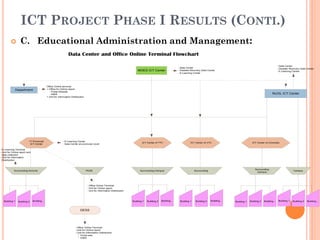
 C. Educational Administration and Management:
MOES ICT Center
Department
NUOL ICT Center
17 Provincial
ICT Center
ICT Center of TTC ICT Center of VTC ICT Center of University
Surrounding Schools PESS SurroundingSurrounding Campus.
Surrounding
Campus
Campus
DESS
Data Center and Office Online Terminal Flowchart
Building 1 Building... Building 1 Building... Building 1 Building...Building 2 Building 2Building 2Building 1 Building...Building 2 Building 1 Building...Building 2
Office Online terminal
+ Office for Online report
- Portal Website
- EMIS
+ Unit for Information Distribution
- Data Center
- Disaster Recovery Data Center
- E-Learning Center
- Data Center
- Disaster Recovery Data Center
- E-Learning Center
- E-Learning Center
- Data Center at provincial Level
- E-Learning Terminal
- Unit for Online report and
data collection
- Unit for Information
Distribution
- Office Online Terminal
- Unit for Online report
- Unit for Information Distribution
- Office Online Terminal
- Unit for Online report
- Unit for Information Distribution
* Portal web
* EMIS
ICT PROJECT PHASE I RESULTS (CONTI.)
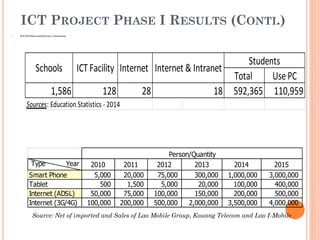
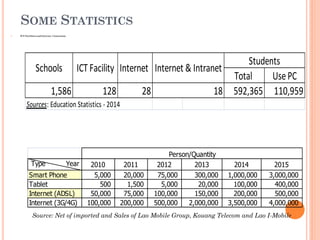
 ICT Facilities and Internet Connection
Source: Net of imported and Sales of Lao Mobile Group, Kouang Telecom and Lao I-Mobile
Total UsePC
1,586 128 28 592,365 110,959
Sources: Education Statistics - 2014
Schools ICT Facility Internet Internet & Intranet
Students
18
Type Year 2010 2011 2012 2013 2014 2015
Smart Phone 5,000 20,000 75,000 300,000 1,000,000 3,000,000
Tablet 500 1,500 5,000 20,000 100,000 400,000
Internet (ADSL) 50,000 75,000 100,000 150,000 200,000 500,000
Internet (3G/4G) 100,000 200,000 500,000 2,000,000 3,500,000 4,000,000
Person/Quantity
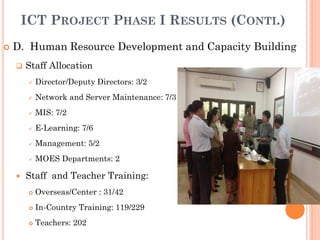
 D. Human Resource Development and Capacity Building
 Staff Allocation
 Director/Deputy Directors: 3/2
 Network and Server Maintenance: 7/3
 MIS: 7/2
 E-Learning: 7/6
 Management: 5/2
 MOES Departments: 2
 Staff and Teacher Training:
 Overseas/Center : 31/42
 In-Country Training: 119/229
 Teachers: 202
ICT PROJECT PHASE I RESULTS (CONTI.)
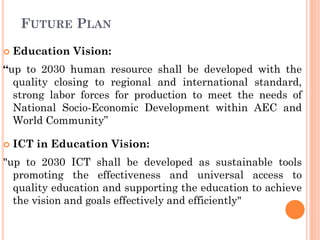
FUTURE PLAN
 Education Vision:
“up to 2030 human resource shall be developed with the
quality closing to regional and international standard,
strong labor forces for production to meet the needs of
National Socio-Economic Development within AEC and
World Community”
 ICT in Education Vision:
"up to 2030 ICT shall be developed as sustainable tools
promoting the effectiveness and universal access to
quality education and supporting the education to achieve
the vision and goals effectively and efficiently"
SOME STATISTICS
 ICT Facilities and Internet Connection
Source: Net of imported and Sales of Lao Mobile Group, Kouang Telecom and Lao I-Mobile
Total UsePC
1,586 128 28 592,365 110,959
Sources: Education Statistics - 2014
Schools ICT Facility Internet Internet & Intranet
Students
18
Type Year 2010 2011 2012 2013 2014 2015
Smart Phone 5,000 20,000 75,000 300,000 1,000,000 3,000,000
Tablet 500 1,500 5,000 20,000 100,000 400,000
Internet (ADSL) 50,000 75,000 100,000 150,000 200,000 500,000
Internet (3G/4G) 100,000 200,000 500,000 2,000,000 3,500,000 4,000,000
Person/Quantity
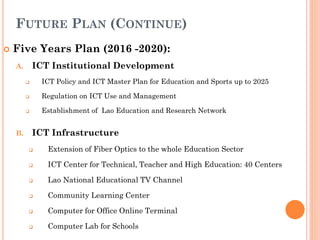
FUTURE PLAN (CONTINUE)
 Five Years Plan (2016 -2020):
A. ICT Institutional Development
 ICT Policy and ICT Master Plan for Education and Sports up to 2025
 Regulation on ICT Use and Management
 Establishment of Lao Education and Research Network
B. ICT Infrastructure
 Extension of Fiber Optics to the whole Education Sector
 ICT Center for Technical, Teacher and High Education: 40 Centers
 Lao National Educational TV Channel
 Community Learning Center
 Computer for Office Online Terminal
 Computer Lab for Schools
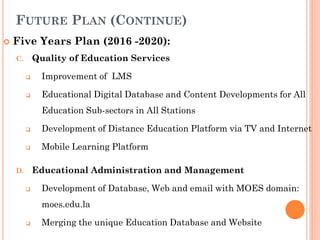
FUTURE PLAN (CONTINUE)
 Five Years Plan (2016 -2020):
C. Quality of Education Services
 Improvement of LMS
 Educational Digital Database and Content Developments for All
Education Sub-sectors in All Stations
 Development of Distance Education Platform via TV and Internet
 Mobile Learning Platform
D. Educational Administration and Management
 Development of Database, Web and email with MOES domain:
moes.edu.la
 Merging the unique Education Database and Website
FUTURE PLAN (CONTINUE)
 Five Years Plan (2016 -2020):
E. Human Resource Development and Capacity
Building
Trainings for IT Technicians on management,
maintenance and services of ICT resources
ICT Pedagogical Trainings for Teacher on educational
content development and teaching method development
Training for Media Staff
IT Literacy for staff and Teacher in Remote Areas
E. International Collaboration and PPP
CHALLENGES
 Leaderships and implementers’ Common vision and
understanding on ICT and its application under resource
constrain as ICT is new conceptual frameworks that is
difficult to realize what works and what does not
 Limitation in both quality and quantity of ICT
implementers.
 Financial constraints : Stable funding resources to develop
the sustainable ICT use in schools.
SUPPORTS NEEDED
 Technical Assistance and Expertise for ICT Policy and Master Plan
Development
 Comprehensive teacher trainings: e-Learning Training such as
educational content development and teaching method development
 Comprehensive administrator trainings: e-Governance of Education
Sector(for example, school administration)
 Providing the PCs or Laptops to schools(one per school): for e-Governance
purposes
 Comprehensive IT manpower training for the maintenances and services
of ICT resources to supporting the education governance and e-learning.
 Financial Assistance for Contents developments and training mother of
chicken
CONCLUSION
 Since ICT as an important tool is increasingly become priority
factor for each sector, particularly for Education sector there is
wide rank of use, management and high cost of maintenance and
more over, we still learn on what work and what does not…..
 Working together closely through International Assistances,
Collaboration, and Cooperation
THANK YOU FOR
ATTENTION
Thanks & Appreciations
for
Questions, suggestion &
Recommendations

ICT in Education

  • 1.
    ICT IN EDUCATIONDEVELOPMENT IN LAO PDR Associate Professor Dr. Somkiat PHASY, Director General ICT Center, Ministry of Education and Sports, Lao PDR ASEAN Workshop “ ICT in Education” 15 – 16 October 2015 Phuket, Thailand
  • 2.
    CONTENTS OF PRESENTATION Introduction  ICT in Education Conceptual Framework  ICT in Education Development Strategy  ICT Project Phase I(E-Education Project)  ICT Project Phase I Results  Some Statistics  Challenges  Supports Needed  Conclusion  Thanks for Attentions & Thanks and Appreciation for Questions and Recommendations
  • 3.
    INTRODUCTION  International Cooperationwith Globalization  ASEAN Integration  ICT - Powerful tools for educational change and Reforms  National Policy and Goals(2006):  2020, Reduce Poverty & Bring Country out of LD Status  MDG and EFA  Building primary foundations for the future industrialization and modernization of the country  Human Resource Development is an important factor
  • 4.
    INTRODUCTION (CONTINUE)  NationalICT Policy  Increasing general access to ICT infrastructure and its software with the provision of modern telecommunications infrastructure, computer networks, application software  Digital educational resources  National ICT Development Framework  Government Enterprise and Private Telecommunication Development  Government Telecommunication Project Agency: Lao E- Government Backbone Transmission Network
  • 5.
    INTRODUCTION (CONTINUE)  NationalEducation System Reform(NESR): 2006 - 2015  Pillar (1): Expand Equitable Access  Pillar (2): Improve Quality of Education  Pillar (3): Strengthen Planning and Management  Results of Development and Implementation Framework of NESR  Promoting Private Education, Extension of Infrastructure, Implementation of New Curriculum and others  ICT in Education Framework Development
  • 6.
    INTRODUCTION (CONTINUE)  NationalICT Development  Government Enterprise and Private Telecommunication Development  Government Telecommunication Project Agency: Lao E- Government Backbone Transmission Network  Status of ICT in Education of Lao PDR(2009-2010):  Ms Office and Internet Explorer, PMIS and running curriculum program at Bachelor levels: Computer Science, Computer Engineering;  Laos (Cambodia, Myanmar, and Timor Leste) in the Third Group of SEAMEO Member Countries at emerging stage of ICT in Education
  • 7.
    INTRODUCTION(CONTINUE)  Evaluation ofNESR Implied to ICT in Education Conceptual Development (2009)  General: Improvement of Quality of Education Services and Equitable Access to Education  Specifics: (1) Limitation of Number of Teachers in Remote Areas (2) Qualification, Skills and Experiences of Teachers in Remotes Areas in compare with Cities (3) Capacities of Teachers in Implementing the New Curriculum (4) Capacities of Administrative Staff in Carrying out their Duties and Responsibilities in 21 st Century
  • 8.
    ICT IN EDUCATIONCONCEPTUAL FRAMEWORK (2009)  Goals: Tools supporting National Education System Reform to Improve the Quality of Education Services and Equitable Access to Education  Objectives  Provide universal and equitable access to knowledge  Enlarge pedagogical portfolio with ICT solutions  Improve the quality of teaching/learning through ICT solutions  Strengthen ICT knowledge for students and teachers  Improve the efficiency and effectiveness of educational administration
  • 9.
    ICT IN EDUCATIONDEVELOPMENT STRATEGY (2009)  ICT in Education Strategic Direction  E-Education:  E-Learning: Internet and Intranet including Mobile Learning;  E-Governance of Education Sector  Distance Education (Community Learning Center or Learning at Home in Remote District Areas): TV Station; CD/DVD/VCD Station; and Radio Station
  • 10.
    ICT IN EDUCATIONDEVELOPMENT STRATEGY (CONTI.)  ICT in Education Development Priorities :2010-2015  Development of ICT Infrastructure Foundation for the whole Education Sector and E-Learning of SE - ICT Project Phase I (2009): 2010 -2013 “Project on Use of ICT to Improve the Quality of and Access to Education” – “E – EDUCATION PROJECT”  Institutional Development and Implementation (2011):2012 – 2013  Building the Foundation for Distance Education(2014):  Capacity Buildings : 2011 – 2015  ICT in Education Policy, ICT in Education Master Plan and ICT in Education 5 Years Plan (2016-2020): 2014 – 2015
  • 11.
    ICT PROJECT PHASEI(E-EDUCATION PROJECT): 2010 -2013  Scope of E-Education Project in Brief
  • 12.
    ICT PROJECT PHASEI(E-EDUCATION PROJECT): 2010 -2013  Objectives: A. To improve the ICT infrastructure for the Education Sector B. To improve the quality of education services C. To improve the education administration and management capability D. Human Resource Development and Capacity Building Technical Scope of Each Objectives below
  • 13.
    ICT INFRASTRUCTURE &EII The Overview of Network Model
  • 14.
    The Education Info-communicationsInfrastructure Overview
  • 15.
  • 16.
  • 17.
    ICT PROJECT PHASEI (CONTINUE) Scope of the Project for Each Objective (Continue) C. Human Resource Development and Capability Building:  Allocating and Recruiting the Staff in each Center and the priority departments concerned  Training:  Overseas: Mother of Chicken  In-Country Training
  • 18.
    ICT PROJECT PHASEI RESULTS 17 Standardized Modern Model Schools – ICT Centers equipped with: 3 x 50 x Scientific Laboratories 3 x 30 x PC Laboratories 2 x 30 x Traditional Classrooms 2 x 100 x Lecture & Conference Rooms 1 x 50 x e-Reading / e-Library Room 1 x 50 x e-Language Room 1 x 11 x Staff’s Office One ICT Center at MOES 3 x 25 x Scientific Laboratories 1 x 25 x PC Laboratories 1 x 150 x Lecture & Conference Rooms 1 x 50 Lecture & Conference Rooms 1 x 25 x e-Language Room 3 x 3 Centers’ Offices: ICT Center, Media Center and Statistics Center for Education and Sports A. ICT INFRASTRUCTURE
  • 19.
    ICT PROJECT PHASEI RESULTS A. ICT INFRASTRUCTURE
  • 20.
    ICT PROJECT PHASEI RESULTS (CONTI.)  Project Status: Project handed over on December 6, 2013  Project Result - Institutional Framework (2013): In Accordance with Education System Reform Plan and as project implication, in order to manage, maintain and serve this huge ICT resources, the ICT Centers for Education and Sports have established in May, 2013 under organizational structure of MOES
  • 21.
    INSTITUTIONAL FRAMEWORK (2013) Organization Structure:  Management Division  Server and Network Division  MIS Division  E-Learning Division  Staff  ICT Center at MOES: Proposed: 29 staff, Current: 24 staff  ICT Centers at Provincial Level – Model Schools: 15 staff ICT PROJECT PHASE I RESULTS (CONTI.)
  • 22.
    INSTITUTIONAL FRAMEWORK (2013) ICTPROJECT PHASE I RESULTS (CONTI.)  Function: The ICT Center which is under direct supervision of Minister is the key enabler to support all ICT facilities and systems for Lao Education and is responsible for formulating policies and strategic planning in the management and monitoring of all ICT resources  To Provide and Support all ICT Equipments and ICT System for Education Sector  Data Centers: MIS for Educational Administration and Management  E-Learning Centers: Learning Management Systems(LMS) and Multimedia devices and equipments for education delivery and Services  ICT Policy and ICT Master Plan and Related Policies and Regulations
  • 23.
    ICT PROJECT PHASEI RESULTS (CONTI.)  B. Quality of Education Services : VC: Meeting & Teaching •
  • 24.
    ICT PROJECT PHASEI RESULTS (CONTI.)  B. Quality of Education Services : - Web-Based Learning: - Online and Offline: Intranet: Lao Educational Resource Center - Internet: laolearn - Forums and Space
  • 25.
    ICT PROJECT PHASEI RESULTS (CONTI.)  B. Quality of Education Services : - Distance Education: Education TV: www.moe.gov.la
  • 26.
    ICT PROJECT PHASEI RESULTS (CONTI.)  C. Educational Administration and Management: Internet Portal: Website and Email www.moe.gov.la www.moes.edu.la Face book on moes page e-mail: spsphasy@moes.edu.la
  • 27.
    ICT PROJECT PHASEI RESULTS (CONTI.)  C. Educational Administration and Management: MIS on Intranet Portal and some statistics in PDF are in Web •  - PMIS  - FMIS of Sector  - FMIS of School  - School Map(Web) •  
  • 28.
    ICT PROJECT PHASEI RESULTS (CONTI.)  C. Educational Administration and Management: MIS on Intranet Portal and some statistics in PDF are in Web •  - Statistics on Web or  - Smart Phone: Appl./Play Store:  Download and Install: EduInfor: Lao EduInfo:Lao or www.devinfo or www.devinfo.org/laoeduinfo •  
  • 29.
    ICT PROJECT PHASEI RESULTS (CONTI.)  C. Educational Administration and Management: MOES ICT Center Department NUOL ICT Center 17 Provincial ICT Center ICT Center of TTC ICT Center of VTC ICT Center of University Surrounding Schools PESS SurroundingSurrounding Campus. Surrounding Campus Campus DESS Data Center and Office Online Terminal Flowchart Building 1 Building... Building 1 Building... Building 1 Building...Building 2 Building 2Building 2Building 1 Building...Building 2 Building 1 Building...Building 2 Office Online terminal + Office for Online report - Portal Website - EMIS + Unit for Information Distribution - Data Center - Disaster Recovery Data Center - E-Learning Center - Data Center - Disaster Recovery Data Center - E-Learning Center - E-Learning Center - Data Center at provincial Level - E-Learning Terminal - Unit for Online report and data collection - Unit for Information Distribution - Office Online Terminal - Unit for Online report - Unit for Information Distribution - Office Online Terminal - Unit for Online report - Unit for Information Distribution * Portal web * EMIS
  • 30.
    ICT PROJECT PHASEI RESULTS (CONTI.)  ICT Facilities and Internet Connection Source: Net of imported and Sales of Lao Mobile Group, Kouang Telecom and Lao I-Mobile Total UsePC 1,586 128 28 592,365 110,959 Sources: Education Statistics - 2014 Schools ICT Facility Internet Internet & Intranet Students 18 Type Year 2010 2011 2012 2013 2014 2015 Smart Phone 5,000 20,000 75,000 300,000 1,000,000 3,000,000 Tablet 500 1,500 5,000 20,000 100,000 400,000 Internet (ADSL) 50,000 75,000 100,000 150,000 200,000 500,000 Internet (3G/4G) 100,000 200,000 500,000 2,000,000 3,500,000 4,000,000 Person/Quantity
  • 31.
     D. HumanResource Development and Capacity Building  Staff Allocation  Director/Deputy Directors: 3/2  Network and Server Maintenance: 7/3  MIS: 7/2  E-Learning: 7/6  Management: 5/2  MOES Departments: 2  Staff and Teacher Training:  Overseas/Center : 31/42  In-Country Training: 119/229  Teachers: 202 ICT PROJECT PHASE I RESULTS (CONTI.)
  • 32.
    FUTURE PLAN  EducationVision: “up to 2030 human resource shall be developed with the quality closing to regional and international standard, strong labor forces for production to meet the needs of National Socio-Economic Development within AEC and World Community”  ICT in Education Vision: "up to 2030 ICT shall be developed as sustainable tools promoting the effectiveness and universal access to quality education and supporting the education to achieve the vision and goals effectively and efficiently"
  • 33.
    SOME STATISTICS  ICTFacilities and Internet Connection Source: Net of imported and Sales of Lao Mobile Group, Kouang Telecom and Lao I-Mobile Total UsePC 1,586 128 28 592,365 110,959 Sources: Education Statistics - 2014 Schools ICT Facility Internet Internet & Intranet Students 18 Type Year 2010 2011 2012 2013 2014 2015 Smart Phone 5,000 20,000 75,000 300,000 1,000,000 3,000,000 Tablet 500 1,500 5,000 20,000 100,000 400,000 Internet (ADSL) 50,000 75,000 100,000 150,000 200,000 500,000 Internet (3G/4G) 100,000 200,000 500,000 2,000,000 3,500,000 4,000,000 Person/Quantity
  • 34.
    FUTURE PLAN (CONTINUE) Five Years Plan (2016 -2020): A. ICT Institutional Development  ICT Policy and ICT Master Plan for Education and Sports up to 2025  Regulation on ICT Use and Management  Establishment of Lao Education and Research Network B. ICT Infrastructure  Extension of Fiber Optics to the whole Education Sector  ICT Center for Technical, Teacher and High Education: 40 Centers  Lao National Educational TV Channel  Community Learning Center  Computer for Office Online Terminal  Computer Lab for Schools
  • 35.
    FUTURE PLAN (CONTINUE) Five Years Plan (2016 -2020): C. Quality of Education Services  Improvement of LMS  Educational Digital Database and Content Developments for All Education Sub-sectors in All Stations  Development of Distance Education Platform via TV and Internet  Mobile Learning Platform D. Educational Administration and Management  Development of Database, Web and email with MOES domain: moes.edu.la  Merging the unique Education Database and Website
  • 36.
    FUTURE PLAN (CONTINUE) Five Years Plan (2016 -2020): E. Human Resource Development and Capacity Building Trainings for IT Technicians on management, maintenance and services of ICT resources ICT Pedagogical Trainings for Teacher on educational content development and teaching method development Training for Media Staff IT Literacy for staff and Teacher in Remote Areas E. International Collaboration and PPP
  • 37.
    CHALLENGES  Leaderships andimplementers’ Common vision and understanding on ICT and its application under resource constrain as ICT is new conceptual frameworks that is difficult to realize what works and what does not  Limitation in both quality and quantity of ICT implementers.  Financial constraints : Stable funding resources to develop the sustainable ICT use in schools.
  • 38.
    SUPPORTS NEEDED  TechnicalAssistance and Expertise for ICT Policy and Master Plan Development  Comprehensive teacher trainings: e-Learning Training such as educational content development and teaching method development  Comprehensive administrator trainings: e-Governance of Education Sector(for example, school administration)  Providing the PCs or Laptops to schools(one per school): for e-Governance purposes  Comprehensive IT manpower training for the maintenances and services of ICT resources to supporting the education governance and e-learning.  Financial Assistance for Contents developments and training mother of chicken
  • 39.
    CONCLUSION  Since ICTas an important tool is increasingly become priority factor for each sector, particularly for Education sector there is wide rank of use, management and high cost of maintenance and more over, we still learn on what work and what does not…..  Working together closely through International Assistances, Collaboration, and Cooperation
  • 40.
    THANK YOU FOR ATTENTION Thanks& Appreciations for Questions, suggestion & Recommendations