
NEURAL TUBE
DEFECT
DR.NUSRAT YASMIN PEYA
CONTENTS
Introduction
Embryology
Patho-physiology
Etiology
Classification
Clinical presentation
CONT….
Investigations
Management
Post-operative complications
Result of some new researches
Unsolved questions and controversy
Take home messages
INTRODUCTION
An estimated 303000 newborns die every years,
worldwide due to congenital anomalies. Among
them neural tube defects are second most
common cause. The incidence of NTDs in the
general population varies from 1 per 1000
pregnancies to 12 per 1000.
CONT…
• Neural tube defects(NTD) encompass a variety of
congenital anomalies ranging from anencephaly to
spina bifida and arise due to defects in the
morphogenesis of the neural tube. It happens in
the first month of pregnancy, often before a
women even knows that she is pregnant.
• The two most common neural tube defects are
SPINA BIFIDA and ANENCEPHALY.
• There are geographical variations in the incidence
of NTDs
ETIOLOGY
• The exact cause of neural tube defects are not known.
• Genetic
• Nutritional factors-folic acid, vit-B 12,zinc deficiencies
• Obese women
• Diabetic mother
• Alcohol abuse
• Antenatal radiation exposure
• Intake of anti epileptic drug during pregnancy
EMBRYOLOGICAL BACKGROUND
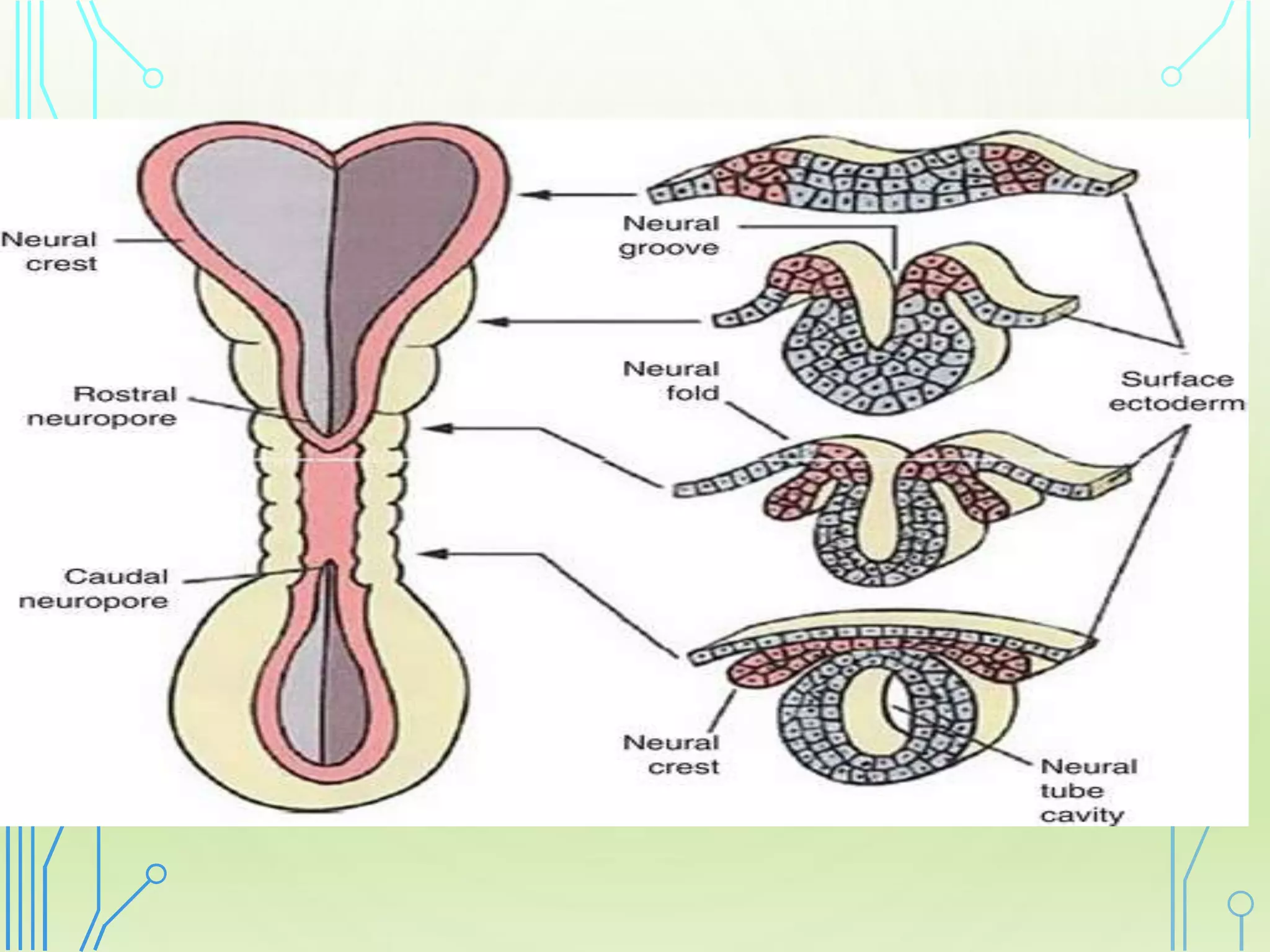
• The neural plate appears on the 3rd week of
gestation as a thickening of the embryonic
ectoderm.
• By the end of 3dr week, lateral edges of the neural
plate become more elevated to form neural folds,
and depressed mid region forms the neural groove.
• Gradually , neural folds fuse to form neural tube.
• Fusion begins at the cervical junction first-
proceeds cranially then caudally
CONT….
• Until fusion is completed, the cephalic and caudal
ends of neural tube communicate with the amniotic
cavity by cranial and caudal neuropores.
• Closure of cranial occurs at 25th day and caudal
neuropore at 27th day
• Depending on the point of interruption in neural
tube formation , NTDs may affect the
brain(anencephaly) and spinal cord(spina bifida)
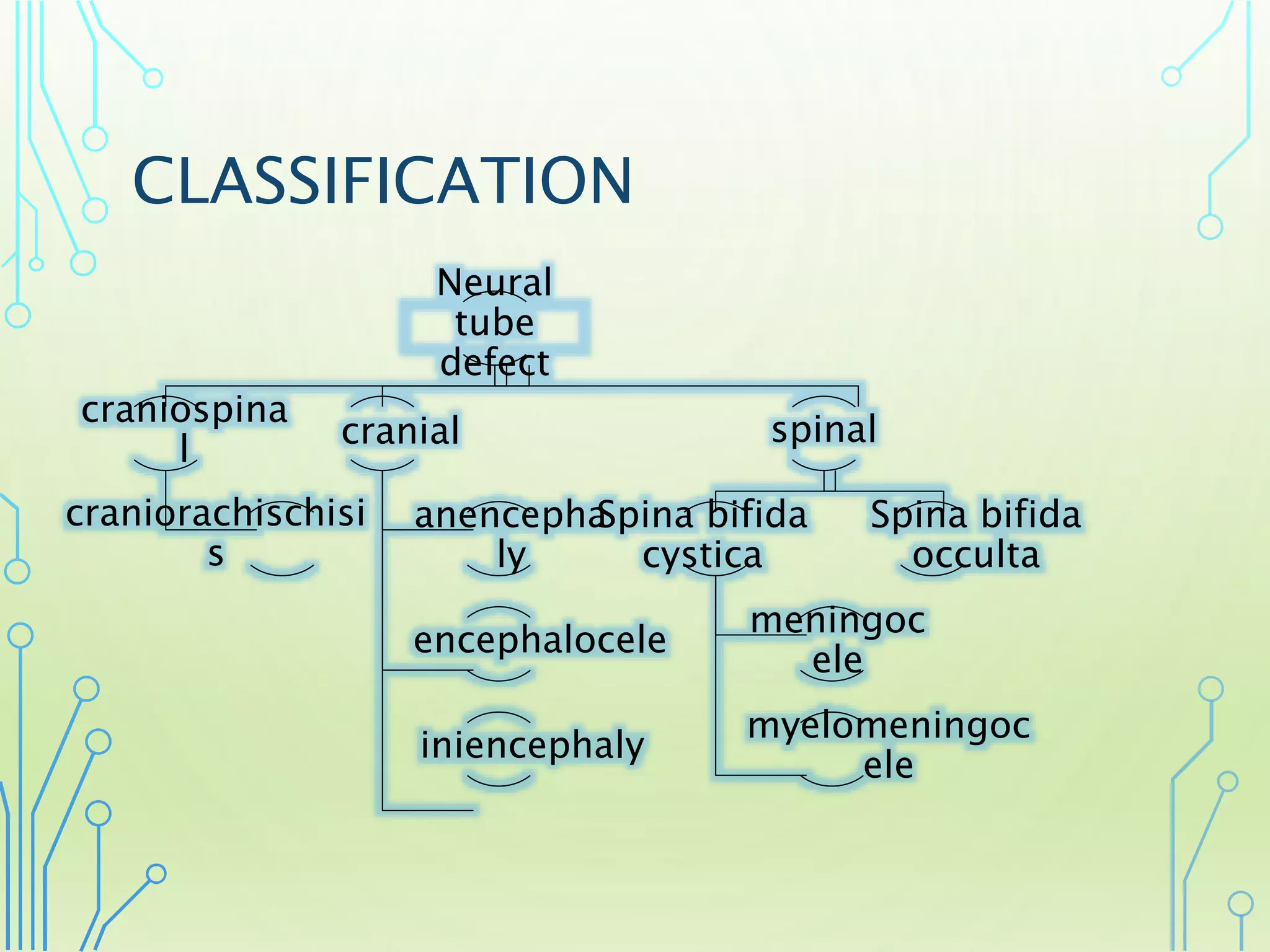
CLASSIFICATION
Neural
tube
defect
craniospina
l
craniorachischisi
s
cranial
anencepha
ly
encephalocele
iniencephaly
spinal
Spina bifida
cystica
meningoc
ele
myelomeningoc
ele
Spina bifida
occulta
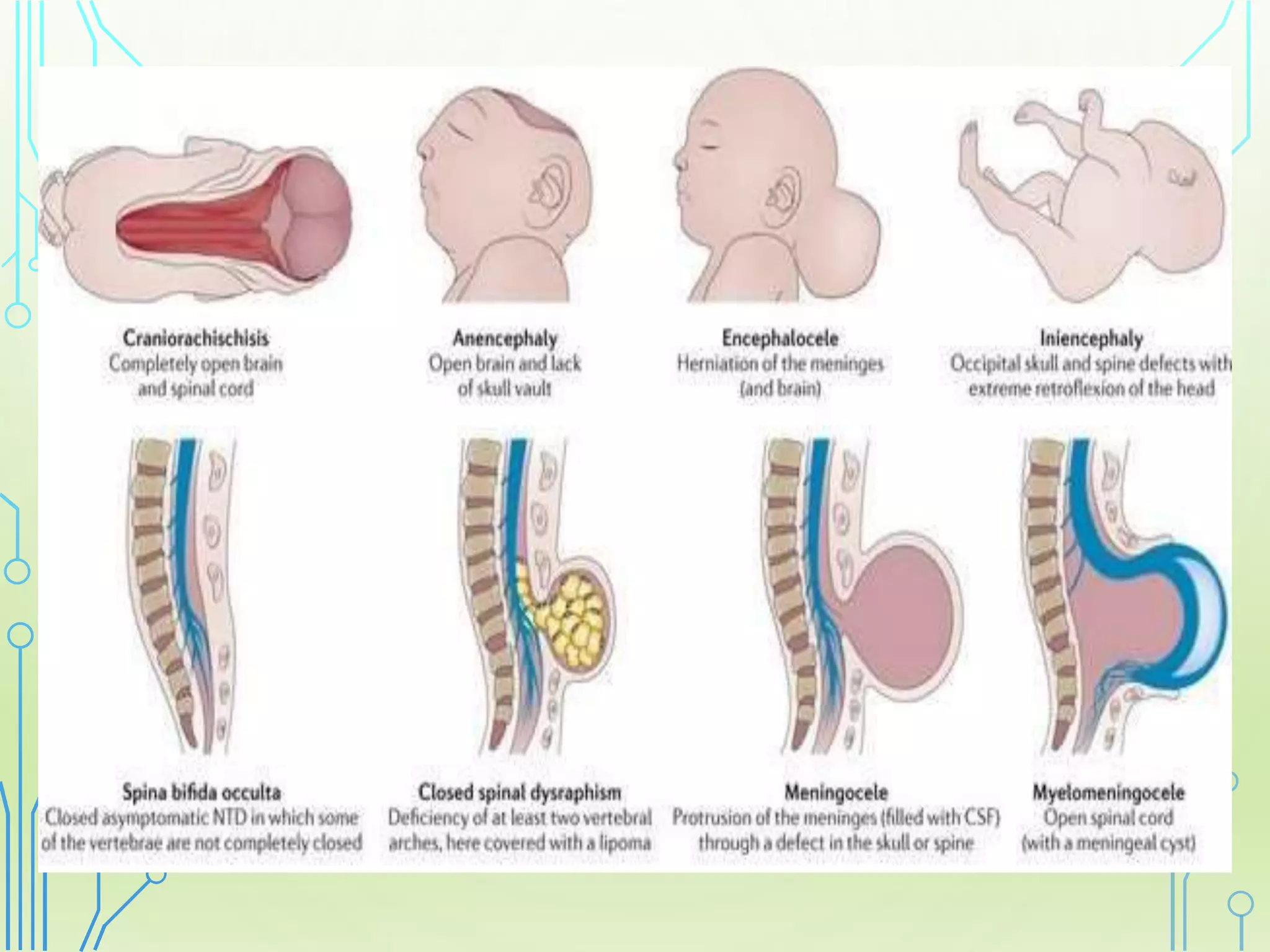
BRAIN DEFECTS
CONT…
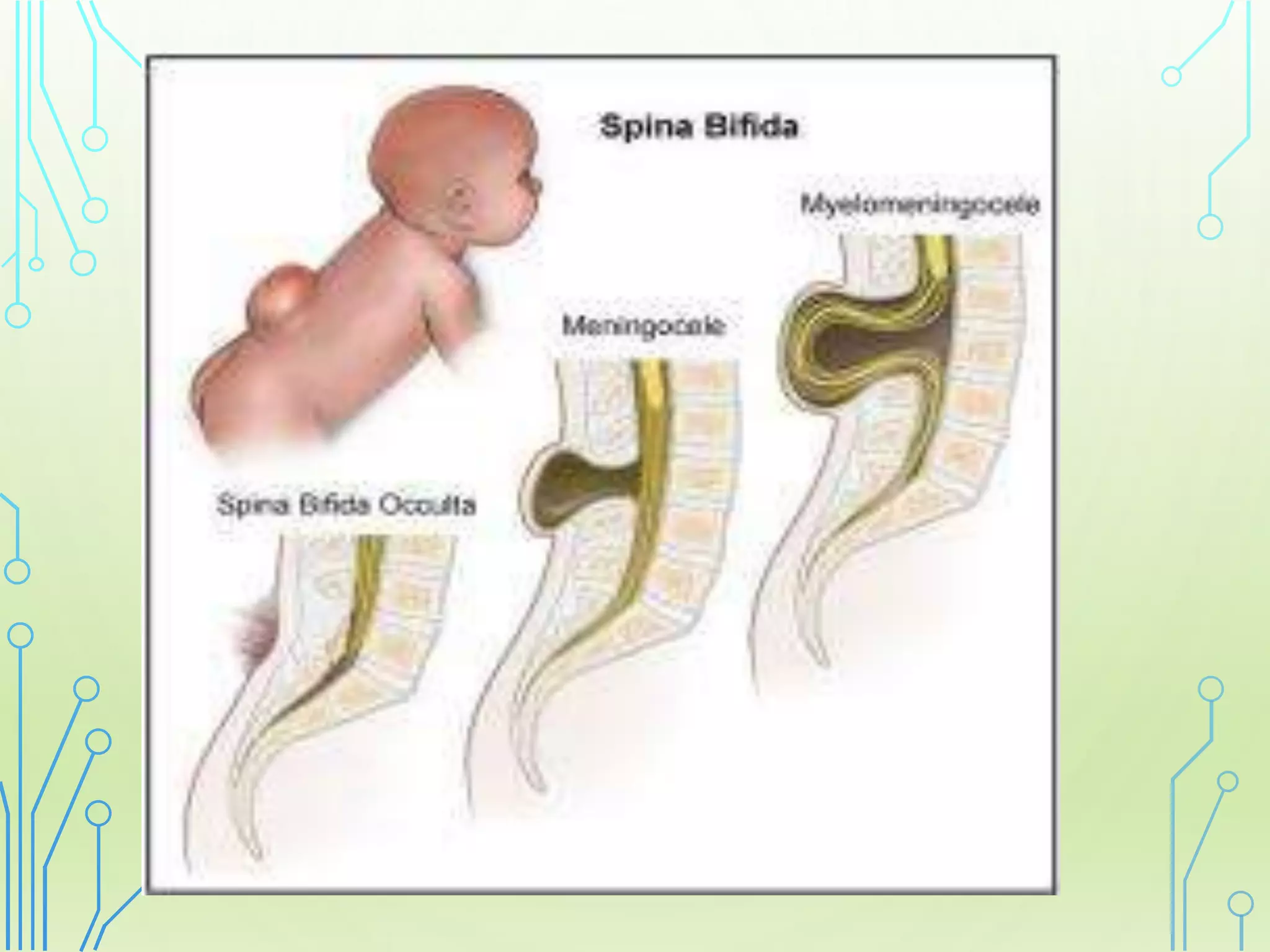
COMMON TYPES OF SPINA
BIFIDA
• MYELOMENINGOCELE is the one of the most
common and most severe form of spina bifida. In
this the unfused portion of spinal column allows
the spinal cord to protrude through an opening ,
forming a sac enclosing the spinal elements, such
as meninges ,CSF , parts of spinal cord and nerve
roots.
• MYENINGOCELE is skin covered sac formed by
meninges filled with CSF usually associated with
posterior arch defect of vertebra
CONT….
• SPINA BIFIDA OCCULTA which is the mildest
form of NTDs not accompanied by the
extrusions of the contents of the vertebral
column .Occasionally, it may cause
neurological deficit because of a tethering of
spinal cord. Some patients may have external
evidence such as dimple ,sinus , tuft of hair or
hamartomatous lesions.
CLINICAL PRESENTATIONS
• Swelling/dimple/tuft of hair/sinus etc. over the spinal area
• Loss of bowel /+bladder control
• Loss of sensation below the level of lesion
• Weakness or paralysis below the lesion
• Others associated condition
club foot
hydrocephalus -38%
congenital heart defect
chiari II malformation
DIAGNOSTIC TESTS
• PRENATAL DIAGNOSIS
Alpha-fetoprotein in maternal serum
Ultrasonography
Amniocentesis
• Postnatal tests
x-ray of spine
MRI of spine
USG /CT scan pf brain
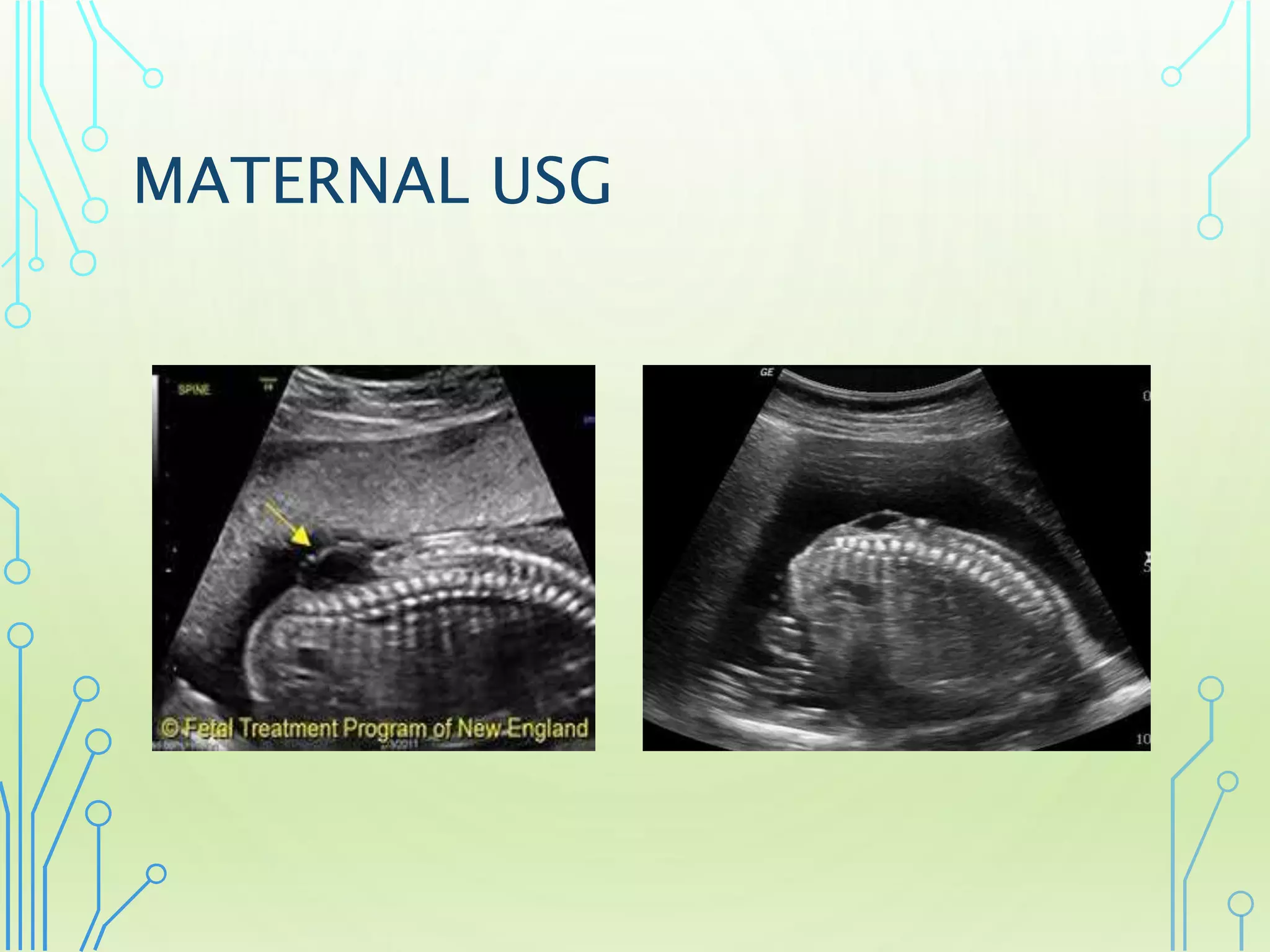
MATERNAL USG
MRI
MANAGEMENT
• Once diagnosed antenatally, after proper Prenatal
assessment by MRI and counseling , fetal surgery
can be done. Now it is practiced in advanced
country.
• Medical care-the should be positioned in the prone
or lateral position to prevent pressure on the
defect.
• Newborn with open NTDs should be kept warm and
the defect should be covered with sterile wet saline
and intravenous antibiotic should be initiated.
• Monitor ICP and measure head circumfren
SURGICAL MANAGEMENT
• EXCISION AND REPAIR OF THE DEFECT –
• Positioning of the patient
• An elliptical incision at the junction of the
arachnoid membrane and the skin
• Membrane is excised and neural plaque freed
• The dura is dissected laterally from the underlying
muscle
• Dura and skin is closed in layer.
POST-OPERATIVE
COMPLICATION
• CSF leak
• Wound infection and wound dehiscence
• Paraplegia
• Bowel and bladder incontinence
PREVENTION OF NEURAL TUBE
DEFECT
• WHO recommend that all women of childbearing
age take a daily supplement of 400 micrograms of
folic acid
• Educate mothers regarding intake of folic acid
especially in periconception period and in first
trimester as well
• Women already had a pregnancy with NTD or
diabetic or under anticonvulsant treatment should
take a daily 5mg tablet of folic acid daily for at
least one month before conception and then
throughout the first 12 weeks of pregnancy
• Genetic counseling or screening
RESULT OF SOME NEW
RESEARCH
• Rat spinal cords exposed to amniotic fluid in retinoic
acid –induced spina bifida-CHILDREN’S HOSPITAL
MEDICAL CENTER,USA
• About 10% of fetuses from diabetic mother display
congenital in various system,among which the NTDs are
more frequenty demonstrated.-NATIONAL UNIVERSITY
OF SINGAPORE
• Low carbohydrate diets may increase risk of neural tube
defect-NATIONAL BIRTH DEFECTS PREVENTION STUDY
,USA
• Arsenic utilize folic acid for its metabolism..so arsenic
poisoning increase the risk of NTDs-BOSTON
UNSOLVED QUESTIONS AND
CONTROVERSY
• Can Closure of NTDs in utero diminished
neurological dysfunction in children?
• Can Folic acid fortification prevent NTDs?
• Dose genetic predisposition comprises the
majority of NTDs?
• Sequence of neural tube closure events
controversial
• Do all NTDs are result from defective neural
tube closure?
TAKE HOME MESSAGES
• Though not established, folic acid
supplementation reduce the incidence of
NTDs.
• Antenatal diagnosis and repair of the defects
in utero(fetal surgery) can reduce the
neurological deficit.
THANK YOU

Neural tube defect

  • 1.
  • 2.
  • 3.
    CONT…. Investigations Management Post-operative complications Result ofsome new researches Unsolved questions and controversy Take home messages
  • 4.
    INTRODUCTION An estimated 303000newborns die every years, worldwide due to congenital anomalies. Among them neural tube defects are second most common cause. The incidence of NTDs in the general population varies from 1 per 1000 pregnancies to 12 per 1000.
  • 5.
    CONT… • Neural tubedefects(NTD) encompass a variety of congenital anomalies ranging from anencephaly to spina bifida and arise due to defects in the morphogenesis of the neural tube. It happens in the first month of pregnancy, often before a women even knows that she is pregnant. • The two most common neural tube defects are SPINA BIFIDA and ANENCEPHALY. • There are geographical variations in the incidence of NTDs
  • 6.
    ETIOLOGY • The exactcause of neural tube defects are not known. • Genetic • Nutritional factors-folic acid, vit-B 12,zinc deficiencies • Obese women • Diabetic mother • Alcohol abuse • Antenatal radiation exposure • Intake of anti epileptic drug during pregnancy
  • 7.
    EMBRYOLOGICAL BACKGROUND • Theneural plate appears on the 3rd week of gestation as a thickening of the embryonic ectoderm. • By the end of 3dr week, lateral edges of the neural plate become more elevated to form neural folds, and depressed mid region forms the neural groove. • Gradually , neural folds fuse to form neural tube. • Fusion begins at the cervical junction first- proceeds cranially then caudally
  • 8.
    CONT…. • Until fusionis completed, the cephalic and caudal ends of neural tube communicate with the amniotic cavity by cranial and caudal neuropores. • Closure of cranial occurs at 25th day and caudal neuropore at 27th day • Depending on the point of interruption in neural tube formation , NTDs may affect the brain(anencephaly) and spinal cord(spina bifida)
  • 10.
  • 12.
  • 13.
  • 14.
    COMMON TYPES OFSPINA BIFIDA • MYELOMENINGOCELE is the one of the most common and most severe form of spina bifida. In this the unfused portion of spinal column allows the spinal cord to protrude through an opening , forming a sac enclosing the spinal elements, such as meninges ,CSF , parts of spinal cord and nerve roots. • MYENINGOCELE is skin covered sac formed by meninges filled with CSF usually associated with posterior arch defect of vertebra
  • 15.
    CONT…. • SPINA BIFIDAOCCULTA which is the mildest form of NTDs not accompanied by the extrusions of the contents of the vertebral column .Occasionally, it may cause neurological deficit because of a tethering of spinal cord. Some patients may have external evidence such as dimple ,sinus , tuft of hair or hamartomatous lesions.
  • 18.
    CLINICAL PRESENTATIONS • Swelling/dimple/tuftof hair/sinus etc. over the spinal area • Loss of bowel /+bladder control • Loss of sensation below the level of lesion • Weakness or paralysis below the lesion • Others associated condition club foot hydrocephalus -38% congenital heart defect chiari II malformation
  • 19.
    DIAGNOSTIC TESTS • PRENATALDIAGNOSIS Alpha-fetoprotein in maternal serum Ultrasonography Amniocentesis • Postnatal tests x-ray of spine MRI of spine USG /CT scan pf brain
  • 20.
  • 21.
  • 22.
    MANAGEMENT • Once diagnosedantenatally, after proper Prenatal assessment by MRI and counseling , fetal surgery can be done. Now it is practiced in advanced country. • Medical care-the should be positioned in the prone or lateral position to prevent pressure on the defect. • Newborn with open NTDs should be kept warm and the defect should be covered with sterile wet saline and intravenous antibiotic should be initiated. • Monitor ICP and measure head circumfren
  • 23.
    SURGICAL MANAGEMENT • EXCISIONAND REPAIR OF THE DEFECT – • Positioning of the patient • An elliptical incision at the junction of the arachnoid membrane and the skin • Membrane is excised and neural plaque freed • The dura is dissected laterally from the underlying muscle • Dura and skin is closed in layer.
  • 25.
    POST-OPERATIVE COMPLICATION • CSF leak •Wound infection and wound dehiscence • Paraplegia • Bowel and bladder incontinence
  • 26.
    PREVENTION OF NEURALTUBE DEFECT • WHO recommend that all women of childbearing age take a daily supplement of 400 micrograms of folic acid • Educate mothers regarding intake of folic acid especially in periconception period and in first trimester as well • Women already had a pregnancy with NTD or diabetic or under anticonvulsant treatment should take a daily 5mg tablet of folic acid daily for at least one month before conception and then throughout the first 12 weeks of pregnancy • Genetic counseling or screening
  • 27.
    RESULT OF SOMENEW RESEARCH • Rat spinal cords exposed to amniotic fluid in retinoic acid –induced spina bifida-CHILDREN’S HOSPITAL MEDICAL CENTER,USA • About 10% of fetuses from diabetic mother display congenital in various system,among which the NTDs are more frequenty demonstrated.-NATIONAL UNIVERSITY OF SINGAPORE • Low carbohydrate diets may increase risk of neural tube defect-NATIONAL BIRTH DEFECTS PREVENTION STUDY ,USA • Arsenic utilize folic acid for its metabolism..so arsenic poisoning increase the risk of NTDs-BOSTON
  • 28.
    UNSOLVED QUESTIONS AND CONTROVERSY •Can Closure of NTDs in utero diminished neurological dysfunction in children? • Can Folic acid fortification prevent NTDs? • Dose genetic predisposition comprises the majority of NTDs? • Sequence of neural tube closure events controversial • Do all NTDs are result from defective neural tube closure?
  • 29.
    TAKE HOME MESSAGES •Though not established, folic acid supplementation reduce the incidence of NTDs. • Antenatal diagnosis and repair of the defects in utero(fetal surgery) can reduce the neurological deficit.
  • 30.