Abdul Mannan
M. Phil Scholar
Deptt. Of Pathobiology
FVS, BZU Multan
 Naturally occurring proteins and
glycoproteins
 Secreted by eukaryotoc cells in response
to viral inections, tumors and other
biological inducers
 Structurally, they are part of the helical
cytokine family which are characterized by
an amino acid chain that is 145-166 amino
acids long
 1957
 Isaacs and Lindenmann
 Did an experiment using chicken cell cultures
 Found a substance that interfered with viral
replication and was therefore named interferon
(“Interference factors”)
 Nagano and Kojima also independently
discovered this soluble antiviral protein
 Interferons play an important role in the first
line of defense against viral infections
 Interferons are part of the non-specific
immune system
 First recognized by their ability to interfere with
viral infections in cultured cells.
 Does not protect the virus infected cell that
produces it.
 Itself is not the antiviral agent.
It moves to other cells where it induces an antiviral
state.(By inhibiting viral replication)
7
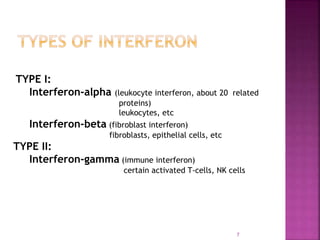
TYPE I:
Interferon-alpha (leukocyte interferon, about 20 related
proteins)
leukocytes, etc
Interferon-beta (fibroblast interferon)
fibroblasts, epithelial cells, etc
TYPE II:
Interferon-gamma (immune interferon)
certain activated T-cells, NK cells
A. IFN-α & β
(Type-I- IFNs)
When prototypic cell of origin is exposed to
-Viruses
-Double stranded RNA
- Cytokines
B. IFN-
(Type-II- IFNs)
Following a number of immunological stimuli
including :-
-T-cell specific antigen
-Staphylococcal enterotoxin -A And
-Mitogens ( Phyto haemagglutinin ,Phorbol
Ester etc)
Morley,Michael.The pharmacology of
lymphocytes.Barlin Heidelberg.Springer.1988.print
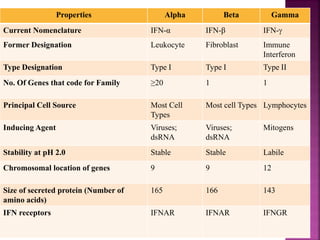
Properties Alpha Beta Gamma
Current Nomenclature IFN-α IFN-β IFN-
Former Designation Leukocyte Fibroblast Immune
Interferon
Type Designation Type I Type I Type II
No. Of Genes that code for Family ≥20 1 1
Principal Cell Source Most Cell
Types
Most cell Types Lymphocytes
Inducing Agent Viruses;
dsRNA
Viruses;
dsRNA
Mitogens
Stability at pH 2.0 Stable Stable Labile
Chromosomal location of genes 9 9 12
Size of secreted protein (Number of
amino acids)
165 166 143
IFN receptors IFNAR IFNAR IFNGR
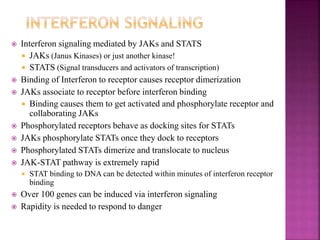
 Interferon signaling mediated by JAKs and STATS
 JAKs (Janus Kinases) or just another kinase!
 STATS (Signal transducers and activators of transcription)
 Binding of Interferon to receptor causes receptor dimerization
 JAKs associate to receptor before interferon binding
 Binding causes them to get activated and phosphorylate receptor and
collaborating JAKs
 Phosphorylated receptors behave as docking sites for STATs
 JAKs phosphorylate STATs once they dock to receptors
 Phosphorylated STATs dimerize and translocate to nucleus
 JAK-STAT pathway is extremely rapid
 STAT binding to DNA can be detected within minutes of interferon receptor
binding
 Over 100 genes can be induced via interferon signaling
 Rapidity is needed to respond to danger
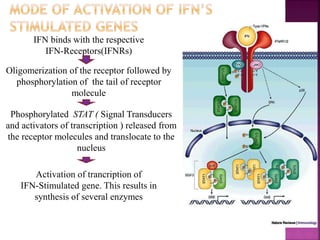
IFN binds with the respective
IFN-Receptors(IFNRs)
Oligomerization of the receptor followed by
phosphorylation of the tail of receptor
molecule
Phosphorylated STAT ( Signal Transducers
and activators of transcription ) released from
the receptor molecules and translocate to the
nucleus
Activation of trancription of
IFN-Stimulated gene. This results in
synthesis of several enzymes
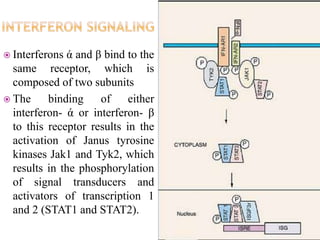
 Interferons ά and β bind to the
same receptor, which is
composed of two subunits
 The binding of either
interferon- ά or interferon- β
to this receptor results in the
activation of Janus tyrosine
kinases Jak1 and Tyk2, which
results in the phosphorylation
of signal transducers and
activators of transcription 1
and 2 (STAT1 and STAT2).
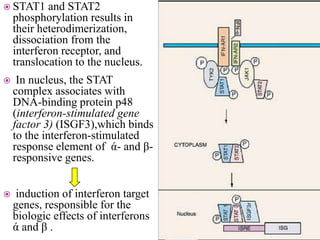
 STAT1 and STAT2
phosphorylation results in
their heterodimerization,
dissociation from the
interferon receptor, and
translocation to the nucleus.
 In nucleus, the STAT
complex associates with
DNA-binding protein p48
(interferon-stimulated gene
factor 3) (ISGF3),which binds
to the interferon-stimulated
response element of ά- and β-
responsive genes.
 induction of interferon target
genes, responsible for the
biologic effects of interferons
ά and β .
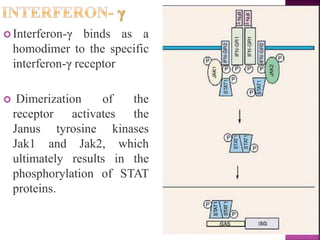
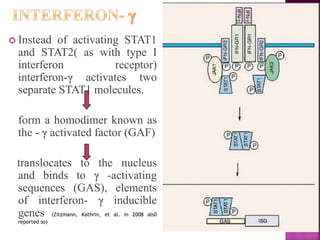
 Interferon-γ binds as a
homodimer to the specific
interferon-γ receptor
 Dimerization of the
receptor activates the
Janus tyrosine kinases
Jak1 and Jak2, which
ultimately results in the
phosphorylation of STAT
proteins.
 Instead of activating STAT1
and STAT2( as with type I
interferon receptor)
interferon-γ activates two
separate STAT1 molecules.
form a homodimer known as
the - γ activated factor (GAF)
translocates to the nucleus
and binds to γ -activating
sequences (GAS), elements
of interferon- γ inducible
genes (Zitzmann, Kathrin, et al. in 2008 als0
reported so)
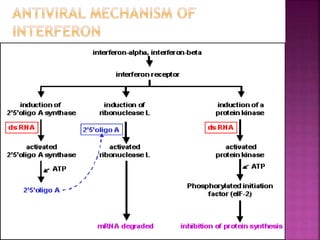
 However its best understood anti-viral mechanism is:
 1. Block viral mRNA synthesis
 2. Block translation of viral mRNA
 Mx proteins
 2',5' oligo(A) synthetase and ribonuclease L
 PKR, double stranded RNA dependent protein kinase
 Mx proteins (myxovirus proteins) are induced by interferon
 Block viral RNA polymerase
 Block transport of viral nucleoproteins (influenza virus) into nucleus
 2',5' oligo(A) synthetase and ribonuclease L
 This enzyme gets activated by dsRNA
 Unique ability to synthesize oligos of A in the 2'- 5' linkage, norm is 3'-5' linkage
 Poly(A) oligos bind ribonuclease L and activate it  mRNA is destroyed
 Both cellular and viral cells may die
 Interferons-alpha and -beta have been used to treat
various viral infections.
 One currently approved use of interferon- IFN-α
is in the treatment of certain cases of acute and chronic
hepatitis C and chronic hepatitis B.
 Interferon-gamma has been used to treat a variety of
disease in which macrophage activation might play an
important role in recovery, eg. lepromatous leprosy, .
 Since interferons have anti-proliferative effects, they
have also been used to treat certain tumors such as
melanoma and Kaposi’s sarcoma.
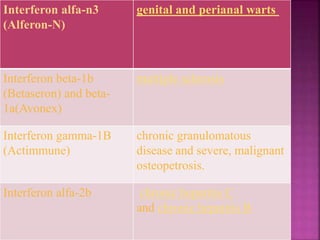
Interferon alfa-n3
(Alferon-N)
genital and perianal warts
Interferon beta-1b
(Betaseron) and beta-
1a(Avonex)
multiple sclerosis
Interferon gamma-1B
(Actimmune)
chronic granulomatous
disease and severe, malignant
osteopetrosis.
Interferon alfa-2b chronic hepatitis C
and chronic hepatitis B
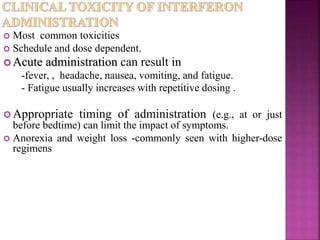
 Most common toxicities
 Schedule and dose dependent.
 Acute administration can result in
-fever, , headache, nausea, vomiting, and fatigue.
- Fatigue usually increases with repetitive dosing .
 Appropriate timing of administration (e.g., at or just
before bedtime) can limit the impact of symptoms.
 Anorexia and weight loss -commonly seen with higher-dose
regimens
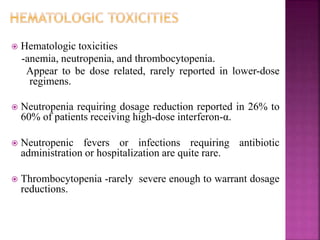
 Hematologic toxicities
-anemia, neutropenia, and thrombocytopenia.
Appear to be dose related, rarely reported in lower-dose
regimens.
 Neutropenia requiring dosage reduction reported in 26% to
60% of patients receiving high-dose interferon-α.
 Neutropenic fevers or infections requiring antibiotic
administration or hospitalization are quite rare.
 Thrombocytopenia -rarely severe enough to warrant dosage
reductions.
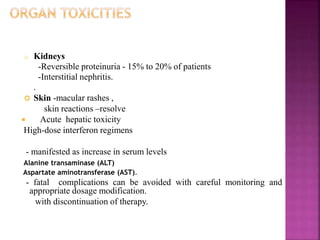
o Kidneys
-Reversible proteinuria - 15% to 20% of patients
-Interstitial nephritis.
.
 Skin -macular rashes ,
skin reactions –resolve
 Acute hepatic toxicity
High-dose interferon regimens
- manifested as increase in serum levels
Alanine transaminase (ALT)
Aspartate aminotransferase (AST).
- fatal complications can be avoided with careful monitoring and
appropriate dosage modification.
with discontinuation of therapy.
• Interferons are broken down into recombinant versions of a specific
interferon subtype and purified blends of natural human interferon.
• Many of these are in clinical use and are given intramuscularly or
subcutaneously
• Recombinant forms of alpha interferon include:
• Alpha-2a drug name Roferon
• Alpha-n3 drug name AlferonN
• Recombinant forms of beta interferon include:
• Beta-1a drug name Avonex
• Beta-1b drug name Betaseron
• Recombinant forms of gamma interferon include:
• Gamma-1b drug name Acimmune
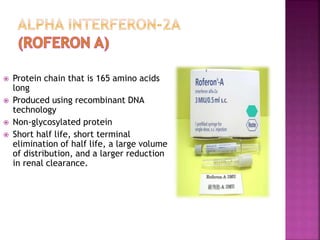
 Protein chain that is 165 amino acids
long
 Produced using recombinant DNA
technology
 Non-glycosylated protein
 Short half life, short terminal
elimination of half life, a large volume
of distribution, and a larger reduction
in renal clearance.
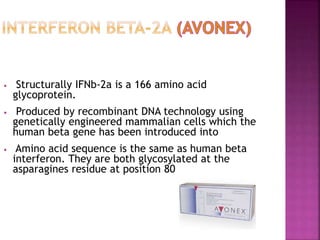
• Structurally IFNb-2a is a 166 amino acid
glycoprotein.
• Produced by recombinant DNA technology using
genetically engineered mammalian cells which the
human beta gene has been introduced into
• Amino acid sequence is the same as human beta
interferon. They are both glycosylated at the
asparagines residue at position 80
 Morley,Michael.The pharmacology of lymphocytes.Barlin
Heidelberg.Springer.1988.print
 Zitzmann, Kathrin, et al. SOCS1 silencing enhances antitumor activity of type I IFNs
by regulating apoptosis in neuroendocrine tumor cells. Cancer research 67.10
(2007): 5025-5032
 Jonasch E and Haluska FG. Interferon 2001;6(1):34-55.
 Rijckborst V and Janssen Harry L.A. The Role of Interferon in Oncological
Practice: Review of Interferon Biology, Clinical Applications, and Toxicities.
Oncologist in Hepatitis B therapy. Curr Hepatitis Rep 2010;9:231-238.
 Kanda T, Imazeki F and Yokosuka O. New Antiviral Therapies for Chronic
Hepatitis C. Hepatol Int 2010;4:548-561
 Hayden FG and Gwalthey JM jr. Intranasal interferon-alpha 2 treatment of
experimental rhinoviral colds. J Infect Dis. 2003 ;150(2):174-80.
interferon

interferon

  • 2.
    Abdul Mannan M. PhilScholar Deptt. Of Pathobiology FVS, BZU Multan
  • 3.
     Naturally occurringproteins and glycoproteins  Secreted by eukaryotoc cells in response to viral inections, tumors and other biological inducers  Structurally, they are part of the helical cytokine family which are characterized by an amino acid chain that is 145-166 amino acids long
  • 4.
     1957  Isaacsand Lindenmann  Did an experiment using chicken cell cultures  Found a substance that interfered with viral replication and was therefore named interferon (“Interference factors”)  Nagano and Kojima also independently discovered this soluble antiviral protein
  • 5.
     Interferons playan important role in the first line of defense against viral infections  Interferons are part of the non-specific immune system
  • 6.
     First recognizedby their ability to interfere with viral infections in cultured cells.  Does not protect the virus infected cell that produces it.  Itself is not the antiviral agent. It moves to other cells where it induces an antiviral state.(By inhibiting viral replication)
  • 7.
    7 TYPE I: Interferon-alpha (leukocyteinterferon, about 20 related proteins) leukocytes, etc Interferon-beta (fibroblast interferon) fibroblasts, epithelial cells, etc TYPE II: Interferon-gamma (immune interferon) certain activated T-cells, NK cells
  • 8.
    A. IFN-α &β (Type-I- IFNs) When prototypic cell of origin is exposed to -Viruses -Double stranded RNA - Cytokines B. IFN- (Type-II- IFNs) Following a number of immunological stimuli including :- -T-cell specific antigen -Staphylococcal enterotoxin -A And -Mitogens ( Phyto haemagglutinin ,Phorbol Ester etc) Morley,Michael.The pharmacology of lymphocytes.Barlin Heidelberg.Springer.1988.print
  • 9.
    Properties Alpha BetaGamma Current Nomenclature IFN-α IFN-β IFN- Former Designation Leukocyte Fibroblast Immune Interferon Type Designation Type I Type I Type II No. Of Genes that code for Family ≥20 1 1 Principal Cell Source Most Cell Types Most cell Types Lymphocytes Inducing Agent Viruses; dsRNA Viruses; dsRNA Mitogens Stability at pH 2.0 Stable Stable Labile Chromosomal location of genes 9 9 12 Size of secreted protein (Number of amino acids) 165 166 143 IFN receptors IFNAR IFNAR IFNGR
  • 10.
     Interferon signalingmediated by JAKs and STATS  JAKs (Janus Kinases) or just another kinase!  STATS (Signal transducers and activators of transcription)  Binding of Interferon to receptor causes receptor dimerization  JAKs associate to receptor before interferon binding  Binding causes them to get activated and phosphorylate receptor and collaborating JAKs  Phosphorylated receptors behave as docking sites for STATs  JAKs phosphorylate STATs once they dock to receptors  Phosphorylated STATs dimerize and translocate to nucleus  JAK-STAT pathway is extremely rapid  STAT binding to DNA can be detected within minutes of interferon receptor binding  Over 100 genes can be induced via interferon signaling  Rapidity is needed to respond to danger
  • 11.
    IFN binds withthe respective IFN-Receptors(IFNRs) Oligomerization of the receptor followed by phosphorylation of the tail of receptor molecule Phosphorylated STAT ( Signal Transducers and activators of transcription ) released from the receptor molecules and translocate to the nucleus Activation of trancription of IFN-Stimulated gene. This results in synthesis of several enzymes
  • 12.
     Interferons άand β bind to the same receptor, which is composed of two subunits  The binding of either interferon- ά or interferon- β to this receptor results in the activation of Janus tyrosine kinases Jak1 and Tyk2, which results in the phosphorylation of signal transducers and activators of transcription 1 and 2 (STAT1 and STAT2).
  • 13.
     STAT1 andSTAT2 phosphorylation results in their heterodimerization, dissociation from the interferon receptor, and translocation to the nucleus.  In nucleus, the STAT complex associates with DNA-binding protein p48 (interferon-stimulated gene factor 3) (ISGF3),which binds to the interferon-stimulated response element of ά- and β- responsive genes.  induction of interferon target genes, responsible for the biologic effects of interferons ά and β .
  • 14.
     Interferon-γ bindsas a homodimer to the specific interferon-γ receptor  Dimerization of the receptor activates the Janus tyrosine kinases Jak1 and Jak2, which ultimately results in the phosphorylation of STAT proteins.
  • 15.
     Instead ofactivating STAT1 and STAT2( as with type I interferon receptor) interferon-γ activates two separate STAT1 molecules. form a homodimer known as the - γ activated factor (GAF) translocates to the nucleus and binds to γ -activating sequences (GAS), elements of interferon- γ inducible genes (Zitzmann, Kathrin, et al. in 2008 als0 reported so)
  • 16.
     However itsbest understood anti-viral mechanism is:  1. Block viral mRNA synthesis  2. Block translation of viral mRNA  Mx proteins  2',5' oligo(A) synthetase and ribonuclease L  PKR, double stranded RNA dependent protein kinase  Mx proteins (myxovirus proteins) are induced by interferon  Block viral RNA polymerase  Block transport of viral nucleoproteins (influenza virus) into nucleus  2',5' oligo(A) synthetase and ribonuclease L  This enzyme gets activated by dsRNA  Unique ability to synthesize oligos of A in the 2'- 5' linkage, norm is 3'-5' linkage  Poly(A) oligos bind ribonuclease L and activate it  mRNA is destroyed  Both cellular and viral cells may die
  • 18.
     Interferons-alpha and-beta have been used to treat various viral infections.  One currently approved use of interferon- IFN-α is in the treatment of certain cases of acute and chronic hepatitis C and chronic hepatitis B.  Interferon-gamma has been used to treat a variety of disease in which macrophage activation might play an important role in recovery, eg. lepromatous leprosy, .  Since interferons have anti-proliferative effects, they have also been used to treat certain tumors such as melanoma and Kaposi’s sarcoma.
  • 19.
    Interferon alfa-n3 (Alferon-N) genital andperianal warts Interferon beta-1b (Betaseron) and beta- 1a(Avonex) multiple sclerosis Interferon gamma-1B (Actimmune) chronic granulomatous disease and severe, malignant osteopetrosis. Interferon alfa-2b chronic hepatitis C and chronic hepatitis B
  • 20.
     Most commontoxicities  Schedule and dose dependent.  Acute administration can result in -fever, , headache, nausea, vomiting, and fatigue. - Fatigue usually increases with repetitive dosing .  Appropriate timing of administration (e.g., at or just before bedtime) can limit the impact of symptoms.  Anorexia and weight loss -commonly seen with higher-dose regimens
  • 21.
     Hematologic toxicities -anemia,neutropenia, and thrombocytopenia. Appear to be dose related, rarely reported in lower-dose regimens.  Neutropenia requiring dosage reduction reported in 26% to 60% of patients receiving high-dose interferon-α.  Neutropenic fevers or infections requiring antibiotic administration or hospitalization are quite rare.  Thrombocytopenia -rarely severe enough to warrant dosage reductions.
  • 22.
    o Kidneys -Reversible proteinuria- 15% to 20% of patients -Interstitial nephritis. .  Skin -macular rashes , skin reactions –resolve  Acute hepatic toxicity High-dose interferon regimens - manifested as increase in serum levels Alanine transaminase (ALT) Aspartate aminotransferase (AST). - fatal complications can be avoided with careful monitoring and appropriate dosage modification. with discontinuation of therapy.
  • 23.
    • Interferons arebroken down into recombinant versions of a specific interferon subtype and purified blends of natural human interferon. • Many of these are in clinical use and are given intramuscularly or subcutaneously • Recombinant forms of alpha interferon include: • Alpha-2a drug name Roferon • Alpha-n3 drug name AlferonN • Recombinant forms of beta interferon include: • Beta-1a drug name Avonex • Beta-1b drug name Betaseron • Recombinant forms of gamma interferon include: • Gamma-1b drug name Acimmune
  • 24.
     Protein chainthat is 165 amino acids long  Produced using recombinant DNA technology  Non-glycosylated protein  Short half life, short terminal elimination of half life, a large volume of distribution, and a larger reduction in renal clearance.
  • 25.
    • Structurally IFNb-2ais a 166 amino acid glycoprotein. • Produced by recombinant DNA technology using genetically engineered mammalian cells which the human beta gene has been introduced into • Amino acid sequence is the same as human beta interferon. They are both glycosylated at the asparagines residue at position 80
  • 26.
     Morley,Michael.The pharmacologyof lymphocytes.Barlin Heidelberg.Springer.1988.print  Zitzmann, Kathrin, et al. SOCS1 silencing enhances antitumor activity of type I IFNs by regulating apoptosis in neuroendocrine tumor cells. Cancer research 67.10 (2007): 5025-5032  Jonasch E and Haluska FG. Interferon 2001;6(1):34-55.  Rijckborst V and Janssen Harry L.A. The Role of Interferon in Oncological Practice: Review of Interferon Biology, Clinical Applications, and Toxicities. Oncologist in Hepatitis B therapy. Curr Hepatitis Rep 2010;9:231-238.  Kanda T, Imazeki F and Yokosuka O. New Antiviral Therapies for Chronic Hepatitis C. Hepatol Int 2010;4:548-561  Hayden FG and Gwalthey JM jr. Intranasal interferon-alpha 2 treatment of experimental rhinoviral colds. J Infect Dis. 2003 ;150(2):174-80.