Cell Biology
Unit 11
 No cell can live in isolation, must interact with
environment
 In multicellular organisms, cells must
communicate with each other
 Growth involves intricate signaling
 Same with Differentiation
 Even Metabolism requires signaling
 Signalling molecules
 Receptors
 Signalling intermediates
 Effector proteins
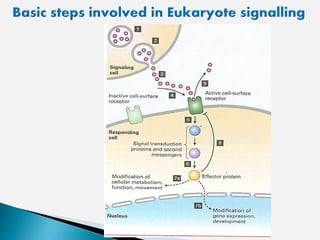
 Depending upon distance travelled by
signalling molecule
◦ Endocrine
◦ Paracrine
◦ Autocrine
◦ Contact dependent
 Earl W. Sutherland, discovered how hormone
epinephrine acts on cells, suggested that
cells receiving signals went through three
processes:
◦ Reception of signal
◦ Transduction of signal
◦ Response to signal
EXTRACELLULAR
FLUID
Reception
Plasma membrane
Transduction CYTOPLASM
Receptor
Signal
molecule
Relay molecules in a signal transduction
pathway
Response
Activation
of cellular
response
Stages in Cell Signaling
 Highly specific binding of signaling molecule
to its receptor
 Binding leads to conformational change in
receptor  often initiation of signal
transduction
 Most receptors are plasma membrane
proteins
 Some receptors present in the cytosol or nucleus
 Small or hydrophobic chemical messengers can
cross plasma membrane and activate intracellular
receptors
e.g. steroid and thyroid hormones
 An activated hormone-receptor complex can act as
a transcription factor
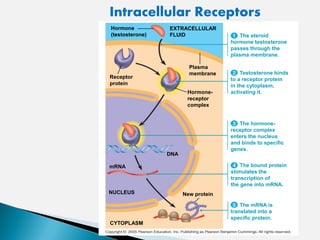
EXTRACELLULAR
FLUID
Plasma
membrane
The steroid
hormone testosterone
passes through the
plasma membrane.
Testosterone binds
to a receptor protein
in the cytoplasm,
activating it.
The hormone-
receptor complex
enters the nucleus
and binds to specific
genes.
The bound protein
stimulates the
transcription of
the gene into mRNA.
The mRNA is
translated into a
specific protein.
CYTOPLASM
NUCLEUS
DNA
Hormone
(testosterone)
Receptor
protein
Hormone-
receptor
complex
mRNA
New protein
Intracellular Receptors
 Water-soluble signaling molecules bind to
receptor proteins present in plasma membrane
 Three main types of membrane receptors:
◦ G-protein-linked receptors
◦ Enzyme coupled cell surface receptors
◦ Ion channel receptors
 Plasma membrane receptor
 G-protein acts as an on/off switch
 GDP bound to G protein is inactive
G-protein-linked receptor
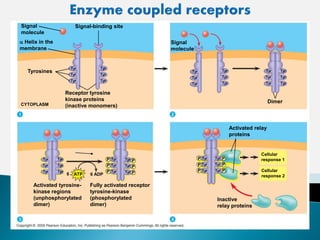
 Receptor tyrosine kinases (RTKs)
 A receptor tyrosine kinase can trigger
multiple signal transduction pathways at once
 Transfers phosphate groups from high-
energy donor molecules, such as ATP, to
specific substrates – signaling intermediates
Signal
molecule
a Helix in the
membrane
Signal-binding site
Tyr
Tyr
Tyr Tyr
Tyr
Tyr
Tyrosines
Receptor tyrosine
kinase proteins
(inactive monomers)CYTOPLASM
Tyr
Tyr
Tyr Tyr
Tyr
Tyr Tyr
Tyr
Tyr Tyr
Tyr
Tyr
Tyr
Tyr
Tyr Tyr
Tyr
Tyr
Activated tyrosine-
kinase regions
(unphosphorylated
dimer)
Signal
molecule
Dimer
Fully activated receptor
tyrosine-kinase
(phosphorylated
dimer)
Tyr
Tyr
Tyr Tyr
Tyr
TyrP
P
P
P
P
PATP 6 ADP
Tyr
Tyr
Tyr Tyr
Tyr
TyrP
P
P
P
P
P
Inactive
relay proteins
Cellular
response 2
Cellular
response 1
Activated relay
proteins
6
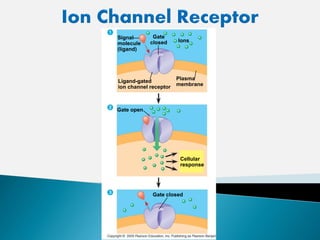
 An ion channel receptor acts as a gated
channel
 Upon binding signal molecule allows
specific ions, such as Na+ or Ca2+, to pass
through a receptor channel
Signal
molecule
(ligand)
Gate
closed Ions
Ligand-gated
ion channel receptor
Plasma
membrane
Gate closed
Gate open
Cellular
response
 May involve multiple steps
 Helps in amplification & Transmission of a
signal
 Provides more opportunities for coordination
and regulation
 Molecules that relay a signal from receptor to
response are mostly proteins
 Extracellular signal molecule that binds to
membrane receptor - First messenger
 Second messengers are small, non-protein, water
soluble molecules or ions
 Second messengers can readily spread in cell by
diffusion
 Second messengers propagate pathways initiated
by G protein-linked receptors and receptor
tyrosine kinases
 Most widely used second messengers
 Discovered by Earl W. Sutherland Jr.
 Formed from ATP by Adenylyl Cyclase, in response
to an extracellular signal
 Many signal molecules trigger formation of cAMP
 cAMP usually activates Protein Kinase A, which
phosphorylates various other downstream proteins
cAMP
ATP
Second
messenger
First messenger
(signal molecule
such as epinephrine)
G-protein-linked
receptor
G protein
Adenylyl
cyclase
Protein
kinase A
Cellular responses
GTP
 Ca2+ is an important second messenger
 Cells tightly regulate Ca2+ concentration
 A signal may trigger an increase in Ca2+ in cytosol
 Pathways leading to the release of Ca2+ involve inositol
triphosphate (IP3) and diacylglycerol (DAG) as
second messengers
CYTOSOL
Ca2+Endoplasmic
reticulum (ER)
IP3-gated
calcium channel
IP3 (second
messenger)
DAG
PIP2G-protein-linked
receptor Phospholipase C
G protein
Signal molecule
(first messenger)
EXTRACELLULAR
FLUID
GTP
Ca2+
(second
messenger)
Various
proteins
activated
Cellular
re-
sponses
 Multi-step signaling pathways have important
benefits:
◦ Amplification of the signal
◦ Contributing to the specificity of the response
◦ Provide many opportunity to regulate the signaling cascade
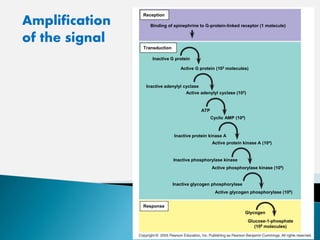
Binding of epinephrine to G-protein-linked receptor (1 molecule)
Reception
Transduction
Inactive G protein
Active G protein (102 molecules)
Inactive adenylyl cyclase
Active adenylyl cyclase (102)
ATP
Cyclic AMP (104)
Inactive protein kinase A
Inactive phosphorylase kinase
Active protein kinase A (104)
Active phosphorylase kinase (105)
Active glycogen phosphorylase (106)
Inactive glycogen phosphorylase
Glycogen
Response
Glucose-1-phosphate
(108 molecules)
Amplification
of the signal
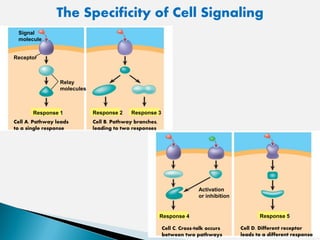
 Different cell types have different set of proteins
 Different protein profile gives each cell type
specificity in detecting and responding to signals
 Response of a cell to a signal depends on cell’s
protein set
 Pathway branching and “cross-talk” further help
the cells to coordinate and regulate response to
incoming signals
Signal
molecule
Receptor
Relay
molecules
Response 1 Response 2 Response 3
Cell B. Pathway branches,
leading to two responses
Cell A. Pathway leads
to a single response
The Specificity of Cell Signaling
Cell C. Cross-talk occurs
between two pathways
Response 4 Response 5
Activation
or inhibition
Cell D. Different receptor
leads to a different response
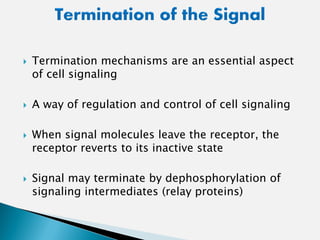
 Termination mechanisms are an essential aspect
of cell signaling
 A way of regulation and control of cell signaling
 When signal molecules leave the receptor, the
receptor reverts to its inactive state
 Signal may terminate by dephosphorylation of
signaling intermediates (relay proteins)
 Regulation of Flagella movement by histidine
kinase – a good example of prokaryote signaling
 Also an evidence of evolution of Signaling
mechanism from prokaryote to eukaryote
 Clock wise and anticlockwise movement of flagella
regulated by signaling- determines its swimming
pattern
 Cell signalling is basis of Prokaryote and Eukaryote life
 For normal functioning coordination of every signaling
pathway is necessary
 Altered signalling pathways may lead to diseases
 Defect can be in any component of signalling ultimately
leading to the disease development
 Cell signalling has been identified in Cancer,
Cardiovascular diseases, Alzheimer's disease, and many
other disorders
 Cell Signalling – an important area of research for drug
discovery
 Cell signaling - essential for survival of both uni-
and multi- cellular organisms
 Involves various components and steps
 Smooth progression and tight control is required
for homeostasis
 Many diseases result from defects in cell signaling
THE END

Cell signaling -_introduction[1]

  • 1.
  • 2.
     No cellcan live in isolation, must interact with environment  In multicellular organisms, cells must communicate with each other  Growth involves intricate signaling  Same with Differentiation  Even Metabolism requires signaling
  • 3.
     Signalling molecules Receptors  Signalling intermediates  Effector proteins
  • 4.
     Depending upondistance travelled by signalling molecule ◦ Endocrine ◦ Paracrine ◦ Autocrine ◦ Contact dependent
  • 5.
     Earl W.Sutherland, discovered how hormone epinephrine acts on cells, suggested that cells receiving signals went through three processes: ◦ Reception of signal ◦ Transduction of signal ◦ Response to signal
  • 6.
    EXTRACELLULAR FLUID Reception Plasma membrane Transduction CYTOPLASM Receptor Signal molecule Relaymolecules in a signal transduction pathway Response Activation of cellular response Stages in Cell Signaling
  • 7.
     Highly specificbinding of signaling molecule to its receptor  Binding leads to conformational change in receptor  often initiation of signal transduction  Most receptors are plasma membrane proteins
  • 8.
     Some receptorspresent in the cytosol or nucleus  Small or hydrophobic chemical messengers can cross plasma membrane and activate intracellular receptors e.g. steroid and thyroid hormones  An activated hormone-receptor complex can act as a transcription factor
  • 9.
    EXTRACELLULAR FLUID Plasma membrane The steroid hormone testosterone passesthrough the plasma membrane. Testosterone binds to a receptor protein in the cytoplasm, activating it. The hormone- receptor complex enters the nucleus and binds to specific genes. The bound protein stimulates the transcription of the gene into mRNA. The mRNA is translated into a specific protein. CYTOPLASM NUCLEUS DNA Hormone (testosterone) Receptor protein Hormone- receptor complex mRNA New protein Intracellular Receptors
  • 10.
     Water-soluble signalingmolecules bind to receptor proteins present in plasma membrane  Three main types of membrane receptors: ◦ G-protein-linked receptors ◦ Enzyme coupled cell surface receptors ◦ Ion channel receptors
  • 11.
     Plasma membranereceptor  G-protein acts as an on/off switch  GDP bound to G protein is inactive
  • 12.
  • 13.
     Receptor tyrosinekinases (RTKs)  A receptor tyrosine kinase can trigger multiple signal transduction pathways at once  Transfers phosphate groups from high- energy donor molecules, such as ATP, to specific substrates – signaling intermediates
  • 14.
    Signal molecule a Helix inthe membrane Signal-binding site Tyr Tyr Tyr Tyr Tyr Tyr Tyrosines Receptor tyrosine kinase proteins (inactive monomers)CYTOPLASM Tyr Tyr Tyr Tyr Tyr Tyr Tyr Tyr Tyr Tyr Tyr Tyr Tyr Tyr Tyr Tyr Tyr Tyr Activated tyrosine- kinase regions (unphosphorylated dimer) Signal molecule Dimer Fully activated receptor tyrosine-kinase (phosphorylated dimer) Tyr Tyr Tyr Tyr Tyr TyrP P P P P PATP 6 ADP Tyr Tyr Tyr Tyr Tyr TyrP P P P P P Inactive relay proteins Cellular response 2 Cellular response 1 Activated relay proteins 6
  • 15.
     An ionchannel receptor acts as a gated channel  Upon binding signal molecule allows specific ions, such as Na+ or Ca2+, to pass through a receptor channel
  • 16.
    Signal molecule (ligand) Gate closed Ions Ligand-gated ion channelreceptor Plasma membrane Gate closed Gate open Cellular response
  • 17.
     May involvemultiple steps  Helps in amplification & Transmission of a signal  Provides more opportunities for coordination and regulation  Molecules that relay a signal from receptor to response are mostly proteins
  • 18.
     Extracellular signalmolecule that binds to membrane receptor - First messenger  Second messengers are small, non-protein, water soluble molecules or ions  Second messengers can readily spread in cell by diffusion  Second messengers propagate pathways initiated by G protein-linked receptors and receptor tyrosine kinases
  • 19.
     Most widelyused second messengers  Discovered by Earl W. Sutherland Jr.  Formed from ATP by Adenylyl Cyclase, in response to an extracellular signal  Many signal molecules trigger formation of cAMP  cAMP usually activates Protein Kinase A, which phosphorylates various other downstream proteins
  • 20.
    cAMP ATP Second messenger First messenger (signal molecule suchas epinephrine) G-protein-linked receptor G protein Adenylyl cyclase Protein kinase A Cellular responses GTP
  • 21.
     Ca2+ isan important second messenger  Cells tightly regulate Ca2+ concentration  A signal may trigger an increase in Ca2+ in cytosol  Pathways leading to the release of Ca2+ involve inositol triphosphate (IP3) and diacylglycerol (DAG) as second messengers
  • 22.
    CYTOSOL Ca2+Endoplasmic reticulum (ER) IP3-gated calcium channel IP3(second messenger) DAG PIP2G-protein-linked receptor Phospholipase C G protein Signal molecule (first messenger) EXTRACELLULAR FLUID GTP Ca2+ (second messenger) Various proteins activated Cellular re- sponses
  • 23.
     Multi-step signalingpathways have important benefits: ◦ Amplification of the signal ◦ Contributing to the specificity of the response ◦ Provide many opportunity to regulate the signaling cascade
  • 24.
    Binding of epinephrineto G-protein-linked receptor (1 molecule) Reception Transduction Inactive G protein Active G protein (102 molecules) Inactive adenylyl cyclase Active adenylyl cyclase (102) ATP Cyclic AMP (104) Inactive protein kinase A Inactive phosphorylase kinase Active protein kinase A (104) Active phosphorylase kinase (105) Active glycogen phosphorylase (106) Inactive glycogen phosphorylase Glycogen Response Glucose-1-phosphate (108 molecules) Amplification of the signal
  • 25.
     Different celltypes have different set of proteins  Different protein profile gives each cell type specificity in detecting and responding to signals  Response of a cell to a signal depends on cell’s protein set  Pathway branching and “cross-talk” further help the cells to coordinate and regulate response to incoming signals
  • 26.
    Signal molecule Receptor Relay molecules Response 1 Response2 Response 3 Cell B. Pathway branches, leading to two responses Cell A. Pathway leads to a single response The Specificity of Cell Signaling Cell C. Cross-talk occurs between two pathways Response 4 Response 5 Activation or inhibition Cell D. Different receptor leads to a different response
  • 27.
     Termination mechanismsare an essential aspect of cell signaling  A way of regulation and control of cell signaling  When signal molecules leave the receptor, the receptor reverts to its inactive state  Signal may terminate by dephosphorylation of signaling intermediates (relay proteins)
  • 29.
     Regulation ofFlagella movement by histidine kinase – a good example of prokaryote signaling  Also an evidence of evolution of Signaling mechanism from prokaryote to eukaryote  Clock wise and anticlockwise movement of flagella regulated by signaling- determines its swimming pattern
  • 31.
     Cell signallingis basis of Prokaryote and Eukaryote life  For normal functioning coordination of every signaling pathway is necessary  Altered signalling pathways may lead to diseases  Defect can be in any component of signalling ultimately leading to the disease development  Cell signalling has been identified in Cancer, Cardiovascular diseases, Alzheimer's disease, and many other disorders  Cell Signalling – an important area of research for drug discovery
  • 32.
     Cell signaling- essential for survival of both uni- and multi- cellular organisms  Involves various components and steps  Smooth progression and tight control is required for homeostasis  Many diseases result from defects in cell signaling
  • 33.