CELL TO CELL COMMUNICATION
MIKG
FKG Usakti
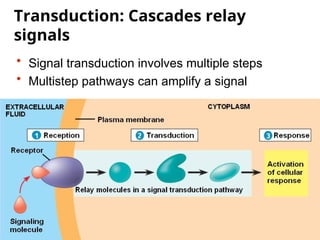
Transduction: Cascades relay
signals
• Signal transduction involves multiple steps
• Multistep pathways can amplify a signal
Signal Transduction Pathways
• Receptor activates another protein, which
activates another, and so on, until protein
producing the response is activated
• At each step, the signal is transduced into a
different form, usually a shape change in a protein
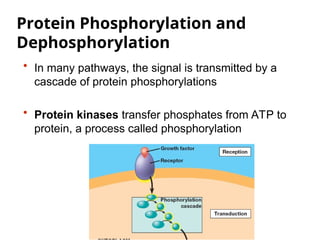
Protein Phosphorylation and
Dephosphorylation
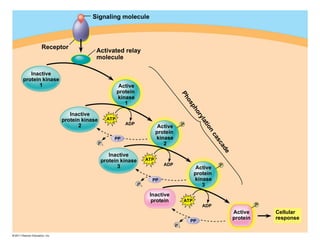
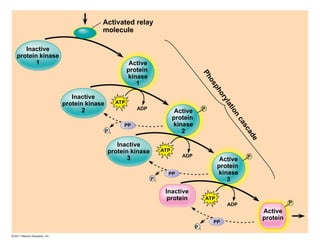
• In many pathways, the signal is transmitted by a
cascade of protein phosphorylations
• Protein kinases transfer phosphates from ATP to
protein, a process called phosphorylation
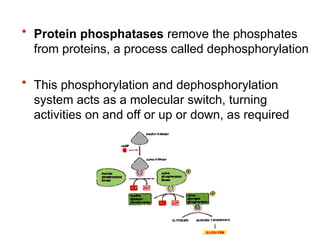
• Protein phosphatases remove the phosphates
from proteins, a process called dephosphorylation
• This phosphorylation and dephosphorylation
system acts as a molecular switch, turning
activities on and off or up or down, as required
Receptor
Signaling molecule
Activated relay
molecule
P
h
o
s
p
h
o
r
y
l
a
t
i
o
n
c
a
s
c
a
d
e
Inactive
protein kinase
1 Active
protein
kinase
1
Active
protein
kinase
2
Active
protein
kinase
3
Inactive
protein kinase
2
Inactive
protein kinase
3
Inactive
protein
Active
protein
Cellular
response
ATP
ADP
ATP
ADP
ATP
ADP
PP
PP
PP
P
P
P
P i
P i
P i
Activated relay
molecule
P
h
o
s
p
h
o
r
y
l
a
t
i
o
n
c
a
s
c
a
d
e
Inactive
protein kinase
1 Active
protein
kinase
1
Active
protein
kinase
2
Active
protein
kinase
3
Inactive
protein kinase
2
Inactive
protein kinase
3
Inactive
protein
Active
protein
ATP
ADP
ATP
ADP
ATP
ADP
PP
PP
PP
P
P
P i
P i
P i
P
Second Messengers
• The extracellular signal molecule (ligand) that
binds to the receptor is a pathway’s “first
messenger”
• Second messengers are small, nonprotein, water-
soluble molecules or ions that spread throughout a
cell
– Calcium
– cAMP
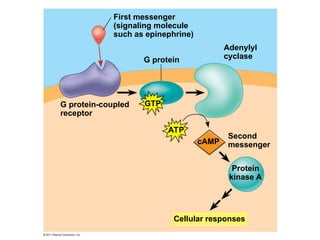
• Many signal molecules trigger formation of cAMP
• cAMP usually activates protein kinase A, which
phosphorylates various other proteins
G protein
First messenger
(signaling molecule
such as epinephrine)
G protein-coupled
receptor
Adenylyl
cyclase
Second
messenger
Cellular responses
Protein
kinase A
GTP
ATP
cAMP
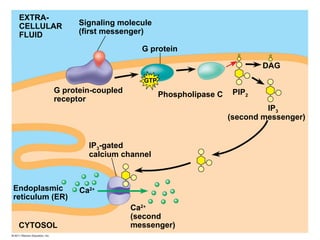
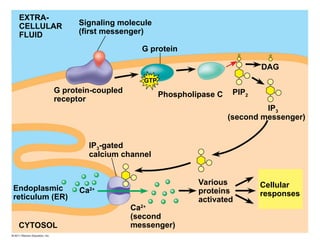
Calcium Ions and Inositol Triphosphate (IP3)
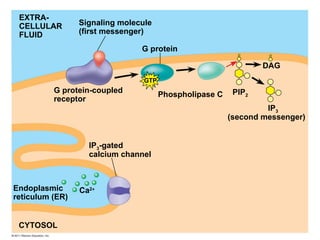
• Calcium ions (Ca2+
) act as a second messenger in
many pathways
• Calcium is an important second messenger because
cells can regulate its concentration
G protein
EXTRA-
CELLULAR
FLUID
Signaling molecule
(first messenger)
G protein-coupled
receptor
Phospholipase C
DAG
PIP2
IP3
(second messenger)
IP3-gated
calcium channel
Endoplasmic
reticulum (ER)
CYTOSOL
Ca2
GTP
G protein
EXTRA-
CELLULAR
FLUID
Signaling molecule
(first messenger)
G protein-coupled
receptor
Phospholipase C
DAG
PIP2
IP3
(second messenger)
IP3-gated
calcium channel
Endoplasmic
reticulum (ER)
CYTOSOL
Ca2
(second
messenger)
Ca2
GTP
G protein
EXTRA-
CELLULAR
FLUID
Signaling molecule
(first messenger)
G protein-coupled
receptor
Phospholipase C
DAG
PIP2
IP3
(second messenger)
IP3-gated
calcium channel
Endoplasmic
reticulum (ER)
CYTOSOL
Various
proteins
activated
Cellular
responses
Ca2
(second
messenger)
Ca2
GTP
Nuclear and Cytoplasmic
Responses
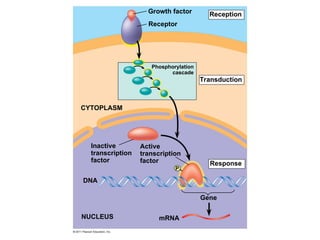
• Ultimately, a signal transduction pathway leads to
regulation of one or more cellular activities
• Many signaling pathways regulate the synthesis of
enzymes or other proteins, usually by turning
genes on or off in the nucleus
• The final activated molecule in the signaling
pathway may function as a transcription factor
Growth factor
Receptor
Reception
Transduction
CYTOPLASM
Response
Inactive
transcription
factor
Active
transcription
factor
DNA
NUCLEUS mRNA
Gene
Phosphorylation
cascade
P
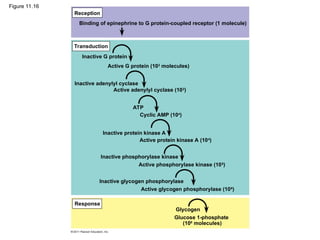
Figure 11.16
Reception
Transduction
Response
Binding of epinephrine to G protein-coupled receptor (1 molecule)
Inactive G protein
Active G protein (102
molecules)
Inactive adenylyl cyclase
Active adenylyl cyclase (102
)
ATP
Cyclic AMP (104
)
Inactive protein kinase A
Active protein kinase A (104
)
Inactive phosphorylase kinase
Active phosphorylase kinase (105
)
Inactive glycogen phosphorylase
Active glycogen phosphorylase (106
)
Glycogen
Glucose 1-phosphate
(108
molecules)
Fine-Tuning of the Response
• There are four aspects of fine-tuning to consider
– Amplifying the signal (and thus the response)
– Specificity of the response
– Overall efficiency of response, enhanced by
scaffolding proteins
– Termination of the signal
Amplify: Cascade amplifies the cell response
At each step, the number of activated product is
greater than in the step before
Specify:
Different proteins allow cells to detect and respond
to different signals
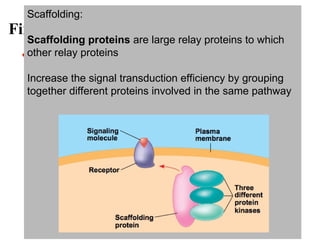
Scaffolding:
Scaffolding proteins are large relay proteins to which
other relay proteins
Increase the signal transduction efficiency by grouping
together different proteins involved in the same pathway
Apoptosis integrates multiple cell-
signaling pathways
• Apoptosis is programmed or controlled cell
suicide
• Components of the cell are chopped up and
packaged into vesicles that are digested by
scavenger cells
• Apoptosis prevents enzymes from leaking out of a
dying cell and damaging neighboring cells
True / false
1. There is no fundamental distinction between
signaling molecules that bind to cell-surface
receptors and those that bind to intracellular
receptors
2. All second messengers are water soluble
and diffuse freely through the cytosol
EXPLAINING PROBLEMS
• how is it that different cells can respond in
different ways to exactly the same signaling
molecule even when the have identical
receptors
• Describe three ways in which a gradual
increase in an extracellular signal can be
sharpened by the target cell to produce an
abrupt or nearly all-or-non response

CELL TO CELL COMMUNICATION - PRESENTATION

  • 1.
    CELL TO CELLCOMMUNICATION MIKG FKG Usakti
  • 2.
    Transduction: Cascades relay signals •Signal transduction involves multiple steps • Multistep pathways can amplify a signal
  • 3.
    Signal Transduction Pathways •Receptor activates another protein, which activates another, and so on, until protein producing the response is activated • At each step, the signal is transduced into a different form, usually a shape change in a protein
  • 4.
    Protein Phosphorylation and Dephosphorylation •In many pathways, the signal is transmitted by a cascade of protein phosphorylations • Protein kinases transfer phosphates from ATP to protein, a process called phosphorylation
  • 5.
    • Protein phosphatasesremove the phosphates from proteins, a process called dephosphorylation • This phosphorylation and dephosphorylation system acts as a molecular switch, turning activities on and off or up or down, as required
  • 6.
    Receptor Signaling molecule Activated relay molecule P h o s p h o r y l a t i o n c a s c a d e Inactive proteinkinase 1 Active protein kinase 1 Active protein kinase 2 Active protein kinase 3 Inactive protein kinase 2 Inactive protein kinase 3 Inactive protein Active protein Cellular response ATP ADP ATP ADP ATP ADP PP PP PP P P P P i P i P i
  • 7.
    Activated relay molecule P h o s p h o r y l a t i o n c a s c a d e Inactive protein kinase 1Active protein kinase 1 Active protein kinase 2 Active protein kinase 3 Inactive protein kinase 2 Inactive protein kinase 3 Inactive protein Active protein ATP ADP ATP ADP ATP ADP PP PP PP P P P i P i P i P
  • 8.
    Second Messengers • Theextracellular signal molecule (ligand) that binds to the receptor is a pathway’s “first messenger” • Second messengers are small, nonprotein, water- soluble molecules or ions that spread throughout a cell – Calcium – cAMP
  • 9.
    • Many signalmolecules trigger formation of cAMP • cAMP usually activates protein kinase A, which phosphorylates various other proteins
  • 10.
    G protein First messenger (signalingmolecule such as epinephrine) G protein-coupled receptor Adenylyl cyclase Second messenger Cellular responses Protein kinase A GTP ATP cAMP
  • 11.
    Calcium Ions andInositol Triphosphate (IP3) • Calcium ions (Ca2+ ) act as a second messenger in many pathways • Calcium is an important second messenger because cells can regulate its concentration
  • 12.
    G protein EXTRA- CELLULAR FLUID Signaling molecule (firstmessenger) G protein-coupled receptor Phospholipase C DAG PIP2 IP3 (second messenger) IP3-gated calcium channel Endoplasmic reticulum (ER) CYTOSOL Ca2 GTP
  • 13.
    G protein EXTRA- CELLULAR FLUID Signaling molecule (firstmessenger) G protein-coupled receptor Phospholipase C DAG PIP2 IP3 (second messenger) IP3-gated calcium channel Endoplasmic reticulum (ER) CYTOSOL Ca2 (second messenger) Ca2 GTP
  • 14.
    G protein EXTRA- CELLULAR FLUID Signaling molecule (firstmessenger) G protein-coupled receptor Phospholipase C DAG PIP2 IP3 (second messenger) IP3-gated calcium channel Endoplasmic reticulum (ER) CYTOSOL Various proteins activated Cellular responses Ca2 (second messenger) Ca2 GTP
  • 15.
    Nuclear and Cytoplasmic Responses •Ultimately, a signal transduction pathway leads to regulation of one or more cellular activities • Many signaling pathways regulate the synthesis of enzymes or other proteins, usually by turning genes on or off in the nucleus • The final activated molecule in the signaling pathway may function as a transcription factor
  • 16.
  • 17.
    Figure 11.16 Reception Transduction Response Binding ofepinephrine to G protein-coupled receptor (1 molecule) Inactive G protein Active G protein (102 molecules) Inactive adenylyl cyclase Active adenylyl cyclase (102 ) ATP Cyclic AMP (104 ) Inactive protein kinase A Active protein kinase A (104 ) Inactive phosphorylase kinase Active phosphorylase kinase (105 ) Inactive glycogen phosphorylase Active glycogen phosphorylase (106 ) Glycogen Glucose 1-phosphate (108 molecules)
  • 18.
    Fine-Tuning of theResponse • There are four aspects of fine-tuning to consider – Amplifying the signal (and thus the response) – Specificity of the response – Overall efficiency of response, enhanced by scaffolding proteins – Termination of the signal Amplify: Cascade amplifies the cell response At each step, the number of activated product is greater than in the step before Specify: Different proteins allow cells to detect and respond to different signals Scaffolding: Scaffolding proteins are large relay proteins to which other relay proteins Increase the signal transduction efficiency by grouping together different proteins involved in the same pathway
  • 19.
    Apoptosis integrates multiplecell- signaling pathways • Apoptosis is programmed or controlled cell suicide • Components of the cell are chopped up and packaged into vesicles that are digested by scavenger cells • Apoptosis prevents enzymes from leaking out of a dying cell and damaging neighboring cells
  • 20.
    True / false 1.There is no fundamental distinction between signaling molecules that bind to cell-surface receptors and those that bind to intracellular receptors 2. All second messengers are water soluble and diffuse freely through the cytosol
  • 21.
    EXPLAINING PROBLEMS • howis it that different cells can respond in different ways to exactly the same signaling molecule even when the have identical receptors • Describe three ways in which a gradual increase in an extracellular signal can be sharpened by the target cell to produce an abrupt or nearly all-or-non response

Editor's Notes

  • #6 Figure 11.10 A phosphorylation cascade.
  • #7 Figure 11.10 A phosphorylation cascade.
  • #10 Figure 11.12 cAMP as a second messenger in a G protein signaling pathway.
  • #12 Figure 11.14 Calcium and IP3 in signaling pathways.
  • #13 Figure 11.14 Calcium and IP3 in signaling pathways.
  • #14 Figure 11.14 Calcium and IP3 in signaling pathways.
  • #16 Figure 11.15 Nuclear responses to a signal: the activation of a specific gene by a growth factor.
  • #17 Figure 11.16 Cytoplasmic response to a signal: the stimulation of glycogen breakdown by epinephrine.