Presentation on : B-H curve
By : Dhruv M Patel(16BEECV084)
(160410111045)
The plot of Magnetization M or Magnetic
field B as a function of Magnetic Field
Intensity H (i.e. M-H or B-H graph) gives
the Hysteresis curve. The permeability μ of
a ferromagnetic material can vary through
the entire range of possible values from
zero to infinity and may be either positive
or negetive.
 Hysteresis, in general, is defined as the lag in
a variable property of a system with respect
to the effect producing it as this effect varies.
In ferromagnetic materials the magnetic flux
density B lags behind the changing external
Magnetizing field Intensity H. Hysteresis
curve is drawn by plotting the graph of B-field
vs H (or M-H) by taking the material through a
complete cycle of H values as follows
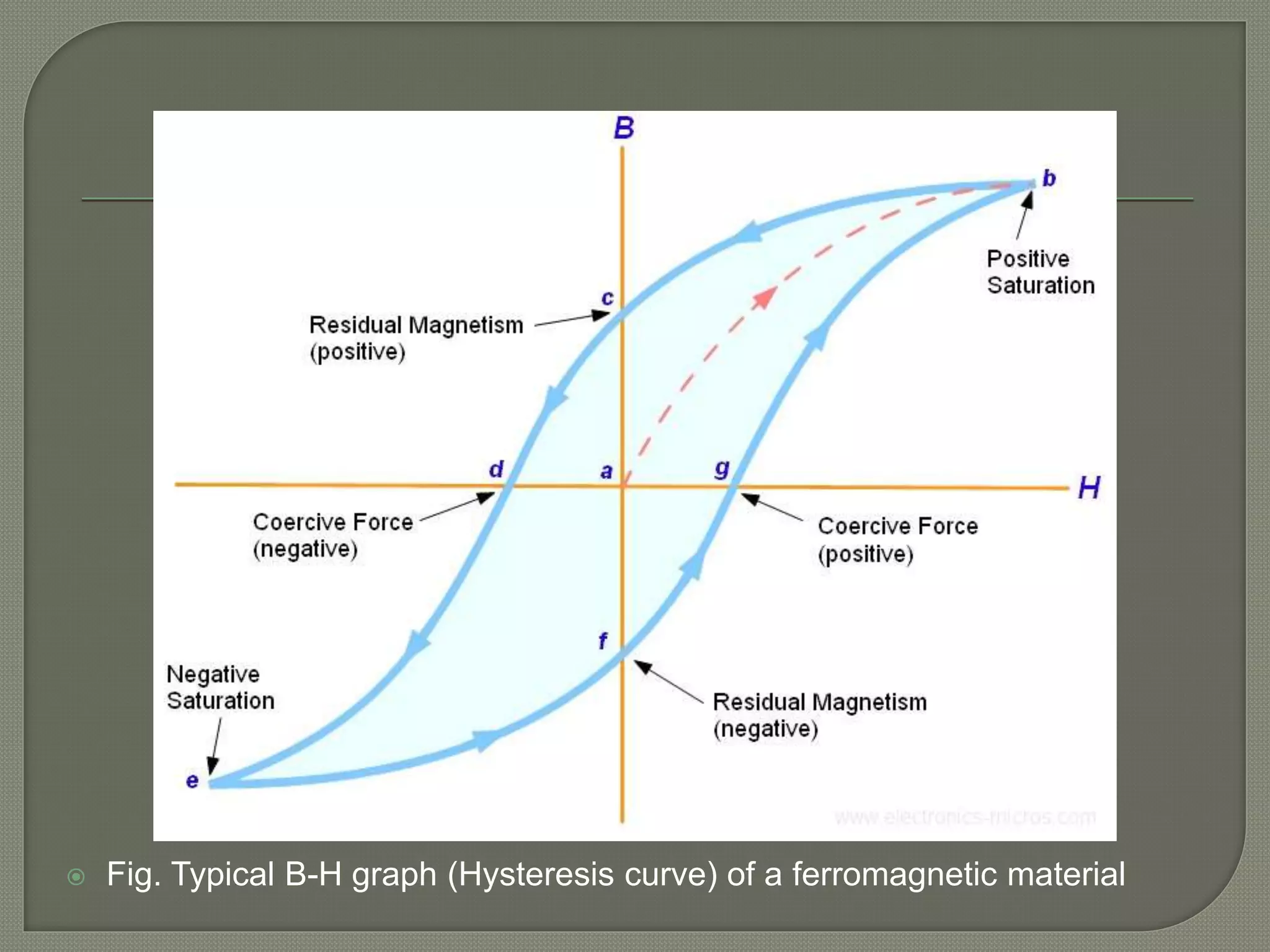
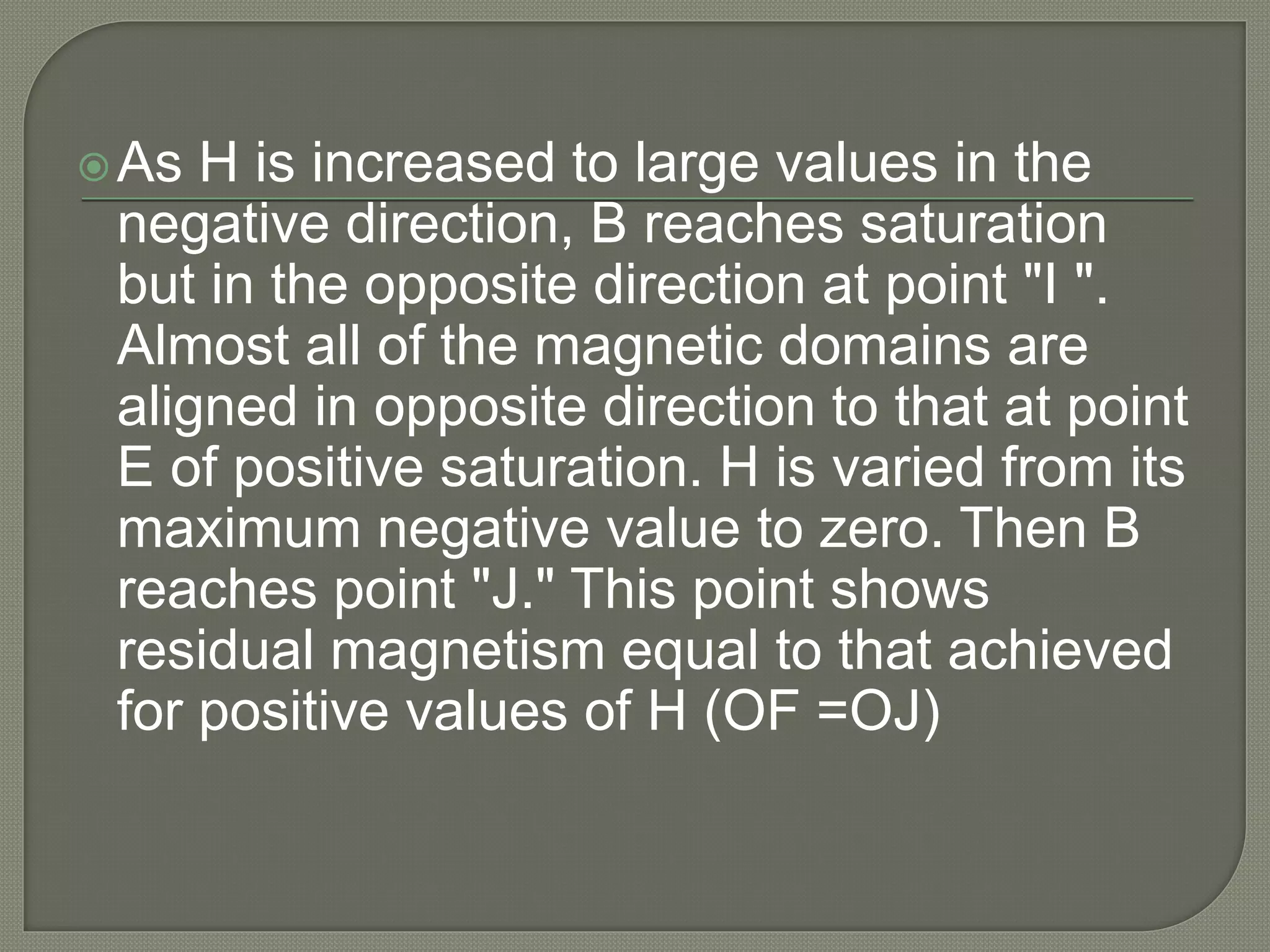
 Fig. Typical B-H graph (Hysteresis curve) of a ferromagnetic material
First, consider an unmagnetized sample of
ferromagnetic material. The magnetic field
intensity H is initially zero at O. H is
increased monotonically, then magnetic
induction B increases nonlinearly along the
curve (OACDE) called as the
magnetization curve. At point E almost all
of the magnetic domains are aligned
parallel with the magnetic field.
An additional increase in H does not
produce any increase in B. E is called as
the point of magnetic saturation of the
material. Values of permeability derived
from the formula along the curve are
always positive and show a wide range of
values. The maximum permeability as
large as occurs at the ``knee'' (point D) of
the curve
Next H is decreased till it reduces to zero.
B reduces from its saturation value at "E"
to that at point "F". Some of the magnetic
domains lose their alignment but some
maintain alignment i.e. Some magnetic flux
density B is still retained in the material
The curve for decreasing values of H (i.e.
Demagnetization curve EF) is offset by an
amount FO from that for increasing values
of H (i.e. Magnetization curve OE). The
amount of offset “FO” is called the
retentivity or the remanence or the level of
residual magnetism.
As H is increased to large values in the
negative direction, B reaches saturation
but in the opposite direction at point "I ".
Almost all of the magnetic domains are
aligned in opposite direction to that at point
E of positive saturation. H is varied from its
maximum negative value to zero. Then B
reaches point "J." This point shows
residual magnetism equal to that achieved
for positive values of H (OF =OJ)
 H is increased back from zero to maximum in
the positive direction. Then B reaches zero
value at “K” i.e. it does not pass through the
origin of the graph. OK indicates the amount
of field H required to nullify theresidual
magnetism OJ retained in the opposite
direction. H is increased from point “K” further
in the positive direction, then again the
saturation of B is reached at point “E” and the
loop is completed.
1.Retentivity - A measure of the residual
flux density corresponding to the saturation
of a magnetic material. It is a material's
ability to retain a certain amount of residual
magnetic field when the magnetizing force
is removed after achieving saturation (The
value of B at point E on the hysteresis
curve).
2. Residual Magnetism or Residual Flux -
The magnetic flux density B that remains
in a material when the magnetizing field
intensity H is zero. Residual magnetism
and retentivity are same only when the
material is magnetized to the saturation
point. However, it may be lower than the
retentivity value otherwise.
3. Coercive Forc Coercivity It is the
amount of reverse magnetizing field
intensity which must e or be applied to a
magnetic material to make the magnetic
flux density of ferromagnetic material
return to zero after it has reached
saturation. (The value of H at point G on
the hysteresis curve).
4. Reluctance - It is the opposition that a
ferromagnetic material shows to the
establishment of a magnetic field.
Reluctance is analogous to the resistance
in an electrical circuit
5.Permeability, μ- Permeability is the
property of a material that measures the
ease with which a magnetic flux is
established in it. μ is negative in the II and
IV quadrants and positive in the I and III
quadrants of the B-H graph (i.e. the
Hysteresis curve).
B-H curve (hysteresis loop)

B-H curve (hysteresis loop)

  • 1.
    Presentation on :B-H curve By : Dhruv M Patel(16BEECV084) (160410111045)
  • 2.
    The plot ofMagnetization M or Magnetic field B as a function of Magnetic Field Intensity H (i.e. M-H or B-H graph) gives the Hysteresis curve. The permeability μ of a ferromagnetic material can vary through the entire range of possible values from zero to infinity and may be either positive or negetive.
  • 3.
     Hysteresis, ingeneral, is defined as the lag in a variable property of a system with respect to the effect producing it as this effect varies. In ferromagnetic materials the magnetic flux density B lags behind the changing external Magnetizing field Intensity H. Hysteresis curve is drawn by plotting the graph of B-field vs H (or M-H) by taking the material through a complete cycle of H values as follows
  • 4.
     Fig. TypicalB-H graph (Hysteresis curve) of a ferromagnetic material
  • 5.
    First, consider anunmagnetized sample of ferromagnetic material. The magnetic field intensity H is initially zero at O. H is increased monotonically, then magnetic induction B increases nonlinearly along the curve (OACDE) called as the magnetization curve. At point E almost all of the magnetic domains are aligned parallel with the magnetic field.
  • 6.
    An additional increasein H does not produce any increase in B. E is called as the point of magnetic saturation of the material. Values of permeability derived from the formula along the curve are always positive and show a wide range of values. The maximum permeability as large as occurs at the ``knee'' (point D) of the curve
  • 7.
    Next H isdecreased till it reduces to zero. B reduces from its saturation value at "E" to that at point "F". Some of the magnetic domains lose their alignment but some maintain alignment i.e. Some magnetic flux density B is still retained in the material
  • 8.
    The curve fordecreasing values of H (i.e. Demagnetization curve EF) is offset by an amount FO from that for increasing values of H (i.e. Magnetization curve OE). The amount of offset “FO” is called the retentivity or the remanence or the level of residual magnetism.
  • 9.
    As H isincreased to large values in the negative direction, B reaches saturation but in the opposite direction at point "I ". Almost all of the magnetic domains are aligned in opposite direction to that at point E of positive saturation. H is varied from its maximum negative value to zero. Then B reaches point "J." This point shows residual magnetism equal to that achieved for positive values of H (OF =OJ)
  • 10.
     H isincreased back from zero to maximum in the positive direction. Then B reaches zero value at “K” i.e. it does not pass through the origin of the graph. OK indicates the amount of field H required to nullify theresidual magnetism OJ retained in the opposite direction. H is increased from point “K” further in the positive direction, then again the saturation of B is reached at point “E” and the loop is completed.
  • 11.
    1.Retentivity - Ameasure of the residual flux density corresponding to the saturation of a magnetic material. It is a material's ability to retain a certain amount of residual magnetic field when the magnetizing force is removed after achieving saturation (The value of B at point E on the hysteresis curve).
  • 12.
    2. Residual Magnetismor Residual Flux - The magnetic flux density B that remains in a material when the magnetizing field intensity H is zero. Residual magnetism and retentivity are same only when the material is magnetized to the saturation point. However, it may be lower than the retentivity value otherwise.
  • 13.
    3. Coercive ForcCoercivity It is the amount of reverse magnetizing field intensity which must e or be applied to a magnetic material to make the magnetic flux density of ferromagnetic material return to zero after it has reached saturation. (The value of H at point G on the hysteresis curve).
  • 14.
    4. Reluctance -It is the opposition that a ferromagnetic material shows to the establishment of a magnetic field. Reluctance is analogous to the resistance in an electrical circuit
  • 15.
    5.Permeability, μ- Permeabilityis the property of a material that measures the ease with which a magnetic flux is established in it. μ is negative in the II and IV quadrants and positive in the I and III quadrants of the B-H graph (i.e. the Hysteresis curve).