Special Machines:
Hysteresis Motors
• Construction
• Principle of Operation
• Power Flow
• Torque-Speed Characteristic
• Edited by: Engineer.Ahmed Amin Hassan
• Date : 1.10.2015
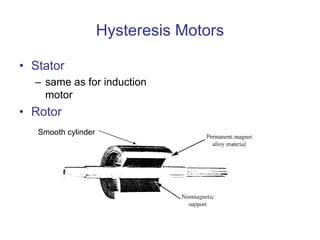
Hysteresis Motors
• Stator
– same as for induction
motor
• Rotor
Smooth cylinder
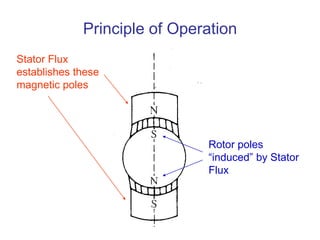
Principle of Operation
Stator Flux
establishes these
magnetic poles
Rotor poles
“induced” by Stator
Flux
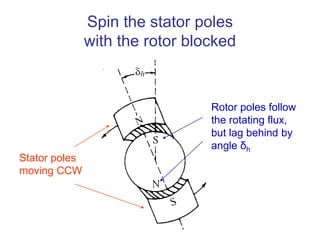
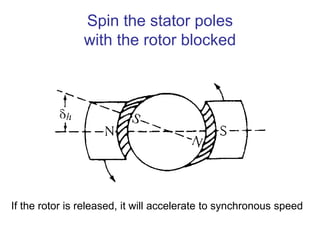
Spin the stator poles
with the rotor blocked
Stator poles
moving CCW
Rotor poles follow
the rotating flux,
but lag behind by
angle δh
Spin the stator poles
with the rotor blocked
If the rotor is released, it will accelerate to synchronous speed
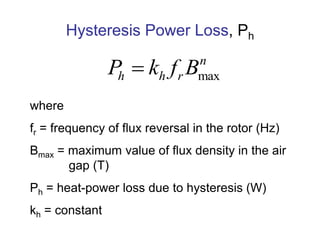
Hysteresis Power Loss, Ph
max
n
h h rP k f B
where
fr = frequency of flux reversal in the rotor (Hz)
Bmax = maximum value of flux density in the air
gap (T)
Ph = heat-power loss due to hysteresis (W)
kh = constant
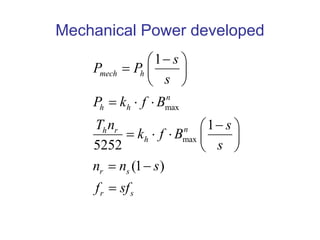
Mechanical Power developed
max
max
1
1
5252
(1 )
mech h
n
h h
nh r
h
r s
r s
s
P P
s
P k f B
T n s
k f B
s
n n s
f sf
 
  
 
  
 
    
 
 

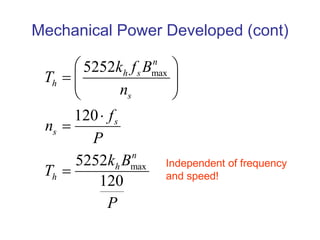
Mechanical Power Developed (cont)
max
max
5252
120
5252
120
n
h s
h
s
s
s
n
h
h
k f B
T
n
f
n
P
k B
T
P
 
  
 



Independent of frequency
and speed!
Hysteresis Motor at Synchronous Speed
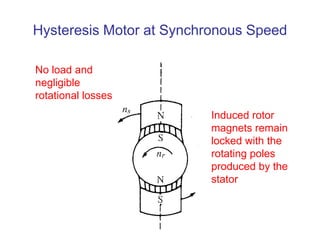
No load and
negligible
rotational losses
Induced rotor
magnets remain
locked with the
rotating poles
produced by the
stator
Hysteresis Motor at Synchronous Speed
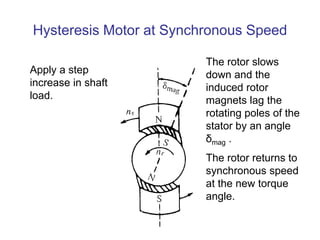
Apply a step
increase in shaft
load.
The rotor slows
down and the
induced rotor
magnets lag the
rotating poles of the
stator by an angle
δmag .
The rotor returns to
synchronous speed
at the new torque
angle.
Hysteresis Motor at Synchronous Speed
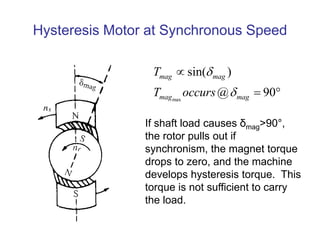
max
sin( )
@ 90
mag mag
mag mag
T
T occurs



 
If shaft load causes δmag>90°,
the rotor pulls out if
synchronism, the magnet torque
drops to zero, and the machine
develops hysteresis torque. This
torque is not sufficient to carry
the load.
Torque-Speed Characteristic
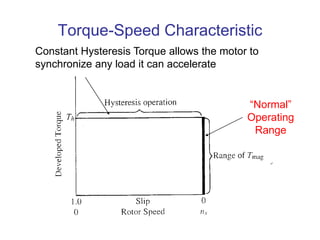
“Normal”
Operating
Range
Constant Hysteresis Torque allows the motor to
synchronize any load it can accelerate

Hysteresis motor

  • 1.
    Special Machines: Hysteresis Motors •Construction • Principle of Operation • Power Flow • Torque-Speed Characteristic • Edited by: Engineer.Ahmed Amin Hassan • Date : 1.10.2015
  • 2.
    Hysteresis Motors • Stator –same as for induction motor • Rotor Smooth cylinder
  • 3.
    Principle of Operation StatorFlux establishes these magnetic poles Rotor poles “induced” by Stator Flux
  • 4.
    Spin the statorpoles with the rotor blocked Stator poles moving CCW Rotor poles follow the rotating flux, but lag behind by angle δh
  • 5.
    Spin the statorpoles with the rotor blocked If the rotor is released, it will accelerate to synchronous speed
  • 6.
    Hysteresis Power Loss,Ph max n h h rP k f B where fr = frequency of flux reversal in the rotor (Hz) Bmax = maximum value of flux density in the air gap (T) Ph = heat-power loss due to hysteresis (W) kh = constant
  • 7.
    Mechanical Power developed max max 1 1 5252 (1) mech h n h h nh r h r s r s s P P s P k f B T n s k f B s n n s f sf                      
  • 8.
    Mechanical Power Developed(cont) max max 5252 120 5252 120 n h s h s s s n h h k f B T n f n P k B T P           Independent of frequency and speed!
  • 9.
    Hysteresis Motor atSynchronous Speed No load and negligible rotational losses Induced rotor magnets remain locked with the rotating poles produced by the stator
  • 10.
    Hysteresis Motor atSynchronous Speed Apply a step increase in shaft load. The rotor slows down and the induced rotor magnets lag the rotating poles of the stator by an angle δmag . The rotor returns to synchronous speed at the new torque angle.
  • 11.
    Hysteresis Motor atSynchronous Speed max sin( ) @ 90 mag mag mag mag T T occurs      If shaft load causes δmag>90°, the rotor pulls out if synchronism, the magnet torque drops to zero, and the machine develops hysteresis torque. This torque is not sufficient to carry the load.
  • 12.
    Torque-Speed Characteristic “Normal” Operating Range Constant HysteresisTorque allows the motor to synchronize any load it can accelerate