BRIDGES

1 January 2014

1
Bridge is a structure built to span physical obstacles such as
a body of water, valley, or road, for the purpose of providing
passage over the obstacle without closing the gap below.
Bridge building is not a new science. The sophistication in
bridge building technology has been developing since the
human civilization.

Figure 1: a) Simplest bridge
1 January 2014

b) The Pamban Bridge
2
IMPORTANCE OF BRIDGES
 Connects Difficult Terrains
 Easy Trade and Transportation of Goods

 Reduces Travelling Time
 Military use
 Political and Economic importance
 Less Emission due to displacement

1 January 2014

3
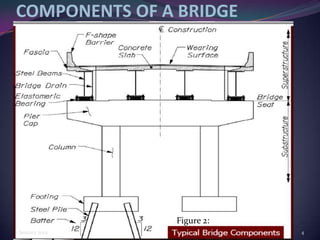
COMPONENTS OF A BRIDGE

Figure 2:
1 January 2014

4
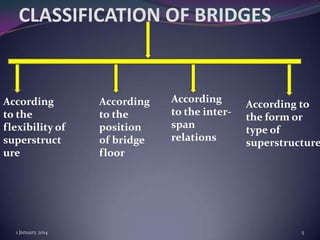
CLASSIFICATION OF BRIDGES

According
to the
flexibility of
superstruct
ure

1 January 2014

According
to the
position
of bridge
floor

According
to the interspan
relations

According to
the form or
type of
superstructure

5
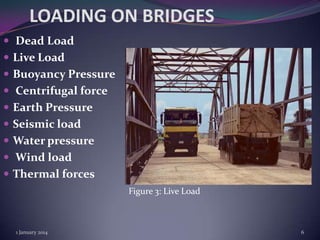
LOADING ON BRIDGES
 Dead Load
 Live Load
 Buoyancy Pressure
 Centrifugal force
 Earth Pressure
 Seismic load

 Water pressure
 Wind load
 Thermal forces
Figure 3: Live Load

1 January 2014

6
1 January 2014

7
AESTHETICS OF BRIDGES
 External appearance
 Internal view
 Sequential View

GUIDELINES:

1) Beauty and Stability
2) Bridge and Environment
Integration
3) Material Choice
4)Moderate Lightings
1 January 2014

Figure 4: Aesthetics of a bridge

8
STEEL BRIDGE
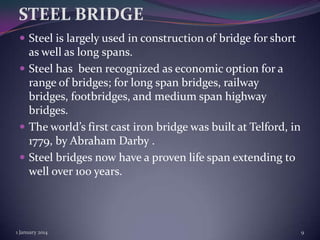
 Steel is largely used in construction of bridge for short

as well as long spans.
 Steel has been recognized as economic option for a
range of bridges; for long span bridges, railway
bridges, footbridges, and medium span highway
bridges.
 The world’s first cast iron bridge was built at Telford, in
1779, by Abraham Darby .
 Steel bridges now have a proven life span extending to
well over 100 years.

1 January 2014

9
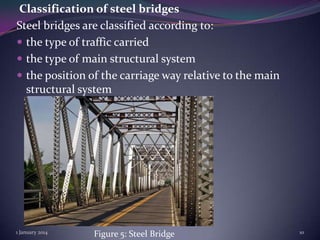
Classification of steel bridges
Steel bridges are classified according to:
 the type of traffic carried
 the type of main structural system
 the position of the carriage way relative to the main
structural system

1 January 2014

Figure 5: Steel Bridge

10
REINFORCED CONCRETE BRIDGE
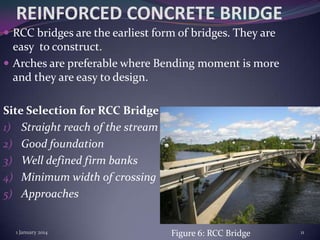
 RCC bridges are the earliest form of bridges. They are

easy to construct.
 Arches are preferable where Bending moment is more
and they are easy to design.
Site Selection for RCC Bridge
1) Straight reach of the stream
2) Good foundation
3) Well defined firm banks
4) Minimum width of crossing
5) Approaches

1 January 2014

Figure 6: RCC Bridge

11
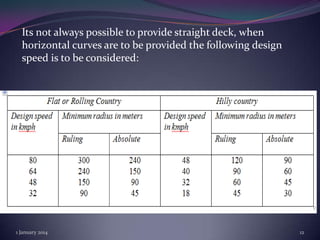
Its not always possible to provide straight deck, when
horizontal curves are to be provided the following design
speed is to be considered:

1 January 2014

12
SUSPENSION BRIDGE
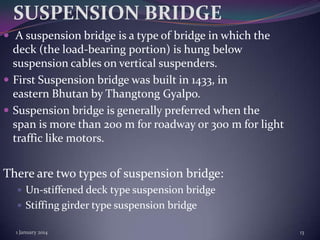
 A suspension bridge is a type of bridge in which the

deck (the load-bearing portion) is hung below
suspension cables on vertical suspenders.
 First Suspension bridge was built in 1433, in
eastern Bhutan by Thangtong Gyalpo.
 Suspension bridge is generally preferred when the
span is more than 200 m for roadway or 300 m for light
traffic like motors.

There are two types of suspension bridge:
 Un-stiffened deck type suspension bridge
 Stiffing girder type suspension bridge
1 January 2014

13
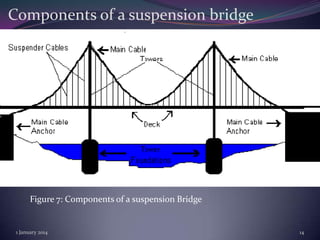
Components of a suspension bridge

Figure 7: Components of a suspension Bridge

1 January 2014

14
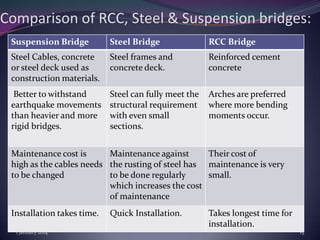
Comparison of RCC, Steel & Suspension bridges:
Suspension Bridge

Steel Bridge

RCC Bridge

Steel Cables, concrete
or steel deck used as
construction materials.

Steel frames and
concrete deck.

Reinforced cement
concrete

Better to withstand
earthquake movements
than heavier and more
rigid bridges.

Steel can fully meet the
structural requirement
with even small
sections.

Arches are preferred
where more bending
moments occur.

Maintenance cost is
Maintenance against
Their cost of
high as the cables needs the rusting of steel has maintenance is very
to be changed
to be done regularly
small.
which increases the cost
of maintenance
Installation takes time.
1 January 2014

Quick Installation.

Takes longest time for
installation.
15
BRIDGE FAILURE
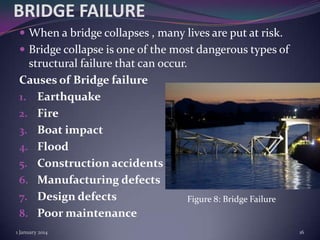
 When a bridge collapses , many lives are put at risk.
 Bridge collapse is one of the most dangerous types of

structural failure that can occur.
Causes of Bridge failure
1. Earthquake
2. Fire
3. Boat impact
4. Flood
5. Construction accidents
6. Manufacturing defects
7. Design defects
Figure 8: Bridge Failure
8. Poor maintenance
1 January 2014

16
MAINTENANCE OF BRIDGES
1. The bearings of girders should be coated with oil
from time to time.

2. The floor system of approaches and bridges
should be properly maintained.
3. The entire drainage system should be inspected

for its proper functioning.
4. The movement of foundations, if any, should be
carefully inspected and all attempts should be
made to stop such further movement.

1 January 2014

17
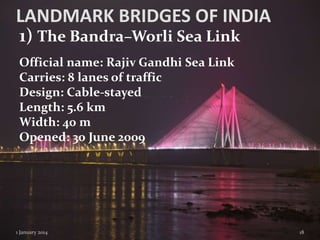
LANDMARK BRIDGES OF INDIA
1) The Bandra–Worli Sea Link
Official name: Rajiv Gandhi Sea Link
Carries: 8 lanes of traffic
Design: Cable-stayed
Length: 5.6 km
Width: 40 m
Opened: 30 June 2009

1 January 2014

18
2) The Howrah Bridge
Official name: Rabindra Setu
Carries: 8 lanes of road
Design: Cantilever
Length: 705 m
Width: 21.6 m
Opened: 3 Feb 1943

1 January 2014

19
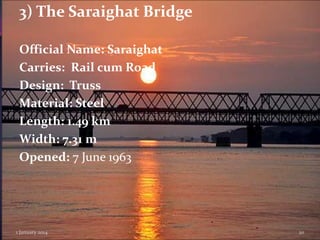
3) The Saraighat Bridge
Official Name: Saraighat
Carries: Rail cum Road
Design: Truss
Material: Steel
Length: 1.49 km
Width: 7.31 m
Opened: 7 June 1963

1 January 2014

20
CONCLUSION
 Bridges connect destinations. Bridges are assets to
mankind and have to last for generations as the
construction of bridge influences the whole
ecosystem and the change is permanent. So proper
planning to adapt the bridge into the natural
ecosystem has to be done. The scope of Bridge

Engineering is ever booming and technology used
in bridge building is also getting sophisticated.

1 January 2014

21
BIBLIOGRAPHY
 S. Ponnuswamy (Guest faculty IIT Madras )., “Bridge Engineering” Tata
McGrwaw-Hill. 2nd Edition, 2008
 Prof. S.R Satish Kumar and Prof. A.R Santha Kumar (IIT Madras)., “ Design of
steel structure Journal” , 2006.
 S.C Rangwala and K.S Rangwala., “ Bridge Engineering” Charotar Publishing
House. 14th Edition ,2012.
 B.L Gupta and Amit Gupta., “Road, Railways, Bridges, Tunnels & Harbour Dock
Engineering” Standard Publishers.7th Edition, 2009.
 S. Ramamrutham., “Design of RCC Structures”., Dhanpat Rai Publishing, 14th
Edition ,1989-1999
 S.S. Bavikatti., “Structure Analysis”., Vikas Publishing House. 14th Edition, 2011.
 Madan Mohan Das, Bhargab Mohan Das and Mimi Das Saikia., “Structure
Analysis”., PHI Publication. 1st Edition, 2011.


Internet surfing







1 January 2014

www.wikipedia.com
www.pbs.org
www.design-technology.org
www.britannica.com
www.steelconstruction.info
www.tatasteelconstruction.com

22
1 January 2014

23

Bridges

  • 1.
  • 2.
    Bridge is astructure built to span physical obstacles such as a body of water, valley, or road, for the purpose of providing passage over the obstacle without closing the gap below. Bridge building is not a new science. The sophistication in bridge building technology has been developing since the human civilization. Figure 1: a) Simplest bridge 1 January 2014 b) The Pamban Bridge 2
  • 3.
    IMPORTANCE OF BRIDGES Connects Difficult Terrains  Easy Trade and Transportation of Goods  Reduces Travelling Time  Military use  Political and Economic importance  Less Emission due to displacement 1 January 2014 3
  • 4.
    COMPONENTS OF ABRIDGE Figure 2: 1 January 2014 4
  • 5.
    CLASSIFICATION OF BRIDGES According tothe flexibility of superstruct ure 1 January 2014 According to the position of bridge floor According to the interspan relations According to the form or type of superstructure 5
  • 6.
    LOADING ON BRIDGES Dead Load  Live Load  Buoyancy Pressure  Centrifugal force  Earth Pressure  Seismic load  Water pressure  Wind load  Thermal forces Figure 3: Live Load 1 January 2014 6
  • 7.
  • 8.
    AESTHETICS OF BRIDGES External appearance  Internal view  Sequential View GUIDELINES: 1) Beauty and Stability 2) Bridge and Environment Integration 3) Material Choice 4)Moderate Lightings 1 January 2014 Figure 4: Aesthetics of a bridge 8
  • 9.
    STEEL BRIDGE  Steelis largely used in construction of bridge for short as well as long spans.  Steel has been recognized as economic option for a range of bridges; for long span bridges, railway bridges, footbridges, and medium span highway bridges.  The world’s first cast iron bridge was built at Telford, in 1779, by Abraham Darby .  Steel bridges now have a proven life span extending to well over 100 years. 1 January 2014 9
  • 10.
    Classification of steelbridges Steel bridges are classified according to:  the type of traffic carried  the type of main structural system  the position of the carriage way relative to the main structural system 1 January 2014 Figure 5: Steel Bridge 10
  • 11.
    REINFORCED CONCRETE BRIDGE RCC bridges are the earliest form of bridges. They are easy to construct.  Arches are preferable where Bending moment is more and they are easy to design. Site Selection for RCC Bridge 1) Straight reach of the stream 2) Good foundation 3) Well defined firm banks 4) Minimum width of crossing 5) Approaches 1 January 2014 Figure 6: RCC Bridge 11
  • 12.
    Its not alwayspossible to provide straight deck, when horizontal curves are to be provided the following design speed is to be considered: 1 January 2014 12
  • 13.
    SUSPENSION BRIDGE  Asuspension bridge is a type of bridge in which the deck (the load-bearing portion) is hung below suspension cables on vertical suspenders.  First Suspension bridge was built in 1433, in eastern Bhutan by Thangtong Gyalpo.  Suspension bridge is generally preferred when the span is more than 200 m for roadway or 300 m for light traffic like motors. There are two types of suspension bridge:  Un-stiffened deck type suspension bridge  Stiffing girder type suspension bridge 1 January 2014 13
  • 14.
    Components of asuspension bridge Figure 7: Components of a suspension Bridge 1 January 2014 14
  • 15.
    Comparison of RCC,Steel & Suspension bridges: Suspension Bridge Steel Bridge RCC Bridge Steel Cables, concrete or steel deck used as construction materials. Steel frames and concrete deck. Reinforced cement concrete Better to withstand earthquake movements than heavier and more rigid bridges. Steel can fully meet the structural requirement with even small sections. Arches are preferred where more bending moments occur. Maintenance cost is Maintenance against Their cost of high as the cables needs the rusting of steel has maintenance is very to be changed to be done regularly small. which increases the cost of maintenance Installation takes time. 1 January 2014 Quick Installation. Takes longest time for installation. 15
  • 16.
    BRIDGE FAILURE  Whena bridge collapses , many lives are put at risk.  Bridge collapse is one of the most dangerous types of structural failure that can occur. Causes of Bridge failure 1. Earthquake 2. Fire 3. Boat impact 4. Flood 5. Construction accidents 6. Manufacturing defects 7. Design defects Figure 8: Bridge Failure 8. Poor maintenance 1 January 2014 16
  • 17.
    MAINTENANCE OF BRIDGES 1.The bearings of girders should be coated with oil from time to time. 2. The floor system of approaches and bridges should be properly maintained. 3. The entire drainage system should be inspected for its proper functioning. 4. The movement of foundations, if any, should be carefully inspected and all attempts should be made to stop such further movement. 1 January 2014 17
  • 18.
    LANDMARK BRIDGES OFINDIA 1) The Bandra–Worli Sea Link Official name: Rajiv Gandhi Sea Link Carries: 8 lanes of traffic Design: Cable-stayed Length: 5.6 km Width: 40 m Opened: 30 June 2009 1 January 2014 18
  • 19.
    2) The HowrahBridge Official name: Rabindra Setu Carries: 8 lanes of road Design: Cantilever Length: 705 m Width: 21.6 m Opened: 3 Feb 1943 1 January 2014 19
  • 20.
    3) The SaraighatBridge Official Name: Saraighat Carries: Rail cum Road Design: Truss Material: Steel Length: 1.49 km Width: 7.31 m Opened: 7 June 1963 1 January 2014 20
  • 21.
    CONCLUSION  Bridges connectdestinations. Bridges are assets to mankind and have to last for generations as the construction of bridge influences the whole ecosystem and the change is permanent. So proper planning to adapt the bridge into the natural ecosystem has to be done. The scope of Bridge Engineering is ever booming and technology used in bridge building is also getting sophisticated. 1 January 2014 21
  • 22.
    BIBLIOGRAPHY  S. Ponnuswamy(Guest faculty IIT Madras )., “Bridge Engineering” Tata McGrwaw-Hill. 2nd Edition, 2008  Prof. S.R Satish Kumar and Prof. A.R Santha Kumar (IIT Madras)., “ Design of steel structure Journal” , 2006.  S.C Rangwala and K.S Rangwala., “ Bridge Engineering” Charotar Publishing House. 14th Edition ,2012.  B.L Gupta and Amit Gupta., “Road, Railways, Bridges, Tunnels & Harbour Dock Engineering” Standard Publishers.7th Edition, 2009.  S. Ramamrutham., “Design of RCC Structures”., Dhanpat Rai Publishing, 14th Edition ,1989-1999  S.S. Bavikatti., “Structure Analysis”., Vikas Publishing House. 14th Edition, 2011.  Madan Mohan Das, Bhargab Mohan Das and Mimi Das Saikia., “Structure Analysis”., PHI Publication. 1st Edition, 2011.  Internet surfing       1 January 2014 www.wikipedia.com www.pbs.org www.design-technology.org www.britannica.com www.steelconstruction.info www.tatasteelconstruction.com 22
  • 23.