Design Sprint
by Google Ventures
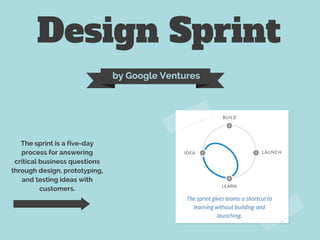
The sprint is a five-day
process for answering
critical business questions
through design, prototyping,
and testing ideas with
customers.
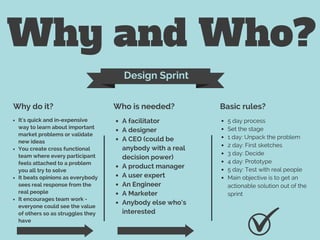
Why and Who?
Design Sprint
Why do it? Who is needed? Basic rules?
It's quick and in-expensive
way to learn about important
market problems or validate
new ideas
You create cross functional
team where every participant
feels attached to a problem
you all try to solve
It beats opinions as everybody
sees real response from the
real people
It encourages team work -
everyone could see the value
of others so as struggles they
have
A facilitator
A designer
A CEO (could be
anybody with a real
decision power)
A product manager
A user expert
An Engineer
A Marketer
Anybody else who’s
interested
5 day process
Set the stage
1 day: Unpack the problem
2 day: First sketches
3 day: Decide
4 day: Prototype
5 day: Test with real people
Main objective is to get an
actionable solution out of the
sprint
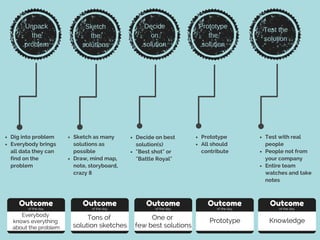
Unpack
the
problem
Sketch
the
solutions
Decide
on
solution
Prototype
the
solution
Test the
solution
Dig into problem
Everybody brings
all data they can
find on the
problem
Outcome
of the day
Everybody
knows everything
about the problem
Sketch as many
solutions as
possible
Draw, mind map,
note, storyboard,
crazy 8
Outcome
of the day
Tons of
solution sketches
Decide on best
solution(s)
"Best shot" or
"Battle Royal"
Outcome
of the day
One or
few best solutions
Prototype
All should
contribute
Outcome
of the day
Prototype
Test with real
people
People not from
your company
Entire team
watches and take
notes
Outcome
of the day
Knowledge
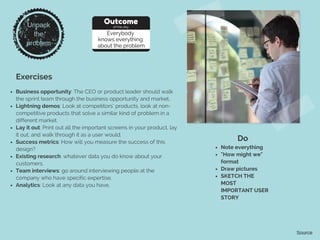
Unpack
the
problem
Exercises
Outcome
of the day
Everybody
knows everything
about the problem
Business opportunity: The CEO or product leader should walk
the sprint team through the business opportunity and market.
Lightning demos: Look at competitors’ products, look at non-
competitive products that solve a similar kind of problem in a
different market.
Lay it out: Print out all the important screens in your product, lay
it out, and walk through it as a user would.
Success metrics: How will you measure the success of this
design?
Existing research: whatever data you do know about your
customers.
Team interviews: go around interviewing people at the
company who have specific expertise.
Analytics: Look at any data you have.
Do
Note everything
"How might we"
format
Draw pictures
SKETCH THE
MOST
IMPORTANT USER
STORY
Source
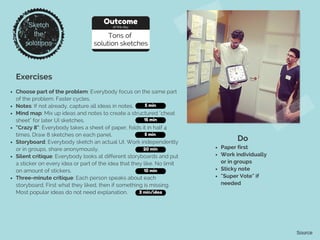
Exercises
Choose part of the problem: Everybody focus on the same part
of the problem. Faster cycles.
Notes: If not already, capture all ideas in notes.
Mind map: Mix up ideas and notes to create a structured "cheat
sheet" for later UI sketches.
"Crazy 8": Everybody takes a sheet of paper, folds it in half 4
times. Draw 8 sketches on each panel.
Storyboard: Everybody sketch an actual UI. Work independently
or in groups, share anonymously.
Silent critique: Everybody looks at different storyboards and put
a sticker on every idea or part of the idea that they like. No limit
on amount of stickers.
Three-minute critique: Each person speaks about each
storyboard. First what they liked, then if something is missing.
Most popular ideas do not need explanation.
Do
Paper first
Work individually
or in groups
Sticky note
"Super Vote" if
needed
Source
Sketch
the
solutions
Outcome
of the day
Tons of
solution sketches
5 min
15 min
5 min
20 min
10 min
3 min/idea
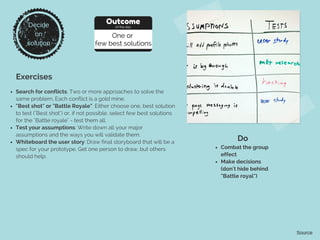
Exercises
Search for conflicts: Two or more approaches to solve the
same problem. Each conflict is a gold mine.
"Best shot" or "Battle Royale": Either choose one, best solution
to test ("Best shot") or, if not possible, select few best solutions
for the "Battle royale" - test them all.
Test your assumptions: Write down all your major
assumptions and the ways you will validate them.
Whiteboard the user story: Draw final storyboard that will be a
spec for your prototype. Get one person to draw, but others
should help.
Do
Combat the group
effect
Make decisions
(don't hide behind
"Battle royal")
Source
Decide
on
solution
Outcome
of the day
One or
few best solutions
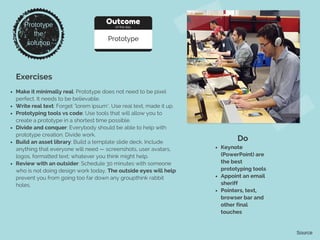
Exercises
Make it minimally real: Prototype does not need to be pixel
perfect. It needs to be believable.
Write real text: Forget "lorem ipsum". Use real text, made it up.
Prototyping tools vs code: Use tools that will allow you to
create a prototype in a shortest time possible.
Divide and conquer: Everybody should be able to help with
prototype creation. Divide work.
Build an asset library: Build a template slide deck. Include
anything that everyone will need — screenshots, user avatars,
logos, formatted text; whatever you think might help.
Review with an outsider: Schedule 30 minutes with someone
who is not doing design work today. The outside eyes will help
prevent you from going too far down any groupthink rabbit
holes.
Do
Keynote
(PowerPoint) are
the best
prototyping tools
Appoint an email
sheriff
Pointers, text,
browser bar and
other final
touches
Source
Prototype
the
solution
Outcome
of the day
Prototype
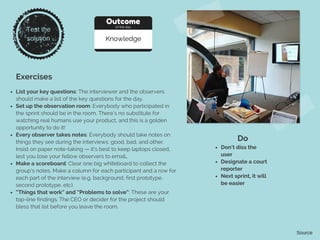
Exercises
List your key questions: The interviewer and the observers
should make a list of the key questions for the day.
Set up the observation room: Everybody who participated in
the sprint should be in the room. There’s no substitute for
watching real humans use your product, and this is a golden
opportunity to do it!
Every observer takes notes: Everybody should take notes on
things they see during the interviews: good, bad, and other.
Insist on paper note-taking — it’s best to keep laptops closed,
lest you lose your fellow observers to email..
Make a scoreboard: Clear one big whiteboard to collect the
group’s notes. Make a column for each participant and a row for
each part of the interview (e.g. background, first prototype,
second prototype, etc).
“Things that work” and “Problems to solve”: These are your
top-line findings. The CEO or decider for the project should
bless that list before you leave the room.
Do
Don’t diss the
user
Designate a court
reporter
Next sprint, it will
be easier
Source
Test the
solution
Outcome
of the day
Knowledge
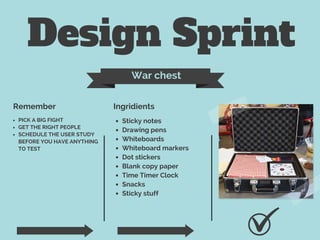
Design Sprint
War chest
Remember Ingridients
PICK A BIG FIGHT
GET THE RIGHT PEOPLE
SCHEDULE THE USER STUDY
BEFORE YOU HAVE ANYTHING
TO TEST
Sticky notes
Drawing pens
Whiteboards
Whiteboard markers
Dot stickers
Blank copy paper
Time Timer Clock
Snacks
Sticky stuff
Resources that were used to create this info deck
How To Conduct Your Own Google Ventures Design
Sprint
The 6 Ingredients You Need To Run A Design Sprint
Lean more about the Design Sprint
The Design Sprint
www.test-n-tell.com

Design sprint info deck

  • 1.
    Design Sprint by GoogleVentures The sprint is a five-day process for answering critical business questions through design, prototyping, and testing ideas with customers.
  • 2.
    Why and Who? DesignSprint Why do it? Who is needed? Basic rules? It's quick and in-expensive way to learn about important market problems or validate new ideas You create cross functional team where every participant feels attached to a problem you all try to solve It beats opinions as everybody sees real response from the real people It encourages team work - everyone could see the value of others so as struggles they have A facilitator A designer A CEO (could be anybody with a real decision power) A product manager A user expert An Engineer A Marketer Anybody else who’s interested 5 day process Set the stage 1 day: Unpack the problem 2 day: First sketches 3 day: Decide 4 day: Prototype 5 day: Test with real people Main objective is to get an actionable solution out of the sprint
  • 3.
    Unpack the problem Sketch the solutions Decide on solution Prototype the solution Test the solution Dig intoproblem Everybody brings all data they can find on the problem Outcome of the day Everybody knows everything about the problem Sketch as many solutions as possible Draw, mind map, note, storyboard, crazy 8 Outcome of the day Tons of solution sketches Decide on best solution(s) "Best shot" or "Battle Royal" Outcome of the day One or few best solutions Prototype All should contribute Outcome of the day Prototype Test with real people People not from your company Entire team watches and take notes Outcome of the day Knowledge
  • 4.
    Unpack the problem Exercises Outcome of the day Everybody knowseverything about the problem Business opportunity: The CEO or product leader should walk the sprint team through the business opportunity and market. Lightning demos: Look at competitors’ products, look at non- competitive products that solve a similar kind of problem in a different market. Lay it out: Print out all the important screens in your product, lay it out, and walk through it as a user would. Success metrics: How will you measure the success of this design? Existing research: whatever data you do know about your customers. Team interviews: go around interviewing people at the company who have specific expertise. Analytics: Look at any data you have. Do Note everything "How might we" format Draw pictures SKETCH THE MOST IMPORTANT USER STORY Source
  • 5.
    Exercises Choose part ofthe problem: Everybody focus on the same part of the problem. Faster cycles. Notes: If not already, capture all ideas in notes. Mind map: Mix up ideas and notes to create a structured "cheat sheet" for later UI sketches. "Crazy 8": Everybody takes a sheet of paper, folds it in half 4 times. Draw 8 sketches on each panel. Storyboard: Everybody sketch an actual UI. Work independently or in groups, share anonymously. Silent critique: Everybody looks at different storyboards and put a sticker on every idea or part of the idea that they like. No limit on amount of stickers. Three-minute critique: Each person speaks about each storyboard. First what they liked, then if something is missing. Most popular ideas do not need explanation. Do Paper first Work individually or in groups Sticky note "Super Vote" if needed Source Sketch the solutions Outcome of the day Tons of solution sketches 5 min 15 min 5 min 20 min 10 min 3 min/idea
  • 6.
    Exercises Search for conflicts:Two or more approaches to solve the same problem. Each conflict is a gold mine. "Best shot" or "Battle Royale": Either choose one, best solution to test ("Best shot") or, if not possible, select few best solutions for the "Battle royale" - test them all. Test your assumptions: Write down all your major assumptions and the ways you will validate them. Whiteboard the user story: Draw final storyboard that will be a spec for your prototype. Get one person to draw, but others should help. Do Combat the group effect Make decisions (don't hide behind "Battle royal") Source Decide on solution Outcome of the day One or few best solutions
  • 7.
    Exercises Make it minimallyreal: Prototype does not need to be pixel perfect. It needs to be believable. Write real text: Forget "lorem ipsum". Use real text, made it up. Prototyping tools vs code: Use tools that will allow you to create a prototype in a shortest time possible. Divide and conquer: Everybody should be able to help with prototype creation. Divide work. Build an asset library: Build a template slide deck. Include anything that everyone will need — screenshots, user avatars, logos, formatted text; whatever you think might help. Review with an outsider: Schedule 30 minutes with someone who is not doing design work today. The outside eyes will help prevent you from going too far down any groupthink rabbit holes. Do Keynote (PowerPoint) are the best prototyping tools Appoint an email sheriff Pointers, text, browser bar and other final touches Source Prototype the solution Outcome of the day Prototype
  • 8.
    Exercises List your keyquestions: The interviewer and the observers should make a list of the key questions for the day. Set up the observation room: Everybody who participated in the sprint should be in the room. There’s no substitute for watching real humans use your product, and this is a golden opportunity to do it! Every observer takes notes: Everybody should take notes on things they see during the interviews: good, bad, and other. Insist on paper note-taking — it’s best to keep laptops closed, lest you lose your fellow observers to email.. Make a scoreboard: Clear one big whiteboard to collect the group’s notes. Make a column for each participant and a row for each part of the interview (e.g. background, first prototype, second prototype, etc). “Things that work” and “Problems to solve”: These are your top-line findings. The CEO or decider for the project should bless that list before you leave the room. Do Don’t diss the user Designate a court reporter Next sprint, it will be easier Source Test the solution Outcome of the day Knowledge
  • 9.
    Design Sprint War chest RememberIngridients PICK A BIG FIGHT GET THE RIGHT PEOPLE SCHEDULE THE USER STUDY BEFORE YOU HAVE ANYTHING TO TEST Sticky notes Drawing pens Whiteboards Whiteboard markers Dot stickers Blank copy paper Time Timer Clock Snacks Sticky stuff
  • 10.
    Resources that wereused to create this info deck How To Conduct Your Own Google Ventures Design Sprint The 6 Ingredients You Need To Run A Design Sprint Lean more about the Design Sprint The Design Sprint www.test-n-tell.com