Maksud Al- Hasan (Mahim)
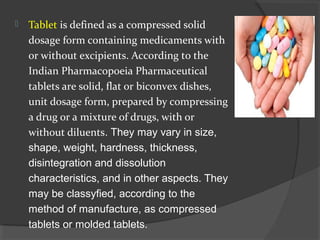
 Tablet is defined as a compressed solid
dosage form containing medicaments with
or without excipients. According to the
Indian Pharmacopoeia Pharmaceutical
tablets are solid, flat or biconvex dishes,
unit dosage form, prepared by compressing
a drug or a mixture of drugs, with or
without diluents. They may vary in size,
shape, weight, hardness, thickness,
disintegration and dissolution
characteristics, and in other aspects. They
may be classyfied, according to the
method of manufacture, as compressed
tablets or molded tablets.
Advantages of Tablet Dosage Form
 Production aspect
 Large scale production atLarge scale production at
lowest costlowest cost
 Easiest and cheapest toEasiest and cheapest to
package and shippackage and ship
 High stabilityHigh stability
 User aspect (doctor,
pharmacist, patient)
 Easy to handlingEasy to handling
 Lightest and most compactLightest and most compact
 Greatest dose precision &Greatest dose precision &
least content variabilityleast content variability
Disadvantages of Tablet
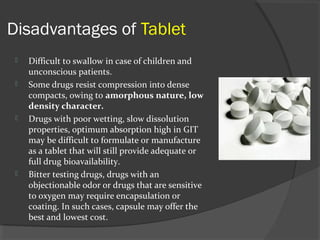
 Difficult to swallow in case of children and
unconscious patients.
 Some drugs resist compression into dense
compacts, owing to amorphous nature, low
density character.
 Drugs with poor wetting, slow dissolution
properties, optimum absorption high in GIT
may be difficult to formulate or manufacture
as a tablet that will still provide adequate or
full drug bioavailability.
 Bitter testing drugs, drugs with an
objectionable odor or drugs that are sensitive
to oxygen may require encapsulation or
coating. In such cases, capsule may offer the
best and lowest cost.
Different Types of tablets
(A) Tablets ingested orally:
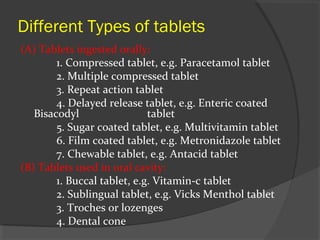
1. Compressed tablet, e.g. Paracetamol tablet
2. Multiple compressed tablet
3. Repeat action tablet
4. Delayed release tablet, e.g. Enteric coated
Bisacodyl tablet
5. Sugar coated tablet, e.g. Multivitamin tablet
6. Film coated tablet, e.g. Metronidazole tablet
7. Chewable tablet, e.g. Antacid tablet
(B) Tablets used in oral cavity:
1. Buccal tablet, e.g. Vitamin-c tablet
2. Sublingual tablet, e.g. Vicks Menthol tablet
3. Troches or lozenges
4. Dental cone
(c) Tablets administered by other route:
1. Implantation tablet
2. Vaginal tablet, e.g. Clotrimazole tablet
(D) Tablets used to prepare solution:
1. Effervescent tablet, e.g. Dispirin tablet (Aspirin)
2. Dispensing tablet, e.g. Enzyme tablet (Digiplex)
3. Hypodermic tablet
4. Tablet triturates e.g. Enzyme tablet (Digiplex)
Tablet Ingredients
In addition to active ingredients, tablet
contains a number of inert materials known
as additives or excipients. Different
excipients are:
 Diluent
 Binder and adhesive
 Disintegrents
 Lubricants and glidants
 Colouring agents
 Flavoring agents
 Sweetening agents
EXCIPIENTS FOR COMPRESSED TABLETS
Compressed tablets usually contain a number of
pharmaceutical adjuncts, known as excipients, in addition
to the medicinal substance. The use of appropriate
excipients is important in the development of the optimum
tablets. Excipients determine the bulk of the final product
in dosage forms such as tablet, capsule, etc., the speed
of disintegration, rate of dissolution,release of drug,
protection against moisture, stability during storage, and
compatibility . Excipients should have no bioactivity, no
reaction with the drug substance, no effect on the
functions of other excipients, and no support of
microbiological growth in the product .
EXCIEPIENTS- functions
 Improve solubility
 Increase stability
 Impart weight, accuracy, & volume(its
allow accuracy of dose)
 Modifying drug release
 Assist product identification
 Increase patient acceptability
 Facilitate dosage form design
 Enhance bioavailability
A. DILUENTS
Diluents increase the volume to a formulation to
prepare tablets of the desired size. Widely used
fillers are lactose, dextrin, microcrystalline cellu-
lose starch, pregelatinized starch, powdered
sucrose, and calcium phosphate.
Properties of Diluents
1. They must be non toxic.
2. They must be commercially available in
acceptable grade
3. There cost must be low
4. They must be physiologically inert
5. They must be physically & chemically stable
by themselves & in combination with the
drugs.
6. They must be free from all microbial
contamination.
7. They do not alter the bioavailability of
drug.
8. They must be color compatible.
B.BINDERS
 Binders promote the adhesion of particles of the
formulation. Such adhesion enables preparation of
granules and maintains the integrity of the final tablet.
As listed in the Table, Commonly used binding agents
include: starch, gelatin and sugars (sucrose, glucose,
dextrose, and lactose).
Examples of Binders
Carboxymethylcellulose, sodium Karaya gum
Cellulose,microcrystalline(Avicel®) Starch, pregelatinized
Ethylcellulose Tragacanth gum
Hydroxypropyl methylcellulose Poly(acrylic acid)
Methylcellulose Polypvinylpyrrolidone
Acacia gum Gelatin
Agar Dextrin
Algin acid Glucose
Guar gum Molasses
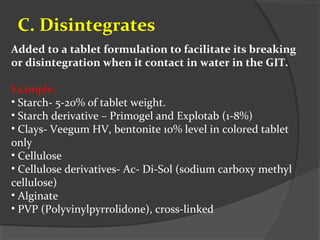
C. Disintegrates
Added to a tablet formulation to facilitate its breaking
or disintegration when it contact in water in the GIT.
Example:
• Starch- 5-20% of tablet weight.
• Starch derivative – Primogel and Explotab (1-8%)
• Clays- Veegum HV, bentonite 10% level in colored tablet
only
• Cellulose
• Cellulose derivatives- Ac- Di-Sol (sodium carboxy methyl
cellulose)
• Alginate
• PVP (Polyvinylpyrrolidone), cross-linked
D. LUBRICANTS
 Lubricant is a substance capable of reducing or
preventing friction, heat, and wear when introduced as a
film between solid surfaces. It works by coating on the
surface of particles, and thus preventing adhesion of the
tablet material to the dies and punches.
Glycerylmonostearate(USP/NFCH2(OH)CH(OH)CH2O2
CC17H35) is one example of a lubricant. Lubricants play
more than one role in the preparation of tablets as
described below.
 1. Lubricants improve the flow of granules in the hopper
to the die cavity.
 2. Lubricants prevent sticking of tablet formulation to the
punches and dies during formulation.
 3. Lubricants reduce the friction between the tablet and
the die wall during the tablet’s ejection from the tablet
machine.
 4. Lubricants give a sheen to the finished tablets.
 Commonly used lubricants include: talc,
magnesium stearat, calcium stearate
,stearic acid, hydrogenated vegetable oils
and (PEG).
E. WETTING AGENTS
 Water molecules attract each other equally in all directions. Water
molecules on the surface, however, can only be pulled into the bulk
water by water molecules underneath, since there are no water
molecules to pull in the opposite direction. The surface tension of water
is strong enough to support the weight of tiny insects such as water
striders. The surface ten-sion in action can be visualized by placing a
small drop of alcohol on a thin layer of water. Alcohol with lower
surface tension mixes with water causing reduction in the surface
tension in the local region. Owing to the higher surface tension of water
in the neighbor, water is pulled from the alcohol dropped region into the
neighbor, and this leads to the formation of a dry spot in the middle of
the water layer.
Compressed tablet manufacture
•The classification of manufacturing methods
wet granulation: suitable for drugs that are stable to
moisture and heat
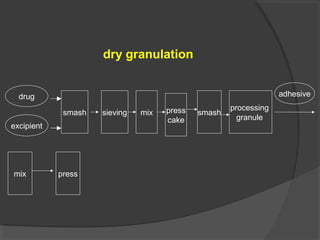
dry granulation: suitable for drugs that are sensitive to
moisture and heat
powder compression : suitable for drugs that are sensitive
to moisture and heat, fill material possessing, good
flowability and compressibility
granulation
direct
compression
crystal compression : suitable for drugs with
proper crystal form and good flowability
Tableting methods
drug
excipients
smash sieving mix
adhesive
prilling
dry
processing
granule
lubricant
mix press
wet granulation
dry granulation
drug
excipient
smash sieving mix press
cake
smash
processing
granule
adhesive
mix press
drugs
excipients
smash sieving mix
adhesive
mix press
powder compression
crystal compression
drugs
excipients
smash sieving
mix mix press
adhesive
The steps of wet granulation
(liquid
binder)
Internal
External
The classification of tablet presses
 Tablet presses:
a. single-punch presses
b. multi-station rotary presses
The main components of single-punch
tablet presses
Core components:
• die
• lower punch
• upper punch
The basic mechanical process of tableting with
single-punch presses
a) filling material
b) scraping away the excessive
granulation
c) forming a tablet by compression
d) pushing up the tablet to stage
surface
e) shoving the tablet aside
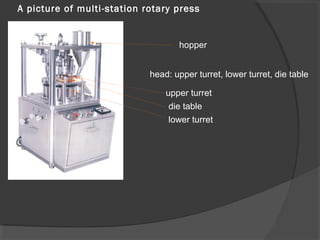
A picture of multi-station rotary press
hopper
head: upper turret, lower turret, die table
upper turret
die table
lower turret
The core components and compression
cycle of rotary presses
A: upper punch
B: die cavity
C: die
D: lower punch
The compression
is applied by both
the upper punch
and the lower
punch.
The compression cycle of a rotary tablet press
Direct compression tableting
Suitable for
1) granular chemicals possessing free flowing and
cohesive properties
e.g. potassium chloride
2) chemicals added with special pharmaceutical
excipients which impart the necessary qualities for
the production of tablets by direct compression
The direct compression tableting excipients include:
a) fillers, as spray-dried lactose, microcrystals of
alphamonohydrate lactose, sucroseinvert ,sugar – corn
starch mixtures, microcrystalline cellulose, crystalline malt
and dicalcium phosphate;
d) disintegrants, as direct-compression starch, sodium
carboxymethyl starch, cross-linked carboxymethylcellulose
fiber, and cross-linked polyvinylpyrrolidone;
c) lubricants, as magnesium stearate and talc;
d) glidants, fumed silicon dioxide
Processing problems
 Capping is the partial or complete separation of the
top or bottom crowns of a tablet from the main body
of the tablet.
 Lamination is separation of a tablet into two or
more distinct layers. Both of these problems usually
result from air entrapment during processing.
 Picking is removal of a tablet’s surface material by a
punch.
 Sticking is adhesion of tablet material to a die wall.
These two problems result from excessive moisture
or substances with low melting temperatures in the
formulation
 Mottling is an unequal color distribution
on a tablet, with light or dark areas standing
on otherwise uniform surface. This results
from use of a drug with a color different
from that of the tablet excipients or from a
drug with colored degradation products.
 Weight variation-granule size distribution,
poor fiow,punch variation
 Hardness variation
 Double impression-monograms or
engraving on punch
Tablet coating
The reasons for tablet coating
1) to protect the medicinal agent against destructive
exposure to air and/or humidity;
2) to mask the taste of the drug;
3) to provide special characteristics of drug release;
4) to provide aesthetics or distinction to the product;
5) to prevent inadvertent contact by nonpatients with
the drug substance
The general methods involved in coating
tablets are as follows
1) sugarcoating tablets
2) film-coating tablets
3) enteric coating
4) pan coating
5) fluid-bed or air suspension coating
6) compression coating
The sugarcoating of tablets may be divided into the
following steps:
1) waterproofing and sealing (if needed)
2) subcoating
3) smoothing and final rounding
4) finishing and coloring (if desired)
5) polishing
film-coating machine
1) waterproofing and sealing (if needed)
aim: to prevent the components from being adversely affected
by moisture; one or more coats; shellac , zein , or a polymer
as cellulose acetate phthalate
2) Subcoating
aim: to bond the sugar coating to the tablet and provide rounding
a) 3 to 5 subcoats of a sugar-based syrup are applied. The
sucrose and water syrup also contains gelatin, acacia, or
PVP.
b) When the tablets are partially dry they are sprinkled with
a dusting powder, usually a mixture of powdered sugar
and starch but sometimes talc, acacia, or precipitated
chalk as well.
c) Then drying the tablets. Repetition (15 to 18 times) the
subcoating process until the tablets are of the desired
shape and size.
3) smoothing and final rounding
aim: to complete the rounding and smooth the coatings
5 to 10 additional coatings of a thick syrup; This syrup is
sucrose-based with or without additional components as
starch and calcium carbonate.
4) finishing and coloring
aim: to attain final smoothness and the appropriate color
several coats of a thin syrup containing the desired colorant
5) imprinting
aim: to impart identification codes and other distinctive symbols to the
product
The imprint may be debossed, embossed, engraved, or printed on the
surface with ink.
6) polishing
aim: to render the tablets the desired sheen/gloss/luster
a) pans lined with canvas cloth impregnated with carnauba waxand/or
beeswax
b) Pieces of wax may be placed in a polishing pan
c) light-spraying of the tablets with wax dissolved in a nonaqueous
solvent
Film-coating
1) The disadvantages of sugarcoating process
a) time-consuming
b) requiring the expertise of highly skilled technicians
c) doubling the size and weight of the original uncoated tablets
d) may vary in size from batch to batch and within a batch
e) large tablets are not as easily swallowed as are small
tablets.
2) The advantages of film-coating process
a) coated tablets having essentially the same weight, shape, and size
as the originally compressed tablet
b) The coating is thin enough to reveal any identifying monograms.
c) far more resistant to destruction by abrasion than are sugar-coated
tablets
d) the coating may be colored to make the tablets attractive and
distinctive.
3) The components of nonaqueous film-coating solutions:
a) film former: e.g. CAP
b) alloying substance: to provide water solubility or permeability to
the film e.g. PEG
c) plasticizer: to render flexibility and elasticity to the coating e.g.
castor oil
d) surfactant: to enhance spreadability of the film e.g.
polyoxyethylene sorbitan derivatives
e) opaquants and colorants: e.g. titanium dioxide, FD&C or D&C
dyes
f) sweeteners, flavors, and aromas: saccharin, vanillin
g) glossant: beeswax
h) volatile solvent: alcohol-acetone mixture
4) The components of a typical aqueous film-coating
solutions:
a) film-forming polymer (7-18%): e.g. cellulose ether
polymers as HPMC, HPC and MC
b) plasticizer (0.5-2.0%): e.g. glycerin, propylene glycol,
PEG, diethyl phthalate, and dibutyl subacetate
c) colorant and opacifier (2.5-8%): FD&C or D&C lakes
and iron oxide pigments
d) water
5) Some problems with aqueous film-coating
a) picking and peeling the appearance of small amounts or large
amounts of film fragments flaking from the tablet surface
b) orange peel effect roughness of the tablet surface due to failure of
spray droplets to coalesce
c) mottling an uneven distribution of color on the tablet surface
d) bridging
filling-in of the score-line or indented logo on the tablet by the film
e) tablet erosion
disfiguration of the core tablet
5) Some problems with aqueous film-coating
a) picking and peeling the appearance of small amounts or large
amounts of film fragments flaking from the tablet surface
b) orange peel effect roughness of the tablet surface due to failure of
spray droplets to coalesce
c) mottling an uneven distribution of color on the tablet surface
d) bridging
filling-in of the score-line or indented logo on the tablet by the film
e) tablet erosion
disfiguration of the core tablet
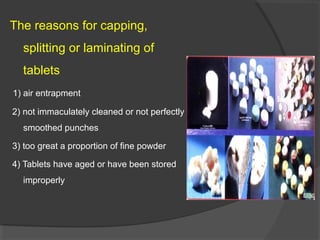
The reasons for capping,
splitting or laminating of
tablets
1) air entrapment
2) not immaculately cleaned or not perfectly
smoothed punches
3) too great a proportion of fine powder
4) Tablets have aged or have been stored
improperly
quality standards and compendial
requirements
The apparent physical features of compressed tablets:
1) shape: round, oblong, unique 2) thickness: thick or thin
3) diameter: large or small 4) flat or convex
5) unscored or scored in halves, thirds and quadrants
6) engraved or imprinted with an identifying symbol and/or code
number
7) coated or uncoated 8)colored or uncolored 9) number of layer.
The die and punches determine the physical features of
compressed tablets.
quality standards and compendial
requirements
 Other physical specifications and quality
standards:
tablet weight weight variation
content uniformity tablet thickness
tablet hardness tablet disintegration
drug dissolution
 in-process controls
 verification after the production
quality standards and compendial requirements
—— tablet weight and Chp weight variation
 Chp weight variation:
sample amount 20
tablets
 Tablets should comply
with the following
requirements stated in
the table below.
Average
weight
Weight
variation
limit
Less than
0.3 g
± 7.5%
0.3 g or
more
± 5%
quality standards and compendial requirements
—— tablet weight and Chp weight variation
The procedure of weight variation determination in Chp:
Weigh accurately 20 tablets and calculate the average
weight, then weigh individually each of the 20 tablets.
Compare the weight of each tablet with the labelled
tablet (if no labelled weight is stated, compare the
weight of each tablet with the average weight
calculated). No more than 2 of the individual weights
exceed the weight variation limit stated in the table
above and none doubles the limit.
quality standards and compendial requirements
—— tablet hardness and friability
Tablet hardness
1)The greater the pressure applied, the harder the
tablets.
2) The hardness required by different tablets
a) lozenges and buccal tablets: hard (dissolve slowly)
b) the tablets for immediate drug release: soft
3) measurement
a) special dedicated hardness testers
b) multifunctional equipment
quality standards and compendial requirements
—— content uniformity
 applys to potent drug of low dose.
 USP method, 10 tablets are individually assayed
for their content.
The amount of active ingredient in each tablet lies
within the range of 85% to 115% of the label claim
and the RSD is less than 6.0%.
quality standards and compendial requirements
—— tablet hardness and friability
Friability
1) It is used to determine a tablet’s durability
2) Method: allowing the tablets to roll and fall within
the rotating apparatus (friabilator); determine the
loss in weight;
3) requirement: weight loss ≤1%
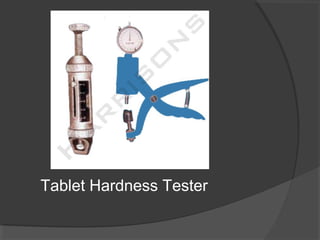
Tablet Hardness Tester
Friability Tester
Dissolution Tester
Disintigration Tester
quality standards and compendial requirements
—— tablet dissolution
1) The importance of in vitro dissolution test
a) to guide the formulation and product development
process toward product optimization
b) to monitor the performance of manufacturing process
c) to assure bioequivalence from batch to batch
d) as a requirement for regulatory approval for product
marketing for products registered with the FDA and
regulatory agencies of other countries.
2) The goal of in vitro dissolution is to provide a
reasonable prediction of the product’s in vivo
bioavailability.
Basis: The combinations of a drug’s solubility and
its intestinal permeability are supposed as a
basis for predicting the likelihood of achieving a
successful in vivo – in vitro correlation (IVIVC).
Considered are drugs determined to have:
a) high solubility and high permeability (IVIVC
may be expected.)
b) low solubility and high permeability (IVIVC
may be expected.)
c) high solubility and low permeability
d) low solubility and low permeability
3) The formulation and manufacturing factors affecting
the dissolution of a tablet
a) the particle size of the drug substance
b) the solubility and hygroscopicity of the formulation
c) the type and concentration of the disintegrant,
binder, and lubricant used
d) the manufacturing method, particularly, the
compactness of the granulation and the
compression force
e) the in-process variables
4) Test method
a) A volume of the dissolution medium is placed in the
vessel and allowed to come to 37 ±0.5 .℃ ℃
b) The stirrer is rotate at the specified speed.
c) At stated intervals, samples of the medium are
withdrawn for chemical analysis
5) Requirement for rate of dissolution
The specific required rates of dissolution are different for
tablets containing different medicinal agents.
e.g. not less than 85% of the labeled amount is dissolved
in 30 minutes
6) Inconsistencies in dissolution
occur not between dosage units from the same production
batch, but rather between batches or between products
from different manufacturers.
Pooled dissolution testing has emerged. This process
recognizes the concept of batch characteristics and
allows pooled specimens to be tested.
THANK YOU

Tablet Formulation Technology

  • 1.
  • 2.
     Tablet isdefined as a compressed solid dosage form containing medicaments with or without excipients. According to the Indian Pharmacopoeia Pharmaceutical tablets are solid, flat or biconvex dishes, unit dosage form, prepared by compressing a drug or a mixture of drugs, with or without diluents. They may vary in size, shape, weight, hardness, thickness, disintegration and dissolution characteristics, and in other aspects. They may be classyfied, according to the method of manufacture, as compressed tablets or molded tablets.
  • 3.
    Advantages of TabletDosage Form  Production aspect  Large scale production atLarge scale production at lowest costlowest cost  Easiest and cheapest toEasiest and cheapest to package and shippackage and ship  High stabilityHigh stability  User aspect (doctor, pharmacist, patient)  Easy to handlingEasy to handling  Lightest and most compactLightest and most compact  Greatest dose precision &Greatest dose precision & least content variabilityleast content variability
  • 4.
    Disadvantages of Tablet Difficult to swallow in case of children and unconscious patients.  Some drugs resist compression into dense compacts, owing to amorphous nature, low density character.  Drugs with poor wetting, slow dissolution properties, optimum absorption high in GIT may be difficult to formulate or manufacture as a tablet that will still provide adequate or full drug bioavailability.  Bitter testing drugs, drugs with an objectionable odor or drugs that are sensitive to oxygen may require encapsulation or coating. In such cases, capsule may offer the best and lowest cost.
  • 5.
    Different Types oftablets (A) Tablets ingested orally: 1. Compressed tablet, e.g. Paracetamol tablet 2. Multiple compressed tablet 3. Repeat action tablet 4. Delayed release tablet, e.g. Enteric coated Bisacodyl tablet 5. Sugar coated tablet, e.g. Multivitamin tablet 6. Film coated tablet, e.g. Metronidazole tablet 7. Chewable tablet, e.g. Antacid tablet (B) Tablets used in oral cavity: 1. Buccal tablet, e.g. Vitamin-c tablet 2. Sublingual tablet, e.g. Vicks Menthol tablet 3. Troches or lozenges 4. Dental cone
  • 6.
    (c) Tablets administeredby other route: 1. Implantation tablet 2. Vaginal tablet, e.g. Clotrimazole tablet (D) Tablets used to prepare solution: 1. Effervescent tablet, e.g. Dispirin tablet (Aspirin) 2. Dispensing tablet, e.g. Enzyme tablet (Digiplex) 3. Hypodermic tablet 4. Tablet triturates e.g. Enzyme tablet (Digiplex)
  • 7.
    Tablet Ingredients In additionto active ingredients, tablet contains a number of inert materials known as additives or excipients. Different excipients are:  Diluent  Binder and adhesive  Disintegrents  Lubricants and glidants  Colouring agents  Flavoring agents  Sweetening agents
  • 8.
    EXCIPIENTS FOR COMPRESSEDTABLETS Compressed tablets usually contain a number of pharmaceutical adjuncts, known as excipients, in addition to the medicinal substance. The use of appropriate excipients is important in the development of the optimum tablets. Excipients determine the bulk of the final product in dosage forms such as tablet, capsule, etc., the speed of disintegration, rate of dissolution,release of drug, protection against moisture, stability during storage, and compatibility . Excipients should have no bioactivity, no reaction with the drug substance, no effect on the functions of other excipients, and no support of microbiological growth in the product .
  • 9.
    EXCIEPIENTS- functions  Improvesolubility  Increase stability  Impart weight, accuracy, & volume(its allow accuracy of dose)  Modifying drug release  Assist product identification  Increase patient acceptability  Facilitate dosage form design  Enhance bioavailability
  • 10.
    A. DILUENTS Diluents increasethe volume to a formulation to prepare tablets of the desired size. Widely used fillers are lactose, dextrin, microcrystalline cellu- lose starch, pregelatinized starch, powdered sucrose, and calcium phosphate.
  • 11.
    Properties of Diluents 1.They must be non toxic. 2. They must be commercially available in acceptable grade 3. There cost must be low 4. They must be physiologically inert 5. They must be physically & chemically stable by themselves & in combination with the drugs. 6. They must be free from all microbial contamination. 7. They do not alter the bioavailability of drug. 8. They must be color compatible.
  • 12.
    B.BINDERS  Binders promotethe adhesion of particles of the formulation. Such adhesion enables preparation of granules and maintains the integrity of the final tablet. As listed in the Table, Commonly used binding agents include: starch, gelatin and sugars (sucrose, glucose, dextrose, and lactose).
  • 13.
    Examples of Binders Carboxymethylcellulose,sodium Karaya gum Cellulose,microcrystalline(Avicel®) Starch, pregelatinized Ethylcellulose Tragacanth gum Hydroxypropyl methylcellulose Poly(acrylic acid) Methylcellulose Polypvinylpyrrolidone Acacia gum Gelatin Agar Dextrin Algin acid Glucose Guar gum Molasses
  • 14.
    C. Disintegrates Added toa tablet formulation to facilitate its breaking or disintegration when it contact in water in the GIT. Example: • Starch- 5-20% of tablet weight. • Starch derivative – Primogel and Explotab (1-8%) • Clays- Veegum HV, bentonite 10% level in colored tablet only • Cellulose • Cellulose derivatives- Ac- Di-Sol (sodium carboxy methyl cellulose) • Alginate • PVP (Polyvinylpyrrolidone), cross-linked
  • 16.
    D. LUBRICANTS  Lubricantis a substance capable of reducing or preventing friction, heat, and wear when introduced as a film between solid surfaces. It works by coating on the surface of particles, and thus preventing adhesion of the tablet material to the dies and punches. Glycerylmonostearate(USP/NFCH2(OH)CH(OH)CH2O2 CC17H35) is one example of a lubricant. Lubricants play more than one role in the preparation of tablets as described below.
  • 17.
     1. Lubricantsimprove the flow of granules in the hopper to the die cavity.  2. Lubricants prevent sticking of tablet formulation to the punches and dies during formulation.  3. Lubricants reduce the friction between the tablet and the die wall during the tablet’s ejection from the tablet machine.  4. Lubricants give a sheen to the finished tablets.
  • 18.
     Commonly usedlubricants include: talc, magnesium stearat, calcium stearate ,stearic acid, hydrogenated vegetable oils and (PEG).
  • 19.
    E. WETTING AGENTS Water molecules attract each other equally in all directions. Water molecules on the surface, however, can only be pulled into the bulk water by water molecules underneath, since there are no water molecules to pull in the opposite direction. The surface tension of water is strong enough to support the weight of tiny insects such as water striders. The surface ten-sion in action can be visualized by placing a small drop of alcohol on a thin layer of water. Alcohol with lower surface tension mixes with water causing reduction in the surface tension in the local region. Owing to the higher surface tension of water in the neighbor, water is pulled from the alcohol dropped region into the neighbor, and this leads to the formation of a dry spot in the middle of the water layer.
  • 20.
    Compressed tablet manufacture •Theclassification of manufacturing methods wet granulation: suitable for drugs that are stable to moisture and heat dry granulation: suitable for drugs that are sensitive to moisture and heat powder compression : suitable for drugs that are sensitive to moisture and heat, fill material possessing, good flowability and compressibility granulation direct compression crystal compression : suitable for drugs with proper crystal form and good flowability
  • 21.
  • 22.
  • 23.
    dry granulation drug excipient smash sievingmix press cake smash processing granule adhesive mix press
  • 24.
  • 25.
  • 26.
    The steps ofwet granulation (liquid binder) Internal External
  • 27.
    The classification oftablet presses  Tablet presses: a. single-punch presses b. multi-station rotary presses
  • 28.
    The main componentsof single-punch tablet presses Core components: • die • lower punch • upper punch
  • 29.
    The basic mechanicalprocess of tableting with single-punch presses a) filling material b) scraping away the excessive granulation c) forming a tablet by compression d) pushing up the tablet to stage surface e) shoving the tablet aside
  • 30.
    A picture ofmulti-station rotary press hopper head: upper turret, lower turret, die table upper turret die table lower turret
  • 31.
    The core componentsand compression cycle of rotary presses A: upper punch B: die cavity C: die D: lower punch The compression is applied by both the upper punch and the lower punch. The compression cycle of a rotary tablet press
  • 32.
    Direct compression tableting Suitablefor 1) granular chemicals possessing free flowing and cohesive properties e.g. potassium chloride 2) chemicals added with special pharmaceutical excipients which impart the necessary qualities for the production of tablets by direct compression
  • 33.
    The direct compressiontableting excipients include: a) fillers, as spray-dried lactose, microcrystals of alphamonohydrate lactose, sucroseinvert ,sugar – corn starch mixtures, microcrystalline cellulose, crystalline malt and dicalcium phosphate; d) disintegrants, as direct-compression starch, sodium carboxymethyl starch, cross-linked carboxymethylcellulose fiber, and cross-linked polyvinylpyrrolidone; c) lubricants, as magnesium stearate and talc; d) glidants, fumed silicon dioxide
  • 34.
    Processing problems  Cappingis the partial or complete separation of the top or bottom crowns of a tablet from the main body of the tablet.  Lamination is separation of a tablet into two or more distinct layers. Both of these problems usually result from air entrapment during processing.  Picking is removal of a tablet’s surface material by a punch.  Sticking is adhesion of tablet material to a die wall. These two problems result from excessive moisture or substances with low melting temperatures in the formulation
  • 35.
     Mottling isan unequal color distribution on a tablet, with light or dark areas standing on otherwise uniform surface. This results from use of a drug with a color different from that of the tablet excipients or from a drug with colored degradation products.  Weight variation-granule size distribution, poor fiow,punch variation  Hardness variation  Double impression-monograms or engraving on punch
  • 36.
    Tablet coating The reasonsfor tablet coating 1) to protect the medicinal agent against destructive exposure to air and/or humidity; 2) to mask the taste of the drug; 3) to provide special characteristics of drug release; 4) to provide aesthetics or distinction to the product; 5) to prevent inadvertent contact by nonpatients with the drug substance
  • 37.
    The general methodsinvolved in coating tablets are as follows 1) sugarcoating tablets 2) film-coating tablets 3) enteric coating 4) pan coating 5) fluid-bed or air suspension coating 6) compression coating
  • 38.
    The sugarcoating oftablets may be divided into the following steps: 1) waterproofing and sealing (if needed) 2) subcoating 3) smoothing and final rounding 4) finishing and coloring (if desired) 5) polishing
  • 39.
  • 41.
    1) waterproofing andsealing (if needed) aim: to prevent the components from being adversely affected by moisture; one or more coats; shellac , zein , or a polymer as cellulose acetate phthalate 2) Subcoating aim: to bond the sugar coating to the tablet and provide rounding a) 3 to 5 subcoats of a sugar-based syrup are applied. The sucrose and water syrup also contains gelatin, acacia, or PVP.
  • 42.
    b) When thetablets are partially dry they are sprinkled with a dusting powder, usually a mixture of powdered sugar and starch but sometimes talc, acacia, or precipitated chalk as well. c) Then drying the tablets. Repetition (15 to 18 times) the subcoating process until the tablets are of the desired shape and size.
  • 43.
    3) smoothing andfinal rounding aim: to complete the rounding and smooth the coatings 5 to 10 additional coatings of a thick syrup; This syrup is sucrose-based with or without additional components as starch and calcium carbonate. 4) finishing and coloring aim: to attain final smoothness and the appropriate color several coats of a thin syrup containing the desired colorant
  • 44.
    5) imprinting aim: toimpart identification codes and other distinctive symbols to the product The imprint may be debossed, embossed, engraved, or printed on the surface with ink. 6) polishing aim: to render the tablets the desired sheen/gloss/luster a) pans lined with canvas cloth impregnated with carnauba waxand/or beeswax b) Pieces of wax may be placed in a polishing pan c) light-spraying of the tablets with wax dissolved in a nonaqueous solvent
  • 45.
    Film-coating 1) The disadvantagesof sugarcoating process a) time-consuming b) requiring the expertise of highly skilled technicians c) doubling the size and weight of the original uncoated tablets d) may vary in size from batch to batch and within a batch e) large tablets are not as easily swallowed as are small tablets.
  • 46.
    2) The advantagesof film-coating process a) coated tablets having essentially the same weight, shape, and size as the originally compressed tablet b) The coating is thin enough to reveal any identifying monograms. c) far more resistant to destruction by abrasion than are sugar-coated tablets d) the coating may be colored to make the tablets attractive and distinctive.
  • 47.
    3) The componentsof nonaqueous film-coating solutions: a) film former: e.g. CAP b) alloying substance: to provide water solubility or permeability to the film e.g. PEG c) plasticizer: to render flexibility and elasticity to the coating e.g. castor oil d) surfactant: to enhance spreadability of the film e.g. polyoxyethylene sorbitan derivatives e) opaquants and colorants: e.g. titanium dioxide, FD&C or D&C dyes f) sweeteners, flavors, and aromas: saccharin, vanillin g) glossant: beeswax h) volatile solvent: alcohol-acetone mixture
  • 48.
    4) The componentsof a typical aqueous film-coating solutions: a) film-forming polymer (7-18%): e.g. cellulose ether polymers as HPMC, HPC and MC b) plasticizer (0.5-2.0%): e.g. glycerin, propylene glycol, PEG, diethyl phthalate, and dibutyl subacetate c) colorant and opacifier (2.5-8%): FD&C or D&C lakes and iron oxide pigments d) water
  • 49.
    5) Some problemswith aqueous film-coating a) picking and peeling the appearance of small amounts or large amounts of film fragments flaking from the tablet surface b) orange peel effect roughness of the tablet surface due to failure of spray droplets to coalesce c) mottling an uneven distribution of color on the tablet surface d) bridging filling-in of the score-line or indented logo on the tablet by the film e) tablet erosion disfiguration of the core tablet
  • 50.
    5) Some problemswith aqueous film-coating a) picking and peeling the appearance of small amounts or large amounts of film fragments flaking from the tablet surface b) orange peel effect roughness of the tablet surface due to failure of spray droplets to coalesce c) mottling an uneven distribution of color on the tablet surface d) bridging filling-in of the score-line or indented logo on the tablet by the film e) tablet erosion disfiguration of the core tablet
  • 51.
    The reasons forcapping, splitting or laminating of tablets 1) air entrapment 2) not immaculately cleaned or not perfectly smoothed punches 3) too great a proportion of fine powder 4) Tablets have aged or have been stored improperly
  • 52.
    quality standards andcompendial requirements The apparent physical features of compressed tablets: 1) shape: round, oblong, unique 2) thickness: thick or thin 3) diameter: large or small 4) flat or convex 5) unscored or scored in halves, thirds and quadrants 6) engraved or imprinted with an identifying symbol and/or code number 7) coated or uncoated 8)colored or uncolored 9) number of layer. The die and punches determine the physical features of compressed tablets.
  • 53.
    quality standards andcompendial requirements  Other physical specifications and quality standards: tablet weight weight variation content uniformity tablet thickness tablet hardness tablet disintegration drug dissolution  in-process controls  verification after the production
  • 54.
    quality standards andcompendial requirements —— tablet weight and Chp weight variation  Chp weight variation: sample amount 20 tablets  Tablets should comply with the following requirements stated in the table below. Average weight Weight variation limit Less than 0.3 g ± 7.5% 0.3 g or more ± 5%
  • 55.
    quality standards andcompendial requirements —— tablet weight and Chp weight variation The procedure of weight variation determination in Chp: Weigh accurately 20 tablets and calculate the average weight, then weigh individually each of the 20 tablets. Compare the weight of each tablet with the labelled tablet (if no labelled weight is stated, compare the weight of each tablet with the average weight calculated). No more than 2 of the individual weights exceed the weight variation limit stated in the table above and none doubles the limit.
  • 56.
    quality standards andcompendial requirements —— tablet hardness and friability Tablet hardness 1)The greater the pressure applied, the harder the tablets. 2) The hardness required by different tablets a) lozenges and buccal tablets: hard (dissolve slowly) b) the tablets for immediate drug release: soft 3) measurement a) special dedicated hardness testers b) multifunctional equipment
  • 57.
    quality standards andcompendial requirements —— content uniformity  applys to potent drug of low dose.  USP method, 10 tablets are individually assayed for their content. The amount of active ingredient in each tablet lies within the range of 85% to 115% of the label claim and the RSD is less than 6.0%.
  • 58.
    quality standards andcompendial requirements —— tablet hardness and friability Friability 1) It is used to determine a tablet’s durability 2) Method: allowing the tablets to roll and fall within the rotating apparatus (friabilator); determine the loss in weight; 3) requirement: weight loss ≤1%
  • 59.
  • 60.
  • 61.
  • 62.
  • 63.
    quality standards andcompendial requirements —— tablet dissolution 1) The importance of in vitro dissolution test a) to guide the formulation and product development process toward product optimization b) to monitor the performance of manufacturing process c) to assure bioequivalence from batch to batch d) as a requirement for regulatory approval for product marketing for products registered with the FDA and regulatory agencies of other countries.
  • 64.
    2) The goalof in vitro dissolution is to provide a reasonable prediction of the product’s in vivo bioavailability. Basis: The combinations of a drug’s solubility and its intestinal permeability are supposed as a basis for predicting the likelihood of achieving a successful in vivo – in vitro correlation (IVIVC).
  • 65.
    Considered are drugsdetermined to have: a) high solubility and high permeability (IVIVC may be expected.) b) low solubility and high permeability (IVIVC may be expected.) c) high solubility and low permeability d) low solubility and low permeability
  • 66.
    3) The formulationand manufacturing factors affecting the dissolution of a tablet a) the particle size of the drug substance b) the solubility and hygroscopicity of the formulation c) the type and concentration of the disintegrant, binder, and lubricant used d) the manufacturing method, particularly, the compactness of the granulation and the compression force e) the in-process variables
  • 67.
    4) Test method a)A volume of the dissolution medium is placed in the vessel and allowed to come to 37 ±0.5 .℃ ℃ b) The stirrer is rotate at the specified speed. c) At stated intervals, samples of the medium are withdrawn for chemical analysis 5) Requirement for rate of dissolution The specific required rates of dissolution are different for tablets containing different medicinal agents. e.g. not less than 85% of the labeled amount is dissolved in 30 minutes
  • 68.
    6) Inconsistencies indissolution occur not between dosage units from the same production batch, but rather between batches or between products from different manufacturers. Pooled dissolution testing has emerged. This process recognizes the concept of batch characteristics and allows pooled specimens to be tested.
  • 69.