Recent Advances in Crop
Classification
Raju Vatsavai

(vatsavairr@ornl.gov)

Computational Sciences and
Engineering Division
ORNL, Oak Ridge, TN, USA
Collaborators:

B. Bhaduri, V. Chandola, G. Jun, J.
Ghosh, S. Shekhar, T. Burk
Remote Sensing – Beyond Images
Workshop, Mexico
th December, 2013.
City, Mexico, 14
Managed by UT-Battelle
for the Department of Energy
Outline
Better spectral and spatial resolution
– Fine-grained (species) classification
– Complex (compound) object recognition

Challenges
– Limited ground-truth: Semi-supervised learning (SSL)
– Spatial homogeneity: SSL + Markov Random Fields
– Spatial heterogeneity: Gaussian Process (GP) learning
– Aggregate vs. Subclasses: Fine-grained classification
– Phenology: Multi-view learning

Conclusions
2

Managed by UT-Battelle
for the Department of Energy
Challenge 1: Limited Training Data
Increasing spectral resolution: 4 to 224 Bands
Challenges
– #of training samples ~ (10 to 30) * (number of dimensions)
– Costly ~ $500-$800 per plot (depends on geographic area)
– Accessibility – Private/Privacy issues (e.g., USFS may average 5%
denied access)
– Real-time – Emergency situations, such as, forest fires, floods

Solutions
– Reduce number of dimensions
– (Artificially) Increase number of samples
– By incorporating unlabeled samples
Naïve semi-supervised (Nigam et al. [JML-2000])
– Bagging [Breiman, ML-96]
3

Managed by UT-Battelle
for the Department of Energy
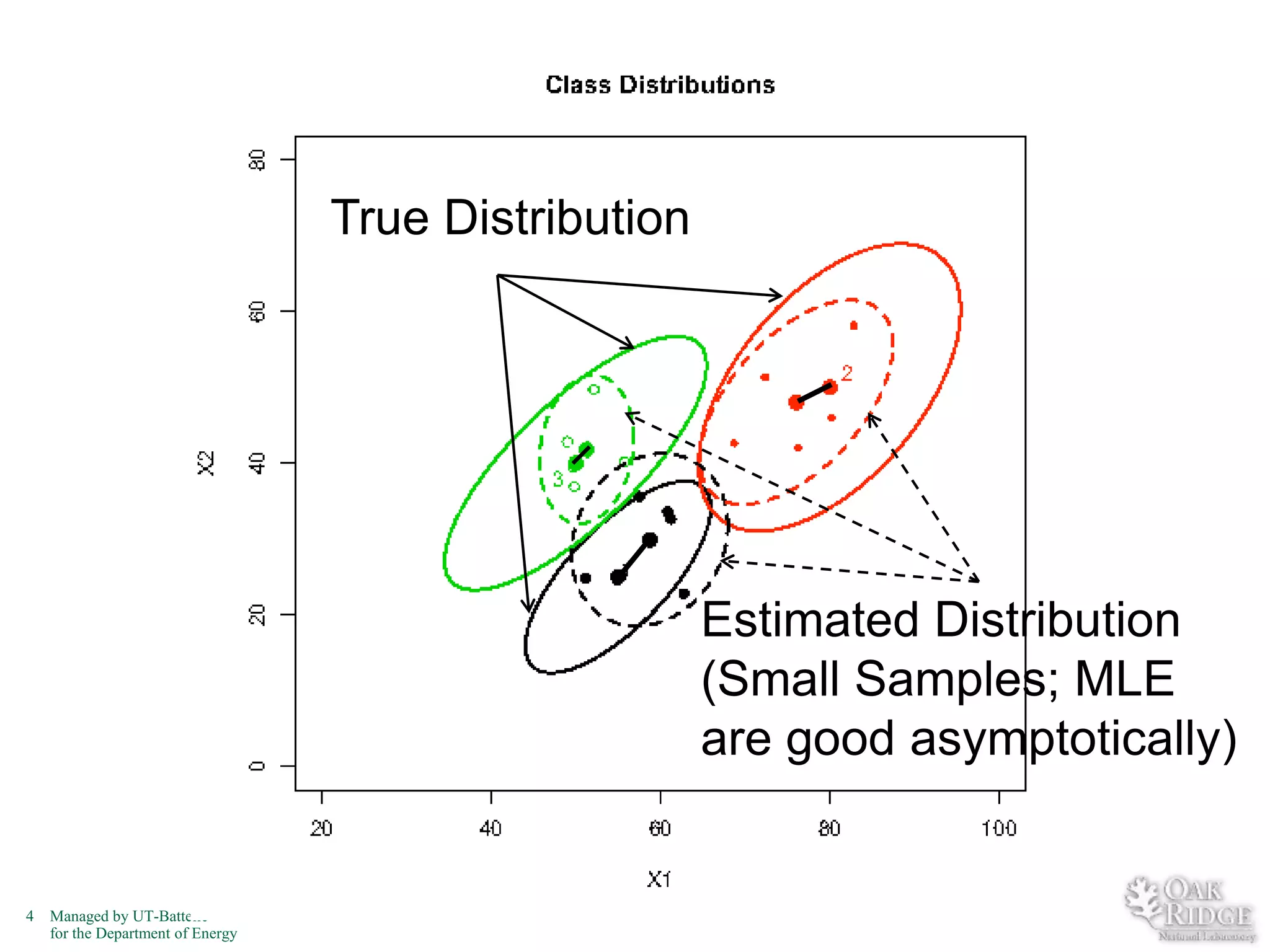
True Distribution

Estimated Distribution
(Small Samples; MLE
are good asymptotically)

4

Managed by UT-Battelle
for the Department of Energy
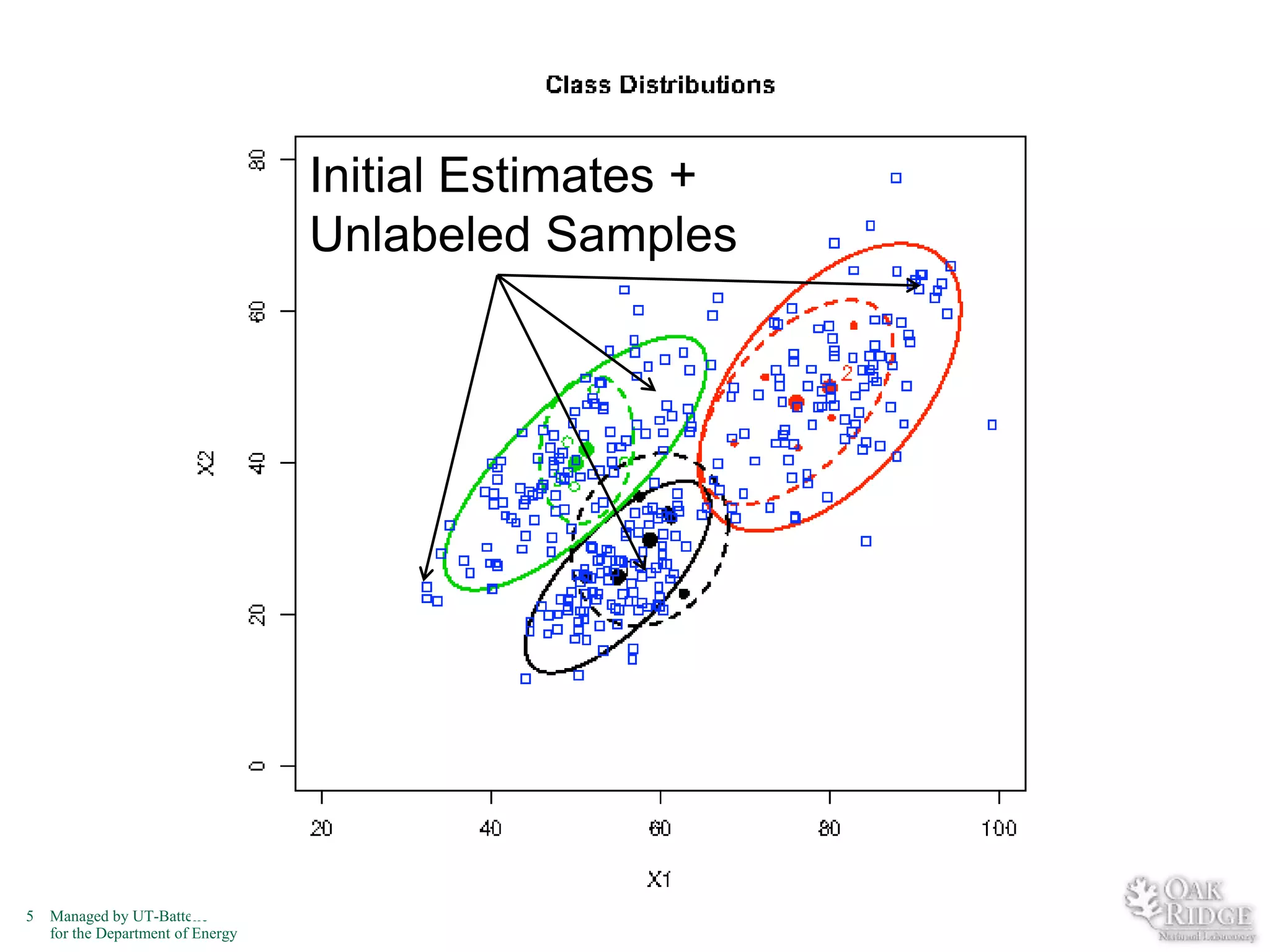
Initial Estimates +
Unlabeled Samples

5

Managed by UT-Battelle
for the Department of Energy
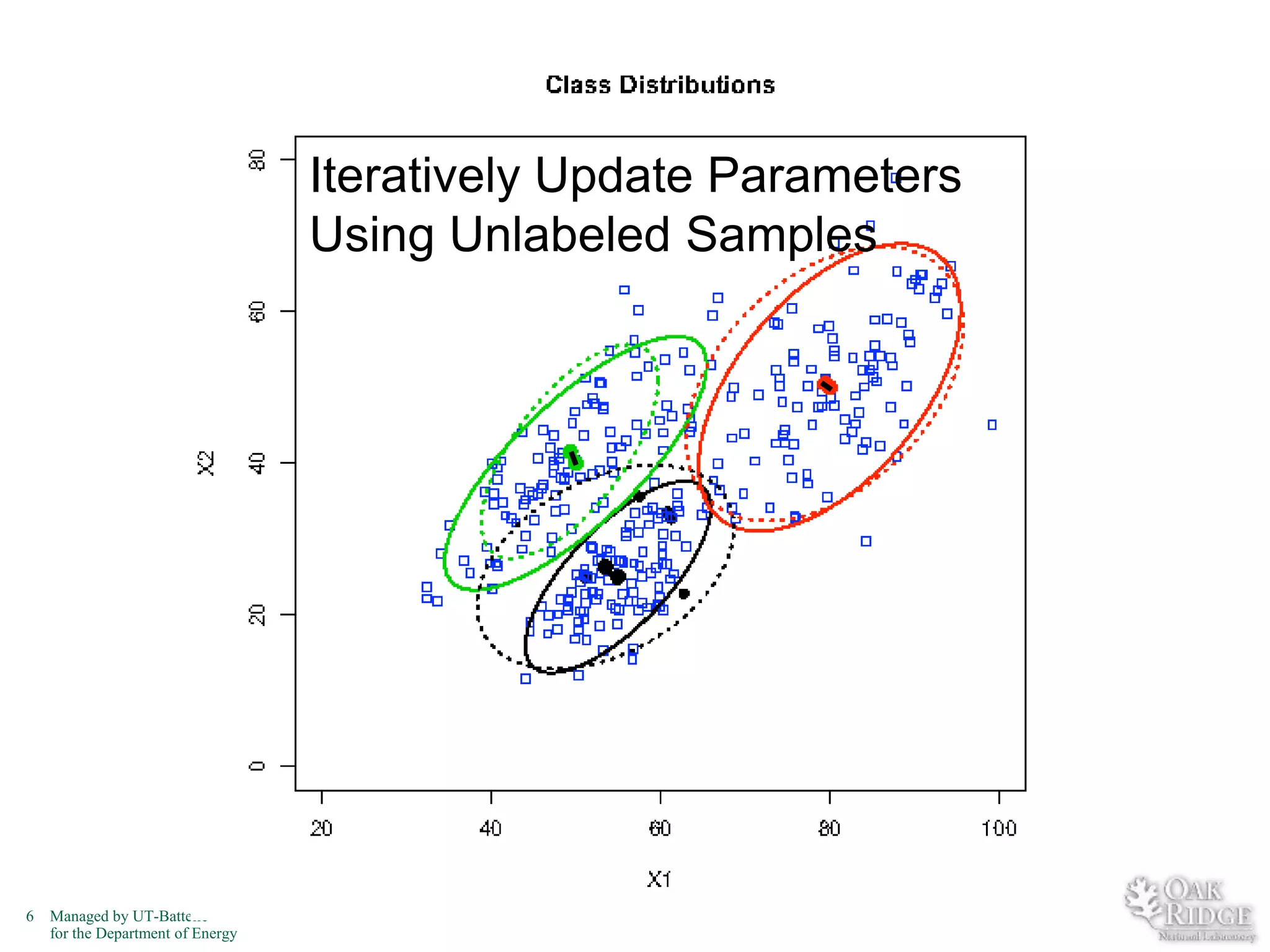
Iteratively Update Parameters
Using Unlabeled Samples

6

Managed by UT-Battelle
for the Department of Energy
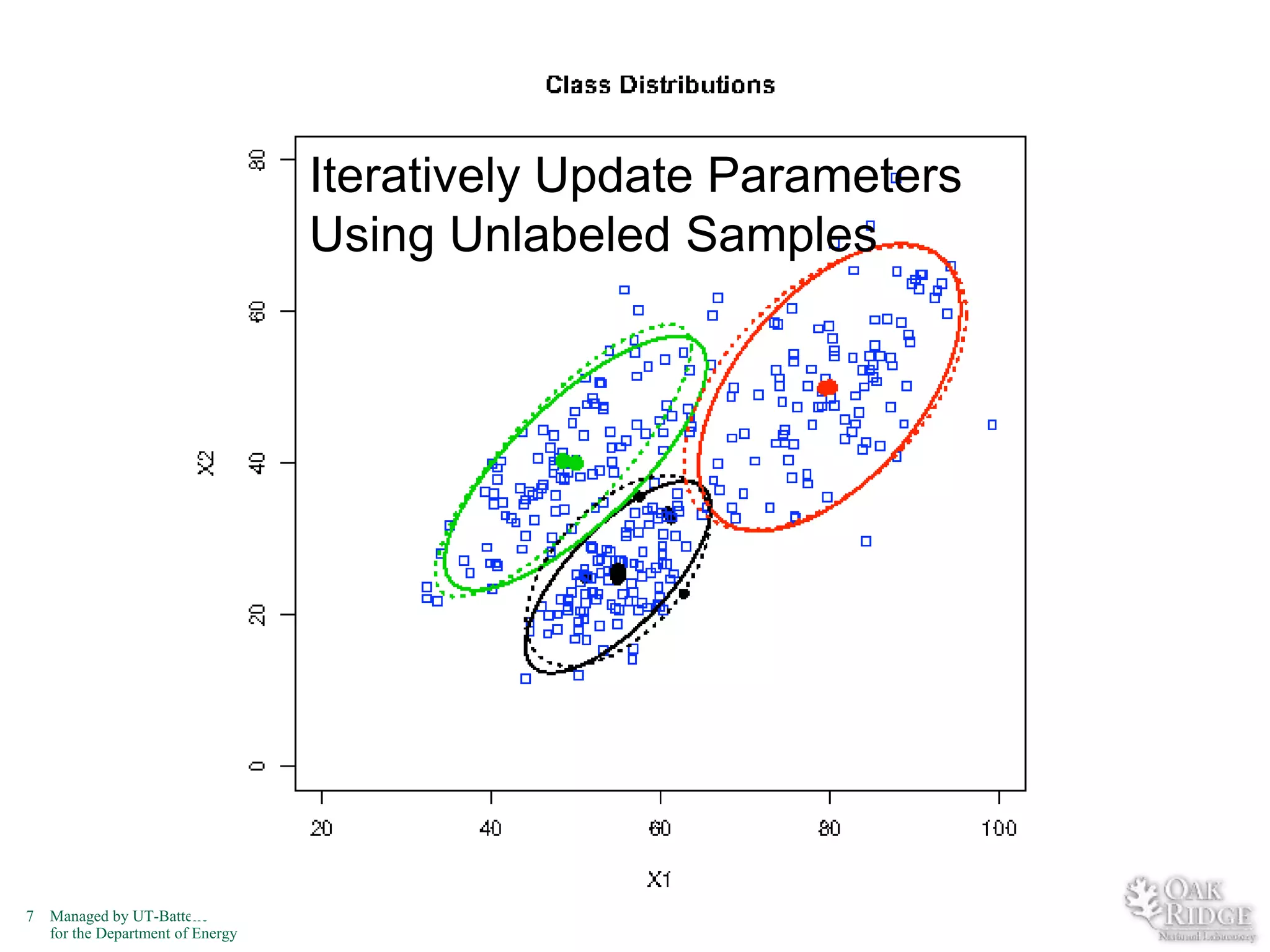
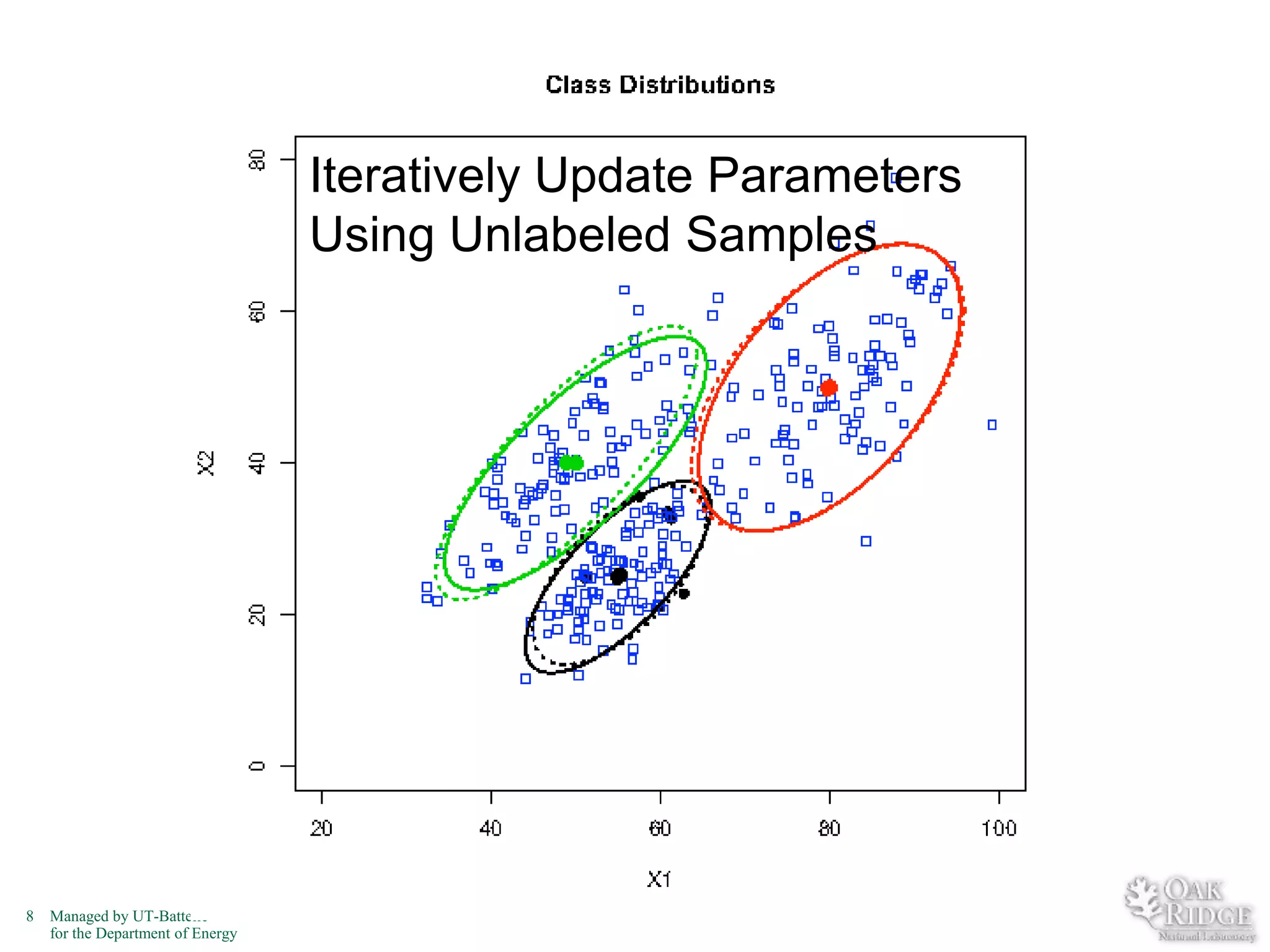
Iteratively Update Parameters
Using Unlabeled Samples

7

Managed by UT-Battelle
for the Department of Energy
Iteratively Update Parameters
Using Unlabeled Samples

8

Managed by UT-Battelle
for the Department of Energy
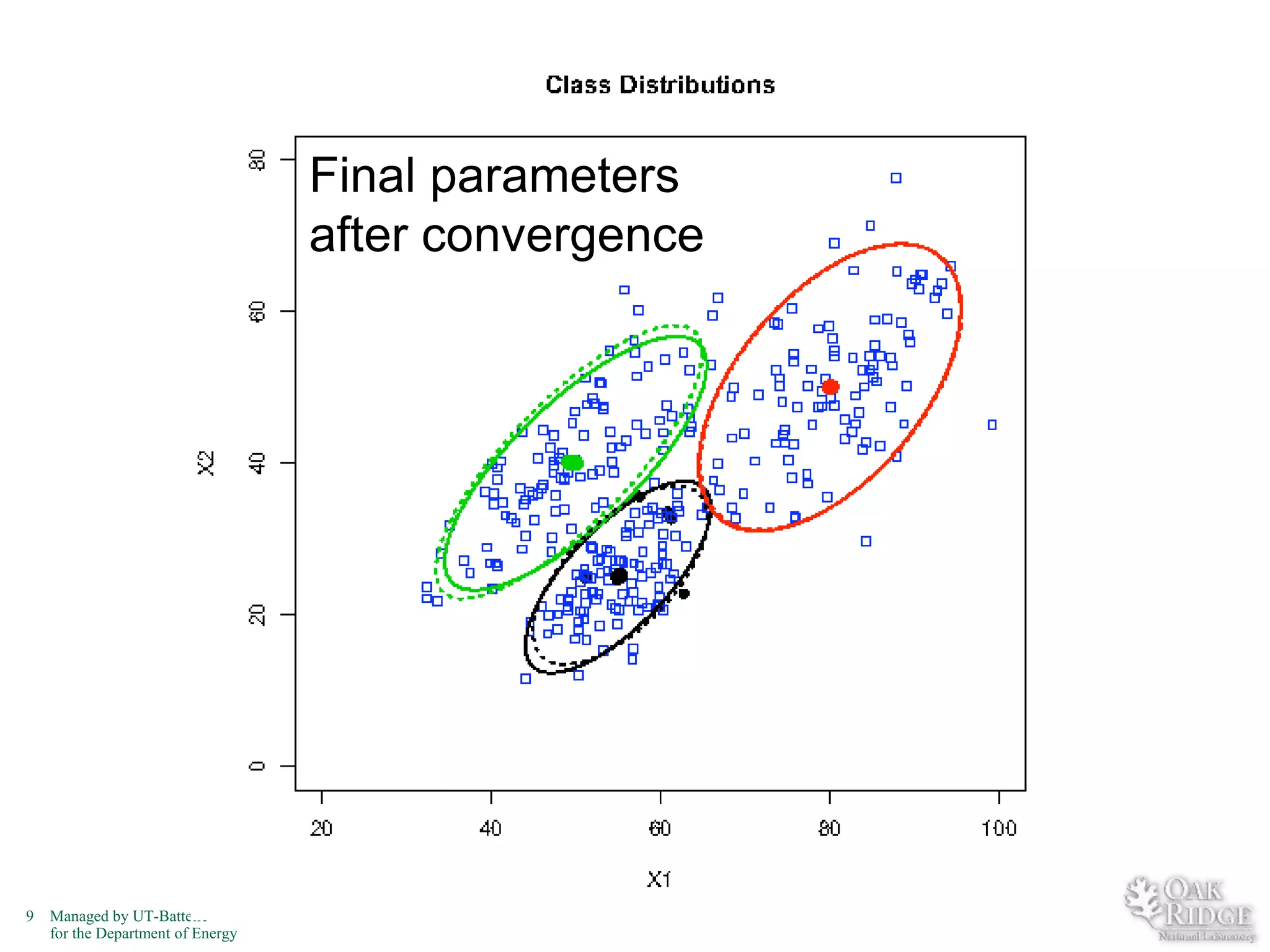
Final parameters
after convergence

9

Managed by UT-Battelle
for the Department of Energy
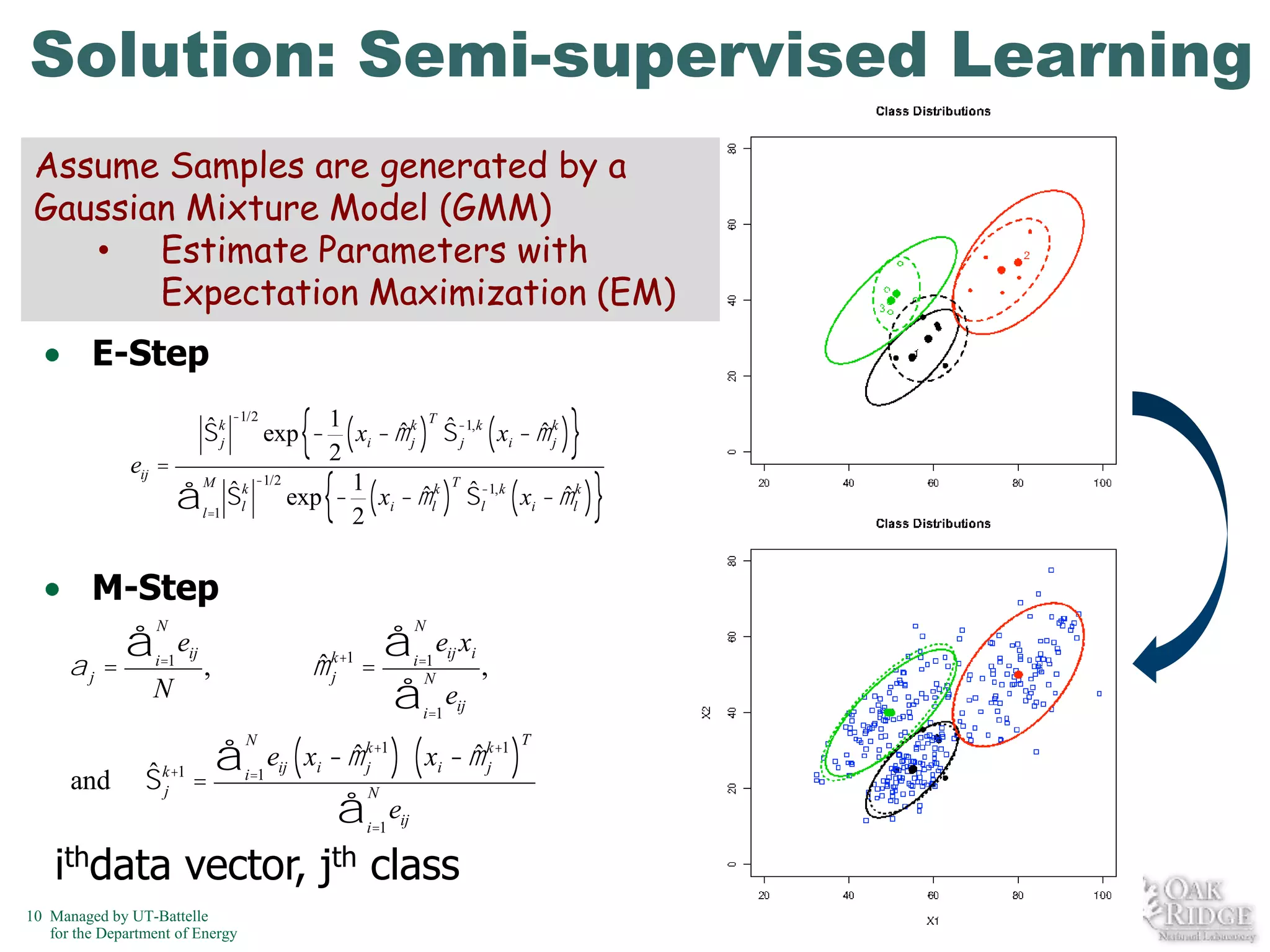
Solution: Semi-supervised Learning
Assume Samples are generated by a
Gaussian Mixture Model (GMM)
• Estimate Parameters with
Expectation Maximization (EM)
E-Step

{

}

T
1
ˆj ˆ j
ˆj
xi - m k ) S-1,k ( xi - m k )
(
2
eij =
-1/2
T
M
1
ˆ
ˆ
ˆ
ˆ
Slk
exp - ( xi - mlk ) S-1,k ( xi - mlk )
ål=1
l
2

ˆ
Skj

-1/2

exp -

{

M-Step
aj

å
=

N
i=1

N

eij

N

ˆj
m k+1

,

i=1 ij i
N
i=1 ij

å
ˆ
Sk+1 = i=1
j
N

and

å ex,
=
å e

ˆj
ˆj
eij ( xi - m k+1 ) ( xi - m k+1 )

å

N

e

i=1 ij

ithdata vector, jth class
10 Managed by UT-Battelle
for the Department of Energy

T

}
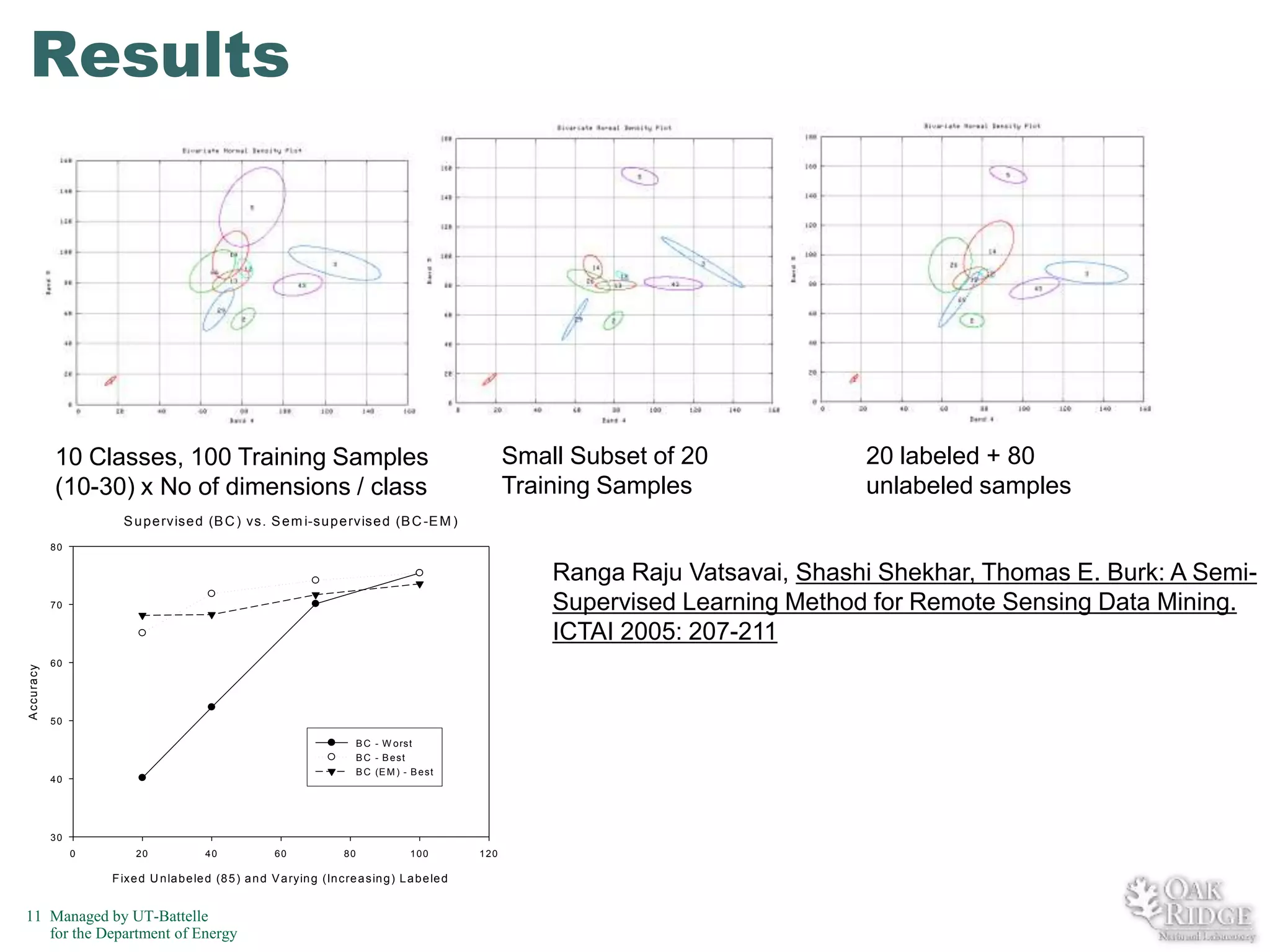
Results

Small Subset of 20
Training Samples

10 Classes, 100 Training Samples
(10-30) x No of dimensions / class

20 labeled + 80
unlabeled samples

S u p e rvise d (B C ) vs. S e m i-su p e rvise d (B C -E M )
80

Ranga Raju Vatsavai, Shashi Shekhar, Thomas E. Burk: A SemiSupervised Learning Method for Remote Sensing Data Mining.
ICTAI 2005: 207-211

A c c u ra c y

70

60

50
B C - W o rs t
B C - B est
B C (E M ) - B e s t

40

30
0

20

40

60

80

100

F ixe d U n la b e le d (8 5 ) a n d V a ryin g (In c re a s in g ) L a b e le d

11 Managed by UT-Battelle
for the Department of Energy

120
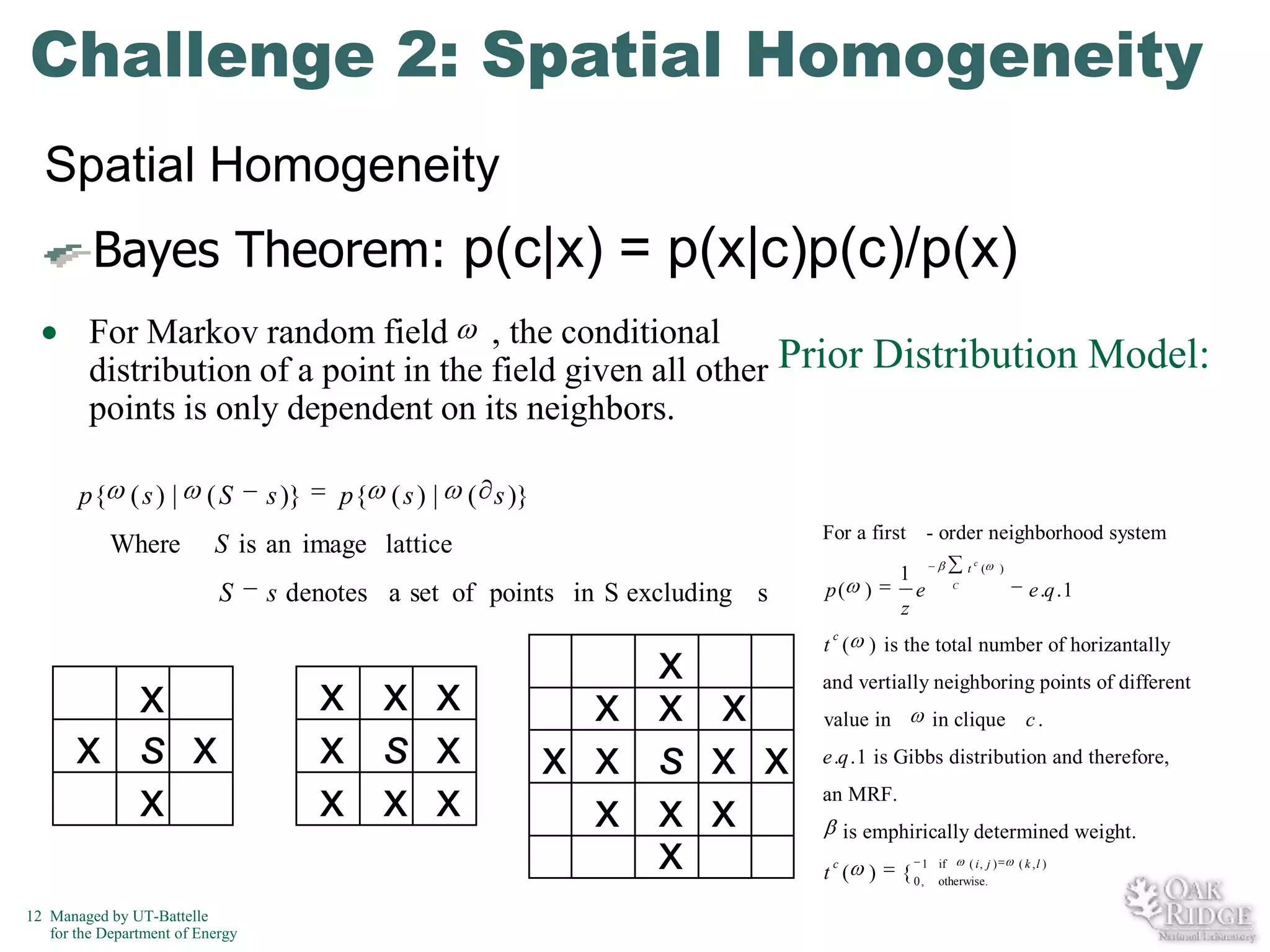
Challenge 2: Spatial Homogeneity
Spatial Homogeneity
Bayes Theorem: p(c|x) = p(x|c)p(c)/p(x)
For Markov random field , the conditional
distribution of a point in the field given all other Prior Distribution Model:
points is only dependent on its neighbors.
p{ ( s ) |
Where

(S

s )}

p{ ( s ) |

( s )}
For a first - order neighborhood system

S is an image lattice
S

s denotes a set of points in S excluding s

p( )

1
z

c

t (

e

C

)

e.q.1

c

x
x s x
x
12 Managed by UT-Battelle
for the Department of Energy

x x x
x s x
x x x

x
x x x
x x s x x
x x x
x

t ( ) is the total number of horizantally
and vertially neighboring points of different
value in

in clique c .

e.q.1 is Gibbs distribution and therefore,
an MRF.
is emphirically determined weight.
c

t ( )

1 if
( i, j )
otherwise.

{ 0,

( k ,l )
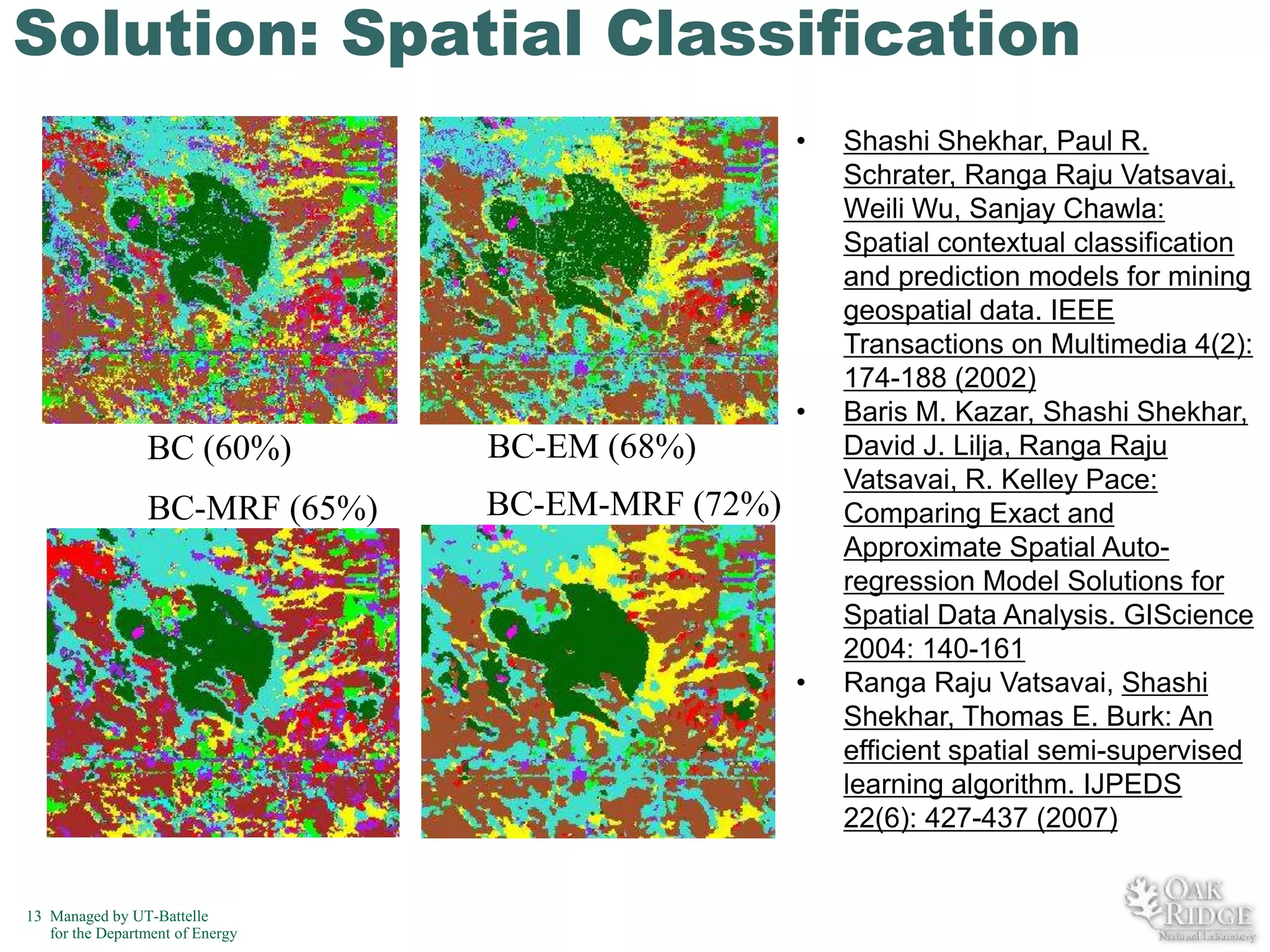
Solution: Spatial Classification
•

•

BC (60%)

BC-EM (68%)

BC-MRF (65%)

BC-EM-MRF (72%)

•

13 Managed by UT-Battelle
for the Department of Energy

Shashi Shekhar, Paul R.
Schrater, Ranga Raju Vatsavai,
Weili Wu, Sanjay Chawla:
Spatial contextual classification
and prediction models for mining
geospatial data. IEEE
Transactions on Multimedia 4(2):
174-188 (2002)
Baris M. Kazar, Shashi Shekhar,
David J. Lilja, Ranga Raju
Vatsavai, R. Kelley Pace:
Comparing Exact and
Approximate Spatial Autoregression Model Solutions for
Spatial Data Analysis. GIScience
2004: 140-161
Ranga Raju Vatsavai, Shashi
Shekhar, Thomas E. Burk: An
efficient spatial semi-supervised
learning algorithm. IJPEDS
22(6): 427-437 (2007)
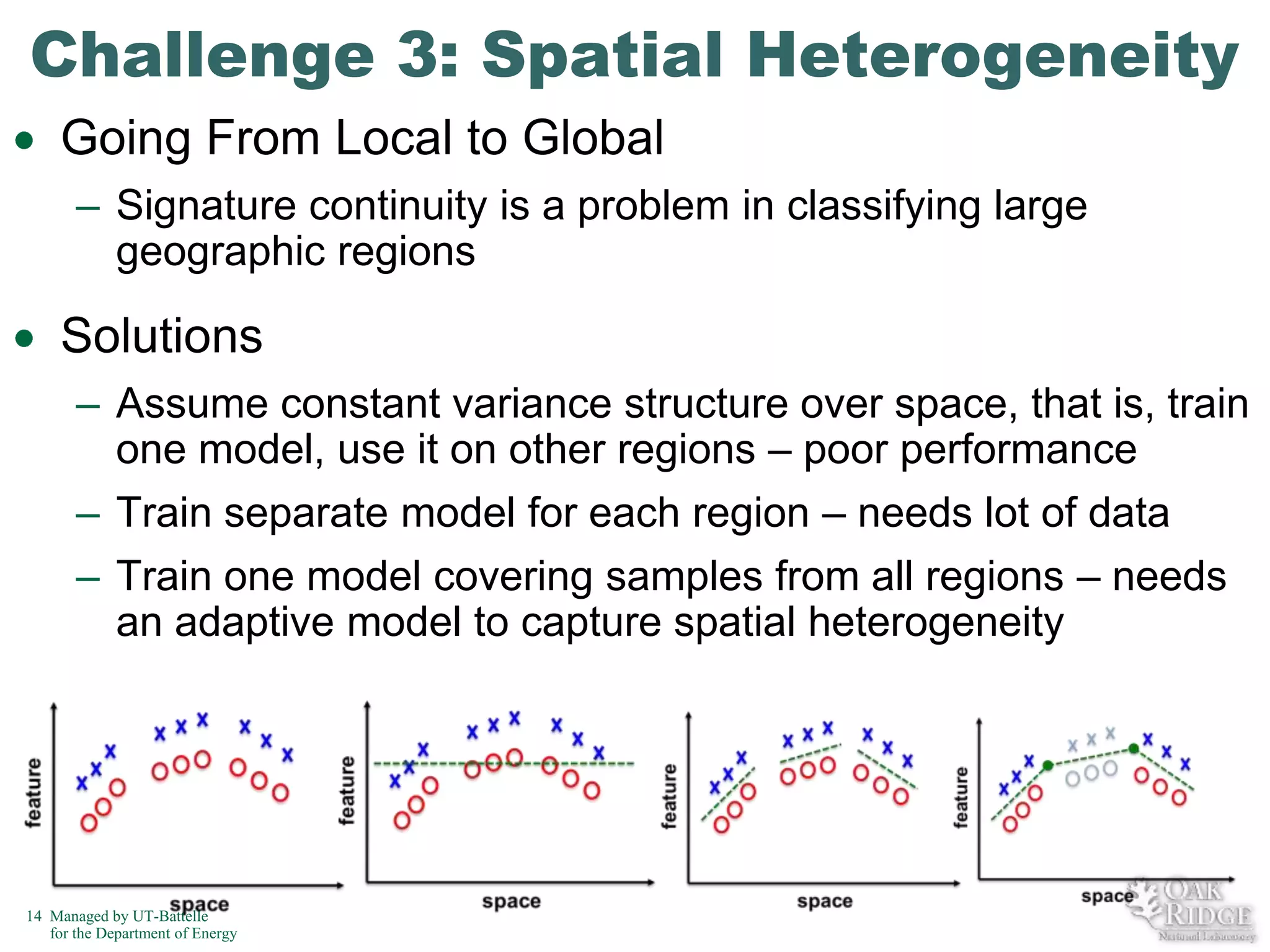
Challenge 3: Spatial Heterogeneity
Going From Local to Global
– Signature continuity is a problem in classifying large
geographic regions

Solutions
– Assume constant variance structure over space, that is, train
one model, use it on other regions – poor performance
– Train separate model for each region – needs lot of data
– Train one model covering samples from all regions – needs
an adaptive model to capture spatial heterogeneity

14 Managed by UT-Battelle
for the Department of Energy
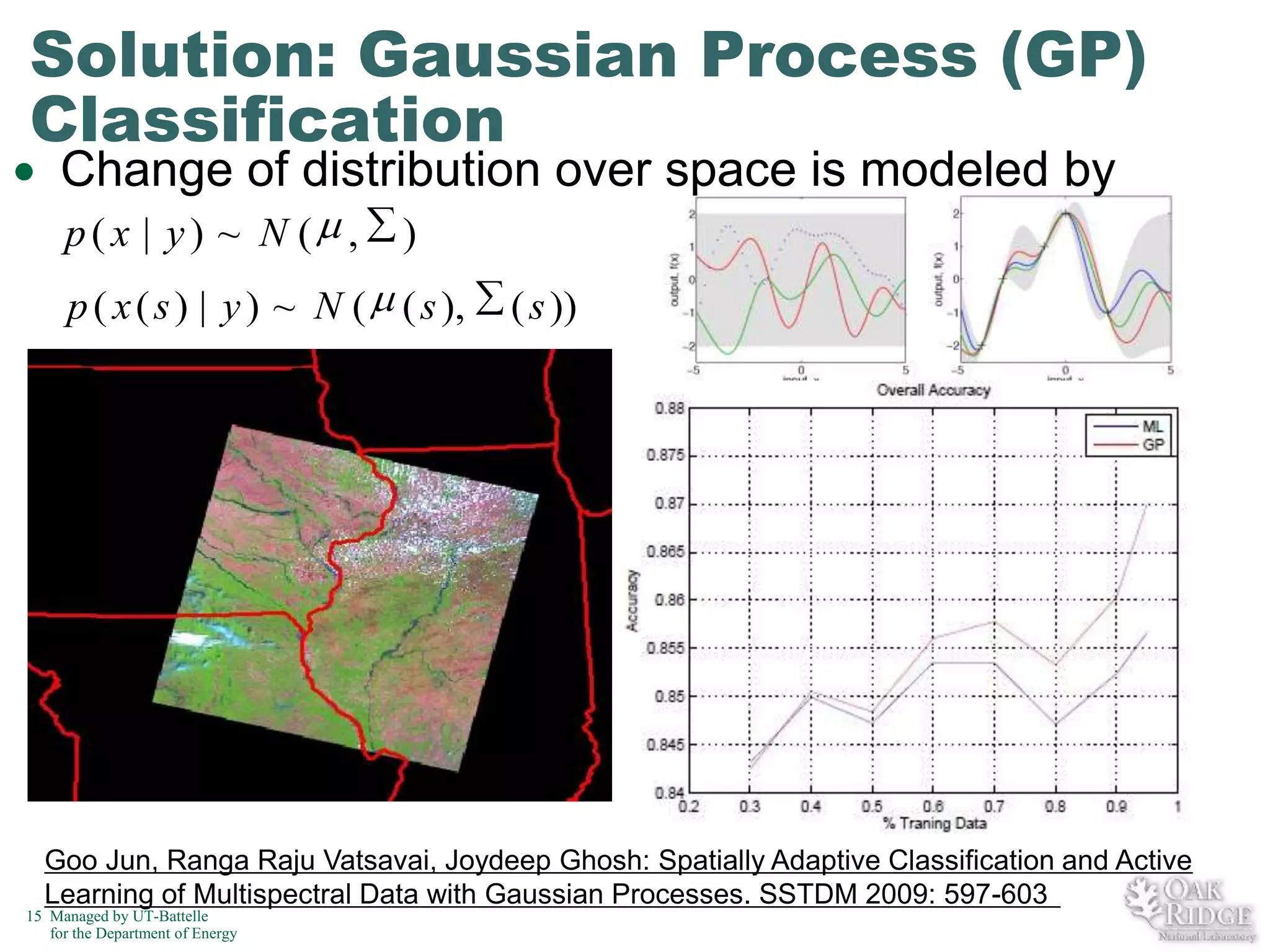
Solution: Gaussian Process (GP)
Classification
Change of distribution over space is modeled by
p(x | y) ~ N ( ,

)

p ( x ( s ) | y ) ~ N ( ( s ),

( s ))

Goo Jun, Ranga Raju Vatsavai, Joydeep Ghosh: Spatially Adaptive Classification and Active
Learning of Multispectral Data with Gaussian Processes. SSTDM 2009: 597-603
15 Managed by UT-Battelle
for the Department of Energy
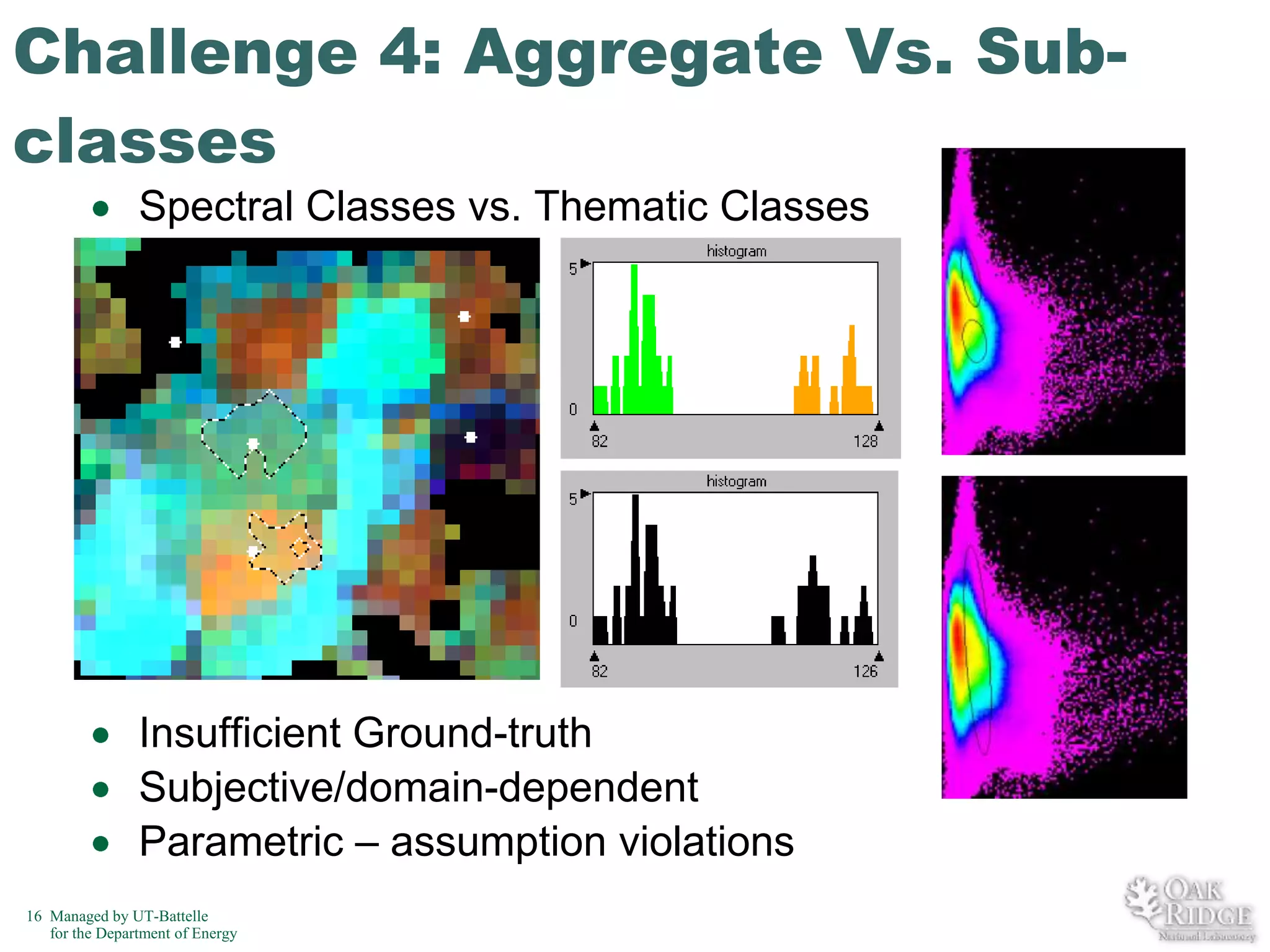
Challenge 4: Aggregate Vs. Subclasses
Spectral Classes vs. Thematic Classes

Insufficient Ground-truth
Subjective/domain-dependent
Parametric – assumption violations
16 Managed by UT-Battelle
for the Department of Energy
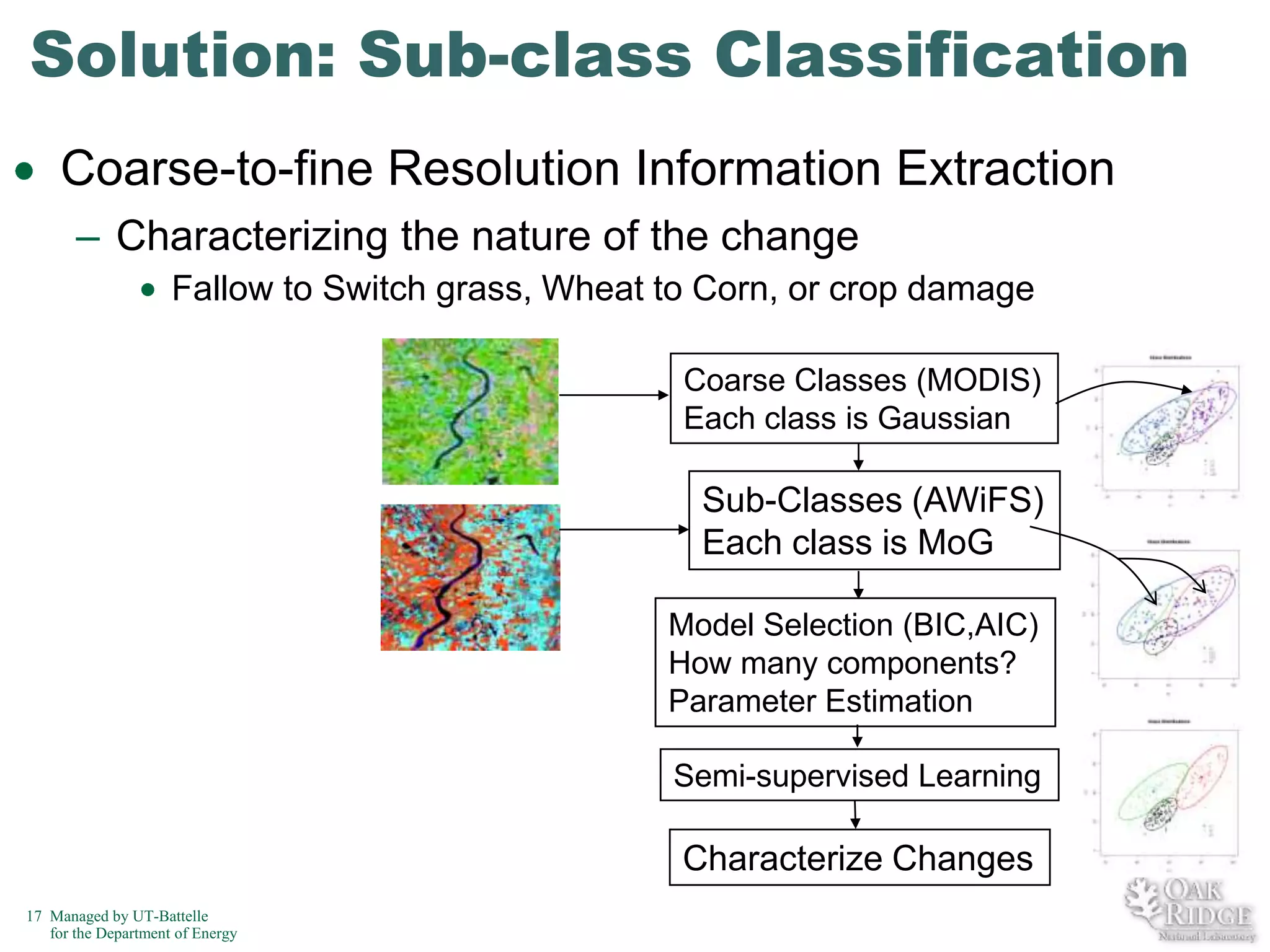
Solution: Sub-class Classification
Coarse-to-fine Resolution Information Extraction
– Characterizing the nature of the change
Fallow to Switch grass, Wheat to Corn, or crop damage
Coarse Classes (MODIS)
Each class is Gaussian

Sub-Classes (AWiFS)
Each class is MoG
Model Selection (BIC,AIC)
How many components?
Parameter Estimation

Semi-supervised Learning

Characterize Changes
17 Managed by UT-Battelle
for the Department of Energy
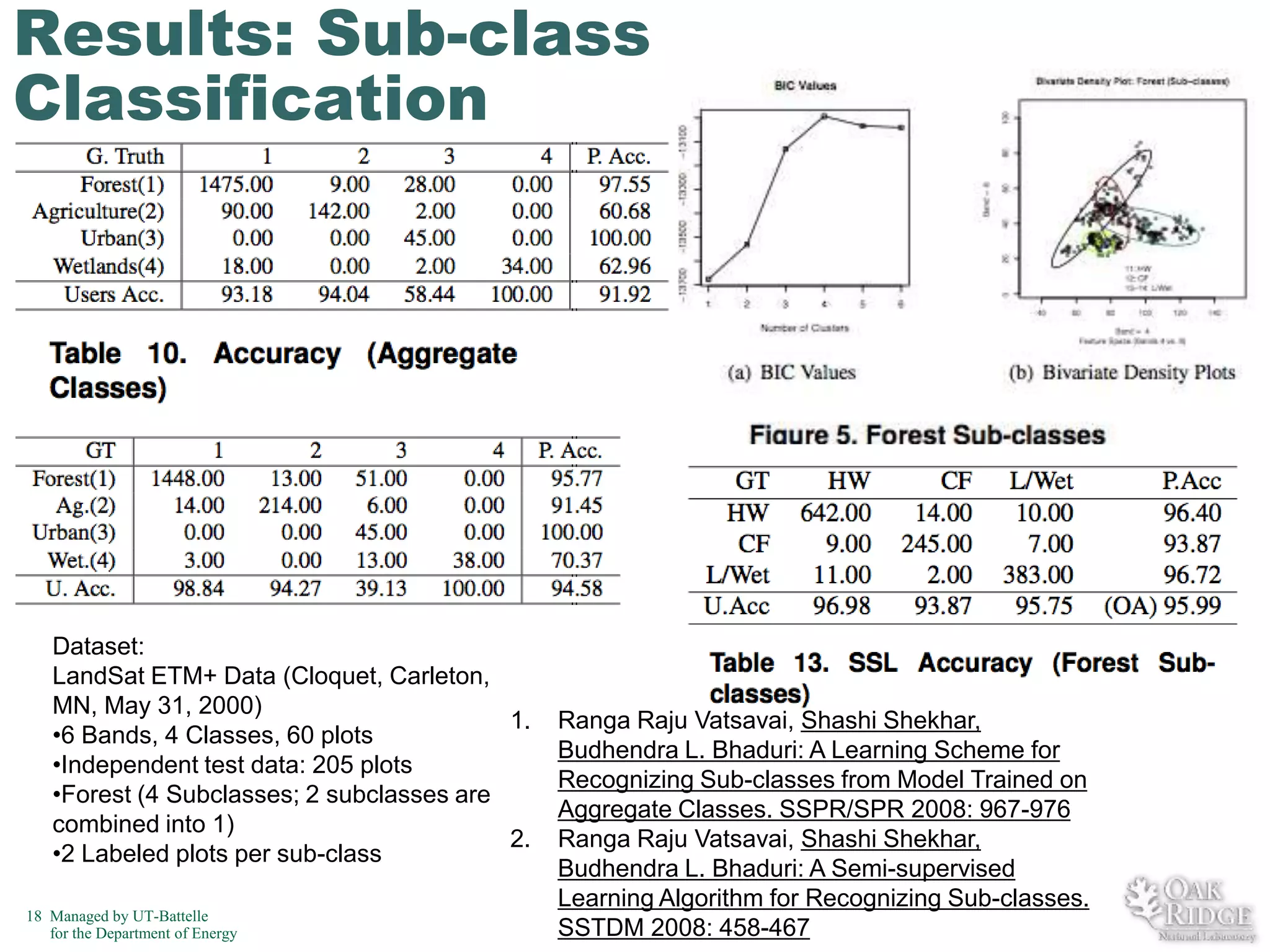
Results: Sub-class
Classification

Dataset:
LandSat ETM+ Data (Cloquet, Carleton,
MN, May 31, 2000)
1.
•6 Bands, 4 Classes, 60 plots
•Independent test data: 205 plots
•Forest (4 Subclasses; 2 subclasses are
combined into 1)
2.
•2 Labeled plots per sub-class
18 Managed by UT-Battelle
for the Department of Energy

Ranga Raju Vatsavai, Shashi Shekhar,
Budhendra L. Bhaduri: A Learning Scheme for
Recognizing Sub-classes from Model Trained on
Aggregate Classes. SSPR/SPR 2008: 967-976
Ranga Raju Vatsavai, Shashi Shekhar,
Budhendra L. Bhaduri: A Semi-supervised
Learning Algorithm for Recognizing Sub-classes.
SSTDM 2008: 458-467
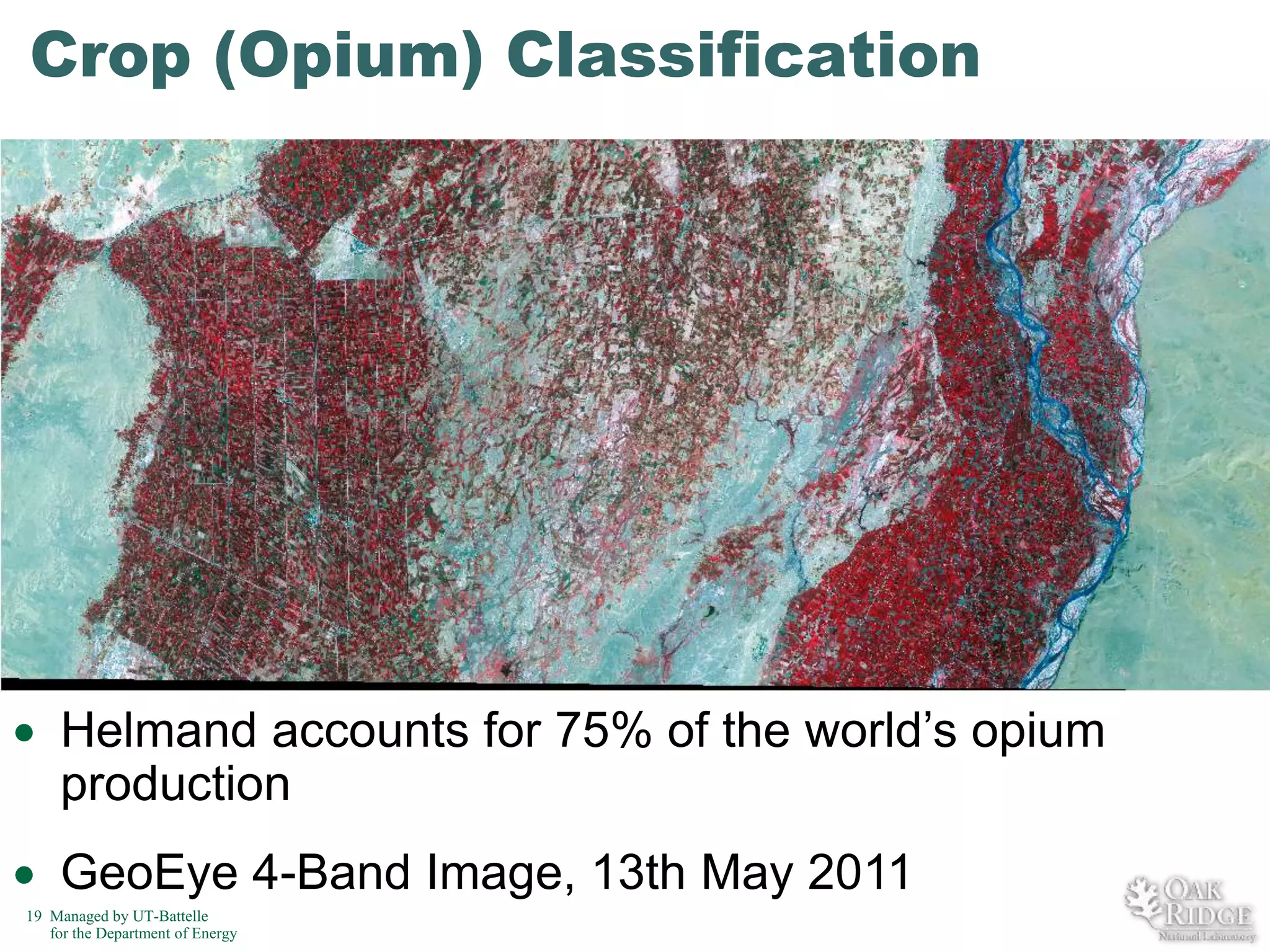
Crop (Opium) Classification

Helmand accounts for 75% of the world’s opium
production
GeoEye 4-Band Image, 13th May 2011
19 Managed by UT-Battelle
for the Department of Energy
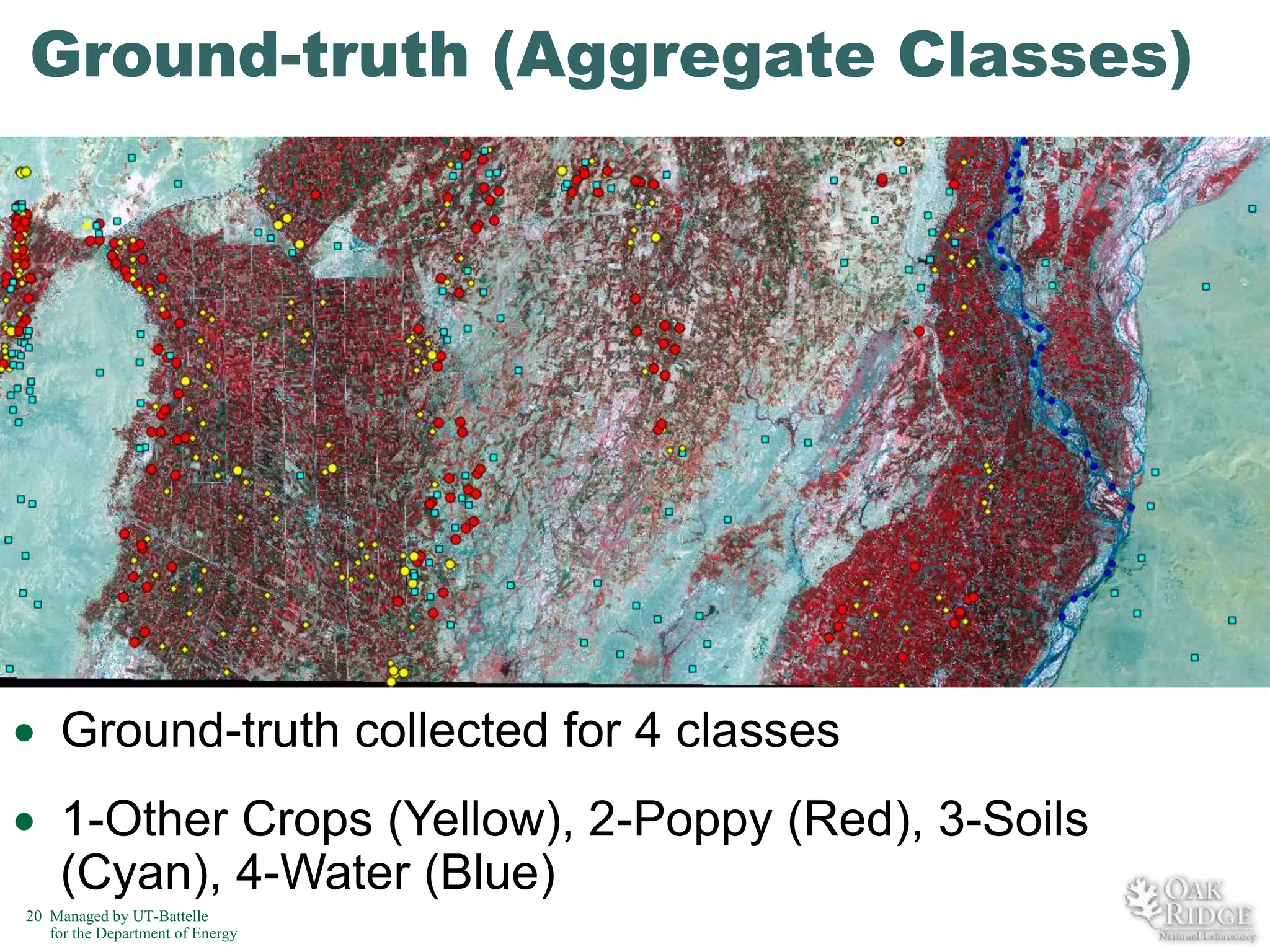
Ground-truth (Aggregate Classes)

Ground-truth collected for 4 classes
1-Other Crops (Yellow), 2-Poppy (Red), 3-Soils
(Cyan), 4-Water (Blue)
20 Managed by UT-Battelle
for the Department of Energy
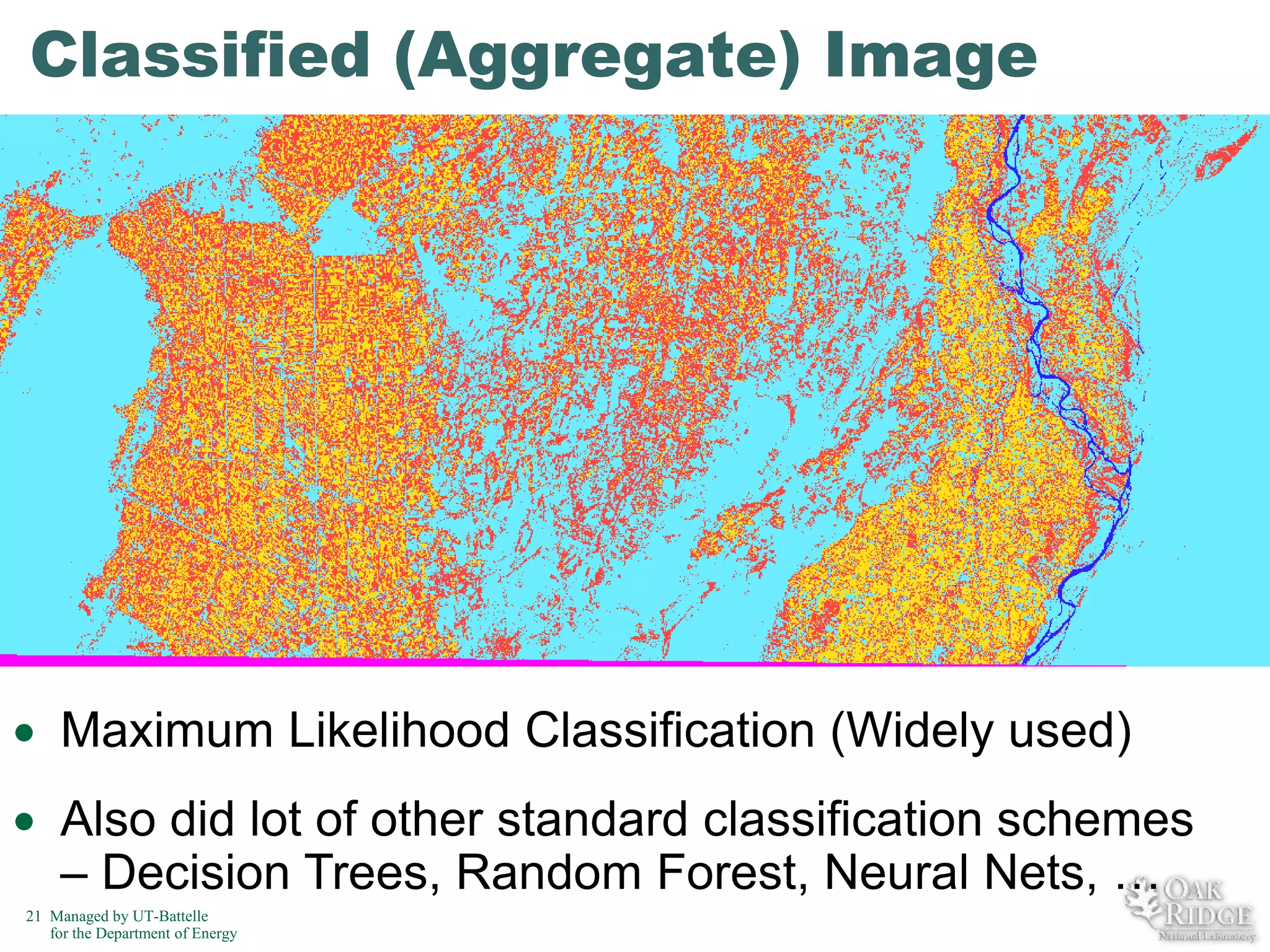
Classified (Aggregate) Image

Maximum Likelihood Classification (Widely used)
Also did lot of other standard classification schemes
– Decision Trees, Random Forest, Neural Nets, …
21 Managed by UT-Battelle
for the Department of Energy
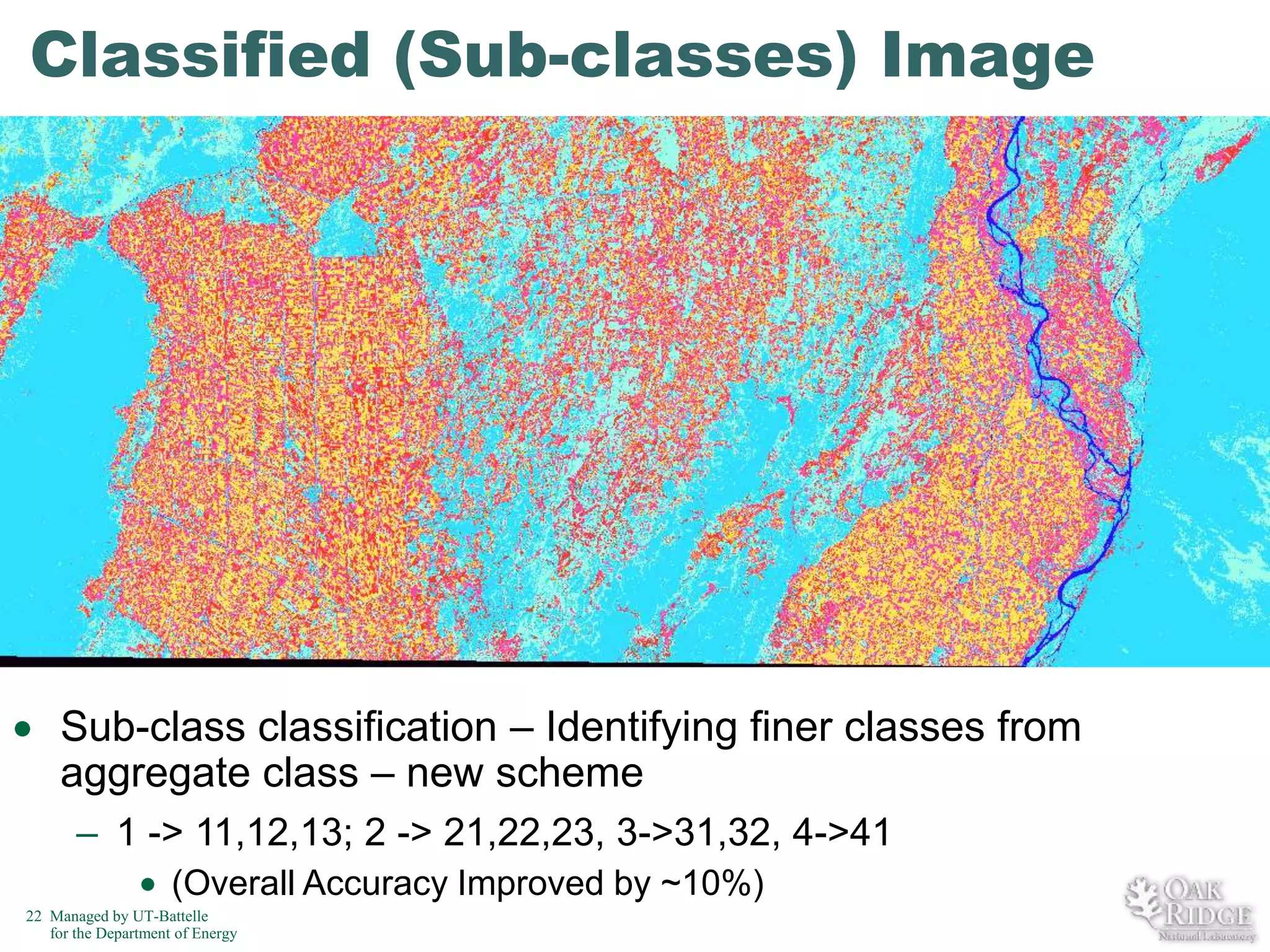
Classified (Sub-classes) Image

Sub-class classification – Identifying finer classes from
aggregate class – new scheme
– 1 -> 11,12,13; 2 -> 21,22,23, 3->31,32, 4->41
(Overall Accuracy Improved by ~10%)
22 Managed by UT-Battelle
for the Department of Energy
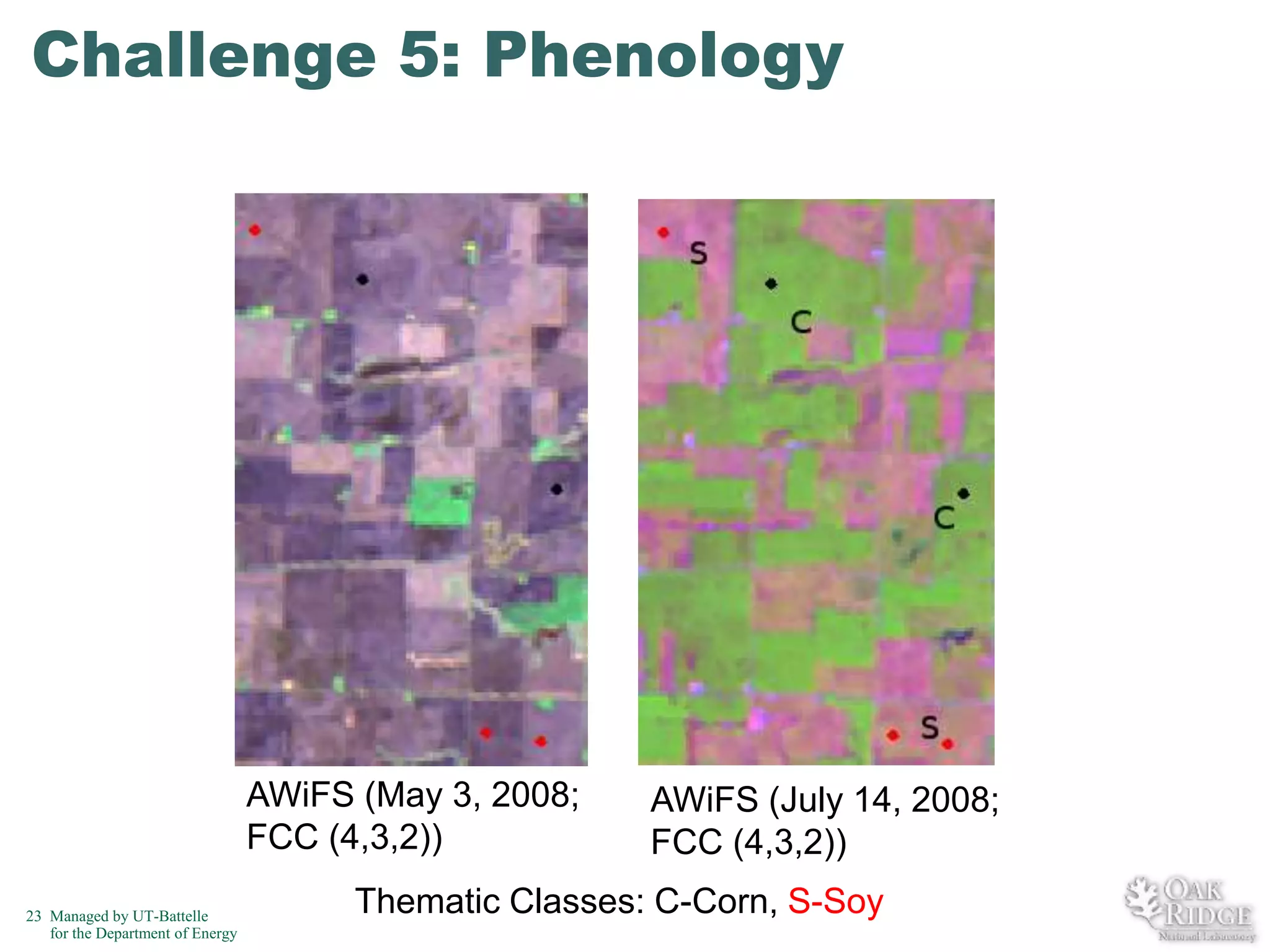
Challenge 5: Phenology

AWiFS (May 3, 2008;
FCC (4,3,2))
23 Managed by UT-Battelle
for the Department of Energy

AWiFS (July 14, 2008;
FCC (4,3,2))

Thematic Classes: C-Corn, S-Soy
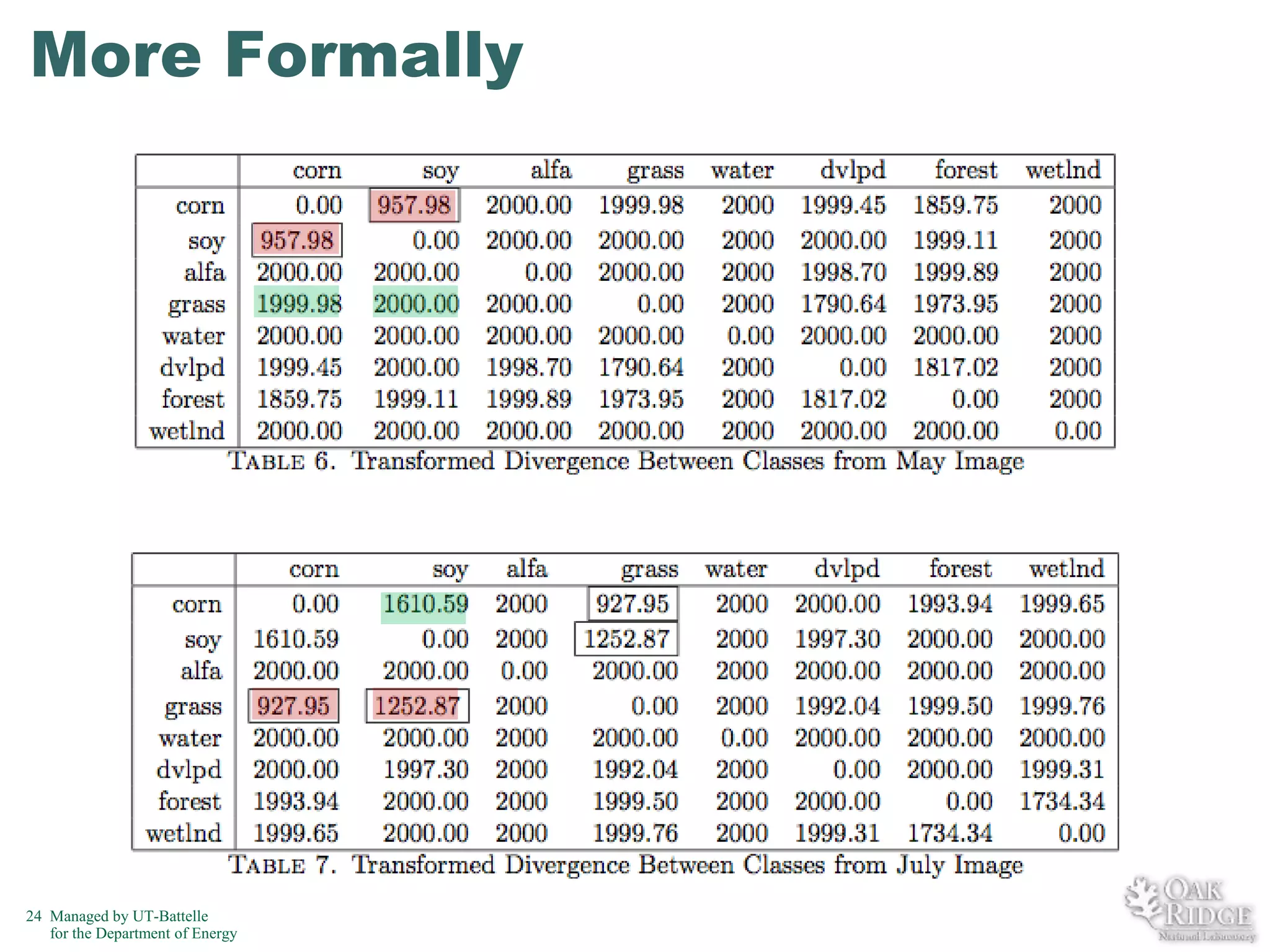
More Formally

24 Managed by UT-Battelle
for the Department of Energy
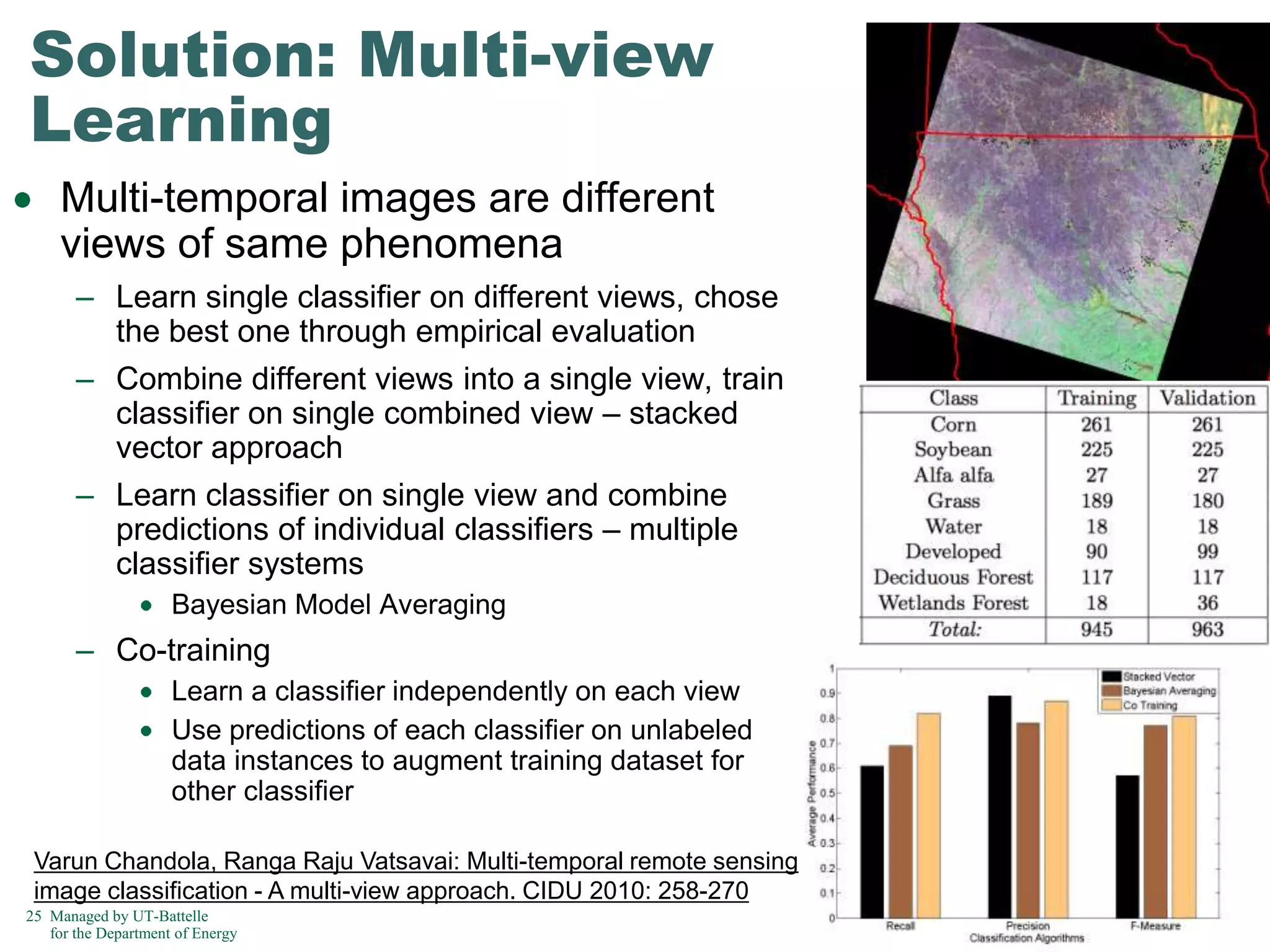
Solution: Multi-view
Learning
Multi-temporal images are different
views of same phenomena
– Learn single classifier on different views, chose
the best one through empirical evaluation
– Combine different views into a single view, train
classifier on single combined view – stacked
vector approach
– Learn classifier on single view and combine
predictions of individual classifiers – multiple
classifier systems
Bayesian Model Averaging

– Co-training
Learn a classifier independently on each view
Use predictions of each classifier on unlabeled
data instances to augment training dataset for
other classifier
Varun Chandola, Ranga Raju Vatsavai: Multi-temporal remote sensing
image classification - A multi-view approach. CIDU 2010: 258-270
25 Managed by UT-Battelle
for the Department of Energy
Conclusions
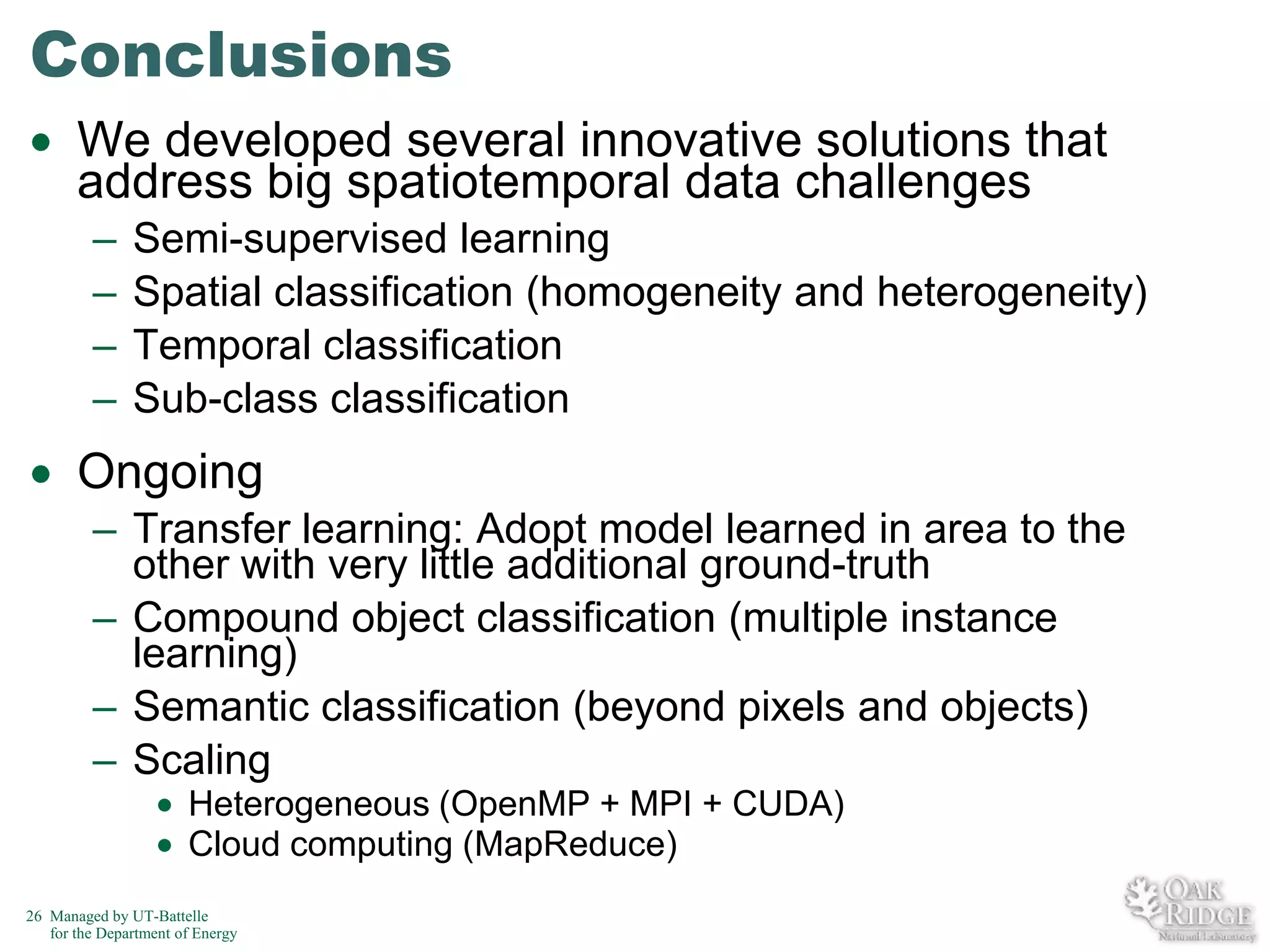
We developed several innovative solutions that
address big spatiotemporal data challenges
–
–
–
–

Semi-supervised learning
Spatial classification (homogeneity and heterogeneity)
Temporal classification
Sub-class classification

Ongoing
– Transfer learning: Adopt model learned in area to the
other with very little additional ground-truth
– Compound object classification (multiple instance
learning)
– Semantic classification (beyond pixels and objects)
– Scaling
Heterogeneous (OpenMP + MPI + CUDA)
Cloud computing (MapReduce)
26 Managed by UT-Battelle
for the Department of Energy
Acknowledgements
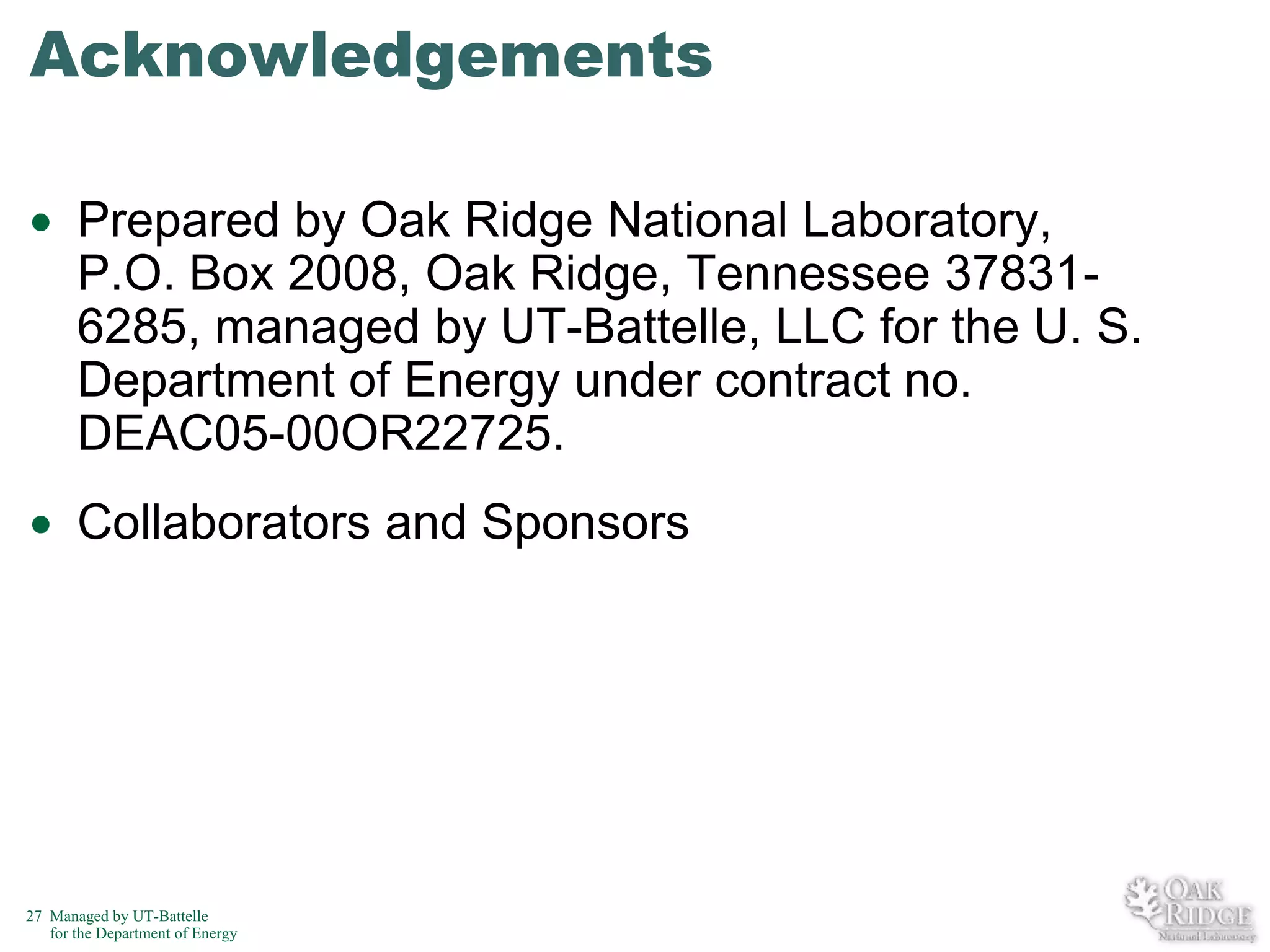
Prepared by Oak Ridge National Laboratory,
P.O. Box 2008, Oak Ridge, Tennessee 378316285, managed by UT-Battelle, LLC for the U. S.
Department of Energy under contract no.
DEAC05-00OR22725.
Collaborators and Sponsors

27 Managed by UT-Battelle
for the Department of Energy

Recent Advances in Crop Classification

  • 1.
    Recent Advances inCrop Classification Raju Vatsavai (vatsavairr@ornl.gov) Computational Sciences and Engineering Division ORNL, Oak Ridge, TN, USA Collaborators: B. Bhaduri, V. Chandola, G. Jun, J. Ghosh, S. Shekhar, T. Burk Remote Sensing – Beyond Images Workshop, Mexico th December, 2013. City, Mexico, 14 Managed by UT-Battelle for the Department of Energy
  • 2.
    Outline Better spectral andspatial resolution – Fine-grained (species) classification – Complex (compound) object recognition Challenges – Limited ground-truth: Semi-supervised learning (SSL) – Spatial homogeneity: SSL + Markov Random Fields – Spatial heterogeneity: Gaussian Process (GP) learning – Aggregate vs. Subclasses: Fine-grained classification – Phenology: Multi-view learning Conclusions 2 Managed by UT-Battelle for the Department of Energy
  • 3.
    Challenge 1: LimitedTraining Data Increasing spectral resolution: 4 to 224 Bands Challenges – #of training samples ~ (10 to 30) * (number of dimensions) – Costly ~ $500-$800 per plot (depends on geographic area) – Accessibility – Private/Privacy issues (e.g., USFS may average 5% denied access) – Real-time – Emergency situations, such as, forest fires, floods Solutions – Reduce number of dimensions – (Artificially) Increase number of samples – By incorporating unlabeled samples Naïve semi-supervised (Nigam et al. [JML-2000]) – Bagging [Breiman, ML-96] 3 Managed by UT-Battelle for the Department of Energy
  • 4.
    True Distribution Estimated Distribution (SmallSamples; MLE are good asymptotically) 4 Managed by UT-Battelle for the Department of Energy
  • 5.
    Initial Estimates + UnlabeledSamples 5 Managed by UT-Battelle for the Department of Energy
  • 6.
    Iteratively Update Parameters UsingUnlabeled Samples 6 Managed by UT-Battelle for the Department of Energy
  • 7.
    Iteratively Update Parameters UsingUnlabeled Samples 7 Managed by UT-Battelle for the Department of Energy
  • 8.
    Iteratively Update Parameters UsingUnlabeled Samples 8 Managed by UT-Battelle for the Department of Energy
  • 9.
    Final parameters after convergence 9 Managedby UT-Battelle for the Department of Energy
  • 10.
    Solution: Semi-supervised Learning AssumeSamples are generated by a Gaussian Mixture Model (GMM) • Estimate Parameters with Expectation Maximization (EM) E-Step { } T 1 ˆj ˆ j ˆj xi - m k ) S-1,k ( xi - m k ) ( 2 eij = -1/2 T M 1 ˆ ˆ ˆ ˆ Slk exp - ( xi - mlk ) S-1,k ( xi - mlk ) ål=1 l 2 ˆ Skj -1/2 exp - { M-Step aj å = N i=1 N eij N ˆj m k+1 , i=1 ij i N i=1 ij å ˆ Sk+1 = i=1 j N and å ex, = å e ˆj ˆj eij ( xi - m k+1 ) ( xi - m k+1 ) å N e i=1 ij ithdata vector, jth class 10 Managed by UT-Battelle for the Department of Energy T }
  • 11.
    Results Small Subset of20 Training Samples 10 Classes, 100 Training Samples (10-30) x No of dimensions / class 20 labeled + 80 unlabeled samples S u p e rvise d (B C ) vs. S e m i-su p e rvise d (B C -E M ) 80 Ranga Raju Vatsavai, Shashi Shekhar, Thomas E. Burk: A SemiSupervised Learning Method for Remote Sensing Data Mining. ICTAI 2005: 207-211 A c c u ra c y 70 60 50 B C - W o rs t B C - B est B C (E M ) - B e s t 40 30 0 20 40 60 80 100 F ixe d U n la b e le d (8 5 ) a n d V a ryin g (In c re a s in g ) L a b e le d 11 Managed by UT-Battelle for the Department of Energy 120
  • 12.
    Challenge 2: SpatialHomogeneity Spatial Homogeneity Bayes Theorem: p(c|x) = p(x|c)p(c)/p(x) For Markov random field , the conditional distribution of a point in the field given all other Prior Distribution Model: points is only dependent on its neighbors. p{ ( s ) | Where (S s )} p{ ( s ) | ( s )} For a first - order neighborhood system S is an image lattice S s denotes a set of points in S excluding s p( ) 1 z c t ( e C ) e.q.1 c x x s x x 12 Managed by UT-Battelle for the Department of Energy x x x x s x x x x x x x x x x s x x x x x x t ( ) is the total number of horizantally and vertially neighboring points of different value in in clique c . e.q.1 is Gibbs distribution and therefore, an MRF. is emphirically determined weight. c t ( ) 1 if ( i, j ) otherwise. { 0, ( k ,l )
  • 13.
    Solution: Spatial Classification • • BC(60%) BC-EM (68%) BC-MRF (65%) BC-EM-MRF (72%) • 13 Managed by UT-Battelle for the Department of Energy Shashi Shekhar, Paul R. Schrater, Ranga Raju Vatsavai, Weili Wu, Sanjay Chawla: Spatial contextual classification and prediction models for mining geospatial data. IEEE Transactions on Multimedia 4(2): 174-188 (2002) Baris M. Kazar, Shashi Shekhar, David J. Lilja, Ranga Raju Vatsavai, R. Kelley Pace: Comparing Exact and Approximate Spatial Autoregression Model Solutions for Spatial Data Analysis. GIScience 2004: 140-161 Ranga Raju Vatsavai, Shashi Shekhar, Thomas E. Burk: An efficient spatial semi-supervised learning algorithm. IJPEDS 22(6): 427-437 (2007)
  • 14.
    Challenge 3: SpatialHeterogeneity Going From Local to Global – Signature continuity is a problem in classifying large geographic regions Solutions – Assume constant variance structure over space, that is, train one model, use it on other regions – poor performance – Train separate model for each region – needs lot of data – Train one model covering samples from all regions – needs an adaptive model to capture spatial heterogeneity 14 Managed by UT-Battelle for the Department of Energy
  • 15.
    Solution: Gaussian Process(GP) Classification Change of distribution over space is modeled by p(x | y) ~ N ( , ) p ( x ( s ) | y ) ~ N ( ( s ), ( s )) Goo Jun, Ranga Raju Vatsavai, Joydeep Ghosh: Spatially Adaptive Classification and Active Learning of Multispectral Data with Gaussian Processes. SSTDM 2009: 597-603 15 Managed by UT-Battelle for the Department of Energy
  • 16.
    Challenge 4: AggregateVs. Subclasses Spectral Classes vs. Thematic Classes Insufficient Ground-truth Subjective/domain-dependent Parametric – assumption violations 16 Managed by UT-Battelle for the Department of Energy
  • 17.
    Solution: Sub-class Classification Coarse-to-fineResolution Information Extraction – Characterizing the nature of the change Fallow to Switch grass, Wheat to Corn, or crop damage Coarse Classes (MODIS) Each class is Gaussian Sub-Classes (AWiFS) Each class is MoG Model Selection (BIC,AIC) How many components? Parameter Estimation Semi-supervised Learning Characterize Changes 17 Managed by UT-Battelle for the Department of Energy
  • 18.
    Results: Sub-class Classification Dataset: LandSat ETM+Data (Cloquet, Carleton, MN, May 31, 2000) 1. •6 Bands, 4 Classes, 60 plots •Independent test data: 205 plots •Forest (4 Subclasses; 2 subclasses are combined into 1) 2. •2 Labeled plots per sub-class 18 Managed by UT-Battelle for the Department of Energy Ranga Raju Vatsavai, Shashi Shekhar, Budhendra L. Bhaduri: A Learning Scheme for Recognizing Sub-classes from Model Trained on Aggregate Classes. SSPR/SPR 2008: 967-976 Ranga Raju Vatsavai, Shashi Shekhar, Budhendra L. Bhaduri: A Semi-supervised Learning Algorithm for Recognizing Sub-classes. SSTDM 2008: 458-467
  • 19.
    Crop (Opium) Classification Helmandaccounts for 75% of the world’s opium production GeoEye 4-Band Image, 13th May 2011 19 Managed by UT-Battelle for the Department of Energy
  • 20.
    Ground-truth (Aggregate Classes) Ground-truthcollected for 4 classes 1-Other Crops (Yellow), 2-Poppy (Red), 3-Soils (Cyan), 4-Water (Blue) 20 Managed by UT-Battelle for the Department of Energy
  • 21.
    Classified (Aggregate) Image MaximumLikelihood Classification (Widely used) Also did lot of other standard classification schemes – Decision Trees, Random Forest, Neural Nets, … 21 Managed by UT-Battelle for the Department of Energy
  • 22.
    Classified (Sub-classes) Image Sub-classclassification – Identifying finer classes from aggregate class – new scheme – 1 -> 11,12,13; 2 -> 21,22,23, 3->31,32, 4->41 (Overall Accuracy Improved by ~10%) 22 Managed by UT-Battelle for the Department of Energy
  • 23.
    Challenge 5: Phenology AWiFS(May 3, 2008; FCC (4,3,2)) 23 Managed by UT-Battelle for the Department of Energy AWiFS (July 14, 2008; FCC (4,3,2)) Thematic Classes: C-Corn, S-Soy
  • 24.
    More Formally 24 Managedby UT-Battelle for the Department of Energy
  • 25.
    Solution: Multi-view Learning Multi-temporal imagesare different views of same phenomena – Learn single classifier on different views, chose the best one through empirical evaluation – Combine different views into a single view, train classifier on single combined view – stacked vector approach – Learn classifier on single view and combine predictions of individual classifiers – multiple classifier systems Bayesian Model Averaging – Co-training Learn a classifier independently on each view Use predictions of each classifier on unlabeled data instances to augment training dataset for other classifier Varun Chandola, Ranga Raju Vatsavai: Multi-temporal remote sensing image classification - A multi-view approach. CIDU 2010: 258-270 25 Managed by UT-Battelle for the Department of Energy
  • 26.
    Conclusions We developed severalinnovative solutions that address big spatiotemporal data challenges – – – – Semi-supervised learning Spatial classification (homogeneity and heterogeneity) Temporal classification Sub-class classification Ongoing – Transfer learning: Adopt model learned in area to the other with very little additional ground-truth – Compound object classification (multiple instance learning) – Semantic classification (beyond pixels and objects) – Scaling Heterogeneous (OpenMP + MPI + CUDA) Cloud computing (MapReduce) 26 Managed by UT-Battelle for the Department of Energy
  • 27.
    Acknowledgements Prepared by OakRidge National Laboratory, P.O. Box 2008, Oak Ridge, Tennessee 378316285, managed by UT-Battelle, LLC for the U. S. Department of Energy under contract no. DEAC05-00OR22725. Collaborators and Sponsors 27 Managed by UT-Battelle for the Department of Energy