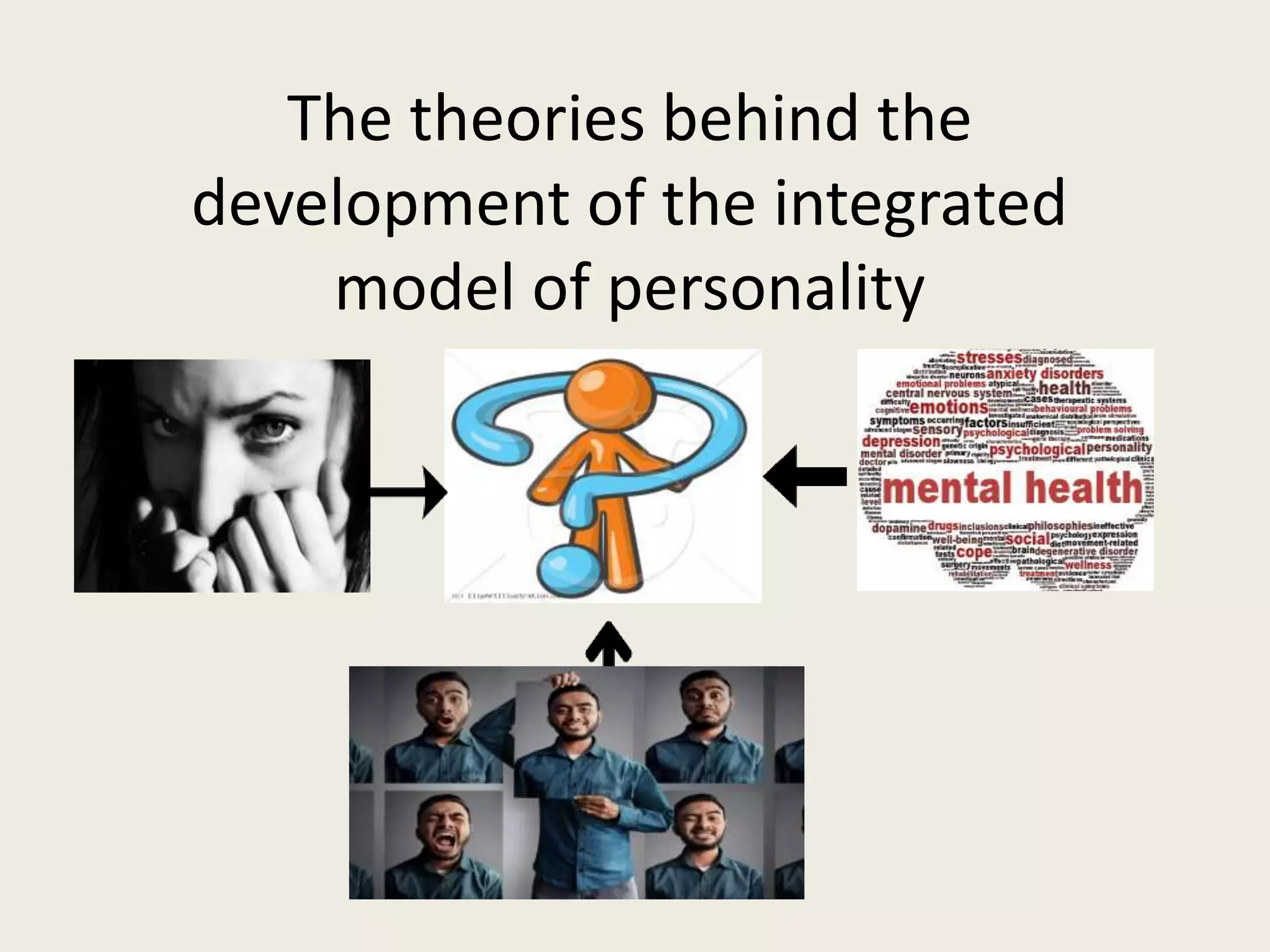
The theories behind the
development of the integrated
model of personality
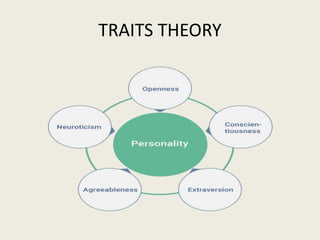
TRAITS THEORY
Allport’s Definition of Personality
Personality is a dynamic organization of
psychophysical systems within an individual that
determines the person’s uniqueness adjustment
to the environment
Traits Theory
Gordon Allport studied human personality by locating
every term that he thought could describe a person in the
dictionary to identify a list of 4541 traits. He organized
them into three categories:
• Cardinal traits: Traits that dominates the personality
across time and situations.
• Central traits: Common traits that are consistent across
time and situations. They form the building blocks of
personality.
• Secondary traits: Traits that are less evident and
inconsistent across time and situations.
Raymond Cattell’s Definition of
Personality
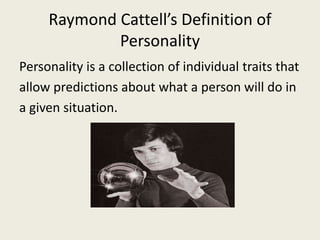
Personality is a collection of individual traits that
allow predictions about what a person will do in
a given situation.
Traits Theory
Raymond Cattell organized the thousands of
traits described by Allport and condensed them
down to 16 primary traits using the statistical
method of factor analysis. into 16 PF
(Personality Factors) to explore the basic
dimensions of personality.
Raymond Cattell 16 PF (Personality
Factors)
The 16 PF (Personality Factors) to explore the
basic dimensions of personality are:
• Abstractedness: Imaginative versus practical
• Apprehension: Worried versus confident
• Dominance: Forceful versus submissive
• Emotional Stability: Calm versus high-strung
Raymond Cattell 16 PF (Personality
Factors)
The 16 PF (Personality Factors) to explore the
basic dimensions of personality are:
• Liveliness: Spontaneous versus restrained
• Openness to Change: Flexible versus attached
to the familiar
• Perfectionism: Controlled versus undisciplined
• Privateness: Discreet versus open
Raymond Cattell 16 PF (Personality
Factors)
The 16 PF (Personality Factors) to explore the
basic dimensions of personality are:
• Reasoning: Abstract versus concrete
• Rule-Consciousness: Conforming versus non-
conforming
• Self-Reliance: Self-sufficient versus dependent
• Sensitivity: Tender-hearted versus tough-
minded.
Raymond Cattell 16 PF (Personality
Factors)
The 16 PF (Personality Factors) to explore the
basic dimensions of personality are:
• Social Boldness: Uninhibited versus shy
• Tension: Impatient versus relaxed
• Vigilance: Suspicious versus trusting
• Warmth: Outgoing versus reserved
Hans Eysenck’s Definition of
Personality
Personality is defined as the enduring
organization of a person's character,
temperament, intelligence and physique, which
determines the individual's unique adjustment
to the environment.
Hans Eysenck
Hans Eysenck classified the traits into three
fundamental factors:
• Psychotics (such antisocial traits as cruelty and
rejection of social customs),
• Introversion-extroversion,
• Emotionality-stability (also called
neuroticism).
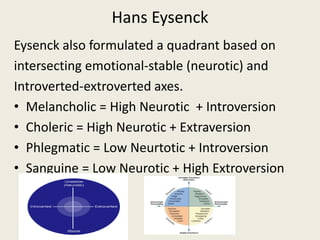
Hans Eysenck
Eysenck also formulated a quadrant based on
intersecting emotional-stable (neurotic) and
Introverted-extroverted axes.
• Melancholic = High Neurotic + Introversion
• Choleric = High Neurotic + Extraversion
• Phlegmatic = Low Neurtotic + Introversion
• Sanguine = Low Neurotic + High Extroversion
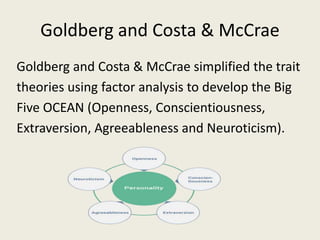
Goldberg and Costa & McCrae
Goldberg and Costa & McCrae simplified the trait
theories using factor analysis to develop the Big
Five OCEAN (Openness, Conscientiousness,
Extraversion, Agreeableness and Neuroticism).
Contributions of trait theories
Able to identify and predict behavior
easier.
Contributions of trait theories
It has generated a great deal of research using a
variety of new research strategies.
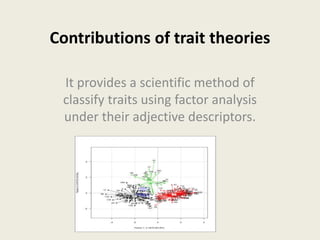
Contributions of trait theories
It provides a scientific method of
classify traits using factor analysis
under their adjective descriptors.
Contributions of traits theories
Trait theorists can explain adaptive or complex
Behavior where a person pattern of behavior
varies across from time to time to adjust to a
given situation.
Contributions of trait theories
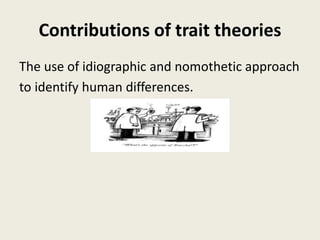
The use of idiographic and nomothetic approach
to identify human differences.
Limitations of traits theories
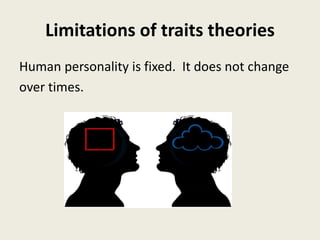
Human personality is fixed. It does not change
over times.
Limitations of traits theories
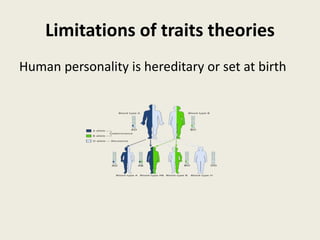
Human personality is hereditary or set at birth
Limitations of traits theories
The Interpretation of five adjectival
descriptors (OCEAN) can be quite subjective. It
depends on one’s point of view.
Limitations of traits theories
The lexicon approach to classifying personality
based the composition of traits is too simplistic.
The traits theorists may be able to describe
behavior but cannot explain why we behave the
way we do.
Limitations of traits theories
Trait theory does not explain and provides an
avenue for personality changes.
Limitations of traits theories
The development of trait theories is not based
on any psychological construct. Apparently, they
can explain what we are but cannot explain why
we behave, feel and think the way we do.
Limitations of traits theories
The use of adjectival descriptors to cluster traits
is not inclusive of all psychological traits.
Limitations of traits theories
The five adjective descriptors (OCEAN) is too
limited or restricted. It does not cover all
psychological traits.
As a result, it cannot fully explain a person's
personality.
Conclusion
In view of the limitations of the six personality
theories there is a need to develop a model that
integrates all the six schools of personality
theories to have an accurate prediction of
human differences.
NEXT VIDEO: INTEGRATED MODEL OF PERSONALITY THEORY – Please subscribe KYKO,
a recipe for success

Traits theory, its contributions and its limitations to predict human differences

  • 1.
    The theories behindthe development of the integrated model of personality
  • 2.
  • 3.
    Allport’s Definition ofPersonality Personality is a dynamic organization of psychophysical systems within an individual that determines the person’s uniqueness adjustment to the environment
  • 4.
    Traits Theory Gordon Allportstudied human personality by locating every term that he thought could describe a person in the dictionary to identify a list of 4541 traits. He organized them into three categories: • Cardinal traits: Traits that dominates the personality across time and situations. • Central traits: Common traits that are consistent across time and situations. They form the building blocks of personality. • Secondary traits: Traits that are less evident and inconsistent across time and situations.
  • 5.
    Raymond Cattell’s Definitionof Personality Personality is a collection of individual traits that allow predictions about what a person will do in a given situation.
  • 6.
    Traits Theory Raymond Cattellorganized the thousands of traits described by Allport and condensed them down to 16 primary traits using the statistical method of factor analysis. into 16 PF (Personality Factors) to explore the basic dimensions of personality.
  • 7.
    Raymond Cattell 16PF (Personality Factors) The 16 PF (Personality Factors) to explore the basic dimensions of personality are: • Abstractedness: Imaginative versus practical • Apprehension: Worried versus confident • Dominance: Forceful versus submissive • Emotional Stability: Calm versus high-strung
  • 8.
    Raymond Cattell 16PF (Personality Factors) The 16 PF (Personality Factors) to explore the basic dimensions of personality are: • Liveliness: Spontaneous versus restrained • Openness to Change: Flexible versus attached to the familiar • Perfectionism: Controlled versus undisciplined • Privateness: Discreet versus open
  • 9.
    Raymond Cattell 16PF (Personality Factors) The 16 PF (Personality Factors) to explore the basic dimensions of personality are: • Reasoning: Abstract versus concrete • Rule-Consciousness: Conforming versus non- conforming • Self-Reliance: Self-sufficient versus dependent • Sensitivity: Tender-hearted versus tough- minded.
  • 10.
    Raymond Cattell 16PF (Personality Factors) The 16 PF (Personality Factors) to explore the basic dimensions of personality are: • Social Boldness: Uninhibited versus shy • Tension: Impatient versus relaxed • Vigilance: Suspicious versus trusting • Warmth: Outgoing versus reserved
  • 11.
    Hans Eysenck’s Definitionof Personality Personality is defined as the enduring organization of a person's character, temperament, intelligence and physique, which determines the individual's unique adjustment to the environment.
  • 12.
    Hans Eysenck Hans Eysenckclassified the traits into three fundamental factors: • Psychotics (such antisocial traits as cruelty and rejection of social customs), • Introversion-extroversion, • Emotionality-stability (also called neuroticism).
  • 13.
    Hans Eysenck Eysenck alsoformulated a quadrant based on intersecting emotional-stable (neurotic) and Introverted-extroverted axes. • Melancholic = High Neurotic + Introversion • Choleric = High Neurotic + Extraversion • Phlegmatic = Low Neurtotic + Introversion • Sanguine = Low Neurotic + High Extroversion
  • 14.
    Goldberg and Costa& McCrae Goldberg and Costa & McCrae simplified the trait theories using factor analysis to develop the Big Five OCEAN (Openness, Conscientiousness, Extraversion, Agreeableness and Neuroticism).
  • 15.
    Contributions of traittheories Able to identify and predict behavior easier.
  • 16.
    Contributions of traittheories It has generated a great deal of research using a variety of new research strategies.
  • 17.
    Contributions of traittheories It provides a scientific method of classify traits using factor analysis under their adjective descriptors.
  • 18.
    Contributions of traitstheories Trait theorists can explain adaptive or complex Behavior where a person pattern of behavior varies across from time to time to adjust to a given situation.
  • 19.
    Contributions of traittheories The use of idiographic and nomothetic approach to identify human differences.
  • 20.
    Limitations of traitstheories Human personality is fixed. It does not change over times.
  • 21.
    Limitations of traitstheories Human personality is hereditary or set at birth
  • 22.
    Limitations of traitstheories The Interpretation of five adjectival descriptors (OCEAN) can be quite subjective. It depends on one’s point of view.
  • 23.
    Limitations of traitstheories The lexicon approach to classifying personality based the composition of traits is too simplistic. The traits theorists may be able to describe behavior but cannot explain why we behave the way we do.
  • 24.
    Limitations of traitstheories Trait theory does not explain and provides an avenue for personality changes.
  • 25.
    Limitations of traitstheories The development of trait theories is not based on any psychological construct. Apparently, they can explain what we are but cannot explain why we behave, feel and think the way we do.
  • 26.
    Limitations of traitstheories The use of adjectival descriptors to cluster traits is not inclusive of all psychological traits.
  • 27.
    Limitations of traitstheories The five adjective descriptors (OCEAN) is too limited or restricted. It does not cover all psychological traits. As a result, it cannot fully explain a person's personality.
  • 28.
    Conclusion In view ofthe limitations of the six personality theories there is a need to develop a model that integrates all the six schools of personality theories to have an accurate prediction of human differences. NEXT VIDEO: INTEGRATED MODEL OF PERSONALITY THEORY – Please subscribe KYKO, a recipe for success