Mental health - Traits
Vennila J
Psychology Facts
1
01 - Introduction
02 - Types
03 - Goal
04 - Differences
05 - Conclusions
INDEX
1
01 - INTRODUCTION
Traits - People differ from one another based
on strength & Intensity of basic traits
dimension
Traits are relevant to mental health that
shapes individual personality which in turn
influences mental well-being
Understanding individual traits is a valuable
assessment in Psychology which helps to
promote Mental health
2
01 - INTRODUCTION Gordon Allport is the founder of Trait theory
& he made significant contributions in
Psychology
He laid the foundation for understanding
individual traits through his 2 famous books
named
• Personality
• A Psychological Interpretation
Personality is the key component in his
theory
3
4
02 - TYPES
Traits are several types. Out of all
types - Big Five Personality traits are
more prominent
4
5
02 - TYPES
Here Let us see Key Contributors of
Traits Theories
• Gordon Allport Trai Theory of Personality
• Eysenck Trait Theory
• Big Five Trait Theory
• Raymond Cattell Trait theory
• Guilford Trait Theory
5
6
02 - TYPES
It emphasizes the individuality of personality &
importance of understanding specific traits which makes a
unique person
His idea is personality came about like series of building
blocks
He Further believed that personality was biologically
determined but shaped by environment
• Gordon Allport Theory of
Personality
6
02 - TYPES
He classifies into 5 major types
• Surface traits - Personality elements that can be
directly observed
• Source Traits - Inferred through statistical
methods
• Cardinal Traits - Dominates an individual entire
personality
• Central Traits - Remains stable throughout life
• Secondary Traits - Emerges in certain situations
Out of these 5 types last 3 types namely Cardinal,
Central & Secondary types are most important
• Gordon Allport Theory of
Personality
7
8
02 - TYPES
Personality Governed by biological factors
Focus on 2 dimensions of Higher Order Traits
1.Extroversion vs Introversion
2.Emotional Stability vs Emotional Instability
2. Eysenck Trait Theory
8
02 - TYPES
Using factors analysis he identified 3 factors namely
1. Extroversion - Talkativeness, Outgoing, Sociable &
Assertive
Introversion - More reserved type, Quite &
Introspective
2. Neurotitsm - Uncontrollable negative emotion like
anxiety & moodiness
Emotional Stability - More resilient, Less likely to be
affective by negative emotion
3. Psychotism - Prone to take risk, impulsive & Anti-
social behavior, Aggression, Lack of Empathy
High Psychotism - Unconventional or Socially
undesirable behavior
2. Eysenck Trait Theory
9
02 - TYPES
• O - Openness to Experience
• C - Conscientiousness
• E - Extraversion
• A - Agreeableness
• N - Neuroticism
It is Collectively known as OCEAN to
remember easily
3. Big Five Trait Theory -
Common Traits
10
02 - TYPES
He is another most influential psychologist.
He proposed 16 Personality Factor Model shortly known as 16 PF
They are....
• Warmth
• Reasoning
• Emotional
• Stability
• Dominance
• Liveliness
• Rule Consciousness
• Social Boldness
• Sensitivity
• Vigilance
• Abstractedness
• Privateness
• Apprehension
• Openness to change
• Self reliance
• Perfection & Tension
4. Raymond Cattell Trait theory
11
02 - TYPES
Cattell extensively used Factor Analysis to identify &
analyze relationship between various personality traits
This Statistical Techniques helped him to uncover the
underlying personality structure
In addition he proposed Fluid & Crystallized Intelligence
Fluid Intelligence - Ability to think & reason
Crystallized Intelligence - Knowledge & Skills acquired
through experience
4. Raymond Cattell Trait
Theory
12
02 - TYPES
Using Factor Analysis Guilford concluded 7
Modalities of Traits
They are
• Morphological
• Physiological
• Needs
• Interest
• Attitudes
• Aptitudes
• Temperament
5. Guilford Trait Theory
13
02 - TYPES
Guilford believed that Intelligence is a combination
of multiple activities
He is renowned for his work in Structure of Intellect
which comprises of 120 different intellectual abilities,
from these he organizes into 3 Dimensions Namely
• Operations
• Products
• Contents
3. Guilford Trait Theory
14
02 - TYPES
Operations -
a. Evaluation
b. Convergent Production
c. Divergent Production
d. Memory
e. Cognition
3. Guilford Trait Theory
15
02 - TYPES
Products -
a. Units
b. Relations
c. Systems
d. Transformations
e. Implications
3. Guilford Trait Theory
16
02 - TYPES
3. Contents -
a. Visual
b. Auditory
c. Symbolic
d. Semantic
e. Behavioral
3. Guilford Trait Theory
17
18
03 - GOAL
Goal of Trait Theory is to identify, categorize &
understand the fundamental & enduring
characteristics to makeup an individual personality
The Goals are
• Describe Personality - It describes the
individual differences in Behavior, Thoughts &
Emotions
• Predict Behavior - Predicts how individual
behaves in various situations
18
19
03 - GOAL
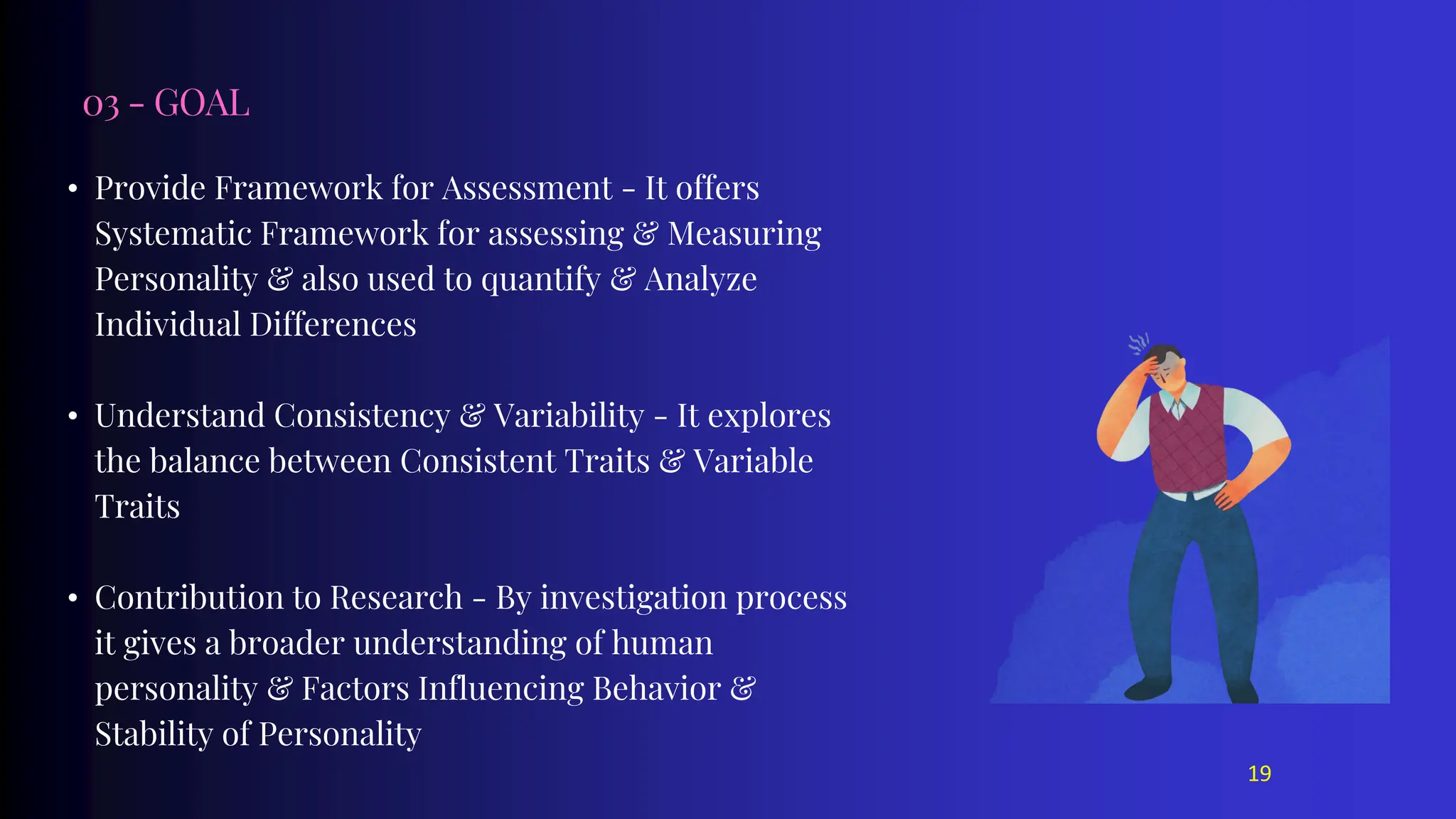
• Provide Framework for Assessment - It offers
Systematic Framework for assessing & Measuring
Personality & also used to quantify & Analyze
Individual Differences
• Understand Consistency & Variability - It explores
the balance between Consistent Traits & Variable
Traits
• Contribution to Research - By investigation process
it gives a broader understanding of human
personality & Factors Influencing Behavior &
Stability of Personality
19
04 - DIFFERENCES
Differences BetweenAllport&Cattell
Theory
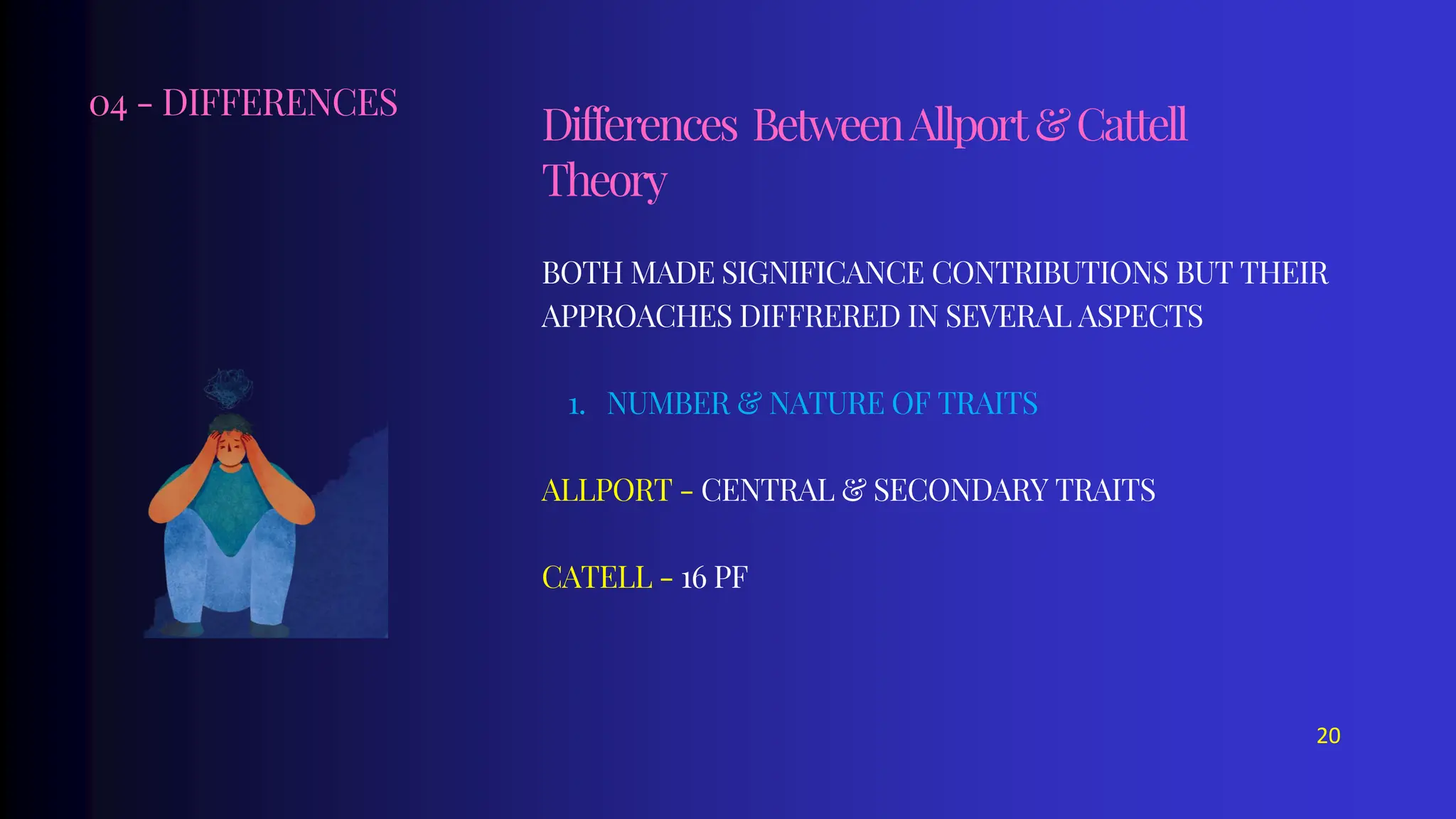
BOTH MADE SIGNIFICANCE CONTRIBUTIONS BUT THEIR
APPROACHES DIFFRERED IN SEVERAL ASPECTS
1. NUMBER & NATURE OF TRAITS
ALLPORT - CENTRAL & SECONDARY TRAITS
CATELL - 16 PF
20
04 - DIFFERENCES
Differences Between Allport & Cattell
Theory
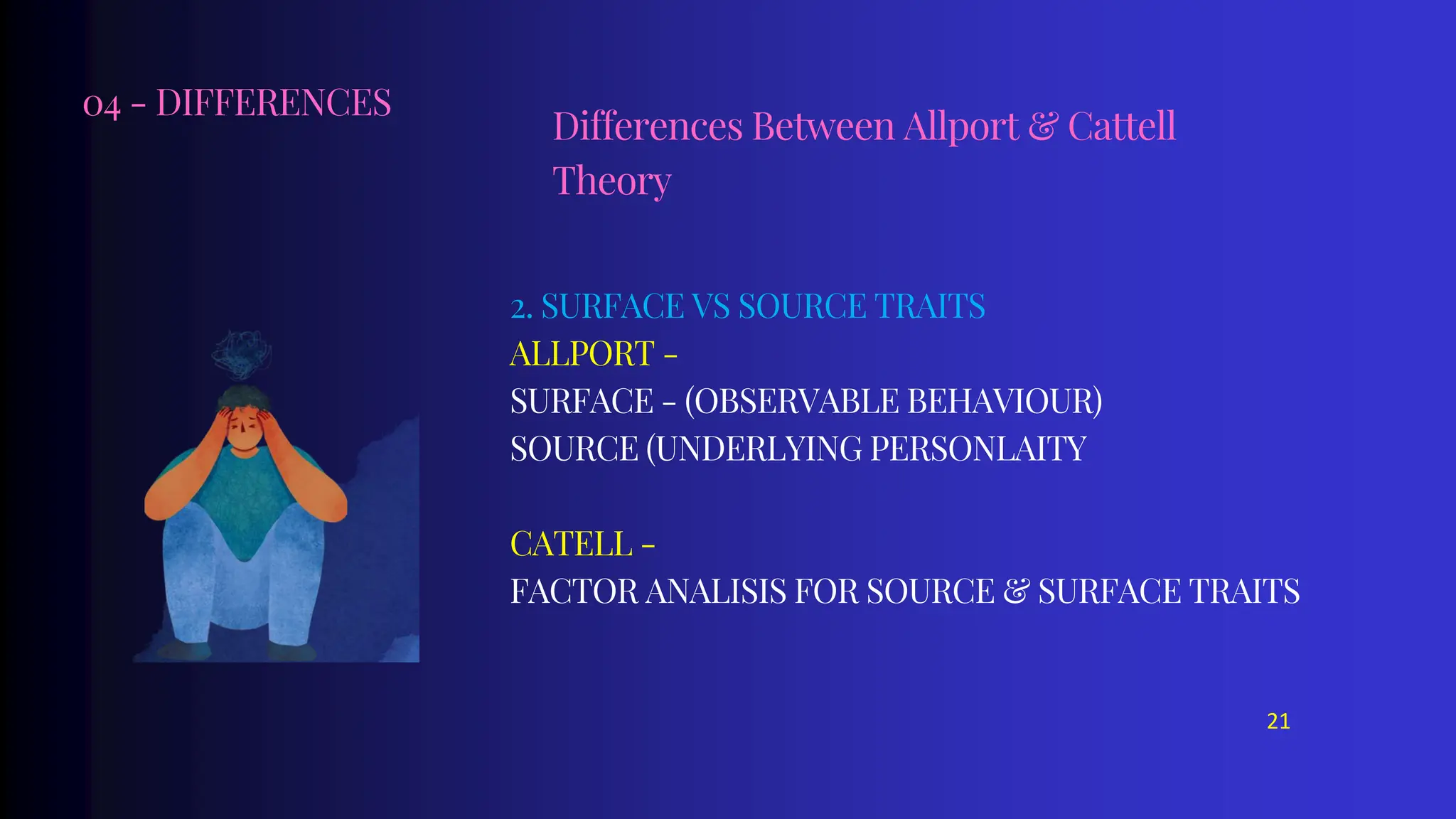
2. SURFACE VS SOURCE TRAITS
ALLPORT -
SURFACE - (OBSERVABLE BEHAVIOUR)
SOURCE (UNDERLYING PERSONLAITY
CATELL -
FACTOR ANALISIS FOR SOURCE & SURFACE TRAITS
21
04 - DIFFERENCES Differences Between Allport &
Cattell Theory
3. IDIOGRAPHIC VS NOMOTHETIC
APPROACHES
ALLPORT - IDIOGRAPHIC - STUDY OF
INDIVIDUAL & UNIQUE TRAITS
CATELL - NOMOTHETIC - AIMS TO IDENTIFY
GENERAL PRINCIPLES & FACTORS THAT
APPLY ACROSS INDIVIDUALS
22
04 - DIFFERENCES Differences Between Allport &
Cattell Theory
4. FLUID VS CRYSTALLIZED INTELLIGENCE
ALLPORT -
FOCUSED PRIMARILY ON PERSONLAITY
TRAITS INSTEAD OF INTELLIGENCE THEORY
CATELL - HIS CONTRIBUTION MAINLY TO
INTELLIGENCE AS FLUID & CRYSTALLIZED
23
05 - CONCLUSION
Each & Every individuals posses same
Personality Traits at varying degrees
There are so many Trait Theories but no
one possess whole personality
It is important to pay attention to
our mental health using Trait
Theories
1
24
05 - CONCLUSION
It facilitates for easy comparison
between individuals
They only describes
Personalities but not explains
much about the same
It is important to pay attention to
our mental health using Trait
Theory
25
25
Thanks for
watching
Vennila J
Be Connect

Trait Theories in Psychology by profound contributors

  • 1.
    Mental health -Traits Vennila J Psychology Facts 1
  • 2.
    01 - Introduction 02- Types 03 - Goal 04 - Differences 05 - Conclusions INDEX 1
  • 3.
    01 - INTRODUCTION Traits- People differ from one another based on strength & Intensity of basic traits dimension Traits are relevant to mental health that shapes individual personality which in turn influences mental well-being Understanding individual traits is a valuable assessment in Psychology which helps to promote Mental health 2
  • 4.
    01 - INTRODUCTIONGordon Allport is the founder of Trait theory & he made significant contributions in Psychology He laid the foundation for understanding individual traits through his 2 famous books named • Personality • A Psychological Interpretation Personality is the key component in his theory 3 4
  • 5.
    02 - TYPES Traitsare several types. Out of all types - Big Five Personality traits are more prominent 4 5
  • 6.
    02 - TYPES HereLet us see Key Contributors of Traits Theories • Gordon Allport Trai Theory of Personality • Eysenck Trait Theory • Big Five Trait Theory • Raymond Cattell Trait theory • Guilford Trait Theory 5 6
  • 7.
    02 - TYPES Itemphasizes the individuality of personality & importance of understanding specific traits which makes a unique person His idea is personality came about like series of building blocks He Further believed that personality was biologically determined but shaped by environment • Gordon Allport Theory of Personality 6
  • 8.
    02 - TYPES Heclassifies into 5 major types • Surface traits - Personality elements that can be directly observed • Source Traits - Inferred through statistical methods • Cardinal Traits - Dominates an individual entire personality • Central Traits - Remains stable throughout life • Secondary Traits - Emerges in certain situations Out of these 5 types last 3 types namely Cardinal, Central & Secondary types are most important • Gordon Allport Theory of Personality 7 8
  • 9.
    02 - TYPES PersonalityGoverned by biological factors Focus on 2 dimensions of Higher Order Traits 1.Extroversion vs Introversion 2.Emotional Stability vs Emotional Instability 2. Eysenck Trait Theory 8
  • 10.
    02 - TYPES Usingfactors analysis he identified 3 factors namely 1. Extroversion - Talkativeness, Outgoing, Sociable & Assertive Introversion - More reserved type, Quite & Introspective 2. Neurotitsm - Uncontrollable negative emotion like anxiety & moodiness Emotional Stability - More resilient, Less likely to be affective by negative emotion 3. Psychotism - Prone to take risk, impulsive & Anti- social behavior, Aggression, Lack of Empathy High Psychotism - Unconventional or Socially undesirable behavior 2. Eysenck Trait Theory 9
  • 11.
    02 - TYPES •O - Openness to Experience • C - Conscientiousness • E - Extraversion • A - Agreeableness • N - Neuroticism It is Collectively known as OCEAN to remember easily 3. Big Five Trait Theory - Common Traits 10
  • 12.
    02 - TYPES Heis another most influential psychologist. He proposed 16 Personality Factor Model shortly known as 16 PF They are.... • Warmth • Reasoning • Emotional • Stability • Dominance • Liveliness • Rule Consciousness • Social Boldness • Sensitivity • Vigilance • Abstractedness • Privateness • Apprehension • Openness to change • Self reliance • Perfection & Tension 4. Raymond Cattell Trait theory 11
  • 13.
    02 - TYPES Cattellextensively used Factor Analysis to identify & analyze relationship between various personality traits This Statistical Techniques helped him to uncover the underlying personality structure In addition he proposed Fluid & Crystallized Intelligence Fluid Intelligence - Ability to think & reason Crystallized Intelligence - Knowledge & Skills acquired through experience 4. Raymond Cattell Trait Theory 12
  • 14.
    02 - TYPES UsingFactor Analysis Guilford concluded 7 Modalities of Traits They are • Morphological • Physiological • Needs • Interest • Attitudes • Aptitudes • Temperament 5. Guilford Trait Theory 13
  • 15.
    02 - TYPES Guilfordbelieved that Intelligence is a combination of multiple activities He is renowned for his work in Structure of Intellect which comprises of 120 different intellectual abilities, from these he organizes into 3 Dimensions Namely • Operations • Products • Contents 3. Guilford Trait Theory 14
  • 16.
    02 - TYPES Operations- a. Evaluation b. Convergent Production c. Divergent Production d. Memory e. Cognition 3. Guilford Trait Theory 15
  • 17.
    02 - TYPES Products- a. Units b. Relations c. Systems d. Transformations e. Implications 3. Guilford Trait Theory 16
  • 18.
    02 - TYPES 3.Contents - a. Visual b. Auditory c. Symbolic d. Semantic e. Behavioral 3. Guilford Trait Theory 17 18
  • 19.
    03 - GOAL Goalof Trait Theory is to identify, categorize & understand the fundamental & enduring characteristics to makeup an individual personality The Goals are • Describe Personality - It describes the individual differences in Behavior, Thoughts & Emotions • Predict Behavior - Predicts how individual behaves in various situations 18 19
  • 20.
    03 - GOAL •Provide Framework for Assessment - It offers Systematic Framework for assessing & Measuring Personality & also used to quantify & Analyze Individual Differences • Understand Consistency & Variability - It explores the balance between Consistent Traits & Variable Traits • Contribution to Research - By investigation process it gives a broader understanding of human personality & Factors Influencing Behavior & Stability of Personality 19
  • 21.
    04 - DIFFERENCES DifferencesBetweenAllport&Cattell Theory BOTH MADE SIGNIFICANCE CONTRIBUTIONS BUT THEIR APPROACHES DIFFRERED IN SEVERAL ASPECTS 1. NUMBER & NATURE OF TRAITS ALLPORT - CENTRAL & SECONDARY TRAITS CATELL - 16 PF 20
  • 22.
    04 - DIFFERENCES DifferencesBetween Allport & Cattell Theory 2. SURFACE VS SOURCE TRAITS ALLPORT - SURFACE - (OBSERVABLE BEHAVIOUR) SOURCE (UNDERLYING PERSONLAITY CATELL - FACTOR ANALISIS FOR SOURCE & SURFACE TRAITS 21
  • 23.
    04 - DIFFERENCESDifferences Between Allport & Cattell Theory 3. IDIOGRAPHIC VS NOMOTHETIC APPROACHES ALLPORT - IDIOGRAPHIC - STUDY OF INDIVIDUAL & UNIQUE TRAITS CATELL - NOMOTHETIC - AIMS TO IDENTIFY GENERAL PRINCIPLES & FACTORS THAT APPLY ACROSS INDIVIDUALS 22
  • 24.
    04 - DIFFERENCESDifferences Between Allport & Cattell Theory 4. FLUID VS CRYSTALLIZED INTELLIGENCE ALLPORT - FOCUSED PRIMARILY ON PERSONLAITY TRAITS INSTEAD OF INTELLIGENCE THEORY CATELL - HIS CONTRIBUTION MAINLY TO INTELLIGENCE AS FLUID & CRYSTALLIZED 23
  • 25.
    05 - CONCLUSION Each& Every individuals posses same Personality Traits at varying degrees There are so many Trait Theories but no one possess whole personality It is important to pay attention to our mental health using Trait Theories 1 24
  • 26.
    05 - CONCLUSION Itfacilitates for easy comparison between individuals They only describes Personalities but not explains much about the same It is important to pay attention to our mental health using Trait Theory 25 25
  • 27.