On Translating a Tamil
Poem
By A. K. Ramanujan
Prepared by
Sneha Agravat
Latta Baraiya
Table of Content
● Introduction
● A. K. Ramanujan
● Abstract of article
● Key Arguments
● Analysis
● Outcome of Article
● Conclusion
Introduction
● Article starts with the talk of world literature
● Ramanujan ask the question,
'How does one translate a poem from another time,
another culture,another language?
● subject of this paper is not the fascinating external
history of this literature, but translation, the transport
of poems from classical Tamil to modem English; the
hazards, the damages in transit, the secret paths, and
the lucky bypasses.
● Ramanujan took various examples of Tamil poems that
he translated into English and he described difficulties
that he faced during translation.
A. K.
Ramanujan
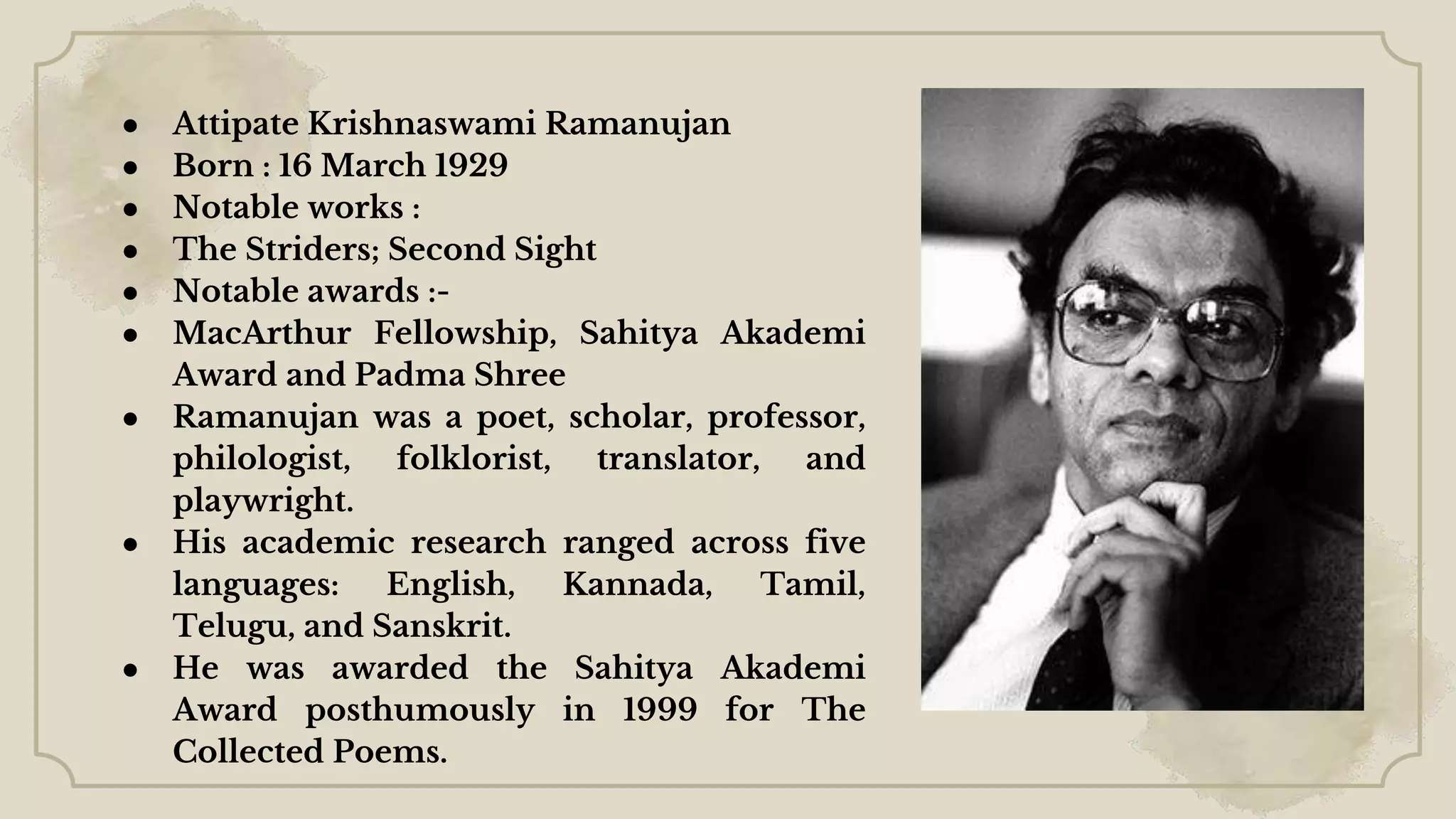
● Attipate Krishnaswami Ramanujan
● Born : 16 March 1929
● Notable works :
● The Striders; Second Sight
● Notable awards :-
● MacArthur Fellowship, Sahitya Akademi
Award and Padma Shree
● Ramanujan was a poet, scholar, professor,
philologist, folklorist, translator, and
playwright.
● His academic research ranged across five
languages: English, Kannada, Tamil,
Telugu, and Sanskrit.
● He was awarded the Sahitya Akademi
Award posthumously in 1999 for The
Collected Poems.
RAMANUJAN’S
CONCEPTION OF
TRANSLATION
➢ Susan Bassnett and Harish Trivedi said in the article that,
❏ In his published work Ramanujan reflected on translation most often
in the context of poetry, and conceived of it as a multi- dimensional
process in which the translator has to deal with his or her material,
means, resources and objectives at several levels simultaneously.
❏ Ramanujan was acutely conscious that even the most scrupulous
translator’s care and craftsmanship cannot solve the problems of
attempting what John Dryden, in 1680, had called metaphrase, the
method of ‘turning an author word by word, and line by line, from one
language into another’.
❏ Ramanujan developed his conceptions of ‘outer’ and ‘inner’ poetic
form from two culturally incommensurate sources. On the one hand,
he owed the distinction in part to Noam Chomsky’s analysis of surface
and deep structure in discourse, and to Roman Jakobson’s rather
different structuralist analysis of the grammar of poetry, especially the
latter’s distinction between ‘verse instance’ and ‘verse design’.
❏ Ramanujan also applied the distinction between outer and inner form to
his own practice as a scholar and poet when, in a rare and therefore
frequently quoted comment, he said that English and my disciplines
(linguistics, anthropology) give me my ‘outer’ forms –linguistic, metrical,
logical and other such ways of shaping experience; and my first thirty
years in India, my frequent visits and fieldtrips, my personal and
professional preoccupations .
❏ with Kannada, Tamil, the classics, and folklore give me my substance, my
‘inner’ forms,images and symbols. They are continuous with each other,
and I no longer can tell what comes from where.
❏ To a remarkable extent Ramanujan’s differentiation between outer and
inner form, which he formulated in the late 1960s or early 1970s,
parallels the distinction between ‘phenotext’ and ‘genotext’ which Julia
Kristeva developed around the same time from the same structural-
linguistic sources, but which she deployed in a post- structuralist
psychoanalytical theory of signifying practices.
(Bassnett, Susan, and Harish Trivedi)
Key
Arguments
● Frost once said “poetry as that which is lost in translation”.
● Evans-Pritchard, the anthropologist, used to say: If you
translate all the European arguments for atheism into
Azande, they would come out as arguments for God in
Azande. Such observations certainly disabuseus of the
commonly-held notion of 'literal' translation.
● Woollcott argued that English does not have left-
branching possibilities, but they are a bit abnormal.
● Hopkins's and Thomas's poetry the leftward syntax is
employed for special poetic effects-it alternates with other,
more 'normal', types of English sentences. In Tamil poetry
the leftward syntax is not eccentric, literary or offbeat. but
part of everyday 'natural' speech.
Analysis
❏ Translation is not only about text it's about
translation of time, other culture, other language.
❏ Problems in translation.
❏ Any single poem is part of a set, a family of sets, a
landscape, a genre.
❏ While translating Tamil poem Ainkurunuru 203,
He begin with the sounds. He find that the sound
system of Tamil is very different from English.
For instance, Old Tamil has six nasal consonants:
a labial, a dental, an alveolar, a retroflex, a palatal
and a velar-m, n, n, ñ, n, n-three of which are not
distinctive in English.
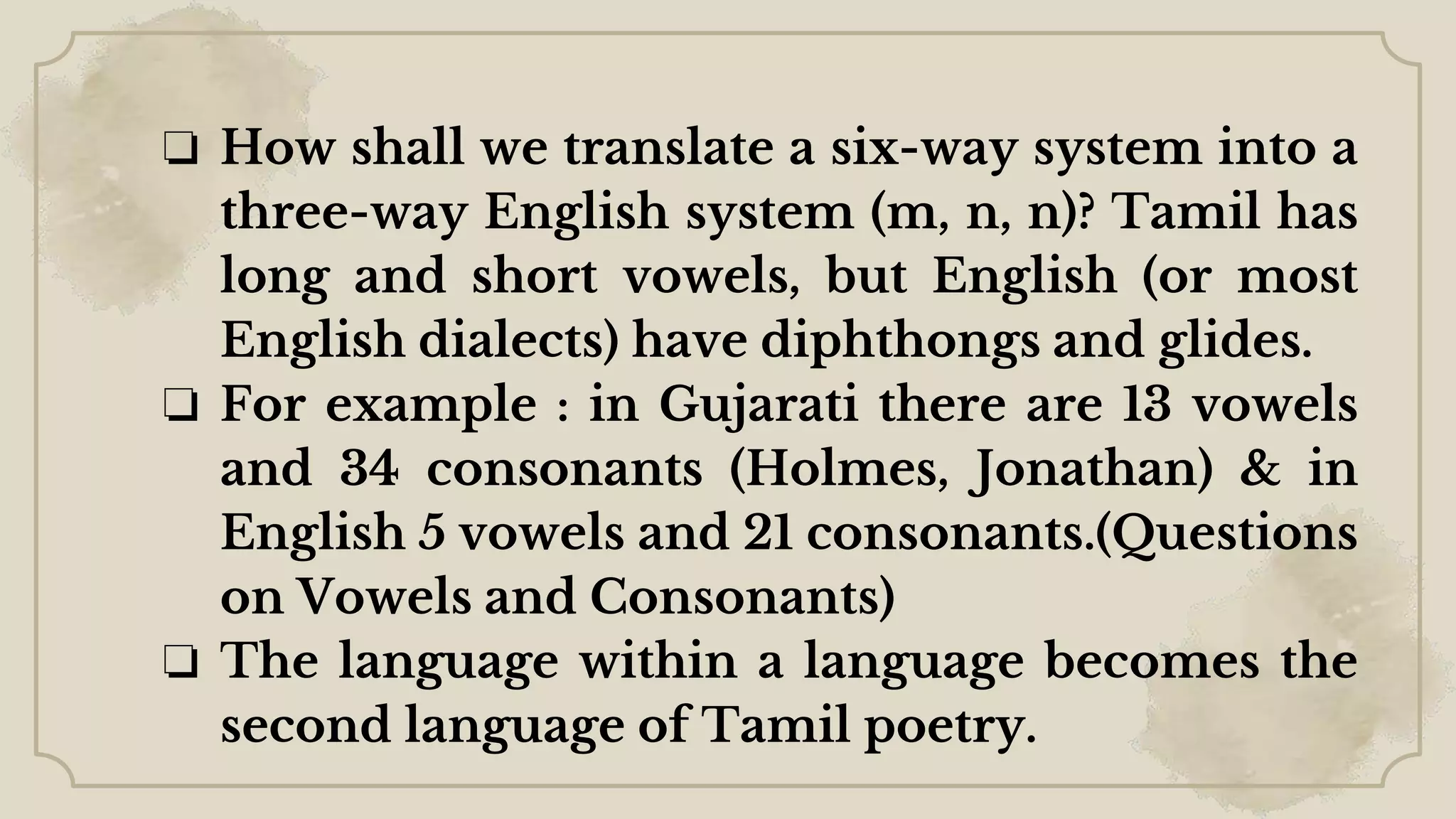
❏ How shall we translate a six-way system into a
three-way English system (m, n, n)? Tamil has
long and short vowels, but English (or most
English dialects) have diphthongs and glides.
❏ For example : in Gujarati there are 13 vowels
and 34 consonants (Holmes, Jonathan) & in
English 5 vowels and 21 consonants.(Questions
on Vowels and Consonants)
❏ The language within a language becomes the
second language of Tamil poetry.
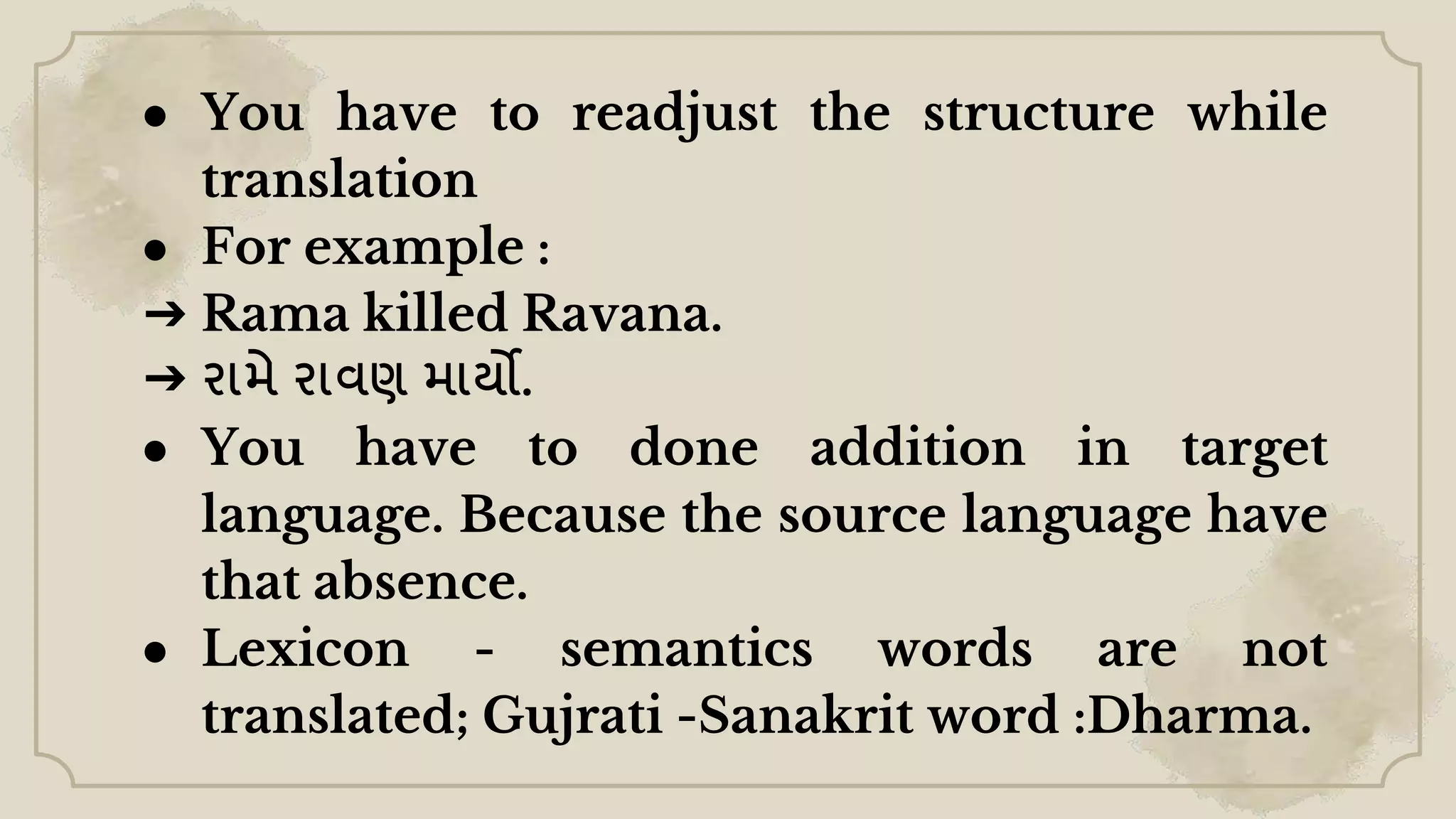
● You have to readjust the structure while
translation
● For example :
➔ Rama killed Ravana.
➔ રામે રાવણ માર્યો.
● You have to done addition in target
language. Because the source language have
that absence.
● Lexicon - semantics words are not
translated; Gujrati -Sanakrit word :Dharma.
Outcome of
Article
❏ Universals: It such universals did not exist, as
Voltaire said of God, we would have had to
invent them. Universals of structure in both
signifiers and signifieds are necessary fictions.
The indispensable as ifs of our fallible enterprise.
❏ Interiorised Contexts: One is translating also this
kind of intertextual web, the meaning- making
web of colophons and commentaries that
surround and contextualise the poem.
❏ Systematicity: One translates not single poems but
bodies of poetry that create and contain their
original world.
❏ Structural mimicry: The structures of individual
poems, the unique figures they make out of all the
given codes of their language, rhetoric , and poetics,
become the points of entry. So one attempts a
structural mimicry, to translate relations, not items
not single words but phrases, sequences, sentences;
not metrical Units but rhythms; not morphology but
syntactic patterns.
Conclusion
● The translation must not only represent,, but re-
present, the original. One walks a tightrope between
the To-language and the From-language, in a double
loyalty.
● A translator is an 'artist on oath'.
● Argument against the Frost.
● Example of a Chinese emperor - tunnel - work from
both side of mountain - meet in the middle - what if
they don't meet ? - counsellor answered - ‘if they don't
meet, we will have two tunnels instead of one’.
● If the representation in another language is not close
enough, but still succeed in ’carrying’ the poem in
some sense, we will have two poems instead of one.
Citations
.
● Bassnett, Susan, and Trivedi, Harish. “‘A.K. Ramanujan’s Theory and
Practice of Translation.’” Post-Colonial Translation: Theory and Practice,
Routledge, London, 2005.
● Holmes, Jonathan. “How Many Vowels and Consonants Are There in
Gujarati?” Cement Answers, 5 March, 2022.
https://cementanswers.com/how-many-vowels-and-consonants-are-there-
in-gujarati/.
● “Questions on Vowels and Consonants .” BYJUS, BYJU'S, 8 Oct. 2021,
https://byjus.com/kids-learning/vowels-consonants-
questions/#:~:text=In%20the%20simplest%20categorization%2C%20English,
breath%20out%20of%20the%20mouth.
● Ramanujan, A.K. “On Translating a Tamil Poem.” The Collected Essays of
A. K. Ramanujan, Oxford University Press, New Delhi, 2013, pp. 219–231.
Thank you

Article 'On Translating a Tamil Poem' by A. K. Ramanujan

  • 1.
    On Translating aTamil Poem By A. K. Ramanujan Prepared by Sneha Agravat Latta Baraiya
  • 2.
    Table of Content ●Introduction ● A. K. Ramanujan ● Abstract of article ● Key Arguments ● Analysis ● Outcome of Article ● Conclusion
  • 3.
  • 4.
    ● Article startswith the talk of world literature ● Ramanujan ask the question, 'How does one translate a poem from another time, another culture,another language? ● subject of this paper is not the fascinating external history of this literature, but translation, the transport of poems from classical Tamil to modem English; the hazards, the damages in transit, the secret paths, and the lucky bypasses. ● Ramanujan took various examples of Tamil poems that he translated into English and he described difficulties that he faced during translation.
  • 5.
  • 6.
    ● Attipate KrishnaswamiRamanujan ● Born : 16 March 1929 ● Notable works : ● The Striders; Second Sight ● Notable awards :- ● MacArthur Fellowship, Sahitya Akademi Award and Padma Shree ● Ramanujan was a poet, scholar, professor, philologist, folklorist, translator, and playwright. ● His academic research ranged across five languages: English, Kannada, Tamil, Telugu, and Sanskrit. ● He was awarded the Sahitya Akademi Award posthumously in 1999 for The Collected Poems.
  • 7.
  • 8.
    ➢ Susan Bassnettand Harish Trivedi said in the article that, ❏ In his published work Ramanujan reflected on translation most often in the context of poetry, and conceived of it as a multi- dimensional process in which the translator has to deal with his or her material, means, resources and objectives at several levels simultaneously. ❏ Ramanujan was acutely conscious that even the most scrupulous translator’s care and craftsmanship cannot solve the problems of attempting what John Dryden, in 1680, had called metaphrase, the method of ‘turning an author word by word, and line by line, from one language into another’. ❏ Ramanujan developed his conceptions of ‘outer’ and ‘inner’ poetic form from two culturally incommensurate sources. On the one hand, he owed the distinction in part to Noam Chomsky’s analysis of surface and deep structure in discourse, and to Roman Jakobson’s rather different structuralist analysis of the grammar of poetry, especially the latter’s distinction between ‘verse instance’ and ‘verse design’.
  • 9.
    ❏ Ramanujan alsoapplied the distinction between outer and inner form to his own practice as a scholar and poet when, in a rare and therefore frequently quoted comment, he said that English and my disciplines (linguistics, anthropology) give me my ‘outer’ forms –linguistic, metrical, logical and other such ways of shaping experience; and my first thirty years in India, my frequent visits and fieldtrips, my personal and professional preoccupations . ❏ with Kannada, Tamil, the classics, and folklore give me my substance, my ‘inner’ forms,images and symbols. They are continuous with each other, and I no longer can tell what comes from where. ❏ To a remarkable extent Ramanujan’s differentiation between outer and inner form, which he formulated in the late 1960s or early 1970s, parallels the distinction between ‘phenotext’ and ‘genotext’ which Julia Kristeva developed around the same time from the same structural- linguistic sources, but which she deployed in a post- structuralist psychoanalytical theory of signifying practices. (Bassnett, Susan, and Harish Trivedi)
  • 10.
  • 11.
    ● Frost oncesaid “poetry as that which is lost in translation”. ● Evans-Pritchard, the anthropologist, used to say: If you translate all the European arguments for atheism into Azande, they would come out as arguments for God in Azande. Such observations certainly disabuseus of the commonly-held notion of 'literal' translation. ● Woollcott argued that English does not have left- branching possibilities, but they are a bit abnormal. ● Hopkins's and Thomas's poetry the leftward syntax is employed for special poetic effects-it alternates with other, more 'normal', types of English sentences. In Tamil poetry the leftward syntax is not eccentric, literary or offbeat. but part of everyday 'natural' speech.
  • 12.
  • 13.
    ❏ Translation isnot only about text it's about translation of time, other culture, other language. ❏ Problems in translation. ❏ Any single poem is part of a set, a family of sets, a landscape, a genre. ❏ While translating Tamil poem Ainkurunuru 203, He begin with the sounds. He find that the sound system of Tamil is very different from English. For instance, Old Tamil has six nasal consonants: a labial, a dental, an alveolar, a retroflex, a palatal and a velar-m, n, n, ñ, n, n-three of which are not distinctive in English.
  • 14.
    ❏ How shallwe translate a six-way system into a three-way English system (m, n, n)? Tamil has long and short vowels, but English (or most English dialects) have diphthongs and glides. ❏ For example : in Gujarati there are 13 vowels and 34 consonants (Holmes, Jonathan) & in English 5 vowels and 21 consonants.(Questions on Vowels and Consonants) ❏ The language within a language becomes the second language of Tamil poetry.
  • 15.
    ● You haveto readjust the structure while translation ● For example : ➔ Rama killed Ravana. ➔ રામે રાવણ માર્યો. ● You have to done addition in target language. Because the source language have that absence. ● Lexicon - semantics words are not translated; Gujrati -Sanakrit word :Dharma.
  • 16.
  • 17.
    ❏ Universals: Itsuch universals did not exist, as Voltaire said of God, we would have had to invent them. Universals of structure in both signifiers and signifieds are necessary fictions. The indispensable as ifs of our fallible enterprise. ❏ Interiorised Contexts: One is translating also this kind of intertextual web, the meaning- making web of colophons and commentaries that surround and contextualise the poem.
  • 18.
    ❏ Systematicity: Onetranslates not single poems but bodies of poetry that create and contain their original world. ❏ Structural mimicry: The structures of individual poems, the unique figures they make out of all the given codes of their language, rhetoric , and poetics, become the points of entry. So one attempts a structural mimicry, to translate relations, not items not single words but phrases, sequences, sentences; not metrical Units but rhythms; not morphology but syntactic patterns.
  • 19.
  • 20.
    ● The translationmust not only represent,, but re- present, the original. One walks a tightrope between the To-language and the From-language, in a double loyalty. ● A translator is an 'artist on oath'. ● Argument against the Frost. ● Example of a Chinese emperor - tunnel - work from both side of mountain - meet in the middle - what if they don't meet ? - counsellor answered - ‘if they don't meet, we will have two tunnels instead of one’. ● If the representation in another language is not close enough, but still succeed in ’carrying’ the poem in some sense, we will have two poems instead of one.
  • 21.
    Citations . ● Bassnett, Susan,and Trivedi, Harish. “‘A.K. Ramanujan’s Theory and Practice of Translation.’” Post-Colonial Translation: Theory and Practice, Routledge, London, 2005. ● Holmes, Jonathan. “How Many Vowels and Consonants Are There in Gujarati?” Cement Answers, 5 March, 2022. https://cementanswers.com/how-many-vowels-and-consonants-are-there- in-gujarati/. ● “Questions on Vowels and Consonants .” BYJUS, BYJU'S, 8 Oct. 2021, https://byjus.com/kids-learning/vowels-consonants- questions/#:~:text=In%20the%20simplest%20categorization%2C%20English, breath%20out%20of%20the%20mouth. ● Ramanujan, A.K. “On Translating a Tamil Poem.” The Collected Essays of A. K. Ramanujan, Oxford University Press, New Delhi, 2013, pp. 219–231.
  • 22.